
Submitted:
28 September 2026
Posted:
29 September 2026
You are already at the latest version
Abstract
Background: Fournier’s gangrene (FG) is a rapidly progressive necrotizing soft-tissue infection associated with substantial mortality despite modern surgical, antimicrobial, and critical-care management. Objective: To synthesize the evidence supporting clinical determinants, FG-specific severity scores, LRINEC, inflammatory biomarkers, general critical-care and comorbidity instruments, and emerging mortality indices in FG. Methods: PubMed/MEDLINE, Web of Science, Scopus, and Google Scholar were searched for publications from 1980 to 2026 using terms related to FG, necrotizing fasciitis, mortality prediction, FGSI, UFGSI, SFGSI, LRINEC, NLR, SOFA/qSOFA, NEWS2, APACHE, Charlson indices, Surgical Apgar Score, FGMI, and FGMI-2P. Original derivation studies, validation cohorts, comparative studies, systematic reviews, and meta-analyses were prioritized. Diagnostic instruments were considered separately from mortality-prediction tools, and retained quantitative claims were checked against their cited primary sources. Results: Large syntheses place FG mortality at approximately 16–20%, with one 25-year review reporting 19.8% mortality among 6,152 cases and no significant temporal improvement [8]. FGSI, UFGSI, and SFGSI remain the best-established FG-specific composite scores; a 40-study meta-analysis reported pooled AUCs of 0.90, 0.94, and 0.84, respectively [21]. LRINEC was developed for diagnosis of necrotizing fasciitis and performs less consistently for mortality prediction in FG [19,20,25,27]. NLR is associated with mortality at thresholds of ≥8 and ≥10 but is best regarded as an adjunct rather than a stand-alone score [73]. CCI/ACCI, SOFA/qSOFA, NEWS2, and APACHE II add information on comorbidity and systemic severity, whereas FGMI and FGMI-2P are promising newer indices requiring further external validation [20,27,28,49,54,60]. Conclusions: Prognostic assessment in FG is best approached as multidimensional. FG-specific scores should be interpreted together with organ dysfunction, comorbidity burden, and inflammatory/nutritional markers. No prognostic score should delay resuscitation, broad-spectrum antimicrobial therapy, or urgent surgical source control.
Keywords:
Fournier’s gangrene
; FGSI
; UFGSI
; SFGSI
; LRINEC
; NLR
; SOFA
; Charlson Comorbidity Index
; FGMI
; mortality
1. Introduction
Fournier’s gangrene (FG) is a fulminant necrotizing fasciitis of the perineal and genital region, historically described by Fournier in 1883 [1]. Subsequent series established its predominantly polymicrobial nature and the central role of prompt, aggressive debridement [2,3,4,5]. Population-based studies further characterized the epidemiology and substantial resource burden of FG [6,7].
Mortality remains considerable despite advances in critical care, antimicrobial therapy, and reconstruction [8,9]. A synthesis of 169 publications reported 1,220 deaths among 6,152 cases (19.8%) from 1993–2018, without a statistically detectable improvement over time [8], consistent with earlier large compilations [10]. A 38-study meta-analysis identified sepsis and multiple-organ failure as the dominant proximate causes of death and found higher comorbidity burdens among non-survivors [11]. Age, renal and cardiovascular disease, diabetes, anatomical origin, and treatment delay recur as adverse factors, although the independent effect of individual comorbidities is heterogeneous after adjustment for age and severity [12,13,14,15,16,17].
Objective prognostic assessment began with the Fournier’s Gangrene Severity Index (FGSI) [18], followed by UFGSI and SFGSI [22,23] and multiple independent validations [19,20,21,24]. LRINEC was developed for diagnostic differentiation of necrotizing fasciitis rather than FG mortality prediction [25,26]. More recently, inflammatory ratios, general critical-care scores, comorbidity indices, and new FG-specific mortality models have expanded the prognostic landscape. This narrative review evaluates these instruments according to their intended purpose, level of validation, and clinical interpretability.
2. Materials and Methods
2.1. Study Design and Rationale
This study was conducted as a narrative review, rather than a systematic review or meta-analysis, to provide a comprehensive and critical synthesis of prognostic determinants and scoring systems used in Fournier’s gangrene (FG). Narrative-review methodology was considered appropriate because the evidence base is clinically and methodologically heterogeneous, encompassing historical derivation studies, retrospective and prospective cohorts, external validations, comparative score analyses, systematic reviews, meta-analyses, sepsis and critical-care instruments, comorbidity indices, individual biomarkers, and management-related prognostic studies. Formal quantitative pooling across all of these evidence types would therefore be neither methodologically coherent nor clinically informative. The objective was instead to integrate the available evidence into a clinically interpretable framework that distinguishes FG-specific mortality scores from diagnostic instruments, general physiological and comorbidity scores, biomarkers, and treatment-related prognostic domains.
A structured, transparent, and reproducible search strategy was deliberately used to strengthen the methodological rigor of the narrative review. This structured approach should not be interpreted as a systematic-review methodology: no prospectively registered protocol, formal PRISMA-based study-selection process, uniform risk-of-bias instrument, dual independent data extraction, or de novo meta-analysis was performed. Instead, methodological quality and applicability were considered according to study design, and quantitative claims retained in the manuscript were checked against their cited primary sources or pooled analyses.
2.2. Literature Search Strategy
A comprehensive literature search was performed in PubMed/MEDLINE, Web of Science, Scopus, and Google Scholar. The search covered publications from 1980 through 2026 in order to capture both the original development of established FG prognostic instruments and the most recent validation studies, comparative analyses, biomarkers, and emerging prognostic models. Earlier landmark publications were retained when required to describe the historical development of FG, sepsis definitions, or the derivation of widely used scoring systems.
Search strategies combined controlled vocabulary, where available, with free-text terms connected by Boolean operators (AND/OR). The strategy was adapted to the syntax of each database. The principal conceptual domains were: (1) disease: “Fournier’s gangrene”, “Fournier gangrene”, “necrotizing fasciitis”, and “necrotizing soft-tissue infection”; (2) prognosis and outcomes: “mortality”, “survival”, “prognosis”, “prognostic factor”, “risk factor”, “prediction”, “discrimination”, “AUC”, and “AUROC”; (3) FG-specific scores: “Fournier’s Gangrene Severity Index”, “FGSI”, “Uludag Fournier’s Gangrene Severity Index”, “UFGSI”, “Simplified Fournier’s Gangrene Severity Index”, “SFGSI”, “Fournier’s Gangrene Mortality Index”, “FGMI”, and “FGMI-2P”; and (4) complementary instruments and biomarkers: “LRINEC”, “J-LRINEC”, “neutrophil-to-lymphocyte ratio”, “NLR”, “SOFA”, “qSOFA”, “NEWS2”, “APACHE”, “Charlson Comorbidity Index”, “age-adjusted Charlson Comorbidity Index”, “Surgical Apgar Score”, “lactate”, “albumin”, “C-reactive protein”, “platelets”, and “sepsis”. Terms within and between domains were combined to maximize sensitivity while retaining clinical specificity.
2.3. Supplementary Search Strategy
To improve completeness, the reference lists of eligible reviews, meta-analyses, score-development studies, and key comparative cohorts were manually screened by backward citation tracking. Forward citation tracking was also used for influential derivation studies and recently proposed models when it identified subsequent validation or comparative evidence. Seminal publications outside the principal search period were included when they were necessary to describe the origin of a score or an established clinical framework. Grey literature was not systematically searched. Guidelines, consensus documents, and authoritative clinical statements were considered when required to contextualize sepsis definitions, physiological warning systems, or management principles, but they were not treated as equivalent to FG-specific prognostic validation studies.
2.4. Study Selection
Study selection was performed in two consecutive stages. Titles and abstracts were first assessed for relevance to FG prognosis, mortality prediction, diagnostic differentiation of necrotizing soft-tissue infection, organ dysfunction, comorbidity, biomarkers, or treatment-related outcome determinants. Full texts of potentially relevant publications were then evaluated against predefined eligibility criteria.
Inclusion criteria comprised peer-reviewed original research studies reporting prognostic determinants or clinical outcomes in FG; derivation or validation studies of prognostic or diagnostic scores relevant to FG; studies directly comparing two or more scoring systems; systematic reviews and meta-analyses; and clinically relevant studies of organ dysfunction, comorbidity, inflammatory or nutritional biomarkers, and treatment timing. Studies of necrotizing soft-tissue infection were included when they provided evidence directly relevant to an instrument used in FG, particularly LRINEC and related diagnostic models. Historical or conceptual publications were retained when necessary to describe score development or accepted clinical definitions.
Exclusion criteria comprised isolated case reports, conference abstracts without sufficient full-text data, duplicate publications, reports without extractable prognostic or diagnostic information, studies unrelated to FG or clinically relevant necrotizing soft-tissue infection, and publications in which the quantitative claim of interest could not be confirmed from the cited source. When overlapping cohorts were identified, the most informative or methodologically appropriate report was prioritized for the relevant analysis.
2.5. Data Extraction and Narrative Synthesis
Because of substantial heterogeneity across the included literature, data were extracted and synthesized narratively. For score-development and validation studies, the extracted information included study population, sample size, mortality outcome, score components, proposed thresholds, discrimination measures such as AUC/AUROC, sensitivity and specificity when available, and whether performance was assessed in a derivation or independent validation cohort. For comparative studies, particular attention was given to head-to-head performance within the same population, because AUC values obtained in separate cohorts were not considered directly rankable.
For biomarker and prognostic-factor studies, extracted information included the clinical population, mortality or other outcome assessed, direction and magnitude of association, proposed thresholds when reported, and the level of adjustment for potential confounding. For systematic reviews and meta-analyses, the number of included studies and participants, pooled effect estimates or pooled discriminatory measures, heterogeneity, and principal limitations were recorded when available.
The evidence was organized into five predefined domains: (i) FG-specific mortality scores; (ii) diagnostic tools for necrotizing soft-tissue infection; (iii) general organ-dysfunction, physiological-warning, and comorbidity instruments; (iv) individual inflammatory, hematological, metabolic, and nutritional biomarkers; and (v) management-related prognostic determinants. This structure was used specifically to avoid conflating diagnostic accuracy with mortality discrimination and to distinguish association with outcome from validated individual-level prediction. No new quantitative meta-analysis was performed.
2.6. Critical Appraisal and Evidence Framework
Methodological quality was critically appraised according to study type. Derivation studies were assessed with attention to sample size, number of outcome events, variable selection, threshold derivation, and the potential for overfitting. External validation studies were evaluated for population independence, completeness of score variables, outcome definition, and reproducibility of discrimination. Comparative cohorts were given particular weight when several instruments were calculated in the same population. Systematic reviews and meta-analyses were interpreted according to search rigor, study inclusion, heterogeneity, and the comparability of pooled populations and outcomes. Biomarker studies were interpreted cautiously when based on small single-center cohorts, unadjusted associations, or non-standardized thresholds.
Rather than formally excluding every study with methodological limitations, the strength and consistency of the evidence were incorporated into the narrative interpretation. Greater evidentiary weight was assigned to pooled analyses, large comparative cohorts, repeated external validation, and consistent replication across independent populations. Lower weight was assigned to single-center derivation studies, isolated biomarker associations, or models without independent validation. Table 1 summarizes the hierarchy evidence and the consistency of the principal prognostic domains identified across the reviewed literature.
2.7. Search Outcomes
Study selection followed a structured narrative-review approach. A total of 636 records were initially identified through database searching. After duplicate removal, 305 unique records remained for title and abstract screening. Following this initial screening, 162 full-text articles were assessed for eligibility according to the predefined inclusion and exclusion criteria. Ultimately, 94 publications were retained and included in the final narrative synthesis. The study-selection process can therefore be summarized as follows: 636 records identified, 305 records after duplicate removal, 162 full-text articles assessed for eligibility, and 94 publications included in the final narrative synthesis. This selection process was conducted within a structured narrative-review methodology and should not be interpreted as a formal PRISMA systematic-review process.
3. Results
3.1. Traditional Prognostic Determinants
Across pooled and single-center studies, poor outcome is repeatedly associated with advanced age, systemic physiological deterioration, renal dysfunction, cardiovascular disease, and delayed source control, although effect sizes vary by cohort [11,12,13,14,15,16,17]. Diabetes is common in FG but is not uniformly an independent predictor after adjustment for age and disease severity [11,12]. Risk-factor patterns also vary with anatomical origin and referral settings [13,14,15,16,17]. The most consistent adverse signal is not any single chronic diagnosis but the combination of comorbidity burden and acute organ dysfunction [Table 2].
3.2. FGSI and Its Derivatives
3.2.1. FGSI, UFGSI, and SFGSI
Laor et al. developed FGSI in 30 patients, 13 of whom died [18]. The score uses nine physiological and laboratory variables—temperature, heart rate, respiratory rate, sodium, potassium, creatinine, hematocrit, leukocyte count, and bicarbonate—each weighted according to deviation from normal. A threshold around 9 became conventional, but later cohorts have used different optimal cut-offs [18,19,20,21]. The detailed parameter-by-parameter point ranges are intentionally omitted here because the present review focuses on prognostic evidence rather than reproducing a bedside scoring manual.
UFGSI adds age and anatomical extent to FGSI [22]. SFGSI reduces the model to creatinine, hematocrit, and potassium, aiming to preserve discrimination with fewer variables [23]. Independent cohorts from several settings have supported the general prognostic value of FGSI-family scores, although thresholds and comparative performance vary [24,31,32,33,34,35,36,37,38,39,40,41] [Table 3]. Microbiological patterns may influence clinical course but do not replace physiological severity assessment [34,35,36,37].
3.2.2. Comparative performance FGSI, UFGSI, and SFGSI
The strongest comparative evidence comes from both individual cohorts and pooled analysis [Table 4].
In a 311-patient cohort, FGSI and UFGSI showed the strongest mortality discrimination among five evaluated instruments, while LRINEC was weakest [19]. In an independent 164-patient comparison of ten instruments, FGSI had an AUROC of 0.905 (95% CI 0.860–0.950), with SOFA and the NUMUNE score also performing well [20]. Other cohorts found FGSI, UFGSI, SFGSI, and ACCI significantly higher among non-survivors, but did not always identify a clear single superior instrument [42,43,44].
A systematic review and meta-analysis of 40 studies and 2.257 patients reported pooled AUCs of 0.90 (95% CI 0.87–0.92) for FGSI, 0.84 (0.80–0.87) for SFGSI, and 0.94 (0.92–0.96) for UFGSI [21]. These pooled estimates should not be numerically ranked against AUROCs from individual cohorts because populations, thresholds, and statistical methods differ. Later comparative work continues to support FGSI-family scores while emphasizing the practical appeal of simpler instruments in resource-limited settings [45,46,47]. Scores validated for mortality should also not be assumed to predict other outcomes; a purpose-built model was required to predict length of stay in one cohort [48].
3.2.3. Emerging FGMI and FGMI-2P
FGMI, introduced in 2024, incorporates age, creatinine, albumin, lymphocyte percentage, and NLR; the derivation study reported an AUC of 0.88 and a threshold of ≥5 associated with higher mortality [27]. FGMI-2P subsequently added platelet count and PaCO2 and reported an AUC of 0.876, sensitivity of 77.8%, and specificity of 83.0% [28]. These instruments are clinically attractive because they combine inflammatory, nutritional, and organ-function information, but they are much newer than FGSI-family scores and require broader independent and prospective validation before routine adoption.
3.3. General Critical-Care and Comorbidity Scores
Sepsis-3 defines sepsis as life-threatening organ dysfunction caused by a dysregulated host response to infection, operationalized by an increase in SOFA of at least 2 points [49,50,51]. In a small dedicated Romanian FG cohort, SOFA-defined organ dysfunction was strongly associated with in-hospital mortality, while metastatic solid malignancy occurred exclusively among non-survivors [52]. These findings support the principle that systemic organ failure and underlying disease burden provide information complementary to FG-specific scores.
qSOFA uses systolic blood pressure ≤100 mmHg, respiratory rate ≥22/min, and altered mentation [49]. It is rapid and laboratory-independent but should not be used as the sole sepsis screening tool. NEWS2 integrates respiratory rate, oxygen saturation, supplemental oxygen, temperature, systolic pressure, heart rate, and consciousness and is recommended by NICE for sepsis risk assessment [54]. Neither score is FG-specific, and neither should determine the indication or timing of surgical source control. Contemporary sepsis management should follow current international guidance [53].
APACHE II remains the APACHE version most frequently used in FG literature and can contribute to mortality assessment in ICU-monitored patients [20,22,29,83]; APACHE III and IV are more data-intensive and are rarely used in FG studies [56,57]. CCI and ACCI quantify chronic disease burden [58,59]. In 264 FG patients, each one-point increase in CCI was independently associated with approximately 1.2-fold higher odds of death, while FGSI also remained independently associated with mortality [60]. The Surgical Apgar Score uses intraoperative blood loss, lowest mean arterial pressure, and lowest heart rate and has shown prognostic utility in FG cohorts, although it reflects intraoperative rather than admission risk [43,61].
The instruments used alongside FG-specific scores are presented in Table 5.
3.4. LRINEC and J-LRINEC
LRINEC was developed to distinguish necrotizing fasciitis from other soft-tissue infections using CRP, leukocyte count, hemoglobin, sodium, creatinine, and glucose [25]. The original study reported AUCs of 0.980 and 0.976 in development and validation cohorts, respectively, but external validation has been less impressive. A meta-analysis restricted to extremity necrotizing fasciitis reported sensitivity of 49.4% and specificity of 83.2% at LRINEC ≥6 [62], while a broader meta-analysis likewise found only moderate pooled diagnostic performance [63]. Japanese validation demonstrated reduced performance of standard LRINEC and motivated development of J-LRINEC [64]. Bloodstream infection itself is associated with adverse outcome in necrotizing fasciitis [65].
For FG mortality prediction, LRINEC is consistently less convincing. It ranked below FGSI-family scores in the 311-patient and 164-patient comparative cohorts [19,20], showed no significant survivor/non-survivor difference in the FGMI derivation cohort [27], and performed inconsistently in additional FG-specific studies [66,67,68]. LRINEC should therefore be regarded primarily as diagnostic support, not as a stand-alone FG mortality score, and a low value must never override strong clinical suspicion or delay surgery [26,30]. J-LRINEC improved diagnostic discrimination in its Japanese derivation/validation population (AUC 0.9683) but remains population-specific and requires external validation [64].
3.5. NLR and Other Biological Markers
NLR reflects the balance between neutrophilia and lymphopenia during systemic inflammatory stress [69]. Individual FG cohorts have reported mixed comparative results: some found NLR useful relative to FGSI, whereas others found neither NLR nor FGSI significant or found NLR inferior to composite scores [66,70,71,72]. The strongest synthesis is a 2025 meta-analysis of 12 studies and 767 patients: NLR was higher among non-survivors, NLR ≥8 was associated with RR 1.76 (95% CI 1.35–2.30), and NLR ≥10 with RR 2.31 (1.27–4.21); no pooled AUC was reported [73]. NLR is therefore best interpreted as an inexpensive complementary risk marker rather than a standardized stand-alone prognostic score. The CRP/albumin ratio has also been proposed as an adjunct [74].
Several laboratory variables contribute directly to validated scores: creatinine, potassium, bicarbonate, hematocrit, leukocyte count, sodium, glucose, CRP, albumin, lymphocyte percentage, platelets, and PaCO2 [18,23,25,27,28]. Other markers have more limited evidence. RDW was associated with mortality in one 160-patient cohort [42], whereas INR and lactate predicted longer hospital stay rather than mortality in a 54-patient study [48]. Positive blood cultures have been associated with longer stay in FG and mortality in broader necrotizing fasciitis populations [48,65]. The evidence hierarchy therefore favors composite scores over isolated biomarkers [Table 6].
3.6. Global Outcomes and Multidisciplinary Management
Large-scale evidence supports persistently high mortality [Table 7]. The 169-publication synthesis reported 19.8% mortality with no significant temporal trend [8], while a national Spanish cohort of 4,755 patients reported 16.1% mortality [75]. Smaller cohorts vary widely, reflecting case mix and sample size [18,22,40,76,77]. The 38-study meta-analysis by El-Qushayri et al. identified sepsis and multiple-organ failure as dominant causes of death and reinforced the adverse influence of major comorbidity burden [11].
Management-focused literature consistently emphasizes coordinated care involving surgery/urology, critical care, microbiology/infectious diseases, and reconstructive expertise where needed [30,78,79]. Cohorts from Romania, China, Spain, Nigeria, and other settings reinforce the recurring association of advanced age, physiological severity, comorbidity, and delayed presentation with adverse outcome [13,76,77,80,81]. The clinical implication is not that a score should trigger debridement, but that risk stratification should occur in parallel with resuscitation, broad-spectrum antibiotics, and urgent source control.
4. Discussion
4.1. Principal Findings and Overall Interpretation
The present review demonstrates that prognostic assessment in Fournier’s gangrene (FG) cannot be adequately represented by a single score, laboratory parameter, or physiological measurement. Rather, the available evidence supports a multidimensional approach in which disease-specific severity, acute organ dysfunction, chronic comorbidity burden, inflammatory and nutritional status, and the timing of definitive treatment provide complementary prognostic information. Within this framework, FGSI, UFGSI, and SFGSI have the deepest FG-specific evidence base, supported by repeated cohort validation and pooled meta-analysis [18,19,20,21,22,23,24]. Their performance is not identical across populations, but they remain the most established instruments for disease-specific mortality stratification.
The available comparative evidence also illustrates why prognostic scores should not be interpreted through a universal numerical hierarchy. In the pooled meta-analysis, UFGSI achieved the highest AUC among the FGSI-family instruments [21], whereas FGSI was the strongest performer in a large cohort comparing ten prognostic systems [20]. These observations are complementary rather than contradictory. Differences in case mix, mortality prevalence, disease extent, referral patterns, timing of laboratory measurements, treatment pathways, and statistical methodology can materially affect discrimination. Consequently, an AUC obtained in one population should not be interpreted as evidence that the same instrument will necessarily outperform another score in a different clinical setting.
4.2. FGSI and Its Derivatives: Established but Not Interchangeable Instruments
The enduring importance of FGSI reflects both its historical position and its biological plausibility. By combining temperature, cardiovascular and respiratory variables, electrolyte abnormalities, renal function, hematological parameters, and acid–base disturbance, FGSI captures the systemic physiological consequences of severe infection rather than relying on a single disease manifestation [18]. Multiple subsequent cohorts have confirmed an association between increasing FGSI and mortality [19,20,21,24]. The pooled evidence further supports substantial discriminatory performance, establishing FGSI as an appropriate reference instrument against which newer models are frequently compared [21].
Nevertheless, FGSI has limitations. It requires several physiological and laboratory measurements, its optimal threshold has varied between cohorts, and it does not explicitly incorporate age, anatomical disease extent, or chronic comorbidity. These limitations provided the rationale for subsequent modifications. UFGSI adds age and anatomical extent to FGSI [22]. Conceptually, this is attractive because advanced age and extensive disease may convey prognostic information that is incompletely represented by acute physiological measurements alone. The high pooled discriminatory performance reported for UFGSI supports this approach [21], although additional variables also increase the information required for calculation.
SFGSI addresses the opposite problem by reducing the score to a small number of readily available laboratory variables [23]. Its clinical appeal lies in simplicity and rapid calculation, particularly where complete physiological datasets are unavailable. However, simplification necessarily reduces the number of biological domains represented by the instrument. The fact that SFGSI nevertheless demonstrates meaningful prognostic performance across several cohorts suggests that a relatively small number of markers of metabolic and renal disturbance can capture an important component of disease severity [23,31,32,33,34,35,36,37]. At the same time, the absence of a universally accepted threshold and the smaller validation base compared with FGSI should prevent SFGSI from being regarded as a complete replacement for the original instrument.
Taken together, these findings suggest that FGSI, UFGSI, and SFGSI should be regarded as related but distinct tools rather than interchangeable versions of the same score. FGSI provides the most established physiological framework, UFGSI extends this framework by incorporating age and anatomical extent, and SFGSI prioritizes bedside simplicity. Selection among them may therefore depend on the clinical setting, available data, and intended purpose rather than exclusively on small differences in reported AUC values [19,20,21,22,23,24].
4.3. Why LRINEC Should Be Kept Conceptually Separate from Mortality Scores
One of the most important findings of this review is the need to preserve the distinction between diagnostic probability and mortality prognosis. LRINEC was developed to distinguish necrotizing fasciitis from less severe soft-tissue infections, not to predict death in patients with an already established diagnosis of FG [25]. Its excellent discrimination in the original derivation and validation populations demonstrated the potential usefulness of routinely available laboratory variables for diagnostic stratification [25]. However, subsequent external validations reported materially lower sensitivity and more heterogeneous performance [26,62,63,64].
This distinction becomes even more important when LRINEC is applied specifically to FG mortality. Comparative FG cohorts generally found weaker mortality discrimination for LRINEC than for FGSI-family instruments or other severity scores [19,20,27,66,67,68]. This does not mean that LRINEC lacks clinical value; rather, it indicates that its principal purpose should not be redefined on the basis of convenience. A score developed to identify the likelihood of necrotizing soft-tissue infection is not necessarily expected to quantify subsequent mortality once the disease is established.
The practical implication is twofold. First, a low LRINEC value should not provide false reassurance when clinical suspicion for necrotizing infection is high, because external validation has demonstrated imperfect sensitivity [26,62,63,64]. Second, a high LRINEC value should not automatically be interpreted as a precise estimate of mortality risk in FG. Diagnostic suspicion and prognostic stratification are different clinical questions and should be addressed with instruments developed or validated for those respective purposes.
4.4. NLR and Other Biomarkers: Complementary Signals Rather Than Stand-Alone Prognostic Systems
Inflammatory biomarkers are attractive in FG because they are inexpensive, rapidly available, and biologically related to systemic inflammatory stress. Among these, NLR has accumulated the most substantial prognostic evidence. Individual cohorts have reported heterogeneous findings [66,70,71,72], but the available meta-analysis demonstrated significantly higher NLR values among non-survivors and increased mortality risk at thresholds of ≥8 and ≥10 [73]. This pooled evidence supports a genuine relationship between NLR and outcome.
However, association with mortality is not equivalent to validated individual-level discrimination. The NLR meta-analysis did not provide a pooled AUC, sensitivity, or specificity, and individual studies have proposed different thresholds [73]. NLR should therefore not be treated as an established stand-alone mortality score comparable with FGSI or UFGSI. Its most defensible role is as a complementary marker indicating an amplified systemic inflammatory response and potentially identifying patients who warrant closer assessment when interpreted alongside physiological severity and organ dysfunction.
The same caution applies even more strongly to other individual biomarkers. RDW, CRP-to-albumin ratio, INR, lactate, platelet indices, and microbiological findings have shown associations with mortality or other adverse outcomes in selected cohorts [42,48,65,74]. These observations are clinically interesting but derive from heterogeneous studies, frequently with modest sample sizes and different endpoints. A statistically significant association in a single cohort should not be interpreted as equivalent to external prognostic validation.
Nevertheless, these markers may have considerable value when integrated into multivariable models. Severe FG simultaneously affects inflammatory activation, immune-cell distribution, tissue perfusion, renal function, acid–base balance, coagulation, and nutritional/metabolic status. A single biomarker captures only one component of this response. Composite models can potentially exploit the complementary information contained in several biological domains while reducing dependence on any single unstable measurement.
4.5. FGMI and FGMI-2P: Promising Evolution Toward Integrated Biological Models
The development of FGMI and subsequently FGMI-2P reflects this transition toward more integrated prognostic modeling [27,28]. FGMI combines age, renal function, albumin, lymphocyte percentage, and NLR, thereby incorporating demographic, renal, nutritional, and inflammatory information. FGMI-2P extends this framework by adding platelet count and PaCO2 [27,28]. These variables are clinically plausible because they reflect several mechanisms associated with severe infection, including systemic inflammation, immune dysregulation, organ dysfunction, nutritional reserve, coagulation-related abnormalities, and respiratory/metabolic disturbance.
The reported AUC values of approximately 0.88 for these models are encouraging [27,28]. Nevertheless, their interpretation requires particular caution because these instruments are recent and their external validation base remains substantially smaller than that of FGSI-family scores. Strong performance during model development does not guarantee equivalent performance in independent populations. Overfitting, differences in mortality prevalence, local laboratory practices, and variations in case selection may all reduce performance when a model is transported to a new setting.
Accordingly, FGMI and FGMI-2P should presently be regarded as promising emerging instruments rather than replacements for FGSI or UFGSI. Their principal scientific contribution may be that they identify a direction for future prognostic research: moving from predominantly physiological scoring toward models that integrate acute physiology with inflammatory, immune, nutritional, and metabolic information. Independent multicenter validation will be necessary to determine whether this theoretical advantage translates into reproducible clinical improvement.
4.6. Organ Dysfunction and the Added Value of General Critical-Care Scores
FG is fundamentally a local necrotizing infection capable of producing systemic organ dysfunction. This explains why general critical-care instruments retain prognostic relevance even though they are not disease-specific. SOFA captures dysfunction across several organ systems and therefore addresses a dimension of severity that FG-specific anatomical or laboratory scores may not completely represent [20,49,50,51]. In one direct ten-score comparison, SOFA demonstrated strong mortality discrimination, second only to FGSI [20]. A dedicated FG cohort also associated Sepsis-3-defined organ dysfunction with in-hospital mortality [52].
These findings support the concept that prognosis in FG depends not only on the anatomical severity of infection but also on the host’s systemic response. Once organ dysfunction develops, the prognostic question changes from the extent of local infection alone to the physiological consequences of that infection. For this reason, simultaneous interpretation of an FG-specific score and an organ-dysfunction score may be more clinically informative than reliance on either domain alone.
qSOFA provides a simpler bedside assessment based on respiratory rate, systolic blood pressure, and mental status [49]. Its advantage is speed and independence from laboratory testing, but its sensitivity is insufficient for it to serve as a sole sepsis-screening instrument [49,54]. Similarly, NEWS2 provides rapid physiological surveillance and is useful for identifying deterioration [54]. Neither instrument is FG-specific, and neither should determine the need for surgical source control. Their value lies in early recognition of physiological instability and escalation of monitoring while definitive clinical and surgical assessment proceeds.
APACHE II occupies a somewhat different position. Its complexity limits routine use outside critical care, but this same breadth makes it relevant among severely ill FG patients requiring ICU management [20,22,29,83]. The available evidence therefore suggests a practical division of roles: FG-specific instruments characterize disease-related mortality risk, whereas SOFA, qSOFA, NEWS2, and APACHE II characterize systemic physiological deterioration at different levels of complexity.
4.7. Chronic Comorbidity, Age, and Physiological Reserve
Acute infection severity is only one determinant of outcome. FG frequently occurs in patients with substantial chronic disease, and the ability to tolerate infection, repeated surgery, anesthesia, prolonged hospitalization, and critical illness depends partly on baseline physiological reserve. This provides the rationale for incorporating CCI or ACCI into prognostic assessment [58,59,60].
The finding that CCI independently predicted mortality in a dedicated FG cohort supports the clinical relevance of cumulative comorbidity burden [60]. Importantly, this perspective differs from examining individual diseases in isolation. Diabetes is common in FG and has historically been emphasized as a major risk factor, but its independent association with mortality has not been consistent after adjustment for age and overall disease severity [11,12]. The same principle may apply to other individual comorbidities. A patient’s total burden of cardiovascular, renal, hepatic, neurological, malignant, and metabolic disease may be more informative than the presence or absence of one diagnosis.
4.8. Surgical Timing and Why Prognostic Scores Must Not Delay Source Control
An important clinical implication of this review is that prognostic assessment must remain subordinate to timely treatment. FG is a surgical emergency, and the accumulated literature consistently emphasizes prompt resuscitation, broad-spectrum antimicrobial therapy, and early aggressive debridement [2,3,4,5,30,37,75,76,77,78,79,80,81]. Prognostic scores may help characterize risk, facilitate communication, identify patients requiring intensive monitoring, and support research stratification, but they should not become prerequisites for surgical intervention.
This distinction is particularly relevant for laboratory-dependent instruments. Waiting for all variables required to calculate a complete score could theoretically introduce delay in a disease in which progression may be rapid. When clinical examination and imaging, where appropriate, support a diagnosis of FG, treatment should proceed according to clinical urgency rather than await completion of a prognostic algorithm.
Repeated debridement, critical-care support, antimicrobial adjustment, reconstruction, and management of metabolic and nutritional disturbances further emphasize why FG care is inherently multidisciplinary [30,78,79]. Urologists, general or colorectal surgeons, anesthesiologists and intensivists, infectious-disease specialists, microbiologists, and reconstructive surgeons may all contribute at different stages. Risk stratification is most clinically meaningful when embedded within such a coordinated pathway rather than treated as an isolated numerical exercise.
4.9. Why Reported Score Performance Differs Between Studies
Considerable between-study variability is apparent throughout the FG prognostic literature and reflects multiple methodological and clinical factors.
First, FG is uncommon, and many studies are retrospective single-center series with relatively few deaths. Under these circumstances, estimates of sensitivity, specificity, odds ratios, and AUC may be unstable. Second, referral patterns differ. Tertiary centers may receive more advanced cases, while other hospitals may treat a broader spectrum of severity. Third, definitions of outcomes, timing of laboratory sampling, thresholds, surgical pathways, and ICU admission criteria are not uniform.
For these reasons, small numerical differences between AUC values should not be overinterpreted. The clinically relevant question is not simply which score produced the highest AUC in one publication, but whether the instrument demonstrates reproducible discrimination, acceptable calibration, practical availability, and incremental information beyond simpler alternatives across independent populations.
4.10. Clinical Integration of Prognostic Information
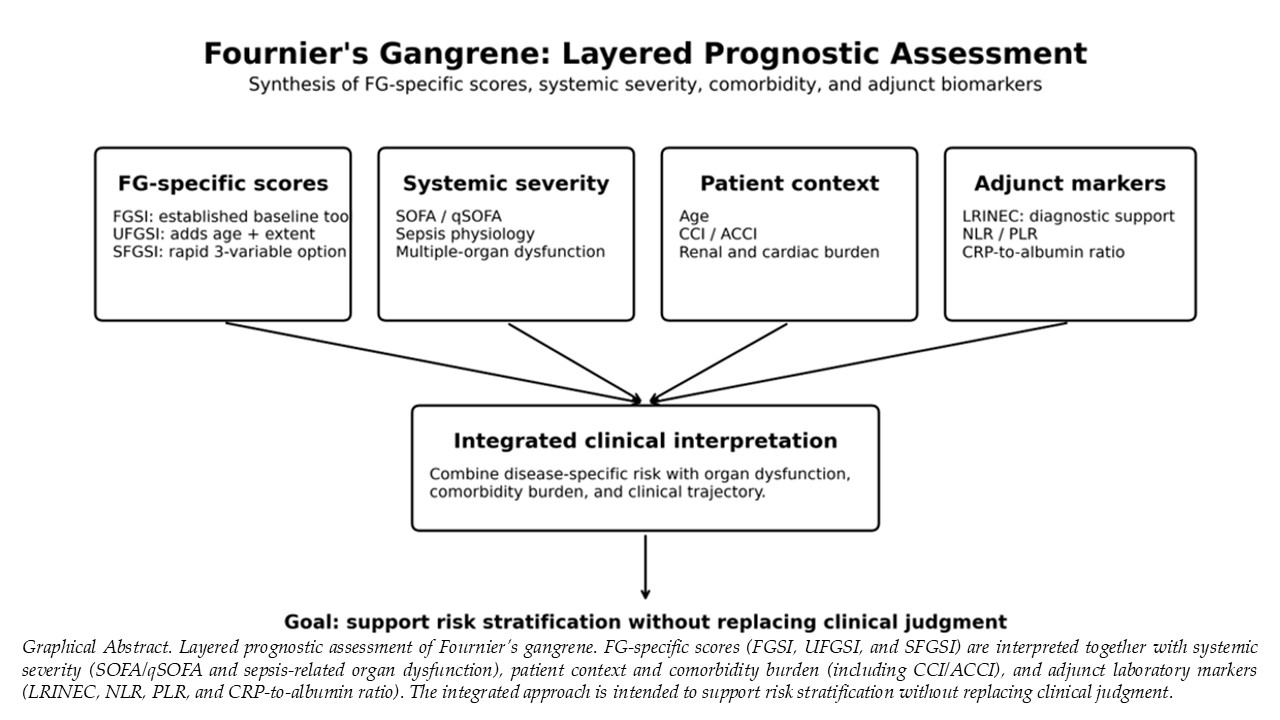
The evidence synthesized in this review supports a layered approach to prognostic assessment rather than selection of a single universal score. At presentation, an FG-specific instrument such as FGSI or UFGSI can provide structured assessment of disease-related mortality risk [18,19,20,21,22]. Simultaneously, SOFA or other physiological warning systems can identify systemic organ dysfunction [20,49,50,51,52,53,54]. CCI/ACCI can characterize baseline comorbidity burden [58,59,60], while NLR and other laboratory markers may provide complementary information regarding inflammatory and metabolic stress [42,65,70,71,72,73,74].
This approach avoids asking one instrument to answer questions for which it was not designed. LRINEC may contribute to diagnostic assessment of necrotizing soft-tissue infection but should not be expected to provide the same mortality discrimination as FG-specific prognostic scores [19,20,25,26,27]. NEWS2 and qSOFA can signal physiological deterioration but do not characterize anatomical disease extent. CCI describes chronic vulnerability but not the immediate severity of infection. Conversely, FGSI does not comprehensively quantify chronic comorbidity.
4.11. Broader Literature, Emerging Management Questions, and Future Research
Broader necrotizing soft-tissue infection literature provides important context for the FG-specific evidence. A meta-analysis of 105 studies and 8,718 patients reported overall NSTI mortality of 23.1% [84], while a 2026 umbrella review highlighted persistent heterogeneity in the FG evidence base and the need for stronger prospective data [85]. Time to source control remains a central management issue; systematic review and meta-analysis of NSTI treatment found that earlier surgery is associated with lower mortality, reinforcing the principle that prognostic assessment must never delay operative management [86]. Contemporary management reviews similarly emphasize rapid recognition, resuscitation, broad-spectrum antimicrobial therapy, repeated debridement when required, and multidisciplinary critical care [87].
Several adjunctive issues influence outcomes beyond admission mortality scoring. Hyperbaric oxygen therapy has been associated with lower mortality in meta-analysis, although the evidence remains predominantly observational [88]. Systematic reviews also describe reconstructive options after source control [89,90], while long-term quality-of-life impairment among survivors demonstrates that in-hospital mortality captures only part of the disease burden [91]. National data suggest sex-related differences in morbidity and mortality [92], and recent systematic reviews continue to identify age, organ dysfunction, comorbidity, and severe systemic illness as recurrent mortality correlates [93,94].
The current evidence base reveals several priorities for future investigation. First, prospective multicenter external validation is needed for both established and emerging scores. Large datasets containing standardized admission variables, treatment timing, anatomical extent, microbiology, organ dysfunction, comorbidity, and mortality would permit direct comparison under uniform conditions. Second, future studies should report not only discrimination but also calibration. An instrument may distinguish higher-risk from lower-risk patients while still systematically overestimating or underestimating absolute mortality. Calibration is particularly important if prognostic scores are to support patient counselling, benchmarking, or clinical decision-support systems.
Third, investigators should assess whether newer models provide incremental value beyond established instruments. Demonstrating that FGMI or FGMI-2P has a statistically significant AUC is insufficient if a simpler established score provides equivalent information. Direct comparisons, calibration assessment, decision-curve analysis, and external validation would better establish whether additional biomarkers meaningfully improve clinical prediction [27,28]. Fourth, dynamic assessment deserves greater attention. Most available instruments rely on admission measurements, yet FG evolves rapidly after resuscitation, surgery, antimicrobial therapy, and organ support. Changes in SOFA, lactate, inflammatory indices, renal function, or other variables during the first 24–72 hours may potentially provide information beyond a single baseline measurement.
Finally, future research should distinguish prediction from causation. Prognostic studies identify variables associated with outcome; they do not necessarily establish that modifying those variables will reduce mortality. Treatment-focused studies should therefore evaluate whether score-guided management adds benefit beyond established principles of rapid recognition, resuscitation, antimicrobial therapy, surgical source control, and multidisciplinary critical care.
4.12. Strengths and Limitations of the Present Review
A major strength of this review is its broad integration of disease-specific scores, diagnostic instruments, general critical-care systems, comorbidity measures, and biological markers within a single clinical framework. This permits direct consideration of the different questions these instruments were designed to answer and reduces the risk of conflating diagnostic and prognostic performance. The review also incorporates evidence ranging from original derivation studies and individual comparative cohorts to systematic reviews and meta-analyses.
Several limitations must nevertheless be acknowledged. First, this is a narrative review rather than a systematic review or meta-analysis. Although the literature search was structured and quantitative claims were checked against their cited sources, no formal PRISMA-based selection process or standardized risk-of-bias assessment was performed. The possibility of selection bias therefore remains.
Second, much of the FG literature consists of retrospective, single-center studies with modest sample sizes and relatively few mortality events. This limits the precision of individual estimates and increases the risk of overfitting in newly derived models. Differences in study populations, healthcare systems, treatment protocols, laboratory timing, thresholds, and definitions further restrict direct comparison.
Third, not all instruments have undergone equivalent validation. FGSI has accumulated evidence over several decades, whereas FGMI and FGMI-2P are recent models with substantially more limited external validation [18,19,20,21,22,23,24,27,28]. Their reported performance should therefore not be interpreted as evidence of equivalence in maturity or generalizability.
Fourth, the review focuses predominantly on in-hospital mortality. Other clinically relevant outcomes, including repeated debridement, ICU duration, organ-support requirements, reconstructive burden, functional outcome, quality of life, and long-term mortality—are less consistently evaluated in the available literature. Prognostic models developed for mortality should not automatically be assumed to predict these different outcomes [48,91].
Overall, prognosis in Fournier’s gangrene is multidimensional. No single score captures the burden of local disease, systemic deterioration, chronic vulnerability, inflammation, and treatment timing. Validated instruments should be used according to their intended purpose, while urgent source control and multidisciplinary management remain fundamental.
5. Conclusions
Mortality in Fournier’s gangrene remains substantial, approximately 16–20% in large contemporary syntheses and national cohorts [8,11,75]. FGSI, UFGSI, and SFGSI remain the best-supported FG-specific composite prognostic instruments [19,20,21,22,23]. LRINEC should be interpreted primarily as diagnostic support for necrotizing soft-tissue infection rather than as a mortality score for FG [19,20,25,26,27]. NLR provides complementary prognostic information, while CCI/ACCI, SOFA/qSOFA, NEWS2, and APACHE II characterize comorbidity and systemic physiological severity [20,49,54,60,73,83]. FGMI and FGMI-2P are promising but require further independent validation [27,28]. The most defensible clinical approach is multidimensional: combine FG-specific risk stratification with organ dysfunction, comorbidity burden, and selected inflammatory/nutritional markers, while ensuring that prognostic calculation never delays resuscitation, antimicrobial therapy, or urgent surgical source control [30,78,79,86].
Author Contributions
Conceptualization, P.N., M.A. and G.V.P.; methodology, P.N., M.A. and G.V.P.; validation, P.N., A.N. and M.F.M.; investigation, P.N., A.N., M.A., M.-N.M., G.V.P. and M.F.M.; resources, P.N., A.N., M.A., M.-N.M., G.V.P. and M.F.M.; data curation, P.N.; writing—original draft preparation, P.N.; writing—review and editing, P.N., A.N., M.A., M.-N.M., G.V.P. and M.F.M.; visualization, P.N.; supervision, M.A. and G.V.P.; project administration, P.N. All authors have read and agreed to the published version of the manuscript.
Funding
This research received no external funding.
Institutional Review Board Statement
Not applicable. This study is a narrative review of previously published literature and did not involve human participants, identifiable human data, or experimental animals.
Informed Consent Statement
Not applicable.
Data Availability Statement
No new data were created or analyzed in this study. Data sharing is not applicable to this article.
Acknowledgments
The authors acknowledge the institutional and academic support provided by the “Dunărea de Jos” University of Galați and the University of Medicine and Pharmacy of Craiova.
Conflicts of Interest
The authors declare no conflicts of interest.
Abbreviations
The following abbreviations are used in this manuscript:
| ACCI | Age-Adjusted Charlson Comorbidity Index |
| APACHE | Acute Physiology and Chronic Health Evaluation |
| AUC | Area under Curve |
| AUROC | Area Under the Receiver Operating Characteristic curve |
| CCI | Charlson Comorbidity Index |
| CRP | C-Reactive Protein |
| FG | Fournier’s gangrene |
| FGMI | Fournier’s Gangrene Mortality Index |
| FGSI | Fournier’s Gangrene Severity Index |
| J-LRINEC | Japanese Laboratory Risk Indicator for Necrotizing Fasciitis |
| LRINEC | Laboratory Risk Indicator for Necrotizing Fasciitis |
| NEWS | National Early Warning Score |
| NICE | National Institute for Health and Care Excellence |
| NLR | neutrophil-to-lymphocyte ratio |
| RDW | Red Cell Distribution Width |
| SFGSI | Simplified Fournier’s Gangrene Severity Index |
| SOFA | Sequential Organ Failure Assessment |
| UFGSI | Uludag Fournier’s Gangrene Severity Index |
| WBC | White Blood Cells |
References
- Fournier, J.A. Gangrène foudroyante de la verge. Sem. Med.;Dis. Colon Rectum 1883, 31(12), 984–988. [Google Scholar] [CrossRef] [PubMed]
- Baskin, L.S.; Carroll, P.R.; Cattolica, E.V.; McAninch, J.W. Necrotising soft tissue infections of the perineum and genitalia: bacteriology, treatment and risk assessment. Br. J. Urol. 1990, 65(5), 524–529. [Google Scholar] [CrossRef] [PubMed]
- Clayton, M.D.; Fowler, J.E., Jr.; Sharifi, R.; Pearl, R.K. Causes, presentation and survival of fifty-seven patients with necrotizing fasciitis of the male genitalia. Surg. Gynecol. Obstet. 1990, 170(1), 49–55. [Google Scholar] [PubMed]
- Malik, A.M.; Sheikh, S.; Pathan, R.; Khan, A.; Sheikh, U. The spectrum of presentation and management of Fournier’s gangrene—an experience of 73 cases. J. Pak. Med. Assoc. 2010, 60(8), 617–619. [Google Scholar] [PubMed]
- Bhatnagar, A.M.; Mohite, P.N.; Suthar, M. Fournier’s gangrene: a review of 110 cases for aetiology, predisposing conditions, microorganisms, and modalities for coverage of necrosed scrotum with bare testes. N Z. Med. J. 2008, 121(1275), 46–56. [Google Scholar] [PubMed]
- Sorensen, M.D.; Krieger, J.N. Fournier’s gangrene: epidemiology and outcomes in the general US population. Urol. Int. 2016, 97(3), 249–259. [Google Scholar] [CrossRef] [PubMed]
- Sorensen, M.D.; Krieger, J.N.; Rivara, F.P.; et al. Fournier’s gangrene: population based epidemiology and outcomes. J. Urol. 2009, 181(5), 2120–2126. [Google Scholar] [CrossRef] [PubMed]
- Radcliffe, R.S.; Khan, M.A. Mortality associated with Fournier’s gangrene remains unchanged over 25 years. BJU Int. 2020, 125(4), 610–616. [Google Scholar] [CrossRef] [PubMed]
- Hagedorn, J.C.; Wessells, H. A contemporary update on Fournier’s gangrene. Nat. Rev. Urol. 2017, 14(4), 205–214. [Google Scholar] [CrossRef] [PubMed]
- Eke, N. Fournier’s gangrene: a review of 1726 cases. Br. J. Surg. 2000, 87(6), 718–728. [Google Scholar] [CrossRef] [PubMed]
- El-Qushayri, A.E.; Khalaf, K.M.; Dahy, A.; et al. Fournier’s gangrene mortality: a 17-year systematic review and meta-analysis. Int. J. Infect. Dis. 2020, 92, 218–225. [Google Scholar] [CrossRef] [PubMed]
- Nisbet, A.A.; Thompson, I.M. Impact of diabetes mellitus on presentation and outcomes of Fournier’s gangrene. Urology 2002, 60(5), 775–779. [Google Scholar] [CrossRef] [PubMed]
- Oyelowo, N.; Ahmed, M.; Lawal, A.T.; et al. Fournier’s gangrene: presentation and predictors of mortality in Zaria, Nigeria. Ann. Afr. Med. 2021, 20(2), 105–110. [Google Scholar] [CrossRef] [PubMed]
- Yanar, H.; Taviloglu, K.; Ertekin, C.; et al. Fournier’s gangrene: risk factors and strategies for management. World J. Surg. 2006, 30(9), 1750–1754. [Google Scholar] [CrossRef] [PubMed]
- Hatipoglu, E.; Demiryas, S.; Şimşek, O.; Sarıbeyoğlu, K.; Pekmezci, S. Fournier’s gangrene: five years’ experience from a single center in Turkey. Ulus. Travma Acil Cerrahi Derg. 2020, 26(2), 235–241. [Google Scholar] [CrossRef] [PubMed]
- Benjelloun el, B.; Souiki, T.; Yakla, N.; et al. Fournier’s gangrene: our experience with 50 patients and analysis of factors affecting mortality. World J. Emerg. Surg. 2013, 8(1), 13. [Google Scholar] [CrossRef] [PubMed]
- Tosun, Y.; Akıncı, O.; Küçük, H.F. Risk factors for mortality in Fournier’s gangrene of anorectal origin. Ulus. Travma Acil Cerrahi Derg. 2022, 28(8), 1128–1133. [Google Scholar] [CrossRef] [PubMed]
- Laor, E.; Palmer, L.S.; Tolia, B.M.; Reid, R.E.; Winter, H.I. Outcome prediction in patients with Fournier’s gangrene. J. Urol. 1995, 154(1), 89–92. [Google Scholar] [CrossRef]
- Arıkan, Y.; Emir, B.; Tarhan, O.; et al. Comparative analysis of scoring systems for predicting mortality in Fournier gangrene: single center, 15 years experience. Updat. Surg. 2024, 76(7), 2683–2692. [Google Scholar] [CrossRef] [PubMed]
- Azmi, Y.A.; Alkaff, F.F.; Renaldo, J. Comparison of different scoring systems for predicting in-hospital mortality for patients with Fournier gangrene. World J. Urol. 2023, 41(10), 2751–2757. [Google Scholar] [CrossRef] [PubMed]
- Tufano, A.; Dipinto, P.; Passaro, F.; et al. The Value of Fournier’s Gangrene Scoring Systems on Admission to Predict Mortality: A Systematic Review and Meta-Analysis. J. Pers. Med. 2023, 13(9), 1283. [Google Scholar] [CrossRef] [PubMed]
- Yilmazlar, T.; Ozturk, E.; Ozguc, H.; Ercan, I.; Vuruskan, H.; Oktay, B. Fournier’s gangrene: an analysis of 80 patients and a novel scoring system. Tech Coloproctol. 2010, 14(3), 217–223. [Google Scholar] [CrossRef] [PubMed]
- Lin, T.Y.; Ou, C.H.; Tzai, T.S.; et al. Validation and simplification of Fournier’s gangrene severity index. Int. J. Urol. 2014, 21(7), 696–701. [Google Scholar] [CrossRef] [PubMed]
- Corcoran, A.T.; Smaldone, M.C.; Gibbons, E.P.; Walsh, T.J.; Davies, B.J. Validation of the Fournier’s Gangrene Severity Index in a large contemporary series. J. Urol. 2008, 180(3), 944–948. [Google Scholar] [CrossRef] [PubMed]
- Wong, C.H.; Khin, L.W.; Heng, K.S.; Tan, K.C.; Low, C.O. The LRINEC (Laboratory Risk Indicator for Necrotizing Fasciitis) score: a tool for distinguishing necrotizing fasciitis from other soft tissue infections. Crit. Care Med. 2004, 32(7), 1535–1541. [Google Scholar] [CrossRef] [PubMed]
- Abdullah, M.; McWilliams, B.; Khan, S.U. Reliability of the Laboratory Risk Indicator in Necrotising Fasciitis (LRINEC) score. Surgeon 2019, 17(5), 309–318. [Google Scholar] [CrossRef] [PubMed]
- Yönder, H.; Çelik, M.; Berhuni, M.S.; et al. Fournier’s Gangrene Mortality Index (FGMI): a new scoring system for predicting Fournier’s gangrene mortality. Diagnostics 2024, 14(23), 2732. [Google Scholar] [CrossRef] [PubMed]
- Altunok, İ.; Özdemir, S. Enhanced prognostic model for mortality in patients with Fournier gangrene: Validation of the Fournier gangrene mortality index and integration of platelet count and PCO2. Am. J. Emerg. Med. 2026, 100, 170–174. [Google Scholar] [CrossRef] [PubMed]
- Knaus, W.A.; Draper, E.A.; Wainer, D.P.; Zimmerman, J.E. APACHE II: a severity of disease classification system. Crit. Care Med. 1985, 13(10), 818–829. [Google Scholar] [CrossRef] [PubMed]
- Huayllani, M.T.; Cheema, A.S.; McGuire, M.J.; Janis, J.E. Practical review of the current management of Fournier’s gangrene. Plast. Reconstr. Surg. Glob. Open 2022, 10(3), e4191. [Google Scholar] [CrossRef] [PubMed]
- Itaimi, A.; Triki, W.; Abbassi, I.; Ayed, K.; Baraket, O.; Bouchoucha, S. Fournier’s gangrene: validation of the severity index. Tunis. Med. 2022, 100(2), 122–126. [Google Scholar] [PubMed]
- Jafar, M.; Shah, M.; Iqbal, J.; Islam, Z.U.; Ullah, M. Fournier’s gangrene: 5-year experience and validity of Fournier gangrene severity index. Pak. J. Med. Health Sci. 2022, 16(12), 690–692. [Google Scholar] [CrossRef]
- Arora, A.; Rege, S.; Surpam, S.; Gothwal, K.; Narwade, A. Predicting mortality in Fournier gangrene and validating the Fournier gangrene severity index: experience with 50 patients in a tertiary care center in India. Urol. Int. 2019, 102(3), 311–318. [Google Scholar] [CrossRef] [PubMed]
- Tang, L.M.; Su, Y.J.; Lai, Y.C. The evaluation of microbiology and prognosis of Fournier’s gangrene in past five years. Springerplus 2015, 4, 14. [Google Scholar] [CrossRef] [PubMed]
- Castillejo Becerra, C.M.; Jaeger, C.D.; Rose, J.R.; et al. Microorganisms and antibiogram patterns in Fournier’s gangrene: contemporary experience from a single tertiary care center. J. Urol. 2020, 204(6), 1249–1255. [Google Scholar] [CrossRef] [PubMed]
- Shiratori, T.; Nakamura, M.; Naito, A.; et al. Clinical features and treatment outcomes of Fournier’s gangrene in a single tertiary emergency hospital: Simplified Fournier’s Gangrene Severity Index score is a predictor for death. Glob. Health Med. 2023, 5(6), 362–365. [Google Scholar] [CrossRef] [PubMed]
- Lin, T.Y.; Cheng, I.H.; Ou, C.H.; et al. Incorporating Simplified Fournier’s Gangrene Severity Index with early surgical intervention can maximize survival in high-risk Fournier’s gangrene patients. Int. J. Urol. 2019, 26(7), 737–743. [Google Scholar] [CrossRef] [PubMed]
- Yeniyol, C.O.; Suelozgen, T.; Arslan, M.; Ayder, A.R. Fournier’s gangrene: experience with 25 patients and use of Fournier’s Gangrene Severity Index score. Urology 2004, 64(2), 218–222. [Google Scholar] [CrossRef] [PubMed]
- Kabay, S.; Yucel, M.; Yaylak, F.; et al. The clinical features of Fournier’s gangrene and the predictivity of the Fournier’s Gangrene Severity Index on the outcomes. Int. Urol. Nephrol. 2008, 40(4), 997–1004. [Google Scholar] [CrossRef] [PubMed]
- Wetterauer, C.; Ebbing, J.; Halla, A.; et al. A contemporary case series of Fournier’s gangrene at a Swiss tertiary care center—can scoring systems accurately predict mortality and morbidity? World J. Emerg. Surg. 2018, 13, 25. [Google Scholar] [CrossRef] [PubMed]
- Noegroho, B.S.; Siregar, S.; Mustafa, A.; Rivaldi, M.A. Validation of FGSI scores in predicting Fournier gangrene in a tertiary hospital. Res. Rep. Urol. 2021, 13, 341–346. [Google Scholar] [CrossRef] [PubMed]
- Esin, H.; Kahramansoy, N.; Çalık, Y.; Karaali, C.; Üreyen, O.; Kıratlı, K. Comparing scoring systems and biomarkers for mortality in Fournier gangrene patients. Bratisl. Med. J. 2025, 126, 1500–1508. [Google Scholar] [CrossRef]
- Roghmann, F.; von Bodman, C.; Löppenberg, B.; Hinkel, A.; Palisaar, J.; Noldus, J. Is there a need for the Fournier’s gangrene severity index? Comparison of scoring systems for outcome prediction in patients with Fournier’s gangrene. BJU Int. 2012, 110(9), 1359–1365. [Google Scholar] [CrossRef] [PubMed]
- Üreyen, O.; Acar, A.; Gökçelli, U.; Atahan, M.K.; İlhan, E. Usefulness of FGSI and UFGSI scoring systems for predicting mortality in patients with Fournier’s gangrene: a multicenter study. Ulus. Travma Acil Cerrahi Derg. 2017, 23(5), 389–394. [Google Scholar] [CrossRef] [PubMed]
- Adli, G.; Kloping, Y.P.; Djatisoesanto, W. Comparing scoring systems for Fournier gangrenes in predicting morbidity and mortality: Is FGSI still reliable? Fr. J. Urol. 2024, 34(9), 102673. [Google Scholar] [CrossRef] [PubMed]
- Çomçalı, B.; Ceylan, C.; Altun Özdemir, B.; Ağaçkıran, İ.; Akıncı, F. Comparison of the newly developed Fournier’s gangrene mortality prediction model with existing models. Ulus. Travma Acil Cerrahi Derg. 2022, 28(4), 490–497. [Google Scholar] [CrossRef] [PubMed]
- Warli, S.M.; Pakpahan, K.A.; Nasution, R.; Kadar, D.D.; Adhyatma, K.P. Role of SFGSI, microbial culture and qSOFA as predictive factors in determining the survival rate in Fournier Gangrene patient. Saudi Med. J. 2024, 45(3), 230–234. [Google Scholar] [CrossRef] [PubMed]
- Ghodoussipour, S.B.; Gould, D.; Lifton, J.; et al. Surviving Fournier’s gangrene: multivariable analysis and a novel scoring system to predict length of stay. J. Plast. Reconstr. Aesthet. Surg. 2018, 71(5), 712–718. [Google Scholar] [CrossRef] [PubMed]
- Singer, M.; Deutschman, C.S.; Seymour, C.W. The Third International Consensus Definitions for Sepsis and Septic Shock (Sepsis-3). JAMA 2016, 315(8), 801–810. [Google Scholar] [CrossRef]
- Seymour, C.W.; Liu, V.X.; Iwashyna, T.J. Assessment of clinical criteria for sepsis: for the Third International Consensus Definitions for Sepsis and Septic Shock (Sepsis-3). JAMA 2016, 315(8), 762–774. [Google Scholar] [CrossRef]
- Vincent, J.L.; Moreno, R.; Takala, J. The SOFA (Sepsis-related Organ Failure Assessment) score to describe organ dysfunction/failure. Intensive Care Med. 1996, 22(7), 707–710. [Google Scholar] [CrossRef] [PubMed]
- Nicolcescu, P.; Bereanu, A.; Mihai, I.; Arbune, M.; Sava, M.; Grigore, N.; Hasegan, A. Beyond Traditional Prognostic Scores: Associations of Organ Dysfunction and Metastatic Malignancy with Mortality in Fournier’s Gangrene. Diseases 2026, 14(9), 347. [Google Scholar] [CrossRef] [PubMed]
- Prescott, H.C.; Antonelli, M.; Alhazzani, W. Surviving Sepsis Campaign: International Guidelines for Management of Sepsis and Septic Shock 2026. Crit. Care Med. 2026, 54(4), 725–812. [Google Scholar] [CrossRef] [PubMed]
- NICE Guideline NG253. Suspected sepsis in people aged 16 or over: recognition, assessment and early management. Last updated: January 2026.
- Knaus, W.A.; Zimmerman, J.E.; Wagner, D.P.; Draper, E.A.; Lawrence, D.E. APACHE—acute physiology and chronic health evaluation: a physiologically based classification system. Crit. Care Med. 1981, 9(8), 591–597. [Google Scholar] [CrossRef] [PubMed]
- Knaus, W.A.; Wagner, D.P.; Draper, E.A.; Zimmerman, J.E.; Bergner, M.; Bastos, P.G.; et al. The APACHE III prognostic system: risk prediction of hospital mortality for critically ill hospitalized adults. Chest 1991, 100(6), 1619–1636. [Google Scholar] [CrossRef] [PubMed]
- Zimmerman, J.E.; Kramer, A.A.; McNair, D.S.; Malila, F.M. Acute Physiology and Chronic Health Evaluation (APACHE) IV: hospital mortality assessment for today’s critically ill patients. Crit. Care Med. 2006, 34(5), 1297–1310. [Google Scholar] [CrossRef] [PubMed]
- Charlson, M.E.; Pompei, P.; Ales, K.L.; MacKenzie, C.R. A new method of classifying prognostic comorbidity in longitudinal studies: development and validation. J. Chronic Dis. 1987, 40(5), 373–383. [Google Scholar] [CrossRef] [PubMed]
- Charlson, M.; Szatrowski, T.P.; Peterson, J.; Gold, J. Validation of a combined comorbidity index. J. Clin. Epidemiol. 1994, 47(11), 1245–1251. [Google Scholar] [CrossRef] [PubMed]
- Hauser, N.; Huang, C.; Vaidya, G.; et al. Fournier’s Gangrene Severity Index and Charlson Comorbidity Index Predict Mortality, Intensive Care Unit Admission, and Length of Hospital Stay in Patients With Fournier’s Gangrene: An Analysis of 264 Consecutive Patients. Cureus 2024, 16(12), e75281. [Google Scholar] [CrossRef] [PubMed]
- Gawande, A.A.; Kwaan, M.R.; Regenbogen, S.E.; Lipsitz, S.A.; Zinner, M.J. An Apgar score for surgery. J. Am. Coll. Surg. 2007, 204(2), 201–208. [Google Scholar] [CrossRef] [PubMed]
- Tarricone, A.; De La Mata, K.; Gee, A.; et al. A systematic review and meta-analysis of the effectiveness of LRINEC score for predicting upper and lower extremity necrotizing fasciitis. J. Foot Ankle Surg. 2022, 61(2), 384–389. [Google Scholar] [CrossRef] [PubMed]
- Fernando, S.M.; Tran, A.; Cheng, W. Necrotizing soft tissue infection: diagnostic accuracy of physical examination, imaging, and LRINEC score: a systematic review and meta-analysis. Ann. Surg. 2019, 269(1), 58–65. [Google Scholar] [CrossRef] [PubMed]
- Norimatsu, Y.; Fukasawa, T.; Ohno, Y.; et al. Validation of Laboratory Risk Indicator for Necrotizing Fasciitis (LRINEC) score and establishment of a novel score in Japanese patients with necrotizing fasciitis (J-LRINEC score). J. Dermatol. 2025, 52(3), 439–444. [Google Scholar] [CrossRef] [PubMed]
- Chen, I.C.; Li, W.C.; Hong, Y.C.; Shie, S.S.; Fann, W.C.; Hsiao, C.T. The microbiological profile and presence of bloodstream infection influence mortality rates in necrotizing fasciitis. Crit. Care 2011, 15(3), R152. [Google Scholar] [CrossRef] [PubMed]
- Bozkurt, O.; Sen, V.; Demir, O.; Esen, A. Evaluation of the utility of different scoring systems (FGSI, LRINEC and NLR) in the management of Fournier’s gangrene. Int. Urol. Nephrol. 2015, 47(2), 243–248. [Google Scholar] [CrossRef] [PubMed]
- Uluğ, M.; Gedik, E.; Girgin, S.; Celen, M.K.; Ayaz, C. The evaluation of microbiology and Fournier’s gangrene severity index in 27 patients. Int. J. Infect. Dis. 2009, 13(6), e424–e430. [Google Scholar] [CrossRef] [PubMed]
- Kincius, M.; Telksnys, T.; Trumbeckas, D.; Jievaltas, M.; Milonas, D. Evaluation of LRINEC scale feasibility for predicting outcomes of Fournier gangrene. Surg. Infect. (Larchmt) 2016, 17(4), 448–453. [Google Scholar] [CrossRef] [PubMed]
- Zahorec, R. Ratio of neutrophil to lymphocyte counts—rapid and simple parameter of systemic inflammation and stress in critically ill. Bratisl. Lek. Listy 2001, 102(1), 5–14. [Google Scholar] [CrossRef]
- Yim, S.U.; Kim, S.W.; Ahn, J.H. Neutrophil-to-lymphocyte and platelet-to-lymphocyte ratios are more effective than the Fournier’s gangrene severity index for predicting poor prognosis in Fournier’s gangrene. Surg. Infect. (Larchmt) 2016, 17(2), 217–223. [Google Scholar] [CrossRef] [PubMed]
- Raizandha, M.A.; Hidayatullah, F.; Kloping, Y.P.; Rizaldi, F. Neutrophil-lymphocyte ratio and Fournier gangrene severity index are not prognostic factors of mortality in Fournier gangrene patients. Universa Med. 2022, 41(1), 71–78. [Google Scholar] [CrossRef]
- Wirjopranoto, S. Comparison between neutrophil-to-lymphocyte ratio and platelet-to-lymphocyte ratio as predictors of mortality on Fournier’s gangrene cases. Indian J. Urol. 2023, 39(2), 121–125. [Google Scholar] [CrossRef] [PubMed]
- Seretis, K.; Bounas, N.; Sfaelos, K.; Gaitanis, G.; Bassukas, I. The neutrophil-to-lymphocyte ratio as a prognostic biomarker of Fournier’s gangrene severity: a meta-analysis. Infect. Dis. Rep. 2025, 17(3), 55. [Google Scholar] [CrossRef] [PubMed]
- Özgül, H.; Uzmay, Y. The role of C-reactive protein albumin ratio for predicting mortality in patients with Fournier’s gangrene. Ulus. Travma Acil Cerrahi Derg. 2023, 29(11), 1242–1247. [Google Scholar] [CrossRef] [PubMed]
- Belinchón-Romero, I.; Ramos-Belinchón, A.; Lobato-Martínez, E.; Sánchez-García, V.; Ramos-Rincón, J.M. National Study of Fournier Gangrene in Spain (2016–2021): gender/sex differences in mortality and risks. Medicina 2024, 60(10), 1600. [Google Scholar] [CrossRef] [PubMed]
- Puia, D.; Gheorghincă, Ş.; Pricop, C. The Antimicrobial Resistance Index and Fournier Gangrene Severity Index of patients diagnosed with Fournier’s gangrene in a tertiary hospital in North Eastern Romania. Medicina 2023, 59(4), 643. [Google Scholar] [CrossRef] [PubMed]
- Zhang, N.; Yu, X.; Zhang, K.; Liu, T. A retrospective case series of Fournier’s gangrene: necrotizing fasciitis in perineum and perianal region. BMC Surg. 2020, 20, 259. [Google Scholar] [CrossRef] [PubMed]
- Bowen, D.; Juliebø-Jones, P.; Somani, B.K. Global outcomes and lessons learned in the management of Fournier’s gangrene from high-volume centres: findings from a literature review over the last two decades. World J. Urol. 2022, 40(10), 2399–2410. [Google Scholar] [CrossRef] [PubMed]
- Bowen, D.; Hughes, T.; Juliebø-Jones, P.; Somani, B. Fournier’s gangrene: a review of predictive scoring systems and practical guide for patient management. Ther. Adv. Infect. Dis. 2024, 11, 20499361241238521. [Google Scholar] [CrossRef] [PubMed]
- Benizri, E.; Fabiani, P.; Migliori, G.; Chevallier, D.; Peyrottes, A.; Raucoules, M. Gangrene of the perineum. Urology 1996, 47(6), 935–939. [Google Scholar] [CrossRef] [PubMed]
- Kranz, J.; Schlager, D.; Anheuser, P.; et al. Desperate need for better management of Fournier’s gangrene. Cent. Eur. J. Urol. 2018, 71(3), 360–365. [Google Scholar] [CrossRef] [PubMed]
- Tran, S.; Pullano, K.J.; Henry, S.; Ribeiro, M.A.F., Jr. Predictive models for necrotizing soft tissue infections: are the available scores trustable? J. Clin. Med. 2025, 14(13), 4550. [Google Scholar] [CrossRef] [PubMed]
- Bozkurt, F.T.; Öncel, H.F.; Salar, R. Predictive factors for mortality in intensive care patients with Fournier’s gangrene: five years’ experience from a single center in Turkey. Eur. Rev. Med. Pharmacol. Sci. 2023, 27(6), 2326–2331. [Google Scholar] [CrossRef] [PubMed]
- Dhanasekara, C.S.; Marschke, B.; Morris, E.; Kahathuduwa, C.N.; Dissanaike, S. Global patterns of necrotizing soft tissue infections: A systematic review and meta-analysis. Surgery 2021, 170(6), 1718–1726. [Google Scholar] [CrossRef] [PubMed]
- Müssgens, C.; Wimmer, L.; Fankhauser, C.D.; Schneidewind, L.; Aschwanden, F.J. Defining the standard of care in Fournier’s gangrene—An umbrella review. Eur. Urol. Open Sci. 2026, 83, 64–71. [Google Scholar] [CrossRef] [PubMed]
- Nawijn, F.; Smeeing, D.P.J.; Houwert, R.M.; Leenen, L.P.H.; Hietbrink, F. Time is of the essence when treating necrotizing soft tissue infections: a systematic review and meta-analysis. World J. Emerg. Surg. 2020, 15, 4. [Google Scholar] [CrossRef] [PubMed]
- Kopechek, K.J.; Patel, H.V.; Koch, G.E. Modern Management of Fournier’s Gangrene. Curr. Urol. Rep. 2025, 26(1), 47. [Google Scholar] [CrossRef] [PubMed]
- Huang, C.; Lin, L.; Tang, T. Hyperbaric Oxygen Therapy Is Associated with Lower Mortality in Patients with Fournier’s Gangrene: A Meta-Analysis. Medicina 2026, 62(6), 1199. [Google Scholar] [CrossRef] [PubMed]
- Susini, P.; Marcaccini, G.; Efica, J.; Giuffrè, M.T.; Mazzotta, R.; Caneschi, C.; Cuomo, R.; Nisi, G.; Grimaldi, L. Fournier’s Gangrene Surgical Reconstruction: A Systematic Review. J. Clin. Med. 2024, 13(14), 4085. [Google Scholar] [CrossRef] [PubMed]
- Alammar, A.; Laing, K.; Somasundaram, J.; Wallace, D.L.; Rogers, A.D. Flap reconstruction following Fournier’s gangrene: A systematic review of techniques and outcomes. Burns 2026, 52(3), 107888. [Google Scholar] [CrossRef] [PubMed]
- Wimmer, L.; Fankhauser, C.D.; Mattei, A.; Schneidewind, L.; Aschwanden, F.J. The Forgotten Suffering of Patients who Survived Fournier’s Gangrene: A Systematic Review of Long-term Outcomes and Quality of Life Impairment. Eur. Urol. Focus. 2026, 12(3), 576–579. [Google Scholar] [CrossRef] [PubMed]
- Abbasi, B.; Hacker, E.; Ghaffar, U.; Hakam, N.; Li, K.D.; Alazzawi, S.; Fernandez, A.; Patel, H.V.; Breyer, B.N. Higher Morbidity and Mortality in Women With Fournier Gangrene Compared With Men: Insights From National Inpatient Sample Data. J. Urol. 2025, 213(1). [Google Scholar] [CrossRef] [PubMed]
- Shet, P.B.; Mustafa, A.D.; Varshney, K.; Rao, L.; Sawdagar, S.; McLennan, F.; Ansari, S.; Shet, D.; Sivathamboo, N.; Campbell, S. Risk Factors for Mortality Among Patients With Fournier Gangrene: A Systematic Review. Surg. Infect. (Larchmt) 2024, 25(4), 261–271. [Google Scholar] [CrossRef] [PubMed]
- Zhang, R.; Xu, Z.; Han, Q.; Wang, G. Risk Factors for Mortality in Patients With Necrotizing Fasciitis: A Systematic Review and Meta-Analysis. Int. J. Clin. Pract. 2026, 2026, 5572865. [Google Scholar] [CrossRef]

Table 1.
Evidence Hierarchy and Consistency of Prognostic Domains Across the Reviewed Literature.
| Panel A — Consistency of major prognostic domains | ||
| Prognostic domain | Overall signal | Interpretive note |
| Organ dysfunction / sepsis physiology | Consistently adverse | Sepsis, multiple-organ failure, SOFA-related deterioration, and physiologic instability repeatedly track poor outcome [11,49,51]. |
| Advanced age | Frequently adverse | Often associated with mortality, although independent significance varies in smaller cohorts [14,15,16]. |
| Comorbidity burden | Generally adverse but heterogeneous | Renal, cardiac, and overall comorbidity burden show prognostic relevance [11,60]; individual conditions are not uniformly independent predictors [58,59]. |
| Diabetes mellitus | Inconsistent as an independent predictor | Highly prevalent in FG, but pooled and adjusted analyses do not uniformly support an independent mortality effect [11,12]. |
| Delay to surgery / source control | Clinically important |
Prompt aggressive debridement remains central to management [61,75,76]; delay is repeatedly discussed as detrimental in multidisciplinary management literature [78,79]. |
| Inflammatory biomarkers | Mixed / complementary |
NLR and PLR show associations in selected studies [69,70,73], but are less consistent than established composite scores; CRP/albumin shows a similar complementary role [74]. |
| Disease extent / dissemination | Adverse when incorporated into risk models | Extent contributes to UFGSI and reflects anatomical burden, although measurement is less standardized across studies [21,22]. |
| Panel B — Evidence hierarchy and methodological limitations | ||
| Evidence type | Contribution to the review | Principal limitation |
| Original derivation cohorts |
Established FGSI, UFGSI, and SFGSI [18,22,23] | Often small, retrospective, and single-center |
| Original LRINEC derivation cohort | Established LRINEC for necrotizing soft-tissue infection [25] | Not FG-specific; diagnostic rather than prognostic intent |
| Single-center validation/ comparison cohorts |
Tested discrimination and compared scores or biomarkers across numerous independent series [19,20,24] | Case-mix, treatment pathways, and thresholds vary substantially [19,20,21] |
| Large administrative/ national cohorts | Defined epidemiology, mortality burden, and broad outcome patterns [8,11,75] | Limited clinical granularity and variable availability |
| Systematic reviews/ meta-analyses | Provided pooled estimates for mortality predictors and score discrimination [11,21,73] | Dependent on heterogeneous source studies and inconsistent reporting |
| Narrative / focused reviews |
Integrated historical, clinical, and prognostic context [30,78,79] | Not designed to provide pooled quantitative effect estimates |
Table 2.
Reported Risk Factors for Mortality in Fournier’s Gangrene.
| Risk Factor | Source |
Association with mortality (non-survivor vs. survivor) |
Consistency across literature reviewed |
| Diabetes mellitus | [11,12] | ~1.4× higher prevalence among non-survivors than survivors (source-reported ratio 0.72, inverted here to the conventional non-survivor: survivor direction; see Table note) [11]; independent effect questioned after adjustment for age/severity in a dedicated single-center analysis [12] | Inconsistent — the most prevalent comorbidity (44.4% of patients), but not confirmed as an independent predictor once age and severity are accounted for [12] |
| Heart disease |
[11] | ~2.6× higher prevalence among non-survivors than survivors (source-reported ratio 0.39, inverted here; see Table note) | Reported significant in pooled analysis [11] |
| Renal failure | [11] | ~2.4× higher prevalence among non-survivors than survivors (source-reported ratio 0.41, inverted here; see Table note) | Reported significant in pooled analysis [11] |
| Kidney disease | [11] | ~2.9× higher prevalence among non-survivors than survivors (source-reported ratio 0.34, inverted here; see Table note) | Reported significant in pooled analysis [11] |
| Hypertension, lung disease, liver disease, malignancy |
[11] | No significant association found | Consistently non-significant in this pooled analysis [11] |
| Sepsis / MOF at presentation | [11] | Leading proximate causes of death: sepsis 76%, MOF 66% | Consistently identified as the dominant terminal mechanisms [11] |
| Advanced age | [14,15,16] | Recurring correlate of mortality across cohorts | Consistently reported, though not always independently significant in every individual small cohort [14,15,16] |
Note: El-Qushayri et al. [11] reported survivor-to-non-survivor prevalence ratios; values in the table are expressed in the conventional non-survivor:survivor direction for interpretability.
Table 3.
Composite Prognostic Scores Used in Fournier’s Gangrene.
| Score | Parameters included | Clinical role / commonly used threshold | Source |
| FGSI | Temperature, HR, RR, Na, K, creatinine, hematocrit, WBC, bicarbonate | FG-specific mortality score; threshold around 9 is conventional, although optimal cut-offs vary by cohort. | [18] |
| UFGSI | FGSI + age + anatomical extent/dissemination |
FG-specific mortality score; original study used a threshold of 9. | [22] |
| SFGSI | Creatinine, hematocrit, K | Simplified FG-specific mortality score; >2 is a commonly used high-risk threshold. | [23] |
| LRINEC | CRP, WBC, hemoglobin, Na, creatinine, glucose | Diagnostic support for necrotizing fasciitis; ≥6 is a commonly used diagnostic threshold. Not an FG mortality score. | [25] |
| FGMI | Age, creatinine, albumin, lymphocyte %, NLR | Emerging mortality model; ≥5 defined the high-risk category in the derivation study. | [27] |
| FGMI-2P | FGMI variables + platelets + PaCO2 | Emerging mortality model; requires further external validation. | [28] |
Legend: HR: Heart Rate; RR=Respiratory Rate; WBC: White Blood Cells; CRP: C-Reactive Protein; NLR: Neutrophile / Lymphocyte Ratio; FGSI= Fournier’s Gangrene Severity Index; UFGSI= Uludag Fournier’s Gangrene Severity Index; SFGSI= Simplified Fournier’s Gangrene Severity Index; LRINEC= Laboratory Risk Indicator for Necrotizing Fasciitis; FGMI= Fournier’s Gangrene Mortality Index.
Table 4.
Comparative Performance of FGSI, UFGSI, SFGSI, and LRINEC Across Different Evidence Levels.
Table 4.
Comparative Performance of FGSI, UFGSI, SFGSI, and LRINEC Across Different Evidence Levels.
| Source | Evidence level | N | Mortality | FGSI | UFGSI | SFGSI | LRINEC | Best performer in that source |
| [19] single-center, 15 y | Single cohort | 311 | 17.6% | Cut-off ≥10; among top 2 | Cut-off ≥12; among top 2 | Not included | Cut-off ≥8; weakest of 5 scores | UFGSI ≈ FGSI > ACCI > qSOFA > LRINEC (within this cohort only) |
| [20] Indonesia, 10-score comparison | Single cohort | 164 | 26.4% | AUROC 0.905 (0.860–0.950) | Not separately reported | Not included | Weaker than FGSI/SOFA/NUMUNE | FGSI (best of 10 scores, within this cohort only) |
| [21] meta-analysis, pooled | Pooled, 40 studies | 2.257 | Not pooled | AUC 0.90 (0.87–0.92) | AUC 0.94 (0.92–0.96) | AUC 0.84 (0.80–0.87) | Not included | UFGSI (highest pooled AUC across the 40 studies) |
Table 5.
General Critical-Care and Comorbidity Instruments Used Alongside FG-Specific Scores.
| Instrument | Key parameters | Score range | Key threshold(s) | Source |
| qSOFA | Systolic BP ≤100 mmHg, respiratory rate ≥22/min, GCS <15 (1 pt each) | 0–3 | ≥2 → increased mortality risk | [49] |
| NEWS2 | Respiratory rate, O2 saturation, supplemental O2, temperature, systolic BP, heart rate, consciousness | 0–20 | Aggregate 0–4: low risk; 5–6: medium risk; ≥7: high risk; a score of 3 in any single parameter also prompts escalation. | [54] |
| APACHE II | Acute physiology (12 variables) + age + chronic health points | 0–71 | Higher score = higher predicted mortality; useful for ICU-monitored FG patients | [29] |
| CCI / ACCI | Weighted chronic comorbidities (1–6 pts each) + age adjustment (+1 to +4) | Open-ended | Each 1-point CCI increase ≈ 1.2-fold higher odds of death in a dedicated FG cohort | [58, 59, 60] |
| Surgical Apgar Score | Estimated blood loss, lowest MAP, lowest heart rate (0–4 pts each) | 0–10 | 0–4 very high risk · 5–7 intermediate · 8–10 low risk | [61] |
Table 6.
Biological Markers with Documented Prognostic Data in Fournier’s Gangrene.
| Marker | Source | Documented role / key evidence |
| Creatinine | [18,23,25] | Component of FGSI, SFGSI, LRINEC (also in FGMI [27]) |
| Potassium | [18,23] | Component of FGSI, SFGSI |
| Bicarbonate | [18] | Component of FGSI |
| Hematocrit | [18,23] | Component of FGSI, SFGSI |
| White blood cell count | [18,25] | Component of FGSI, LRINEC |
| Sodium | [18,25] | Component of FGSI, LRINEC |
| Glucose | [25] | Component of LRINEC |
| CRP | [25] | Component of LRINEC |
| CRP/albumin ratio | [74] | Single Turkish cohort: proposed as complementary marker alongside FGSI, not a replacement |
| Albumin | [27,28] | Component of FGMI, FGMI-2P |
| Lymphocyte % | [27,28] | Component of FGMI, FGMI-2P |
| NLR | [27,28,73] | Component of FGMI, FGMI-2P; pooled meta-analysis (767 patients, 12 studies): mortality RR 1.76 (95% CI 1.35–2.30) at NLR ≥8 and RR 2.31 (95% CI 1.27–4.21) at NLR ≥10; no pooled AUC reported |
| NLR (individual cohorts) |
[70,71,72] | Mixed single-cohort findings: comparable/superior to FGSI in one cohort [70]; neither NLR nor FGSI significant in a 55-patient cohort [71]; inferior to FGSI-family scores in an Indonesian cohort [72] |
| Platelets | [28] | Component of FGMI-2P |
| pCO2 | [28] | Component of FGMI-2P |
| RDW | [42] | Additional significant association with mortality in one 160-patient cohort |
| INR | [48] | Univariate predictor of longer length of stay in one 54-patient cohort |
| Lactate | [48] | Univariate predictor of longer length of stay in one 54-patient cohort |
| Positive blood culture | [48,65] | Associated with longer stay in FG [48]; independent predictor of mortality in necrotizing fasciitis broadly [65] |
Table 7.
In-Hospital Mortality Reported Across Large Syntheses and Selected Individual Cohorts.
| Source | Type | N | Study Period | Mortality |
| [8] | Aggregated synthesis, 169 publications | 6,152 | 1993–2018 | 19.8% (no significant trend over time, p=0.996) |
| [11] | Systematic review + meta-analysis, 38 studies | ~1,990 | 2002–2019 | Not pooled as a single rate; sepsis (76%) and MOF (66%) identified as leading causes of death |
| [75] | National cohort, Spain | 4,755 | 2016–2021 | 16.1% |
| [18] | Single-center derivation cohort | 30 | 15-year period | 43.3% (13/30) |
| [22] | Single-center derivation cohort | 80 | 10-year period | 21% |
| [40] | Single-center cohort, Switzerland | 20 | 2012–2017 | Not pooled with others; small cohort |
| [76] | Single-center cohort, Romania | 40 | 2016–2022 | 12.5% |
| [77] | Single-center cohort, China | 12 | 2016–2019 | 8.3% (1/12) |
Disclaimer/Publisher’s Note: The statements, opinions and data contained in all publications are solely those of the individual author(s) and contributor(s) and not of MDPI and/or the editor(s). MDPI and/or the editor(s) disclaim responsibility for any injury to people or property resulting from any ideas, methods, instructions or products referred to in the content. |
© 2026 by the authors. Licensee MDPI, Basel, Switzerland. This article is an open access article distributed under the terms and conditions of the Creative Commons Attribution (CC BY) license (http://creativecommons.org/licenses/by/4.0/).
Copyright: This open access article is published under a Creative Commons CC BY 4.0 license, which permit the free download, distribution, and reuse, provided that the author and preprint are cited in any reuse.