

Submitted:
29 September 2026
Posted:
29 September 2026
You are already at the latest version
Abstract
Bride price (caili) has become one of the most debated features of contemporary Chinese marriage. Rising payments, a surplus of unmarried men, and public controversy over the "commodification" of marriage have generated a large and multidisciplinary literature. This paper reviews 46 publications from 1990 to 2026 drawn from demography, economics, sociology, gender studies, law and media studies. The literature is organized into five themes: (1) demographic foundations of the marriage squeeze; (2) economic explanations and consequences of marriage payments; (3) gender, family and women's position; (4) historical and cultural transformation of marriage customs; and (5) rural governance, law and public discourse. The review shows that most explanations converge on a market logic in which sex-ratio imbalance and competition for brides raise payments, while newer work emphasizes women's agency, class and regional variation, and the moral politics of bride price. Gaps remain in causal identification, urban–rural and regional comparison, men's experiences, and evaluation of policy interventions. A research agenda is proposed.
Keywords:
bride price
; bridewealth
; marriage squeeze
; sex ratio
; marriage market
; gender
; rural China
1. Introduction
Marriage payments are found across many societies, and economists distinguish bride price, paid by the groom’s side to the bride or her family, from dowry, paid by the bride’s side to the groom or the newly formed household (Anderson, 2007). These transfers are not purely financial transactions. They can also reflect kinship obligations, gender norms, expectations about marriage, household formation and the distribution of economic resources between families. In China, marriage transactions have been repeatedly reshaped by demographic, institutional and economic changes throughout the twentieth century and have re-emerged as a visible and often contested practice in contemporary society (Fang, 1990; Watson & Ebrey, 1992; Zhang, 2000). Anthropological research has further shown that bridewealth can change in meaning over time, including shifts in who controls the payment and how it is incorporated into the economic arrangements of newly married couples (Yan, 2005).
Since the 2010s, the combination of a male-surplus population and rapidly rising marriage payments has made bride price an increasingly important subject of demographic, economic and policy concern (Jiang & Sánchez-Barricarte, 2012; Jiang et al., 2015; Luo, 2024). China’s historically uneven sex ratio at marriageable ages has contributed to competition in local marriage markets, particularly in areas where the supply of marriageable women is relatively limited. At the same time, rising housing costs, expectations concerning weddings and household formation, regional inequality and differences in family resources can interact with marriage payments. Recent empirical research also suggests that economic changes do not necessarily produce a uniform increase in bride price. For example, evidence from China’s trade liberalization period indicates that changes in men’s earning capacity and women’s relative economic position can affect marriage payments in different ways across regions and households.
The meaning and consequences of bride price are likewise contested. For some households, the payment may function as a form of interfamily transfer, compensation or contribution to the economic resources of a newly married couple. In other circumstances, high payments may increase the financial burden associated with marriage, particularly for families with sons in areas where competitive marriage markets prevail. Research on contemporary China has also examined bride price in relation to women’s position, divorce and the return of marriage payments, demonstrating that the consequences of bride price can extend beyond the moment of marriage itself (Wan, 2024).
These developments make bride price an important topic for understanding the interaction between demographic change, household economics and changing marriage norms in China. However, the existing literature is fragmented across economics, demography, anthropology, sociology, law and regional studies. It also spans different types of evidence, including nationally representative surveys, local fieldwork, court records, case studies, books, student theses, preprints and media analyses. Consequently, findings are not always directly comparable, and different disciplines often emphasize different explanations for the same phenomenon.
This review therefore synthesizes the available literature to identify the principal explanations for the level and recent rise of bride price, the consequences reported for different members of households, and the areas where additional empirical research is needed. Rather than assuming that bride price has a single economic or cultural cause, the review considers demographic, economic, institutional and social explanations together.
The review is organized around three research questions:
RQ1. What are the main explanations for the level and rise of bride price in China?
RQ2. What consequences for households, women and men are reported?
RQ3. What gaps and directions emerge for future research?
2. Method
The review is based on the 46 items in the supplied reference list. Each item was screened according to its title, publication outlet, publication year and publication type, and was then coded inductively into a primary thematic category according to its principal research focus. The purpose of this procedure was to identify broad patterns in the literature rather than to assign a quantitative quality score to individual publications.
The publications span 1990–2026, allowing the review to capture both foundational work on marriage transactions and more recent research on the contemporary rise and social consequences of bride price. The distribution of publications also shows a notable increase after 2020, reflecting renewed interest in China’s demographic conditions, marriage-market pressures, household financial burdens and the policy implications of changing marriage practices. The corpus includes research from different disciplinary perspectives, making it possible to examine bride price not only as a monetary transfer but also as a demographic, institutional and sociocultural phenomenon.
The review includes journal articles, books and book chapters, student theses, working papers, preprints and repository records. This broad inclusion strategy was adopted because important research on Chinese marriage payments is distributed across academic disciplines and publication formats, particularly where local or emerging evidence has not yet appeared in established international journals. However, the diversity of sources also means that the evidentiary strength of individual publications varies substantially.
Limitations: the synthesis relies primarily on bibliographic information and the scope indicated by titles, abstracts or publication outlets rather than a systematic full-text quality appraisal. It is therefore a thematic and indicative review rather than a quantitative meta-analysis or formal quality-weighted systematic review. The number of publications assigned to a particular theme should not be interpreted as evidence that the theme has stronger empirical support than another theme. Some items are theses, working papers, preprints or repository records (e.g., SSRN, OSF and Zenodo) and are not necessarily peer reviewed. One entry, Yang et al. (2016), lacks a title in the supplied reference list, while several sources are published in Chinese, German or Russian. These linguistic and bibliographic limitations may also affect the completeness and comparability of the synthesis.
3. Overview of the Corpus
The 46 publications cover a relatively broad historical period, but the literature becomes substantially more concentrated in the post-2010 period, particularly after 2020. Earlier studies primarily provide theoretical, historical and anthropological foundations for understanding marriage payments, while more recent research increasingly examines the interaction between bride price, demographic imbalance, household economic conditions and changing marriage markets.
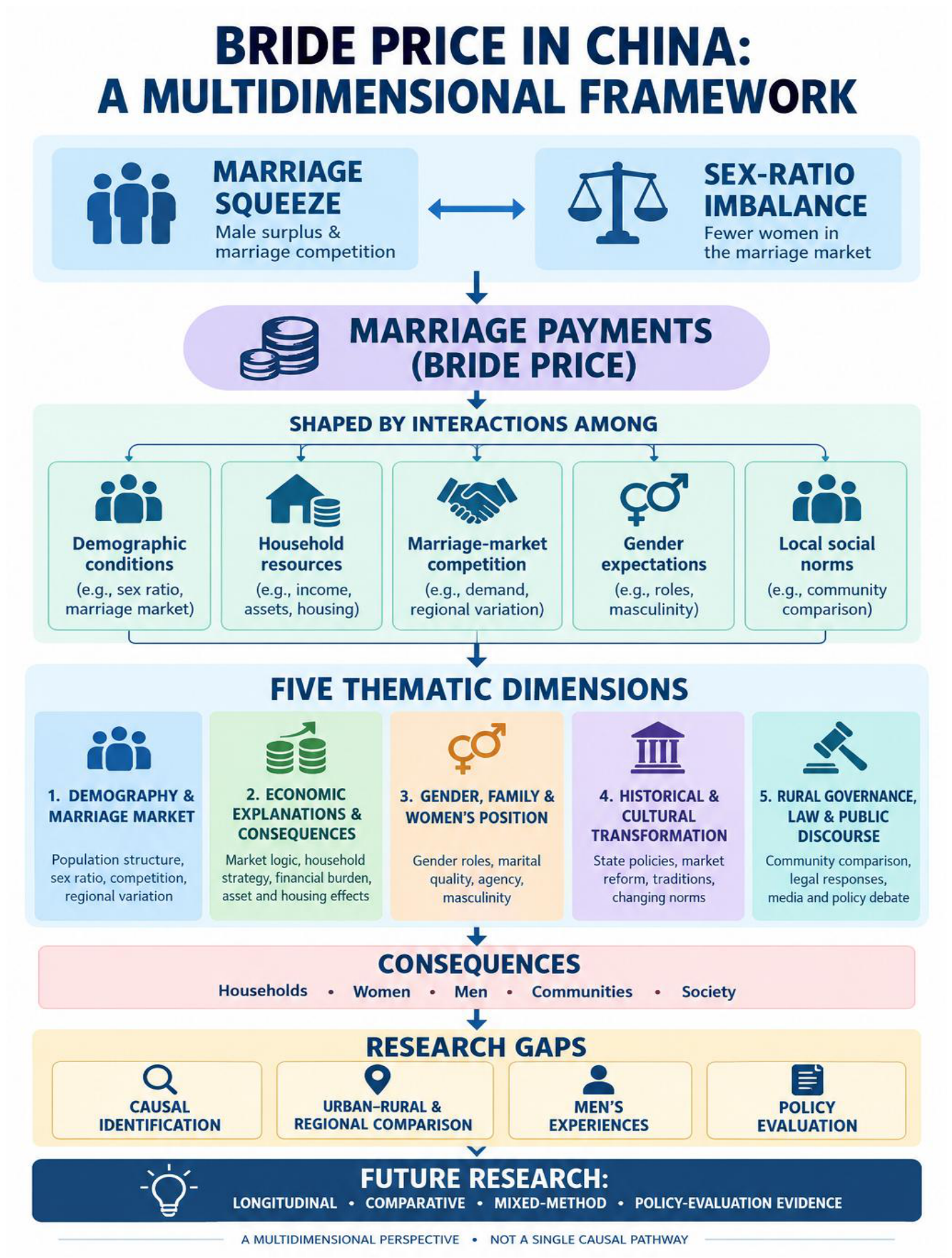
The corpus can be broadly organized around several interconnected themes: demographic and marriage-market explanations; economic and household determinants; gender and family relations; social and regional variation; and policy, legal and social consequences. These themes overlap because the level of bride price is unlikely to be explained by a single factor. Demographic conditions may influence competition in marriage markets, while household wealth, housing requirements and local social expectations can affect the amount families are willing or expected to provide. Cultural norms and family strategies may subsequently reinforce or modify these economic pressures.

Table 1.
summarizes the thematic classification of the reviewed literature and identifies the dominant approaches represented within each area. This classification provides the basis for the thematic synthesis that follows, while recognizing that several publications address more than one theme.
Table 1.
summarizes the thematic classification of the reviewed literature and identifies the dominant approaches represented within each area. This classification provides the basis for the thematic synthesis that follows, while recognizing that several publications address more than one theme.
| Theme | Approx. no. of studies | Representative studies | Dominant approach |
|---|---|---|---|
| Demographic foundations of the marriage squeeze | 13 | Poston & Glover (2004); Li et al. (2005); Jiang et al. (2011); Huang (2014); Rossi & Xiao (2025) | Projections, census and survey analysis |
| Economics of marriage payments | 10 | Anderson (2007); Zhang et al. (2012); Li & Li (2021); Xu (2022); Feng et al. (2024) | Econometric and panel or survey studies |
| Gender, family and women’s position | 6 | Chen & Pan (2023); Wan (2024); Li et al. (2023); He (2024); Han et al. (2026) | Qualitative and mixed methods, survey analysis |
| Historical and cultural transformation | 7 | Fang (1990); Watson & Ebrey (1992); Zhang (2000); Nivard (2017) | Ethnography, history, descriptive accounts |
| Rural governance, law and public discourse | 10 | Gong et al. (2018); Guo (2021); Pißler (2026); Ma (2024a, 2024b); Xie et al. (2026) | Case studies, legal and discourse analysis |
Note: several studies span themes; counts reflect primary coding.
Figure 1.
A Multidimensional Framework for Understanding Bride Price in China.
4. Thematic Synthesis
4.1. Demographic Foundations: The Marriage Squeeze
Early work on fertility decline and the marriage market anticipated the consequences of son preference and sex-ratio imbalance (Guo & Deng, 1996; Li et al., 2005; Poston & Glover, 2004). China’s persistent imbalance in the sex ratio at birth and the resulting cohort structure created a demographic environment in which the number of men seeking marriage could substantially exceed the number of women available in particular marriage markets. Projections show a growing male surplus in the marriage market (Jiang et al., 2011; Li, 2010; Li et al., 2014), and Huang (2014) and Jiang and Li (2024) consolidate the evidence on gender imbalance. This demographic perspective provides one of the most frequently cited explanations for rising marriage competition and increasing financial expectations placed on prospective grooms.
Village-level and exploratory surveys document “bare branches,” referring to men who are unlikely to marry, and shifting union-formation patterns in rural areas (Attané, 2020; Jin et al., 2013). These studies suggest that the consequences of the marriage squeeze are not distributed evenly across the population. Men with limited economic resources, those living in areas with particularly imbalanced marriage markets, and those with fewer opportunities for geographic or socioeconomic mobility may face greater difficulty forming unions. Regional differences among unmarried men are examined by Chengliang (2022), while Eklund (2013) considers the policy implications through the concept of an “ecology of choice.”
Importantly, more recent research complicates the simple assumption that a shortage of women automatically produces a corresponding increase in marriage demand among men. Rossi and Xiao (2025), for example, ask whether the observed male surplus should instead be understood partly through mismatch, changing preferences and decisions to opt out of marriage. Recent empirical evidence similarly suggests that the relationship between local sex ratios and marriage payments can vary across marriage cohorts and between different forms of marriage payment (Du, 2025). Thus, demographic imbalance provides an important structural condition, but it does not by itself explain the amount of bride price or the decision of individuals to marry.
4.2. Economic Explanations and Consequences
Economic accounts treat bride price as a price in a competitive marriage market, as an inter-family transfer, or as a signal of economic status and commitment, in line with the comparative logic of Anderson (2007). From a marriage-market perspective, bride price may respond to the relative bargaining positions of men and women and to the availability of potential spouses. From a household perspective, it may represent a transfer between families that is connected to wealth, expected future support, housing and the economic formation of the new household.
Empirical evidence links payments to sex imbalance and preferences for sons (Xu, 2022), to household income (Li & Li, 2021), to marriage distance and love matches (Lyu & Zhang, 2021), and to broader economic conditions ranging from trade liberalization (Feng et al., 2024) to housing markets (Zhang et al., 2012). More recent county-level evidence also indicates that the relationship between local sex ratios and marriage payments may differ across cohorts, suggesting that demographic conditions interact with changing economic and social institutions rather than producing a fixed effect on bride price (Du, 2025). This is important because it cautions against interpreting the rise of bride price as the consequence of demographic imbalance alone.
Broader studies of the economics of marriage (Gao et al., 2022) and marriage expenses (Jiang et al., 2015; Bairuiyang, 2023; Luo, 2024) describe a substantial financial burden on grooms’ families. Housing and other marriage-related expenditures can reinforce this burden because families may regard financial resources and property ownership as prerequisites for establishing an independent household. Jiang and Sánchez-Barricarte (2012) therefore emphasize the possibility that high marriage payments can obstruct marriage for economically disadvantaged men.
The economic consequences may also extend beyond the immediate transfer between two families. If households borrow, liquidate assets or increase savings to meet marriage expectations, bride price can affect consumption, investment and household financial security. Recent research among young male migrant workers similarly reports an association between high-bride-price regions and lower marriage and parenthood expectations, particularly among lower-income and less-educated men. Overall, the literature suggests that bride price should be understood not simply as a one-time payment but as part of a broader package of marriage-market and household economic decisions.
4.3. Gender, Family and Women’s Position
A second body of work asks who benefits from and is affected by bride price. Studies examine its relationship with gender roles (Chen & Pan, 2023), marital quality and urban–rural differences (Li et al., 2023), and women’s position between money and intimacy (Wan, 2024). This literature challenges interpretations that treat bride price exclusively as a financial burden on men or as a straightforward benefit to women. The social meaning of the payment may differ depending on whether the money is retained by the bride’s parents, transferred to the bride, invested in the new household, or combined with other forms of family support.
Wan (2024), for example, places bride price within the broader relationship between money, intimacy and women’s position in contemporary Chinese marriage. This perspective highlights a tension between the economic and relational dimensions of marriage payments. On one hand, bride price can be interpreted as recognition of women’s value and as a transfer that may increase the resources available to the bride or the couple. On the other hand, when the payment becomes highly commercialized, it may reinforce perceptions of marriage as an economic transaction. Recent research therefore increasingly examines how women themselves negotiate, interpret and experience these arrangements rather than treating them as passive recipients.
Masculinity is another increasingly prominent lens. Marriage-squeeze pressures may encourage men to demonstrate their suitability as husbands through material provision, including the ability to provide a bride price, housing or other marriage-related resources (Driessen & Sier, 2019; He, 2024). In this sense, the financial expectations associated with marriage can become connected to masculine identity and social status. Men who cannot meet these expectations may experience not only an economic disadvantage but also difficulties in fulfilling locally defined expectations of adulthood and family formation.
Newer work explores negotiation, community norms and education effects (Han et al., 2026), suggesting that women and families are active participants rather than passive objects of exchange. The emerging literature therefore points toward a more relational understanding in which bride price is negotiated among prospective spouses, parents and wider communities. This also means that gender consequences may vary according to education, income, residence, family background and local marriage-market conditions. A more systematic examination of these differences would help move the literature beyond a simple male-burden versus female-benefit framework.
4.4. Historical and Cultural Transformation
Historical and ethnographic accounts show that marriage transactions have changed substantially with state campaigns, collectivization and market reform (Fang, 1990; Zhang, 2000; Watson & Ebrey, 1992). Rather than being a static cultural practice, bride price has repeatedly adapted to changing economic institutions, family structures and state policies. During periods of strong state intervention in family and marriage practices, traditional marriage customs could be restricted or publicly discouraged, while subsequent market reforms created new economic conditions under which marriage-related transfers could re-emerge.
Later work traces wedding customs across the decades (Nivard, 2017; Qiu, 2013), reintroduces “old traditions” of bride price to contemporary readers (Bepчeнкo, 2024), and documents its treatment in popular press coverage (Yuan, 2013). These studies demonstrate that contemporary discussions often reinterpret older practices through present-day concerns about money, family responsibility, gender equality and social status. Consequently, the meaning attached to a particular payment cannot necessarily be inferred from its historical form alone.
This historical perspective cautions against treating today’s bride price as either simply traditional or purely modern. Contemporary payments may contain elements of inherited cultural practice while simultaneously reflecting market competition, rising household wealth, housing expectations and changing patterns of family formation. The persistence of the practice may therefore represent continuity in form but considerable change in economic and social function. Understanding this distinction is important when evaluating claims that bride price is either an unchanged cultural tradition or a new phenomenon produced entirely by contemporary market conditions.
4.5. Rural Governance, Law and Public Discourse
Studies of villages and rural revitalization describe how high bride price forms through social exchange, community comparison and locally established expectations (Gong et al., 2018; Guo, 2021). In closely connected rural communities, families may compare marriage payments, wedding expenditures and housing arrangements with those of other households. Such comparison can contribute to a process in which individual families face pressure to match or exceed prevailing local standards. Bride price can consequently function not only as a private family decision but also as a visible indicator of household resources and social standing.
Recent contributions address legal and policy responses, including judicial interpretations on bride price (Pißler, 2026), governance toward “civilized” customs (Xie et al., 2026), and the moral reframing of bride price from ritual to profit and back to reason (Li, 2026). These developments demonstrate that the issue has increasingly entered the domain of public governance. Policy interventions may seek to reduce excessive marriage-related expenditures, protect households from financial pressure and encourage alternative forms of marriage practice. At the same time, regulation can raise questions about the boundary between legitimate cultural practices and forms of economic pressure that policymakers seek to discourage.
Discourse analyses show how state and social media frame bride price as either protecting or commodifying women (Ma, 2024a, 2024b). These competing interpretations are significant because the same practice can be described in very different ways depending on the perspective adopted. From one perspective, bride price may be framed as recognition of women’s contribution and protection of women’s interests; from another, excessive payments may be portrayed as the commodification of marriage or as a source of economic inequality. The newest work links economic precarity to gender antagonism, including the “anti-marriage turn” and structural gender contradictions (Huang & Holliday, 2026; Yuan & Liu, 2026).
5. Cross-Cutting Observations
Table 2.
Competing explanatory frameworks.
| Framework | Core claim | Illustrative studies |
|---|---|---|
| Marriage-market/squeeze | Male surplus bids up payments | Jiang & Sánchez-Barricarte (2012); Xu (2022) |
| Household economics | Payments reflect income, distance, and family strategy | Li & Li (2021); Lyu & Zhang (2021) |
| Macroeconomic and asset channels | Trade and housing conditions shape payments | Feng et al. (2024); Zhang et al. (2012) |
| Gender and masculinity | Payments reproduce gender roles and men’s pressure to provide | Driessen & Sier (2019); He (2024); Wan (2024) |
| Social norms and governance | Community comparison sustains inflation; interventions target custom | Gong et al. (2018); Xie et al. (2026); Pißler (2026) |
Table 3.
Methodological profile.
| Dimension | Observation | Implication |
|---|---|---|
| Design | Strong demographic and econometric core; qualitative work growing | Mechanisms are less well documented than correlations |
| Geography | Emphasis on rural areas and selected provinces | Urban and regional comparison is thin |
| Perspective | Focus on grooms’ families and women; fewer studies of men’s own accounts | Uneven voice |
| Sources | Mixture of journals, books, theses and preprints | Variable quality control |
6. Research Gaps and Agenda
Table 4.
Gaps and future directions.
| Gap | Suggested direction |
|---|---|
| Causal identification remains limited | Quasi-experimental designs, natural experiments and longitudinal panel data |
| Distributional effects are unclear | Track how payments affect poverty, debt, migration and marriage timing for grooms’ and brides’ families |
| Regional and urban–rural variation is under-studied | Multi-site comparative studies and standardized measures of payments |
| Policy evaluation is scarce | Assess caps, local campaigns and legal reforms with pre- and post-designs |
| Men’s and young people’s perspectives are limited | Qualitative and mixed studies of non-marriage, opting out and shifting attitudes |
| Discourse and behavior are studied separately | Link social-media narratives to actual payment negotiations |
7. Conclusion
Research on bride price in China has moved considerably beyond early demographic warnings about a growing male surplus and economic models of marriage-market competition toward more multidimensional accounts that incorporate gender, household strategy, socioeconomic inequality, community norms, historical change and public moral debate. The literature increasingly indicates that bride price should not be understood as a single, stable institution with one underlying cause. Rather, its level and meaning emerge from the interaction of demographic conditions, household resources, marriage-market competition, gender expectations and locally specific social norms.
The demographic literature identifies the marriage squeeze as an important structural condition, particularly in areas where the number of marriageable men exceeds the number of women. However, demographic imbalance alone does not determine the level of bride price. Economic circumstances, housing requirements, family wealth and expectations regarding household formation can modify how demographic pressure is translated into actual marriage payments. Recent evidence from China’s trade liberalization experience, for example, shows that changes in men’s earning capacity and women’s relative economic position can reduce bride price under particular economic conditions, demonstrating that marriage payments can respond to broader labor-market transformations as well as demographic pressures.
The literature also shows that the consequences of bride price are unevenly distributed. For some households, payments may function as an interfamily transfer or as resources that ultimately contribute to the formation of the newly married household. Anthropological research has documented changes in which family member controls the payment, including cases in which the bride increasingly becomes the recipient and uses the resources as part of the conjugal household. At the same time, high payments can create substantial financial pressure for families with sons, particularly where marriage expectations are closely connected to housing, status and visible household expenditure. Consequently, the same practice can represent economic support for one household while creating financial constraints for another.
Gender and family relations are similarly complex. Contemporary research demonstrates that bride price can simultaneously be interpreted as compensation associated with women’s labor and fertility, as an intergenerational transfer to newlyweds, and as a potentially contested form of economic exchange. Wan’s analysis of more than 100,000 Chinese court decisions demonstrates that the meaning assigned to bride price is associated with how payments are handled when an engagement or marriage dissolves, with rural–urban residence and the circumstances of the relationship also affecting repayment outcomes. These findings reinforce the importance of distinguishing between the amount of bride price, its intended recipient, its use within the household and its legal treatment after relationship dissolution.
Historical and ethnographic evidence further suggests that contemporary bride price should not be characterized simply as either an unchanged traditional custom or a completely new market phenomenon. Marriage transactions have been repeatedly transformed by state policies, collectivization, market reform and changing family relationships. Research on rural China shows, for example, that market reforms altered the organization and meaning of bridewealth while individuals themselves actively negotiated how payments were used and controlled. This historical perspective is particularly important when interpreting recent increases in payment levels because contemporary practices may combine older cultural expectations with new economic and social incentives.
For policymakers, these findings suggest that interventions focused only on reducing the nominal amount of bride price may not address the broader conditions that sustain marriage-related financial pressure. Demographic imbalance, regional inequality, housing costs, employment opportunities, family expectations and community comparison can operate simultaneously. Policy evaluation should therefore consider not only whether reported bride-price amounts decline, but also whether interventions affect marriage formation, household debt, women’s bargaining position, men’s economic security and the welfare of newly married couples.
Future research would benefit from stronger causal designs, broader comparative evidence and more systematic evaluation of policy interventions. Longitudinal household surveys could help distinguish temporary changes in payment levels from longer-term transformations in marriage behavior. Comparative studies across rural and urban areas, provinces and different socioeconomic groups could clarify why similar demographic conditions produce different marriage-payment patterns. Greater attention should also be given to unmarried men and women themselves, rather than relying primarily on family-level or aggregate indicators.
Overall, the existing literature indicates that China’s bride-price phenomenon is best understood as an intersection of demography, economics, gender, family relations, culture and governance. The next stage of research should therefore move beyond asking simply why bride price is high and examine when, for whom, and under what institutional and socioeconomic conditions marriage payments become financially burdensome, socially meaningful or contested. Such an approach would provide a stronger empirical foundation for understanding changing marriage practices in China and for assessing the effectiveness and unintended consequences of policy responses.
References
- Anderson, S. The economics of dowry and brideprice. The Journal of Economic Perspectives. 2007. Available online: https://pubs.aeaweb.org/doi/10.1257/jep.21.4.151.
- Attané, I. Changes in union formation patterns in a context of male marriage-squeeze: An exploratory survey in rural Shaanxi, China. In China Population and Development Studies; 2020; Available online: https://link.springer.com/10.1007/s42379-020-00060-8.
- Bairuiyang, B. The effects of bride price on the Chinese marriage market. Journal of Student Research. 2023. Available online: https://jsr.org/hs/index.php/path/article/view/3110.
- Chen, J.; Pan, W. Bride price and gender role in rural China. Heliyon. 2023. Available online: https://linkinghub.elsevier.com/retrieve/pii/S2405844022040774.
- Chengliang, L. Studies on China’s bachelors from the perspective of regional difference. 2022. Available online: https://www.taylorfrancis.com/books/9781003182757/chapters/10.4324/9781003182757-12.
- Driessen, M.; Sier, W. Rescuing masculinity: Giving gender in the wake of China’s marriage squeeze. In Modern China; 2019; Available online: https://journals.sagepub.com/doi/10.1177/0097700419887465.
- Eklund, L. Marriage squeeze and mate selection – Analysing the ecology of choice and implications for social policy in China; Lund University Publications, 2013; Available online: https://lup.lub.lu.se/record/4003022.
- Fang, Y. G. Marriage transaction in contemporary China. In UA Campus Repository; The University of Arizona, 1990; Available online: http://hdl.handle.net/10150/291940.
- Feng, Q.; Shangguan, Y.; Hao, W. Does opening up change customs? Evidence from trade liberalization and marriage payments in China. In Review of Development Economics; 2024; Available online: https://onlinelibrary.wiley.com/doi/10.1111/rode.13108.
- Gao, Z.; Pang, J.; Zhou, H. The economics of marriage: Evidence from China. In Humanities and Social Sciences Communications; 2022; Available online: https://www.nature.com/articles/s41599-022-01400-4.
- Gong, X.; Xin, Q.; Cong, J. Social lopsided exchange: On high bride price in rural areas – Taking Village X, Town Q in Heze County as an example. In Proceedings of the 2018 4th International Conference on Social Science and Higher Education (ICSSHE 2018), 2018; Available online: https://www.atlantis-press.com/article/25903728.
- Guo, J. Analysis of the formation mechanism of high bride price in rural areas in the context of rural revitalization strategy. In Scientific and Social Research; 2021; Available online: https://ojs.bbwpublisher.com/index.php/ssr/article/view/3429.
- Guo, Z.; Deng, G. A theoretical study on the marriage market: Perspectives on the marriage market in the process of fertility decline in China. PubMed. 1996. Available online: https://pubmed.ncbi.nlm.nih.gov/12291450.
- Han, B.; He, R.; Kane, D. Negotiating bride price in contemporary China: Gender identities, community norms, and education effects in marriage practices. Chinese Journal of Sociology. 2026. Available online: https://journals.sagepub.com/doi/10.1177/2057150.
- He, Y. Bride price and masculinity in China; University of Chicago, 2024. [Google Scholar] [CrossRef]
- Huang, K. Marriage squeeze in China. Journal of Family Issues. 2014. Available online: https://journals.sagepub.com/doi/10.1177/0192513.
- Huang, Q.; Holliday, R. The anti-marriage turn: Economic precarity and racialized grievance in the Chinese manosphere. Journal of Gender Studies. 2026. Available online: https://www.tandfonline.com/doi/full/10.1080/09589236.2026.2693073.
- Jiang, Q.; Li, S. Gender imbalance and marriage squeeze in China; Taylor & Francis, 2024; Available online: https://www.taylorfrancis.com/books/9781003433873.
- Jiang, Q.; Sánchez-Barricarte, J. J. Bride price in China: The obstacle to ‘bare branches’ seeking marriage. In The History of the Family; 2012; Available online: http://www.tandfonline.com/doi/abs/10.1080/1081602X.2011.640544.
- Jiang, Q.; Sánchez-Barricarte, J. J.; Li, S.; Feldman, M. W. Marriage squeeze in China’s future. In Asian Population Studies; 2011; Available online: http://www.tandfonline.com/doi/abs/10.1080/17441730.2011.608979.
- Jiang, Q.; Zhang, Y.; Sánchez-Barricarte, J. J. Marriage expenses in rural China. Project MUSE. 2015. Available online: https://muse.jhu.edu/pub/250/article/580762.
- Jin, X.; Liu, L.; Li, Y.; Feldman, M. W.; Li, S. “Bare branches” and the marriage market in rural China: Preliminary evidence from a village-level survey. Chinese Sociological Review. 2013. Available online: https://www.tandfonline.com/doi/full/10.2753/CSA2162-0555460104.
- Li, J.; Li, J. Bride price and household income: Evidence from rural China. Journal of the Asia Pacific Economy. 2021. Available online: https://www.tandfonline.com/doi/full/10.1080/13547860.2021.1940695.
- Li, N. 中国彩礼从”礼”到”利”再到”理”的异化与回归. Korean Chin. Relat. Rev. 2026. [Google Scholar] [CrossRef]
- Li, S. A study of China’s future marriage squeeze. Renkou Yu Fazhan. 2010. Available online: https://en.cnki.com.cn/Article_en/CJFDTOTAL-SCRK201003009.htm.
- Li, S.; Jiang, Q.; Feldman, M. W. The male surplus in China’s marriage market: Review and prospects. In INED Population Studies; 2014; Available online: https://link.springer.com/10.1007/978-94-017-8987-5_5.
- Li, S.; Jiang, Q.; Attané, I.; Feldman, M. W. Son preference and the marriage squeeze in China—An integrated analysis of the first marriage and remarriage market. 2005. Available online: http://citeseerx.ist.psu.edu/viewdoc/summary?doi=10.1.1.584.6321.
- Li, T.; Huang, J.; Xiong, Y. The influence of bride price on the marriage quality of Chinese women and its differences between urban and rural areas. Chinese Journal of Sociology. 2023. Available online: http://journals.sagepub.com/doi/10.1177/2057150.
- Luo, F. The cost of marriage in contemporary China. Journal of Education, Humanities and Social Sciences. 2024. Available online: https://drpress.org/ojs/index.php/EHSS/article/view/22713.
- Lyu, Q.; Zhang, L. Love match, marriage distance, and marriage payment: Evidence from rural China. Sustainability. 2021. Available online: https://www.mdpi.com/2071-1050/13/23/13058.
- Ma, J. Alignment, negation, and androcentricity: Representation of bride price by Chinese state media. Social Semiotics. 2024a. Available online: https://www.tandfonline.com/doi/full/10.1080/10350330.2024.2413565.
- Ma, J. Protection or commodification of women? Discursive construction of bridewealth on Chinese social media. In Feminist Media Studies; 2024b; Available online: https://www.tandfonline.com/doi/full/10.1080/14680777.2024.2356547.
- Nivard, J. Mirror of time: Chinese weddings through the decades; OpenEdition, 2017; Available online: https://cecmc.hypotheses.org/33750.
- Pißler, K. B. Die Brautpreisbestimmungen des Obersten Volksgerichts: Moderne Regelung eines traditionellen chinesischen Brauchs. Zeitschrift Für Chinesisches Recht. 2026. Available online: https://www.zchinr.org/index.php/zchinr/article/view/2394.
- Poston, D. L.; Glover, K. S. Too many males: Marriage market implications of gender imbalances in China. 2004. Available online: http://demoscope.ru/weekly/knigi/tours_2005/papers/iussp2005s50404.pdf.
- Qiu, Y. Chinese marriage traditions: Exploring contemporary changes. In Lund University Publications Student Papers; 2013; Available online: http://lup.lub.lu.se/student-papers/record/3994741.
- Rossi, P.; Xiao, Y. Left over or opting out? Squeeze, mismatch and surplus in Chinese marriage markets. Journal of Development Economics. 2025. Available online: https://linkinghub.elsevier.com/retrieve/pii/S0304387825001804.
- Wan, Y. Between money and intimacy: Brideprice, marriage, and women’s position in contemporary China. Demographic Research. 2024. Available online: https://www.demographic-research.org/articles/volume/50/46.
- Watson, R. S.; Ebrey, P. Marriage and inequality in Chinese society. California Scholarship Online. 1992. Available online: https://academic.oup.com/california-scholarship-online/book/28600.
- Xie, M.; Xue, G.; Liu, H. Contemporary bride price customs, practical dilemmas, and pathways to civilized governance; Zenodo, 2026. [Google Scholar] [CrossRef]
- Xu, Y. Paying for the selected son? Sex imbalance and marriage payments in China. SSRN Electronic Journal. 2022. Available online: https://www.ssrn.com/abstract=4022000.
- Yang, X.; Attané, I.; Li, S.; Yang, B. Title not provided in the supplied reference. In American Journal of Men’s Health; 2016; Available online: http://citeseerx.ist.psu.edu/viewdoc/summary?doi=10.1.1.830.8879.
- Yuan. Fit to be tied. 北京周报:英文版. 2013. Available online: http://www.cqvip.com/QK/61000X/201331/46543916.html.
- Yuan, D.; Liu, Z. Research on gender contradictions in contemporary China: Structural pressures, the negativity of marital surplus, and the gender projection of class contradictions. In OSF Preprints; 2026; Available online: https://osf.io/53ctn_v1.
- Zhang, C.; An, G.; Yu, X. What drives China’s house prices: Marriage or money? China & World Economy; 2012; Available online: https://onlinelibrary.wiley.com/doi/10.1111/j.1749-124X.2012.01293.x.
- Zhang, W. Dynamics of marriage change in Chinese rural society in transition: A study of a northern Chinese village. In Population Studies; 2000; Available online: https://www.tandfonline.com/doi/full/10.1080/713779064.
- Bepчeнкo, A. Л. Old traditions in contemporary China: The bride price. 2024. Available online: https://lk.iccaras.ru/assets/components/dsgfileupload/files/29b9eda0.pdf.
Disclaimer/Publisher’s Note: The statements, opinions and data contained in all publications are solely those of the individual author(s) and contributor(s) and not of MDPI and/or the editor(s). MDPI and/or the editor(s) disclaim responsibility for any injury to people or property resulting from any ideas, methods, instructions or products referred to in the content. |
© 2026 by the authors. Licensee MDPI, Basel, Switzerland. This article is an open access article distributed under the terms and conditions of the Creative Commons Attribution (CC BY) license (http://creativecommons.org/licenses/by/4.0/).
Copyright: This open access article is published under a Creative Commons CC BY 4.0 license, which permit the free download, distribution, and reuse, provided that the author and preprint are cited in any reuse.