

Submitted:
28 September 2026
Posted:
29 September 2026
You are already at the latest version
Abstract
Basalt and granite offer complementary opportunities for geological CO2 storage where conventional sedimentary reservoirs are limited or permanent mineral trapping and geothermal integration are priorities. This review examines how mineralogy, pore and fracture architecture and fluid-rock reactions control storage performance in these crystalline reservoirs. Basalt contains reactive olivine, pyroxene, plagioclase and volcanic glass that release Ca2+, Mg2+ and Fe2+, supporting carbonate precipitation. Field projects including CarbFix and Wallula demonstrate its potential for rapid mineralization. Granite is less reactive and has low primary porosity, making storage dependent largely on natural or engineered fractures. Feldspar alteration and integration with Enhanced Geothermal Systems may nevertheless support combined CO2 storage and heat extraction. In both lithologies, dissolution and secondary precipitation modify porosity, permeability and injectivity, creating a tradeoff between mineral trapping and sustained fluid flow. Laboratory experiments, field demonstrations and reactive transport models are evaluated to identify the principal controls on mineralization and reservoir performance. Key research needs include improved laboratory-to-field scaling, coupled hydrochemical and geomechanical modeling and dedicated granite field validation. Basalt and granite should therefore be considered complementary components of a diversified geological carbon storage portfolio.
Keywords:
CO2 storage
; basalt
; granite
; crystalline reservoirs
; mineral carbonation
; injectivity
; reactive transport
1. Introduction
Geological carbon storage is an important strategy for managing emissions from industries that are difficult to decarbonize. Most storage projects target deep saline aquifers and depleted hydrocarbon reservoirs because they provide substantial pore volume and established characterization methods. However, concerns related to pressure management, brine displacement, leakage pathways and long-term monitoring have encouraged investigation of additional geological options [1].
Basalt and granite are crystalline igneous rocks with contrasting storage properties. Basalt contains reactive olivine, pyroxene, calcium-rich plagioclase and volcanic glass. Their dissolution releases Ca2+, Mg2+ and Fe2+ that can react with dissolved inorganic carbon to form stable carbonate minerals [2,3]. Field projects provide evidence that this mechanism can operate under reservoir conditions. CarbFix demonstrated rapid mineralization following dissolved CO2 injection while Wallula confirmed carbonate formation after separate phase injection into continental flood basalt [4,5].
Granite is dominated by quartz and feldspars and provides fewer readily available divalent cations. It also has low matrix porosity and permeability, making fluid transport dependent largely on natural, weathered or engineered fractures [6,7]. These properties limit rapid mineralization and injection capacity but may provide storage opportunities in crystalline regions lacking suitable sedimentary formations. Granite may also support combined CO2 storage and geothermal heat extraction through Enhanced Geothermal Systems [8,9].
The contrasting mineralogical, geochemical and reservoir responses of basalt and granite are summarized in Figure 1. Existing reviews commonly examine basalt mineralization, granite fluid-rock interactions or conventional geological storage separately. Direct comparison remains limited, particularly regarding how mineral dissolution, secondary precipitation and structural evolution affect porosity, permeability, injectivity and storage security. This review addresses that gap by synthesizing laboratory, field and modeling evidence for both lithologies. It compares their mineralogical and structural controls, evaluates the coupling between geochemical reactions and reservoir performance and identifies research priorities for field deployment. Basalt and granite are considered complementary storage options rather than direct replacements for conventional reservoirs.
2. Review Scope and Approach
This critical narrative review evaluates experimental, field and modeling evidence for geological CO2 storage in basalt and granite. The scope is restricted to in situ storage in crystalline formations and associated geothermal applications. Ex situ mineral carbonation, mineralization in mine wastes and storage in sedimentary reservoirs are considered only where they provide a necessary comparison. Sources were retained when they reported mineral dissolution or precipitation, pore or fracture evolution, injectivity, containment, geomechanical response, field monitoring or storage-capacity assessment.
The evidence is organized into four categories: laboratory experiments, dedicated field demonstrations, numerical models and geological or geothermal analogues. Laboratory studies include batch, flow-through and hydrothermal experiments. Dedicated field evidence is represented principally by CarbFix and Wallula. Geothermal systems are treated as analogues for granite because they demonstrate fracture circulation, pressure response and seismic monitoring, but they do not directly verify permanent CO2 storage.
Evidence is interpreted according to its directness and scale. Field observations are given the greatest weight for demonstrated injectivity, mineralization and containment. Laboratory experiments establish mechanisms but may overstate field reaction rates because crushed samples and small cores expose greater reactive surface area. Numerical models support scenario analysis, but their conclusions depend on kinetic parameters, reactive surface area, fracture representation and calibration data.
This is not a systematic review or meta-analysis. Experimental conditions, reporting metrics and reservoir scales differ too widely for quantitative pooling. The synthesis therefore evaluates convergence among independent evidence types and distinguishes demonstrated outcomes from modeled projections and theoretical capacity estimates. The literature set is intended to support a focused mechanistic comparison rather than exhaustive bibliographic coverage.
3. Geological and Mineralogical Controls on CO2 Storage
Storage performance in crystalline rocks depends on mineral reactivity, pore or fracture architecture and access of CO2-rich fluids to reactive surfaces. Basalt generally combines reactive mafic minerals with vesicular and fractured flow units while granite contains less reactive felsic minerals and depends mainly on fractures for fluid transport.
3.1. Basalt Mineralogy and Reservoir Architecture
Basalt is composed primarily of plagioclase, pyroxene and variable proportions of olivine, volcanic glass and iron-titanium oxides. Olivine and glass are commonly among the most reactive phases while pyroxene and calcium-rich plagioclase provide additional Ca, Mg and Fe for carbonate formation. Reaction rates depend on temperature, pH, mineral composition, surface area and fluid residence time [10,11].
Basalt composition varies among volcanic provinces and individual lava flows. Olivine rich basalts may provide greater Mg and Fe availability while altered basalts may contain clays, zeolites or silica that coat mineral surfaces and compete with carbonates for released cations. Mineral abundance alone therefore does not determine storage potential; reactive phases must also be accessible to injected fluids [3,12].
Reservoir properties are controlled by the architecture of successive lava flows. Vesicular tops, brecciated contacts, cooling fractures and interflow zones commonly provide injection pathways while dense interiors and altered interbeds may restrict vertical migration. This layered structure can create alternating injection and containment intervals but permeability may vary substantially because of differences in vesicularity, fracture connectivity and burial history [5,13,14].
Dissolution may enlarge connected pores or fractures while carbonate, clay, zeolite and silica precipitation may reduce connectivity. The net hydraulic response depends on where reactions occur relative to dominant flow pathways. Basalt storage assessment must therefore combine mineralogical characterization with porosity, permeability and flow unit analysis.
3.2. Granite Mineralogy and Fracture Architecture
Granite consists primarily of quartz, alkali feldspar and sodium-rich plagioclase with smaller proportions of biotite, amphibole and accessory oxides. It contains fewer minerals capable of rapidly supplying Ca2+, Mg2+ and Fe2+ than basalt. Quartz is comparatively unreactive while feldspar dissolution is slow under most storage conditions [6,9].
Feldspar alteration releases Na+, K+, Al3+, dissolved silica and limited Ca2+. These components may form kaolinite, illite, dawsonite or minor carbonate phases depending on temperature, pressure and fluid chemistry. Biotite and amphibole may provide localized sources of Mg and Fe where they are exposed along fractures. Granite mineralization is therefore strongly dependent on local composition and fluid access.
Fresh granite has very low matrix porosity and permeability. Storage and transport depend on natural fractures, faults, weathered intervals or stimulated fracture networks. Fracture aperture, orientation and connectivity determine both injectivity and access to reactive mineral surfaces. Weathered or hydrothermally altered granite may provide improved flow capacity but commonly remains heterogeneous [7,9].
Fluid-rock reactions and pressure changes can modify fracture behavior. Feldspar dissolution may enlarge apertures while clay or carbonate precipitation may narrow them. Increasing pore pressure can open or reactivate fractures, improving injectivity but increasing seismic and containment risks. Granite storage consequently requires integrated hydraulic, geochemical and geomechanical assessment.
Granite may be relevant in crystalline regions without suitable sedimentary formations and may support combined storage and geothermal heat extraction. However, evidence remains primarily experimental and numerical rather than field validated. The principal geological and mineralogical differences between basalt and granite are summarized in Table 1.
As shown in Table 1, basalt and granite differ in both mineral reactivity and the structures controlling fluid migration. These differences determine their dominant storage mechanisms and hydraulic responses
4. Coupled Hydrochemical and Geomechanical Storage Mechanisms
CO2 storage in basalt and granite involves interconnected physical, chemical and mechanical processes. Following injection, CO2 may remain mobile, dissolve in formation water or react with primary minerals to form stable secondary phases. These processes can modify pore structure, fracture connectivity, injectivity and rock stability.
4.1. CO2 Dissolution and Fluid Acidification
Mineral trapping begins when injected CO2 dissolves in formation water and produces carbonic acid:
CO2 + H2O ⇌ H2CO3
H2CO3 ⇌ H+ + HCO3−
HCO3− ⇌ H+ + CO32−
The resulting decrease in pH promotes silicate dissolution and releases cations that may subsequently form carbonate minerals [2,15]. The extent of dissolution depends on pressure, temperature, salinity and fluid composition. Higher pressure generally increases CO2 solubility while salinity reduces it. Elevated temperature may decrease CO2 solubility but accelerate mineral reactions [3].
In basalt, acidified fluids react with olivine, pyroxene, plagioclase and volcanic glass within vesicles, fractures and permeable flow contacts. Dissolved CO2 injection can reduce buoyancy-driven migration and promote immediate fluid-rock interaction, as demonstrated by CarbFix, but it requires substantial water volumes [4,16].
In granite, fluid access is restricted mainly to connected fractures and altered zones. Quartz is relatively unreactive while feldspar dissolution is slow, making reaction extent sensitive to fracture surface area and residence time [6,7]. Rapid flow may preserve injectivity but limit reaction while slower flow may promote alteration and secondary precipitation.
CO2 dissolution provides aqueous-phase trapping and drives mineral alteration. Permanent immobilization requires subsequent primary-mineral dissolution and stable secondary-mineral precipitation.
4.2. Mineral Dissolution and Secondary Precipitation
Primary mineral dissolution supplies the cations required for carbonate formation. Hydrogen ions generated by CO2 dissolution attack mineral surfaces and release Ca2+, Mg2+, Fe2+ and dissolved silica. Reaction rates depend on mineral composition, pH, temperature, reactive surface area, fluid chemistry and residence time [2,11].
In basalt, olivine, pyroxene, calcium-rich plagioclase and volcanic glass are the principal reactive phases. Forsterite dissolution provides a simplified example:
Mg2SiO4 + 4H+ → 2Mg2+ + H4SiO4
Olivine releases Mg and Fe while pyroxene and plagioclase provide additional Ca, Mg and Fe. Volcanic glass can react rapidly because of its disordered structure and relatively high surface area. However, basalt composition and mineral accessibility vary among reservoirs and secondary coatings may progressively reduce reaction rates [3,12]:
Ca2+ + CO32− → CaCO3
Mg2+ + CO32− → MgCO3
Fe2+ + CO32− → FeCO3
These reactions produce calcite, magnesite and siderite and convert dissolved carbon into solid phases. Calcite may precipitate more readily than magnesite because magnesium carbonate formation commonly faces greater kinetic barriers. Experimental and field studies confirm carbonate formation during basalt-CO2 interaction but reaction rates and products vary with temperature, brine composition and flow conditions [4,5,17].
Carbonate precipitation competes with clay, zeolite and silica formation. These phases may consume cations that would otherwise contribute to carbonate formation. Mineralization capacity estimated only from bulk Ca, Mg and Fe content may therefore exceed the amount of CO2 actually immobilized [11].
Granite dissolution is dominated by feldspar alteration. Alkali feldspar and plagioclase release Na+, K+, Al3+, silica and limited Ca2+ while biotite and amphibole may provide localized Mg and Fe. Depending on fluid chemistry, these components may form kaolinite, illite, dawsonite and minor carbonate phases [6,9]. Extensive field-scale carbonate formation in granite has not yet been demonstrated.
The location of precipitation is as important as its total abundance. Minerals forming within stagnant pores may improve storage security without substantially affecting injectivity. Precipitation within pore throats, fracture constrictions or the near-well region may instead restrict flow. Dissolution may initially enlarge pores or fractures but this improvement can be offset by later precipitation. These contrasting pathways are illustrated in Figure 1 and their hydraulic consequences are examined in the following subsection.
4.3. Porosity, Permeability and Injectivity Evolution
Mineral dissolution and precipitation produce competing changes in reservoir transport properties. Dissolution can enlarge pores or fracture apertures while secondary minerals may narrow pore throats, seal fractures or coat reactive surfaces. The net response depends more on the location of reaction than on the total volume of minerals dissolved or precipitated [7,11,18].
Porosity and permeability do not necessarily change proportionally. Precipitation may cause only a small reduction in total porosity but a substantial permeability decline when it occurs within connected pore throats or fracture constrictions. Conversely, dissolution within isolated pores may increase porosity without improving flow. Permeability is therefore especially sensitive to pore connectivity and fracture aperture.
Injectivity represents the ability of a reservoir to accept fluid at a given pressure increase and may be expressed as:
where J is the injectivity index, q is the injection rate and ΔP is the pressure increase required to sustain flow. Declining injectivity may result from precipitation, salt formation, particle migration, fracture closure or pressure buildup. Increasing injectivity may reflect dissolution, fracture opening or improved flow connectivity. Pressure data must therefore be interpreted with chemical and mechanical observations.
J = q/ΔP
In basalt, dissolution may initially enlarge vesicles or connected pores while carbonate, clay, zeolite and silica precipitation may later restrict flow. Mineralization away from dominant flow pathways can improve storage permanence without severely reducing injection capacity. Precipitation near-wells or within critical pore throats can instead produce rapid injectivity decline [5,11].
Granite permeability depends primarily on fracture aperture and connectivity. Feldspar dissolution may enlarge fracture surfaces while clay or carbonate precipitation may narrow them. Pressure and effective stress may also open, close or reactivate fractures independently of geochemical alteration [6,7].
Fluid residence time controls the balance between reaction and transport. Rapid flow may preserve injectivity but limit mineralization while prolonged contact can enhance reaction and increase clogging risk. This tradeoff is illustrated conceptually in Figure 2. Monitoring injectivity together with effluent chemistry, mineralogy and pore or fracture imaging provides the strongest basis for distinguishing dissolution, precipitation and mechanical effects.
4.4. Geomechanical Response
CO2 injection changes pore pressure, effective stress and fracture behavior. These changes can modify permeability independently of mineral dissolution or precipitation. Effective stress may be expressed as:
where σ′ is effective stress, σ is total stress, Pₚ is pore pressure and α is the Biot coefficient. Increasing pore pressure reduces effective stress and may open fractures or cause slip along critically stressed discontinuities. This response can improve injectivity but may also increase induced seismicity and fluid migration risk; safe operation therefore requires site-specific pressure limits and fault-stability analysis [19,20].
σ′ = σ − αPₚ
In basalt, mechanical behavior varies among dense flow interiors, vesicular zones and fractured contacts. Pressure may improve connection among vesicles or fractures while excessive injection can reactivate faults or redirect flow. Dissolution may weaken mineral contacts and secondary precipitation may seal or strengthen fractures. Carbonate growth within confined pore spaces may also generate localized stress but its field-scale significance remains uncertain [3,5].
Granite is particularly sensitive to mechanical effects because flow depends on fractures. Increasing pore pressure may enlarge apertures while pressure decline may promote closure. CO2-rich fluids can also alter fracture surfaces through feldspar dissolution and secondary precipitation, affecting roughness, shear strength and hydraulic behavior [6,7].
Enhanced Geothermal Systems provide useful analogues for pressure management and seismic monitoring in granite. However, they do not directly demonstrate permanent CO2 storage because their fluids, temperatures and operational objectives may differ from dedicated storage projects [8,9].
Hydraulic responses cannot be attributed to geochemical reactions alone. Injectivity changes may result from precipitation, dissolution, compaction, fracture opening or shear displacement. Reliable interpretation requires combining pressure and flow measurements with effluent chemistry, deformation monitoring, microseismic observations and pre- and post-injection imaging.
5. Experimental, Field and Modeling Evidence
Evidence for crystalline CO2 storage comes from laboratory experiments, field demonstrations, geological analogues and numerical models. These approaches provide complementary information on reaction mechanisms, reservoir behavior and long-term performance.
5.1. Laboratory Evidence
Laboratory investigations commonly use batch, hydrothermal and flow through experiments. Batch studies identify dissolution products and potential secondary minerals but crushed samples may overestimate field reaction rates because they provide greater surface area and prolonged fluid contact. Flow through experiments better represent reservoir transport by measuring pressure, permeability, effluent chemistry and mineral alteration during fluid injection. However, small cores cannot reproduce field-scale heterogeneity or connected fracture networks [2,11].
Basalt experiments demonstrate dissolution of olivine, pyroxene, plagioclase and volcanic glass under acidic CO2-rich conditions. Effluent enrichment in Ca, Mg, Fe and Si provides evidence of primary mineral alteration while post-reaction characterization may identify carbonate, clay, zeolite or silica formation. Reaction rates generally increase with temperature and surface area but may decline as reactive minerals are depleted or secondary coatings develop [3,21].
Flow through experiments are particularly useful for connecting geochemical reactions to hydraulic performance. Changes in pressure difference and permeability can reveal pore opening or restriction while effluent chemistry indicates mineral dissolution. Post reaction X-ray diffraction, microscopy and pore imaging can identify secondary phases and their spatial distribution. Appiah et al. [17] used this integrated approach to investigate secondary mineral formation during basalt CO2 interaction under reservoir conditions.
Granite experiments generally show slower feldspar alteration and localized changes along fracture surfaces. CO2-rich fluids may release Na, K, Ca, Al and Si while promoting clay, dawsonite or minor carbonate formation. Hydrothermal conditions can accelerate feldspar dissolution and alter rock strength or fracture permeability but quartz remains comparatively resistant [6,9].
Laboratory evidence supports the proposed reaction mechanisms but does not reliably determine absolute field-scale rates. Grain size, reactive surface area, brine composition, residence time and fracture connectivity differ considerably among experiments. Future studies should use intact cores, representative formation fluids and reservoir relevant pressure and temperature while reporting standardized mineralogical, chemical and hydraulic measurements.
5.2. Field Demonstrations and Geological Analogues
Field projects provide the strongest evidence of injectivity, mineralization and containment under reservoir conditions. Basalt has been evaluated through dedicated injection projects while granite storage remains supported mainly by geothermal analogues, laboratory studies and numerical models.
CarbFix in Iceland provides the clearest evidence of rapid basalt mineralization. CO2 dissolved in water was injected into permeable basalt and monitored using chemical and isotopic tracers. Mass balance calculations indicated that more than 95 percent of the injected CO2 was mineralized within approximately two years [4]. Dissolved phase injection reduced buoyancy-driven migration and promoted immediate contact with reactive minerals. However, the method requires substantial water and its performance may not transfer directly to less permeable or more altered basalts.
CarbFix2 extended this approach by injecting CO2 and hydrogen sulfide captured from geothermal emissions into high-temperature basalt. The project demonstrated the potential to integrate mineral storage with geothermal energy and acid gas management [22,23].
The Wallula pilot injected a separate CO2 phase into the Columbia River Basalt Group. Post-injection samples confirmed carbonate formation within basalt vesicles and fractures, demonstrating mineral trapping under a different injection strategy from CarbFix [5,24]. The projects should not be assigned identical mineralization percentages or timescales because their injection methods, reservoir conditions and monitoring approaches differed.
Together, CarbFix and Wallula demonstrate that basalt mineralization can occur after either dissolved or separate phase injection. Dissolved injection may accelerate reaction and reduce plume buoyancy while separate phase injection can reduce water requirements. Selection should consider mineral reactivity, permeability, water availability, pressure behavior and monitoring capability.
No dedicated granite CO2-storage pilot is represented in the evidence reviewed here. Enhanced Geothermal Systems provide analogues because they involve fracture stimulation, fluid circulation and seismic monitoring within granitic reservoirs. These projects demonstrate that fracture networks can support fluid injection but also reveal risks related to pressure management, fracture closure and induced seismicity [7,8]. They do not directly establish long-term CO2 mineral storage.
Weathered or naturally fractured granite may provide greater injectivity than fresh crystalline rock but hydrocarbon accumulation or geothermal circulation alone does not demonstrate mineralization capacity. A dedicated granite pilot must measure pressure, fracture behavior, fluid chemistry and post-injection mineral alteration before field feasibility can be established [9,25].
5.3. Modeling and Laboratory to Field Scaling
Geochemical and reactive transport models predict storage behavior beyond the spatial and temporal limits of experiments and field monitoring. Equilibrium models identify minerals that are thermodynamically capable of dissolving or precipitating but cannot determine how rapidly those reactions will occur. Supersaturation therefore indicates precipitation potential rather than confirmed mineral formation.
Kinetic models represent mineral dissolution and precipitation rates as functions of temperature, pH, fluid composition and reactive surface area, their reliability depends strongly on the selected rate laws and surface area estimates [26,27]. Values derived from crushed minerals may overestimate reservoir reactions where surfaces are inaccessible, coated by secondary minerals or isolated from dominant flow pathways [11,28].
Reactive transport models couple geochemical reactions with fluid flow and solute transport. In basalt, they commonly predict early dissolution of mafic minerals followed by carbonate and secondary silicate precipitation. The spatial distribution of these products determines whether mineralization promotes self-sealing or causes injectivity loss. Field observations from CarbFix and Wallula improve model calibration but their parameters should not be transferred directly to all basalt reservoirs [5,29].
Granite models predict slower feldspar alteration and greater formation of clays, dawsonite and minor carbonates. Because flow is concentrated within fractures, dual-porosity or dual-permeability approaches are more appropriate than uniform porous media models. These approaches distinguish rapid fracture flow from slower interaction with the surrounding matrix.
Adjimah et al. [25] applied a dual-permeability coupled model to fractured granite at St. Johns Dome. Their results showed that fracture connectivity and injection pressure strongly influence fluid migration, reservoir stability and storage performance. Coupled hydrochemical and geomechanical models can also distinguish precipitation-related permeability loss from fracture opening, closure or reactivation. However, they require detailed fracture, stress, kinetic and mechanical data that are rarely available.
Translating laboratory rates to reservoir scale remains a central uncertainty. Crushed samples expose fresh surfaces while intact rocks contain minerals that may be inaccessible to injected fluids. Secondary coatings further reduce surface availability. Effective reactive surface area should therefore be constrained using intact core experiments, imaging, effluent chemistry and field tracer data rather than geometric estimates alone [2,3].
Fluid residence time determines whether reaction or transport dominates. This relationship can be expressed using the Damköhler number:
where τₜᵣₐₙₛₚₒᵣₜ and τᵣₑₐction represent the characteristic transport and reaction timescales, respectively. Low Da indicates transport that is rapid relative to reaction, whereas high Da favors greater alteration before the fluid leaves the reactive region.
Da = τₜᵣₐₙₛₚₒᵣₜ/τᵣₑₐction
Basalt scaling must account for vesicular flow tops, fractures, dense interiors and altered interbeds that create preferential flow or bypass reactive minerals. Granite scaling is controlled by discrete fractures that may carry most of the injected fluid while leaving the matrix poorly contacted. Fracture aperture and connectivity can also evolve through pressure changes, dissolution and precipitation.
Reliable field prediction requires integrating pressure and flow measurements with tracers, effluent chemistry, mineralogical analysis, imaging and microseismic monitoring. Models should be calibrated against these observations and report uncertainty ranges rather than single mineralization rates or storage capacities. Basalt benefits from field datasets for calibration while granite predictions remain conditional until a dedicated storage pilot is completed. The strengths and limitations of the available evidence are summarized in Table 2.
As shown in Table 2, basalt storage is supported by converging laboratory, field and modeling evidence while granite remains supported primarily by experiments, geothermal analogues and conditional model predictions.
6. Engineering Design and Monitoring
Engineering design must balance injection capacity, mineral reaction, pressure management and long-term containment. Conditions that increase mineralization may also promote clogging or pressure buildup. Operations should therefore be adjusted using hydraulic, chemical and geomechanical monitoring.
6.1. Injection and Fluid Management
CO2 may be injected as a dissolved aqueous phase or as a separate free phase. Dissolved injection promotes immediate contact with reactive minerals and reduces buoyancy-driven migration, as demonstrated by CarbFix, but requires substantial water and surface infrastructure [4]. Separate phase injection can reduce water demand and was successfully tested at Wallula but introduces plume migration, multiphase flow and pressure management concerns [5].
Water availability is especially important for basalt storage. Seawater, produced water or compatible formation brines may reduce freshwater use but their salinity and dissolved ions affect CO2 solubility and secondary precipitation. High salinity generally reduces CO2 solubility while Ca, Mg, sulfate and other species may alter carbonate, clay or salt formation. Fluid compatibility testing should therefore precede injection [3].
Injection rate controls pressure, residence time and fluid-rock contact. High rates may maintain near-well flow but reduce reaction time and increase fracture reactivation risk. Low rates may enhance mineral alteration but concentrate precipitation within critical pathways. Step-rate testing, core flooding and reactive transport modeling should be used to define an acceptable operating range.
Temperature also produces competing effects. Elevated temperature generally accelerates silicate dissolution but can reduce CO2 solubility. Optimal conditions should balance aqueous CO2 availability with reaction kinetics rather than simply maximize temperature or pressure [21].
In basalt, injection intervals should contain accessible olivine, pyroxene, calcium-rich plagioclase or volcanic glass within connected vesicles or fractures. Distributed injection, alternating intervals or periodic rate adjustments may move reactive fluids beyond the near-well region before substantial precipitation occurs.
Granite requires targeting naturally fractured, weathered or altered intervals. Stimulation may improve access to feldspar-bearing surfaces but must remain below pressure thresholds for unwanted fracture propagation or fault reactivation. Step-rate tests, stress characterization and microseismic monitoring are therefore essential [7,9].
Proposed catalysts, enzymes or reactive additives should remain research tools until their stability, compatibility and environmental effects are demonstrated under reservoir conditions. The operational objective is distributed mineral trapping without unacceptable injectivity loss, rather than maximum early precipitation. This balance is illustrated in Figure 2.
6.2. Site Selection, Monitoring and Verification
A suitable crystalline reservoir must combine accessible reactive minerals, adequate injectivity and geological containment. Basalt and granite require different characterization priorities because their flow structures and geomechanical risks differ.
Basalt assessment should define the geometry of successive lava flows. Vesicular tops, brecciated contacts, cooling fractures and interflow zones commonly provide injection pathways while dense interiors and altered interbeds may restrict vertical migration. Core analysis, borehole logs, geophysics and hydraulic testing can identify these contrasts and determine whether permeable intervals are laterally connected [5,13,14].
Mineralogical characterization should quantify olivine, pyroxene, plagioclase, volcanic glass and preexisting alteration minerals. X-ray diffraction, electron microscopy and bulk geochemistry can estimate reactive cation availability and identify phases that may compete with carbonate formation. These results should be integrated with porosity, permeability and pore structure measurements.
Granite site selection should focus on fracture aperture, orientation and connectivity. Fresh granite with limited fractures is unlikely to provide sufficient injectivity while weathered or hydrothermally altered intervals may offer improved flow. Borehole imaging, seismic surveys, hydraulic testing and tracers are needed to distinguish connected storage pathways from potential leakage routes [6,9].
The in situ stress field is particularly important for granite. Stress measurements, fault mapping and baseline microseismic monitoring should establish pressure limits that preserve injectivity without reactivating critically stressed fractures. Containment assessment should also identify overlying low-permeability units and determine whether faults act as barriers or conduits [7].
Monitoring should be linked to expected storage mechanisms. Continuous pressure and flow measurements track hydraulic response but cannot independently identify its cause. Injectivity decline may reflect precipitation, salt formation, fracture closure or pressure buildup while increasing injectivity may indicate dissolution or fracture opening.
Geochemical monitoring provides evidence of reaction progress. Concentrations of Ca, Mg, Fe, Si, Na, alkalinity and dissolved inorganic carbon can indicate mineral dissolution and evolving carbonate saturation. Isotopic and nonreactive tracers constrain fluid residence time, dilution and migration. CarbFix demonstrated the value of combining tracers with aqueous chemistry to estimate CO2 transformation in basalt [4].
Permanent trapping is best confirmed through mineralogical evidence. Recovered core, cuttings or downhole samples may identify newly formed carbonates and their location within pores or fractures. Wallula demonstrated the importance of direct mineral identification following injection [5].
Geophysical methods including seismic imaging, electrical resistivity and borehole logging may track fluid distribution or reservoir alteration. Granite monitoring should include microseismic arrays and, where feasible, deformation measurements to detect fracture reactivation, opening or closure. These data should be interpreted with injection pressure, flow rate and coupled models.
At a minimum, long-term verification in both basalt and granite requires the following monitoring techniques: (1) continuous pressure and flow rate measurements at all injection and observation wells; (2) geochemical sampling to track changes in major cations (such as Ca, Mg, Fe, Na, K) and dissolved inorganic carbon; (3) recovery and analysis of core or cuttings both before and after injection to directly observe mineral alteration; (4) use of tracers to monitor fluid migration pathways; and (5) time-lapse geophysical imaging (such as microseismic, seismic reflection, or electrical resistivity tomography) to detect changes in reservoir structure and monitor containment. For granite, baseline and ongoing microseismic monitoring are especially important to track induced seismicity and fracture behavior. This minimum set of monitoring standards should be incorporated into all field pilots and demonstration projects to ensure robust, long-term verification of CO2 storage performance in crystalline reservoirs.
Baseline groundwater and soil gas measurements are needed to distinguish injection related changes from natural variability. Long-term security should be demonstrated using converging evidence from pressure stabilization, tracer behavior, fluid chemistry, mineral identification, geophysics and agreement between observations and model predictions. The principal engineering controls and monitoring priorities are summarized in Table 3.
6.3. Energy and Industrial Integration
Integrating CO2 storage with geothermal energy and industrial infrastructure may improve project economics and expand the use of crystalline reservoirs. Basalt and granite offer different opportunities because of their contrasting mineralization rates and reservoir structures.
Basalt storage can be coupled with geothermal operations where emissions, water handling systems and injection infrastructure already exist. CarbFix2 demonstrates this approach by injecting CO2 and hydrogen sulfide captured from geothermal emissions into basalt [23]. Industrial facilities located near continental basalt provinces may also benefit from shorter transport distances but proximity alone does not establish storage suitability. Regional assessments suggest substantial theoretical capacity in some continental basalt provinces, including China [30]. However, mineralogy, permeability, water availability and containment must still be demonstrated at each site.
Offshore basalt could provide large storage volumes and access to seawater for dissolved injection. However, subsea wells, pipelines, monitoring and regulatory responsibility introduce significant costs and uncertainties. Large theoretical offshore capacity has been proposed for deep-sea basalt, but injectivity, monitoring and containment remain site-specific; pilot validation is required before industrial deployment [14,31].
Granite may be integrated with Enhanced Geothermal Systems. Supercritical CO2 has been proposed as a heat extraction fluid within fractured granite while partial retention could contribute to storage [8]. This dual use may offset drilling and monitoring costs but creates competing objectives because geothermal circulation seeks fluid recovery while storage requires secure retention. Pressure, fracture evolution, mineral precipitation and induced seismicity must therefore be managed carefully [7,9].
Shared pipelines, compression systems and injection hubs may reduce costs for both lithologies. Existing wells or geothermal infrastructure should be reused only after confirming integrity and compatibility with CO2. Source location, transportation, fluid composition, water demand, energy use and monitoring obligations must be evaluated as one integrated system. The major engineering controls and monitoring requirements are summarized in Table 3.
Table 3 shows that basalt design emphasizes water management, reactive flow unit selection and control of precipitation while granite design emphasizes fracture characterization, pressure limits and seismic safety.
7. Comparison with Conventional Geological Reservoirs
Deep saline aquifers and depleted hydrocarbon reservoirs remain the principal targets for geological CO2 storage because they provide substantial pore volume, established injection technologies and extensive geological data. Their storage relies on structural, residual, solubility and mineral trapping while early containment depends strongly on caprock integrity and pressure management [1].
Saline aquifers can provide large regional capacity but injection increases reservoir pressure and displaces formation water [26]. Pressure buildup may limit usable capacity or promote fluid migration through faults, fractures or abandoned wells. Depleted hydrocarbon reservoirs offer known geology and existing infrastructure but legacy wells may provide leakage pathways and must be assessed for CO2 compatibility.
Basalt differs because mineral trapping can become important relatively early. Dissolution of mafic minerals releases Ca2+, Mg2+ and Fe2+ for carbonate precipitation, reducing mobile CO2 and potentially lowering long-term leakage risk [2,4]. However, basalt is operationally less mature, highly heterogeneous and may require substantial water for dissolved injection. Secondary precipitation can also reduce injectivity.
Granite provides a more limited alternative. Fresh granite lacks sufficient matrix permeability and its storage potential depends on fractures, weathered zones or geothermal infrastructure. Mineral trapping is slower than in basalt while pressure-induced fracture reactivation requires careful management [7,9,20].
These reservoirs should be viewed as complementary rather than competing options. Conventional formations provide the greatest near term maturity and pore volume. Basalt offers rapid mineral immobilization where reactive flow units and water are available while granite may provide niche opportunities in fractured or geothermal settings. Reservoir selection should be based on source location, accessible capacity, injectivity, containment and monitoring requirements. The principal differences among conventional, basalt and granite reservoirs are summarized in Table 4.
As shown in Table 4, conventional reservoirs remain distinguished by their infrastructure maturity, injectivity and regulatory familiarity, whereas basalt can achieve comparatively rapid mineral immobilization under favorable mineralogical, hydrological and injection conditions and granite provides a slower, fracture dependent option best suited to niche or dual use settings. None of these reservoir classes should be regarded as a substitute for the others; rather, they represent complementary components of a diversified geological CO2 storage portfolio.
8. Research Gaps and Deployment Priorities
Basalt and granite expand geological CO2 storage options but uncertainties remain concerning reaction rates, injectivity and field-scale performance. Basalt research must progress from successful pilots toward validation across diverse geological settings while granite requires a dedicated injection pilot to establish feasibility.
Laboratory-to-field scaling remains a central challenge. Crushed samples and small cores may overestimate reservoir reactions because they expose greater mineral surface area than intact rocks. Effective reactive surface area, fluid residence time and secondary coatings should be constrained using intact core experiments, imaging, effluent chemistry and field tracers [11,28].
The relationship between mineralization and injectivity also requires further investigation. Carbonate precipitation improves permanence but may restrict pore throats, fractures or the near-well region. Dissolution can improve flow but may weaken mineral contacts or alter fracture stability. Long duration experiments should combine pressure, permeability, deformation, chemistry and spatial imaging to determine where reactions occur.
Additional basalt pilots are needed in continental flood basalts, altered sequences and offshore formations. These projects should test the transferability of CarbFix and Wallula results while addressing water demand, saline injection fluids, reservoir heterogeneity and long-term injectivity [4,5,14].
Granite requires direct field validation. A pilot should measure fracture connectivity, pressure, microseismicity, fluid chemistry and mineral alteration before, during and after injection. The objective should be to determine whether sufficient storage volume and residence time can be achieved without unacceptable seismic risk or rapid fracture sealing [9,25].
Coupled hydrochemical and geomechanical models should represent fracture opening, closure and reactivation together with dissolution and precipitation. Granite models require dual-permeability representations while basalt models should capture contrasts among vesicular zones, fractures and dense flow interiors. Predictions should be calibrated against observations and reported with uncertainty ranges.
Monitoring must also be linked to expected storage mechanisms. Geochemical tracers and mineralogical observations are central to basalt while pressure and microseismic measurements are particularly important for granite. Economic and environmental assessments should include water sourcing, transportation, energy demand, monitoring duration and seismic risk rather than relying only on theoretical mineral capacity. The priority research needs are summarized in Table 5 and their relationship to technological development is illustrated in Figure 3.
As summarized in Table 5, basalt research should prioritize scaling, water management and preservation of injectivity while granite research should focus on fracture stability and direct field validation.
9. Conclusions
Basalt and granite provide complementary opportunities for expanding geological CO2 storage beyond conventional sedimentary reservoirs. Their performance depends on mineral composition, pore or fracture architecture, fluid chemistry and geomechanical behavior. Basalt contains reactive mafic minerals that release Ca2+, Mg2+ and Fe2+ for carbonate formation while granite contains fewer reactive cation sources and depends largely on fractures for fluid transport.
Basalt is the more mature crystalline storage option. Laboratory studies establish its dissolution and precipitation pathways while CarbFix and Wallula demonstrate field-scale mineralization using different injection strategies [4,5]. However, water demand, flow unit heterogeneity, brine composition and precipitation-related injectivity loss remain important constraints.
Granite remains an emerging and specialized option. Experiments and models demonstrate feldspar alteration and coupled fracture responses but dedicated field evidence is unavailable. Its most promising applications may involve fractured or weathered formations and integration with Enhanced Geothermal Systems. A field pilot is required to evaluate injectivity, fracture stability, mineral alteration and seismic risk [9,25].
To guide future research and validation, key criteria for a granite CO2 storage field pilot should include:
- Selection of a site with sufficiently connected natural or engineered fractures to support target injection rates, as determined through borehole imaging and hydraulic testing.
- Detailed characterization of the fracture network, including mapping of aperture, orientation, connectivity, and in situ stress fields to assess injectivity and containment risks.
- Installation of a comprehensive monitoring system, including continuous pressure and flow measurements, downhole and surface microseismic arrays for real-time tracking of induced seismicity, and baseline stress and deformation sensors to detect fracture propagation or reactivation.
- Implementation of geochemical monitoring to track changes in fluid composition, particularly concentrations of Ca, Na, K, Al, Si, dissolved inorganic carbon, and the detection of mineral dissolution or secondary precipitation products.
- Recovery and analysis of cores and cuttings pre- and post-injection to directly observe mineral alteration and the spatial distribution of precipitated phases in fracture zones.
- Use of tracers and time-lapse geophysical imaging to monitor fluid migration, identify preferential flow pathways, and distinguish between storage within fractures and loss to the matrix or unintended leakage routes.
- Assessment of long-term containment potential, including evaluation of regional caprock effectiveness and fault sealing behavior under elevated pore pressures.
- Collection of economic and operational data on injection rates, well integrity, and surface infrastructure performance to inform feasibility at industrial scale.
Meeting these criteria will provide robust technical and monitoring data critical to validating granite as a viable option for geological CO2 storage.
For both lithologies, the central engineering challenge is balancing mineral trapping with sustained injectivity. Hydraulic changes may result from dissolution, precipitation or mechanical fracture response. Reliable assessment therefore requires integrated pressure, flow, chemical, mineralogical, imaging and deformation measurements supported by coupled models.
Looking ahead, the most urgent research priorities for advancing the field are: (1) developing robust laboratory-to-field scaling methods to predict reservoir-scale reaction rates and surface area availability accurately; (2) establishing comprehensive, site-specific monitoring frameworks that integrate pressure, chemical, geophysical, and mineralogical data for both short- and long-term verification; and (3) improving coupled hydrochemical and geomechanical models that represent reactive transport, fracture evolution, and the interplay between chemical reactions and mechanical behavior. Focusing on these areas will help address key uncertainties and support the safe, effective deployment of CO2 storage in basalt and granite.
Crystalline reservoirs should complement rather than replace saline aquifers and depleted hydrocarbon reservoirs. Basalt can provide rapid mineral immobilization where suitable geology and water are available while granite may offer site-specific opportunities in fractured or geothermal settings.
Supplementary Materials
None.
Author Contributions
Conceptualization, J.M.A., E.A.A., A.-A.M. and W.A.; methodology, J.M.A. and E.A.A.; investigation and literature review, J.M.A., E.A.A., A.-A.M. and P.K.B.; data curation, J.M.A. E.A.A. and A.-A.M.; writing—original draft preparation, J.M.A. E.A.A and A.-A.M.; writing—review and editing, A.-A.M., W.A., P.K.B., N.S. and S.W.; visualization, J.M.A. and E.A.A.; validation, W.A., N.S. and S.W.; supervision, W.A., N.S. and S.W.; project administration, W.A. All authors have read and agreed to the published version of the manuscript.
Institutional Review Board Statement
Not applicable.
Informed Consent Statement
Not applicable.
Data Availability Statement
No new data were created or analyzed in this study. Data sharing is not applicable to this article.
Conflicts of Interest
The authors declare no conflicts of interest.
References
- Bachu, S.; Bonijoly, D.; Bradshaw, J.; Burruss, R.; Holloway, S.; Christensen, N. P.; Mathiassen, O. M. CO2 storage capacity estimation: Methodology and gaps. Int. J. Greenh. Gas. Control 2007, 1, 430–443. [Google Scholar] [CrossRef]
- Gislason, S. R.; Oelkers, E. H. Carbon storage in basalt. Science 2014, 344, 373–374. [Google Scholar] [CrossRef] [PubMed]
- Raza, A.; Glatz, G.; Gholami, R.; Mahmoud, M.; Alafnan, S. Carbon mineralization and geological storage of CO2 in basalt: Mechanisms and technical challenges. Earth-Sci. Rev. 2022, 229, 104036. [Google Scholar] [CrossRef]
- Matter, J. M.; Stute, M.; Snæbjörnsdóttir, S. Ó.; Oelkers, E. H.; Gislason, S. R.; Aradóttir, E. S.; Sigfússon, B.; Gunnarsson, I.; Sigurdardóttir, H.; Gunnlaugsson, E.; Axelsson, G.; Alfredsson, H. A.; Wolff-Boenisch, D.; Mesfin, K.; Taya, D. F. R.; Hall, J.; Dideriksen, K.; Broecker, W. S. Rapid carbon mineralization for permanent disposal of anthropogenic carbon dioxide emissions. Science 2016, 352, 1312–1314. [Google Scholar] [CrossRef] [PubMed]
- McGrail, B. P.; Schaef, H. T.; Spane, F. A.; Cliff, J. B.; Qafoku, O.; Horner, J. A.; Thompson, C. J.; Owen, A. T.; Sullivan, C. E. Field validation of supercritical CO2 reactivity with basalts. Environ. Sci. Technol. Lett. 2017, 4, 6–10. [Google Scholar] [CrossRef]
- Lo Ré, C.; Kaszuba, J. P.; Moore, J. N.; McPherson, B. J. Fluid–rock interactions in CO2-saturated, granite-hosted geothermal systems: Implications for natural and engineered systems from geochemical experiments and models. Geochim. Cosmochim. Acta 2014, 141, 160–178. [Google Scholar] [CrossRef]
- Isaka, B. L. A.; Ranjith, P. G.; Rathnaweera, T. D. The use of super-critical carbon dioxide as the working fluid in enhanced geothermal systems: A review study. Sustain. Energy Technol. Assess. 2019, 36, 100547. [Google Scholar] [CrossRef]
- Brown, D. W. A hot dry rock geothermal energy concept utilizing supercritical CO2 instead of water. In Proceedings of the Twenty-Fifth Workshop on Geothermal Reservoir Engineering, Stanford University, Stanford, California; pp. 233–238.
- Shu, B.; Chen, J.; Xue, H. Experimental study of the change of pore structure and strength of granite after fluid–rock interaction in CO2-EGS. Renew. Energy 2024, 220, 119635. [Google Scholar] [CrossRef]
- Gysi, A. P.; Stefánsson, A. CO2–water–basalt interaction: Low-temperature experiments and implications for CO2 sequestration into basalts. Geochim. Cosmochim. Acta 2012, 81, 129–152. [Google Scholar] [CrossRef]
- Kanakiya, S.; Adam, L.; Esteban, L.; Rowe, M. C.; Shane, P. Dissolution and secondary mineral precipitation in basalts due to reactions with carbonic acid. J. Geophys. Res. Solid Earth 2017, 122, 4312–4327. [Google Scholar] [CrossRef]
- Adam, L.; van Wijk, K.; Otheim, T.; Batzle, M. Changes in elastic wave velocity and rock microstructure due to basalt–CO2–water reactions. J. Geophys. Res. Solid Earth 2013, 118, 4039–4047. [Google Scholar] [CrossRef]
- McGrail, B. P.; Schaef, H. T.; Ho, A. M.; Chien, Y.-J.; Dooley, J. J.; Davidson, C. L. Potential for carbon dioxide sequestration in flood basalts. J. Geophys. Res. Solid Earth 2006, 111, B12201. [Google Scholar] [CrossRef]
- Snæbjörnsdóttir, S. Ó.; Wiese, F.; Fridriksson, T.; Ármansson, H.; Einarsson, G. M.; Gislason, S. R. CO2 storage potential of basaltic rocks offshore Iceland. Energy Procedia 2016, 86, 371–380. [Google Scholar] [CrossRef]
- Matter, J. M.; Broecker, W. S.; Gislason, S. R.; Gunnlaugsson, E.; Oelkers, E. H.; Stute, M.; Sigurdardóttir, H.; Stefánsson, A.; Alfreðsson, H. A.; Aradóttir, E. S. P.; Axelsson, G.; Sigfússon, B.; Wolff-Boenisch, D. The CarbFix pilot project: Storing carbon dioxide in basalt. Energy Procedia 2011, 4, 5579–5585. [Google Scholar] [CrossRef]
- Sigfússon, B.; Gíslason, S. R.; Matter, J. M.; Stute, M.; Gunnlaugsson, E.; Gunnarsson, I.; Aradóttir, E. S.; Sigurdardóttir, H.; Mesfin, K.; Alfredsson, H. A.; Wolff-Boenisch, D.; Arnarson, M. T.; Oelkers, E. H. Solving the carbon-dioxide buoyancy challenge: The design and field testing of a dissolved CO2 injection system. Int. J. Greenh. Gas. Control 2015, 37, 213–219. [Google Scholar] [CrossRef]
- Appiah, E.; Owusu, E.; Simmons, J.; Ge, X.; Wu, J.; Ma, X.; Wang, S. Experimental investigation of secondary mineral formation during CO2–basalt interaction under reservoir conditions. Paper SPE-CCUS-2026-4423733; Proceedings of the SPE/AAPG/SEG Carbon Capture, Utilization, and Storage Conference and Exhibition. The Woodlands, TX, USA, 30 March–1 April 2026. [Google Scholar] [CrossRef]
- Wolff-Boenisch, D.; Galeczka, I. M. Flow-through reactor experiments on basalt–(sea)water–CO2 reactions at 90 °C and neutral pH: What happens to the basalt pore space under post-injection conditions? Int. J. Greenh. Gas. Control 2018, 68, 176–190. [Google Scholar] [CrossRef]
- Rutqvist, J. The geomechanics of CO2 storage in deep sedimentary formations. Geotech. Geol. Eng. 2012, 30, 525–551. [Google Scholar] [CrossRef]
- Rutqvist, J.; Rinaldi, A. P.; Cappa, F.; Jeanne, P.; Mazzoldi, A.; Urpi, L.; Guglielmi, Y.; Vilarrasa, V. Fault activation and induced seismicity in geological carbon storage—Lessons learned from recent modeling studies. J. Rock Mech. Geotech. Eng. 2016, 8, 789–804. [Google Scholar] [CrossRef]
- Sissmann, O.; Brunet, F.; Martinez, I.; Guyot, F.; Verlaguet, A.; Pinquier, Y.; Daval, D. Enhanced olivine carbonation within a basalt as compared to single-phase experiments: Reevaluating the potential of CO2 mineral sequestration. Environ. Sci. Technol. 2014, 48, 5512–5519. [Google Scholar] [CrossRef] [PubMed]
- Gunnarsson, I.; Aradóttir, E. S.; Oelkers, E. H.; Clark, D. E.; Arnarson, M. Þ.; Sigfússon, B.; Snæbjörnsdóttir, S. Ó.; Matter, J. M.; Stute, M.; Júlíusson, B. M.; Gíslason, S. R. The rapid and cost-effective capture and subsurface mineral storage of carbon and sulfur at the CarbFix2 site. Int. J. Greenh. Gas. Control 2018, 79, 117–126. [Google Scholar] [CrossRef]
- Clark, D. E.; Oelkers, E. H.; Gunnarsson, I.; Sigfússon, B.; Snæbjörnsdóttir, S. Ó.; Aradóttir, E. S.; Gíslason, S. R. CarbFix2: CO2 and H2S mineralization during 3.5 years of continuous injection into basaltic rocks at more than 250 °C. Geochim. Cosmochim. Acta 2020, 279, 45–66. [Google Scholar] [CrossRef]
- White, S. K.; Spane, F. A.; Schaef, H. T.; Miller, Q. R. S.; White, M. D.; Horner, J. A.; McGrail, B. P. Quantification of CO2 mineralization at the Wallula Basalt Pilot Project. Environ. Sci. Technol. 2020, 54, 14609–14616. [Google Scholar] [CrossRef] [PubMed]
- Adjimah, J. M.; Ampomah, W.; Sibaweihi, N.; Alhassan, A. M. Geomechanical simulation of CO2 injection in fractured granite formations at the St John’s Dome (SJD): A dual-permeability coupled modeling approach. Paper SPE-CCUS-2026-4429663; Proceedings of the SPE/AAPG/SEG Carbon Capture, Utilization, and Storage Conference and Exhibition. The Woodlands, TX, USA, 30 March–1 April 2026. [Google Scholar] [CrossRef]
- Boison, P. K. N.; Ampomah, W.; Simmons, J. D.; Bui, D.; Sibaweihi, N.; Amosu, A.; Opoku Duartey, K. Geochemical Assessment of Long-Term CO2 Storage from Core- to Field-Scale Models. Energies 2025, 18, 4089. [Google Scholar] [CrossRef]
- Boison, P. K. N.; Ampomah, W.; Simmons, J.; Bui, D. Integrated Geochemical Modeling for CO2 Sequestration in the San Juan Basin, New Mexico. In Proceedings of the SPE Eastern Regional Meeting, Wheeling, WV, USA, 8–10 October 2024. [Google Scholar] [CrossRef]
- Aradóttir, E. S. P.; Sonnenthal, E. L.; Björnsson, G.; Jónsson, H. Multidimensional reactive transport modeling of CO2 mineral sequestration in basalts at the Hellisheidi geothermal field, Iceland. Int. J. Greenh. Gas. Control 2012, 9, 24–40. [Google Scholar] [CrossRef]
- Snæbjörnsdóttir, S. Ó.; Sigfússon, B.; Marieni, C.; Goldberg, D.; Gislason, S. R.; Oelkers, E. H. Carbon dioxide storage through mineral carbonation. Nat. Rev. Earth Environ. 2020, 1, 90–102. [Google Scholar] [CrossRef]
- Zhang, L.; Wen, R.; Li, F.; Li, C.; Sun, Y.; Yang, H. Assessment of CO2 mineral storage potential in the terrestrial basalts of China. Fuel 2023, 348, 128602. [Google Scholar] [CrossRef]
- Goldberg, D. S.; Takahashi, T.; Slagle, A. L. Carbon dioxide sequestration in deep-sea basalt. Proc. Natl. Acad. Sci. USA 2008, 105, 9920–9925. [Google Scholar] [CrossRef] [PubMed]
Figure 1.
Conceptual CO2 storage pathways in basalt and granite. Basalt mineralization is driven by dissolution of reactive mafic minerals and carbonate precipitation. Granite storage is controlled by fracture mediated transport, slower feldspar alteration and secondary mineral formation. Both pathways influence injectivity and containment. Conceptual synthesis based on Gislason and Oelkers [2], Lo Ré et al. [6], Isaka et al. [7] and Raza et al. [3].
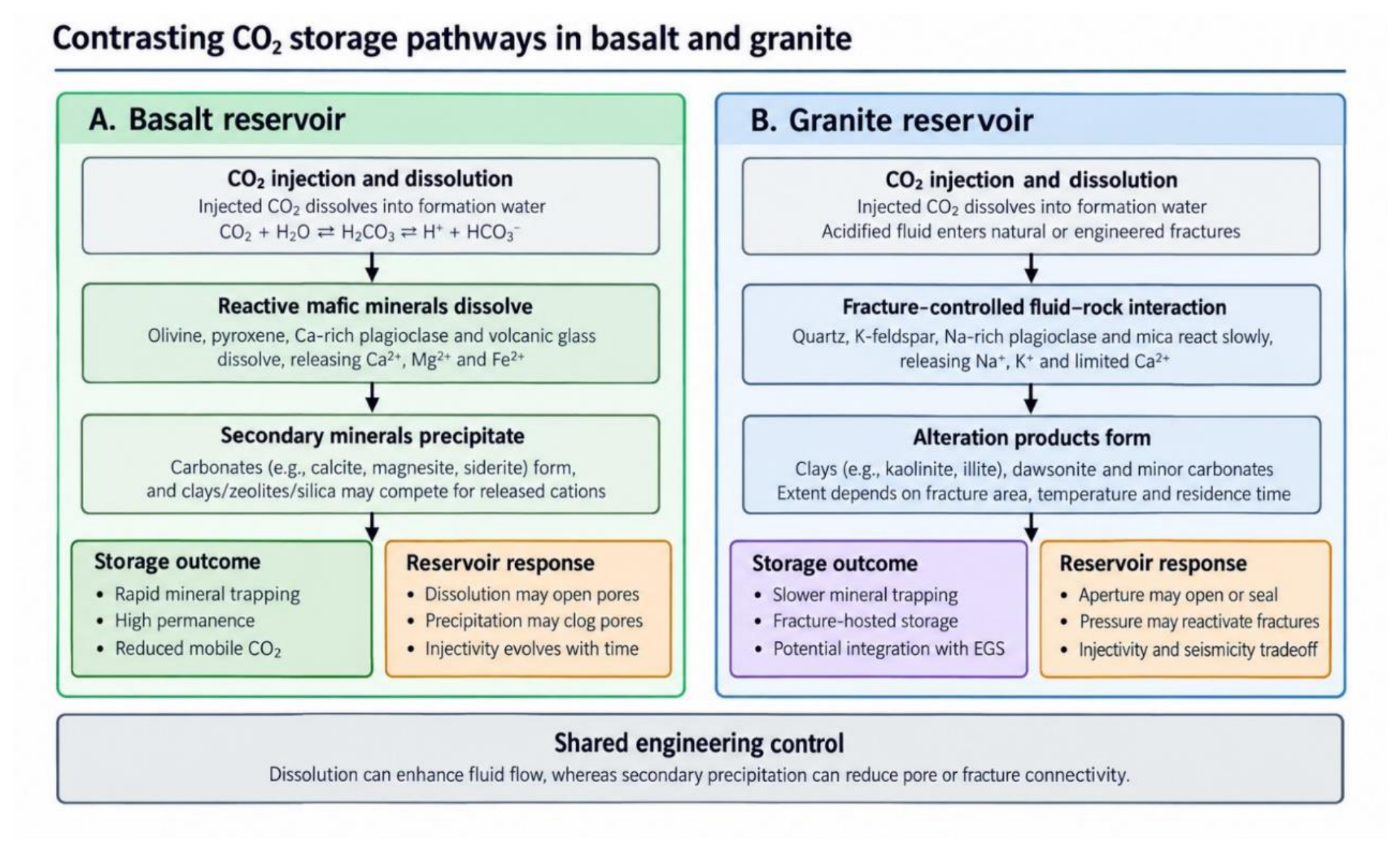
Figure 2.
Conceptual tradeoff between mineral trapping and injectivity. Dissolution may initially improve flow while continued precipitation within pores or fractures can reduce injectivity. The curves are qualitative and are not fitted to experimental data. Conceptual synthesis based on Kanakiya et al. [11], Isaka et al. [7], Raza et al. [3] and Shu et al. [9].
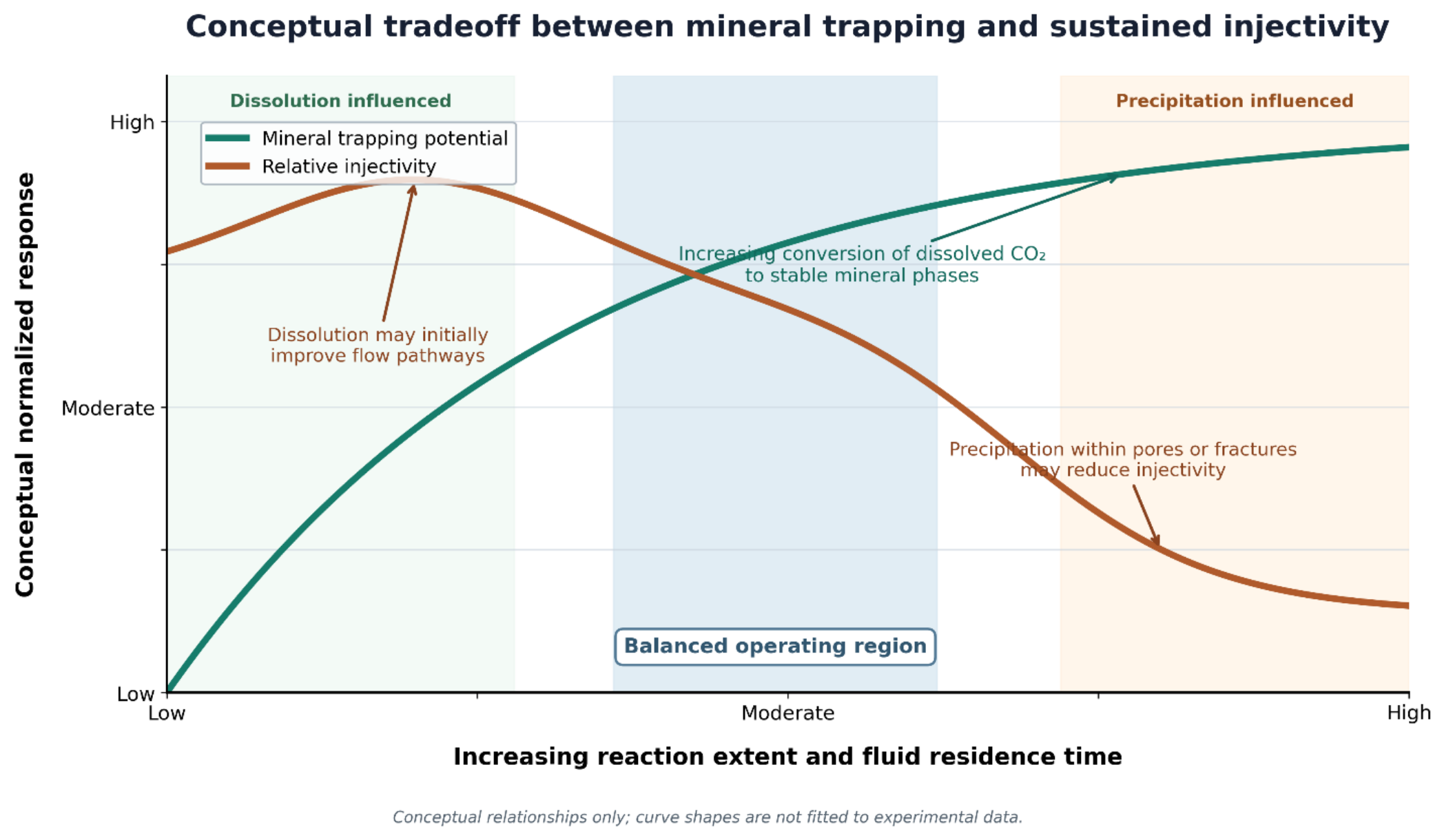
Figure 3.
Evidence and deployment roadmap for basalt and granite CO2 storage. Basalt has established laboratory and pilot evidence but requires validation across diverse geological settings. Granite requires a dedicated field pilot before broader deployment. Advancement depends on demonstrated injectivity, containment, geomechanical safety and monitoring performance. Conceptual synthesis based on Matter et al. [4], McGrail et al. [5], Shu et al. [9] and Adjimah et al. [25].
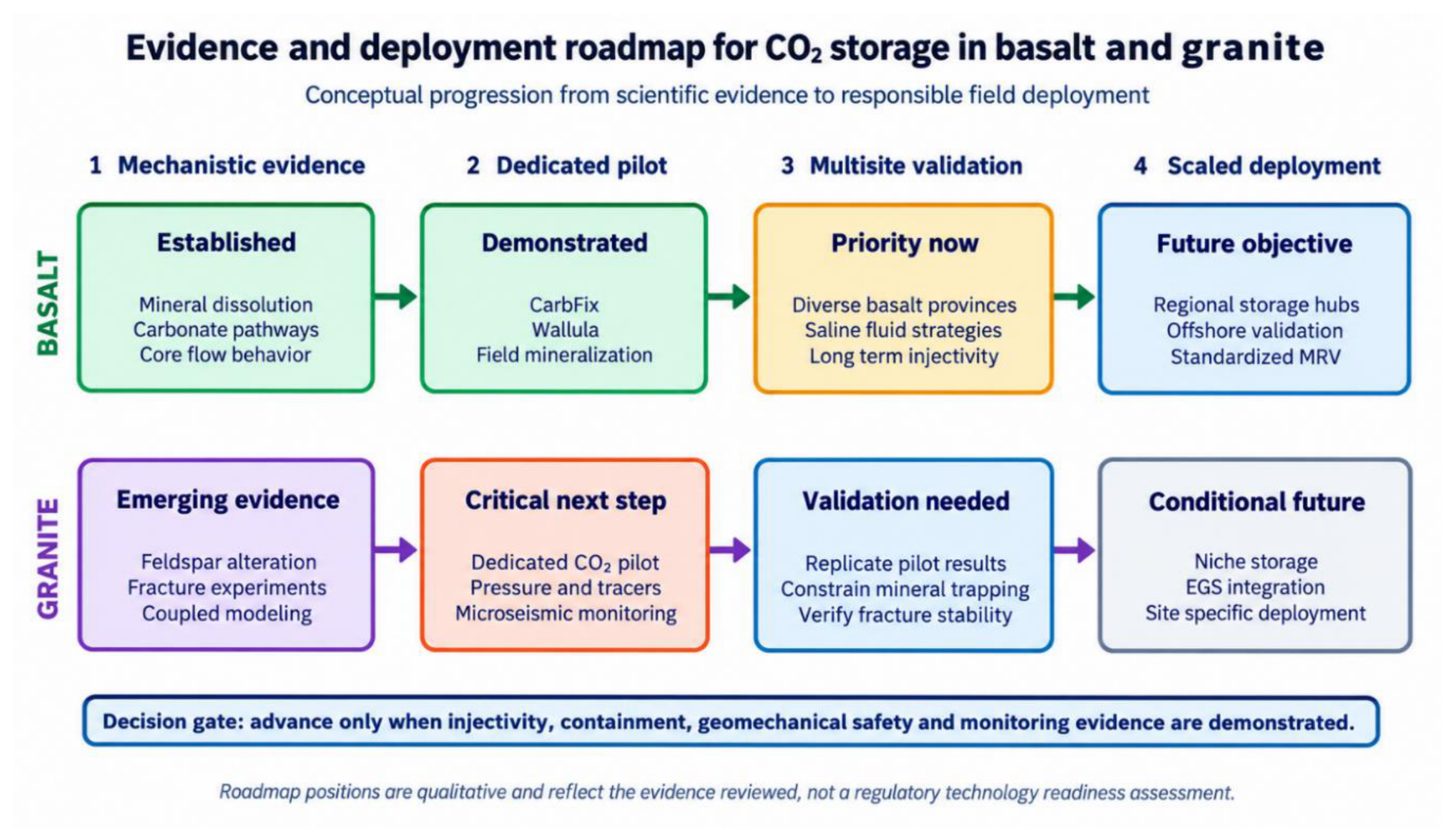

Table 1.
Comparative geological, mineralogical and reservoir characteristics of basalt and granite relevant to geological CO2 storage.
Table 1.
Comparative geological, mineralogical and reservoir characteristics of basalt and granite relevant to geological CO2 storage.
| Characteristic | Basalt | Granite | Storage implication |
| Dominant minerals | Plagioclase, pyroxene, olivine and volcanic glass | Quartz, alkali feldspar, plagioclase, biotite and amphibole | Basalt generally contains more sources of Ca2+, Mg2+ and Fe2+ |
| Relative reactivity | High for olivine and volcanic glass | Low because quartz and feldspars dominate | Basalt generally supports faster mineral dissolution and carbonation |
| Flow structure | Vesicles, fractures, brecciated zones and interflow contacts | Natural, weathered or engineered fractures | Granite injectivity depends strongly on fracture connectivity |
| Expected secondary minerals | Carbonates, clays, zeolites and silica | Clays, dawsonite and minor carbonates | Basalt favors carbonate formation while granite produces more aluminosilicate alteration |
| Hydraulic response | Dissolution may enlarge pores while precipitation may reduce connectivity | Dissolution or precipitation may open or narrow fractures | Both systems exhibit competition between mineralization and injectivity |
| Principal operational risk | Water demand, heterogeneity and precipitation-related clogging | Low injectivity, fracture reactivation and induced seismicity | Injection strategy must reflect mineralogy and reservoir structure |
| Monitoring priority | Tracers, fluid chemistry, mineralization and injectivity | Pressure, fracture behavior, microseismicity and mineral alteration | Basalt monitoring emphasizes mineralization while granite monitoring emphasizes fracture stability |
| Evidence maturity | Dedicated field projects including CarbFix and Wallula | Laboratory studies, models and geothermal analogues | Basalt has greater field validation |
Table 2.
Study-level comparison of laboratory, field and modeling evidence for CO2 storage in basalt and granite. Findings are reported as evidence from the cited studies, while the limitations and review relevance reflect the critical synthesis applied in this review.
Table 2.
Study-level comparison of laboratory, field and modeling evidence for CO2 storage in basalt and granite. Findings are reported as evidence from the cited studies, while the limitations and review relevance reflect the critical synthesis applied in this review.
| Study | Rock or system | Evidence and scale | Main finding | Principal limitation | Relevance to this review |
| Gysi and Stefánsson [10] | Basalt | Low-temperature laboratory experiments | Identified primary-mineral dissolution and secondary-phase formation during CO2-water-basalt interaction. | Laboratory surface area and residence time do not reproduce field-scale flow and heterogeneity. | Supports the reaction mechanisms used to interpret basalt mineralization. |
| Kanakiya et al. [11] | Basalt | Core-scale dissolution and precipitation study | Showed that dissolution and secondary precipitation modify pore structure and transport properties. | Core-scale responses may not represent connected field-scale flow units. | Supports the mineralization-injectivity tradeoff. |
| Wolff-Boenisch and Galeczka [18] | Basalt-seawater system | Flow-through reactor experiment | Demonstrated that post-injection reactions can alter basalt pore space under saline-fluid conditions. | Elevated temperature and controlled flow conditions restrict direct field transfer. | Provides evidence for water chemistry and permeability effects. |
| Matter et al. [4] | CarbFix basalt, Iceland | Field injection and tracer assessment | Reported more than 95% mineralization of injected CO2 within approximately two years. | Site-specific permeability and substantial water demand may limit transferability. | Provides the strongest direct evidence for rapid basalt mineralization. |
| Sigfússon et al. [16] | CarbFix injection system | Field-scale injection-system design and testing | Demonstrated dissolved-CO2 injection designed to reduce buoyancy-driven migration. | Requires water handling and surface dissolution infrastructure. | Supports comparison of dissolved and separate-phase injection. |
| Gunnarsson et al. [22]; Clark et al. [23] | CarbFix2 basalt, Iceland | Continuous field injection with geothermal integration | Demonstrated combined CO2 and H2S mineral storage within an operating geothermal system. | High-temperature geothermal conditions differ from many prospective basalt reservoirs. | Supports industrial integration while limiting broad extrapolation. |
| McGrail et al. [5]; White et al. [24] | Wallula flood basalt, USA | Pilot injection and post-injection assessment | Confirmed carbonate formation after separate-phase CO2 injection and subsequently quantified mineralization. | Evidence comes from one pilot and one continental basalt sequence. | Shows that basalt mineralization is not restricted to dissolved injection. |
| Lo Ré et al. [6] | Granite-hosted geothermal system | Geochemical experiments and modeling | Showed feldspar alteration and predicted clay, dawsonite and minor carbonate formation. | Does not demonstrate reservoir-scale injection, containment or permanent storage. | Provides the principal mechanistic evidence for granite geochemistry. |
| Shu et al. [9] | Granite in a CO2-EGS context | Laboratory fluid-rock interaction study | Measured changes in granite pore structure and strength after CO2-fluid interaction. | Short-duration laboratory results cannot establish field injectivity or seismic safety. | Supports coupled chemical and mechanical assessment of granite. |
| Adjimah et al. [25] | Fractured granite, St John’s Dome | Dual-permeability coupled numerical model | Showed that fracture connectivity and injection pressure control migration and geomechanical response. | Results remain model-dependent and lack validation by a dedicated granite storage pilot. | Directly supports the fractured-granite comparison and stated research gap. |
Table 3.
Principal engineering controls, risks and monitoring priorities for CO2 storage in basalt and granite.
Table 3.
Principal engineering controls, risks and monitoring priorities for CO2 storage in basalt and granite.
| Design consideration | Basalt | Granite | Management and monitoring priority |
| Target interval | Vesicular tops, brecciated contacts and permeable interflow zones | Naturally fractured, weathered or hydrothermally altered intervals | Integrate core analysis, borehole imaging and hydraulic testing |
| Injection strategy | Dissolved injection enhances reaction while separate phase injection reduces water demand | Injection depends on fracture flow and geothermal objectives | Select using fluid compatibility, pressure and flow modeling |
| Pressure and rate | Must account for permeability contrasts among flow units | Must remain below fracture reactivation thresholds | Apply step-rate tests and continuous pressure monitoring |
| Fluid chemistry | Controls CO2 solubility, carbonate formation and clogging | Controls feldspar alteration and secondary mineral formation | Monitor pH, salinity, dissolved ions and saturation state |
| Injectivity response | May reflect dissolution, precipitation or pressure redistribution | May reflect chemical alteration or fracture opening and closure | Combine hydraulic data with chemistry, imaging and deformation |
| Geomechanical risk | Fault reactivation and pressure communication among flow units | Induced seismicity and unintended fracture migration | Establish baseline stress and use microseismic monitoring |
| Storage verification | Tracers, fluid chemistry and carbonate identification | Fluid retention, fracture stability and gradual mineral alteration | Combine geochemistry, mineralogy, geophysics and model comparison |
| Energy integration | Geothermal emissions management and possible offshore storage | Enhanced Geothermal Systems | Evaluate fluid recovery, thermal behavior and infrastructure integrity |
Table 4.
Comparison of conventional sedimentary reservoirs with crystalline (basalt and granite) reservoirs for geological CO2 storage. The table summarizes differences in storage mechanism, reactivity, injectivity, operational risk, field evidence and deployment status.
Table 4.
Comparison of conventional sedimentary reservoirs with crystalline (basalt and granite) reservoirs for geological CO2 storage. The table summarizes differences in storage mechanism, reactivity, injectivity, operational risk, field evidence and deployment status.
| Feature | Conventional Reservoirs | Basalt | Granite |
| Reservoir type | Sedimentary formations with substantial pore volume (deep saline aquifers, depleted hydrocarbon reservoirs) | Fine grained to vesicular mafic volcanic rock with layered flow architecture | Coarse grained felsic igneous rock with very low matrix porosity |
| Dominant storage mechanism | Structural, residual and solubility trapping; mineral trapping occurs slowly | Mineral carbonation of olivine, pyroxene and plagioclase, generally rapid | Fracture controlled fluid transport with slower feldspar derived mineral trapping |
| Reactivity | Generally low; host rock reacts slowly with CO2-rich fluids | High; abundant divalent cations support rapid dissolution | Low; quartz is largely unreactive and feldspar dissolution is slow |
| Injectivity | Potentially high in sufficiently thick and permeable formations, but controlled by heterogeneity, pressure limits and well configuration | Controlled by vesicles, flow unit boundaries and fractures; can decline through self-sealing | Dependent on natural or stimulated fracture connectivity; often limited without stimulation |
| Trapping security | Relies on long-term caprock integrity and monitoring; leakage risk if seals are compromised | CarbFix and Wallula demonstrate carbonate formation under site-specific injection and reservoir conditions | Slower mineral trapping; containment depends more on structural sealing and fracture stability |
| Principal operational risk | Pressure buildup, brine displacement and leakage through faults or legacy wells | Water demand for dissolved injection, precipitation-related clogging and site heterogeneity | Fracture reactivation and induced seismicity; limited injectivity without stimulation |
| Field evidence maturity | Commercial scale projects (for example Sleipner, Quest, Boundary Dam) | Dedicated pilot and demonstration projects (CarbFix, CarbFix2, Wallula) | Supported mainly by geothermal analogues, laboratory studies and models; the evidence reviewed here includes no dedicated storage pilot |
| Scalability and global potential | Substantial capacity but limited to sedimentary basins with uneven geographic distribution | Very large potential in continental flood basalts and offshore provinces | Widespread occurrence but constrained by slower kinetics and fracture dependence |
| Industrial and energy integration | Established links with oil and gas infrastructure; enhanced oil recovery opportunities | Can be coupled with geothermal operations, as demonstrated by CarbFix2 | Potential dual use with Enhanced Geothermal Systems |
| Deployment status | Mature and commercially deployed under established regulatory frameworks | Emerging but advancing rapidly, with field validation at pilot scale | Early stage and largely experimental, pending dedicated field pilots |
Table 5.
Priority research gaps, required methods and expected engineering outcomes for CO2 storage in basalt and granite.
Table 5.
Priority research gaps, required methods and expected engineering outcomes for CO2 storage in basalt and granite.
| Research priority | Reservoir relevance | Required investigation | Expected outcome |
| Reactive surface area and scaling | Basalt and granite | Intact core experiments, imaging, tracers and calibrated models | More realistic field mineralization rates |
| Mineralization and injectivity | Basalt and granite | Long duration flow tests combining pressure, chemistry and imaging | Improved prediction of clogging, pore opening and self-sealing |
| Competing secondary minerals | Primarily basalt | Effluent analysis, saturation modeling and mineral characterization | Better prediction of carbonate, clay, zeolite and silica formation |
| Water and fluid chemistry | Primarily basalt | Testing of seawater, produced water and saline brines | Reduced freshwater demand and precipitation risk |
| Flow unit heterogeneity | Basalt | Borehole logging, core analysis, geophysics and tracer testing | Improved selection of permeable and reactive intervals |
| Fracture behavior and seismicity | Granite | Stress characterization, hydraulic testing and microseismic monitoring | Safe pressure limits and improved fracture management |
| Granite field validation | Granite | Dedicated pilot integrating hydraulic, chemical and mechanical monitoring | Direct evidence of injectivity, mineralization and containment |
| Coupled model validation | Basalt and granite | Calibration using laboratory and field observations with uncertainty analysis | More reliable predictions of long-term reservoir performance |
Disclaimer/Publisher’s Note: The statements, opinions and data contained in all publications are solely those of the individual author(s) and contributor(s) and not of MDPI and/or the editor(s). MDPI and/or the editor(s) disclaim responsibility for any injury to people or property resulting from any ideas, methods, instructions or products referred to in the content. |
© 2026 by the authors. Licensee MDPI, Basel, Switzerland. This article is an open access article distributed under the terms and conditions of the Creative Commons Attribution (CC BY) license (http://creativecommons.org/licenses/by/4.0/).
Copyright: This open access article is published under a Creative Commons CC BY 4.0 license, which permit the free download, distribution, and reuse, provided that the author and preprint are cited in any reuse.