

Submitted:
28 September 2026
Posted:
29 September 2026
You are already at the latest version
Abstract
The adaptive reuse of historic buildings is a conservation approach that integrates heritage protection with the principles of sustainable use; however, the effects of such interventions on users’ psychological experience have received limited attention. This study examines the effects of perceived restorativeness on sense of place and cultural heritage attachment, place satisfaction, and place identity in an adaptively reused historic building. The research was conducted at the Seljuk-period Bedriye Madrasa in Aksaray, Türkiye, which has been converted into a library, study space and café, using a convergent parallel mixed-methods design. Quantitative data obtained from 273 users were analysed with structural equation modelling (SEM), and qualitative data from open-ended questions were analysed through content analysis. The findings show that perceived restorativeness has significant positive effects on sense of place and cultural heritage attachment (β = 0.795), place satisfaction (β = 0.386) and place identity (β = 0.458), and that sense of place and cultural heritage attachment significantly predicts both place satisfaction (β = 0.257) and place identity (β = 0.252). The direct effect of place satisfaction on place identity and the hypothesised mediation paths were not supported. The qualitative findings corroborated the quantitative results, revealing that the historic atmosphere, quietness, natural stone texture and courtyard layout strengthen users’ mental restoration, calmness, concentration and sense of cultural belonging. The study demonstrates that the success of adaptive reuse projects should be evaluated not only through physical conservation criteria but also through users’ psychological experiences and the processes by which they form bonds with place.
Keywords:
adaptive reuse
; perceived restorativeness
; sense of place
; cultural heritage attachment
; place satisfaction
; place identity
; structural equation modelling
; mixed methods
1. Introduction
Historic buildings are not only heritage assets that carry the physical traces of past societies into the present; they are also fundamental components that shape the identity, collective memory and cultural continuity of cities. However, owing to the changing needs of social life, technological developments and shifting patterns of use, many historic buildings lose their original functions and, when left unused, face physical deterioration, functional obsolescence and problems of economic sustainability. Within the conservation discipline, adaptive reuse—an approach that aims to reintegrate historic buildings into contemporary life while preserving their authentic values—has become increasingly important. Adaptive reuse is recognised as a sustainable conservation strategy that ensures not only the physical preservation of buildings but also the continued presence of cultural heritage as a living value within social life. In Türkiye, too, the conversion of building types such as caravanserais (hans), madrasas, bathhouses (hammams) and mansions into libraries, cafés, cultural centres or study spaces has become a prominent field of practice.
Because of its contributions to environmental sustainability, the circular economy and heritage conservation, adaptive reuse has been widely discussed in the architecture and conservation literature [1,2,3]. Existing studies largely evaluate adaptive reuse through criteria such as the success of physical conservation, economic sustainability, energy performance, functional suitability and user numbers. Nevertheless, the psychological experience, emotional bonds and production of spatial meaning that adaptively reused historic buildings generate among their users have been addressed only to a limited extent. Yet the success of an adaptive reuse project is closely related not only to the survival of the building but also to the quality of the experiential, emotional and cognitive relationship that users establish with it [4].
Research in environmental psychology has long shown that the physical environment plays a decisive role in individuals’ cognitive processes, emotional states and behaviour. In particular, Attention Restoration Theory, developed by Kaplan and Kaplan, proposes that environments with certain characteristics reduce mental fatigue and support cognitive restoration. Although this theoretical approach was originally developed with reference to natural environments, a growing body of research indicates that it may also apply to museums, cultural venues and some historic settings. Even so, integrative models examining how perceived restorativeness shapes users’ psychological relationship with place in adaptively reused historic buildings remain scarce.
Similarly, although sense of place, place attachment and place satisfaction are among the most intensively studied concepts in environmental psychology, research explaining how these constructs interact in the context of historic heritage has not yet reached a sufficient level. Existing studies mostly treat these concepts independently; studies that examine perceived restorativeness, sense of place in the cultural heritage context and place attachment together within a single structural model are rare. In particular, empirical evidence on the direct and indirect effects of restorative experience on user satisfaction and place identity in adaptively reused historic buildings is limited.
To address this theoretical gap, the present study examines, through structural equation modelling, the relationships among users’ perceived restorativeness, sense of place and cultural heritage attachment, place satisfaction and place identity in the context of the Seljuk-period Bedriye Madrasa, which was adaptively reused as a library, study area and café following its restoration. In addition, open-ended user responses were analysed through content analysis in order to support the quantitative findings with users’ own experiences.
The study aims to make three main contributions to the literature. First, by addressing perceived restorativeness in adaptively reused historic buildings from an environmental psychology perspective, it brings a user-centred approach to the cultural heritage literature. Second, by examining the direct and indirect relationships among perceived restorativeness, sense of place, place satisfaction and place identity within a single structural model, it contributes to closing the theoretical gap in the existing literature. Finally, thanks to a convergent parallel mixed-methods approach combining quantitative and qualitative data, it explains the user experience of adaptively reused historic buildings in a multidimensional way and offers a scientific evaluation framework for future conservation and adaptive reuse practice.
2. Theoretical Framework
2.1. Perceived Restorativeness
The concept of the restorative environment is grounded in Attention Restoration Theory (ART), developed by Kaplan and Kaplan [5] and elaborated by Kaplan [6]. According to the theory, the cognitive demands of daily life gradually deplete individuals’ capacity for directed attention, resulting in mental fatigue. Environments with restorative properties, in turn, renew individuals’ cognitive resources and support psychological well-being. Kaplan [6] states that, for a restorative experience to occur, an environment must possess four key qualities: being away, fascination, extent and compatibility.
ART was initially developed to explain the effects of natural environments on individuals [7,8,9]. Subsequent studies, however, have shown that restorative experience is not confined to natural settings. Kaplan, Bardwell and Slakter [10] demonstrated that museums can have restorative qualities; Packer and Bond [11] showed that restorative dimensions are prominent in museum visitors’ experiences; and Bornioli, Parkhurst and Morgan [12] reported that certain urban settings can also contribute to subjective well-being. Scopelliti and Giuliani [13], moreover, drew attention to the fact that restorative experience varies according to life stage and type of place. Accordingly, it is now accepted that the key determinant of restorative experience is not whether an environment is natural or built, but how the user perceives and experiences it.
This approach provides an important theoretical basis for evaluating the user experience of adaptively reused historic buildings. Through their authentic spatial organisation, material textures, historical layers and an atmosphere distinct from everyday life, historic buildings can support the core components of restorative experience. In particular, the courtyard layout, controlled use of light, natural material texture and spatial legibility characteristic of the traditional madrasa typology may help users perceive the environment as both engaging and mentally restful. Historic buildings can therefore be regarded not only as heritage assets to be protected but also as environmental experience settings that support users’ cognitive restoration.
The transformation of conservation thinking in recent years has made user experience an important criterion for the success of adaptive reuse. Today, the conservation of historic buildings is associated not only with maintaining physical authenticity but also with users adopting, experiencing and integrating the building into their daily lives. The success of adaptive reuse should therefore be assessed not only through physical interventions consistent with conservation principles but also through how users perceive the environment. Interventions that preserve the authentic character of the historic building and integrate the new function harmoniously with the existing spatial identity are expected to strengthen perceived restorativeness. In line with this theoretical framework, perceived restorativeness is expected to exert significant effects on the other psychological constructs in the research model.
2.2. Sense of Place and Cultural Heritage Attachment
Sense of place refers to the totality of meanings that an individual attributes to a particular place together with the cognitive, affective and behavioural tendencies they develop towards it. Jorgensen and Stedman [14] define sense of place as a multidimensional construct composed of the cognitive, affective and conative components of an individual’s attitude towards a place, while Stedman [15] emphasises that the physical attributes of a place are decisive in the formation of these meanings. Sense of place is thus a product not only of individual experience but also of the interaction between the physical environment and the user.
In the cultural heritage context, sense of place is further strengthened by elements such as historical continuity, collective memory and cultural identity. Historic buildings are not merely physical environments belonging to past eras; they are meaning-laden places that convey the cultural values, ways of life and shared memory of societies to the present. The continued use of these buildings in daily life through adaptive reuse enables users to interact directly with the historic environment and thereby reinforces the meaning attributed to the place. It is therefore accepted that the sense of place formed in adaptively reused historic buildings rests not only on the physical environment but also on the cultural heritage values the building represents [16,17].
From the perspective of environmental psychology, the relationship between perceived restorativeness and sense of place can be regarded as two complementary processes. When users perceive the environment as restful, engaging and coherent, they attend more closely not only to the aesthetic qualities of the historic building but also to the historical and cultural meanings it carries. In other words, restorative experience strengthens the cognitive and emotional interaction that individuals establish with the environment and thereby contributes to a deepening of the meaning attributed to the historic building.
Sense of place is also known to influence how users evaluate a place. When users perceive a historic building not merely as a functional space but as part of cultural identity and urban memory, their satisfaction with the environment may increase. At the same time, a stronger relationship of meaning with the historic building may help users develop a stronger place identity with it over time. Sense of place and cultural heritage attachment is therefore considered one of the key psychological mechanisms explaining the relationships between perceived restorativeness and user outcomes.
2.3. Place Satisfaction
Place satisfaction refers to the overall level of satisfaction that results from users’ evaluation of the physical, functional and experiential characteristics of an environment against their expectations and needs. In environmental psychology and post-occupancy evaluation (POE) research, place satisfaction is regarded as one of the key indicators for evaluating the performance of the built environment for users [18]. In adaptively reused historic buildings, satisfaction is not limited to physical comfort or functional adequacy; users’ ability to experience the historical identity of the building, to perceive its authentic architectural character and the harmonious integration of the new function with the historic fabric are also important components of this evaluation process. Place satisfaction is therefore considered an important performance indicator of the user-centred success of adaptive reuse.
Perceived restorativeness is expected to influence users’ overall evaluations of the environment positively. In addition, a stronger cultural meaning attributed to the historic building also contributes to more favourable evaluations of the place. In other words, when users experience the environment as restful and meaningful, their satisfaction with the adaptively reused historic building increases. In this study, place satisfaction is regarded as an important user outcome shaped by the joint effect of perceived restorativeness and sense of place and cultural heritage attachment.
2.4. Place Attachment
Place attachment is a multidimensional concept that refers to the emotional, cognitive and behavioural bonds that develop over time between an individual and a particular place. Hidalgo and Hernández [19] define place attachment as the emotional closeness an individual develops towards a specific environment, while Williams and Vaske [20] address this bond in two main dimensions: place identity and place dependence. Place identity refers to a place becoming part of the individual’s self-concept, whereas place dependence refers to the individual finding that place more suitable than alternatives for carrying out particular activities. Later, Scannell and Gifford [21] explained place attachment within an integrative framework comprising person, psychological process and place dimensions, showing that this relationship develops not only in relation to the physical environment but also through individuals’ experiences and the meanings they attribute to the environment.
In adaptively reused historic buildings, place attachment is not merely the result of habits formed through prolonged use of the space. The psychological experiences users develop in relation to the historic building, the cultural meanings they attribute to it and their adoption of the building as part of their daily lives are also important components of this process. In other words, the fundamental aim of adaptive reuse is not only to preserve the historic building physically but also to establish a sustainable relationship between the user and cultural heritage. Place attachment can therefore be regarded as one of the important user outcomes for evaluating the long-term success of adaptive reuse projects.
In this context, perceived restorativeness is thought to influence place attachment directly. Historic environments perceived as supporting mental restoration, as engaging and as compatible with user expectations may help individuals develop positive experiences with the place and, over time, make these experiences part of their identity. However, restorative experience alone is considered insufficient; the cultural meanings users attribute to the place and their overall satisfaction with it are also thought to play a decisive role in the formation of this relationship. The present study therefore assumes that place identity is shaped by the joint effect of perceived restorativeness, sense of place and cultural heritage attachment, and place satisfaction.
In addition to the relationships tested in the structural model, whether the dimension scores differed by gender, age, education, occupation, visit frequency and purpose of use was examined within the scope of descriptive analyses. Consistent with the theoretical expectation that place attachment is a phenomenon that develops over time [21,22], visit frequency in particular was expected to be associated with attachment scores.
2.5. Research Model and Hypotheses
The theoretical model of the study is shown in Figure 1. In the model, perceived restorativeness is positioned as the exogenous variable; sense of place and cultural heritage attachment and place satisfaction as mediating and outcome variables; and place identity as the final outcome variable. On the basis of the explanations presented in the theoretical framework, the following research hypotheses were developed.
H₁.
Perceived restorativeness positively predicts sense of place and cultural heritage attachment.
H₂.
Perceived restorativeness positively predicts place satisfaction.
H₃.
Sense of place and cultural heritage attachment positively predicts place satisfaction.
H₄.
Perceived restorativeness positively predicts place identity.
H₅.
Sense of place and cultural heritage attachment positively predicts place identity.
H₆.
Place satisfaction positively predicts place identity.
H₇.
Sense of place and cultural heritage attachment mediates the relationship between perceived restorativeness and place satisfaction.
H₈.
Sense of place and cultural heritage attachment mediates the relationship between perceived restorativeness and place identity.
3. Materials and Methods
3.1. Research Design
This study was conducted using a convergent parallel mixed-methods design in which quantitative data were given priority and qualitative data assumed an explanatory, complementary role [23]. In this design, quantitative and qualitative data are collected simultaneously within the same research process, analysed independently of each other, and the findings are integrated at the interpretation stage. The main aim of the study was to test quantitatively the relationships among users’ perceived restorativeness, sense of place and cultural heritage attachment, place satisfaction and place identity in an adaptively reused historic building, and to explain these relationships in greater detail through users’ experiences using qualitative data obtained from open-ended questions.
A cross-sectional correlational survey model was adopted in the quantitative part of the study. Within this scope, the direct and indirect relationships among users’ perceived restorativeness, sense of place and cultural heritage attachment, place satisfaction and place identity were tested with structural equation modelling (SEM). In the qualitative part, responses to three open-ended questions placed at the end of the same data collection instrument were analysed using content analysis and treated as an explanatory data source supporting the interpretation of the quantitative findings.
Quantitative and qualitative data were obtained simultaneously from the same participants in a single data collection process; after each data type was analysed separately, the findings were integrated at the interpretation stage. This integration process strengthened the interpretive power of the study by allowing the statistical relationships obtained from the quantitative analyses to be supported by participants’ views [24].
3.2. Study Area
The study area is the Bedriye Madrasa, one of the important educational buildings of the Anatolian Seljuk period, located in the city centre of Aksaray, Türkiye, in Taşpazar Neighbourhood (block 338, parcels 2–4), at the intersection of 804th and 841st Streets, approximately 40 m south-west of the Cıncıklı Masjid. The restoration and adaptive reuse works carried out by Aksaray Municipality were completed in 2023, and the building began to serve as a library, study area, café and social space (Figure 2).
Used as an educational building for many years after its foundation, the madrasa was one of the important institutions where scholarly activities were carried out during the Seljuk and Ottoman periods. With the entry into force of the Law on the Unification of Education (Tevhid-i Tedrisat) in the Republican period, it lost its original educational function and, in the following period, fell out of use for various reasons, suffering considerable physical and functional deterioration. It constitutes a typical example of the loss of function and the problems of sustainable use observed in many historic educational buildings in Anatolia (Figure 3).
Architecturally, the Bedriye Madrasa has the open-courtyard plan scheme commonly seen in Anatolian Seljuk madrasas. Designed as a single-storey building, it consists of student cells and a classroom (dershane) arranged around a courtyard surrounded by arcades. With a usable area of approximately 510 m², the building was constructed of finely dressed stone; its plain façade composition, arcade system and courtyard-centred spatial organisation reflect the characteristic features of its period. The courtyard, which forms the focal point of the building, serves as a shared use and interaction area, while the arcades provide circulation. The student cells, in turn, were conceived as spaces allowing individual use. This plan organisation provides the spatial order required by the educational function while also supporting social interaction among users.
The main reason for selecting the Bedriye Madrasa as the study area is that it has been adaptively reused while preserving its historic identity and has become an active public space serving different user groups. Today the building is used for a variety of purposes, including studying, reading, individual work, socialising, experiencing the historic environment and café use. This multifunctional pattern of use provides a suitable research setting for the holistic examination of the relationships among perceived restorativeness, sense of place, cultural heritage attachment, place satisfaction and place identity. The Bedriye Madrasa therefore constitutes a representative case for the multidimensional evaluation of the user experience of adaptively reused historic buildings (Figure 4).
3.3. Study Group and Data Cleaning
The study group consists of individuals aged 18 and over who visited or actively used the Bedriye Madrasa during the three-month period covering May, June and July 2026. Participants were reached through convenience sampling; participation was voluntary, and no identifying information was requested from participants.
The raw dataset consisted of records belonging to 300 participants. During data cleaning, the demographic information, the responses to the 29 scale items and the answers to the open-ended questions were evaluated together. The examination revealed that 27 records were exact duplicates of earlier records; only the first record in each duplicate group was retained, and the repeated records were removed from the dataset. The analyses were thus carried out on data obtained from 273 participants.
To assess data quality, missing data, invalid values and response patterns were also examined. No missing data or values outside the 1–5 range were found in the Likert-type items.
Examination of the response patterns revealed that six participants had given the same response to all 29 items of the scale. However, the responses these participants gave to the open-ended questions were found to be meaningful, consistent and relevant to the research context; it was therefore decided not to classify these records automatically as low-quality data. Moreover, in a sensitivity analysis conducted after removing these six participants from the dataset (n = 267), no change was observed in the direction or statistical significance of the structural model results. The records in question were therefore retained in the final dataset.
The demographic characteristics of the study group are presented in Table 1.
The demographic characteristics of the study group represent a variety of user profiles who experience the adaptively reused historic building through different forms of use. Approximately half of the participants were in the 18–25 age group, and the fact that a substantial proportion were students indicates that the building is used intensively for education and study purposes. At the same time, the inclusion of participants from different educational levels and occupational groups shows that the user experience is not specific to a particular group.
The balanced distribution of visit frequency between first-time visitors and regular users allows both first impressions and user experiences that develop over time to be evaluated. Similarly, the balanced distribution of purposes of use among different activities such as studying, socialising, spending time in the café and experiencing the historic place shows that the Bedriye Madrasa is not a building serving a single function but a multifunctional public space that brings together users with different expectations and habits of use.
3.4. Data Collection Instruments
The data were collected through a structured questionnaire consisting of six demographic questions, a total of 29 Likert-type items belonging to four scales, and three open-ended questions. All scale items were rated on a five-point Likert scale (1 = strongly disagree, 5 = strongly agree). Scales widely used in the international literature and adapted into Turkish were employed, and two scales were developed by the researchers to measure constructs specific to the research context.
3.4.1. Place Attachment Scale
Place attachment was measured with the Abbreviated Place Attachment Scale (APAS), developed by Boley et al. [25] on the basis of the two-dimensional approach of Williams and Vaske [20]. The Turkish adaptation of the scale was carried out by Gültekin and Bulut [26]. The scale comprises six items in two dimensions: place identity and place dependence. In this study the items were adapted to the context of the Bedriye Madrasa; the place identity dimension measures users’ emotional belonging and identity relationship with the place, while the place dependence dimension measures their evaluations of the functional adequacy of the place.
3.4.2. Perceived Restorativeness Scale
To measure perceived restorativeness, an 11-item version of the Perceived Restorativeness Scale (PRS-11), developed by Hartig et al. [27] and shortened by Pasini et al. [28], was adapted to the research context. The items were adjusted with regard to the historic and architectural characteristics of the Bedriye Madrasa, and the scale covers the dimensions of being away, fascination and coherence–compatibility.
3.4.3. Sense of Place and Cultural Heritage Attachment Scale
To measure sense of place and cultural heritage attachment, a six-item scale was developed within the scope of the study, drawing on the sense-of-place approach of Jorgensen and Stedman [14] and the work of Dameria et al. [16] in the cultural heritage context. The scale items cover users’ perceptions and evaluations regarding the historical past of the Bedriye Madrasa, its cultural identity, its place in social memory, its adaptive reuse, and the preservation and transmission of cultural heritage to future generations.
3.4.4. Place Satisfaction Scale
To measure place satisfaction, a six-item scale was developed by the researchers with regard to the use characteristics of the Bedriye Madrasa. The scale items evaluate physical environmental conditions, cleanliness and maintenance, the adequacy of the services provided, the compatibility of the new function with the historic fabric, the overall user experience and the tendency to recommend the place to others. This scale is not an adaptation of a standard instrument; it was constructed to measure user satisfaction specific to the research context.
3.4.5. Open-Ended Questions
In the final section of the questionnaire, participants were asked three open-ended questions concerning the features of the place they liked most, their suggestions for improving the place, and the psychological effects of the time spent there. The qualitative data obtained were subjected to content analysis in order to support the interpretation of the quantitative findings and to reveal user experiences in greater detail.
3.5. Data Analysis
Statistical analyses were performed using IBM SPSS Statistics 27 and Python 3.11. Before the analyses, the dataset was checked for duplicate records, undefined codes, missing values, variable ranges and invariant response patterns. Univariate normality was assessed using skewness and kurtosis coefficients, and multivariate normality using Mardia’s [29] coefficients.
The construct validity of the scales was evaluated using different analytical approaches for scales previously adapted into Turkish and for scales adapted or developed within this study. For the Place Attachment Scale, whose Turkish validity and reliability study had been carried out previously, only confirmatory factor analysis (CFA) was applied to test whether its two-dimensional structure was confirmed in the present sample. For the Perceived Restorativeness Scale adapted in this study and the Sense of Place and Cultural Heritage Attachment and Place Satisfaction scales developed here, exploratory factor analysis (EFA) and confirmatory factor analysis were conducted together. Before the EFA, the suitability of the data for factor analysis was assessed using the Kaiser–Meyer–Olkin (KMO) measure of sampling adequacy and Bartlett’s test of sphericity. Principal components was used as the extraction method and, on the assumption that the dimensions are theoretically correlated, oblique rotation (direct oblimin) was used. The number of factors was determined by jointly considering the eigenvalue > 1 criterion, the scree plot and the results of parallel analysis with 1000 iterations [30]. Items were evaluated using a criterion of ≥ 0.40 for the primary factor loading and, in the case of cross-loading, ≥ 0.10 for the difference between loadings [31].
Maximum likelihood estimation was used in the confirmatory factor analyses, and model fit was evaluated with the χ²/df, CFI, TLI, RMSEA, SRMR, GFI and AGFI fit indices [32,33,34]. Maximum likelihood estimation has been reported to yield reliable results for five-category Likert-type scales when distributional conditions are taken into account [35]. The measurement model was first tested separately for each scale and then on the combined measurement model; during model development no item was removed from the dataset and no error covariance was freed. Convergent validity was assessed using standardised factor loadings, composite reliability (CR ≥ 0.70) and average variance extracted (AVE ≥ 0.50); discriminant validity was assessed using the Fornell–Larcker criterion and the heterotrait–monotrait ratio (HTMT < 0.85) [36,37,38]. The internal consistency of the scales was examined using Cronbach’s alpha coefficients and corrected item–total correlations. Because all data were collected with a single self-report instrument, common method variance was assessed with Harman’s single-factor test [39].
The structural model was tested following the two-step approach proposed by Anderson and Gerbing [40]. Because the assumption of multivariate normality was not met, the significance of the indirect effects was tested using the bootstrap method with 5000 resamples, which requires no distributional assumption; percentile and bias-corrected 95% confidence intervals were reported together [41]. For group comparisons, independent-samples t-tests and Hedges’ g effect sizes were computed for two-group variables; for variables with more than two groups, Welch’s ANOVA, which is robust to violations of the homogeneity of variance assumption, the Games–Howell post hoc test and eta-squared (η²) effect sizes were used. To control the probability of Type I error arising from multiple comparisons, the Benjamini–Hochberg false discovery rate correction was applied to the p values of the 24 omnibus tests [42]. The level of statistical significance was set at p < 0.05.
Responses to the open-ended questions were analysed through content analysis combining inductive and deductive approaches. The coding process began with a detailed reading of all responses; the codes were then reviewed in the light of Attention Restoration Theory [6] and the core concepts of the place attachment literature, and themes were formed. Because a single response could relate to more than one theme, the same statement could be coded under several themes; the theme percentages may therefore sum to more than 100%.
3.6. Ethical Considerations
This study was approved by the Human Research Ethics Committee of Aksaray University (decision no. E-34183927-020-00001199815, dated 22 April 2026). Participation in the study was entirely voluntary, and participants were informed about the purpose, scope and intended use of the research before data collection began. The introductory section of the questionnaire clearly stated that participation was voluntary, that participants could withdraw from the study at any time, that no identifying information would be requested, that the data obtained would be kept confidential and used solely for scientific research purposes. All data were collected anonymously, and participants’ privacy and the confidentiality of their personal data were protected at every stage of the research.
4. Results
4.1. Descriptive Findings
Item-level skewness coefficients ranged from −1.21 to 0.10 and kurtosis coefficients from −0.86 to 1.44. These values meet the criteria recommended by Kline [33] (|skewness| < 3; |kurtosis| < 10) and indicate that the items satisfy the assumption of univariate normality. In contrast, Mardia’s multivariate kurtosis coefficient showed a significant departure from the normal distribution assumption (b₂ₚ = 1105.58; z = 40.25; p < 0.001). The significance of the indirect effects in the structural model was therefore evaluated using the bootstrap method.
The means, standard deviations, Cronbach’s α coefficients and Pearson correlations of the dimensions are presented in Table 2.
Examination of the dimension means shows that participants generally evaluated the Bedriye Madrasa positively. The highest mean was obtained for place satisfaction (M = 3.90) and the lowest for place identity (M = 3.01). Positive and significant correlations were found among all variables (p < 0.001). The strongest relationship was between perceived restorativeness and sense of place and cultural heritage attachment (r = 0.72), and the weakest between place satisfaction and place identity (r = 0.22).
4.2. Measurement Model
4.2.1. Exploratory Factor Analysis
In the exploratory factor analysis conducted on the 23 items other than those of the Place Attachment Scale, the sample was found to be suitable for factor analysis (KMO = 0.940; Bartlett’s χ²(253) = 4175.49, p < 0.001). Eigenvalues, the scree plot and the parallel analysis results supported a three-factor structure, which explained 57.28% of the total variance. In line with their theoretical content, the factors were labelled Perceived Restorativeness, Place Satisfaction, and Sense of Place and Cultural Heritage Attachment. Limited cross-loading was observed for two items; however, this was judged to be theoretically explicable, and the items were retained in the scale to be re-tested in the confirmatory factor analysis.
4.2.2. Confirmatory Factor Analysis
The measurement model was evaluated across three alternative structures. In the first model place attachment was modelled as one-dimensional, in the second as two-dimensional, and in the third perceived restorativeness was modelled as a second-order latent variable. The fit indices of the models are presented in Table 3.
The model comparisons showed that the fit indices improved as the theoretical factor structures were progressively added to the model. The final model (M3) achieved acceptable fit values (χ²/df = 2.190; CFI = 0.914; TLI = 0.904; RMSEA = 0.066; SRMR = 0.058). In addition, all standardised factor loadings were significant, and it was not necessary to remove any item or to specify any error covariance in the measurement model. These findings indicate that the proposed measurement model successfully represents the theoretical structure.
4.2.3. Reliability and Convergent Validity
The reliability of the measurement model was evaluated using Cronbach’s alpha and composite reliability (CR), and its convergent validity using average variance extracted (AVE). The results are presented in Table 4.
Cronbach’s alpha coefficients ranged from 0.726 to 0.922 and CR values from 0.740 to 0.943. AVE values met the recommended threshold of 0.50 for all constructs except place dependence. Although the AVE value for place dependence fell slightly below the threshold, convergent validity was considered acceptable because its CR value exceeded 0.70. Overall, the findings indicate that the measurement model provides adequate reliability and convergent validity.
4.2.4. Discriminant Validity
Discriminant validity was evaluated using the Fornell–Larcker criterion and the HTMT ratio. The results are presented in Table 5.
All HTMT values were below the recommended limit of 0.85, supporting discriminant validity among the constructs in the study. The Fornell–Larcker criterion, however, was not fully met for the place identity–place dependence and place dependence–perceived restorativeness pairs. This can nevertheless be explained by the theoretical proximity of the constructs in question. In addition, in the common method bias analysis the first factor explained 42.06% of the total variance; since this proportion is below the 50% threshold, no evidence of a dominant common method effect was found in the data.
4.3. Structural Model
In the structural model, perceived restorativeness was modelled as the exogenous variable; sense of place and cultural heritage attachment and place satisfaction as mediating and outcome variables; and place identity as the final outcome variable. Place dependence was not included in the structural model as an independent latent variable because it did not fully satisfy the discriminant validity criteria. The model showed the same fit values as the measurement model (χ²(364) = 797.10; χ²/df = 2.190; CFI = 0.914; TLI = 0.904; RMSEA = 0.066; SRMR = 0.058). The path diagram of the tested structural model is presented in Figure 5.

Table 6.
Standardised path coefficients in the structural model.
| Path | β | SE | z | p | Result |
| Perceived restorativeness → Sense of place | 0.795 | 0.084 | 10.56 | < 0.001 | Significant |
| Perceived restorativeness → Place satisfaction | 0.386 | 0.105 | 3.50 | < 0.001 | Significant |
| Sense of place → Place satisfaction | 0.257 | 0.090 | 2.42 | 0.016 | Significant |
| Perceived restorativeness → Place identity | 0.458 | 0.137 | 3.80 | < 0.001 | Significant |
| Sense of place → Place identity | 0.252 | 0.113 | 2.26 | 0.024 | Significant |
| Place satisfaction → Place identity | −0.146 | 0.093 | −1.89 | 0.058 | Not significant |
Note. β = fully standardised path coefficient; SE = standard error; z = critical ratio. R²(sense of place and cultural heritage attachment) = 0.631; R²(place satisfaction) = 0.373; R²(place identity) = 0.356.
The structural model results show that perceived restorativeness has significant positive direct effects on sense of place and cultural heritage attachment (β = 0.795; p < 0.001), place satisfaction (β = 0.386; p < 0.001) and place identity (β = 0.458; p < 0.001). In addition, sense of place and cultural heritage attachment significantly predicts both place satisfaction (β = 0.257; p = 0.016) and place identity (β = 0.252; p = 0.024). In contrast, the direct effect of place satisfaction on place identity was not statistically significant (β = −0.146; p = 0.058).
The model explains 63.1% of the variance in sense of place and cultural heritage attachment, 37.3% of the variance in place satisfaction and 35.6% of the variance in place identity.
Table 7.
Direct, indirect and total effects (5000-sample bootstrap).
| Effect | β | 95% CI (percentile) | 95% CI (BC) |
| PR → Sense of place → Satisfaction (indirect) | 0.204 | [−0.026; 0.402] | [−0.003; 0.419] |
| PR → Satisfaction (direct) | 0.386 | [0.117; 0.677] | [0.104; 0.665] |
| PR → Satisfaction (total) | 0.591 | [0.435; 0.710] | [0.442; 0.713] |
| PR → Sense of place → Place identity (indirect) | 0.200 | [−0.009; 0.399] | [0.000; 0.407] |
| PR → Satisfaction → Place identity (indirect) | −0.057 | [−0.155; 0.013] | [−0.180; 0.001] |
| PR → Place identity (direct) | 0.458 | [0.191; 0.726] | [0.185; 0.720] |
| PR → Place identity (total) | 0.571 | [0.460; 0.670] | [0.455; 0.664] |
Note. PR = perceived restorativeness; CI = confidence interval; BC = bias-corrected. An indirect effect was considered statistically significant when the confidence interval did not include zero [41].
The bootstrap analyses show that the direct and total effects of perceived restorativeness on place satisfaction and place identity are significant. In contrast, the indirect effects computed through sense of place and cultural heritage attachment, and the indirect effect on place identity through place satisfaction, were not statistically significant. The mediation relationships proposed in the research model were therefore not supported.
According to the structural model findings, hypotheses H₁, H₂, H₃, H₄ and H₅ were supported, whereas H₆, H₇ and H₈ were not supported (Table 8).
4.4. Group Comparisons
Within the scope of the research question, place attachment, perceived restorativeness, sense of place and cultural heritage attachment and place satisfaction scores were compared by gender, age, education, occupation, visit frequency and purpose of use. The results that remained significant after the Benjamini–Hochberg correction are presented in Table 9.
The group comparisons show that the most pronounced difference emerged for visit frequency. Place attachment scores were significantly higher among participants who visited the place more frequently. Similarly, visit frequency had significant but smaller effects on perceived restorativeness and on sense of place and cultural heritage attachment, whereas no significant difference was found for place satisfaction.
With respect to gender, female participants scored higher than male participants on place attachment and perceived restorativeness, whereas no significant difference was found for sense of place and cultural heritage attachment or place satisfaction.
With respect to age, place attachment and sense of place and cultural heritage attachment scores differed significantly. The means for these dimensions were higher in the older age groups in particular. However, given the limited sample sizes in some age groups, these results should be interpreted with caution.
Among occupational groups, the most pronounced difference was observed in sense of place and cultural heritage attachment. The scores of the group consisting of teachers and academics were higher than those of the other occupational groups. No significant difference was found by educational level.
Purpose of use also produced significant differences in sense of place and cultural heritage attachment and in place satisfaction. Participants who came to explore the historic place obtained higher scores than participants with other purposes of use.
Overall, the findings show that visit frequency, purpose of use and, to some extent, demographic characteristics can influence users’ experience of the historic place.
4.5. Findings from the Open-Ended Responses
The three open-ended questions in the study received 223, 212 and 215 valid responses respectively. The responses were coded through content analysis, and similar content was grouped under themes. The prominent themes and their frequencies for each question are presented in Table 10.
In the responses concerning the features participants liked most, the dominant theme was the historic fabric, architecture and cultural atmosphere (51.1%). This was followed by calmness, quietness, peace and relaxation (30.0%), study and library facilities (22.9%), general aesthetics and functionality (22.4%), café services (21.1%), the social environment (17.5%) and the courtyard, garden and spatial layout (14.3%). Participants’ statements show that the physical characteristics of the historic environment and the spatial experience were evaluated together. One participant, for example, expressed this as follows:
“In particular, the isolated and quiet atmosphere provided by the inner courtyard and the texture of the stone walls make it easier for me to concentrate.”
Among the suggestions for improving the quality of the place, the most frequently mentioned issues were capacity, furniture arrangement, book variety and opening hours (25.5%). These were followed by suggestions concerning thermal, visual and acoustic comfort (22.2%), garden and landscape arrangements (16.5%), café services (15.1%), and events and promotional activities (12.7%). A further 11.8% of participants made no suggestion for change. Suggestions for promoting the historic building more effectively are illustrated by the following statements:
“A QR-code guide could be added. We had to look things up ourselves.”
“Hosting academic or cultural workshops in the place would strengthen young people’s bond with it in particular.”
In the responses concerning psychological effects, the most frequently recurring theme was peace, relaxation and stress reduction (53.0%). This was followed by positive affect, happiness and well-being (43.7%), concentration and mental restoration (15.8%), connection with the past and belonging (12.1%), and socialising and a sense of safety (10.2%). The proportion of responses reporting a negative psychological experience was very low (1.4%). Participants’ statements support these themes:
“Coming here during breaks resets me mentally.”
“It helped my mind rest, even for a short while, escaping the turmoil of this age.”
“Studying here during exam periods makes me feel more disciplined than at home. The stone walls, the courtyard and the sound of water help me gather my thoughts without distracting me.”
Overall, the open-ended responses show that participants’ evaluations of the architectural features, quiet atmosphere, study facilities and psychological effects of the historic building were predominantly positive, and that their suggestions for improvement were directed mainly at physical comfort, facilities for use and the promotion of the historic building.
5. Discussion
This study examined, through a mixed-methods approach, the relationships among users’ perceived restorativeness, sense of place and cultural heritage attachment, place satisfaction and place attachment in an adaptively reused historic madrasa. The structural equation model results showed that five of the eight hypotheses tested (H₁–H₅) were supported, whereas H₆, which predicted a direct effect of place satisfaction on place identity, and H₇ and H₈, which predicted a mediating role of sense of place and cultural heritage attachment, were not supported. Evaluating the quantitative findings together with the open-ended responses allowed a more holistic interpretation of the relationships among restorative qualities, cultural meaning and place attachment in the user experience of adaptively reused historic buildings. The findings of the study are discussed below under four main themes.
5.1. The Central Role of Perceived Restorativeness
The most important finding of the study is that perceived restorativeness is the strongest determinant in the model. Perceived restorativeness showed significant positive effects on sense of place and cultural heritage attachment, place satisfaction and place identity. This finding indicates that adaptively reused historic buildings not only provide physical conservation but also create environments that support users’ psychological well-being.
This result is consistent with Attention Restoration Theory and shows that restorative experience can also emerge strongly in cultural heritage buildings. The fact that the open-ended findings likewise associated the historic atmosphere, quietness and stone texture with peace and mental restoration supports the quantitative results.
5.2. The Historic Environment as an Integrated Experience
The strong relationship between perceived restorativeness and sense of place and cultural heritage attachment indicates that users perceive the historic environment not only as a cultural value but also as an integrated experience that provides psychological restoration. This shows that cultural heritage is not merely a physical element representing the past; it is also a core component of the emotional and cognitive relationship that users establish with the environment.
In this respect, the study offers an original model that integrates the restorative environment approach with the cultural heritage and sense-of-place literature.
5.3. Place Identity and the Unsupported Hypotheses
No significant effect of place satisfaction on place identity was found in the study, and the proposed mediation relationships were not confirmed. This result suggests that place identity is formed through experiences that develop over time and through the meanings attributed to the historic environment, rather than through short-term evaluations of satisfaction.
The finding from the group comparisons that participants who visit the place more frequently have higher place attachment scores also supports this interpretation. It can therefore be argued that repeated experiences and cultural interaction are important for the formation of a strong place identity in historic buildings.
5.4. Theoretical and Practical Contributions
The study makes three main contributions. First, by examining perceived restorativeness and cultural heritage attachment within the same structural model, it integrates the environmental psychology and cultural heritage literatures. Second, it reveals the effect of adaptively reused historic buildings on user psychology using both quantitative and qualitative data. Third, it shows that in adaptive reuse projects not only physical conservation but also the spatial qualities that support restorative experience should be taken into account in the design process.
These findings can contribute to conservation and design approaches that prioritise user experience in future adaptive reuse projects for historic buildings.
6. Conclusions
This study has shown, in the case of the adaptively reused Bedriye Madrasa, that perceived restorativeness is a key determinant of user experience. Perceived restorativeness showed significant effects on sense of place and cultural heritage attachment, place satisfaction and place identity.
The study makes a theoretical contribution to the literature by proposing an original structural model that integrates environmental psychology and cultural heritage research. In addition, supporting the quantitative findings with participants’ experiences through the mixed-methods approach increased the interpretive power of the results.
In terms of practice, the findings show that preserving restorative environmental qualities in adaptive reuse projects is important for user satisfaction and spatial belonging. Interventions in historic buildings should therefore incorporate not only physical conservation principles but also users’ psychological and experiential needs into the design process.
Future research is recommended to compare historic buildings with different functions and different cultural contexts, and to examine the development of place identity over time through longitudinal studies.
Author Contributions
Conceptualization, C.T. and Ç.G.A.; methodology, Ç.G.A.; software, C.T. and Ç.G.A.; validation, C.T., Ç.G.A. and H.S.D.; formal analysis, C.T., Ç.G.A. and H.S.D.; investigation, C.T., Ç.G.A. and H.S.D.; resources, C.T. and Ç.G.A.; data curation, C.T. and Ç.G.A.; writing—original draft preparation, C.T., Ç.G.A. and H.S.D.; writing—review and editing, C.T., Ç.G.A. and H.S.D.; visualization, C.T. and Ç.G.A.; supervision, C.T., Ç.G.A. and H.S.D.; project administration, C.T. and Ç.G.A. All authors have read and agreed to the published version of the manuscript.
Funding
This research received no external funding.
Institutional Review Board Statement
The study was conducted in accordance with the Declaration of Helsinki, and approved by the Human Research Ethics Committee of Aksaray University (decision no. E-34183927-020-00001199815, 22 April 2026).
Informed Consent Statement
Informed consent was obtained from all subjects involved in the study.
Data Availability Statement
The data presented in this study are available on request from the corresponding author due to ethical and privacy restrictions.
Acknowledgments
The authors thank Aksaray Municipality and the staff of Bedriye Medrese for facilitating data collection.
Conflicts of Interest
The authors declare no conflicts of interest.
Abbreviations
The following abbreviations are used in this manuscript:
| AGFI | Adjusted goodness-of-fit index |
| APAS | Abbreviated Place Attachment Scale |
| ART | Attention Restoration Theory |
| AVE | Average variance extracted |
| BC | Bias-corrected |
| CFA | Confirmatory factor analysis |
| CFI | Comparative fit index |
| CI | Confidence interval |
| CR | Composite reliability |
| EFA | Exploratory factor analysis |
| GFI | Goodness-of-fit index |
| HTMT | Heterotrait–monotrait ratio |
| KMO | Kaiser–Meyer–Olkin |
| PA | Place attachment |
| POE | Post-occupancy evaluation |
| PR | Perceived restorativeness |
| PRS | Perceived Restorativeness Scale |
| RMSEA | Root mean square error of approximation |
| SEM | Structural equation modelling |
| SRMR | Standardized root mean square residual |
| TLI | Tucker–Lewis index |
References
- Bullen, P.A.; Love, P.E.D. Adaptive reuse of heritage buildings. Struct. Surv. 2011, 29, 411–421. [Google Scholar] [CrossRef]
- Plevoets, B.; Van Cleempoel, K. Adaptive Reuse of the Built Heritage: Concepts and Cases of an Emerging Discipline; Routledge: London, UK, 2019. [Google Scholar]
- Yung, E.H.K.; Chan, E.H.W. Implementation challenges to the adaptive reuse of heritage buildings: Towards the goals of sustainable, low carbon cities. Habitat Int. 2012, 36, 352–361. [Google Scholar] [CrossRef]
- Gao, J.; Lin, S.; Zhang, C. Authenticity, involvement, and nostalgia: Understanding visitor satisfaction with an adaptive reuse heritage site in urban China. J. Destin. Mark. Manag. 2020, 15, 100404. [Google Scholar] [CrossRef]
- Kaplan, R.; Kaplan, S. The Experience of Nature: A Psychological Perspective; Cambridge University Press: Cambridge, UK, 1989. [Google Scholar]
- Kaplan, S. The restorative benefits of nature: Toward an integrative framework. J. Environ. Psychol. 1995, 15, 169–182. [Google Scholar] [CrossRef]
- Berto, R. Exposure to restorative environments helps restore attentional capacity. J. Environ. Psychol. 2005, 25, 249–259. [Google Scholar] [CrossRef]
- Korpela, K.; Hartig, T. Restorative qualities of favorite places. J. Environ. Psychol. 1996, 16, 221–233. [Google Scholar] [CrossRef]
- Ulrich, R.S. Aesthetic and affective response to natural environment. In Behavior and the Natural Environment; Altman, I., Wohlwill, J.F., Eds.; Plenum Press: New York, NY, USA, 1983; pp. 85–125. [Google Scholar]
- Kaplan, S.; Bardwell, L.V.; Slakter, D.B. The museum as a restorative environment. Environ. Behav. 1993, 25, 725–742. [Google Scholar] [CrossRef]
- Packer, J.; Bond, N. Museums as restorative environments. Curator Mus. J. 2010, 53, 421–436. [Google Scholar] [CrossRef]
- Bornioli, A.; Parkhurst, G.; Morgan, P.L. Psychological wellbeing benefits of simulated exposure to five urban settings: An experimental study from the pedestrian’s perspective. J. Transp. Health 2018, 9, 105–116. [Google Scholar] [CrossRef]
- Scopelliti, M.; Giuliani, M.V. Choosing restorative environments across the lifespan: A matter of place experience. J. Environ. Psychol. 2004, 24, 423–437. [Google Scholar] [CrossRef]
- Jorgensen, B.S.; Stedman, R.C. Sense of place as an attitude: Lakeshore owners’ attitudes toward their properties. J. Environ. Psychol. 2001, 21, 233–248. [Google Scholar] [CrossRef]
- Stedman, R.C. Is it really just a social construction? The contribution of the physical environment to sense of place. Soc. Nat. Resour. 2003, 16, 671–685. [Google Scholar] [CrossRef]
- Dameria, C.; Akbar, R.; Indradjati, P.N.; Tjokropandojo, D.S. A conceptual framework for understanding sense of place dimensions in the heritage context. J. Reg. City Plan. 2020, 31, 139–163. [Google Scholar] [CrossRef]
- Lewicka, M. Place attachment, place identity, and place memory: Restoring the forgotten city past. J. Environ. Psychol. 2008, 28, 209–231. [Google Scholar] [CrossRef]
- Preiser, W.F.E.; Rabinowitz, H.Z.; White, E.T. Post-Occupancy Evaluation; Van Nostrand Reinhold: New York, NY, USA, 1988. [Google Scholar]
- Hidalgo, M.C.; Hernández, B. Place attachment: Conceptual and empirical questions. J. Environ. Psychol. 2001, 21, 273–281. [Google Scholar] [CrossRef]
- Williams, D.R.; Vaske, J.J. The measurement of place attachment: Validity and generalizability of a psychometric approach. For. Sci. 2003, 49, 830–840. [Google Scholar] [CrossRef]
- Scannell, L.; Gifford, R. Defining place attachment: A tripartite organizing framework. J. Environ. Psychol. 2010, 30, 1–10. [Google Scholar] [CrossRef]
- Lewicka, M. Place attachment: How far have we come in the last 40 years? J. Environ. Psychol. 2011, 31, 207–230. [Google Scholar] [CrossRef]
- Creswell, J.W.; Plano Clark, V.L. Designing and Conducting Mixed Methods Research, 3rd ed.; Sage: Thousand Oaks, CA, USA, 2018. [Google Scholar]
- Fetters, M.D.; Curry, L.A.; Creswell, J.W. Achieving integration in mixed methods designs: Principles and practices. Health Serv. Res. 2013, 48, 2134–2156. [Google Scholar] [CrossRef] [PubMed]
- Boley, B.B.; Strzelecka, M.; Yeager, E.P.; Ribeiro, M.A.; Aleshinloye, K.D.; Woosnam, K.M.; Mimbs, B.P. Measuring place attachment with the Abbreviated Place Attachment Scale (APAS). J. Environ. Psychol. 2021, 74, 101577. [Google Scholar] [CrossRef]
- Gültekin, M.H.; Bulut, Y. Turkish adaptation of the abbreviated place attachment scale (APAS) and its relationship with well-being after earthquakes. Discov. Psychol. 2025, 5, 177. [Google Scholar] [CrossRef]
- Hartig, T.; Korpela, K.; Evans, G.W.; Gärling, T. A measure of restorative quality in environments. Scand. Hous. Plan. Res. 1997, 14, 175–194. [Google Scholar] [CrossRef]
- Pasini, M.; Berto, R.; Brondino, M.; Hall, R.; Ortner, C. How to measure the restorative quality of environments: The PRS-11. Procedia Soc. Behav. Sci. 2014, 159, 293–297. [Google Scholar] [CrossRef]
- Mardia, K.V. Measures of multivariate skewness and kurtosis with applications. Biometrika 1970, 57, 519–530. [Google Scholar] [CrossRef]
- Horn, J.L. A rationale and test for the number of factors in factor analysis. Psychometrika 1965, 30, 179–185. [Google Scholar] [CrossRef] [PubMed]
- Tabachnick, B.G.; Fidell, L.S. Using Multivariate Statistics, 7th ed.; Pearson: Boston, MA, USA, 2019. [Google Scholar]
- Hu, L.; Bentler, P.M. Cutoff criteria for fit indexes in covariance structure analysis: Conventional criteria versus new alternatives. Struct. Equ. Model. 1999, 6, 1–55. [Google Scholar] [CrossRef]
- Kline, R.B. Principles and Practice of Structural Equation Modeling, 4th ed.; Guilford Press: New York, NY, USA, 2016. [Google Scholar]
- Schermelleh-Engel, K.; Moosbrugger, H.; Müller, H. Evaluating the fit of structural equation models: Tests of significance and descriptive goodness-of-fit measures. Methods Psychol. Res. Online 2003, 8, 23–74. [Google Scholar]
- Rhemtulla, M.; Brosseau-Liard, P.É.; Savalei, V. When can categorical variables be treated as continuous? A comparison of robust continuous and categorical SEM estimation methods under suboptimal conditions. Psychol. Methods 2012, 17, 354–373. [Google Scholar] [CrossRef] [PubMed]
- Fornell, C.; Larcker, D.F. Evaluating structural equation models with unobservable variables and measurement error. J. Mark. Res. 1981, 18, 39–50. [Google Scholar] [CrossRef]
- Hair, J.F.; Black, W.C.; Babin, B.J.; Anderson, R.E. Multivariate Data Analysis, 8th ed.; Cengage: Andover, UK, 2019. [Google Scholar]
- Henseler, J.; Ringle, C.M.; Sarstedt, M. A new criterion for assessing discriminant validity in variance-based structural equation modeling. J. Acad. Mark. Sci. 2015, 43, 115–135. [Google Scholar] [CrossRef]
- Podsakoff, P.M.; MacKenzie, S.B.; Lee, J.Y.; Podsakoff, N.P. Common method biases in behavioral research: A critical review of the literature and recommended remedies. J. Appl. Psychol. 2003, 88, 879–903. [Google Scholar] [CrossRef] [PubMed]
- Anderson, J.C.; Gerbing, D.W. Structural equation modeling in practice: A review and recommended two-step approach. Psychol. Bull. 1988, 103, 411–423. [Google Scholar] [CrossRef]
- Preacher, K.J.; Hayes, A.F. Asymptotic and resampling strategies for assessing and comparing indirect effects in multiple mediator models. Behav. Res. Methods 2008, 40, 879–891. [Google Scholar] [CrossRef] [PubMed]
- Benjamini, Y.; Hochberg, Y. Controlling the false discovery rate: A practical and powerful approach to multiple testing. J. R. Stat. Soc. Ser. B (Methodol.) 1995, 57, 289–300. [Google Scholar] [CrossRef]
Figure 1.
Theoretical model of the study. Indicator items of the latent variables are omitted for simplicity. Place dependence, the second dimension of place attachment, was retained in the measurement model but was not included in the structural model as an independent construct because it did not achieve discriminant validity with perceived restorativeness; this decision and its rationale are presented in detail in the Results section.
Figure 1.
Theoretical model of the study. Indicator items of the latent variables are omitted for simplicity. Place dependence, the second dimension of place attachment, was retained in the measurement model but was not included in the structural model as an independent construct because it did not achieve discriminant validity with perceived restorativeness; this decision and its rationale are presented in detail in the Results section.
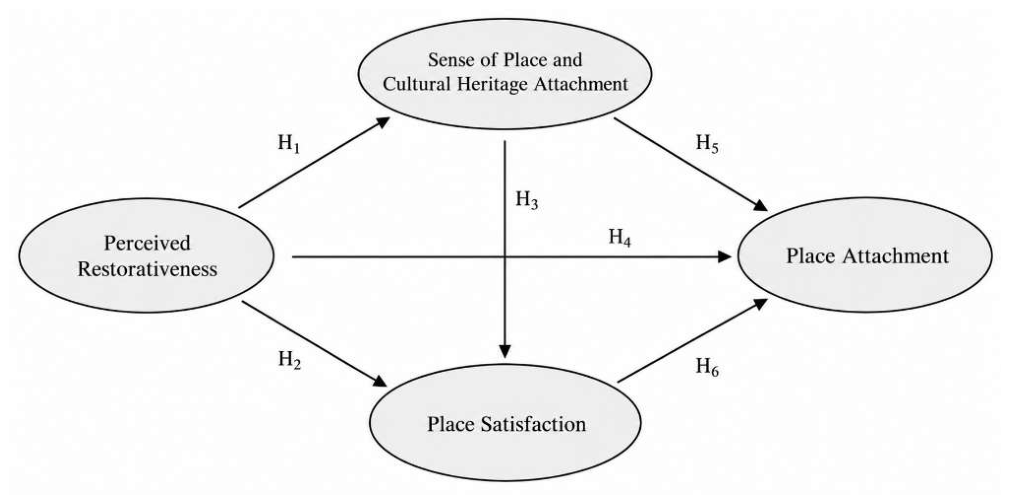
Figure 2.
Location and spatial uses of the Bedriye Madrasa: (a) location of the building in the city centre; (b) spatial use scheme after adaptive reuse.
Figure 2.
Location and spatial uses of the Bedriye Madrasa: (a) location of the building in the city centre; (b) spatial use scheme after adaptive reuse.
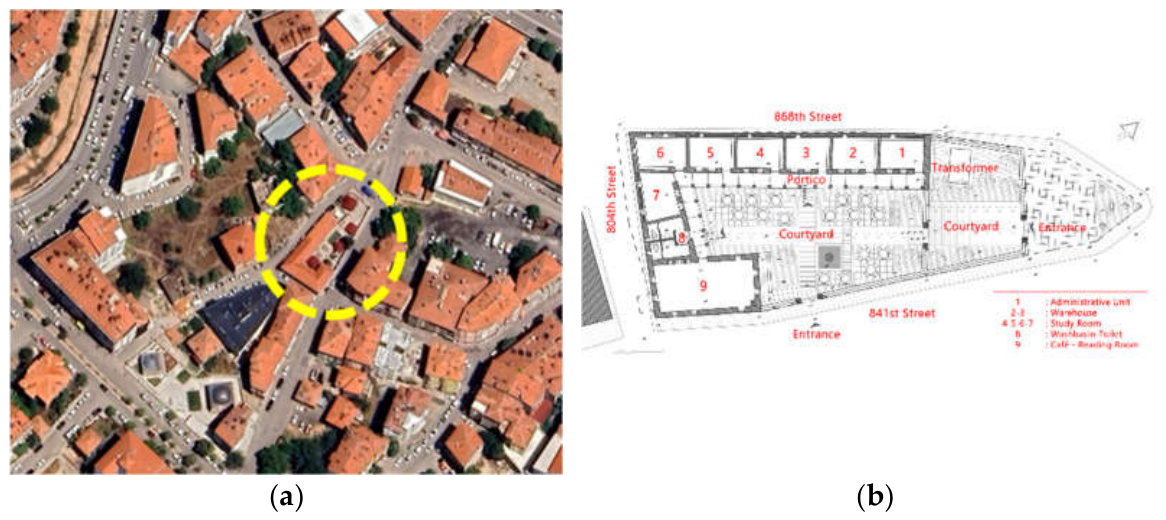
Figure 3.
The Bedriye Madrasa in Aksaray before restoration: (a) general view; (b) courtyard and arcades.
Figure 3.
The Bedriye Madrasa in Aksaray before restoration: (a) general view; (b) courtyard and arcades.
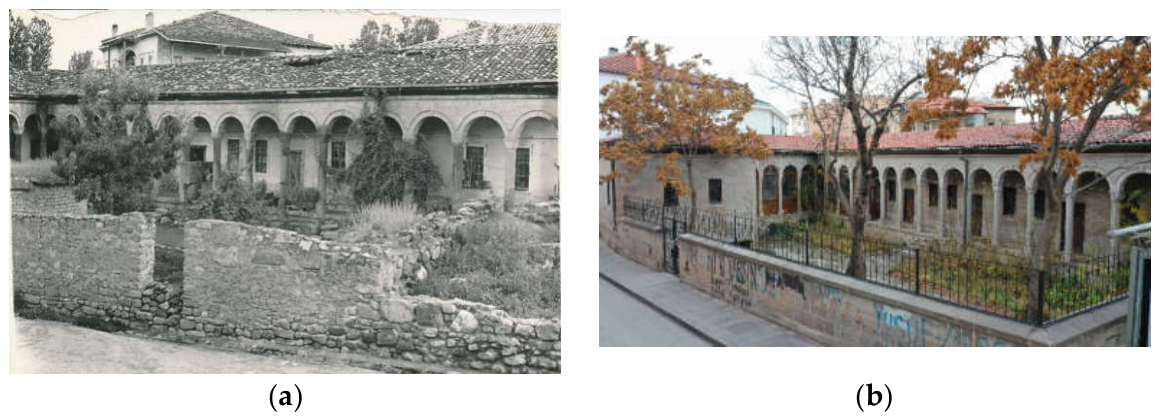
Figure 4.
The Bedriye Madrasa after adaptive reuse: (a) general view of the building; (b) courtyard.
Figure 4.
The Bedriye Madrasa after adaptive reuse: (a) general view of the building; (b) courtyard.
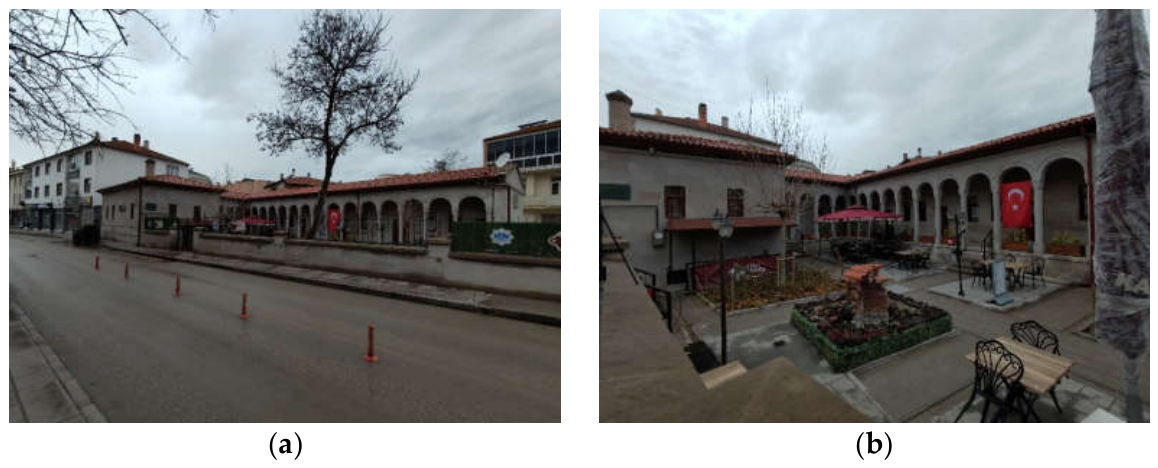
Figure 5.
Path diagram of the tested structural model. Indicator items are omitted to improve legibility. The dashed line indicates the statistically non-significant path. * p < 0.05; ** p < 0.001.
Figure 5.
Path diagram of the tested structural model. Indicator items are omitted to improve legibility. The dashed line indicates the statistically non-significant path. * p < 0.05; ** p < 0.001.
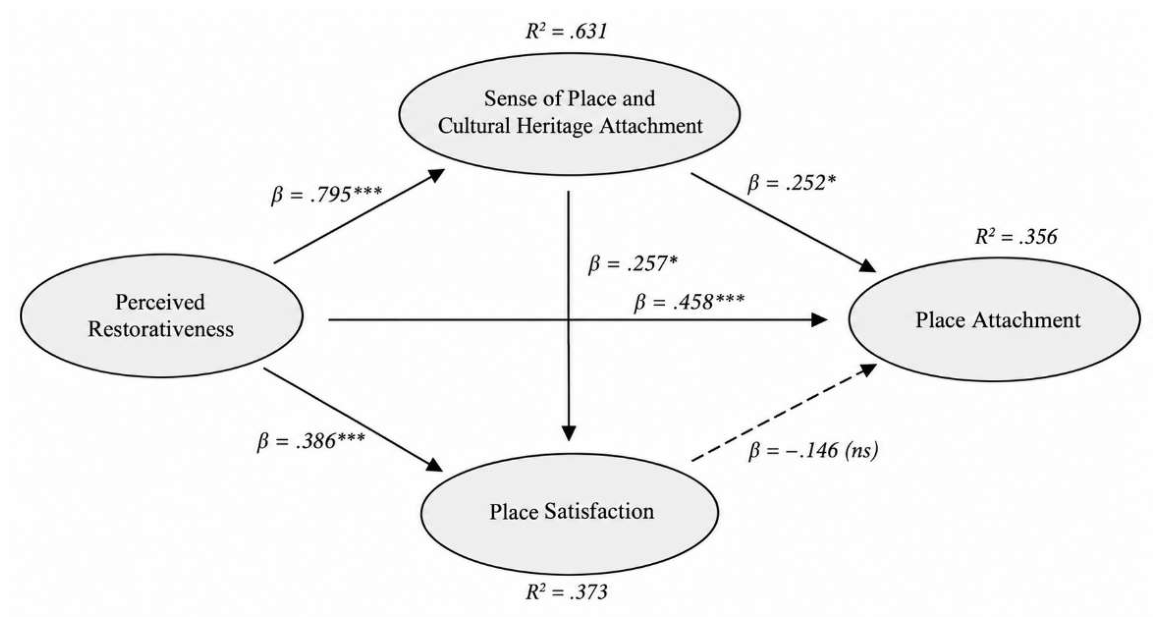
Table 1.
Demographic characteristics of the participants (n = 273).
| Variable | Category | n | % |
| Age | 18–25 | 124 | 45.4 |
| 26–35 | 63 | 23.1 | |
| 36–50 | 53 | 19.4 | |
| 51–65 | 28 | 10.3 | |
| 65 and over | 5 | 1.8 | |
| Gender | Female | 143 | 52.3 |
| Male | 130 | 47.7 | |
| Education | Primary | 16 | 5.9 |
| High school | 50 | 18.3 | |
| Associate degree | 42 | 15.4 | |
| Bachelor’s degree | 144 | 52.7 | |
| Postgraduate | 21 | 7.7 | |
| Occupation | Student | 114 | 41.8 |
| Teacher/academic | 20 | 7.3 | |
| Public employee | 46 | 16.8 | |
| Self-employed | 36 | 13.2 | |
| Retired | 20 | 7.3 | |
| Other | 37 | 13.6 | |
| Number of visits | First visit | 54 | 19.8 |
| 2–5 times | 82 | 30.0 | |
| 6–10 times | 58 | 21.2 | |
| More than 10 | 79 | 29.0 | |
| Purpose of use | Studying | 60 | 22.0 |
| Reading | 34 | 12.5 | |
| Socialising | 59 | 21.6 | |
| Exploring the historic place | 49 | 17.9 | |
| Spending time in the café | 50 | 18.3 | |
| Other | 21 | 7.7 |
Table 2.
Descriptive statistics, reliability coefficients and correlations of the dimensions.
| Dimension | M | SD | α | 1 | 2 | 3 | 4 | 5 |
| 1. Place identity | 3.01 | 1.02 | 0.857 | — | ||||
| 2. Place dependence | 3.45 | 0.86 | 0.726 | 0.60 | — | |||
| 3. Perceived restorativeness | 3.64 | 0.74 | 0.922 | 0.53 | 0.62 | — | ||
| 4. Sense of place and cultural heritage attachment | 3.82 | 0.86 | 0.915 | 0.50 | 0.46 | 0.72 | — | |
| 5. Place satisfaction | 3.90 | 0.76 | 0.892 | 0.22 | 0.27 | 0.52 | 0.50 | — |
Note. All correlation coefficients are significant at p < 0.001. Correlation coefficients were calculated on the basis of dimension mean scores.
Table 3.
Comparison of the measurement models.
| Model | χ² | df | χ²/df | CFI | TLI | RMSEA | SRMR | AGFI |
| M1. PA one-dimensional, PRS single factor | 999.68 | 371 | 2.695 | 0.875 | 0.864 | 0.079 | 0.066 | 0.799 |
| M2. PA two sub-dimensions | 912.61 | 367 | 2.487 | 0.892 | 0.880 | 0.074 | 0.060 | 0.815 |
| M3. M2 + PRS second-order (final) | 797.10 | 364 | 2.190 | 0.914 | 0.904 | 0.066 | 0.058 | 0.837 |
Table 4.
Reliability and convergent validity of the measurement model.
| Dimension | k | Cronbach’s α | CR | AVE |
| Place identity | 3 | 0.857 | 0.862 | 0.676 |
| Place dependence | 3 | 0.726 | 0.740 | 0.490 |
| Perceived restorativeness (second-order) | 11 | 0.922 | 0.943 | 0.848 |
| Being away | 4 | 0.869 | 0.873 | 0.634 |
| Fascination | 3 | 0.789 | 0.796 | 0.568 |
| Coherence–compatibility | 4 | 0.834 | 0.832 | 0.554 |
| Sense of place and cultural heritage attachment | 6 | 0.915 | 0.916 | 0.644 |
| Place satisfaction | 6 | 0.892 | 0.893 | 0.583 |
Note. k = number of items; CR = composite reliability; AVE = average variance extracted. The CR and AVE values for perceived restorativeness were calculated on the basis of the second-order construct. Values for the being away, fascination and coherence–compatibility sub-dimensions are presented separately for comparison. Evaluation criteria were α ≥ 0.70, CR ≥ 0.70 and AVE ≥ 0.50 [36,37].
Table 5.
Fornell–Larcker criterion and HTMT ratios.
| Construct 1 | Construct 2 | r | √AVE (1/2) | F–L criterion | HTMT |
| Place identity | Place dependence | 0.739 | 0.822 / 0.700 | Not met | 0.755 |
| Place identity | Perceived restorativeness | 0.571 | 0.822 / 0.921 | Met | 0.600 |
| Place identity | Sense of place | 0.533 | 0.822 / 0.803 | Met | 0.563 |
| Place identity | Place satisfaction | 0.266 | 0.822 / 0.763 | Met | 0.256 |
| Place dependence | Perceived restorativeness | 0.749 | 0.700 / 0.921 | Not met | 0.762 |
| Place dependence | Sense of place | 0.547 | 0.700 / 0.803 | Met | 0.566 |
| Place dependence | Place satisfaction | 0.323 | 0.700 / 0.763 | Met | 0.336 |
| Perceived restorativeness | Sense of place | 0.795 | 0.921 / 0.803 | Met | 0.779 |
| Perceived restorativeness | Place satisfaction | 0.591 | 0.921 / 0.763 | Met | 0.576 |
| Sense of place | Place satisfaction | 0.564 | 0.803 / 0.763 | Met | 0.559 |
Table 8.
Results of the hypothesis tests.
| Hypothesis | Relationship | β | Statistic | Result |
| H₁ | PR → Sense of place | 0.795 | p < 0.001 | Supported |
| H₂ | PR → Place satisfaction | 0.386 | p < 0.001 | Supported |
| H₃ | Sense of place → Place satisfaction | 0.257 | p = 0.016 | Supported |
| H₄ | PR → Place identity | 0.458 | p < 0.001 | Supported |
| H₅ | Sense of place → Place identity | 0.252 | p = 0.024 | Supported |
| H₆ | Place satisfaction → Place identity | −0.146 | p = 0.058 | Not supported |
| H₇ | PR → Sense of place → Satisfaction | 0.204 | BC %95 GA [−0.003; 0.419] | Not supported |
| H₈ | PR → Sense of place → Place identity | 0.200 | BC %95 GA [0.000; 0.407] | Not supported |
Note. PR = perceived restorativeness. Decisions on H₇ and H₈ were based on whether the 5000-sample bias-corrected bootstrap confidence intervals included zero.
Table 9.
Group differences by demographic variables (Welch ANOVA / independent-samples t-test, Benjamini–Hochberg adjusted p values).
Table 9.
Group differences by demographic variables (Welch ANOVA / independent-samples t-test, Benjamini–Hochberg adjusted p values).
| Variable | Place attachment | Perceived restorativeness | Sense of place | Place satisfaction |
| Gender | 0.018* | 0.033* | 0.150 | 0.397 |
| Age | 0.004* | 0.557 | 0.009* | 0.798 |
| Education | 0.147 | 0.054 | 0.147 | 0.257 |
| Occupation | 0.039* | 0.072 | 0.002* | 0.798 |
| Number of visits | < 0.001* | 0.033* | 0.039* | 0.551 |
| Purpose of use | 0.257 | 0.387 | 0.009* | 0.039* |
Note. The values in the table are p values after the Benjamini–Hochberg correction. Gender comparisons were made with independent-samples t-tests and the other comparisons with Welch’s ANOVA. The Games–Howell post hoc test was applied for significant omnibus tests. * p < 0.05.
Table 10.
Findings from the open-ended responses.
| Question | Theme | f | % |
| Most appreciated feature (n = 223) | Historic fabric, architecture and cultural atmosphere | 114 | 51.1 |
| Calmness, quietness, peace and relaxation | 67 | 30.0 | |
| Study, reading and library facilities | 51 | 22.9 | |
| General aesthetics, quality and functionality | 50 | 22.4 | |
| Café, service and affordable prices | 47 | 21.1 | |
| Social environment and inclusiveness | 39 | 17.5 | |
| Courtyard, garden, location and spatial layout | 32 | 14.3 | |
| Suggestions for improvement (n = 212) | Capacity, furniture, book variety, opening hours | 54 | 25.5 |
| Thermal, visual and acoustic comfort | 47 | 22.2 | |
| Garden, courtyard, shading and landscape | 35 | 16.5 | |
| Café, menu, service and prices | 32 | 15.1 | |
| Events, promotion and cultural programme | 27 | 12.7 | |
| No change needed | 25 | 11.8 | |
| Psychological effect (n = 215) | Peace, relaxation and stress reduction | 114 | 53.0 |
| Positive affect, happiness and well-being | 94 | 43.7 | |
| Concentration, productivity and mental restoration | 34 | 15.8 | |
| Connection with the past, belonging and nostalgia | 26 | 12.1 | |
| Socialising and sense of safety | 22 | 10.2 | |
| Negative effect or discomfort | 3 | 1.4 |
Note. Because a participant’s response could be coded under more than one theme, the percentages sum to more than 100%. The table presents the most frequently recurring themes for each question.
Disclaimer/Publisher’s Note: The statements, opinions and data contained in all publications are solely those of the individual author(s) and contributor(s) and not of MDPI and/or the editor(s). MDPI and/or the editor(s) disclaim responsibility for any injury to people or property resulting from any ideas, methods, instructions or products referred to in the content. |
© 2026 by the authors. Licensee MDPI, Basel, Switzerland. This article is an open access article distributed under the terms and conditions of the Creative Commons Attribution (CC BY) license (http://creativecommons.org/licenses/by/4.0/).
Copyright: This open access article is published under a Creative Commons CC BY 4.0 license, which permit the free download, distribution, and reuse, provided that the author and preprint are cited in any reuse.