

Submitted:
28 September 2026
Posted:
29 September 2026
You are already at the latest version
Abstract
The construction industry's transition toward bio-based building envelopes is constrained by the absence of structured validation methodologies connecting material-level evidence to industrial feasibility. This paper proposes a multi-dimensional validation framework for post-consumer wood reinforced PLA (PCW-PLA) façade panels at TRL 3–4. A Panel Design stage fixes the starting conditions – production process and panel type, panel geometry, target façade stratigraphy and fixing configuration – with the compound as a fixed input. Four sequential assessment phases follow: (1) design integration, based on U-value calculations of the complete façade and of the acoustic test core; (2) manufacturing workability; (3) acoustic characterisation; and (4) mechanical performance validation. Each phase concludes with a gate issuing PROCEED, REDESIGN or DISCONTINUE; REDESIGN outcomes re-enter at Panel Design, Phase 1 or Phase 2 according to the level at which the deficiency is addressed. Performance dimensions are selected through a dual criterion – assessability at TRL 3–4 and discriminability across configurations – and gate thresholds are calibrated to the early-stage evidence context rather than to product-grade conformance. Comparison with nine existing approaches shows that none combines performance dimensions with gate logic, TRL structure and redesign re-entry paths. The framework architecture is material-independent and transferable to other bio-based panel products.
Keywords:
bio-based composite panel
; prefabricated façade
; validation framework
; technology readiness level
; manufacturing workability
; polylactic acid (PLA)
; post-consumer wood
; acoustic characterisation
; off-site construction
; circular economy
1. Introduction
The construction sector accounts for about 37% of global energy- and process-related CO₂ emissions and material resource consumption, driving sustained policy and industrial pressure toward low-embodied-carbon and circular building material systems [1,2,3]. The European Green Deal, the Construction Products Regulation (CPR, Regulation (EU)) [4], and the Ecodesign for Sustainable Products Regulation (ESPR, Regulation (EU) 2024/1781) [5] establish the regulatory architecture within which this transition must occur, with lifecycle performance requirements increasingly extended to construction materials and components. Within this context, bio-based building envelope products have attracted significant research and industrial interest as candidates for low-embodied-carbon, circular-economy-compatible façade systems, combining renewable material feedstocks with the potential for end-of-life valorisation [6,7,8].
Post-consumer wood (PCW)-reinforced polylactic acid (PLA) composites represent a convergent bio-based material category addressing both dimensions of this challenge. PLA provides a biodegradable, bio-derived polymer matrix with established processing compatibility across both compression moulding and additive manufacturing routes [9,10,11], while post-consumer wood fibre introduces a circular-economy dimension by valorising construction and demolition waste within a closed-loop product system [12,13,14,15,16]. When produced as construction products, these composites offer geometric flexibility and multi-functional performance potential suited to prefabricated façade system integration [17,18,19]. EN 13830 [20], the product standard for curtain walling, requires evidence from multiple performance dimensions as minimum conditions for system qualification at full scale, but despite this well-established standardized certification trajectory for façade manufacturers, the growing material-level research on PLA biocomposites and the documented progress in bio-based construction product development, the transition from laboratory evidence to industrially viable building products remains structurally constrained. There is a gap due to the absence of validated multi-dimensional testing protocols for development actors – material scientists, product engineers, and construction system integrators – which are necessarily reliant on ad hoc characterisation programmes without structured criteria for go/no-go decisions, a condition that Cooper [21] and Petrescu et al. [22] identify, in related product development contexts, as a primary source of inefficiency and elevated development risk. This generates two compounding risks: the risk of premature scale-up investment when single-dimension laboratory performance is extrapolated to system-level viability without evidence across all required dimensions, and the risk of unnecessary development discontinuation when an early-stage failure in one dimension, often correctable through targeted redesign, is not distinguished from a fundamental material limitation. Both risks translate directly into wasted development expenditure and delayed market entry for bio-based products operating under increasing regulatory pressure from the CPR [23] and the ESPR [5], which require structured performance evidence for product qualification but do not yet provide Technology Readiness Level (TRL) specific validation protocols for novel bio-based material categories.
The multi-dimensional nature of this validation challenge is confirmed by the pattern of gaps declared across recent characterisation studies. Research simultaneously addressing multiple performance dimensions of bio-based building products consistently omits workability as a characterisation dimension [24,25,26]: manufacturing processability, the capacity of the panel material to be cut, routed, and finished with accessible industrial equipment, is treated as a given rather than as an independently verifiable prerequisite for product-qualification claims [27,28]. Conversely, studies that include characterization [18] do not incorporate gate-controlled progression criteria or feedback mechanisms connecting performance outcomes to design decisions. Reviews of bio-based building material performance testing [8,26] confirm that these dimensions are typically evaluated in isolation or in partial combinations, without a unified validation architecture, and no published framework addresses multiple performance dimensions under a sequential structure for bio-based building envelope products development.
Structured approaches to construction and building product development fall broadly into two categories: sector-agnostic process frameworks and domain-specific characterisation programmes. The Stage-Gate model [21] defines a product development process articulated in phases separated by go/no-go decision gates, but prescribes no performance criteria for specific material or application categories, with an iterative loop mechanism. The EU TRL framework [29] provides a maturity classification applicable to construction materials research but functions as a readiness descriptor rather than a validation methodology, with no performance gate criteria for specific product types. Petrescu et al. [22] adapt TRL logic to biocomposite materials in the construction sector, but address technology adoption readiness in broadly defined market and regulatory terms, without multi-dimensional performance gates or iterative redesign loops. Domain-specific validation approaches for bio-based construction products provide more targeted reference yet remain incomplete. Among domain-specific references, the ISOBIO project [30] demonstrates rigorous hygrothermal and mechanical characterisation of bio-based insulation with documented thresholds, but without acoustic measurement, workability assessment, or gate-controlled progression. The Basajaun project [18] reports thermal, acoustic, and structural testing of bio-based curtain wall profiles under EN 13830 without gate criteria or redesign re-entry paths. Verspeek and van der Burgh [25] survey eight bio-based façade products and document extensive gaps in technical data across fire, strength, and durability dimensions, with no acoustic or workability characterisation and no gate logic. Sandak et al. [8] and Atsonios et al. [31] provide references on bio-based building skin performance and off-site prefabricated façade characterisation methodologies. Wood plastic composite (WPC) machinability literature [32,33,34] provides empirical anchors for specific dimensions but address them in isolation. This selection is indicative, not exhaustive, and covers generic process frameworks adaptable to construction, product development roadmaps for bio-based or composite materials, and multi-dimensional characterisation studies applied to façade systems. None of these approaches combines multi-dimensional performance assessment with TRL structure, gate logic and redesign re-entry paths; this gap motivates the framework proposed in this paper. This paper addresses the identified gap by proposing a multi-dimensional validation framework for wood-based PLA composite façade panels at TRL 3-4. The framework is designed to generate the minimum evidence base required to justify next-TRL scale-up commitment while accommodating the material availability, sample size, and prototype precision constraints inherent to early-stage bio-based product development. The experimental application of the framework to PCW-PLA composite panels is not in the scope of this paper. Table 1 summarises the scope and process characteristics of the approaches reviewed above.
2. Materials and Methods
The methodology described in this section concerns the design of the validation framework itself: TRL constraints (Section 2.1), gate-decision logic (2.2), dimension selection (2.3), threshold calibration (2.4), workability evaluation (2.5) and market references (2.6).
2.1. Technology Readiness Level Rationale
The proposed framework targets TRL 3-4, defined by the EC [29] as the stage at which key functions are experimentally demonstrated at laboratory scale and technology validation is initiated under laboratory conditions. This stage imposes constraints for wood-based PLA that must be reflected in framework calibration: (i) feedstock variability and quantity available – post-consumer wood which has compositional heterogeneity that generates inter-batch property dispersion and therefore material quantity availability constraints [35]; (ii) process-induced material state variability – compression moulding and FDM produce specimens with systematically different void content and PLA crystallinity from identical feedstocks, due to differential thermal flows [36]; (iii) prototype dimensional precision – FDM tolerances of ±0.2–0.5 mm increase with geometry complexity [37], while compression moulding introduces springback and shrinkage dependent on filler content and cooling rate [38]; (iv) specimen-to-system scale mismatch at laboratory with dimensions governed by fabrication capacity at TRL 3–4 and performed on specimens substantially smaller than the assemblies at full scale; (v) absence of industrial manufacturing data with process reproducibility and tooling scalability data are unavailable at TRL 3-4 by definition.
2.2. Gate-Decision Logic
The framework adopts a gate structure derived from the Stage-Gate model [21] in which each phase terminates with an explicit decision point conditioning progression, and from its later evolution towards iterative spiral development [39], which recognises that early-stage gate failures frequently indicate correctable design limitations rather than fundamental non-viability. This framework formalises that principle as a three-outcome gate logic: PROCEED, all criteria are met, and the configuration advances to the subsequent phase; REDESIGN, criteria are not met, but the failure mode is bounded and correctable within the current TRL, and the configuration re-enters at Panel Design or at the current or a prior phase with targeted modifications; DISCONTINUE, criteria are not met and the failure mode indicates a fundamental incompatibility irrecoverable within TRL 3-4 constraints, and development of that configuration is terminated. The operationalisation of the boundary between REDESIGN and DISCONTINUE through explicit activation criteria calibrated to the TRL 3-4 constraints identified in Section 2.1 constitutes an original contribution of this work.
2.3. Performance Dimension Selection Criterion
The performance dimensions addressed by the framework are identified through a dual criterion, with both conditions evaluated independently: (i) the dimension is assessable at TRL 3-4 specimen scale; and (ii) its result can produce differentiated outcomes across configurations of the same product, that is, it can generate a PROCEED, REDESIGN or DISCONTINUE decision. Dimensions whose results are predictable from material composition, or are addressable through standard design solutions irrespective of the tested configuration, are excluded as non-discriminating at this stage. The criterion operates within a two-level validation structure reflecting the component role of the panel within a prefabricated façade system: Level 1 (this framework) addresses component-intrinsic dimensions, measurable at TRL 3-4 specimen scale that vary across PCW-PLA configurations and govern the decision of whether the panel fulfils its functional specification as a non-load-bearing facing component; Level 2 (beyond this framework's scope, TRL 5-6) addresses system-emergent dimensions arising from the full façade assembly configuration that are not governed by the panel composition under test. Dimensions that are measurable at panel scale but for which no performance specification governs this component type in its layer role and that therefore cannot generate a meaningful PROCEED/REDESIGN/DISCONTINUE decision are classified as design characterisation inputs for Level 2 system integration and excluded from Level 1 gate logic. The exclusion categories are: (A) the dimension is measurable at panel scale but does not govern the component's functional specification in its non-load-bearing facing layer role within the façade assembly; its result cannot generate a meaningful PROCEED/REDESIGN/DISCONTINUE decision for panel development regardless of the value obtained. (B) Result non-discriminating across PCW-PLA panel configurations: the outcome is predictable from material composition regardless of configuration tested, or is addressable through a standard design solution applicable independently of panel configuration. (C) System-emergent property, requires full façade assembly. (D) Partially predictable outcome direction; functional solution addressed at system design level.
2.4. Gate Criterion Calibration Methodology
Each gate criterion is calibrated by answering a single guiding question: what is the minimum evidence of development potential required to justify investment in the next phase? This calibration logic distinguishes the proposed approach from two methodologically problematic alternatives: (i) directly importing compliance-grade thresholds from product standards, which would systematically reject products with correctable early-stage limitations; and (ii) setting thresholds so permissive that no product would fail, defeating the gate function entirely. Threshold values at each gate are therefore derived from three source types, applied in combination: (a) the stated measurement precision or method uncertainty of the reference standard, which defines the minimum detectable difference meaningful for a development decision; (b) published lower-bound performance data for market-reference products in the same application category, used to establish the minimum bar for substitution plausibility; and (c) the minimum acceptable anchor of the evaluation scale used, which provides an ordinal lower bound independent of continuous measurement uncertainty. The specific threshold values and their individual justifications are presented in Section 3 alongside the gate to which they apply, enabling the rationale to be read in direct relation to the assessment it governs. The calibration logic – not the numerical values themselves – is the transferable contribution: practitioners applying the framework to different bio-based material systems should apply the same three-source derivation to obtain thresholds appropriate to their material class and TRL stage.
The coefficient of variation (CoV = standard deviation/mean × 100%) is introduced as a gate criterion and manufacturing maturity indicator [40,41]. At TRL 3-4, high inter-specimen variability does not necessarily reflect an inherent material limitation: it may indicate that the production process has not yet reached the parameter stability required for consistent panel output. CoV separates these two sources of underperformance, directing corrective action to the production process defined at Panel Design.
2.5. Workability Evaluation: Likert Scale Application
Manufacturing workability is evaluated for each processing method assessed, using a five-point Likert scale [42] applied independently to three descriptors: (i) edge quality (surface finish, absence of delamination, no excessive chipping); (ii) dimensional accuracy (deviation of the processed dimension from the target); and (iii) industrial scalability (compatibility of the processing method with industrial production). Processing methods are selected to represent both on-site adaptation and off-site industrial prefabrication within the target supply chain. Dimensional accuracy is scored on measured deviation (Table 2): 1, > 5 mm; 2, > 2–5 mm; 3, > 1–2 mm; 4, 0.2–1 mm; 5, < 0.2 mm, so that the boundary between scores 2 and 3 coincides with the ±2 mm panel tolerance [43]. Edge quality and industrial scalability are scored against qualitative anchors: 1, not acceptable (result does not meet minimum functional requirements); 3, adequate (meets the minimum functional requirement); 5, excellent (meets or exceeds industrial production standard); scores 2 and 4 denote performance between adjacent anchors. For net-shape production routes, which deliver panels at final specimen dimensions without post-processing, dimensional accuracy is verified against the ±2 mm target, and edge quality and industrial scalability are deferred to later-TRL characterisation.
2.6. Market Reference Benchmarks for Gate Threshold Contextualisation
Market-reference façade configurations serve as contextual anchors for gate threshold calibration. Rather than defining performance targets in absolute terms, the framework calibrates thresholds relative to the performance of existing products to which the bio-based panel is intended as an equivalent or substitutable component. This approach grounds development decisions in application-relevant performance expectations, ensuring that gate criteria reflect the minimum performance required for the bio-based panel to be competitive within its intended market segment, rather than arbitrary laboratory reference values. Market references are not gate criteria and do not substitute experimental evidence; they provide the lower-bound performance context within which results are interpreted, consistent with the calibration logic.
3. Results
3.1. Performance Dimension Identification
The selection criterion is applied to twelve candidate dimensions spanning material properties, component-level performance, and façade system qualification requirements. Classification is based on two conditions evaluated independently: testability at TRL 3–4 specimen scale and capacity to generate differentiated outcomes across PCW-PLA configurations. Three dimensions satisfy both conditions and are included in Level 1 validation (Table 3). Nine dimensions are excluded (Table 4) according to the exclusion categories defined in Section 2.3.
Three dimensions satisfy the dual criterion at panel scale and are included in Level 1 validation: manufacturing workability, acoustic characterisation, and mechanical performance. Within acoustic characterisation, insertion loss (IL) is additionally measured on panel core configurations using an adapted impedance tube procedure [45]. IL is not a gate criterion and is not directly comparable to the weighted sound reduction index Rw, determined under laboratory conditions per EN ISO 10140 [54], but it provides indicative directional evidence on acoustic insulation potential and informs panel and stratigraphy revision decisions at Gates 3 and 4. Nine dimensions are excluded under four distinct rationales: result non-relevant to a performance gate decision regardless of value obtained, because façade thermal performance is governed by insulation layer design rather than by the panel layer's calculated U-values are nonetheless used in Phase 1 as design-coherence parameters (Gate 1), which verify stratigraphic consistency and do not rank configurations by thermal performance; result non-discriminating across configurations due to predictability from material selection or system-level governing variable (fire performance, UV resistance); system-emergent property not assessable at Level 1 (air permeability, watertightness, wind load resistance, acoustic insulation Rw); and partially assessable at Level 1 with residual configuration-dependence governed by system-level design variables outside the panel-level design space at TRL 3-4 (long-term hygrothermal durability, thermal cycling resistance).
3.2. Framework Overview and Output
The framework comprises a Panel Design stage, which defines the starting conditions, followed by four sequential assessment phases separated by go/no-go decision gates. Figure 1 presents the complete framework architecture, including phase content, gate criteria, decision paths, and the redesign re-entry paths. A complete pass through Gates 1-4, including any redesign iterations, produces: (i) façade configuration(s) with confirmed design compatibility at stratigraphy levels; (ii) manufacturing pathway characterisation with equipment-specific workability data; (iii) sound absorption profile (α vs. frequency) and IL diagnostic data for validated configurations; (iv) mechanical performance envelope (fm, E, ft) with manufacturing process variability assessment; and (v) next-TRL scale-up priorities derived from CoV analysis and Phase 4 failure mode diagnosis.
3.3. Panel Design – Starting Conditions
Panel Design is the configuration-definition stage that precedes characterisation. It is not an assessment phase and has no associated gate: it fixes the starting conditions that Phases 1-4 subsequently evaluate. The PCW-PLA compound is a fixed input to the framework: the framework validates the integration of an already-formulated compound into a façade panel, whereas compound formulation is a material development activity that precedes the framework and involves the material supplier. Three sets of variables are defined, ordered by decreasing effort required to revise them: (i) production process and panel type – solid panel produced by compression moulding or honeycomb panel produced by fused filament fabrication (FDM); (ii) panel geometry and panel stratigraphy – thickness, face–core arrangement, layers laminated with the PLA panel; and (iii) the target façade stratigraphy – the assembly of all façade layers, whose non-panel layers are detailed in Phase 1 – and fixing configuration into which the panel is integrated. The production process is treated as a Panel Design variable, since it governs the mechanical properties and the inter-specimen variability evaluated at Gate 4. Each configuration is documented with the declared material data that serve as inputs to the Phase 1 calculations.
Panel Design is also the re-entry point for REDESIGN outcomes that require a change to the starting conditions: at Gate 1 (panel stratigraphy or target façade stratigraphy), at Gate 3 where the acoustic deficiency is addressed at panel level, and at Gate 4 (mechanical or variability deficiency). After any revision, the configuration re-enters at Phase 1, so that every modified configuration is re-verified for design coherence at Gate 1 before resources are committed to subsequent phases. REDESIGN outcomes confined to manufacturing process parameters (Gate 2) leave the starting conditions unchanged and re-enter at Phase 2. Where a deficiency can be resolved only by modifying the compound formulation, the configuration is discontinued within the framework and the finding is returned to material development.
3.4. Phase 1 – Design Integration Assessment
Phase 1 is a design analysis phase. It establishes design compatibility between the bio-based panel configuration and a benchmark façade stratigraphy through calculation, not experimental measurement of the panel's thermal properties. Two U-value calculations are required simultaneously, both per ISO 6946 [50] using declared λ values from published material data for PLA and wood-based panel components. The first evaluates the complete façade layered build-up from structural support to outer cladding, comparing the computed U-value with that of the market-reference configuration (Section 2.6) as a design context. The second evaluates the isolated acoustic test core sub-assembly – the stratigraphy used as the Phase 3 IL test specimen – calculated for both the bio-based and the market-reference configurations. This ensures that acoustic differences measured in Phase 3 reflect panel and stratigraphy design rather than different insulation regimes. Dynamic thermal parameters (periodic thermal transmittance Yie, decrement factor f, time lag φ) are computed per EN ISO 13786 [57] and hygrothermal and interstitial condensation risk is assessed per EN ISO 13788 [58].
Gate 1 evaluates both calculations simultaneously and determines whether the proposed façade configuration meets the design coherence threshold required to proceed to Phase 2 and commit Phase 3 acoustic specimen preparation. Gate 1 criterion is set at ΔU ≤ 10%, where ΔU is the relative difference between the U-value of the bio-based configuration and that of a market-reference configuration, referred to the latter, satisfied simultaneously at complete-façade and at acoustic-test-core level for at least one market-reference configuration. The 10% threshold defines the admissibility window within which bio-based and market-reference configurations are considered thermally equivalent; deviations exceeding this range indicate that acoustic differences could reflect different insulation regimes rather than panel and stratigraphy design. The threshold is further grounded in the expanded uncertainty range of in-situ thermal transmittance measurement per ISO 9869-1 (±10–20%) [59], confirming that differences below this floor cannot be resolved at Level 2 and do not constitute a meaningful design divergence.
ΔU ≤ 10%
Gate 1's threshold (1) addresses: PROCEED to Phase 2; ΔU > 10% with redesign feasible: REDESIGN (panel stratigraphy or target façade stratigraphy); ΔU > 10% with no redesign achieving threshold: DISCONTINUE.
3.5. Phase 2 – Manufacturing Workability Assessment
Phase 2 is a manufacturing assessment phase. It evaluates whether the PCW-PLA panel can be processed to acceptable dimensional and surface quality through the processing methods defined in Section 2.5. Workability is assessed across three dimensions – edge quality, dimensional accuracy, and industrial scalability – rated on a five-point Likert scale, with a target dimensional tolerance of ±2 mm. Where the manufacturing process produces panels directly to final specimen dimensions without post-production machining (net-shape manufacturing), dimensional accuracy verification against the ±2 mm target replaces Likert-based machining workability assessment; edge quality and industrial scalability for that process route are deferred to later-TRL characterisation.
Gate 2 evaluates workability results across all assessed processing methods and determines whether at least one method meets the minimum manufacturing standard required to confirm that the panel is processable within acceptable tolerances for façade panel fabrication. Gate 2 criterion is set at edge quality ≥ 3/5, dimensional accuracy ≥ 3/5 (deviation ≤ 2 mm, Table 2), and industrial scalability ≥ 2/5 for at least one processing method simultaneously. The composite threshold defines the admissibility boundary between processing methods that yield geometrically consistent panel output and those that generate surface and dimensional defects incompatible with façade fabrication requirements; Likert ≥ 3 corresponds to the "adequate" anchor of the five-point workability scale (Section 2.5), and ±2 mm is consistent with prefabricated curtain wall panel fabrication tolerances given in curtain walling specification guidance [43]. Industrial scalability ≥ 2/5 is accepted because industrial manufacturing data are unavailable at TRL 3-4 by definition (Section 2.1, constraint v); limitations scored at 2 are documented for scale-up planning. Gate 2 failure across all evaluated processing methods, combined with failure of dimensional accuracy verification for any net-shape route, triggers manufacturing process redesign; where no adjustment achieves the threshold, the configuration is discontinued.
edge quality ≥ 3/5 ∧ accuracy ±2 mm ∧ scalability ≥ 2/5
Gate 2's threshold (2) addresses: PROCEED to Phase 3; no machining method satisfying threshold with process adjustment feasible: REDESIGN (manufacturing process parameters); no method satisfying threshold and no adjustment achievable: DISCONTINUE.
3.6. Phase 3 – Acoustic Characterisation
Phase 3 measures the sound absorption coefficient α per ISO 10534-2 [44] in an impedance tube at two diameters (Ø40 mm and Ø100 mm) covering 100–5000 Hz, with n ≥ 3 replicates per configuration. The two diameters provide complementary frequency coverage across the full characterisation range.
Insertion loss (IL) is measured on isolated panel core configurations using an adapted ISO 11691 [45] procedure. IL is included in a preliminary, indicative capacity: it quantifies sound attenuation of the panel core under plane-wave incidence, providing directional evidence on acoustic insulation potential and on panel–material coupling behaviour relevant to façade assembly design. IL anomalies – resonance dips and frequency-specific patterns – are retained as diagnostic inputs to panel or façade stratigraphy revision decisions at Panel Design and Phase 1. IL does not contribute to the Gate 3 decision, for three reasons: (i) IL characterises the tested build-up rather than the panel alone, so that a threshold would evaluate the stratigraphy, not the panel under development; (ii) the adapted procedure has no standardised acceptance value and no established correlation with Rw, so that none of the three threshold sources defined in Section 2.4 is available; and (iii) acoustic insulation is a system-emergent property deferred to Level 2 (Category C, Table 4).
Gate 3 evaluates the acoustic absorption profile across configurations and determines whether at least one configuration demonstrates sufficient broadband absorption potential to justify the mechanical testing investment of Phase 4. Gate 3 criterion is set at α ≥ 0.30 across ≥ 3 contiguous 1/3-octave bands within the 500–4000 Hz range, for at least one configuration. The threshold exceeds the ISO 11654 [60] Class E lower bound (α_w ≥ 0.15), requiring demonstrable broadband absorption rather than isolated resonance behaviour; the 500–4000 Hz range covers the primary zone of speech intelligibility and dominant environmental noise; the contiguity requirement of ≥ 3 consecutive 1/3-octave bands excludes configurations whose qualifying absorption is confined to a single narrow resonance peak and therefore does not represent functional broadband performance.
α ≥ 0.30, ≥ 3 contiguous 1/3-octave bands, 500–4000 Hz
Gate 3's threshold (3) addresses: PROCEED to Phase 4; α below threshold with adjustment feasible: REDESIGN along one of two independent routes, selected according to the variable identified as governing the deficiency – (a) return to Panel Design where the deficiency is addressed at panel-level variables (e.g. panel type, cell geometry or thickness), or (b) direct re-entry at Phase 1 where the deficiency is addressed by adjusting non-panel layers (e.g. backing cavity depth or layer sequence) within the target façade stratigraphy defined at Panel Design; in both routes the revised configuration passes Gate 1 before acoustic re-characterisation; α below threshold with no adjustment achieving threshold: DISCONTINUE.
3.7. Phase 4 – Mechanical Performance Validation
Phase 4 characterises bending strength f_m and modulus of elasticity E per EN 310 [47], and internal bond strength f_t per EN 319 [48], for all configurations. In the absence of a dedicated standard for PLA-based panels, these methods are adopted as test references and adapted to the material; adaptations are documented as framework design parameters. Bending strength f_m and modulus E are determined for all configurations. Internal bond strength f_t targets the face–core interface as a priority concern where interlayer adhesion may be the governing failure mechanism.
CoV is computed for f_m, E and f_t for every configuration tested, as it is a Gate 4 criterion. CoV > 15% identifies parameters where the variability of the selected production process is the primary constraint, signalling that the production process defined at Panel Design must be revised before mechanical testing at next TRL. Sample size is adapted to material availability and documented as a framework design parameter.
Gate 4 evaluates mechanical performance results and manufacturing process maturity simultaneously and determines whether the panel configuration demonstrates "sufficient mechanical development potential to justify advancement to Level 2 façade-scale characterisation. Gate 4 criterion is set at f_m ≥ 5.0 N/mm², E ≥ 1400 N/mm², and f_t ≥ 0.34 N/mm², all three simultaneously, with CoV ≤ 15% across all three properties. The thresholds are set at the most conservative minimum normative values across the market-reference products landscape – cement board (EN 12467 [61], Category A2), gypsum board (EN 520 [62], Type A), and OSB3 (EN 300 [63]) – defining the entry threshold below which the panel fails to meet the minimum mechanical requirement of any established product in the target application class: f_m ≥ 5.0 N/mm² corresponds to the cement board lower bound (EN 12467), the most conservative minimum for bending strength across all three reference products; E ≥ 1400 N/mm² is anchored to the OSB3 minor-axis minimum (EN 300), the only reference product in the comparison landscape that declares flexural modulus; f_t ≥ 0.34 N/mm² corresponds to the OSB3 internal bond minimum (EN 300), the most conservative minimum with a test methodology comparable to EN 319. Reference products are used as benchmarks of mechanical property values irrespective of their load-bearing classification; the target application is non-load-bearing façade cladding, which resists self-weight and wind actions without contributing to the stability of the building structure. This comparison is indicative and does not constitute normative equivalence, as specimen geometry, loading conditions, and applicable standards differ across product categories, and no product standard exists for PLA-based panels. Thresholds are applied to mean values; since the reference requirements are expressed as 5-percentile values [63], the comparison indicates development potential rather than conformance, and the CoV ≤ 15% criterion bounds the dispersion below the mean.
f_m ≥ 5.0 N/mm² ∧ E ≥ 1400 N/mm² ∧ f_t ≥ 0.34 N/mm² ∧ CoV ≤ 15%
Gate 4's threshold (4) addresses: PROCEED to Level 2 façade-scale characterisation; mechanical or CoV criteria not met with redesign feasible: REDESIGN (return to Panel Design for revision of production process, panel type or geometry, followed by re-entry at Phase 1); no configuration achieving threshold: DISCONTINUE. Both mechanical deficiency and CoV > 15% are attributed to Panel Design choices rather than to Phase 2 processing: Phase 2 has already confirmed the workability of the manufactured panel, whereas f_m, E, f_t and their variability are governed by the production process selected at Panel Design.
4. Discussion
4.1. Comparison with Existing Frameworks
Table 5 compares the proposed framework against the reference approaches most directly relevant to the product category.
Two gaps emerge from Table 5. Process-oriented approaches [21,29] provide gate logic or TRL structure but are sector-agnostic and define no performance dimensions. Product-specific approaches [8,18,22,25,30,31,32,33,34] assess performance dimensions but none combines gate logic with TRL structure, and none defines redesign re-entry paths. The proposed framework is the only approach in Table 5 adressing all six criteria.
4.2. Validity of the Dimension Selection Methodology
The dual criterion applied in Section 3.1 produces a reproducible classification: each exclusion category corresponds to a defined outcome of the two conditions (Section 2.3), so that the category assigned to each dimension in Table 4 can be independently verified. Category A exclusions (λ, U-value) derive from non-relevance, since façade thermal performance is governed by the insulation layer rather than by the panel layer. Category B exclusions (fire performance, UV resistance) derive from non-discriminability: reaction to fire is predictable from material selection regardless of panel configuration, and UV degradation is governed by surface treatment rather than by panel geometry. Category C exclusions (air permeability, watertightness, wind load resistance, Rw) mark the Level 1 / Level 2 boundary: these properties emerge at system level and are deferred to Level 2 rather than removed from the development pathway. Category D exclusions (long-term hygrothermal durability, thermal cycling resistance) identify the boundary case in which Level 1 measurement is partially possible but the residual configuration-dependence is governed by system-level design variables outside the Panel Design space at TRL 3–4.
The inclusion of IL in Phase 3 follows from the Category C exclusion of Rw. By treating IL as a non-gating diagnostic, the framework keeps acoustic insulation as a monitored dimension at Level 1 without basing a gate decision on a non-standardised procedure.
4.3. Panel Design as Validation Boundary
Separating Panel Design from the assessment phases makes the object of validation explicit: the framework validates the integration of an already-formulated compound into a façade panel, not the compound formulation. This boundary gives DISCONTINUE a defined meaning. A configuration is discontinued when no revision of the Panel Design variables achieves the gate threshold. A deficiency resolvable only by reformulation is returned to material development as a finding outside the framework.
Ordering the Panel Design variables by revision effort provides a hierarchy for redesign decisions: at each REDESIGN outcome, revisions of the target façade stratigraphy and fixing configuration can be evaluated before revisions of panel geometry, and these before a change of production process. Combined with re-entry at the level where the deficiency is addressed, this keeps redesign effort proportional to the origin of the deficiency.
5.4. Level 1 Validation as Investment Gateway to Level 2
Level 1 – testing Phase 1 design calculations, Likert workability protocol, impedance tube measurement and mechanical bench testing – has substantially lower resource requirements than Level 2 testing under EN 13830 [20], which requires full-scale façade specimens and test rig infrastructure. Gate logic initiates each phase only when the preceding gate is passed: a configuration failing Gate 2 does not consume Phase 3 or Phase 4 resources. The structure therefore defers large capital commitment until the Level 1 evidence base justifies it, consistent with Stage-Gate [21] investment logic.
5.5. Limitations
Gate 1 requires two U-value calculations, for the complete façade and for the acoustic test core. This assumes that the acoustic test core is a definable sub-assembly of the complete façade stratigraphy, which may not hold for highly integrated or non-planar façade architectures.
Fire performance is excluded from the gate structure because reaction to fire is governed by the compound [64], which is a fixed input to the framework. Applications requiring Euroclass B or higher therefore require fire screening of the compound before framework entry.
Because IL is not a gate criterion, IL data cannot be reported as a product acoustic specification without explicit methodological qualification distinguishing it from Rw.
Two redesign decisions rely on practitioner judgement: the choice between the two Gate 3 routes, which depends on attributing the α deficiency to panel-level or stratigraphy-level variables, and the termination of redesign cycles, since no maximum iteration count is specified. For each cycle, documenting the re-entry point, the finding addressed and the iteration count is recommended as part of the framework output.
Phase 4 sample size is adapted to material availability. CoV estimated from few replicates carries high uncertainty, and the Gate 4 CoV criterion should be interpreted together with the documented sample size.
5. Conclusions
This paper proposes a multi-dimensional validation framework for post-consumer wood reinforced PLA façade panels at TRL 3-4, addressing the absence of a structured gate-controlled methodology for the performance dimensions assessable at panel scale.
The original contributions are: (i) a dimension selection methodology applying a dual criterion – Level 1 assessability and configuration-discriminability – to twelve candidate dimensions, with A–D exclusion categories that make the selection reproducible and transferable to other bio-based building panels; (ii) a two-level validation structure separating panel-level evidence (Level 1, TRL 3-4) from façade system qualification (Level 2, TRL 5-6+), with a dedicated Level 2 pathway; (iii) a Panel Design stage that fixes the starting conditions of validation, with the compound as a fixed input and variables ordered by revision effort; (iv) a five-point Likert workability protocol applied as a gate criterion across on-site and off-site processing equipment; (v) IL as a non-gating diagnostic indicator that keeps acoustic insulation as a monitored dimension at Level 1 without substituting system-level Rw characterisation; (vi) gate criteria calibrated to the TRL 3-4 evidence context, distinguishing development potential from product-grade conformance; and (vii) redesign re-entry paths that return each REDESIGN outcome to the level at which the deficiency is addressed – Panel Design, Phase 1 or Phase 2 – while retaining the evidence record of prior phases.
The staged gate structure is designed to reduce development risk before Level 2 system commitment: Level 1 evidence supports next-TRL investment decisions, while Level 2 validation generates the performance evidence required for market access of curtain walling under EN 13830 within the construction products regulation [4].
The framework architecture – dimension selection methodology, two-level boundary, Panel Design stage, redesign re-entry paths and A-D exclusion categories – is material-independent and applicable to any formulated bio-based compound. Numerical gate thresholds are anchored to the target façade application and to the market-reference products; practitioners applying the framework to other bio-based panel systems recalibrate them through the three-source derivation of Section 2.4, without modifying the architecture.
The experimental application of the framework to PCW-PLA panels, outside the scope of this paper, will constitute its first application to a real development case. Independent application by other research groups to different bio-based compounds remains necessary for external validation.
Author Contributions
Conceptualization, A.P.; methodology, A.P.; formal analysis, A.P. and M.G.; investigation, A.P. and M.G.; writing—original draft preparation, A.P.; writing—review and editing, A.P. and M.G.; visualization, A.P.; supervision, A.P.; project administration, A.P.; funding acquisition, A.P.. All authors have read and agreed to the published version of the manuscript.
Funding
This research was conducted within the Wood2Wood (W2W) project, funded by the European Union under the Horizon Europe programme, Grant Agreement No. 101138789. Views and opinions expressed are however those of the author(s) only and do not necessarily reflect those of the European Union or HADEA. Neither the European Union nor the granting authority can be held responsible for them.
Institutional Review Board Statement
Not applicable.
Informed Consent Statement
Not applicable.
Data Availability Statement
No new data were created or analyzed in this study. Data sharing is not applicable to this article.
Acknowledgments
During the preparation of this study, the authors used Claude (Anthropic; Claude Sonnet 4.6 and Claude Opus 5.5) for the purposes of literature search support, editing and proofreading support, and generation of Figure 1 from the framework defined by the authors. The authors have reviewed and edited the output and take full responsibility for the content of this publication.
Conflicts of Interest
The authors declare that the research was conducted in the absence of any commercial or financial relationships that could be construed as a potential conflict of interest. The funders had no role in the design of the study; in the collection, analyses, or interpretation of data; in the writing of the manuscript; or in the decision to publish the results. All findings, interpretations, and recommendations represent the authors’ independent scientific judgment.
Abbreviations
The following abbreviations are used in this manuscript:
| CoV | Coefficient of variation |
| CPR | Construction Products Regulation |
| EC | European Commission |
| EN | European Standard |
| ESPR | Ecodesign for Sustainable Products Regulation |
| EU | European Union |
| FDM | Fused filament fabrication |
| HADEA | European Health and Digital Executive Agency |
| IL | Insertion loss |
| ISO | International Organization for Standardization |
| OSB | Oriented strand board |
| PCW | Post-consumer wood |
| PLA | Polylactic acid |
| R&D | Research and development |
| SBI | Single burning item |
| SD | Standard deviation |
| TRL | Technology readiness level |
| UV | Ultraviolet |
| W2W | Wood2Wood |
| WPC | Wood–plastic composite |
Abbreviations
The following symbols are used in this manuscript:
| α | Normal-incidence sound absorption coefficient | – |
| α_w | Weighted sound absorption coefficient (ISO 11654) | – |
| ΔU | Relative difference between the U-values of the bio-based and the market-reference configuration | % |
| E | Modulus of elasticity in bending | N/mm² |
| f | Decrement factor | – |
| f_m | Bending strength | N/mm² |
| f_t | Internal bond strength | N/mm² |
| λ | Thermal conductivity | W/(m·K) |
| n | Number of replicates | – |
| R_w | Weighted sound reduction index | dB |
| U | Thermal transmittance | W/(m²·K) |
| Yie | Periodic thermal transmittance | W/(m²·K) |
| φ | Time lag | h |
References
- Environment, U.N. Global Status Report for Buildings and Construction 2025-2026 | UNEP - UN Environment Programme Available online: https://www.unep.org/resources/report/global-status-report-buildings-and-construction-2025-2026 (accessed on 31 August 2026).
- Buildings and Construction - Internal Market, Industry, Entrepreneurship and SMEs Available online: https://single-market-economy.ec.europa.eu/industry/sustainability/buildings-and-construction_en (accessed on 5 June 2026).
- Chen, L.; Zhang, Y.; Chen, Z.; Dong, Y.; Jiang, Y.; Hua, J.; Liu, Y.; Osman, A.I.; Farghali, M.; Huang, L.; et al. Biomaterials Technology and Policies in the Building Sector: A Review. Environ Chem Lett 2024, 22, 715–750. [CrossRef]
- Regulation (EU) 2024/3110 of the European Parliament and of the Council of 27 November 2024 laying down harmonised rules for the marketing of construction products and repealing Regulation (EU) No 305/2011; 2024;
- European Parliament Regulation - EU - 2024/1781 - EN - EUR-Lex Available online: https://eur-lex.europa.eu/eli/reg/2024/1781/oj/eng (accessed on 18 April 2025).
- Galimshina, A.; Moustapha, M.; Hollberg, A.; Padey, P.; Lasvaux, S.; Sudret, B.; Habert, G. Bio-Based Materials as a Robust Solution for Building Renovation: A Case Study. Applied Energy 2022, 316, 119102. [CrossRef]
- Leszczyszyn, E.; Heräjärvi, H.; Verkasalo, E.; Garcia-Jaca, J.; Araya-Letelier, G.; Lanvin, J.-D.; Bidzińska, G.; Augustyniak-Wysocka, D.; Kies, U.; Calvillo, A.; et al. The Future of Wood Construction: Opportunities and Barriers Based on Surveys in Europe and Chile. Sustainability 2022, 14, 4358. [CrossRef]
- Sandak, A.; Sandak, J.; Brzezicki, M.; Kutnar, A. Biomaterials for Building Skins. In Bio-based Building Skin; Sandak, A., Sandak, J., Brzezicki, M., Kutnar, A., Eds.; Springer: Singapore, 2019; pp. 27–64 ISBN 978-981-13-3747-5.
- Rajeshkumar, G.; Arvindh Seshadri, S.; Devnani, G.L.; Sanjay, M.R.; Siengchin, S.; Prakash Maran, J.; Al-Dhabi, N.A.; Karuppiah, P.; Mariadhas, V.A.; Sivarajasekar, N.; et al. Environment Friendly, Renewable and Sustainable Poly Lactic Acid (PLA) Based Natural Fiber Reinforced Composites – A Comprehensive Review. Journal of Cleaner Production 2021, 310, 127483. [CrossRef]
- Ilyas, R.A.; Sapuan, S.M.; Harussani, M.M.; Hakimi, M.Y. a. Y.; Haziq, M.Z.M.; Atikah, M.S.N.; Asyraf, M.R.M.; Ishak, M.R.; Razman, M.R.; Nurazzi, N.M.; et al. Polylactic Acid (PLA) Biocomposite: Processing, Additive Manufacturing and Advanced Applications. Polymers 2021, 13, 1326. [CrossRef]
- Ilyas, R.A.; Zuhri, M.Y.M.; Aisyah, H.A.; Asyraf, M.R.M.; Hassan, S.A.; Zainudin, E.S.; Sapuan, S.M.; Sharma, S.; Bangar, S.P.; Jumaidin, R.; et al. Natural Fiber-Reinforced Polylactic Acid, Polylactic Acid Blends and Their Composites for Advanced Applications. Polymers 2022, 14, 202. [CrossRef]
- Jahan, I.; Zhang, G.; Bhuiyan, M.; Navaratnam, S. Circular Economy of Construction and Demolition Wood Waste—A Theoretical Framework Approach. Sustainability 2022, 14, 10478. [CrossRef]
- Mrad, C.; Frölén Ribeiro, L. A Review of Europe’s Circular Economy in the Building Sector. Sustainability 2022, 14, 14211. [CrossRef]
- Kiesnere, G.; Atstaja, D.; Cudecka-Purina, N.; Susniene, R. The Potential of Wood Construction Waste Circularity. Environments 2024, 11, 231. [CrossRef]
- Cakaj, A.; Hesse, L.; Krause, A.; Speth, H.; Lüdtke, J. Barriers and Potentials for Circular Use of Waste Wood in Construction and Demolition Sector with Special Focus on Germany. Urban Science 2025, 9, 367. [CrossRef]
- López Ruiz, L.A.; Roca Ramón, X.; Gassó Domingo, S. The Circular Economy in the Construction and Demolition Waste Sector – A Review and an Integrative Model Approach. Journal of Cleaner Production 2020, 248, 119238. [CrossRef]
- Pracucci, A.; Vandi, L.; Morganti, L.; Fernández, A.G.; Nunez Diaz, M.; Navarro Muedra, A.; Győri, V.; Kouyoumji, J.-L.; Astudillo Larraz, J. Design and Simulation for Technological Integration of Bio-Based Components in Façade System Modules. Buildings 2024, 14, 1114. [CrossRef]
- Vandi, L.; Muedra, A.N.; Astudillo Larraz, J.; de Aretxaga Escudero, S.L.; Pracucci, A. Testing Activities for Technological and Normative Validation of Bio-Based Components in Façade System Modules. Buildings 2024, 14, 1105. [CrossRef]
- Ioannou, O.; Konijnenberg, F. Valorizing Food Waste into Functional Bio-Composite Façade Cladding: A Circular Approach to Sustainable Construction Materials. Clean Technologies 2026, 8, 11. [CrossRef]
- UNI EN 13830:2020 Available online: http://store.uni.com/catalogo/uni-en-13830-2020 (accessed on 29 April 2021).
- Cooper, R.G. Stage-Gate Systems: A New Tool for Managing New Products. Business Horizons 1990, 33, 44–54. [CrossRef]
- Petrescu, T.-C.; Voordijk, J.T.; Mihai, P. Developing a TRL-Oriented Roadmap for the Adoption of Biocomposite Materials in the Construction Industry. Front. Eng. Manag. 2023, 10, 223–236. [CrossRef]
- Regulation - EU - 2024/1781 - EN - EUR-Lex Available online: https://eur-lex.europa.eu/eli/reg/2024/1781/oj/eng (accessed on 22 September 2026).
- Awad, H.H.; Desouki, M. Multifunctional Performance Assessment of Waste-Based Bioplastic Wall Panels for Acoustic Thermal and Structural Efficiency in Interior Architecture. Sci Rep 2025, 15, 15708. [CrossRef]
- Verspeek, S.; Advice, A. Performance of Bio-Based Facades.
- Ye, F.; Wei, H.; Xiao, Y.; Berardi, U.; Quaranta, G.; Demartino, C. Bio-Based Insulation Materials in Sustainable Constructions: A Review of Environmental, Thermal and Acoustic Insulation, Durability, and Mechanical Performances. Renewable and Sustainable Energy Reviews 2025, 223, 115872. [CrossRef]
- Alhawamdeh, M.; Lee, A. A Systematic Review and Meta-Synthesis of the Barriers of Offsite Construction Projects. International Journal of Construction Management 2025, 25, 1087–1099. [CrossRef]
- Razkenari, M.; Fenner, A.; Shojaei, A.; Hakim, H.; Kibert, C. Perceptions of Offsite Construction in the United States: An Investigation of Current Practices. Journal of Building Engineering 2020, 29, 101138. [CrossRef]
- European Commission Commission Decision C(2014)4995. Technology Readiness Levels (TRL): Horizon 2020 Work Programme 2014–2015, General Annexes 2014.
- Development and Demonstration of Highly Insulating, Construction Materials from Bio-Derived Aggregates | ISOBIO | Project | Results | H2020 Available online: https://cordis.europa.eu/project/id/636835/results (accessed on 23 September 2026).
- Atsonios, I.; Katsigiannis, E.; Koklas, A.; Kolaitis, D.; Founti, M.; Mouzakis, C.; Tsoutis, C.; Adamovský, D.; Colom, J.; Philippen, D.; et al. Off-Site Prefabricated Hybrid Façade Systems: A Holistic Assessment. Journal of Facade Design and Engineering 2023, 11, 097–122. [CrossRef]
- Zhu, Z.; Buck, D.; Wang, J.; Wu, Z.; Xu, W.; Guo, X. Machinability of Different Wood-Plastic Composites during Peripheral Milling. Materials 2022, 15, 1303. [CrossRef]
- Górski, J.; Podziewski, P.; Borysiuk, P. The Machinability of Flat-Pressed, Single-Layer Wood-Plastic Particleboards While Drilling—Experimental Study of the Impact of the Type of Plastic Used. Forests 2022, 13, 584. [CrossRef]
- Borysiuk, P.; Auriga, R.; Wilkowski, J.; Auriga, A.; Trociński, A.; Seng Hua, L. A Study on the Susceptibility of PLA Biocomposites to Drilling. Forests 2022, 13, 1950. [CrossRef]
- Nguyen, D.L.; Luedtke, J.; Nopens, M.; Krause, A. Production of Wood-Based Panel from Recycled Wood Resource: A Literature Review. Eur. J. Wood Prod. 2023, 81, 557–570. [CrossRef]
- Narlıoğlu, N. Comparison of Mechanical Properties of 3D-Printed and Compression-Molded Wood-Polylactic Acid (PLA) Composites. BioRes 2022, 17, 3291–3302. [CrossRef]
- Medruț, A.A.; Linul, E. Process–Structure Relationships Governing Dimensional Accuracy in Material-Extrusion-Printed PLA-Based Composites. Polymers 2026, 18, 818. [CrossRef]
- Pisupati, A.; Curto, M.; Laurent, T.; Cosson, B.; Park, C.H.; Dhakal, H.N. Influence of Cooling Rate on the Flexural and Impact Properties of Compression Molded Non-Woven Flax/PLA Biocomposites. Polymers 2025, 17, 493. [CrossRef]
- Robert G. Cooper What’s Next?: After Stage-Gate. Research-Technology Management 2014, 57, 20–31. [CrossRef]
- He, X.; Oyadiji, S.O. Application of Coefficient of Variation in Reliability-Based Mechanical Design and Manufacture. Journal of Materials Processing Technology 2001, 119, 374–378. [CrossRef]
- Becker, C.; Oberlercher, H.; Heim, R.B.; Wuzella, G.; Faller, L.-M.; Riemelmoser, F.O.; Nicolay, P.; Druesne, F. Experimental Quantification of the Variability of Mechanical Properties in 3D Printed Continuous Fiber Composites. Applied Sciences 2021, 11, 11315. [CrossRef]
- Likert, R. A Technique for the Measurement of Attitudes. Archives of Psychology 1932, 22 140, 55–55.
- Standard for Systemised Building Envelopes (Replaces All Three Earlier Standards) 2006 Available online: https://www.cwct.co.uk/products/cwct-standard (accessed on 25 September 2026).
- ISO 10534-2:2023 - Acoustics — Determination of Acoustic Properties in Impedance Tubes — Part 2: Two-Microphone Technique for Normal Sound Absorption Coefficient and Normal Surface Impedance Available online: https://www.iso.org/standard/81294.html (accessed on 31 August 2026).
- ISO 11691:2020 - Acoustics — Measurement of Insertion Loss of Ducted Silencers without Flow — Laboratory Survey Method Available online: https://www.iso.org/standard/69859.html (accessed on 31 August 2026).
- EN ISO 178:2019 - UNI Ente Italiano Di Normazione Available online: https://store.uni.com/en-iso-178-2019 (accessed on 24 September 2026).
- EN 310:1993 - UNI Ente Italiano Di Normazione Available online: https://conto.uni.com/en/en-310-1993 (accessed on 31 August 2026).
- EN 319:1993 - Tensile Strength Test for Particleboards and Fibreboards Available online: https://standards.iteh.ai/catalog/standards/cen/476c6e54-1b1a-491d-90a9-93da4e3601a5/en-319-1993?srsltid=AfmBOorOV9tJGsufAzeQXnc2r0-xO7s_ZGxwjGDembp0U5GcjUXEpw8W (accessed on 31 August 2026).
- UNI EN 12664:2002 - UNI Ente Italiano Di Normazione Available online: https://store.uni.com/uni-en-12664-2002 (accessed on 24 September 2026).
- ISO 6946:2017 - Building Components and Building Elements — Thermal Resistance and Thermal Transmittance — Calculation Methods Available online: https://www.iso.org/standard/65708.html (accessed on 31 August 2026).
- EN 13823:2020+A1:2022 - UNI Ente Italiano Di Normazione Available online: https://store.uni.com/en-13823-2020-a1-2022 (accessed on 24 September 2026).
- Laurent M. Matuana; Shan Jin; Nicole M. Stark Ultraviolet Weathering of HDPE/Wood-Flour Composites Coextruded with a Clear HDPE Cap Layer. 96, 97–106. [CrossRef]
- EN 1991-1-4:2026 - UNI Ente Italiano Di Normazione Available online: https://store.uni.com/en-1991-1-4-2026 (accessed on 24 September 2026).
- UNI EN ISO 10140-2:2021 - UNI Ente Italiano Di Normazione Available online: https://store.uni.com/uni-en-iso-10140-2-2021 (accessed on 24 September 2026).
- Wang, L.; Abenojar, J.; Martínez, M.A.; Santiuste, C. Degradation of Mechanical Properties of Flax/PLA Composites in Hygrothermal Aging Conditions. Polymers 2024, 16, 528. [CrossRef]
- EN 15534-4:2014 - UNI Ente Italiano Di Normazione Available online: https://store.uni.com/en-15534-4-2014 (accessed on 24 September 2026).
- ISO 13786:2017 - Thermal Performance of Building Components — Dynamic Thermal Characteristics — Calculation Methods Available online: https://www.iso.org/standard/65711.html (accessed on 31 August 2026).
- ISO 13788:2012 - Hygrothermal Performance of Building Components and Building Elements — Internal Surface Temperature to Avoid Critical Surface Humidity and Interstitial Condensation — Calculation Methods Available online: https://www.iso.org/standard/51615.html (accessed on 31 August 2026).
- ISO 9869-1:2014 - UNI Ente Italiano Di Normazione Available online: https://store.uni.com/iso-9869-1-2014 (accessed on 24 September 2026).
- ISO 11654:1997 - UNI Ente Italiano Di Normazione Available online: https://store.uni.com/iso-11654-1997 (accessed on 25 September 2026).
- EN 12467:2012+A2:2018 - UNI Ente Italiano Di Normazione Available online: https://store.uni.com/en-12467-2012-a2-2018 (accessed on 24 September 2026).
- EN 520:2004 Available online: https://bsol-bsigroup-com.ezproxy.unibo.it/PdfViewer/Viewer?pid=000000000030185975 (accessed on 6 December 2024).
- EN 300:2006 - UNI Ente Italiano Di Normazione Available online: https://store.uni.com/en-300-2006 (accessed on 24 September 2026).
- S. Chapple; R. Anandjiwala Flammability of Natural Fiber-Reinforced Composites and Strategies for Fire Retardancy: A Review. 2010, 23, 871–893.
Figure 1.
Multi-dimensional validation framework for bio-based façade panels at TRL 3–4; Panel Design (green box); Phases 1–4 (grey boxes); Gates 1–4 (dark grey diamonds).
Figure 1.
Multi-dimensional validation framework for bio-based façade panels at TRL 3–4; Panel Design (green box); Phases 1–4 (grey boxes); Gates 1–4 (dark grey diamonds).
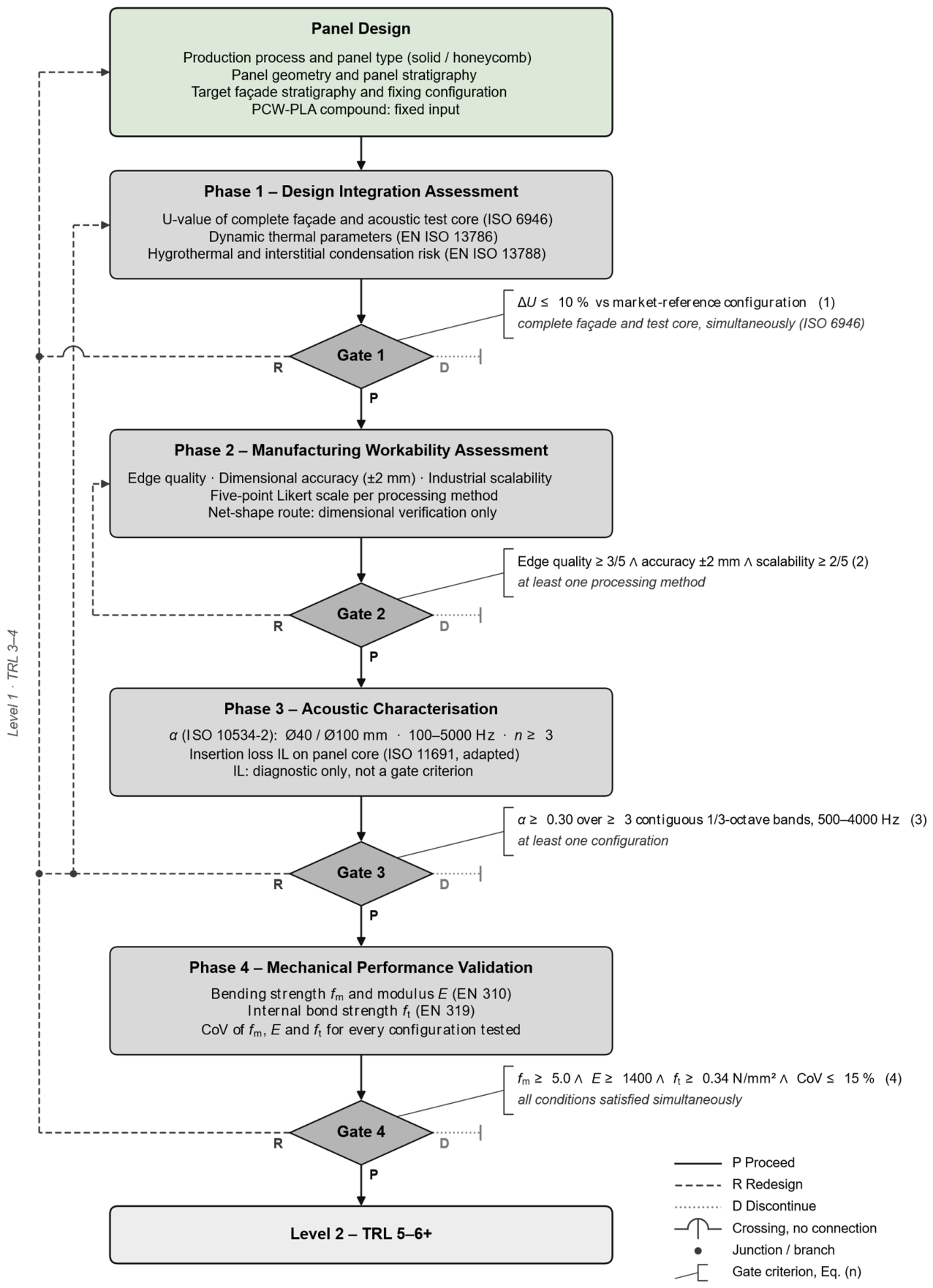

Table 1.
Characteristics of existing development frameworks and validation approaches for bio-based construction products.
Table 1.
Characteristics of existing development frameworks and validation approaches for bio-based construction products.
| Framework | Sector / scope | Gate logic | TRL-structured | Redesign re-entry |
| Stage-Gate [21] | Generic new product development | Y | N | P |
| EU TRL framework [29] | Generic R&D | N | Y | N |
| Petrescu et al. [22] | Biocomposites in construction | N | Y | N |
| ISOBIO [30] | Bio-based insulation | N | N | N |
| Basajaun [18] | Bio-based façade modules | N | N | N |
| Verspeek & van der Burgh [25] | Bio-based façade panels | N | N | N |
| Sandak et al. [8] | Bio-based building skins | N | N | N |
| Atsonios et al. (2023) [31] | Off-site prefabricated façades | N | N | N |
| Machining from multiple authors [32,33,34] | Wood–plastic and PLA biocomposites | N | N | N |
Table 2.
Workability scoring scale.
| Score | Edge quality | Dimensional accuracy (deviation) | Industrial scalability |
| 1 – not acceptable | Delamination or chipping precluding façade use | > 5 mm | Not compatible with industrial production |
| 2 – limited | Localised defects requiring rework | > 2–5 mm | Small-batch production with throughput or tooling constraints |
| 3 – adequate | Minor defects, acceptable without rework | > 1–2 mm | Batch production |
| 4 – good | Sporadic defects, not visible after installation | 0.2–1 mm | Batch production, adaptable to volume production |
| 5 – excellent | Defect-free edge, industrial finish | < 0.2 mm | Volume production |
Table 3.
Performance dimensions included in Level 1 (TRL 3-4) validation.
| Id | Dimension | Test standard | Measure | Gate outcome |
| 1 | Manufacturing workability | Adapted protocol (Section 2.5) | Edge quality, dimensional accuracy, industrial scalability (Likert 1–5) | PROCEED / REDESIGN / DISCONTINUE |
| 2 | Acoustic characterisation | ISO 10534-2 [44] ISO 11691:2020 [45] |
α: normal incidence absorption coefficient IL: insertion loss (diagnostic; indicative of insulation potential, not comparable to Rw) |
PROCEED / REDESIGN / DISCONTINUE (α only) Diagnostic (IL) |
| 3 | Mechanical performance | EN 310 [47]/ EN 319 [48] | Bending strength f_m and modulus of elasticity E (N/mm²); internal bond strength f_t (N/mm²) | PROCEED / REDESIGN / DISCONTINUE |
Table 4.
Performance dimensions excluded from Level 1 validation.
| Id | Dimension | Level 1 assessable | Cat. | Deferred to | Refs |
| 4 | Thermal conductivity (λ) | Yes (testing) | A | Level 2 | [49] |
| 5 | Thermal transmittance (U-value) | Yes (calculation from material data) | A | Level 2 | [20,50] |
| 6 | Fire performance (Euroclass) | Partial | B | Level 2, SBI test | [51] |
| 7 | UV resistance / weathering | Yes | B | Level 2 – surface treatment | [52] |
| 8 | Air permeability / watertightness | No | C | Level 2 – EN 13830 | [20] |
| 9 | Wind load / impact resistance | No | C | Level 2 – EN 13830 | [20,53] |
| 10 | Acoustic insulation (Rw) | No | C | Level 2 (Level 1 assessment with IL) |
[54] |
| 11 | Long-term hygrothermal durability | Partial | D | Level 2 – accelerated ageing protocol | [55] |
| 12 | Thermal cycling resistance | Partial | D | Level 2 – accelerated cycling protocol | [56] |
Table 5.
Comparison of the proposed framework with existing development and validation approaches for bio-based building products. Legend: Y, addressed for performance dimensions, assessed through a defined test procedure with results interpreted against an explicit acceptance criterion; for process attributes, formally specified as a structural element of the approach. P, partially addressed for performance dimensions, assessed without an explicit acceptance criterion, or limited to a subset of the dimension; for process attributes, present without predefined decision criteria or destination. N, not addressed within the stated scope. SA, sector-agnostic with generic methodology defining no domain-specific performance dimensions; criterion not applicable.
Table 5.
Comparison of the proposed framework with existing development and validation approaches for bio-based building products. Legend: Y, addressed for performance dimensions, assessed through a defined test procedure with results interpreted against an explicit acceptance criterion; for process attributes, formally specified as a structural element of the approach. P, partially addressed for performance dimensions, assessed without an explicit acceptance criterion, or limited to a subset of the dimension; for process attributes, present without predefined decision criteria or destination. N, not addressed within the stated scope. SA, sector-agnostic with generic methodology defining no domain-specific performance dimensions; criterion not applicable.
| Framework | Sector / scope | Workability | Acoustic | Mechanical | Gate logic | TRL-structured | Redesign re-entry |
| Stage-Gate [21] | Generic new product development | SA | SA | SA | Y | N | P |
| EU TRL framework [29] | Generic R&D | SA | SA | SA | N | Y | N |
| Petrescu et al. [22] | Biocomposites in construction | N | N | P | N | Y | N |
| ISOBIO [30] | Bio-based insulation | N | N | Y | N | N | N |
| Basajaun [18] | Bio-based façade modules | P | Y | Y | N | N | N |
| Verspeek & van der Burgh [25] | Bio-based façade panels | N | N | P | N | N | N |
| Sandak et al. [8] | Bio-based building skins | N | P | P | N | N | N |
| Atsonios et al. (2023) [31] | Off-site prefabricated façades | N | P | Y | N | N | N |
| Machining from multiple authors [32,33,34] | Wood–plastic and PLA biocomposites | P | N | N | N | N | N |
| This work | Bio-based façade panels, TRL 3–4 | Y | Y | Y | Y | Y | Y |
Disclaimer/Publisher’s Note: The statements, opinions and data contained in all publications are solely those of the individual author(s) and contributor(s) and not of MDPI and/or the editor(s). MDPI and/or the editor(s) disclaim responsibility for any injury to people or property resulting from any ideas, methods, instructions or products referred to in the content. |
© 2026 by the authors. Licensee MDPI, Basel, Switzerland. This article is an open access article distributed under the terms and conditions of the Creative Commons Attribution (CC BY) license (http://creativecommons.org/licenses/by/4.0/).
Copyright: This open access article is published under a Creative Commons CC BY 4.0 license, which permit the free download, distribution, and reuse, provided that the author and preprint are cited in any reuse.