

Submitted:
27 September 2026
Posted:
29 September 2026
You are already at the latest version
Abstract
Resonance patterns are crucial in living systems and also play a role in encoding information in modern communication technology. The DNA molecule exhibits resonant properties. We previously characterized nitrogenous bases as analogous to radio-frequency qubits. This paper explores the role of the hydrogen bond in the DNA self-synchronization mechanism. We analyze a network of n-coupled hydrogen nuclear spins between two electron-cloud spins, each individually connected to the sugar-phosphate backbone, which acts as a resonator. An external magnetic field along the z-axis affects the effective behavior of the nuclear-spin network. The symmetry breaking that enables quantum decisions in the system is governed by the hydrogen’s spin orientation. A network of interconnected spins functions as a qubit register for quantum information processing and serves as a platform for nanoscale magnetic resonance. Following the well-established proton nuclear magnetic resonance model, we describe electrons coherently traveling through a highly efficient spin filter. The article presents a highly theoretical framework. This approach has limitations, as it lacks an experimental protocol to verify the analogies between macroscopic spectroscopy and molecular biology.
Keywords:
DNA
; quantum computer
; self-synchronization
; spin network
; Hidrogen
Introduction
We have previously explained how DNA functions through a combination of biology, physics, and informatics. At the genetic level, each cell must solve two types of algorithmic problems: one involving information, which relates to coordinated energy processes, and another involving energy, which relates to informational processes. Resonance systems can serve as a common foundation for these dual-purpose algorithms by linking oscillatory energy to communication informatics. The concept of resonance genetics for hereditary information integrates biology, physics, and informatics, as resonance systems facilitate the reception and transmission of information (Petoukhov, 2016).
Moreover, biology and engineering share many intriguing design principles. The well-known phenomenon of vibro-transfer of energy among parts of an oscillatory system occurs when a rotary electromotor can operate stably even when disconnected from the power supply if it is placed on a vibro-platform with another rotary electromotor of similar resonant characteristics that is connected to a power source. This occurs through self-synchronization via resonant interactions (Peng et al., 2025; Zou et al., 2020). Through self-synchronization, only those motors that resonate with the base motor will work together as a single functional colony. The resonant integration of parts into a unified system relies on the fundamental physical principle of minimum energy (Hovgaard, 1923), each component of the system requires less energy to perform its work than it would when operating alone. Because the base stack is hydrophobic on the inside and its core is isolated from water, proteins, and other molecules in the surrounding environment, these molecules are excluded, making DNA an insulated wire and a linear (double-helical) crystal (Berlin et al., 2000). This should enable electron and proton charges to oscillate within the base stack without disturbing other atoms and, consequently, without much energy dissipation (Riera Aroche, Ortiz García, Martínez Arellano, et al., 2024).
Recently, synchronization phenomena have been studied for applications in communication systems and complex networks (Argyris et al., 2005). DNA sequences produce biologically active electromagnetic fields. Electromagnetic fields in both the extremely low-frequency and radio-frequency (RF) ranges have been shown to promote protein synthesis. This indicates that even a weak electromagnetic field can cause DNA to unwind and trigger protein synthesis (Cantu et al., 2023; Ivancsits et al., 2005; Kim et al., 2024; Liu et al., 2024; Sun et al., 2023). Because DNA is stabilized by hydrogen bonds and electromagnetic fields primarily interact with electrons, these fields likely impact electrons within the hydrogen bonds, possibly weakening them. Additionally, electrons in water’s flickering hydrogen bonds may be affected at certain frequencies. This process might create numerous temporary protons and electrons in and near the DNA, which can be energized by electromagnetic fields. As we explained in one of our recent works (Riera Aroche et al., 2025).
Drawing a parallel to these arguments, DNA has been characterized as an ideal quantum computer (Hood & Galas, 2003). Its scientific relevance stems from two main features: its digital structure and its complementarity, where each helix strand pairs precisely with its partner. The nitrogenous bases C, G, A, and T serve as carriers of resonant trait pairs, with resonant frequencies and oscillatory energies vital for encoding information (Petoukhov, 2016; Petoukhov & Petukhova, 2017), we discussed the quantum architecture of DNA, viewing each nitrogenous base as a superconductor owing to its aromatic nature, and each base pair as a two-level system (qubit) connected by a hydrogen bond functioning as a Josephson junction. Drawing an analogy to quantum cryptography, we examined a straightforward teleportation protocol that uses the four Bell states and classical information(Riera Aroche, Ortiz García, Martínez Arellano, et al., 2024). While we mathematically represented the states for each pair, our model did not specify which parts of the biological structure would actively participate, nor did we simulate a quantum operator.
DNA qubits resonate through shared oscillatory properties and wave-like interactions, much like musical notes. When one instrument produces a sound, it can cause another instrument’s string to vibrate if the two are tuned to the same pitch. Likewise, an analog radio’s tuning dial adjusts reception frequency by varying the capacitance in a resonant circuit, allowing it to select a specific station. We suggest that certain DNA sequences with comparable oscillatory patterns can also resonate, enabling synchronization and signaling. The oscillations of delocalized -electron resonance clouds in the base stack depend on similar delocalized proton clouds of hydrogen bonds—these are the oscillations of electron and proton clouds. Noise-induced synchronization is predicted in many-body systems, leading to entangled collective oscillations. We also highlight how the transcriptional machinery’s resilience relates to the quantum synchronization phenomenon’s resistance to detuning the DNA qubits’ natural frequencies.
Considering DNA as a system in which each qubit is capacitively coupled to a resonator (the sugar-phosphate backbone), in the dispersive regime—where the DNA base pair qubit is detuned from the resonator’s frequency—the qubit’s state shifts the resonator’s frequency. This allows the RNA polymerase to determine the qubit’s state (Riera Aroche, Ortiz García, Martínez Arellano, et al., 2024; Riera Aroche, Ortiz García, Sánchez Moreno, et al., 2024). In other words, the qubit links its states to the resonator’s resonant frequency, enabling a non-destructive readout of the qubit’s state. Here, however, we complete the analysis of the quantum process of genetic information transmission, incorporating the role of the proton within the hydrogen bond as a biological quantum logic operator in DNA.
Section I. A Code Founded on the Proton
In the genetic code, the DNA alphabet is related to the 20 amino acids of the protein alphabet through a triplet code represented by codons, which are triplet of nitrogenous bases connected via phosphodiester bonds along the sugar-phosphate backbone. This model assumes each nitrogenous base is fixed to its corresponding transmission line, the sugar-phosphate backbone (Riera Aroche, Ortiz García, Sánchez Moreno, et al., 2024), as shown in Figure 1A. The hydrogen atom in a hydrogen bond oscillates harmonically under an elastic molecular force, modeled by Hooke’s law (), treating the bond as a spring. Hydrogen bonds can facilitate strong electronic interactions within or between molecules by increasing resonance, delocalizing electrons, or flattening the conjugated backbone. A higher bond-strength constant, indicating a more stable bond, is associated with higher vibrational frequencies. Protons involved in hydrogen bonds (like O-H...O or N-H...O) are “unshielded,’ resulting in signals at higher chemical shift values (downfield) in the proton nuclear magnetic resonance spectrum. According to Hooke’s Law for simple harmonic motion:
Where represents the vibration frequency, the force constant related to the bond strength, and the reduced mass obtained from the bonded atoms.
If we identify each base pair using the proton spin coupling correlation, then codon ABC is represented by , , and . Figure 1A. But base pairing in DNA involves two hydrogen bonds (A-T) or three (C-G) per pair. Therefore, , , and , are the result of the hydrogen coupling of at least two hydrogen bonds.
Proton splitting occurs when a proton signal separates into multiple peaks due to magnetic effects from nearby non-equivalent protons, typically three bonds away. The resulting pattern follows an rule, where indicates the number of neighboring protons. The relative intensities of the peaks are governed by Pascal’s triangle. Spin-spin splitting results from considering all possible individual spins of the protons. This splitting is mutual; if one proton causes another to split, the reverse must also be true (Autschbach & Le Guennic, 2007; Edison et al., 1994).
Let the codon ABC be any DNA codon, and let , , and represent the coupling of protons in the hydrogen bonds of the nitrogenous base pairs that compose that codon. The coupling among the three — , , and — in the codon ABC results in a quadruple signal with eight possible spin permutations (Figure 1B). The central signals are three times larger than the outer ones because they correspond to three equivalent spin arrangements that absorb at the same frequency. Since the signals of , , or are affected by the number of protons ( or ), we need to recalculate the relative areas based on Pascal’s triangle. For , the relative areas will produce three signals, with the highest peak in the center representing two equivalent spin permutations . Due to the two nuclear energy interactions, four new energy levels are created. Each nucleus can be aligned either with or against the applied field. One lower-energy level occurs when both nuclei are aligned with the field, and a higher-energy level when both are aligned against it. Between these two, additional energy levels correspond to configurations in which one nucleus is aligned with the field and the other is aligned against it.
The energy of a given spin state is:
Where represents the positive value of the most stable state, and ℏ is Planck’s constant. Proton spin transitions generate radio-wave emissions that can be detected electronically. In systems with dipolar interactions among neighboring nuclear spins, decoupling influences signal intensity. These intensity changes depend on the distance between the interacting spins. In this model of DNA function, RNA polymerase employs its CTD heptapeptide sequence: Y1S2P3T4S5P6S7 to separate signals and interpret each base pair within a codon. is the created RNA polymerase magnetic field, and is the magnetogyric ratio (a proportionality constant describing the spin energies of the nucleus in an external magnetic field).
A nuclear spin functions as a tiny magnet, producing a local magnetic field. Two nearby hydrogen nuclei can interact directly through space (not through bonds), a phenomenon known as dipolar coupling or the Nuclear Overhauser Effect (NOE), involving the transfer of spin polarization. This led to changes in their signal intensities. When two nuclei interact at a distance and with an angle between the vector and the magnetic field direction, the local magnetic field caused by this dipolar interaction is expressed as (Ando et al., 2000):
The spacing between peaks offers valuable insights into molecular structure. This spacing, measured in Hertz, is known as the coupling constant between magnetically coupled protons. It is denoted as .
Section 2. Proton Coupled Resonance as Coupled Oscillators
The overall position of a signal and the magnetic field strength needed for energy absorption are related to electron density and circulation within complexes, as shown in Figure 2. When subjected to a magnetic field, electrons follow particular paths and produce small magnetic fields, known as induced fields (). These induced fields oppose the applied magnetic field, making the effective field () less than the applied field itself:
determines the resonance behavior of the nucleus, and is the screening or protection constant. In nitrogenous bases, applying a magnetic field causes their electrons to move in loops, creating a secondary magnetic field with lines of force that close on themselves. The frequencies at which the response amplitude reaches a relative maximum are also known as the system’s resonant frequencies. Small periodic forces near a system’s resonant frequency can cause large amplitude oscillations by storing vibrational energy. Resonant systems can be used to generate vibrations at a specific frequency or to select specific frequencies from a complex vibration containing many frequencies.
A proton is a positively charged particle that has spin. Any rotating electric () charge produces a small magnetic moment aligned with its axis of rotation. For a nucleus to be magnetic, it must have a spin angular momentum. The nuclear magnetic moment is related to the angular momentum through the equation:
Where is the nuclear spin vector, is the nuclear Landé factor, and is the proton mass. The spin of a magnetic nucleus is quantized and can only have specific, well-defined values. When a magnetic field is applied, a nucleus with spin can only align either with ( or against the field (. According to Boltzmann’s Law, nuclei with predominate. The energy of the spin states can be determined by:
Where is the nuclear magnetic moment in the direction of the external field, . The energy difference between the two spin states is:
is given by , where is the magnetogyric ratio. It is defined in terms of the ratio of the magnetic moment to the angular momentum as . Please, see Figure 3
The expression for the interaction energy among , and , considering a set of quantized orientations with quantized energy levels for the nuclear spin is:
Where:
: the magnetic moment of , and
The 3 × 3 matrices, , , and C, show how the components of one nuclear spin magnetic moment interact with those of the other nuclear spin magnetic moment.
The hydrogen nuclei are energetically excited by a combination of the and RF-radiation. When the energy supplied to , and matches the energy difference between the spin states, resonance occurs, allowing all the hydrogen nuclei to absorb energy as they transition between them. In the codon ABC, three wave vectors are chosen so that one serves as the main mode and the other two function as sidebands, creating a triplet under a particular resonance condition. RNA polymerase acts as a multi-frequency array harvester. An electromagnetic harvester with an array of the highly conserved heptapeptide sequence: Y1S2P3T4S5P6S7 that generates steady power across a uniform spectrum of natural frequencies. Tuning the harvester’s resonant frequency to match the dominant vibration frequency improves the vibration energy harvester’s efficiency (Dowlati et al., 2024).
The transition follows the Bohr condition, with energy transfer occurring when precisely equals , where represents the radiation frequency in the RF range. Consequently, the relation for a nuclear transition is given by:
Where is the angular frequency.
The coupling of protons at on the codon is not the only way nitrogenous bases are coupled and synchronized to a frequency. The codon ABC can be viewed as a system of three coupled oscillators. We previously modeled DNA as a combination of -circuits with the base pair represented by nine Radio-Frequency Superconducting Quantum Interference Devices (SQUIDs) inside (Riera Aroche, Ortiz García, Sánchez Moreno, et al., 2024). We investigated the theoretical possibility of using networks of base-pair-coupled oscillators as data storage systems. Let’s consider the oscillation frequency of a codon ABC as:
Where is the frequency of one base pair and is the amplitude of the three oscillators (a codon). Then, if oscillators are synchronized by the first and the third harmonic, they should be described by the system of non-linear differential equations:
Where, for the first oscillator, for the second, and for the third. and are defined by approximating by a third-order polynomial. . and represents the differential current. , , and are the frequency of the first, second, and the third oscillator, respectively; and , the coupling coefficient and shows the influence of the systems A and B, while is the coupling coefficient and shows the influence of the system C on the second one.
The solution to Equation 11 lies in ; . Where is the amplitude, represents the elongations in function of time, and is the angular frequency. We can derive once: , and then: . Then we substitute into the system of three equations, transforming it into an algebraic system with a coefficient matrix, enabling us to calculate each oscillator’s frequency.
Kuramoto’s schematic phase model was used to demonstrate how small residual forces can induce collective synchronization in the motion of many coupled oscillators (Acebrón et al., 2005; Gupta et al., 2014). Here, ABC are considered three oscillators, each with its own natural frequency (Figure 1A). With representing the coupling force among A, B, and C, and assuming the phases rotate at a frequency , we can analyze the system’s evolution:
With
The behavior of the phases can be visualized as three points moving around the unit circle in the complex plane of the phase space diagram. The complex order parameter of this group can be described as the magnitude and phase of its centroid. If the three base-pair oscillators move together, we will have , and they will act as a single large oscillator entity.
By using this parameter and setting the imaginary parts equal in equation 12, Kuramoto derived the following expression:
Therefore, even though A, B, and C possess their own autonomy, they all communicate via the magnitudes and . This interaction tends to pull the phase towards the average phase . Additionally, the effective coupling force, , depends on the coherence . For the coupling matrix , we consider the ABC nearest-neighbor coupling model (Acebrón et al., 2005).
A, B, and C base pairs exhibit, in addition to quantum beating oscillations at individual frequencies , two collective coherent quantum oscillations characterized by two frequencies, , and . represents the average energy level difference across a codon. The frequency of individual coherent quantum-mechanical oscillations that can be excited in a single base pair is , while is the sugar-phosphate backbone frequency renormalized by interaction. The collective shift of base pair frequencies is resonantly enhanced when the backbone’s frequency, , matches the frequency’s average value (the amplitude of these oscillations is strongly enhanced in the resonant case as ). Please see the schematic representation in Figure 1A.
The description of DNA as a circuit, in which each strand of the sugar-phosphate backbone constituted a resonator, was discussed in detail in the reference (Riera Aroche, Ortiz García, Sánchez Moreno, et al., 2024). The sugar-phosphate backbone is characterized by two parameters, and , which are the inductance and capacitance per unit length, as described in (Riera Aroche, Ortiz García, Sánchez Moreno, et al., 2024). Please see Figure 4. The frequencies are expressed as , where , , and is the size (n = 1,2 . . .). In the reference (Asadi et al., 2018), the equations of motion for a mechanical resonator with two modes of response are detailed.
Section 3. A Quantum Gate Leveraging the Proton
A particular nucleotide quantum gate is defined by the electron spin direction. Quantum logical operations in DNA are performed through each nucleotide’s ability to act as a quantum logic gate. These individual nucleotide quantum gates are maintained in coherence by the hydrogen proton in the hydrogen bond. A quantum logic system must include a pathway for coherence, allowing qubits of superimposed information to be transmitted and maintained in superposition. It also requires a mechanism for quantum decision-making to disrupt this coherence, and a quantum gate that enables these qubits to interact coherently. These elements of a quantum logic system are properties of DNA, thereby supporting the DNA molecule’s quantum logic function (Mihelic, 2013).
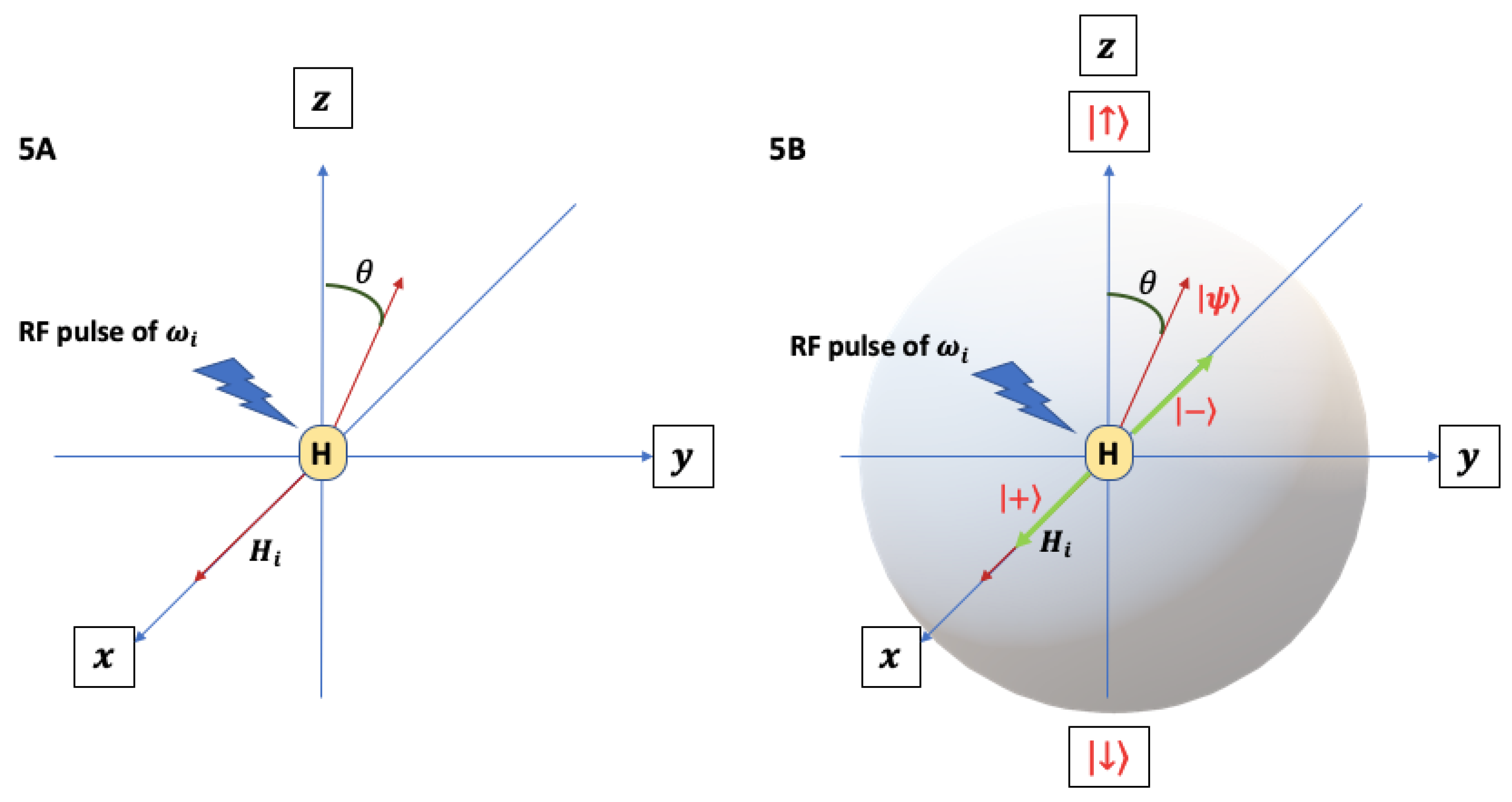
High-power RF pulses are applied to a sample to rotate the equilibrium longitudinal magnetization, and the free-induction decay of the transverse component is then detected as a time-dependent signal. In Figure 5A, applying an RF pulse at the same frequency as the Larmor frequency for the static field produces an RF magnetic field along the x-axis in the rotating frame of . Then, M is rotated around the x-axis into the y-z plane. The rate at which M changes over time in the rotating flame of is given by:
and the rotation angle is provided by:
With refers to the duration of the RF pulse application.
In DNA, the Hamiltonian of a coupled hydrogen-nucleus system in the codon ABC subjected to a magnetic field of intensity , which represents the total energy of all spin systems, is defined as:
Where:
: is the component of the nuclei’ spin I in the direction
: is the magnetrogyric ratio of A nuclei
: is a screening coefficient of A nuclei
: is a coupling constant between nuclei A, B, and C
When all nuclei have a spin to , the only options for the quantum number are or . Therefore, the system is either in the state or . The spin functions for the three nuclei of a codon with spins in the individual states or can be written as:
For , there are product functions. Thus, the matrix elements could be calculated using the basic product functions.
In the absence of couplings (), the Hamiltonian can be separated into three terms, each depending on different spin coordinates (A, B, and C), and its eigenfunctions can be expressed as products of the eigenfunctions of each individual term. Since there are two specific functions for each nucleus and , the sum of , will have eigenfunctions which will constitute an orthonormal basis of the spin function space of the system:
This basis allows us to express the eigenvalue equation of the Hamiltonian with couplings:
Using the Bloch representation, we can describe all quantum gates as rotations of the Bloch vector of a DNA qubit’s state (Figure 5 B). To illustrate this, we will consider the Pauli operators and their action on a qubit’s state vector. From these, we will define rotations about an axis on the Bloch sphere. Every qubit is represented as a point on the Bloch sphere, where the poles represent the eigenstates. The colatitude angle, θ, ranges from 0 to π, while the azimuthal angle, ϕ, spans from 0 to 2π. The effect of a quantum gate on a single qubit is a rotation on the Bloch sphere, resulting in a new qubit state. On the Bloch sphere, we visualize the action of different logic gates or the temporal evolution of a two-level system state under a given Hamiltonian. An axis and a rotation angle define a rotation operator that rotates a point on the sphere around the axis by the angle.
In DNA as a quantum computer, we have two systems: the first consists of two spins A and T, or two spins C and G, prepared in a known pure state. Additionally, we have the system U, which consists of a spin in an unknown pure state.
The initial state of a base pair (system ) is (Riera Aroche, Ortiz García, Martínez Arellano, et al., 2024):
Where the state of the system is represented in the form , and is equivalent to .
and satisfy .
is the proton spin state
Then, when with a magnitude is applied in the direction of the axis on the spin , the operator multiplies the state by an irrelevant global phase and reverses the orientation of the spin at if the spin of , and leave it in its original orientation if .
With the Hamiltonian .
RNA phosphorylation of amino acids in the CTD, according to the bibliographies (Riera Aroche et al., 2025; Riera Aroche, Ortiz García, Sánchez Moreno, et al., 2024), produces RF pulses at a frequency of , creating .
Section 4. Description of the Code for Methionine
According to the stochastic local operations and classical communication (SLOCC) classification (Li, 2018), any three-qubit pure state may be fully separable, biseparable, or genuinely entangled. By definition, the state is fully separable or pure product if it can be written as a tensor product of three single-qubit pure states: . A state that is not entirely separable but becomes separable under a specific bipartition of the three qubits is called a biseparable state. Biseparable states are classified into three types according to the partition. For instance, a state that is biseparable with respect to the first qubit and the other two qubits has the form . Here, is an entangled state of the second and third qubits. If a state is neither entirely separable nor biseparable, it is referred to as genuinely entangled. Under the SLOCC classification, there are only two types of these genuinely entangled states: GHZ and W states: and .
For methionine, the codon ABC is T-A, A-T, and C-G. Then, if RNA polymerase reads TAC:
If you introduce the resonant frequency of each core when there are no couplings (the resonance frequency of a shielded core): , then:
If , there is no coupling, and this Hamiltonian would be separable into three terms dependent on different spin coordinates. The orthonormal basis of the spin function space of the system allows expressing the eigenvalue equation of the Hamiltonian with couplings:
Each column in a matrix (eigenvector) contains the coefficients that specify an eigenfunction.
The spin Hamiltonian for each nucleus in TAC during RNA polymerase exerting an in the z direction axis:
Using and :
Then, the operator associated with the z component of the total spin angular momentum has the value :
The selection rules are described using the quantum number: . Thus, the following values are obtained for each basis function: for , for , for , and for .
Now, by analyzing the structure of DNA and its hydrogen bonds, we can clearly understand that the functions and are not possible. And if we assume that RNA polymerase reads only one strand, then the most likely spin combination of the total coupling hydrogen bond will correspond to the direction of the magnetic field. Therefore, using the teleport protocol of section 3, for TAC (Equations 19,20, and 22):
Generation of the GHZ state:
In a system with three spin -½ particles, a normalized quantum state is represented by:
Where and form the basis of spin monoparticular eigenstates, such that considering the third-component Pauli operator satisfy:
The evolution of a closed quantum system is described by a unitary transformation. Such that the state at time is related to the state of the system at time by a unitary operator
Where is a unitary operator and is its Hermitian conjugate. The hydrogen spin is a unitary operator transformation acting in the system TAC.
Section 5. Discussion
DNA can be modeled as a chain of superconducting qubits, with interactions between neighboring units mediated by the sugar-phosphate backbone, which acts as a resonator (Riera Aroche, Ortiz García, Martínez Arellano, et al., 2024; Riera Aroche, Ortiz García, Sánchez Moreno, et al., 2024). Each nitrogenous base has a unique vibrational signature (Lee et al., 2006; Shanmugasundaram & Puranik, 2009), but within DNA, they vibrate collectively because each base pair acts as a similar unit oscillator. Coupled oscillators (base pairs and codons) can synchronize independently, much like vibro-coupled motors or Kuramoto oscillator networks. Since oscillations and spontaneous synchronization are crucial for transmitting encoded information, we analyzed a model of three oscillators (a codon) with distributed natural frequencies interacting via mean-field coupling.
Synchronization is a broad concept in both classical and quantum physics: it typically occurs when coupled nonlinear oscillators match their internal rhythms and oscillate together (Balanov et al., n.d.; Buča et al., 2022; Laskar et al., 2020; Touboul et al., 2020). Noise-induced synchronization is another surprising outcome of random fluctuations. Chaotic signals have been suggested as broadband carriers for information, potentially offering high robustness and privacy in data transmission (Ashraf et al., 2024; Jiang et al., 2012; Roy, 2005; Shen et al., 2023; Wang et al., 2020). Noise-induced quantum synchronization has been observed in a linear chain of superconducting transmon qubits with nearest-neighbor interactions (Tao et al., 2025). Furthermore, simulation results indicate that both upstream and downstream data encrypted with chaotic carriers can be effectively decrypted (Jiang et al., 2012; Wu et al., 2023). In this work, the RNA polymerase is used to generate a magnetic field via RF-like pulses that interact with proton spins, enabling non-destructive “readout” and logical operations.
Previous studies have shown that the vibrational coupling constants between nitrogenous base modes are most strongly influenced by hydrogen-bonding interactions between bases, rather than by the number of base pairs (Cocco & Monasson, 2000; Lee et al., 2006; Lee & Cho, 2006). This is important because it highlights the role of hydrogen bonding in the transmission of genetic information. The proton nuclear magnetic resonance model lets us see not only individual atoms but also how they connect, thanks to interactions between nearby protons called couplings. Protons can usually interact with other protons up to three bonds away (Ahluwalia, 2023; Akash & Rehman, 2025; Morris & Reynolds, 2024). Spin-spin coupling happens because protons tend to align in specific ways within magnetic fields. Since each proton naturally has a magnetic moment, one proton’s magnetic moment can influence another. The coupling mechanism is thought to arise from bonding electrons (Autschbach & Le Guennic, 2007) and is generally not observed when the coupled protons are separated by more than three sigma bonds. In particular, electric ring currents create a magnetic field similar to that of a magnetic dipole (Bally & Rablen, 2011). Conversely, a magnetic field can induce electric ring currents, which then generate a magnetic dipole moment in a system of charged particles. An interconnected spin network serves as a qubit register for quantum information processing and as a platform for nanoscale magnetic resonance.
Some nuclei display unique behaviors in very strong magnetic fields because a nucleus with spin can have possible orientations, which are degenerate in the absence of a magnetic field. When subjected to a magnetic field, these spin states split into different energy levels—a phenomenon known as the Zeeman effect (Bally & Rablen, 2011; Ivanov et al., 2022; Lott et al., 1966). This splitting also occurs when the magnetic spins of two different types of protons interact. In such cases, the protons are considered magnetically coupled. In a nuclear spin, the potential orientations of the nuclear magnetic dipole relative to the magnetic field are quantized. Out of the 2l + 1 possible orientations, one will be aligned parallel to the field, having the lowest energy, while the others possess higher energies. Transitions between these energy levels involve a specific, quantized amount of energy. This concept is similar to the previously discussed quantum model, which involves the sequential phosphorylation of the seven amino acid repeats in the CTD (Riera Aroche et al., 2025; Riera Aroche, Ortiz García, Sánchez Moreno, et al., 2024).
Analysis of modern ab initio wave functions in terms of natural bond orbitals strongly indicates the resonance-type “charge transfer” nature of H-bonding (Weinhold, 2005; Weinhold & Klein, 2014). Resonant three-wave interactions and their dynamic equivalents, three-oscillator interactions, are fundamental in physics because they embody the simplest nonlinear effects in systems that can be approximated as a linear superposition of discrete waves and oscillations (Parra et al., 2001). The so-called resonance-assisted hydrogen bond is a hydrogen bond strengthened by π-type electronic delocalization in the molecule; it can be inter- or intramolecular, the latter being more strongly strengthened by delocalization (Parra et al., 2001). In this work, we emphasize the importance of the resonance characteristics of hydrogen bonding. DNA base pairs and their hydrogen-bonded protons are viewed as coupled spins and nonlinear oscillators that can resonate, synchronize, and create quantum information structures. These protons play a key role in maintaining coherence and enabling quantum decision-making.
Conclusions
This paper presents a theoretical model in which DNA functions as a quantum logic processor based on resonant phenomena, particularly those involving hydrogen bonds. DNA base pairs and their hydrogen-bonded protons are considered as coupled spins and nonlinear oscillators that can resonate, synchronize, and form quantum information structures such as qubits, gates, and entangled states. The C-terminal domain (CTD) of RNA polymerase is modeled as generating a magnetic field, and RF-like pulses that interact with proton spins, enabling non-destructive “readout” and logical operations.
DNA’s base stack functions like a hydrophobic, nearly insulated resonant medium where electron and proton clouds can oscillate with minimal energy loss. Coupled oscillators (base pairs and codons) can synchronize independently, similar to vibro-coupled motors or Kuramoto oscillator networks. Collective modes occur when sugar-phosphate backbone resonances match the average frequencies of base pairs. Hydrogen-bond protons in base pairs are explained using basic proton NMR concepts: spin states, Zeeman splitting, spin–spin coupling, NOE, and splitting patterns (n+1 rule, Pascal’s triangle). A codon is modeled as three coupled proton spins (Ha, Hb, Hc), producing multiple energy levels and distinct NMR-like signals that inherently encode information. We present the explicit spin Hamiltonians for three coupled protons in a codon and derive the eigenstates and selection rules using total spin-z components. For specific codons (e.g., TAC for methionine), we analyze allowed versus disallowed spin configurations and relate them to how RNA polymerase would “read” the sequence.
In this paper, each base pair is modeled as a qubit; the hydrogen-bonded protons help sustain coherence and facilitate quantum decision-making. Quantum gates are depicted as rotations on the Bloch sphere driven by RF-like fields produced by CTD phosphorylation events. The paper employs standard quantum information concepts (Pauli operators, unitary evolution, GHZ states, SLOCC classification) and maps them onto codons and proton-spin networks. Building on previous work, we describe a teleportation-like protocol in which proton spin states (and their couplings) enable quantum information transfer through DNA. For methionine’s codon TAC, we demonstrate how three coupled spins could produce GHZ-type entangled states. As mentioned earlier in the reference (Riera Aroche, Ortiz García, Martínez Arellano, et al., 2024): God created a perfect quantum computer: the DNA.
“The one thing which one has to accept and which is the inalienable consequence of the wave-equation as it is used in every problem, under the most various forms, is this: that the interaction between two microscopic physical systems is controlled by a peculiar law of resonance» [Schrodinger, 1952, p. 115]
Funding
not funding.
Ethical Approval
not applicable.
Clinical trial number
not applicable.
Consent to Publish declaration
not applicable.
Consent to Participate declaration
not applicable.
Availability of data and materials
All data and materials are included in the text.
Conflicts of Interest
The authors declare no competing financial interest.
References
- Acebrón, J. A.; Bonilla, L. L.; Pérez Vicente, C. J.; Ritort, F.; Spigler, R. The Kuramoto model: A simple paradigm for synchronization phenomena. Reviews of Modern Physics 2005, 77(1), 137–185. [Google Scholar] [CrossRef]
- Ahluwalia, V. K. Nuclear Magnetic Resonance (NMR) Spectroscopy. In Instrumental Methods of Chemical Analysis; Springer Nature Switzerland, 2023; pp. 271–343. [Google Scholar] [CrossRef]
- Akash, M. S. H.; Rehman, K. Comprehensive Insights into Nuclear Magnetic Resonance Spectroscopy. In Essentials of Pharmaceutical Analysis; Springer Nature Singapore, 2025; pp. 439–532. [Google Scholar] [CrossRef]
- Ando, I.; Kobayashi, M.; Kanekiyo, M.; Kuroki, S.; Ando, S.; Matsukawa, S.; Kurosu, H.; Yasunaga, H.; Amiya, S. NMR Spectroscopy in Polymer Science. In Experimental Methods in Polymer Science; Elsevier, 2000; pp. 261–493. [Google Scholar] [CrossRef]
- Argyris, A.; Syvridis, D.; Larger, L.; Annovazzi-Lodi, V.; Colet, P.; Fischer, I.; García-Ojalvo, J.; Mirasso, C. R.; Pesquera, L.; Shore, K. A. Chaos-based communications at high bit rates using commercial fibre-optic links. Nature 2005, 438(7066), 343–346. [Google Scholar] [CrossRef] [PubMed]
- Asadi, K.; Yu, J.; Cho, H. Nonlinear couplings and energy transfers in micro- and nano-mechanical resonators: intermodal coupling, internal resonance and synchronization. Philosophical Transactions of the Royal Society A: Mathematical, Physical and Engineering Sciences 2018, 376(2127), 20170141. [Google Scholar] [CrossRef] [PubMed]
- Ashraf, M. W. A.; Singh, A. R.; Pandian, A.; Bajaj, M.; Zaitsev, I.; Rathore, R. S. Enhancing network security with hybrid feedback systems in chaotic optical communication. Scientific Reports 2024, 14(1), 24958. [Google Scholar] [CrossRef] [PubMed]
- Autschbach, J.; Le Guennic, B. Analyzing and Interpreting NMR Spin–Spin Coupling Constants Using Molecular Orbital Calculations. Journal of Chemical Education 2007, 84(1), 156. [Google Scholar] [CrossRef]
- Balanov, A.; Janson, N.; Postnov, D.; Sosnovtseva, O. Synchronization in Systems with Complex Multimode Dynamics. In Synchronization; Springer Berlin Heidelberg, n.d.; pp. 353–376. [Google Scholar] [CrossRef]
- Bally, T.; Rablen, P. R. Quantum-Chemical Simulation of 1H NMR Spectra. 2.† Comparison of DFT-Based Procedures for Computing Proton–Proton Coupling Constants in Organic Molecules. The Journal of Organic Chemistry 2011, 76(12), 4818–4830. [Google Scholar] [CrossRef] [PubMed]
- Berlin, Y. A.; Burin, A. L.; Ratner, M. A. DNA as a molecular wire. Superlattices and Microstructures 2000, 28(4), 241–252. [Google Scholar] [CrossRef]
- Buča, B.; Booker, C.; Jaksch, D. Algebraic theory of quantum synchronization and limit cycles under dissipation. SciPost Physics 2022, 12(3), 097. [Google Scholar] [CrossRef]
- Cantu, J. C.; Butterworth, J. W.; Peralta, X. G.; Payne, J. A.; Echchgadda, I. Analysis of global DNA methylation changes in human keratinocytes immediately following exposure to a 900 MHz radiofrequency field. Bioelectromagnetics 2023, 44(3–4), 77–89. [Google Scholar] [CrossRef] [PubMed]
- Cocco, S.; Monasson, R. Theoretical study of collective modes in DNA at ambient temperature. The Journal of Chemical Physics 2000, 112(22), 10017–10033. [Google Scholar] [CrossRef]
- Dowlati, S.; Kacem, N.; Bouhaddi, N. Enhancing the Performance of Vibration Energy Harvesting Based on 2:1:2 Internal Resonance in Magnetically Coupled Oscillators. Micromachines 2024, 16(1), 23. [Google Scholar] [CrossRef] [PubMed]
- Edison, A. S.; Markley, J. L.; Weinhold, F. Calculations of one-, two- and three-bond nuclear spin-spin couplings in a model peptide and correlations with experimental data. Journal of Biomolecular NMR 1994, 4(4), 519–542. [Google Scholar] [CrossRef] [PubMed]
- Gupta, S.; Campa, A.; Ruffo, S. Kuramoto model of synchronization: equilibrium and nonequilibrium aspects. Journal of Statistical Mechanics: Theory and Experiment 2014, 2014(8), R08001. [Google Scholar] [CrossRef]
- Hood, L.; Galas, D. The digital code of DNA. Nature 2003, 421(6921), 444–448. [Google Scholar] [CrossRef] [PubMed]
- Hovgaard, W. The Principle of Minimum Energy and the Motion of Fluids. Proceedings of the National Academy of Sciences 1923, 9(11), 363–369. [Google Scholar] [CrossRef] [PubMed]
- Ivancsits, S.; Pilger, A.; Diem, E.; Jahn, O.; Rüdiger, H. W. Cell type-specific genotoxic effects of intermittent extremely low-frequency electromagnetic fields. Mutation Research/Genetic Toxicology and Environmental Mutagenesis 2005, 583(2), 184–188. [Google Scholar] [CrossRef] [PubMed]
- Ivanov, V. V.; Mancini, R. C.; Huerta, N. A.; Swanson, K. J.; Winget, D. E.; Montgomery, M. H.; Golovkin, I. E.; Hariharan, H. K.; Berbel, Z. S. Quadratic Zeeman effect in hydrogen at 2–3 MG magnetic fields. Physical Review E 2022, 106(4), 045206. [Google Scholar] [CrossRef] [PubMed]
- Jiang, N.; Zhang, C.; Qiu, K. Secure passive optical network based on chaos synchronization. Optics Letters 2012, 37(21), 4501. [Google Scholar] [CrossRef] [PubMed]
- Kim, J. H.; Kang, D.-J.; Seok, J. Y.; Kim, M.-H.; Kim, D.-S.; Jeon, S.-B.; Choi, H.-D.; Moon, J. I.; Kim, N.; Kim, H. R. Exposure to Radiofrequency Electromagnetic Fields Enhances Melanin Synthesis by Activating the P53 Signaling Pathway in Mel-Ab Melanocytes. International Journal of Molecular Sciences 2024, 25(22), 12457. [Google Scholar] [CrossRef] [PubMed]
- Laskar, A. W.; Adhikary, P.; Mondal, S.; Katiyar, P.; Vinjanampathy, S.; Ghosh, S. Observation of Quantum Phase Synchronization in Spin-1 Atoms. Physical Review Letters 2020, 125(1), 013601. [Google Scholar] [CrossRef] [PubMed]
- Lee, C.; Cho, M. Vibrational dynamics of DNA. II. Deuterium exchange effects and simulated IR absorption spectra. The Journal of Chemical Physics 2006, 125(11). [Google Scholar] [CrossRef] [PubMed]
- Lee, C.; Park, K.-H.; Cho, M. Vibrational dynamics of DNA. I. Vibrational basis modes and couplings. The Journal of Chemical Physics 2006, 125(11). [Google Scholar] [CrossRef] [PubMed]
- Li, D. Stochastic local operations and classical communication (SLOCC) and local unitary operations (LU) classifications of n qubits via ranks and singular values of the spin-flipping matrices. Quantum Information Processing 2018, 17(6), 132. [Google Scholar] [CrossRef]
- Liu, L.; Huang, B.; Lu, Y.; Zhao, Y.; Tang, X.; Shi, Y. Interactions between electromagnetic radiation and biological systems. IScience 2024, 27(3), 109201. [Google Scholar] [CrossRef] [PubMed]
- Lott, S. H.; Roos, C. E.; Ginter, M. L. Studies of the Zeeman Effect Using Strong Pulsed Magnetic Fields*†. Journal of the Optical Society of America 1966, 56(6), 775. [Google Scholar] [CrossRef]
- Mihelic, F. Model of Biological Quantum Logic in DNA. Life 2013, 3(3), 474–481. [Google Scholar] [CrossRef] [PubMed]
- Morris, A. L. C.; Reynolds, W. F. Nuclear magnetic resonance spectroscopy in drug discovery. In Pharmacognosy; Elsevier, 2024; pp. 649–684. [Google Scholar] [CrossRef]
- Parra, R. D.; Furukawa, M.; Gong, B.; Zeng, X. C. Energetics and cooperativity in three-center hydrogen bonding interactions. I. Diacetamide-X dimers (X=HCN, CH3OH). The Journal of Chemical Physics 2001, 115(13), 6030–6035. [Google Scholar] [CrossRef]
- Peng, H.; Yang, Y.; Yin, P.; Sun, R. Theoretical and experimental study on self-synchronization of anti-resonance system with three co-rotating rotors driven by exciters. Nonlinear Dynamics 2025, 113(16), 21095–21117. [Google Scholar] [CrossRef]
- Petoukhov, S. V. The system-resonance approach in modeling genetic structures. Biosystems 2016, 139, 1–11. [Google Scholar] [CrossRef] [PubMed]
- Petoukhov, S. V.; Petukhova, E. S. The Concept of Systemic-Resonance Bioinformatics: Resonances and the Quest for Transdisciplinarity. In Information Studies and the Quest for Transdisciplinarity; WORLD SCIENTIFIC, 2017; pp. 467–487. [Google Scholar] [CrossRef]
- Riera Aroche, R.; Ortiz García, Y. M.; Martínez Arellano, M. A.; Riera Leal, A. DNA as a perfect quantum computer based on the quantum physics principles. Scientific Reports 2024, 14(1), 11636. [Google Scholar] [CrossRef] [PubMed]
- Riera Aroche, R.; Ortiz García, Y. M.; Sánchez Moreno, E. C.; Enriquez Cervantes, J. S.; Machado Sulbaran, A. C.; Riera Leal, A. DNA Gene’s Basic Structure as a Nonperturbative Circuit Quantum Electrodynamics: Is RNA Polymerase II the Quantum Bus of Transcription? Current Issues in Molecular Biology 2024, 46(11), 12152–12173. [Google Scholar] [CrossRef] [PubMed]
- Riera Aroche, R.; Sánchez Moreno, E. C.; Ortiz García, Y. M.; Machado Sulbarán, A. C.; Riera Leal, L.; Olivas Román, L. R.; Riera Leal, A. The Transcription Machinery and the Driving Force of the Transcriptional Molecular Condensate: The Role of Phosphates. Current Issues in Molecular Biology 2025, 47(7), 571. [Google Scholar] [CrossRef] [PubMed]
- Roy, R. Chaos down the line. Nature 2005, 438(7066), 298–298. [Google Scholar] [CrossRef] [PubMed]
- Shanmugasundaram, M.; Puranik, M. Computational prediction of vibrational spectra of normal and modified DNA nucleobases. Journal of Raman Spectroscopy 2009, 40(12), 1726–1748. [Google Scholar] [CrossRef]
- Shen, B.; Shu, H.; Xie, W.; Chen, R.; Liu, Z.; Ge, Z.; Zhang, X.; Wang, Y.; Zhang, Y.; Cheng, B.; Yu, S.; Chang, L.; Wang, X. Harnessing microcomb-based parallel chaos for random number generation and optical decision making. Nature Communications 2023, 14(1), 4590. [Google Scholar] [CrossRef] [PubMed]
- Sun, C.; Zhu, L.; Qin, H.; Su, H.; Zhang, J.; Wang, S.; Xu, X.; Zhao, Z.; Mao, G.; Chen, J. Inhibition of mitochondrial calcium uptake by Ru360 enhances the effect of 1800 MHz radio-frequency electromagnetic fields on DNA damage. Ecotoxicology and Environmental Safety 2023, 264, 115472. [Google Scholar] [CrossRef] [PubMed]
- Tao, Z.; Schmolke, F.; Hu, C.-K.; Huang, W.; Zhou, Y.; Zhang, J.; Chu, J.; Zhang, L.; Sun, X.; Guo, Z.; Niu, J.; Weng, W.; Liu, S.; Zhong, Y.; Tan, D.; Yu, D.; Lutz, E. Noise-induced quantum synchronization with entangled oscillations. Nature Communications 2025, 16(1), 8457. [Google Scholar] [CrossRef] [PubMed]
- Touboul, J. D.; Piette, C.; Venance, L.; Ermentrout, G. B. Noise-Induced Synchronization and Antiresonance in Interacting Excitable Systems: Applications to Deep Brain Stimulation in Parkinson’s Disease. Physical Review X 2020, 10(1), 011073. [Google Scholar] [CrossRef]
- Wang, L.; Mao, X.; Wang, A.; Wang, Y.; Gao, Z.; Li, S.; Yan, L. Scheme of coherent optical chaos communication. Optics Letters 2020, 45(17), 4762. [Google Scholar] [CrossRef] [PubMed]
- Weinhold, F. Resonance Character of Hydrogen-bonding Interactions in Water and Other H-bonded Species; 2005; pp. 121–155. [Google Scholar] [CrossRef] [PubMed]
- Weinhold, F.; Klein, R. A. What is a hydrogen bond? Resonance covalency in the supramolecular domain. Chem. Educ. Res. Pract. 2014, 15(3), 276–285. [Google Scholar] [CrossRef]
- Wu, Y.; Zhang, Z.; Luo, H.; Deng, L.; Yang, Q.; Dai, X.; Liu, D.; Gao, X.; Yu, Y.; Cheng, M. 100Gb/s coherent optical secure communication over 1000 km based on analog-digital hybrid chaos. Optics Express 2023, 31(20), 33200. [Google Scholar] [CrossRef] [PubMed]
- Zou, M.; Fang, P.; Hou, Y.; Chai, G.; Chen, J. Self-synchronization theory of tri-motor excitation with double-frequency in far resonance system. Proceedings of the Institution of Mechanical Engineers, Part C: Journal of Mechanical Engineering Science 2020, 234(16), 3166–3184. [Google Scholar] [CrossRef] [PubMed]
Figure 1.
1A. Spin coupling of protons involved in the pairing of nitrogenous bases in DNA. If a codon is considered as a system of three base pairs labeled A, B, and C, the coupling of hydrogen bonds results in , , and . 1B. Spin-spin splitting results from considering all possible individual spins of the protons. The relative areas are based on Pascal’s triangle. The coupling among , , and in the codon ABC results in a quadruple signal with eight possible spin permutations that produce four distinct signals. The proton coupling scheme among nitrogenous base pairs in a codon functions similarly to three coupled harmonic oscillators connected via a resonator. The nearest-neighbor interaction results from direct inductive or capacitive electromagnetic coupling between A, B, and C, or from long-range electromagnetic interactions caused by the emission, propagation, and absorption of virtual photons within the low-dissipation resonator connected to the base pair array. Both interaction types rely on the coupling coefficient g, which is set by the mutual inductance either between pairs or between a base pair and the resonator. The direct nearest-neighbor interaction is proportional to g, while the long-range interaction depends on g squared.
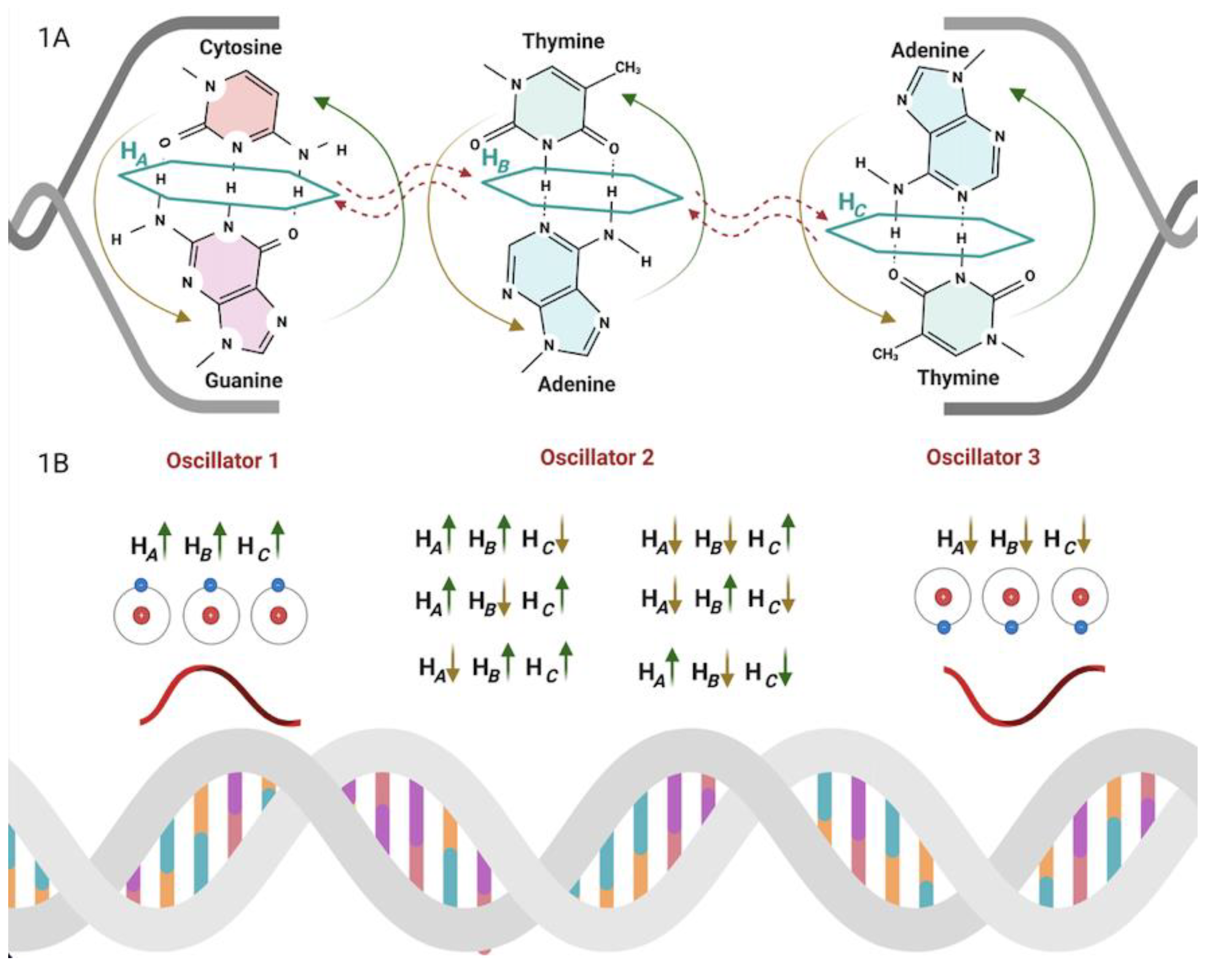
Figure 2.
Model of DNA as a group of coupled oscillators. In the figure, we present a schematic of the codon. Each level of the DNA base pair is capacitively coupled to a transmission guide and subject to harmonic forcing in the magnetic flux passing through it. DNA strands are considered a distributed-parameter transmission line. There are connections between successive base pairs. Hence, the distributed sites are the nucleobases. Electrons move along specific paths when exposed to a magnetic field, generating small magnetic fields, represented by the discontinuous yellow and gray circles.
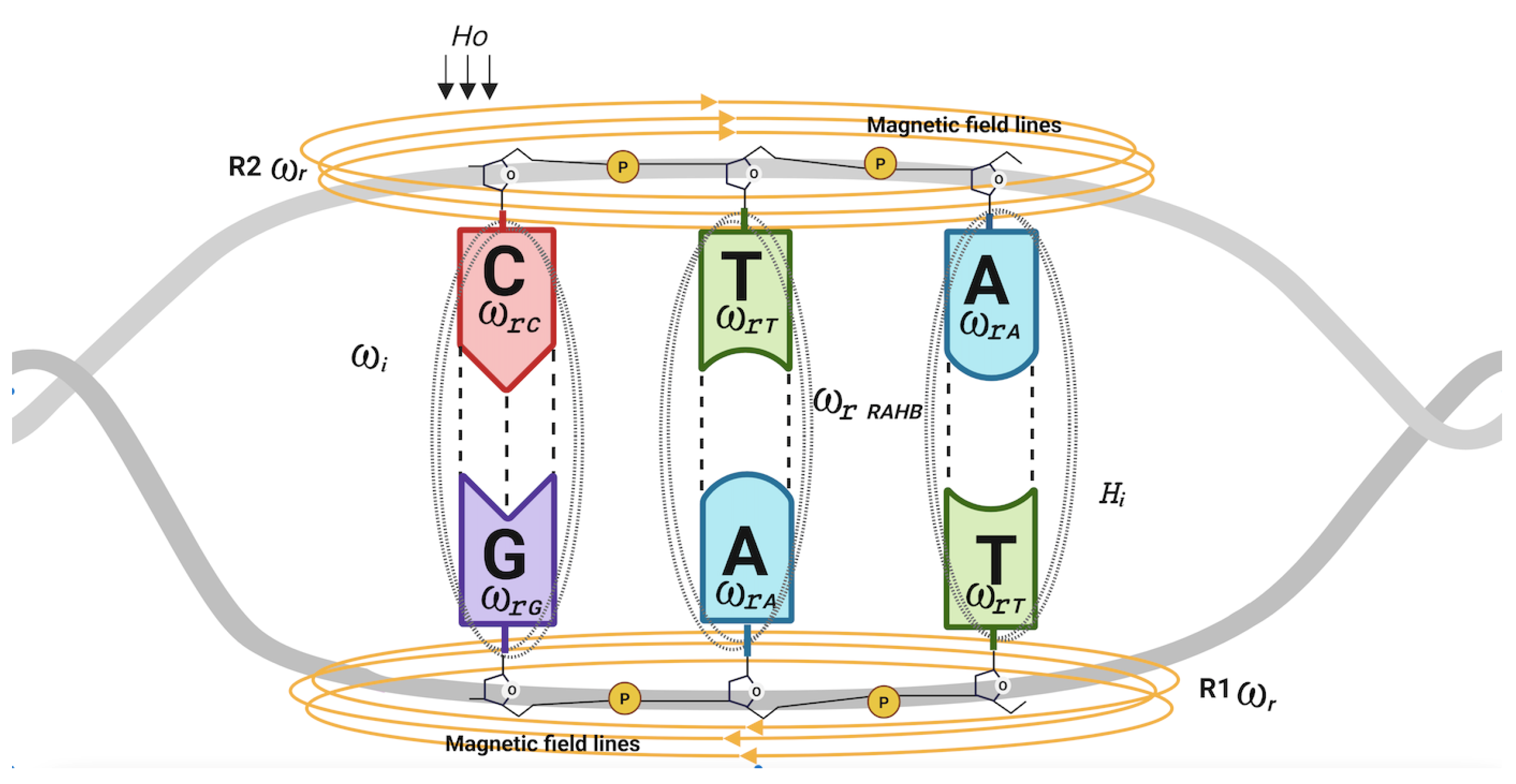
Figure 3.
A diagram of the Zeeman splitting of the proton nucleus A, B, or C (I=1/2) in an applied magnetic field .
Figure 3.
A diagram of the Zeeman splitting of the proton nucleus A, B, or C (I=1/2) in an applied magnetic field .
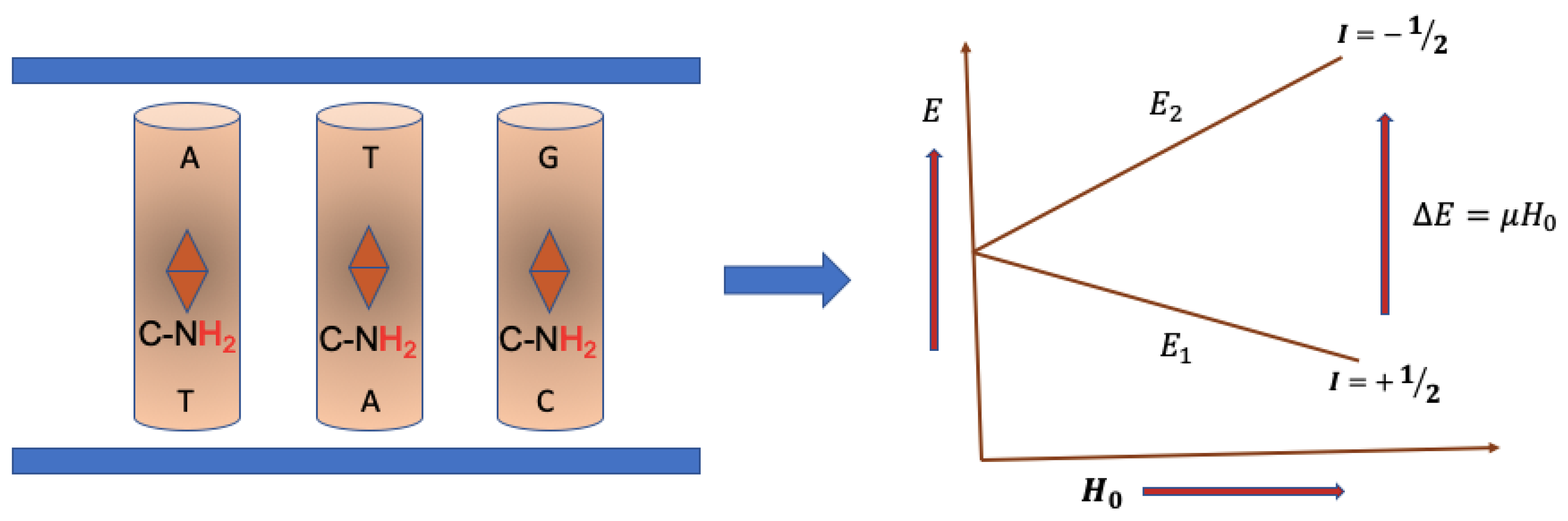
Figure 4.
Taken from the article previously published by our group in (Riera Aroche, Ortiz García, Sánchez Moreno, et al., 2024). DNA strands are modeled as resonators, illustrating the distributed inductance and capacitance present. Connections exist between successive base pairs, making the nucleobases the distributed sites. Each level of the DNA base pair is capacitively linked to a transmission guide, which is influenced by harmonic forcing from the magnetic flux passing through it. The application of Kirchhoff’s laws is also depicted.
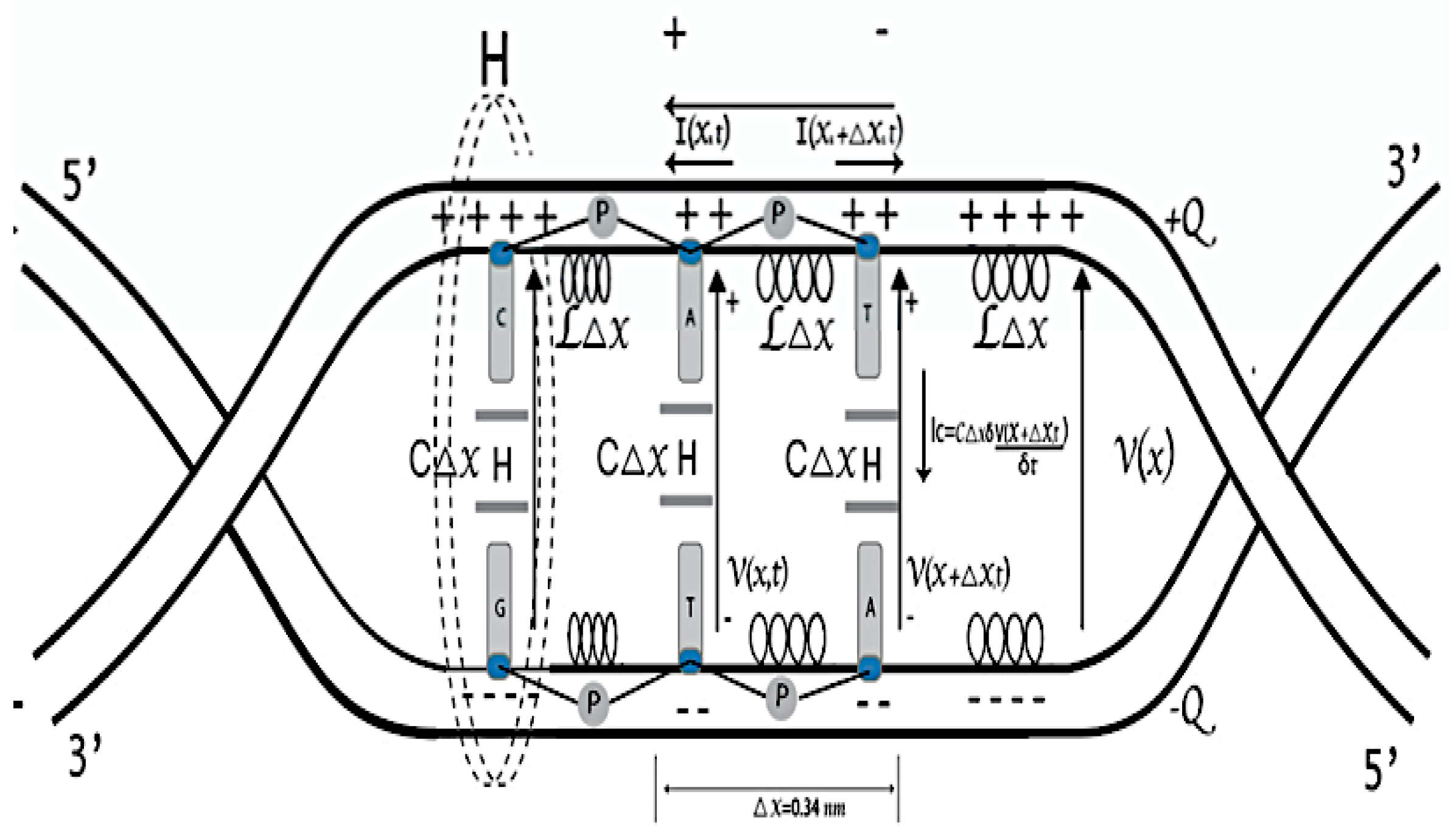
Figure 5.
5A. Rotation of the magnetization vector around the x-axis in the y-z plane within the rotating flame at the Larmor frequency , caused by the RF pulse that creates the magnetic field in the rotating flame. 5B. Similarly, using the Bloch representation, all quantum gates can be viewed as rotations of the Bloch vector of a DNA qubit’s state. Each qubit is depicted as a point on the Bloch sphere, where the poles symbolize the eigenstates. The colatitude angle, θ, varies from 0 to π, while the azimuthal angle ranges from 0 to 2π. The action of a quantum gate on a single qubit is a rotation on the Bloch sphere, resulting in a new qubit state. The RNA polymerase alters the external magnetic flux, generating a phase difference. When the flow phase shift occurs, the Bloch sphere is reproduced.
Disclaimer/Publisher’s Note: The statements, opinions and data contained in all publications are solely those of the individual author(s) and contributor(s) and not of MDPI and/or the editor(s). MDPI and/or the editor(s) disclaim responsibility for any injury to people or property resulting from any ideas, methods, instructions or products referred to in the content. |
© 2026 by the authors. Licensee MDPI, Basel, Switzerland. This article is an open access article distributed under the terms and conditions of the Creative Commons Attribution (CC BY) license (http://creativecommons.org/licenses/by/4.0/).
Copyright: This open access article is published under a Creative Commons CC BY 4.0 license, which permit the free download, distribution, and reuse, provided that the author and preprint are cited in any reuse.