

Submitted:
25 September 2026
Posted:
29 September 2026
You are already at the latest version
Abstract
Fungal organohalogenated secondary metabolites play essential roles in ecological interactions, chemical defense, and pharmaceutical applications. This overview synthesizes current insights into the genomic organization, biosynthetic machinery, computational prediction tools (antiSMASH, SSNs), epigenetic control mechanisms, and green biocatalytic applications of fungal chlorinated metabolites. Fungi utilize specialized enzymes, primarily free-standing flavin-dependent halogenases (FDHs) that employ a 10 Å internal tunnel to channel hypochlorite to a catalytic lysine, generating electrophilic chloramines. Other systems include heme-dependent and vanadium-dependent haloperoxidases, as well as copper radical halogenases (DUF3328). These enzymes are encoded within Biosynthetic Gene Clusters (BGCs) regulated by Zn2Cys6 transcription factors, the Velvet complex, and chromatin remodeling. Engineered FDHs and biocatalysts, such as RadH and MalA variants, facilitate late-stage, regioselective C–H functionalization on non-native drug scaffolds. Additionally, griseofulvin shows expanded pharmacological value, selectively inhibiting tumor centrosome clustering via KIFC1/HSET kinesin blockade. Harnessing fungal halogenation machinery advances green biocatalysis and unlocks novel pathways for drug discovery.
Keywords:
BGCs
; organohalogenated compounds
; regulation
1. Introduction
Natural-products chemistry regarded organohalogenated compounds as synthetic substances or isolated anthropogenic contaminants. Chlorinated, brominated, or iodinated molecules detected in biological extracts were dismissed as artifacts derived from solvents or extraction procedures; by 1961, only 29 halometabolites of microbial origin had been documented [1,2]. This paradigm changed radically following the discovery of griseofulvin in cultures of Penicillium griseofulvum. Researchers identified the compound as the “Curling Factor” because of its specific morphological effects on hyphae, establishing griseofulvin as the first organohalogenated antifungal agent to achieve widespread systemic clinical use [3]. Morris and Hager [4] isolated and purified the chloroperoxidase (CPO) secreted by Caldariomyces fumago in crystalline form, demonstrating that eukaryotic organisms can biosynthesize organic compounds containing carbon–halogen bonds. Over the past five decades, the number of naturally occurring organohalogenated compounds identified and reported has increased from fewer than 50 characterized molecules in the late 1960s to more than 10,000 compounds. Accordingly, fungi have emerged as the fourth most important kingdom for producing halogenated metabolites, accounting for approximately 20% of all microbial halometabolites and surpassed only by marine sponges, algae, and bacteria [1]. Fungi, particularly members of the phylum Basidiomycota, play a biogeochemical role in chlorine cycling in terrestrial and atmospheric ecosystems [5]. Ligninolytic white-rot and litter-decomposing species belonging to genera such as Bjerkandera sp., Hypholoma sp., Phellinus sp., Mycena sp., Phlebia sp., and Trametes sp. biosynthesize and secrete adsorbable organic halogens (AOX) and low-molecular-weight aromatic and aliphatic organohalogenated compounds [5,6], including chloromethane (CH3Cl). Basidiomycetes of the family Hymenochaetaceae, including Phellinus pomaceus, Inonotus, and Fomitiporia, actively convert chloride ions from wood and cellulose into volatile CH3Cl during secondary metabolism. CH3Cl acts as a coupled methyl donor for methylation of carboxylic esters and phenolic ethers, such as veratryl alcohol, required in fungal ligninolytic systems. In forest litter, genera such as Bjerkandera biosynthesize de novo a set of chlorinated anisyl metabolites (CAMs), including alcohols and aldehydes such as 3-chloro-4-methoxybenzene and 3,5-dichloro-4-methoxybenzene [5]. These chlorinated aldehydes function as protective substrates for extracellular aryl-alcohol oxidases (AAOs), which generate hydrogen peroxide (H2O2), an essential cofactor for lignin peroxidases (LiP) and manganese peroxidases (MnP) during depolymerization of the complex lignin matrix [5,6]. Chlorine increases oxidation of the benzene ring, protecting these aromatic mediators from premature oxidative degradation by the fungus’ own enzymes [5]. The fate of these organohalogenated metabolites in soil is associated with humification and carbon sequestration. Laccases and peroxidases mediate the oxidative polymerization of chlorinated phenols and chlorinated hydroquinones, such as the drosophilins produced by Psathyrella sp. and Coprinus sp., covalently coupling these organochlorine building blocks to humic substances [5,6]. This process generates chlorohumus, a high-molecular-weight reservoir of chlorinated organic carbon that is resistant to microbial degradation and constitutes a major biogenic pathway for the long-term retention and storage of chlorine in the lithosphere [5]. The enzymatic generation of a carbon–halogen bond entails an energetic cost; nevertheless, it has been evolutionarily retained because it confers adaptive advantages under natural selection. Halogen substituents, such as chlorine or bromine, alter the physicochemical properties of secondary metabolites, increasing lipophilicity, resistance to metabolic inactivation, membrane permeability, and the capacity to form halogen bonds and directional σ-hole interactions with macromolecular receptors [1]. An ecological example of the adaptive value of halogenation is the “Sclerotium Fortress” model [7]. Fungi such as Aspergillus carbonarius, Aspergillus ochraceus, and Aspergillus flavus selectively sequester high concentrations of chlorinated toxins, such as ochratoxin A [8], and polyketide pigments, such as asparasone A [9], within sclerotial tissue. Ochratoxin A acts as a potent anti-insecticidal and biocidal agent that inhibits predation by fungivorous arthropods and soil insects [8], and the asparasone A scaffold provides a physical and antioxidant shield against UV radiation and thermal stress [9]. In the resorcylic acid lactone radicicol, produced by Pochonia chlamydosporia and Chaetomium chiversii, the aromatic chlorine atom forms a halogen bond within the ATP-binding site of the eukaryotic molecular chaperone Hsp90 [10,11]. Removal of chlorine in its analogue monocillin I decreases Hsp90-binding affinity, demonstrating that halogenation can convert a metabolic precursor into a targeted toxin for fungal competition and ecological niche dominance [12].
Organohalogenated compounds also fulfill biosynthetic roles in developmental signaling and cellular interactions. In Dictyostelium discoideum, the chlorinated polyketide DIF-1 (Differentiation-Inducing Factor 1; 1-(3,5-dichloro-2,6-dihydroxy-4-methoxyphenyl)hexan-1-one) acts as an endogenous morphogen [13]. Regioselective chlorination catalyzed by the flavin-dependent halogenase ChlA is essential for recognition of DIF-1 by the signal-transduction machinery and initiation of cellular differentiation toward stalk formation during fruiting-body morphogenesis [13].
2. Biosynthetic Machinery and Enzymatic Mechanisms.
2.1. Flavin-Dependent Halogenases
Flavin-dependent halogenases (FDHs) are the enzyme family responsible for regioselective halogenation of aromatic and heterocyclic rings [1,14]. Unlike bacterial systems, which require the substrate to be covalently tethered to an acyl carrier protein (ACP) or peptidyl carrier protein (PCP), most characterized fungal FDHs operate as free-standing enzymes that recognize soluble, non-tethered substrates (Table 1) [15,16].
2.1.1. The 10 Å Tunnel Mechanism and Formation of the Catalytic Chloramine
Fungal FDHs function as two-component systems that require an accessory flavin reductase to supply reduced flavin adenine dinucleotide (FADH2) at the expense of NADH or NADPH [15,23]. The three-dimensional architecture of FDHs contains two independent catalytic sites separated by approximately 10 Å and connected by an internal hydrophobic tunnel (Figure 1) [23,24].
Hypochlorite generation at the flavin site is initiated within the flavin-binding domain, characterized by the conserved GxGxxG motif, through reaction of FADH2 with molecular O2 to form the covalent C4a-hydroperoxy-FAD intermediate FAD-C4a-OOH [23,24]. Nucleophilic attack by Cl⁻ on the C4a-hydroperoxy-FAD oxygen yields hypochlorous acid (HOCl) and regenerates the flavin hydroxide species (FAD-C4a-OH) [23]. The reaction products are directed into the tunnel; by preventing release of the reactive oxidant HOCl into the aqueous medium and nonspecific substrate hydroxylation, HOCl is channeled through the 10 Å tunnel to the substrate-binding site, and reacts with a conserved catalytic lysine (e.g., Lys108 in MalA/MalA′, Lys74 in Rdc2/RadH, and Lys79 in PrnA) [15,23,25]. Protonation of this adduct produces the electrophilic protonated lysine chloramine, -NH2Cl+ [23]. This stabilized chloramine donates a Cl+ equivalent toward the target aromatic carbon, affecting regioselective electrophilic aromatic substitution. A proximal basic residue (e.g., Glu346 in PrnA) assists the reaction by deprotonating the intermediate and restoring aromaticity [15,23].
2.1.2. Fungal Subclasses and Structural Motifs
Fungal FDHs show structural and functional diversification and can be grouped into subclasses according to substrate specificity [1,16]. These include indole and indole-alkaloid FDHs, exemplified by the iterative halogenases MalA and MalA′, isolated from Malbranchea aurantiaca and Malbranchea graminicola, respectively, which catalyze dichlorination of premalbrancheamide to produce the calmodulin antagonist malbrancheamide [15,26]. The crystal structure of MalA′ revealed that it belongs to a fungal FDH subclass with a C-terminal Zn2+ ion-binding motif and a catalytic site tailored to accommodate the bicyclodiazaoctane scaffold. Studies of Lys108 established its role in the active chloramine mechanism, while Asp109 and Ser129 regulate chlorination regioselectivity between the C8 and C9 positions [15]. Phenol and polyphenol FDHs are the main FDH group in Ascomycota within sequence-similarity networks (SSNs) [1,16]. The enzyme GsfI, encoded within the gsf cluster of Penicillium aethiopicum, catalyzes regioselective chlorination at C7 of griseophenone C to produce griseophenone B during griseofulvin biosynthesis [17,18,27]. Rdc2/RadH, encoded in the rdc and rad clusters of Pochonia chlamydosporia and Chaetomium chiversii, respectively, catalyzes chlorination of monocillin II to pochonin D during biosynthesis of Hsp90 inhibitor radicicol [10,19,28]. Rdc2 shows synthetic flexibility, capable of chlorinating non-native macrolactones and heterocyclic systems such as isoquinolines [19]. OtaD (AcOTAhal), encoded in the ota locus of Aspergillus carbonarius and Aspergillus ochraceus, is responsible for chlorination of ochratoxin B to produce the mycotoxin ochratoxin A [1,15]. GedL halogenates sulochrin to dihydrogeodin in Aspergillus terreus [20], whereas PtaM halogenates isosulochrin in Pestalotiopsis fici in the biosynthesis of pesteic acid [1,29].
2.2. Heme-Dependent (hHPOs) and Vanadium-Dependent (vCPOs) Chloroperoxidases
2.2.1. Heme-Dependent Haloperoxidases
The chloroperoxidase from Leptoxyphium fumago (CfuCPO) is a 42 kDa monomeric glycoprotein containing approximately 18% carbohydrate [4,30,31]. It has a structure combining features of cytochromes P450 and peroxidases [30,32] and contains a ferriprotoporphyrin IX prosthetic group axially coordinated to the protein through a cysteine residue (Cys29), a polar glutamate residue (Glu183) acts as an acid–base catalyst during halogenation [32]. Reaction of the Fe3+-heme group with H2O2, deprotonation by Glu183 generates Compound I, a cationic oxoiron(IV) porphyrin radical intermediate (Fe(IV)=O Por•+) [30,32]. Compound I oxidizes halides to release HOCl into the medium [4,33], where it diffuses from the enzyme. Consequently, hHPO-mediated chlorination is governed by the reactivity of the substrate and lacks stereoselectivity and regioselectivity. In the absence of halides, CPO exhibits P450-like activity, catalyzing asymmetric sulfoxidation, stereospecific alkene epoxidation, and benzylic hydroxylation [30,34]. However, hHPOs undergo inactivation through oxidative destruction of the porphyrin ring in the presence of excess H2O2 [30].
2.2.2. Vanadium-Dependent Chloroperoxidases
Fungal vanadium-dependent chloroperoxidases, isolated from terrestrial hyphomycetes such as Curvularia inaequalis (CivCPO) and marine fungi such as Hortaea werneckii, represent stable biocatalysts [25,35]. They contain a vanadate prosthetic center. CivCPO is a 67.5 kDa monomeric enzyme that coordinates an inorganic orthovanadate oxoanion (HVO4−2 / VO4−3) in a trigonal-bipyramidal geometry. The vanadium center is covalently linked to the imidazole nitrogen of a single histidine residue (His496) and stabilized by a hydrogen-bonding network involving Lys353, Arg360, Arg490, and Ser402 (Figure 2). Unlike heme, vanadium shows no change in oxidation state (V+5) during catalysis. Vanadate acts as a Lewis acid, coordinating H2O2 to form a reactive η2-peroxovanadate intermediate [35,36]. The anion undergoes nucleophilic attack on the coordinated peroxide, promoting heterolytic cleavage of the O–O bond and release of HOX [25,36]. Unlike marine algal bromoperoxidases, fungal vCPOs contain a specific hydrophobic site in which Trp350 facilitates chloride binding [35,36]. They are of biotechnological interest because of their resistance to thermal denaturation, high H2O2 concentrations, and organic solvents or ionic liquids [25,31].
2.3. Emerging Mechanisms and Non-Canonical Biosynthetic Topologies
2.3.1. Copper Radical Halogenases
The discovery of ApnU in the biosynthetic pathway of the mitochondrial complex II inhibitor atpenin A5 in Penicillium oxalicum changed the prevailing view of unactivated C(sp3)–H functionalization, demonstrating that this chemistry is not restricted to non-heme iron/α-ketoglutarate (NHFe–αKG)-dependent enzymes [21,37]. ApnU is the founding member of the DUF3328 protein family (Pfam 11807), and structural modeling and biochemical characterization indicate that it functions as a membrane-associated homodimer coordinating a Type II dinuclear Cu+2 center at the dimer interface through two conserved copies of the HxxHC(x)nHxxHC motif. The enzyme requires O2 and an external reductant, such as ascorbate or NADH, to generate a copper–oxygen–halogen radical intermediate. This species abstracts hydrogen from an unactivated alkyl chain of the substrate, generating a carbon-centered radical that reacts with the coordinated halogen to effect iterative chlorination and iodination of unactivated C(sp3)–H positions. Other DUF3328-family enzymes include CctR from Talaromyces islandicus, which catalyzes copper- and O2-dependent radical hydroxylation of 2-aminobutyric acid to L-allo-threonine during cyclochlorotine hepatotoxin biosynthesis, and AprY, which functions as a peptide macrocyclase catalyzing Cβ–O ether cross-link formation in the nonribosomal peptide asperipin-2a (Figure 3) [37].
2.3.2. Multifunctional and Hybrid Enzymes.
AoiQ represents an example of a multifunctional enzyme identified in Aspergillus oryzae RIB40. It comprises 1014 amino acids [1,38], with an N-terminal region containing the complete catalytic motifs of a flavin-dependent halogenase, and its C-terminal region contains an S-adenosyl-L-methionine (SAM)-dependent methyltransferase domain. This enzyme catalyzes geminal α,α-dichlorination at an enolizable aliphatic (sp3) carbon within the alkyl chain of diaportin derivatives, such as des-O-methyldiaportin and diaportin. The fused SAM-methyltransferase domain catalyzes phenolic bis-methylation of the intermediates, demonstrating the evolutionary fusion of tailoring modules within a single polypeptide chain [38].
2.3.3. “Off-Cluster” Biosynthetic Topologies.
The forest pathogen Armillaria mellea produces a broad range of chlorinated sesquiterpenoid aryl esters known as melleolides [5,22]. Sequencing of the principal melleolide biosynthetic cluster revealed that the genomic locus lacks a gene encoding a halogenase. Chlorination is carried out by a system of five parallel flavin-dependent halogenases (ArmH1–ArmH5) located in distant chromosomal regions uncoupled from the main biosynthetic cluster (off-cluster). Heterologous assays demonstrated that these independent FDHs, particularly ArmH4, recognize non-chlorinated melleolides as free substrates and catalyze regioselective chlorination of the aromatic ring, producing 6′-chloro-melleolide F [22]. This phenomenon highlights the capacity of fungi to recruit enzymes to diversify their secondary metabolome (Table 2).
3. Genomic Organization and Genetic/Epigenetic Regulation of Organohalogenated Biosynthetic Gene Clusters (BGCs)
3.1. Genomic Architecture and Biosynthetic Logic of Model Chlorinated BGCs
The genetic machinery responsible for the biosynthesis of organohalogenated secondary metabolites is organized into Biosynthetic Gene Clusters (BGCs) [39,40]. These loci coordinate biosynthesis of the core molecular scaffold through synthases or synthetases (PKS, NRPS, terpene synthases, or hybrid systems), together with tailoring enzymes, including flavin-dependent halogenases (FDHs), chloroperoxidases, and the recently discovered copper radical halogenases [1,39]. Comparative analysis of BGC architecture can therefore elucidate the biosynthetic strategies used by fungi to channel halogenation (Table 3).
3.1.1. The gsf Cluster
The clinically used antifungal griseofulvin is a chlorinated spirocyclic macrolide, with its biosynthetic pathway encoded by the gsf gene cluster [17,18,27]. The cluster spans 25 kb and harbors an enzymatically coordinated set of genes, including the non-reducing polyketide synthase GsfA, which contains SAT, KS, AT, PT, and ACP domains and condenses one acetyl-CoA unit with six malonyl-CoA units to generate an aromatic heptaketide intermediate [17,27]. The S-adenosyl-L-methionine (SAM)-dependent O-methyltransferases GsfB and GsfC catalyze consecutive methylation of the 3-OH and 9-OH groups of the benzophenone precursor to form griseophenone C [17,44]. These methylations block dehydration and suppress premature branching to the undesired xanthone norlichexanthone. The flavin-dependent halogenase GsfI catalyzes the electrophilic bond of a single chlorine atom at C7 of griseophenone C, producing griseophenone B. Subsequently, the cytochrome P450 monooxygenase GsfF mediates intramolecular oxidative phenolic coupling between the orcinol and phloroglucinol rings of griseophenone B, generating the characteristic spirocyclic structure of desmethyl-dehydrogriseofulvin [17]. Finally, the O-methyltransferase GsfD methylates the 5-OH group to form dehydrogriseofulvin, followed by the NADPH-dependent short-chain dehydrogenase/reductase GsfE, which stereospecifically reduces the enol double bond of the cyclohexadienone ring to produce griseofulvin [17,41]. Comparative genomic studies across 12 fungal species demonstrated that, of the 13 genes originally reported in P. aethiopicum, only a seven-gene core (gsfA–gsfF and gsfI) is conserved among all griseofulvin producers, and other genes, including gsfH, gsfK, and gsfR2, have been rearranged or lost in species such as Penicillium griseofulvum [27,41].
3.1.2. The ota Cluster
The ota BGC governs biosynthesis of the chlorinated nephrotoxin ochratoxin A (OTA) in species of Aspergillus and Penicillium [42,43]. The consensus locus comprises four core biosynthetic genes (otaA–D). OtaA (HR-PKS) synthesizes the pentaketide precursor 7-methylmellein from acetyl-CoA and malonyl-CoA [42]. OtaC (cytochrome P450) oxidizes the C7 methyl group to a carboxylic acid, generating 7-carboxymellein (ochratoxin β), which is covalently coupled by the monomodular NRPS OtaB to L-phenylalanine to form ochratoxin B. OtaD (AcOTAhal) is a free-standing flavin-dependent halogenase that catalyzes regioselective late-stage chlorination at C5 of the isocoumarin ring of ochratoxin B, generating mature ochratoxin A [1,42,43].
3.1.3. The mal Cluster
The mal cluster catalyzes the biosynthesis of chlorinated indole alkaloids known as malbrancheamides [15,26]. The biosynthetic logic integrates a coordinated combination of enzymatic modules. Initially, the NRPS MalG synthesizes the cyclic diketopiperazine intermediate by coupling L-tryptophan and L-proline. Subsequently, the prenyltransferase MalE catalyzes transprenylation of the indole ring using dimethylallyl pyrophosphate (DMAPP) [15]. The NADPH-dependent cycloadditionase MalC orients the substrate to promote an enantioselective and diastereoselective intramolecular Diels–Alder (IMDA) cycloaddition, forming the complex bicyclo2,5-diazaoctane core of (+)-premalbrancheamide. Finally, the iterative flavin-dependent halogenase MalA, which contains a conserved C-terminal Zn+2-binding motif, recognizes the substrate and adds two chlorine atoms sequentially at C8 and C9 of the indole core to generate malbrancheamide B and malbrancheamide A [15,26].
3.2. Pathway-Specific and Global Transcriptional Regulation
3.2.1. Pathway-Specific Transcription Factors
Transcription of organohalogenated BGCs is hierarchically organized through the coordinated action of pathway-specific transcription factors encoded within the cluster and broad-acting global master regulators (Figure 3, Table 4) [7,39].
Approximately 50% of fungal BGCs contain a gene encoding a binuclear zinc-cluster Zn2Cys6-dependent transcription factor [39]. These factors recognize and bind specific palindromic motifs or direct and inverted repeats within promoters of genes belonging to the same cluster [39,45]. In Aspergillus terreus, GedR functions as the master switch for the geodin biosynthetic cluster. Heterologous overexpression or induction of gedR simultaneously activates transcription of all 13 genes in the locus, including the gedC PKS and the sulochrin halogenase gedL [20]. AflR is the conserved Zn2Cys6 factor in Aspergillus flavus and Aspergillus nidulans that recognizes the palindromic sequence 5′-TCGN5CGA-3′ in biosynthetic promoters [7,39,45]. AflR physically associates with the coactivator protein AflS (AflJ) to recruit RNA polymerase II [7,45]
3.2.2. The Velvet Complex.
The Velvet complex is a nuclear trimeric machinery composed of the developmental structural proteins VeA and VelB together with the methyltransferase LaeA (Loss of AflR Expression A) [7,46]. This complex functions as the principal physiological integrator linking morphological development, including the balance between conidiation and sclerotial/cleistothecial formation, with light perception and secondary metabolism [7,39,46]. LaeA acts as a positive global regulator of secondary metabolism in Aspergillus sp., Penicillium sp., Fusarium sp., and Trichoderma sp. [39]. LaeA counteracts chromosomal heterochromatin-mediated silencing in subtelomeric regions, where organohalogenated BGCs are preferentially located [7,39,40]. In the absence of light, importin α KapA transports the VeA–VelB heterodimer into the nucleus, where it interacts with LaeA to form the functional Velvet complex [7,46]. This complex promotes the development of sclerotia and transcription of protective chlorinated BGCs, such as ochratoxin A in Aspergillus carbonarius and asparasone A in Aspergillus flavus [7,9].
3.3. Epigenetic Control and Chromatin Remodeling
3.3.1. Repressive and Activating Chromatin Marks
Reported epigenetic mechanisms controlling expression include H3K27me3 and H3K9me3, which condense nucleosomes across the BGC, physically restricting access by transcription factors and RNA polymerase II, and thereby repressing transcription [39,40,48]. During secondary-metabolite production (idiophase) or in response to environmental triggers, histone demethylases such as KdmB remove methyl groups from H3K27me3 context, and histone acetyltransferases (HATs), such as EsaA, acetylate lysine residues on histones H3 and H4, promoting BGC transcription (Table 5) [39,40].
3.3.2. Histone Deacetylases and the SAGA-ADA Coactivator Complex
Deacetylation plays an important role in BGC regulation. Fungal histone deacetylases, including HdaA, RpdA, and SirA, remove acetyl groups and maintain transcriptional silencing [39,50]. Mutation of hdaA or chemical treatment with HDAC inhibitors, such as suberoylanilide hydroxamic acid (SAHA) or trichostatin A (TSA), increases secondary-metabolite diversity by inducing cryptic clusters, including production of daldinone E in Daldinia sp. and induction of chlorinated azanaphthoquinones [39,50,51]. The SAGA-ADA acetyltransferase complex, which contains the histone acetyltransferase GcnE, functions as an epigenetic regulator of metabolite induction during interspecies microbial interactions. When Streptomyces rapamycinicus physically interacts with Aspergillus nidulans, targeted recruitment of GcnE to promoters of silenced BGCs is triggered, resulting in acetylation of histones H3 and H4 and activation of biosynthesis of compounds such as orsellinic acid and chlorinated derivatives [39,49,51].
3.4. Environmental Signals and Halide Sensing
3.4.1. Bromide-Selective Transcriptional Repression
Fungal organohalogenated BGCs have evolved mechanisms for sensing the environment and regulating their expression in response to the availability of specific inorganic halides; an example is the biosynthesis of the chlorinated resorcylic acid lactone radicicol in the nematophagous fungus Pochonia chlamydosporia. Supplementation of the culture medium with 50 mM NaBr does not result in production of brominated radicicol; instead, it suppresses radicicol biosynthesis in a dose-dependent manner, redirecting the pathway toward the substantial accumulation of non-chlorinated precursors, the monocillins (II, III, IV, and V). Quantitative RT-PCR assays demonstrated that bromide anions repress transcription of the flavin-dependent halogenase gene rdc2 at the mRNA level, preventing its intracellular accumulation [28]. This repression is selective, because NaBr addition does not alter transcription of the neighboring P450 epoxidase gene rdc4 or the core polyketide synthase genes in the cluster (rdc1 and rdc5). This phenomenon shows the fungal genomic signaling networks that sense environmental halide concentrations and selectively switch the chlorination machinery off or on.
4. Genomic Mining, Computational Prediction and Systems Biology.
4.1. Bioinformatic Platforms and Repositories for Fungal Genomic Mining
The advent of next-generation sequencing (NGS) technologies and the expansion of public genomic repositories, such as NCBI GenBank and the JGI MycoCosm portal, which hosts more than 2,000 fungal genomes, have revealed that the metabolic capacity of filamentous fungi exceeds the number of compounds experimentally characterized under standard laboratory conditions. This gap between biosynthetic genotype and chemical phenotype has driven the development of specialized bioinformatic tools designed for the localization, delineation, and silico functional prediction of BGCs encoding halogenases [1,39].
4.1.1. Cluster Delimitation Algorithms.
The antiSMASH platform (Antibiotic & Secondary Metabolite Analysis Shell) is the standard bioinformatic tool for identifying BGCs in fungi [39,52]. It uses profile-based Hidden Markov Models (pHMMs) to detect core synthases (PKS, NRPS) and associated tailoring enzymes, including flavin-dependent halogenase domains (FAD-binding GxGxxG motif), heme/vanadium peroxidases, and DUF3328 domains [1,52]. The CASSIS platform (Cluster Assignment by Islands of Sites) identifies BGC boundaries by detecting conserved binding motifs for pathway-specific transcription factors shared among promoters of neighboring genes. SMURF (Secondary Metabolite Unknown Regions Finder) analyzes co-expression and genomic proximity in Pezizomycotina fungi [39]. Other important platforms include BIG-SLiCE and MIBiG, which are used for large-scale genomic analysis. BIG-SLiCE clusters millions of BGCs into Gene Cluster Families (GCFs) based on quantifiable biosynthetic feature vectors. These predictions are validated against the MIBiG (Minimum Information about a Biosynthetic Gene Cluster) repository, a database linking gene sequences to experimentally characterized chemical structures, including the gsf, ota, mal, and rdc loci [1,53].
4.2. Sequence-Similarity Networks for Halogenase Classification and Substrate-Specificity Prediction
Sequence-Similarity Networks (SSNs), generated using the EFI-EST (Enzyme Function Initiative–Enzyme Similarity Tool) bioinformatic platform, have transformed functional prediction of fungal and bacterial flavin-dependent halogenases (FDHs) by organizing thousands of sequences into discrete subnetworks according to aligned-sequence identity thresholds (Table 6) [1,16].
4.2.1. Subnetwork Topology and Prediction of Substrate Specificity
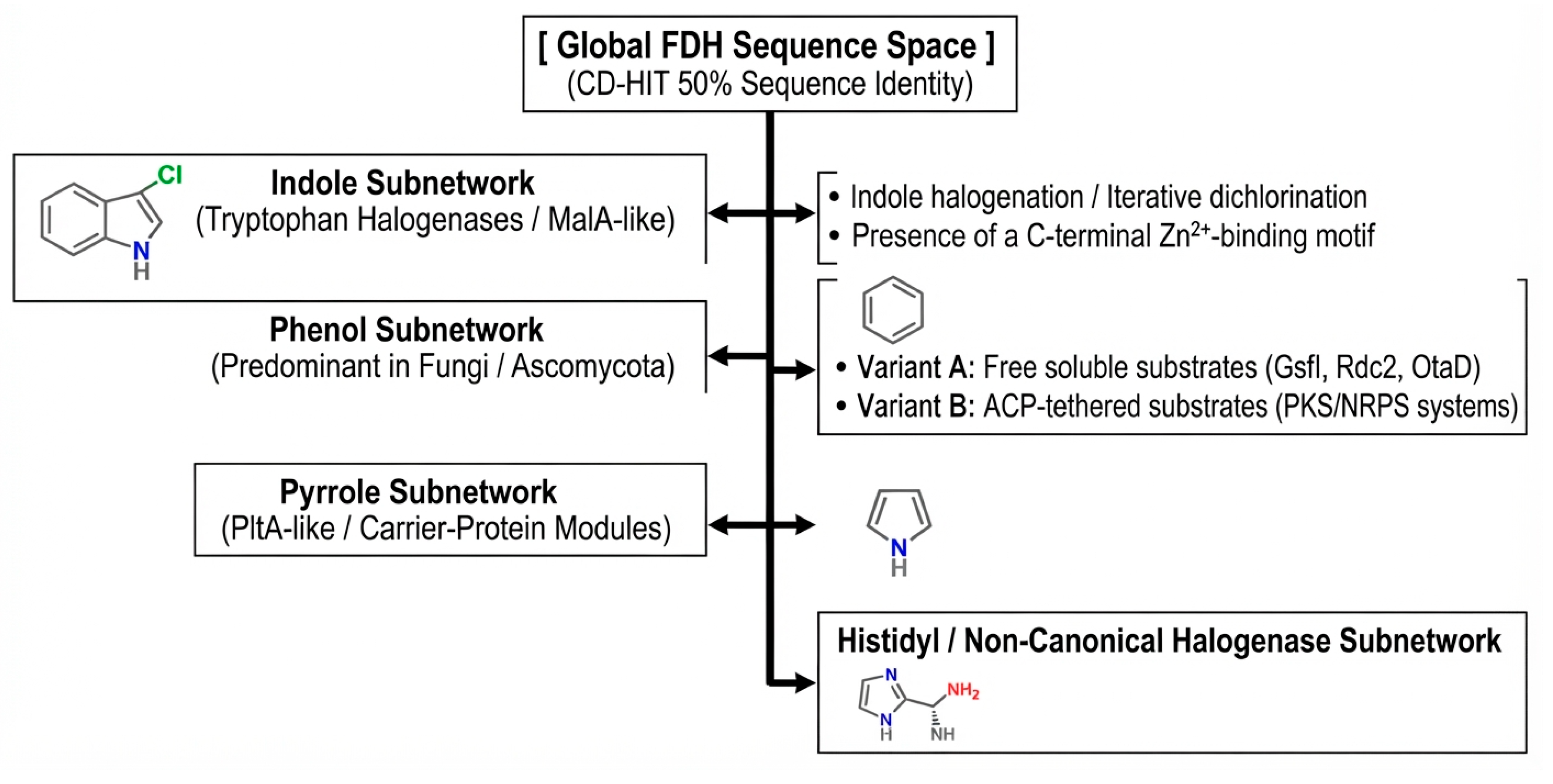
When FDH sequences are processed using a stringent alignment-score threshold, FDHs segregate into four principal functional subnetworks [16]. The first is the indole subnetwork, which includes bacterial tryptophan halogenases such as RebH, PrnA, and PyrH, as well as the unique fungal subclass represented by MalA and MalA′ [15,16]. Fungal indole FDHs are characterized by their ability to accept complex, non-tethered alkaloid substrates and by a structured C-terminal domain involved in Zn+2 coordination [15]. The phenol subnetwork is the most abundant FDH group in the fungal kingdom (Pezizomycotina sp.); it is subdivided into two principal catalytic architectures. The first comprises free-substrate variants (Variant A), including GsfI (griseofulvin), Rdc2/RadH (radicicol), OtaD (ochratoxin A), GedL (geodin), and PtaM (pesteic acid), which recognize soluble polyphenolic intermediates or benzophenones in the aqueous phase [1,16]. The second comprises ACP-tethered variants (variant B), in which enzymes are coupled to PKS/NRPS assembly lines and halogenate phenolic rings, while the substrate remains attached to an acyl-carrier domain [16,54]. Finally, the pyrrole and histidyl subnetworks are involved in halogenation of carrier-protein-tethered pyrrole rings or histidine residues, respectively, as exemplified by PltA in pyoluteorin biosynthesis [16].
Figure 4.
FDH subnetwork architecture in SSNs (EFI-EST).
4.2.2. Homology-Guided Discovery of Halogenases
Structural-conservation analysis of SSNs has enabled the discovery of new fungal organohalogenated compounds by tracing homology to known halogenases. Within the Rdc2/RadH-like group, a search for orthologs of the Pochonia chlamydosporia halogenase Rdc2 in the MycoCosm database identified proteins with 60% identity in the genome of Thermomyces lanuginosus, linking them to chlorination of the macrolide monorden E. Similar mappings explain aromatic chlorination regioselectivity in palmerin D (Lachnum palmae) and chaetosemin G (Chaetomium sp.) [1]. Pestalacloride discovery using GedL as a guide involved using the sequence of the Aspergillus terreus sulochrin halogenase gene gedL as a bioinformatic probe in Pestalotiopsis rhododendri, leading to identification of the halogenase gene ptlK and subsequent isolation of the atropisomeric chlorinated derivatives (±)-pestalaclorides A1a and A2a [1,29].
4.3. Systems Biology Strategies for Activating Silent Organohalogenated BGCs
Because most BGCs detected bioinformatically remain transcriptionally silent or cryptic under conventional laboratory conditions, systems biology provides advanced methodologies for inducing their expression and characterizing their chlorinated metabolites [39,51].
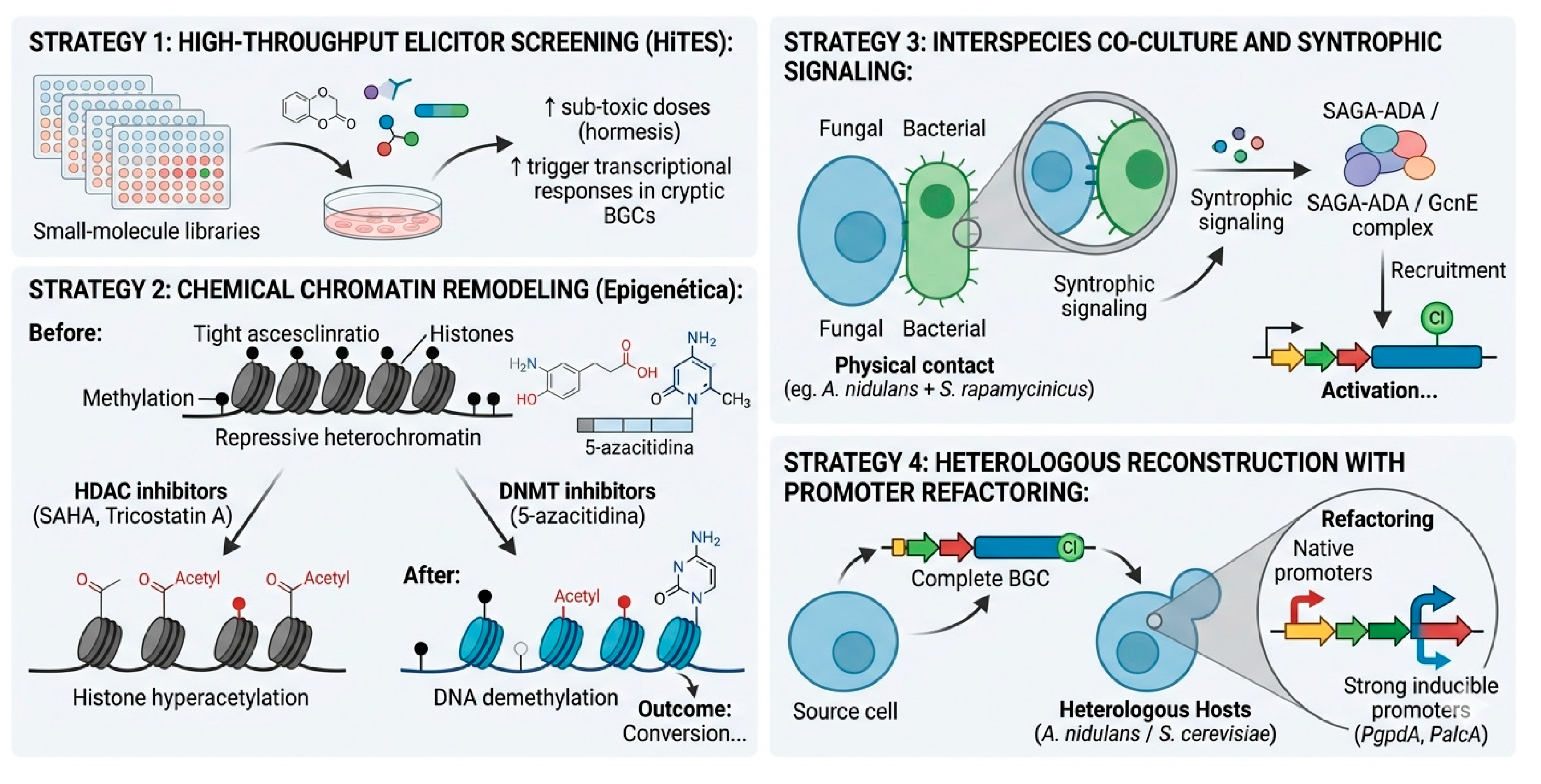
Figure 5.
Strategies for activating organohalogenated BGCs.
4.3.1. HiTES
The HiTES method (High-Throughput Elicitor Screening) employs libraries of small molecules, such as commercial antibiotics or secondary metabolites, at sub-inhibitory or sub-toxic concentrations to induce hormetic responses in filamentous fungi. This mild chemical perturbation stimulates global signaling networks that activate transcription of silent BGCs, enabling detection of new halogenated metabolites by LC-MS/MS [51].
4.3.2. Chemical Chromatin Remodeling.
Application of chemical modulators of chromatin state has become an effective approach for activating fungal secondary metabolism [39,51,55], including histone deacetylase (HDAC) inhibitors. Treatment of fungal cultures with suberoylanilide hydroxamic acid (SAHA) or trichostatin A (TSA) inhibits HDACs (e.g., HdaA), thereby increasing acetylation levels of histones H3 and H4 associated with BGCs [39,51,55]. A representative example is the addition of 800 µM SAHA to cultures of the ascomycete Daldinia sp., which activated a cryptic polyketide cluster and led to the isolation of the chlorinated pentacyclic polyketide daldinone E [55]. Likewise, DNA methyltransferase (DNMT) inhibitors such as 5-azacytidine (5-AC) induce demethylation of fungal genomic DNA, decompacting subtelomeric heterochromatin regions and activating the transcription of associated PKSs and halogenases (Table 7) [39,51].
4.3.3. Interspecies Co-culture and Induction by Microbial Syntrophy
Co-culture of fungi with competing bacteria mimics natural ecological interactions and triggers activation of halogenated chemical defenses [39,51]. An example is the Aspergillus nidulans–Streptomyces rapamycinicus model. Physical contact triggers a signaling cascade that recruits the fungal SAGA-ADA coactivator complex, mediated by the histone acetyltransferase GcnE, to promoters of silenced BGCs [49,51], resulting in targeted H3K9 acetylation and active transcription of BGCs producing phenolic metabolites and defensive chlorinated derivatives [49,51].
4.3.4. Heterologous Reconstruction and Promoter Engineering
When chlorinated BGCs do not respond to chemical or environmental inducers, synthetic biology enables direct transfer of the cluster into optimized heterologous hosts (chassis), such as Aspergillus nidulans, Aspergillus niger, or Saccharomyces cerevisiae [20,39,56]. This is exemplified by reconstruction of the ged cluster from Geodina. Nielsen et al. [20] transferred and assembled all 13 genes of the Aspergillus terreus ged cluster within the Aspergillus nidulans genome using USER cloning technology. Replacement of the promoter of the regulatory gene gedR with the strong constitutive pgpdA promoter from A. nidulans activated the biosynthetic cascade, enabling efficient expression of the PKS, coupling oxidase, and flavin-dependent halogenase GedL to produce chlorinated geodin [20].
5. Biotechnological Applications, Biocatalysis, and Biosynthetic Engineering
5.1. Late-Stage C–H Functionalization by Biocatalysis
The regioselective and stereospecific halogenation at unactivated positions of complex molecules represents one of the most challenging problems in conventional synthetic organic chemistry. Traditional chemical reagents require harsh reaction conditions, use toxic or corrosive solvents, exhibit poor regioselectivity, and generate polluting inorganic by-products [21,57]. In this context, fungal flavin-dependent halogenases (FDHs) and enzymes with non-canonical topologies have emerged as green biocatalysts for late-stage C–H functionalization, enabling direct derivatization of non-native pharmaceutical scaffolds under mild, aqueous, and physiological conditions [16,21,58].
5.1.1. Catalytic Versatility of RadH and Fungal FDHs
An example of this biosynthetic landscape with potential pharmaceutical applications is RadH (Chaetomium chiversii), which is naturally integrated into the biosynthesis of the resorcylic acid lactone radicicol. The flavin-dependent halogenase RadH has demonstrated exceptional substrate promiscuity [11,19]. Biocatalytic studies demonstrated that RadH regioselectively chlorinates or brominates a broad range of non-native heterocyclic scaffolds present in marketed drugs, including isoquinoline, flavone, flavonoid, and coumarin derivatives; for example, it forms the key 8-chloro-7-hydroxycoumarin moiety found in antibiotics such as chlorobiocin [19,57]. Through protein engineering and directed evolution supported by high-throughput fluorescence screening, RadH mutants with improved thermal stability and catalytic turnover were obtained for integration into heterologous synthetic pathways in Escherichia coli [19]. Another example is a family-level mapping of FDHs for drug derivatization using activity profiling based on Sequence-Similarity Networks (SSNs). Fisher et al. [16] identified fungal and bacterial biocatalysts capable of preparative bromination and chlorination on milligram scales of complex bioactive molecules. For example, FDH variant 1-F11 catalyzed regioselective bromination of the carbazole ring of the β-blocker carvedilol with a 56% isolated yield, as well as bromination at position 4 of β-estradiol 17-β-D-glucuronide with a 57% yield. Likewise, halogenase 1-F08 catalyzed regioselective bromination at C5 of premalbrancheamide with a 51% yield and at C3 of the indole moiety of the selective ATR kinase inhibitor AZ20 [16]. Directed evolution of the tryptophan halogenase RebH and the iterative fungal halogenases MalA/MalA′ has expanded their binding sites to accept bulky substrates such as pindolol, yohimbine, quinoline derivatives, and indole alkaloids [15,16]. More recently, RebH variants have been shown to catalyze non-natural reactions such as the enantioselective semipinacol rearrangement of prochiral allylic alcohols for asymmetric C–C bond construction [59].
5.1.2. Chemoenzymatic Strategies and “GenoChemetics” Integration
The regioselectivity of fungal halogenases allows them to be used as the first activation step in GenoChemetics cascades. In this approach, an enzymatically incorporated halogen substituent acts as an orthogonal reactive handle on the aromatic ring for subsequent cross-coupling reactions catalyzed by palladium, such as Suzuki–Miyaura or Sonogashira coupling, thereby enabling diversification of drug structures in water and in the presence of living cells [21,57].
5.2. Advanced Heterologous Expression Platforms and Biosynthetic Engineering
5.2.1. The FAC-MS Platform
The FAC-MS technology (Fungal Artificial Chromosome–Metabolic Scoring), developed by Keller and colleagues, combines cloning of large fungal BGCs into fungal artificial chromosomes (FACs) with high-resolution metabolomic profiling in a genetically optimized Aspergillus nidulans host. FAC vectors contain intact fungal genomic fragments ranging from 30 to 150 kb, encompassing complete complex BGCs with PKS/NRPS megasynthases, self-resistance genes, transcription factors, and flavin-dependent halogenases or peroxidases. This capability has enabled capture and expression of dozens of cryptic BGCs from wild ascomycetes, leading to the discovery of more than 15 new secondary-metabolite families and facilitating in vivo characterization of their halogenases [39,60].
5.2.2. The HEx Platform
The HEx platform (Heterologous Expression Platform), developed by Harvey et al. [61], uses Saccharomyces cerevisiae as a system for engineering and assembling fungal BGCs through homologous recombination in yeast [39]. Rather than relying on native fungal promoters, which are frequently silenced by the host, HEx synthetically refactors each BGC gene by replacing its regulatory regions with constitutive or inducible yeast promoters. Evaluation of 41 fungal BGCs using the HEx platform produced 22 previously undetected secondary metabolites, demonstrating that HEx is a scalable system suitable for characterizing individual fungal halogenases or complete chlorinated clusters (Table 8) [39,61].
5.2.3. Reconstitution of Complex Chlorinated BGCs and Promoter Refactoring
In addition to FAC-MS and HEx, direct assembly using uracil-specific excision reagent (USER) cloning technology has enabled the reconstruction of complete chlorinated loci, such as the geodin cluster (ged, 13 genes) in Aspergillus nidulans [20]. Host optimization through deletion of the non-homologous end-joining gene nkuA (ΔnkuA) and suppression of dominant endogenous BGCs, such as those for sterigmatocystin or aspercryptin, reduces metabolomic background and maximizes biosynthetic yields of chlorinated derivatives [20,39,56].
5.3. Pharmaceutical Repurposing of Organohalogenated Metabolites.
Drug repurposing consists of identifying new therapeutic indications for small molecules that already have clinical approval and established pharmacokinetic safety profiles [41]. The most emblematic case within the fungal organohalogenome is griseofulvin, originally isolated from Penicillium griseofulvum and Penicillium aethiopicum (Table 9) [2,3,41].
5.3.1. Selective Inhibition of Centrosome Clustering in Oncology
Human cancer cells frequently exhibit centrosome amplification. To circumvent chaotic multipolar mitosis that results in mitotic catastrophe and cell death, tumor cells depend on a survival mechanism known as centrosome clustering, which is mediated by microtubule-transport proteins such as the kinesin KIFC1/HSET. [41,62,63]. Through a high-throughput phenotypic screen designed to identify centrosome-clustering inhibitors in human tumor cells, Rebacz et al., [63] identified griseofulvin as a selective, low-toxicity ligand (Figure 6).
Griseofulvin transiently binds β-tubulin within the microtubule cytoskeleton, perturbing microtubule dynamics and interfering with HSET kinesin function [62,63]. This prevents supernumerary centrosomes from clustering into two poles during metaphase, forcing formation of multipolar mitotic spindles and triggering permanent arrest at the spindle assembly checkpoint (SAC), followed by apoptosis in cancer cells [41,62,63]. Unlike conventional microtubule-stabilizing agents such as paclitaxel or vinca alkaloids, which cause severe peripheral neuropathy by disrupting the microtubule network in normal diploid neurons, griseofulvin does not alter mitosis in normal cells with a conserved diploid centrosome number, thereby providing a highly selective oncological therapeutic window [62,63]. Synthetic modification studies of the C ring of griseofulvin demonstrated that replacement of the methoxy group at the 2′ position with aromatic chains or bulky ethers, such as the 2′-benzyloxy and 2′-naphthylmethoxy analogues, increases centrosome-clustering inhibitory potency by more than 20-fold relative to the natural compound, opening avenues for development of new antineoplastic agents [41,42,43,44,45,46,47,48,49,50,51,52,53,54,55,56,57,58,59,60,61,62].
5.3.2. Biological Evaluation as an Antiviral Agent
Inhibition of hepatitis C virus replication observed in cell-culture assays has shown that griseofulvin effectively inhibits HCV RNA replication in vitro, suppressing accumulation of the viral replicon without inducing cytotoxicity in host hepatocytes [41,64]. Molecular-docking analyses have likewise shown that griseofulvin and its demethylated metabolites (4-demethylgriseofulvin and 6-demethylgriseofulvin) exhibit favorable binding free energies toward SARS-CoV-2 targets, including the main proteases Mpro and PLpro, the RNA-dependent RNA polymerase (RdRp), and the receptor-binding domain (RBD) of the Spike protein, suggesting potential for therapeutic repurposing as a broad-spectrum antiviral [41].
6. Conclusions
Fungal organohalogenated metabolites represent a rich, evolutionarily refined chemical space driven by sophisticated enzymatic machinery, including flavin-dependent halogenases and novel copper radical catalysts. Advanced genomic mining, Sequence-Similarity Networks, and heterologous expression systems (such as FAC-MS and HEx) successfully bridge the gap between cryptic biosynthetic potential and experimental discovery. By enabling precise, late-stage C–H functionalization under mild aqueous conditions, these fungal biocatalysts offer powerful green alternatives to traditional synthetic chemistry for drug diversification. Furthermore, the therapeutic repurposing of established halometabolites like griseofulvin underscores their enduring clinical relevance in modern oncology and antiviral development.
Author Contributions
Conceptualization, C.A-M. and V.L-R.; investigation, C.A-M. and V.L-R.; writing—original draft preparation, C.A-M.; writing—review and editing, V.L-R.; funding acquisition, C.A-M. and V.L-R. All authors have read and agreed to the published version of the manuscript.
Funding
This research was funded by the National Technological Institute of Mexico, grant number 25308.26-PD.
Acknowledgments
The authors want to thank the National Technological Institute of Mexico, campuses ITS/ Abasolo and ITS/ Irapuato, for the facilities and resources provided throughout the development of this work. During the preparation of this manuscript, the authors used Gemini (version 3.8 Flash) for figure design and table organization for the analysis. The authors have reviewed and edited the output and take full responsibility for the content of this publication.
Conflicts of Interest
The authors declare no conflicts of interest.
Abbreviations
The following abbreviations are used in this manuscript:
| AntiSMASH | Antibiotic & Secondary Metabolite Analysis Shell |
| SSN | Sequence-Similarity Network |
| BGC | Biosynthetic Gene Cluster |
| HMM | Hidden Markov Model |
| MiBIG | Minimum Information about a Biosynthetic Gene Cluster |
| CAMs | Chlorinated Anisyl Metabolites |
| FDHs | Flavin-Dependent Halogenases |
| hHPO | Heme-Dependent Haloperoxidase |
| cCPO | Vanadium-Dependent Chloroperoxidase |
| SAT | Starter Unit Acyltransferase |
| KS | Ketosynthase |
| AT | Acyltransferase |
| PT | Peptide Thiolation |
| ACP | Acyl Carrier Protein |
References
- Cochereau, B.; Meslet-Cladière, L.; Pouchus, Y.F.; Grovel, O.; Roullier, C. Halogenation in Fungi: What Do We Know and What Remains to Be Discovered? Molecules 2022, 27, 3157. [Google Scholar] [CrossRef]
- Oxford, A.E.; Raistrick, H.; Simonart, P. Studies in the Biochemistry of Micro-Organisms: Griseofulvin, C(17)H(17)O(6)Cl, a Metabolic Product of Penicillium Griseo-Fulvum Dierckx. Biochem J. 1939, 33, 240–248. [Google Scholar] [CrossRef]
- Rønnest, M.H.; Raab, M.S.; Anderhub, S.; Boesen, S.; Krämer, A.; Larsen, T.O.; Clausen, M.H. Disparate SAR Data of Griseofulvin Analogues for the Dermatophytes Trichophyton Mentagrophytes, T. Rubrum, and MDA-MB-231 Cancer Cells. J. Med. Chem. 2012, 55, 652–660. [Google Scholar] [CrossRef]
- Morris, D.R.; Hager, L.P. Chloroperoxidase: I. Isolation and Properties of the Crystalline Glycoprotein. J. Biol. Chem. 1966, 241, 1763–1768. [Google Scholar] [CrossRef]
- de Jong, E.; Field, J.A. Sulfur Tuft and Turkey Tail: Biosynthesis and Biodegradation of Organohalogens by Basidiomycetes. Ann. Rev. Microbiol. 1997, 51, 375–414. [Google Scholar] [CrossRef]
- Karich, A.; Ullrich, R.; Scheibner, K.; Hofrichter, M. Fungal Unspecific Peroxygenases Oxidize the Majority of Organic EPA Priority Pollutants. Front Microbiol. 2017, 8. [Google Scholar] [CrossRef]
- Calvo, A.M.; Cary, J.W. Association of Fungal Secondary Metabolism and Sclerotial Biology. Front Microbiol. 2015, 6, 62. [Google Scholar] [CrossRef]
- Wicklow, D.T.; Dowd, P.F.; Alfatafta, A.A.; Gloer, J.B. Ochratoxin A: An Antiinsectan Metabolite from the Sclerotia of Aspergillus carbonarius NRRL 369. Can. J. Microbiol. 1996, 42, 1100–1103. [Google Scholar] [CrossRef]
- Cary, J.W.; Harris-Coward, P.Y.; Ehrlich, K.C.; Di Mavungu, J.D.; Malysheva, S.V.; De Saeger, S.; Dowd, P.F.; Shantappa, S.; Martens, S.L.; Calvo, A.M. Functional Characterization of a veA-Dependent Polyketide Synthase Gene in Aspergillus flavus Necessary for the Synthesis of Asparasone, a Sclerotium-Specific Pigment. Fungal Genet Biol. 2014, 64, 25–35. [Google Scholar] [CrossRef]
- Reeves, C.D.; Hu, Z.; Reid, R.; Kealey, J.T. Genes for the Biosynthesis of the Fungal Polyketides Hypothemycin from Hypomyces subiculosus and Radicicol from Pochonia chlamydosporia. Appl. Environ. Microbiol. 2008, 74, 5121–5129. [Google Scholar] [CrossRef]
- Wang, S.; Xu, Y.; Maine, E.A.; Wijeratne, E.M.K.; Espinosa-Artiles, P.; Gunatilaka, A.A.L.; Molnár, I. Functional Characterization of the Biosynthesis of Radicicol, an Hsp90 Inhibitor Resorcylic Acid Lactone from Chaetomium chiversii. Chem. Biol. 2008, 15, 1328–1338. [Google Scholar] [CrossRef]
- Zeng, J.; Zhan, J. A Novel Fungal Flavin-Dependent Halogenase for Natural Product Biosynthesis. Chem. Bio Chem. 2010, 11, 2119–2123. [Google Scholar] [CrossRef]
- Neumann, C.S.; Walsh, C.T.; Kay, R.R. A Flavin-Dependent Halogenase Catalyzes the Chlorination Step in the Biosynthesis of Dictyostelium Differentiation-Inducing Factor 1. PNAS 2020, 107. [Google Scholar] [CrossRef]
- Agarwal, V.; Miles, Z.D.; Winter, J.M.; Eustáquio, A.S.; El Gamal, A.A.; Moore, B.S. Enzymatic Halogenation and Dehalogenation Reactions: Pervasive and Mechanistically Diverse. Chem. Rev. 2017, 117, 5619–5674. [Google Scholar] [CrossRef]
- Fraley, A.E.; Garcia-Borràs, M.; Tripathi, A.; Khare, D.; Mercado-Marin, E.V.; Tran, H.; Dan, Q.; Webb, G.P.; Watts, K.R.; Crews, P.; et al. Function and Structure of MalA/MalA’, Iterative Halogenases for Late-Stage C–H Functionalization of Indole Alkaloids. J. Am. Chem. Soc. 2017, 139, 12060–12068. [Google Scholar] [CrossRef]
- Fisher, B.F.; Snodgrass, H.M.; Jones, K.A.; Andorfer, M.C.; Lewis, J.C. Site-Selective C–H Halogenation Using Flavin-Dependent Halogenases Identified via Family-Wide Activity Profiling. ACS Cent. Sci. 2019, 5, 1844–1856. [Google Scholar] [CrossRef]
- Cacho, R.A.; Chooi, Y.-H.; Zhou, H.; Tang, Y. Complexity Generation in Fungal Polyketide Biosynthesis: A Spirocycle-Forming P450 in the Concise Pathway to the Antifungal Drug Griseofulvin. ACS Chem. Biol. 2013, 8, 2322–2330. [Google Scholar] [CrossRef]
- Chooi, Y.-H.; Cacho, R.; Tang, Y. Identification of the Viridicatumtoxin and Griseofulvin Gene Clusters from Penicillium aethiopicum. Chem. Biol. 2010, 17, 483. [Google Scholar] [CrossRef]
- Menon, B.; Brandenburger, E.; Sharif, H.; Klemstein, U.; Shepherd, S.; Greaney, M.; Micklefield, J. RadH: A Versatile Halogenase for Integration into Synthetic Pathways. Angew. Chem. Int. Ed. 2017, 56, 11841. [Google Scholar] [CrossRef]
- Nielsen, M.T.; Nielsen, J.B.; Anyaogu, D.C.; Holm, D.K.; Nielsen, K.F.; Larsen, T.O.; Mortensen, U.H. Heterologous Reconstitution of the Intact Geodin Gene Cluster in Aspergillus nidulans through a Simple and Versatile PCR Based Approach. PLoS ONE 2013, 8, e72871. [Google Scholar] [CrossRef]
- Luo, J.; Li, N.; Wang, J.; Gao, Y.; Tang, H.; Bai, L.; Lee, S.Y.; Tong, Y. Halogenases and Dehalogenases: Mechanisms, Engineering, and Applications. Nat. Prod. Rep. 2026, 43, 427–461. [Google Scholar] [CrossRef]
- Wick, J.; Heine, D.; Lackner, G.; Misiek, M.; Tauber, J.; Jagusch, H.; Hertweck, C.; Hoffmeister, D. A Fivefold Parallelized Biosynthetic Process Secures Chlorination of Armillaria mellea (Honey Mushroom) Toxins. Appl. Environ. Microbiol. 2016, 82, 1196–1204. [Google Scholar] [CrossRef]
- Barker, R.D.; Yu, Y.; De Maria, L.; Johannissen, L.O.; Scrutton, N.S. Mechanism of Action of Flavin-Dependent Halogenases. ACS Catal. 2022, 12, 15352–15360. [Google Scholar] [CrossRef]
- Blasiak, L.C.; Drennan, C.L. Structural Perspective on Enzymatic Halogenation. Acc. Chem. Res. 2009, 42, 147–155. [Google Scholar] [CrossRef]
- Dong, J.J.; Fernández-Fueyo, E.; Li, J.; Guo, Z.; Renirie, R.; Wever, R.; Hollmann, F. Halofunctionalization of Alkenes by Vanadium Chloroperoxidase from Curvularia inaequalis. Chem. Commun. 2017, 53, 6207–6210. [Google Scholar] [CrossRef]
- Fraley, A.E.; Sherman, D.H. Enzyme Evolution in Fungal Indole Alkaloid Biosynthesis. FEBS J. 2020, 287, 1381–1402. [Google Scholar] [CrossRef]
- Aris, P.; Yan, L.; Wei, Y.; Chang, Y.; Shi, B.; Xia, X. Conservation of Griseofulvin Genes in the gsf Gene Cluster among Fungal Genomes. G3 Genes Genom. Genet. 2021, 12, jkab399. [Google Scholar] [CrossRef]
- Zeng, J.; Zhan, J. A Novel Fungal Flavin-Dependent Halogenase for Natural Product Biosynthesis. Chembiochem 2010, 11, 2119–2123. [Google Scholar] [CrossRef]
- Luo, M.; Wang, M.; Chang, S.; He, N.; Shan, G.; Xie, Y. Halogenase-Targeted Genome Mining Leads to the Discovery of (±) Pestalachlorides A1a, A2a, and Their Atropisomers. Antibiotics 2022, 11, 1304. [Google Scholar] [CrossRef]
- Hofrichter, M.; Ullrich, R. Heme-Thiolate Haloperoxidases: Versatile Biocatalysts with Biotechnological and Environmental Significance. Appl. Microbiol. Biotechnol. 2006, 71, 276–288. [Google Scholar] [CrossRef]
- Sanfilippo, C.; D’Antona, N.; Nicolosi, G. Chloroperoxidase from Caldariomyces fumago Is Active in the Presence of an Ionic Liquid as Co-Solvent. Biotechnol. Lett. 2004, 26, 1815–1819. [Google Scholar] [CrossRef]
- Sundaramoorthy, M.; Terner, J.; Poulos, T.L. The Crystal Structure of Chloroperoxidase: A Heme Peroxidase--Cytochrome P450 Functional Hybrid. Structure 1995, 3, 1367–1377. [Google Scholar] [CrossRef]
- Osborne, R.L.; Coggins, M.K.; Terner, J.; Dawson, J.H. Caldariomyces fumago Chloroperoxidase Catalyzes the Oxidative Dehalogenation of Chlorophenols by a Mechanism Involving Two One-Electron Steps. J. Ame Chem. Soc. 2007, 129. [Google Scholar] [CrossRef]
- Morozov, A.N.; Chatfield, D.C. How the Proximal Pocket May Influence the Enantiospecificities of Chloroperoxidase-Catalyzed Epoxidations of Olefins. Int. J. Mol. Sci. 2016, 17, 1297. [Google Scholar] [CrossRef]
- Messerschmidt, A.; Wever, R. X-Ray Structure of a Vanadium-Containing Enzyme: Chloroperoxidase from the Fungus Curvularia inaequalis. PNAS 1996, 93, 392–396. [Google Scholar] [CrossRef]
- Mubarak, M.Q.E.; Gérard, E.F.; Blanford, C.F.; Hay, S.; de Visser, S.P. How Do Vanadium Chloroperoxidases Generate Hypochlorite from Hydrogen Peroxide and Chloride? A Computational Study. ACS Catal. 2020, 10, 14067–14079. [Google Scholar] [CrossRef]
- Chiang, C.-Y.; Ohashi, M.; Le, J.; Chen, P.-P.; Zhou, Q.; Qu, S.; Bat-Erdene, U.; Hematian, S.; Rodriguez, J.A.; Houk, K.N.; et al. Copper-Dependent Halogenase Catalyses Unactivated C-H Bond Functionalization. Nature 2025, 638, 126–132. [Google Scholar] [CrossRef]
- Chankhamjon, P.; Tsunematsu, Y.; Ishida-Ito, M.; Sasa, Y.; Meyer, F.; Boettger-Schmidt, D.; Urbansky, B.; Menzel, K.-D.; Scherlach, K.; Watanabe, K.; et al. Regioselective Dichlorination of a Non-Activated Aliphatic Carbon Atom and Phenolic Bismethylation by a Multifunctional Fungal Flavoenzyme. Angew. Chem. Int. Ed. 2016, 55, 11955. [Google Scholar] [CrossRef]
- Keller, N.P. Fungal Secondary Metabolism: Regulation, Function and Drug Discovery. Nat. Rev. Microbiol. 2019, 17, 167–180. [Google Scholar] [CrossRef]
- Nützmann, H.-W.; Scazzocchio, C.; Osbourn, A. Metabolic Gene Clusters in Eukaryotes. Annu Rev. Genet. 2018, 52, 159–183. [Google Scholar] [CrossRef]
- Aris, P.; Wei, Y.; Mohamadzadeh, M.; Xia, X. Griseofulvin: An Updated Overview of Old and Current Knowledge. Molecules 2022, 27, 7034. [Google Scholar] [CrossRef]
- Wang, Y.; Wang, L.; Wu, F.; Liu, F.; Wang, Q.; Zhang, X.; Selvaraj, J.N.; Zhao, Y.; Xing, F.; Yin, W.-B.; et al. A Consensus Ochratoxin A Biosynthetic Pathway: Insights from the Genome Sequence of Aspergillus ochraceus and a Comparative Genomic Analysis. Appl. Environ. Microbiol. 2018, 84, e01009-18. [Google Scholar] [CrossRef]
- Ferrara, M.; Perrone, G.; Gambacorta, L.; Epifani, F.; Solfrizzo, M.; Gallo, A. Identification of a Halogenase Involved in the Biosynthesis of Ochratoxin A in Aspergillus carbonarius. Appl. Environ. Microbiol. 2016, 82, 5631–5641. [Google Scholar] [CrossRef]
- Petersen, A.B.; Rønnest, M.H.; Larsen, T.O.; Clausen, M.H. The Chemistry of Griseofulvin. Chem. Rev. 2014, 114, 12088–12107. [Google Scholar] [CrossRef]
- Yu, J.; Chang, P.-K.; Ehrlich, K.C.; Cary, J.W.; Bhatnagar, D.; Cleveland, T.E.; Payne, G.A.; Linz, J.E.; Woloshuk, C.P.; Bennett, J.W. Clustered Pathway Genes in Aflatoxin Biosynthesis. Appl. Environ. Microbiol. 2004, 70, 1253–1262. [Google Scholar] [CrossRef]
- Bayram, O.; Krappmann, S.; Ni, M.; Bok, J.W.; Helmstaedt, K.; Valerius, O.; Braus-Stromeyer, S.; Kwon, N.-J.; Keller, N.P.; Yu, J.-H.; et al. VelB/VeA/LaeA Complex Coordinates Light Signal with Fungal Development and Secondary Metabolism. Science 2008, 320, 1504–1506. [Google Scholar] [CrossRef]
- Bok, J.W.; Keller, N.P. LaeA, a Regulator of Secondary Metabolism in Aspergillus spp. Eukaryot. Cell 2004, 3, 527–535. [Google Scholar] [CrossRef]
- Reyes-Dominguez, Y.; Bok, J.W.; Berger, H.; Shwab, E.K.; Basheer, A.; Gallmetzer, A.; Scazzocchio, C.; Keller, N.; Strauss, J. Heterochromatic Marks Are Associated with the Repression of Secondary Metabolism Clusters in Aspergillus nidulans. Mol. Microbiol. 2010, 76, 1376–1386. [Google Scholar] [CrossRef]
- Nützmann, H.-W.; Reyes-Dominguez, Y.; Scherlach, K.; Schroeckh, V.; Horn, F.; Gacek, A.; Schümann, J.; Hertweck, C.; Strauss, J.; Brakhage, A.A. Bacteria-Induced Natural Product Formation in the Fungus Aspergillus nidulans Requires Saga/Ada-Mediated Histone Acetylation. PNAS 2011, 108, 14282–14287. [Google Scholar] [CrossRef]
- Shwab, E.K.; Bok, J.W.; Tribus, M.; Galehr, J.; Graessle, S.; Keller, N.P. Histone Deacetylase Activity Regulates Chemical Diversity in Aspergillus. Eukaryot. Cell 2007, 6, 1656–1664. [Google Scholar] [CrossRef]
- Okada, B.K.; Seyedsayamdost, M.R. Antibiotic Dialogues: Induction of Silent Biosynthetic Gene Clusters by Exogenous Small Molecules. FEMS Microbiol. Rev. 2017, 41, 19–33. [Google Scholar] [CrossRef]
- Blin, K.; Shaw, S.; Kloosterman, A.M.; Charlop-Powers, Z.; van Wezel, G.P.; Medema, M.H.; Weber, T. antiSMASH 6.0: Improving Cluster Detection and Comparison Capabilities. Nucleic Acids Res. 2021, 49, W29–W35. [Google Scholar] [CrossRef]
- Kautsar, S.A.; Blin, K.; Shaw, S.; Navarro-Muñoz, J.C.; Terlouw, B.R.; van der Hooft, J.J.J.; van Santen, J.A.; Tracanna, V.; Suarez Duran, H.G.; Pascal Andreu, V.; et al. MIBiG 2.0: A Repository for Biosynthetic Gene Clusters of Known Function. Nucleic Acids Res. 2020, 48, D454–D458. [Google Scholar] [CrossRef]
- Wagner, C.; El Omari, M.; König, G.M. Biohalogenation: Nature’s Way to Synthesize Halogenated Metabolites. J. Nat. Prod. 2009, 72. [Google Scholar] [CrossRef]
- Du, L.; King, J.B.; Cichewicz, R.H. Chlorinated Polyketide Obtained from a Daldinia Sp. Treated with the Epigenetic Modifier Suberoylanilide Hydroxamic Acid. J. Nat. Prod. 2014, 77, 2454. [Google Scholar] [CrossRef]
- Bao, M.; Shi, Y.; Gong, X.; Guo, Y.; Wang, J.; Chen, X.; Liu, L. New Bioactive Secondary Metabolites from Fungi. Mycol. 2025, 16(5), 961–987. [Google Scholar] [CrossRef]
- Gkotsi, D.S.; Dhaliwal, J.; McLachlan, M.M.; Mulholand, K.R.; Goss, R.J. Halogenases: Powerful Tools for Biocatalysis (Mechanisms Applications and Scope). Curr. Opin. Chem. Biol. 2018, 43, 119–126. [Google Scholar] [CrossRef]
- Menon, B.R.K.; Richmond, D.; Menon, N. Halogenases for Biosynthetic Pathway Engineering: Toward New Routes to Naturals and Non-Naturals. Catal. Rev. 2022, 64, 533–591. [Google Scholar] [CrossRef]
- Shen, X.; Gupta, P.; Gandhi, P.; Ramirez, I.; Mondal, D.; Lewis, J.C. Engineered Flavin Dependent Halogenases Catalyze C−C Bond Formation via Enantioselective Semipinacol Rearrangement. ChemRxiv 2025. [Google Scholar] [CrossRef]
- Clevenger, K.D.; Bok, J.W.; Ye, R.; Miley, G.P.; Verdan, M.H.; Velk, T.; Chen, C.; Yang, K.; Robey, M.T.; Gao, P.; et al. A Scalable Platform to Identify Fungal Secondary Metabolites and Their Gene Clusters. Nat. Chem. Biol. 2017, 13, 895–901. [Google Scholar] [CrossRef]
- Harvey, C.J.B.; Tang, M.; Schlecht, U.; Horecka, J.; Fischer, C.R.; Lin, H.-C.; Li, J.; Naughton, B.; Cherry, J.; Miranda, M.; et al. HEx: A Heterologous Expression Platform for the Discovery of Fungal Natural Products. Sci. Adv. 2018, 4, eaar5459. [Google Scholar] [CrossRef]
- Petersen, A.B.; Rønnest, M.H.; Larsen, T.O.; Clausen, M.H. The Chemistry of Griseofulvin. Chem. Rev. 2014, 114, 12088–12107. [Google Scholar] [CrossRef]
- Rebacz, B.; Larsen, T.O.; Clausen, M.H.; Rønnest, M.H.; Löffler, H.; Ho, A.D.; Krämer, A. Identification of Griseofulvin as an Inhibitor of Centrosomal Clustering in a Phenotype-Based Screen. Cancer Res. 2007, 67, 6342–6350. [Google Scholar] [CrossRef]
- Jin, H.; Yamashita, A.; Maekawa, S.; Yang, P.; He, L.; Takayanagi, S.; Wakita, T.; Sakamoto, N.; Enomoto, N.; Ito, M. Griseofulvin, an Oral Antifungal Agent, Suppresses Hepatitis C Virus Replication in vitro. Hepatol. Res. 2008, 38, 909–918. [Google Scholar] [CrossRef]
Figure 1.
Schematic representation of fungal FDHs. .
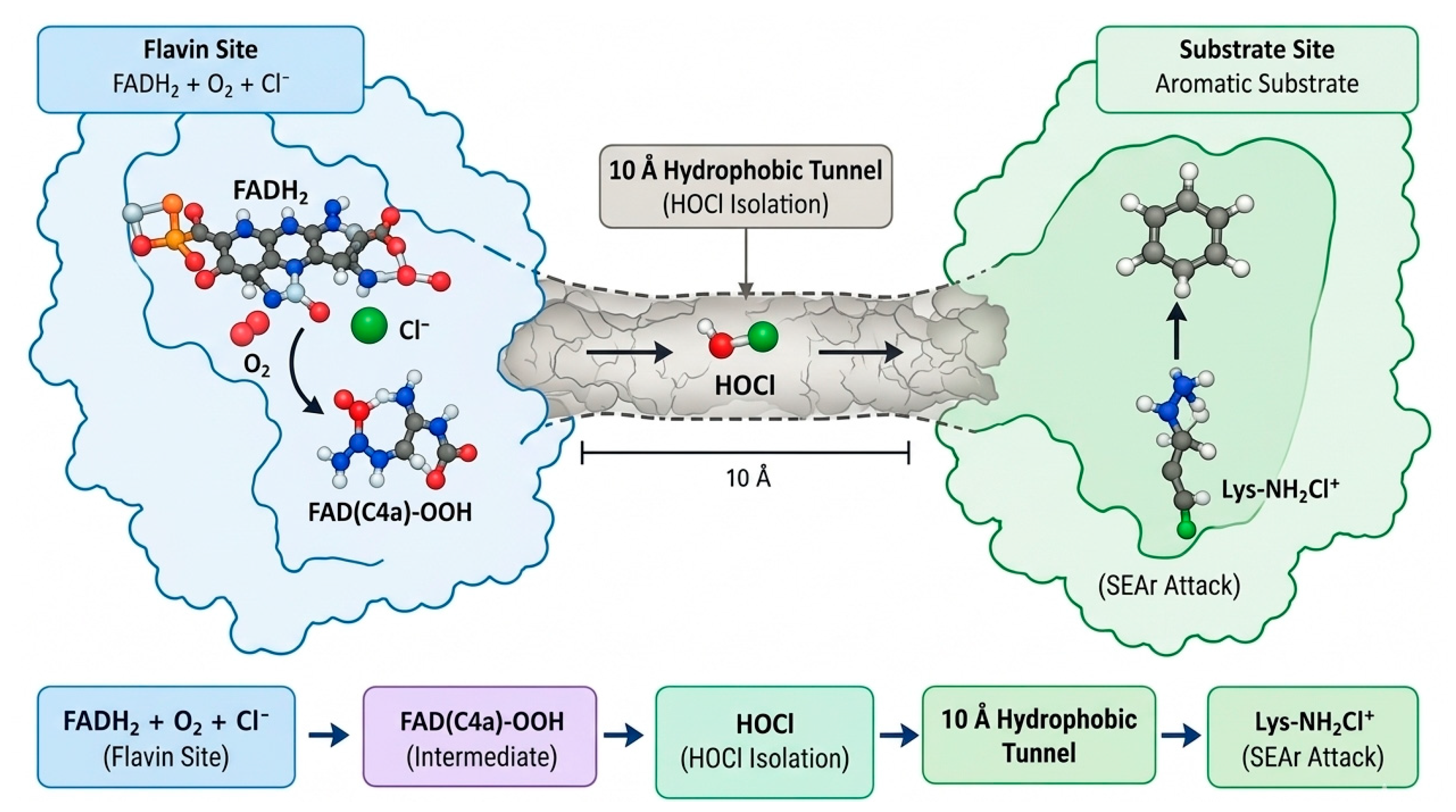
Figure 2.
Mechanistic comparison between hHPO (Heme) vs vCPO (Vanadate).
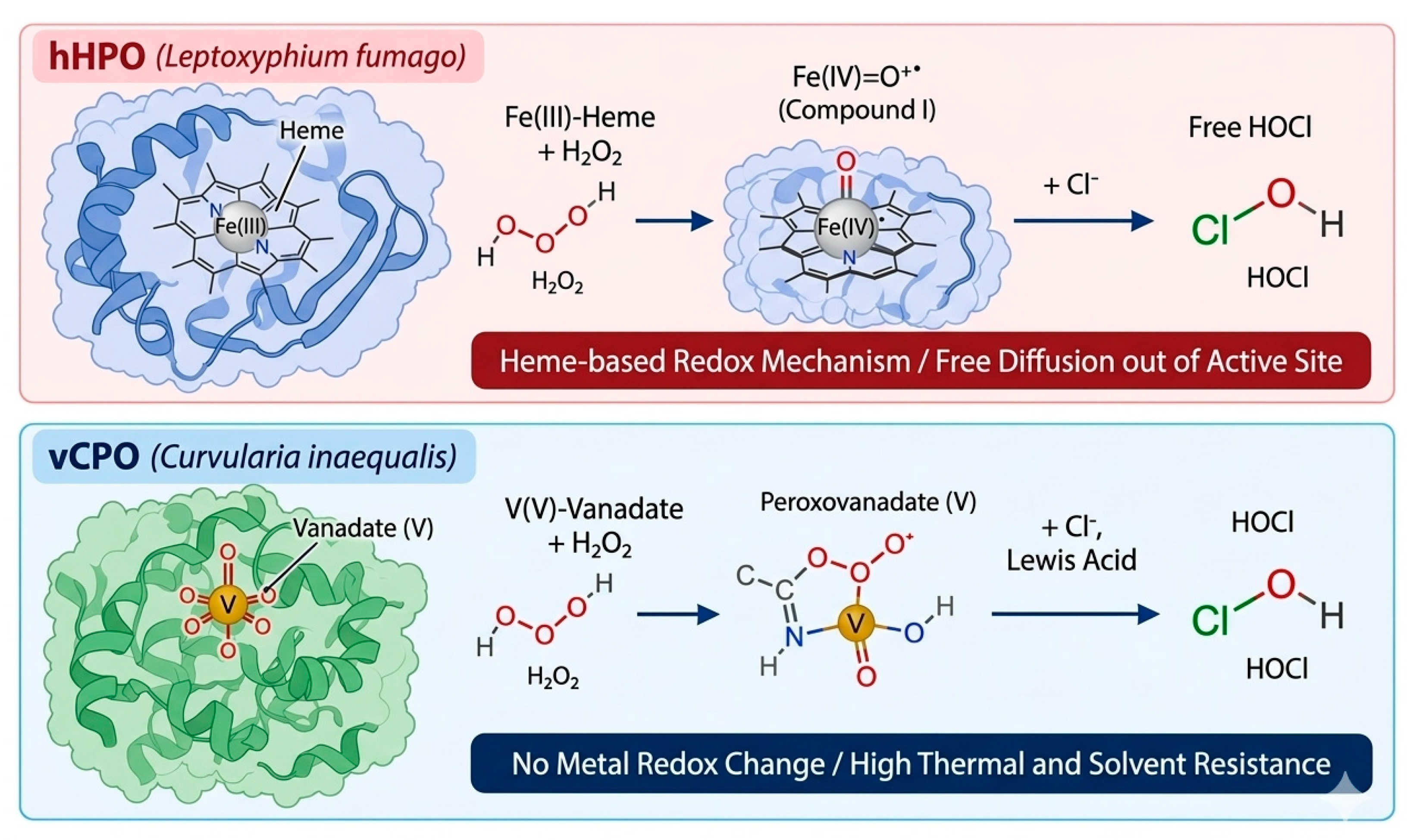
Figure 3.
Non-canonical halogenation mechanisms.
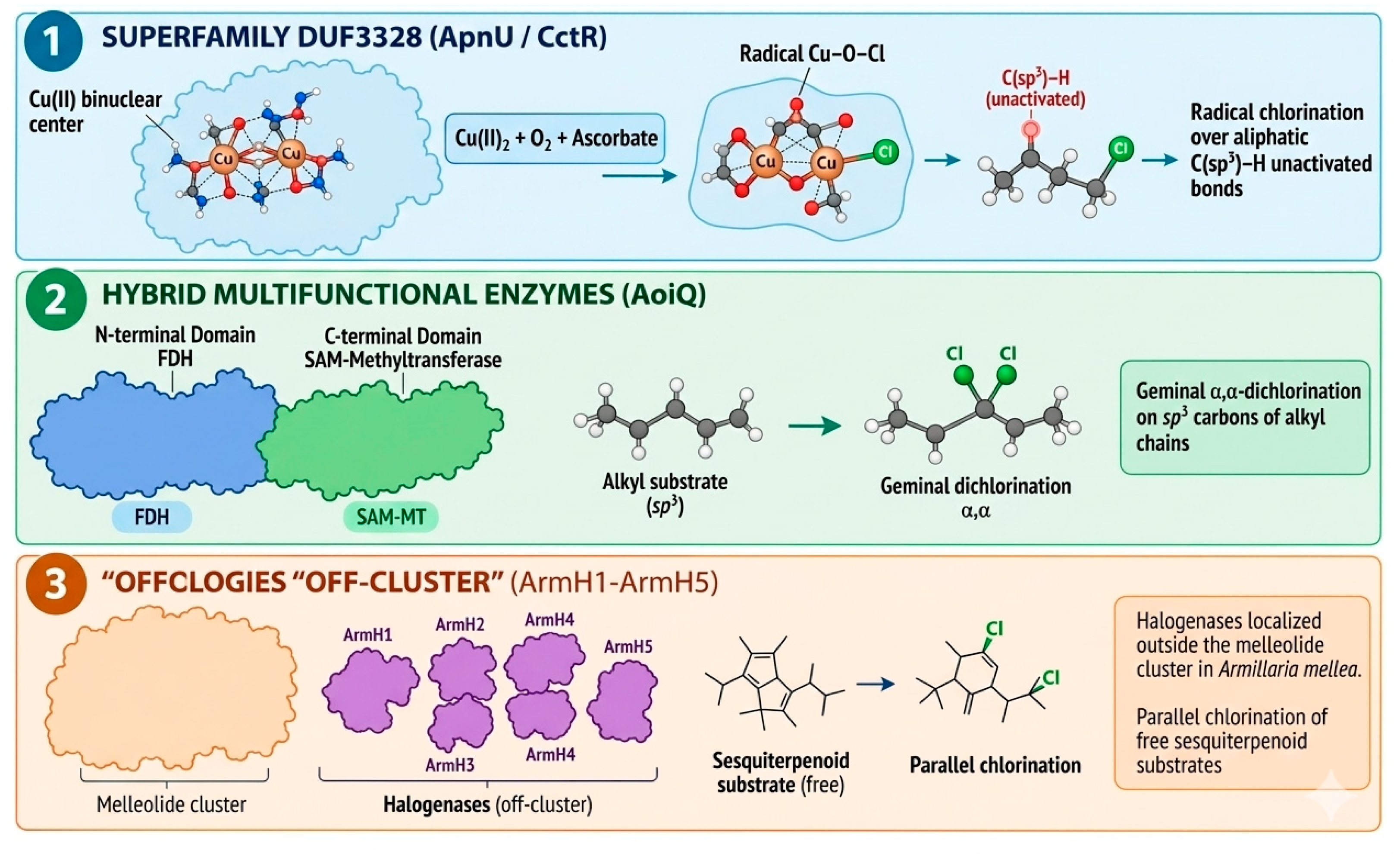
Figure 6.
Multifunctionality of griseofulvin in medicine.
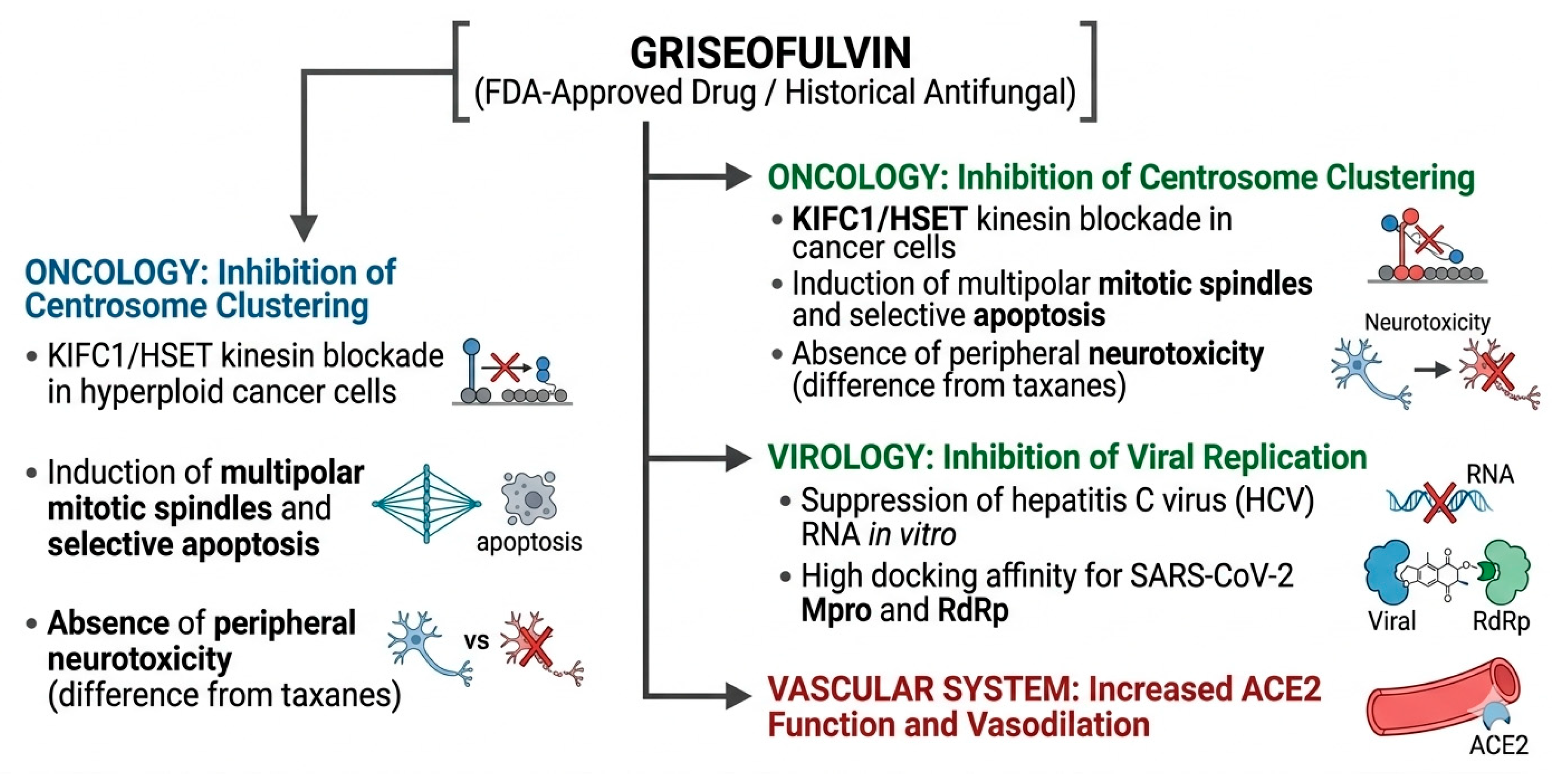

Table 1.
Classification, structural properties, and substrates of fungal Flavin-Dependent Halogenases (FDHs).
Table 1.
Classification, structural properties, and substrates of fungal Flavin-Dependent Halogenases (FDHs).
| Enzyme | Species | Substrate | Position | Characteristics | References |
|---|---|---|---|---|---|
| MalA / MalA’ | Malbranchea aurantiaca / M. graminicola | Indole Alkaloids / Premalbrancheamide | Late-stage dichloroaction C8/ C9 | C-terminal Zn+2-binding motif; catalytic Lys108. | [15] |
| GsfI | Penicillium aethiopicum | Polyketides / Griseophenone C | Regiospecific chlorination at C7 | Formation of the griseofulvin intermediate. | [17,18] |
| Rdc2 / RadH | Pochonia chlamydosporia / Chaetomium chiversii | Resorcylic Acid Macrolides / Monocillin II | Aromatic chlorination C3 | High synthetic flexibility | [10,19] |
| OtaD (AcOTAhal) | Aspergillus carbonarius / A. ochraceus | Isocoumarins / Ochratoxin B | Regioselective chlorination at C5 | Late-stage chlorination required for mycotoxic bioactivity. | [1,15] |
| GedL / PtaM | Aspergillus terreus / Pestalotiopsis fici | Benzophenones / Sulochrin and Isosulochrin | Chlorination on phenolic rings | Biosynthesis of dihydrogeodin and pesteic acid. | [20,21] |
| ArmH1–ArmH5 | Armillaria mellea | Sesquiterpenes / Melleolides | Chlorination on the aryl moiety | System of 5 “off-cluster” halogenases acting in parallel. | [22] |
Table 2.
Non-canonical mechanisms and emerging biosynthetic architectures of fungal chlorination.
| Enzyme | Structure | Mechanism | Function | References |
|---|---|---|---|---|
| ApnU / CctR | DUF3328 Superfamily (Binuclear CuII Center) | Requires O2 and an external reductant (ascorbate/NADH); generates a Cu-O-Cl radical | Radical halogenation and hydroxylations on inactive aliphatic Csp3)-H bonds. | [37] |
| AoiQ | Chimeric / Hybrid Protein (N-terminal FDH + C-terminal SAM-Methyltransferase) | Dual coordinated catalysis in a single polypeptide | Geminal a, a-dichloroation on sp3 carbons and concomitant phenolic bismethylation. | [38] |
| Off-Cluster System (ArmH) | Solitary FDHs uncoupled from the main BGC | Recognition of free sesquiterpenic intermediates | Parallel aromatic chlorination for toxin diversification (melleolides). | [22] |
Table 3.
Genomic architecture, enzymatic functions, and biosynthetic logic of model organohalogenated BGCs in fungi.
Table 3.
Genomic architecture, enzymatic functions, and biosynthetic logic of model organohalogenated BGCs in fungi.
| Cluster | Size (kb) | Gene | Biosynthetic Genes | Final Product | References |
|---|---|---|---|---|---|
| gsf (Penicillium aethiopicum, P. griseofulvum) | ~25 kb gsfA–F, gsfI | GsfI (Flavin-dependent halogenase, FDH) | GsfA: NR-PKS (SAT-KS-AT-PT-ACP) | Griseophenone C Griseophenone B Dehydrogriseofulvin Griseofulvin | [17,18,27,41] |
| GsfB/GsfC: O-Methyltransferases | |||||
| GsfF: Cytochrome P450 monooxygenase | |||||
| GsfE: Enoate reductase | |||||
| ota (Aspergillus carbonarius, A. ochraceus) | ~20 kb otaA–D | OtaD (AcOTAhal) (Solitary / free-state FDH) | OtaA: HR-PKS (7-methylmellein synthesis) | Ochratoxin b Ochratoxin B Ochratoxin A (OTA) | [1,42,43] |
| OtaC: Cytochrome P450 (C7-oxidation) | |||||
| OtaB: Monomodular NRPS (L-Phe ligation) | |||||
| mal (Malbranchea aurantiaca) | ~18 kb malA, malC, malE, malG | MalA / MalA’ (Iterative FDH with C-terminal Zn2+ motif) | MalG: Dimeric NRPS (L-Trp + L-Pro) | (+)-Premalbrancheamide Malbrancheamide B Malbrancheamide A | [15,26] |
| MalE: Indolic prenyltransferase | |||||
| MalC: IMDAase (Diels-Alder cycloaddition) | |||||
| ged (Aspergillus terreus) | ~32 kb (gedA–M | GedL (Aromatic FDH) | GedC: NR-PKS | Sulochrin Dihydrogeodin àGeodin | [20] |
| GedA: O-Methyltransferase | |||||
| GedR: Zn2Cys6 transcription factor | |||||
| rdc (Pochonia chlamydosporia) | ~35 kb rdc1–rdc5 | Rdc2 (RadH) C3 regioselective FDH | Rdc1: HR-PKS | Monocillin II Radicicol | [10,28] |
| Rdc5: NR-PKS | |||||
| Rdc4: P450 epoxidase |
Table 4.
Transcription factors and regulatory complexes controlling organohalogenated BGCs.
| Control Level | Factor | Protein Domain | Binding Motif | Effect | References |
|---|---|---|---|---|---|
| Pathway-Specific | GedR | Zn2-Cys6 transcription factor | Intergenic promoters of the ged locus | Overexpression/activation (13 genes of the geodin pathway). | [20] |
| Pathway-Specific | AflR / AflS | Binuclear Zn2-Cys6 + AflS coactivator | Palindrome 5’-TCGN5CGA-3’ | Recruitment of RNA Pol II; | [7,45] |
| Pathway-Specific | OtaR1 / OtaR2 | Zn2-Cys6 and bZIP (ota-specific) | Promoters of otaA, otaB, otaC, and otaD | Coordinated regulation of the OtaD halogenase and OtaB NRPS for Ochratoxin A biosynthesis. | [42,43] |
| Global Pleiotropic | Velvet Complex | Nuclear trimer: VeA–VelB–LaeA | Light and subtelomeric chromatin integrator | Links between morphological development and the induction of chlorinated BGCs. | [7,46] |
| Global Methyltransferase | LaeA | S-adenosylmethionine domain protein | Heterochromatic zones in subtelomeric regions | Antagonizes chromatin silencing. | [39,47] |
Table 5.
Epigenetic regulators and environmental responses according to inorganic halide availability.
Table 5.
Epigenetic regulators and environmental responses according to inorganic halide availability.
| Type | Mechanism | Molecular Target | Biological Response | References |
|---|---|---|---|---|
| Heterochromatin (Repression) | Histone Methyltransferases (e.g., KMT6 / Set1) | Nucleosomal trimethylations H3K27me3 and H3K9me3 | Transcriptional silencing and condensation of organohalogenated BGCs during vegetative growth. | [40,48] |
| Euchromatin (Activation) | Histone Acetyltransferases (HATs: EsaA, GcnE) | Lysine acetylations on H3 and H4 N-terminal tails | Decompression of the chromatin fiber; promotes RNA Pol II binding and activation of PKS/NRPS and FDHs. | [39,40,49] |
| Remodeling via Inactivation | Inhibition / Deletion of HDACs (HdaA, RpdA, SirA) | Chemical treatment with SAHA or Trichostatin A | “Awakening” of silenced BGCs and massive expression of cryptic chlorinated secondary metabolites. | [50,51] |
| Interspecies Induction | SAGA-ADA coactivator complex (Streptomyces pathway) | Recruitment of GcnE at promoters post-bacterial contact | Mycelium-bacteria physical contact-directed activation for the biosynthesis of chlorinated polyketide derivatives. | [39,49] |
| Environmental Halide Sensitivity | Specific repression by Inorganic Bromide | Selective transcriptional repression of the rdc2 gene mRNA | NaBr presence specifically represses the rdc2 halogenase in Pochonia chlamydosporia, accumulating non-chlorinated monocillins. | [28] |
Table 6.
Functional classification of Flavin-Dependent Halogenases (FDHs) using Sequence-Similarity Networks (SSNs) and targeted discovery.
Table 6.
Functional classification of Flavin-Dependent Halogenases (FDHs) using Sequence-Similarity Networks (SSNs) and targeted discovery.
| SSN | Subclass | Substrate Range | Metabolites | References |
|---|---|---|---|---|
| Indole Subnetwork | MalA, MalA’, RebH | Accept complex free alkaloids; possess a C-terminal Zn+2-binding domain | Chlorination and iterative installation of Cl atoms at C8 and C9 (malbrancheamides). | [15,16] |
| Phenol Subnetwork (Variants A) | GsfI, Rdc2/RadH, OtaD, GedL, PtaM | Recognition of soluble intermediates (benzophenones, isocoumarins, macrolides) | Chlorination of griseofulvin, ochratoxin A, geodin, radicicol, and pesteic acid. | [1,16] |
| Phenol Subnetwork (Variants B) | PKS/NRPS-associated enzymes | Halogenation of substrates covalently tethered to an acyl carrier protein (ACP) domain | Modification of lipid precursors and aromatic polyketides coupled to megasynthases. | [16,54] |
| Rdc2/RadH-like Group | Orthologs in T. lanuginosus, L. palmae | Regioselective halogenation of macrolactones and polyphenols | Discovery of monorden E, palmerin D, and chaetosemin G. | [1] |
| GedL-like Group | PtlK (Pestalotiopsis rhododendri) | Recognition of substituted aromatic rings | Targeted discovery of chlorinated atropisomers ((±)-pestalaclorides A1a and A2a). | [1,29] |
Table 7.
Systems biology experimental methods for the activation and characterization of silent organohalogenated BGCs.
Table 7.
Systems biology experimental methods for the activation and characterization of silent organohalogenated BGCs.
| Strategy | Mechanism | Molecular Change | Experimental Example | References |
|---|---|---|---|---|
| HiTES Screening | Small molecules at sub-inhibitory doses | Induction of transcriptional hormesis in repressed BGCs | LC-MS/MS detection of hidden, newly discovered chlorinated secondary metabolites. | [51] |
| HDAC Inhibition | SAHA (800 mMTrichostatin A | Blockade of HdaA; hyperacetylation of H3 and H4 histones at the locus | Activation of the polyketide BGC and isolation of daldinone E in Daldinia sp. | [50,55] |
| DNMT Inhibition | 5-Azacytidine (5-AC) | DNA demethylation in subtelomeric heterochromatic regions | Heterochromatin decompaction and transcription of PKSs and FDHs. | [39,51] |
| Interspecies Co-culture | Physical contact between A. nidulans and S. rapamycinicus | Recruitment of the SAGA-ADA complex GcnE and H3K9 acetylation | Expression of defensive BGCs and production of chlorinated phenolic derivatives. | [49,51] |
| Heterologous Reconstruction | Expression in A. nidulans via USER cloning | Replacement of the native regulator promoter (gedR) with the PgpdA promoter | Synchronous reconstruction of all 13 genes of the ged cluster to synthesize geodin. | [20] |
Table 8.
Comparative analysis of synthetic heterologous expression platforms and chassis engineering for organohalogenated fungal BGCs.
Table 8.
Comparative analysis of synthetic heterologous expression platforms and chassis engineering for organohalogenated fungal BGCs.
| Platform | Host | Mechanism | BGC Size | Main Advantages | References |
|---|---|---|---|---|---|
| FAC-MS | Optimized Aspergillus nidulans | Fungal Artificial Chromosomes (FACs, episomal vectors) | 30 – 150 kb | High-throughput metabolomic mapping; discovery of >15 metabolite families. | [39,60] |
| HEx Platform | Saccharomyces cerevisiae | Refactoring with yeast promoters and homologous recombination | Coordinated multigene expression of refactored BGCs | Successful production of 22/41 evaluated BGCs; eliminates wild-type silencing. | [39,61] |
| USER Reconstruction | Aspergillus nidulans Delta nkuA | Uracil-excision cloning and PgpdA promoter replacement | Synchronous multigenic reconstruction | High targeted integration rate; suppression of endogenous BGCs | [20,56] |
| Chassis Engineering | A. oryzae / A. niger | Disruption of NHEJ Delta nkuA and major BGCs | Low metabolomic background host cells | Yield maximization and simplified purification of chlorinated products. | [20,39] |
Table 9.
Fungal biocatalysts, engineered variants, and substrate scope for late-stage C–H functionalization.
Table 9.
Fungal biocatalysts, engineered variants, and substrate scope for late-stage C–H functionalization.
| Biocatalyst | Platform | Drug Target | Regioselectivity | Yield | References |
|---|---|---|---|---|---|
| RadH | Chaetomium chiversii | Isoquinolines, flavones, coumarins | Regioselective halogenation at C8 (e.g., 8-chloro-7-hydroxycoumarin) | Substrate promiscuity; optimized by directed evolution. | [11,19] |
| Variant 1-F11 | FDH (SSN-profiled) | Carvedilol and b-estradiol glucuronide | Regioselective bromination at the carbazole ring (C1) / steroid C4 | 56% (carvedilol) and 57% (steroid) isolated yield. | [16] |
| Variant 1-F08 | FDH (SSN-profiled) | Premalbrancheamide and AZ20 | Regioselective bromination at carbon C5 / indole core C3 | 51% yield for premalbrancheamide. | [16] |
| MalA / MalA’ | Malbranchea aurantiaca | Bulky indole alkaloids (pindolol, yohimbine) | Iterative chlorination and bromination at unactivated positions | Binding-pocket modification via protein engineering. | [15,16] |
| RebH variants | Directed evolution (Leishmania / E. coli) | Prochiral allylic alcohols | Enantioselective semipinacol rearrangement C-C bond | Non-natural carbocatalytic transformation. | [59] |
Disclaimer/Publisher’s Note: The statements, opinions and data contained in all publications are solely those of the individual author(s) and contributor(s) and not of MDPI and/or the editor(s). MDPI and/or the editor(s) disclaim responsibility for any injury to people or property resulting from any ideas, methods, instructions or products referred to in the content. |
© 2026 by the authors. Licensee MDPI, Basel, Switzerland. This article is an open access article distributed under the terms and conditions of the Creative Commons Attribution (CC BY) license (http://creativecommons.org/licenses/by/4.0/).
Copyright: This open access article is published under a Creative Commons CC BY 4.0 license, which permit the free download, distribution, and reuse, provided that the author and preprint are cited in any reuse.