

Submitted:
04 October 2026
Posted:
07 October 2026
You are already at the latest version
Abstract
Cancer cells exhibit metabolic reprogramming, including increased aerobic glycolysis, glutaminolysis, and altered lipid metabolism, which supports tumor growth and contributes to immune evasion. A growing but heterogeneous body of literature has investigated whether targeting these metabolic dependencies alongside standard oncologic treatment may provide therapeutic benefit. This review critically examines clinically investigated metabolically directed approaches, including metronomic chemotherapy, hyperthermia, high-dose intravenous vitamin C, hyperbaric oxygen therapy, fasting-related nutritional strategies, ketogenic diets, and insulin-based approaches, while distinguishing them from established targeted therapies, monoclonal antibodies, and immune checkpoint inhibitors. Emerging immunometabolic and microenvironmental targets are also discussed, including lactate transport, ferroptosis, autophagy and amino acid metabolism, cancer-associated fibroblasts, tumor-associated macrophages, abnormal vasculature, and immunosuppressive cytokine signaling. In addition, drug-delivery strategies are considered by distinguishing the established pharmaceutical role of dimethyl sulfoxide (DMSO) as a solvent or excipient from nanoparticle-, exosome-, and peptide-based targeting platforms. Available evidence is characterized according to clinical maturity, ranging from established phase III-supported therapies and randomized clinical evidence to early-phase, preclinical, or currently unproven approaches. Although several metabolically directed interventions have biological rationale and varying degrees of clinical support, no comprehensive multicomponent metabolic regimen has been validated in controlled clinical trials. Future development should prioritize stepwise, biomarker-informed prospective studies evaluating individual interventions and biologically justified combinations alongside standard-of-care therapy. Metabolically directed strategies should therefore be interpreted according to the evidence supporting each component rather than as a single established therapeutic regimen.
Keywords:
cancer metabolism
; metabolic reprogramming
; tumor microenvironment
; targeted drug delivery
; evidence-based oncology
1. Introduction
Cancer is the second most common cause of death worldwide, and surgery, chemotherapy, and radiotherapy remain the fundamental approaches to its treatment [1]. The limited cellular specificity of conventional chemotherapeutic agents leads to systemic toxicity, while tumor heterogeneity (spanning genomic instability, clonal evolution, cancer-stem-cell plasticity, and dynamic remodeling of the tumor microenvironment) paves the way for the development of resistance and relapse over time [2]. Over the past two decades, immunotherapy, including checkpoint blockade, adoptive T-cell transfer, and cancer vaccines, has become a major axis of cancer treatment; however, these approaches can also carry serious immune-related adverse effects [3].
Against this background, this review focuses on metronomic chemotherapy, hyperthermia, high-dose vitamin C, hyperbaric oxygen therapy (HBOT), insulin-based approaches, and dimethyl sulfoxide (DMSO), selected because of their proposed effects on tumor metabolism, oxygenation, oxidative stress, drug sensitivity, and/or the tumor microenvironment. These interventions are considered in the context of metabolic reprogramming and alongside established targeted therapies, monoclonal antibodies, and immunotherapies. The review is not intended as an exhaustive survey of complementary or alternative cancer therapies, nor does inclusion imply equivalent efficacy or evidentiary support. Instead, it distinguishes established oncological strategies from interventions that remain investigational or lack adequate clinical validation, with the aim of separating biologically plausible concepts that warrant prospective investigation from therapeutic claims not yet supported by robust clinical evidence.
2. Biological Rationale for Metabolically Directed Oncology
The conceptual framework of this review is summarized in Figure 1. Tumor metabolic reprogramming is considered in relation to metabolically directed interventions, the tumor microenvironment, and the standard oncological treatment backbone, while recognizing that these approaches are supported by substantially different levels of clinical evidence.
2.1. The Warburg Effect and Metabolic Flexibility
The observation described by Otto Warburg in the 1920s – that cancer cells shift strongly toward aerobic glycolysis even in the presence of oxygen (the Warburg effect)—forms the foundation of modern cancer metabolism research [4]. Today, this concept of “metabolic flexibility” is regarded as a multidimensional network encompassing glycolysis, glutaminolysis, fatty-acid oxidation and synthesis (FASN-mediated de novo lipogenesis), the mTOR signaling pathway, and one-carbon/antifolate metabolism [5]. Simultaneous suppression of several of these pathways to drive the tumor cell into an energy and biosynthetic-precursor crisis provides the scientific rationale for the concept of “metabolic blockade” [6,7,8,9].
Agents that alter mitochondrial respiratory function, including metformin, IACS-010759, and atovaquone, have been investigated in cancer research. Tumor cells can compensate for respiratory inhibition by increasing glycolysis[10], and atovaquone-mediated complex III inhibition can increase glycolytic flux [11,12]. This finding suggests that unidirectional metabolic blockade alone may not be sufficient, and multi-pathway metabolic inhibition has therefore been proposed [7,13,14]. However, the clinical development of potent OXPHOS inhibitors such as the complex I inhibitor IACS-010759 has been limited by unacceptable off-target toxicity [13,14]. Given that glycolysis and glutaminolysis are the major bioenergetic and biosynthetic pathways in cancer cells, while OXPHOS is strictly required for normal cell function, we postulate that emphasis should be placed on targeting the most conserved metabolic dependencies first [15,16].
2.2. Metabolic Phenotyping / Seahorse
A central methodological question in metabolically directed oncology is how to measure, rather than assume, the glycolytic and oxidative phenotype of a tumor. Extracellular flux analysis, commercially available through the Agilent Seahorse XF/XFe platform, measures the oxygen consumption rate (OCR) as an indirect readout of mitochondrial oxidative phosphorylation and the extracellular acidification rate (ECAR) as a surrogate for glycolytic activity in living cells [17,18]. Combined OCR/ECAR profiling can therefore characterize metabolic phenotypes and assess changes in cellular bioenergetics in response to experimental interventions [19,20].
Extracellular flux analysis is well established in cancer cell lines and is increasingly used in patient-derived organoids and short-term ex vivo models [21,22]. However, its application for individualized treatment selection remains investigational. In addition, extracellular flux measurements are highly sensitive to culture conditions, nutrient availability, and ex vivo handling. Placement of cells into culture can itself induce rapid metabolic alterations, including the Crabtree effect, and differences in media composition or experimental conditions may substantially influence the apparent glycolytic or oxidative phenotype [20]. Indeed, the same cell lines may display markedly different metabolic profiles under different culture and laboratory conditions [23]. Tumor metabolism is also dynamic and may adapt under therapeutic pressure; therefore, a single baseline OCR/ECAR measurement characterizes the metabolic state at a particular time point rather than predicting the subsequent adaptive trajectory of the tumor [2,11,12]. Accordingly, Seahorse-based profiling should currently be viewed as a research tool for metabolic characterization and hypothesis generation, and as a potential correlative biomarker in prospective studies, rather than as a validated clinical decision-making platform [24].
3. Clinically Investigated Metabolic Interventions
3.1. Metronomic Chemotherapy
Metronomic chemotherapy (MCT), in contrast to the standard maximum-tolerated-dose (MTD) regimen, involves administering cytotoxic agents at low doses, at frequent intervals, without long drug-free breaks [24]. Its primary mechanism of action is described as anti-angiogenesis, achieved by targeting the endothelial cells that supply tumor vasculature and circulating endothelial progenitor cells; immune modulation via reduction of regulatory T cells and promotion of dendritic-cell maturation has also been demonstrated [25,26,27]. A systematic review of controlled phase II/III trials published between 2012 and 2018 found positive results in four phase III and four randomized phase II studies; however, most studies did not demonstrate statistically significant improvements in overall survival or progression-free survival [28]. MCT is therefore regarded as a valuable option, owing to its low toxicity profile, particularly in frail/elderly patients and in palliative care, but current evidence is not sufficient to replace standard MTD therapy given with curative intent [25,26,28], and MCT should not be presented as a stand-alone standard oncological treatment. Combining MCT with other multimodal therapeutic strategies, such as metabolic inhibitors, pro-oxidant therapies or repurposed anti-cancer drugs, remains under investigation.
3.2. Hyperthermia (Regional or Systemic Heat Therapy)
Controlled heating of tumor tissue to 41–43°C acts through multiple mechanisms, including protein denaturation, improved drug and oxygen distribution via increased blood flow, and induction of immunogenic cell death (ICD) [29,30,31]. The combination of hyperthermia with radiotherapy and/or chemotherapy is supported by randomized trials in cervical cancer, rectal cancer, and several other tumor types, and has been incorporated into standard treatment protocols as an adjunct in some countries [29,31,32]. Surface expression of heat-shock proteins (particularly HSP70) can enhance the systemic anti-tumor immune response via Natural Killer cells and dendritic cells [33,34,35].
3.3. High-Dose Intravenous Vitamin C (Pro-Oxidant Effect)
At physiological concentrations achieved through oral intake, ascorbic acid (vitamin C) primarily acts as an antioxidant [36]. In contrast, pharmacological concentrations reached through intravenous administration may exert pro-oxidant effects, including extracellular generation of hydrogen peroxide (H₂O₂). Reduced catalase activity in certain cancer cells has been proposed to limit their capacity to detoxify peroxide and thereby contribute to the potential preferential cytotoxic effects of pharmacological ascorbate on tumor cells [36,37,38]. Phase I–II studies suggest that high-dose intravenous vitamin C is feasible and generally well tolerated when administered alongside chemotherapy in selected patient populations, with some studies also reporting potential quality-of-life benefits [38,39,40]. Nevertheless, current reviews emphasize that robust Phase III (NCT04516681) evidence demonstrating an effect on clinically relevant outcomes, particularly survival, remains insufficient [37,38,41]. Accordingly, high-dose intravenous vitamin C should currently be regarded as an investigational supportive or adjunctive approach whose clinical efficacy has not yet been established conclusively. Similarly, the proposed enhancement of antitumor activity when pharmacologic ascorbate is combined with hyperbaric oxygen or other strategies targeting the tumor microenvironment is based largely on mechanistic and preclinical rationale and requires confirmation in prospective human studies [38,42,43,44]. From a safety perspective, the potential risk of hemolysis associated with high-dose intravenous vitamin C in individuals with glucose-6-phosphate dehydrogenase (G6PD) deficiency should be considered, and assessment of G6PD status before treatment may be appropriate [45,46]. Renal function should also be evaluated before treatment and monitored when clinically indicated, particularly given the potential risk of oxalate nephropathy and renal impairment.
3.4. Hyperbaric Oxygen Therapy
Hyperbaric Oxygen Therapy (HBOT) involves keeping the patient in a pressurized environment with 100% oxygen. Tumor hypoxia is known to trigger HIF-1α–mediated signaling pathways (angiogenesis, glycolytic shift, apoptosis resistance) [47,48]; it has therefore been suggested that reducing hypoxia with HBOT could theoretically work against the tumor through both reoxygenation and increased mitochondrial ROS production (pro-oxidative effects) [49,50]. In some preclinical models, HBOT has been shown to suppress HIF-1α, slowing tumor growth and increasing apoptosis [51,52]. HBOT has been reported to suppress tumor growth [53,54] when given in a combination regimen with the ketogenic diet, but also mildly increase both proliferation and — paradoxically chemosensitivity via the HIF1α/HIF2α–ABCG2 axis when administered as monotherapy [55]. Current reviews conclude that there is, overall, no evidence that HBOT promotes tumor growth as a general rule, while emphasizing that the effect varies by tumor type, stage, and concomitant treatment [52,55]. However, to our knowledge, no clinical report of accelerated tumor progression or hyperprogressive disease with HBOT has been presented, despite increasing clinical use and FDA-approved indications such as radiation necrosis [56].
Accordingly, the stand-alone anticancer role of HBOT remains investigational. Although combining HBOT with hyperthermia, high-dose vitamin C, or chemotherapy has a mechanistic rationale, therapeutic synergy has not been established in controlled human studies. These combinations should therefore be regarded as hypotheses requiring prospective clinical evaluation rather than established treatment strategies.
3.5. Nutrition-Based Metabolic Interventions: Fasting-Mimicking Diet and the Ketogenic Diet
Fasting-related nutritional strategies have emerged as clinically investigated approaches to modulating cancer metabolism. In the multicenter randomized phase II DIRECT trial, patients with HER2-negative breast cancer who followed a fasting-mimicking diet (FMD) before and during neoadjuvant chemotherapy showed a higher radiological complete/partial response rate, together with reduced chemotherapy-induced DNA damage in normal cells [57]. A separate randomized study reported lower rates of grade III/IV nausea and neutropenia in patients receiving an FMD during chemotherapy [58]. These findings provide clinical support for further investigation of structured, medically supervised FMD as an adjunct to standard cancer therapy, although confirmation in larger trials and across different tumor types is required. The evidence for ketogenic diets (KD) is less mature. Preclinical studies have suggested that KD may enhance the antitumor activity of PI3K inhibition in pancreatic-cancer models [59,60]; however, these findings cannot yet be extrapolated to clinical efficacy in patients.
Pilot, investigator-initiated clinical trials of ketogenic diets primarily support clinical benefit in glioblastoma [15,61,62], with larger phase II studies underway (NCT05708352). Ketogenic diets provide maximal benefit when implemented to mimic the physiology of fasting, i.e., consistently low glucose-ketone index [15,61,63]. A ketogenic diet in tumors with glycolytic Warburg-like phenotypes, as well as structured, medically supervised FMD protocol — as opposed to unsupervised fasting — are therefore the components of this review with the most direct randomized-trial support, reducing (rather than adding to) chemotherapy-related toxicity. Accordingly, FMD and KD should be considered separately in terms of evidence level, and neither should be regarded as a substitute for guideline-based oncological treatment.
3.6. Insulin-Augmented Low-Dose Chemotherapy
Two related but distinct approaches exist in the literature and should not be conflated. “Insulin Potentiation Therapy” (IPT) refers to a hypothesis originating in the 1930s, most recently presented in [64,65], holding that insulin-induced increases in cell-membrane glucose-transporter activity allow very low doses of chemotherapy (10–25% of standard dose) to achieve efficacy equivalent to full-dose treatment. Researchers from the US National Cancer Institute’s Clinical Pharmacology Program have stated that there are no definitive clinical data supporting IPT, no evidence that chemotherapy at this reduced dose achieves standard-dose efficacy, and that the approach may increase the risk of resistance development and hypoglycemia [40]. The Memorial Sloan Kettering and CAM-Cancer databases likewise classify IPT as unproven [64,65]. Based on current evidence, IPT should not be used as a substitute for standard-dose chemotherapy, and no claim that it increases drug uptake or potentiates efficacy should be made outside a controlled trial.
A separate line of published clinical research, generally termed “metabolically supported chemotherapy”, has been reported by İyikesici, Seyfried, and colleagues: full- or near-full-dose standard chemotherapy regimens administered concomitantly with pharmacologically induced, closely monitored hypoglycemia (via regular insulin), together with a ketogenic diet, hyperthermia, and hyperbaric oxygen therapy [66]. The rationale is that acute hypoglycemia transiently increases tumor glucose uptake and chemotherapy avidity in glucose-dependent tumor cells relative to metabolically flexible normal tissue [66,67,68,69,70]. Published outcomes for this specific protocol consist of case reports and small retrospective case series in stage III/IV breast, gastric, pancreatic, and non-small-cell lung cancer, reporting favorable radiological or pathological responses and, in some series, extended survival compared with historical controls [66,67,68,69,70]. These reports are hypothesis-generating and mechanistically distinct from historical low-dose IPT in that standard-dose chemotherapy is retained. However, they remain at the case-report/retrospective-series level of evidence, were conducted by a single treating group without independent replication, and – because concomitant induction of hypoglycemia is itself an active medical intervention with recognized risks, their safe delivery requires continuous glucose monitoring and is not appropriate outside a specialized, closely supervised clinical setting. The evidence-level Table 1 lists this protocol separately from IPT to avoid conflating a monitored, standard-dose, actively published clinical program with the traditional low-dose IPT hypothesis; both, however, remain below the threshold of controlled-trial evidence required for recommendation as standard oncologic treatment.
4. Targeted Drug Delivery Strategies and the Role of DMSO
Improving tumor-selective drug delivery is an important objective in oncology, particularly when systemic toxicity restricts the therapeutic window of cytotoxic or targeted agents [71]. Within this context, DMSO has occasionally been proposed as a permeability-enhancing carrier; however, this concept should be distinguished from engineered drug-delivery platforms specifically designed to improve tumor targeting. This section therefore evaluates the evidence for DMSO as a pharmaceutical carrier and contrasts it with nanoparticle-, exosome-, and peptide-based delivery strategies.
4.1. DMSO as a Pharmaceutical Solvent and Permeability Enhancer
Dimethyl sulfoxide (DMSO) is a solvent widely used in pharmacology and as a cell membrane permeability enhancer. It has an approved intravesical indication for interstitial cystitis and is also used as a vehicle or excipient in some pharmaceutical formulations [72]. However, there is no clinical evidence that DMSO itself has therapeutic anticancer activity in humans [73].
The biological effects of DMSO are concentration dependent. At high concentrations, laboratory studies have demonstrated toxic effects on erythrocytes, platelets, and vascular endothelial cells, including hemolysis, platelet dysfunction, and endothelial apoptosis [74]. At lower concentrations, DMSO has been reported to alter mitochondrial respiratory capacity in cancer cells, with very low concentrations producing variable and, in some experimental settings, potentially proliferation-enhancing effects [75]. Limited clinical observations have also suggested a possible role in the palliation of refractory cancer-related pain, although this is distinct from an anticancer effect.
Accordingly, in this context, the established relevance of DMSO is primarily as a pharmaceutical solvent or permeability-enhancing excipient. Evidence is insufficient to support its use as an anticancer agent or as a tumor-selective chemotherapy carrier, and claims that DMSO potentiates the antitumor efficacy of co-administered chemotherapy have not been confirmed in clinical studies.
4.2. Nanoparticle-Based Drug Delivery
Engineered nanoparticles offer a more extensively investigated approach to tumor-directed drug delivery. Liposomal, polymeric, and inorganic nanoparticles can modify drug pharmacokinetics and biodistribution and may enhance tumor accumulation through passive and/or ligand-mediated targeting mechanisms [76]. Several nanoparticle-based formulations, including PEGylated liposomal doxorubicin, have gained regulatory approval, while ongoing preclinical and clinical research continues to optimize drug loading, stability, tumor penetration, and controlled release [77,78]. These platforms therefore provide clinical proof of principle that reformulating anticancer agents can modify their delivery and toxicity profiles [79]. Nevertheless, the performance of individual nanoparticle systems is formulation- and tumor-dependent, and successful delivery should not be generalized across all nanoparticle technologies.
4.3. Exosome- and Peptide-Based Targeting
Exosomes are endogenous extracellular vesicles increasingly investigated as delivery vehicles for chemotherapeutic agents, nucleic acids, and proteins. Their biological origin offers potential advantages in biocompatibility and cellular communication, and their surfaces can be engineered to enhance tissue and tumor targeting. However, challenges in isolation, standardization, cargo-loading efficiency, reproducibility, and large-scale manufacturing continue to limit clinical translation [77,80,81].
Tumor-targeting peptides represent another strategy to improve drug localization and tissue penetration. For example, the iRGD cyclic peptide interacts with αv integrins and neuropilin receptors associated with tumor vasculature and has been studied as a conjugated or co-administered approach to enhance tumor penetration of therapeutic agents [48,82]. Although peptide-directed approaches have advanced toward clinical evaluation, their therapeutic utility remains dependent on the specific carrier, payload, molecular target, and tumor context. Overall, nanoparticle-, exosome-, and peptide-based systems provide a more advanced scientific framework for tumor-directed drug delivery than the proposed use of DMSO as a nonspecific chemotherapy carrier [83]. Their inclusion here is not intended to imply equivalent clinical maturity: some nanoparticle formulations are already clinically established, whereas many exosome- and peptide-based strategies remain investigational. Notably, none of these delivery platforms has yet been validated as an integral component of a metabolically directed multimodal treatment strategy in controlled clinical trials, which underscores the rationale for future prospective investigation.
5. Integration with Standard Precision Oncology
Unlike the metabolic approaches above, the following components are standard oncological treatments backed by strong phase III evidence and included in international guidelines (NCCN, ESMO). Whether combining these treatments with metabolic agents produces synergy in patients has not been demonstrated on an evidence basis [84]; the discussion below therefore presents mechanistic hypotheses that would need to be tested prospectively, not established combination regimens.
5.1. Molecular Targets
Molecularly targeted therapies have become an established component of precision oncology, with treatment selection increasingly guided by actionable genomic alterations. EGFR-mutated tumors, particularly lung cancers, are treated with third- and first-generation TKIs such as osimertinib and erlotinib as standard treatment [85]. In tumors with ALK/ROS1 fusions, agents such as alectinib and crizotinib are standard treatment [86,87]. In BRCA1/2-mutated tumors with impaired DNA repair mechanisms, PARP inhibitors such as olaparib act via the principle of synthetic lethality and are approved in the adjuvant and metastatic settings [88]. In tumors harboring the BRAFV600E mutation, the combination of dabrafenib plus trametinib is standard treatment, depending on tumor type and clinical indication [89].
A mechanistic hypothesis of synergy can be proposed between the oxidative DNA damage produced by high-dose IV vitamin C and the repair-blocking effect of PARP inhibitors [90]; however, no clinical study currently exists in the literature that has prospectively tested this combination in humans. Likewise, any expectation that hyperthermia, HBOT, or DMSO would meaningfully potentiate PARP-inhibitor activity is speculative and unsupported by clinical data at this time.
5.2. By Pathological Features: Monoclonal Antibodies
In HER2-positive breast and gastric cancers, HER2-directed monoclonal antibodies such as trastuzumab and pertuzumab have established roles in treatment [91]. Bevacizumab is also used in selected malignancies in which VEGF-mediated angiogenesis is a relevant therapeutic target [92]. The combination of bevacizumab-based chemotherapy with regional hyperthermia has been examined in small pilot studies [93]. Although these preliminary findings provide a rationale for further investigation of potential interactions between hyperthermia and anti-angiogenic therapy, the available clinical evidence remains limited. Larger, controlled prospective studies are therefore required before any synergistic effect can be confirmed.
5.3. By Immunological Features: Checkpoint Inhibitors
PD-1/PD-L1 blockers (pembrolizumab, nivolumab, atezolizumab) are standard treatment in patients selected according to PD-L1 level, MSI status, and TMB values [94]. There is strong mechanistic evidence that lactic-acid accumulation in the tumor microenvironment suppresses T-cell function; for this reason, reversing tumor acidification by metabolic targeting [95] buffering the acidic microenvironment and combining hyperthermia with immunotherapy is an active area of current immune-metabolism research [35,96,97,98]. Whether adding HBOT, high-dose IV vitamin C, insulin-augmented chemotherapy, or DMSO to checkpoint-inhibitor therapy improves outcomes has not been studied and should not be presented as an established strategy; it remains, a hypothesis worth testing in the context of the acidic-microenvironment/hyperthermia rationale described above.
6. Emerging Metabolic and Microenvironmental Targets
The following subsections summarize current literature that could strengthen the metabolic–immunological rationale for future protocol design. These are largely at the preclinical/early-clinical stage and should be regarded as research hypotheses, not as components of a validated treatment regimen.
6.1. Lactate/MCT Axis
Glycolytic tumor cells export lactate predominantly through MCT4, contributing to lactate accumulation and acidification of the tumor microenvironment [98,99,100]. The resulting acidic microenvironment directly suppresses dendritic-cell maturation, Natural Killer cell cytotoxicity, and CD8+ T-cell function; lactate also epigenetically locks in the immunosuppressive M2 phenotype in tumor-associated macrophages via histone lactylation and depletes the L-arginine required for T-cell proliferation via increased arginase-1 [97,98]. Agents such as the MCT1/4 inhibitor AZD3965 have shown synthetic lethality with metformin in preclinical models [100]. This axis provides mechanistic support for the general concept of buffering the acidic tumor microenvironment as an adjunct to immunotherapy, though the clinical benefit of bicarbonate buffering specifically has not been demonstrated in controlled human trials.
6.2. Ferroptosis and Redox Sensitivity
Ferroptosis, an iron-dependent, lipid-peroxidation-mediated form of programmed cell death, is described as a significant vulnerability of cancer cells under high oxidative stress [98,101]. A mechanistic intersection between the H2O2 and free-radical burden produced by high-dose IV vitamin C and the induction of ferroptosis is biologically plausible; combination with targeting of the cystine/glutathione axis is a hypothesis for future research [101]. Itaconate production in tumor-associated neutrophils has been shown to confer resistance to ferroptosis [68], indicating that ferroptosis-based strategies must also account for the myeloid-cell population of the tumor microenvironment. Ferroptosis induction is a promising target for future combination-therapy design, but no clinical data currently link high-dose vitamin C, or any other component discussed in this review, to ferroptosis-mediated tumor control in patients.
6.3. Autophagy/Amino-Acid Metabolism
Autophagy and amino-acid metabolism represent interconnected mechanisms through which tumor cells adapt to metabolic stress and the tumor microenvironment contributes to immune suppression [102]. Inhibition of lysosomal/autophagic flux, including with lysosomotropic agents such as hydroxychloroquine, has been investigated as a strategy to increase sensitivity to chemotherapy and targeted therapies, particularly in metabolically stressed and RAS-mutant tumors [103]. However, clinical studies have not demonstrated a consistent survival benefit, and autophagy inhibition remains investigational.
Amino-acid metabolic pathways also contribute to tumor-associated immune suppression. Increased arginase-1 activity and indoleamine 2,3-dioxygenase 1 (IDO1)-mediated tryptophan–kynurenine metabolism can impair T-cell function within the tumor microenvironment [96,97,101]. Therapeutic targeting of these pathways, including combinations with immune checkpoint inhibitors, has entered clinical investigation but has not yet established a standard therapeutic role [96]. Collectively, modulation of autophagy and amino-acid metabolism represents a biologically plausible strategy for overcoming metabolic adaptation and immune suppression, but its integration with other metabolically directed therapies requires further prospective clinical evaluation.
6.4. TME-Directed Strategies
The tumor microenvironment (TME), comprising cancer-associated fibroblasts (CAFs), tumor-associated macrophages (TAMs), abnormal vasculature, and immunosuppressive cytokine networks, represents an additional therapeutic layer beyond direct tumor cell targeting [104]. CAFs promote tumor progression and treatment resistance through extracellular matrix remodeling, growth factor and cytokine signaling, and interactions with immune cells; strategies targeting FAP-positive CAFs, CXCL12/CXCR4 signaling, and TGF-β are under clinical investigation [105,106]. Similarly, TAMs contribute to an immunosuppressive microenvironment and resistance to systemic therapy, although their functional heterogeneity has shifted therapeutic interest from broad macrophage depletion toward selective reprogramming approaches [2,107,108].
Abnormal tumor vasculature further contributes to hypoxia and immune exclusion [109]. Vascular-normalization strategies, particularly those involving VEGF-pathway inhibition, may improve perfusion and immune-cell infiltration and provide a rationale for combining anti-angiogenic agents with immune checkpoint inhibitors in selected cancers [110,111]. In parallel, cytokine pathways such as IL-6/JAK/STAT3 and TGF-β mediate bidirectional signaling among tumor, stromal, and immune cells and are being investigated as therapeutic targets, although their effects are highly context dependent [112,113].
Collectively, CAF-, TAM-, vascular-, and cytokine-directed strategies illustrate the therapeutic potential of remodeling the TME rather than targeting cancer cells alone [114]. However, most of these approaches remain preclinical or in early clinical development, and their integration with metabolically directed interventions, including hyperthermia, has not been prospectively validated [115]. They should therefore be considered emerging targets for mechanistic and clinical investigation rather than established components of a metabolically directed treatment regimen.
7. Emerging Metabolic and Microenvironmental Targets
The interventions discussed in this review differ substantially in their degree of clinical validation, ranging from established standard-of-care therapies to early-stage or unproven approaches. Table 1 summarizes the current clinical evidence for each intervention according to the type and maturity of the available data. These categories are intended as a descriptive evidence summary rather than a formal evidence-grading system, and the supporting studies are discussed and referenced in the corresponding sections above.
8. Translational Roadmap for Prospective Trials
The biological rationale for integrating metabolically directed interventions with standard oncologic treatment warrants prospective investigation; however, current evidence does not support a predefined multicomponent treatment sequence. Future studies should therefore evaluate individual interventions and biologically justified combinations within formally approved prospective protocols. Early-phase studies should first establish feasibility, safety, and dose compatibility when these interventions are added to guideline-based anticancer therapy. Whenever possible, study designs should allow the contribution of individual components to be distinguished, particularly when interventions supported by different levels of clinical evidence are combined. Subsequent randomized or appropriately controlled trials should determine whether these approaches provide measurable benefit beyond standard therapy. Simultaneous introduction of multiple investigational components should generally be avoided unless supported by adequate preclinical and safety data, as this complicates attribution of efficacy and toxicity.
Patient selection should consider tumor type, disease stage, molecular characteristics, prior treatment, nutritional status, and relevant metabolic or microenvironmental features. Correlative biomarkers of metabolic activity, hypoxia, immune status, and treatment-induced metabolic adaptation should be incorporated where appropriate. Experimental approaches such as extracellular flux analysis may support biological characterization and hypothesis generation but should not currently guide clinical treatment selection. Clinical endpoints should reflect the phase and objective of the study: early trials should prioritize safety, tolerability, feasibility, and dose-limiting toxicity, whereas subsequent studies may assess objective response, progression-free survival, overall survival, quality of life, and treatment-related toxicity. Pharmacodynamic and biomarker endpoints may additionally help determine whether the intended metabolic or microenvironmental effect is achieved in vivo.
Safety monitoring should be intervention specific. High-dose intravenous vitamin C requires renal assessment and consideration of G6PD deficiency; insulin-based approaches require intensive glucose monitoring and predefined hypoglycemia management; nutritional interventions require assessment of nutritional status and the risk of weight or lean-mass loss; and HBOT and hyperthermia require their respective eligibility and safety assessments. Monitoring procedures, stopping rules, and adverse-event reporting should be prespecified. All prospective studies should be conducted under institutional ethics/IRB approval, with multidisciplinary oncologic oversight and informed consent clearly communicating the evidence level and investigational status of each component. Metabolically directed interventions should be evaluated alongside, rather than presented as established alternatives to, guideline-based oncologic care.
Ultimately, prospective development should determine whether individual metabolically directed interventions or biologically justified combinations provide clinically meaningful benefit beyond standard therapy. Stepwise, biomarker-informed, and appropriately controlled studies are needed to distinguish mechanistic plausibility from therapeutic benefit.
9. Limitations and Scientific Caveats
Several limitations should be considered when interpreting the approaches discussed in this review. First, the evidence base is highly heterogeneous, ranging from mechanistic and preclinical studies to case reports, retrospective series, early-phase trials, and randomized clinical studies. These different levels of evidence are not directly comparable, and findings obtained in specific tumor types or experimental models should not be generalized across cancers. Importantly, no multicomponent regimen integrating several of the metabolic interventions reviewed here has been validated as a whole in a randomized controlled trial. The contribution of each component therefore needs to be evaluated independently before drawing conclusions regarding combined efficacy. Second, several proposed interactions between interventions remain mechanistic hypotheses rather than clinically demonstrated synergies. These include the proposed use of DMSO beyond its established role as a pharmaceutical excipient, potentiation of anticancer effects through combinations of HBOT with high-dose vitamin C or other metabolic interventions, and assumptions about insulin-mediated enhancement of chemotherapy outside specifically studied protocols. Similarly, the available literature does not support DMSO as an anticancer agent or historical low-dose insulin potentiation therapy (IPT) as an established method of enhancing chemotherapy. Because hyperbaric oxygen as a standalone treatment has been reported to produce both anti-tumoral and tumor-favoring effects in some tumor types, HBOT indication should be individualized by tumor type in light of current literature, and no synergistic efficacy with other treatment components in this review has been established. Much of the evidence supporting complex metabolically directed combinations comes from small, uncontrolled, or single-center studies. These observations are valuable for hypothesis generation but cannot establish causality, determine the contribution of individual treatment components, or substitute for controlled clinical trials. Accordingly, favorable outcomes reported in individual patients or small cohorts should not be interpreted as evidence of efficacy for the combined regimen. These limitations reinforce the need for stepwise, tumor-specific, biomarker-informed prospective studies that evaluate safety and efficacy against clearly defined standard-of-care comparators.
10. Conclusions
Deliberately targeting tumor metabolism alongside standard oncological care is a scientifically coherent and active research direction, but the individual components discussed in this review sit at markedly different points on the evidence spectrum. Genetically targeted therapy, monoclonal antibodies, immune checkpoint inhibition, and — among metabolic interventions — a structured fasting-mimicking diet and hyperthermia in selected tumor types, are supported by randomized or phase III evidence. High-dose intravenous vitamin C, hyperbaric oxygen therapy, and a specific monitored protocol combining standard-dose chemotherapy with induced hypoglycemia remain investigational, with case-report to phase I/II-level support, as well as a challenging funding environment due to off-patent or non-patentable nature. DMSO as an anticancer carrier and historic low-dose Insulin Potentiation Therapy are, on current evidence, unproven and should not be presented to patients as effective cancer treatments. Nanoparticle, exosomal, and peptide-targeted drug-delivery platforms offer a considerably better-evidenced alternative direction for improving tumor-selective drug delivery than non-targeted solvent carriers. We recommend that future work test the multi-component metabolic combination prospectively, under IRB oversight, against each component's own evidence tier, rather than as a single undifferentiated 'holistic' regimen.
Author Contributions
Conceptualization, Iyikesici MS and Oncul O.; methodology, Iyikesici MS and Sen S.; investigation, Budak S and Iyikesici MS.; writing—original draft preparation, Oncul O and Sen S.; writing—review and editing, Seyfried T and Duraj T.; supervision, Seyfried T. Authorship must be limited to those who have contributed substantially to the work reported.
Funding
This research received no external funding.
Institutional Review Board Statement
Not applicable.
Informed Consent Statement
Not applicable.
Data Availability Statement
No new data were created; all data discussed are available in the cited references.
Acknowledgments
During the preparation of this manuscript, the author(s) used ChatGPT (OpenAI) solely for language-editing purposes (improving clarity, grammar, and phrasing of the English text). The tool was not used to generate scientific content, data, analyses, or conclusions. The author(s) have reviewed and edited the resulting text as necessary and take full responsibility for the content and accuracy of this publication.
Conflicts of Interest
The authors declare no conflicts of interest.
References
- Siegel, R.L.; et al. Cancer statistics, 2026. CA Cancer J. Clin. 2026, 76(1), e70043. [Google Scholar] [CrossRef] [PubMed]
- Zhang, J.; et al. Tumor heterogeneity: development, mechanisms, and therapeutic implications. Signal Transduct. Target Ther. 2026, 11(1). [Google Scholar] [CrossRef] [PubMed]
- Zhang, M.; et al. Advances in cancer immunotherapy: historical perspectives, current developments, and future directions. Mol. Cancer 2025, 24(1), 136. [Google Scholar] [CrossRef] [PubMed]
- Warburg, O. On the origin of cancer cells. Science 1956, 123(3191), 309–14. [Google Scholar] [CrossRef] [PubMed]
- Kreuzaler, P.; et al. Adapt and conquer: Metabolic flexibility in cancer growth, invasion and evasion. Mol. Metab. 2020, 33, 83–101. [Google Scholar] [CrossRef] [PubMed]
- Li, J.; et al. Targeting Metabolism in Cancer Cells and the Tumour Microenvironment for Cancer Therapy. Molecules 2020, 25(20). [Google Scholar] [CrossRef] [PubMed]
- Vasan, K.; Chandel, N.S. Molecular and cellular mechanisms underlying the failure of mitochondrial metabolism drugs in cancer clinical trials. J. Clin. Invest 2024, 134(3). [Google Scholar] [CrossRef] [PubMed]
- Hu, Y.; et al. Tumor energy metabolism: implications for therapeutic targets. Mol. BioMed 2024, 5(1), 63. [Google Scholar] [CrossRef] [PubMed]
- Zheng, M.; et al. Hypoxia-activated glutamine antagonist prodrug combined with combretastatin A4 nanoparticles for tumor-selective metabolic blockade. J. Control Release 2024, 365, 480–490. [Google Scholar] [CrossRef] [PubMed]
- Boreel, D.F.; et al. Inhibition of OXPHOS induces metabolic rewiring and reduces hypoxia in murine tumor models. Clin. Transl. Radiat. Oncol. 2024, 49, 100875. [Google Scholar] [CrossRef] [PubMed]
- Fiorillo, M.; et al. Repurposing atovaquone: targeting mitochondrial complex III and OXPHOS to eradicate cancer stem cells. Oncotarget 2016, 7(23), 34084–99. [Google Scholar] [CrossRef] [PubMed]
- Cheng, G.; et al. Combining PEGylated mito-atovaquone with MCT and Krebs cycle redox inhibitors as a potential strategy to abrogate tumor cell proliferation. Sci. Rep. 2022, 12(1), 5143. [Google Scholar] [CrossRef] [PubMed]
- Machado, N.D.; et al. Targeting mitochondrial oxidative phosphorylation: lessons, advantages, and opportunities. Br. J. Cancer 2023, 129(6), 897–899. [Google Scholar] [CrossRef] [PubMed]
- Yap, T.A.; et al. Complex I inhibitor of oxidative phosphorylation in advanced solid tumors and acute myeloid leukemia: phase I trials. Nat. Med. 2023, 29(1), 115–126. [Google Scholar] [CrossRef] [PubMed]
- Duraj, T.; et al. Clinical research framework proposal for ketogenic metabolic therapy in glioblastoma. BMC Med. 2024, 22(1), 578. [Google Scholar] [CrossRef] [PubMed]
- Seyfried, T.N.; Shelton, L.M. Cancer as a metabolic disease. Nutr. Metab. (Lond) 2010, 7, 7. [Google Scholar] [CrossRef] [PubMed]
- Plitzko, B.; Loesgen, S. Measurement of Oxygen Consumption Rate (OCR) and Extracellular Acidification Rate (ECAR) in Culture Cells for Assessment of the Energy Metabolism. Bio Protoc. 2018, 8(10), e2850. [Google Scholar] [CrossRef] [PubMed]
- Technologies, A. Seahorse XF Analyzer: measuring OCR and ECAR to assess cancer cell bioenergetics. Application Note. 2026. Available online: https://www.agilent.com/en/products/cell-analysis/how-seahorse-xf-analyzers-work.
- Dranka, B.P.; et al. Assessing bioenergetic function in response to oxidative stress by metabolic profiling. Free Radic. Biol. Med. 2011, 51(9), 1621–35. [Google Scholar] [CrossRef] [PubMed]
- Schmidt, C.A.; Fisher-Wellman, K.H.; Neufer, P.D. From OCR and ECAR to energy: Perspectives on the design and interpretation of bioenergetics studies. J. Biol. Chem. 2021, 297(4), 101140. [Google Scholar] [CrossRef] [PubMed]
- Valdivia, A.; et al. A novel ex vivo platform for functional evaluation of treatment responses in metastatic ovarian cancer. npj Precis Oncol. 2026, 10(1). [Google Scholar] [PubMed]
- Singh, K.; Berg, T. Extracellular Flux Assays for the Measurement of Glycolysis and Mitochondrial Respiration in Brain Cancer Cells. Methods Mol. Biol. 2025, 2944, 73–109. [Google Scholar] [CrossRef] [PubMed]
- Duraj, T.; et al. Metabolic therapy and bioenergetic analysis: The missing piece of the puzzle. Mol. Metab. 2021, 54, 101389. [Google Scholar] [CrossRef] [PubMed]
- Goedhart, N.B.; Simon-Molas, H. Metabolic Profiling of Tumor and Immune Cells Integrating Seahorse and Flow Cytometry. Methods Mol. Biol. 2025, 2930, 103–126. [Google Scholar] [CrossRef] [PubMed]
- Basar, O.Y.; et al. Optimizing cancer therapy: a review of the multifaceted effects of metronomic chemotherapy. Front Cell Dev. Biol. 2024, 12, 1369597. [Google Scholar] [CrossRef] [PubMed]
- Iyikesici, M. Survival outcomes of metabolically supported chemotherapy combined with ketogenic diet, hyperthermia, and hyperbaric oxygen therapy in advanced gastric cancer. Niger. J. Clin. Pract. 2020, 23(5), 734–740. [Google Scholar] [CrossRef] [PubMed]
- Xu, Z.; et al. The role of MCT1 in tumor progression and targeted therapy: a comprehensive review. Front Immunol. 2025, 16, 1610466. [Google Scholar] [CrossRef] [PubMed]
- Wichmann, V.; et al. Recent clinical evidence on metronomic dosing in controlled clinical trials: a systematic literature review. Acta Oncol. 2020, 59(7), 775–785. [Google Scholar] [CrossRef] [PubMed]
- Datta, N.R.; et al. Integrating Loco-Regional Hyperthermia Into the Current Oncology Practice: SWOT and TOWS Analyses. Front Oncol. 2020, 10, 819. [Google Scholar] [CrossRef] [PubMed]
- Brancato, L.; et al. The MATTERS Trial: Safety and Tolerability of Whole-Body Hyperthermia at 41.50 degrees C in Combination with Chemotherapy in Metastatic Cancer Patients. Cancer Res. Commun. 2026, 6(2), 273–283. [Google Scholar] [CrossRef] [PubMed]
- Lee, S.Y.; et al. Quo Vadis Oncological Hyperthermia (2020)? Front Oncol. 2020, 10, 1690. [Google Scholar] [CrossRef] [PubMed]
- Ademaj, A.; et al. Neoadjuvant chemoradiotherapy in combination with deep regional hyperthermia followed by surgery for rectal cancer: a systematic review and meta-analysis. Strahlenther. Onkol. 2025, 201(2), 151–162. [Google Scholar] [CrossRef] [PubMed]
- Adkins, I.; et al. Severe, but not mild heat-shock treatment induces immunogenic cell death in cancer cells. Oncoimmunology 2017, 6(5), e1311433. [Google Scholar] [CrossRef]
- Tsang, Y.W.; et al. Improving immunological tumor microenvironment using electro-hyperthermia followed by dendritic cell immunotherapy. BMC Cancer 2015, 15, 708. [Google Scholar] [CrossRef] [PubMed]
- Abreu, M.M.; Chocron, A.F.; Smadja, D.M. From cold to hot: mechanisms of hyperthermia in modulating tumor immunology for enhanced immunotherapy. Front Immunol. 2025, 16, 1487296. [Google Scholar] [CrossRef] [PubMed]
- Vissers, M.C.M.; Das, A.B. Potential Mechanisms of Action for Vitamin C in Cancer: Reviewing the Evidence. Front Physiol. 2018, 9, 809. [Google Scholar] [CrossRef] [PubMed]
- Wilson, M.K.; et al. Review of high-dose intravenous vitamin C as an anticancer agent. Asia Pac. J. Clin. Oncol. 2014, 10(1), 22–37. [Google Scholar] [CrossRef] [PubMed]
- Bottger, F.; et al. High-dose intravenous vitamin C, a promising multi-targeting agent in the treatment of cancer. J. Exp. Clin. Cancer Res. 2021, 40(1), 343. [Google Scholar] [CrossRef] [PubMed]
- Polireddy, K.; et al. High Dose Parenteral Ascorbate Inhibited Pancreatic Cancer Growth and Metastasis: Mechanisms and a Phase I/IIa study. Sci. Rep. 2017, 7(1), 17188. [Google Scholar] [CrossRef] [PubMed]
- Hoffer, L.J.; et al. High-dose intravenous vitamin C combined with cytotoxic chemotherapy in patients with advanced cancer: a phase I-II clinical trial. PLoS ONE 2015, 10(4), e0120228. [Google Scholar] [CrossRef] [PubMed]
- Giansanti, M.; et al. High-Dose Vitamin C: Preclinical Evidence for Tailoring Treatment in Cancer Patients. Cancers 2021, 13(6). [Google Scholar] [CrossRef] [PubMed]
- Espey, M.G.; et al. Pharmacologic ascorbate synergizes with gemcitabine in preclinical models of pancreatic cancer. Free Radic. Biol. Med. 2011, 50(11), 1610–9. [Google Scholar] [CrossRef] [PubMed]
- Volta, V.; et al. Preclinical demonstration of synergistic Active Nutrients/Drug (AND) combination as a potential treatment for malignant pleural mesothelioma. PLoS ONE 2013, 8(3), e58051. [Google Scholar] [CrossRef] [PubMed]
- Li, Z.; et al. Increased Tumoral Microenvironmental pH Improves Cytotoxic Effect of Pharmacologic Ascorbic Acid in Castration-Resistant Prostate Cancer Cells. Front Pharmacol. 2020, 11, 570939. [Google Scholar] [CrossRef] [PubMed]
- Nielsen, T.K.; et al. Weekly ascorbic acid infusion in castration-resistant prostate cancer patients: a single-arm phase II trial. Transl. Androl. Urol. 2017, 6(3), 517–528. [Google Scholar] [CrossRef] [PubMed]
- Quinn, J.; et al. Effect of High-Dose Vitamin C Infusion in a Glucose-6-Phosphate Dehydrogenase-Deficient Patient. Case Rep. Med. 2017, 5202606. [Google Scholar] [CrossRef] [PubMed]
- Moen, I.; Stuhr, L.E. Hyperbaric oxygen therapy and cancer--a review. Target Oncol. 2012, 7(4), 233–42. [Google Scholar] [CrossRef] [PubMed]
- Nikitovic, D.; et al. Enhancing Tumor Targeted Therapy: The Role of iRGD Peptide in Advanced Drug Delivery Systems. Cancers 2024, 16(22). [Google Scholar] [CrossRef] [PubMed]
- Meng, Y.; et al. Breaking the hypoxia barrier: Advances and challenges of hyperbaric oxygen therapy in cancer treatment. BioMed Pharmacother. 2025, 193, 118703. [Google Scholar] [CrossRef] [PubMed]
- Deng, Q.; Yang, X.; Li, Z. Hyperbaric oxygen: a multifaceted approach in cancer therapy. Med. Gas. Res. 2024, 14(3), 130–132. [Google Scholar] [CrossRef] [PubMed]
- Zhang, L.; et al. Hyperbaric Oxygen Therapy Represses the Warburg Effect and Epithelial-Mesenchymal Transition in Hypoxic NSCLC Cells via the HIF-1alpha/PFKP Axis. Front Oncol. 2021, 11, 691762. [Google Scholar] [CrossRef] [PubMed]
- Chen, S.Y.; et al. Hyperbaric oxygen suppressed tumor progression through the improvement of tumor hypoxia and induction of tumor apoptosis in A549-cell-transferred lung cancer. Sci. Rep. 2021, 11(1), 12033. [Google Scholar] [CrossRef] [PubMed]
- Poff, A.M.; et al. The ketogenic diet and hyperbaric oxygen therapy prolong survival in mice with systemic metastatic cancer. PLoS ONE 2013, 8(6), e65522. [Google Scholar] [CrossRef] [PubMed]
- Poff, A.M.; et al. Non-Toxic Metabolic Management of Metastatic Cancer in VM Mice: Novel Combination of Ketogenic Diet, Ketone Supplementation, and Hyperbaric Oxygen Therapy. PLoS ONE 2015, 10(6), e0127407. [Google Scholar] [CrossRef] [PubMed]
- Gong, S.; et al. Hyperbaric oxygen promotes both the proliferation and chemosensitization of glioblastoma cells by inhibiting HIF1alpha/HIF2alpha-ABCG2. Front Mol. Neurosci. 2025, 18, 1584407. [Google Scholar] [CrossRef] [PubMed]
- Canarslan Demir, K.; et al. Hyperbaric Oxygen Therapy for Managing Cancer Treatment Complications: A Safety Evaluation. Medicina 2025, 61(3). [Google Scholar] [CrossRef] [PubMed]
- de Groot, S.; et al. Fasting mimicking diet as an adjunct to neoadjuvant chemotherapy for breast cancer in the multicentre randomized phase 2 DIRECT trial. Nat. Commun. 2020, 11(1), 3083. [Google Scholar] [CrossRef] [PubMed]
- Bahrami, A.; et al. Fasting mimicking diet during neo-adjuvant chemotherapy in breast cancer patients: a randomized controlled trial study. Front Nutr. 2024, 11, 1483707. [Google Scholar] [CrossRef] [PubMed]
- Ylikomi, T.; Nees, M. Ketogenic Diet as an Adjuvant in Epithelial Cancers: Mechanisms, Model Systems, and Translational Opportunities. Cancers 2026, 18(16). [Google Scholar] [CrossRef] [PubMed]
- Yang, L.; et al. Ketogenic diet and chemotherapy combine to disrupt pancreatic cancer metabolism and growth. Med 2022, 3(2), 119–136. [Google Scholar] [CrossRef] [PubMed]
- Phillips, M.C.L.; et al. Intensive multimodal ketogenic metabolic therapy in glioblastoma: A clinical trial. Neurooncol Adv. 2026, 8(1), vdag165. [Google Scholar] [CrossRef] [PubMed]
- Kiryttopoulos, A.; et al. Successful application of dietary ketogenic metabolic therapy in patients with glioblastoma: a clinical study. Front Nutr. 2024, 11, 1489812. [Google Scholar] [CrossRef] [PubMed]
- Meidenbauer, J.J.; Mukherjee, P.; Seyfried, T.N. The glucose ketone index calculator: a simple tool to monitor therapeutic efficacy for metabolic management of brain cancer. Nutr. Metab. (Lond) 2015, 12, 12. [Google Scholar] [CrossRef] [PubMed]
- Cancer, C.a.A.M.f. Insulin potentiation therapy. 2025. Available online: https://cam-cancer.org/insulin-potentiation-therapy.
- Center., M.S.K.C. Insul. Potentiation Ther. — Integr. Med. Monogr. 2021 25/02/2021. [CrossRef]
- Iyikesici, M.S.; et al. Metabolic Response to an Individualized Multimodal Treatment Strategy in Advanced Pancreatic Adenocarcinoma: A Case Report. Curr. Oncol. 2026, 33(8). [Google Scholar] [CrossRef] [PubMed]
- Iyikesici, M.S. Feasibility study of metabolically supported chemotherapy with weekly carboplatin/paclitaxel combined with ketogenic diet, hyperthermia and hyperbaric oxygen therapy in metastatic non-small cell lung cancer. Int. J. Hyperth. 2019, 36(1), 446–455. [Google Scholar] [CrossRef] [PubMed]
- Iyikesici, M.S.; et al. Metabolically Supported Chemotherapy for Managing End-Stage Breast Cancer: A Complete and Durable Response. Cureus 2021, 13(4), e14686. [Google Scholar] [CrossRef] [PubMed]
- Iyikesici, M.S.; et al. Efficacy of Metabolically Supported Chemotherapy Combined with Ketogenic Diet, Hyperthermia, and Hyperbaric Oxygen Therapy for Stage IV Triple-Negative Breast Cancer. Cureus 2017, 9(7), e1445. [Google Scholar] [CrossRef] [PubMed]
- Iyikesici, M.S.; et al. Long-Term Outcomes of the Treatment of Unresectable (Stage III - IV)Ductal Pancreatic Adenocarcinoma Using Metabolically Supported Chemotherapy (MSCT): A Retrospective Study. J. Pancreas 2016, 17. [Google Scholar]
- Hoang, B.X.; et al. The Rationality of Implementation of Dimethyl Sulfoxide as Differentiation-inducing Agent in Cancer Therapy. Cancer Diagn. Progn. 2023, 3(1), 1–8. [Google Scholar] [CrossRef] [PubMed]
- Xiang, Y.; et al. Targeted inhibition of tumor-specific glutaminase diminishes cell-autonomous tumorigenesis. J. Clin. Invest 2015, 125(6), 2293–306. [Google Scholar] [CrossRef] [PubMed]
- Center, M.S.K.C. Dimethylsulfoxide — Integrative Medicine monograph. 2026. Available online: https://www.mskcc.org/cancer-care/integrative-medicine/herbs/dimethylsulfoxide.
- Yi, X.; et al. Toxic effects of dimethyl sulfoxide on red blood cells, platelets, and vascular endothelial cells in vitro. FEBS Open Bio 2017, 7(4), 485–494. [Google Scholar] [CrossRef] [PubMed]
- Sangweni, N.F.; et al. The Implication of Low Dose Dimethyl Sulfoxide on Mitochondrial Function and Oxidative Damage in Cultured Cardiac and Cancer Cells. Molecules 2021, 26(23). [Google Scholar] [CrossRef] [PubMed]
- Hristova-Panusheva, K.; et al. Nanoparticle-Mediated Drug Delivery Systems for Precision Targeting in Oncology. Pharmaceuticals 2024, 17(6). [Google Scholar] [CrossRef] [PubMed]
- Yang, Q.; et al. Exosome-based delivery strategies for tumor therapy: an update on modification, loading, and clinical application. J. Nanobiotechnology 2024, 22(1), 41. [Google Scholar] [CrossRef] [PubMed]
- Rahman, M.A.; et al. A Comprehensive Review of Nanoparticle-Based Drug Delivery for Modulating PI3K/AKT/mTOR-Mediated Autophagy in Cancer. Int. J. Mol. Sci. 2025, 26(5). [Google Scholar] [CrossRef] [PubMed]
- Zhao, G.; Rodriguez, B.L. Molecular targeting of liposomal nanoparticles to tumor microenvironment. Int. J. Nanomed. 2013, 8, 61–71. [Google Scholar] [CrossRef] [PubMed]
- Li, J.; Wang, J.; Chen, Z. Emerging role of exosomes in cancer therapy: progress and challenges. Mol. Cancer 2025, 24(1), 13. [Google Scholar] [CrossRef] [PubMed]
- Chen, Y.F.; et al. Exosomes: a review of biologic function, diagnostic and targeted therapy applications, and clinical trials. J. BioMed Sci. 2024, 31(1), 67. [Google Scholar] [CrossRef] [PubMed]
- Liu, X.; et al. Targeted drug delivery using iRGD peptide for solid cancer treatment. Mol. Syst. Des. Eng. 2017, 2(4), 370–379. [Google Scholar] [CrossRef] [PubMed]
- Yong, T.; et al. Tumor exosome-based nanoparticles are efficient drug carriers for chemotherapy. Nat. Commun. 2019, 10(1), 3838. [Google Scholar] [CrossRef] [PubMed]
- O'Brien, K.; et al. Integrative Approaches to the Treatment of Cancer. Cancers 2022, 14(23). [Google Scholar] [CrossRef] [PubMed]
- Araki, T.; et al. Current treatment strategies for EGFR-mutated non-small cell lung cancer: from first line to beyond osimertinib resistance. Jpn. J. Clin. Oncol. 2023, 53(7), 547–561. [Google Scholar] [CrossRef] [PubMed]
- Peng, L.; et al. Targeting ALK Rearrangements in NSCLC: Current State of the Art. Front Oncol. 2022, 12, 863461. [Google Scholar] [CrossRef] [PubMed]
- Mansfield, A.S.; et al. Crizotinib in patients with tumors harboring ALK or ROS1 rearrangements in the NCI-MATCH trial. npj Precis Oncol. 2022, 6(1), 13. [Google Scholar] [CrossRef] [PubMed]
- Jain, A.; Barge, A.; Parris, C.N. Combination strategies with PARP inhibitors in BRCA-mutated triple-negative breast cancer: overcoming resistance mechanisms. Oncogene 2025, 44(4), 193–207. [Google Scholar] [CrossRef] [PubMed]
- Shimoi, T.; et al. Dabrafenib and trametinib administration in patients with BRAF V600E/R or non-V600 BRAF mutated advanced solid tumours (BELIEVE, NCCH1901): a multicentre, open-label, and single-arm phase II trial. EClinicalMedicine 2024, 69, 102447. [Google Scholar] [CrossRef] [PubMed]
- Demiray, M. Combinatorial Therapy of High Dose Vitamin C and PARP Inhibitors in DNA Repair Deficiency: A Series of 8 Patients. Integr. Cancer Ther. 2020, 19, 1534735420969812. [Google Scholar] [CrossRef] [PubMed]
- Swain, S.M.; Shastry, M.; Hamilton, E. Targeting HER2-positive breast cancer: advances and future directions. Nat. Rev. Drug Discov. 2023, 22(2), 101–126. [Google Scholar] [CrossRef] [PubMed]
- Chitoran, E.; et al. Bevacizumab-Based Therapies in Malignant Tumors-Real-World Data on Effectiveness, Safety, and Cost. Cancers 2024, 16(14). [Google Scholar] [CrossRef] [PubMed]
- Ranieri, G.; et al. Bevacizumab-Based Chemotherapy Combined with Regional Deep Capacitive Hyperthermia in Metastatic Cancer Patients: A Pilot Study. Int. J. Mol. Sci. 2017, 18(7). [Google Scholar] [CrossRef] [PubMed]
- Sheng, Z.; et al. The efficacy of anti-PD-1/PD-L1 therapy and its comparison with EGFR-TKIs for advanced non-small-cell lung cancer. Oncotarget 2017, 8(34), 57826–57835. [Google Scholar] [CrossRef] [PubMed]
- Seyfried, T.N.; et al. Metabolic management of microenvironment acidity in glioblastoma. Front Oncol. 2022, 12, 968351. [Google Scholar] [CrossRef] [PubMed]
- Li, M.; et al. Metabolic reprogramming in the post-metastatic tumor microenvironment: multi-omics insights into determinants of immunotherapy response. Front Immunol. 2025, 16, 1742855. [Google Scholar] [CrossRef] [PubMed]
- Xue, J.; et al. Metabolic collusion driving immune evasion in cholangiocarcinoma: unmasking the dual control of the immuno-metabolic microenvironment. Front Immunol. 2025, 16, 1697056. [Google Scholar] [CrossRef] [PubMed]
- Meng, J.; et al. A lactylation-ferroptosis cross-talk gene signature predicts hepatocellular carcinoma prognosis and reveals STMN1/PRDX1 as therapeutic targets. Front Immunol. 2025. 16, 1677089. [Google Scholar]
- Affinito, A.; et al. MCT4-driven CAF-mediated metabolic reprogramming in breast cancer microenvironment is a vulnerability targetable by miR-425-5p. Cell Death Discov. 2024, 10(1), 140. [Google Scholar] [CrossRef] [PubMed]
- Kalyanaraman, B.; Cheng, G.; Hardy, M. Therapeutic Targeting of Tumor Cells and Tumor Immune Microenvironment Vulnerabilities. Front Oncol. 2022, 12, 816504. [Google Scholar] [CrossRef] [PubMed]
- Lin, Z.; et al. Amino acids shape the metabolic and immunologic landscape in the tumor immune microenvironment: from molecular mechanisms to therapeutic strategies. Cancer Biol. Med. 2025, 22(7), 726–46. [Google Scholar] [CrossRef] [PubMed]
- Nazio, F.; et al. Autophagy and cancer stem cells: molecular mechanisms and therapeutic applications. Cell Death Differ. 2019, 26(4), 690–702. [Google Scholar] [CrossRef] [PubMed]
- Piffoux, M.; Eriau, E.; Cassier, P.A. Autophagy as a therapeutic target in pancreatic cancer. Br. J. Cancer 2021, 124(2), 333–344. [Google Scholar] [CrossRef] [PubMed]
- Huang, Z.; et al. Cancer-associated fibroblasts in the tumor microenvironment: heterogeneity, crosstalk mechanisms, and therapeutic implications. Mol. Cancer 2025, 25(1), 19. [Google Scholar] [CrossRef] [PubMed]
- Cao, Z.; et al. Cancer-associated fibroblasts as therapeutic targets for cancer: advances, challenges, and future prospects. J. BioMed Sci. 2025, 32(1), 7. [Google Scholar] [CrossRef] [PubMed]
- Fan, C.; et al. Cancer-Associated Fibroblasts: Origin, Classification, Tumorigenicity, and Targeting for Cancer Therapy. MedComm (2020) 2025. 6, 11, e70415. [Google Scholar]
- Sato, T.; et al. Sustained inhibition of CSF1R signaling augments antitumor immunity through inhibiting tumor-associated macrophages. JCI Insight 2025, 10(1). [Google Scholar] [CrossRef] [PubMed]
- Lv, Q.; et al. CSF1R inhibition reprograms tumor-associated macrophages to potentiate anti-PD-1 therapy efficacy against colorectal cancer. Pharmacol. Res. 2024, 202, 107126. [Google Scholar] [CrossRef] [PubMed]
- Pietrobon, V.; Marincola, F.M. Hypoxia and the phenomenon of immune exclusion. J. Transl. Med. 2021, 19(1), 9. [Google Scholar] [CrossRef] [PubMed]
- Chen, Z.; et al. Elucidating the Mechanism of VVTT Infection Through Machine Learning and Transcriptome Analysis. Int. J. Mol. Sci. 2025, 26(3). [Google Scholar] [CrossRef] [PubMed]
- Huang, Y.; et al. Vascular normalizing doses of antiangiogenic treatment reprogram the immunosuppressive tumor microenvironment and enhance immunotherapy. Proc. Natl. Acad. Sci. U S A 2012, 109(43), 17561–6. [Google Scholar] [CrossRef] [PubMed]
- Fa'ak, F.; et al. Selective immune suppression using interleukin-6 receptor inhibitors for management of immune-related adverse events. J. Immunother. Cancer 2023, 11(6). [Google Scholar] [CrossRef] [PubMed]
- Perez-Penco, M.; et al. The antitumor activity of TGFbeta-specific T cells is dependent on IL-6 signaling. Cell Mol. Immunol. 2025, 22(1), 111–126. [Google Scholar] [CrossRef] [PubMed]
- Mayasin, Y.; et al. Targeting TAMs & CAFs in melanoma: New approaches to tumor microenvironment therapy. Oncol. Res. 2025, 33(9), 2221–2242. [Google Scholar] [CrossRef] [PubMed]
- Li, N.; et al. Recent advances in preclinical studies combining hyperthermia therapy with novel immune checkpoint targeting agents. Front Immunol. 2026, 1722115. [Google Scholar] [CrossRef] [PubMed]
Figure 1.
Conceptual framework of metabolically directed oncology and its integration with the tumor microenvironment and standard oncological care. Arrows represent conceptual relationships and do not imply established therapeutic synergy, treatment sequence, or clinical efficacy.
Figure 1.
Conceptual framework of metabolically directed oncology and its integration with the tumor microenvironment and standard oncological care. Arrows represent conceptual relationships and do not imply established therapeutic synergy, treatment sequence, or clinical efficacy.
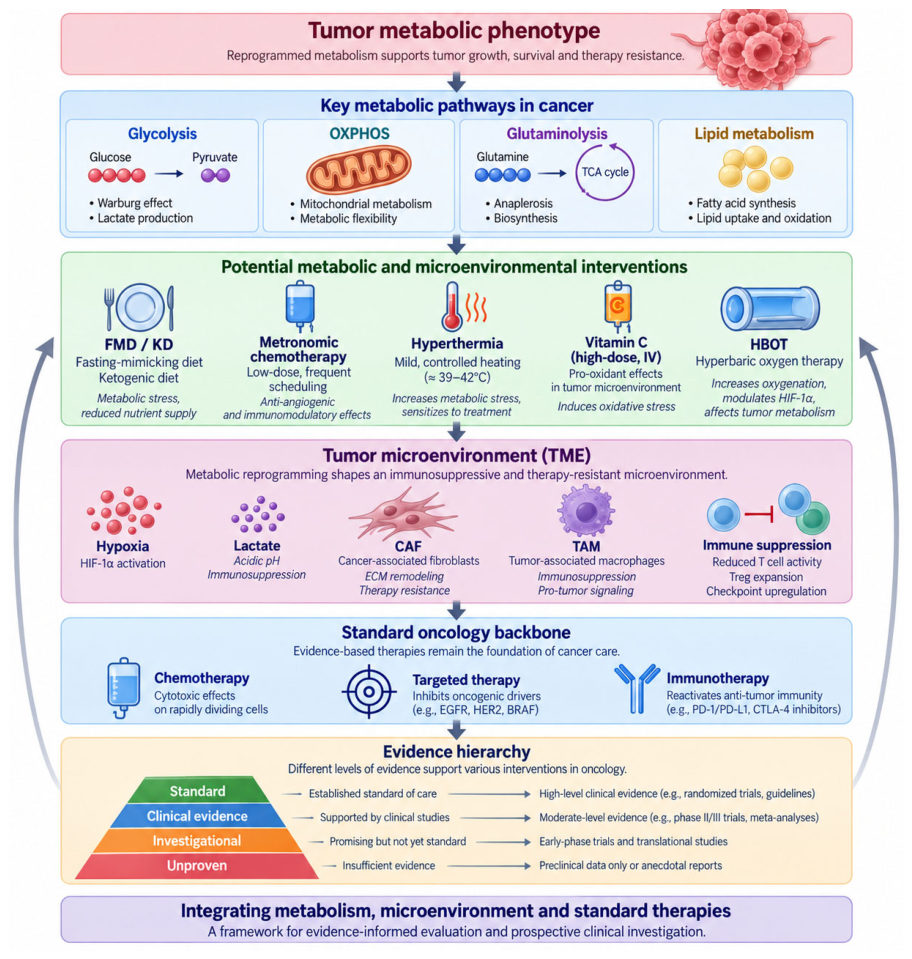

Table 1.
Summary of the current clinical evidence for the therapeutic and drug-delivery approaches discussed in this review.
Table 1.
Summary of the current clinical evidence for the therapeutic and drug-delivery approaches discussed in this review.
| Component | Mechanistic Hypothesis |
Level of Clinical Evidence |
Note |
| Targeted smart drugs (EGFR/ALK/BRAF/PARP inhibitors) | Driver-mutation-specific inhibition | Strong (Phase III, standard treatment) | Evidence-based oncology; used within its indication regardless of the rest of this review. |
| Monoclonal antibodies (trastuzumab, bevacizumab) | Receptor blockade / anti-angiogenesis | Strong (Phase III, standard treatment) | Proven standard treatment in biomarker-selected patients. |
| Immune checkpoint inhibitors (PD-1/PD-L1) | Removal of T-cell suppression | Strong (Phase III, standard treatment) | Indicated according to PD-L1/MSI/TMB; already evidence-based. |
| Fasting-mimicking diet (FMD) and ketogenic diet (nutritional ketosis) as chemotherapy adjuncts | Differential stress resistance | Moderate (randomized phase II) | Best-evidenced dietary adjuncts in this review; reduces chemotherapy toxicity. |
| Low-dose / metronomic chemotherapy | Anti-angiogenesis, immune modulation | Moderate (Phase II/III in some tumors, mostly palliative) | Overall survival benefit not demonstrated in most studies, influenced by the recurrent/palliative settings. |
| Regional/systemic hyperthermia | Protein denaturation, increased blood flow, immunogenic cell death | Moderate–Strong (Phase III in some tumor types, as an adjunct) | Evidence varies by tumor type; proven as part of a combination, not alone. |
| High-dose IV vitamin C | Peroxide-mediated pro-oxidant cytotoxicity | Limited (Phase I/II, safety-focused; no Phase III survival data) | Benefit shown in quality of life/tolerance; insufficient evidence of stand-alone anti-tumor efficacy. |
| Hyperbaric oxygen therapy | Reduction of tumor hypoxia/HIF-1α | Limited and conflicting (mixed preclinical data) | Both anti-tumoral and proliferation-favoring effects reported in some cancer types; individualize by tumor type. |
| Metabolically supported chemotherapy (İyikesici/Seyfried protocol): standard-dose chemotherapy + induced hypoglycemia + KD/HT/HBOT | Transient increase of glucose-dependent tumor-cell drug uptake under hypoglycemia | Low (case reports / retrospective case series, single treating group, no RCT) | Distinct from IPT: retains standard chemotherapy dose; requires continuous glucose monitoring; not independently replicated. |
| DMSO infusion (as chemotherapy carrier / anticancer agent) | Increased cell-membrane permeability | Unproven for anticancer effect (no human efficacy data) | Reviews state there is no evidence it treats cancer in humans; limited signal for pain palliation only. |
| Insulin Potentiation Therapy (IPT), historic low-dose concept | Assumption that insulin increases intracellular drug uptake at 10–25% chemotherapy dose | Unproven / not recommended by expert organizations | NCI, MSKCC, and CAM-Cancer describe IPT as unproven and potentially harmful (hypoglycemia, resistance risk from inadequate dosing). |
| Nanoparticle/exosome/peptide-targeted drug carriers | Enhanced permeability and retention; active receptor targeting | Mixed: some formulations FDA-approved; most exosome/peptide platforms preclinical–early clinical | Substantially stronger mechanistic and regulatory evidence base than DMSO as a carrier; not yet incorporated into any metabolic-combination protocol in controlled trials. |
| Tumor-microenvironment targeting (CAF/TAM/vascular normalization/cytokine network) | Reprogramming of the stromal-immune support system | Research stage (preclinical–early clinical; some combinations approved, most experimental) | Bevacizumab+atezolizumab combination approved; CSF1R- and IL-6-targeted approaches have shown mixed results in early-phase trials. |
| Combined multi-component 'metabolically controlled' protocol as a whole (all elements above given together) | Simultaneous multi-target metabolic and immunological suppression | Not tested as a combined regimen (no trial of the full combination exists) | Each component must be evaluated on its own evidence level; the combination itself requires a prospective, controlled trial before any efficacy claim can be made. |
Disclaimer/Publisher’s Note: The statements, opinions and data contained in all publications are solely those of the individual author(s) and contributor(s) and not of MDPI and/or the editor(s). MDPI and/or the editor(s) disclaim responsibility for any injury to people or property resulting from any ideas, methods, instructions or products referred to in the content. |
© 2026 by the authors. Licensee MDPI, Basel, Switzerland. This article is an open access article distributed under the terms and conditions of the Creative Commons Attribution (CC BY) license (http://creativecommons.org/licenses/by/4.0/).
Copyright: This open access article is published under a Creative Commons CC BY 4.0 license, which permit the free download, distribution, and reuse, provided that the author and preprint are cited in any reuse.