

Submitted:
27 September 2026
Posted:
29 September 2026
You are already at the latest version
Abstract
Green facades and green roofs are increasingly promoted as core strategies for building decarbonisation, energy-efficient design, and ecological building concepts, with their environmental performance extensively documented through Life Cycle Assessment (LCA). However, the social dimension of these interventions occupant wellbeing, labour conditions embedded in the production of renewable and recycled materials, equity of access to green retrofits, and community acceptance remains largely absent from mainstream sustainability assessment. This paper conducts a systematic review, following PRISMA 2020 guidelines, of the LCA literature on green roofs and living walls published between 2015 and 2025, screening 264 records identified in Scopus and Web of Science down to 45 included studies. The review finds that environmental, economic, and technical performance evaluations dominate this literature, and that the evidence base is heavily concentrated on green roofs (91% of included studies) rather than green facades or living walls (9%). Only one included study applies a full Social Lifecycle Assessment (S-LCA) methodology to a green roof, confirming that social sustainability evaluation of vegetated building envelopes exists but remains an isolated, non-cumulative contribution rather than an established practice. Drawing on the identified findings, this paper develops a preliminary S-LCA framework for green roofs and living walls, modifying the five UNEP/SETAC stakeholder categories to better reflect the specific characteristics and social implications of vegetated envelopes. The framework provides a more comprehensive approach for researchers and policy-makers to assess the broader impacts of building greening strategies beyond conventional environmental performance indicators.
Keywords:
green facades
; green roofs
; social lifecycle assessment
; systematic review
; building decarbonisation
; sustainable construction
; ecological building concepts
1. Introduction
The building sector is widely recognised as a major contributor to global greenhouse gas emissions, energy demand, and resource consumption. When both operational and embodied impacts are considered, buildings account for a considerable proportion of global energy-related carbon emissions.
To overcome these challenges, greening strategies such as green facades, green roofs, and living wall systems have become increasingly important in recent years for mitigating urban heat island effects [1]. Therefore, they are used not only to reduce the urban heat Island but also to support building decarbonisation initiatives as part of building energy performance improvement strategies. Today, these vegetated envelope systems are increasingly used in more sustainable construction methods. They are often used in tandem with recycled resources and energy-efficient, ecological insulation strategies, driving a broader shift towards energy-efficient, environmentally adaptive buildings [2].
Life Cycle Assessment (LCA) has emerged as the fundamental technique for assessing the environmental performance of such interventions and their effects, including embodied carbon, energy use, water use, and material flows over the life of a building. Researchers have conducted various projects to assess how environmental LCA can be used to evaluate green roofs, green facades, and living wall systems [2,3]. These evaluations cover operational energy needs, stormwater management, and the reduction of urban overheating. Additionally, these studies have highlighted environmental issues associated with material production, installation methods, water use, and maintenance.
Although the environmental effects of vegetated building systems have been extensively researched, their social effects have received limited attention. Social Lifecycle Assessment (S-LCA) has been more widely adopted across sectors such as agriculture, textiles, and construction materials. It has not yet been widely applied to green roof and green facade research. Social aspects, including the health and psychological wellbeing of occupants, working conditions for producing and maintaining materials, affordability, and the accessibility of green retrofit solutions, are often overlooked in existing research. In addition, community involvement in green building projects is often overlooked [4]. This suggests that sustainability assessments conducted today will inevitably be only partial in their assessment of these systems, as they typically measure only environmental impact, neglecting the social factors that affect their acceptance, implementation, and sustainability[5]. However, it becomes more important as cities in Europe, Asia, and North America research, develop, and implement policies and incentives to encourage the use of green roofs and facades as elements of urban sustainability and climate adaptation. However, decision-makers lack many tools to assess the social inclusiveness, economic accessibility, and beneficial impact of these interventions across user groups. Environmental LCA is an insufficient tool for answering questions about social equity and community involvement, as well as the distribution of benefits and burdens of building greening initiatives.
To address this research gap, this paper conducts a systematic review of existing LCA studies on green facades and green roofs, guided by the following research questions:
RQ1: To what extent have social sustainability indicators been incorporated into existing LCA studies of green facades and green roofs?
RQ2: Which social dimensions have been addressed, underexplored, or overlooked in the current literature?
RQ3: What methodological and conceptual challenges contribute to the limited integration of social sustainability assessment in studies of vegetated building systems, and how can these challenges be addressed?
Based on the findings of the systematic review, this study proposes a preliminary Social Lifecycle Assessment (S-LCA) framework specifically developed for green facades and green roofs. The proposed framework adapts established stakeholder categories from UNEP/SETAC guidance to reflect the particular social characteristics of vegetated building envelopes. By incorporating social indicators alongside conventional environmental assessment approaches, the framework aims to support a more comprehensive evaluation of building greening strategies and their implications for occupants, workers, communities and other stakeholders.
The remainder of this paper is organised as follows. Section 2 presents the theoretical background of LCA and S-LCA approaches within the built environment. Section 3 describes the systematic review methodology, following PRISMA guidelines. Section 4 discusses the review findings through thematic analysis of identified social sustainability indicators. Section 5 introduces the proposed S-LCA framework for green facades and green roofs. Section 6 examines the implications of the findings for research, policy, and practice, while Section 7 concludes the paper and identifies future research directions. Unlike previous reviews that have primarily focused on the environmental and economic performance of green roofs and living walls, this study examines the relatively underexplored integration of social sustainability into lifecycle assessment research. Building upon the limited existing contribution identified by [6,7] this research develops a stakeholder-oriented S-LCA framework specifically adapted to vegetated building envelopes. The framework extends current S-LCA approaches by addressing social considerations that are particularly relevant to green roofs and facades, including maintenance-related labour, equitable access to green retrofit opportunities, occupant wellbeing, and community acceptance.
2. Theoretical Background
2.1. Environmental Lifecycle Assessment of Green Building Envelopes
LCA is an ISO-standardised environmental assessment methodology defined by ISO 14040 and ISO 14044. It assesses the potential effects of products, processes or systems over their life cycle. It also covers raw material extraction, use, and ultimately disposal. In the building industry, LCA is becoming a common tool for determining the embodied carbon, operational energy consumption, resource use, and material flows associated with buildings. It is used with various building approaches. Over the past few years, it has been applied to assess the greening strategy of buildings, such as green facades, green roofs, and living wall systems.
Environmental LCA studies of vegetated building envelopes focus on several key aspects: (1) the embodied environmental effects associated with substrates, vegetation components, irrigation systems and also structural support elements; (2) potential reductions in operational energy demand resulting from improved thermal performance and decreased cooling requirements; (3) ecosystem-related benefits, including storm water management and urban heat reduction; and (4) end-of-life scenarios, including material recovery, reuse, and recyclability considerations. These assessments have provided valuable insights into the environmental performance of green envelope systems; however, they have primarily concentrated on biophysical effects, with limited attention given to their broader social implications.
This body of work has matured considerably, particularly for green roofs, and increasingly informs building decarbonisation policy and energy-efficient building design standards.
2.2. Social Lifecycle Assessment: Origins and Framework
Social Lifecycle Assessment (S-LCA) extends LCA methodology to assess the social and socio-economic effects throughout the life cycle of a product or service. The UNEP/SETAC Life Cycle Initiative provided the first international guidance in 2009. They significantly updated this guidance in the 2020 Guidelines for Social Life Cycle Assessment of Products and Organisations, which they developed to provide more extensive guidance for organisations and to enhance connections to the UN Sustainable Development Goals.
Based on these guidelines, five major stakeholder categories were identified: workers, value chain actors, local communities, consumers, and society. These impact categories include subcategories such as fair wages, occupational health and safety, cultural heritage, access to resources, and community participation. They are measured using qualitative, semi-quantitative, or quantitative indicators.
S-LCA follows the LCA structure from environmental LCA and comprises four stages as per the ISO 14040 LCA framework: goal and scope definition, LCIA, and interpretation.
In contrast to traditional environmental LCA, S-LCA focuses more on stakeholder perspectives and on indicators that often entail qualitative information, social perceptions, and contextual factors, in addition to measurable physical parameters. The methodology has been further developed in recent years, supported by databases and assessment tools, such as the Social Hotspots Database and the Product Social Impact Life Cycle Assessment database. In addition, the release of ISO 14075:2024 has helped to advance international acceptance and standardisation of the principles of S-LCA within the ISO 14000 family.
2.3. Why Green Building Envelopes Create Unique Challenges for S-LCA Assessment
While S-LCA has been more widely developed, e.g., in the textile sector, food supply chains, and traditional building materials, its application to green facades and green roofs remains methodologically challenging. The current categories of stakeholders and social indicator frameworks are not sufficient to capture the unique characteristics and implications of vegetated building systems.
Green envelopes have several unique elements that must be examined beyond those of conventional building elements:
This is the continuous need for biological management and labour. Green facades and roofs are not like other building materials which are relatively passive once in place, but are living systems which must be maintained throughout their operational life. Labour requirements are continuous, for example, irrigation, plant maintenance, pruning, pest management, and replacement of growing substrates. The relevance of the 'workers' stakeholder category is not limited to the construction phase, but is ongoing throughout the use phase.
Interconnectedness of environmental functions and social outcomes: The benefits of green envelopes cannot be easily separated into environmental and social benefits. It is observed that there is an overlap between ecosystem services and human-centred benefits, including improvements in air quality, psychological wellbeing, enhanced thermal comfort perception, and opportunities for interaction with the natural environment. This interaction presents problems when assessing whether some impacts should be considered social value (as in LCA-based methodologies) or environmental contributions.
Equity, access and access to benefits: Many of the benefits of green retrofit solutions are associated with high initial investment and could therefore affect their availability across different social groups. Green envelopes can play a role in creating healthier, more resilient urban environments but not all communities will reap the same rewards. Hence, the subjects of affordability, social inclusion and environmental justice are significant and may not be sufficiently captured in current assessment frameworks.
The above features indicate that conventional S-LCA indicators might not be applicable without adaptation to the social aspects of vegetated building envelopes. The systematic review presented in Section 4 therefore examines both the inclusion and frequency of social indicators in existing LCA studies of GFA and GGR, as well as how social indicators have been defined, adapted, or omitted in past research. The results of this analysis feed into the design of the tailored S-LCA framework presented in Section 5.
3. Methodology
3.1. Systematic Review Protocol
The present study follows the PRISMA 2020 (Preferred Reporting Items for Systematic Reviews and Meta-Analyses) framework to guide the systematic review procedure. This protocol was adopted to ensure a transparent, structured, and reproducible research process while maintaining methodological reliability throughout the stages of literature identification, screening, and analysis.
3.2. Databases and Search Strategy
A comprehensive literature search was performed using two internationally recognised academic databases: Scopus and the Web of Science Core Collection. These databases were selected due to their broad coverage of interdisciplinary research, including engineering, environmental studies, sustainability science, and social research related to green construction and building performance evaluation.
The search approach was developed using a combination of keywords representing three main research themes: lifecycle assessment methodologies, social sustainability considerations, and vegetated building systems. An equivalent search query was applied to both databases, with slight modifications introduced to accommodate the different indexing structures and search field specifications of each platform. Specifically, the TITLE-ABS-KEY function was used for Scopus searches. At the same time, the Topic field was applied in Web of Science to identify relevant publications based on titles, abstracts, and keywords.
("green facade*" OR "green roof*" OR "living wall*" OR "vegetated envelope*") AND ("life cycle assessment" OR "LCA" OR "S-LCA")
The literature search was restricted to studies published between January 2015 and December 2024. The eligibility criteria included peer-reviewed journal articles, conference proceedings, and review articles, while publications in languages other than English were excluded to maintain consistency in the analysis.
The initial database screening yielded 90 publications from Scopus and 174 from the Web of Science Core Collection. Therefore, a total of 264 records were obtained at the identification stage, before duplicate removal and further screening.

Table 1.
Inclusion and Exclusion Criteria.
| Criteria | Inclusion | Exclusion |
|---|---|---|
| Topic focus | Studies applying LCA (environmental or social) to green facades and/or green roofs | Green infrastructure unrelated to building envelopes (e.g., urban parks, street trees) |
| Methodology | Empirical, review, or framework-based studies | Descriptive/opinion pieces without methodological basis |
| Scope | Building-level or material-level assessment | Studies focused solely on stormwater/hydrology without an LCA component |
| Language | English | Non-English without available translation |
| Publication type | Peer-reviewed articles, reviews, conference proceedings | Non-peer-reviewed blogs, unverified industry claims |
| Time frame | 2015-2025 | Pre-2015 (unless seminal/highly cited foundational studies) |
3.4. Screening Process (PRISMA Flow)
The selection of studies was conducted using the systematic review software Rayyan and structured according to the PRISMA 2020 guidelines. A total of 264 records were imported at the identification stage: 90 from Scopus and 174 from the Web of Science Core Collection.
Duplicates were identified using Rayyan's automated tool and later verified manually. Eight records were automatically eliminated as potential duplicates, leaving 256. Another manual search revealed 72 more duplicate records. These records were not re-indexed after manual duplicate checking, so they were still displayed during the next screening step. Hence, they were not included in the screening of title and abstract with the exclusion flag "duplicate record". This method was reported to keep the process transparent and to allow for understanding of the screening process.
These records were then screened using the eligibility criteria defined in Section 3.3, using both title and abstract screening. Sixty-five studies were removed from the 256 assessed at this stage, leaving 191 articles available for full-text evaluation: 131 were classified as "Include" and 60 as "Maybe."
During the full-text assessment phase, 142 studies were excluded. The main exclusion criteria were studies that were not conducted using a lifecycle assessment approach directly related to green roofs, green facades, or living wall systems, and duplicate publications identified in the previous steps of the screening.
Post full-text screening, 49 studies met the pre-defined inclusion criteria. After the final manual quality check, four further duplicate publications were identified, primarily due to slight errors in publication metadata or title formatting of identical publications in Scopus and Web of Science.
These remaining duplicates were removed, and the final review sample comprised 45 unique studies, which served as the basis for qualitative synthesis and analysis.
3.5. Data Extraction and Synthesis
For each study included in the review, the following information was extracted: bibliographic details (authors, publication year, and title); the type of vegetated building envelope investigated (e.g., green roof or living wall/vertical greening system); the type of lifecycle assessment employed (environmental LCA, Social Lifecycle Assessment (S-LCA), Lifecycle Costing (LCC), or hybrid approaches), as identified from the title and, where available, the abstract; and the primary research focus, including topics such as carbon and climate impacts, thermal performance, economic evaluation, substrate and material characteristics, or photovoltaic integration.
Given the volume of the final set, thematic categorisation in Section 4 is based primarily on title-level and metadata analysis; a smaller number of studies were additionally cross-checked against available abstracts. This represents a first-pass descriptive synthesis; a full narrative synthesis based on complete reading of all 45 full texts is recommended as a valuable next step for future work and is noted as a limitation in Section 6.2.
4. Results
4.1. Search and Screening Outcomes
The systematic search identified 264 records (90 from Scopus, 174 from Web of Science). Following the deduplication and screening process detailed in Section 3.4, 256 records were screened by title and abstract, of which 65 were excluded. The remaining 191 records were assessed at the full-text stage, of which 142 were excluded, most commonly for lacking a lifecycle assessment methodology specifically applied to a green roof, green facade, or living wall, or for being an unresolved duplicate. Manual cross-checking of the resulting 49 records identified 4 additional duplicate pairs, yielding a final set of 45 unique included studies. The complete PRISMA 2020 flow diagram is presented in Figure 1.
4.2. Descriptive Characteristics of the Included Studies
Growing research interest in green building envelope sustainability assessment over the past years is reflected in the concentration of the 45 included studies, especially from 2020 onwards.
Many of the studies in the final data set relate to green roofs. The 45 publications reviewed cover the following: Green Roof Systems (41 publications, 91%) and Living Walls or vertical greening systems (4 publications, 9%) [8,9,10,11]. There are no studies specifically dedicated to green facades as a category separate from living walls. This reveals that lifecycle assessment studies of vegetated building envelopes have mainly focused on roof applications, with façade applications relatively under-studied.
The reviewed studies also identify several common research themes. The conventional green roof system is the most common object of investigation in environmental LCA studies, as reported in most publications [12,13]. The most common topics of research are lifecycle costing and economic performance [14]; embodied and operational carbon emissions and climate-change impacts [15,16]; thermal and energy performance [17]; substrate composition and the use of recycled or locally sourced materials [18,19,20] and the integration of vegetated roofs with photovoltaic systems [21,22,23] Several review articles collate advancements in the environmental and economic evaluation of vegetated building systems, including [24,25,26].
The literature reviewed overall shows a strong focus on environmental performance, energy efficiency, and economic evaluation, while social sustainability aspects are not yet prominent. This observation forms the starting point for further consideration of social indicators in the following Sections (4.2–4.4).
The 45 studies included were analysed according to the data extraction process described in Section 3.5, and the characteristics of the studies are summarised in Table 2, which includes the publication information, types of vegetated envelopes, the lifecycle assessment approach in the studies, the evaluation of social indicators, and the main focus of the research.
4.3. Extent of Social Indicator Integration (Addresses RQ1)
Of the 45 studies reviewed, only one publication, Application of Social Lifecycle Assessment in Urban Settings: Social Impact Assessment of Green Roofs, explicitly applies a Social Life Cycle Assessment (S-LCA) methodology to a green roof case study, highlighting the limited application of S-LCA in assessing the social dimensions of building greening interventions:
Social Impact Assessment of Green Roofs, applies a Social Lifecycle Assessment (S-LCA) methodology in a green roof case study. This suggests that S-LCA is a new method applied to research on vegetated building envelopes, but it has very limited applications. The study by [7] is the only one in the systematic review to have undergone an LCA covering the entire life cycle. [7] It is the only study identified in the systematic review that performed a comprehensive S-LCA.
Two other studies [27] include social aspects within a more comprehensive socio-environmental assessment framework, using the Envision rating system rather than a specific S-LCA methodology. This study addresses selected social sustainability aspects; it does not use S-LCA indicators based on stakeholders or follow the UNEP/SETAC or ISO methodologies.
The other 43 studies (95.6%) are exclusively concerned with environmental performance, economic evaluation or technical aspects of the vegetated building systems. These studies lack explicit social indicators, stakeholder-based assessments, and recognised S-LCA impact categories, as indicated by their titles and available abstracts. As such, the literature reviewed suggests that there has been an imbalance in research focus between environmental and techno-economic lifecycle assessment of green roofs and living walls, with comparatively less research on the social dimension.4.4 Which Social Dimensions Are Represented, Underdeveloped, or Absent (addresses RQ2)
Mapped against the five UNEP/SETAC stakeholder categories introduced in Section 2.2, and drawing on the single S-LCA study identified [7] alongside the broader set:
- Workers: no included study quantifies occupational safety or labour conditions associated with ongoing horticultural maintenance of green roofs or living walls.
- Local community: [7] is the only included study explicitly framed around social impact in an urban community setting; none of the other included studies addresses public perception, community consultation, or local acceptance.
- Society: none of the included studies addresses the distributive equity of access to green retrofitting, or the social implications of decarbonisation policies mandating green roofs or living walls.
This confirms the pattern anticipated in Section 2.3: social dimensions specific to green envelopes (ongoing maintenance labour, distributive equity of access) are not merely underdeveloped but entirely unaddressed across the systematically identified literature, while adjacent technical outcomes (thermal comfort, air quality) are studied only as environmental performance metrics, not reframed through a social-indicator lens.
4.5. Methodological and Conceptual Barriers (Addresses RQ3)
The heavy concentration of the included literature on environmental, economic, and technical performance outcomes (carbon, cost, thermal behaviour, materials) suggests that the methodological infrastructure for measuring these dimensions is comparatively mature and well-rehearsed, creating a path of least resistance for researchers relative to social outcomes, for which standardised, green-envelope-specific indicators do not yet exist. The isolated position of [7] as the sole applied S-LCA case, alongside [28] framework-level socio-environmental contribution, suggests that where social evaluation is attempted, it currently proceeds without a shared methodological precedent to build on or compare against; each contribution effectively starts from first principles rather than extending a cumulative body of green-envelope-specific S-LCA practice. This is consistent with the theoretical account in Section 2.3, which anticipated that the distinguishing features of vegetated envelopes (ongoing maintenance labour, blurred ecosystem-service boundaries, distributive access questions) would not map cleanly onto generic S-LCA subcategories without deliberate adaptation.
[28] contribution, by contrast, works through Envision, a third-party infrastructure sustainability rating system used in civil engineering practice, rather than through primary stakeholder data collection. Its abstract confirms that the paper's approach is to map existing green roof design, construction, and structural standards (which are not necessarily aligned with one another) against Envision's rating categories to support decision-making that jointly considers structural, social, environmental, and economic parameters. This represents a standards-mapping and rating-alignment exercise rather than an applied social-indicator survey: it identifies where social considerations could be incorporated into existing infrastructure certification processes. Still, it does not itself measure or report social outcomes from real green roof projects, as Mazzucco et al.'s questionnaires do. The two studies are therefore complementary rather than duplicative: Dastan Diznab and Tehrani offer a certification-integration pathway, while Mazzucco et al. offer field-collected stakeholder data, and neither builds on the other, reinforcing this paper's finding that the field lacks a cumulative, shared methodological base.
A detailed review of the full text by Mazzucco, Canepa, and Perini (2023) provides further insight into the application of S-LCA to green roofs. Rather than applying the UNEP/SETAC stakeholder framework in its entirety, the authors retained only the workers stakeholder category. They introduced a new user category in place of consumers, arguing that consumers were not appropriate for evaluating public and semi-public green roof spaces. This modification reflects an important methodological adaptation, recognising that vegetated building systems involve patterns of use and social interaction that differ from those associated with conventional manufactured products.
For the workers stakeholder group, the assessment focused on two impact categories, Working Conditions and Health and Safety, covering subcategories such as fair wages, working hours, equal opportunities, social benefits, quality of work, workplace relationships, occupational safety, accident prevention, and protective measures. For the user's stakeholder group, two new impact categories were developed specifically for the built environment: Conditions of Use, which includes governance, transparency, and user participation in sustainability initiatives, and Socio-economic and Environmental Repercussions, which considers community involvement, employment generation, and perceived environmental benefits. These categories extend the generic UNEP/SETAC framework by incorporating issues that are directly relevant to the operation and use of vegetated building systems.
The assessment was based on two structured questionnaires administered to 35 workers and 60 users in Italy between September 2022 and February 2023. A notable outcome of the study is the development of a practical 13-step assessment checklist that links each evaluation criterion to relevant Sustainable Development Goal (SDG) targets and internationally recognised labour standards, including International Labour Organisation (ILO) conventions and the European Union Directive 2022/2041 on adequate minimum wages. Rather than proposing new stakeholder groups, the study demonstrates how existing S-LCA guidance can be selectively adapted and operationalised for green roof projects through context-specific indicators and assessment procedures.
Notably, the study's own findings reinforce this paper's broader argument about an underdeveloped evidence base: of 35 worker respondents, only three were women, a gender imbalance the authors could not analyse further given the small sample; 74% of workers were freelancers, of whom 85% worked more than 40 hours per week and fewer than 20% reported social benefits beyond retirement (e.g., only 11% had paid parental leave); and only 20% of the green roof projects surveyed were public rather than private, a finding directly relevant to the distributive-access question raised in Section 2.3, since public projects imply broader community accessibility than private ones. The authors describe their framework as a preliminary assessment tool rather than a validated or broadly applicable methodology, acknowledging the need for further research to refine the proposed indicators and evaluate the approach across a wider range of case studies. This self-identified limitation is consistent with the findings of the present review, suggesting that the application of S-LCA to green roof systems is still at an early stage of methodological development and has yet to become an established approach within the broader lifecycle assessment literature.
5. Proposed Social Lifecycle Assessment Framework for Green Façades and Green Roofs
This paper's proposed framework builds directly on the two-stakeholder model developed by [7], workers and users, rather than attempting to apply all five generic UNEP/SETAC (2020) categories at once, since Section 4.3 confirms that [7] is the only prior study to have operationalised any S-LCA stakeholder structure for green roofs specifically. This paper extends their model in three respects, informed by the gaps identified in Section 2.3 and Section 4.4: first, by adding explicit subcategories for value-chain labour conditions in recycled and renewable material sourcing, which [7]'s workers category does not cover; second, by extending their "users" category with a distributive-equity lens, addressing the public-versus-private access question their own data raises (only 20% of surveyed projects were public) but do not develop into an indicator; and third, by extending the framework's scope from green roofs specifically to living walls and vertical greening systems, reflecting this paper's broader systematic review scope (Section 4.2).
Table 3.
The Stakeholder category.
| Stakeholder category | Subcategories (based on Mazzucco et al., 2023, extended) | Illustrative indicators |
|---|---|---|
| Workers | Fair salary; working hours; equal opportunities; social benefits; quality of work; social interactions; intervention sustainability; safety; accidents; protections (all per [7]) | % freelance vs employed; weekly working hours; parental-leave provision; PPE availability; accident rate (as measured in Mazzucco et al.'s worker questionnaire) |
| Value chain actors (extension) | Labour conditions in the production of recycled/renewable substrate and insulation materials not addressed by Mazzucco et al.'s worker category, which covers only on-site installation/maintenance labour. | Supplier social auditing; traceability of recycled material sourcing |
| Users (per Mazzucco et al., 2023) | Governance; transparency; sustainability involvement (Conditions of Use); community involvement; job creation; environmental benefits (Socio-economic and Environmental Repercussions) | Awareness of maintenance/disposal responsibilities; new local jobs created; reported environmental benefits (per Mazzucco et al.'s user questionnaire) |
| Distributive equity (extension) | Public vs private access to green roof/living wall benefits flagged but not indicator-ised by [7], whose sample was 75% private, 20% public projects | Proportion of public/subsidised vs private installations; income-group access to green retrofit incentives |
| Local community (extension) | Visual/aesthetic impact; noise/disruption during installation; applicable to living walls and facades, not addressed in Mazzucco et al.'s roof-only sample | Community consultation occurrence; resident complaint/satisfaction records during installation |
This framework is intended as a direct, cumulative extension of ]'s checklist-based approach rather than a competing model. It should similarly be treated as a starting point for empirical application and refinement. Its extended subcategories (value-chain labour, distributive equity, living-wall-specific community impact) should be validated and weighted through stakeholder consultation, for example, a Delphi study or participatory workshops with architects, housing authorities, and community representatives and, ideally, tested against a larger and more geographically diverse worker/user sample than Mazzucco et al.'s Italy-based 35/60 respondents, before operational use.
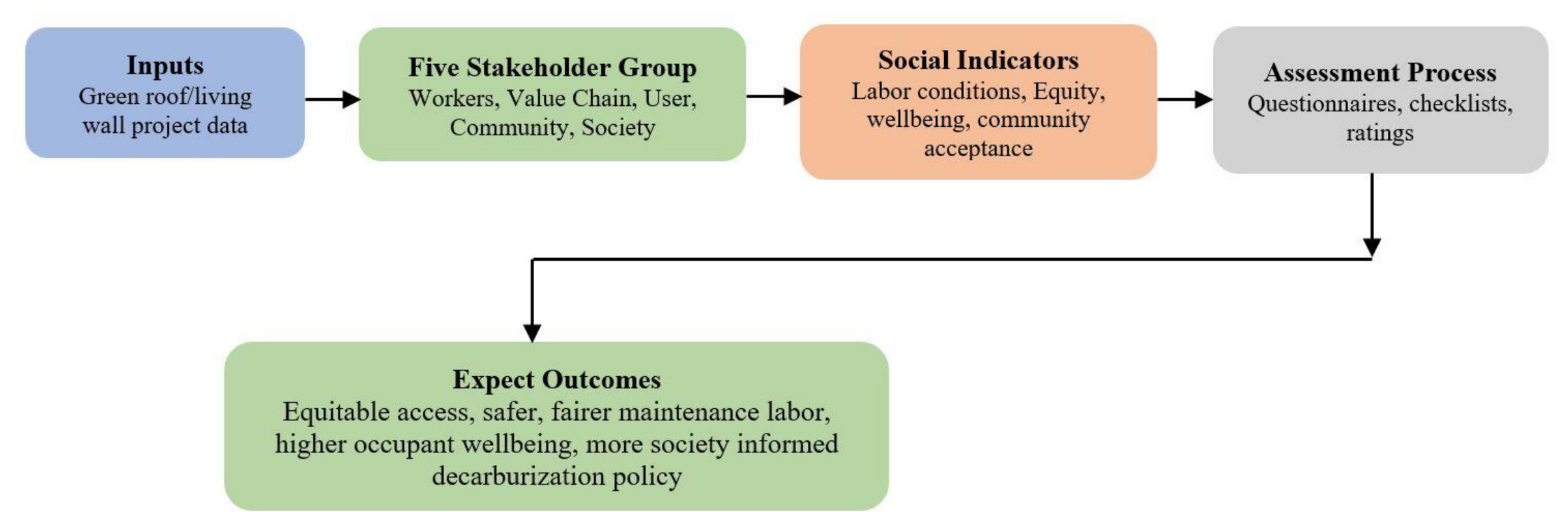
Figure 2.
Conceptual framework linking inputs, stakeholder groups, social indicators, and the assessment process to expected outcomes [7].
Figure 2.
Conceptual framework linking inputs, stakeholder groups, social indicators, and the assessment process to expected outcomes [7].
6. Discussion
Unlike [29], one of the included studies in this review, which focused on life cycle sustainability assessment of green roofs from environmental and economic perspectives, the present review demonstrates, at the level of a full systematic search rather than a narrower environmental-economic synthesis, that social sustainability remains almost absent from current LCA practice for green roofs and living walls.
The findings of the present review reinforce the observations reported by [29], but do so from a systematically identified and screened body of literature. Rather than representing an isolated conclusion from a previous review, the limited consideration of social sustainability is confirmed across 45 studies published over the period examined.
Overall, the review demonstrates that research on green roofs and living walls has focused predominantly on environmental, economic, and technical performance. Among the 45 included studies, only one [7] applies a dedicated Social Lifecycle Assessment (S-LCA) methodology. At the same time, another [29] incorporates social considerations through a broader sustainability assessment framework rather than a stakeholder-based S-LCA approach. The limited integration of social assessment suggests that important issues including labour conditions, equitable access to green retrofit programmes, and occupant health and wellbeing remain largely outside the scope of current lifecycle assessment research. Consequently, policy and design decisions informed primarily by environmental and economic LCA may not fully capture the broader social implications of vegetated building systems.
The review also reveals a marked imbalance in the distribution of research across different types of vegetated building envelopes. Green roofs account for 41 of the 45 included studies (91%). In contrast, only four studies investigate living walls or vertical greening systems, and none examine green facades as a distinct category separate from living walls. This uneven distribution suggests that the available evidence supporting lifecycle assessment of vegetated building envelopes is substantially more developed for roof systems than for façade-based applications. Accordingly, the findings and the proposed S-LCA framework should be interpreted within the context of this imbalance, while recognising the need for further research on green facades and other wall-based greening technologies.
The isolated position of [7] is itself informative. Rather than indicating that S-LCA is entirely unknown to this field, it indicates that S-LCA application to green roofs currently exists as a singular, non-cumulative contribution: with no comparable prior study to build on, it is unclear whether its proposed stakeholder categories and indicators have been adopted, critiqued, or extended by subsequent work. This is consistent with the theoretical account in Section 2.3, which anticipated that the distinguishing features of vegetated envelopes (ongoing maintenance labour, blurred ecosystem-service boundaries, distributive access questions) would not map cleanly onto generic S-LCA subcategories without deliberate, sustained adaptation a process that, on this evidence, has barely begun.
6.1. Implications for Policy and Practice
For policymakers mandating green roofs as part of building decarbonisation strategies, the near-total absence of social evaluation in the systematically identified literature means that current policy justifications rest almost entirely on environmental and economic performance evidence. The proposed framework (Section 5) offers a structured starting point for anticipating and monitoring the social trade-offs, particularly around maintenance labour and equitable access that this evidence base does not yet address. For practitioners (architects, developers, landscape engineers), the findings suggest that occupant wellbeing and maintenance labour conditions are not yet standard considerations in the green roof design literature and should be deliberately introduced rather than adopted from existing precedent.
6.2. Limitations
This review is limited to English-language, peer-reviewed literature indexed in Scopus and Web of Science, and may therefore underrepresent regional or grey literature addressing social dimensions of green building envelopes. The thematic categorisation in Section 4 is based primarily on title-level and metadata analysis of the 45 included studies rather than full-text reading of each; a complete narrative synthesis based on full-text reading of all 45 studies is recommended as a priority for future work to verify and enrich the categorisations offered here, and may surface additional social content not evident from titles alone. The strong concentration of included studies on green roofs rather than green facades or living walls (Section 4.2) also means this paper's conclusions apply most confidently to roof systems, with the living-wall/facade evidence base (n=4) within this sample too small to support strong independent conclusions about that subcategory. The proposed framework (Section 5) is conceptual and has not yet been empirically validated or weighted through stakeholder consultation; this represents a priority for future research.
7. Conclusions
This paper aimed to explore to what extent, if at all, social sustainability aspects are included in Lifecycle Assessment studies of green roof and green façade projects, and to suggest a framework for the missing field. Of the 264 records, 45 studies were eligible after a systematic review conducted according to the PRISMA 2020 guidelines. The review indicates that research on VEBs has mainly focused on their environmental, economic, and technical aspects. Among the included studies, only one (Mazzucco et al., 2023) uses the Social Lifecycle Assessment (S-LCA) methodology for green roofs, suggesting that its adoption in this field is limited. While S-LCA is well established and widely used in other sectors, its use in vegetated building systems has not yet fully captured issues specific to this technology, such as long-term maintenance activities, the relationship between ecosystem services and social wellbeing, and questions of equity regarding access to green retrofit interventions. The review also indicates a high degree of concentration of evidence on green roofs rather than green facades or living walls, and this needs to be taken into account when defining the scope of the field's sustainability claims in the future. This paper responded by presenting a preliminary S-LCA framework based on the 5 UNEP/SETAC stakeholder categories, tailored to green roofs and living walls. It provides a foundation for the research, practice, and policy communities to assess building greening more comprehensively by integrating the environmental and social aspects of sustainable construction, which are currently separate, and extends the previous work of [7], which was limited to the environmental approach.
Future research should focus on: Full-text narrative synthesis of the 45 studies located in this study beyond the title-level categorisation provided in this paper; A stakeholder consultation and application of the proposed framework to case studies, to validate the framework; Systematic search expansion to the addition of living-wall and facade-specific terms, as well as grey literature, to help address the roof/facade asymmetry identified in Section 4.2; and comparative studies which compare how building decarbonisation policies in different regulatory contexts address or do not address social equity in green infrastructure mandates.
While the adoption of green roofs, green facades and other nature-based building solutions is growing and is seen to reflect the objectives of climate change mitigation and adaptation, there is a need for increasingly complex assessment approaches that take into account the social, as well as the environmental and economic aspects. Social sustainability aspects of life cycle assessment can help provide a holistic view of the impact that such interventions have on workers, building users, local communities, and other stakeholders.
Future studies should therefore aim to develop further and validate S-LCA methods for vegetated building systems, including improvements to context-specific social indicators and their use across different building systems and geographical contexts. These would help inform decision-making, allowing environmental, economic, and social performance to be measured within a common lifecycle framework.
Funding
This research received no external funding.
Acknowledgments
During the preparation of this manuscript, the authors used ChatGPT (OpenAI) and Claude (Anthropic) for language editing, proofreading, and formatting of the manuscript. The authors have reviewed and edited the output and take full responsibility for the content of this publication.
Conflicts of Interest
The authors declare no conflicts of interest.
References
- Liu, R.; Yao, L.; Gong, Y.; Wang, Z. Life Cycle Assessment with Carbon Footprint Analysis in Glulam Buildings: A Review. Buildings 2025, 15, 1–26. [Google Scholar] [CrossRef]
- Zhou, Y.; Yu, X.; Zhang, X. Lifecycle carbon footprints of buildings and sustainability pathways in China. Carbon Footpr. 2024, 3. [Google Scholar] [CrossRef]
- Yan, Y.; Xiang, C. Life cycle carbon footprint and sustainability assessment of building-integrated photovoltaics: A comparative review of technologies and applications. Energy Build. 2026, 350, 116678. [Google Scholar] [CrossRef]
- Fawaz, M.; Elgheznawy, D.; Nashaat, B.; Megahed, N. A. Hybrid Façades: A Systematic Review of Integrating Vertical Greenery Systems with Advanced Façade Technologies. Sustain. 2026, 18. [Google Scholar] [CrossRef]
- Cervantes-Nájera, A. L.; Martínez-Rodríguez, M. C.; Campos-Villegas, L. E.; Bello-Yañez, X. V.; Brenneisen, S. Green Roof Systems within the Framework of a Circular Economy: A Scoping Review. Recycling 2024, 9, 1–20. [Google Scholar] [CrossRef]
- Cuce, P. M. Sustainable Insulation Technologies for Low-Carbon Buildings: From Past to Present. Sustain. 2025, 17, 1–50. [Google Scholar] [CrossRef]
- Mazzucco, G.; Canepa, M.; Perini, K. Application of Social-Life Cycle Assessment in Urban Settings: Social Impact Assessment of Green Roofs. Buildings 2023, 13. [Google Scholar] [CrossRef]
- Barreca, F.; Cardinali, G. D.; Bruno, R.; Arcuri, N. Sustainability Assessments of Living Walls in the Mediterranean Area. Buildings 2024, 14. [Google Scholar] [CrossRef]
- Mannan, M.; Al-Ghamdi, S. G. Investigating environmental life cycle impacts of active living wall for improved indoor air quality. Build. Environ. 2022, 208, 108595. [Google Scholar] [CrossRef]
- Oquendo-Di Cosola, V.; Olivieri, F.; Ruiz-García, L.; Bacenetti, J. An environmental Life Cycle Assessment of Living Wall Systems. J. Environ. Manag. 2020, 254, 109743. [Google Scholar] [CrossRef]
- Pan, L.; Chu, L. M. Energy saving potential and life cycle environmental impacts of a vertical greenery system in Hong Kong: A case study. Build. Environ. 2016, 96, 293–300. [Google Scholar] [CrossRef]
- Wang, Y.; Ni, Z.; Hu, M.; Li, J.; Wang, Y.; Lu, Z.; Chen, S.; Xia, B. Environmental performances and energy efficiencies of various urban green infrastructures: A lifecycle assessment. J. Clean. Prod. 2020, 248, 119244. [Google Scholar] [CrossRef]
- Rasul, M. G.; Arutla, L. K. R. Environmental impact assessment of green roofs using life cycle assessment. Energy Rep. 2020, 6, 503–508. [Google Scholar] [CrossRef]
- Ulubeyli, S.; Arslan, V.; Kazaz, A. Comparative life cycle costing analysis of green roofs: The regional aspect. Period. Eng. Nat. Sci. 2017, 5, 136–144. [Google Scholar] [CrossRef]
- Dong, X.; Lu, F.; He, B. J. Assessment of green roof cooling performance and operational carbon potential based on roof cooling unit. Sustain. Cities Soc. 2025, 135, 107022. [Google Scholar] [CrossRef]
- Dong, X.; He, B. J. A standardised assessment framework for green roof decarbonisation: A review of embodied carbon, carbon sequestration, bioenergy supply, and operational carbon scenarios. Renew. Sustain. Energy Rev. 2023, 182, 113376. [Google Scholar] [CrossRef]
- Wei, T.; Jim, C. Y.; Chen, Y.; Chen, A.; Li, X. Complementary influence of green-roof and roof-slab thermal conductivity on winter indoor warming assessed by finite element analysis. Energy Rep. 2022, 8, 14852–14864. [Google Scholar] [CrossRef]
- Rincón, L.; Coma, J.; Pérez, G.; Castell, A.; Boer, D.; Cabeza, L. F. Environmental performance of recycled rubber as drainage layer in extensive green roofs. A comparative Life Cycle Assessment. Build. Environ. 2014, 74, 22–30. [Google Scholar] [CrossRef]
- Eksi, M.; Sevgi, O.; Akburak, S.; Yurtseven, H.; Esin, İ. Assessment of recycled or locally available materials as green roof substrates. Ecol. Eng. 2020, 156. [Google Scholar] [CrossRef]
- Tams, L.; Nehls, T.; Calheiros, C. S. C. Rethinking green roofs- natural and recycled materials improve their carbon footprint. Build. Environ. 2022, 219, 109122. [Google Scholar] [CrossRef]
- Lamnatou, C.; Chemisana, D. Photovoltaic-green roofs: A life cycle assessment approach with emphasis on warm months of Mediterranean climate. J. Clean. Prod. 2014, 72, 57–75. [Google Scholar] [CrossRef]
- Liao, X.; Ali, A. B. M.; Singh, N. S. S.; Baghoolizadeh, M.; Alam, M. M.; Orlova, T.; Salahshour, S.; Alizadeh, A. Comprehensive review of green roof and photovoltaic-green roof systems for different climates to examine the energy-saving and indoor thermal comfort. Int. Commun. Heat Mass Transf. 2025, 164. [Google Scholar] [CrossRef]
- Chen, T.; Zhang, N.; Ye, Z.; Jiang, K.; Lin, Z.; Zhang, H.; Xu, Y.; Liu, Q.; Huang, H. Carbon reduction benefits of photovoltaic-green roofs and their climate change mitigation potential: A case study of Xiamen city. Sustain. Cities Soc. 2024, 114, 105760. [Google Scholar] [CrossRef]
- Manso, M.; Teotónio, I.; Silva, C. M.; Cruz, C. O. Green roof and green wall benefits and costs: A review of the quantitative evidence. Renew. Sustain. Energy Rev. 2021, 135. [Google Scholar] [CrossRef]
- Mihalakakou, G.; Souliotis, M.; Papadaki, M.; Menounou, P.; Dimopoulos, P.; Kolokotsa, D.; Paravantis, J. A.; Tsangrassoulis, A.; Panaras, G.; Giannakopoulos, E.; et al. Green roofs as a nature-based solution for improving urban sustainability: Progress and perspectives. Renew. Sustain. Energy Rev. 2023, 180, 113306. [Google Scholar] [CrossRef]
- Shafique, M.; Kim, R.; Rafiq, M. Green roof benefits, opportunities and challenges – A review. Renew. Sustain. Energy Rev. 2018, 90, 757–773. [Google Scholar] [CrossRef]
- Banirazi Motlagh, S. H.; Pons, O.; Hosseini, S. M. A. Sustainability model to assess the suitability of green roof alternatives for urban air pollution reduction applied in Tehran. Build. Environ. 2021, 194, 107683. [Google Scholar] [CrossRef]
- Benoît, C.; Norris, G. A.; Valdivia, S.; Ciroth, A.; Moberg, A.; Bos, U.; Prakash, S.; Ugaya, C.; Beck, T. The guidelines for social life cycle assessment of products: Just in time! Int. J. Life Cycle Assess. 2010, 15, 156–163. [Google Scholar] [CrossRef]
- Brunklaus, B.; Schade, J.; Mukkavaara, J. The use of green roofs to improve wooden buildings for a future bioeconomy. E3S Web Conf. 2022, 349, 1–6. [Google Scholar] [CrossRef]
Figure 1.
PRISMA 2020 flow diagram of the systematic search, screening, and inclusion process.
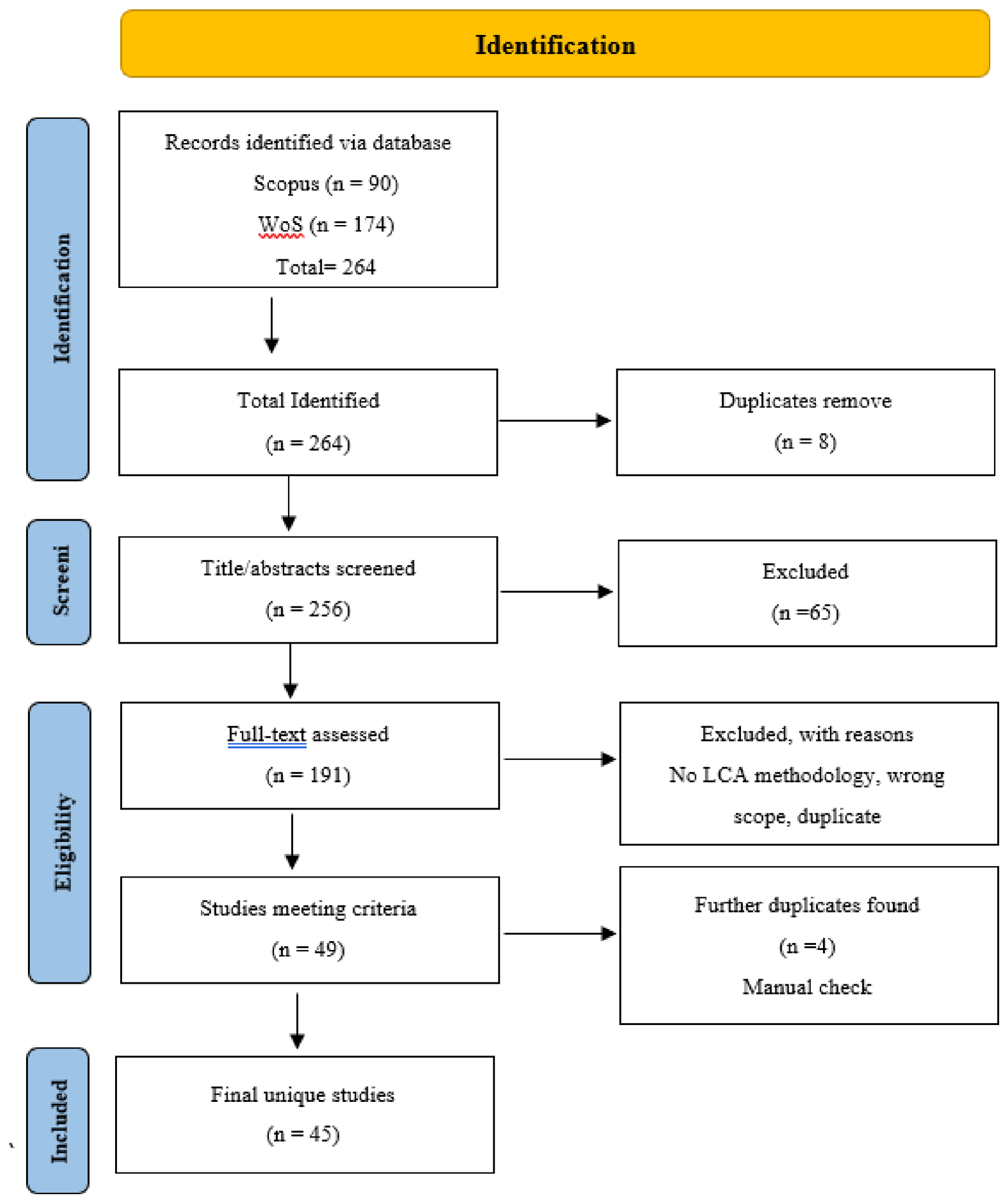
Table 2.
Summary of the 45 included studies by author, year, envelope type, apparent LCA type, presence of social indicators, and main thematic focus.
Table 2.
Summary of the 45 included studies by author, year, envelope type, apparent LCA type, presence of social indicators, and main thematic focus.
| Author(s) | Year | Envelope Type | LCA Type | Social Indicators | Main Focus |
|---|---|---|---|---|---|
| Brunklaus, Schade & Mukkavaara | 2022 | Roof | Env. LCA | None | Wooden building material integration |
| Vilcekova, Burdova & Budajova | 2024 | Roof | Env. LCA | None | Building materials circularity |
| Ulubeyli, Arslan & Kazaz | 2017 | Roof | LCC | None | Regional lifecycle costing comparison |
| Mazzucco, Canepa & Perini | 2023 | Roof | S-LCA | Yes | Worker/user survey, social checklist tool |
| Xu, Lin, Zhu, Zhang & Wang | 2024 | Roof | Env.-econ. LCA | None | Sponge-city macro-level assessment |
| Dastan Diznab & Tehrani | 2022 | Roof | Rating framework | Partial | Envision standards mapping |
| Shafique, Azam, Rafiq & Ateeq | 2020 | Roof | Review | None | General LCA review of green roofs |
| Vacek, Struhala & Matějka | 2017 | Roof | Env. LCA | None | Semi-intensive green roof case study |
| Shafique, Luo & Zuo | 2020 | Roof (PV) | Review | None | Photovoltaic-green roof review |
| Rasul & Arutla | 2020 | Roof | Env. LCA | None | Environmental impact case study |
| Wang, Ni, Hu, Li, Wang & Lu | 2020 | Roof/mixed | Env. LCA | None | Urban green infrastructure comparison |
| Mihalakakou et al. | 2023 | Roof | Review | None | Nature-based solution review |
| Pique, Blanchet & Breton | 2023 | Roof | Env. LCA | None | Cold-climate GWP comparison |
| Barreca, Cardinali, Bruno & Arcuri | 2024 | Living wall | Env./econ. LCA | None | Mediterranean living-wall assessment |
| Kim et al. | 2018 | Roof | Env.-econ. + survey | Partial | Roof farm vs garden, perception survey |
| Mannan & Al-Ghamdi | 2022 | Living wall | Env. LCA | None | Indoor air quality focus |
| Azzi, Karltun & Sundberg | 2022 | Roof | Env. LCA | None | Biochar substrate case study |
| Oquendo-Di Cosola et al. | 2020 | Living wall | Env. LCA | None | Two prototype LWS comparison |
| Peri et al. | 2022 | Roof | Env. LCA (EoL) | None | End-of-life/disposal scenario |
| Keyhani, Bahadori-Jahromi et al. | 2024 | Roof | Carbon LCA | None | Hilton Watford case study |
| Pushkar, Halperin & Ribakov | 2022 | Roof | Env. LCA | None | Seismic retrofit combination |
| Manso, Teotónio, Silva & Cruz | 2021 | Roof/wall | Review | None | Quantitative benefits/costs review |
| Pan & Chu | 2016 | Living wall | Env. LCA | None | Hong Kong case study |
| Liu, Huo & Zhang | 2016 | Roof | LCC | None | Economic efficiency assessment |
| Rincon, Coma, Perez & Castell | 2014 | Roof | Env. LCA (materials) | None | Recycled rubber drainage layer |
| Shafique, Kim & Rafiq | 2018 | Roof | Review | None | General benefits/challenges review |
| Wei, Jim, Chen, Chen & Li | 2022 | Roof | Thermal performance | None | Winter indoor warming modelling |
| Balasbaneh, Sher, Madun & Ashour | 2024 | Roof | Review (LCSA) | None | Broad sustainability literature review |
| Motlagh, Pons & Hosseini | 2021 | Roof | Sustainability model | None | Air-pollution reduction, Tehran |
| Tams, Nehls & Calheiros | 2022 | Roof | Env. LCA (materials) | None | Recycled materials, carbon footprint |
| Berardi, Ghaffarian-Hoseini x2 | 2014 | Roof | Review | None | Environmental benefits review |
| Shafique, Xue & Luo | 2020 | Roof | Review (carbon) | None | Carbon sequestration review |
| Brudermann & Sangkakool | 2017 | Roof | Decision analysis | None | Adoption decision factors, Europe |
| Gargari, Bibbiani, Fantozzi & Campiotti | 2016 | Roof | Env. LCA | None | Natural resource use |
| Lamnatou & Chemisana | 2014 | Roof (PV) | Env. LCA | None | PV-green roof, Mediterranean climate |
| dos Santos, Silva & dos Santos | 2019 | Roof | Env./thermal | None | Thermal discomfort/water scarcity |
| Eksi, Sevgi, Akburak & Yurtseven | 2020 | Roof | Materials assessment | None | Substrate material assessment |
| Radujkovic & Papuga | 2022 | Roof | Climate adaptation | None | Adaptive climate-change measure |
| Polo-Labarrios, Quezada-Garcia et al. | 2020 | Roof | Thermal performance | None | Thermal performance comparison |
| Vilcekova, Budajova & Harcarova | 2024 | Roof | Env. LCA | None | Composition impact on life cycle |
| Liao, Ali, Singh & Bagholi et al. | 2025 | Roof (PV) | Review | None | Energy-saving/thermal comfort review |
| Chen, Zhang, Ye, Jiang & Lin | 2024 | Roof (PV) | Carbon LCA | None | Xiamen city case study |
| Leite, Antunes & Silva | 2025 | Roof | Env. LCA | None | Rainwater/food-producing roof |
| Dong, Lu & He | 2025 | Roof | Carbon/thermal LCA | None | Cooling-unit performance |
| Dong & He | 2023 | Roof | Framework/carbon review | None | Decarbonisation assessment framework |
Disclaimer/Publisher’s Note: The statements, opinions and data contained in all publications are solely those of the individual author(s) and contributor(s) and not of MDPI and/or the editor(s). MDPI and/or the editor(s) disclaim responsibility for any injury to people or property resulting from any ideas, methods, instructions or products referred to in the content. |
© 2026 by the authors. Licensee MDPI, Basel, Switzerland. This article is an open access article distributed under the terms and conditions of the Creative Commons Attribution (CC BY) license.
Copyright: This open access article is published under a Creative Commons CC BY 4.0 license, which permit the free download, distribution, and reuse, provided that the author and preprint are cited in any reuse.