
Submitted:
26 September 2026
Posted:
29 September 2026
You are already at the latest version
Abstract
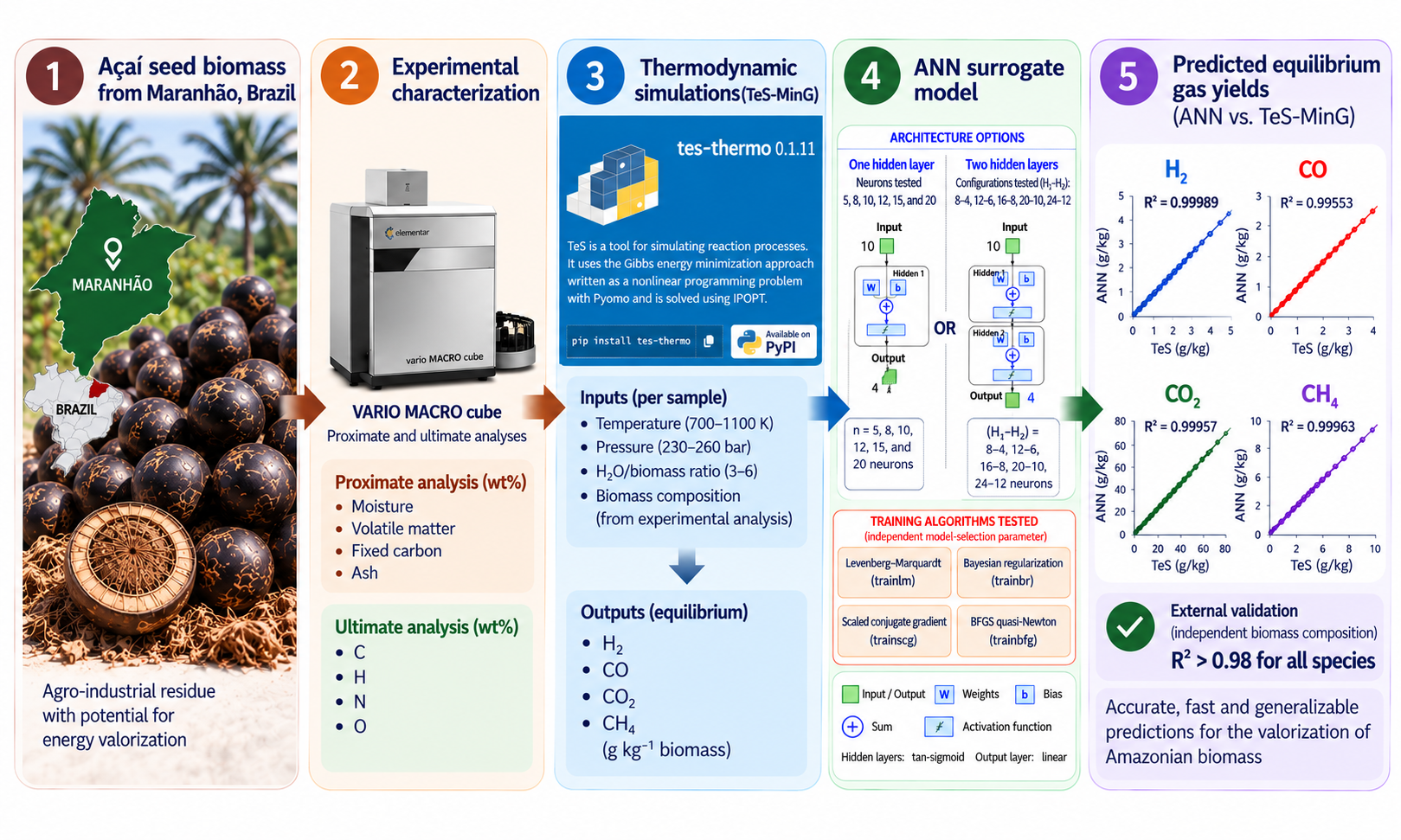
Thermodynamic equilibrium modeling is a useful approach for predicting gas production during supercritical water gasification (SCWG) of wet biomass; however, Gibbs energy minimization can be computationally demanding for repeated process simulations. This study developed an artificial neural network (ANN) surrogate model to predict the equilibrium yields of H₂, CO, CO₂, and CH₄ during SCWG of açaí residual biomass from Maranhão, Brazil. Four biomass samples collected under different geographical and seasonal conditions were characterized by ultimate analysis and used to generate a thermodynamic database with 1,000 simulations per sample using the TeS-Thermo PyPI Python library. The ANN comprised 10 input variables, two hidden layers with 12 and 6 neurons, and 4 output neurons, and was trained using the Levenberg–Marquardt algo-rithm. The selected ANN achieved R² values of 0.99989, 0.99553, 0.99957, and 0.99963 for H₂, CO, CO₂, and CH₄, respectively. External validation using an independent biomass composition provided evidence of the ANN's generalization capability within the in-vestigated compositional domain, with R² values above 0.98 for all four species. Sensi-tivity analyses further demonstrated that the ANN reproduced the effects of temperature (700–1100 K), water-to-biomass molar ratio (3–6 mol mol⁻¹), and pressure (230–260 bar), with low deviations from TeS-Thermo predictions. These results demonstrate that the ANN provides an accurate and computationally efficient surrogate model for rapid thermo-dynamic screening, sensitivity analysis and process optimization of SCWG biomass processes.
Keywords:
artificial neural network
; surrogate model
; supercritical water gasification
; açaí residual biomass
; thermodynamic equilibrium
; syngas prediction
; machine learning
; hydrogen production
Copyright: This open access article is published under a Creative Commons CC BY 4.0 license, which permit the free download, distribution, and reuse, provided that the author and preprint are cited in any reuse.