

Submitted:
27 September 2026
Posted:
28 September 2026
You are already at the latest version
Abstract
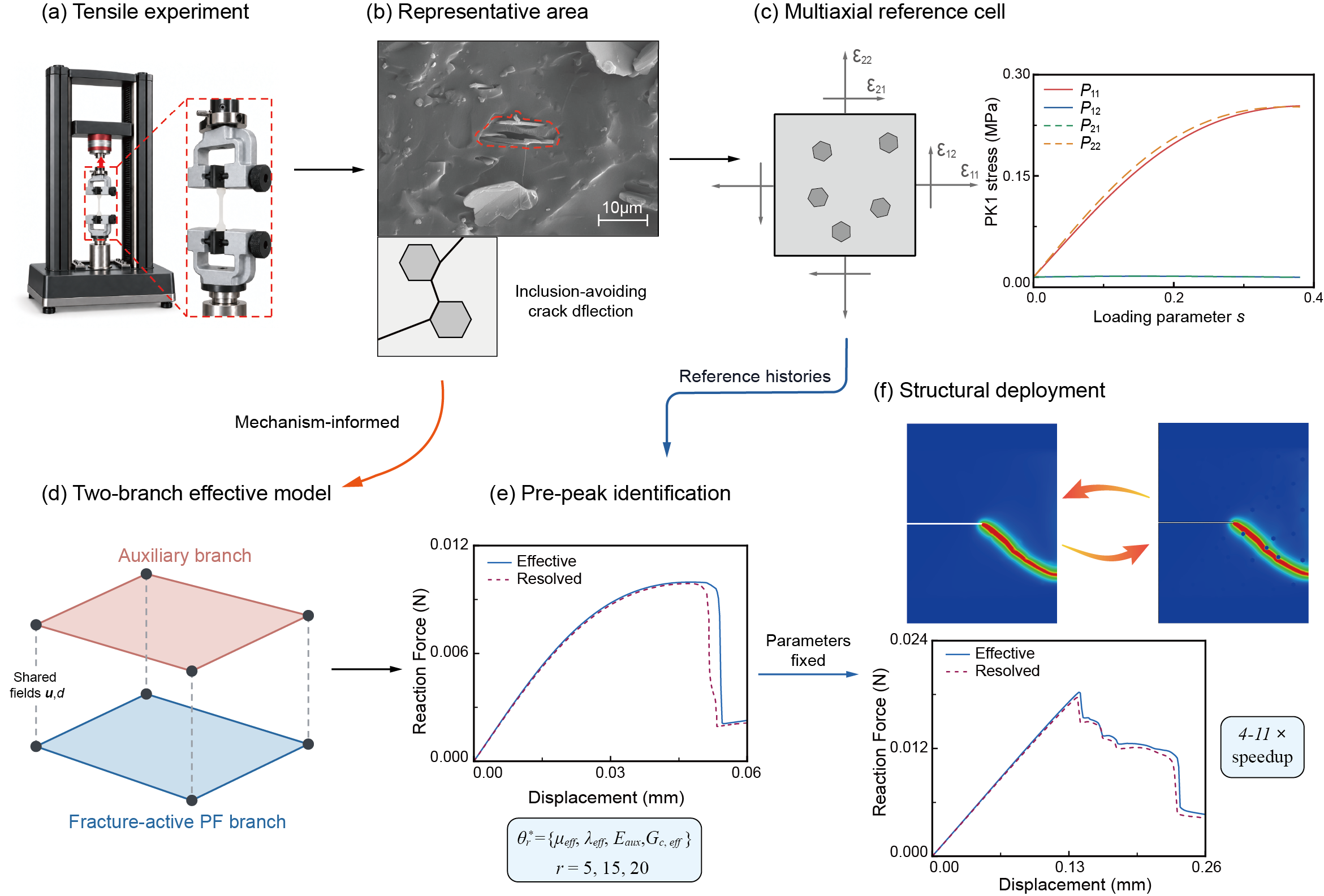
Microstructure-resolved phase-field models capture crack–reinforcement interactions in hyperelastic composites, but repeated platelet-scale fracture calculations are costly for structural analysis. This work develops a microstructure-informed effective phase-field model for hexagonal boron nitride (hBN)-reinforced silicone rubber. Fractography supports a predominantly matrix-dominated, reinforcement-deflected fracture idealization and motivates a mechanical-role-separated closure. A finite-strain phase-field branch represents the fracture-active response, while a low-order auxiliary branch represents reinforcement-mediated load transfer. Both contribute to the effective stress and share one phase-field state, but only the tensile energy of the fracture-active branch drives fracture evolution. Four closure parameters are constrained using 33 proportional multiaxial loading paths and the complete pre-peak histories of all four in-plane first Piola–Kirchhoff stress components. A coefficient-separated reconstruction accelerates the offline search, while the spatial phase-field formulation is retained for structural calculations. The identified parameters are frozen and transferred to re-entrant-corner and edge-defect problems and to a separate five-repeat-per-formulation tensile dataset. Eleven of the 12 structural comparisons have pre-peak NRMSE below 3%, with a maximum of 3.732%, and retain the dominant localization patterns. For the 11 cases with complete terminal reference responses, fracture-displacement differences remain within approximately 3%. Experimental peak-normalized pre-peak RMSE ranges from 1.20% to 2.98%. Structural calculations are typically accelerated by about 4–7×, reaching 11.04× in the fastest benchmark. The framework therefore provides a compact, fully offline route to structure-level fracture prediction without online microstructural solves.
Keywords:
phase-field fracture
; hyperelastic composites
; finite strain
; multiscale fracture
; parameter identification
; effective modeling
Copyright: This open access article is published under a Creative Commons CC BY 4.0 license, which permit the free download, distribution, and reuse, provided that the author and preprint are cited in any reuse.