

Submitted:
24 September 2026
Posted:
28 September 2026
You are already at the latest version
Abstract
Paramilitary institutions play a critical role in national security, discipline formation, and public order; however, the quality of their residential accommodations significantly influences personnel well-being, performance, and psychological stability. This study assesses paramilitary accommodation facilities in the NYSC orientation camp at Iseyin, Oyo State, with a focus on the available infrastructural components and how functional they are, spatial planning, environmental quality, privacy, safety, and overall habitability. This research sampled 150 corps members purposively and data were collected using a structured questionnaire designed to capture both quantitative and qualitative data. The collected data were analyzed using descriptive statistics such as frequencies and actual counts, supported by charts to visualize infrastructural conditions the corps members were exposed to. The findings concluded that the NYSC camp is equipped with essential infrastructural components, including dormitories, dining halls, toilets, bathrooms, water supply, and electricity, however, high occupancy levels were reported. Physical conditions of the facilities showed functional limitations and maintenance challenges. Movement within dormitories was restricted, issues of poor ventilation, lighting, and sanitation services.
Keywords:
paramilitary accommodation
; National Youth Service Corps
; corps members
; ventilation
; lighting
; infrastructure
1. Introduction
The National Youth Service Corps (NYSC), Oyo State, orientation camp, currently located in Iseyin Local Government Area, serves as the designated facility for hosting all corps members posted to the state for their three-week induction. Its geographical setting plays a significant role in shaping the accommodation realities for corps members. Iseyin, though accessible, is located at a considerable distance from major urban centers such as Ibadan, which affects both logistics and access to certain amenities. The camp itself, being in a semi-rural environment, reflects both the strengths and weaknesses of NYSC accommodation design in Nigeria.
The Iseyin orientation camp was commissioned in the early 2000s to replace the old temporary site used by the NYSC in Oyo State. Built in accordance with the NYSC national architectural template, it consists of dormitory blocks, a parade ground, administrative offices, and a number of ancillary structures. Over the years, while some buildings have received maintenance and minor upgrades, others have shown visible signs of wear due to heavy annual use and inadequate renovation funding.
The camp is designed to accommodate several hundred corps members at once, along with a smaller population of officials, security personnel, and service providers. Its infrastructure follows the standard paramilitary-style layout, with a central parade ground serving as the focal point, surrounded by dormitories, mess halls, and administrative blocks. However, certain facilities, such as the medical bay and sanitary blocks, are undersized compared to the population they serve, creating strain during peak periods.
The provision of suitable accommodation is not merely a necessity but a critical part of the NYSC experience, designed to facilitate communal living, enhance discipline, and ensure the physical and mental well-being of corps members. It is envisioned that well-maintained facilities with essential amenities contribute to a positive service year, allowing corps members to focus on their assignments and engage meaningfully with their host communities [1]. However, despite the clear mandate and the substantial resources seemingly allocated, a significant problem reported by corps members nationwide is the generally poor state of accommodation facilities within many NYSC camps and lodges. Scholarly analysis identifies inadequate facilities and poor funding as critical impediments that not only cause general discontent but also threaten the scheme's ability to achieve its goal of national integration [2].
Numerous personal reports and academic evaluations consistently highlight challenges such as dilapidated structures, insufficient sanitary facilities, inadequate water supply, unstable electricity, and poor ventilation [3]. Empirical evidence from Nigerian institutional housing studies confirms that these infrastructural gaps, specifically the lack of potable water and functional waste disposal systems significantly diminish the habitability of residential facilities [4].
These poor living conditions, particularly concerning the foundational infrastructure, not only compromise the health and comfort of corps members but can also foster resentment and distract them from their service. Furthermore, research indicates that such substandard environments characterized by overcrowding and poor sanitary infrastructure serve as primary drivers for the transmission of communicable diseases and significant psychological distress among residents [5,6].
Specifically, in Oyo State, which hosts a prominent NYSC orientation camp and receives a large number of corps members annually, the state of accommodation facilities for these young graduates is a matter of growing concern. Empirical evidence from studies within the state indicates that infrastructural deficits in corps members' residences significantly impede their motivation and overall service delivery [1]. Additionally, in a study of corps members in the Ibadan metropolis, despite the social integration successes of the scheme, local assessments in the Ibadan metropolis reveal a significant gap in infrastructural support; while corps members report high levels of hospitality from host communities, they remain deeply dissatisfied with the quality of physical infrastructure and accommodation provided [7].
So although there have been various state-level interventions and the presence of the permanent orientation camp in Iseyin, a disconnect remains between policy intent and the lived experience of corps members. Understanding the specific structural and functional challenges faced by these individuals is essential to identifying why existing interventions have failed to yield satisfactory living conditions, and what specific improvements are required to align the state's facilities with global and national standards.
Accommodation Realities and Challenges
Dormitory capacity is the first and most pressing challenge. Officially, each dormitory is designed to accommodate between 40 and 60 corps members, but during periods of high posting, these numbers often swell to 70 or more, leading to overcrowding. This reduces personal space, increases heat and humidity inside the rooms, and raises the risk of communicable diseases spreading. Ventilation systems, primarily ceiling fans and open windows, struggle to cope in the hotter months.
Sanitary facilities face similar capacity issues. Toilets and showers are often overwhelmed during peak hours, resulting in long queues that cut into scheduled training time. Corps members frequently raise concerns about water supply interruptions, especially during the dry season, which forces them to fetch water from external sources within the camp.
The dining hall is functional but limited in size. With hundreds of corps members needing to eat within tight meal schedules, the space can become congested, leading to discomfort and rushed meals. Kitchen staff have adapted by serving meals in staggered shifts, but this sometimes delays other camp activities.
Recreational facilities in the camp are minimal. While there is a parade ground and some open space for football or volleyball, there is no fully equipped gym, and indoor recreation areas are scarce. This limits the range of physical and social activities available to corps members outside mandatory drills.
Nigeria suffers from a "Build and Abandon" syndrome. Public infrastructure is often treated as a "political trophy" rather than a functional asset. Most NYSC facilities use "Reactive Maintenance" which is, fixing things only after they have completely collapsed [8]. This is more expensive and leaves the building in a state of "perpetual decay," which directly contributes to the Atmosphere of Neglect felt by the corps members [9].
The funding of NYSC camps is split between the Federal and State governments. This "Dual Responsibility" often leads to Bureaucratic Inertia, where neither party takes full ownership of repairs. Political shifts often result in the abandonment of orientation camp projects started by previous administrations, leading to the "Infrastructural Obsolescence" seen in older camps like Iseyin [2].
2. Materials and Methods
Research Design: The study adopts a descriptive survey research design which provides a structured framework for collecting, organizing, analyzing, interpreting, and presenting data about the physical condition and functionality without manipulating variables. It enables the research to capture detailed quantitative and qualitative information on corps members’ perceptions, experiences, and the infrastructural realities within the NYSC camp in Oyo State.
Area of the Study: The study was conducted in the NYSC orientation camp in Oyo State, Nigeria. This location was selected because it is a central site for the deployment of corps members in the state and provides a representative environment to assess the quality and adequacy of NYSC accommodation facilities. The camp is characterized by dormitories, dining halls, sanitation blocks, and recreational facilities, reflecting the typical layout and capacity of NYSC camps across Nigeria. Oyo State’s camp offers accessibility to corps members of varying backgrounds and provides opportunities to assess the interplay between infrastructural adequacy and the overall NYSC experience. Its selection aligns with the study’s objective to evaluate living conditions in a controlled, high-density, and regimented residential environment.
Population of Study: The population of the study comprises all corps members residing in the Oyo State NYSC camp during the 2025 orientation year. According to camp records, approximately 1,500 corps members were registered during the period under study. The population includes both male and female participants, with diverse age groups, educational qualifications, and socio-economic backgrounds, providing a comprehensive view of experiences and perceptions regarding accommodation infrastructure.
Sample Size and Sampling Technique: A sample size of 150 corps members (which includes a 10% non-response allowance) was selected for the study. This size was determined using the Taro Yamane formula with a 95% confidence level and a 5% margin of error to ensure statistical reliability. Purposive sampling was used to select respondents who had spent at least two weeks in the camp, ensuring they had adequate exposure to assess dormitory occupancy, sanitation, utility provision, and general camp conditions. This approach guaranteed the inclusion of participants with first-hand experience, enhancing the validity and relevance of the data collected.
Data Collection Instruments: Data were collected using a structured questionnaire designed to capture both quantitative and qualitative data. The questionnaire included sections on dormitory conditions (occupancy, ventilation, windows, beds, doors), sanitation and utility infrastructure (toilets, bathrooms, water, electricity), dining facilities and communal areas, corps members’ comfort, security, and overall camp experience. The questionnaire also included closed-ended questions for quantifiable analysis and Likert-scale items to measure satisfaction, comfort, and perceptions of adequacy.
Methods of Data Analysis: Data from the questionnaires were analyzed using descriptive statistics such as frequencies, percentages, Charts, tables, and graphs were used to visualize trends in dormitory occupancy, sanitation adequacy, utility provision, and overall comfort. Qualitative responses were thematically analyzed to provide insight into improvement to NYSC camp accommodation, comments and suggestions.
3. Results
3.1. Demographic Characteristics of Respondents
The demographic analysis of the 150 respondents reveals important insights about the profile of corps members in the NYSC camp in Oyo State. In terms of gender, the respondents were almost evenly split, with 78 males (52.0%) and 72 females (48.0%). This indicates a balanced representation of both genders in the study, allowing for fairly generalizable observations across male and female corps members. Regarding age, the majority of respondents (98, 65.3%) were between 20 and 25 years, reflecting the typical age range for corps members who have recently completed tertiary education. A smaller proportion were 26–30 years old (38, 25.4%), while only 6 respondents (4.0%) were below 20 years and 8 respondents (5.3%) were above 30 years. This suggests that the camp population is predominantly young adults in early career stages. Analysis of marital status shows that most respondents were single (138, 92.0%), with only a small number married (10, 6.7%) or categorized as other (2, 1.3%). This pattern aligns with the youth profile of the NYSC participants, most of whom are unmarried and focused on the one-year national service.
For educational qualifications, the majority of respondents held a B.Sc. or B.A. degree (104, 69.3%), followed by HND holders (32, 21.3%). A few respondents had postgraduate qualifications (6, 4.0%) or other educational backgrounds (8, 5.4%). This indicates that the camp population is largely comprised of graduates from universities and polytechnics, consistent with the national requirement for NYSC participation.
Figure 1.
Distribution of Respondents by Gender, Age, Marital Status, and Educational Qualification.
Figure 1.
Distribution of Respondents by Gender, Age, Marital Status, and Educational Qualification.
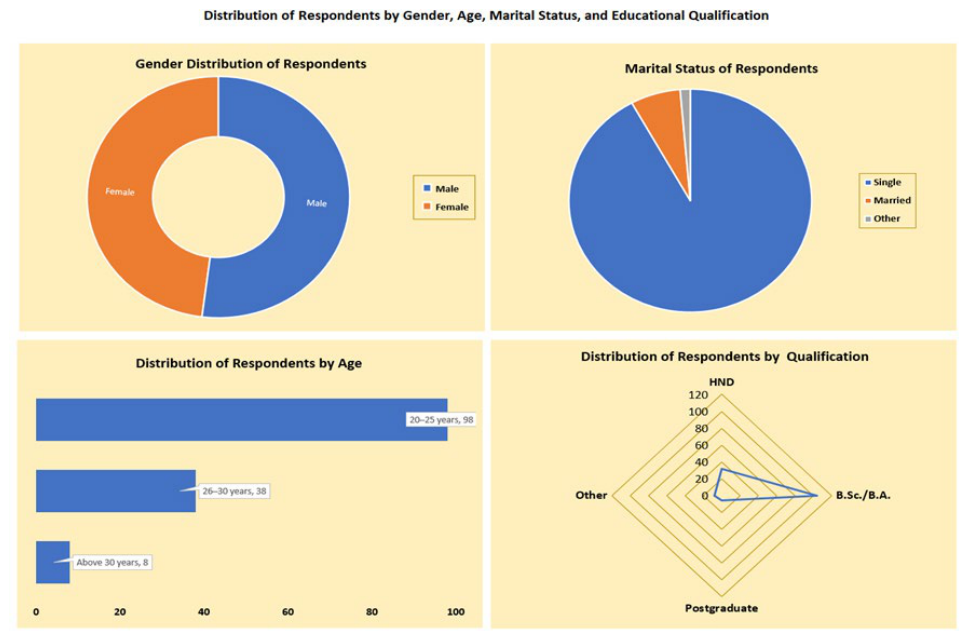
Overall, the demographic profile shows a predominantly young, single, and university-educated population, with a nearly equal representation of male and female corps members. This profile provides context for interpreting their experiences and perceptions regarding accommodation and infrastructural conditions in the camp.
3.2. What Are the Current Infrastructural Components (e.g., Buildings, Sanitation Facilities, Water Systems, Electrical Systems, Common Areas) Present in the NYSC Accommodation Facility in Oyo State?
Figure 2.
Dormitory occupancy, number of windows, number of doors, number of dining halls, number of toilet and bathroom cubicles, and availability of water and electricity in the NYSC accommodation facility.
Figure 2.
Dormitory occupancy, number of windows, number of doors, number of dining halls, number of toilet and bathroom cubicles, and availability of water and electricity in the NYSC accommodation facility.
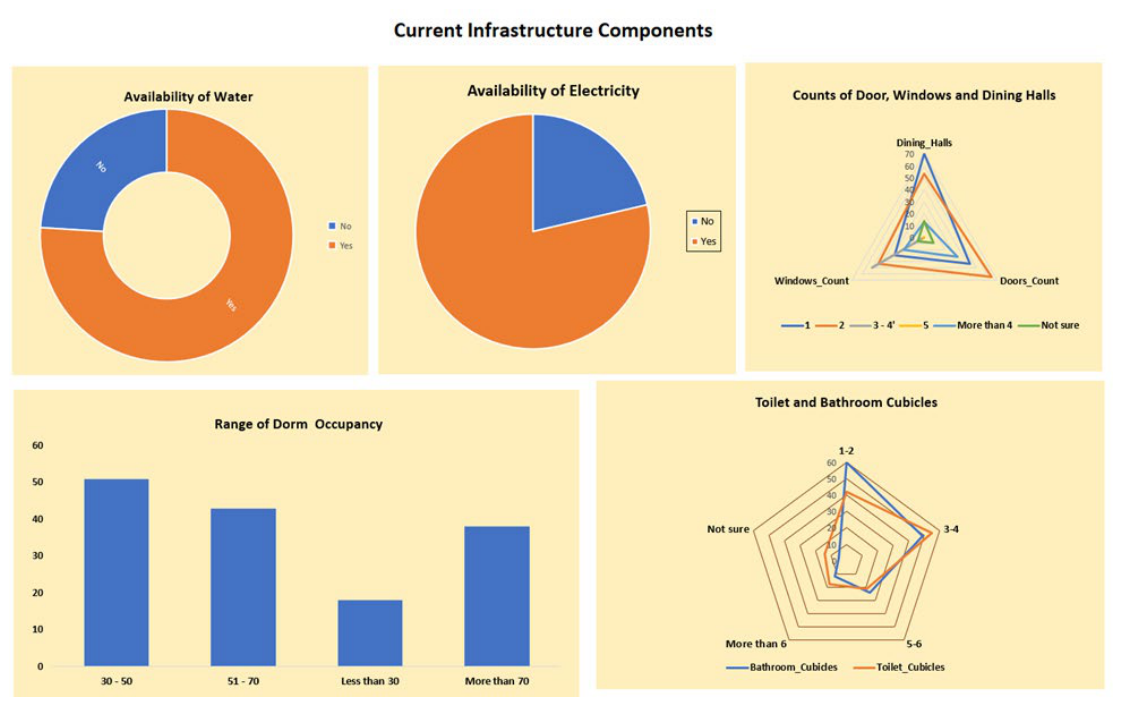
The findings reveal that the NYSC accommodation facility in Oyo State is equipped with several fundamental infrastructural components, although their distribution and adequacy vary across the camp. Analysis of dormitory occupancy shows that 51 corps members share dormitories with 30–50 occupants, 43 shares with 51–70 occupants, 38 reported more than 70 occupants per dormitory, and only 18 reported fewer than 30 occupants. This suggests that dormitories are generally high-density halls, consistent with paramilitary accommodation principles requiring large sleeping quarters for efficiency and supervision. However, the number of occupants per dormitory may exceed ArchiData’s recommended minimum floor space of 4.65 m² per person, which could negatively affect comfort, health, and morale [10].
With respect to building design, dormitories have between one and more than four windows, with 50 dormitories having 3–4 windows, 45 having 2, 29 having 1, and 20 having more than 4 windows. Window provision supports ventilation and natural lighting, but dormitories with only one window may have inadequate airflow, potentially leading to heat build-up and discomfort. Door provision appears fairly adequate, with 65 dormitories having 2 doors, 32 having 3 or more, 44 having 1 door, and 9 uncertain. Dormitories with a single door may restrict movement and emergency egress, highlighting partial compliance with ArchiData standards for circulation [11].
Common facilities such as dining halls are limited, with 70 respondents reporting only one dining hall, 53 reporting two, 13 reporting more than two, and 14 unsure. ArchiData recommends 1.2 m² per occupant for seating and circulation, suggesting that current dining facilities may be insufficient for the camp population, potentially causing congestion and affecting comfort, nutrition, and morale [12]. Sanitation infrastructure is present but unevenly distributed. Toilet provision shows that 55 dormitory blocks have 3–4 cubicles, 42 have 1–2, 21 have 5–6, 18 have more than 6, and 14 were unsure. Bathroom facilities follow a similar trend, with 60 dormitories having 1–2 cubicles, 49 having 3–4, 24 having 5–6, 12 having more than 6, and 5 unsure. ArchiData recommends 1 toilet or shower per 10–12 occupants, indicating that many dormitories fall below recommended standards. This may lead to long queues, rushed bathing, and potential hygiene and health risks such as diarrhoea and skin infections [13] [14]. Utility services such as water and electricity are largely available but not universal. A total of 114 respondents confirmed water supply, while 36 reported no access; 118 confirmed electricity provision, while 32 reported none. Reliable access to utilities is critical for welfare, hygiene, and operational functionality in a paramilitary setting [15].
Hence, the NYSC camp in Oyo State possesses essential infrastructural components including dormitory buildings, dining halls, sanitation facilities, water supply, and electricity. When assessed against paramilitary accommodation standards, these components partially meet the objectives of functionality, welfare, and security. High dormitory occupancy, uneven window and door distribution, limited dining facilities, and partial utility provision suggest that the infrastructure is under strain. Enhancing spatial allocation, improving ventilation and lighting, increasing sanitation capacity, and ensuring universal access to utilities would better align the facility with ArchiData standards and paramilitary best practices, ultimately promoting the health, morale, and operational efficiency of corps members.
3.3. What Is the Current Physical Condition (Like State of Repair, Functionality, Adequacy) of These Infrastructural Components Within the Facility?
Figure 3.
Ease of movement, condition of beds and mattresses, functionality of windows, ventilation and lighting quality, cleanliness of toilets and bathrooms, availability of running water, and observed building defects.
Figure 3.
Ease of movement, condition of beds and mattresses, functionality of windows, ventilation and lighting quality, cleanliness of toilets and bathrooms, availability of running water, and observed building defects.
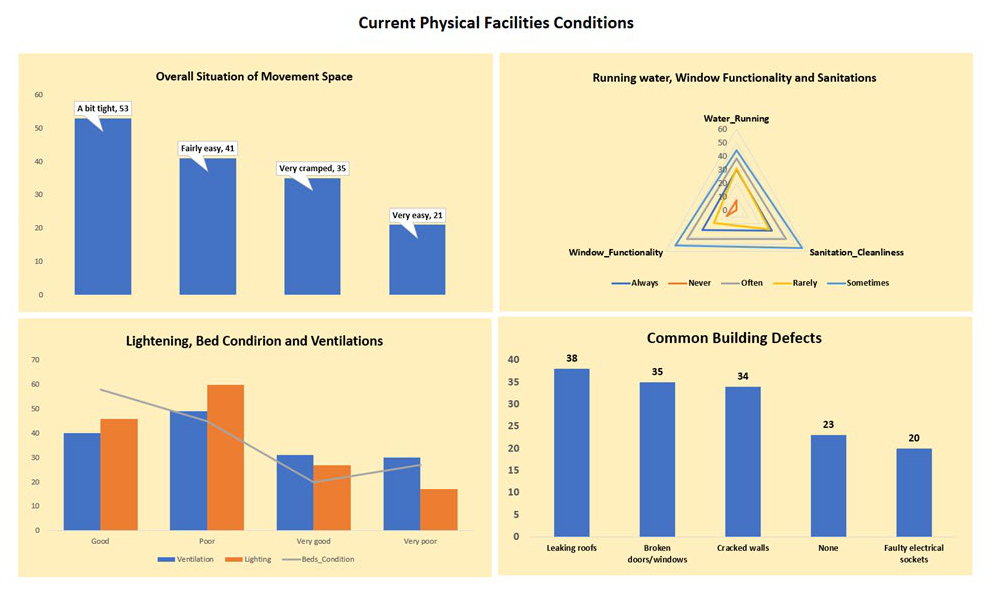
The findings indicate that the physical condition of the NYSC accommodation facility in Oyo State presents notable challenges in terms of functionality, adequacy, and maintenance. Ease of movement within dormitories shows that 53 respondents described the space as “a bit tight,” 41 as “fairly easy,” 35 as “very cramped,” and 21 as “very easy.” These responses suggest that the dormitory layout may restrict comfortable circulation, especially in rooms with high occupancy, consistent with ArchiData guidelines that recommend sufficient space for free movement to prevent stress and accidents (U.S. Army Environmental Health Inspections, 2016). Beds and mattresses also show variable conditions. Fifty-eight respondents rated their beds as “fairly good,” 45 as “poor,” 20 as “very good,” and 27 as “very poor.” This indicates that nearly half of the respondents experience substandard sleeping arrangements, which can negatively affect sleep quality, physical health, and overall morale [15].
Window functionality varies across dormitories. Fifty-two respondents reported that windows function “sometimes,” 42 indicated “often,” 29 “always,” 19 “rarely,” and 8 “never.” Properly functioning windows are critical for ventilation, lighting, and comfort. Inadequate window functionality reduces air circulation and natural light, which can increase heat buildup and discomfort, aligning with empirical studies emphasizing that ventilation is essential in high-density residential facilities. Ventilation and lighting were also assessed. Forty respondents reported “good” ventilation, 49 “poor,” 31 “very good,” and 30 “very poor.” For lighting, 46 reported “good,” 60 “poor,” 27 “very good,” and 17 “very poor.” These findings highlight uneven distribution of environmental quality within dormitories, where poor ventilation and lighting may compromise comfort, reduce concentration, and increase susceptibility to illness [8].
Sanitation and cleanliness are similarly inconsistent. Fifty-six respondents rated bathroom cleanliness as “sometimes” clean, 42 as “often,” 28 as “rarely,” and 24 as “always.” Poor hygiene in shared facilities can facilitate the spread of communicable diseases such as diarrhoea, cholera, and skin infections, supporting a study’s assertion [13] that sanitation is critical to health and morale in paramilitary settings. Availability of running water is uneven, with 44 respondents indicating “sometimes,” 38 “often,” 31 “rarely,” 30 “always,” and 7 “never.” Reliable water supply is vital for personal hygiene, sanitation, and food preparation. Inconsistent water provision limits usability of dormitories and bathrooms and negatively affects the welfare of corps members [14]. Observed building defects include leaking roofs (38 respondents), broken doors/windows (35), cracked walls (34), faulty electrical sockets (20), and no defects in 23 cases. These structural issues underscore gaps in maintenance and raise safety concerns, consistent with empirical observations that regular inspection and repair of paramilitary infrastructure is essential to prevent accidents and maintain operational efficiency.
Overall, the findings indicate that while the NYSC camp possesses essential infrastructure, overcrowding, inconsistent functionality of facilities, inadequate sanitation, and structural defects compromise the adequacy, usability, and comfort of the living environment. These observations align with empirical literature on paramilitary accommodation, which emphasizes the importance of spatial adequacy, functional facilities, hygiene, and structural integrity in ensuring the health, morale, and operational effectiveness of residents [15]. Addressing these deficiencies is crucial to improve corps members’ welfare and optimize camp functionality.
4. Conclusions
This study examined the infrastructural conditions of the NYSC accommodation facility in Oyo State and the primary objective was to assess the types, adequacy, functionality of available infrastructure. The findings indicate that the NYSC camp is equipped with essential infrastructural components, including dormitories, dining halls, toilets, bathrooms, water supply, and electricity. However, high occupancy levels were reported. Physical conditions of the facilities showed functional limitations and maintenance challenges.
Based on the findings from this study, it is recommended that the management should address the issue of overcrowding by reviewing dormitory occupancy levels and, where feasible, expanding sleeping facilities or redistributing residents across available halls. This would reduce pressure on space, improve ease of movement, and enhance comfort. Also, sanitation facilities should be upgraded and evenly distributed to meet the needs of the resident population. Additional toilets and bathroom cubicles should be provided in proportion to the number of occupants, and maintenance schedules should be implemented to ensure that these facilities remain clean, functional, and safe for use. Regular monitoring of water supply and electricity provision is also recommended to ensure uninterrupted access to essential utilities, as these directly influence both comfort and health outcomes for corps members.
Another recommendation is that improvements to dormitory design should be considered, including increasing the number of windows and ensuring proper ventilation and lighting. Doors should be adequate to allow safe circulation and emergency egress, particularly in highly populated halls. Addressing structural defects such as leaking roofs, cracked walls, and broken fixtures is also crucial for creating a safe and functional living environment. The common facilities such as dining halls and recreational areas should be enhanced to accommodate the resident population effectively. Expanding dining hall capacity and improving the organization of meal schedules would reduce waiting times, promote orderly meal consumption, and enhance social interaction among corps members. Recreational spaces and common rooms should be provided or upgraded to support relaxation, stress relief, and social engagement, which are essential for mental well-being.
Finally, security measures should be strengthened throughout the facility to ensure a safe living environment. Consistent patrols, adequate lighting, and controlled access to sensitive areas would foster a greater sense of safety and reduce anxiety among residents. Overall, a comprehensive approach that addresses overcrowding, utility provision, sanitation, structural integrity, and security will significantly enhance the quality of accommodation, promote the physical and psychological well-being of corps members, and ensure that the NYSC facility meets the standards of acceptable living conditions as observed in other paramilitary accommodations.
Abbreviations
The following abbreviations are used in this manuscript:
| NYSC | National Youth Service Corps |
References
- Akinola, A. O. Factors and challenges affecting work performance of National Youth Corps members in Ibadan, South-West Nigeria. The Nigerian Journal of Sociology and Anthropology 2025, 13(2), 114–128. [Google Scholar]
- Aremu, F. A. National Youth Service Corps programme and the quest for national integration: Issues for policy consideration. Journal of Management and Social Sciences 2018, 7(1), 279–296. [Google Scholar]
- Ajayi, A. S. A Comprehensive Review of Artificial Intelligence Applications in the Construction Industry: Current Trends, Potential Impacts, and Future Directions. Journal Of Economics Intelligence And Technology 2025, 1(1), 14–24. [Google Scholar]
- Abiodun, O.; Olotuah, A. O.; Ezennaya, O. S. Assessment of housing quality and residents' satisfaction in institutional housing in Nigeria. International Journal of Built Environment and Sustainability 2022, 9(1), 45–56. [Google Scholar]
- Oluwadare, C. T.; Ojo, B. Housing conditions and health status of residents in institutionalized settings: A study of environmental health risks. Journal of Environmental Health and Sustainable Development 2022, 7(2), 1625–1638. [Google Scholar]
- Ajayi Adeola, S.; Morakinyo Abiodun, A.; Akeredolu Eunice, A.; Alabi Oluwaseyi, A. A Review of the Natural and Cultural Effects of Landscape on Rural and Urban Settlements in Nigeria. Journal of Behavioural Informatics, Digital Humanities and Development Rese 2025, 11, 71–88. [Google Scholar] [CrossRef]
- Udoh, A. Perceptions of corps members on the effectiveness of the National Youth Service Corps (NYSC) scheme in Ibadan Metropolis, Oyo State, Nigeria. Journal of Behavioural Studies 2021, 11(1), 45–58. [Google Scholar]
- Ajayi, S.; Oluwoye, J.; Olutoge, F. A.; Coker, A. O. Impact of Palm Kernel Shell Ash (PKSA) on the Strength and Water Absorption Properties of Earth Blocks. International Journal of Advances in Scientific Research and Reviews 2019, 4(3), 129–135. [Google Scholar]
- Jimoh, A. O.; Popoola, O. Impact of housing quality on the health status of residents in institutional schemes: A case study of Oyo State. Wukari International Studies Journal 2024, 10(1), 156–170. [Google Scholar]
- Ajayi, Adeola; Oluwoye, Jacob. The Impact of Mix Holdback Time on Wet Compressive Strength of Compressed Stabilized Earth Blocks. International Journal of Scientific Engineering and Science 2023, 7(9), 13–15. [Google Scholar]
- Ajayi, Adeola; Coker, Akinwale; Oluwoye, Jacob. Comparative Analysis of Dry and Wet Compressive Strength Ratios in Cement-Palm Kernel Shell Ash Stabilized Earth Blocks. International Research Journal of Modernization in Engineering Technology and Science 2023, 5(12), 2679–2684. [Google Scholar]
- Ajayi, A. S. Construction Industry: Current Trends, Potential Impacts, and Future a Comprehensive Review of Artificial Intelligence Applications in the Directions. International Journal of Architecture, Arts and Applications 2025, 11(2), 48–57. [Google Scholar] [CrossRef]
- Abubakar, I. R. Household response to inadequate water supply in Nigerian cities: A case of Jos. Water Production Journal 2017, 12(1), 42–54. [Google Scholar]
- Nwokoro, I. Health implications of housing and urban environmental quality in Lagos, Nigeria. International Journal of Urban Sustainable Development 2020, 12(1), 54–69. [Google Scholar]
- Maiyaki, I.; Mohd-Sani, N.; Muhammad, M. S. Relationship between housing condition, soldiers’ social life and morale in Coral Barracks, Nigeria. Journal of Technology Management and Business 2021, 8(2), 66–78. [Google Scholar] [CrossRef]
Disclaimer/Publisher’s Note: The statements, opinions and data contained in all publications are solely those of the individual author(s) and contributor(s) and not of MDPI and/or the editor(s). MDPI and/or the editor(s) disclaim responsibility for any injury to people or property resulting from any ideas, methods, instructions or products referred to in the content. |
© 2026 by the authors. Licensee MDPI, Basel, Switzerland. This article is an open access article distributed under the terms and conditions of the Creative Commons Attribution (CC BY) license (http://creativecommons.org/licenses/by/4.0/).
Copyright: This open access article is published under a Creative Commons CC BY 4.0 license, which permit the free download, distribution, and reuse, provided that the author and preprint are cited in any reuse.