
Submitted:
25 September 2026
Posted:
28 September 2026
You are already at the latest version
Abstract
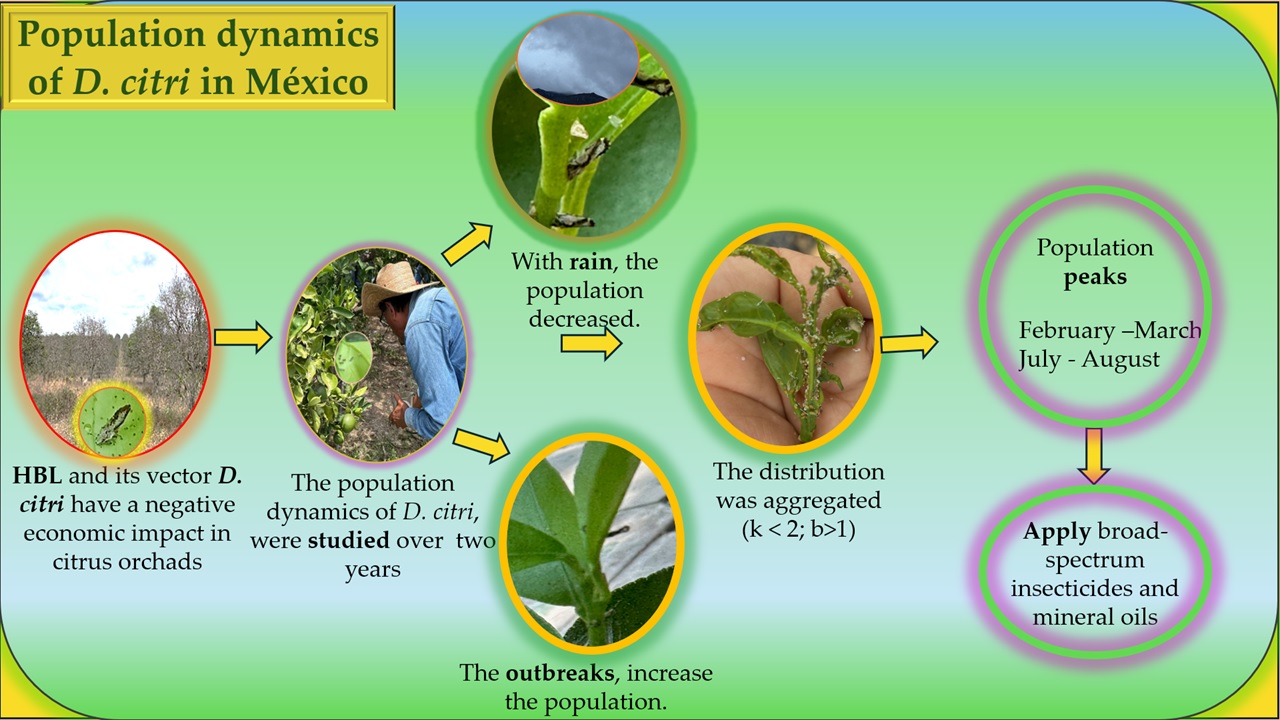
Citrus fruits are considered the most consumed fruits in the world; however, their production is becoming less efficient and their cost has increased, mainly due to the rapid spread of Huanglongbing (HLB), a disease whose vector is an insect called Diaphorina citri. Controlling this vector is essential to controlling the disease, which is complicated by the lack of knowledge about the population dynamics of D. citri. Mexico is the fourth largest citrus producer internationally. Therefore, the objective of this study was to evaluate the popula-tion dynamics and aggregation indices of D. citri in “Valencia Late” orange crops in three locations in northern Veracruz State, Mexico. To achieve this, minimum and maximum temperatures, precipitation, and relative humidity were recorded. Linear regression mod-els were developed between these environmental parameters and the number of adult psyllids and nymphs. The results showed a positive association between the development of new outbreaks and the presence of population peaks of nymphs and adults in Febru-ary-March and July-August. Therefore, it is suggested that broad-spectrum insecticides and mineral oils be applied during this period. Rainfall reduced the presence of nymphs at the three locations. The calculated aggregation indices showed that the distribution of nymphs was aggregated, and that of adults tended to be so, but during periods of low density, their distribution was random.
Keywords:
Asian citrus psyllid
; vector
; environmental parameters
; citrus
; HLB
; climatic factors
Copyright: This open access article is published under a Creative Commons CC BY 4.0 license, which permit the free download, distribution, and reuse, provided that the author and preprint are cited in any reuse.