

Submitted:
25 September 2026
Posted:
28 September 2026
You are already at the latest version
Abstract
Multi-hazard early warning systems are increasingly central to disaster risk reduction and climate adaptation, yet their effectiveness depends on more than forecast accuracy. Artificial intelligence is expanding capabilities in risk mapping, environmental monitoring, forecasting, impact estimation, communication, and decision support. The emerging literature, however, already demonstrates that artificial intelligence can contribute across the established early-warning pillars; repeating that proposition offers limited conceptual novelty. This review therefore shifts attention from individual components to the quality of the information transformations that connect them. Drawing on a focused integrative review of recent peer-reviewed scholarship and authoritative international guidance, the paper introduces handoff integrity as a conceptual construct for artificial-intelligence-enabled multi-hazard early warning systems. Handoff integrity denotes the extent to which risk information remains or becomes contextually meaningful, timely, uncertainty-aware, interpretable, actionable, accountable, and accessible as it crosses functional and institutional boundaries. The framework identifies five critical handoffs: risk contextualization, forecast-to-impact translation, impact-to-warning translation, warning-to-action orchestration, and response-to-learning feedback. Six dimensions - semantic fidelity, contextual relevance, timeliness, uncertainty traceability, actionability, and accountability and inclusiveness - provide a basis for evaluating these interfaces. The framework positions artificial intelligence as an integration layer rather than an autonomous substitute for scientific institutions, emergency authorities, local knowledge, or human judgment. It further identifies data interoperability, governance, equity, trust, cybersecurity, institutional capacity, and lifecycle sustainability as conditions for durable performance. The paper contributes a technology-neutral, testable framework that extends evaluation beyond algorithmic accuracy toward the integrity of the pathway from risk knowledge to protective action.
Keywords:
artificial intelligence
; multi-hazard early warning systems
; disaster risk reduction
; impact-based forecasting
; risk communication
; early action
; AI governance
; sustainability
1. Introduction
Interactions among climatic extremes, environmental change, infrastructure interdependence, urbanization, and unequal exposure and vulnerability increasingly shape disaster risk. The Intergovernmental Panel on Climate Change concludes that climate-related risks intensify with additional warming and that effective adaptation requires attention to interactions between climatic and societal conditions [1]. Regional studies also illustrate how anthropogenic pressures and temperature variability can compound risk in the U.S. Gulf and southeastern United States [2,3]. These conditions make timely, credible, and actionable risk information a core element of climate resilience and sustainable development.
The Sendai Framework for Disaster Risk Reduction 2015-2030 explicitly calls for increased availability of and access to multi-hazard early warning systems under Target G [4]. Progress is measurable but incomplete. The 2025 global assessment reported that 119 countries, or 60% of all countries, reported having a multi-hazard early warning system, while substantial capacity and coverage gaps persisted, including among Small Island Developing States [5]. The challenge is therefore not simply to build more warning technologies, but to strengthen the end-to-end systems through which risk is understood, monitored, communicated, and acted upon.
World Meteorological Organization guidance organizes effective multi-hazard early warning systems around four interconnected components: disaster risk knowledge; detection, observation, monitoring, analysis, forecasting; warning dissemination and communication; and preparedness and response [6]. In this paper, MHEWS refers to integrated systems that address multiple hazards by connecting risk knowledge, monitoring and forecasting, warning communication, and preparedness and response to enable timely action. Although these components are often presented separately for administrative clarity, early warning functions as a chain of dependent transformations. Garcia and Fearnley demonstrated more than a decade ago that failures often arise not from a single component but from the processes linking components [7]. Alcantara-Ayala and Oliver-Smith similarly argued that early warning can become disconnected from the social production of risk and the contexts in which warnings are interpreted and acted upon [8]. This literature provides an important conceptual lineage for examining connections rather than treating early-warning pillars as self-contained modules.
Artificial intelligence (AI) is now changing the technical possibilities at multiple points in this chain. Recent machine-learning weather models have demonstrated strong medium-range forecasting capability, rapid inference, and, increasingly, probabilistic prediction [9,10]. AI is also being applied to flood prediction, remote sensing, risk mapping, impact assessment, language processing, and emergency decision support [11,12]. These advances are consequential because they can increase the volume, speed, spatial detail, and frequency of information available to warning institutions. Yet more capable models do not guarantee that risk information will remain meaningful or actionable after it passes through subsequent organizational and communicative steps.
Recent scholarship already addresses integrated AI for climate-risk early warning. Reichstein et al. propose integrated AI approaches linking Earth-system information, impact prediction, user interfaces, community feedback, and responsible AI [13]. Tiggeloven et al. systematically review AI across the early-warning chain and identify opportunities, limitations, and guardrails across the four Early Warnings for All pillars [14]. Lu et al. propose a GeoAI-driven, decision-oriented Multi-Hazard Early Warning System (MHEWS) methodology that combines geospatial information, knowledge representation, large language models, and stakeholder-specific decision support [15]. At the policy level, the 2026 Early Warnings for All report explicitly assesses AI applications across all four MHEWS pillars and identifies conditions for responsible implementation [16]. Consequently, the broad proposition that AI can be integrated across MHEWS is no longer a sufficient novelty claim.
The unresolved problem examined here is more specific: what happens to risk information as it changes form and crosses boundaries between scientific models, risk analysts, warning authorities, communication systems, emergency managers, and communities? A forecast may be accurate yet lose uncertainty information when converted into an impact statement. An impact statement may be valid yet fail when translated into a public warning that omits location, timing, accessibility, or feasible action. A technically delivered warning may still fail to activate institutional protocols or household protection. Conversely, response outcomes may never be incorporated into future risk models or communication procedures. These are not simply component failures; they are failures of transfer and transformation.
This paper introduces the concept of handoff integrity to analyze those transitions. Handoff integrity is defined as the extent to which risk information remains or becomes contextually meaningful, timely, uncertainty-aware, interpretable, actionable, accountable, and accessible as it is transformed and transferred across functional and institutional boundaries within a multi-hazard early warning system. The concept deliberately extends the earlier literature on critical links in warning systems into the contemporary context of AI-mediated data fusion, probabilistic prediction, automated impact estimation, generative communication, decision support, and adaptive learning. The novelty therefore lies not in claiming that links, integration, or end-to-end warning are new, but in specifying an interface-quality construct and dimensions that can be operationalized and tested.
The review has four objectives. First, it synthesizes how AI is changing risk knowledge, forecasting, impact translation, communication, preparedness, and learning. Second, it distinguishes technological capability within individual components from the integrity of information handoffs across the complete warning chain. Third, it proposes five critical AI-enabled handoffs and six dimensions of handoff integrity. Fourth, it develops propositions and evaluation priorities that connect technical performance with institutional coordination, public understanding, equity, governance, and long-term sustainability. The resulting framework is intended to be hazard-agnostic and technology-neutral, allowing future empirical work to test whether interface quality helps explain why technically capable warning systems produce different societal outcomes.
2. Review Approach, Source Verification, and Analytical Method
2.1. Review Design and Scope
This article uses a focused integrative review and conceptual synthesis. It is not presented as a systematic review, scoping review, or meta-analysis, and it does not claim exhaustive retrieval of every AI or early-warning publication. Source identification was iterative and concept-led rather than protocol-driven; accordingly, the review does not report PRISMA-style database counts or infer literature prevalence from the cited evidence. The purpose is theory development: to synthesize established early-warning concepts with rapidly evolving AI research to identify a specific analytical gap and construct a testable framework. Recent literature was prioritized because both AI capability and international early-warning policy are changing quickly. Foundational earlier studies were retained where they establish concepts that remain necessary for the argument, particularly critical links, people-centered warning, impact forecasting, and forecast-based early action.
The evidence base combines peer-reviewed research with authoritative institutional guidance from organizations responsible for disaster-risk reduction, meteorology, telecommunications, public warning, and AI risk management. International guidance on risk knowledge emphasizes using targeted hazard, exposure, and vulnerability information throughout forecasting, communication, and anticipatory action [17]. People-centered and inclusive guidance was included because warning effectiveness depends on accessibility and exposed populations' ability to respond [18,19]. Recent after-event guidance was also considered because it evaluates performance across monitoring, forecasting, dissemination, coordination, and response, thereby providing a useful operational complement to the conceptual framework developed here [20].
2.2. Source Verification and Evidence Appraisal
The bibliographic records were verified against publisher pages, DOI records, or official institutional publication pages. Major factual claims were retained only where the cited source directly supported the argument. Quantitative claims were minimized unless they were clearly stated in an authoritative source. For example, the global MHEWS coverage figure is drawn directly from the 2025 WMO/UNDRR assessment, while claims about the capabilities of specific AI forecasting systems are tied to their primary peer-reviewed publications. Sources that could support only broader contextual claims were not used to substantiate more specific AI or MHEWS mechanisms.
2.3. Analytical Coding Logic
Sources were interpreted according to three analytical questions: (1) what information or decision function does technology or institution perform; (2) where does that function sit within the end-to-end warning process; and (3) what transformation must occur before the resulting information can support a subsequent actor or protective action? This third question is central. It shifts attention away from a catalog of AI methods and toward the interfaces where meaning, uncertainty, responsibility, accessibility, or timeliness can be preserved, added, degraded, or lost.
3. Multi-Hazard Early Warning as a Socio-Technical Information-to-Action System
MHEWS should be understood as socio-technical systems rather than as forecasting platforms. Their scientific components generate hazard and risk information. Still, warnings only become protective when institutions interpret that information, decide when to communicate, reach diverse audiences, and connect messages to feasible action. Rokhideh et al. show that significant gaps remain in MHEWS implementation under the Sendai Framework despite policy progress [21]. From a people-centered perspective, Budimir et al. emphasize that implementation in the Global South is shaped by local knowledge, institutional capacity, inclusion, and the realities of populations exposed to multiple hazards [22]. Marchezini likewise shows why social participation and warning implementation practices must be treated as central rather than peripheral to EWS design [23].
Operational evidence reinforces this systems view. Damoah's 2026 scoping review of climate-relevant warning systems in the U.S. Gulf Coast identifies a recurring separation between hazard monitoring on one hand and socio-ecological vulnerability, ecosystem conditions, dissemination design, and preparedness on the other [24]. The importance of this evidence is not that it proves a universal pattern, but that it illustrates how substantial monitoring capability can coexist with weaker integration of the information required for people-centered action. The problem is therefore not reducible to data scarcity or model accuracy.
This insight connects directly to Garcia and Fearnley's earlier concept of critical links. Their review emphasized that breakdowns in the links between components can undermine otherwise capable systems. The present paper retains that premise but asks how it changes when AI itself performs some of the transformations between components: combining heterogeneous datasets, translating forecasts into impacts, generating or tailoring messages, ranking response options, and learning from post-event data. AI can accelerate these transfers, but acceleration may magnify errors if provenance, uncertainty, and institutional control are weak. Thus, AI raises the stakes of interface quality rather than eliminating the need to examine it [7].
The warning chain can therefore be represented as a sequence of information transformations: risk knowledge → anticipation → impact interpretation → warning communication → decision → protective action → learning. Each step depends on the quality of the preceding input, but each also changes the form of the information. Hazard probabilities become impact estimates; impact estimates become messages; messages become decisions; decisions become actions; outcomes become lessons. Handoff integrity provides a language for evaluating whether those transformations preserve what the next user needs.
4. Artificial Intelligence Capabilities Across the Warning Chain
4.1. Risk Knowledge and Contextualization
Risk knowledge establishes what can be affected, where, by what processes, and under which vulnerability and capacity conditions. Contemporary AI can support this task through computer vision, remote sensing, geospatial machine learning, anomaly detection, data fusion, and information extraction from unstructured records. Jones et al. illustrate how AI can be used in climate-impact applications, including flood-risk analysis that combines hazard, exposure, and impact information [12]. The UNDRR risk-knowledge handbook similarly emphasizes that contextual hazard, exposure, and vulnerability information should inform forecasting, communication channels, warning triggers, and anticipatory action rather than remain confined to a preliminary assessment [17].
As an emerging example, Asghar and Damoah's 2026 coastal-resilience preprint synthesizes AI, remote sensing, and geospatial applications for shoreline change, flood susceptibility, ecosystem monitoring, land-cover change, and adaptation planning [25]. Because the work is a preprint, it should not carry the evidentiary weight of peer-reviewed sources; nevertheless, it illustrates the breadth of data-intensive risk-knowledge functions that can feed early-warning systems. Its emphasis on local validation, uncertainty communication, and participatory planning is consistent with the broader argument that risk intelligence must remain interpretable and contextually grounded.
AI also creates a representation problem. Variables that are readily machine-readable can dominate variables that are socially important but poorly measured. Official datasets may weakly capture informal tenure, disability-related barriers, social isolation, local trust, household resources, and community coping capacity. Inclusive-warning guidance therefore calls for disaggregated information, accessible design, and direct participation of groups whose risks are often underrepresented [18,19]. Damoah's Gulf Coast review similarly suggests that social vulnerability and ecosystem information remain unevenly operationalized in existing warning practices [24]. Higher-resolution data should therefore not be equated automatically with higher-quality risk knowledge.
4.2. Detection, Monitoring, Analysis, and Forecasting
Forecasting is currently the most visible area of AI innovation in weather and climate services. GraphCast demonstrated highly skillful global medium-range forecasting with machine learning [9], while Pangu-Weather showed accurate medium-range global forecasting using three-dimensional neural networks [26]. NeuralGCM illustrates a hybrid direction that combines machine learning with dynamical modeling [27], and GenCast extends AI weather prediction into probabilistic ensemble forecasting [10]. These developments matter because warning institutions depend on timely estimates of hazardous conditions, and rapid inference can increase update frequency or computational accessibility.
AI is also expanding hazard prediction beyond global weather fields. Nearing et al. demonstrate AI-based flood prediction across ungauged watersheds, addressing a persistent hydrological challenge in data-sparse settings [11]. Camps-Valls et al. review AI approaches for modeling and understanding extreme weather and climate events and emphasize the importance of transparent, reliable models, real-time information, and stakeholder trust [28]. These studies support the conclusion that AI can add substantial predictive and analytical capability. Still, they do not imply that data-driven models are universally superior or robust outside the conditions under which they were trained.
This limitation matters in climate-risk settings. Rare extremes, changing baselines, nonstationary exposure, and shifts in observation systems can create conditions that differ from those represented in historical training data. Model performance therefore requires ongoing verification, calibration, and comparison with physical understanding and operational expertise [28]. In a safety-critical context, a point forecast with impressive benchmark skill is insufficient if the system cannot communicate uncertainty, detect model degradation, or provide fallback procedures when data or computational infrastructure fail.
The central analytical distinction is that forecast skill is not equivalent to warning effectiveness. Technical metrics such as error, discrimination, calibration, and lead time are necessary for model evaluation. Still, they do not measure whether a forecast was converted into an impact estimate, whether a warning was understood, or whether a protective action occurred. The next stage - forecast-to-impact translation - therefore deserves explicit treatment rather than being assumed to follow automatically from improved prediction.
4.3. Forecast-to-Impact Translation
Impact forecasting addresses the gap between what the hazard will be and what the hazard may do. Merz et al. review impact forecasting across natural hazards and show why emergency management benefits from rapid estimates of consequences rather than hazard magnitude alone [29]. Potter et al. similarly document both the benefits and implementation challenges of impact-based severe-weather warnings, including organizational coordination and the need to maintain trust [30]. In flood warning, Najafi et al. demonstrate high-resolution impact-based forecasting that links inundation information to affected assets and associated uncertainties [31].
AI can support this transformation by combining forecast ensembles with dynamic exposure, infrastructure condition, mobility, demographic vulnerability, and historical impact data [12,13,31]. In principle, the output can shift from a statement such as a probability of threshold-exceeding rainfall to an estimate of which roads, neighborhoods, hospitals, power systems, or livelihoods may be disrupted. This transformation is where contextual risk knowledge becomes operationally valuable. It also creates a major opportunity for error propagation: uncertainty in the hazard forecast, exposure data, vulnerability model, and impact function must be combined rather than silently collapsed.
Accordingly, this paper treats forecast-to-impact translation as a distinct handoff rather than a simple model post-processing step. The quality of this handoff depends on semantic fidelity to the underlying forecast, contextual relevance to the affected population and infrastructure, timeliness within the decision window, and explicit representation of uncertainty. AI can improve the speed and granularity of impact estimation, but it can also create false precision if model outputs are presented without the uncertainty and assumptions that generated them.
4.4. Warning Dissemination and Communication
Warnings are successful only if relevant actors receive information in a form they can understand and use. Pescaroli et al. emphasize persistent gaps between technical, social, and organizational dimensions of early warning and the need for evidence on public response [32]. Bean et al. show that even mature mobile public-warning systems in Japan and the United States face problems of misuse, nonuse, misunderstanding, standardization, and local adaptation [33]. Raphela and Ekeke, working in a South African township context, show how limited infrastructure and communication access can constrain conventional dissemination channels [34].
Natural-language processing and generative AI could assist with multilingual translation, text simplification, message summarization, accessible formatting, audience-specific instructions, and rapid generation of updates [16,35]. Those capabilities are potentially valuable when warning authorities must communicate across multiple languages, locations, and user groups under severe time pressure. Yet generative flexibility is precisely why communication requires safeguards. Generative systems can produce confabulated or otherwise unreliable content. In a warning context, an altered numerical value, omitted condition, unsupported specificity, or distorted probabilistic statement could change meaning and action [35]. In a safety-critical warning, such changes are not merely stylistic errors.
The appropriate design principle is therefore institutionally governed assistance rather than autonomous warning issuance. Critical thresholds, source attribution, numerical values, locations, validity periods, protective instructions, and escalation rules should remain under the control of authorized warning institutions. AI can help adapt approved content to audiences and channels, but high-consequence outputs require validation, provenance, and auditable human authority. This position is consistent with broader AI-risk governance guidance that emphasizes context, monitoring, accountability, and management of harmful or unreliable outputs [35,36].
Communication must also be connected to response capacity. Coughlan de Perez et al. argue that investment in communication and response is essential if warning advances are to translate into reduced harm [37]. Inclusive-warning guidance similarly emphasizes that accessibility, language, disability, gender, and communication access must be addressed across the warning process, not after messages have already been designed [18,19]. AI personalization therefore should be evaluated by reach, comprehension, trust, and actionability, not simply by the number of automatically generated message variants.
4.5. Preparedness, Anticipatory Action, and Response
Preparedness is the point at which warning intelligence must activate responsibilities, resources, and decisions. Anticipatory action frameworks seek to act before peak impacts materialize, using forecasts and risk information to trigger predefined measures [38]. Forecast-based financing provides an earlier operational model in which forecast thresholds are tied to predetermined actions and financing [39]. Monitoring, evaluation, accountability, and learning are then needed to determine whether such actions were timely and effective and to improve future practice [40].
AI can support this stage through optimization, resource allocation, scenario analysis, evacuation planning, logistics, infrastructure prioritization, and decision support. The key distinction is between decision support and decision authority. Emergency decisions affect rights, mobility, public expenditure, service continuity, and life safety; they also depend on legal mandates, institutional responsibility, political judgment, and local feasibility. An algorithm may identify a route as efficient while missing accessibility constraints, community distrust, or road conditions that have changed since the last data update. Human authority is therefore a substantive design requirement, not a ceremonial approval step.
Asghar and Damoah's 2026 heatwave-resilience preprint provides an emerging, non-peer-reviewed example of this broader logic. It connects AI-supported hazard anticipation with social vulnerability, adaptive communication, and interventions such as cooling access, transportation, and public-health action [41]. The relevance to the present paper is not the specific heatwave framework but the demonstration that prediction alone does not constitute protection. Similarly, Addison et al. report 2026 empirical evidence from public-health leaders in Trinidad and Tobago indicating interest in AI-enabled early warning for climate-vulnerable health preparedness while also identifying readiness and implementation barriers [42]. Together, these examples show why AI-EWS research is expanding beyond meteorological forecasting into health and service systems.
5. Research Gap and Conceptual Contribution: Handoff Integrity
5.1. Integration is Necessary but Insufficient
Integration is already an established goal in early-warning scholarship and policy. The 2026 EW4All AI report explicitly maps AI opportunities across all four MHEWS pillars [16]; Reichstein et al. propose an integrated AI perspective for complex climate risks [13]; Tiggeloven et al. assess applications and guardrails across the warning chain [14]; and Lu et al. provide a decision-oriented GeoAI architecture that links data, knowledge, stakeholders, and action [15]. Any claim that this paper is the first to advocate end-to-end or cross-pillar AI integration would therefore be inaccurate.
The remaining analytical space concerns the quality of the transformations within an integrated architecture. Connectivity does not guarantee fidelity. A technically connected system can still lose uncertainty when a forecast becomes an impact statement, omit vulnerable groups when an impact model becomes a targeted warning, or generate an actionable recommendation that lacks institutional authority. The present framework therefore makes the interface - not the AI model or the MHEWS pillar - the principal unit of analysis.
This position builds on, rather than displaces, the older critical-links literature. Garcia and Fearnley identify the importance of processes linking EWS components [7]. Alcantara-Ayala and Oliver-Smith highlight translation and the social context of warning [8]. The current contribution extends these concerns into a setting in which AI increasingly performs the transformations themselves. The distinctive question is whether AI-mediated transformations preserve the properties needed for subsequent human and institutional use.
Table 1 positions the handoff-integrity framework against the main strands of scholarship that inform it and clarifies the specific analytical gap this review addresses.
5.2. Definition and Dimensions of Handoff Integrity
Against the literature summarized in Table 1, handoff integrity is defined as the extent to which risk information remains or becomes contextually meaningful, timely, uncertainty-aware, interpretable, actionable, accountable, and accessible as it is transformed and transferred across functional and institutional boundaries within a multi-hazard early warning system. The phrase "remains or becomes" is intentional. Some transformations should preserve meaning, while others must add context. A raw hazard forecast, for example, should preserve its uncertainty while gaining exposure and vulnerability information during impact translation.
Six dimensions specify the construct—first, semantic fidelity concerns whether the essential scientific meaning is preserved during transformation. Second, contextual relevance concerns whether information is linked appropriately to place, exposure, vulnerability, infrastructure, user role, and decision need. Third, timeliness concerns whether the handoff occurs while meaningful action remains possible. Fourth, uncertainty traceability concerns whether uncertainty can be followed across transformations rather than disappearing in downstream products. Fifth, actionability concerns whether the output clarifies feasible decisions, responsibilities, and timing. Sixth, accountability and inclusiveness concern whether provenance and decision authority remain visible and whether different populations can access and act on the information.
These dimensions are deliberately broader than conventional information-quality criteria because warning systems must serve both technical and social functions. A message may be semantically correct yet inaccessible. A recommendation may be timely yet institutionally unauthorized. A highly localized impact prediction may be precise but based on exposure data that systematically miss informal settlements. Handoff integrity is therefore not a score for model accuracy; it is a construct for evaluating the quality of transformation between stages.
5.3. Five Critical AI-Enabled Handoffs
The proposed framework identifies five handoffs. Handoff 1, risk contextualization, transforms observations and heterogeneous risk data into contextualized knowledge. Handoff 2, forecast-to-impact translation, converts predicted physical conditions into expected consequences. Handoff 3, impact-to-warning translation, converts expected consequences into targeted and understandable warnings. Handoff 4, warning-to-action orchestration, connects warnings to feasible institutional and household protective action. Handoff 5, response-to-learning feedback, returns observed outcomes, communication performance, and response experience to future risk knowledge, models, thresholds, and protocols.
Figure 1 presents these five handoffs as an end-to-end warning chain and shows the cross-cutting conditions that must remain in place if AI-enabled transformations are to preserve handoff integrity.
The following subsections examine each handoff in sequence, beginning with transforming heterogeneous observations and vulnerability information into usable risk knowledge.
5.4. Handoff 1 - Risk Contextualization
Risk contextualization asks whether incoming observations, remote sensing, historical records, exposure inventories, socioeconomic indicators, and community knowledge are combined into a representation that is useful for downstream analysis. AI can increase the amount of data that can be fused, but the integrity question is whether the fusion preserves provenance and represents who and what is actually at risk. A high-integrity handoff should document data freshness, spatial resolution, missing populations, uncertainty, and the relationship between model-derived indicators and locally observed vulnerability.
5.5. Handoff 2 - Forecast-to-Impact Translation
Forecast-to-impact translation asks whether a physical prediction becomes a defensible estimate of consequences without losing uncertainty or introducing unjustified precision. This handoff requires explicit relationships among hazard magnitude, exposure, vulnerability, infrastructure, timing, and compounding conditions. It should preserve alternative scenarios where evidence does not support a single deterministic outcome. In operational terms, it is the transition from predicting rainfall, heat, wind, or river flow to anticipating disrupted roads, affected households, stressed health services, or infrastructure failure.
5.6. Handoff 3 - Impact-to-Warning Translation
Impact-to-warning translation asks whether technical consequence information is transformed into messages that retain the essential risk meaning while becoming understandable and accessible to specific audiences. Generative AI can be useful here, but the handoff should protect invariant content: hazard, location, timing, source authority, uncertainty where decision-relevant, and protective instructions. Authorized templates and validation rules should govern message adaptation. The goal is not maximal personalization; it is appropriate adaptation without semantic drift.
5.7. Handoff 4 - Warning-to-Action Orchestration
Warning-to-action orchestration asks whether warnings are connected to clear responsibilities and feasible actions. For institutions, this includes standard operating procedures, thresholds, financing, staffing, logistics, shelters, transport, infrastructure controls, and communication with partner agencies. For households and communities, feasibility depends on mobility, resources, trust, caregiving responsibilities, disability access, language, and local conditions. AI decision support can help prioritize options, but handoff integrity requires that recommendations remain auditable and that responsible authorities can understand, override, and justify decisions.
5.8. Handoff 5 - Response-to-Learning Feedback
Response-to-learning feedback completes the warning cycle. After-event evaluation should not be limited to forecast verification. The 2026 UNDRR-led AER guidance examines monitoring and prediction, forecasts, warning dissemination, communication, coordination, and response [20]. This broader perspective is essential for AI-enabled systems. Post-event learning should examine which groups received warnings, where meaning was lost, whether decisions occurred within usable lead time, where actions were infeasible, whether false alarms affected trust, and how model or institutional errors contributed to outcomes. AI can assist pattern detection in such data, but retraining should remain governed so that biased historical outcomes are not automatically institutionalized.
Table 2 consolidates the five handoffs into a common diagnostic structure, linking representative AI-enabled roles to the integrity checks and failure modes to examine during design, validation, and after-event review.
6. Governance and Sustainability Conditions for Durable Handoff Integrity
The failure modes summarized in Table 2 also make clear that technical performance alone cannot sustain handoff integrity. The cross-cutting conditions shown in Figure 1 - including data interoperability, human authority, explainability, governance, equity, trust, cybersecurity, institutional capacity, and financial and environmental sustainability - shape whether otherwise capable AI tools can function reliably across the warning chain.
6.1. Data Interoperability and Provenance
AI-enabled MHEWS depends on data distributed across meteorological and hydrological services, disaster-management agencies, geological institutions, health systems, telecommunications providers, local governments, humanitarian organizations, satellites, sensors, and community networks. Technical connectivity alone is insufficient. Systems also need shared definitions, timestamps, spatial references, severity categories, metadata, provenance, and rules for data authority. Interoperability should therefore be understood as technical, semantic, and institutional. Without these layers, AI can combine incompatible data more quickly without making the resulting information more trustworthy.
The 2026 EW4All AI report identifies data quality, interoperability, governance, transparency, and human oversight among the conditions for responsible AI implementation in MHEWS [16]. The risk-knowledge handbook likewise emphasizes context-specific information and use of risk knowledge throughout the EWS process [17]. For handoff integrity, provenance is especially important because downstream users must be able to identify which observations, models, assumptions, and transformations produced a recommendation.
6.2. Human Authority, Explainability, and Uncertainty
AI governance in warning systems should distinguish automated analysis from delegated authority. NIST's AI Risk Management Framework emphasizes governance, mapping, measurement, and management of AI risks in context [36]. Its Generative AI Profile extends this approach to risks specific to generative systems [35]. These principles are directly relevant to early warning because automated outputs may influence evacuation, infrastructure operation, public-health decisions, transport restrictions, and allocation of scarce emergency resources.
Meaningful human authority requires more than a nominal approval button. Authorized personnel need enough information to assess model limitations, identify when conditions differ from those represented in training or validation, and override automated recommendations when warranted. The level of explanation should be tailored to the user. Forecasters may need diagnostics and ensemble comparisons; emergency managers may need scenario consequences and confidence information; community members may need clear statements of expected impacts and actions. Explainability is therefore a layered design requirement, not a single technical property.
Uncertainty is especially vulnerable during handoffs because each transformation tends to simplify information. A probabilistic forecast can become a categorical impact statement; an impact range can become a single message; a decision-support ranking can be interpreted as an instruction. High handoff integrity requires uncertainty traceability: the ability to follow the source, magnitude, and practical meaning of uncertainty as information moves downstream. This does not require overwhelming the public with technical probabilities. It requires preventing the translation process from creating unsupported certainty.
6.3. Equity, Accessibility, and Trust
AI can improve inclusion by identifying underserved areas, translating messages, supporting accessible formats, and prioritizing assistance. It can also deepen exclusion if systems rely on digital traces, broadband access, smartphone ownership, official data coverage, or language resources that are unevenly distributed. Inclusive EWEA guidance explicitly calls for gender-responsive and disability-inclusive approaches across the warning system [18], while World Bank guidance provides practical entry points for inclusive and accessible EWS design [19]. Equity should therefore be measured in warning reach, comprehension, feasibility of action, and outcomes across population groups rather than treated solely as a design principle.
Trust is similarly relational. Mobile-warning research shows that mature technological systems still face misunderstanding and use problems [33]. Community-level research in South Africa further illustrates why infrastructure and local communication conditions can determine whether messages are practically useful [34]. AI-generated or AI-tailored warnings should therefore strengthen recognizable authoritative systems rather than create new ambiguity about who is speaking, who is responsible, or whether the message can be trusted.
6.4. Cybersecurity, Redundancy, and Fallback Capacity
Greater digital integration can increase exposure to data, model, access-control, and service-availability risks. In safety-critical warning infrastructure, corrupted inputs, unauthorized message generation, compromised credentials, or service disruption could affect the reliability of information and decisions. Although the present review does not develop a full cybersecurity framework, AI risk-management guidance supports context-specific governance, monitoring, documentation, and risk controls [35,36]. Handoff integrity therefore requires authentication, secure data exchange, logging, version control, anomaly detection, and explicit procedures for switching to alternative data or manual operations. A warning system should remain capable of issuing authoritative information when the AI layer is degraded or unavailable.
6.5. Environmental, Institutional, and Financial Sustainability
AI-enabled warning infrastructure also has lifecycle costs. The International Energy Agency's Energy and AI assessment documents the growing relationship between AI capability, data centers, electricity demand, and energy-system planning [43]. For MHEWS, computational sustainability intersects with reliability: systems that depend continuously on high-cost cloud infrastructure, external vendors, or unavailable technical skills may be difficult to maintain in settings with weak grids, limited connectivity, or constrained public budgets. Fit-for-purpose models, hybrid approaches, edge processing, and maintainable local systems may therefore create more durable resilience than computationally maximal solutions.
Financial sustainability is equally important. Damoah and Yeboah analyze innovative climate-finance instruments in the United States and emphasize the importance of transparent governance, policy coherence, and credible reporting for climate-related investment [44]. Their study is not an MHEWS financing study and should not be used to claim that green bonds or sustainability-linked loans have already been demonstrated to finance AI early-warning systems. The relevant contribution is broader: long-lived climate-resilient infrastructure requires governance and financing arrangements that can sustain operation, maintenance, workforce development, upgrades, and accountability beyond the initial technology acquisition.
This distinction supports three levels of integration. Technical integration concerns whether models, data, and platforms can exchange information. Operational integration concerns whether institutions can convert that information into coordinated protective action. Sustainable integration concerns whether financial, technical, organizational, and human capacities can preserve those functions over time. Durable handoff integrity depends on all three. A system that performs well during a short pilot but cannot be updated, audited, maintained, or financed locally is not a sustainable warning system.
7. Contribution to Knowledge and Testable Research Propositions
7.1. Contribution 1 - A New Unit Of Analysis
The first contribution shifts the unit of analysis from component capability to interface performance. Conventional MHEWS frameworks need the four pillars because they organize essential functions. The handoff perspective complements, rather than replaces, those pillars by asking whether the output of one function becomes a usable input to the next. The framework therefore formalizes a distinction that is often implicit in operational practice: component capability does not equal system integration, and system integration does not necessarily guarantee high-integrity transformation.
7.2. Contribution 2 - The Handoff-Integrity Construct
The second contribution is the handoff-integrity construct itself. By combining semantic fidelity, contextual relevance, timeliness, uncertainty traceability, actionability, accountability, and inclusiveness, the construct creates a vocabulary for evaluating AI-mediated transformations that conventional forecasting metrics do not capture. This is particularly relevant as systems adopt automated data fusion, impact modeling, natural-language generation, and decision support. The faster and more automated the transformation, the more important it becomes to verify what has been preserved, altered, or lost.
7.3. Contribution 3 - A Five-Interface Architecture
The third contribution is the five-interface architecture: risk contextualization; forecast-to-impact translation; impact-to-warning translation; warning-to-action orchestration; and response-to-learning feedback. The architecture makes two transitions especially visible. Impact intelligence is positioned explicitly between forecasting and warning, preventing forecast skill from being treated as equivalent to warning value. Feedback is positioned as a system function rather than an optional after-action exercise, enabling future evaluation to incorporate technical errors, communication performance, institutional response, and community experience.
7.4. Contribution 4 - Multidimensional Evaluation Beyond Accuracy
The fourth contribution is evaluative. AI-EWS research commonly reports technical metrics because they are necessary and measurable. Handoff integrity adds system-level measures that can be assessed alongside them. Future studies could measure whether probability information survives forecast-to-impact conversion, how long each institutional handoff consumes, whether message translations preserve critical content, what proportion of intended groups can access and comprehend messages, whether response recommendations identify accountable actors, and whether post-event evidence changes future protocols. These measures would make interface performance observable rather than rhetorical.
7.5. Contribution 5 - Integration of Technical and Socio-Institutional Scholarship
The fifth contribution is integrative in a theoretical sense. AI research often emphasizes data, models, and computational performance, whereas people-centered warning scholarship emphasizes trust, institutions, vulnerability, communication, and action. Handoff integrity places these concerns within the same causal pathway. A technically accurate forecast can fail at a social interface; a trusted community message can be undermined by weak upstream science; an effective institutional protocol can fail if it is activated too late. The framework therefore conceptualizes AI-enabled MHEWS as socio-technical information-to-action systems.
7.6. Contribution 6 - A Basis for Future Measurement
The sixth contribution is a foundation for a future Handoff Integrity Index or related diagnostic instrument. The present article does not claim to have validated such an index. Instead, it specifies the dimensions and interfaces that future research could operationalize using process metrics, expert assessment, log data, message testing, public-response surveys, and after-event evaluation. A validated instrument could allow comparison across hazards, technologies, institutions, and countries while retaining the distinction between technical performance and end-to-end warning effectiveness.
7.7. Research Propositions
The framework yields propositions that can be tested empirically. These propositions are intentionally directional rather than causal claims established by the present review. Their value is to clarify what evidence would be needed to move from conceptual synthesis to explanatory research. Table 3 translates the conceptual framework into seven testable expectations and identifies illustrative measures that could support future operationalization.
8. Discussion
The propositions summarized in Table 3 bridge the conceptual model to future empirical evaluation. More broadly, the literature now makes a persuasive case that AI can expand the analytical capabilities of early-warning systems. The important research question is shifting from whether AI can be used to how it can be integrated responsibly and whether that integration improves protective outcomes. As Figure 1 emphasizes, the handoff-integrity framework contributes to this transition by identifying a mechanism through which technically strong AI outputs may retain or lose societal value as they move through the warning chain.
This focus complements integrated AI perspectives rather than competing with them. Reichstein et al. emphasize integrated AI for complex climate risk [13]; Tiggeloven et al. map AI applications and guardrails across EWS functions [14]; Lu et al. demonstrate a decision-oriented GeoAI architecture [15]; and the 2026 EW4All report maps current AI opportunities across all four pillars [16]. Those contributions establish that cross-pillar AI is feasible and increasingly important. Handoff integrity asks a subsequent evaluative question: how can an integrated system demonstrate that its transformations preserve the information properties required for the next decision?
The framework also clarifies the relationship between Damoah and Asghar's hazard-specific work and the present contribution. Damoah's peer-reviewed Gulf Coast review identifies operational fragmentation between hazard monitoring and socio-ecological risk information [24]. Asghar and Damoah's coastal-resilience and heatwave papers illustrate rapidly expanding AI applications in specific environmental and climate-health contexts [25,41]. The present article does not replicate those hazard frameworks. It moves to a hazard-agnostic level and theorizes the integrity of the transfers through which AI-generated information must pass before it can support protective action.
A practical implication is that evaluation should operate at four levels. Technical performance asks whether models are accurate, calibrated, robust, and timely. Handoff performance asks whether meaning, context, uncertainty, accessibility, and authority survive transformation. Institutional and behavioral performance asks whether organizations and communities understand, trust, coordinate, and act. Societal performance asks whether the system contributes to lower harm, reduced disruption, and more equitable protection. No single metric can substitute for others, and causal attribution to AI alone should be avoided because disaster outcomes depend on infrastructure, poverty, health systems, governance, social protection, and individual behavior.
The warning-to-action stage is particularly important because technical advances can create an illusion of completion. A faster or more skillful forecast may expand the potential decision window, but administrative authorization, impact interpretation, communication delays, transport constraints, or resource shortages can consume that advantage. Conversely, modest forecasting improvement may create large practical value when it arrives in a system with strong risk contextualization, clear triggers, accessible communication, and funded action protocols. This is the logic behind the interface-complementarity proposition.
After-event review offers a practical route for testing these ideas. UNDRR-led 2026 guidance already encourages end-to-end assessment of monitoring, prediction, warnings, communication, coordination, and response [20]. Future studies could add explicit handoff measures to such reviews: how long information took to cross each boundary, which qualifiers disappeared, whether vulnerable groups were represented, when authority was unclear, and which feedback resulted in system change. This would turn the conceptual construct into an operational diagnostic without requiring a wholly new evaluation infrastructure.
The framework also has policy implications for the Early Warnings for All agenda. Investment should not be concentrated solely on frontier forecasting models or isolated AI pilots. Interface quality depends on data standards, interoperable institutions, accessible communication, workforce capacity, community participation, fallback procedures, and sustainable financing. These elements may be less visible than new AI models, but they determine whether computational advances become usable risk intelligence. The appropriate objective is therefore not an AI-first warning system; it is a people-centered, accountable warning system that uses AI where it demonstrably improves the integrity, timeliness, reach, or actionability of the information-to-action pathway.
9. Limitations
This paper has several limitations. First, it is a focused integrative review rather than an exhaustive systematic review, and the distribution of cited studies should not be interpreted as a quantitative map of the entire AI-EWS literature. Second, AI capability is changing rapidly; applications described as emerging in 2026 may become operational or be superseded quickly. Third, the concept of handoff integrity has not yet been empirically validated. The six dimensions and five handoffs require operational definitions, measurement testing, and cross-hazard and cross-institutional comparisons before they can be used as a standardized index.
Fourth, MHEWS differ across hazard timescales. Earthquake, tsunami, flood, cyclone, wildfire, drought, heat, landslides, and public-health warnings operate under different lead times, observational constraints, institutional mandates, and response options. The framework is intentionally generic and must be adapted, not mechanically applied. Fifth, the review includes two recent Asghar-Damoah preprints; they are clearly labeled non-peer-reviewed and are used only as emerging, hazard-specific supporting evidence. Finally, disaster outcomes cannot be attributed to AI or warning quality alone. Infrastructure, poverty, housing, mobility, health systems, governance, public trust, and available resources strongly condition whether warnings reduce harm.
10. Conclusions
Artificial intelligence is expanding what multi-hazard early warning systems can observe, predict, translate, communicate, and recommend. The core challenge, however, is not simply to insert AI into each early-warning component. The value of AI depends on whether information retains the qualities required for the next actor and the next decision as it moves from risk knowledge to forecast, impact, warning, action, outcome, and learning.
This paper contributes the concept of handoff integrity to make that problem explicit. Five critical handoffs and six integrity dimensions provide a technology-neutral structure for evaluating the pathway between computational capability and protective action. The framework also clarifies that human authority, uncertainty, inclusion, governance, cybersecurity, institutional capacity, and financial sustainability are not peripheral safeguards; they are conditions under which high-integrity handoffs can persist.
The next research step is empirical. Future studies should measure interface performance, test the proposed propositions, and determine whether handoff integrity explains differences in warning comprehension, institutional coordination, early action, and equitable protection across hazards and settings. The objective is not to make early warning autonomous. It is to make the complete warning chain more coherent, trustworthy, inclusive, and effective.
Author Contributions
S.A.: Conceptualization, methodology, validation, investigation, resources, writing—original draft preparation, writing—review and editing, and visualization. The author has read and agreed to the published version of the manuscript.
Funding
This research received no external funding.
Data availability statement
No new data were created or analyzed in this study. Data sharing does not apply to this article.
Acknowledgments
The author acknowledges using Grammarly for language editing and readability. All outputs were critically reviewed and independently verified by the author, who retains full responsibility for the accuracy, originality, and scholarly content of the manuscript.
Conflicts of Interest
The author declares no competing interests.
References
- Intergovernmental Panel on Climate Change. Climate Change 2023: Synthesis Report. Geneva: IPCC; 2023. [CrossRef]
- Damoah B, Adu E, Ofori E, Apraku A. Aggravation of climate change crisis in Gulf Regions of United States: a review of anthropogenic factors. Journal of Ecohumanism. 2024;3(4):438-449. [CrossRef]
- Damoah B, Khalo X. Extreme temperature variability in the Southeastern United States: trends in Mississippi State. International Journal of Environmental Sustainability and Social Science. 2024;5(6):1991-2002. [CrossRef]
- United Nations Office for Disaster Risk Reduction. Sendai Framework for Disaster Risk Reduction 2015-2030. Geneva: UNDRR; 2015.
- United Nations Office for Disaster Risk Reduction; World Meteorological Organization. Global Status of Multi-Hazard Early Warning Systems 2025. Geneva: UNDRR/WMO; 2025.
- World Meteorological Organization. Multi-Hazard Early Warning Systems: A Checklist. Geneva: WMO; 2018.
- Garcia C, Fearnley CJ. Evaluating critical links in early warning systems for natural hazards. Environmental Hazards. 2012;11(2):123-137. [CrossRef]
- Alcantara-Ayala I, Oliver-Smith A. Early warning systems: lost in translation or late by definition? A FORIN approach. International Journal of Disaster Risk Science. 2019;10(3):317-331. [CrossRef]
- Lam R, Sanchez-Gonzalez A, Willson M, Wirnsberger P, Fortunato M, Alet F, et al. Learning skillful medium-range global weather forecasting. Science. 2023;382:1416-1421. [CrossRef] [PubMed]
- Price I, Sanchez-Gonzalez A, Alet F, Andersson TR, El-Kadi A, Masters D, et al. Probabilistic weather forecasting with machine learning. Nature. 2025;637:84-90. [CrossRef] [PubMed]
- Nearing G, Cohen D, Dube V, Gauch M, Gilon O, Harrigan S, et al. Global prediction of extreme floods in ungauged watersheds. Nature. 2024;627:559-563. [CrossRef] [PubMed]
- Jones A, Kuehnert J, Fraccaro P, et al. AI for climate impacts: applications in flood risk. npj Climate and Atmospheric Science. 2023;6:63. [CrossRef]
- Reichstein M, Benson V, Blunk J, Camps-Valls G, Creutzig F, Fearnley CJ, et al. Early warning of complex climate risk with integrated artificial intelligence. Nature Communications. 2025;16:2564. [CrossRef] [PubMed]
- Tiggeloven T, Pfeiffer S, Matano A, van den Homberg MJC, Thalheimer L, Reichstein M, et al. The role of artificial intelligence for early warning systems: status, applicability, guardrails, and ways forward. iScience. 2025;28(11):113689. [CrossRef] [PubMed]
- Lu Q, Wen J, Yan J, Wang Y, Chen H. A GeoAI-driven and decision-oriented methodology for multi-hazard early warning system development. International Journal of Disaster Risk Science. 2026. [CrossRef]
- United Nations Office for Disaster Risk Reduction; World Meteorological Organization; International Telecommunication Union; International Federation of Red Cross and Red Crescent Societies. Leveraging AI to Enhance Multi-Hazard Early Warning Systems. Geneva: ITU; 2026. ISBN 978-92-61-42321-6.
- United Nations Office for Disaster Risk Reduction; CIMA Foundation. Handbook on the Use of Risk Knowledge for Multi-Hazard Early Warning Systems. Geneva: UNDRR; 2024.
- United Nations Office for Disaster Risk Reduction. Inclusive Early Warning Early Action: Checklist and Implementation Guide. Geneva: UNDRR; 2023.
- Yore R, Fearnley C, Fordham M, Kelman I. Designing Inclusive, Accessible Early Warning Systems: Good Practices and Entry Points. Washington, DC: World Bank Group; 2023.
- United Nations Office for Disaster Risk Reduction; International Federation of Red Cross and Red Crescent Societies; International Telecommunication Union; World Meteorological Organization. After-Event Review (AER): Methodological Guidance on Conducting After-Event Reviews of Early Warning Systems. Geneva: UNDRR; 2026.
- Rokhideh M, Fearnley C, Budimir M. Multi-hazard early warning systems in the Sendai Framework for Disaster Risk Reduction: achievements, gaps, and future directions. International Journal of Disaster Risk Science. 2025;16:103-116. [CrossRef]
- Budimir M, Sakic-Troglic R, Almeida C, Arestegui M, Chuquisengo Vasquez O, Cisneros A, et al. Opportunities and challenges for people-centered multi-hazard early warning systems: perspectives from the Global South. iScience. 2025;28(5):112353. [CrossRef] [PubMed]
- Marchezini V. What is a sociologist doing here? An unconventional people-centered approach to improve warning implementation in the Sendai Framework for Disaster Risk Reduction. International Journal of Disaster Risk Science. 2020;11(2):218-229. [CrossRef]
- Damoah B. Operational early warning systems and socio-ecological risk in the U.S. Gulf Coast: integrating ecosystem loss and social vulnerability, a scoping review. Sustainability. 2026;18(8):3872. [CrossRef]
- Asghar S, Damoah B. Artificial intelligence for coastal resilience and environmental sustainability: a review of remote sensing and geospatial applications. Preprints. 2026. Preprint; not peer reviewed. [CrossRef]
- Bi K, Xie L, Zhang H, Chen X, Gu X, Tian Q. Accurate medium-range global weather forecasting with 3D neural networks. Nature. 2023;619:533-538. [CrossRef] [PubMed]
- Kochkov D, Yuval J, Langmore I, Norgaard P, Smith J, Mooers G, et al. Neural general circulation models for weather and climate. Nature. 2024;632:1060-1066. [CrossRef] [PubMed]
- Camps-Valls G, Fernandez-Torres MA, Cohrs KH, et al. Artificial intelligence for modeling and understanding extreme weather and climate events. Nature Communications. 2025;16:1919. [CrossRef] [PubMed]
- Merz B, Kuhlicke C, Kunz M, Pittore M, Babeyko A, Bresch DN, et al. Impact forecasting to support emergency management of natural hazards. Reviews of Geophysics. 2020;58(4):e2020RG000704. [CrossRef]
- Potter S, Harrison S, Kreft P. The benefits and challenges of implementing impact-based severe weather warning systems: perspectives of weather, flood, and emergency management personnel. Weather, Climate, and Society. 2021;13:303-314. [CrossRef]
- Najafi H, Shrestha PK, Rakovec O, Apel H, Vorogushyn S, Kumar R, et al. High-resolution impact-based early warning system for riverine flooding. Nature Communications. 2024;15:3726. [CrossRef] [PubMed]
- Pescaroli G, Dryhurst S, Karagiannis GM. Bridging gaps in research and practice for early warning systems: new datasets for public response. Frontiers in Communication. 2025;10:1451800. [CrossRef]
- Bean H, Takenouchi K, Cruz AM. Mobile public warning in Japan and the United States: a sister cities collaboration. Frontiers in Communication. 2025;10:1518729. [CrossRef]
- Raphela TD, Ekeke N. Resilience and the dissemination of flood disaster early warning messages in a township in South Africa. Frontiers in Communication. 2025;10:1503016. [CrossRef]
- Autio C, Schwartz R, Dunietz J, Jain S, Stanley M, Tabassi E, et al. Artificial Intelligence Risk Management Framework: Generative Artificial Intelligence Profile. NIST AI 600-1. Gaithersburg, MD: National Institute of Standards and Technology; 2024. [CrossRef]
- Tabassi E. Artificial Intelligence Risk Management Framework (AI RMF 1.0). NIST AI 100-1. Gaithersburg, MD: National Institute of Standards and Technology; 2023. [CrossRef]
- Coughlan de Perez E, Berse K, Depante LAC, Easton-Calabria E, Evidente EPR, Ezike T, et al. Learning from the past in moving to the future: invest in communication and response to weather early warnings to reduce death and damage. Climate Risk Management. 2022;38:100461. [CrossRef]
- Chaves-Gonzalez J, Milano L, Omtzigt DJ, Pfister D, Poirier J, Pople A, et al. Anticipatory action: lessons for the future. Frontiers in Climate. 2022;4:932336. [CrossRef]
- Coughlan de Perez E, van den Hurk B, van Aalst MK, Jongman B, Klose T, Suarez P. Forecast-based financing: an approach for catalyzing humanitarian action based on extreme weather and climate forecasts. Natural Hazards and Earth System Sciences. 2015;15(4):895-904. [CrossRef]
- Enenkel M, Dall K, Huyck CK, McClain SN, Bell V. Monitoring, evaluation, accountability, and learning (MEAL) in anticipatory action - earth observation as a game changer. Frontiers in Climate. 2022;4:923852. [CrossRef]
- Asghar S, Damoah B. AI-enabled heatwave resilience for high-risk communities in the United States: an equity-centered climate risk management framework. Preprints. 2026. Preprint; not peer reviewed. [CrossRef]
- Addison L, Pooransingh S, De Freitas L. Artificial intelligence-enabled early warning systems for public health preparedness: perspectives of senior public health leaders in a Small Island Developing State. Frontiers in Public Health. 2026;14:1931303. [CrossRef] [PubMed]
- International Energy Agency. Energy and AI. Paris: IEA; 2025.
- Damoah B, Yeboah C. Harnessing innovative financial instruments for robust climate change mitigation in the United States. Academia Environmental Sciences and Sustainability. 2025;2(3). [CrossRef]
Figure 1.
Handoff-integrity framework for AI-enabled multi-hazard early warning systems. Original conceptual synthesis by the author, informed by MHEWS guidance and prior critical-links and integrated-AI literature [6,7,8,13,14,15,16,17,18,19,20].
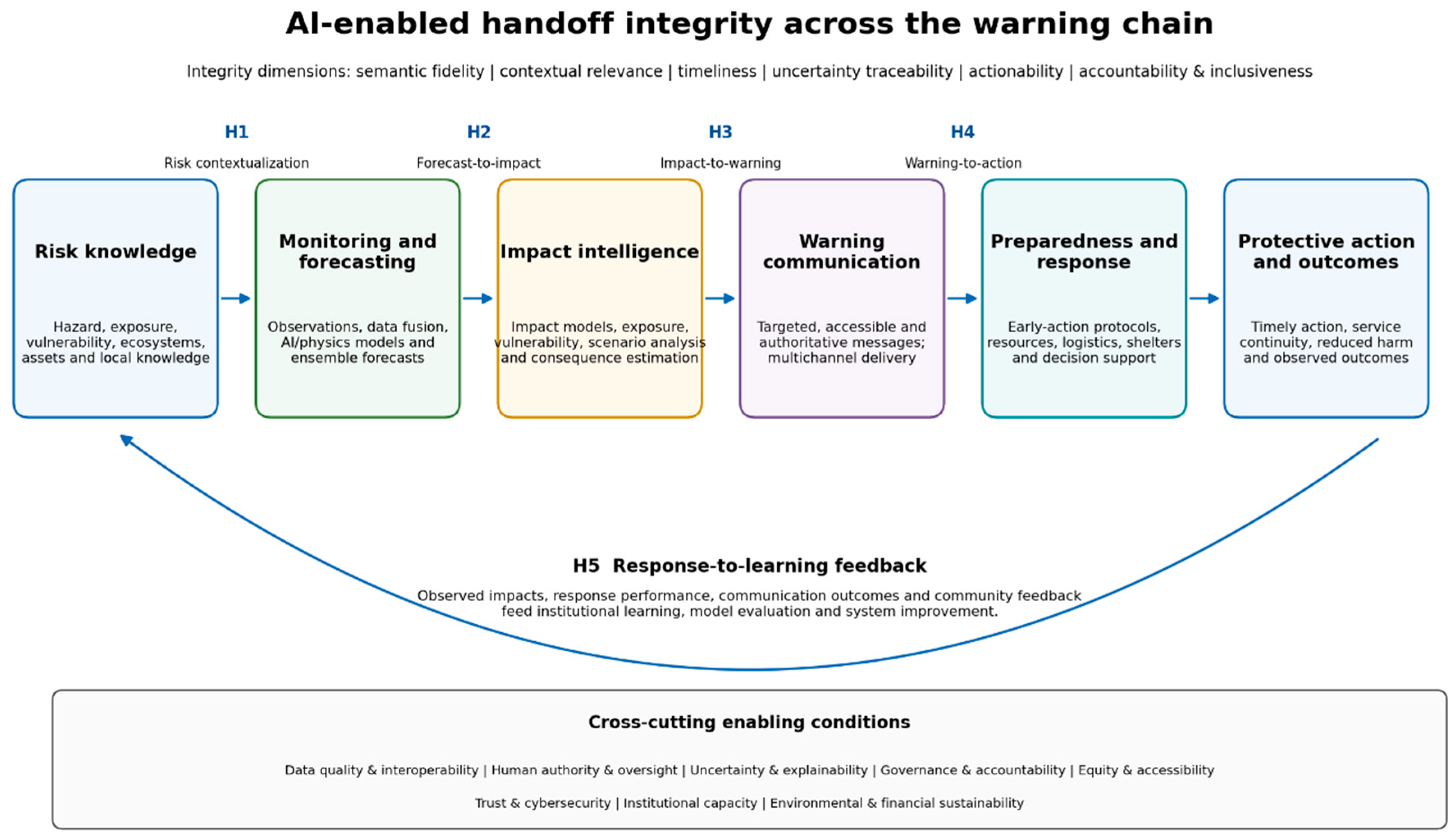

Table 1.
Positioning of the handoff-integrity framework relative to prior scholarship.
| Literature stream/examples | Established contribution | Remaining analytical issue | Contribution of this paper |
| Critical links in EWS (Garcia and Fearnley [7]) | Shows that failures can arise in processes linking EWS components. | Does not address AI-mediated transformations, generative systems, or explicit interface-quality dimensions. | Extends critical-links logic into AI-mediated information transfer. |
| Warning translation and people-centered EWS [8,21,22,23] | Shows that warnings are embedded in social, institutional, and vulnerability contexts. | Does not provide a technology-neutral construct for measuring AI interface quality. | Connects technical transformation to meaning, access, authority, and action. |
| Integrated climate-risk AI and AI-EWS reviews [13,14] | Maps AI capabilities, integrated architectures, challenges, and guardrails. | Primarily organized around capabilities, applications, or pillars. | Changes the unit of analysis from components to handoffs. |
| GeoAI decision-oriented MHEWS (Lu et al. [15]) | Connects geospatial data, knowledge, agents, stakeholders, and decisions. | The architecture does not establish that information meaning and uncertainty remain intact across every transformation. | Defines six integrity dimensions applicable across architectures. |
| EW4All AI policy guidance [16] | Demonstrates AI opportunities across all four MHEWS pillars and responsible-use conditions. | Policy guidance does not operationalize a dedicated interface-quality construct. | Provides a conceptual mechanism and testable propositions for evaluating handoffs. |
Note. The comparison is an original synthesis of the cited literature; the final column states the distinct contribution developed in this review.
Table 2.
Five handoffs, AI-enabled roles, integrity checks, and representative failure modes.
| Handoff | AI-enabled role | Integrity checks | Representative failure modes |
| H1 Risk contextualization | Data fusion, geospatial AI, remote sensing, knowledge extraction | Coverage, provenance, data freshness, vulnerability representation, local validation | Missing populations; stale exposure data; biased proxies; untraceable sources |
| H2 Forecast-to-impact | Impact modeling, ensemble interpretation, dynamic exposure linkage | Calibration, uncertainty propagation, context relevance, scenario validity | False precision; uncertainty loss; exposure mismatch; model drift |
| H3 Impact-to-warning | Translation, summarization, accessibility adaptation, audience tailoring | Semantic fidelity, authority, language quality, channel access, invariant critical content | Hallucination; mistranslation; omitted qualifiers; inaccessible delivery |
| H4 Warning-to-action | Optimization, scenario analysis, resource prioritization, decision support | Feasibility, legal authority, lead time, human override, equity | Automation bias; infeasible recommendations; inequitable allocation; unclear accountability |
| H5 Response-to-learning | Outcome analysis, anomaly detection, model/protocol learning | Outcome completeness, causal caution, community feedback, governed updating | Biased feedback; selective learning; uncontrolled retraining; repeated institutional failure |
Table 3.
Research propositions and possible empirical measures.
| Proposition | Expectation | Illustrative measures |
| P1 Interface complementarity | Gains in one MHEWS component will yield smaller improvements in protective outcomes when adjacent handoffs are weak. | Forecast skill; handoff delay; impact-usefulness score; action activation; avoided disruption. |
| P2 Impact-translation mediation | Impact translation will mediate the relationship between hazard-forecast quality and warning usefulness. | Forecast skill; impact-model calibration; decision relevance; warning comprehension |
| P3 Handoff integrity | Higher handoff integrity will be associated with better comprehension, coordination, and timely action. | Six-dimension integrity score; response time; protocol activation; survey comprehension |
| P4 Uncertainty traceability | Preservation of uncertainty across interfaces will reduce inappropriate overconfidence in AI-supported decisions. | Calibration display; uncertainty retention; confidence-action mismatch; override behavior |
| P5 Human authority and provenance | Clear human authority and provenance will support more calibrated institutional and public trust. | Source recognition; auditability; trust scales; appropriate reliance; override records |
| P6 Equity moderation | Accessibility and equity failures will weaken the societal benefit of otherwise high-performing AI systems. | Reach and comprehension by group; channel access; action feasibility; outcome disparities. |
| P7 Feedback quality | Systems that incorporate technical, institutional, behavioral, and community feedback will show stronger adaptive performance over time. | After-event changes; model recalibration; protocol revision; repeated failure rate; learning-cycle time |
Note. The propositions and illustrative measures are developed from the handoff-integrity framework proposed in this review and are intended for future empirical testing.
Disclaimer/Publisher’s Note: The statements, opinions and data contained in all publications are solely those of the individual author(s) and contributor(s) and not of MDPI and/or the editor(s). MDPI and/or the editor(s) disclaim responsibility for any injury to people or property resulting from any ideas, methods, instructions or products referred to in the content. |
© 2026 by the authors. Licensee MDPI, Basel, Switzerland. This article is an open access article distributed under the terms and conditions of the Creative Commons Attribution (CC BY) license (http://creativecommons.org/licenses/by/4.0/).
Copyright: This open access article is published under a Creative Commons CC BY 4.0 license, which permit the free download, distribution, and reuse, provided that the author and preprint are cited in any reuse.