

Submitted:
24 September 2026
Posted:
28 September 2026
You are already at the latest version
Abstract
Dry reforming of methane DRM converts CH4 and CO2 into syngas but remains limited by metal sintering, carbon accumulation, and interfacial instability at high temperatures. These limitations depend not only on the intrinsic properties of the active metal, but also on the spatial coupling among CH4-activation sites, CO2-activation or oxygen-supply regions, and species-transport pathways. This review therefore focuses on how these functional units are spatially organized and kinetically coupled in DRM catalysts, using support dimensionality as a geometric framework for comparison rather than as an independent determinant of catalytic performance. One-, two-, and three-dimensional supports provide distinct combinations of site proximity, interfacial continuity, confinement, connectivity, and transport geometry, thereby offering different routes to coordinate carbon formation, oxygen supply, and intermediate transport. Across these architectures, we compare how such spatial characteristics regulate the coupling between carbon-forming and oxygen-supplying processes, working-state reconstruction, local carbon–oxygen kinetic matching, and effective transport distances between bifunctional sites. Finally, general design principles are extracted across dimensional categories, together with future directions involving operando characterization, comparable model systems, and multiscale transport analysis for durable DRM catalysts.
Keywords:
dry reforming of methane
; catalyst support
; dimensionality
; metal-support interface
; oxygen supply
; mass transfer
1. Introduction
Methane is the principal component of natural gas and is also a greenhouse gas with a substantial climate impact [1]. Therefore, the efficient valorization of methane while reducing its emissions is an important objective in low-carbon energy conversion [2]. Current methane-conversion routes [3] include steam reforming, partial oxidation, autothermal reforming, catalytic cracking, and dry reforming. Among them, dry reforming of methane (DRM) uses CO2 as a co-reactant, coupling CH4 activation and CO2 conversion within the same catalytic system to produce syngas [4].
DRM is a typical dual-reactant reaction involving the coupling of multiple functional sites [5]. Stepwise CH4 dehydrogenation and the formation of CHx/C species occur mainly on metal sites, whereas CO2 adsorption, polarization, dissociation, and the supply of oxygen-containing species rely more strongly on the support surface and metal-support interface [6]. These functional regions must be connected by continuous transport pathways so that CO2-derived oxygen-containing species can participate promptly in the interfacial conversion of CHx/C. Because DRM generally operates at high temperatures, metal migration, sintering, and interfacial reconstruction [7] can alter the number and size of CH4-activation sites and their spatial proximity to CO2-activation or oxygen-supply regions [8]. Meanwhile, accumulated carbon species can further block active boundaries and restrict species transport. DRM deactivation should therefore not be simplified as independent coking or sintering processes, but rather understood as a coupled evolution involving the progressive mismatch of metal-site stability, oxygen-species turnover, and transport pathways under working conditions [9].
In recent years, DRM research has expanded from reaction pathways to physicochemical properties, deactivation mechanisms, and engineering applications [10]. Alhassan et al. systematically compared active metals, supports, preparation methods, and reactor configurations, and emphasized that catalytic performance depends on multicomponent synergy . Awad et al. identified metal-support interactions, metal particle size, surface acid-base properties, oxygen vacancies, reducibility, and pore structure as major physicochemical parameters governing DRM activity and deactivation, highlighting the strong coupling among these variables. Reported CO2 and CH4 conversions for different Ni-based nanocatalysts span approximately 6-99% and 3-98%, respectively [11], while Co-based systems cover approximately 45-97% and 22-98%, indicating that coupled differences in support structure, metal scale, and related parameters can produce nearly an order-of-magnitude variation in performance. From the perspective of oxygen migration and oxygen vacancies, Rosli et al. noted that mobile oxygen generated by CO2 activation at defect sites can participate in surface carbon gasification. thus, coke resistance depends not only on the number of oxygen vacancies but also on the kinetics of oxygen generation, migration, and consumption. Ighalo and Amama further compared low-dimensional supports such as CNTs, graphene, and MXenes [12] and reported clear spatial-location effects , with metals located on CNT inner walls generally showing higher DRM activity than those on outer walls.
Among these regulating factors, the support is a key link between catalyst composition and catalytic performance. In addition to physically dispersing the active metal, it directly affects the electronic state of active sites, CO2 adsorption and activation, and the oxidative removal of surface carbon species through metal-support interactions (MSI) [13], thereby coupling different functional sites across spatial and temporal scales. Importantly, support dimensionality is not a performance-determining factor independent of composition, exposed facets, defects, or metal size [14,15]. Materials within the same dimensional category can exhibit markedly different catalytic behavior because of differences in chemistry and reaction conditions. In this review, dimensionality is therefore used only as a geometric descriptor of how many directions a functional unit can extend continuously, what spatial constraints it experiences, and over what length scales it can connect with other functional units. The discussion consequently focuses on how different geometric boundaries organize metal stabilization, oxygen-supply pathways, and mass transport.
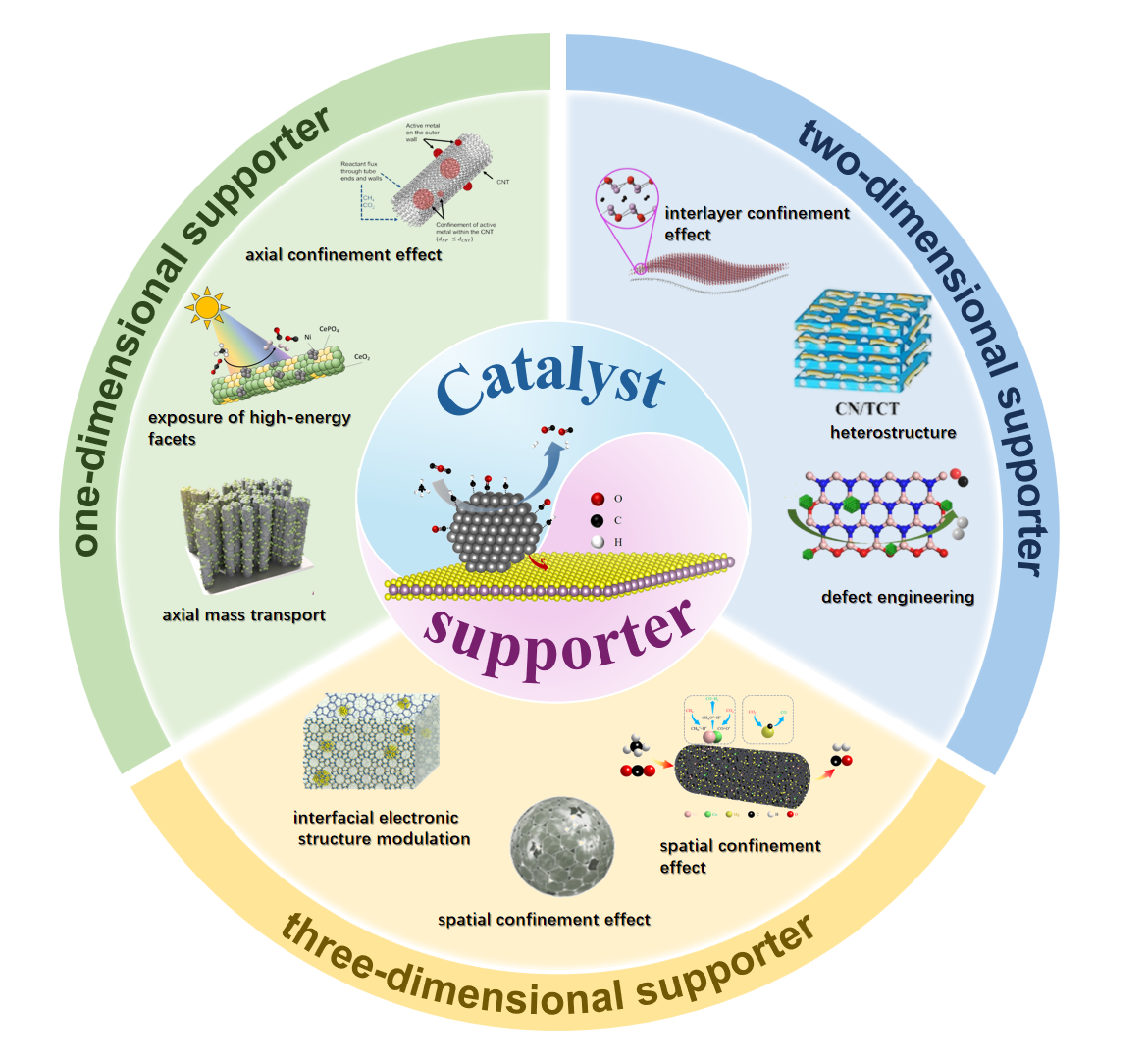
Under this geometric definition, 0D supports are confined in all three spatial directions, and their functional sites interact mainly through the outer surfaces of isolated particles or local heterointerfaces. they therefore serve as a reference for local interfacial coupling. 1D structures are axially continuous and radially confined, 2D structures are continuous in-plane and confined normal to the plane, and 3D structures form bulk-connected networks through multidirectionally continuous frameworks and pores. This review first establishes common criteria based on thermodynamic boundaries and local C/O kinetic competition, and then compares the spatial organization provided by different dimensions using metal stabilization, CO2 activation and oxygen supply, and mass transport as a unified framework. Dimension-related performance differences are discussed only for systems with reasonably comparable compositions, metal scales, and reaction conditions (Figure 1) [16].
2. Thermodynamic-Kinetic Constraints and Dimension-Dependent Spatial Organization of DRM Supports
2.1. Thermodynamic Boundaries and Local C/O Kinetic Matching
DRM is a typical dual-reactant, multisite-coupled reaction that cannot be completed by a single active center [17]. Metal sites for carbon-forming CH4 activation, sites for CO2 activation and oxygen supply, dynamic metal-support interfaces, and intermediate-transport pathways must operate as a cooperative reaction network. A common constraint in support design is therefore to maintain kinetic coordination among carbon generation, oxygen-species replenishment [18], and interfacial oxidation within the local reaction space.
Thermodynamically, CH4 + CO2 ⇌ 2CO + 2H2 is strongly endothermic, with a standard reaction enthalpy of ΔH°298 = +247 kJ·mol−1. High temperatures favor higher equilibrium conversions, but also accelerate deep CH4 cracking, metal-particle migration and sintering, and metal-support interfacial reconstruction. CO disproportionation and carbon nucleation may also occur in specific local environments [19]. Consequently, oxygen storage, defect-mediated oxygen exchange, or carbonate cycles can contribute to coke suppression only when they can be continuously regenerated at the reaction temperature and remain effectively connected to metal sites where carbon species form [20].
Kinetically, DRM comprises parallel and consecutive steps including stepwise CH4 dehydrogenation, CO2 adsorption and activation, generation and migration of oxygen-containing species, CHx/C oxidation, and product desorption. Stable operation is governed by the dynamic competition between carbon formation and oxidative removal at local interfaces [21]. If the characteristic time for carbon formation is shorter than the combined time required for oxygen generation, transport, and regeneration [22], carbon accumulates before interfacial oxygen can arrive. Even a support with high oxygen-storage capacity may provide insufficient effective oxygen flux when transport distances are too long, interfacial contact densities are low, or migration pathways are discontinuous [23]. Conversely, excessive oxygen supply may oxidize metal sites, cause overcoverage by oxygen-containing species, or inhibit CH4 activation. Local C/O matching should therefore be described jointly by effective path length, interfacial contact, characteristic times for carbon generation and oxygen turnover, and effective interfacial oxygen flux, and verified using transient, isotopic, or interface-normalized kinetic evidence [24].
Wang et al. deposited Ir nanoclusters on defective CeO2−x nanorods to construct adjacent Irδ+–Ov–Ce3+ interfacial motifs and thereby spatially couple CH4 activation with CO2-derived oxygen supply. Interfacial Irδ+ sites adsorb and dissociate CH4 to form CHx species, whereas neighboring Ce3+–Ov sites promote CO2 activation and replenish reactive oxygen, enabling carbonaceous intermediates to be oxidized near the interface. Operando DRIFTS showed the formation of HCOO and CHxO accompanied by attenuation of CHx signals after CO2 introduction (Figure 2a), while reverse sequential feeding further verified interfacial coupling between CHx and CO2-derived oxygen-containing species (Figure 2b). DFT calculations showed that interfacial oxygen supply favors CH2 oxidation to CH2O over continued dehydrogenation to CH (Figure 2c) [5]. These results indicate that a high oxygen-vacancy concentration or strong CO2 activation becomes relevant to coke suppression only when it is spatially coupled to CH4-activation sites and alters the competing pathways of CHx intermediates.
Accordingly, DRM stability can be substantially improved by regulating the spatial positions of functional sites, interfacial connectivity, and the continuity of transport pathways so that carbon formation and oxidative removal remain continuously coupled within the local reaction space. Catalyst design should therefore target working interfaces formed cooperatively by multiple functional sites under reaction conditions, maintaining both a regenerable local oxygen-containing environment and effective interfacial coupling among CH4 activation, CO2 activation and oxygen supply, and intermediate conversion.
2.2. Spatial Organization of Support Functions
Support composition and surface chemistry determine which metal-anchoring sites, CO2-activation sites, and oxygen-exchange units can form, whereas dimensionality primarily constrains how these functional units are spatially arranged and connected [25]. Here, the support is analyzed geometrically according to the directions of structural continuity and the degrees of spatial confinement, giving 0D [25], 1D, 2D [26], and 3D [27] configurations [28].
Different dimensionalities first impose different spatial boundary conditions. In 0D structures, all three dimensions are nanoscale-confined. metal sites, CO2-activation sites, and oxygen-supply regions are mainly located on isolated particle surfaces, facet boundaries, or local heterointerfaces. Their coupling therefore relies largely on short-range adjacency within an individual particle and lacks an interface that extends continuously along a defined direction. In contrast, 1D supports extend continuously along one direction while remaining laterally confined, and curved surfaces, tube walls, and internal cavities create directional interfacial boundaries. Two-dimensional supports are continuous in-plane and confined out-of-plane, with basal planes, edges, defects, and interlayer regions being spatially and kinetically nonequivalent. Three-dimensional supports rely on multidirectionally continuous bulk frameworks and form particle-scale interconnected networks through pore walls, grain boundaries, cavities, and hierarchical pores. The key distinction among 1D, 2D, and 3D structures therefore lies in the spatial degrees of freedom available for configuring functional units, the directions over which interfaces can extend, and the characteristic connection lengths between distinct regions.
Under reaction conditions, these spatial relationships evolve dynamically through metal migration, defect generation and healing, local coordination changes, and interfacial reconstruction. Dimensional analysis should therefore extend beyond the initial morphology and determine whether the geometric features present before reaction can maintain effective connections among metal sites, oxygen-supply regions, and transport pathways in the working state. Because 0D structures mainly provide a reference for local particle-scale interfaces and their spatial characteristics are defined here, Section 3 does not discuss them separately. instead, it focuses on how the directional continuous interfaces of 1D structures, planar continuous interfaces of 2D structures, and bulk-connected networks of 3D structures further modify the spatial coupling of bifunctional sites.
2.3. Attribution Limits of Dimensional Effects and Principles for Cross-Dimensional Comparison
Dimension-related effects should be compared only when the active metal, support composition, metal loading and initial size, major surface chemical states [29], and reaction conditions [30] are broadly comparable. If changes in dimensionality are accompanied by changes in crystal phase, defect concentration, acid-base properties [31], or metal scale [9], the resulting catalytic response cannot be attributed to geometry alone and must instead be interpreted in terms of the combined effects of these variables on interfacial structure and spatial organization [32]. Accordingly, cross-study comparisons should not rank 0D-3D supports directly using raw CH4 or CO2 conversions.
On this basis, dimensionality is used here as a structural framework for describing how bifunctional sites are spatially connected. Different supports are compared in terms of three dimension-sensitive processes: metal stabilization [33], oxygen-supply pathways [34], and mass transport [27] , with priority given to systems that provide comparable geometric or morphological controls. Active-site- or interface-normalized rates, metal size and location before and after reaction, coke-formation rates, oxygen-exchange kinetics, and effective diffusivities are considered where available to distinguish contributions from site population [35], interfacial chemistry [36], and spatial organization [37].
3. Spatial Organization and Bifunctional-Site Coupling in Supports of Different Dimensionalities
Based on the common criteria established in Section 2, the following discussion compares how 1D, 2D, and 3D supports use directional continuous interfaces, planar continuous interfaces, and bulk-connected networks, respectively, to organize metal stabilization, oxygen supply, and mass transport. The three classes are analyzed using the same mechanistic dimensions. No performance hierarchy is assigned. the emphasis is instead on identifying how different geometric boundaries alter the connectivity of bifunctional sites.
3.1. One-Dimensional Structures: Coupling Structure, Interfaces, and Transport within Directional Spatial Frameworks
One-dimensional or quasi-one-dimensional supports reported for DRM include reducible oxide nanorods/nanowires [38,39], basic or carbonate-cycle-related one-dimensional oxides, tubular silicate/aluminosilicate supports, one-dimensional carbon supports [40], and frameworks containing periodic coordination units. This section focuses on how axial interfacial continuity, short radial proximity, and curvature/cavity confinement in 1D structures stabilize metal sites [26], organize oxygen-supply pathways, and regulate mass transport and migration [41].
For metal stabilization, 1D supports can coordinate metal species through surface defects, oxygen-containing groups, and framework coordination sites, while their continuous side surfaces and limited transverse dimensions reduce metal migration and particle contact, thereby suppressing high-temperature sintering [42]. In hollow structures, inner-wall curvature and cavity boundaries can further constrain particle displacement. HAP nanorods provide a representative example of metal stabilization by a one-dimensional coordination framework. The oriented HAP nanorods prepared by Wang et al. expose Ca–O–P structural units continuously along the axial direction. Ni2+ can substitute Ca2+ to form Ni–O–P coordination, thereby fixing Ni within the HAP framework, while neighboring Ca–O–P and Ca-related basic sites remain available for CO2 adsorption and activation. Ni activation sites and basic CO2-activation sites can thus repeatedly occur in close proximity along the nanorod surface, organizing CH4- and CO2-activation regions within the same continuous 1D interface. As Ni loading increases, Ca–O–P sites are progressively substituted by Ni2+ to form Ni–O–P coordination, accompanied by attenuation of the corresponding basic-site signal in CO2-TPD-MS (Figure 3a). TEM and EDX further show that Ni remains uniformly dispersed in 0.3Ni/HAP after reduction and reaction, whereas distinct Ni particles form and sinter on commercial HAP, indicating that framework coordination contributes to metal stabilization. H2-TPR shows the emergence of free NiO at higher loading, suggesting that exchangeable Ca–O–P sites become saturated. Additional Ni can then no longer generate neighboring CO2-activation sites proportionally, weakening bifunctional-site coupling [43].
Once metal sites are stabilized, the oxygen-supply interface determines whether a 1D structure can maintain local C/O coupling. Depending on whether CO2-derived oxygen enters a reversible solid oxygen reservoir, the relevant pathways can be broadly classified as solid-state redox oxygen supply and surface-intermediate-mediated oxygen supply. The former includes reversible oxygen exchange through the intrinsic lattice oxygen of the support or a supported secondary oxide promoter, whereas the latter relies on basic sites, hydroxyls, heteroatoms, or defects to generate carbonates, formates, adsorbed oxygen, or related surface species. Both pathways require the oxygen-supply region and the metal carbon-forming site to remain connected over accessible short distances along the 1D framework.
For oxygen supply through intrinsic lattice oxygen, the continuous side surfaces and small radial dimensions of CeO2 nanorods favor exposure of oxygen-exchange sites and shorten the distance over which lattice oxygen must migrate from the near-surface region to the Ni–CeO2 interface, thereby coupling support oxygen storage with interfacial oxygen delivery over a short path. Zou et al. introduced Zr to distort the CeO2 lattice, promoting Ce–O bond activation, oxygen-vacancy formation, and lattice-oxygen migration. When the Zr content was increased to 10%, HRTEM revealed an independent ZrO2 phase (Figure 3b), indicating that excess Zr was no longer fully incorporated into the CeO2 lattice. EPR showed that Ni/Ce0.95Zr0.05O2 exhibited the strongest g = 2.002 oxygen-vacancy signal (Figure 3c), while O 1s XPS indicated the highest concentration of surface oxygen vacancies and adsorbed oxygen. CO2 uptake increased from 0.097 mmol·gcat−1 for Ni/CeO2 to 0.121 mmol·gcat−1, and the oxygen storage capacity (OSC) reached 294 μmol·gcat−1 (Figure 3d). this sample also showed the highest CH4 and CO2 conversions over 550-800 °C (Figure 3e,f). CH4-TPSR detected CO signals associated with both surface and bulk lattice oxygen for Ni/CeO2 and Ni/Ce0.95Zr0.05O2, whereas no corresponding CO signal appeared for Ni/ZrO2. In CO2-TPSR, the CO peak near 300 °C for Ni/Ce0.95Zr0.05O2 was approximately twice that of Ni/CeO2, indicating that oxygen vacancies promoted CO2 dissociation and oxygen replenishment. In carbon-TPR, the CO peak area of Ni/Ce0.95Zr0.05O2 was approximately 1.5 times that of Ni/CeO2 and appeared at a lower temperature, showing that available oxygen species participated more readily in carbon gasification [44]. These results demonstrate that the continuous surface and limited radial dimension of the 1D CeO2 framework organize Zr-induced oxygen vacancies, lattice-oxygen migration channels, and Ni carbon-forming sites within a relatively short oxygen-supply pathway.
When reversible oxygen is supplied by a secondary oxide phase supported on a 1D framework, the critical requirement becomes the spatial colocalization of the metal, promoter, and support. TEM and elemental mapping by Łamacz et al. showed CeZrO2 nanoparticles distributed on the CNT surface, with Ni locally adjacent to Ce and Zr (Figure 4a). During annealing of NiCZ/CNT at 500 °C, lattice oxygen can be released from CeZrO2 to generate oxygen vacancies, while its high oxygen mobility and redox properties facilitate reduction of Ni species. During reaction, in addition to DRM and RWGS, NiCZ/CNT exhibited a distinct CO2 deoxygenation pathway accounting for 16.7%, 14.1%, and 13.0% of CO2 consumption at 500, 700, and 800 °C, respectively (Figure 4b), indicating that adjacent Ce3+/oxygen-vacancy and Ni0 sites promote CO2 activation and deoxygenation. Post-reaction XRD further showed partial oxidation of Ni to NiO in NiCZ/CNT, whereas NiO in Ni/CNT was fully reduced to Ni, supporting a mechanism in which CO2 dissociates at oxygen vacancies in CeZrO2, replenishes lattice oxygen, and transfers oxygen species toward neighboring Ni through the highly mobile oxide lattice [45]. Thus, the decisive feature of this pathway is not whether the 1D carbon support itself contains oxygen, but whether the secondary oxide, metal particles, and tube wall form a stable three-phase adjacent interface capable of oxygen exchange.
For systems that do not rely on reversible lattice oxygen, 1D supports organize CO2-adsorption sites and metal sites through directional surfaces, tube-wall boundaries, and local coordination environments, allowing oxygen-containing surface intermediates to form over short interfacial distances and participate in CHx/C* conversion. In N-CNTs, pyridinic N, graphitic N, and carbon defects can regulate metal anchoring and CO2 adsorption/polarization at the tube wall [41], while the continuous 1D interface keeps CO2-activation regions close to metal sites and thereby facilitates local surface oxygen supply. In halloysite nanotubes (HNTs), inner- and outer-wall hydroxyl groups, Al/Si–O acid-base sites, and cavity confinement regulate the formation, residence, and conversion of CO2-derived intermediates. The HAP nanorods discussed above combine Ni stabilization and local generation of CO2-derived surface oxygen through Ca–O–P coordination units, CaO-like basic sites, and surface hydroxyls. Although these systems differ in oxygen source, they share the same spatial requirement: CO2-activation/oxygen-supply regions and metal carbon-forming sites must form a continuous reaction sequence within the same local working interface.
Under these conditions, 1D supports regulate local transport through axially continuous surfaces and limited radial dimensions. Solid nanorods rely mainly on open external surfaces and extended interfaces to improve CH4 and CO2 access to active regions, whereas hollow nanotubes regulate gas diffusion and local residence through cavity connectivity , nonequivalent inner and outer walls, and curvature effects. At the same time, continuous 1D interfaces facilitate short-range migration and conversion of CHxO, HCOO, and surface oxygen species between metal sites and CO2-activation regions [26]. Thus, the transport role of 1D structures lies in coordinating gas-phase accessibility with interfacial species exchange so that CO2-derived oxygen-containing species can promptly oxidize nearby CHx/C* [46].
Taking advantage of the extended axial interface and constrained radial transport distance in 1D structures, Lorber et al. constructed solid 2Ni−R CeO2 nanorods in which access of gas-phase reactants to the Ni−CeO2 interface was coupled with local turnover of CO2-derived surface intermediates (Figure 4c). At 500 °C, the CH4 and CO2 reaction rates were approximately five times those of the CeO2 spherical sample, whereas carbon deposition during CH4-only cracking reached 52 wt%. The low coke level under DRM therefore did not arise from weakened CH4 activation, but from kinetic matching between CO2 activation and carbon gasification at the Ni−CeO2 interface. DRIFTS-MS showed that the nanorod surface predominantly formed more readily converted monodentate/bidentate carbonates and formate-related species (Figure 4d), whereas CeO2 cubes more readily formed multidentate carbonate coverages near 1490 and 1385 cm−1 (Figure 4e). H2-pulse experiments further showed that multidentate carbonates reacted only slowly at 500 °C and were more likely to behave as spectator species occupying surface sites. The spatial role of solid 1D nanorods can therefore be attributed to open interfacial accessibility, facet-dependent CO2 adsorption states, and effective turnover of surface species near the metal [47].
By contrast, hollow or quasi-hollow 1D supports such as CNTs [48] and tubular silicate/aluminosilicate nanotubes possess confined cavities, nonequivalent inner and outer walls, and curved interfaces, creating transport and reaction environments distinct from those of open external surfaces [49]. In comparative studies of Ni located on the inner and outer walls of CNTs, placement of Ni particles inside the tube limits migration along the support surface and direct particle-particle contact, favoring metal dispersion at high temperature. Inner-wall curvature and the associated electronic environment also lower the NiO reduction temperature from 320 °C for the outer-wall system to 293 °C. At 750 °C, I−Ni/CNTs achieved CH4 and CO2 conversions of 83.4% and 70.2%, respectively, and retained 65.4% and 78.8% after 8 h, both higher than the outer-wall-loaded system. Carbon deposition also decreased from 20.8% to 9.3%. CNT inner-wall confinement therefore not only modifies gas ingress and egress, but also restricts Ni migration and contact, improves high-temperature metal stability, and suppresses carbon accumulation, thereby maintaining a more stable reaction interface within the tube cavity [50,51].
Spatial regulation by 1D supports is not enhanced monotonically by increasing metal loading, defect density, promoter content, or confinement strength. Instead, these parameters must remain within a range that preserves metal stabilization, oxygen supply, and interfacial accessibility [44]. In HAP nanorods, excessive Ni loading exceeds the available [Ca–O–P] anchoring capacity and promotes the formation of non-framework NiO species, thereby weakening the spatial coupling between Ni sites and adjacent CO₂-activation sites [43]. Similarly, excessive Zr incorporation into CeO2 nanorods can generate segregated ZrO2 and reduce the accessibility of oxygen-vacancy-related sites, showing that oxygen-supply enhancement also has a compositional optimum. For tubular supports, effective confinement requires persistent colocalization of the metal and promoter within the tube. Mo-modified Ni/HNT suppresses Ni migration from the nanotube cavity, whereas carbon-fibre-supported Ni−CeZrO2 exhibits poorer active-phase dispersion and incomplete Ni−CeZrO2 contact [52]. Inner- and outer-wall Ni/CNT comparisons further demonstrate that confinement strongly depends on the actual location of Ni within the tubular architecture [51]. Therefore, 1D support design should focus on maintaining a stable working-state connection among metal sites, CO2-activation or oxygen-supply regions, and transport pathways rather than maximizing any single structural parameter [53].
In summary, the axial continuity and transversely confined geometry of 1D supports organize metal species on continuous curved surfaces, tube-wall boundaries, or periodic coordination units, thereby limiting lateral migration and particle coalescence and improving interfacial stability [40]. Their elongated frameworks and short transverse dimensions can keep intrinsic lattice oxygen, supported oxide promoters, or CO2-derived oxygen-containing species close to metal sites [54] and reduce the effective transport distance to CHx/C*. For solid nanorods [55], open external surfaces and axially extended interfaces favor reactant access and surface-intermediate turnover, whereas hollow nanotubes additionally regulate local diffusion and residence through cavity confinement, nonequivalent inner/outer walls, and curvature [38]. The principal role of 1D supports is therefore to use directional continuous interfaces and transversely confined space to stabilize CH4-activation sites, position CO2-activation or oxygen-supply regions nearby, and sustain species exchange between them, thereby strengthening bifunctional-site coupling under working conditions.
3.2. Two-Dimensional Structures: Metal Anchoring, Oxygen-Supply Interfaces, and In-Plane/Interlayer Transport Under Planar Anisotropy
Two-dimensional supports consist of atomic- or nanoscale sheet-like units characterized by in-plane continuity and out-of-plane periodicity breaking [56]. Basal planes, edges, defects, and interlayer regions are strongly anisotropic in coordination state, accessibility, and transport direction. Comparison of reported 2D DRM catalysts shows that the more effective systems use this planar anisotropy to organize metal sites, CO2-activation/oxygen-exchange regions, and short transport pathways on the same sheet or across adjacent sheets [57].
The in-plane extension and out-of-plane confinement of 2D supports expose basal planes, edges, and defect sites within an open planar interface. For atomic metal species and small clusters, low-coordination atoms generated at edges, vacancies, or locally distorted regions provide discrete in-plane anchoring sites. Local coordination and interfacial charge interactions suppress metal desorption and in-plane migration, allowing highly exposed small metal species to remain dispersed and stable on the sheet surface.
As the metal size increases from atoms or small clusters to nanoparticles, local coordination remains operative, while the larger particle-sheet contact area increases the contribution of defect-mediated embedding and interfacial structural constraint. Cao et al. selected h-BN nanosheets as a Ni support because of their high thermal and chemical stability, open 2D interface, and ability to host abundant surface vacancies. Ni particles were embedded mainly in defect-rich h-BNNS surfaces and retained high stability after 120 h of DRM. Related DFT calculations showed that a B vacancy strengthened the adsorption energy of Ni2 on h-BN from −4.28 to −8.70 eV and increased charge transfer from 0.18-0.24 e to 0.44-1.62 e, confirming stronger Ni-BN interfacial bonding. Highly exposed BN vacancies on the 2D sheet therefore enhance the local stability of Ni species through stronger interfacial bonding. As particle size increases, defect coordination and embedding-induced interfacial constraint jointly suppress Ni migration and coalescence, preserving the high-temperature stability of the Ni-BN interface [58].
For single atoms and very small clusters, controlled defects and dopant sites in 2D materials can suppress high-temperature migration and aggregation by adjusting the local coordination environment [59]. Zhang et al. constructed a Ru2/SiO2@BN system in which the SiO2 surface was coated with a continuous BN nanolayer approximately 2-3 nm thick (Figure 5a). The g = 2.002 EPR signal and PL emission near 850 nm were consistent with B-vacancy-related defects in the BN layer, providing low-coordination anchoring environments for Ru species. AC-HAADF-STEM directly revealed numerous Ru atom pairs, and statistical analysis of more than 80 Ru···Ru separations gave 0.305 ± 0.019 nm, indicating predominantly uniform dual-atom dispersion (Figure 5b). Combined AC-HAADF-STEM, EXAFS/DET, and post-reaction structural characterization showed that low-coordination B/N sites in the BN layer form Ru–N and Ru–B bonds, stabilizing Ru as an asymmetric dual-atom structure with a Ru-Ru separation of approximately 3.04 Å (Figure 5c). Atomic-scale dispersion was retained after 1000 h of DRM. This defect-defined atomic configuration suppresses Ru migration and aggregation at high temperature while preserving the spatial relationship between adjacent Ru atoms and the BN interface, providing a stable local structure for coupled CH4 activation and subsequent CO2-assisted oxygen-containing transformations [60].
The enhancement of interfacial organization by 2D structures is not, however, monotonic with defect density, oxygen coverage, or interlayer openness. Too few defects provide insufficient metal anchoring and CO2-activation sites, whereas excessive defects may promote pore coalescence, sheet fragmentation, excessive metal encapsulation, or changes in reaction pathway [61]. A universal failure threshold cannot be defined by a single defect atomic percentage across different materials. Pham et al. examined the porosity associated with circular nanopores in h-BN rather than isolated B-vacancy concentration. Their 300 K simulation gave E = −20.52p + 706.26 GPa, where p is porosity in percent. Increasing porosity to 5.36% and 12.05% decreased Young's modulus by approximately 16% and 35%, respectively, without a discontinuous transition near 5%. Thus, approximately 5% porosity can at most be treated as a structural warning range that requires verification of pore coalescence and sheet integrity. actual failure should be evaluated from continuous cracks, reduced lateral dimensions, sheet fragmentation, and metal detachment or abnormal encapsulation after reaction [62].
After metal sites are stabilized, 2D supports can participate in oxygen cycling through open basal planes, highly exposed low-coordination defects, and, for selected materials, layer-dependent electronic-structure regulation [63,64]. Open basal planes expose CO2-activation sites and oxygen-containing species directly adjacent to metal sites [65], while in-plane defects, because of their coordinative unsaturation and accessibility, can act as CO2-adsorption and oxygen-exchange centers. In 2D materials containing redox-active centers, changes in layer number and local coordination can additionally modify the band structure and electronic state of the metal centers, thereby tuning oxygen binding and release [62]. Two-dimensional supports can consequently replenish surface oxygen, regenerate lattice oxygen, or undergo reversible oxide-carbide transformations while continuously updating oxygen-containing species near metal sites across an open planar interface [66].
Two-dimensional redox-active phases can therefore operate as surface or solid-state oxygen-exchange interfaces, allowing the oxygen state to cycle dynamically between CH4 consumption and CO2 replenishment [67]. In 2D-Mo2COx/SiO2, dispersed Mo2COx nanosheets retained their sheet-like morphology after treatment in H2 or CO2 at 800 °C (Figure 5d), keeping variable-valence Mo sites and surface O exposed on the same open basal plane. Maximum activity corresponded to a surface-oxygen coverage of approximately 0.67 monolayer and an average Mo oxidation state of about +4 (Figure 5e), while the activity per Mo atom was approximately three orders of magnitude higher than that of bulk Mo2C (Figure 5f). These results show that the key function of the 2D oxycarbide is to maintain an appropriate balance between vacant Mo sites and reactive O* on the same basal plane. Insufficient oxygen coverage limits CHx/C* oxidation, whereas excessive coverage blocks CH4-activation sites and may drive overoxidation [66].
When oxygen turnover is accompanied by changes in the composition of the active phase, multilayer sheet-like frameworks can additionally confine the spatial locations of oxide and carbide phases. The V2O3–V8C7/m-V2CTx system reported by Thakur et al. stores and releases oxygen through reversible oxide-carbide interconversion. XRD, Raman spectroscopy, and XPS confirmed the coexistence of V2O3 and V8C7 after reaction. The oxide phase disappeared after an independent carburization treatment and reappeared together with the carbide phase when DRM was resumed (Figure 6a), supporting reversible updating of the working phase composition with the gas environment. Isotopic experiments further showed simultaneous formation of 13CO and 12CO after switching to 13CO2 (Figure 6b), whereas 13CO gradually increased when 13CH4 was introduced (Figure 6c), indicating that CO is produced both by CO2 oxidation of the carbide and by CH4 recarburization of the oxide. The multilayer V2CTx framework (Figure 6d) confines V2O3 and V8C7 nanocrystals to sheet surfaces and interlayer regions, allowing oxidation and carburization to cycle across adjacent short-range interfaces, thereby enabling oxygen storage, release, and regeneration while preventing phase separation into bulk domains or irreversible overoxidation [12].
In addition to surface-oxygen coverage and solid-phase transformations, basal planes of 2D sheets and continuous in-plane interfaces can place CO2-adsorption sites and metal sites on the same accessible surface, allowing oxygen-containing intermediates generated on the support to participate in nearby CHx/C* conversion over short in-plane distances [68]. In the Ni-Cu nanoalloy/MgAlOx nanosheet system constructed by Xiao et al., the periclase-like MgAlOx derived from the layered precursor retained a sheet thickness of approximately 20-50 nm, while ~5.4 nm Ni-Cu alloy particles were uniformly dispersed on the sheet surface, creating extensive contact boundaries between alloy sites and in-plane basic regions. CO2-TPD showed that 6Ni6CuMgAl-S contained 889.93·gcat−1 total basic sites, substantially more than the 372.18·gcat−1 of 12NiAl-S, with medium-to-strong basic sites predominating. This enhances CO2 adsorption and polarization and favors the formation of carbonate-related surface species. Because these basic sites coexist with Ni-Cu particles on the same accessible sheet surface, CO2-derived oxygen-containing species are spatially positioned to participate in CHx/C* conversion at nearby metal interfaces. After 70 h of reaction, the coke-formation rate was only 0.386 mgC·gcat−1·h−1 (Figure 6e), while the alloy particle size increased only from 5.4 to 5.8 nm (Figure 6f), indicating that sheet basicity, alloying, and interfacial organization jointly suppress coking and particle growth [69].
This system shows that 2D sheets [62] can use open basal planes and in-plane basic sites to place Ni-Cu sites and CO2-adsorption regions in short-range proximity on the same accessible interface, providing a spatial basis for the local formation and interfacial conversion of CO2-derived oxygen-containing species. Unlike solid oxygen-reservoir pathways, this type of 2D oxygen supply relies primarily on the functional nonequivalence of basal planes, edges, and defect regions and their in-plane connection to metal boundaries, allowing oxygen-containing species to participate in CHx/C* conversion over short interfacial distances. Such geometric adjacency, however, demonstrates only the spatial possibility of short-range oxygen supply. Operando spectroscopy or transient kinetics are still required to establish whether oxygen-containing intermediates are continuously generated, transported, and turned over along the sheet interface.
After an oxygen-supply interface is established, 2D supports regulate transport mainly through continuous basal planes and large-area face-to-face interfaces that extend the reaction region [70]. Open monolayer or few-layer sheets allow CH4 and CO2 to reach exposed interfaces directly and shorten the migration distance of surface intermediates between metal and oxygen-supply sites. In multilayer or 2D heterostructures, extensive face-to-face contact can create continuous interlayer interfaces and enlarge regions for charge transfer and oxygen exchange, although their effective utilization remains limited by edge entrances, free interlayer spacing, and stacking. The transport role of 2D structures therefore derives from continuous planar interfaces and interlayer connections that expand species exchange from local point/line contacts to extended planar interfaces and shorten the distance over which oxygen-containing species must reach metal sites on the same or adjacent sheets, thereby promoting bifunctional-site coupling.
Using the V2O3–V8C7/m-V2CTx system of Thakur et al. as an example, selective etching of V2AlC transformed the dense bulk precursor into accordion-like multilayer m-V2CTx. Removal of the Al atomic layers separated the initially tightly stacked V2C layers and generated edge openings leading into internal interlayer regions, thereby extending gas accessibility from the outermost surface to part of the internal sheets. The (0002) diffraction peak of m-V2CTx appeared at 8.32°, and its shift to lower angle indicated an increased periodic spacing along the c axis. The corresponding c-axis lattice parameter reached approximately 21.24 Å, while the specific surface area increased from 1.50 m2·g−1 for V2AlC to 10.25 m2·g−1, indicating greater sheet expansion and a larger number of potentially accessible surfaces after etching [12].
It should be noted that the c-axis parameter of 21.24 Å corresponds to d002 ≈ 10.62 Å, but this periodic interlayer distance is not equivalent to the free aperture actually available for gas transport [71]. The accessible space is additionally constrained by the V2C framework thickness, surface termination groups, interfacial atomic configuration, and surface atomic arrangement. XRD interlayer spacing alone therefore cannot directly determine the effective transport dimension for gas molecules . Ding et al. showed for Ti3C2Tx lamellar membranes that H2 could still permeate rapidly at a free interlayer spacing of approximately 3.5 Å, whereas only two CO2 molecules with a kinetic diameter of about 3.3 Å crossed during a 200 ns simulation. This behavior results from the combined effects of geometric confinement and interfacial interactions. When molecular dimensions approach the free interlayer spacing, the configurational space available for translation and reorientation is sharply reduced, lowering the probability of entrance and passage. In addition, the relatively large quadrupole moment of CO2 strengthens its interaction with MXene surfaces. the calculated interaction energy reaches −175.1 kJ·mol−1, leading to pronounced adsorption retention within the interlayer channel and further increasing transport resistance for incoming molecules by occupying the limited free space [71]. Subsequent potential-of-mean-force simulations further showed a distinct free-energy barrier for CO2 at the entrance of Ti3C2O2 channels, followed by local enrichment and blockage after entry because of strong interfacial interactions. this effect weakens as the interlayer spacing increases. Subnanometer interlayer transport is therefore jointly controlled by size exclusion, adsorption retention, and position-dependent free-energy barriers rather than by the classical Knudsen relation based only on molecular mass and wall collisions [72].
In summary, 2D supports are characterized by in-plane continuity and out-of-plane confinement [73]. Coordination heterogeneity among basal planes, edges, defects, and interlayer regions [74] provides differentiated anchoring environments and can suppress metal detachment or further aggregation [75], improving the stability of metal active sites and their interfacial configurations . Open basal planes and in-plane defects can also position CO2-adsorption/activation regions, surface-oxygen generation sites, or reversible oxygen-exchange regions near metal sites, enabling oxygen-containing species to participate in CHx/C* conversion along short in-plane or interlayer pathways. For few-layer structures, exposed surfaces favor direct reactant access and surface-species turnover, whereas multilayer structures can use edge entrances and interlayer spaces to enable interlayer exchange, provided that sufficient interlayer openness is retained [56]. The central role of 2D structures is therefore to use planar anisotropy to regulate metal stabilization [76], the spatial distribution of oxygen-supply regions, and interfacial transport length scales. Only when these geometric features maintain stable proximity and sustained species exchange between CH4-activation sites and CO2-activation/oxygen-supply sites can the 2D morphology be translated into effective bifunctional-site coupling under working conditions [77].
3.3. Three-Dimensional Structures: Metal Stabilization, Oxygen-Supply Networks, and Pore Transport in Bulk-Connected Frameworks
Three-dimensional supports are generally composed of continuous bulk frameworks, interconnected pores, and interfacial units distributed over internal and external surfaces, thereby creating reaction environments that extend continuously in all three dimensions [78]. Their structural role is to establish connections across pore walls, grains, and interfaces within a particle, impose multidirectional constraints on metal species, allow oxygen-containing species to move through bulk or near-surface networks [78], and exchange reactants and products between the particle interior and exterior through hierarchical pores [79]. Accordingly, this section discusses multidirectional anchoring and in situ exsolution of metal sites, spatial connectivity of working oxygen-supply networks, hierarchical pore transport and confined microenvironments [80], and the failure modes associated with mismatch among these functions [81].
At the metal-anchoring scale, 3D supports provide crystal edges, steps, pore-wall recesses, and framework nodes that constrain metal nucleation positions and diffusion pathways from multiple spatial directions [82]. These features increase the barriers for metal species to leave stable interfaces, cross pore walls, or approach neighboring particles, thereby lowering the probability of high-temperature migration and coalescence. For metals located inside pores or cavities, pore-mouth size, cavity curvature, and wall spacing can further restrict radial growth, axial migration, and direct particle-particle contact, so that geometric confinement and interfacial bonding jointly maintain metal particle size [83].
Song et al. constructed a Ni-Mo/MgO system based on the ability of MgO crystal edges and steps to constrain metal migration and reconstruction, allowing Ni-Mo particles to evolve from initial migration toward a stable interfacial configuration during high-temperature DRM. Synchrotron diffraction showed that the initial Ni-Mo crystallite size of 2.88 nm increased to 17.30 nm after 1 h of activation at 800 °C, indicating substantial initial migration and coalescence. After 50, 100, and 600 h, however, the particle sizes remained at 16.05, 17.64, and 17.30 nm, respectively, with no further time-dependent growth. Together with in situ TEM observations of thermally activated migration and the Tammann temperature of Ni nanoparticles near 691 °C, these results indicate that MgO edges do not completely suppress the initial migration, but instead direct Ni-Mo particles toward high-energy crystal edges and steps, where they reconstruct into a self-limited steady-state assembly of approximately 17 nm. The transition from rapid initial growth to a long-term constant size demonstrates that crystal edges can restrict further coalescence and maintain a stable metal-support contact boundary [84].
The Ni-Mo/MgO system illustrates how crystal edges and steps in a 3D framework can constrain the continued migration of externally deposited metal particles. In some complex oxides, metal stability can also be regulated directly by the parent lattice by incorporating the active metal into the lattice before reduction and subsequently exsolving it in situ. Metal cations migrate toward the surface together with oxygen-vacancy formation and local coordination changes, producing partially embedded metal-oxide interfaces near their original lattice positions. Compared with externally impregnated particles, this route can better constrain the nucleation location and strengthen interfacial bonding. however, excessive exsolution may still lead to independent surface nucleation or continued growth on pre-existing particles, reducing the fraction of effectively embedded interfaces.
The Ce-modified La0.97Ni0.4Cr0.6O3 system reported by Hao et al. illustrates the relationship between lattice regulation and the stability of in situ exsolved Ni. DFT showed that when Ce occupied the first and third layers, the Ni segregation energy decreased from −1.23 eV to −1.32 and −2.36 eV, respectively (Figure 7a), indicating that A-site Ce-induced lattice distortion makes Ni exsolution thermodynamically more favorable. After reduction at 900 °C, some Ni particles in R-0.2Ce were embedded in the parent perovskite surface (Figure 7b), with an average size of 37.9 nm and a density of 9.3 NPs·μm−2. After 800 h of reaction, the particle size increased only to 61.8 nm, whereas in the Ce-free sample it increased from 69.0 to 116.9 nm within 120 h. Ni K-edge XANES further supported the lattice origin of Ni and the more pronounced exsolution induced by Ce modification (Figure 7c) [85].
Once metal sites are stabilized, reducible 3D supports such as perovskite- and fluorite-type oxides can activate CO2 at oxygen vacancies and basic sites on external surfaces or internal pore walls. The resulting oxygen species refill local vacancies and enter the near-surface lattice, then migrate through interconnected lattice-oxygen channels, grain boundaries, and defect regions toward metal boundaries located at either the particle exterior or interior, where they participate in CHx/C* oxidation. The continuous 3D framework connects spatially distributed oxygen vacancies, lattice-oxygen migration channels, and metal interfaces into an oxygen-exchange network, allowing CO2 replenishment, lattice-oxygen migration, and interfacial oxygen consumption to cycle cooperatively at different locations [86]. If defects remain confined to local surfaces, internal migration pathways are discontinuous, or pore-wall shrinkage and phase reconstruction interrupt interior-exterior connectivity, even a high static defect concentration cannot ensure timely oxygen delivery to carbon-forming metal regions [87]. Local oxygen storage becomes an effective sustained oxygen-supply process only when CO2 refilling, near-surface oxygen exchange, bulk migration, and interfacial consumption remain continuously coupled throughout the framework [31].
In the Ce-modified La0.97Ni0.4Cr0.6O3 system, the initial reduction temperature of R-0.2Ce decreased to approximately 240 °C. In CH4-TPR, a CO2 signal appeared as low as 230 °C, and H2 and CO were detected at 405 °C (Figure 7d). By contrast, H2 appeared only at 464 °C for R-0Ce, with CO2 and CO generated near 482 °C, indicating that Ce modification markedly enhances lattice-oxygen release and migration. In situ DRIFTS further detected CHxO*, HCOO, and bidentate carbonates, and the CHx signal decreased strongly under the mixed feed (Figure 7e), showing that CO2-derived oxygen species participate in the conversion of carbonaceous intermediates. DFT calculated a 1.57 eV barrier for CH2 oxidation to CH2O on R-0.2Ce, lower than the 1.74 eV barrier for continued dehydrogenation to CH, whereas the corresponding barriers on R-0Ce were 2.00 and 1.02 eV, respectively. After 800 h, the Ce3+ fraction in R-0.2Ce increased from 18.6% to 41.1%, while coke-related mass loss was only 1.6%. These results indicate that surface CeO2−x oxygen vacancies and perovskite lattice oxygen form a regenerable oxygen-release/CO2-refilling cycle that suppresses deep dehydrogenation and coking by altering the competing conversion pathways of CH2 [85].
Oxygen supply in non-reducible or weakly reducible 3D supports relies more strongly on local surface turnover at pore-wall interfaces [88]. In systems containing basic sites, hydroxyl groups, or interfacial defects, 3D cavities and multidirectional pore walls can bring these CO2-activation regions into short-range proximity with metal carbon-forming sites inside the particle [78], promoting the formation of CO2-derived carbonates, formates, adsorbed oxygen, or related oxygen-containing species at nearby interfaces and their subsequent participation in CHx/C* oxidation [89].
After the oxygen-supply pathway is established, continuous frameworks and hierarchical pores in 3D supports can organize metal sites, CO2-activation/oxygen-supply regions, and transport pathways within the same particle, thereby improving accessibility and species exchange between bifunctional sites. According to the IUPAC classification, macropores are larger than 50 nm, mesopores are 2-50 nm, and micropores are no larger than 2 nm, although the actual transport regime also depends on the ratio of molecular mean free path to pore size [90]. Under high-temperature DRM conditions, macropores mainly reduce long-range transport resistance between the particle interior and exterior, mesopores balance internal interfacial exposure against diffusion distance, and micropores become increasingly governed by adsorption fields and configurational diffusion as their dimensions approach those of CH4 and CO2. Hierarchical 3D pore structures [91] can thus use different pore scales to reduce long-range transport resistance, maintain access to internal interfaces, and regulate locally confined diffusion, thereby coordinating intraparticle mass exchange with bifunctional-site turnover [92].
Cheng et al. exploited micropore-regulated local transport times and intermediate residence to design a Ni-MFI system. Using a ligand-protected hydrothermal route, 0.9 wt% Ni was introduced into the MFI framework, with approximately 85.1% of Ni present as cationic species embedded in the framework and only 1.1% as metallic Ni. These cationic sites formed Niδ+–O(2−ξ)− coordination units with neighboring framework oxygen (Figure 7f). After sequential CH4 and CO2 feeding, Ni-MFI-HT continued to release H2 and CO and showed multiple sequential signal peaks (Figure 7g). This response can be attributed to different CO2 arrival times and oxidation rates for CHx species at different positions within the MFI crystals, indicating that reactions inside the pores are not synchronous but are regulated by site depth and local transport distance. In situ DRIFTS further detected CHx, CH3O, and CHO, showing that partially dehydrogenated intermediates generated at cationic Ni sites can continue to undergo oxidation within the pores. The coke-related mass loss of spent Ni-MFI-HT was only ~0.4% (Figure 7h), corresponding to a coke-formation rate of only 5.4 × 10⁻⁶ molC·gcat−1·h−1. Thus, MFI micropores organize cationic Ni, polarized framework oxygen, and reactant-accessible space within the same pore neighborhood, regulating CHx residence and subsequent oxidation and thereby lowering carbon formation and coking [89].
Nevertheless, the 3D interconnected network formed by pore walls, pore necks, and cavities provides only a potential transport space [93]. whether internal sites can participate effectively in DRM still depends on the matching between particle-scale diffusion and interfacial reaction rates. Simulations of porous Rh/Al2O3 particles by Liu et al. showed optimum pore sizes of approximately 300 nm for both monodisperse and bidisperse pore structures, with optimum porosities of 0.51-0.59 and 0.61-0.64, respectively [94]. Further increases in pore size or porosity did not improve catalytic efficiency. The optimized bidisperse 3D pore network increased catalytic activity by 56-175% while reducing catalyst usage by 10-18%, indicating that the benefit of a 3D support arises from coordinating pore-level connectivity with effective diffusion distance rather than maximizing a single pore parameter. For systems involving reactions within the particle interior, internal kinetic accessibility should therefore be assessed using particle-size effects, effective diffusivity, the Thiele modulus, and the Weisz-Prater criterion [95,96]. a Weisz-Prater number below approximately 0.3 is generally considered to indicate weak internal diffusion limitations.
In summary, 3D supports are characterized by multidirectionally continuous frameworks and three-dimensional pore networks [97]. Continuous pore walls, grain boundaries, and cavities can restrict metal migration and particle contact from multiple directions, while embedded interfaces formed during in situ exsolution can further stabilize metal sites [98]. In reducible 3D frameworks, continuous lattices and defect networks connect CO2-activation regions with neighboring metal interfaces and provide oxygen-exchange pathways across pore walls or near-surface regions. Non-reducible systems instead rely mainly on pore-wall functional sites for local turnover of oxygen-containing species. Meanwhile, hierarchical macropore, mesopore, and micropore networks regulate particle-exterior/interior exchange, accessibility of internal interfaces, and locally confined transport, respectively, thereby coordinating reactant entry, intermediate conversion, and product desorption [99]. The defining role of 3D structures is therefore to use bulk connectivity and multiscale pore networks to organize metal stabilization, oxygen-supply pathways, and intraparticle transport so that CH4-activation sites and CO2-activation/oxygen-supply regions remain effectively connected under working conditions, sustaining particle-scale bifunctional-site coupling.
4. Conclusions and Outlook
This review defines support dimensionality as a geometric framework for analyzing the spatial organization of working DRM interfaces. Cross-case comparison shows that catalytic behavior depends on the cooperation among stable metal activation sites, continuously turning-over CO2-activation/oxygen-supply units [100], and effective species exchange between them [101]. Dimensionality changes the spatial connectivity available to these functional units and the manner in which that connectivity evolves under working conditions, whereas the resulting performance remains jointly controlled by composition, exposed facets, defects, metal scale, and reaction conditions.
From a spatial-organization perspective, the common challenge for 1D, 2D, and 3D supports is to organize CH4-activation sites, CO2-activation/oxygen-supply regions, and intermediate-transport pathways within the same effective reaction space. Different dimensionalities provide different boundary conditions for this common requirement. Zero-dimensional structures serve as a reference for local particle-scale interfaces [102]. One-dimensional structures extend local adjacency into directional interfaces through axial continuity and radial confinement, allowing metal-support boundaries to be extended while radial or cavity transport is regulated. Two-dimensional structures further use continuous basal planes and face-to-face contacts to create planar connectivity, enabling highly exposed defects and large-area interfaces to regulate atomic-scale anchoring and short-range oxygen exchange. Three-dimensional structures use bulk frameworks and pores to extend functional units into the particle interior, where comparatively high volumetric loading, oxygen exchange, and multiscale mass transport can be organized together [103]. Increasing dimensional connectivity therefore changes bifunctional-site organization from local adjacency to directional continuity, planar continuity, and bulk connectivity. In practical catalysts, multidimensional composite structures are also common, but their selection should still be guided by the interfacial length scale and transport mode required by the rate-controlling processes [104].
Cross-dimensional design can be further summarized by four common constraints. First, metal loading should match the available anchoring sites so that metal size and interfacial location are maintained [105]. Second, the generation, transport, and regeneration of oxygen-containing species must be coordinated with CH4 activation and carbon-formation rates [106]. Third, carbon-forming sites and CO2-activation/oxygen-supply regions require an accessible and experimentally verifiable transport length scale supported by continuous interfacial, surface, or solid-state pathways. Finally, the initial metal-support interface, oxygen-supplying phase, and transport network must remain functionally continuous during high-temperature operation or preserve their reaction function through reversible reconstruction [107].
Future DRM catalyst design should establish comparable model systems that distinguish support-chemistry effects from spatial-organization effects. With active metal, support composition, metal loading, and initial metal scale held approximately constant, geometric variables such as curvature, interfacial extension, interlayer openness, pore connectivity, or confinement length should be selectively varied [108]. Evaluation should extend beyond overall conversion to interface-normalized turnover frequencies, evolution of metal size and location, coke-formation rates [109], oxygen-exchange kinetics [110], and effective diffusivities, thereby establishing more reliable structure-kinetics relationships [111] between geometric variables and local C/O dynamics [13].
Second, dimension-related effects require working-state evidence matched to the proposed mechanism. Operando microscopy and X-ray absorption spectroscopy can track metal location and local coordination, while in situ DRIFTS, isotopic transients, pulse experiments, and oxygen-exchange measurements can distinguish reactive intermediates from spectator coverages and identify the generation, migration, and regeneration of oxygen species. Transport assignments involving cavities, interlayer spaces, or particle interiors should additionally be tested using diffusion criteria so that geometric accessibility is not directly equated with kinetic effectiveness.
Finally, support design should move from optimization of a single dimensional morphology toward cross-scale functional integration. Atomic-to-nanoscale structure determines metal coordination [112], interfacial configuration, and proximity between bifunctional sites, whereas mesoscopic-to-particle-scale structure governs oxygen exchange and mass transport. Transferable design rules should further establish how these spatial relationships are preserved or reversibly reconstructed during long-term high-temperature operation [113] and redox cycling, enabling a transition from static morphological descriptions to verifiable working-interface design [16].
Author Contributions
Writing—original draft preparation, Y.W. and Y.Z.; writing—review and editing, Y.W., Y.Z., J.D. and Y.S.; supervision, R.W. All authors have read and agreed to the published version of the manuscript.
Acknowledgments
This work was supported by the National Natural Science Foundation of China Youth Science Fund Project, Grant Number 12404197; National Natural Science Foundation of China (Joint Funds) Key Program, Grant Number U24A2023; State Key Laboratory for Advanced Metals and Materials, Grant No. 2025-S01.
Data Availability Statement
No new data were created or analyzed in this study. Data sharing is not applicable to this article.
Conflicts of Interest
The authors declare no conflicts of interest.
References
- Wang, Y.; Zhao, M.; Tian, X.; Yuan, W.; Li, T.; Zhu, Q.; Wang, T.; Wang, K.; Huang, M.; Wei, R.; et al. Global methane emissions rebounded in 2024 despite a deceleration in atmospheric growth. Nature Communications 2026, 17, 6116. [CrossRef]
- Yang, R.; He, C.; Dong, Y.; Chen, W.; Chen, L.; Wang, Z.; Kan, M.; Wu, S.; Zhang, J. Photothermal methane dry reforming: catalyst architectures, mechanistic pathways, and future challenges. Chemical Society Reviews 2025, 54, 11017–11060. [CrossRef]
- Li, Y.; Luo, L.; Zhang, J.; Hao, G.; Jiang, W.; Liu, G. Exploring the power of light for methane conversion: Mechanism, advance, and prospective. Next Energy 2025, 8, 100274. [CrossRef]
- Hao, C.; Qu, Z.; Smith, L.R.; Dummer, N.F.; Qi, H.; Slater, T.J.A.; Zhu, Z.; Zhang, R.; Sun, Z.; Sun, Z.; et al. Ce-induced synergistic effect in exsolved perovskite catalyst for highly efficient and robust methane dry reforming. Nature Communications 2025, 16, 10630. [CrossRef]
- Wang, H.; Cui, G.; Lu, H.; Li, Z.; Wang, L.; Meng, H.; Li, J.; Yan, H.; Yang, Y.; Wei, M. Facilitating the dry reforming of methane with interfacial synergistic catalysis in an Ir@CeO2−x catalyst. Nature Communications 2024, 15, 3765. [CrossRef]
- Koirala, A.R.; Choi, M.; Kwak, N.-S.; Heo, D.H.; Choi, Y.; Kim, K.S.; Lee, H.; Panpranot, J.; Yoo, J.S.; Lee, D.C. Dynamic yttria–NiCo interfaces enable coke-resistant and sintering-free dry reforming of methane via enhanced CO2 activation. Applied Catalysis B: Environment and Energy 2026, 383, 126111. [CrossRef]
- Zhang, J.; Li, Y.; Song, H.; Zhang, L.; Wu, Y.; He, Y.; Ma, L.; Hong, J.; Tayal, A.; Marinkovic, N.; et al. Tuning metal-support interactions in nickel–zeolite catalysts leads to enhanced stability during dry reforming of methane. Nature Communications 2024, 15, 8566. [CrossRef]
- Pan, T.; Xu, W.; Deng, H.; Zhao, H.; Xiong, Y.; Chen, Z. A lattice oxygen-free design for efficient and stable photothermal methane dry reforming. Nature Communications 2026, 17, 2151. [CrossRef]
- Zhang, W.; Zhou, T.; Xu, X.; Wu, W.; Yan, H.; Zeng, J. Taming catalyst stability through nanoscale design for dry reforming of methane: deactivation mechanisms, strategies, and outlook. Science Bulletin 2026, 71, 3118–3135. [CrossRef]
- Sharifnattaj, A.; Ghaziasgar, S.; Bahadori, Y.; Saidi, M. Recent progress in catalysts development of dry reforming of methane process: Review of active phases and supports of catalyst. Molecular Catalysis 2025, 582, 115060. [CrossRef]
- BaQais, A.; El-Salamony, R.A.; Ibrahim, A.A.; Ali, F.A.A.; Algarni, T.S.; Fakeeha, A.H.; Al-Fatesh, A.S.; Qahtan, T.F.; Kumar, R.; Osman, A.I. Impact of Support Type on Nickel-Based Catalysts for the Dry Reforming of Methane. Energy Science & Engineering 2025, 13, 4886–4899. [CrossRef]
- Thakur, R.; VahidMohammadi, A.; Smith, J.; Hoffman, M.; Moncada, J.; Beidaghi, M.; Carrero, C.A. Insights into the Genesis of a Selective and Coke-Resistant MXene-Based Catalyst for the Dry Reforming of Methane. ACS Catal. 2020, 10, 5124–5134. [CrossRef]
- You, J.; Lai, L.; Chen, Y. Recent Advances in Strong Metal-Support Interaction Engineering for Dry Reforming of Methane Catalysts. Small 2026, 22, e11973. [CrossRef]
- Jia, Y.; Wu, S.; Qiu, P.; Meng, L.; Zhu, T. Atomically dispersed metal catalysts for methane dry reforming. Journal of Materials Chemistry A 2025, 13, 5530–5545. [CrossRef]
- Shen, D.; Liu, Y.; Zheng, S.; Wei, J.; Wang, Y.; Zhao, Y.; Liu, J.; Li, G.; Zhang, G. Low-temperature dry reforming of methane for sustainable syngas production: Catalyst design strategies, mechanistic insights, and future perspectives. Renewable and Sustainable Energy Reviews 2026, 239, 117142. [CrossRef]
- Abiso, A.M.; Vasiliades, M.A.; Wei, X.; Fan, X.; Musyoka, N.M.; Atta, A.Y.; Zorpas, A.A.; Efstathiou, A.M.; Debiagi, P. Dry reforming of methane on supported nickel catalysts: Recent advances on process modelling, carbon pathways and life cycle assessment. Chemical Engineering Journal 2026, 544, 178501. [CrossRef]
- Agún, B.; Abánades, A. Comprehensive review on dry reforming of methane: Challenges and potential for greenhouse gas mitigation. International Journal of Hydrogen Energy 2025, 103, 395–414. [CrossRef]
- Osazuwa, O.U.; Ng, K.H. The roles of oxygen mobility and oxygen vacancy in metallic catalysts-prompted dry reforming of methane: A review. Renewable Energy 2026, 256, 124074. [CrossRef]
- Cherbański, R.; Murgrabia, S.; Kotkowski, T.; L'Hospital, V.; Molga, E.; Stankiewicz, A. Dry reforming of methane: thermodynamic, kinetic and catalyst coking investigations. International Journal of Hydrogen Energy 2026, 212, 153769. [CrossRef]
- Xue, J.; Zhang, X.; Feng, S.; Ling, L.; Wang, S.; Shen, Q.; Zhu, Y. Oxygen vacancy promote photoactivation of lattice oxygen for highly efficient dry reforming of methane under low temperature. Applied Catalysis B: Environment and Energy 2026, 386, 126368. [CrossRef]
- Li, C.; Zhang, M.; Gao, Q.; Wang, J.; Zhang, J.; Zhang, Q.; Han, Y. A review on the mechanisms of carbon deposition and removal and strategies for resolving carbon deposition-induced deactivation in dry reforming of methane. Molecular Catalysis 2026, 596, 115920. [CrossRef]
- Vasiliades, M.A.; Damaskinos, C.M.; Lykaki, M.; Stefa, S.; Binas, V.D.; Kentri, T.; Boghosian, S.; Konsolakis, M.; Efstathiou, A.M. Deciphering the role of nano-CeO2 morphology on the dry reforming of methane over Ni/CeO2 using transient and isotopic techniques. Applied Catalysis B: Environment and Energy 2024, 350, 123906. [CrossRef]
- Rao, Z.; Huang, Z.; Zhang, K.; Wang, J.; Feng, Y.; Wang, K.; Chen, Y.; Cao, Y.; Li, L.; Jiang, A.; et al. Concentrated-solar catalytic methane dry reforming with ultrahigh conversion and durability. Nature Communications 2025, 16, 9605. [CrossRef]
- Zhang, X.; Liu, Y.; Zheng, X.; Jin, K.; Song, L.; Qi, J.; Wang, R.; Wang, B.; Wu, M.; Hu, H. Catalysts in motion: Operando probes and AI-augmented pathways toward rational heterogeneous catalyst design. Applied Catalysis A: General 2026, 725, 121101. [CrossRef]
- Ganesan, M.; Hughes, K.J.; Tenchov, R.; Iyer, K.A.; Ralhan, K.; Lotti Diaz, L.M.; Bird, R.E.; Ivanov, J.M.; Zhou, Q.A. Leveraging Nanoscience for Advancing Heterogeneous Catalysis: An Analysis of the Influence of Nanocatalyst Dimensions. ACS Applied Energy Materials 2025, 8, 8656–8679. [CrossRef]
- Veziroglu, S.; Shondo, J.; Tjardts, T.; Sarwar, T.B.; Sünbül, A.; Mishra, Y.K.; Faupel, F.; Aktas, O.C. Photocatalytic deposition of noble metals on 0D, 1D, and 2D TiO2 structures: a review. Nanoscale Advances 2024, 6, 6096–6108. [CrossRef]
- Hijazi, N.; Bavykina, A.; Yarulina, I.; Shoinkhorova, T.; Ramos-Fernandez, E.V.; Gascon, J. Chemical engineering of zeolites: alleviating transport limitations through hierarchical design and shaping. Chemical Society Reviews 2025, 54, 6335–6384. [CrossRef]
- Fairhurst, A.R.; Snyder, J.; Wang, C.; Strmcnik, D.; Stamenkovic, V.R. Electrocatalysis: From Planar Surfaces to Nanostructured Interfaces. Chemical Reviews 2025, 125, 1332–1419. [CrossRef]
- Muravev, V.; Simons, J.F.M.; Parastaev, A.; Verheijen, M.A.; Struijs, J.J.C.; Kosinov, N.; Hensen, E.J.M. Operando Spectroscopy Unveils the Catalytic Role of Different Palladium Oxidation States in CO Oxidation on Pd/CeO2 Catalysts. Angew. Chem. Int. Ed. 2022, 61, e202200434. [CrossRef]
- Gil-Barbarin, A.; Choya, A.; Gutiérrez-Ortiz, J.I.; de Rivas, B.; López-Fonseca, R. Kinetic Modeling for Coke Combustion over a Nickel Catalyst Deactivated under Methane Dry Reforming Conditions. ACS Omega 2025, 10, 16841–16852. [CrossRef]
- Romay, M.; Serrano, D.P.; Escola, J.M.; Pizarro, P. Dry reforming of methane over Ni/MFI catalysts: Role of the zeolite support acidity. Catalysis Today 2025, 460. [CrossRef]
- Zhang, Y.; Chen, F.; Yang, X.; Guo, Y.; Zhang, X.; Dong, H.; Wang, W.; Lu, F.; Lu, Z.; Liu, H.; et al. Electronic metal-support interaction modulates Cu electronic structures for CO2 electroreduction to desired products. Nature Communications 2025, 16. [CrossRef]
- Song, T.; Dong, J.; Li, R.; Xu, X.; Hiroaki, M.; Yang, B.; Zhang, R.; Bai, Y.; Xin, H.; Lin, L.; et al. Oxidative Strong Metal-Support Interactions between Metals and Inert Boron Nitride. J Phys Chem Lett 2021, 12, 4187–4194. [CrossRef]
- Abasaeed, A.E.; Sofiu, M.L.; Acharya, K.; Osman, A.I.; Fakeeha, A.H.; Al-Otaibi, R.L.; Ibrahim, A.A.; Al-Awadi, A.S.; Bayahia, H.; Al-Zahrani, S.A.; et al. The influence of Ni stability, redox, and lattice oxygen capacity on catalytic hydrogen production via methane dry reforming in innovative metal oxide systems. Energy Sci. Eng. 2023, 11, 1436–1450. [CrossRef]
- Abotaleb, A.; Al-Masri, D.; Alkhateb, A.; Mroue, K.; Zekri, A.; Mashhour, Y.; Sinopoli, A. Assessing the effect of acid and alkali treatment on a halloysite-based catalyst for dry reforming of methane. RSC Adv. 2024, 14, 4788–4803. [CrossRef]
- Xiong, H.; Dai, Z.; Fu, C.; Ji, X.; Dong, Y.; Ge, M.; Long, R.; Bi, Y.; Xiong, Y. Constructing Dynamic Rhδ+-Ov-Ti Interfacial Sites for Highly Efficient and Stable Photothermal Catalytic Methane Dry Reforming. J Am Chem Soc 2025, 147, 38204–38214. [CrossRef]
- Guo, W.; Li, W.; Ren, J.; Zhang, S. Overcoming the Activity-CH4 Reducibility Trade-off in Dry Reforming of Methane via Spatially Separated Rh1 and Frustrated Lewis Pairs. Angewandte Chemie International Edition 2025, 65. [CrossRef]
- Nambo, A.; Atla, V.; Vasireddy, S.; Kumar, V.; Jasinski, J.B.; Upadhyayula, S.; Sunkara, M. Nanowire-Based Materials as Coke-Resistant Catalyst Supports for Dry Methane Reforming. Catalysts 2021, 11, 175. [CrossRef]
- Li, Y.; Yao, L.; Li, J.; Yu, T.; Qiu, L.; Nasir, M.S.; Wang, T.; Rahman, M.A.; Anand, N.; Sadaf, S.M.; et al. GaN nanowire-supported NiO for low-temperature and durable dry reforming of methane toward syngas. Applied Catalysis B: Environment and Energy 2025, 366. [CrossRef]
- Rakhi; Giri, B.R.; Günther, V.; Mauss, F. Investigation dry reforming of methane over nickel using a one-dimensional model. Pamm 2023, 23. [CrossRef]
- Gonçalves, L.P.L.; Meledina, M.; Meledin, A.; Petrovykh, D.Y.; Sousa, J.P.S.; Soares, O.S.G.P.; Kolen'ko, Y.V.; Pereira, M.F.R. Understanding the importance of N−doping for CNT-supported Ni catalysts for CO2 methanation. Carbon 2022, 195, 35–43. [CrossRef]
- Gao, X.; Liu, G.; Wei, Q.; Yang, G.; Masaki, M.; Peng, X.; Yang, R.; Tsubaki, N. Carbon nanofibers decorated SiC foam monoliths as the support of anti-sintering Ni catalyst for methane dry reforming. International Journal of Hydrogen Energy 2017, 42, 16547–16556. [CrossRef]
- Wang, Y.-B.; He, L.; Zhou, B.-C.; Tang, F.; Fan, J.; Wang, D.-Q.; Lu, A.-H.; Li, W.-C. Hydroxyapatite Nanorods Rich in [Ca–O–P] Sites Stabilized Ni Species for Methane Dry Reforming. Ind. Eng. Chem. Res. 2021, 60, 15064–15073. [CrossRef]
- Zou, Z.; Zhang, T.; Lv, L.; Tang, W.; Zhang, G.; Gupta, R.K.; Wang, Y.; Tang, S. Preparing a Zr-Doped CeO2 Nanorod to Improve the Catalytic Performance of the Ni-Based Catalyst for Dry Reforming of Methane by Enhancing Oxygen Supply. ACS Sustain. Chem. Eng. 2023, 11, 7443–7453. [CrossRef]
- Łamacz, A.; Jagódka, P.; Stawowy, M.; Matus, K. Dry Reforming of Methane over CNT-Supported CeZrO2, Ni and Ni-CeZrO2 Catalysts. Catalysts 2020, 10, 741. [CrossRef]
- Zhu, Y.; Chen, K.; Yi, C.; Mitra, S.; Barat, R. Dry reforming of methane over palladium–platinum on carbon nanotube catalyst. Chemical Engineering Communications 2018, 205, 888–896. [CrossRef]
- Lorber, K.; Zavašnik, J.; Arčon, I.; Huš, M.; Teržan, J.; Likozar, B.; Djinović, P. CO2 Activation over Nanoshaped CeO2 Decorated with Nickel for Low-Temperature Methane Dry Reforming. ACS Appl. Mater. Interfaces 2022, 14, 31862–31878. [CrossRef]
- Donphai, W.; Faungnawakij, K.; Chareonpanich, M.; Limtrakul, J. Effect of Ni-CNTs/mesocellular silica composite catalysts on carbon dioxide reforming of methane. Applied Catalysis A: General 2014, 475, 16–26. [CrossRef]
- Adeoye, S.A.; Amama, P.B. Catalytic applications of carbon nanotubes in energy and environmental remediation: multifunctional roles and design strategy. Nanoscale 2026, 18, 8953–8990. [CrossRef]
- Ighalo, J.O.; Amama, P.B. Recent progress in the design of dry reforming catalysts supported on low-dimensional materials. Journal of CO2 Utilization 2024, 81, 102734. [CrossRef]
- Ma, Q.; Wang, D.; Wu, M.; Zhao, T.; Yoneyama, Y.; Tsubaki, N. Effect of catalytic site position: Nickel nanocatalyst selectively loaded inside or outside carbon nanotubes for methane dry reforming. Fuel 2013, 108, 430–438. [CrossRef]
- Jagódka, P.; Matus, K.; Sobota, M.; Łamacz, A. Dry Reforming of Methane over Carbon Fibre-Supported CeZrO2, Ni-CeZrO2, Pt-CeZrO2 and Pt-Ni-CeZrO2 Catalysts. Catalysts 2021, 11, 563. [CrossRef]
- Tuti, S.; Luisetto, I.; Pasqual Laverdura, U.; Marconi, E. Dry Reforming of Methane on Ni/Nanorod-CeO2 Catalysts Prepared by One-Pot Hydrothermal Synthesis: The Effect of Ni Content on Structure, Activity, and Stability. Reactions 2022, 3, 333–351. [CrossRef]
- Tao, Z.; Shen, D.; Liu, Y.; Zhang, X.; Zhang, G. Enhanced Stability and Activity of Nitrogen-Doped Carbon Nanotube-Supported Ni Catalysts for Methane Dry Reforming. Catalysts 2025, 15, 559. [CrossRef]
- Peden, J.; Ryley, J.; Terrones, J.; Smail, F.; Elliott, J.A.; Windle, A.; Boies, A. Production of hydrogen and carbon nanotubes from methane using a multi-pass floating catalyst chemical vapour deposition reactor with process gas recycling. Nat. Energy 2025, 11, 121–134. [CrossRef]
- Zhang, S.; Tang, L.; Yu, J.; Zhan, W.; Wang, L.; Guo, Y.; Guo, Y. Spherical Ni Nanoparticles Supported by Nanosheet-Assembled Al2O3 for Dry Reforming of CH4: Elucidating the Induction Period and Its Excellent Resistance to Coking. ACS Applied Materials & Interfaces 2021, 13, 58605–58618. [CrossRef]
- Zhang, M.; Wang, Z.; Bo, X.; Huang, R.; Deng, D. Two-Dimensional Catalysts: From Model to Reality. Angewandte Chemie 2025, 137, e202419661. [CrossRef]
- Cao, Y.; Maitarad, P.; Gao, M.; Taketsugu, T.; Li, H.; Yan, T.; Shi, L.; Zhang, D. Defect-induced efficient dry reforming of methane over two-dimensional Ni/h-boron nitride nanosheet catalysts. Appl. Catal. B Environ. 2018, 238, 51–60. [CrossRef]
- Wu, J.C.S.; Chou, H.-C. Bimetallic Rh–Ni/BN catalyst for methane reforming with CO2. Chem. Eng. J. 2009, 148, 539–545. [CrossRef]
- Zhang, Y.; Wang, H.; Zhang, M.; Cao, N.; Wang, K.; Yan, M.; Zhang, X.; Xie, P. Asymmetric Dual-Atom Ru Anchored in Boron Nitride Nanolayer Triggers Mechanism Transition for Stable Dry Reforming. J. Am. Chem. Soc. 2026, 148, 15550–15565. [CrossRef]
- Dubey, P.; Chen, N.C.-R.; Liu, X.; Yin, Y.; Shirasaki, K.; Wu, K.C.-W.; Zhao, Y.; Yamauchi, Y. Low-Dimensional MOF Nanoarchitectonics: Progress in MOF-2D Material Hybrid Architectures for Energy Conversion and Storage. Adv. Mater. 2026, 38, e21053. [CrossRef]
- Pham, V.-T.; Fang, T.-H. Mechanical and thermal characterizations of nanoporous two-dimensional boron nitride membranes. Scientific Reports 2022, 12, 6306. [CrossRef]
- Ying, Y.; Fan, K.; Lin, Z.; Huang, H. Facing the “Cutting Edge:” Edge Site Engineering on 2D Materials for Electrocatalysis and Photocatalysis. Advanced Materials 2025, 37, 2418757. [CrossRef]
- Zhang, X.; Deng, J.; Lan, T.; Shen, Y.; Zhong, Q.; Ren, W.; Zhang, D. Promoting Methane Dry Reforming over Ni Catalysts via Modulating Surface Electronic Structures of BN Supports by Doping Carbon. ACS Catal. 2022, 12, 14152–14161. [CrossRef]
- Kweon, S.; Kim, Y.W.; Jo, D.; Shin, C.-H.; Park, M.B.; Min, H.-K. Defect-induced formation of nickel silicates on two-dimensional MWW-type catalysts promoting catalytic activity for dry reforming of methane. Microporous and Mesoporous Materials 2022, 332, 111683. [CrossRef]
- Kurlov, A.; Deeva, E.B.; Abdala, P.M.; Lebedev, D.; Tsoukalou, A.; Comas-Vives, A.; Fedorov, A.; Müller, C.R. Exploiting two-dimensional morphology of molybdenum oxycarbide to enable efficient catalytic dry reforming of methane. Nat. Commun. 2020, 11, 4920. [CrossRef]
- Zhou, H.; Chen, Z.; Kountoupi, E.; Tsoukalou, A.; Abdala, P.M.; Florian, P.; Fedorov, A.; Müller, C.R. Two-dimensional molybdenum carbide 2D-Mo2C as a superior catalyst for CO2 hydrogenation. Nature Communications 2021, 12. [CrossRef]
- Oh, K.H.; Kang, S.W.; An, B.S.; Yang, J.I.; Park, J.C. Scalable Exsolution-Derived E-Ni/m-MgAlOx Catalysts with Anti-Sintering Stability for Methane Dry Reforming. Small 2025, 21. [CrossRef]
- Xiao, Z.; Hou, F.; Zhang, J.; Zheng, Q.; Xu, J.; Pan, L.; Wang, L.; Zou, J.; Zhang, X.; Li, G. Methane Dry Reforming by Ni–Cu Nanoalloys Anchored on Periclase-Phase MgAlOx Nanosheets for Enhanced Syngas Production. ACS Appl. Mater. Interfaces 2021, 13, 48838–48854. [CrossRef]
- Li, W.; Liu, C.; Gu, C.; Choi, J.-H.; Wang, S.; Jiang, J. Interlayer Charge Transfer Regulates Single-Atom Catalytic Activity on Electride/Graphene 2D Heterojunctions. Journal of the American Chemical Society 2023, 145, 4774–4783. [CrossRef]
- Ding, L.; Wei, Y.; Li, L.; Zhang, T.; Wang, H.; Xue, J.; Ding, L.-X.; Wang, S.; Caro, J.; Gogotsi, Y. MXene molecular sieving membranes for highly efficient gas separation. Nature Communications 2018, 9, 155. [CrossRef]
- Qiu, X.; Zheng, Y.; Li, H.; Qu, K.; Yan, H.; Li, R. Unveiling gas transport mechanisms in tunable MXene nanochannels: Insights from molecular dynamics simulations. Journal of Membrane Science 2025, 715, 123459. [CrossRef]
- Popov, I.; Ghaderzadeh, S.; Kohlrausch, E.C.; Norman, L.T.; Slater, T.J.A.; Aliev, G.N.; Alhabeadi, H.; Kaplan, A.; Theis, W.; Khlobystov, A.N.; et al. Chemical Kinetics of Metal Single Atom and Nanocluster Formation on Surfaces: An Example of Pt on Hexagonal Boron Nitride. Nano Letters 2023, 23, 8006–8012. [CrossRef]
- Hu, H.; Wang, Z.; Pan, M.; Chen, Y.; Han, Y.; Wang, J. Interface Effects in Metal-2D TMDs Systems: Advancing the Design and Development Electrocatalysts. Advanced Science 2025, 12, 2500226. [CrossRef]
- Jang, S.W.; Kumari, N.; Nam, E.; Lee, Y.K.; Cha, Y.; An, K.; Lee, I.S. Soccer Ball-like Assembly of Edge-to-edge Oriented 2D-silica Nanosheets: A Promising Catalyst Support for High-Temperature Reforming. Angewandte Chemie International Edition 2023, 63. [CrossRef]
- Zhang, X.; Deng, J.; Lan, T.; Shen, Y.; Qu, W.; Zhong, Q.; Zhang, D. Coking- and Sintering-Resistant Ni Nanocatalysts Confined by Active BN Edges for Methane Dry Reforming. ACS Appl. Mater. Interfaces 2022, 14, 25439–25447. [CrossRef]
- Aramouni, N.A.K.; Touma, J.G.; Tarboush, B.A.; Zeaiter, J.; Ahmad, M.N. Catalyst design for dry reforming of methane: Analysis review. Renew. Sustain. Energy Rev. 2018, 82, 2570–2585. [CrossRef]
- Li, S.; Ding, A.; Zhang, W.; Xie, Z.; Papini, M.P.; Xuan, Y.; Zheng, H. Three-Dimensionally Ordered Macroporous La2O3-Supported Ni Catalyst for Methane Dry Reforming. Catalysts 2025, 15, 992. [CrossRef]
- Lanre, M.S.; Abasaeed, A.E.; Fakeeha, A.H.; Ibrahim, A.A.; Alquraini, A.A.; AlReshaidan, S.B.; Al-Fatesh, A.S. Modification of CeNi0.9Zr0.1O3 Perovskite Catalyst by Partially Substituting Yttrium with Zirconia in Dry Reforming of Methane. Materials 2022, 15. [CrossRef]
- Liu, Y.; Chen, Y.; Gao, Z.; Zhang, X.; Zhang, L.; Wang, M.; Chen, B.; Diao, Y.; Li, Y.; Xiao, D.; et al. Embedding high loading and uniform Ni nanoparticles into silicalite-1 zeolite for dry reforming of methane. Applied Catalysis B: Environment and Energy 2022, 307. [CrossRef]
- Liu, Y.; Liu, X.; Li, D.; Li, T.; Jiang, Z.; Guo, Y. Enhanced photothermal synergistic catalysis of dry reforming of methane on high metal dispersion MOF-derived Ni/CeO2 catalysts. Journal of Environmental Chemical Engineering 2025, 13. [CrossRef]
- Miao, C.; Chen, S.; Shang, K.; Liang, L.; Ouyang, J. Highly Active Ni–Ru Bimetallic Catalyst Integrated with MFI Zeolite-Loaded Cerium Zirconium Oxide for Dry Reforming of Methane. ACS Applied Materials & Interfaces 2022, 14, 47616–47632. [CrossRef]
- Rao, Z.; Wang, K.; Cao, Y.; Feng, Y.; Huang, Z.; Chen, Y.; Wei, S.; Liu, L.; Gong, Z.; Cui, Y.; et al. Light-Reinforced Key Intermediate for Anticoking To Boost Highly Durable Methane Dry Reforming over Single Atom Ni Active Sites on CeO2. J. Am. Chem. Soc. 2023, 145, 24625–24635. [CrossRef]
- Song, Y.; Ozdemir, E.; Ramesh, S.; Adishev, A.; Subramanian, S.; Harale, A.; Albuali, M.; Fadhel, B.A.; Jamal, A.; Moon, D.; et al. Dry reforming of methane by stable Ni–Mo nanocatalysts on single-crystalline MgO. Science 2020, 367, 777–781. [CrossRef]
- Hao, C.; Qu, Z.; Smith, L.R.; Dummer, N.F.; Qi, H.; Slater, T.J.A.; Zhu, Z.; Zhang, R.; Sun, Z.; Sun, Z.; et al. Ce-induced synergistic effect in exsolved perovskite catalyst for highly efficient and robust methane dry reforming. Nat. Commun. 2025, 16, 10630. [CrossRef]
- Manan, W.N.; Wan Isahak, W.N.R.; Yaakob, Z. CeO2-Based Heterogeneous Catalysts in Dry Reforming Methane and Steam Reforming Methane: A Short Review. Catalysts 2022, 12. [CrossRef]
- Tamura, K.; Murata, D.; Sumi, T.; Kokuryo, S.; Kitamura, H.; Tsubota, S.; Miyake, K.; Uchida, Y.; Miyamoto, M.; Nishiyama, N. Dry Reforming of Methane with Suppressed Carbon Deposition over Cr- and Ni-Loaded Dealuminated β Zeolites. Energy & Fuels 2023, 37, 18945–18951. [CrossRef]
- Shao, B.; Wang, Z.-Q.; Gong, X.-Q.; Liu, H.; Qian, F.; Hu, P.; Hu, J. Synergistic promotions between CO2 capture and in-situ conversion on Ni-CaO composite catalyst. Nat. Commun. 2023, 14, 996. [CrossRef]
- Cheng, Q.; Yao, X.; Ou, L.; Hu, Z.; Zheng, L.; Li, G.; Morlanes, N.; Cerrillo, J.L.; Castaño, P.; Li, X.; et al. Highly Efficient and Stable Methane Dry Reforming Enabled by a Single-Site Cationic Ni Catalyst. J. Am. Chem. Soc. 2023, 145, 25109–25119. [CrossRef]
- Song, J.; Duan, X.; Zhang, W. Methane dry reforming over mesoporous La2O3 supported Ni catalyst for syngas production. Microporous and Mesoporous Materials 2021, 310. [CrossRef]
- Zhao, S.; Wang, L.; Lyu, S.; Liu, R.; Zhang, X.; Zhang, R.; Liu, G. Modulation of Pt electron transfer via engineered ultra-thin TiO2-Al2O3 interfaces for coke-resistant methane dry reforming. Nat. Commun. 2026, 17, 3682. [CrossRef]
- Zhang, L.; Zhang, Y. An active and stable Ni/Al2O3 nanosheet catalyst for dry reforming of CH4. RSC Advances 2015, 5, 62173–62178. [CrossRef]
- Lim, Z.-Y.; Tu, J.; Zhou, F.; Chen, B.; Choy, K.L. Unlocking exceptional diffusion of porous Ni@SiO2 nanocapsule catalysts for enhanced dry reforming of methane. Applied Catalysis B: Environment and Energy 2024, 350, 123891. [CrossRef]
- Liu, X.; Wang, H.; Ye, G.; Zhou, X.; Keil, F.J. Enhanced performance of catalyst pellets for methane dry reforming by engineering pore network structure. Chemical Engineering Journal 2019, 373, 1389–1396. [CrossRef]
- Ighalo, J.O.; Paddock, M.D.; Almkhelfe, H.; Nepal, A.; Lacroix, B.; He, X.; Anthony, J.L.; Amama, P.B. Dry reforming of methane at high space velocities on CeO2-supported Ni catalysts. Chemical Engineering Journal 2025, 508, 160707. [CrossRef]
- Manabayeva, A.M.; Mäki-Arvela, P.; Vajglová, Z.; Martinez-Klimov, M.; Yevdokimova, O.; Peuronen, A.; Lastusaari, M.; Tirri, T.; Baizhumanova, T.S.; Kassymkan, K.; et al. Dry Reforming of Methane over Mn-modified Ni-based Catalysts. Catalysis Letters 2024, 154, 4780–4794. [CrossRef]
- Pandey, A.; Biswas, P. Tri-reforming of methane over Ni/ZrO2 catalyst derived from Zr-MOF for the production of synthesis gas. Environ Sci Pollut Res Int 2024, 31, 35069–35082. [CrossRef]
- Tian, X.; Shi, Y.; Zhang, J.; Wang, F. Photothermal dry reforming of methane reaction over (Ni/Ce0.8Zr0.2O2)@SiO2 catalysts: The Ni content regulation. Green Energy & Environment 2025, 10, 1751–1763. [CrossRef]
- Zhang, S.; Muratsugu, S.; Ishiguro, N.; Tada, M. Ceria-Doped Ni/SBA-16 Catalysts for Dry Reforming of Methane. ACS Catalysis 2013, 3, 1855–1864. [CrossRef]
- Jiao, H.; Wang, G.-C. A Comprehensive Theoretical Study of the Mechanism for Dry Reforming of Methane on a Ni4/ZrO2(101) Catalyst Under External Electric Fields: The Role of Interface and Oxygen Vacancy. ACS Catal. 2025, 15, 3846–3859. [CrossRef]
- Ye, S.; Yan, X.; Li, H.; Yang, S.; Liu, T.; Long, Y.; Jiao, F.; Liu, Q. Experimental investigation of dry reforming of methane over Ni/CeO2 catalysts in a kW-scale solar reactor: enhanced performance of porous structures. Applied Energy 2026, 414, 127837. [CrossRef]
- Ceulemans, S.; Morais, E.; Loenders, B.; Bogaerts, A. Microkinetic modelling of post-plasma catalysis to improve the conversion of dry reforming of methane in a gliding arc plasmatron. Journal of Catalysis 2026, 453, 116474. [CrossRef]
- Wang, J.; Huang, Z.; Hu, W.; Li, L.; Li, Y.; Cui, Y.; Zhou, Y. Constructing Molybdenum-Stabilized Nickel-Oxo Sites for Boosting Low-Temperature Dry Reforming of Methane. ACS Catalysis 2025, 15, 18944–18952. [CrossRef]
- Gao, Z.; Cai, M.; Zhang, J.; Wang, J.; Liu, C.; Guo, P.; Mou, X.; Lin, R.; Liu, J. Design of technical Ni@Silicate-1 catalysts for dry reforming of methane. Chemical Engineering Journal 2025, 512, 162223. [CrossRef]
- Huang, L.-N.; Zhao, H.; Jiang, L.; Geng, J.; Li, Z.; Li, Y.; Li, K. Mechanistic Insights into the Role of CH4 and CO2 Activation in Dry Reforming of Methane over Ni/CeO2 Catalysts with Different Crystal Planes. ACS Catalysis 2026, 16, 3267–3283. [CrossRef]
- Ebrahimi, A.; Bagheri, A.; Cabral, T.O.; Ighalo, J.O.; Amama, P.B.; Pourkargar, D.B. A microkinetic-informed learning framework for predictive modeling of catalytic dry reforming with limited experimental data. Chemical Engineering Science 2026, 332, 124062. [CrossRef]
- Zhang, H.; Liu, P. Theoretical Insights into Reaction-Induced Transformation and Tuning of Catalytic Behavior in Heterogenous Catalysis. ACS Catalysis 2026, 16, 9669–9681. [CrossRef]
- Lin, Y.; Yu, M.; Wang, Q.; Zhang, W.; Yin, W.; Yang, C.; Qiu, T. Unraveling the structure-performance relationship of foam reactor with hierarchical pore structure for dry reforming of methane reaction. Fuel 2025, 389, 134596. [CrossRef]
- Zhang, X.; Guo, J.; Guo, Y.; Yu, Y.; Liu, X.; Zhang, Z.; Zhi, L.; Song, X.; Wang, R.; Zhao, C. Integrated CO2 capture and utilization via calcium-looping and dry reforming of methane: A review on sintering and coke deposition, mitigation strategies and techno-economic analysis. Fuel 2026, 408, 137706. [CrossRef]
- Colombo, R.; Moroni, G.; Negri, C.; Delen, G.; Monai, M.; Donazzi, A.; Weckhuysen, B.M.; Maestri, M. Surface Carbon Formation and its Impact on Methane Dry Reforming Kinetics on Rhodium-Based Catalysts by Operando Raman Spectroscopy. Angewandte Chemie International Edition 2024, 63. [CrossRef]
- Osazuwa, O.U.; Ng, K.H.; Cheng, Y.W.; Lei, Y. A review on multiscale kinetic investigation of dry methane reforming: Parametric effects, model discrimination, and apparent activation energy analyses. International Journal of Hydrogen Energy 2026, 237, 155305. [CrossRef]
- Si, J.; Huang, M.; Zhang, X.; Yang, H.; Hu, Y.; Liang, X.; Tang, B.; Li, Z.; Yan, H.; Zhao, G.; et al. Discovery of a Robust Ru1–O–Ce Single Atom Catalyst for Coke-Free Dry Reforming of Methane. Journal of the American Chemical Society 2026, 148, 21737–21745. [CrossRef]
- Lee, M.; Shin, Y.; Kim, D.; Lee, J.; Yun, C.; Lee, J.W. Techno-economic and life-cycle assessments of dry methane reforming for efficient syngas production with excess-CO2 feeds. International Journal of Hydrogen Energy 2026, 247, 155871. [CrossRef]
Figure 1.
Dimensional regulation of support structure and spatial coupling among active sites, oxygen-supply regions, and transport pathways in DRM catalysts.
Figure 1.
Dimensional regulation of support structure and spatial coupling among active sites, oxygen-supply regions, and transport pathways in DRM catalysts.
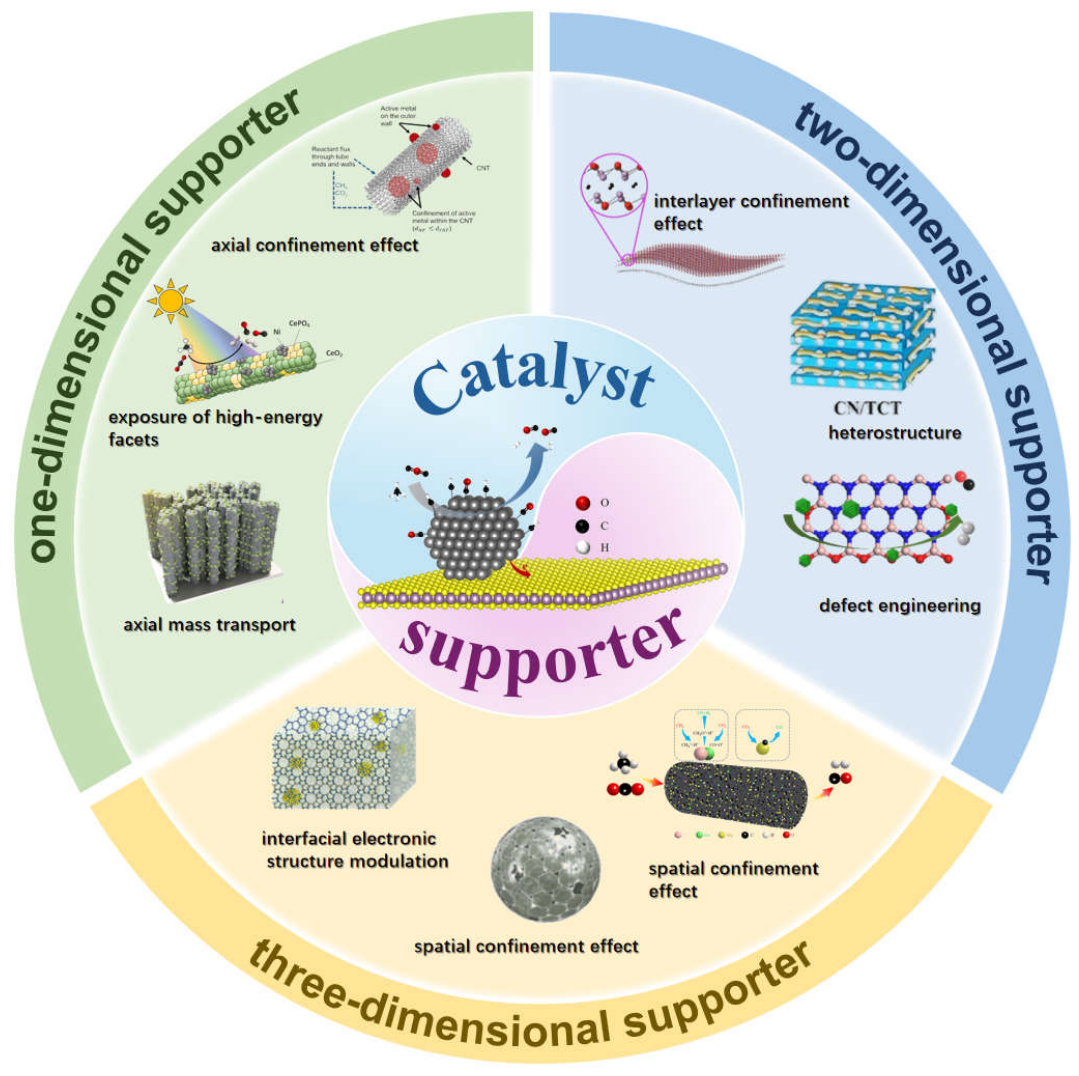
Figure 2.
(a) Operando DRIFTS spectra under sequential CH4 → CH4 + CO2 → CH4 feeding at 700 °C. (b) Operando DRIFTS spectra under reverse CO2 → CO2 + CH4 → CO2 feeding at 700 °C. (c) DRM reaction pathway and DFT energy profile at the Ir@CeO2−x interface.
Figure 2.
(a) Operando DRIFTS spectra under sequential CH4 → CH4 + CO2 → CH4 feeding at 700 °C. (b) Operando DRIFTS spectra under reverse CO2 → CO2 + CH4 → CO2 feeding at 700 °C. (c) DRM reaction pathway and DFT energy profile at the Ir@CeO2−x interface.
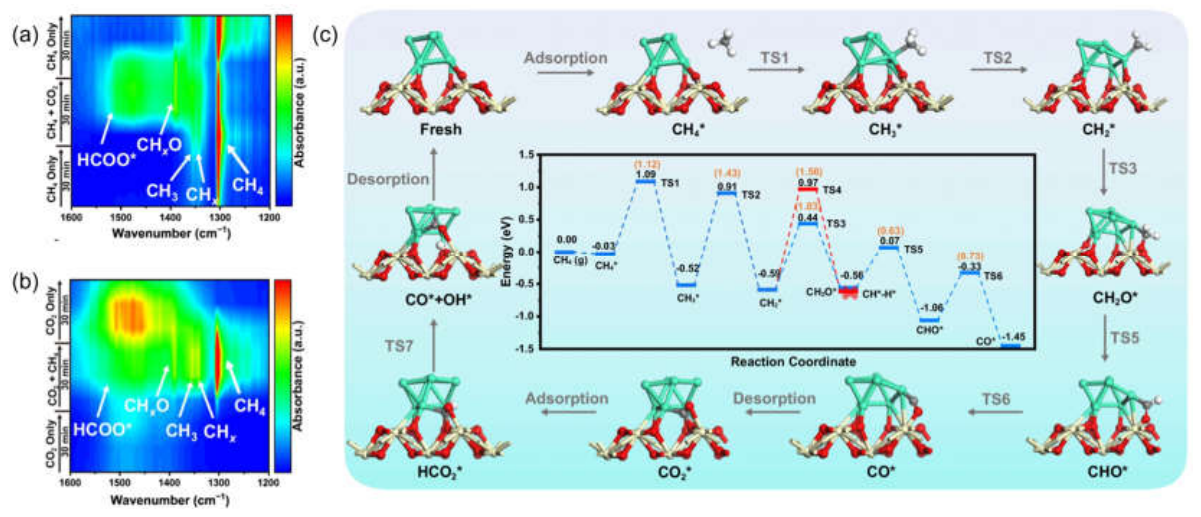
Figure 3.
(a) CO2-TPD-MS profiles of xNi/HAP and 0.3Ni/HAP-ref. (b) HRTEM image of Ni/Ce0.95Zr0.05O2. (c) EPR spectra of different Ni/Ce1−xZrxO2 catalysts. (d) O2-TPD profiles of the reduced catalysts. (e,f) CH4 and CO2 conversions of the catalysts at different temperatures.
Figure 3.
(a) CO2-TPD-MS profiles of xNi/HAP and 0.3Ni/HAP-ref. (b) HRTEM image of Ni/Ce0.95Zr0.05O2. (c) EPR spectra of different Ni/Ce1−xZrxO2 catalysts. (d) O2-TPD profiles of the reduced catalysts. (e,f) CH4 and CO2 conversions of the catalysts at different temperatures.
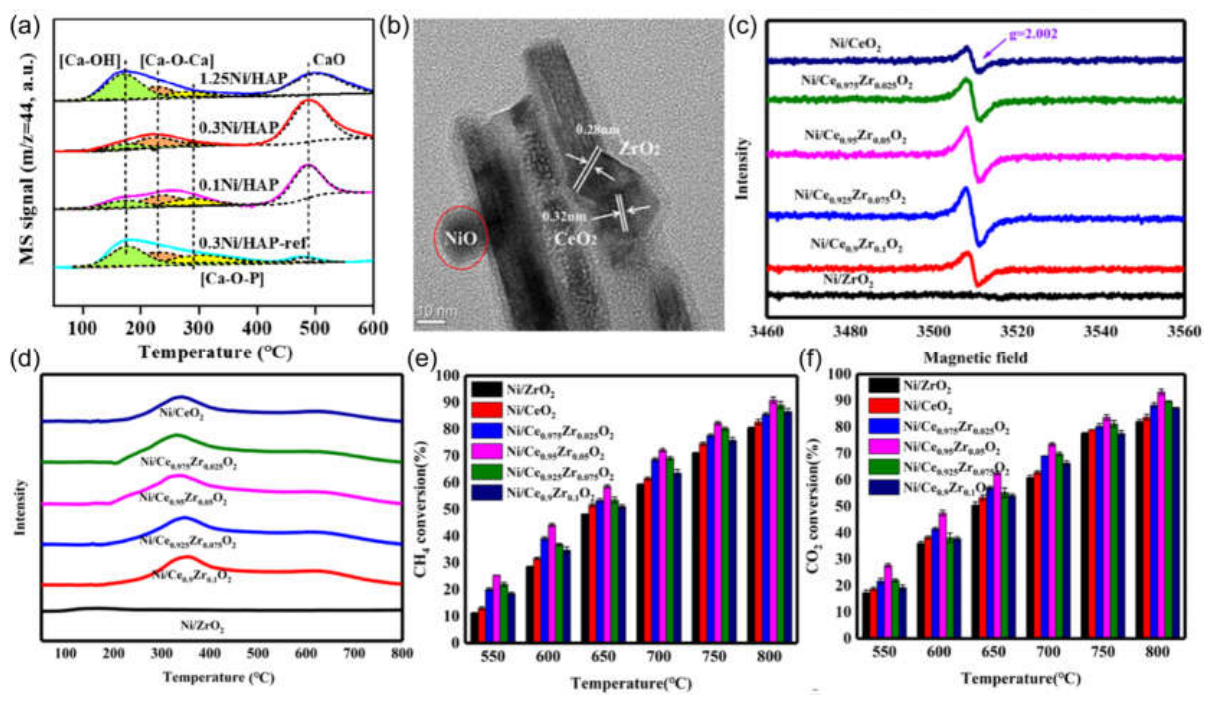
Figure 4.
(a) HRTEM image and selected-area electron diffraction of Ni and CeZrO2 nanocrystals supported on CNTs. (b) Contributions of DRM, RWGS, and CO2 deoxygenation to CO2 consumption over NiCZ/CNT. (c) TEM image of CeO2 nanorods and Ni nanoparticles in 2Ni−R. (d) DRIFTS spectra of reduced 2Ni−R during CO2 adsorption and temperature ramping. (e) Corresponding DRIFTS spectra of reduced 2Ni−C.
Figure 4.
(a) HRTEM image and selected-area electron diffraction of Ni and CeZrO2 nanocrystals supported on CNTs. (b) Contributions of DRM, RWGS, and CO2 deoxygenation to CO2 consumption over NiCZ/CNT. (c) TEM image of CeO2 nanorods and Ni nanoparticles in 2Ni−R. (d) DRIFTS spectra of reduced 2Ni−R during CO2 adsorption and temperature ramping. (e) Corresponding DRIFTS spectra of reduced 2Ni−C.
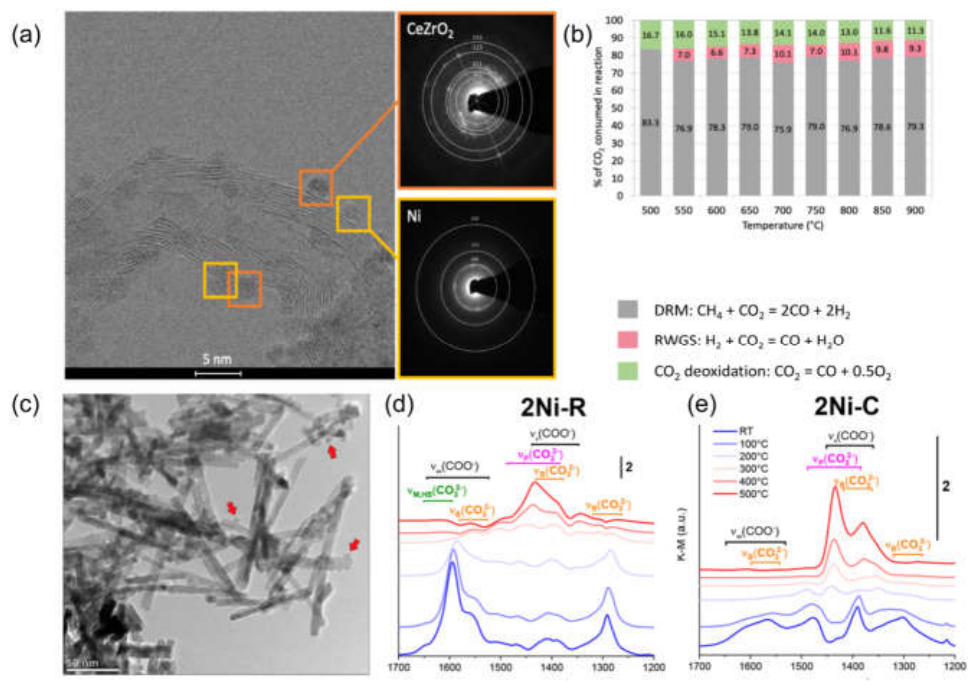
Figure 5.
(a) EDX elemental map of Ru2/SiO2@BN. (b) AC-HAADF-STEM image of Ru2/SiO2@BN. (c) EXAFS fitting results for Ru2/SiO2@BN. (d) TEM image of 2D-Mo2CTx/SiO2. (e) Correlation between the average Mo oxidation state determined by Mo K-edge XANES and DRM activity. (f) DRM stability of 2D-Mo2COx/SiO2 at different contact times.
Figure 5.
(a) EDX elemental map of Ru2/SiO2@BN. (b) AC-HAADF-STEM image of Ru2/SiO2@BN. (c) EXAFS fitting results for Ru2/SiO2@BN. (d) TEM image of 2D-Mo2CTx/SiO2. (e) Correlation between the average Mo oxidation state determined by Mo K-edge XANES and DRM activity. (f) DRM stability of 2D-Mo2COx/SiO2 at different contact times.
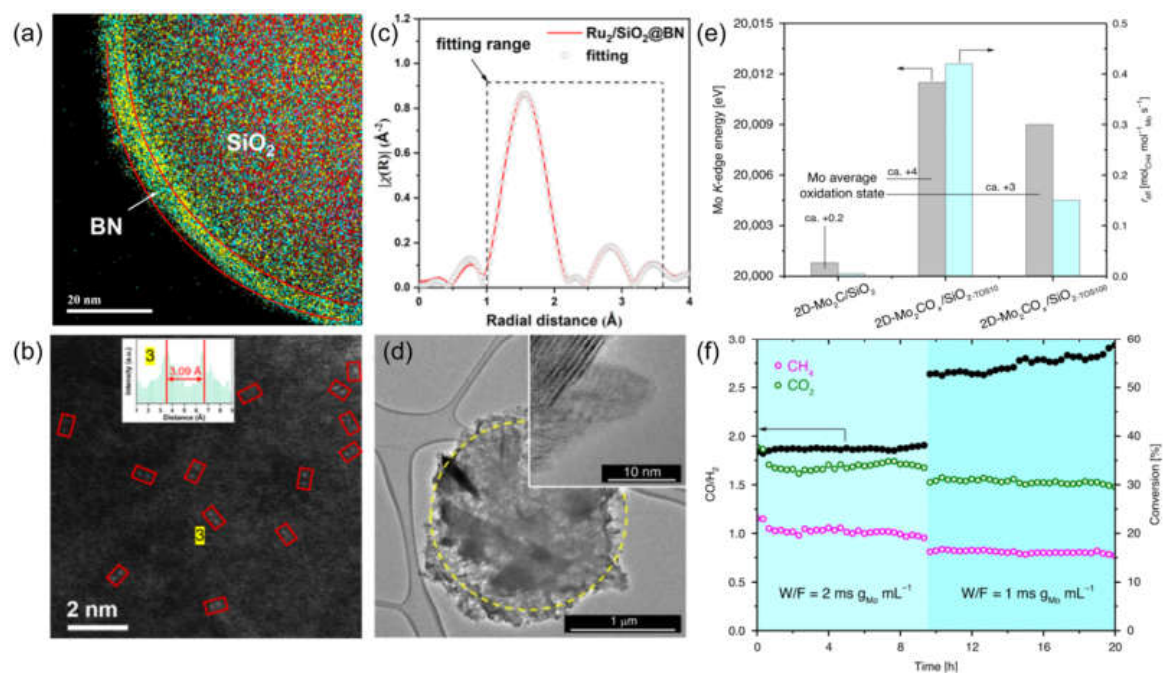
Figure 6.
(a) XRD patterns of m-V2CTx after carburization and subsequent DRM. (b) Isotopic transient response after switching from 12CO2 to 13CO2. (c) Isotopic response after switching from 12CH4 to 13CH4. (d) SEM image of V2O3–V8C7/m-V2CTx after DRM. (e) TG/DTG curves of the spent catalysts. (f) TEM, HRTEM, and metal-particle-size distribution of spent 6Ni6CuMgAl-S.
Figure 6.
(a) XRD patterns of m-V2CTx after carburization and subsequent DRM. (b) Isotopic transient response after switching from 12CO2 to 13CO2. (c) Isotopic response after switching from 12CH4 to 13CH4. (d) SEM image of V2O3–V8C7/m-V2CTx after DRM. (e) TG/DTG curves of the spent catalysts. (f) TEM, HRTEM, and metal-particle-size distribution of spent 6Ni6CuMgAl-S.
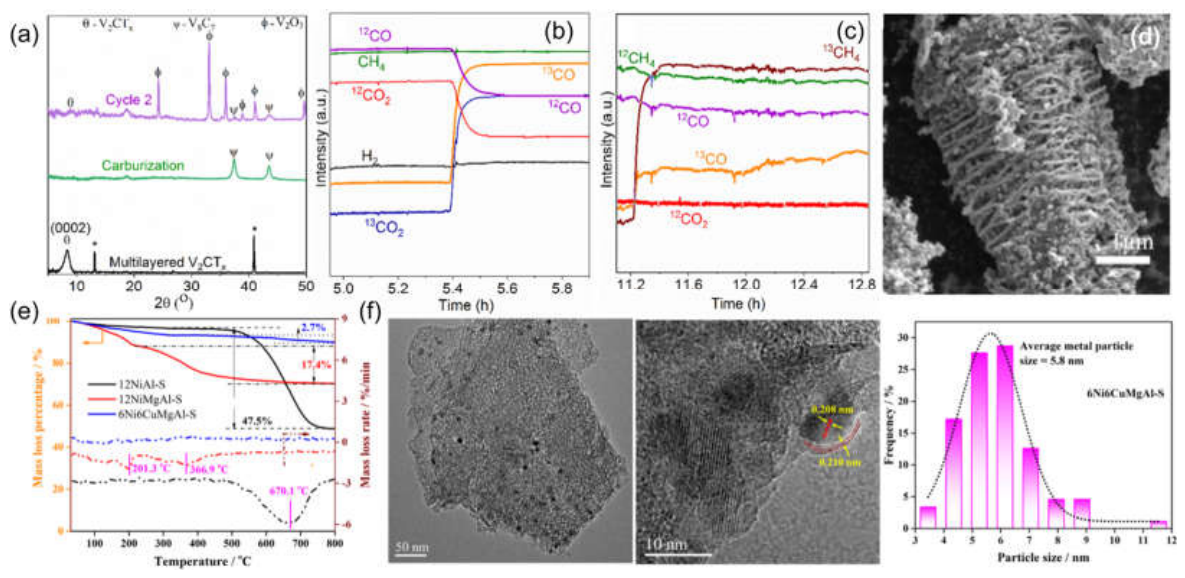
Figure 7.
(a) DFT-calculated effect of A-site Ce doping on Ni segregation energy. (b) HRTEM image of exsolved Ni nanoparticles in R-0.2Ce. (c) Ni K-edge XANES spectra of R-0Ce and R-0.2Ce. (d) CH4-TPR-MS profile of R-0.2Ce. (e) In situ DRIFTS spectra of R-0.2Ce at 500 °C during sequential CH4, CO2, and CH4 + CO2 feeding. (f) Ni K-edge EXAFS fitting results for Ni-MFI-HT. (g) Transient H2 MS response after switching from CH4 to CO2. (h) TGA curves of spent Ni-MFI catalysts.
Figure 7.
(a) DFT-calculated effect of A-site Ce doping on Ni segregation energy. (b) HRTEM image of exsolved Ni nanoparticles in R-0.2Ce. (c) Ni K-edge XANES spectra of R-0Ce and R-0.2Ce. (d) CH4-TPR-MS profile of R-0.2Ce. (e) In situ DRIFTS spectra of R-0.2Ce at 500 °C during sequential CH4, CO2, and CH4 + CO2 feeding. (f) Ni K-edge EXAFS fitting results for Ni-MFI-HT. (g) Transient H2 MS response after switching from CH4 to CO2. (h) TGA curves of spent Ni-MFI catalysts.
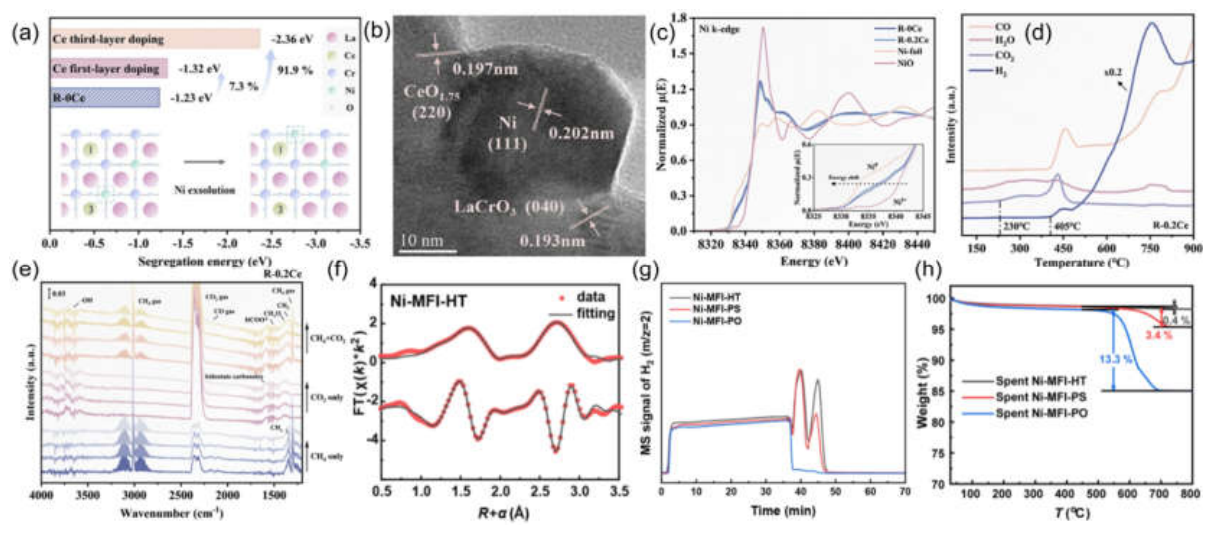
Disclaimer/Publisher’s Note: The statements, opinions and data contained in all publications are solely those of the individual author(s) and contributor(s) and not of MDPI and/or the editor(s). MDPI and/or the editor(s) disclaim responsibility for any injury to people or property resulting from any ideas, methods, instructions or products referred to in the content. |
© 2026 by the authors. Licensee MDPI, Basel, Switzerland. This article is an open access article distributed under the terms and conditions of the Creative Commons Attribution (CC BY) license (http://creativecommons.org/licenses/by/4.0/).
Copyright: This open access article is published under a Creative Commons CC BY 4.0 license, which permit the free download, distribution, and reuse, provided that the author and preprint are cited in any reuse.