

Submitted:
25 September 2026
Posted:
28 September 2026
You are already at the latest version
Abstract
Limited evidence quantifies the relevance of cultural heritage during post-disaster recovery. To fill this gap, this paper explores the relevance of cultural heritage in the post-disaster recovery of L'Aquila (Italy), which was hit by an earthquake on 6th April 2009.This manuscript combines sentiment, topic and word frequency analyses of tweets posted on Twitter/X around the tenth anniversary of the earthquake. Sentiment and topic analysis are performed at the tweet and sentence levels, using 4,349 tweets posted from 4 to 10 April 2019 with the hashtag #L’Aquila. Results show that cultural heritage is the main topic in 14 tweets (0.3%) and one of the topics in 243 (5.6%) tweets, which was lower than expected in a town rich in historic buildings and monuments such as L’Aquila. However, our sentiment analysis indicates that the predominant polarity in tweets on cultural heritage is positive at both the tweet (79%) and the sentence levels (85%). The word frequency analysis enabled the identification of the most popular heritage artefacts in L’Aquila. We conclude that the restoration of cultural heritage contributed to the recovery, but its relevance is not immediately visible to the local population.
Keywords:
cultural heritage
; post-disaster recovery
; L’Aquila
; earthquake
; social media
; Twitter/X
; sentiment analysis
; topic analysis
; urban reconstruction
; restoration
1. Introduction
There is limited evidence to quantify the relevance of cultural heritage during post-disaster recovery. This paper explores the role of cultural heritage in the recovery 10 years [1] after the 2009 earthquake in L'Aquila, the provincial and regional capital of the Abruzzo region, Italy, located in a medium seismic zone northeast of Rome [2].
1.1. Historical Background
L’Aquila is an ancient city built by masters who carved and chiselled the stones and portals of its churches and palaces, and that has survived the devastation of earthquakes [3,4]. This mountain city, with rugged stone houses [4], currently covers 474 Km2 and was founded in 1254. It was later destroyed by Manfred, King of Sicily, and reconstructed again as a free commune in 1266 under the rule of another King of Sicily: Charles of Anjou [5]. In the 15th Century, L’Aquila became the most flourishing city in the Kingdom after Naples, due to its industries and printing works, to decline again at the beginning of the next century after the dismemberment of the county in 1529 by Charles V, King of Sicily and Naples, and the subsequent alternating sides between France and Spain. The city rose again under the rule of the Bourbons, with Charles III of Spain, before declining once more. Its inhabitants participated with the rest of Abruzzo in the uprising against the French and in the Risorgimento after the annexation to the Kingdom of Italy, when the city suffered greatly from brigandage [5].
The main monument constructed in L’Aquila during the 13th Century is the Romanesque church of Santa Maria di Collemaggio [4,6] (Figure 1a), whose construction began in 1287 and served as a model for other churches in the region. The Cathedral of L’Aquila (Figure 1b), the churches of San Pietro di Sassa (Figure 1c) and Santa Giusta di Bazzano (Figure 1d), also date back to the 13th Century [7]. Although the Cathedral was damaged several times by earthquakes, it was rebuilt in the 18th and 20th Centuries [5]. Another historic monument that dates back to the 13th century is the fountain of the 99 spouts (Figure 1e), a trapezoidal plan with high walls in a checkered pattern of pink and white stone constructed in 1272 [8] and modified in the 15th and 16th centuries [5].
By the 14th century, the city still retained its medieval layout within its walls [2,9,10,11,12,13]. During this century, the churches of San Domenico, portrayed in Figure 2 (a), Santa Maria Paganica depicted in Figure 2 (b), Santa Maria di Roio presented in Figure 2 (c) and San Bernardino showed in Figure 2 (d), (e) and (f) were constructed. The façade of San Bernardino was designed by the Renaissance Italian architect, painter and sculptor Nicola Filotesio, also known as Cola dell’Amatrice. This façade integrates the influences from Roman works from the early 16th century and the tradition of medieval Abruzzo architecture [2,5,9,10,13]. By this century, L’Aquila counted with a splendid city centre with baroque decorations [14] and coats of arms [15]. In the 16th century, construction of the Spanish Castle (1530-1635) portrayed in Figure 2 (g), a square-plan building with polygonal corner bastions, began. It was restored in the first half of the 20th century and currently houses the National Museum of Abruzzo [5].
The city was called Aquila until 1939. The economy of L’Aquila benefited from tertiary activities that replaced pastoral activities, agriculture, and artisanal leatherworking, as well as wood, textile, and metal production, encouraging demographic recovery after the de-population of the 1970s. Commercial and administrative functions prevailed alongside the establishment of research facilities and the University in 1964. The Rome-Abruzzo-Gran Sasso-Teramo motorway is the region’s most important road connection [5]. The proximity to the majestic Gran Sasso mountain [4] attracts many tourists to L’Aquila and before the earthquake this city was strongly identified with its historic city centre (among the top 10 in Italy) [16,17]. This historic centre used to be the pulsating heart of the city [18], functioning as the main business district, a centre of monumental value, a prime hub for socializing and a location for real estate investment [17]. L’Aquila, designated the Italian capital of culture for 2026 [19], was awarded with this distinction due to its unique historical heritage, contemporary culture and polycentric territorial system [19]. Despite this legacy, none of the heritage monuments and places of L’Aquila have been included in the United Nations Educational, Scientific and Cultural Organisation (UNESCO) World Heritage List [20].
Several strong earthquakes have struck L'Aquila and its cultural heritage throughout history including 1315 [6], 1349 and 1461 [6,21,22], with the most severe occurring on the2nd February 1703 [4,6,21,23]. The church of Santa Maria del Suffragio, also known as the Church of the Holy Souls [24], was built in 1713 as a tribute to the victims of this earthquake [25] and to symbolise the reconstruction of the city in the 18th Century [25,26]. Another building constructed after the 1703 earthquake [8] was the Palazzo Ardinghelli [27], located around the square Santa Maria Paganica [27]. Designed by Francesco Fontana, it was built between 1732 and 1743 [28], a period during which the Ardinghelli family of Tuscan origin [29] became extinct [8]. This palace is considered one of the finest examples of Baroque architecture [14] in L'Aquila [29]. In 1915, another earthquake devastated the Marsica area and the town of Avezzano [4], located within 54.5 km of L’Aquila.
1.2. Impact of the Earthquake on Cultural Heritage
On the 6th April 2009 [2,6,21,30,31,32,33,34,35,36,37,38,39,40,41,42,43,44,45,46,47,48,49] at 03:32 am [1,4,22,32,46,47,50,51,52,53,54,55,56,57,58,59,60,61], an earthquake with a magnitude of 6.3 Mw [9,13,26,37,45,52,55,57,58,62,63,64,65,66,67,68,69,70,71] struck L’Aquila again [1,5], a city that hosted approximately 70,000 people at the time [41,64]. This earthquake affected also other 55 municipalities [21]. The epicentre was in the neighbouring town of Poggio di Roio, 3.4 km to the southwest of the city. L’Aquila was severely damaged, 309 people lost their lives [2,12,13,24,31,32,33,36,37,38,42,45,46,47,48,49,51,52,53,54,55,57,58,63,64,66,68,69,70,71,72,73,74,75,76,77,78], between 1,500 [50,60], 1600 [2,12,13,32,33,38,42,47,48,49,52,54,55,56,58,68,74,75,76], 1178 [73] and 2000 [63] were injured, from 65,000 [42], 67,000 [63,74] to 67,500 people became homeless due to the earthquake, between 65,000 [73] 70,000 [68,69] and 80,000 [2,13,33,35,36,37,38,47,49,54,56,70,75] people were displaced, including 13,000 university students [32] and 10,000 buildings were damaged [1,69,79]. Although hundreds of works of art were rescued from the debris, [61] a vast artistic heritage [2,49], palaces, and over a hundred of churches [13,17,32,34,44,69,74,75] from the middle ages [80], all masonry structures of varying importance and size [81], were counted in the list [66] of 700 buildings, that according to the Italian Ministry of Cultural Heritage and activities (MiBACT, by its acronym in Italian) needed to be repaired or reconstructed [1,9,31,32,34,57,63,68,73] given the damages by the earthquake [21,37,39,43,47]. As those buildings located on the main street (Via Roma culminating in the Palace located on the corner of Via Cascina) [81] were part of one of the largest historic centres in Italy [41,51],this damage is considered incalculable [82]. Damages to historic buildings included the collapse of roofs, vaults, floors and walls, as well as the formation of cracks and through-holes in the masonry and floor structures. This level of damages required to secure building with external and internal shoring and controlled demolition for some buildings with severe damage [81]. Those damages were produced by: the lack of sufficient connections to tackle first-mode failure mechanisms; the presence of trust systems such as vaults, inadequately restrained roofs, insufficient support of the beams; the extremely low mechanical performance of the masonry; the poor quality and conservation of the mortar; and the weakening of the resistance of the structures given internal modifications [81].
It is estimated that between 1.5 and 3 million tons of waste were generated [73,83]. Ironically, the church of Santa Maria del Suffragio suffered extensive damage to the floor and the main altar, while the dome collapsed almost completely. The Italian Civil Protection Department immediately mapped the area and conducted a building damage survey to establish a red zone inaccessible to residents, that corresponded to the historic city centre [73].
On the 13th April 2009, the superintendent Angelo Galletti planned to enter the church of Santa Maria del Suffragio and save the polyptych that was in its apse [65]. The image of this heavily damaged church became a symbol of the city's devastation [26] as it is portrayed in Figure 3 (a). The rubble of the Valadier Dome of the Church of the Anime Sante was seen around the world just after the earthquake while the dome of the Church of Sant’Agostino also collapsed. The Basilica of Santa Maria di Collemaggio was seriously damaged [84] and remained under surveillance after the earthquake. The body of Celestine V, buried in this church, was rescued. The organ was under the rubble, paintings from the basilica, including the Coronation of Celestine by Carl Ruther, were collected by the Italian Civil Protection Department and the Superintendency [65]. The walls of the courtyard of Palazzo Ardinghelli collapsed with the subsequent partial destruction of the portico, and substantial damage to the upper floor, due to the massive collapse of the roof in various places [29]. In the morning of the 13th April 2009 a team of art historians, architects, technicians, and volunteers from Legambiente began conducting building inspections and compiling assessment forms for restoration projects. They were vigilant to avoid demolitions and reported the need to prop up unsafe churches. This team followed intervention models that included the recovery, cataloguing, packaging, and transportation of cultural heritage artefacts to protect these elements and avoid illicit appropriation by ‘collectors’ [65].
Dozens of smaller towns in Abruzzo were severely affected too [42,64,67,73]. Onna, a small hamlet located8.3 Km to the southeast of L’Aquila, was almost entirely erased by the earthquake [10,32,68]. 85% of its ancient buildings collapsed [85], and its city centre was severely affected [68]. The statue of Our Lady of Onna withstood the destruction, unharmed, while the statues of saints had fallen to the ground [50]. The eighteenth-century church Santa Maria della Concezione in Paganica, a hamlet located just seven kilometers from L’Aquila [11], was seen around the world with its façade teetering, torn, and partially collapsed. Nearby the parish church of Santa Maria Assunta, constructed on the 13th century and renovated on the 17th century, appeared intact from outside but with damage inside [21]. In Chieti, the floor of the Palazzo d’Achille collapsed, and the courthouse and church of San Francesco suffered significant damage. Half of the courthouse was declared unusable. Damage was also reported in the Cathedral of San Giustino, affecting the circular dome above the main altar, the arches, some stairways, the entrance and the water mains [46]. Other towns affected by the 2009 earthquake were Castelnuovo, Sant’Eusanio Forconese, San Gregorio, Tempera and Villa Sant’Angelo [68]. The earthquake also erased a Vatican reserve that had lasted at least 715 years [4]. By 2011, only houses with minor damage had been repaired, whereas reconstruction in L’Aquila city centre began only in 2014 [86].
1.3. Post-Disaster Recovery: Tenth Anniversary of the Earthquake
After the 2009 earthquake in L’Aquila, the Minister of Culture, Sandro Bondi, allocated 10 million Euros from the Ministry's budget to the recovery of cultural heritage in L’Aquila. Another five million were earmarked for the Polo Museale based on an agreement with the Minister for Economic Development, Claudio Scajola. The general director of Museum Development, Mario Resca, planned to travel, stopping first in the United States to contact those willing to donate to restore damaged monuments. A ‘competition of solidarity’ [34] was launched focused on cultural heritage, which according to the regional director of Cultural heritage, Anna Maria Regianni, would contribute to construct a ‘collective soul’ to an area historically ‘riddle with particularisms’ [65]. The Interministerial Committee for Economic Planning and Sustainable Development (CIPESS, by its acronym in Italian), formerly known as CIPE, earmarked 2.4 billion Euros for private reconstruction in the affected historic centres. However, this reconstruction started only three years after the earthquake. The value of the yearly amounts approved by the Special Office for the Reconstruction of L’Aquila (USRA, by its acronym in Italian) remained constant except for 2015, when there was a peak of over 450 million to finance large complexes located in the historic centre of L’Aquila [87].
By the tenth anniversary of the earthquake [2,3,13,21,34,35,39,43,44,50,59,63,74,88,89], L’Aquila, was still considered the largest construction site in Europe [3,10,16,21,32,37,48,74,90,91]. This characterisation, particularly concerned its city centre [64,88,92], as the historic centre was still full of around 50 cranes [48,78] and construction sites [71,75], because there was still much to be done, according to Sergio Mattarella, President of Italy [34,39] and Gianluca Vacca, Undersecretary of State for Cultural Heritage [51]. Entire streets, hence, continued to be inaccessible to the public [78]. Ten years later [6,10,12,15,16,17,22,30,31,34,37,39,42,44,45,46,47,49,54,66,67,69,70,77,78,84,90,92,93,94] the reconstruction of L’Aquila, remained a major national challenge for Italy [1,9,22,34,39,43,44,55,93] due to its slow progress [50,51,58,76] as work continued mainly in the historic city centre [32], which by then was still uninhabited [9,10,22,30,45,48,55,58,62,73,74,78,93,95], especially in the night as only 30% of the damaged buildings had been restored [42,58]. According to Pellegrino, L’Aquila residents were starting to forget the names of the alleys in the historic centre and the only street that was still alive in the night was Via Garibaldi, thanks to the bars and clubs [30]. Streets such as San Pietro and San Domenico were still as they were on the 6th April in the morning [37]. The reconstruction of the historic city centre was planned to be completed by 2022 [9,58,69], 2023 or 2024, according to the Director of the Special Reconstruction Office of the Municipality of L'Aquila: Salvatore Provenzano [91]. The reconstruction of historic monuments was entrusted to private firms, based on the belief that they had higher standards than local construction companies. This assumption was later proved wrong when it was found that they were negotiating with the Camorra to obtain low-cost labor [73].
Ten years after the earthquake [43,76], the destruction in Onna was also visible [6,60]. The roofs of the stone buildings were still collapsed, entire walls were missing and residential buildings remained uninhabitable in this historic city [50,60]. The hamlets of Ona still awaited the reconstruction process [31,42,90,93], only one street had been cleared from rubble [10] by 2019. Among the buildings in this town there is a monument called ’Madonna of Remembrance’, located at the spot where the bodies of the dead were first brought [60]. The statue of the Virgin in the church of Onna also serves as a reminder of the earthquake. In Paganica, the time seemed to have stood still since the 6th April 2009 by the tenth anniversary [11]. Similar situations were reported in other historic centres in the L'Aquila area, where rubble was still there, and the reconstruction was extremely slow [2,12,67,76,78,91,96,97]. The risk of losing historical features of Santo Stefano di Sesanio due to inadequate restoration was denounced by Italia Nostra [72]. The churches Santa Maria della Concezione and Santa Maria Asunta were currently temporarily closed. Ten years later, the restoration of Palazzo d’Achile in Chieti was almost complete, however, it had not yet reopened due to false announcements and mishaps involving the company that obtained the contract, and other delays. The opening date of this historic municipal building was unknown by the tenth anniversary of the earthquake [46]. Instead, the restoration and bringing the Chieti courthouse up to code were completed seven years later. The church of San Francesco was reopened ten years later for the urban trekking event, albeit with precautions for visitor safety [46].
On the contrary, historic buildings and churches [12,93] in L’Aquila had been repaired by the tenth anniversary of the earthquake [1,3,10,32,50,58,63,69,91]. 11 historical churches and numerous noble and ancient palaces had been rebuilt [22,96]. The reconstruction of the public and private heritage was coordinated by the MiBACT [81] Regional Secretariat, which secured €1.5 billion approved over 10 years [32]. The restoration of cultural heritage resumed thanks to a list prepared by the Molise National Research Council (CNR) that included crypts, abbeys, churches, museums and other sites scattered throughout the province of L’Aquila. Another list of cultural heritage artifacts recovered in L’Aquila was prepared by the Curia’s treasury counting canvases, 17th-Century confessionals, organs, manuscripts, monstrances, chalices, and crosses. These elements were sent to the vaults of the Carabinieri Cultural Heritage Unit [65].
The church of Santa Maria del Suffragio [32,64] was reopened on the 6th December 2018, despite the construction equipment was still present on site. The quick restoration [24] of this church, that included the reopening of part of the nave in 2010, less than one year after the earthquake, was possible thanks to the invitation of the Italian government to foreign countries to adopt one of the monuments [21,52]. Therefore, the total restoration of the church of Santa Maria del Suffragio started in 2014 as a collaboration between France and Italy [26,58]. The progress of the restoration of this church by 2010, 2012, 2014, and 2016 is portrayed in Figure 3(b), (c), (d), (e), and (f) respectively. The Basilica of Santa Maria di Collemaggio could be visited since 2014, but the scaffolding and props were still visible inside until it was reopened in 2017 after a major restoration [84].
The Chiesa of San Pietro Apostolo was reconstructed in Onna [32] by a German team [73]. Unfortunately, this was not the case for some of the 251 churches in the diocese of L’Aquila, which were still damaged and unsafe by the tenth anniversary of the 2009 earthquake, due to the slow pace of reconstruction [13,66]. This was the case with the Cathedral, the most important church in L’Aquila in the main square, diagonal to the church Santa Maria del Suffragio, where reconstruction works had not started by that time. It had a caved-in roof, left to rot, the frescoes and all the assets exposed to the weatherability [98]. The delays in the reconstruction of some churches are due to a dispute initiated by the Curia, which required it to be the sole contracting authority and to award the work through private negotiations, in defiance of the Ministry of Cultural Heritage and Activities' decision and the need for public tenders [17].
The condition of the historic city centre by the tenth anniversary based on reports on social media indicates some partially rebuilt areas, excellent restoration of buildings and structures of historical and architectural value. According to officials, by 2019 L’Aquila had become the safest city of Italy, located in a seismic hazard zone, considering that the most cutting-edge reconstruction techniques had been used [48]. In contrast, other buildings looked like they did ten years before after the earthquake [17]. The interventions reconciled the need to ensure adequate structural safety and conservation aspects of the historical buildings. Those interventions included: 10 cm seismic joint dividing the aggregate in two, masonry work on the lower-level stone walls, demolition in the upper levels, construction of reinforced concrete foundations and curbs, reparation and reinforcement of vaults, connection of reinforced concrete slabs to steel beams, and the reinforcement of roofs, which were supported by stone walls or with laminated wood beams [81].
By 2019, according to the undersecretary for reconstruction, Vito Crimi, the private reconstruction at the city centre had reached between 73.13% [11,87], and according to other estimates, 74% [41,63,92,93], 75% [56], progressing more quickly [12,51] than the public reconstruction [6,56,58,89,92], which was delayed by bureaucracy [66,90], understaffed offices and regulatory chaos [26,51,63]. Another building that benefitted from the international and interinstitutional collaboration [29] and was therefore quickly restored was the Palazzo Ardinghelli. This building acquired by the Italian government [8] was restored thanks to the financial contribution of the Russian Federation. On 30th October 2020, Palazzo Ardinghelli was opened to the public as a section of MAXXI , the Roman Museum of Arts of the 21st Century [29]. The building that houses this museum established a strong connection with the Palazzo, adopting the same architectural lines and respecting the volumetric proportions (solids and voids), while contrasting the austere eighteenth-century moldings of the Palazzo Ardinghelli with the geometric patterns of its façade panels [27]. Another monument restored by the tenth anniversary is the long-standing symbol of the city: The fountain of the 99 spouts. By that time, works were also underway near Porta Bazzano and along Costa Masciarelli, where, although still hidden behind scaffolding, old houses were gradually revealing their colorful facades again [64].
However, these are isolated examples, because the recovery of the rest of the historic city centre was still infuriatingly slow [30,37,41,64,66,74] by the tenth anniversary. Before the earthquake, the historic city centre was home to more than 10,000 people [11,45,76] and over 1,200 [70,97] commercial, artisanal and professional businesses [17]. According to Confcommercio [93] only between 20 [70] 60 [72],80 [10,93] or 83[45] and 86 (7.1%) businesses in 2019 had reopened, out of the 1000 [72,74,93] or 1,200 [97] that existed before the earthquake. Moreover, those that had been reopened were heavily focused on traditional products, intended mainly for tourists [59]. Carla Bianchi, a L’Aquila resident in 2019 states:’ You have to be very bold to open a store in a ghost town centre’[10,72]. By the time of the tenth anniversary, the historical city centre was an empty shell [6,60,89], with 1% of the commercial activity that existed before the earthquake [33,55]. However, remote workers recommended L’Aquila as an ideal place for them and digital nomads, given the hospitality in the bars, awesome co-working spaces, large availability of flats to rent in the restored historical buildings that sometimes included vaults and frescos in living rooms, and the cultural activities, such as the Perdonanza Celestiniana, book presentations and public lectures [36]. The German Chancellor at that time, Angela Merkel, supported the reconstruction in Onna with €3 million [50,58,60] but was not formally adopted. This was a reconciliation action for the massacre of 16 [85] or 17 people committed in 1944 by the Nazis [50,85].
In 2019, the Undersecretary of State for Cultural Heritage in Italy announced the allocation of approximately €1 million for a series of cultural initiatives to mark the tenth anniversary of the 2009 Earthquake in L’Aquila. These initiatives aimed to connect the reconstructed sites showcasing the city’s tangible cultural heritage, represented by restored architectural and museum treasures [51]. In the same year, the interim Regional Secretary of the Ministry of Cultural Heritage and Activities for Abruzzo, Stefano D’Amico announced the allocation of €49 million to the public heritage reconstruction sector through the CIPE Resolution No. 112 of December 2017. 85% of these financial resources were allocated to ecclesiastical buildings, with 247 public heritage projects implemented since 2012, spending €226 million in funding, of which 116 had not yet begun by 2019 (almost 47% of the total), 19 were ongoing, and 112 were completed [51]. According to Alessandra Vitorini, the Superintendent of Archaeology, Fine Arts, and Landscape for L’Aquila and the Crater (officially delineated seismic zone involving 56 municipalities around L’Aquila), by 2019, 942 buildings and sites had been declared of cultural interest located in the area affected by the 2009 earthquake. 675 (71.7%) of those buildings and sites were located in L’Aquila and the surrounding areas, the remaining 267 (28.3%) in the crater. Additionally, there are other public assets, including churches, palaces, fountains, monuments, monasteries, gates, walls and towers, protected by law for a total of 2,000 properties of cultural interest.
By that time €1.3 billion were allocated to the reconstruction of private cultural heritage [32], with 313 approved projects (95% of the projects submitted) [63] mostly completed [32]. Several iconic basilicas, among a total of 25 monuments, were restored in the city, and by the end of 2019 it was expected that the churches Santa Maria del Soccorso, San Silvestro, San Pietro Coppito, and San Filippo Neri [15] would reopen. The special Superintendent for the areas struck by the 2016 Amatrice earthquake [22,63], Paolo Ianelli, stated that L’Aquila represents an example of a benchmark approach to building heritage, compatible with a protection model [51]. However, by the 10th anniversary [24,49], it was estimated that a further €7 billion would still be needed to complete the reconstruction [55].
1.4. The Role of Cultural Heritage on the Post-Disaster Recovery
Following an earthquake, there is an urgent need for information [99,100], which is why data collection typically occurs in place during the relief period or emergency phase [101]. Post-disaster recovery is divided into three [102] or four phases [101,103]: emergency response or relief, early recovery, recovery and development. Collecting data only during the emergency response phase yields limited knowledge of post-disaster recovery in the medium and long term. The anniversary of earthquakes provides a window of opportunity to collect additional valuable information and evaluate the progress of the recovery [104]. In the past, data were collected through on-site missions [105] that included academics and practitioners in geology, civil engineering, and architecture. Today, Social Media (SM) and crowdsourcing platforms turn their users into ‘people as sensors’ [102,106] who can generate and provide updated image and text data after earthquakes [107], or any other natural or man-made phenomena, not only during the emergency phase but also during the recovery and redevelopment phases.
However, text data obtained from SM is unstructured, necessitating the support of Natural Language Processing (NLP) techniques to extract information [108,109]. The NLP is a branch of artificial intelligence that enables machines to understand human language by analysing sentences and words. One specific NLP technique is Sentiment Analysis (SA), also known as 'opinion mining'. This NLP application classifies people's opinions, attitudes and emotions towards entities and their attributes, as expressed in written text, into a specific polarity (positive, negative or neutral) [110,111]. These entities can be products, services, events, organisations, individuals [112], or objects of social research [113]. Another NLP technique is topic analysis and topic modelling, which extracts meaning from text by identifying recurrent themes or topics in large collections of text data. In topic analysis, the text is classified according to predefined topics, while in topic modelling, a machine learning algorithm identifies the topics. Sentiment and topic analysis can be performed at three levels of granularity: document, sentence, feature, or aspect level. Extracting information from social media text using NLP can improve situational awareness and boost information dissemination during emergency response, as well as enable monitoring of the recovery of affected communities [109]. This last action is essential for emergency response institutions, government agencies, and non-governmental organisations to focus their action plans on the long term.
Sentiment analysis has been applied to SM posts to predict subsequent incidents [114] during the emergency response phase after earthquakes and other natural phenomena, but there is scarce evidence of its application to evaluate recovery or redevelopment [115]. The same happens with topic modelling, which has been used for identifying the distribution of demand for humanitarian aid after Typhoon Haiyan in 2013 [116], identifying basic needs of the population after India-Pakistan floods in 2014 [117], damage assessment after the Napa earthquake in 2014 [118], after Hurricane Harvey in 2017 [119] and the Aegean earthquake in 2020 [120]. Topic modelling in post-disaster recovery has been used by Yan et al., combined with SA to extract information from tweets about Lombok and Bali after a series of earthquakes in both places in August 2018 [121]. Contreras et al. have also combined sentiment and topics for the cases of Nepal [122] and L’Aquila [108], and in the latter publication, cultural heritage was identified among the topics mentioned by users, which already indicates relevance to the recovery process.
There is limited research about the role of cultural heritage during the recovery and redevelopment of urban spaces after disasters. Only KC, Karuppannan and Sivam [123] attempted to fill this gap, focusing on the role of cultural heritage in maintaining socio-cultural values during the reconstruction of zones impacted by the 2015 Gorkha earthquake. Cultural heritage is defined as monuments, groups of separate or connected buildings, and sites that are of outstanding universal value from the perspectives of history, art, science, and ethnology or anthropology [124]. However, the broad definition of cultural heritage is not limited to artefacts, such as monuments, buildings and sites. It also includes inherited living expressions and traditions passed from ancestors to descendants, such as knowledge and skills for producing handicrafts, practices concerning nature and the universe, festive events, rituals, social practices, performing arts and oral traditions [125]. That is why cultural heritage is classified into tangible and intangible. Tangible heritage includes monuments, buildings, and sites, and intangible heritage involves living expressions and traditions.
Tangible and intangible heritage are increasingly crucial to societies, providing a sense of belonging, serving as an anchor in a fast-changing world, and being identified through people's interactions with their environment [123]. Earthquakes and aftershocks cause substantial damage to historic buildings and disrupt daily activities, traditions, and rituals [123]. Cultural heritage is valuable but often fragile, so it is essential to understand its role in the aftermath of a disaster to encourage its protection, conservation [126] and restoration. The practice of traditional rituals improves the capacity of communities affected by disasters to cope with their impact and return to normality [127], helping people to express emotions associated with the disaster [128], and assisting in the recovery process [129]. Methods such as surveys and semi-structured interviews have been used in the past to understand the role of cultural heritage in the post-disaster phase [123]. We consider that social media platforms can also serve as a tool for understanding this role and its significance in the recovery process.
Cultural heritage is one of the societal aspects which are most affected by a disaster. This research aims to quantify the relevance of cultural heritage and specific artefacts to the recovery process after the 2009 earthquake in L'Aquila, extracting information from social media on the tenth anniversary of the earthquake and combining sentiment, topic, and word-frequency analyses at different levels of disaggregation. We hypothesise that the restoration of cultural heritage played a key role in the recovery from the earthquake in L’Aquila and that this relevance can be measured by the mention of artifacts in tweets related to the earthquake's tenth anniversary.
This paper is divided into five sections. The introduction describes the case study area, and illustrates the event that sparked our interest, the reconstruction of the tangible cultural heritage and our approach, our aim, and our hypothesis. The second section explains the methodology in detail. The third section presents our findings across different levels of text data disaggregation, and the discussion elaborates on them, ending with the conclusions.
2. Materials and Methods
Our research methodology involves eight steps: 1) hashtags identification; 2) hashtags selection; 3) data collection; 4) data extraction; 5) data processing; 6) sentiment analysis; 7) topic analysis, with the identification of tweets addressing the topic of cultural heritage; 8) word frequency analysis at the tweet level, at sentence level, and on the content of links on those tweets.
First, we identify hashtags related to the 10th anniversary of the L’Aquila earthquake. By monitoring social media in the days before and after the 10th anniversary, the first author identified eight relevant hashtags: #L’Aquila, #Laquila10annidopo, #LAquilaGrandiSperanze, #PortamiDoveSeiNata, #ionodomentico, #terremoto del #6aprile, #6aprile2019, and #forzalaquila [130]. Second, the most frequent hashtag was selected among this set of hashtags related to the anniversary: L’Aquila. Third, tweet data was purchased from a third-party vendor using the selected hashtag. Fourth, 4,349 tweets posted from 4 to 10 April 2019 with the hashtag #L’Aquila were extracted from the report provided by the third-party vendor. Fifth, the collected data were processed and prepared for analysis [104]. The sixth and seventh steps focused on segmenting tweets addressing cultural heritage at the post and sentence level to quantify them and determine their polarity. Tweets classified into the topic of cultural heritage are those that mention physical artefacts and intangible attributes from the past [108]. Combining the collective expertise of the authors in post-disaster recovery processes, human geography, architecture, urban planning, data and knowledge engineering, structural engineering, earthquake reconnaissance and their knowledge of the case study area, a set of classification rules for polarity and topics was agreed on, using a reflexive process to internally validate our classification via sample cross-checks and a final moderation by the first author. Actions that contribute to the recovery process are considered positive. Aspects that delay the recovery are classified as negative, while the invitation of commemoration ceremonies and seismic information are classified as neutral [108]. We acknowledge that not everyone will agree with our classification, nor will all tweets associate with a specific rule falling into a unique category, which is why there is an additional classification at the sentence level. However, we argue that most of our rules would not be controversial to most people, and most tweets associated with each rule will fall into the category we have selected for it [104]. The classification rules per polarity are listed in Table 1.
The eighth step was a word-frequency analysis using word clouds to visualise the most frequent cultural heritage artefacts mentioned in tweets, links embedded in these tweets, sentences included in other tweets on which cultural heritage is not the main topic, and links embedded in them. This analysis will help us identify the key cultural heritage artefacts in L’Aquila discussed during the recovery process ten years after the earthquake and their relevance, as reflected in their frequency of mention. The flowchart of the applied methodology is presented in Figure 4.
3. Results
Cultural heritage is the main topic in 14 tweets (0.3%) and one of the topics in 243 (5.6%) tweets.
3.1. Polarity at Tweet and Sentence Level
Sentiment analysis indicated that the prevalent polarity in tweets addressing the topic of cultural heritage is positive at both tweet levels, with 11 tweets (79%), and the sentence level (35% of the excerpts contained in 85 tweets), but without so much difference between positive and negative polarity in the second case. The distribution of the polarity is depicted in Figure 5.
Selected tweets are presented in Figure 6. The classification of these tweets into positive (Figure 6 a), negative (Figure 6b) and neutral polarity (Figure 6c), as well as their classification per sentence in percentage, can be read below:
- Positive polarity (60%)
10 years ago, L'Aquila in Italy was ravaged by a powerful earthquake. The reconstruction is not finished but Santa Maria del Suffragio, the historic city's flagship church, has been restored thanks to the help of France. An exemplary partnership.
- ▪ Positive: 0.6.
- ▪ Neutral: 0.3.
- ▪ Negative: 0.1
Figure 6.
(b) Tweet classified into negative polarity posted around the tenth Anniversary of the 2009 Earthquake in L'Aquila with sentences that mention the topic of cultural heritage. Source: [132].
Figure 6.
(b) Tweet classified into negative polarity posted around the tenth Anniversary of the 2009 Earthquake in L'Aquila with sentences that mention the topic of cultural heritage. Source: [132].
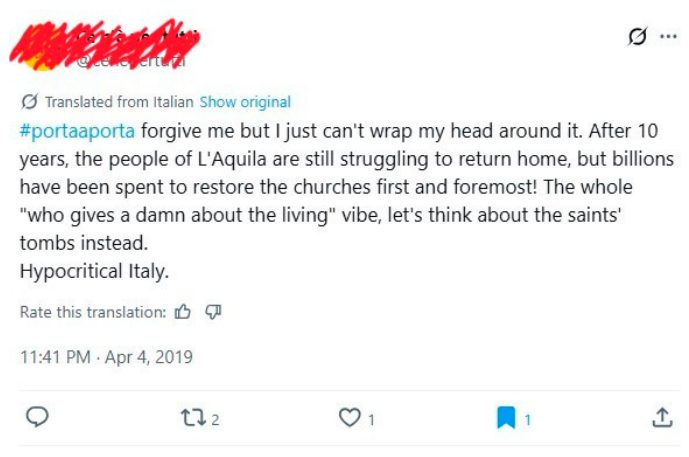
- Negative polarity (95%)
Porta a porta forgive me but I just can't wrap my head around it. After 10 years, the people of L'Aquila are still struggling to return home, but billions have been spent to restore the churches first and foremost! The whole "who gives a damn about the living" vibe, let's think about the saints' tombs instead. Hypocritical Italy.
- ▪ Negative: 0.95
- ▪ Positive: 0.04
- ▪ Unrelated:0.01
Figure 6.
(c) Tweet classified into neutral polarity posted around the tenth Anniversary of the 2009 Earthquake in L'Aquila with sentences that mention the topic of cultural heritage. Source: [133].
Figure 6.
(c) Tweet classified into neutral polarity posted around the tenth Anniversary of the 2009 Earthquake in L'Aquila with sentences that mention the topic of cultural heritage. Source: [133].
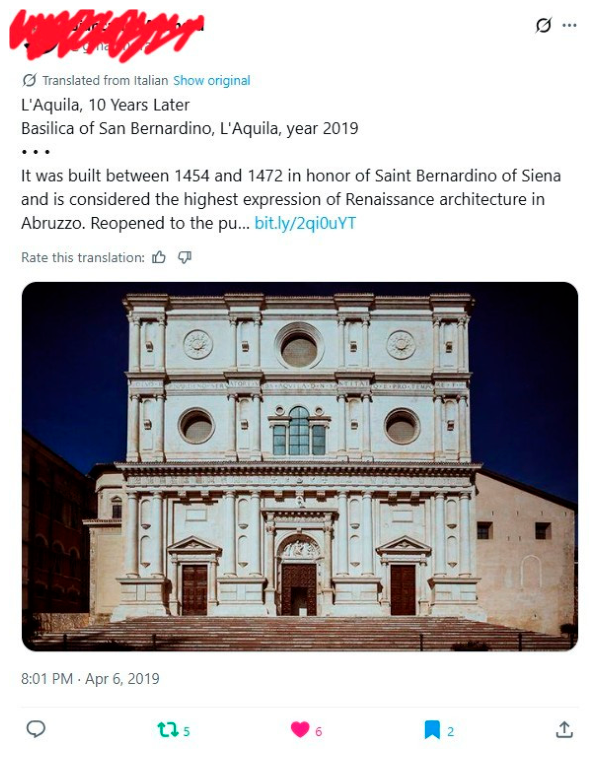
- Neutral polarity (95%)
L'Aquila, 10 years later. Basilica of San Bernardino, L'Aquila, year 2019. It was built between 1454 and 1472 in honor of San Bernardino of Siena and is considered the highest expression of Renaissance architecture in Abruzzo. Reopened at the pu…
- ▪ Neutral: 0.95
- ▪ Positive: 0.05
3.2. Word Frequency Analysis
3.2.1. Tweet Level
The word frequency analysis based on text data from tweets that address the topic of cultural heritage depicted in the word cloud in Figure 7 allowed the identification of the Luminous Fountain portrayed in Figure 8 as the most frequent tangible heritage artefact in L’Aquila mentioned on 14 tweets, followed by the words ’reconstruction‘ and ’restored’. A tweet included a link to Instagram, which featured the promotional poster for a book on Medieval Painting in the Abruzzo Region of L'Aquila [134,135].
3.2.2. Tweet Level - Links
The word frequency analysis based on text data from the links included in the 14 tweets that address the topic of cultural heritage depicted in the word cloud in Figure 9, allowed the identification of Palazzo Ardinghelli (portrayed in Figure 10) as another tangible heritage artefact in L’Aquila key in the restoration of the historic city centre. Other frequently referenced landmarks included the churches Santa Maria del Suffragio (Figure 3), Santa Maria di Collemaggio (Figure 1a) and Santa Maria Paganica (Figure 2b).
3.2.3. Sentence Level
The topic of cultural heritage is mentioned in tweets whose main topics are restoration, early recovery, reconstruction, construction practices, depopulation and displacement, commemorative actions, urban facilities, and solidarity messages. At this level of disaggregation, the most frequent term was 'historic centre’, and the monument most frequently mentioned was the Basilica di San Bernardino (Figure 2 (d), (e) and (f)), which had not been mentioned in the previous levels of analysis. The Basilica of Santa Maria di Collemaggio (Figure 1a) and the church of Santa Maria del Suffragio (Figure 3) are mentioned again, but less frequently. Architectonic details start appearing on the text data: the rose window of the Basilica of Santa Maria di Collemaggio and its portals [136,137] and the staircase of the Basilica di San Bernardino [138,139], both elements visible in Figure 1(a) and 2(d), respectively. Even construction materials, such as masonry building aggregate [140] and bricks [141], technologies and suppliers, such as Kerakoll spa [142], are now being mentioned. The result of this frequency analysis is depicted in Figure 11.
3.2.4. Sentence Level - Links
These links contain text and/or video. In the case of video, it was necessary to watch the record and the transcription to collect the text data. In this level, it was possible to identify the name of Governmental officials involved in the restoration of the historic buildings, budget allocated, administrative problems, other artifacts of cultural heritage considered on the restoration, construction materials, construction techniques used according to the structures of the buildings, architectonic details, building code considered, typical structural failures, and the institutions and disciplines involved in the restoration tasks [84]. The result of this frequency analysis is depicted in Figure 12.
4. Discussion
We consider that the continued reconstruction and repair [6] of monuments in L’Aquila following the earthquakes make it infeasible to preserve the authenticity of the materials and the integrity of the buildings, which is why none of the historic buildings in L’Aquila identified in this research have been included on the UNESCO World Heritage List. However, the Perdonanza Celestiniana procession, which takes place annually in L’Aquila on the 28th and 29th of August, was recognised by UNESCO as intangible cultural heritage in 2019 [21,143], which for us is a signal of post-disaster culture-led redevelopment (going beyond the existing state before the earthquake). Besides buildings, one tweet with a poster promoting a book about Medieval Painting in the Abruzzo Region of L'Aquila was found in the dataset. In the promotion of this book, it is stated that the places in the Abruzzo region where the pictorial testimonies to the medieval past [2,9,10,11,12,13] are preserved are the churches, which are the monuments mentioned in the tweets and that were reconstructed first.
The invitation to foreign partners [17], such as France [26,58] Russia [29] and Germany [50,58], made it possible to rapidly restore churches, Palazzo Ardinghgelli and some reconstruction activities in Onna. This example should serve as a best practice for countries where tangible cultural heritage, such as historic buildings, is damaged by disasters, enabling their restoration or at least the replication of their original form to symbolise the return to normality. It is important to highlight the efforts required for the rapid reconstruction of those historic buildings considering that, according to Luciano Marchetti, former Deputy Commissioner for Reconstruction in Umbria and Abruzzo, addressing the damages of historic buildings or older properties was more challenging that repairing newer buildings, given that the first ones were usually located in the narrow streets of the historic city centre, difficult to reach by the construction machinery, and in some cases presented fragmented ownership [51].
Intangible heritage is not mentioned in the tweets; this may be because the direct effect of an earthquake is damage to tangible heritage; however, intangible heritage in L’Aquila was also affected: the route of the procession for the Perdonanza Celestiniana needed to be changed after the earthquake due to reconstruction works [143]. Maybe it is that the disruption to intangible heritage caused by the earthquake was not visible or relevant to Twitter or Instagram users who posted their opinions on the progress of recovery by the tenth anniversary of the 2009 earthquake. This could be explained by the fact that damage to tangible heritage and its later restoration is more visible. The route of the traditional Good Friday Stations of the Cross in Chieti, considered the oldest in Italy, was modified for the Selecchy Choir, singing the Miserere, symbol of the Chieti procession, to stop on Via Pianell, at the Civitella viewpoint, and chanted towards the Gran Sasso in a gesture of closeness to L’Aquila [46]. This action shows that cultural traditions can also be modified during post-disaster recovery to accommodate changing circumstances and show solidarity and support to those affected.
In the analysis of the text data at the sentence level of tweets where cultural heritage is not the main topic, architectural details, construction materials, and technologies are mentioned. At the finest level of disaggregation, examining the links embedded in those tweets, government officials responsible for managing the Cultural Heritage of L’Aquila were identified by name, the financial resources allocated by them to the restoration of the monuments with figures, the construction details, the typical structural failures the non-structural and structural elements in historic building damaged by the earthquake were listed, as well as the proposed interventions, [81] the stage of projects implementation, laws, the amount of buildings declared of cultural interest by the government in the case study area, their location and other tangible cultural heritage artifacts present in the case study area such monasteries, gates, walls and towers, not mentioned in coarser levels of text data analysis such as tweets, links on those tweets and sentence of tweets. However, it is inevitable to think that the 280-character limit could influence the monuments mentioned in tweets, as well as the amount of information included in the posts.
The oldest monument of L’Aquila, the Basilica Santa Maria di Collemaggio, is not explicitly mentioned in the tweets addressing cultural heritage; instead, the Luminous Fountain was mentioned. The roles of Palazzo Ardinghelli, the churches Santa Maria del Suffragio, Basilica of Santa Maria di Collemaggio, and Santa Maria Paganica are evident through word frequency analysis of sentences and the links included in tweets that specifically address cultural heritage as the main topic. The relevance of Palazzo Ardinghelli could be explained by the fact that its restoration was underway at the time of the tenth anniversary of the earthquake [8], when the Twitter data for this research was collected, and its future role as a section of MAXXI, the Roman Museum of Arts of the 21st Century, had just been announced [29]. The frequency of the term 'historic centre' is also important because it is the urban framework in which the city's tangible and intangible cultural heritage is located and present, and the most affected zone by the 2009 earthquake.
The percentage of tweets addressing the topic of cultural heritage at the post or sen-tence level is lower than expected in a town rich in historic buildings and monuments such as L’Aquila. However, cultural heritage is present in those with positive polarity, mentioning specific buildings and city areas, such as the churches Santa Maria del Suffragio and the Basilica of Santa Maria di Collemaggio, the luminous fountain, the Basilica of San Bernardino, Palazzo Ardinghelli, and the historic city centre. Tweets with negative polarity question the priority given to restoring those monuments, even though no schools had yet reopened in the city centre [93]. Ignoring that the financial resources for the restoration of building heritage and the repair or reconstruction of schools come from different sources: private and public, respectively. Tweets with neutral polarity in these cases provide information about the buildings, monuments or the historic centre. Finally, the fact that the sentiment analysis was run through expert manual classification constitutes a benchmark to label text data from similar cases.
5. Conclusions
L’Aquila is a medieval city, and the key tangible cultural heritage artefacts in the recovery of L’Aquila are represented by urban spaces, such as the historic city centre and squares, churches, paintings in the churches, statues, and palaces from the Renaissance and Baroque period [14,74]. Historic buildings in L’Aquila were constructed between the 13th and the 16th Century in stone [84] and were the first to be repaired and/or reconstructed using solid bricks [77] and hydraulic lime mortar [84]. The restoration of these historic buildings has played a significant role in the city's recovery: contributing to narratives of post-disaster renewal, cultural continuity, and the revitalisation of L'Aquila's historic centre. This rapid reconstruction of some historic buildings was made possible by the financial support of France, Russia and Germany. This international cooperation and solidarity [39,43] for reconstruction are only possible for tangible cultural heritage, given its importance for the collective memory of humanity, as evidenced by the rapid collection of funds to rebuild the roof of the Notre-Dame de Paris after the fire in 2019. The delay in the reconstruction of L’Aquila was never a lack of resources; it was more given to administrative procedures.
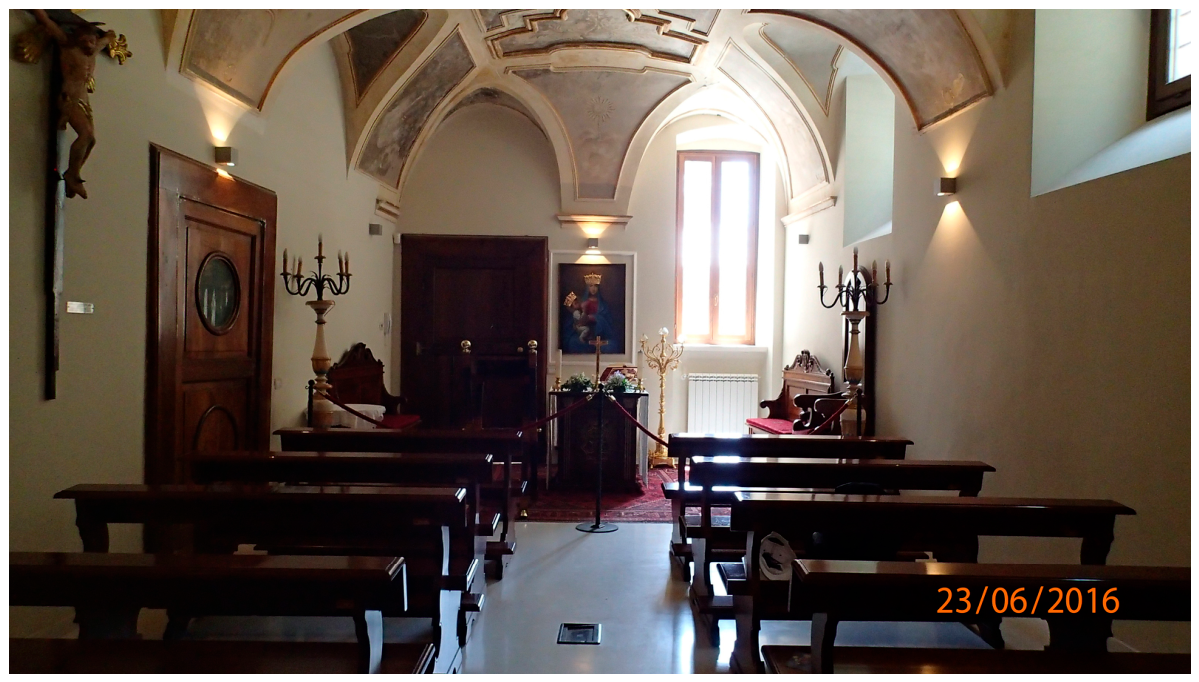
The most frequently mentioned artefacts mentioned during the tenth anniversary were: the church Santa Maria del Suffragio, the Basilica of Santa Maria di Collemaggio, the historic centre, the Basilica of San Domenico, the luminous fountain and Palazzo Ardinghelli. The construction of the church Santa Maria del Suffragio, as a tribute to the victims of the 1703 earthquake [21,25] and to symbolise the reconstruction of the city and its subsequent recovery after the 2009 earthquake, confirms the role of buildings that later become building heritage as symbols of a city's recovery and resilience [25]. This can explain why it was built next to this church and connected to it [25], the Cappella della Memoria, or Chapel of Remembrance, serving as a place of spiritual communion and remembrance; this time for the victims of the 2009 earthquake. The interior of this chapel is presented below in Figure 12. Among the new streets in Onna, a monument called ‘Madonna of Remembrance’ was erected standing on the spot where the bodies of the dead were first brought ‘[50].
Figure 13.
Chapel of remembrance at L’Aquila, Italy. Photo: Diana Contreras.
A similar case, Palazzo Ardinghelli, confirms once more not only the resilience of the community living in L’Aquila to earthquakes, but also the opportunities for change, improvement and even reconciliation [50] that disasters bring, through the renovation and retrofitting [96] of historic and heritage buildings having the capacity to attract more tourist. remote workers and digital nomads. We expect that all restoration of historic buildings has included bringing them up to the building code.
When the Abruzzo Regional President Marco Marsilio welcomed for L’Aquila the award as Italian Capital of Culture, highlighted this award as the opportunity to show to Italy and Europe that L’Aquila is a living laboratory of cultural regeneration and this designation not only reward the material, but also the social reconstruction, considering culture as an engine capable of recomposing social fabric by uniting, healing and transforming, stimulating economy and generating identity. President Marsilio describes L’Aquila as a ‘place of encounter, dialogue and innovation capable of transforming the wounds of an earthquake into a driving force’ [19]. However, the revitalization of the historic city centre cannot be based merely on the renovation of churches and palaces, housing, schools and shops [89] for those living in those houses are needed. Stones should not be separated from the community that gives those stones meaning and a future. Residents in L’Aquila would like to turn the city into a ‘city museum’ [72]. It is comforting that, despite the construction works in the historic city centre, this place was the setting for the commemoration ceremonies for the tenth anniversary of the 2009 earthquake.
The repair of the churches and the renovation of this palace align with the fourth priority of the Sendai Framework for Disaster Risk Reduction 2015-2030: ‘build back better’ in recovery [144]. These actions will contribute not only to the preservation of heritage but also to the repopulation of the previously empty city centre. The case of L'Aquila suggests that restored heritage assets may contribute to restoring a sense of place and identity, attracting visitors and investment, supporting the reopening of businesses, reactivating public spaces and re-establishing the symbolic role of the historic centre. However, the findings also indicate that heritage restoration alone does not guarantee the repopulation of affected historic centres, restoring buildings is not equivalent to restoring communities as physical reconstruction may progress faster than social recovery. The Roman Museum of Arts of the 21st Century was conceived as a space for community engagement, a learning hub for all ages, a source of academic research, and a tourist attraction. Now, cultural heritage plays a more active role within the community. We agreed with the Undersecretary of State for Cultural Heritage that culture can rebuild and revitalise a region [51]. To avoid dying, L’Aquila must return to being a city steeped in history [65].
We conclude that, based on the example of L’Aquila, heritage buildings located in seismic zones [145] should be retrofitted to avoid losing their UNESCO recognition as world heritage sites, which will also align with the third priority of the Sendai Framework: Investing in disaster risk reduction for resilience. This statement is supported by the vice-president of the Order of Architects of Rome on the 10th anniversary of the earthquake in L’Aquila, Christian Rocchi. This architect considered it essential and urgent to prevent and maintain in Italy to avoid disasters, given that, according to him, most of its historic city centres would not be able to withstand the intensity of a significant earthquake [51]. We agreed with publications that make a call to consolidate the heritage of practices, planning and technologies implemented in the restoration of significant historic building, to replicate these best restoration practices in the fragile buildings of the Apennines area, buildings that define the entire country identity [17].
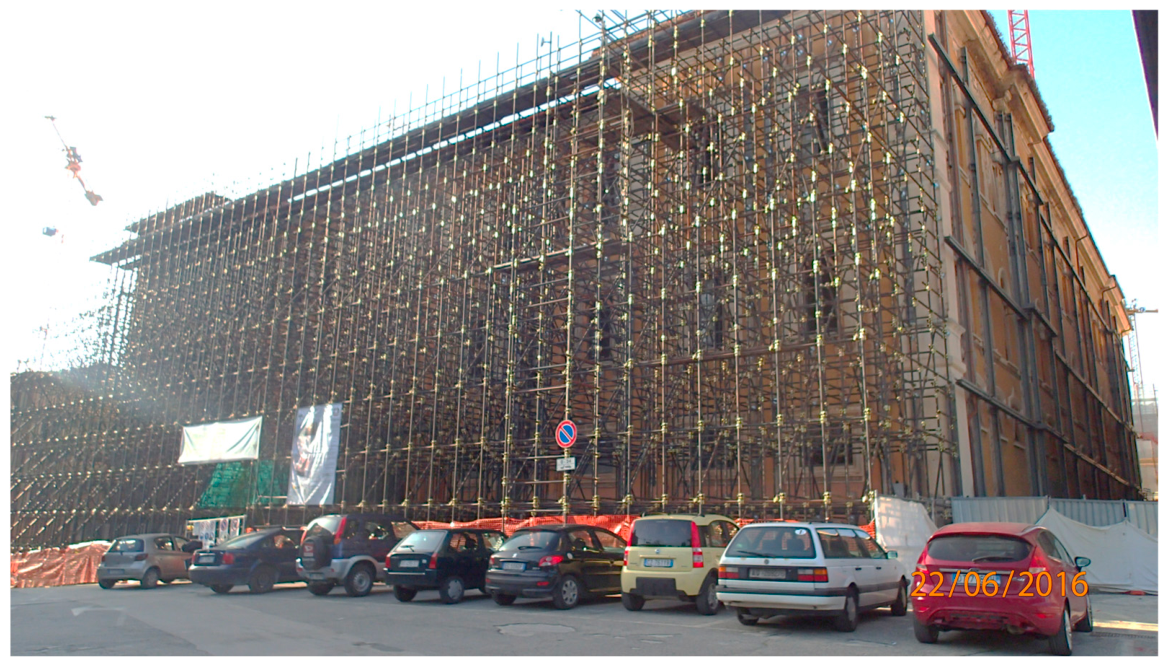
Since cultural heritage is a shared legacy and its preservation a collective responsibility, the international community should always be invited to contribute to the retrofitting, reinforcement, reconstruction or restoration of tangible cultural heritage not only to preserve a place's identity for the collective memory of humanity but also for the safety of those who inhabit, visit or use these places. However, it is also necessary to consider the insurance of historic buildings to avoid relying on the international solidarity of other countries. Sometime before the earthquake and at the end of the school year, Massimo Cialente, mayor of L’Aquila (2007-2017) started the seismic upgrade of the historic building that hosted the ‘Edmondo De Amicis’ elementary school, built in the 15th Century by San Giovanni da Capestrano as a hospital, remaining in use until the 19th century, closed after the earthquake and still covered in scaffolding by the. 10th Anniversary of the earthquake. The historic building is portrayed in Figure 14.
The president of the Republic, on the 10th anniversary of the earthquake in L’Aquila, Sergio Mattarella, considered that the restorations completed are ‘living testimony of the national and international solidarity expressed towards the people of L’Aquila’ [1,39,44]. The rapid reconstruction or restoration of these monuments conveys a sense of recovery and offers normality [3] and continuity to the communities affected by disasters. Sergio Mattarella also believes that the completed restorations are a sign of hope [1,34,39,43,44].
Figure 14.
Edmondo De Amicis’ elementary school. Photo: Diana Contreras.
Similar attention should be given to preserving intangible cultural heritage: the fact that intangible heritage was not mentioned in the tweets posted during the 10th anniversary of the earthquake in L'Aquila does not mean it was unaffected, this fact highlights how post-disaster recovery narratives tend to privilege material reconstruction over less visible cultural practices. For those in L’Aquila, the most relevant tangible cultural heritage is the buildings and mainly the churches, and this is justified not only because of their role in the urban landscape but also because they host paintings that serve as testimony of the splendid medieval [9,10,11,12,13] past that marked the history of the region [134,135]. The fact that most of these buildings were located in the most affected part of the city by the 2009 earthquake and were restored earlier than any other urban facility in the city centre arguably contributed to the repopulation of the historic centre, attracting people, especially during the day. As stated by one inhabitant in L’Aquila on the 10th anniversary: ‘(…) at least along the Corso, a semblance of normality has begun to return (…)’[62].
The visibility of heritage assets in social media discourse reflects both their cultural significance and their role as tangible, publicly recognisable indicators of recovery. Therefore, we can accept our hypothesis that the restoration of cultural heritage contributed to the recovery after the 2009 earthquake. Still, its contribution is not immediately evident to the population; who rather perceive a sense of normality with the repair and/or reconstruction of the tangible cultural heritage. This restoration contributes to return the urban character to L’Aquila historic centre and to the reopening of businesses by the tenth anniversary of the earthquake.
The combination of NLP techniques allowed us to establish the role of cultural heritage in the recovery process through topic analysis and to identify the key cultural heritage artefacts in the city's recovery. At a higher level of disaggregation in the analysis of the text data, more information can be found. No academic publication such as local news are rich sources of information about damages, restoration activities, reconstruction techniques, construction materials and intangible heritage.
Author Contributions
“Conceptualization, D.C.; methodology, D.C.; validation, formal analysis, D.C., C.P., G.F., and F.L.; data curation, D.C. and F.L; writing—original draft preparation, D.C.; writing—review and editing, D.C., C.P., G.F., F.L. and S.W; visualization, D.C.; supervision, S.W.; project administration, S.W.; funding acquisition, S.W. All authors have read and agreed to the published version of the manuscript.
Funding
This research was funded by the Engineering and Physical Sciences Research Council (EPSRC) [Grant No. EP/P025641/1].
Data Availability Statement
Dataset used for this research is publicly available at: Contreras Mojica, Diana; Pezzica, Camilla; Forino, Giuseppe; Liberatore, Federico (2026). Supervised sentiment and topic classification of Twitter/X data on cultural heritage in the post-earthquake recovery of L’Aquila, Italy (tweet and sentence level). Cardiff University. Dataset. https://doi.org/10.17035/cardiff.33456058.v2
Acknowledgments
This is Cardiff EARTH CRediT Contribution 53. The authors thank the reviewers for their contribution to improving the content of this article. Thanks to the Section Managing Editor for the invitation to submit this manuscript and handling this publication, respectively.
Conflicts of Interest
The authors declare no conflicts of interest.
Abbreviations
The following abbreviations are used in this manuscript:
| MiBACT | Ministry of Cultural Heritage and Activities and Tourism in Italy |
| NLP | Natural Language Processing. |
| CNR | National Research Council. |
| SM | Social media |
| UNESCO | United Nations Educational, Scientific and Cultural Organisation |
References
- Mattarella, S., Mattarella:'Reconstruction remains a great national challenge'. 2019.
- n.d. The L'Aquila earthquake is already ten years old. Welcome>World>Italy 2019 [cited 2026 6th April 2019]; Available from: https://www.tdg.ch/le-seisme-de-l-aquila-a-deja-dix-ans-893725276330?utm_source=dlvr.it&utm_medium=twitter.
- Galeotti, R., L'Aquila ten years later, come back to visit: you will love our tenacious people, in Il Capoluogo. 2019.
- Mattia, G.D., L'Aquila, the City of the Spirit, in Terre Marsicane. 2019.
- TRECCANI. Aquila, L’. 2019 [cited 2023 13th January 2023]; Available from: https://www.treccani.it/enciclopedia/l-aquila/.
- n.d., Ten Years suspended, in Il Fatto Quotidiano 2019: Rome, Italy.
- Piergigli, M. Saint Justus in Bazzano. Guided tours of medieval Italian art, divided by geographical area 2006 [cited 2025 25th November 2025]; Available from: https://www.medioevo.org/artemedievale/pages/abruzzo/Bazzano.html.
- Lear, E. Rome in the Footstep of an XVIIIth Century Traveller. L'Aquila - Other Monuments 2023 September 2023 [cited 2025 29th November 2025]; Available from: https://www.romeartlover.it/Aquila6.html.
- Poucke, S.V., H.D. Bruyker, and K.D. Roover, Ten years after the earthquake, L'Aquila is still a city under construction: "Reconstruction remains a major national challenge", in vrt. 2019.
- Dumont, A.F., L'Aquila, ten years after the earthquake: belief in politics has collapsed, in Marianne. 2019.
- Bakchine, A. Ten years after the earthquake, L'Aquila is healing its wounds. 2019 5th April 2019 [cited 2026 3rd January 2026]; Available from: https://www.tdg.ch/dix-ans-apres-le-seisme-laquila-panse-ses-plaies-194092460112?utm_source=dlvr.it&utm_medium=twitter.
- Galofaro, A., Ten years after the earthquake, the difficult reconstruction of L'Aquila, Italy, in interfrance. 2019.
- n.d. Ten years ago, an earthquake in L'Aquila killed more than 300 people in Italy. World 2019 [cited 2026 5th January 2026]; Available from: https://www.rts.ch/info/monde/10346343-il-y-a-10-ans-un-seisme-a-laquila-faisait-plus-de-300-morts-en-italie.html.
- France2, Italy: L'Aquila still awaiting reconstruction 10 years after the earthquake. 2019, Franceinfo.
- n.d. L'Aquila, 10 years after the earthquake. 2019 [cited 2025 22nd December 2025]; Available from: https://stream24.ilsole24ore.com/gallery/italia/l-aquila-10-anni-il-terremoto/ABYtaWkB?refresh_ce=1.
- Dursi, J. L'Aquila: Question of the Abruzzo, Italian and European people. 2019 [cited 2023 23rd August 2023]; Available from: https://www.pescaranews.net/notizie/attualita/23092/laquila-questione-del-popolo-abruzzese-italiano-ed-europeo.
- Editorial. Earthquake special: L'Aquila, ten years after the 2009 earthquake. 2019 [cited 2024 17th March 2024]; Available from: https://www.hgnews.it/2019/04/06/speciale-sima-laquila-dieci-anni-dal-terremoto-del-2009/.
- RaiRadio1. The historic center of #LAquila was the pulsating heart of the city. Our project aims to recreate a community, to get back to feeling good together, while waiting for the historic center to return to what it was.?Listen again to Marco Molina, president of the Rugby Experience School L'Aquila. 2019 4th April 2029 [cited 26th November 2025]; Available from: https://x.com/radio1rai/status/1113834366243889152.
- Editorial-Staff. L'Aquila is the Italian Capital of Culture 2026: the "Multiverse City" project has been awarded. 2025 3rd December 2025 [cited 2025 27th December 2025]; Available from: https://www.ilmartino.it/2025/12/laquila-e-capitale-italiana-della-cultura-2026-premiato-il-progetto-citta-multiverso/.
- UNESCO. World Heritage List 2025 [cited 2025 23rd November 2025 ]; Available from: https://whc.unesco.org/en/list/.
- Palmerini, G., L'Aquila: our thanks ten years after the earthquake, in Mar dei Sargassi. 2019.
- n.d. Leere und Trauer – auch zehn Jahre nach Beben von L’Aquila. 2019 [cited 2024 12th August 2024]; Available from: https://www.epochtimes.de/politik/europa/leere-und-trauer-auch-zehn-jahre-nach-beben-von-laquila-a2847251.html?welcomeuser=1.
- Stucchi, M., et al., Historical earthquakes and seismic hazard of the L’Aquila area. Progettazione Sismica, 2009. 1: p. 23–34.
- Bartolomei, R., L'Aquila earthquake, the survivor: "We, the betrayed boys", in Quotidiano Nazionale. 2019: Bologna, Italy.
- Pinton, D., The Chapel of Remembrance for the 2009 earthquake, in L'Aquila Blog. 2021: L'Aquila, Italy.
- Becker, C. Ten years after the earthquake, this church in L'Aquila has regained its luster thanks to France. 2019 [cited 2025 27th November 2025]; Available from: https://fr.aleteia.org/2019/04/05/dix-ans-apres-le-seisme-cette-eglise-de-laquila-a-retrouve-son-lustre-grace-a-la-france/.
- Wienerberger. The reconstruction of a building in the historic center of L'Aquila with Wienerberger bricks. 2019 [cited 2024 13th July 2019]; Available from: https://www.ingenio-web.it/articoli/la-ricostruzione-di-un-palazzo-nel-centro-storico-de-l-aquila-con-i-laterizi-wienerberger/.
- Lear, E. Rome in the Footsteps of an XVIIIth Century Traveller. L'Aquila - Other Monuments 2023 September 2023 [cited 2025 29th November 2025]; Available from: https://www.romeartlover.it/Aquila6.html.
- Taranta, S., Palazzo Ardinghelli is reborn: The restoration and MAXXI L'Aquila, in Saturday 5 and Sunday 6 September: Presentation of the restoration and guided tours of the palace. 2020, MAXXI - Museo nazionale delle arti del XXI secolo L'Aquila, Italy p. 3.
- Tarantino, P., 2009-2019. Ten years after the L'Aquila earthquake that shook a land and a community. “Zona Nostra” is our exclusive reportage from Abruzzo, in Terre di frontiera. 2019, Ossopensante APS.
- Editorial-Staff, L'Aquila, ten years later: "Planning and prevention are still lacking.", in Italiambiente. 2019, BiodiversitaIA: Verona, Italy.
- Skytg24. L'Aquila, 10 years since the earthquake: the city of grief, reconstruction, and the future. Show 2019 [cited 2025 28th December 2025]; Available from: https://tg24.sky.it/cronaca/2019/04/03/decennale-terremoto-aquila-2009#00.
- Castelfranco, S., Italian city of L’Aquila still rebuilding ten years after deadly earthquake, in rFI. 2019.
- Italpress, Mattarella ‘Rebuilding L’Aquila is a national challenge’. in ViviEnna. 2019: Palermo, Italy.
- ANSA, Monsignor Antonini, L'Aquila will be splendid, in ANSA.it. 2019: Rome, Italy.
- Canovi, E., 10 years after the earthquake, why you should give L’Aquila a try if you are a remote worker or a digital nomad. 2019, LinkedIn.
- Euronews, L'Aquila exactly 10 years after the earthquake, in euronews. 04/06/2019.
- n.d., Abruzzo dieci anni dopo il sisma, il racconto di Mirarchi. 2019, Calabria7.
- Editorial-board. Earthquake, L'Aquila 10 years later. Mattarella: 'Reconstruction remains a great national challenge'. 2019 [cited 2023 19 February 2023]; Available from: https://www.abruzzolive.tv/catastrofi/terremoto-l-aquila-10-anni-dopo-mattarella-la-ricostruzione-resta-una-grande-sfida-nazionale-it23970.html.
- Franchi, M. and G. Venturini. Repair and seismic improvement of a masonry building aggregate in L'Aquila. 2019 [cited 2023 24th December 2023]; Available from: https://www.ingenio-web.it/articoli/riparazione-e-miglioramento-sismico-di-un-aggregato-edilizio-in-muratura-a-l-aquila/.
- Fasan, G., Roma Club L'Aquila, Zingarelli: "Forward for love", in Il Romanista. 2019.
- n.d. Sky TG24 presents: "L'Aquila Ten Years Later". 2019 5th April 2019 [cited 2025 31st December 2025]; Available from: https://www.affaritaliani.it/entertainment/sky-tg24-presenta-l-aquila-dieci-anni-dopo-597719.html?ref=rss&utm_source=dlvr.it&utm_medium=twitter.
- Mattarella, S., Statement by President Mattarella on the tenth anniversary of the L'Aquila earthquake P.o. Republic, Editor. 2019: Rome, Italy.
- Editorial-Team, Ten years after the earthquake in L'Aquila, Mattarella: "Reconstruction remains a great national challenge", in TorreChannel.it. 2019.
- Fabi, T., Ten years after the earthquake, the city of L'Aquila is struggling to recover, in RTBF.ACTUS. 2019.
- Editorial-board, 10 years from 3.32am: the province of Chieti also paid a heavy price for the L'Aquila earthquake, in CHIETITODAY. 2019: Chieti, Italy.
- Rai3, Il terremoto a L'Aquila, 10 anni dopo. Il ricordo dei social #Timeline. 2019.
- n.d., La reconstrucción de L'Aquila continúa diez años después del terremoto que dejó 309 muertos in Información y actualidad, I.y. actualidad, Editor. 2019, rtve: Madrid, Spain.
- n.d., The L'Aquila earthquake is already ten years old, in L'essentiel. 2019: Luxembourg.
- Modola, S., Italia recuerda a las víctimas de L'Aquila en el décimo aniversario del seísmo, in Europa Press. 2019: Spain.
- OAR. L'Aquila ten years later: two-speed reconstruction. 2019 [cited 2023 6th August 2023]; Available from: https://ordine.architettiroma.it/attivita-ordine/laquila-dieci-anni-doporicostruzione-a-due-velocita/.
- TELEPONTE, TELEPONTE - 2009-2019, il decennale del Sisma de L'Aquila ha fermato un'intera nazione. 2019, Teleponte TV.
- n.d., Ten years after the earthquake, the Yellow Cross of Ancona returns to L'Aquila. 2019, Vivere Ancona.
- Tv2000it, Speciale TGtg: "Ritorno a L’Aquila". 2019, Tv2000it: Rome, Italy.
- Ansa. Procession marks 10 years since earthquake in L'Aquila. 2019 [cited 2026 25th May 2026]; Available from: https://brazil.mom-gmr.org/en/media/detail/outlet/istoe/.
- n.d., La segunda vida de L'Aquila, in HOY. 2019, Corporación de Medios de Extremadura S.A.: Badajoz, Spain.
- Quarto, R., 10 years after the earthquake, Ruggiero Quarto recalls the events in L'Aquila. 2019: Turin, Italy.
- Melguizo, S., El renacer a cámara lenta de L'Aquila, in El Mundo. 2019.
- Capolla, F., L'Aquila earthquake/10 years of hope and construction: those who remained were not lost, in Il Sussidiario.net 2019: Milan, Italy.
- n.d., Miles de personas marchan en L’Aquila (Italia) para conmemorar el décimo aniversario del seísmo, in Okdiario. 2019: Madrid, Spain.
- n.d., Vigili del Fuoco primi interventi a L'Aquila 2013, Motoclub Vigili del Fuoco Perigia Perugia, Italy.
- Graziani, M.R., L'Aquila, who are the citizens who arrived after the earthquake: Michela's story, in DiRE. 2019, DIRE Agency Rome, Italy.
- Vespa, S., L'Aquila, 10 years after the earthquake and a law on disasters that is still missing, in Formiche. 2019.
- Pasqualini, L., L'Aquila, 6 April: the video report ten years after the earthquake [VIDEO and PHOTO], in el Itagnol. 2019.
- Antonini, C., L'Aquila, the roar inside. Chronicle of the end of the world…, in POP OFF. 2019.
- Euronews. L'Aquila: Ten years later. News>World>Italy 2019 [cited 2025 28th December 2025]; Available from: https://gr.euronews.com/2019/04/06/l-aquila-deka-xronia-meta?utm_term=Autofeed&utm_medium=Social&utm_source=Twitter#Echobox=1554558457.
- Editorial-Staff, Press conference 'L'Aquila ten years later: critical issues and prospects', in IRPINA24. 2019.
- INGVterremoti. Remembering the earthquake of 6 April 2009 in L'Aquila. 2019 [cited 2023 9th November 2023]; Available from: https://ingvterremoti.com/2019/04/05/ricordando-il-terremoto-del-6-aprile-2009-a-laquila/.
- Belga, Ten years after a devastating earthquake, the Italian city of L'Aquila has not yet been fully rebuilt, in HLN. 2019, DPG Media: Antwerp, Belgium.
- Puglia, A., The L'Aquila earthquake ten years later: 'There is nothing to celebrate', in VITA. 2019.
- n.d. L'Aquila, a suspended city: 10 years after the earthquake, the city center remains almost deserted. Specials 2019 [cited 2026 31st May 2026]; Available from: https://askanews.it/old/op.php?file=/video/2019/04/05/laquila-citt%c3%a0-sospesa-a-10-anni-dal-sisma-il-centro-semideserto-20190405_video_18234378/.
- Montanari, T., L'Aquila, the city that doesn't exist: Stones separated from the People, in EDDYBURG. 2019.
- Zippa, A., L'Aquila: the silence that does not forget, in Appia Polis. 2019.
- STA, Ten years after the earthquake, the Italian city is still a big construction site #video. 2019.
- Delle-Noci, L., Ten years ago the earthquake in L'Aquila. Remember so as not to forget, in Riviera oggi. 2019: Grottammare, Italy.
- VN. La destrucción sigue presente en L’Aquila diez años después del terremoto. 2019 [cited 2024 30th May 2024]; Available from: https://valencianoticias.com/la-destruccion-sigue-presente-en-laquila-diez-anos-despues-del-terremoto/.
- Samori, C. L'Aquila 10 years after the earthquake. 2019 [cited 2024 10th June 2024]; Available from: https://www.ingenio-web.it/articoli/l-aquila-10-anni-dopo-il-sisma/.
- France-2. Italy: L'Aquila still awaits reconstruction 10 years after the earthquake. 2019 [cited 2026 12th January 2026]; Available from: https://www.franceinfo.fr/environnement/catastrophes-naturelles/seismes/italie-l-aquila-attend-toujours-la-reconstruction-10-ans-apres-le-seisme_3263613.html.
- Contreras, D., G. Forino, and T. Blaschke, Measuring the progress of a recovery process after an earthquake: The case of L'Aquila, Italy. International Journal of Disaster Risk Reduction, 2018. 28: p. 450–464. [CrossRef]
- PreventionWeb. Italy: L'Aquila Earthquake 2009. 2019 15th June 2026 [cited 2026 18th July 2026]; Available from: https://www.preventionweb.net/collections/italy-laquila-earthquake-2009.
- Mannella, A. The use of Kerakoll technologies for the recovery of protected buildings in the historic center of L'Aquila. 2019 [cited 2024 18th July 2024]; Available from: https://www.ingenio-web.it/articoli/l-uso-di-tecnologie-kerakoll-per-il-recupero-di-edifici-tutelati-nel-centro-storico-de-l-aquila/.
- Redazione371, Ten years since the earthquake in L'Aquila. A prayer from Mons. Fusco, in Positanonews. 2019: Salerno, Italy.
- Brown, C., M. Milke, and E. Seville, Disaster waste management: A review article. Waste Management, 2011. 31(6): p. 1085–1098. [CrossRef]
- INGENIOvideo, Il Terremoto a L'Aquila: 10 anni dopo. Storia di una Ricostruzione non completata. 2019: Galazzano, Italy.
- Budini, R. Onna, the village erased by earthquake. Italy. 2015 14th April 2015 [cited 2025 18th December 2025]; Available from: https://unframe.com/onna-the-village-erased-by-earthquake-italy/.
- Contreras, D., et al., Myths and realities about the recovery of L׳Aquila after the earthquake. International Journal of Disaster Risk Reduction, 2014. 8(0): p. 125–142. [CrossRef]
- USRA. L'Aquila 2009-2019: where are we with the reconstruction? 2019 [cited 2024 12th July 2024]; Available from: https://www.ingenio-web.it/articoli/l-aquila-2009-2019-a-che-punto-siamo-con-la-ricostruzione/.
- Ribbon, S., L'Aquila: an assessment 10 years after the earthquake. Interview with Stefania Pezzopane, in Artribune. 2019, Artribune: Rome, Italy.
- VN, We have rebuilt two nursery schools because children are the future of L'Aquila, in Varese News. 2019: Varese, Italy.
- Evangelisti, M., L'Aquila, 10 years after the earthquake: reconstruction halfway due to the haste of politicians, in Il Messaggero. 2019: Rome, Newspaper.
- INGENIOvideo, L'Aquila 10 anni dopo - Il Reportage. 2019.
- n.d. L'Aquila. He lost the city 2019 [cited 2025 28th December 2025]; Available from: https://eddyburg.it/archivio/laquila-ha-perso-la-citta/.
- Battista, E.D., Tenth anniversary of the L'Aquila earthquake - Rebuilding still halfway through, in Ansa Magazine. 2019: ANSA.it.
- Sensi, C. Terni Firefighters Return to L'Aquila. 2019 [cited 2026 10th January 2026]; Available from: https://www.terninrete.it/notizie-di-terni-i-vigili-del-fuoco-di-terni-tornano-a-laquila/.
- Rossi, E., L'Aquila, ten years after the earthquake, is a completely peripheral city, in Contropiano. 2019: Rome, Italy.
- Alexander, D., Ten years after the 6 April 2009 L'Aquila earthquake: some reflections, in PreventionWeb. 2019, UNDRR: Geneva, Switzerland.
- TVsette. L'AQUILA 10 YEARS LATER. Of the 1,200 businesses that opened in the historic center before the earthquake of April 6, 2009, only 86 have reopened today. Much of the privately owned buildings have been rebuilt, but no schools have reopened in the heart of the city. Instead, the ancient University, with its twenty thousand students, is being reborn. Following the earthquake, the Gran Sasso Science Institute, a higher education institution directed by the renowned physicist Eugenio Coccia, was added. This is the new "City of Knowledge" taking shape, amid delays and uncertainties, in the reconstruction of its buildings and its social fabric. 2019 [cited 19th December 2025]; Available from: https://www.facebook.com/Tvsette.paginaufficiale/posts/2245297762179746.
- D'Ettorre, V., L'Aquila's Cathedral has not yet reopened. Bishop Petrocchi speaks out. 2019, Rome, Italy: TV2000.
- Contreras, D., et al., Post-Disaster Recovery Assessment Using Sentiment Analysis of English-Language Tweets: A Tenth-Anniversary Case Study of the 2010 Haiti Earthquake. Sustainability, 2025. 17(11): p. 4967. [CrossRef]
- Mota-Santiago, L.R., A. Lozano, and A.E. Ortiz-Valera, Determination of disaster scenarios for estimating relief demand to develop an early response to an earthquake disaster in urban areas of developing countries. International Journal of Disaster Risk Reduction, 2023. 87: p. 103570. [CrossRef]
- Contreras, D., Fuzzy Boundaries Between Post-Disaster Phases: The Case of L’Aquila, Italy. International Journal of Disaster Risk Science, 2016. 7(3): p. 277–292. [CrossRef]
- Shibuya, Y., Social Media Communication Data for Recovery Detecting Socio-Economic Activities Following a Disaster. 1st ed. 2020.. ed, ed. SpringerLink. 2020: Singapore : Springer Singapore : Imprint: Springer.
- Chang, S.E., Urban disaster recovery: a measurement framework and its application to the 1995 Kobe earthquake. Disasters, 2009. 34(2): p. 303 – 327. [CrossRef]
- Contreras, D., et al., Assessing post-disaster recovery using sentiment analysis: The case of L’Aquila, Italy. Earthquake Spectra, 2021. 38(1): p. 81–108. [CrossRef]
- Rossetto, T., et al., The value of multiple earthquake missions: the EEFIT L’Aquila Earthquake experience. Bulletin of Earthquake Engineering, 2014. 12(1): p. 277–305. [CrossRef]
- Laituri, M. and K. Kodrich, On Line Disaster Response Community: People as Sensors of High Magnitude Disasters Using Internet GIS. Sensors, 2008. 8(5): p. 3037–3055. [CrossRef]
- Wang, C., et al., Public perception of earthquake events: evidence from social media – a case study of the 2025 Dingri earthquake. Geomatics, Natural Hazards and Risk, 2025. 16(1): p. 2542196. [CrossRef]
- Contreras, D., et al., Assessing post-disaster recovery using sentiment and topic analysis on social media posts: L'Aquila, Italy, in 18th World Conference on Earthquake Engineering - 18WCEE 2024. 2024: Milan, Italy. p. 12.
- Ma, Z.H., et al., Surveying the Use of Social Media Data and Natural Language Processing Techniques to Investigate Natural Disasters. NATURAL HAZARDS REVIEW, 2024. 25(4). [CrossRef]
- Medhat, W., A. Hassan, and H. Korashy, Sentiment analysis algorithms and applications: A survey. Ain Shams Engineering Journal, 2014. 5(4): p. 1093–1113. [CrossRef]
- Ragini, J.R., P.M.R. Anand, and V. Bhaskar, Big data analytics for disaster response and recovery through sentiment analysis. International Journal of Information Management, 2018. 42: p. 13–24. [CrossRef]
- Liu, B., Introduction in Sentiment Analysis: Mining Opinions, Sentiments, and Emotions. 2015, Cambridge University Press: Cambridge. p. 1–15.
- Antypas, D., A. Preece, and J. Camacho Collados, Politics and Virality in the Time of Twitter: A Large-Scale Cross-Party Sentiment Analysis in Greece, Spain and United Kingdom. 2022.
- Bai, H. and G. Yu, A Weibo-based approach to disaster informatics: incidents monitor in post-disaster situation via Weibo text negative sentiment analysis. Natural Hazards, 2016. 83(2): p. 1177–1196. [CrossRef]
- Yan, Y., et al., Monitoring and Assessing Post-Disaster Tourism Recovery Using Geotagged Social Media Data. ISPRS International Journal of Geo-Information, 2017. 6(5): p. 144. [CrossRef]
- Zhang, T., et al., A topic model based framework for identifying the distribution of demand for relief supplies using social media data. International Journal of Geographical Information Science, 2021. 35(11): p. 2216–2237. [CrossRef]
- Rexiline Ragini, J., P.M. Rubesh Anand, and V. Bhaskar, Mining crisis information: A strategic approach for detection of people at risk through social media analysis. International Journal of Disaster Risk Reduction, 2018. 27: p. 556–566. [CrossRef]
- Resch, B., F. Usländer, and C. Havas, Combining machine-learning topic models and spatiotemporal analysis of social media data for disaster footprint and damage assessment. Cartography and Geographic Information Science, 2018. 45(4): p. 362–376. [CrossRef]
- Mihunov, V.V., et al., Disaster Impacts Surveillance from Social Media with Topic Modeling and Feature Extraction: Case of Hurricane Harvey. International Journal of Disaster Risk Science, 2022. 13(5): p. 729–742. [CrossRef]
- Contreras, D., et al., Intensity-Based Sentiment and Topic Analysis. The Case of the 2020 Aegean Earthquake. Frontiers in Built Environment, 2022. 8. [CrossRef]
- Yan, Y., J. Chen, and Z. Wang, Mining public sentiments and perspectives from geotagged social media data for appraising the post-earthquake recovery of tourism destinations. Applied Geography, 2020. 123: p. 102306. [CrossRef]
- Contreras, D., et al. Assessment of the Recovery Process using Sentiment and Topic analysis: the case study of the 2015 Gorkha Earthquake. in SECED 2023. 2023. Cambridge, United Kingdom: SECED.
- Chandani, K., S. Karuppannan, and A. Sivam, Importance of Cultural Heritage in a Post-Disaster Setting: Perspectives from the Kathmandu Valley. Journal of Social and Political Sciences, 2019. 2(2). [CrossRef]
- UNESCO. Glossary. 2025 [cited 2025 3rd November 2025]; Available from: https://whc.unesco.org/en/glossary/224.
- UNESCO. What is Intangible Cultural Heritage? 2001 [cited 2025 3rd November 2025]; Available from: https://ich.unesco.org/en/what-is-intangible-heritage-00003.
- Spennemann, D.H.R. and K. Graham, The importance of heritage preservation in natural disaster situations. International Journal of Risk Assessment and Management, 2007. 7(6-7): p. 993–1001. [CrossRef]
- Bhandari, R.B., N. Okada, and J.D. Knottnerus, Urban Ritual Events and Coping with Disaster Risk a Case Study of Lalitpur, Nepal. Journal of Applied Social Science, 2011. 5(2): p. 13–32. [CrossRef]
- Eyre, A., In remembrance: post-disaster rituals and symbols. . The Australian Journal of Emergency Management, 1999. 14(3): p. 23.
- Nelson, C.L., Protecting the Past From Natural Disasters. 1991, Washington DC:: National Trust for Historic Preservation.
- Contreras, D., et al. Assessing Post-Disaster Recovery Using Sentiment Analysis. The case of L’Aquila, Haiti and Chile. in 17th World Conference on Earthquake Engineering 2020. Sendai, Japan.
- Becker, C. Ten years ago, L'Aquila, in #Italy, was devastated by a powerful earthquake. The reconstruction is not yet complete, but Santa Maria del Suffragio, the flagship church of the historic city, was able to be restored thanks to the help of #France. An exemplary partnership:https://bit.ly/2G4FZof. 2019 5th April 2019 [cited 6th December 2025]; Available from: https://x.com/carobckr/status/1114207196345245696.
- Cen'èpertutti. #portaaporta forgive me but I just can't wrap my head around it. After 10 years, the people of L'Aquila are still struggling to return home, but billions have been spent to restore the churches first and foremost! The whole "who gives a damn about the living" vibe, let's think about the saints' tombs instead. Hypocritical Italy. 2019 4th April 2019 [cited 6th December 2025]; Available from: https://x.com/cenepertutti/status/1113934639842889729.
- Malandra, G. L'Aquila, 10 Years Later. Basilica of San Bernardino, L'Aquila, year 2019 • • • It was built between 1454 and 1472 in honor of Saint Bernardino of Siena and is considered the highest expression of Renaissance architecture in Abruzzo. Reopened to the pu… http://bit.ly/2qi0uYT. 2019 6th April 2019 [cited 6th December 2025]; Available from: https://x.com/gmalandra/status/1114604179694157824.
- n.d., Medieval painting in the Abruzzo region of L'Aquila, ed. S. Paone and A. Tomei. 2010. 184.
- laurhabibi. Memoria e Cultura. #laquila. Instagram 2019 5th April 2019 [cited 4th December 2025]; Available from: https://www.instagram.com/p/Bv3q5eElW7e/?utm_source=ig_twitter_share&igshid=11yxim3arzrd6.
- LineaCaliSrl. Let's continue our journey to discover the most beautiful places in Italy. This weekend we will go to L'Aquila to visit the Basilica of Santa Maria di Collemaggio. Majestic and proud, the basilica captivates with every detail, from the large rose window to the entrance portals. 2019 5th April 2019 [cited 30th November 2025]; Available from: https://twitter.com/lineacalisrl/status/1114105622386085890.
- gustabruzzo.it. The Social Wall for Everyone – http://Walls.io. L’Aquila, rosone della Basilica di Collemaggio. 6 Aprile 2009 - 6 Aprile 2019 Forza L’Aquila bella mè?????? #landscapephotography #earth_focus #ig_laquila_ #clickfor_laquila #volgolaquila… https://walls.io/s/qPiBK. 2019 9th April 2019 [cited 30th November 2025]; Available from: https://x.com/gustabruzzo_it/status/1115645676992573440.
- AbruzzoWeb. L'AQUILA: SCALINATA SAN BERNARDINO NEL DEGRADO, L'INCIVILTA' REGNA SOVRANA http://bit.ly/2UoW2WD #abruzzo. 2019 8th April 2019 [cited 30th November 2025]; Available from: https://x.com/abruzzoweb/status/1115259486262964225.
- SeoArticle. L'AQUILA: SCALINATA SAN BERNARDINO NEL DEGRADO, L'INCIVILTA' REGNA SOVRANA http://seomarketingarticle.altervista.org/laquila-scalinata-san-bernardino-nel-degrado-lincivilta-regna-sovrana/. 2019 8th April 2019 [cited 30th November 2025]; Available from: https://x.com/articoliseo/status/1115269851554177026.
- INGENIOnews. Riparazione e miglioramento sismico di un aggregato edilizio in muratura a L'Aquila. 2S.I. Software e Servizi per l'Ingegneria S.r.l. https://ingenio-web.it/23111-riparazione-e-miglioramento-sismico-di-un-aggregato-edilizio-in-muratura-a-laquila https://ingenio-web.it/23111-riparazione-e-miglioramento-sismico-di-un-aggregato-edilizio-in-muratura-a-laquila. 2019 9th April 2019 [cited 30th November 2025]; Available from: https://x.com/ingenionews/status/1115569665705684993.
- INGENIOnews. La ricostruzione di un palazzo nel centro storico de L’Aquila con i laterizi Wienerberger Italia. #ricostruzione #aquila #terremoto #costruireinlaterizio... https://ingenio-web.it/23067-la-ricostruzione-di-un-palazzo-nel-centro-storico-de-laquila-con-i-laterizi-wienerberger. 2019 7th April 2019 [cited 30th November 2025]; Available from: https://x.com/ingenionews/status/1114814372466044934.
- INGENIOnews. L'uso di tecnologie KeraKoll Spa per il recupero di edifici tutelati nel centro storico de L'Aquila ? #rinforzo https://ingenio-web.it/23114-luso-di-tecnologie-kerakoll-per-il-recupero-di-edifici-tutelati-nel-centro-storico-de-laquila. 2019 9th April 2019 [cited 30th November 2025]; Available from: https://x.com/ingenionews/status/1115630743068319744.
- L'Aquila. The Celestinian Pardon. 2025 [cited 2025 4th December 2025]; Available from: https://www.comune.laquila.it/pagina27_la-perdonanza-celestiniana.html.
- UNDRR, Sendai Framework for Disaster Risk Reduction 2015 - 2030. 2015. p. 37.
- Pavlova, I., et al., Global overview of the geological hazard exposure and disaster risk awareness at world heritage sites. Journal of Cultural Heritage, 2017. 28: p. 151–157. [CrossRef]
Figure 1.
Monuments in L’Aquila from the 13th Century: (a) church of Santa Maria di Collemaggio; (b) The Cathedral of L’Aquila, photos: Diana Contreras; (C) Church of San Pietro di Sassa. Source: Trip.com; (d) Church of Santa Giusta di Bazzano and (e) Fountain of the 99 spouts. Photos: Giuseppe Forino.
Figure 1.
Monuments in L’Aquila from the 13th Century: (a) church of Santa Maria di Collemaggio; (b) The Cathedral of L’Aquila, photos: Diana Contreras; (C) Church of San Pietro di Sassa. Source: Trip.com; (d) Church of Santa Giusta di Bazzano and (e) Fountain of the 99 spouts. Photos: Giuseppe Forino.
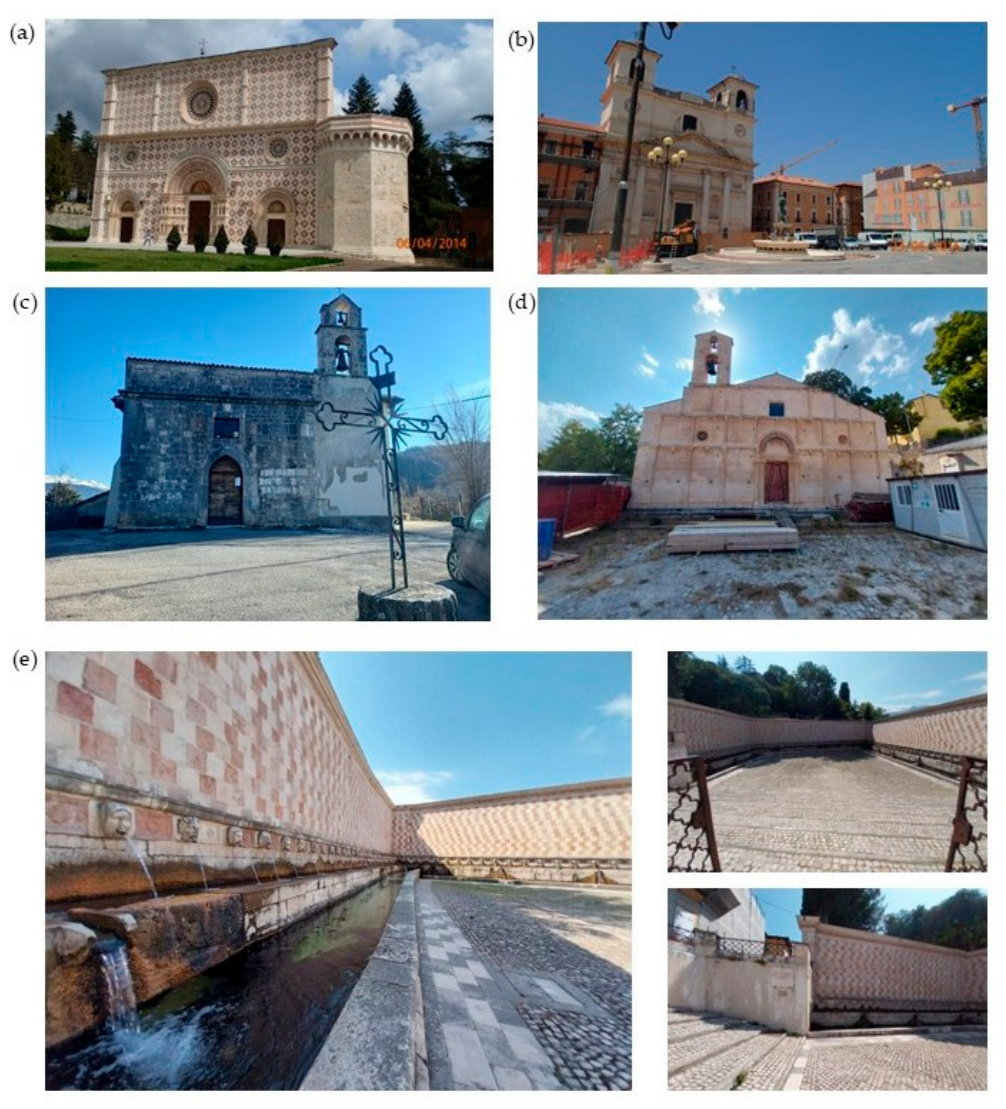
Figure 2.
Churches constructed in L’Aquila during the 14th Century: (a) Church of San Domenico (May 2024) Source: Google maps; (b) Church of Santa Maria Paganica and (c) Church of Santa Maria di Roio. (23rd July 2026) Photo: Giuseppe Forino; (d) Church of San Bernardino (e) San Bernardino (interior- front); (f) San Bernardino (interior- back) and (g) Spanish Castle (2010). Photos: Diana Contreras.
Figure 2.
Churches constructed in L’Aquila during the 14th Century: (a) Church of San Domenico (May 2024) Source: Google maps; (b) Church of Santa Maria Paganica and (c) Church of Santa Maria di Roio. (23rd July 2026) Photo: Giuseppe Forino; (d) Church of San Bernardino (e) San Bernardino (interior- front); (f) San Bernardino (interior- back) and (g) Spanish Castle (2010). Photos: Diana Contreras.
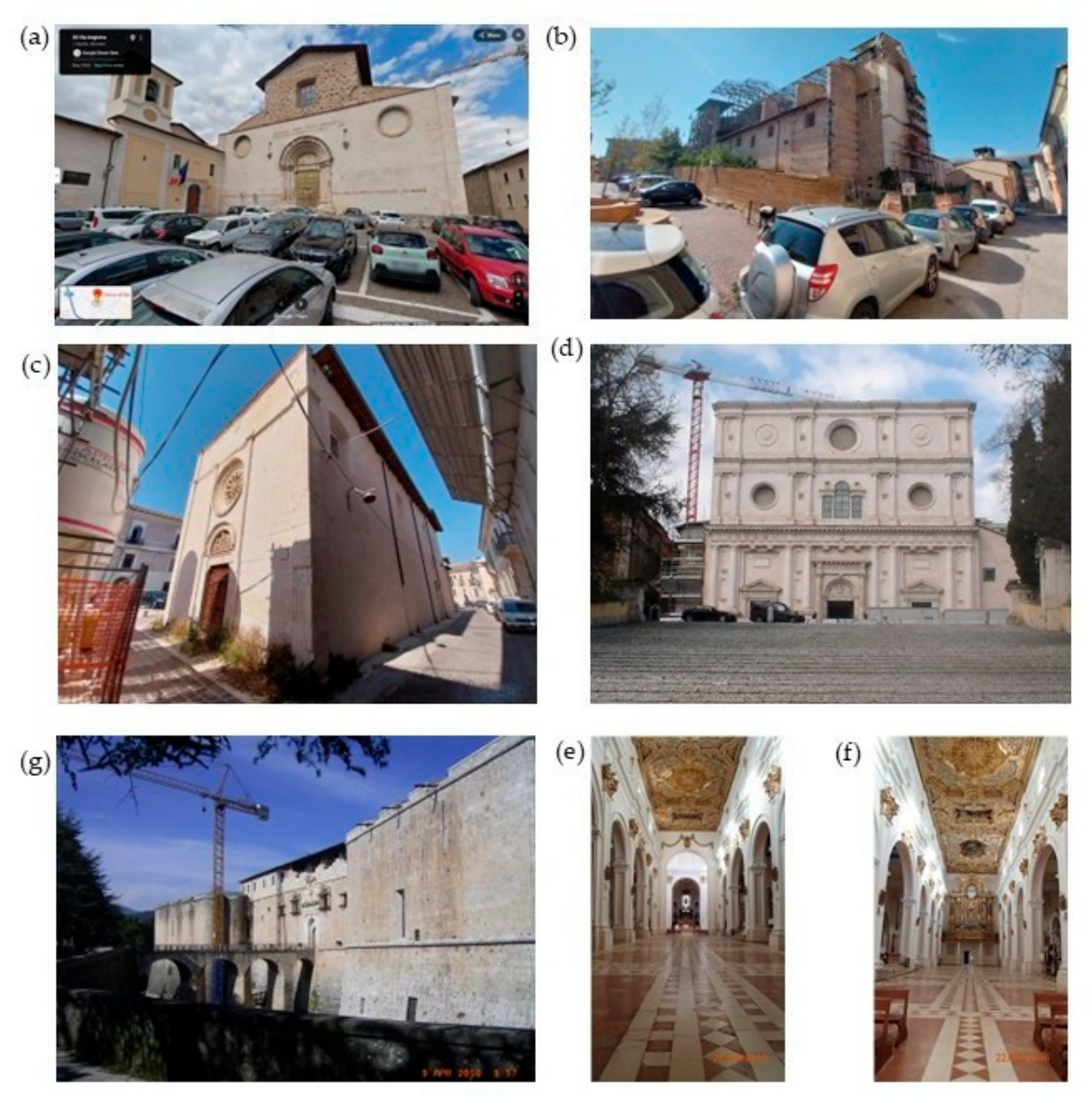
Figure 3.
Church of Santa Maria del Suffragio restoration process: (a) Damage after the earthquake in 2009, photo: David Alexander; (b) 2010; (C) 2012; (d) 2014;(e) 2016; photos: Diana Contreras and (f) 2026. Photo: Giuseppe Forino.
Figure 3.
Church of Santa Maria del Suffragio restoration process: (a) Damage after the earthquake in 2009, photo: David Alexander; (b) 2010; (C) 2012; (d) 2014;(e) 2016; photos: Diana Contreras and (f) 2026. Photo: Giuseppe Forino.
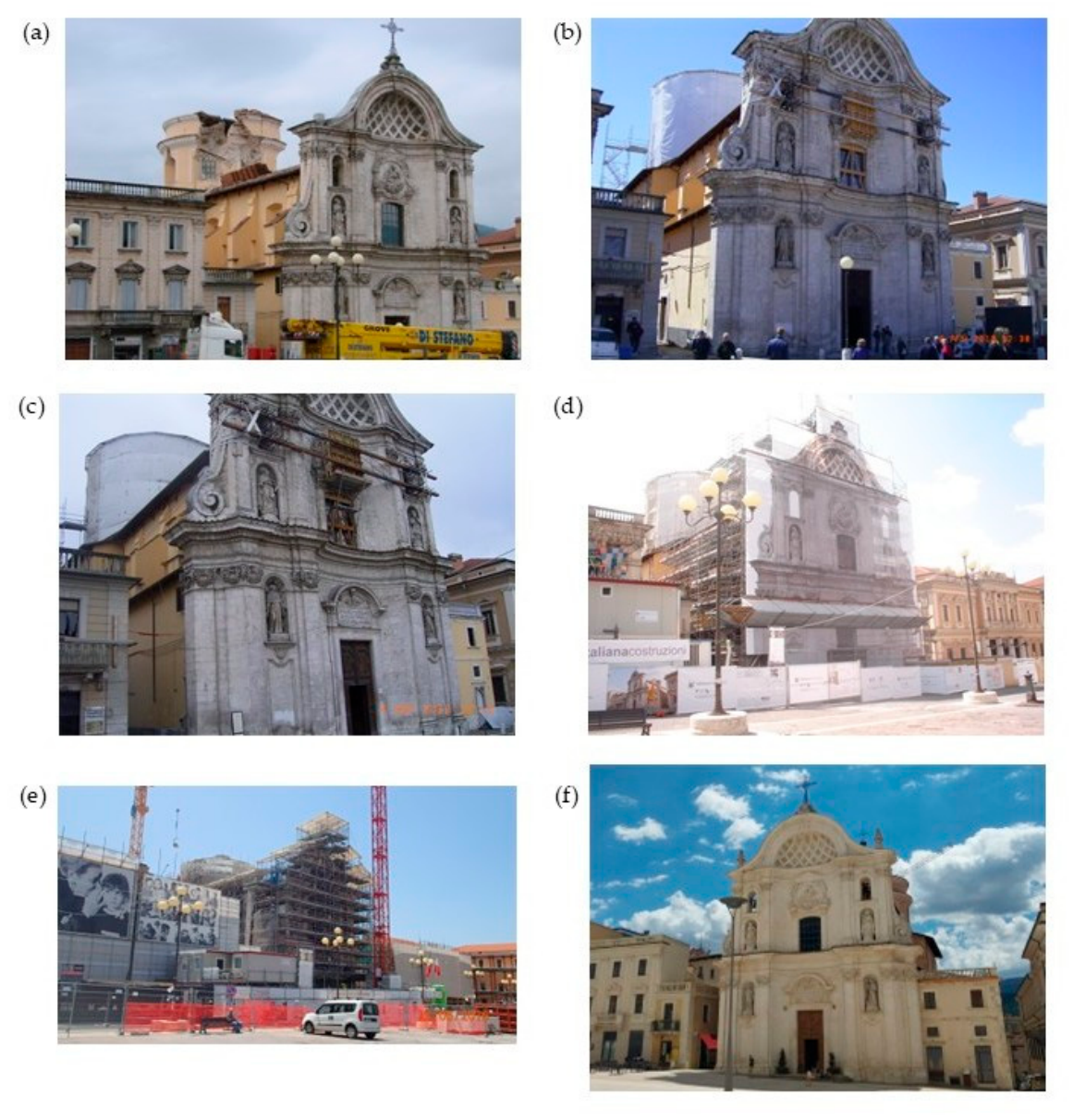
Figure 4.
Methodology flowchart.
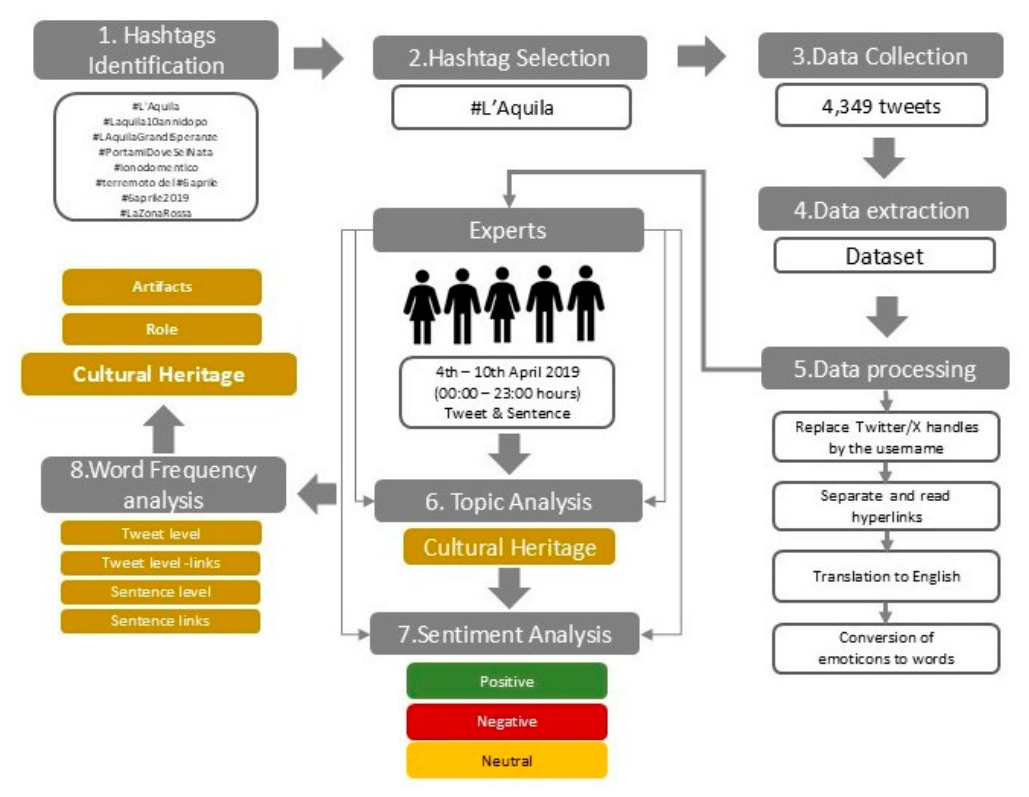
Figure 5.
Sentiment analysis: (a) Tweet level; (b) Sentence level.
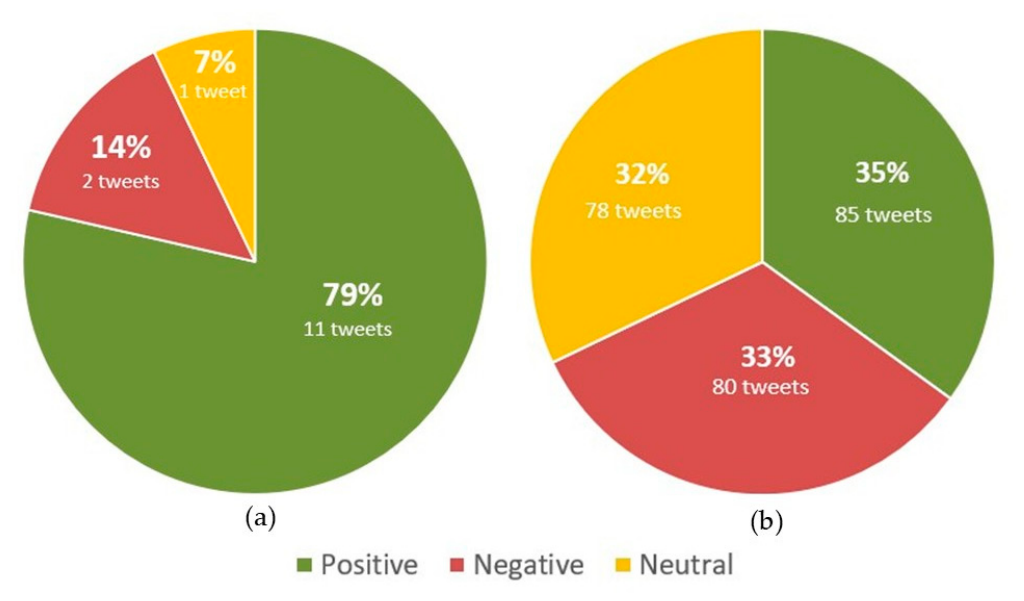
Figure 6.
(a) Tweet classified into positive polarity posted around the tenth Anniversary of the 2009 Earthquake in L'Aquila with sentences that mention the topic of cultural heritage. Source: [131].
Figure 6.
(a) Tweet classified into positive polarity posted around the tenth Anniversary of the 2009 Earthquake in L'Aquila with sentences that mention the topic of cultural heritage. Source: [131].
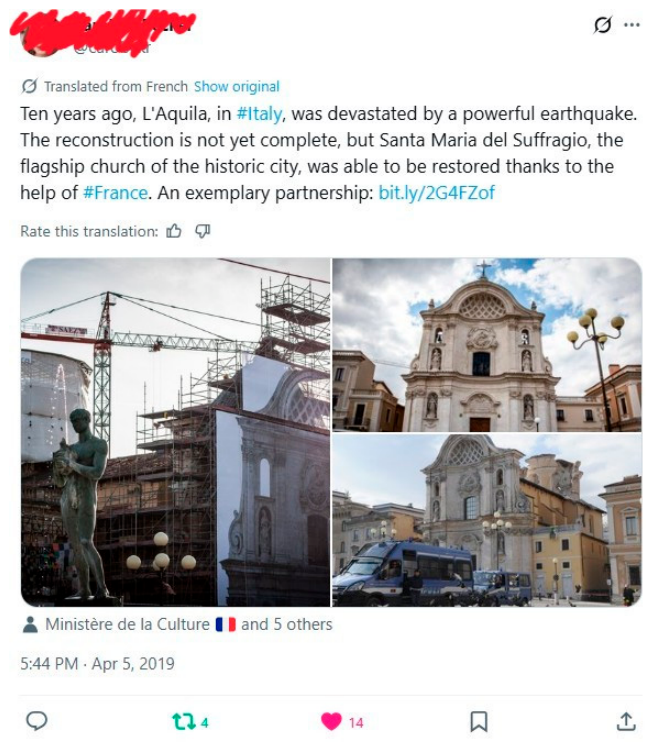
Figure 7.
Word frequency analysis at tweet level.
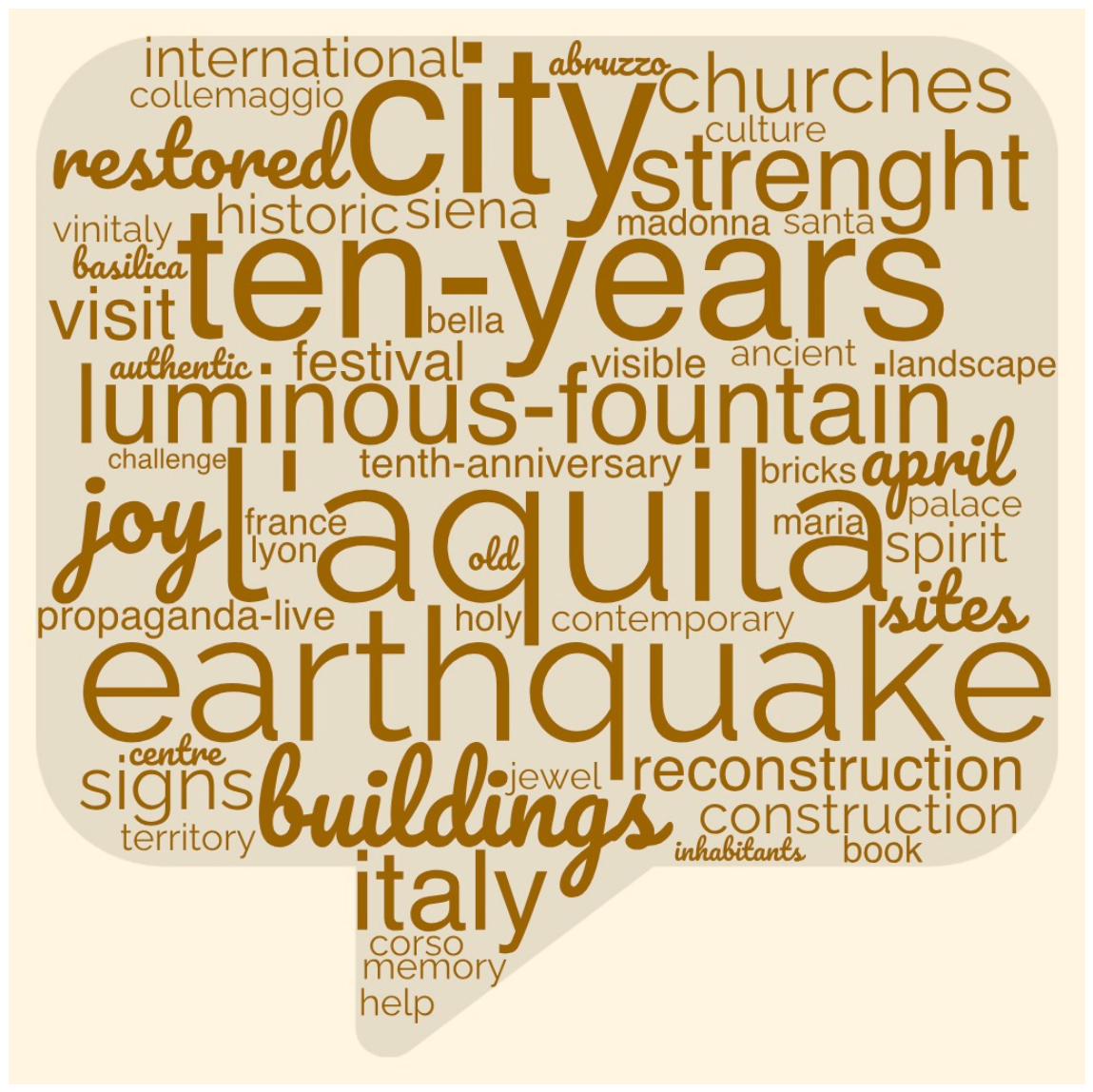
Figure 8.
The Luminous Fountain in L’Aquila, Italy (2012). Photo: Diana Contreras.
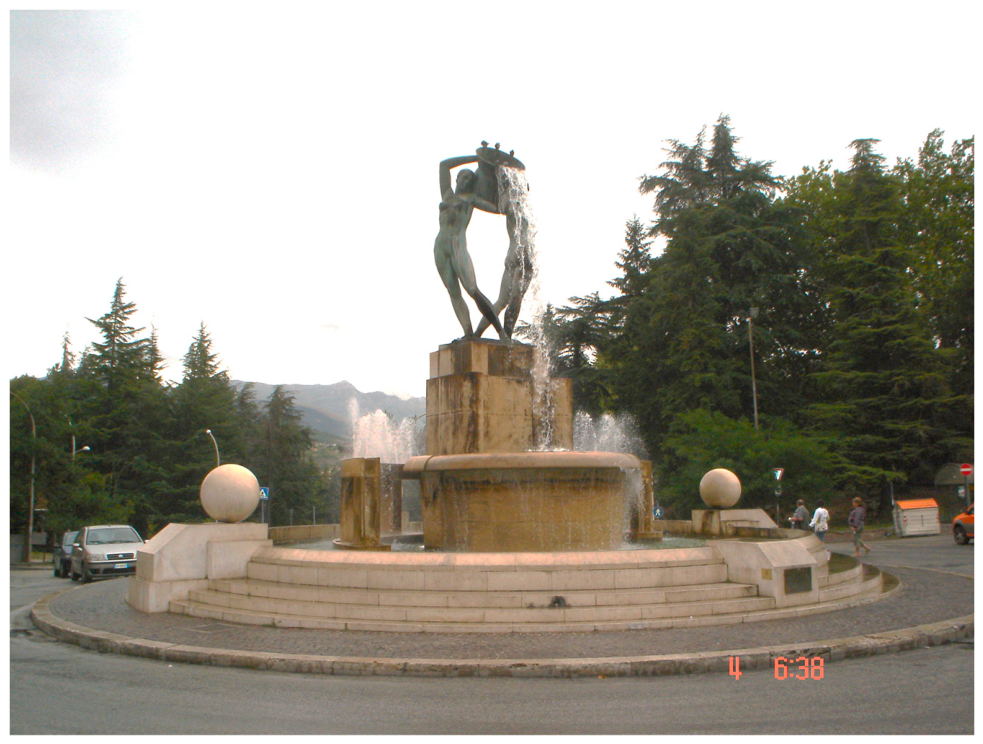
Figure 9.
Word cloud identifying key words in text data included in links embedded in tweets with cultural heritage as main topic.
Figure 9.
Word cloud identifying key words in text data included in links embedded in tweets with cultural heritage as main topic.
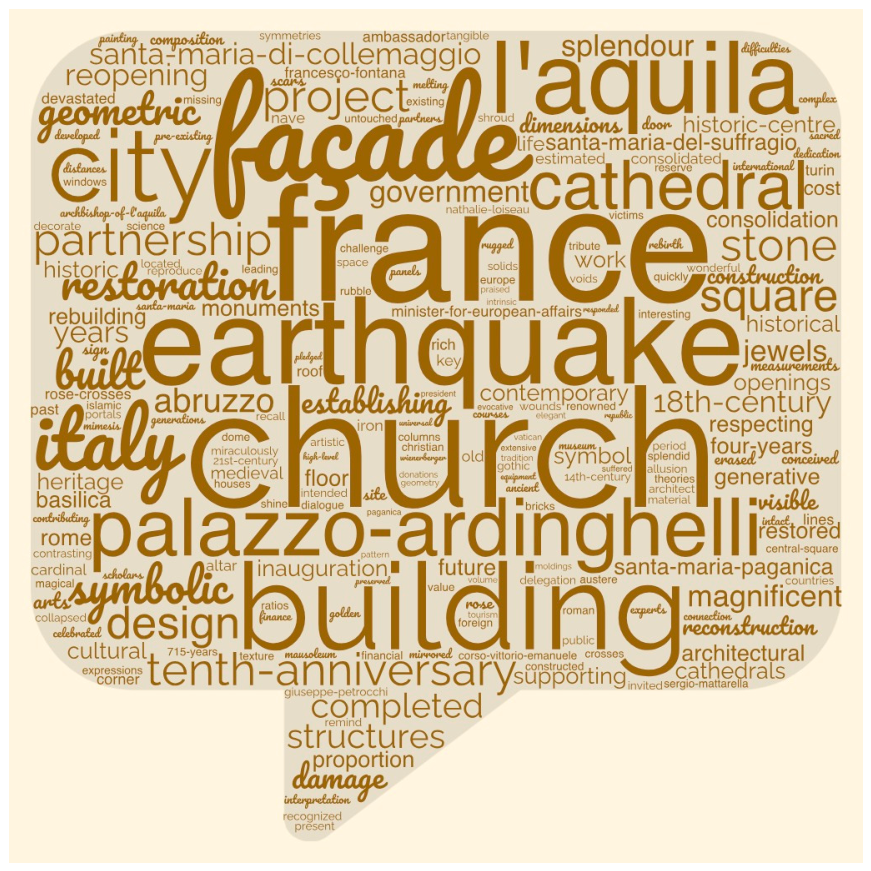
Figure 10.
Palazzo Ardinghelli (23rd July 2026). Photo: Giuseppe Forino.
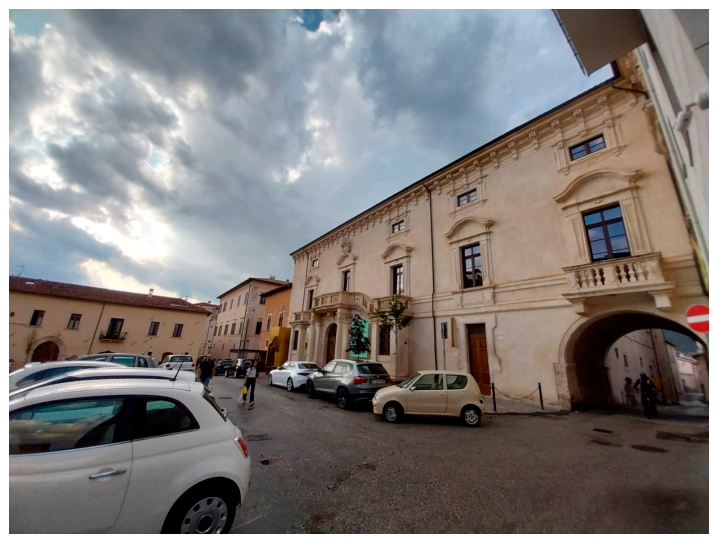
Figure 11.
Word cloud identifying key words at sentence level on tweets which the topic of cultural heritage is not the main topic.
Figure 11.
Word cloud identifying key words at sentence level on tweets which the topic of cultural heritage is not the main topic.
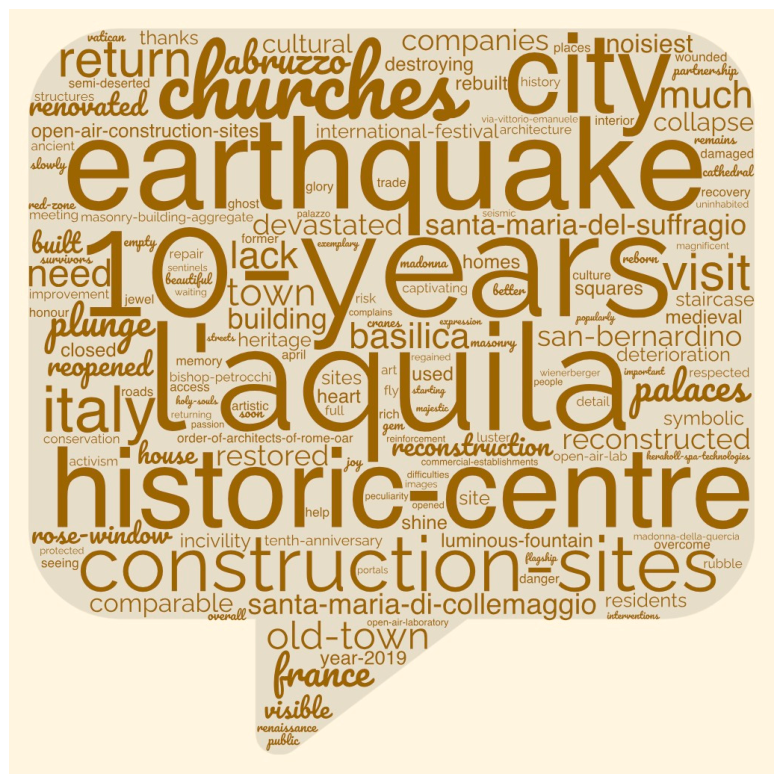
Figure 12.
Word cloud identifying key words at sentence level on links tweets which the topic of cultural heritage is not the main topic.
Figure 12.
Word cloud identifying key words at sentence level on links tweets which the topic of cultural heritage is not the main topic.
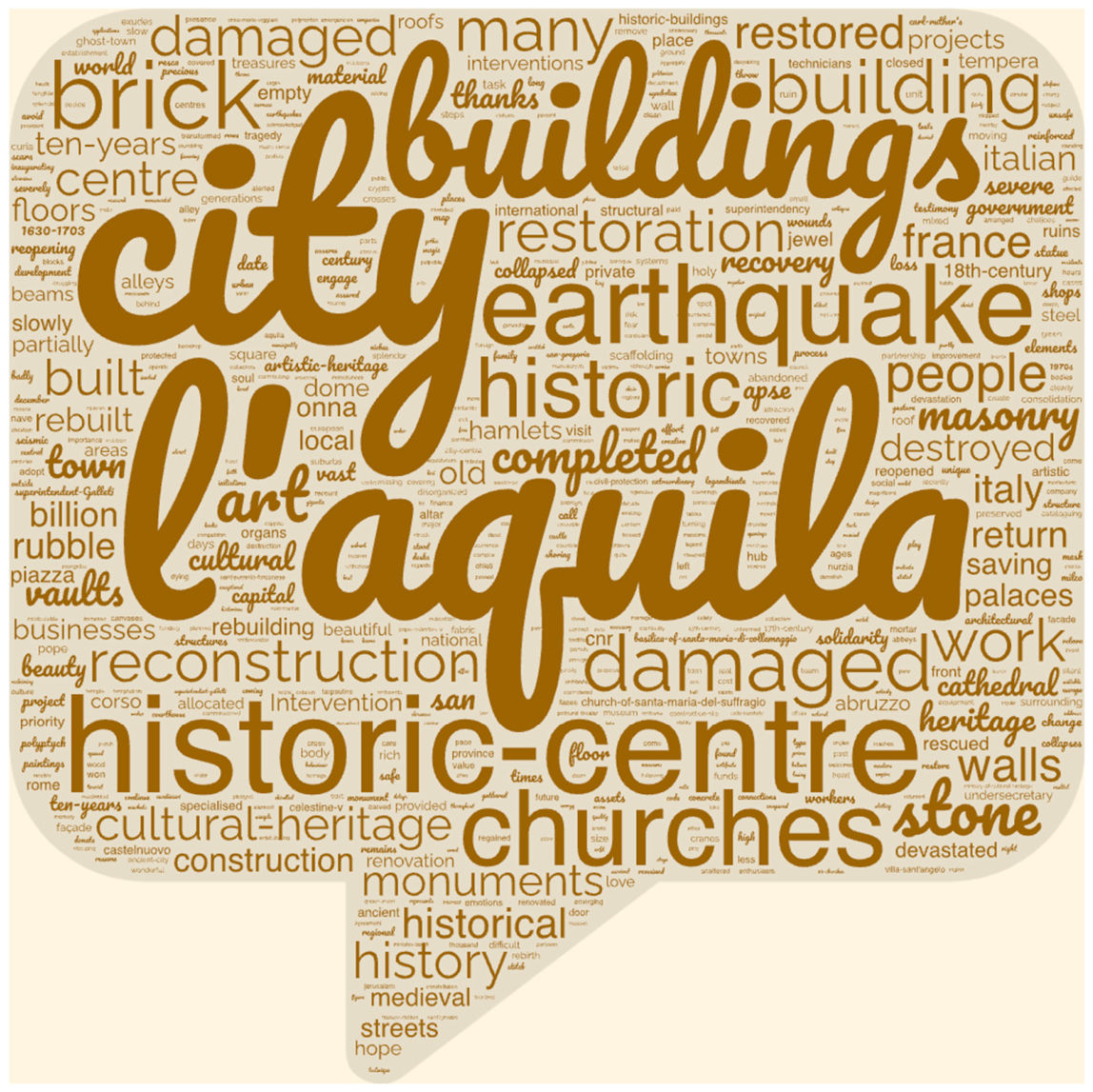

Table 1.
Classification rules for sentiment analysis. Source: Adapted from [108].
Table 1.
Classification rules for sentiment analysis. Source: Adapted from [108].
| Polarity | Rules |
|---|---|
| Positive |
|
| Negative |
|
| Neutral |
|
Disclaimer/Publisher’s Note: The statements, opinions and data contained in all publications are solely those of the individual author(s) and contributor(s) and not of MDPI and/or the editor(s). MDPI and/or the editor(s) disclaim responsibility for any injury to people or property resulting from any ideas, methods, instructions or products referred to in the content. |
© 2026 by the authors. Licensee MDPI, Basel, Switzerland. This article is an open access article distributed under the terms and conditions of the Creative Commons Attribution (CC BY) license (http://creativecommons.org/licenses/by/4.0/).
Copyright: This open access article is published under a Creative Commons CC BY 4.0 license, which permit the free download, distribution, and reuse, provided that the author and preprint are cited in any reuse.