
Submitted:
23 September 2026
Posted:
28 September 2026
You are already at the latest version
Abstract
The ontological transition from biological signaling to the complexities of human natural language has traditionally been conceptualized as a saltational leap—a categorical rupture where mechanical causality terminates and "rational" intentionality emerges. This paper posits the Teleofunctional Evolutionary Representation Model (TERM) as a robust framework to bridge this theoretical lacuna. By synthesizing Ruth Millikan’s biosemantics with a novel structural-functional taxonomic unit termed the "Functure," this study argues for a formal, teleological continuity extending from primordial genetic sequences (R0) to the sophisticated structures of formal logic (R3). The analysis provides a rigorous critique of the rationalist tradition, which erroneously treats representation as an exclusively mental phenomenon. Instead, it is proposed that intentionality constitutes a natural property derived from the evolutionary efficacy of producer-consumer systems. The model culminates in a redefinition of logic: rather than a collection of transcendental Platonic laws, logic is understood as the stabilized regulation of representational transitions, selected to facilitate inter-agent social coordination. This exploration offers a naturalized account of semantics, displacing the "subjective mind" from the locus of meaning and repositioning it as an emergent product of teleofunctional history.
Keywords:
Teleofunctional Evolutionary Representation Model
; functure
; biosemantics
; Ruth G. Millikan
1. The Crisis of Meaning and the Rationalist Illusion
1.1. The Semantic Gap and the Historical Context of Dualism
The conceptual boundary demarcating the purely biological from the explicitly linguistic remains one of the most contentious, heavily debated, and historically entrenched frontiers in contemporary philosophy of mind, cognitive science, and theoretical biology (Godfrey-Smith, 1996). On one side of this seemingly insurmountable "semantic gap" lies the physicalist domain of molecular biology, governed entirely by the mechanical, deterministic, and probabilistic processes of genetic replication, protein synthesis, and metabolic regulation. On the other side of this divide lies the sphere of human natural language, a domain characterized by complex intentionality, propositional attitudes, truth-functional compositionality, and the rigorous normative constraints of formal logic.
Historically, the philosophical community has categorized representation as an inherently and exclusively mental operation—a subjective reconstruction of the external physical environment within an internal, phenomenal cognitive theater. This "Representational Theory of Mind" traces its lineage to Aristotelian hylomorphism and was subsequently fortified by the Cartesian dualistic turn between res cogitans and res extensa, presupposing that the correspondence between thought and reality is an exclusively cognitive affair. Within this entrenched paradigm, mental states such as beliefs, desires, and perceptions are viewed as the primary and original repositories of intentionality, defined fundamentally by their "aboutness" or directedness toward external objects and states of affairs. This perspective has been so pervasive throughout the history of Western philosophy that it is frequently treated as an unexamined axiom: that representation logically necessitates a conscious, perceiving mind for its instantiation.
1.2. The Cartesian Legacy and the Representational Theory of Mind
The Cartesian division between res cogitans (the thinking substance) and res extensa (the extended, physical substance) established a theoretical framework wherein meaning and physical causality were fundamentally segregated. Even as contemporary cognitive science largely rejected Cartesian substance dualism in favor of materialist functionalism or computational theories of mind (such as Jerry Fodor's Language of Thought hypothesis) (Fodor, 1975), the underlying assumption that meaning requires an internal cognitive syntax remained largely intact.
In modern frameworks, intentionality is often conceptualized as a property of internal mental symbols that possess syntactic structures analogous to those of natural language (Fodor, 2008). However, these models consistently struggle with the foundational problem of "original intentionality"—how physical symbols within a biological brain acquire their semantic content in the first place without relying on an external, conscious interpreter. Even philosophers who reject a naive correspondence picture of thought retain this difficulty in subtler form: Putnam’s (1981) internal realism, for instance, still locates the meaning-fixing relation within the cognizing subject’s conceptual scheme rather than in a mind-independent selection history. And theorists who reject internal representation altogether, such as Brooks (1991), frame the resulting choice as a binary between full symbolic representation and no representation at all, rather than recognizing the graded, naturalized continuum running from molecular biology to language that TERM aims to reconstruct. Traditional theories on both sides of this divide therefore fail to recognize proto-semantic interactions at fundamental biological levels, perpetuating the semantic gap between life and mind.
1.3. A Rigorous Critique of Semantic Rationalism
The Teleofunctional Evolutionary Representation Model (TERM), grounded firmly in the principles of biosemantics pioneered by Ruth Millikan, challenges this rationalist, subject-centric tradition. It is necessary to contend against "meaning rationalism"—the pervasive philosophical doctrine asserting that thoughts must possess an a priori internal consistency and be fully intelligible solely through introspective analysis or formal logical deduction (Millikan, 2004). Rationalism inherently implies that a cognitive subject’s internal, conscious grasp of a concept constitutes the very foundation of its semantic meaning and normative validity.
In stark contrast, TERM posits that meaning is a natural, objective property emerging directly from the physical architecture and evolutionary history of biological life. By grounding semantics in evolutionary biology and teleofunctional analysis, the theoretical focus shifts irrevocably from the internal "certainty" or "clarity" of the perceiving subject to the historical "success" of biological functions (Millikan, 2005). If a honeybee’s highly choreographed waggle dance accurately represents the spatial coordinates, distance, and quality of a nectar source, its representational status is not derived from the individual bee’s cognitive "grasp" of a geometric concept. Rather, the meaning is established because the entire dance-producer-and-observer-consumer system possesses a rigorous selection history predicated strictly on that environmental correspondence. This paradigm shift facilitates interpreting human natural language not as a metaphysical miracle of pure reason or an inexplicable cognitive mutation, but rather as the most advanced, highly coordinated stratum of a continuous biological hierarchy (Pinker, 1994).
1.4. The Teleosemantic Alternative and the Origin of Normativity
The rationalist framework ultimately fails to provide a cohesive, naturalistic account for the origin of normativity—the standard by which something ought to be the case (Papineau, 1987). If meaning is treated as a purely mental or ideal phenomenon, the mechanism by which a thought, utterance, or biological signal can be deemed objectively "erroneous" in relation to the physical world remains obscure and philosophically problematic.
By invoking the concept of teleofunction—a function defined by the evolutionary history of selection that accounts for an entity's continued proliferation (Neander, 1991; Godfrey-Smith, 1994)—"error" is effectively redefined. It is no longer viewed merely as a logical inconsistency or a subjective misapprehension, but rather as a quantifiable biological failure. A representation is deemed false or inaccurate precisely when the environmental conditions requisite for the consuming system's functional success and survival are absent. Thus, normativity is grounded not in Platonic ideals, but in the pragmatic, historical reality of biological survival and evolutionary fitness (Millikan, 1993).
2. The Ontological Bridge—From Structure to Functure
2.1. The Separability of Artifacts Versus Biological Necessity
To properly delineate the formal continuity of meaning across evolutionary epochs, a rigorous ontological analysis of the relationship between physical structure and teleological function is imperative. Within the domain of non-biological artifacts and humanly engineered tools, structure and function are both conceptually and physically autonomous entities (Millikan, 1984).
Consider the standard example of a "shoe" or a "hammer." A shoe may be comprehensively defined by its structural properties: a hollow, geometric object contoured to the anatomy of the human foot, constructed from specific composite materials such as leather, synthetic polymers, or rubber. Its function—providing environmental protection, thermal insulation, and the mechanical facilitation of bipedal locomotion—constitutes a completely distinct, supplementary layer of description. It is entirely possible for an observer to provide an exhaustive molecular, geometric, and physical description of a shoe without making any reference whatsoever to its utility. In this context, function is "imposed" or "ascribed" upon the physical structure entirely by external human intent and cultural practice. The artifact possesses no intrinsic, objective functional identity independent of the user's mental states or societal conventions.
2.2. Thermodynamics, Chemical Necessity, and Biological Architecture
In naturally evolved biological entities, this ontological separation between structure and function is nonexistent. The fundamental architecture of life operates under strict thermodynamic and chemical constraints, in which the precise configuration of matter is the exclusive determinant of its capacity to perform work and sustain the organism (Kauffman, 1993). Consider a complex organic molecule, such as Acetyl-CoA, or a specialized macromolecular machine, such as DNA polymerase. Their physical configuration—the precise spatial arrangement of atoms, the dynamic distribution of electromagnetic charges across their surfaces, the specific hydrophobic and hydrophilic folding patterns of their peptide chains—is the immediate, direct, and indivisible determinant of their biological role — as Jacob and Monod’s (1961) analysis of allosteric conformational transitions in regulatory proteins first demonstrated for the case of gene regulation specifically, a result since generalized across molecular biology.
These biological entities do not merely "possess" a function in the superficial manner of an engineered tool; they inherently are their function, existing in a state of continuous biochemical potentiality. A structural description of an enzyme that omits its active site's affinity for a specific substrate is fundamentally incomplete, as the structure itself is a physical manifestation of its evolutionary purpose.
2.3. The Emergence of the "Functure" (Structural-Functional Unity)
To formally capture this biological reality, this paper introduces and identifies this structural-functional unity as the "Functure" (a portmanteau denoting the indivisibility of Function and Structure). Within a Functure, the physical structure is not a passive, interchangeable substrate for an arbitrarily assigned function; rather, the specific function provides the exclusive evolutionary rationale and historical explanation for the structure's very existence and continued replication in a population (Barbieri, 2003).
For instance, Acetyl-CoA operates as a critical, highly conserved Functure within the citric acid cycle (Krebs cycle). Its highly specific chemical architecture is not a product of random, arbitrary assembly; it has been rigorously refined and conserved by natural selection specifically to facilitate the efficient transport of acetyl groups for cellular respiration. A minute structural alteration, such as a single atomic substitution altering its binding affinity, results in the immediate and catastrophic cessation of its metabolic function. Thus, the "meaning" or semantic value of the molecule is inextricably linked to its precise topological position within the metabolic chain.
2.4. Functures as Ontological Primitives for Biosemantics
If biosemantics is to serve as a comprehensive, naturalized theory of meaning, it must explicitly adopt the Functure as its primary, foundational unit of analysis. The Functure represents the exact theoretical nexus where blind physical causality transitions into "meaningful," teleological interaction. The structure's presence in the present moment is causally explained by the Intentionality (the directedness) of its functional outcome in the past (Dretske, 1988). This conceptualization effectively bypasses the need for an external conscious observer, embedding meaning directly into the organism's biochemical fabric. By tracking the evolution of Functures from simple metabolic loops to complex neural assemblies, TERM establishes an unbroken ontological chain from basic chemistry to advanced cognition.
3. Naturalizing Intentionality (Aboutness)
3.1. Brentano's Ghost and the Spectator Fallacy
In traditional analytic philosophy and phenomenology, stretching back to Franz Brentano, the concept of Intentionality is frequently and erroneously conflated with conscious "intent," subjective awareness, or a deeply metaphysical "mental directedness." Brentano famously posited intentionality as the defining mark of the mental, explicitly separating the psychological realm from the physical. This enduring assumption inevitably leads to what may be termed the "Spectator Fallacy"—the erroneous, anthropocentric assumption that for a physical state, symbol, or signal to be "about" an external object, it must necessarily be perceived, interpreted, and understood by a conscious, observing subject (Dretske, 1981).
This fallacy plagues numerous thought experiments in the philosophy of mind, notably John Searle’s "Chinese Room" argument, which presumes that syntactic manipulation lacks intrinsic semantics unless a conscious observer is present to bestow meaning upon the symbols (Searle, 1980). The TERM model systematically rejects this anthropocentric prerequisite.
3.2. Information versus Natural Intentionality
It is crucial to differentiate between raw information and true natural intentionality. While physical systems routinely transmit information (e.g., tree rings correlating with historical rainfall patterns), they do not inherently possess intentionality unless an evolved system is designed to use that correlation (Skyrms, 2010). The tree rings are not "about" the rain in a teleosemantic sense because the tree does not utilize the rings to alter its behavior in response to past weather; the correlation is merely a physical byproduct.
The TERM model employs intentionality in a strictly naturalistic, teleological sense: as an objective property of "aboutness" that remains entirely independent of consciousness or subjective interpretation (Millikan, 1989). Intentionality is herein defined as a highly specific relationship characterized by strict environmental mapping and functional dependence. A transcribed mRNA sequence possesses natural intentionality because its specific nucleotide arrangement is intrinsically about the corresponding polypeptide chain it codes for; similarly, a circulating hormonal signal, such as glucagon or insulin, is deeply intentional because its release and concentration levels are about systemic blood-glucose variables (Maynard Smith, 2000).
3.3. The Historical-Functional Relation
This non-conscious form of intentionality is best characterized as a natural, historically forged relation wherein a Vehicle signifies or maps a World-state primarily because a highly specific Consumer mechanism relies entirely on that structural correspondence to successfully execute its Proper Function (Jablonka & Lamb, 2005).
Consider the magnetosomes found in certain marine anaerobic bacteria (Dretske, 1986). These internal structures align with the Earth’s magnetic field, guiding the bacteria downward toward oxygen-depleted waters. The magnetosome is a vehicle that represents the direction of anaerobic environments. It is "about" the safe, oxygen-free zone. If a scientist places a bar magnet near the bacteria, causing them to swim upward into oxygen-rich, lethal water, the magnetosome has generated a "false" representation. It misrepresented the environment. As Dretske (1986) himself notes, this example carries an indeterminacy: the magnetosome’s function could be described as detecting magnetic north or as detecting oxygen-free water, and only a consumer-based individuation of function, of the kind developed in §4.4, fixes which description is correct.
3.4. The Role of the Lineage in Anchoring Meaning
This perspective is fundamentally anti-rationalist and strictly evolutionary. It suggests that the "meaning" of a biological signal or Functure resides neither in the signal's intrinsic physical geometry nor in the interpretive mind of a third-party observer. Instead, meaning is anchored entirely in the specific environmental conditions that were historically necessary for the consumer mechanism's reproductive success (Millikan, 1989). Consequently, intentionality is a historical-functional relation, bound to the phylogenetic lineage of the organism. The semantic validity of a representation’s "aboutness" is confirmed exclusively by the survival and genetic proliferation of the ancestral lineage that successfully utilized it. An organism's cognitive understanding of the genetic code is not a prerequisite for the genetic code's meaningfulness; rather, its meaning is continuously manifested and validated through the organism's continued biological existence and reproductive success.
4. The Producer-Consumer Framework
4.1. Shannon Information Versus Teleofunction
The academic discourse regarding "biological information" is frequently polarized between Claude Shannon’s mathematical theory of communication—which is fundamentally focused on signal predictability, bandwidth, and uncertainty reduction across a noisy channel—and the highly interpretive, often subjective frameworks of biosemiotics (Hoffmeyer, 1996). While Shannon information is invaluable for understanding the physical limits of neural or genetic transmission, it is entirely agnostic to semantic content; a string of random noise can contain the same Shannon entropy as a profound literary work.
The TERM model synthesizes these disparate approaches by moving beyond mere signal probability, formally establishing the producer-consumer architecture as the absolute locus of semantic content. Information becomes representation only when integrated into an evolved functional loop.
4.2. Formalizing the Producer-Consumer Architecture
Within the TERM framework, a representation or meaningful signal exists exclusively within a highly integrated biological system comprised of two essential components (Sterelny, 2003):
- A Producer: A dedicated mechanism (a specific Functure) possessing the evolved proper function of generating a vehicle (V) strictly and only when a highly specific environmental world-state (W) is present. The producer's biological mandate is to map the world onto a signal (Millikan, 1984).
- A Consumer: A corresponding mechanism (a secondary, structurally complementary Functure) possessing the evolved proper function of receiving and utilizing the vehicle (V) to execute a specific behavioral, physiological, or metabolic action (I). Crucially, the biological success of this action is entirely contingent upon the actual physical existence of the world-state (W) originally mapped by the producer.
For example, a beaver spotting a predator (Producer) slaps its tail on the water (Vehicle) because a wolf is approaching (World-state). The other beavers in the colony (Consumers) hear the slap and immediately dive underwater (Interpretive effect). The dive is only biologically successful—in terms of expending energy to evade death—if the wolf is actually present.
4.3. Biological Normativity and the Definition of Error
In purely causal, inorganic physical systems, the concept of "error" is entirely inapplicable; there are only antecedent physical causes and consequent physical effects. A rock falling from a cliff does not make an "error" if it strikes the ground. However, within an evolved teleosemantic system, it becomes scientifically possible and necessary to define "misrepresentation," "falsehood," and "error" objectively (Godfrey-Smith, 1996).
Should a consumer mechanism respond to a vehicle (V) in the complete absence of the corresponding, necessary world-state (W)—whether this absence is due to genetic mutation, severe environmental interference, biological mimicry, or deceptive signaling by a predator—the system has definitively failed to fulfill its proper function. The beaver that dives when a falling branch (not a wolf) causes a splash has acted on a false representation. This rigorous framework allows for the definition of "truth" and "falsehood" in strictly biological, non-mental terms. A true representation is defined as one in which the environmental state accurately aligns with the consumer's functional requirements. This theoretical move provides the necessary, long-sought ontological bridge extending from pure chemical states (what physically is) to logical normativity (what functionally ought to be).
4.4. Resolving the Disjunction Problem
This producer-consumer dynamic successfully resolves pervasive philosophical dilemmas such as Jerry Fodor’s "Disjunction Problem" (Fodor, 1975). Fodor argued that teleosemantics cannot determine whether a frog's visual system represents "flies" or merely "small, dark, moving dots," since both historically triggered the frog's tongue-snapping reflex. Under TERM, the ambiguity is resolved by analyzing the Consumer. The frog's digestive system (the ultimate consumer of the action) extracts metabolic value exclusively from nutrient-rich flies, not from small dark dots (like pebbles). Therefore, the representation is objectively about flies, because the presence of a fly is the specific environmental condition required for the consumer mechanism to achieve evolutionary success (Millikan, 1984).
5. Formal Architecture of the TERM Model
5.1. The Representational Relation (Rep): Domains and Satisfaction Conditions
Any representational episode in the TERM hierarchy is formalized as a five-domain relation, Rep, rather than an unstructured list of five items. A tuple ⟨V, W, F, P, I⟩ belongs to Rep just in case it satisfies the conditions given below. The base symbol is deliberately written Rep rather than R to avoid collision with the hierarchy levels R0–R3 introduced in §6, which index a different construction entirely.
Rep ⊆ × × × ×
(Vehicles): the domain of physical structure-types capable of serving as signs — nucleotide sequences, hormone molecules, spike-train patterns, phonetic utterances. A token of this domain is denoted V, matching its use throughout the rest of this paper.
(World-states): the domain of environmental or physiological condition-types a vehicle can be about. A token is denoted W.
(Proper functions): the domain of historically selected functions, individuated by a Millikanian Normal explanation — the actual selection history that explains why a device performing that function persisted in the population (Millikan, 1984, 1989). A token is denoted F.
(Producer–consumer pairs): the domain of paired devices ⟨Pprod, Pcons⟩ standing in a shared reproductive lineage, such that Pprod's proper function is to produce a vehicle and Pcons's proper function is to consume it. A token pair is denoted P.
(Interpretive effects): the domain of behavioral, physiological, or cognitive outputs a consumer device can produce upon receiving a vehicle. A token is denoted I.
Unlike a bare list of five explananda, Rep comes with explicit satisfaction conditions. A tuple ⟨V, W, F, P, I⟩ belongs to Rep just in case:
(i) P = ⟨Pprod, Pcons⟩ share a reproductive lineage L;
(ii) F is Pprod's proper function: to produce V when, and only when, W obtains — established by a Normal explanation N1 (Millikan, 1984, 1989);
(iii) Pcons's proper function is discharged by transforming V into I, where this transformation is adaptive (Normal explanation N2) if and only if W in fact obtains.
This yields an explicit, non-circular truth-condition rather than a stipulated one. A token production–consumption event is veridical just in case W obtains when V is produced and consumed; it is a misrepresentation just in case Pcons executes I — thereby attempting to discharge its proper function — while W does not obtain. Error falls directly out of clause (iii); it is not asserted separately. This makes explicit, as a five-domain relation with satisfaction conditions, the same apparatus Millikan uses for Normal conditions and proper function (Millikan, 1984) — rather than merely relabeling it.
5.2. Producer and Consumer Mappings, and the Measure of Semantic Fidelity
Let fp be the disposition of Pprod, partial over , that assigns a vehicle to a world-state whenever W falls within the historically Normal range of Pprod: fp: ⇀ . Let fc be the corresponding disposition of Pcons, partial over : fc: ⇀ . Neither function is guaranteed to be defined for every input, and neither is optimized against an unspecified global quantity; both are historically contingent dispositions of particular devices, fixed by selection on the lineage L.
The theoretically load-bearing quantity is not an unspecified “system stability,” but semantic fidelity — the conditional reliability of the mapping across the reproductive history of L:
Fid(fp, fc) = P(W | V is produced by Pprod and consumed by Pcons)
estimated over the tokens of V actually produced and consumed across the history of L, not over a single event. Selection favors producer–consumer pairs with high Fid(fp, fc) whenever the fitness payoff of a correct response to W exceeds the cost of responding to V absent W — the same payoff-weighted reliability that stabilizes signaling in Skyrms’s (2010) sender–receiver games.
This measure distinguishes teleosemantic content from bare Shannon covariation (§4.1). The tree rings discussed in §3.2 carry Shannon information about rainfall — mutual information I(V; W) > 0 — but are not intentional, because no consumer device’s proper function depends on that covariation; Fid is undefined for the pair, since there is no Pcons. A vehicle is teleosemantically about W only when Fid(fp, fc) is itself explanatorily load-bearing — the reason the producer–consumer pair was selected — not a coincidental correlation.
This also sharpens the resolution of Fodor’s disjunction problem already introduced in §4.4. Because Fid is defined relative to the consumer’s proper function, and the frog’s digestive consumer’s proper function is discharged only by nutrient uptake from flies, Fid is high for the fly–vehicle pairing and low (or undefined, absent a relevant consumer) for the dot–vehicle pairing, even though both vehicle-types trigger the identical tongue-snap.
5.3. Descriptive and Directive Content as Direction of Fit
Millikan’s (1995) distinction between descriptive and directive (Pushmi-Pullyu) content can now be stated as a difference in which side of the fp/fc mapping carries the burden of success, rather than as two loosely described “primary evolved functions.”
Descriptive (indicative) success: V is successful when fp(W) = V accurately tracks the actual W — success is measured by the fit of vehicle to world.
Directive (imperative) success: V is successful when fc(V) = I brings about, or is fit for, a world-state that satisfies the consumer’s proper function — success is measured by the fit of world (via behavior) to vehicle.
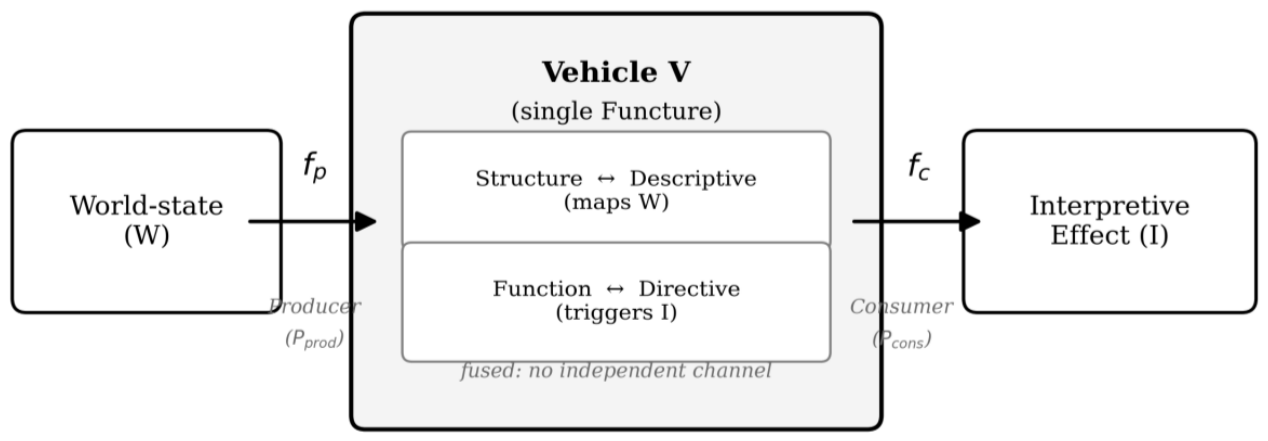
A Functure carries pure Pushmi-Pullyu content when both success conditions must be met by the very same physical vehicle without remainder — precisely the R0/R1 condition (§6), where the DNA sequence’s role in specifying protein structure (descriptive success) is not separable, even in principle, from its role in directing the ribosome’s synthesis (directive success).
5.4. Structural Decoupling: Reformalizing Schemas 1 and 2
Schema 1 (The Integrated Functure) depicts the R0/R1 condition formally: a single structure instantiates both the descriptive mapping fp: W → V and the directive mapping fc: V → I without any independent physical channel separating them. Formally, description and direction are the same function under two descriptions, not two functions composed together.
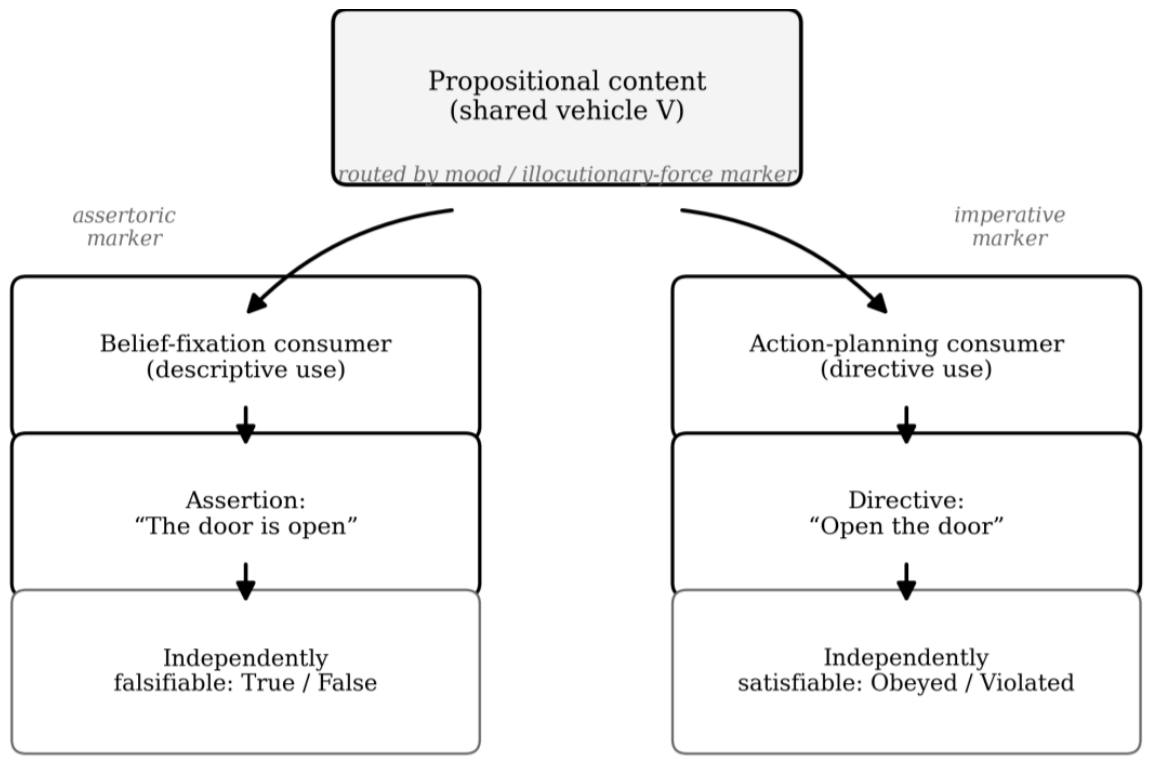
Schema 2. (The Decoupled Representation) depicts the R3 condition: distinct syntactic markers of mood or illocutionary force route an otherwise shared propositional vehicle to different consumer systems — an assertoric marker routes V to belief-fixation consumers (descriptive use), while an imperative marker routes the same propositional content to action-planning consumers (directive use). The formal signature of decoupling is that the two uses become separately falsifiable: “The door is open,” used descriptively, can be false while remaining a well-formed directive if reissued as “Open the door” — no such independent falsification is available for the fused R0/R1 Functure, whose single vehicle cannot fail descriptively without simultaneously failing directively.
6. The Representational Hierarchy—R0 to R3
6.1. Two Independent Parameters: Detachment and Compositional Depth
Rather than treating the transition between hierarchy levels as the output of an unspecified transformation function, TERM indexes the four levels along two independent, operationally defined parameters.
Detachment (D): the spatial and temporal separation between a vehicle’s production event and its consumption event, measured in the physical medium of transmission — zero for a co-located molecular complex, the diffusion distance for a circulating hormone, and unbounded (spatially and temporally) for a written or recorded utterance consumed by someone who was not present at production.
Compositional depth (K): the number of independently recombinable sub-vehicle units whose systematic recombination is exploited by fp and fc to generate novel (V, I) pairs not individually selected for. K is low when a device’s repertoire is a fixed, non-recombining list (e.g., a small set of alarm calls) and high when a finite inventory of units productively generates an open-ended set of vehicles (e.g., phonemes composing morphemes composing sentences).
The four levels are then defined as an ordinal typology on the (D, K) plane, not as successive outputs of a recursive equation:
D(R0) ≈ 0 < D(R1) < D(R2) < D(R3)
K(R0) ≈ K(R1) < K(R2) < K(R3)
Each inequality is a substantive, in-principle-falsifiable claim, checkable against an independent measurement of spatial/temporal separation or of combinatorial productivity — unlike an equation whose transformation function is left unspecified. TERM does not claim that a single continuous dynamical law drives D and K upward; modeling their joint evolutionary trajectory (e.g., via the replicator-dynamics formalism of Skyrms, 2010) is a further empirical project this typology makes tractable but does not itself carry out.
6.2. R0: Genetic Representation (GL)
The foundational stratum comprises structural Functures at the molecular level. D(R0) ≈ 0: the nucleic acid vehicle is physically attached to its site of interpretation, with transcription and translation machinery acting on the same molecule that encodes it. K(R0) is minimal: codon-to-amino-acid assignment is a fixed lookup table, not a productively recombining syntax at the level of use. The producer is the historical process of mutation and selection; the consumer is the intracellular transcription–translation machinery (Barbieri, 2003).
6.3. R1: Biological Signaling (BS)
The transition to R1 is defined by a discrete increase in D: hormones, cytokines, and neurotransmitters are produced and consumed at physically separate sites connected only by circulation or diffusion, introducing genuine transmission risk that R0’s co-located Functures cannot suffer. For example, insulin secreted by the pancreas travels through the circulatory system to interact with distant muscle and adipose cells, spatially decoupling the representation of blood-glucose levels from the site of measurement. K(R1) remains close to K(R0): the signaling repertoire is still a largely fixed inventory of hormone types, not yet a combinatorial system (Maynard Smith, 2000).
6.4. R2: Cognitive Representation (CR) and Signal Detachment
R2 is marked by two simultaneous increases. D(R2) includes, for the first time, temporal detachment: a vehicle — a sustained neural activation pattern — can be tokened in the complete absence of its corresponding W, enabling offline simulation (§8.3). A mammal can maintain a cognitive map of a water source miles away without actively sensing water. K(R2) rises as perceptual features become recombinable, allowing an organism to represent novel conjunctions of previously separate features, though not yet with the open productivity of R3 (Gärdenfors, 2003).
6.5. R3: Public Natural Language (NL)
R3 maximizes both parameters. D(R3) is unbounded in principle: a vehicle can be produced by one individual and consumed by another separated by arbitrary distance, time (writing), or generations (cultural transmission), and can concern world-states that never obtain (fiction, counterfactuals). K(R3) is maximal: a finite phonemic and syntactic inventory generates an unbounded set of well-formed, individually novel vehicles — structurally analogous to the way a finite amino-acid alphabet generates a combinatorially vast space of protein folds (§9.2), differing only in that R3’s combinatorics are actively exploited within a single generation, while R0’s are fixed by the much slower selection process operating over the lineage (Tomasello, 2008; Millikan, 2005).
7. The Logical Dimension—Inference as Selected Transition
7.1. Logic as the "Software of Social Coordination"
The TERM framework mandates a radical redefinition of formal logic. Logic is not conceptualized as a pre-existing collection of transcendentals; Platonic laws are passively discovered by the human intellect. Rather, logic is understood as the fiercely selected, stabilized regulation of transitions between intentional representations within a social matrix (Lewis, 1969).
In highly social, cooperative species such as Homo sapiens, collective survival and successful exploitation of the environment are absolutely contingent upon precise inter-agent coordination (C). When Agent A actively transmits a linguistic representation to Agent B, the cognitive rules governing the transition between these representations must flawlessly preserve functional utility.
7.2. The Selection of Inference Rules (Inferential Coordination - IC)
Consider a primitive hominid hunting scenario. The inferential transition from the descriptive representation "Fire is present" and "Fire is hazardous to biological tissue" to the directive representation "Evasive or protective action is immediately required" must be reliably and systematically maintained across the entire population. Failures in this logical transition—such as deducing that fire is safe to touch—result in immediate breakdowns in coordination, physical injury, and subsequent severe evolutionary disadvantage (Mercier & Sperber, 2011).
7.3. Evolutionary Game Theory and Stabilized Meaning
Drawing on David Lewis’s (1969) game-theoretic analysis of convention as a coordination equilibrium, and its extension into an explicitly evolutionary framework by Skyrms (2010), inference rules, including fundamental logical structures such as Modus Ponens and the Law of Non-Contradiction, are viewed as biological and social adaptations. They have been selected over generations precisely due to their "truth-preserving" properties. This preservation ensures that the functional, survival-enhancing efficacy of a representation is reliably maintained during complex social transmission and cognitive processing.
7.4. Modus Ponens as a Biological Adaptation
Logic, therefore, represents the "Inferential Coordination" (IC) layer. It is the sophisticated evolutionary algorithm that facilitates the seamless transition from private, localized cognition to a public, highly normative, and standardized communication system. The deeply perceived "necessity" or "infallibility" of logic is not a metaphysical truth, but a profound biological imperative: it constitutes the exact set of representational transitions that are absolutely essential for the continued functionality, cohesion, and survival of the producer-consumer system operating within a complex, interdependent social context (Mercier & Sperber, 2011).
8. The Neuroscientific Foundation of R2
8.1. Sensory Transduction and Neural Functures
To ground the R2 cognitive level in physical reality, one must examine the neurobiology of sensory transduction. At the R2 level, the Vehicle (V) undergoes a radical physical transformation, shifting from simple molecular structures (such as hormones or peptides) to highly complex, dynamic patterns of neural electrical activation and synaptic modulation.
However, despite this shift in the physical substrate, the foundational Functure principle remains completely invariant. A specialized neural circuit within the mammalian visual cortex (such as the V1 area) constitutes a precise Functure whose highly specific synaptic architecture is dictated entirely by its evolutionary function (e.g., edge detection, orientation tuning, or rapid motion tracking). This is compatible with the complication Akins (1996) raises against a naive "detector" picture of the senses: many sensory systems are better described as tracking organism-relative, action-guiding variables than as veridically mirroring external geometry. TERM absorbs this point directly, since on the producer–consumer framework of §5.1 the relevant world-state W is individuated relative to the consumer’s proper function, not to mind-independent geometry per se — so the neural architecture need only be sculpted to serve the organism’s needs, not to accurately mirror the environment in some observer-independent sense.
8.2. Neural Functures and Predictive Coding
Modern neuroscientific theories, particularly Predictive Processing and the Free Energy Principle (Friston, 2010), align seamlessly with the TERM model. The brain is not a passive receiver of information; it is a highly active prediction engine. The neural Functures constantly generate descending predictive representations (V) about the expected state of the world (W). Sensory input acts primarily as an error signal to correct these predictions. The "proper function" of the cortex is to minimize prediction error, ensuring that internal cognitive representations remain tightly coupled to the external environmental realities critical for survival (Tye, 2000).
8.3. Simulation and Offline Processing
The defining evolutionary hallmark of R2 is the advanced capacity to maintain and manipulate a neural vehicle in the complete absence of the corresponding external world-state (W). This capacity for offline processing represents the critical biological precursor to abstract reasoning and imagination (Gärdenfors, 2003).
8.4. The Bridge to Symbolic Thought
By utilizing a detached neural Functure to recall specific environmental features, an organism can simulate potential futures. A predator can mentally simulate the trajectory of fleeing prey without currently seeing the prey. This sophisticated detachment is the direct evolutionary bridge connecting the hardwired reflexive behaviors of R1 to the fully decoupled, highly symbolic, and abstract representations foundational to human natural language in R3. The neural pathways evolved for spatial navigation are co-opted and exapted for traversing conceptual and linguistic spaces (Gärdenfors, 2000).
9. Addressing Objections
9.1. The "Metaphor" Objection
Critics from both analytic philosophy and molecular biology frequently assert that characterizing DNA and cellular signaling as a "code," "language," or "representation" is purely metaphorical and lacks rigorous semantic content. The TERM model refutes this by demonstrating that the five-domain representational relation Rep ⊆ × × × × defined in §5.1 is equally and formally applicable to both primordial genetic sequences and complex linguistic structures. The observable distinction resides in the quantifiable degree of detachment (D), compositional depth (K), and temporal scale defined in §6.1, absolutely not in the fundamental, underlying ontological nature of the representational relation itself (Barbieri, 2003).
9.2. The Problem of Compositionality and Recursion
A massive challenge to naturalistic models of language originates from Chomskyan generative linguistics (Hauser, Chomsky, & Fitch, 2002), which points to the infinite creativity and recursive compositionality of human language as evidence of a unique, non-continuous cognitive leap. Regarding this infinite creativity, TERM argues that recursive compositionality is not a miraculous insertion into the hominid brain, but rather a high-level, highly complex Functure (R3) that iteratively evolved specifically to meet the exponential coordination demands of increasingly complex, culturally sophisticated social environments (Pinker, 1994).
Just as a finite, highly constrained set of twenty amino acids is capable of yielding an astronomically immense, functionally infinite variety of complex protein folds through combinatorial chemistry, a finite set of syntactical and linguistic rules generates infinite propositional variety. Recursion is an advanced extension and optimization of the fundamental producer-consumer framework, designed for massive data compression and rapid transmission, not a magical departure from biological reality.
9.3. The Normativity Objection
A persistent philosophical objection asks: If meaning is strictly biological and physical, can robust normative concepts such as "objective truth" or "moral reality" actually exist? TERM posits that our highly venerated concepts of truth and logic are deeply refined, socially institutionalized versions of basic teleosemantic "success." A "true" statement or a "valid" logical deduction is fundamentally one that facilitates the successful, harmonious, and survival-enhancing coordination of the massive human social Functure. Truth is defined by its operational efficacy in reality (Papineau, 1987).
9.4. The Quus/Plus Meaning Skepticism
Furthermore, in response to Kripke’s (1982) Wittgensteinian skepticism regarding rule-following (the famous "quus" vs. "plus" problem) — a puzzle closely related to Quine’s (1960) indeterminacy of translation — TERM provides a biological anchor. The fact that a subject means "addition" rather than some bizarre alternative function is anchored not in a conscious, instantaneous mental state, but in the biological and social lineage of the organism’s training and the stabilizing function of the community that ensures the representational rules are adhered to for the sake of cooperative utility (Millikan, 1984).
10. Conclusions
This comprehensive study strongly advocates for a moderate version of the evolutionary continuity thesis (Lorenz, 1973). While human public natural language undoubtedly possesses highly unique, derived attributes—such as recursive syntax, immense combinatorial flexibility, and the capacity for extreme temporal displacement—it fundamentally inherits its core semantic architecture and essential normative structure directly from the deep history of biological representation. Meaning did not appear ex nihilo with the advent of Homo sapiens; it has been evolving since the first replicator mapped its environment (Jablonka & Lamb, 2005).
The formal core of the continuity thesis defended here is not a single equation but the two strict orderings established in §6.1:
D(GL) < D(BS) < D(CR) < D(NL) K(GL) ≈ K(BS) < K(CR) < K(NL)
These orderings state, in checkable form, that each successive stage of the hierarchy is reached by an increase along one or both of two independent, non-mysterious parameters — spatiotemporal detachment and compositional depth — rather than by a categorical leap into a different ontological kind. This is what it means, formally, to say that logic and language inherit their architecture from biological representation: R3 differs from R0 in degree along D and K, not in the kind of relation (§5.1) that constitutes representation at all.
The TERM model also provides profound implications for the development of Artificial Intelligence. It suggests that Large Language Models, which lack a historical producer-consumer grounding in a physical environment where survival is at stake, manipulate syntax without true teleosemantic intentionality (Searle, 1980). For an AI to possess original meaning on this view, its symbol manipulations would need to be embedded in a continuous historical lineage in which producing and consuming those symbols was itself selected for because it tracked the environment (Millikan, 1984) — the same embodied, world-coupled grounding Brooks (1991) argued genuine intelligence requires, even though he framed this as replacing internal representation rather than historically grounding it.
The Teleofunctional Evolutionary Representation Model establishes the following foundational pillars:
- The rigorous identification of the Functure as the absolute ontological unit of biosemantics.
- The complete establishment of an Anti-Rationalist, biological foundation for intentionality and meaning.
- The formalization of the five-domain representational relation Rep, with explicit satisfaction and error conditions, as the ontological unit of analysis for all representational acts.
- The articulation of a Four-Level Hierarchy (R0 to R3) indexed by two independent, operational parameters — detachment (D) and compositional depth (K) — detailing the evolution of representation.
- The redefinition of Logic as a necessary biological adaptation evolved specifically for complex social coordination.
By definitively displacing the Cartesian "spectator mind" from the center of semantic theory and refocusing intensely on the "history of the biological lineage," the TERM model provides a highly robust, strictly naturalistic, and scientifically grounded framework for the comprehensive study of meaning in the contemporary era.
References
- Akins, K. Of sensory systems and the 'aboutness' of mental states. J. Philos. 1996, 93(7), 337–372. [Google Scholar] [CrossRef]
- Barbieri, M. The Organic Codes: An Introduction to Semantic Biology; Cambridge University Press, 2003. [Google Scholar]
- Brooks, R. Intelligence without representation. Artif. Intell. 1991, 47(1-3), 139–159. [Google Scholar] [CrossRef]
- Dretske, F. Knowledge and the Flow of Information; MIT Press, 1981. [Google Scholar]
- Dretske, F. Misrepresentation. In Belief: Form, Content, and Function; Bogdan, R., Ed.; Oxford University Press, 1986; pp. 17–36. [Google Scholar]
- Dretske, F. Explaining Behavior: Reasons in a World of Causes; MIT Press, 1988. [Google Scholar]
- Fodor, J. A. The Language of Thought; Harvard University Press, 1975. [Google Scholar]
- Fodor, J. A. LOT 2: The Language of Thought Revisited; Oxford University Press, 2008. [Google Scholar]
- Friston, K. The free-energy principle: A unified brain theory? Nat. Rev. Neurosci. 2010, 11(2), 127–138. [Google Scholar] [CrossRef]
- Gärdenfors, P. Conceptual Spaces: The Geometry of Thought; MIT Press, 2000. [Google Scholar]
- Gärdenfors, P. How Homo Became Sapiens: On the Evolution of Thinking; Oxford University Press, 2003. [Google Scholar]
- Godfrey-Smith, P. A Modern History Theory of Functions. Noûs 1994, 28(3), 344–362. [Google Scholar] [CrossRef]
- Godfrey-Smith, P. Complexity and the Function of Mind in Nature; Cambridge University Press, 1996. [Google Scholar]
- Hauser, M. D.; Chomsky, N.; Fitch, W. T. The faculty of language: What is it, who has it, and how did it evolve? Science 2002, 298(5598), 1569–1579. [Google Scholar] [CrossRef]
- Hoffmeyer, J. Signs of Meaning in the Universe; Indiana University Press, 1996. [Google Scholar]
- Jablonka, E.; Lamb, M. J. Evolution in Four Dimensions; MIT Press, 2005. [Google Scholar]
- Jacob, F.; Monod, J. Genetic regulatory mechanisms in the synthesis of proteins. J. Mol. Biol. 1961. [Google Scholar] [CrossRef]
- Kauffman, S. A. The Origins of Order; Oxford University Press, 1993. [Google Scholar]
- Kripke, S. A. Wittgenstein on Rules and Private Language; Harvard University Press, 1982. [Google Scholar]
- Lewis, D. Convention: A Philosophical Study; Harvard University Press, 1969. [Google Scholar]
- Lorenz, K. Behind the Mirror: A Search for a Natural History of Human Knowledge; Harcourt Brace Jovanovich, 1973. [Google Scholar]
- Maynard Smith, J. The concept of information in biology. Philos. Sci. 2000, 67(2), 177–194. [Google Scholar] [CrossRef]
- Mercier, H.; Sperber, D. Why do humans reason? In Behavioral and Brain Sciences; 2011. [Google Scholar]
- Millikan, R. G. Language, Thought, and Other Biological Categories; MIT Press, 1984. [Google Scholar]
- Millikan, R. G. Biosemantics. J. Philos. 1989, 86(6), 281–297. [Google Scholar] [CrossRef]
- Millikan, R. G. White Queen Psychology and Other Essays for Alice; MIT Press, 1993. [Google Scholar]
- Millikan, R. G. Pushmi-pullyu representations. In Philosophical Perspectives; 1995. [Google Scholar]
- Millikan, R. G. Varieties of Meaning; MIT Press, 2004. [Google Scholar]
- Millikan, R. G. Language: A Biological Model; Oxford University Press, 2005. [Google Scholar]
- Nöth, W. Handbook of Semiotics; Indiana University Press, 1990. [Google Scholar]
- Neander, K. The Teleological Notion of Function. Australas. J. Philos. 1991. [Google Scholar] [CrossRef]
- Neander, K. A Mark of the Mental; MIT Press, 2017. [Google Scholar]
- Papineau, D. Reality and Representation; Blackwell, 1987. [Google Scholar]
- Peirce, C. S. Collected Papers; Harvard University Press, 1931. [Google Scholar]
- Pinker, S. The Language Instinct; William Morrow and Company, 1994. [Google Scholar]
- Putnam, H. Reason, Truth, and History; Cambridge University Press, 1981. [Google Scholar]
- Quine, W. V. O. Word and Object; MIT Press, 1960. [Google Scholar]
- Searle, J. R. Minds, brains, and programs. In Behavioral and Brain Sciences; 1980. [Google Scholar]
- Shannon, C. E. A Mathematical Theory of Communication. In Bell System Technical Journal.; 1948. [Google Scholar]
- Skyrms, B. Signals: Evolution, Learning, and Information; Oxford University Press, 2010. [Google Scholar]
- Sterelny, K. Thought in a Hostile World; Blackwell, 2003. [Google Scholar]
- Tomasello, M. Origins of Human Communication; MIT Press, 2008. [Google Scholar]
- Tye, M. Consciousness, Color, and Content; MIT Press, 2000. [Google Scholar]
Scheme 1.
The Integrated Biosemantical Functure (Pushmi-Pullyu).
Scheme 2.
The Decoupled Representation (R3).
Disclaimer/Publisher’s Note: The statements, opinions and data contained in all publications are solely those of the individual author(s) and contributor(s) and not of MDPI and/or the editor(s). MDPI and/or the editor(s) disclaim responsibility for any injury to people or property resulting from any ideas, methods, instructions or products referred to in the content. |
© 2026 by the author. Licensee MDPI, Basel, Switzerland. This article is an open access article distributed under the terms and conditions of the Creative Commons Attribution (CC BY) license.
Copyright: This open access article is published under a Creative Commons CC BY 4.0 license, which permit the free download, distribution, and reuse, provided that the author and preprint are cited in any reuse.