

Submitted:
24 September 2026
Posted:
28 September 2026
You are already at the latest version
Abstract
The completed Giza plan supplies a stellar–solar clock model whose younger fitted state lies near 2562 BCE, within the published 95% radiocarbon-based accession range for Khufu (2629–2558 BCE). The 12,400-year stellar search has no dynastic-age constraint. Under primary Vondrák precession, historical channels alone select 2594 BCE within the 68% range. Dimensionless ground invariants define paired angular targets separated by 57,600 years; the primary fit gives 0.166° RMS. Cygnus–Deneb–Galactic centre leads 504,400 fixed-star assignments and eight 440-model constellation panels with stellar motion. With Cygnus retained, full-sphere searches locate the reference 4.46 arcmin from Sagittarius A*, or 1.11 arcmin with measured reference motion. Target permutations preserve a unique sub-0.5° assignment. Broad integer freedom admits rivals; fixing the continuous terrestrial inclination retains the candidate as best located. Near 60,162 BCE, Cassiopeia reconstructs 24–28–34 at 0.175° RMS under propagated stellar motion. At the younger state, the solstitial Sun reproduces the register with 0.0171 code-unit residual. Material recovery extends to five chambers, the Queen’s niche and the Sphinx; four additional chambers fail the inherited rules. These retrospective mappings support a testable hypothesis that Giza’s architecture and sculpture represent celestial time, with a state compatible with Khufu’s era; ancient intention remains unresolved.
Keywords:
Giza
; archaeoastronomy
; precession
; Galactic centre
; architectural metrology
; Great Sphinx
1. Introduction
Research on the astronomical design of Giza has investigated stellar methods of cardinal orientation, precessional chronology and the role of the solar horizon. Spence and Belmonte examined stellar orientation models [1,2]; Nell and Ruggles refined the survey evidence and emphasized the wider sunrise–sunset context [3]; and Magli considered astronomical alignments and landscape relationships in a common-project hypothesis [4]. Within the Sphinx complex, Ricke and Schott interpreted the temple’s twenty-four courtyard pillars and paired sanctuaries in terms of the Sun’s daily and nightly circuit [5,6]. The question pursued here is whether the completed plan supplies a numerical register that links stellar and solar geometry and can also be recovered in the monuments’ interiors and sculpture.
The model begins with two directions in the completed Giza plan. Their dimensionless invariants generate a register that constrains a stellar configuration referenced to the centre of the Milky Way and supplies a subsequent summer-solstice comparison. The stellar calculation selects the younger epoch without a solar term, a causeway term or a dynastic-date prior. The younger solution falls near 2562 BCE, bringing the modeled sky into the Khufu-era chronological comparison. The Sun then provides a readout at that fixed epoch. We follow the same register into five internal chambers, the Queen’s niche and the proportions of the Great Sphinx, and test its transfer to four additional rooms. This sequence connects the plan, the sky, the Sun and the monuments’ material details through an explicit set of mappings.
The Galactic-centre reference has physical significance established independently of Giza. Sagittarius A* identifies the central massive black hole through stellar dynamics and radio astrometry [7,8]. Its direction supplies a physically motivated reference for the angular relations, while fitting the reference across the full sphere tests where the specified stellar geometry places it. The distinction between this coordinate role and an ancient observing procedure is developed in the Discussion.
The comparison suite includes 504,400 object assignments under one exact paired protocol, competing intervals, four pole histories and a free common angular scale. Additional controls compare all four third-channel definitions, 360 target assignments, broader integer vocabularies and 440 equally assembled constellation models with propagated stellar motion. For the retained Cygnus assignment, target grammar, scale and interval, two full-sphere searches place the fitted reference just 0.074° (4.46 arcmin) from Sgr A*, at 0.1595° RMS. The next distinct solution located gives 2.9801° RMS, an 18.7-fold residual gap. Including measured reference motion reduces the separation to 1.11 arcmin, with a 17.2-fold residual gap. These searches extend the spatial test beyond the 576 local displaced-anchor trials. The solar calculation then evaluates the younger stellar state without refitting it, with horizon and latitude controls. Together, these comparisons test the object assignment, temporal region, reference direction and solar readout of the coupled model.
Published surveys provide the material basis for the analysis, with source lineages and reconstruction uncertainties retained explicitly [3,9]. Assessed across successive royal projects, these relations frame Giza’s completed complex as a possible material representation of celestial time. The proposed common register connects the exterior plan with selected interiors and sculpture; the younger stellar state brings this architectural question into comparison with Khufu’s historical setting. We examine the numerical proposal through explicit mappings, competing astronomical assignments and four primary room failures. The contribution is a quantitative account of how a temporal representation can extend across the complex’s different material forms.
2. Materials and Methods
Surveyed pyramid centres supply two directions; a bounded integer approximation and declared formulas turn them into a numerical register, angular targets and a temporal interval. These mappings are model choices. With them fixed, the principal stellar fit adjusts one epoch. The Sun is evaluated at that epoch, while chamber dimensions, counts and Sphinx proportions are compared with the register through specified local mappings.
2.1. The Completed Plan and Its Sources
The geometric inputs are the centres of the Khufu, Khafre and Menkaure pyramids, the previously specified Sphinx reference, and published causeway directions. The pyramid-centre analysis retains the Petrie and modern coordinate lineages separately. Figure 1 reconstructs the centre positions from the archived midpoint-offset tables and identifies the two directional operators; it is a metric plot of the analytical points, not a reconstruction of missing masonry. Supplementary Information (SI), Section S2, documents the reconstruction and its source limitations.
The first vector runs from Khufu to Menkaure. The second runs from the midpoint of those two centres to Khafre. Each observed direction is approximated by a directed coprime integer pair in a true-east/true-north frame, using minimum angular discrepancy within a declared component bound. With the bound set at 12, the representatives are a = (−7, −9) and b = (−3, 1). They describe directions, not metre or cubit lengths. Their components do not change when the underlying measured coordinates are converted between linear units.
The distinction between a completed-plan relation and a building procedure is essential. Khufu, Khafre and Menkaure belong to successive royal projects. A formula using Menkaure as an input cannot demonstrate that the later pyramid physically determined the earlier location of Khafre. We therefore analyze a final-layout relationship. A prior master plan or subsequent preservation of an earlier scheme remains a separate historical hypothesis requiring evidence beyond the fit [10,11,12]. Magli’s orientation-based argument for an inverse Khufu–Khafre chronology [13] and his subsequent proposal of a common project [4] address construction history; neither follows from the completed-plan relations tested here.
A centroid-fan construction supplies a second representation. Its archived sectors are 96.0593°, 119.7758°, 72.4907° and 71.6743°. Their low-complexity common-scale approximation is 24(4, 5, 3, 3) degrees, with 0.3165° RMS. The Sphinx is outside the three-pyramid centroid construction, but its inclusion and the fan vocabulary arose during the wider investigation. “Outside a particular fit” is consequently not equivalent to “unseen during discovery.”
2.2. What Was Fixed, and When
The input record distinguishes discovery, specification for a subsequent calculation and genuinely external evidence. The initial investigation used modern celestial descriptors, including a Cygnus vocabulary assembled from J2000 stellar coordinates and modern constellation definitions. That history cannot be rewritten as an exclusively archaeological, blind nomination of Cygnus. Modern IAU boundaries and area ranks are useful records of how the candidate was encountered; they are not evidence that Old Kingdom Egyptians possessed those boundaries or ranks [14].
The lattice representation, invariant formulas, temporal interval and solar interpretation were then developed at different stages. The stellar targets and interval were fixed before the solar execution described here, so the solar calculation does not tune the primary stellar date. Nevertheless, the complete chain was not preregistered before discovery. The new catalogue and free-scale audits likewise test an already identified model. Table 1 summarizes the information order; SI Table S11 retains the extended genealogy.
2.3. Archaeological Chronology Is an External Constraint
The analysis does not date construction to the older modeled sky. The Merer papyri document limestone transport associated with Khufu’s pyramid project, while settlement archaeology at Heit el-Ghurab situates work, provisioning and administration in the Fourth Dynasty [15,16]. These sources anchor the material monuments in an archaeological setting that the astronomical model must respect. They supply no documentary identification of the proposed Cygnus register or the 57,600-year interval.
Radiocarbon-based royal chronology supplies an external calendar comparison [17]. Table 1 of that study reports modeled Khufu accession ranges of 2613–2577 BCE (68%) and 2629–2558 BCE (95%). These posterior ranges combine radiocarbon with reign order and length; Khufu has no directly assigned sample in that table. We compare them with the fitted epoch after the stellar search, which has no dynastic-age term or restricted Fourth-Dynasty window. The overall model was developed retrospectively with Giza’s historical setting known. Accession-range agreement is therefore an external chronological correspondence, not a blind construction-date estimate.
2.4. Ground Invariants and the Angular Correspondence
For the directed primitive representatives, define the dimensionless quantities
They obey J² = A₀B − C². The subscript on A₀ separates the Gram invariant from a physical azimuth. The invariant register includes J = 34, A₀ − J = 96, A₀ − 2J = 62, A₀ − 3J = 28, A₀ − 3J − C = 16 and A₀ − 2J + B = 72. Its arithmetic is exact once a and b have been selected; the selection itself approximates measured geometry and depends on the coordinate frame and complexity bound.
To compare this register with astronomical angles, an additional correspondence is necessary. Let R denote a physical right angle and N = 2A₀ − 5J = 90 a dimensionless code value. Define the angular code coordinate
“Code units” express angles on the register’s dimensionless numerical scale. The quotient θ/R is dimensionless and has the same value in degrees, radians or turns. Equation (2) therefore prevents a change of angular units from changing the calculation. It does not derive the correspondence N ↔ R from dimensional analysis. That correspondence is a substantive part of the proposed encoding, recognized during model development. In degree notation E(θ) happens to have the same numerical value as θ expressed in degrees. No claim of ancient degree notation follows from that identity.
Similarly, define q = 2C = 24 and introduce an explicit time unit τ equal to one model Julian year:
Geometry alone cannot produce a duration. Equation (3) is a proposed numerical-to-temporal map, not a physical law derived from a dimensionless square. The interval-formula audit tests alternatives within a declared expression family; it does not establish historical use of τ or completeness of all possible maps.
The ideal historical and deep code registers are H = (28, 72, 16) and D₀ = (52, 96, 72). The principal stellar calculation uses a continuous geometric replacement for the first deep target: the acute direction of a relative to the east–west axis, θₐ = arctan(9/7). Thus the actual fitted deep vector is D = (E(θₐ), 96, 72), with E(θₐ) = 52.125016. D and D₀ are not interchangeable. The solar display uses the ideal integer register; the main stellar fit retains the continuous direction.
2.5. Stellar Observables and the Paired Objective
The candidate consists of the five Northern Cross stars Deneb, Sadr, Albireo, Fawaris and Aljanah, together with the Galactic-centre direction represented by Sagittarius A*. In the archived HYG catalogue, these are also the five brightest stars assigned to Cygnus (SI Section S14.3). The centre supplies the anchor; Deneb supplies the stellar endpoint. Their distinct roles are built into the observable definitions. The physical rationale concerns the Galactic centre as a structural reference: the black hole dominates stellar dynamics in its immediate vicinity, while rotation on larger scales depends on the mass of the bulge, disc and halo [18]. The clock calculation concerns terrestrial precession and stellar directions; it does not interpret 57,600 years as an orbital period around the black hole.
The stellar vectors are propagated using the archived astrometric inputs, with the Galactic-centre marker fixed in the principal inertial prescription. A sensitivity audit propagates the marker using the measured apparent motion [7,19], dominated by Solar reflex motion. First-order extrapolation gives a displacement from J2000 of 0.49 arcmin at the historical state and 6.65 arcmin at the deep state. These displacements motivate a direct refit; they are not uncertainty estimates for the fitted direction (SI Section S18). Long-term precession follows Vondrák, Capitaine and Wallace [20,21]; three Tang-based implementations provide additional pole histories [22]. Catalogue and propagation choices are specified in SI Section S3.
At each epoch, the first observable is the declination of the normalized sum of the six unit vectors. The second is the smaller right-ascension separation between Deneb and the anchor. The third is role-specific: the absolute rising amplitude of the anchor in the historical state and its upper-culmination altitude in the deep state. At latitude φ = 29.9792°, these horizon quantities are |arcsin(sin δ/cos φ)| and R − |φ − δ|, respectively, in consistent angular units. A non-rising anchor is inadmissible for the historical rising-amplitude channel. Taking the absolute value discards the north/south sign of the rising amplitude; this is a declared choice of the model.
Let fH(y) and fD(y − T/τ) denote the two three-component vectors in angular code coordinates. With H and D fixed, the principal objective is
There is one fitted chronological parameter, y, searched over astronomical years −12,400 to 0. The deep partner is fixed by Equation (3), giving −70,000 to −57,600. A five-year grid followed by refinement of local minima is used for the principal candidate. The six channels receive equal numerical weight. They are related geometrical quantities, not six independent observations with known Gaussian errors; Equation (4) is therefore a descriptive score, not a chi-squared likelihood. Neither causeway directions, a solar term nor a dynastic-date prior enters the objective.
Astronomical year zero is retained in computation. For a negative astronomical year y, the corresponding BCE coordinate is 1 − y. Decimal years identify reproducible numerical optima, whereas rounded dates and cross-model corridors express the appropriate chronological scale.
2.6. A Separate Formulation with Free Angular Scale
Unit conversion leaves Equation (4) unchanged in substance. A stronger test asks whether the temporal relationship survives when one angular unit per code unit is no longer imposed. For the six target proportions tᵢ and physical angular observables fᵢ, define
S is a relative shape discrepancy. The common scale μ is estimated by the mean-ratio convention rather than fixed at one degree. All fᵢ and μ acquire the same factor on conversion to radians or turns, so S is invariant. The same targets, interval and search domain are retained, and all four pole histories are recomputed. This is a different objective with an additional estimated scale. It inherits neither the fixed-scale catalogue rank nor any prior null count. It also retains the target proportions, the channel roles and the assumed interval.
2.7. Solar Execution of the Register
At the northern summer solstice, the solar declination δ equals the model obliquity. For latitude φ and adopted solar-centre altitude h, the eastward rising azimuth A⊙, measured clockwise from true north, satisfies
The primary solar calculation uses h = 0, a geometric centre on a level astronomical horizon. Meridian zenith distance is z = φ − δ in the regime considered here. Convert these angles with Equation (2), writing zc = E(z), d = E(δ) and s = E(A⊙). Then define the ordered solar display
The comparison register is Q = (16, 24, 28, 34, 52, 62, 72, 96). Its compact prototype is (zc, d, s, B, N) = (6, 24, 62, 10, 90), which can also be written (C/2, 2C, A₀ − 2J, B, 2A₀ − 5J). These exact algebraic identities must be distinguished from a physical solar solution: at exactly φ = 30° and δ = 24°, Equation (6) gives A⊙ = 61.987835°, not exactly 62°.
At fixed φ and h, all varying solar outputs are functions of the one continuous parameter δ. Eight close entries in F are consequently an eight-entry display of one astronomical state, not eight independent confirmations. We report both the display RMS and its primitive quantities, and compare geometric centre, refracted centre and upper-limb horizon conventions.
2.8. Recovery of the Register in Chambers and Sculpture
The material extension asks whether the ideal register can be recovered from the interiors and the Great Sphinx. It does not refit the sky. Four metric chamber cases use locally specified encoders, while the King supplies an addressed count program, the Queen's niche provides a dependent feature-level reading and the Sphinx supplies a directed-ratio construction. For the four metric chambers and the Sphinx, the basis b = (c, q, d, h, m) feeds the common decoder
The target basis is (16, 24, 28, 34, 100), which yields Q = (16, 24, 28, 34, 52, 62, 72, 96). Its associated interval number is nT = mq² = 57,600; physical time is T = nTτ, with the stipulated year unit from Equation (3). The King's addressed program is evaluated directly against the same Q; its equality to (b) at the stated census does not make the two formulas identical under perturbation. These are ideal code values, including 52 rather than the principal stellar target 52.125016. For a propagated output x, the common descriptive score is
Local inputs remain distinct: wall counts for the King; internally normalized dimensions for the whole Queen's Chamber; lengths divided by declared cubit references for Khafre and Menkaure; and E(arctan(length ratio)) for the Sphinx. The latter retains Equation (2), so the calculation is invariant to expressing angles in degrees, radians or turns. The niche's frontal and orthogonal readings have different channel sets and are scored separately. SI Section S11 supplies the measured, fixed and reconstructed inputs and every encoder.
The chamber source lineage comprises Petrie’s published dimensions [9] and the architectural corpus of Maragioglio and Rinaldi [23,24,25]. The lower Khafre passage length is attributed through Hamilton’s 2021 synthesis to that corpus; its primary plate remains to be checked directly [26]. Menkaure’s 20 + 2 + 5 cubit partition is a reconstruction retained from Hamilton’s 2020 synthesis [27]. The King’s immediate count sources are Ford’s secondary discussions [28,29], with Perring’s elevations providing primary documentary context rather than a fresh recount in this study [30]. SI Table S8 distinguishes measured, fixed and reconstructed inputs.
The local positive rules were recognized retrospectively with the target already known. Their common output therefore tests conditional recoverability across supports, not an unchanged measuring procedure applied blindly to every object. Four additional chambers were subsequently tested under existing rules and dated protocols. The negative outcomes are retained without adding an operator to rescue them. A physical survey, an idealized design tuple and a count transcription are not interchangeable observations.
2.9. Comparative Tests and Reproducibility
The principal identity audit uses 20 archived asterisms with 100 eligible endpoints and 5,044 anchors: 5,043 stars in the archived bright-star subset plus the Galactic-centre marker. Each of the 504,400 combinations receives the same H, continuous D, fixed 57,600-year interval and historical range −12,400 to 0. To avoid unequal availability of proper motions, all objects are fixed at the archived ICRS/J2000 catalogue directions in this comparison. It tests object identity within that homogeneous regime; the motion-propagated candidate is evaluated separately.
Every model is evaluated on a 25-year grid. For each endpoint, the 50 best anchor models and every additional model with grid RMS below 1° are retained; all their local grid minima, including boundary minima, are refined. The resulting comparison contains 5,000 refined models. This is a global grid-and-refinement procedure, not a mathematical certificate excluding an arbitrarily narrow unsampled minimum. Both the complete grid table and all refined rows are supplied. A second run replaces the continuous first deep target by 52 to measure the effect of integer idealization.
The anchor-sensitivity audit retains the principal five-star propagation, continuous targets, fixed interval and Vondrák pole history. It replaces Sgr A* by directions on eight angular rings of radius 0.1–10°, with 72 bearings per ring. Each of the 576 alternatives receives a fresh epoch search over −12,400 to 0 on a five-year grid with refinement of all located local minima. The trial anchors remain fixed in the inertial frame. This calculation measures numerical sensitivity to reference direction; it does not assign a visibility error or a confidence region. SI Section S3.4 specifies the spherical construction and reports a separate local fit with free anchor coordinates. A further search releases the reference direction across the full sphere while retaining Cygnus, its roles, the targets, scale, interval and pole history. Two equal-area Fibonacci grids of 8,192 and 32,768 directions are crossed with the 497-point historical time grid. Spatially distributed and low-score seeds initialize 668 and 679 continuous three-parameter refinements, respectively. Neither grid nor its seeds inserts the Sgr A* coordinates (SI Section S3.5). This is conditional numerical localization within the already specified model, not a reconstruction of the discovery process.
The interval audit compares 65 distinct intervals generated by the archived 13-atom expression family, deduplicated from 93 formulas within 10–100 ka. The same four pole histories and principal stellar roles are retained. These intervals do not span all imaginable numerical chronologies. Their purpose is to price a stated part of the formula freedom rather than to declare a universal denominator.
A further post-discovery protocol varies four historical/deep definitions of the third channel and all 360 distinct assignments of the six targets. A separate additive-expression extension releases six integer targets, then retains the continuous terrestrial first deep target while releasing the other five. An equal-rule sky panel selects the five brightest archived HYG stars in each of the 88 IAU constellations and tests each possible endpoint: 440 models under homogeneous 5D and hybrid 6D propagation, each with four pole histories. These controls retain Sgr A*, the interval, angular scale and full historical window. Their protocols were recorded before the respective executions, after the original results were known; all favorable and adverse outputs are retained (SI Section S14).
A channel-block ablation reoptimizes the historical-only, deep-only and paired objectives over the original full temporal windows, with stellar identity, targets, scale and pole history retained. It reports what each block selects and the cost of imposing the fixed separation (SI Section S17).
Causeway comparisons are performed only after the stellar epochs have been fitted. The Khufu evidence is represented by separate source branches: the Lauer–Goyon 75–76° reconstruction and the approximately 80° line associated with the Lehner interpretation. These are competing reconstructions of the same damaged feature and are never averaged or multiplied as independent evidence. Khafre’s reverse surviving-edge corridor is 283.433333–283.550000° [3,10,31,32].
Solar tests use the fitted historical and deep epochs without optimization, then vary horizon convention, latitude and event. Broad time scans expose recurrence. A secondary seasonal relay uses the specified Deneb–Albireo axis, with the Sun set in opposition in right ascension to a selected stellar endpoint. Its endpoint competition is kept separate from the fixed-solstice result. The new dimensional, free-scale, catalogue and anchor-sensitivity calculations are executable additions to the preserved source archives. SI Section S10 maps each result to its code and identifies computations re-executed for this integration.
Complementary stellar diagnostics evaluate different parts of the specified geometry after the paired dates are fixed. Cassiopeia contributes the intrinsic 24–28–34 relation of Ruchbah, Schedar and Segin (SI Section S5) and a separate inversion comparison using Ruchbah with a catalogue anchor (SI Section S13.1). Its inversion role was nominated before the later horizon and intrinsic-closure calculations. The Schedar–Deneb–Sadr–Albireo ruler uses motion-propagated ecliptic-longitude differences without a precession matrix (SI Sections S7 and S13.4). Ecliptic latitude and the Draco-reference pole phase supply further coordinate and interval checks (SI Sections S13.2–S13.3). These calculations retain their own targets and comparison families; the principal epochs are fitted by Equation (4).
2.10. AI-Assisted Preparation
OpenAI’s ChatGPT/Codex tools assisted with manuscript drafting, document preparation, and the development of analysis and verification scripts. The numerical specifications, source qualifications and execution scope are documented in this article and its Supplementary Information. Responsibility for the methods, interpretation and submitted text rests with the authors.
3. Results
3.1. Terrestrial Compression and Paired Stellar Epochs
The primary Vondrák search spans 12,400 years without a dynastic-age constraint and places the younger state near 2562 BCE, within Khufu’s published 95% radiocarbon-based accession range [17]. The Petrie outer direction differs from (−7, −9) by 0.02318°. The midpoint displacement differs from (−3, 1) by approximately 0.00370°. A two-rule positional reconstruction has RMS 0.292 m in the Petrie lineage and 1.315 m in the modern lineage. The latter has a close runner-up at 1.397 m. The preferred outer direction ranks first through primitive bounds of 15, but a different edge with larger integers obtains a smaller angular discrepancy when the bound reaches 20. The terrestrial fit therefore identifies a compact representation within the tested component bounds.
With the continuous deep target, the primary paired fit is yH = −2560.585123 and yD = −60160.585123, giving RMS 0.165568°. The corresponding rounded BCE dates are approximately 2562 and 60,162. Across the four implementations, the older state remains in 60.16–60.23 ka BCE, quantifying its sensitivity to the tested pole histories (Table 2).
The primary younger state lies within Khufu’s published 95% accession range, near its younger edge and outside the 68% range [17]. The four fixed-scale epochs span approximately 2634–2562 BCE: three lie within the 95% range, while the Tang pole-and-rate variant is about 4.5 years older than its older bound. Two Tang variants lie within the 68% range. This comparison connects the stellar solution to Khufu’s chronology without supplying a dynastic date to the optimizer (SI Section S15.1).
The historical-only Vondrák fit gives 2594.297 BCE at 0.0821° RMS, within the 68% accession range, without the deep state or fixed interval. Across all four pole histories, historical-only optima span 2549–2594 BCE: Vondrák and Tang pole-and-rate lie within 68%; native Tang lies within 95% but outside 68%; and the Tang J2000-pole variant is 9.4 years younger than the 95% bound. The Vondrák deep-only optimum is 60,129 BCE at 0.0579° RMS. SI Section S17 and Table S21 report the full-window comparison.
The 57,600-year interval ranks first among all 65 competitors under each pole history and is the only interval below 0.5° RMS in that family. The runner-up interval is 31,200 years. Releasing the two dates independently improves the primary Vondrák fit to 0.0710° and yields 57,535.1 years, about 64.9 years shorter than the specified interval. Imposing the interval shifts the primary historical optimum by 32.7 years, quantifying the cost of requiring both states to satisfy the fixed separation.
3.2. Object Competition Under a Common Paired Protocol
Cygnus–Deneb–Galactic centre ranks first among all 504,400 grid models and among the 5,000 refined candidates. Its homogeneous fixed-star RMS is 0.174148°, with yH = −2558.220487. The runner-up, Lyra–Delta Lyr–HIP 72210, gives 0.710921°; the third, Cygnus–Deneb–HIP 87072, gives 0.717618°. Only the nominated model is below 0.5° in the refined set. The nominated assignment retains a roughly fourfold residual advantage over its nearest catalogue competitor (Figure 2).
These exact paired comparisons supersede the legacy 504,400-model comparison. The integer-target variant also places the nominated model first, at 0.188657° versus 0.704135° for its runner-up. The first-place ranking therefore persists under both continuous and integer targets, including when the fractional part of θₐ is removed.
The equal-rule constellation panel independently varies group membership under propagated stellar motion. Cygnus–Deneb ranks first and is the only model below 0.5° RMS in all eight 440-model panels. Under Vondrák, its RMS is 0.1601–0.1602°; the runner-up is Cygnus–Sadr at 4.0123–4.0128°. The best different constellation is Coma Berenices, with endpoint HIP 60202, at 6.4463–6.4527°. Across all histories its residual is 22.4–40.3 times that of Cygnus–Deneb. The two runners-up thus distinguish endpoint selection from constellation identity (SI Table S17).
3.3. Reference Localization and Coordinate Checks
With Cygnus retained, two full-sphere searches under primary Vondrák precession with a fixed inertial marker place the fitted reference 4.46 arcmin from Sgr A*. The common optimum has J2000 RA 266.437961°, declination −28.935763°, with yH = −2558.164667 and six-channel RMS 0.159489°. Its spherical separation from Sgr A* is 0.074380°. The next distinct solution located by either search gives 2.980130° RMS, 18.7 times the minimum (Figure 3C,D). Convergence near the Galactic centre does not require starting the optimizer at that direction. The search still retains the target grammar, Cygnus assignment, common angular scale and interval developed during discovery. The two added fitted coordinates make its residual and located minima distinct from the fixed-anchor catalogue competition; the finite search does not certify the continuous global optimum (SI Figure S1).
Propagating the reference with the measured apparent motion brings the fitted direction closer to Sgr A*: both full-sphere grids converge 1.11 arcmin from its J2000 position, with RMS 0.172409° and a 17.2-fold gap to the next distinct solution. The separation contracts by a factor of 4.0 while RMS rises from 0.159489°. With the reference fixed to the nominated source and propagated, the historical epoch shifts by only 0.785 year. This sensitivity test prescribes the motion externally and refits the epoch and initial coordinates; the original fixed-marker comparisons remain the primary results (SI Section S18).
At 0.5° displacement from Sgr A*, all 72 sampled bearings yield reoptimized RMS values between 0.197705° and 0.382687°, compared with 0.165568° at the original anchor. At 1°, 38 of 72 lie below the descriptive 0.5° RMS reference level; at 2°, none does, and the lowest sampled RMS is 0.507231°. The fit therefore has finite angular tolerance and degrades as the reference is moved farther away (Figure 3A,B).
The epoch is re-estimated for every trial. At 0.5° displacement, historical optima range from astronomical year −2622.579 to −2498.482, approximately 2624–2499 BCE. Tolerance in the stellar score consequently permits changes in the date and does not preserve the original sub-year solar inverse correspondence. These are sampled ring results under one pole history, with no optical visibility model. Their fixed-scale catalogue ranks and causeway predictions have not been recalculated.
A complementary ecliptic-latitude calculation recovers the same centre reference through a different coordinate construction (SI Section S13.2). Sgr A* ranks first among 5,044 directions against the register-derived J2000 target −5.6°. At the principal paired dates, its ecliptic-of-date latitudes are −5.003998° and −7.609743° against −5.0° and −7.6°. The recognized expression pair ranks first among 84 alternatives, at 0.007447° RMS versus 0.134562° for the runner-up. A separate ecliptic-only fit places the paired dates 55.6 years from the primary result. This retrospective coordinate check supports the consistency of the specified reference across frames.
3.4. Observable, Target and Scale Robustness
The temporal region survives release of the angular scale; the assembly controls identify the adopted channel roles and continuous terrestrial inclination as sources of specificity. The free-scale Vondrák fit has yH = −2597.369079 and yD = −60197.369079, with 0.212379% relative RMS and mean scale 1.003016° per target unit. Its second located temporal minimum has 20.991% relative RMS, near yH = −7612. The other pole histories retain the best solution in the same historical region, with 0.339–0.369% relative RMS and scales from 0.996933 to 0.998422° per target unit. Recomputing in radians and turns reproduces the relative scores to numerical precision.
These results show that the paired temporal pattern can survive release of the fixed degree scale within the specified target proportions and interval. They do not validate the object assignment under free scale, because the 504,400-model catalogue comparison has not been rerun under Equation (5). They also do not preserve the sub-year stellar–solar inverse coincidence discussed below: the free-scale optimum shifts the younger epoch by about 37 years in the primary model. Figure 4 shows the scale-free temporal profiles and their competing branch.
The third-channel audit reoptimizes all four combinations of rising amplitude and culmination altitude. The adopted historical-rise/deep-culmination combination gives 0.166–0.277° RMS across the histories; the alternatives give 10.833–26.907°. The adopted definitions arose during development and are the only tested combination below 0.5°. Permuting the six targets likewise leaves the original assignment first and uniquely below 0.5° among 360 assignments in every history; the nearest alternatives give 5.994–6.212° (SI Table S16).
Releasing all six targets to 90 admissible even integers locates 35, 46, 44 and 39 distinct tuples below 0.5° in Vondrák and the three Tang histories, respectively. Alternatives outperform the integerized candidate in Vondrák and native Tang. When the first deep target retains the terrestrial inclination of 52.125016°, the original candidate is the best located solution in all four histories, with only 2, 1, 2 and 1 tuples below 0.5°. These are lower bounds on located passing tuples, not exhaustive frequencies. The contrast identifies the continuous ground constraint as a source of specificity within this enlarged target family (SI Table S18).
3.5. The Solar Readout at the Fixed Historical State
At the primary historical stellar epoch, the geometric-centre solstitial Sun reproduces the ideal register with 0.0171 code-unit RMS; the same display’s residual is 64.8 times larger at the deep epoch. At the primary historical epoch and φ = 29.9792°, the summer-solstice calculation gives δ = 23.979130°, z = 6.000070°, A⊙ = 62.019149° and rising amplitude R − A⊙ = 27.980851°. The meridian and horizon partitions round to 6°|84° and 28°|62°, respectively. The eight-entry display, shown rounded, is
Its RMS against Q is 0.017106 code units, numerically degree-equivalent under Equation (2). The primitive variable triple (z, δ, A⊙) differs from (6°, 24°, 62°) by RMS 0.01635°. The deep-epoch display RMS is 1.10807, and its obliquity and sunrise azimuth are 22.933314° and 63.266210°. Thus the fixed solar-solstice readout strongly prefers the younger stellar state under the geometric-centre convention.
This contrast depends materially on the observational convention. At h = −0.5667°, the historical and deep display RMS values become 0.2828 and 0.9100; at h = −0.8333°, they become 0.4224 and 0.8353. The historical preference remains, but the contrast falls from 64.8 to 3.2 and 2.0. Nearest-integer closure of all eight entries survives the refracted-centre convention and fails under the upper-limb convention. A claim about an actual observed sunrise therefore requires a specified station, skyline and refraction model; the best numerical result presently concerns geometric solar-centre coordinates (Figure 5).
Solving z = 6° at the specified latitude gives y = −2561.321, only 0.736 years from the primary stellar optimum. Both the stellar epoch and this meridian inverse fall within the published 95% Khufu accession range [17]. This proximity is reported as a conditional inverse relation. It is not sub-year archaeological dating. The latitude was stored to four decimal places; changing it within rounding precision moves the root by roughly half a year. In the new sensitivity calculation, an illustrative 100 m northward displacement moves the root by about 9.4 years, and 1 km by about 95 years. Other reasonable single-output inversions give different dates: δ = 24°, A⊙ = 62° and δ + A⊙ = 86° yield approximately −2784, −2731 and −2468. Selecting the closest inverse after seeing the stellar date does not create an independent clock.
In the seven-field Egyptian panel, both the compact solar cross and the full display place Giza first at the historical epoch. Their optimized latitudes, 29.984502° and 29.994773° N, lie within Giza’s nearest-field cell. Across 20,401 five-year samples from −100,000 to 2000, the two criteria select the same field at 869 samples, and every such agreement selects Giza. Six windows recur; the historical stellar epoch lies 24.4 years from the midpoint of its approximately 906-year window. At the fixed deep epoch, the criteria instead select different fields, Meidum and Abu Rawash. Six of seven fields nevertheless reproduce the rounded register. The continuous comparison discriminates latitude within this panel, while longitude remains unconstrained (SI Sections S7 and S16).
3.6. Complementary Stellar Geometry
Complementary geometric diagnostics characterize the stellar configurations and their relation to the monuments without selecting the principal clock’s dates. Under the Lauer–Goyon branch, the deep state predicts a Galactic-centre rising azimuth of 75.934852° and an azimuth of 283.588922° when Deneb culminates. The latter lies 0.038922° beyond the upper edge of the reverse-Khafre corridor. At the historical state, the corresponding predictions are 106.280450° and 248.657445°. The deep projection is therefore much closer to these two directional constraints. Across the four pole histories, the reverse-Khafre discrepancy ranges from 0.039° to 0.548°; several implementations miss the narrow surviving-edge corridor appreciably.
Under the approximately 80° Khufu branch, the relevant fixed-epoch scene changes: Ruchbah and Segin are predicted near 79.674° and 79.942° when Deneb culminates, alongside the westward Galactic-centre direction. Its three-channel RMS is 0.193° in the adopted motion-propagated calculation. The 80° and 75–76° reconstructions therefore lead to source-conditioned alternatives for interpreting the same damaged Khufu feature.
Cassiopeia also reconstructs part of the register through its internal stellar geometry, independently of the causeway source branch. At the fixed deep epoch, the angle at Schedar and its half-edge adjustments give (24.105316°, 28.283006°, 34.033030°) against (24°, 28°, 34°), with RMS 0.175380°. The construction ranks first among 1,990,656 directed formula/target cases and remains the best distinct-edge, distinct-target geometry in the 4,354,560-case sign-open comparison, up to exchange of the adjusted channels. Holding the same stars at J2000 positions raises the RMS to 18.665966°, a 106.4-fold change. This fixed-epoch result identifies accumulated stellar motion as essential to the successful Cassiopeia relation (SI Section S5).
The earlier inversion-role comparison has also been rerun at the current paired epochs. Cassiopeia/Ruchbah remains the winning endpoint under all four astrometric regimes. With complete 6D inputs, Ruchbah–Rotanev ranks first among 28,208 models at 2.127° RMS, ahead of the best other asterism, Andromeda, at 3.561°. The larger 5D and hybrid panels retain Ruchbah first with HIP 101589 as anchor. This is a broader inversion-phase relation, evaluated at the dates already fixed by the primary clock; its full specification and anchor-dependent ranks are reported in SI Table S14.
The structural ruler connects Cassiopeia directly to Cygnus. At the fixed deep epoch, the directed Schedar–Deneb–Sadr–Albireo chain gives three ecliptic-longitude segments of 61.941°, 10.472° and 23.319° against the terrestrial seed (62°, 10°, 24°), with three-segment RMS 0.479°. Including their dependent sums gives the archived six-read score of 0.403° and first rank among 7,000 declared endpoint, trio and operator choices. The ruler’s temporal response is broad: its six-read optimum lies near astronomical year −48,180, and about 34.3% of the −70,000 to 0 grid scores at least as well as at the fixed deep epoch. It therefore characterizes the stellar structure without independently selecting that epoch (SI Section S13.4).
The separate Draco-reference phase comparison ranks the 57,600-year interval first among 65 alternatives in all four pole histories; its worst-model optimized RMS is 0.154°, versus 1.410° for 31,200 years. This interval comparison and its broader controls are detailed in SI Section S13.3.
A secondary relay gives a physical way to connect stellar phase and season. With αSun = αstar − 180° and tan δSun = tan ε sin αSun, the historical Deneb endpoint places the Sun 1.935° in right ascension from summer solstice and gives display RMS 0.0293. The deep Albireo endpoint places it 0.547° from the equinox and gives RMS 0.2364 against the equinoctial display. The endpoint change is 91.388°, close to a quarter turn. Opening all 20 ordered endpoint pairs produces a runner-up only about 3.8% worse. The seasonal relation is most distinctive under the already specified longitudinal-axis roles, linking the historical Deneb endpoint to summer solstice and the deep Albireo endpoint to the equinox. The complementary register transformation and its controls are retained in SI Section S16.5.
3.7. From the Plan to Five Internal Chambers and the Niche
The ideal encoders recover Q in the King's and Queen's Chambers of Khufu, the lower and burial chambers of Khafre, and the upper or second chamber of Menkaure. These are five rooms. The whole Queen’s Chamber uses Petrie’s ridge height, length, width and wall height (245.10, 226.47, 205.85 and 184.47 in), normalized by length minus width. Its continuous recovery gives RQ = 0.862% and uses no niche measurement [9, Section 41; SI Section S11.2]. The Queen's niche is a feature of one of them and is not counted as a sixth room. The contrast between the whole Queen's Chamber and the King is informative: the former uses continuous dimensions; the latter uses a discrete wall inventory. The three additional rooms extend the same output register across the royal complexes while retaining their different local rules and source qualifications.
Retrospective finite comparisons also distinguish the ideal chamber inventories (SI Section S11.2). The lower and burial chambers of Khafre and the upper chamber of Menkaure each retain one exact assignment among 120, 120 and 60 distinct role permutations, respectively. With integer inputs in 1–30 and m = 100, their encoders each yield one ordered solution among 135,000, 810,000 and 135,000 inventories, respectively. For the whole Queen’s Chamber, (12, 11, 10, 9) is the only exact primitive scale class among 363,016 admissible classes in the same integer range. These comparisons identify unique ideal closures within each specified family.
The Queen's niche recovers the integer states from the five-stage sequence (6, 5, 4, 3, 2). Its measured frontal angles also supply a compact 62.160° and 34.014° pair, whose difference and sum give 28.146° and 96.175°. When the 52 channel compatible with Khufu's conventional seked is removed from discrimination, the remaining mapping ranks first among 500 declared alternatives at 1.085% RMS, versus 2.945% for the runner-up. The orthogonal calculation uses the documented 41-inch depth to compare horizontal and vertical roles, providing linked readings of the same niche.
The King's Chamber analysis uses the wall census reported in published secondary discussions [28,29]; a blind recount of the primary elevations remains a separate validation step. In this transcription, the opposite-wall differences (S − N, W − E) = (9, 1) recover the roof-beam count and a localized remainder. Division by nine yields quotients (2, 3, 2, 4) and remainders (0, 0, 1, 0). The archived program uses those values and connected wall combinations to recover all eight targets; its interval number is 100 × 24². This recovery is unique within the declared 49,152-program role, sign and topology comparison. Figure 6 contrasts the niche’s dimensional inputs with this wall-count transcription.
Continuous propagation quantifies the departures of the material approximations from the ideal register. The four metric cases yield interval numbers from 55,757.10 to 57,940.40, with relative departures from −3.199% to +0.591%. Those departures remain visible even where the channel RMS is below 1%. Figure 7 compares the recovery of the shared register across the positive cases with the four primary room failures.
A narrower material relation also survives removal of several disputed inputs. For the lower Khafre chamber, the inherited encoder implies (d + q)/√m = 2(L + W)/√(L ht). Using only measured room length 10.42 m, width 3.11 m and total height 2.61 m gives 5.188881, 0.214% below the target ratio 52/√100 = 5.2. The opening and passage cancel, as does any common physical length unit or cubit reference. This supports one scale-free relation within the specified encoder; it does not validate the full chamber mapping or supply another date (SI Section S11.2).
3.8. Four Chambers Where the Inherited Rules Fail
The four primary negative outcomes delimit the reach of the material rules (SI Table S13). Khufu's Subterranean Chamber fails the unchanged lower-chamber encoder across six eligible ideal variants. Menkaure's first panelled, granite sepulchral and six-loculus chambers fail every distinct assignment of their declared inventories to the three inherited metric encoders, at both opened gauges. The upper Menkaure chamber in SI Table S12 is a different room.
The protocols record prior exposure: approximate Subterranean dimensions were known before detailed extraction, and Menkaure's measurements had been seen before its clock outcomes were calculated. These controls are subsequent tests with documented exposure, not a blind discovery of the positive rules. They demonstrate that the inherited encoders do not automatically recover the register in every tested room. They neither sample all Giza chambers nor justify treating five positives and four negatives as exchangeable trials. In particular, the failures of worked and finished Menkaure rooms rule out a universal finished-versus-unfinished explanation.
3.9. From Architecture to the Great Sphinx
The Sphinx extends the numerical recovery to a sculptural support (Figure 8). Seven dimensions from the inherited anatomical inventory [33,34] enter five directed ratios; total length is excluded from this angular graph. In the order height of head/total height, face width/waist width, waist width/haunch width, chest width/haunch width and foreleg-elbow span/head height, their angular code values are 16.214, 23.989, 27.635, 33.621 and 72.368. Taking m as the sum of the third and fifth values gives 100.002539. Applying the common decoder without rounding gives RQ = 1.021072% and nT = 57,548.980564, a −0.088575% departure from 57,600. Rounding the five basis entries, as a separately declared idealization, recovers the exact basis and Q.
The observed anatomical assignment ranks first among 40,320 assignments to the fixed graph, with a runner-up at 1.203788% RMS. Inverting the five directed ratios opens 32 variants and leaves the stated orientation first. The graph itself was selected retrospectively; these comparisons hold that choice fixed. Uniform dimensional rescaling leaves every angle unchanged, but independent additive perturbations of ±0.10 m preserve the rounded basis in only 56.5501% of the million sampled cases. The waist refers to a clad surface, not a demonstrated original-rock section; its archaeological identification and source uncertainty remain consequential [33,34] (SI Section S11).
Figure 7 brings the material results together: the register associated with the exterior stellar–solar model is recoverable through declared mappings in five chambers, the Queen’s niche and the proportions of the Sphinx, while four additional rooms fail the inherited rules. The model’s material scope therefore extends from the completed plan into architectural interiors and sculpture, with the tested failures marking where the current mappings cease to transfer.
4. Discussion
The results support a concrete hypothesis about Giza’s architectural organization: a shared proportional register may connect the completed plan, internal spaces and sculpture to a representation of celestial time. Two primitive ground directions generate the register, and the paired stellar inversion relates Cygnus to the Galactic-centre reference through epochs separated by the specified interval. Within the specified clock model, the full-sphere fit under the primary pole history places that reference 4.46 arcmin from Sgr A*, narrowing to 1.11 arcmin when measured reference motion is included. The younger epoch lies within the published 95% Khufu accession range and gives the successful geometric solstitial execution at Giza; the same fixed-solstice calculation at the older epoch is 64.8 times worse. The ideal register is recoverable in selected internal spaces and the Great Sphinx, while four additional chambers fail the inherited mappings. This conjunction gives the proposed temporal representation both a historical comparison and a material scope extending across the complex.
Each control addresses a different choice. Object competition tests the assignment within its catalogue; the scale audit tests a stipulated angular convention; the local anchor audit measures angular tolerance, while the full-sphere search localizes the fitted reference. The third-channel and permutation audits test observable choice and target placement, while the 88-constellation panel tests a uniform assembly rule with stellar motion. Broad integer freedom permits alternative fits; fixing the continuous terrestrial inclination restores the nominated tuple as best located across all four histories. The temporal fit therefore depends on a constraint supplied by the plan’s continuous geometry, making that measured direction central to the proposed representation of time. The material tests add a different question: where the register can be reconstructed under declared local mappings. Together these comparisons identify what makes the fit distinctive, which changes it tolerates and where its rules fail. Their results are conditional model comparisons rather than a combined probability of intention. The Gram identity and related exact algebra establish properties of the adopted representation; historical use requires evidence of a different kind.
Sgr A* contributes a physical rationale as well as a coordinate. Its identification with the Galactic centre is established outside this investigation, so the decision to test that direction can be motivated independently of its residual in the Giza model. This external physical significance and the observed catalogue performance are complementary considerations. Neither makes the original discovery sequence prospective or removes the need to declare alternatives.
A mathematical reference direction need not itself be visible. Accordingly, the source's optical invisibility does not invalidate its coordinate role in the present model. A claim that the builders intentionally used that reference carries an additional requirement: evidence for how the direction was identified, represented or transmitted. Recognizing such a direction would not necessarily require knowledge of black-hole physics, but the present numerical results supply no ancient identification procedure. The anchor audit makes the issue more concrete by quantifying angular tolerance; it does not demonstrate that a naked-eye observer could attain that tolerance.
The Great Rift supplies a qualitative visible context: its dark band extends from the Summer Triangle region, including Cygnus, toward Sagittarius [35]. This foreground-dust structure connects broad sky regions; it does not identify the coordinates of Sgr A*.
A published Egyptian interpretation gives this visible context cultural relevance. Combining textual sources with reconstructed skies, Graur [36] proposes that the Milky Way marked Nut’s arms in winter and torso or backbone in summer, without being identical to the goddess. His subsequent study [37] interprets an undulating curve on the outer coffin of Nesitaudjatakhet as a possible depiction of the Milky Way and its Great Rift, and discusses related curves in New Kingdom royal tombs. He also revisits the proposed identification of the Winding Waterway with the Galaxy and a funerary crossing, while acknowledging that the textual passages are inconclusive on their own. This provides a specific Egyptian cultural context in which to investigate the visible Galactic band. The cited images are much later than Fourth-Dynasty Giza; neither study establishes the Galactic-centre direction, the stellar roles used here, or this angular and temporal code in the pyramid builders’ practice.
The observational question therefore remains quantitative. A historical interpretation needs a defined visible fiducial and a procedure whose directional error can be compared with the anchor audit; displacement of an apparent brightness feature is not itself an observer’s localization uncertainty. In that audit, all sampled 0.5° offsets remain below 0.5° RMS, 38 of 72 do so at 1°, and none does at 2°. These scores constrain the numerical model, not naked-eye precision.
The solar outputs share one continuous degree of freedom at fixed latitude and horizon. The Gram outputs share two selected primitive vectors. The seasonal relay reuses the fitted stellar epochs. These relationships preclude multiplication of small residuals or ranks as though each were a fresh experiment. The supplementary dependency ledger assigns every numerical result to its generating inputs. The internal and sculptural results likewise share a target, while their local positive mappings were constructed retrospectively. The niche belongs to the Queen's Chamber; its profile and the whole-room dimensions must not be counted as independent rooms. The four primary room failures show limited transferability of inherited rules. They do not estimate the chance of discovering the original positive mappings or demonstrate universal selectivity among ancient buildings.
Cassiopeia and the primary clock respond differently to stellar motion. The intrinsic Cassiopeia closure reported in Section 3.6 requires the adopted accumulated motions, whereas a complete fixed-star refit of the principal clock shifts its dates by only a few years. The ecliptic check, polar ruler and Draco phase likewise have distinct computational dependencies. Together they describe several aspects of the recovered geometry; the dependency record in SI Sections S9 and S13 specifies which quantities they share. A historical inference about observation or transmission requires evidence beyond this computational coherence.
Other adverse results are retained. A broadened independent-integer fan vocabulary fits many structural frames; a full six-module centroid completion fails; the stellar ruler’s measured 23.319° segment rounds to 23 rather than 24 (SI Section S7); the natural third state and traditional shaft-date extensions fail; and the wide-field generative comparison has not yet been executed. The centroid-operator and constructor perturbation results, including the competing approximately 33 ka recurrence, are retained with their original objectives in SI Section S13. The existing real-pyramid-field test applies the Giza lattice to other fields, which is a narrower question than allowing every field to derive its own best register, interval and sky. None of these limitations is repaired merely by collecting additional dependent correspondences.
The archived synthetic tests likewise remain conditional. Their zero joint matches in ten-million-draw ensembles concern specified plan and axis generators, a fixed target vocabulary and particular label gates. They do not sample the history of discovering alternative formulas and cannot support a universal chance probability or an odds statement about intention. This follows the broader distinction between descriptive fit, sampling models and historical inference emphasized in archaeoastronomical methodology [38,39,40].
Cardinal orientation, solar symbolism, practical surveying and landscape constraints are substantive alternatives or complementary uses of the monuments, rather than generic background [1,2,41,42]. The present model does not offer a common-likelihood comparison against all of them. In particular, near-30° latitude and Fourth Dynasty obliquity already make a 24° declination and a roughly 62° geometric solstitial azimuth unsurprising as individual quantities. The question requiring explanation is their proposed coupling to the selected terrestrial grammar, not the existence of the solar angles in isolation. The selected solstitial day also has a specific landscape context: Lehner’s reported summer-solstice sunset between Khufu and Khafre, viewed from the Sphinx Temple area, was examined further by Dash [11,42]. That western setting alignment and the present eastern rising calculation concern the same seasonal event through distinct geometries.
The deep state is a computed component of the paired objective: it carries the continuous terrestrial target and constrains the same chronological parameter through the fixed interval. The historical-only Vondrák fit already lies within the 68% Khufu accession range without using the deep block or interval, while the paired model adds compatibility with a second celestial configuration (SI Section S17). Historical explanations for the completed-plan relation include deliberate design, later accommodation to an inherited geometry, retrospective selection by the analyst, or a mixture of these. The numerical comparisons do not determine which mechanism produced the relationship. No source examined here establishes the angular code, the six-channel measurement procedure, or observation or transmission across the 57,600-year separation. The modeled deep state is therefore not presented as a construction or observation date. The younger state is the one compared with Khufu’s chronology.
The Sphinx complex provides a local archaeological context for representing celestial time in built form. Ricke interpreted the Sphinx Temple’s twenty-four courtyard pillars as the twelve hours of day and twelve of night, with ritual movement following the solar circuit [5, p. 36]; Schott developed the associated textual and architectural interpretation [6]. The ARCE mapping project also identified an alignment linking the temple axis, the sculpture’s southern feature and the apparent southern edge of Khafre’s pyramid at equinoctial sunset [43]. These interpretations motivate investigation of temporal representation in the complex. The equinoctial alignment and daily cycle provide historical context for the present model’s distinct solstitial calculation and proportional mappings.
Egyptian slope calculation supplies a relevant mathematical comparison. The later Rhind tradition expresses inclinations through the seked, a horizontal run per reference rise [44]. Proportional constructions can therefore represent an inclination without degree notation. This is a historical analogy for investigating ratios; it does not establish Fourth-Dynasty use of the present arctangent mappings, Gram formulas or decoder.
The most useful next evidence is therefore evidence capable of breaking these equivalences. An independently reconstructed Khufu upper-causeway centreline could discriminate the incompatible source branches. A measured skyline and defined observing station could test whether the geometric azimuths correspond to feasible sightlines. A documented architectural sequence could constrain whether the primitive relations were available during a relevant phase. A generative multi-field control could test whether Giza remains distinctive when other fields receive their own target derivation and the same computational freedom. The current archive specifies these tests without presenting their unexecuted outcomes as results. For the material extension, a blind recount of the King's walls, direct confirmation of the lower Khafre passage and Menkaure partition, and a surface-specific Sphinx survey would test the inputs on which the proposed recovery depends. Comparable structures should receive declared rules and equal opportunities for failure before their outcomes are known.
5. Conclusions
The study develops a quantitative model in which Giza’s proportional geometry represents celestial time across the completed plan, selected interiors and the Great Sphinx. Under its specified angular and temporal maps, the paired stellar fit locates a younger state near 2562 BCE within the published 95% Khufu accession range and an older state near 60,162 BCE; Cygnus–Deneb–Galactic centre leads the common-protocol catalogue comparison; and the summer-solstice Sun closely reproduces the ideal register at the younger epoch without a solar refit. At the older state, Cassiopeia recovers the 24–28–34 relation under propagated stellar motion and retains the winning inversion endpoint across the four tested astrometric regimes. The ideal register is further recoverable through the stated local mappings in five chambers, the Queen's niche and the proportions of the Great Sphinx; four additional rooms remain primary negatives. The material recurrence makes the completed complex the scale at which this proposed representation of time must be assessed.
The main temporal region survives four pole-history implementations and release of the common angular scale. With Cygnus, the target grammar, scale and interval retained, two full-sphere searches under the primary implementation locate the fitted reference 0.074° (4.46 arcmin) from Sgr A*. The minimum RMS is 0.1595°, compared with 2.9801° for the next distinct solution located: an 18.7-fold residual gap. Including measured reference motion reduces the separation to 1.11 arcmin, with RMS 0.1724° and a 17.2-fold residual gap. Together with the local anchor audit, this gives the Galactic-centre reference both a localized optimum and a measured angular tolerance. The equal-rule constellation and target-assignment controls retain the nominated solution; broad integer freedom shows why the continuous terrestrial inclination matters. Together, these results give the proposed representation of celestial time a defined stellar reference, a state compatible with Khufu’s era and a register recoverable across several material forms. The historical question is whether successive royal projects preserved a shared proportional repertoire linking architectural form to the sky. Independent reconstruction of Khufu’s upper causeway, a blind recount of the King’s Chamber walls and a surface-specific Sphinx survey would test the material inputs and relations on which that proposal depends.
Supplementary Materials
The following supporting information can be downloaded at the website of this paper posted on Preprints.org, Supplementary Information: full methods, sensitivity analyses, stellar and material controls, source provenance, chronology comparisons and Tables S1–S22. Supplementary Data 1: executable code, input data, complete outputs, figure sources, preserved source archives and verification records.
Author Contributions
Conceptualization, L.G.R.; methodology, L.G.R. and M.A.S.; software, L.G.R.; validation, M.A.S.; formal analysis, L.G.R. and M.A.S.; investigation, L.G.R. and M.A.S.; data curation, L.G.R.; writing—original draft preparation, L.G.R.; writing—review and editing, L.G.R. and M.A.S.; visualization, L.G.R.; project administration, L.G.R.
Funding
This research received no external funding.
Institutional Review Board Statement
Not applicable. This study uses astronomical calculations and published archaeological records and does not involve human participants or animal experiments.
Informed Consent Statement
Not applicable.
Data Availability Statement
Supplementary Data 1 supplies four preserved source archives, the global paired identity, dimensional-scale, anchor-sensitivity, full-sphere reference, Cassiopeia-inversion, material-recovery and additional assembly-control scripts, complete output tables, figure source data, verification records and SHA-256 manifests. SI Sections S10–S18 map the computations, restored comparisons, new controls and chronological/circular checks. The source archives contain exploratory and superseded variants; this manuscript and the accompanying README identify the controlling analysis.
Acknowledgments
The authors thank the Ágora Study Group for discussion and critical feedback. OpenAI’s ChatGPT/Codex tools assisted with drafting, document preparation, and analysis and verification scripts, as detailed in Section 2.10. The authors take responsibility for the methods, interpretation and manuscript content.
Conflicts of Interest
The authors declare no conflict of interest.
References
- Spence, K. Ancient Egyptian chronology and the astronomical orientation of pyramids. Nature 2000, 408, 320–324. [Google Scholar] [CrossRef] [PubMed]
- Belmonte, J. A. On the orientation of Old Kingdom Egyptian pyramids. J. Hist. Astron. 2001, 32 (Suppl. 26), S1–S20. [Google Scholar] [CrossRef]
- Nell, E.; Ruggles, C. The orientations of the Giza pyramids and associated structures. J. Hist. Astron. 2014, 45, 304–360. [Google Scholar] [CrossRef]
- Magli, G. Akhet Khufu: Archaeo-astronomical Hints at a Common Project of the Two Main Pyramids of Giza, Egypt. Nexus Netw. J. 2009, 11(1), 35–50. [Google Scholar] [CrossRef]
- Ricke, H. Der Harmachistempel des Chefren in Giseh. Beiträge zur Ägyptischen Bauforschung und Altertumskunde 10. Wiesbaden: Franz Steiner Verlag. 1970.
- Schott, S. Ägyptische Quellen zum Plan des Sphinxtempels. Beiträge zur Ägyptischen Bauforschung und Altertumskunde 10. Wiesbaden: Franz Steiner Verlag. 1970.
- Reid, M. J.; Brunthaler, A. The proper motion of Sagittarius A*. II. The mass of Sagittarius A*. Astrophys. J. 2004, 616, 872–884. [Google Scholar] [CrossRef]
- Genzel, R.; Eisenhauer, F.; Gillessen, S. The Galactic Center massive black hole and nuclear star cluster. Rev. Mod. Phys. 2010, 82, 3121. [Google Scholar] [CrossRef]
- Petrie, W. M. F. The Pyramids and Temples of Gizeh; Field and Tuer: London, 1883. [Google Scholar]
- Lehner, M. The development of the Giza necropolis: the Khufu project. Mitteilungen Des. Dtsch. Archäologischen Inst. Abt. Kairo 1985, 41, 109–143. [Google Scholar]
- Lehner, M. Giza: a contextual approach to the pyramids. Arch. Für Orientforsch. 1985, 32, 136–158. [Google Scholar]
- Rossi, C. Architecture and Mathematics in Ancient Egypt; Cambridge University Press: Cambridge, 2004. [Google Scholar] [CrossRef]
- Magli, G. On the astronomical orientation of the IV dynasty Egyptian pyramids and the dating of the second Giza pyramid. arXiv 2003, arXiv:physics/0307100. [Google Scholar] [CrossRef]
- Delporte, E. Délimitation scientifique des constellations: tables et cartes; Cambridge University Press: Cambridge, 1930. [Google Scholar]
- Tallet, P. Les papyrus de la mer Rouge I: le « Journal de Merer » (Papyrus Jarf A et B). Mémoires publiés par les membres de l’Institut français d’archéologie orientale 136; IFAO: Cairo, 2017. [Google Scholar]
- AERA. The Lost City of the Pyramids. Ancient Egypt Research Associates. n.d. Available online: https://aeraweb.org/projects/lost-city/ (accessed on 23 September 2026).
- Bronk Ramsey, C.; et al. Radiocarbon-based chronology for dynastic Egypt. Science 2010, 328, 1554–1557. [Google Scholar] [CrossRef] [PubMed]
- Sofue, Y. Rotation curve and mass distribution in the Galactic Center—from black hole to entire Galaxy. Publ. Astron. Soc. Jpn. 2013, 65, 118. [Google Scholar] [CrossRef]
- Reid, M. J.; Brunthaler, A. The Proper Motion of Sagittarius A*. III. The Case for a Supermassive Black Hole. Astrophys. J. 2020, 892, 39. [Google Scholar] [CrossRef]
- Vondrák, J.; Capitaine, N.; Wallace, P. New precession expressions, valid for long time intervals. Astron. Astrophys. 2011, 534, A22. [Google Scholar] [CrossRef]
- Vondrák, J.; Capitaine, N.; Wallace, P. New precession expressions, valid for long time intervals (corrigendum). Astron. Astrophys. 2012, 541, C1. [Google Scholar] [CrossRef]
- Tang, X.; Chen, Y.; Shen, Y.; Jin, W. Long-term evolution of the Earth’s precession. Mon. Not. R. Astron. Soc. 2021, 508, 5230–5242. [Google Scholar] [CrossRef]
- Maragioglio, V.; Rinaldi, C. A. L'architettura delle piramidi menfite. Parte IV; Officine Grafiche Canessa: Rapallo, 1965. [Google Scholar]
- Maragioglio, V.; Rinaldi, C. A. L'architettura delle piramidi menfite. Parte V; Officine Grafiche Canessa: Rapallo, 1966. [Google Scholar]
- Maragioglio, V.; Rinaldi, C. A. L'architettura delle piramidi menfite. Parte VI; Officine Grafiche Canessa: Rapallo, 1967. [Google Scholar]
- Hamilton, K. The Pyramid of Khafre Giza: A Layman's Guide. Independent research guide; secondary attribution used with the qualifications in SI Section S11. 2021.
- Hamilton, K. The Pyramid of Menkaure at Giza: A Layman's Guide. Independent research guide; reconstruction used with the qualifications in SI Section S11. 2020.
- Ford, R. E. The Great Pyramid: Symbols and Hieroglyphs in the King's Chamber. Graham Hancock Official Website, 26 May. Secondary count transcription. 2009.
- Ford, R. E. The Great Pyramid: Measures of Time and the Precession of the Equinoxes. Graham Hancock Official Website, 21 May. Secondary discussion. 2009.
- Perring, J. S. The Pyramids of Gizeh. Part I; James Fraser: London, 1839. [Google Scholar]
- Lauer, J.-P. Le temple haut de la pyramide du roi Chéops à la Grande Pyramide de Guizeh. Ann. Du. Serv. Des. Antiq. De l’Égypte 1947, 46, 245–259. [Google Scholar]
- Goyon, G. La chaussée monumentale et le temple de la vallée de la pyramide de Khéops. Bull. De l’Institut Français d’archéologie Orient. 1969, 67, 49–69. [Google Scholar] [CrossRef]
- Lehner, M. Archaeology of an Image: The Great Sphinx of Giza. PhD dissertation, Yale University, 1991. [Google Scholar]
- Lehner, M. ARCE Sphinx Project 1979–1983 Archive. Edited by M. Flowers and R. Miracle. Open Context. 2017. [CrossRef]
- Troche, K. August’s Night Sky Notes: The Great Rift. NASA Science. 2025. Available online: https://science.nasa.gov/solar-system/skywatching/night-sky-network/augusts-night-sky-notes-the-great-rift/ (accessed on 23 September 2026).
- Graur, O. The ancient Egyptian personification of the Milky Way as the Sky-Goddess Nut: an astronomical and cross-cultural analysis. J. Astron. Hist. Herit. 2024, 27(1), 28–45. [Google Scholar] [CrossRef]
- Graur, O. The ancient Egyptian cosmological vignette: first visual evidence of the Milky Way and trends in coffin depictions of the sky goddess Nut. J. Astron. Hist. Herit. 2025, 28(1), 97–124. [Google Scholar] [CrossRef]
- Ruggles, C. L. N. Best practice for evaluating the astronomical significance of archaeological sites. In Handbook of Archaeoastronomy and Ethnoastronomy; Ruggles, C. L. N., Ed.; Springer: New York, 2015; pp. 373–388. [Google Scholar] [CrossRef]
- Silva, F. Inferring alignments I: exploring the accuracy and precision of two statistical approaches. J. Skyscape Archaeol. 2017, 3(1), 93–111. [Google Scholar] [CrossRef]
- Silva, F. A probabilistic framework and significance test for the analysis of structural orientations in archaeoastronomy. J. Archaeol. Sci. 2020, 118, 105138. [Google Scholar] [CrossRef]
- Ruggles, C. L. N. Monuments of the Giza Plateau. In Handbook of Archaeoastronomy and Ethnoastronomy; Ruggles, C. L. N., Ed.; Springer: New York, 2015; pp. 1519–1530. [Google Scholar] [CrossRef]
- Dash, G. Solar alignments of Giza. AERAgram 2011, 12(2), 3–8. [Google Scholar]
- Ancient Egypt Research Associates. Mapping the Sphinx: The details of mapping the Sphinx. Available online: https://aeraweb.org/mapping-the-sphinx/ (accessed on 23 September 2026).
- University College London. Calculating the pyramid angle: seked-measurements. Digital Egypt for Universities (2001). Available online: https://www.ucl.ac.uk/museums-static/digitalegypt/pyramids/angle.html (accessed on 23 September 2026).
Figure 1.
Metric pyramid-centre plan reconstructed from the archived midpoint-offset tables, translated to the Khufu centre. East and north are positive; the scale uses the archive’s 0.5236 m per display unit. The outer vector joins Khufu to Menkaure; the transverse vector joins their midpoint to Khafre. The inset enlarges the latter displacement. Only the analytical centres and operators are shown: pyramid footprints, the Sphinx and damaged causeways are not reconstructed. Both coordinate lineages and the reconstruction formula are supplied in SI Section S2 and the figure-data CSV.
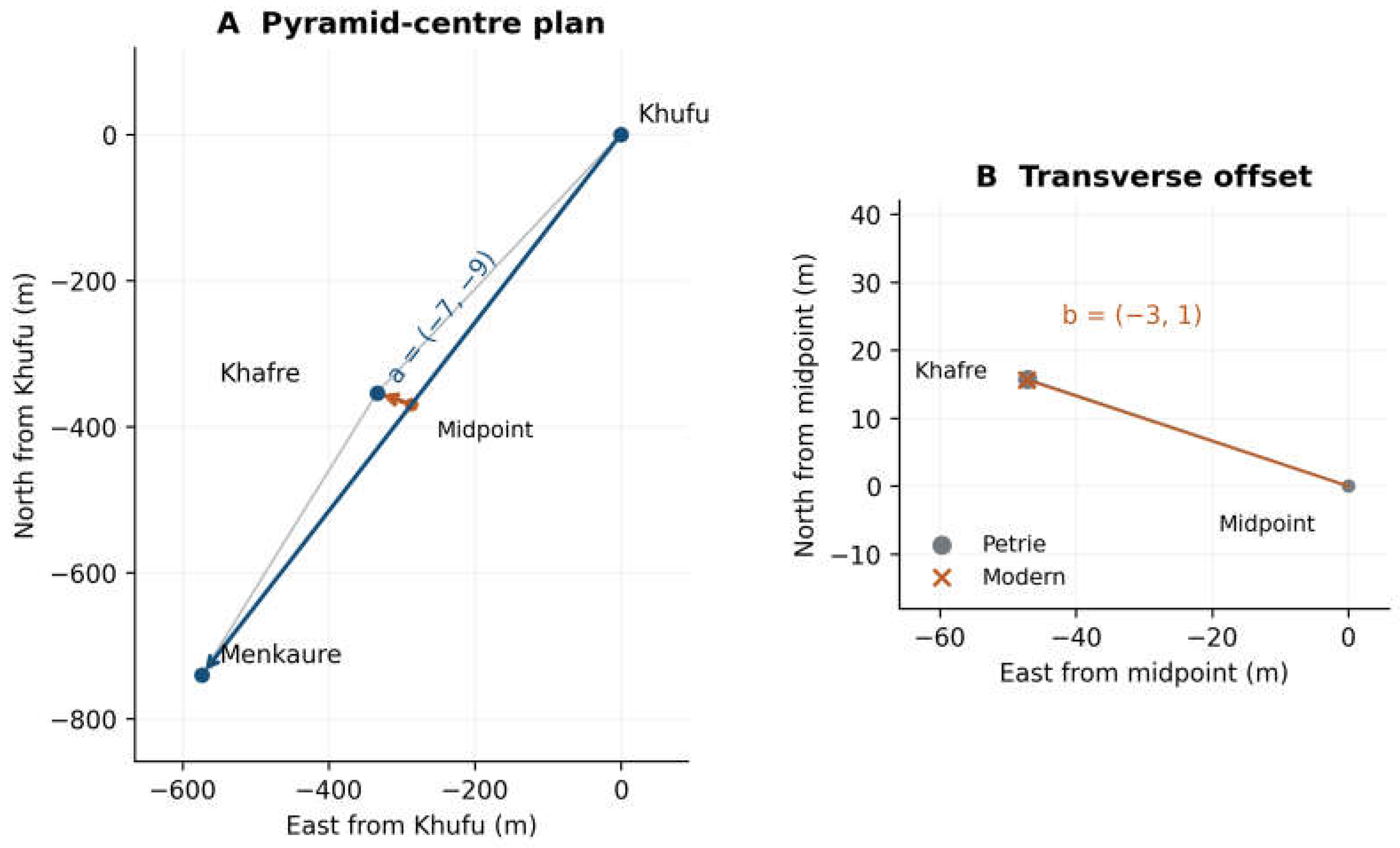
Figure 2.
Cygnus–Deneb–Galactic centre leads the common-protocol fixed-star identity comparison. The bars show the ten best refined models from a 504,400-model fixed-star grid, with the same continuous targets, exact 57,600-year separation and historical epoch domain. The dashed line marks 0.5°, a descriptive reference threshold. Each label gives asterism, endpoint and anchor. This panel ranks specified models and is not a p-value or a full-motion all-catalogue comparison.
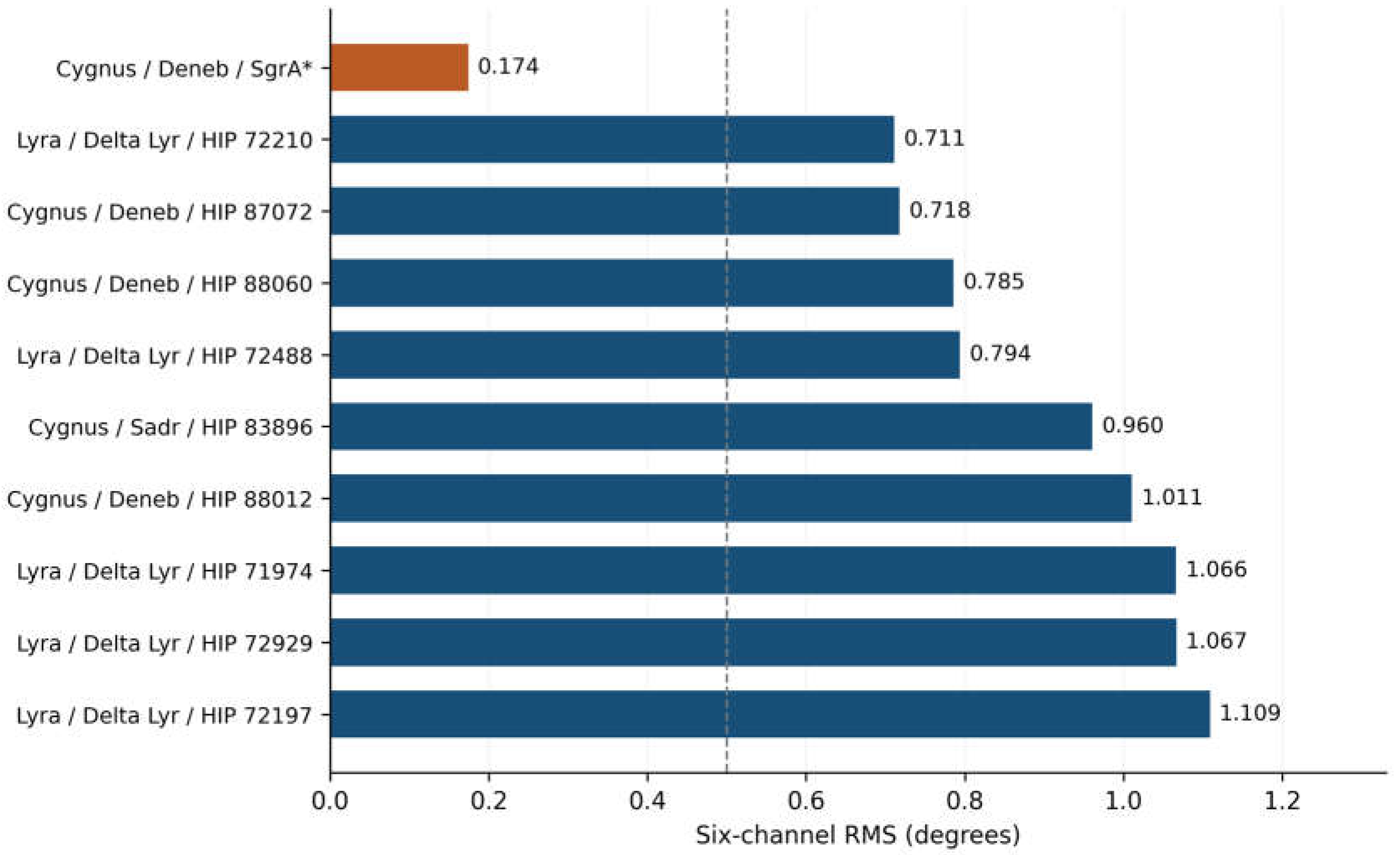
Figure 3.
Local tolerance and full-sphere localization of the Galactic-centre reference. (A) Directions on the five inner displacement rings; colour gives the refitted six-channel RMS and the cross marks Sgr A*. (B) Median and sampled minimum–maximum across 72 bearings on each of eight rings, with the original-anchor RMS and 0.5° reference level marked. (C) Minimum RMS over the 497-point historical grid at 32,768 equal-area inertial directions. Display cells take the score of their nearest sampled direction on the sphere, filling the projection without score interpolation. (D) The continuously fitted reference lies 4.46 arcmin from Sgr A*; plotted offsets are local, whereas the labelled separation is spherical. Cygnus, the target grammar, common scale, interval and primary Vondrák history are retained. The sky grid and refinement seeds contain no inserted Sgr A* direction. Colours encode numerical fit, and the ring ranges summarize sensitivity; neither is a confidence region or an estimate of ancient observing precision. Panels show the fixed-marker prescription; SI Section S18 reports the measured-motion extension. The wider sky display is also supplied in SI Figure S1.
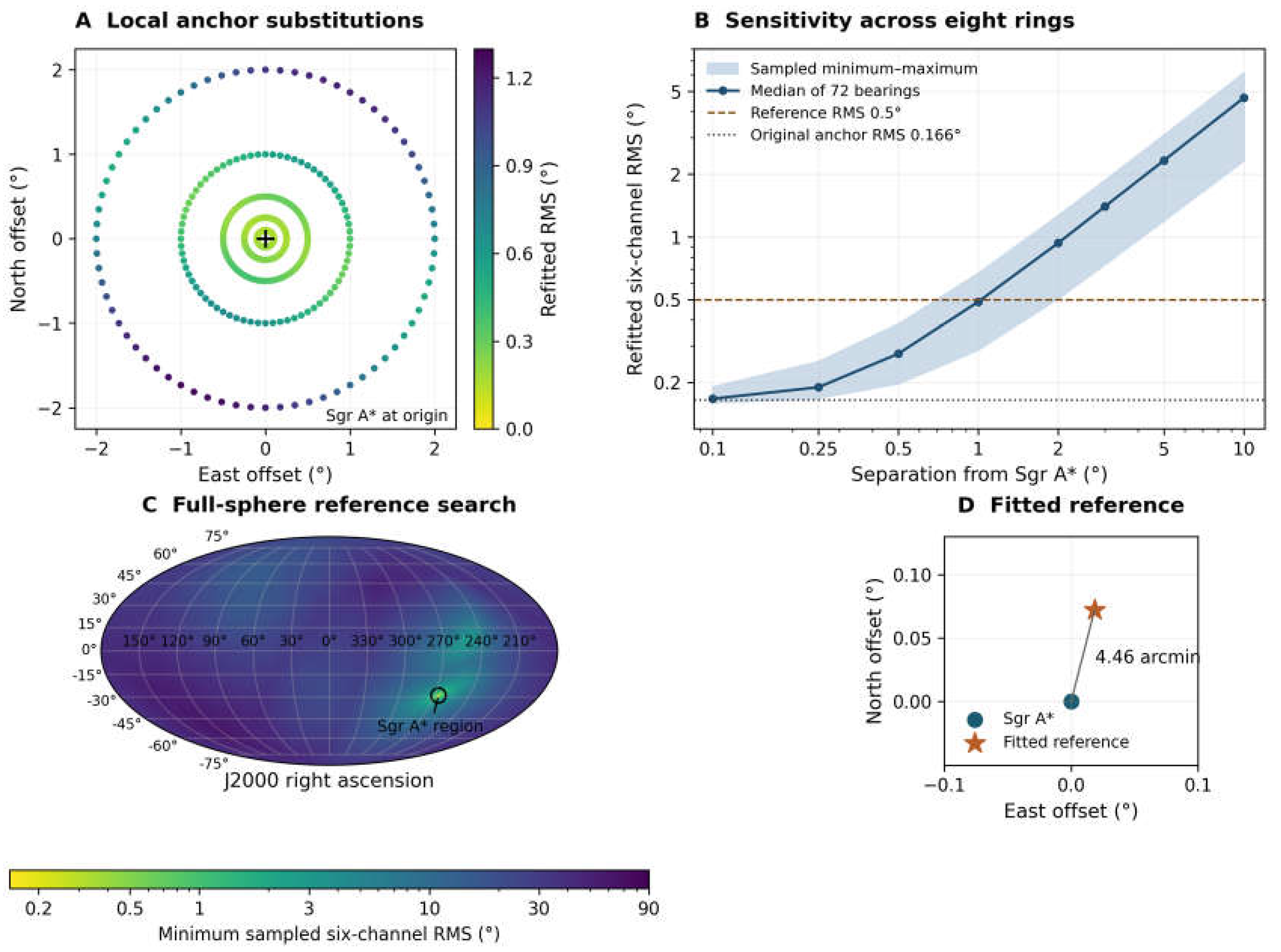
Figure 4.
The preferred temporal region persists when the common angular scale is estimated freely. Each curve uses the same target proportions and 57,600-year interval, while its mean angular scale is estimated at every epoch. Panel A shows the full historical search domain; panel B resolves the preferred region. Scores are relative RMS percentages. The alternative minimum near −7500 to −7600 is much poorer; these curves do not supply an archaeological confidence interval.
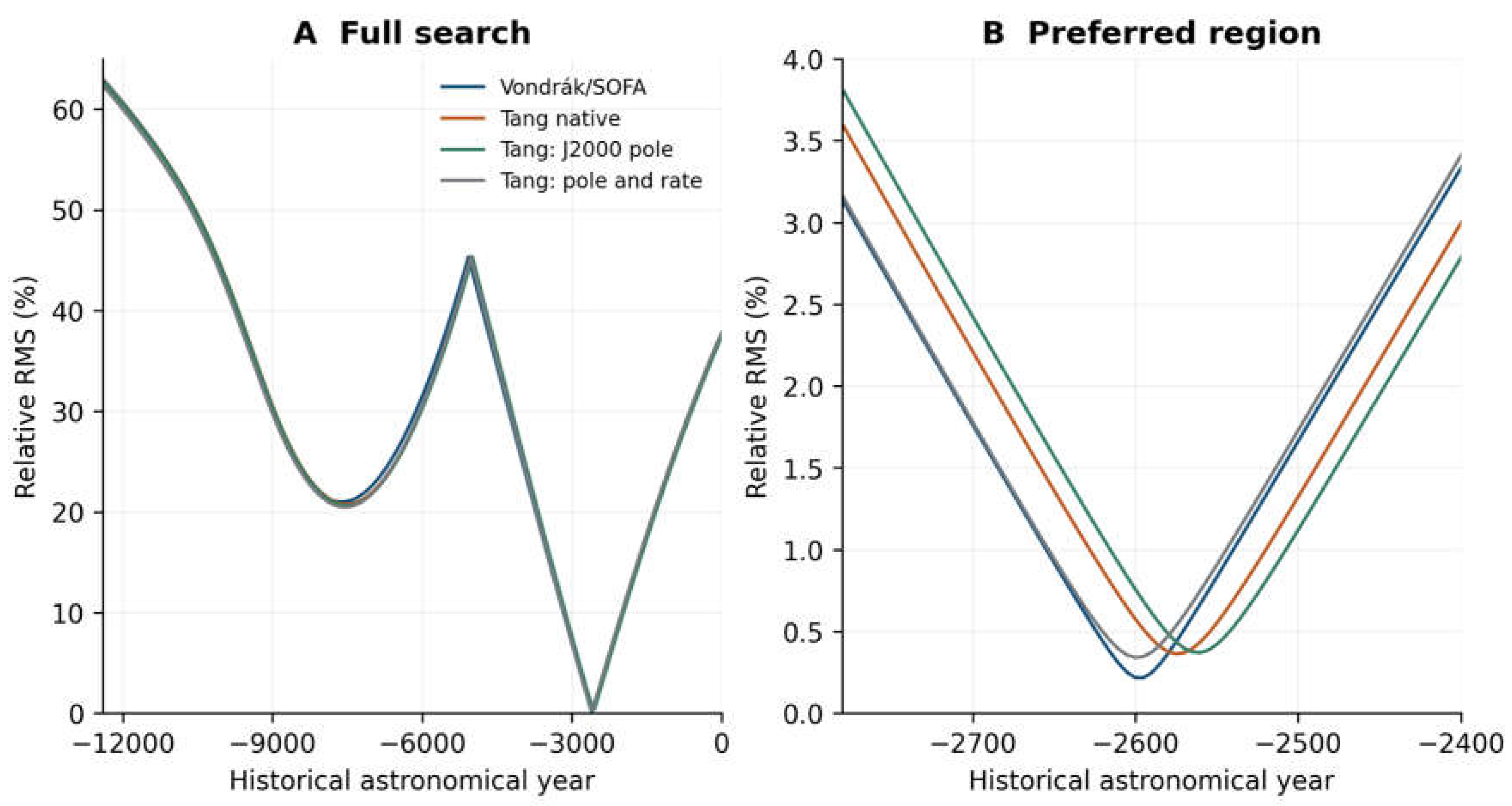
Figure 5.
At the two fixed stellar epochs, the solstitial display fits the register more closely at the historical state under all three horizon conventions. Panel A shows residuals of the eight ordered display entries against Q under the geometric-centre convention. Panel B shows the display RMS under three horizon conventions. The eight outputs are algebraically dependent functions of one solstitial declination at fixed latitude and horizon; their count must not be interpreted as eight independent observations.
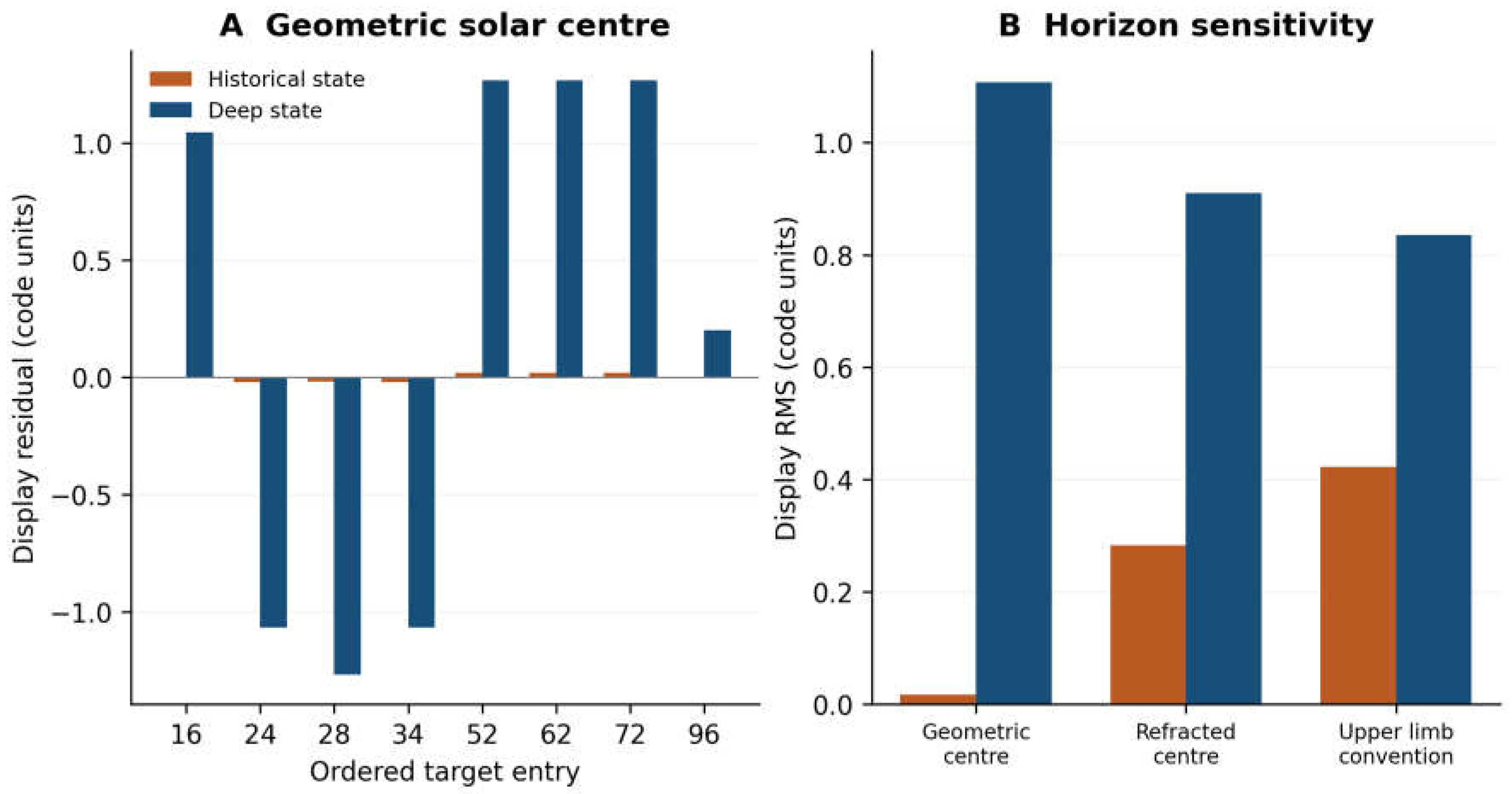
Figure 6.
Measured geometry and discrete counts within Khufu’s pyramid. (A) Centred niche profile reconstructed from Petrie’s widths and heights [9, Section 43]. The drawn diagonals define the two angles; their subscripts count stages from the base. Labels 6–2 are ideal half-cubit widths. The niche belongs to the Queen’s Chamber and is not an additional room. (B) Wall counts by course from Ford’s secondary transcription [28, Table 1] and nine roof beams documented by Petrie [9, Section 53]. Rows follow the tabulated numbering; equal cells show counts rather than masonry-joint geometry or measured beam widths. Primary verification of the wall census remains pending. In the archived sensitivity test, each of eight single-wall ±1-count changes breaks two to five targets of the stated program. SI Sections S11.3–S11.4 give the distinct local mappings.
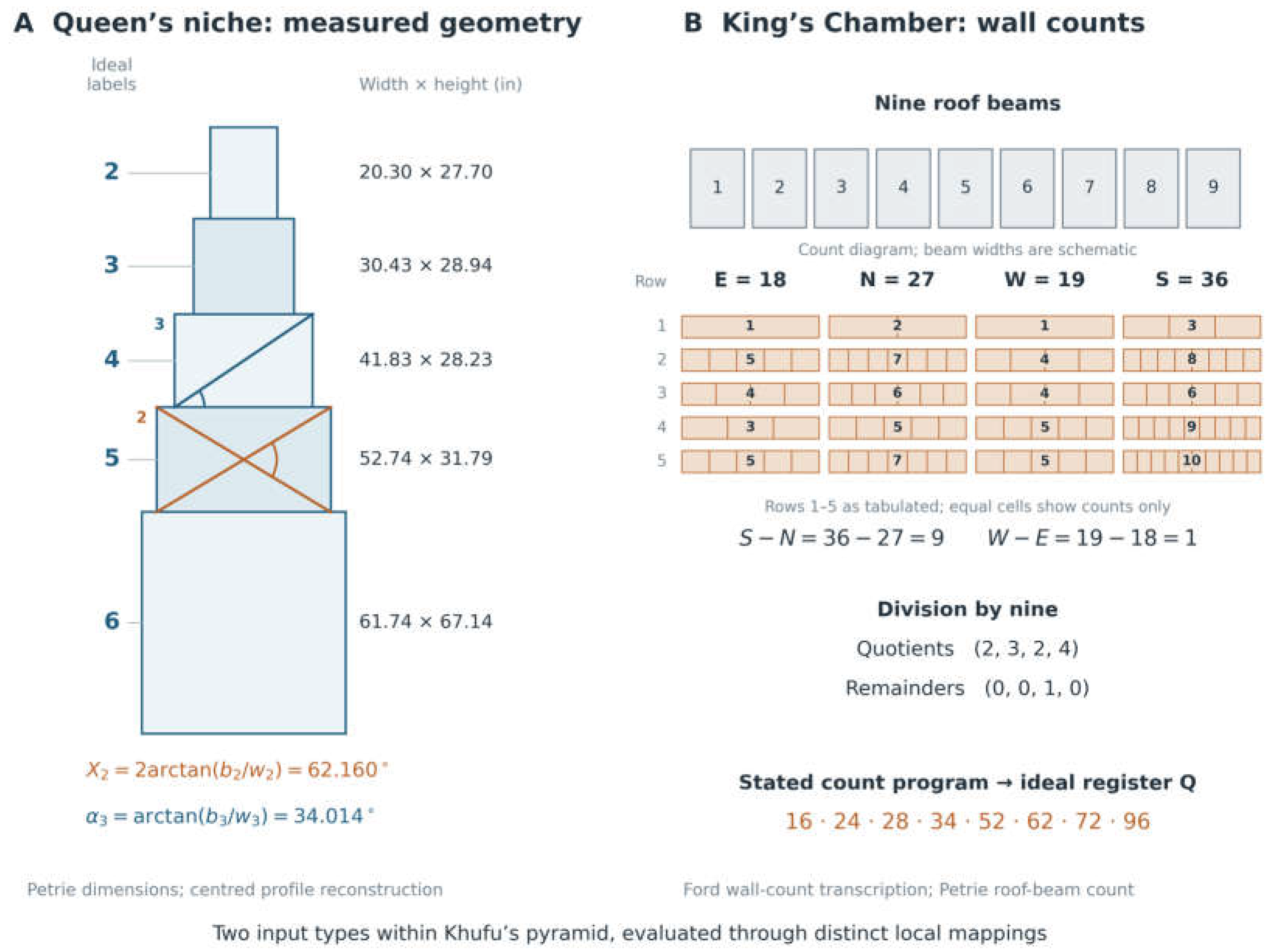
Figure 7.
Recovery of the ideal register across material supports and four primary failures. Panel A gives relative residuals of each ordered Q channel for the King's addressed census program, four metric chamber encoders and the Sphinx's common decoder. The divider marks the sculptural case. Each row retains its own input provenance and local mapping; zero in the King row is exact only in the stated count transcription. The niche uses a different channel set and is documented separately in SI Table S12 and SI Section S11. Panel B shows continuous height-datum scores for Khufu's Subterranean Chamber, with the range indicated by a line, and the best ideal-inventory scores across the opened rules, roles and gauges for three Menkaure rooms. Right-hand labels give maximum unordered exact target coverage; coverage and minimum RMS need not coincide in one assignment. The panels have different score ranges and diagnostic regimes, and do not define a common sampling distribution or a likelihood ratio.
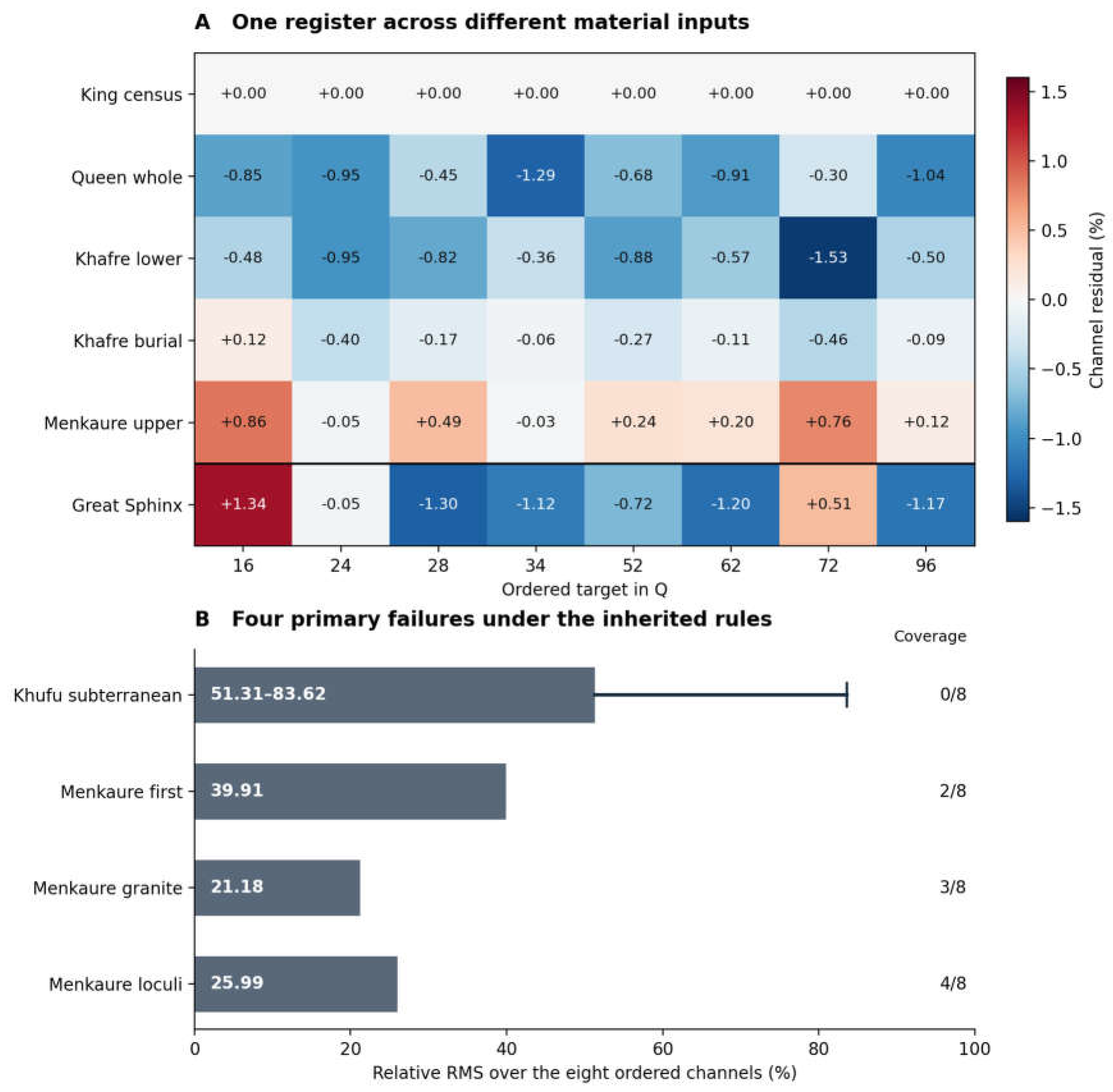
Figure 8.
Anatomical supports used in the Sphinx calculation. South elevation, plan and frontal view from the Lehner–Kapp survey lineage, with the inherited authors' dimension annotations. The arrows identify roles in the published inventory and are not new endpoint measurements; total length L is shown for context and excluded from the angular graph. W denotes the clad-base waist, whose relation to original rock requires separate evidence. Source: Lehner [34], ARCE Sphinx Project 1979–1983 Archive, Open Context, https://doi.org/10.6078/M7CZ356B, CC BY 4.0; photogrammetric drawings by Ulrich Kapp. The supplied annotated figure is reproduced unchanged.
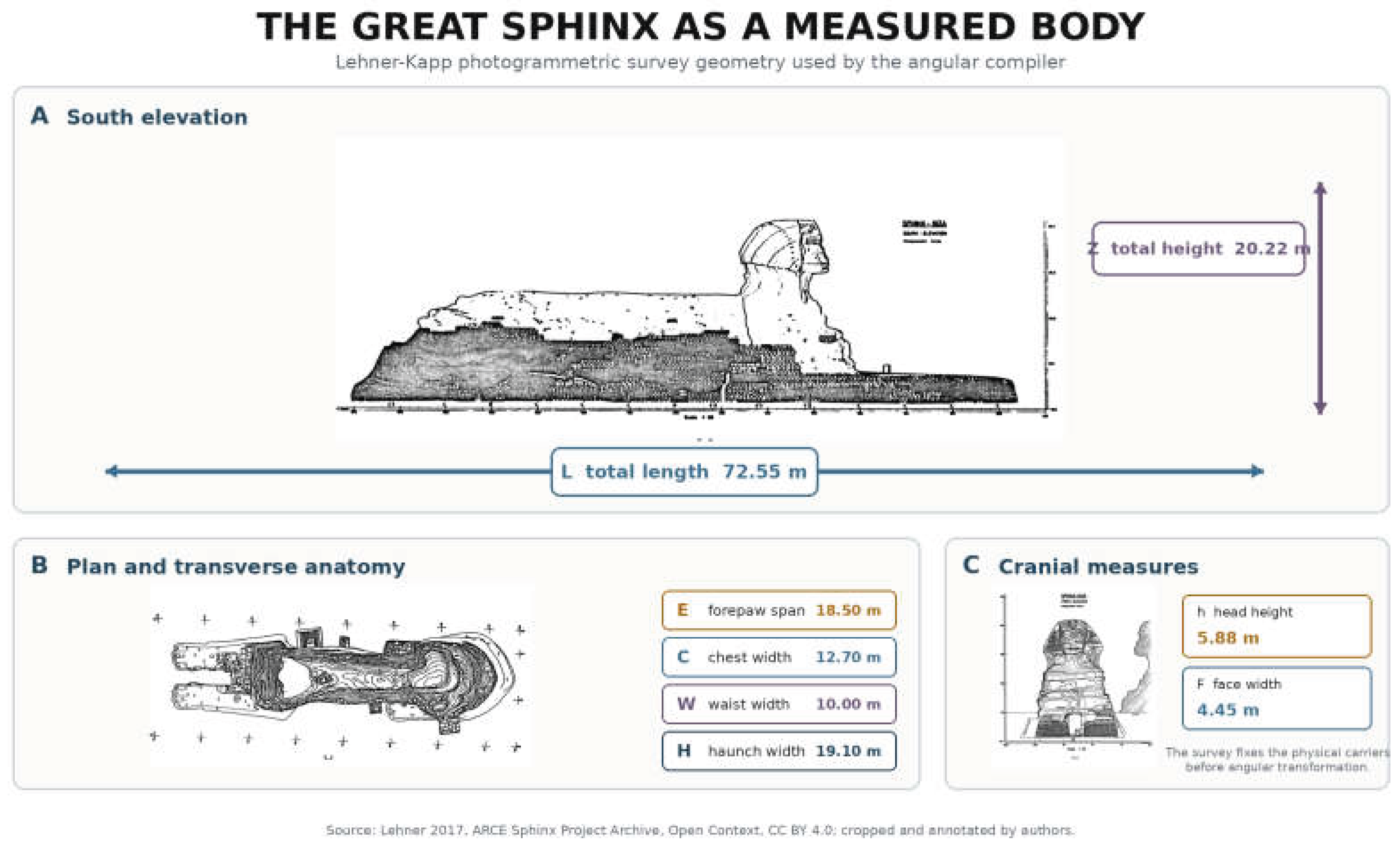

Table 1.
Information order across the model and its comparisons. Recorded protocols precede the stated executions, rather than discovery of the original model. SI Table S11 provides the extended genealogy.
Table 1.
Information order across the model and its comparisons. Recorded protocols precede the stated executions, rather than discovery of the original model. SI Table S11 provides the extended genealogy.
| Component | Information already available | Specification before execution | Comparison |
| Candidate and ground grammar | Modern celestial descriptors and Giza context | Exploratory development | Candidate, directions and mappings |
| Stellar targets and interval | Candidate and ground grammar | Targets and interval fixed before solar execution | Paired stellar epochs |
| Identity, interval, scale and reference audits | Principal fit already known | Post-discovery comparison families | Conditional ranking and robustness |
| Solar readout and seasonal relay | Stellar result already known | Stellar objective retained; solar formulas developed later | Solar geometry at retained epochs |
| Causeways and complementary stars | Principal epochs already fitted | Primary dates held fixed | Geometric compatibility |
| Positive chambers and Sphinx | Target register already known | Local rules developed retrospectively | Material recovery |
| Four negative chambers | Approximate Khufu dimensions; Menkaure measurements | Dated protocols before specified clock outputs | Transfer of inherited rules |
| Assembly controls | Original stellar results | Protocol and addendum recorded before respective runs | Channels, targets, integers and quintets |
| Channel-block ablation | Original fit and earlier local fits | Protocol and script hashes recorded before full-window run | Separate versus paired epochs |
| Sgr A* motion audit | Fixed-marker fit and motion suggestion | Protocol and script hashes recorded before execution | Reference and epoch sensitivity |
Table 2.
Fixed-scale and free-scale paired fits. Dates are astronomical years; relative RMS is 100S from Equation (5).
Table 2.
Fixed-scale and free-scale paired fits. Dates are astronomical years; relative RMS is 100S from Equation (5).
| Pole history | Fixed-scale yH | Fixed-scale yD | RMS (°) | Free-scale yH | Relative RMS (%) |
| Vondrák/SOFA | −2560.585 | −60160.585 | 0.165568 | −2597.369 | 0.212379 |
| Tang native | −2603.326 | −60203.326 | 0.254699 | −2574.044 | 0.362058 |
| Tang, J2000 pole | −2591.220 | −60191.220 | 0.243042 | −2561.597 | 0.369296 |
| Tang, J2000 pole and rate | −2632.513 | −60232.513 | 0.276689 | −2598.877 | 0.339380 |
Disclaimer/Publisher’s Note: The statements, opinions and data contained in all publications are solely those of the individual author(s) and contributor(s) and not of MDPI and/or the editor(s). MDPI and/or the editor(s) disclaim responsibility for any injury to people or property resulting from any ideas, methods, instructions or products referred to in the content. |
© 2026 by the authors. Licensee MDPI, Basel, Switzerland. This article is an open access article distributed under the terms and conditions of the Creative Commons Attribution (CC BY) license (http://creativecommons.org/licenses/by/4.0/).
Copyright: This open access article is published under a Creative Commons CC BY 4.0 license, which permit the free download, distribution, and reuse, provided that the author and preprint are cited in any reuse.