

Submitted:
24 September 2026
Posted:
25 September 2026
You are already at the latest version
Abstract
The first two papers of Principles of Artificial Science I developed a gauge-theoretic architecture for Big Knowledge Assembly Dynamics and then implemented its first concrete mechanism through U(1)-based single-charge knowledge assembly. The present paper advances from Abelian transport to non-Abelian internal assembly. Quantum chromodynamics (QCD) supplies the mathematical scaffold: a three-dimensional internal representation, an SU(3) connection, noncommuting generators, path-ordered transport, interaction-dependent curvature, and composite states built from fractionally charged constituents. The purpose is not to identify economic or cognitive systems with subatomic matter, but to convert shared structures previously developed in Integration Science into an operational interface for Artificial Science. Earlier sub-economic dynamics modeled achievement and fear-of-failure as up- and down-type impulses, introduced fractional market charges, represented Freudian Id-Self-Superego structure as a three-color internal space, and assigned consciousness a gluon-like mediating role. The present paper combines these ingredients with a parallel sub-cognitive triplet - truth, belief, and justification - in which language plays the mediating role. A three-index state with indices (a, f, g) separates color-like internal position a, flavor-like type f, and generation-like intensity g. The generation index is linked to Yang’s trichotomy, grounded in earlier mental-logic experiments in which inference-schema weights formed three empirical clusters. We formulate an SU(3) knowledge-assembly interface, weak and strong criteria of assemblability, a Fractional-Charge and Dominance Assembly Principle, and a non-Abelian account of order-sensitive composition, curvature, and holonomy. Proton-like uud states are interpreted as achievement-dominant but risk-aware active states; neutron-like udd states as fear-dominant but still aspirational standing-by states. Their different persistence is connected to the Better-Life Principle of ordinary rationality. The framework concludes by preparing the transition from strong-like internal binding to SU(2)-type externality-driven state transformation in Artificial Science I (4).
Keywords:
artificial science
; integration science
; big knowledge dynamics
; knowledge assembly
; SU(3)
; QCD
; non-Abelian symmetry
; color-like charge
; flavor-like charge
; fractional charge
; consciousness
; language
; Yang’s trichotomy
; holonomy
1. Introduction: From Abelian Transport to Non-Abelian Assembly
Artificial intelligence increasingly faces a problem deeper than knowledge storage, retrieval, or even integration: heterogeneous knowledge must be assembled so that distinct local structures can interact without losing the relations that make them meaningful. The first paper in this series proposed gauge symmetry as a structural technology for this task, while the second paper developed U(1) symmetry as the minimal mechanism of single-charge, Abelian knowledge transport (Yang, 2026a, 2026b). The present paper asks what changes when knowledge contains several coupled internal components whose transformations no longer commute.
The conceptual transition is from transport to interaction. In an Abelian system, local transformations can accumulate a phase, but the ordering of internal operations does not generate a new algebraic interaction term. In a non-Abelian system, by contrast, the order of operations is itself structural. This makes SU(3) a natural next step for Big Knowledge Dynamics: it provides a disciplined language for multi-component internal states, mediating fields, noncommuting transformations, interaction-generated curvature, and path-ordered memory.

In non-Abelian knowledge assembly, order is part of structure.
The paper develops three intertwined claims. First, a three-component knowledge state becomes an integrated system only when relations among the components are dynamically mediated. Second, macroscopic market or logical charge can be assembled from fractional internal contributions. Third, color-like position, flavor-like type, and generation-like intensity are distinct coordinates and must not be collapsed into one another. These claims are assembled from earlier work in sub-economic dynamics, reasoning dynamics, Integration Science, and ordinary rationality, but are reorganized here into a reusable Artificial Science interface.
2. Mathematical Scaffold and Three-Charge Architecture
2.1. QCD as a Structural Scaffold, Not an Ontology
Quantum chromodynamics is used here as a scaffold rather than as an ontological claim about minds, markets, or language. The relevant mathematical facts are structural. A quark color state transforms in the fundamental three-dimensional representation of SU(3). The gauge connection is Lie-algebra-valued, the generators fail to commute, and the curvature contains a commutator term. None of this implies that psychological or economic systems literally contain quarks or gluons. The claim is that a common mathematical organization can be abstracted, mapped, and re-grounded in domain-specific semantics.




The last term is decisive. In a U(1) theory the commutator vanishes. In SU(3), transformations can interact with one another, so curvature is influenced not only by spatial or contextual variation of the connection but also by noncommutativity of the internal transformation algebra. For Artificial Science, this motivates the interpretation that knowledge interaction itself may contribute to assembly curvature.

The path-ordering symbol P is equally important. When transformations do not commute, not only the path but also the order in which internal operations occur affects the transported state. This distinction will later support models of order-sensitive reasoning, modular AI composition, and multi-agent interaction.
2.2. What Is a Three-Charge Knowledge System?
The expression three-charge knowledge system is an Artificial Science technical term. It does not mean that SU(3), as an abstract mathematical group, literally has three conserved charges. Rather, it denotes a knowledge system whose designated internal representation contains three coupled color-like components. The mathematically relevant object is a triplet representation, while the semantic realization of that triplet is domain-dependent.

Three entries alone are not enough. A list of three concepts is not an SU(3) system. What matters is the specification of admissible transformations among them, the connection that compares local frames, and the mediator through which their internal relations become dynamically effective. Thus, three components are not yet three-component dynamics.
Multiplicity does not produce unity; mediation produces unity.
2.3. Three Structural Realizations of the Internal Triplet
2.3.1. QCD Color Space
The physical scaffold is the familiar color triplet. The present theory imports the organization - a three-dimensional internal state, local SU(3) transformations, and gauge-mediated interaction - without importing the physical ontology of QCD into economics or cognition.
2.3.2. Sub-Economic Dynamics: Id, Self, and Superego
Earlier sub-economic dynamics constructs an internal color-like space for economic impulses using Freud-inspired personality structure. Its three components are Id, Self (Ego), and Superego. In that earlier formulation, these components provide the internal coordinate system in which impulse states can rotate and transform, while consciousness plays the mediator role analogous to the gluon field (Yang, 2024c).
2.3.3. Sub-Cognitive Dynamics: Truth, Belief, and Justification
The corresponding sub-cognitive triplet is epistemic rather than personality-based. A knowing state is represented by three coupled conditions: p is true, the subject believes p, and there is justification for p. Integration Science had already noted the structural parallel between the Freudian triplet and the Platonic epistemic triplet. The present paper advances this correspondence by treating truth, belief, and justification as a three-component internal knowledge space and by assigning language the mediator role through which these components can be expressed, connected, tested, and transformed.
| Physical scaffold | Sub-Economic Dynamics | Sub-Cognitive Dynamics |
| Color triplet | Id / Self / Superego | Truth / Belief / Justification |
| Internal color space | Impulse-personality space | Epistemic space |
| Gluon field | Consciousness | Language |
| Non-Abelian coupling | Coupled impulse dynamics | Coupled epistemic dynamics |
3. Mediation and Internal Coordinates
The conceptual center of this paper is the mediator. In QCD, color-bearing quarks do not become a bound dynamical system merely because three color labels exist; the gauge field carries the interaction. Earlier sub-economic dynamics makes the parallel explicit: consciousness is not a fourth color charge but a mediator that can simultaneously relate multiple impulses, just as the gluon field mediates color interaction (Yang, 2024c).
The present extension introduces an analogous role for language in sub-cognitive dynamics. Truth, belief, and justification are not simply placed side by side. Language supplies a medium through which a claim can be asserted, believed, challenged, justified, revised, and transmitted. In this sense, language is treated functionally, not physically, as the mediator that makes the epistemic triplet dynamically interactive.

This notation records structural role, not material identity. Consciousness is not claimed to be a gluon, and language is not claimed to be a gauge boson. Rather, each domain possesses an object that occupies the mediator position in the structural map.
3.1. Color, Flavor, and Generation: A Three-Index Architecture
Three distinct kinds of internal information must be kept separate. Color-like position describes where a state lies in the designated internal triplet. Flavor-like type describes what kind of impulse or state is present. Generation-like level describes graded intensity. We therefore introduce the central state notation of this paper:

Here a is the color-like internal component, f is the flavor-like type, and g is the generation-like intensity level. SU(3) acts on the color index a; flavor and generation remain distinct labels unless another interaction is explicitly introduced.
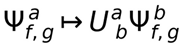
This separation prevents a recurrent conceptual error. Color, flavor, and generation answer different questions: Where is the state internally located? What type of state is it? At what graded level is it expressed? The usefulness of the architecture lies precisely in keeping these dimensions orthogonal enough to be recombined without being confused.
3.2. Flavor-Like Impulses and Fractional Charges
Earlier sub-economic dynamics distinguishes two basic impulse flavors. The achievement or achievement-seeking impulse is modeled by an up-type state u, while fear or fear-of-failure is modeled by a down-type state d (Yang, 2024c). These are flavor-like labels, not color labels.

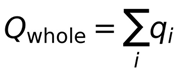
The next component is fractional charge. In the physical scaffold the up and down quarks carry electric charges +2/3 e and -1/3 e. The composite proton uud therefore carries +e, whereas the neutron udd carries zero electric charge. The earlier sub-economic model uses this arithmetic as a structural device for assembling integer market charge from fractional impulse charges.


Artificial Science abstracts this into a Fractional-Charge Assembly Principle: a macroscopic market or logical charge may be an assembled property of fractionally charged internal constituents rather than a primitive property carried by any single constituent. The principle is compositional, not merely metaphorical: the global quantity depends on the organized configuration of deeper components.
4. Composite States and Dominance Structure
The configurations uud and udd carry more information than charge arithmetic. They encode dominance. A proton-like uud state contains two achievement-type components and one fear-type component. It therefore represents an achievement-dominant state in which fear remains present as a risk-sensitive constraint. A neutron-like udd state contains two fear-type components and one achievement-type component. It represents a fear-dominant state in which aspiration is not extinguished but survives as a residual possibility of reversal.


4.1. Financial-Market Interpretation
In a financial-market example, the proton-like participant is driven primarily by achievement. The participant enters the market, buys the asset, and therefore carries an active market charge, while still retaining concern about loss. The neutron-like participant may still want to make money, but fear dominates; the participant stands by and remains market-neutral. Importantly, market neutrality is not absence of impulse. It is a structured bound state in which the macroscopic market charge is currently zero.
4.2. Cognitive Interpretation
A parallel construction applies to cognition. When achievement dominates, a person actively enters a reasoning process and carries an active logical charge. A standing-by cognitive state can preserve the possibility of reasoning while not yet activating the logical dynamics. Thus zero logical charge should not be confused with cognitive emptiness. It can represent a latent or inhibited state whose internal components remain dynamically available.
This motivates a Dominance-Charge Principle: the macroscopic charge of a composite economic or cognitive state depends not only on which constituents are present, but on how their flavor-like contributions are organized into a dominant configuration.
4.3. Generation-Like Structure and Yang’s Trichotomy
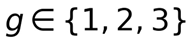
Color and flavor do not yet encode strength. For this purpose, the present framework introduces a generation-like index g in {1,2,3}. The psychological motivation is independent of particle physics. In Yang, Braine, and O’Brien (1998), mental-predicate-logic experiments estimated weights for inference schemas from systematically constructed reasoning tasks. The later sub-economic formulation reports that the ten schema weights appeared to form three clusters; replacing them by a three-parameter grouping preserved the reported correlation, whereas a two-parameter reduction significantly degraded it (Yang, 2024c).
The three-level pattern was generalized to familiar bounded perceptual judgments: easy, somewhat difficult, and very difficult; cheap, somewhat expensive, and very expensive; weak, stronger, and very strong impulse. We call this generalized organization Yang’s Trichotomy. In the present paper the new step is to encode the trichotomy as a generation-like coordinate of the internal knowledge state.
This is a structural correspondence, not an identification with physical quark generations. The physical generations provide a natural three-tier scaffold; the cognitive side contributes its own experimental motivation. The two become useful for Artificial Science only after the distinction between source structure and target-domain meaning is maintained.
5. The SU(3) Knowledge-Assembly Interface
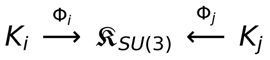
The purpose of Artificial Science is not merely to notice correspondences but to convert them into reusable structural interfaces. We therefore define a common non-Abelian assembly object:

The entries respectively denote the shared structural group, its Lie algebra, the designated representation, covariant differentiation, curvature, path ordering, holonomy, and the domain-specific mediator. For each domain i, a structural map Φ_i sends the local knowledge block K_i into the common interface. The domains therefore need not be directly identical to one another; they become composable by preserving designated relations in the shared structure.
5.1. Weak Assemblability
Two knowledge blocks are weakly SU(3)-assemblable when their selected triplet representations admit equivariant structural maps that preserve the common group action. In abstract form, if ρ_i and ρ denote the domain and interface representations, then the structural map should intertwine them on the designated subspace.

5.2. Strong Assemblability
Strong assemblability requires more. The map must also preserve covariant transport and the relevant curvature or holonomy structure. This is what separates a serious structural assembly from the simple observation that three items in one field resemble three items in another.

where the geometry permits a precise pullback relation, curvature compatibility may be required as well. Holonomy should be compared up to the appropriate gauge equivalence, since a raw non-Abelian holonomy matrix depends on the chosen base-frame while its conjugacy class or character carries the invariant content.
More precisely, if a domain base M_i is related to the interface base M by a map f_i:M_i→M, then comparison of connections and curvatures requires the corresponding pullback (together with the chosen representation or bundle map). Thus a statement such as “preserve D or F” is meaningful only after the base-space and fiber identifications have been specified. For closed loops, the gauge-invariant comparison should be made through conjugacy-class data or characters such as Tr Hol(C), rather than by equating raw holonomy matrices in unrelated frames.
6. Noncommutativity, Curvature, and Structural Memory
The deepest difference between I(2) and I(3) is not the number three; it is noncommutativity. When two internal transformations A and B do not commute, performing A before B can differ from performing B before A. This makes sequence an intrinsic part of the assembled knowledge state.

At the infinitesimal level, curvature is precisely the obstruction to commuting covariant derivatives, up to convention-dependent factors:

This identity provides an especially clean bridge to knowledge assembly. If two infinitesimal transformations applied in different orders yield different states, the discrepancy can be represented geometrically as assembly curvature. Curvature is therefore not a synonym for error. Nonzero curvature may encode legitimate interaction, disciplinary individuality, or path-dependent structure.
Closed-loop transport yields non-Abelian holonomy. A system can return to the same nominal task or conceptual location while carrying a changed internal relational state. The endpoint can be the same while the structural memory differs. This motivates the principle that AI systems may need to represent not only what state they occupy, but how that state was assembled.
6.1. Lifetime Asymmetry and the Better-Life Principle
Composite states need not have equal persistence. The present framework interprets proton-like achievement-dominant states as relatively long-lived active configurations and neutron-like fear-dominant states as more metastable standing-by configurations. The analogy must be stated carefully: in physics a free neutron is unstable, whereas neutrons bound in suitable nuclei can be stable. The Artificial Science claim concerns a structural asymmetry of persistence, not a literal transfer of particle lifetimes into psychology.
The proposed directionality is supplied by the Better-Life Principle of ordinary rationality. Earlier economic-dynamics work treats the desire to make life better as a baseline of ordinary rationality. A person may hesitate, stand by, or take a null action, but the longer-run organization of ordinary life remains oriented toward maintaining or improving viable conditions. The present paper uses that principle to explain why a fear-dominant zero-charge state need not be an absorbing state.

A neutron-like market participant may stand by because fear currently dominates, yet the residual achievement component preserves a possible return to active participation. Likewise, a standing-by cognitive state can retain an unresolved demand for understanding or achievement. We therefore introduce a testable model hypothesis rather than a universal psychological law: under comparable conditions, achievement-dominant composite states should tend to persist longer than fear-dominant standing-by states when the Better-Life orientation remains operative.

7. AI Implications and the Transition to SU(2)
The SU(3) framework suggests a family of AI problems that are difficult to express in a purely Abelian language. The proposal is not that present AI systems literally instantiate SU(3), but that the mathematical architecture offers experimentally testable diagnostics for multi-component interaction.
First, multi-step reasoning can be order-sensitive: retrieving a fact and then revising a hypothesis need not yield the same state as revising first and retrieving under the revised hypothesis. Second, multi-agent systems can be noncommutative when one agent changes the state-space in which another acts. Third, modular AI systems can contain individually competent components whose compositions interfere because their transformations are not mutually compatible. Fourth, internal representations can contain features whose interactions matter more than their isolated inventory.

The quantity Ω_AB is proposed as an order-sensitivity diagnostic: it measures how strongly two knowledge transformations fail to commute on a given state. It does not by itself prove an SU(3) gauge model, but it supplies an operational bridge between the abstract theory and empirical AI experiments. A program of Artificial Science should therefore ask whether structured internal coordinates, mediator-aware composition, and commutator diagnostics improve transfer, modularity, continual learning, or long-horizon stability compared with content-only composition.
7.1. From Strong-Like Binding to Weak-Like Externality
The present paper deliberately stops at internal assembly. Its principal mechanism is strong-like binding: multiple internal components remain dynamically related through a mediator. The next paper turns to a different question - what external interaction changes the state of an already assembled system?
In the physical scaffold, charged-current weak interaction can change quark flavor. In the Artificial Science program, the corresponding externalities include economic policy, market regulation, examination pressure, reasoning demand, and other external constraints that alter the balance between achievement and fear. The important transition is therefore not from three components to two components, but from internal binding to externally induced transformation.

A change in a single flavor-like constituent can change the macroscopic identity of the bound state, for example from an achievement-dominant active configuration to a fear-dominant standing-by configuration or the reverse. This prepares the SU(2)-type dynamics of Artificial Science I (4), where economic externality and cognitive externality play the weak-like role. Residual post-transition experience - the aftertaste of profit or loss, easy or difficult examination, success or frustration - will then be treated as a path-dependent memory variable rather than as part of the present SU(3) mechanism.
9. Conclusions
Artificial Science I (3) develops SU(3) symmetry as a candidate technology for three-component non-Abelian knowledge assembly. The paper advances beyond U(1) transport by introducing internal interaction, mediation, path ordering, interaction-sensitive curvature, and matrix-valued structural memory. Its central state is the three-index object Ψ with indices (a, f, g), separating internal position, state type, and graded intensity.
Across the three principal realizations considered here, QCD contributes the color-triplet and gluon scaffold; sub-economic dynamics contributes Id-Self-Superego, consciousness, achievement/fear flavor, fractional market charge, and proton-/neutron-like bound states; sub-cognitive dynamics contributes truth-belief-justification, language mediation, and logical charge. These are not treated as identical contents. They are mapped into a common interface because their designated relational architectures can be compared and, in stronger cases, made covariantly compatible.

The resulting program gives a precise meaning to knowledge assembly: knowledge is not assembled merely by placing parts together. It is assembled by specifying how its parts transform one another, how those transformations are mediated, and which structural relations remain invariant across changes of local representation. This prepares Artificial Science I (4), where the emphasis shifts from strong-like internal binding to weak-like economic and cognitive externality.::
References
- Baez, J. C.; Muniain, J. P. Gauge Fields, Knots and Gravity; World Scientific, 1994. [Google Scholar]
- Braine, M. D. S.; O’Brien, D. P. (Eds.) Mental Logic; Lawrence Erlbaum Associates, 1998. [Google Scholar]
- Freud, S. The Ego and the Id. In The Standard Edition of the Complete Psychological Works of Sigmund Freud; Strachey, J., Ed. and Translator; Hogarth Press, 1923/1961; Vol. 19. [Google Scholar]
- Gross, D. J.; Wilczek, F. Ultraviolet behavior of non-Abelian gauge theories. Physical Review Letters 1973, 30, 1343–1346. [Google Scholar] [CrossRef]
- Politzer, H. D. Reliable perturbative results for strong interactions? Physical Review Letters 1973, 30, 1346–1349. [Google Scholar] [CrossRef]
- Nakahara, M. Geometry, Topology and Physics, 2nd ed.; Institute of Physics Publishing, 2003. [Google Scholar]
- Peskin, M. E.; Schroeder, D. V. An Introduction to Quantum Field Theory; Addison-Wesley, 1995. [Google Scholar]
- Yang, C. N. Integral formalism for gauge fields. Physical Review Letters 1974, 33, 445–447. [Google Scholar] [CrossRef]
- Yang, C. N.; Mills, R. L. Conservation of isotopic spin and isotopic gauge invariance. Physical Review 1954, 96, 191–195. [Google Scholar] [CrossRef]
- Yang, Y. Principles of Integration Science: Its Content, Methods, and Significance. Preprints 2024a, 202409.2157.v1. [Google Scholar] [CrossRef]
- Yang, Y. Principles of Market Dynamics: Economic Dynamics and Standard Model (II). Preprints 2024b, 202410.1564.v2. [Google Scholar] [CrossRef]
- Yang, Y. Principles of the Sub-Econ Dynamics: The Econ-Dynamics and the Standard Model (III). Preprints 2024c, 202407.1843.v2. [Google Scholar] [CrossRef]
- Yang, Y. Principles of Economic Externality Dynamics: Economic Dynamics and the Standard Model (V). Journal of Electrical Electronics Engineering 2024d, 3, 1–13. [Google Scholar] [CrossRef]
- Yang, Y. Principles of Reasoning Dynamics. Preprints 2024e, 202405.1027.v2. [Google Scholar] [CrossRef]
- Yang, Y. The Contents, Methods, and Significance of the Economic Dynamics: The Economic Dynamics and the Standard Model (I). Preprints 2024f, 202408.0810.v1. [Google Scholar] [CrossRef]
- Yang, Y. The Topics, Methods, and Significance of a Higher Cognition Theory. Preprints 2024g, 202411.1514.v1. [Google Scholar] [CrossRef]
- Yang, Y.; Fu, X. Gauge Symmetry Structures and Big Knowledge Assembly Dynamics: Principles of Artificial Science I (1). Preprints 2026a, 202609.2063.v1. [Google Scholar] [CrossRef]
- Yang, Y.; Fu, X. Single-Charge Knowledge-System Assembly and U(1) Symmetry: Principles of Artificial Science I (2). Preprints 2026b, 202609.2204.v1. [Google Scholar] [CrossRef]
- Yang, Y.; Braine, M. D. S.; O’Brien, D. P. Some empirical justifications of one mental predicate-logic model. In Mental Logic; Braine, M. D. S., O’Brien, D. P., Eds.; Lawrence Erlbaum Associates, 1998; pp. 333–365. [Google Scholar]
- Zee, A. Quantum Field Theory in a Nutshell, 2nd ed.; Princeton University Press, 2010. [Google Scholar]
Disclaimer/Publisher’s Note: The statements, opinions and data contained in all publications are solely those of the individual author(s) and contributor(s) and not of MDPI and/or the editor(s). MDPI and/or the editor(s) disclaim responsibility for any injury to people or property resulting from any ideas, methods, instructions or products referred to in the content. |
© 2026 by the authors. Licensee MDPI, Basel, Switzerland. This article is an open access article distributed under the terms and conditions of the Creative Commons Attribution (CC BY) license (http://creativecommons.org/licenses/by/4.0/).
Copyright: This open access article is published under a Creative Commons CC BY 4.0 license, which permit the free download, distribution, and reuse, provided that the author and preprint are cited in any reuse.