

Submitted:
24 September 2026
Posted:
24 September 2026
You are already at the latest version
Abstract
Large language models (LLMs) are increasingly used to draft, summarise, review, and transform scholarly text. At the same time, studies of retracted research show that problematic evidence can remain embedded in later reviews, guidelines, and other publications, while downstream correction is uncommon. Prior studies of downstream response in retraction cohorts generally use the citing publication as their unit and report different outcomes, such as correction, notification, or reply. We propose correction reach as an assertion-level construct: the extent to which a qualifying correction event prompts documented reassessment of downstream assertions that depend on the corrected source. The framework separates notification, reassessment, and effect. A descendant counts as reached when the dependency is examined and the decision is recorded, including a decision that no change is needed. A purposive critical review positions the construct against retraction propagation, citation distortion, provenance, and prior studies of downstream correction. We then specify a bounded denominator, observable reassessment events, correction latency, and three empirical designs. LLMs may increase the production and transformation of derivative claims, but they may also improve dependency mapping and updating. Their net effect on corrigibility is therefore an empirical question. Correction reach provides a common unit for studying downstream corrigibility.
Keywords:
correction reach
; corrigibility
; large language models
; scholarly communication
; retraction
; evidence synthesis
; post-publication correction
; research integrity
1. Introduction
A researcher asks a large language model to summarise a literature, edits the output, and publishes a sentence based on that synthesis. Three years later, the study on which the sentence ultimately depends is retracted. The source record changes. The downstream sentence does not.
This is not a new problem. Scientific claims have always moved through reviews, guidelines, teaching material, and later papers, and each transformation can weaken the link to the original evidence. Retractions and corrections change the status of a source artefact, but they do not automatically trigger reconsideration of the claims built from it. The problem is therefore not only whether an error is corrected at its source. It is whether that correction reaches the downstream uses that depend on the source.
The scale of this downstream problem is measurable. The VITALITY study identified 1,330 retracted randomised trials and 847 systematic reviews that had quantitatively incorporated at least one of them (Xu et al., 2025). Recomputing affected meta-analyses without the retracted trials changed the direction of the pooled effect in 8.4% of cases, statistical significance in 16.0%, both in 3.9%, and effect magnitude by more than half in 15.7%. Evidence from substantially affected meta-analyses had also entered clinical practice guidelines.
Downstream response has also been studied directly. Avenell et al. (2019) traced 12 retracted trial reports into 68 reviews, guidelines, and trials and found only one publication that appeared to have reassessed the affected evidence. Kataoka et al. (2022) identified 239 systematic reviews and clinical practice guidelines that had used a trial later retracted in their evidence synthesis; 11, or about 5%, were later corrected or retracted. Among 127 publications that had incorporated an already-retracted trial without caution, none subsequently corrected themselves. Avenell et al. (2024) then randomised how authors of affected publications were alerted. One year later, nine publications had issued a public notification.
These studies establish the phenomenon. What they do not provide is a common unit for measuring it. The object is usually a publication, while the actual dependency may lie in one estimate, recommendation, or sentence. The outcome may be a correction, a notice, a reply, or a recomputed result. A publication that was examined and correctly left unchanged is difficult to distinguish from one that was never examined. Transformed descendants that no longer carry the original citation may disappear from the denominator entirely.
This article proposes an operational unit for that missing step. Correction reach is the extent to which a qualifying correction event prompts documented reassessment of downstream assertions that depend on the corrected source. The unit is the dependent assertion. The outcome is documented reassessment, not mere notification and not necessarily textual change.
LLMs make this question timely without predetermining the answer. Their use is now detectable at scale in biomedical publishing. Kobak et al. (2025) estimated that at least 13.5% of 2024 biomedical abstracts had been processed with an LLM. LLM-assisted workflows can make transformation of prior text faster and may weaken provenance, but the same systems can also help retrieve sources, map dependencies, and support updating. The relevant question is therefore not whether LLMs make scholarship less corrigible by assumption. It is whether the scholarly record can identify and reassess dependent assertions as quickly as those assertions are produced and transformed.
2. Materials and Methods
This article was developed through a purposive critical review intended to define and stress-test a construct, not to estimate prevalence. Searches covered six areas: scientific self-correction, citation distortion and claim lineage, retraction and correction diffusion, claim provenance, LLMs in scholarly writing and synthesis, and living evidence or correction infrastructure. The initial search was run on 13 June 2026 using PubMed, forward citation tracing, arXiv, CEUR-WS, PhilPapers, and PhilSci-Archive. Additional near-neighbour studies on downstream correction after retraction were identified during a later novelty audit and checked against their primary texts, including Avenell et al. (2019, 2024), Kataoka et al. (2022), and Xu et al. (2025).
A source was retained when it established a premise, distinguished an adjacent construct, or supplied an empirical boundary condition. Numerical claims were checked against primary reports. The review is bounded and is not presented as exhaustive. The search log and source-verification record are deposited in the Open Science Framework (see Data Availability Statement).
3. What Existing Work Measures
3.1. Claims Propagate and Transform
Citation networks can do more than transmit references: they can transform claims. Greenberg (2009) reconstructed a biomedical citation network in which a small evidential base acquired disproportionate authority through repeated citation, selective attention, and restatement. Duyx et al. (2017) later showed across 52 studies that statistically significant and hypothesis-supporting results were cited more often than nonsignificant or non-supporting results. These findings do not concern correction directly, but they establish the structure that correction must later traverse: claims branch, concentrate, and change meaning as they move.
A citation is therefore an imperfect proxy for dependency. Some citations are historical or critical. Conversely, a downstream claim may depend on an earlier source after the citation has disappeared through paraphrase, synthesis, or reuse. Correction needs a unit closer to the claim that is doing evidential work.
3.2. Retraction Status Does Not Reliably Propagate
Retraction signals also travel incompletely. Hsiao and Schneider (2021) examined 13,252 post-retraction citation contexts in biomedicine and found that only 5.4% acknowledged the retraction. Frampton et al. (2021) showed that retracted COVID-19 articles could remain available online in unmarked forms, and Avissar-Whiting (2022) found inconsistent propagation of retraction status between journal articles and linked preprints. Infrastructure standards such as the RISRS recommendations and the NISO CREC guidance aim to improve the visibility and interoperability of correction status (Schneider et al., 2022; NISO, 2024).
Visibility is necessary, but it is not the outcome of interest here. A status signal can be perfectly transmitted while every downstream claim remains untouched.
3.3. Downstream Correction Has Been Measured
The closest prior work measures what happens to publications that depend on retracted evidence.
Avenell et al. (2019) traced 12 retracted trial reports into 68 systematic reviews, meta-analyses, narrative reviews, guidelines, and trials. They judged that 13 publications would likely change their findings if the affected reports were removed, with another eight uncertain. When the literature was revisited, one publication appeared to have reassessed the evidence and issued a correction.
Kataoka et al. (2022) identified 587 systematic reviews and clinical practice guidelines citing retracted randomised trials. Of 239 publications that had used a later-retracted trial in their evidence synthesis, 11 were corrected or retracted. None of those corrections explicitly mentioned the retraction. Among 127 publications that had incorporated an already-retracted trial without caution, none later corrected themselves. The median interval from retraction to correction among the corrected pre-retraction publications was 264.5 days.
Avenell et al. (2024) tested an intervention. For 88 citing publications affected by 27 retracted trials, they randomised whether the alert went to one author or up to three authors, with or without the editor. Contacting more authors increased replies; adding the editor did not. Whether the citing publication was likely to change, and by how much, did not affect response or action. After one year, nine publications had issued a public notification. Their conclusion was direct: email alerts to authors and editors were not enough.
Bolland et al. (2022) framed the obligation more broadly: citing publications may themselves require correction when their findings depend on a retracted source. That identifies the problem without providing a common measure of reassessment.
VITALITY approached the same problem from the dependency side. Xu et al. (2025) identified affected meta-analyses and recomputed them after removing retracted trials. This established whether the retracted evidence mattered to the pooled result. It did not measure whether the people responsible for those downstream syntheses had reassessed the dependency.
The remaining gap is therefore narrower than a claim that downstream correction has not been studied. It has. The unresolved problem is measurement. The studies above use publications or meta-analyses as their units, focus largely on formal retraction, and define response in different ways. Together they do not supply a general assertion-level denominator that distinguishes notification, reassessment, and effect.
Table 1 positions correction reach against these neighbouring constructs.
4. Correction Reach
4.1. Notification, Reassessment, and Effect
A downstream correction process has three distinct stages.
Notification means that a correction signal was delivered or made available through a defined channel to the relevant actor or system.
Reassessment means that a downstream assertion depending on that source was examined in response to the correction, and that examination was documented.
Effect means that reassessment changed something, such as wording, an estimate, a recommendation, a citation, or publication status.
These stages should not be collapsed. A notification can be ignored. A reassessment can conclude that no change is needed. A visible correction can occur for reasons unrelated to the source event.
Correction reach is defined at the second stage. A descendant has been reached when its dependency was reassessed and the reassessment can be linked to the correction event. This definition deliberately counts a documented decision of no change as successful reach. The relevant question is whether the dependency was reconsidered, not whether every correction must propagate into a textual amendment.
4.2. Operational Specification
Correction reach has six components (Table 2).
An ancestor claim is the bounded assertion whose evidential status later changes. It need not be the first historical statement of the claim. It anchors the downstream corpus being studied.
A correction event is a dated, attributable change in the status or evidential basis of an ancestor claim that warrants downstream reassessment under prespecified rules. Formal retraction is the clearest example. Other applications may include corrections, expressions of concern, or adjudicated responses to failed replications or reanalyses.
A dependent descendant is a downstream assertion whose evidential or textual lineage relies on the ancestor, directly or through transformation. Mere mention is not enough.
Reassessment occurs when a responsible actor or defined process examines whether that descendant should change.
A reached descendant is a dependent descendant whose documented reassessment is linked to the correction event.
Correction latency is the interval from the correction event to documented reassessment.
Within a declared corpus:
Correction reach = reached dependent assertions / identifiable dependent assertions
The denominator is necessarily bounded. No study can assume that it has found every descendant across the scholarly record. The estimate must therefore be reported with its corpus boundary and ascertainment method. A study might define the corpus as all citing systematic reviews in a database, all recommendations in a guideline family, or all claims in a publisher’s indexed content.
This denominator is the main difference between correction reach and a count of corrected publications. It asks first which assertions depended on the source, then whether each was reconsidered. It also separates an assertion that was reassessed and left unchanged from one that was never reassessed.
4.3. Worked Example
Suppose a randomised trial reports that a treatment is effective. A systematic review includes the trial, a guideline relies on the pooled estimate, teaching material restates the recommendation, and a later manuscript paraphrases the teaching material without carrying the original citation.
The trial is then retracted.
The source record has changed, but none of the descendants has been reassessed merely because the retraction notice exists. The systematic review may need a new estimate. The guideline may need a revised recommendation. The teaching material may need only a caveat. The later manuscript may remain correct because independent evidence supports the sentence. Each outcome is possible.
Under correction reach, the review, guideline, teaching claim, and manuscript sentence are counted as reached only when their dependency on the retracted trial is reconsidered and that reconsideration is documented. An unchanged descendant can therefore count as reached. An unchanged descendant that was never examined does not.
Figure 1 separates propagation, source correction, and downstream response.
4.4. Boundaries of the Construct
Correction reach is an assertion-level process measure. It is not a measure of community belief. A scientific community may abandon a claim while old reviews and teaching material continue to present it, or the reverse. This differs from social-epistemic ideas such as uptake of criticism, which concern what a community accepts or does (Longino, 1990).
It also differs from information diffusion. Knowing that a retraction signal reached an author does not show that any dependent assertion was examined. Provenance is likewise related but distinct. Provenance asks where an assertion came from; correction reach asks what happens after the source changes.
The construct will fit some domains better than others. It assumes that dependent assertions and their reassessment can be represented in records. Software, datasets, formal proofs, and rapidly versioned repositories may require different operational rules.
5. Why LLMs Change the Stakes
LLMs matter because they act at both ends of the process.
Summaries, literature overviews, draft paragraphs, and reformulations can be produced quickly. The marginal effort required to produce another textual descendant can be low, while reassessment still requires finding the dependency and deciding whether it matters.
LLM-assisted text can also weaken or distort provenance. Walters and Wilder (2023) documented fabricated references in literature-review tasks, and Peters and Chin-Yee (2025) found that model-generated summaries were more likely than expert summaries to overgeneralise scientific findings. These are bounded task results, not field-wide rates, but they illustrate two relevant failure modes: source links can become unreliable, and the content of a claim can change during transformation.
Automation can also support evidence checking. Lai et al. (2024) reported mean correct assessment rates of 84.5% and 89.5% for two LLMs against an expert standard in a risk-of-bias task. Song et al. (2026) reported a mean recall of 96.24% across nine studies and a mean F1 score of 92.17% across six studies using AI or semiautomated tools in living evidence synthesis. These capabilities may help locate dependent claims, retrieve the underlying evidence, and triage which descendants need expert reassessment.
The net direction is unknown. If LLM-assisted workflows expand the number of transformed descendants faster than provenance and reassessment capacity, correction reach could fall. If they are used to preserve source links and automate dependency mapping, correction reach could rise. The construct is intended to make that difference measurable rather than assumed.
6. A Research Agenda
Three designs would move correction reach from specification to evidence.
6.1. Retrospective Lineage Audit
The first priority is to establish whether correction reach can be measured reliably in an existing corpus.
A study would:
- select a bounded set of correction events;
- identify downstream assertions within a declared corpus;
- code whether each assertion depends on the corrected source;
- determine whether a correction signal was delivered or made available through a defined channel to the responsible actor;
- identify whether documented reassessment occurred and link it to the correction signal;
- classify each dependent assertion as reached, with the recorded decision coded as change or no change, or as not reached when no documented reassessment exists, whether or not a signal was delivered; and
- estimate correction reach and correction latency.
The primary outcome is the proportion of identifiable dependent assertions with documented reassessment linked to the correction event. Secondary outcomes include documented signal delivery or availability, latency, the proportion changed after reassessment, documented no-change decisions, and inter-rater agreement for dependency coding.
The VITALITY corpus is a strong starting point because the affected systematic reviews and the counterfactual effect of removing retracted trials have already been mapped. An assertion-level audit could ask a new question without rebuilding the entire evidence network: which specific pooled estimates, conclusions, or recommendations were later reassessed by the people responsible for them?
This design would also expose the main measurement problem directly. Reassessment that leaves no public record is invisible. The observed reach would therefore be a measure of documented reassessment, not all reassessment that may have occurred.
6.2. Transformation and Reassessment Experiment
A controlled experiment could test how different writing workflows affect later corrigibility.
Participants could transform a source claim into a review paragraph, recommendation, teaching statement, or manuscript sentence using either human-only or LLM-assisted writing. Within the LLM-assisted arm, retrieval grounding and explicit provenance preservation could be varied. Investigators would then introduce a defined correction to the source claim and test whether the descendants can be linked back to it and whether the appropriate assertions are selected for reassessment.
The main outcomes would be provenance retention, dependency identification, correct selection for reassessment, and unnecessary changes. This design separates two mechanisms that are otherwise confounded: how the lineage was created and how the correction was later handled.
6.3. Correction-Propagation Intervention
Avenell et al. (2024) already tested whom to alert. A remaining intervention question is what the alert should contain.
A pragmatic trial could compare a standard notice stating that a cited source has been corrected or retracted with an assertion-specific alert that identifies the dependent statement, shows the inferred dependency path, and asks for a documented reassessment.
The primary outcome should be documented reassessment of the dependent assertion. Reply rate, notice publication, and textual change are secondary. False-positive dependency alerts and unnecessary updates should also be measured.
This design tests the distinction at the centre of the framework: transmitting a correction signal is not the same as reaching the downstream claim.
7. Implications for Editorial and Infrastructure Practice
Current infrastructure is strongest at the source. Retraction notices, Crossmark, bibliographic databases, version histories, and metadata following CREC recommendations can make a status change visible. The harder task is forward identification of the claims that depend on that source.
A correction-reach workflow would add four functions: identify likely dependent assertions, notify the people responsible for them, record whether reassessment occurred, and preserve the decision. The record would not need to force an amendment. It would need to distinguish “examined, no change required” from “not examined”.
Two practical changes would make this possible. Publishers and evidence-maintenance platforms could make reassessment a recordable event linked to the source correction. Systems that assist writing or evidence synthesis could preserve claim-level provenance through successive transformations rather than only preserving a reference list.
The obligation is not created by LLMs. They make the cost asymmetry more visible. If derivative claims can be produced quickly but cannot later be located when their evidence changes, the scholarly record becomes easier to extend than to repair.
8. Limitations
Correction reach is a proposed construct, not a validated metric. Its denominator depends on corpus boundaries and on the ability to identify genuine dependency rather than citation alone. Provenance loss can hide descendants, and documented reassessment will underestimate reassessment that occurred without a public record.
The review supporting the framework was purposive and bounded. It was designed to identify near-neighbour concepts and empirical constraints, not to exhaust every term used in philosophy of science, scientometrics, publishing research, or information science. No Web of Science or Scopus search was performed. An equivalent construct may exist under different terminology.
The framework requires a qualifying correction event, but what warrants reassessment can be disputed. Retraction does not make every statement in a paper false, and non-retraction events require domain-specific rules.
Finally, no evidence reviewed here establishes that LLM use has increased or decreased correction reach across the scholarly record. That remains an empirical question.
9. Conclusions
Correcting a source does not correct the claims built from it. Existing studies show that downstream response to retracted evidence is uncommon and that notification alone often does not lead to documented action. Across the literature reviewed here, a common unit for measuring the step between source correction and downstream repair remains lacking.
Correction reach defines that unit as documented reassessment of a dependent assertion. It separates notification, reassessment, and effect, accepts a documented decision of no change as a successful response, and requires an explicit denominator within a declared corpus.
LLMs make this measure more relevant because they can accelerate claim transformation while also supporting tools for tracing and updating those claims. Whether they widen or narrow the correction gap should be measured, not assumed.
Author Contributions
Conceptualization, T.T.; methodology, T.T. and Y.N.L.; investigation, T.T.; validation, T.T. and Y.N.L.; writing, original draft preparation, T.T.; writing, review and editing, T.T. and Y.N.L.; visualization, T.T. All authors have read and agreed to the published version of the manuscript.
Funding
This research received no external funding.
Institutional Review Board Statement
Not applicable.
Informed Consent Statement
Not applicable.
Data Availability Statement
No new empirical dataset was generated. The search log, primary-source verification record, and supporting review materials are openly available in the Open Science Framework at https://doi.org/10.17605/OSF.IO/KGS4Y under a CC BY 4.0 licence.
Acknowledgments
During the preparation of this manuscript, ChatGPT (OpenAI) was used for language editing. Both authors reviewed and edited the output and take full responsibility for the content. Source-dependent claims were checked against the cited sources.
Conflicts of Interest
The authors declare no conflicts of interest.
References
- Avenell, A.; Bolland, M. J.; Gamble, G. D.; Grey, A. A randomized trial alerting authors, with or without coauthors or editors, that research they cited in systematic reviews and guidelines has been retracted. Account. Res. 2024, 31(1), 14–37. [Google Scholar] [CrossRef]
- Avenell, A.; Stewart, F.; Grey, A.; Gamble, G.; Bolland, M. An investigation into the impact and implications of published papers from retracted research: Systematic search of affected literature. BMJ Open 2019, 9(10), e031909. [Google Scholar] [CrossRef] [PubMed]
- Avissar-Whiting, M. Downstream retraction of preprinted research in the life and medical sciences. PLoS ONE 2022, 17(5), e0267971. [Google Scholar] [CrossRef] [PubMed]
- Bolland, M. J.; Grey, A.; Avenell, A. Citation of retracted publications: A challenging problem. Account. Res. 2022, 29(1), 18–25. [Google Scholar] [CrossRef] [PubMed]
- Duyx, B.; Urlings, M. J. E.; Swaen, G. M. H.; Bouter, L. M.; Zeegers, M. P. Scientific citations favor positive results: A systematic review and meta-analysis. J. Clin. Epidemiol. 2017, 88, 92–101. [Google Scholar] [CrossRef] [PubMed]
- Frampton, G.; Woods, L.; Scott, D. A. Inconsistent and incomplete retraction of published research: A cross-sectional study on COVID-19 retractions and recommendations to mitigate risks for research, policy and practice. PLoS ONE 2021, 16(10), e0258935. [Google Scholar] [CrossRef] [PubMed]
- Greenberg, S. A. How citation distortions create unfounded authority: Analysis of a citation network. BMJ 2009, 339, b2680. [Google Scholar] [CrossRef] [PubMed]
- Hsiao, T. K.; Schneider, J. Continued use of retracted papers: Temporal trends in citations and (lack of) awareness of retractions shown in citation contexts in biomedicine. Quant. Sci. Stud. 2021, 2(4), 1144–1169. [Google Scholar] [CrossRef] [PubMed]
- Kataoka, Y.; Banno, M.; Tsujimoto, Y.; Ariie, T.; Taito, S.; Suzuki, T.; Oide, S.; Furukawa, T. A. Retracted randomized controlled trials were cited and not corrected in systematic reviews and clinical practice guidelines. J. Clin. Epidemiol. 2022, 150, 90–97. [Google Scholar] [CrossRef] [PubMed]
- Kobak, D.; González-Márquez, R.; Horvát, E. Á.; Lause, J. Delving into LLM-assisted writing in biomedical publications through excess vocabulary. Sci. Adv. 2025, 11(27), eadt3813. [Google Scholar] [CrossRef] [PubMed]
- LaCroix, T.; Geil, A.; O’Connor, C. The dynamics of retraction in epistemic networks. Philosophy of Science 2021, 88(3), 415–438. [Google Scholar] [CrossRef]
- Lai, H.; Ge, L.; Sun, M.; Pan, B.; Huang, J.; Hou, L.; Yang, Q.; Liu, J.; Liu, J.; Ye, Z.; Xia, D.; Zhao, W.; Wang, X.; Liu, M.; Talukdar, J. R.; Tian, J.; Yang, K.; Estill, J. Assessing the risk of bias in randomized clinical trials with large language models. JAMA Netw. Open 2024, 7(5), e2412687. [Google Scholar] [CrossRef] [PubMed]
- Longino, H. E. Science as social knowledge: Values and objectivity in scientific inquiry; Princeton University Press, 1990. [Google Scholar]
- National Information Standards Organization. NISO RP-45-2024, Commun. Retractions Remov. Expr. Concern (CREC); 2024. [Google Scholar] [CrossRef]
- Peters, U.; Chin-Yee, B. Generalization bias in large language model summarization of scientific research. R. Soc. Open Sci. 2025, 12(4), 241776. [Google Scholar] [CrossRef] [PubMed]
- Schneider, J.; Woods, N. D.; Proescholdt, R.; the RISRS Team. Reducing the inadvertent spread of retracted science: Recommendations from the RISRS report. Res. Integr. Peer Rev. 2022, 7, 6. [Google Scholar] [CrossRef] [PubMed]
- Song, X.; Lian, Z.; Wang, R.; Li, R.; Yang, Z.; Luo, X.; Feng, L.; Ma, Z.; Pu, Z.; Wang, Q.; Ge, L.; Li, C.; Chen, Y.; Yang, K.; Lavis, J. The phases of living evidence synthesis using AI: Living evidence synthesis (version 1). J. Med. Internet Res. 2026, 28, e76130. [Google Scholar] [CrossRef] [PubMed]
- Walters, W. H.; Wilder, E. I. Fabrication and errors in the bibliographic citations generated by ChatGPT. Sci. Rep. 2023, 13, 14045. [Google Scholar] [CrossRef] [PubMed]
- Xu, C.; Fan, S.; Tian, Y.; Liu, F.; Furuya-Kanamori, L.; Clark, J.; Zhang, C.; Li, S.; Lin, L.; Chu, H.; Li, S.; Golder, S.; Loke, Y.; Vohra, S.; Glasziou, P.; Doi, S. A.; Liu, H. Investigating the impact of trial retractions on the healthcare evidence ecosystem (VITALITY Study I): Retrospective cohort study. BMJ 2025, 389, e082068. [Google Scholar] [CrossRef] [PubMed]
- Zhang, Y.; Ives, Z.; Roth, D. “Who said it, and why?” Provenance for natural language claims. In Proceedings of the 58th Annual Meeting of the Association for Computational Linguistics; Association for Computational Linguistics, 2020; pp. 4416–4426. [Google Scholar] [CrossRef]
Figure 1.
Claim propagation, source correction, and downstream response. A claim in an ancestor artefact is transformed across reviews, guidelines, teaching material, LLM-assisted syntheses, and later manuscripts. A correction changes the status of the ancestor. Downstream response is separate: notification makes the signal available, and correction reach occurs when a dependent assertion is reassessed and the decision is documented, whether that decision is an update or no change. A notified descendant with no documented decision is not reached. Notification alone does not establish reach.
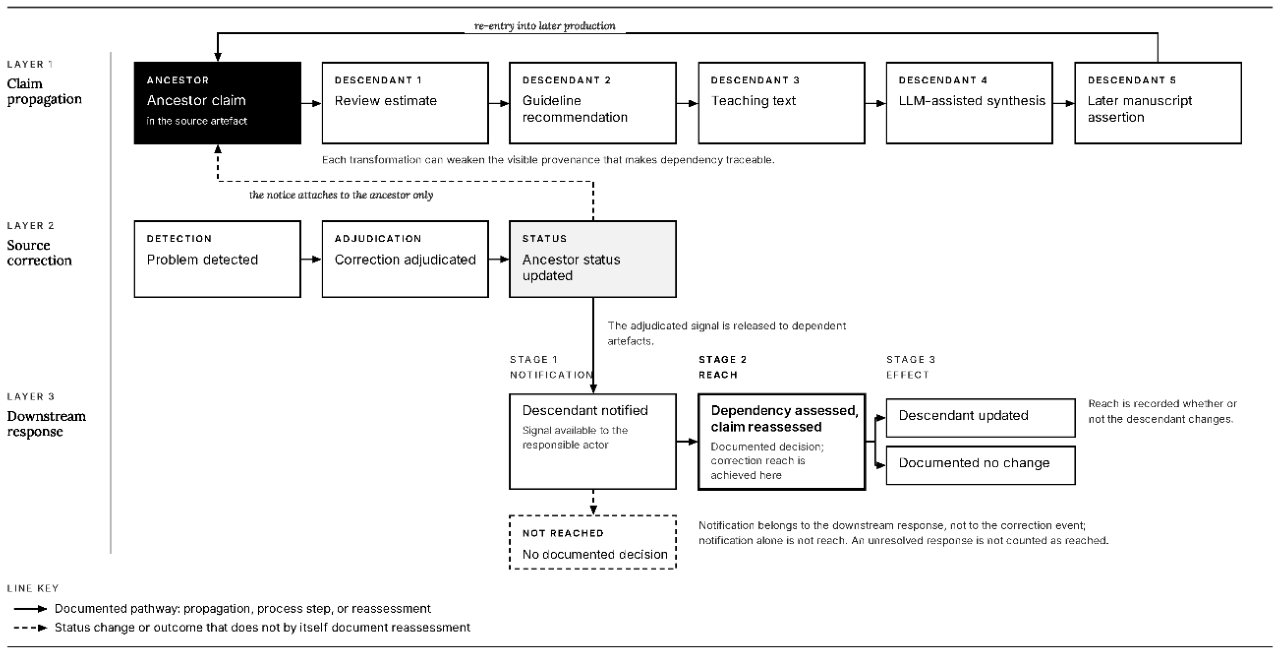

Table 1.
Neighbouring constructs and the remaining measurement gap.
| Construct | Unit of analysis | Central question | What remains unresolved |
|---|---|---|---|
| Uptake of criticism (Longino, 1990) | Community beliefs and practices | Does criticism change what a community accepts or does? | Which dependent assertions were identified and reassessed |
| Information diffusion (LaCroix et al., 2021) | Signals moving among agents or nodes | Who receives the correction signal? | Whether a dependent assertion was examined |
| Retraction-status propagation (Hsiao & Schneider, 2021; Schneider et al., 2022) | Status or metadata attached to a source | Does correction status remain visible and interoperable? | Whether downstream claims are reassessed |
| Citation distortion (Greenberg, 2009; Duyx et al., 2017) | Citation network and representations of a claim | How does a claim gain authority or change meaning? | What happens after the source claim is corrected |
| Evidence contamination (Xu et al., 2025) | Meta-analytic estimate containing a retracted trial | Would removal of the retracted study change the result? | Whether the responsible authors later reconsidered the dependency |
| Downstream correction need (Bolland et al., 2022) | Citing publication | Which citing papers may themselves require correction? | Whether the dependency was reassessed and how to count that response |
| Downstream correction after retraction (Avenell et al., 2019, 2024; Kataoka et al., 2022) | Citing publication | Was an affected publication corrected, and can alerting improve response? | A common assertion-level denominator and reassessment outcome |
| Provenance (Zhang et al., 2020) | Link between an assertion and its sources | Can an assertion be traced to what it derives from? | Whether a source correction triggers reassessment |
| Correction reach | Dependent downstream assertion | Did a qualifying correction event prompt documented reassessment? | How community belief changes, and whether every descendant can be found |
Table 2.
Operational components of correction reach.
| Component | Definition | Observable in practice as |
|---|---|---|
| Ancestor claim | Bounded assertion whose evidential status later changes | Claim anchoring the downstream corpus |
| Correction event | Dated, attributable change in the status or evidential basis of an ancestor claim that warrants reassessment under prespecified rules | Retraction, correction, expression of concern, or other adjudicated challenge |
| Dependent descendant | Downstream assertion whose evidential or textual lineage relies on the ancestor | Coded dependency, distinguished from mention |
| Reassessment | Examination of whether the descendant should change | Documented decision linked to the correction event |
| Reached descendant | Dependent descendant with documented reassessment linked to the correction | Record of change or documented no-change decision |
| Correction latency | Time from correction event to documented reassessment | Elapsed time between dated records |
Disclaimer/Publisher’s Note: The statements, opinions and data contained in all publications are solely those of the individual author(s) and contributor(s) and not of MDPI and/or the editor(s). MDPI and/or the editor(s) disclaim responsibility for any injury to people or property resulting from any ideas, methods, instructions or products referred to in the content. |
© 2026 by the authors. Licensee MDPI, Basel, Switzerland. This article is an open access article distributed under the terms and conditions of the Creative Commons Attribution (CC BY) license (http://creativecommons.org/licenses/by/4.0/).
Copyright: This open access article is published under a Creative Commons CC BY 4.0 license, which permit the free download, distribution, and reuse, provided that the author and preprint are cited in any reuse.