

Submitted:
23 September 2026
Posted:
24 September 2026
You are already at the latest version
Abstract
Children’s drawings serve as rich clinical and developmental assessment tools, yet their interpretation remains subjective. The emergence of vision–language models (VLMs) offers a novel, automated approach to this challenge, raising a critical question: do different AI models derive the same clinical narrative when presented with the identical drawing? To investigate this, we evaluated five VLMs—GPT-4 Vision, Claude Vision, Gemini, Grok, and LLaMA—interpreting 315 children’s drawings under a shared, projective-inspired framework. We systematically compared the models’ outputs across emotional tone, thematic focus, linguistic style, and semantic similarity. Our findings reveal a fundamental split between perception and expression: while the systems converged strongly on basic semantic content and topic structure—agreeing on what they see—they diverged significantly in sentiment, clinical vocabulary, tone register, and interpretive stance. This divergence yields a distinct, identifiable “interpretive fingerprint” for each model. We conclude that model choice fundamentally shapes the interpretive narrative in ways that matter for applied use. Given their stylistic divergences and unique interpretive biases, VLMs cannot serve as objective, standalone evaluators, but should instead be utilized strictly as supplementary instruments under professional clinical supervision.
Keywords:
vision–language models (VLMs)
; psychological drawing analysis
; children’s artwork interpretation
; AI in mental health assessment
; projective techniques
; multimodal AI
; interpretability in clinical AI
1. Introduction
For decades, developmental and clinical psychologists have relied on children’s drawings as a window into young minds. Before the age of seven, children often lack the vocabulary to express complex thoughts or emotions, making drawing their primary language. Projective techniques—such as the Draw-a-Person Test [1] and the House–Tree–Person Test [2]—have long been used to assess cognitive development, outlining personality traits, and gently identifying signs of distress or trauma. Even beyond formal assessment, handing a child a crayon serves as an incredibly effective, non-threatening icebreaker for those who are shy or face language barriers.
But there is a well-known vulnerability in this practice: interpreting art is inherently subjective. Two practitioners can derive completely different meanings from the exact same drawing, and there is rarely a clear “ground truth” to settle the debate. Do dark colors or an oversized figure indicate profound anxiety, or just a stylistic choice? Because these interpretations are so easily influenced by cultural context, examiner bias, and the child’s transient mood, researchers have rightfully cautioned that drawings should never be used as standalone diagnostic evidence [3,4].
Now, a new variable has entered the equation. Vision–language models (VLMs)—such as GPT-4 Vision, Claude Vision, and Gemini—are remarkably fluent at exactly the surface task these psychological assessments require. They can seamlessly ingest an image, identify objects, infer relationships, and generate a coherent narrative. On one side, AI promises a scalable, perfectly consistent analysis that could finally eliminate human inter-rater variability. On the other side, unleashing black-box algorithms on sensitive clinical tasks introduces serious risks of algorithmic bias and interpretive opacity—issues we are already facing in adjacent fields like digital phenotyping and AI-assisted screening [5,6,7].
This tension is what motivated our research. To our knowledge, this is one of the first studies to put multiple VLMs head-to-head in the specific domain of psychological drawing interpretation. While prior work has explored AI in general art analysis [8] and computational feature extraction [9], no study has systematically benchmarked how different VLMs compare when handed a standardized clinical framework. By doing so, we offer a multi-model comparison, a computationally adapted framework for projective assessment, and baseline performance metrics for any future attempts at clinical integration.
One central question organizes our study: when given the exact same children’s drawings, how do VLMs differ in their emotional tone, thematic focus, linguistic style, and semantic meaning?
To answer this, we designed a large-scale, AI-to-AI analysis across a corpus of 315 drawings, giving us ample statistical power to map the inherent variability across five major models. However, to ensure our models were extracting professionally recognizable psychological content rather than just generating “fluent noise,” we built in a vital reality check. We asked two licensed clinical psychologists to independently analyze a 31-drawing subset using our shared framework. We included this small check not to rank the AI against a human “gold standard,” but to validate our pipeline and to understand exactly how machine interpretations deviate from professional human judgment.
2. Background
Classic projective instruments—like the Draw-a-Person Test [1] and the House–Tree–Person Test [2,10]—have long structured clinical interpretation around visual cues: the size of a figure, spatial organization, object relationships, and symbolic content. Clinicians have used them for decades, both as diagnostic aids and as gentle therapeutic prompts [11].
However, for as long as these tests have existed, their scientific standing has been debated a lot. Thomas and Jolley [3] famously concluded that children’s drawings are simply “too complexly determined and inherently ambiguous” to stand alone as diagnostic evidence. The meaning of a drawing isn’t static, either; Bonoti and Metallidou [4] demonstrated that children’s own interpretations of their artwork shift over time. Furthermore, as Lilienfeld et al. [12] documented, standard scoring guidelines often fail to insulate interpretations from the examiner’s personal bias, situational context, or cultural background.
If you look closely at the literature, three major barriers consistently emerge:
- The Subjectivity Trap. Different practitioners looking at the same visual cues often reach entirely different conclusions, leading to notoriously poor inter-rater reliability. The classic finding by Dawes et al. [13]—that actuarial, rule-based judgment outperforms subjective clinical judgment in consistency—applies heavily here.
- The Absence of Standardization. Scoring systems vary wildly across different clinics and practitioners. While recent attempts to digitize and standardize these systems [14] have improved structural consistency, they haven’t entirely eliminated interpretive variability.
- Contextual and Cultural Blind Spots. Visual symbolism, color usage, and composition mean very different things across different cultures, severely limiting the generalizability of any single interpretive framework [11].
Together, these challenges highlighits for a more systematic, reproducible approach—especially in high-stakes clinical settings where misinterpreting a child’s drawing can have real-world consequences.
This is where AI-based analysis enters the picture, promising both consistency and scale. We already know from Cetinic and She [8] that AI systems are highly capable of analyzing artwork, and researchers like Wang et al. [15] and Farhad et al. [9] have laid the groundwork for using machine learning to detect visual features linked to trauma or distress. But as Beltzung et al. [5] rightly point out, this introduces a massive accountability problem: neural networks might classify a drawing accurately, but they do so opaquely. A clinician cannot audit a black box. Furthermore, as we’ve seen in LLM applications for therapy transcripts [6,7], these models are prone to generating highly plausible, authoritative-sounding narratives that may actually be biased or completely disconnected from the input evidence [16,17].
Currently, AI applications in psychological assessment are mostly limited to single-model implementations or basic feature-extraction pipelines. What is missing—and what we set out to build—is a systematic, cross-model comparison grounded in a standardized clinical framework.
3. Materials and Methods
3.1. Analytical Framework
To evaluate these models fairly, we needed an interpretive framework that bridges traditional projective psychology [1,2,11] with recent digitized scoring methods [5,14]. We structured this into a three-dimensional classification system specifically designed to test the distinct capabilities of VLMs:
- Technical–structural features (line pressure, image size, stroke style): to test the model’s fundamental computer vision.
- Geometric–spatial features (angularity, symmetry, spatial distribution): to test the model’s spatial reasoning regarding balance and organization.
- Content–symbolic features (symbols, object placement, color usage): to test the model’s capacity for interpretive narrative generation.
This framework allows us to take a traditionally subjective process and measure it quantitatively, without abandoning the established traditions of clinical assessment.
3.2. Dataset and VLM Testing Protocol
Our dataset comprises 315 fully anonymized children’s drawings—spanning House–Tree–Person scenes, family sketches (KFD-style), and free-themed art (Figure 1). We applied minimal digital preprocessing to standardize the formats and resolutions, being careful to preserve the raw artistic qualities. The corpus was assembled through publicly available sources.
We put five VLMs to the test: GPT-4 (gpt-4o), Anthropic Claude (claude-3-opus-20240229), Google Gemini (gemini-2.0-flash), Grok (grok-2-vision-1212), and the open-source model LLaVA [18]. (Note: for consistency across our figures and tables, we refer to these as ChatGPT, Claude, Gemini, Grok, and LLaMA, respectively, adopting the latter’s underlying language backbone as its alias.)
Every model received the exact same image and the exact same prompt: “You are a projective psychologist analyzing children’s drawings. Analyze this drawing from a projective psychology perspective. Provide a structured, detailed response addressing these areas in a clear and analytical manner.” The image was supplied via direct vision input, and each model was run once per image. This generated a total of 1,575 model interpretations. Of the 325 drawings originally collected, 10 (≈3%) were dropped because at least one model returned an error or a refusal (e.g., “I’m sorry, I can’t analyze this.”), leaving 315 complete cases with substantive analyses from all five models.
To keep our AI outputs anchored to clinical reality, we ran a validation check. Two licensed clinical psychologists independently analyzed a stratified 31-drawing subset using our exact three-dimensional framework, with no access to the AI-generated outputs. They were instructed to avoid speculative diagnoses and focus on observable features and emotional tone. An example drawing is shown in Figure 2. Table A1 in Appendix A provides a side-by-side example of this: where the human clinician is concrete and relational, the AI models tend to be longer, warmer, and heavily focused on the literal elements of the drawing.
3.3. Preprocessing
When it came time to analyze the AI’s textual outputs, we kept a light touch. We lowercased the text, stripped out non-informative tokens, and split the data into sentences and words. But we intentionally left their punctuation, formatting, and technical vocabulary intact—because a model’s distinctive stylistic quirks are a crucial part of what we were trying to measure.
3.4. Validation Metrics
For our human-to-AI validation check, we assessed alignment across three weighted dimensions (a 40/30/30 composite):
- Thematic Alignment (40%). We extracted six core psychological themes (emotions, development, symbols, relationships, environment, expression) using domain-specific keyword dictionaries and scored the conceptual overlap with Jaccard similarity coefficients.
- Emotional Tone (30%). We scored sentiment using weighted indicators—positive terms (+1), negative terms (−1), clinical concerns (−2), developmental positives (+1), and neutral terms (0)—to gauge directional agreement.
- Lexical Similarity (30%). We combined Jaccard vocabulary overlap and cosine similarity to see if the models were using the same professional terminology as our clinicians.
We want to be clear about the constraints here: with two raters and 31 drawings, this is a validation pipeline designed to establish the direction of AI deviation, not an attempt to rank models against an clinical gold standard.
3.5. Sentiment and Emotion Measures
To measure affective tone across all 1,575 responses, we deployed three independent tools. We used VADER [19] to establish a baseline polarity score (−1 to +1). We then added texture using two transformer classifiers: j-hartmann/emotion-english-distilroberta-base for coarse primary emotions (joy, sadness, anger, fear), and bhadresh-savani/bert-base-uncased-emotion, a BERT model fine-tuned on the Emotion dataset, for fine-grained six-way classification (joy, sadness, anger, fear, love, surprise). Finally, a keyword tally cross-checked the classifiers to ensure consistency. The three tools were applied independently and never averaged into a single composite; each captures a different layer of emotional characterization.
3.6. Psychological Content and Style Measures
We didn’t just want to know what the models felt, but how they chose to express it. Using a LIWC-inspired lexical analysis, we tracked their use of family (“family, parents, mother, father”), social (“friend, together, play”), emotional (“love, happy, sad, angry, fear, anxiety”), and clinical (“trauma, abuse, depression, diagnosis”) terminology. We also tracked their interpretive stance: did the model use third-person child-referential framing (“the child feels…”) or a safer, drawing-referential framing (“the drawing shows…”)? To cap it off, we measured readability (Flesch–Kincaid), sentence length, and vocabulary richness (the ratio of unique words to total words) to establish each model’s baseline tone. We additionally performed a zero-shot classification of each response against three broad tone categories—clinical/analytical, empathetic/supportive, and neutral/objective—backed by manual spot-checks on random samples.
3.7. Semantic Similarity, Clustering, and Statistical Testing
Finally, to map the conceptual agreement between models, we embedded each response using Sentence-BERT (all-MiniLM-L6-v2; [20]) and computed pairwise cosine similarities across all ten model pairings, for each of the 315 drawings.
To determine if the responses clustered by author (the specific AI model) or by content (the specific drawing), we applied LDA topic modeling [21] and BERTopic [22], visualizing the embeddings in two dimensions with t-SNE. For statistical rigor, continuous measures were tested via one-way ANOVA and Tukey HSD post-hoc comparisons, while pairwise t-tests were subjected to both Bonferroni and False Discovery Rate (FDR) corrections to ensure our findings were robust against statistical noise. Welch’s t-test was used for pairwise sentiment comparisons to accommodate unequal variances, and the Kruskal–Wallis test served as a non-parametric alternative where distributions departed from normality. The significance threshold was set at .
4. Results
4.1. Sentiment: Five Models, Five Emotional Profiles
VADER sentiment scores across all 315 drawings (Figure 3, Figure 4) separate the models cleanly. ChatGPT produces the most positive interpretations (mean = 0.71), followed by Grok (0.61), Claude (0.48), LLaMA (0.39), and Gemini (0.34) (Table 1).
Note the quartiles: the medians sit near the ceiling for every model (0.90–0.99), so the means are separated almost entirely by how often each model is willing to go negative. Gemini’s first quartile of −0.70 against ChatGPT’s +0.94 is the distributional core of the difference.
Are these differences reliable? Welch’s t-tests with Cohen’s d, under both Bonferroni and FDR correction (Table 2), say yes for the big contrasts. ChatGPT versus Gemini yields t = 6.44 (p < .001, d = 0.51, a moderate-to-large effect); ChatGPT versus LLaMA t = 5.72 (p < .001, d = 0.46); Gemini versus Grok t = −4.52 (p < .001, d = −0.36). ChatGPT versus Grok, by contrast, is only marginal uncorrected (p = 0.06) and survives neither correction—the two most positive models are not reliably distinguishable from each other. The corrections earn their keep on the Claude comparisons: Claude–Gemini (p = 0.03) and Claude–Grok (p = 0.02) lose significance under Bonferroni but retain it under FDR, effects best described as modest but probably real. Effect sizes across all comparisons range from d = 0.11 to 0.51, with the Gemini–LLaMA pair consistently smallest—those two models behave alike in sentiment.
Tukey HSD (Table 3, Figure 5), the more conservative family-wise view, confirms the structure. ChatGPT’s sentiment is significantly higher than Claude’s (mean difference = −0.2376, p = 0.0007), Gemini’s (−0.3765, p < 0.001), and LLaMA’s (−0.3255, p < 0.001)—consistent with its design center as a conversational, user-aligned assistant. Grok differs reliably from Gemini (0.2758, p < 0.001) and LLaMA (−0.2248, p = 0.0016), positioning it between LLaMA’s flatter affect and the positive end of the scale. LLaMA diverges from ChatGPT, Gemini, and Grok but not from Claude, consistent with an emotionally flatter register that may suit tasks where neutrality is a feature. Claude–Gemini, Claude–Grok, Claude–LLaMA, and Gemini–LLaMA are not significant under Tukey.
The upshot: the models do not merely differ in average sentiment; they form distinct emotional profiles. For a system whose output may inform decisions about a child, the affective frame is not a stylistic nicety, and integrating these tools without calibration would import each vendor’s frame wholesale.
4.2. Emotion Composition
The categorical classifiers add texture (Figure 6). Under the coarse DistilRoBERTa classification, neutral dominates the primary emotional space for every model, with joy second; ChatGPT and Grok produce the most joy-heavy interpretations, while LLaMA leans hardest toward neutrality. Under the fine-grained BERT-emotion classification, Gemini, Claude, and LLaMA spread more evenly across categories, whereas ChatGPT and Grok again concentrate on joy—a uniformly positive interpretive style visible from two independent instruments.
A multi-label Jaccard analysis over the full predicted emotion sets (confidence threshold ≥ 0.2; [23]) quantifies inter-model emotional agreement (Figure 7). The strongest alignment is ChatGPT–Grok (J = 0.69); the weakest is Claude–LLaMA (J = 0.45). Gemini aligns moderately with Grok (0.59) and less with Claude (0.48) or LLaMA (0.49), placing its emotional outputs between Grok’s expressiveness and LLaMA’s neutrality; ChatGPT holds modest alignment with both Claude and LLaMA (0.55 each). No pair reaches full agreement. The emotional map that emerges is a spectrum: ChatGPT and Grok at the positive, reassuring end; Claude and Gemini at the more worried, problem-seeking end; and LLaMA frequently registering fear and trauma cues while, oddly, minimizing anger and aggression cues—a pattern consistent with our qualitative reading of the texts.
4.3. Lexical Fingerprints
The LIWC-style category analysis (Figure 8) shows the models differ not just in what they detect but in how they talk about it. LLaMA and Grok use emotionally expressive terms most freely; LLaMA stands out for clinical vocabulary—trauma, disorder, diagnosis—while Claude and Grok reference family and personal relationships most, a relational interpretation style. The drawing-reference dimension, separating analyses framed around the visual artifact from analyses framed around the imagined child, peaks in LLaMA: the most external, observational stance in the set.
ANOVA confirms the category differences are systematic: family references (F = 6.12, p < 0.001), social content (F = 7.78, p < 0.00001), emotional terms (F = 7.65, p < 0.00001), clinical language (F = 24.05, p < 0.000001), and drawing-focused framing (F = 48.84, p < 0.000001) all differ across models. The single null is first-person language (F = 1.18, p = .316): no model speaks as “I,” a consistency that plausibly reflects a shared alignment convention of maintaining an external narrator.
Pairwise t-tests with dual corrections (Table A2, Appendix A) locate the differences. In the family category, Claude and Gemini are the distinctive pair, significant under both corrections; ChatGPT differs from Claude and Grok under FDR. In social language, ChatGPT uses more social terms than Claude and Gemini (both corrections), a stronger interpersonal framing. The emotional category belongs to Grok, which differs from every model except LLaMA—a richer or more varied affective lexicon, particularly against Claude and Gemini, while ChatGPT and Claude are statistically indistinguishable here. Clinical vocabulary is where nearly every pair separates, with Grok and LLaMA the most divergent pair; some models plainly lean toward pathologizing or technical description more than others, presumably reflecting training data or alignment goals. And in drawing-reference framing, Claude differs from every other model—the most abstract, least artifact-anchored interpreter—while ChatGPT and Grok reference visual elements in closely similar fashion.
The lexical fingerprints, in other words, are stable enough to identify a model by how it writes about a drawing.
4.4. Readability and Tone
Readability metrics (Figure 9; Table A3, Appendix A) separate the models on a third axis. LLaMA writes the most complex prose on average (grade level M = 14.41) but with high variance driven by outliers—its maximum recorded grade level is 105.1, a readability score with no known human audience, and one reason we treat its central tendency with caution.1 ChatGPT (13.92) and Claude (13.56) are consistently high and stable; Gemini is the most accessible (13.03). Sentence length tells the same story: LLaMA is the most verbose (22.90 words per sentence, significantly longer than every other model; LLaMA vs. Claude t = −5.46, p < 0.00001), ChatGPT follows at 18.23, and Claude, Gemini, and Grok cluster at 16.7–17.1. Vocabulary richness inverts the ranking: Gemini (0.655) and Claude (0.646) are the most lexically diverse, Grok (0.605) and LLaMA (0.581) the least. All three metrics differ significantly across models by ANOVA (grade level F(4, 1590) = 7.45, p < 0.00001; sentence length F = 26.12; vocabulary richness F = 189.99), and the pairwise structure is dense: ChatGPT is significantly more complex than Gemini (t = 9.03) and Grok (t = 3.45, p = 0.0006) but not LLaMA (p = 0.22), and the vocabulary-richness contrasts are the sharpest in the battery (Gemini vs. LLaMA t = 20.47; Claude vs. Grok t = 13.95; both p < 0.00001).
Zero-shot tone classification (Figure 10) adds the stylistic summary. ChatGPT, Claude, and Grok write predominantly in an empathetic/supportive register aligned with therapeutic communication norms; Gemini is the outlier, with roughly 38% of its outputs classified as clinical/analytical—a more detached, diagnostic framing; LLaMA blends the two. Genuinely neutral/objective tone is rare everywhere: whatever else these systems do, they do not describe a child’s drawing dispassionately. Model choice therefore shapes not only what is interpreted but how it is delivered—as warm reflection or as structured analysis—which is a real selection criterion for clinical and educational applications.
4.5. Semantic Similarity
SBERT cosine similarities across all ten model pairs and 315 drawings (Figure 11 and Figure 12) show the interpretations converging more than the styles do. Most pairs cluster in the 0.7–0.85 range; ChatGPT–Claude and ChatGPT–Grok are the most aligned pairs, exceeding 0.8 mean cosine similarity (0.80 and 0.84 respectively in the pairwise matrix), indicating strong narrative convergence on what a given drawing is about. Every pair involving LLaMA sits lower (0.69–0.72) with greater variance, and LLaMA’s per-drawing similarities frequently fall below the 0.7 threshold—the consensus outlier, interpretively as well as stylistically. The line plots show pair similarity is stable across the dataset rather than driven by a subset of drawings, and the scatter of similarity against response length shows no strong dependence of agreement on verbosity.
4.6. Clustering: Style Belongs to the Model, Themes Belong to the Drawing
The t-SNE and topic-model analysis of all 1,575 interpretations (Figure 13) resolves a question the pairwise metrics cannot: when responses cluster, do they cluster by author or by content? Both, in an informative division of labor. Colored by model, the embedding shows partial clustering—Claude and LLaMA are spatially cohesive (consistent house styles), while ChatGPT and Gemini disperse more widely (more adaptable, drawing-dependent interpretation). Colored by topic, the picture reorganizes: dense topic clusters cut across model boundaries. A dominant topic—emotion identification and family organization—spans the entire dataset, with smaller topics for trauma, social interaction, and symbolic elements. ChatGPT and Claude contribute most heavily to the dominant topic; LLaMA is over-represented in the alternative topics, consistent with its outlier status in the similarity analysis.
The division matters for applications. Thematic content is drawing-driven and shared across architectures—the models largely agree on what a drawing contains. Style, register, and emphasis are model-driven. An ensemble of VLMs would therefore agree on themes while disagreeing on framing, which is roughly the profile of a panel of human practitioners, and which suggests that consensus methods could stabilize the framing without sacrificing the shared thematic core.
4.7. Validation Against Clinical Raters
The validation check asks two things of the 31-drawing subset: do the models extract the themes a professional extracts, and in which direction does their tone deviate? Table 4 assembles the comparison against the two clinical raters.
On the first question, the check passes. Thematic overlap with the clinicians is moderate to high for every model (66–73%), with Grok highest (0.728), then Gemini (0.711) and Claude (0.697): the core psychological constructs the framework targets are being identified reliably, which is what the AI-to-AI analyses require to be meaningful. Emotional directionality is broadly aligned as well—Gemini leads at 0.782 with 72.2% directional agreement—and the lexical pattern (9–16% Jaccard vocabulary overlap but 62–69% frequency-weighted cosine similarity, ChatGPT highest at 0.453) is the signature of models grasping the concepts while phrasing them differently.
On the second question, the deviation is uniform and directional. Every model displays a systematic positive interpretation bias—normalized tone scores of 1.0–2.2 against the raters’ near-neutral 0.07—and every model is wordier (1.7–2.1× the clinicians’ response length) and leans two to three times harder on formal clinical terminology. The clinical analyses are concise, lexically diverse, and emotionally neutral; no model reproduces that profile, though Gemini comes closest (best tone calibration at 1.68× clinician length). The bias is a property of the model family, not of any single system, and it is the validation check’s finding with clinical teeth: a system that reads drawings more cheerfully than clinicians do will miss subtle distress indicators, which is exactly the failure mode professional oversight exists to catch.
We do not read Table 4 as a model ranking. Thirty-one drawings and two raters cannot support one, and the composite weights (40/30/30) are a judgment call. What the check validates is the pipeline—the themes are professionally recognizable—and what it establishes is direction: all five models deviate from professional judgment the same way.
5. Discussion and Limitations
The findings suggest that vision-language models share a broad thematic understanding of children’s drawings but differ in how they describe and interpret them. Across the 315-drawing corpus, moderate to high semantic similarity and a shared topic structure indicate substantial overlap in the themes identified by the models. This agreement, however, does not extend to their emotional tone, use of clinical terminology, or interpretive stance. Models can recognize similar content while constructing quite different accounts of its psychological significance.
These differences were reflected in recognizable patterns of language use. Grok relied more heavily on emotional vocabulary, LLaMA adopted a more clinical and observational register, Claude favored abstract framing, ChatGPT emphasized social and relational themes, and Gemini used a more analytical tone. Such patterns suggest that model choice can influence how a drawing is presented to the reader, even when the underlying themes remain similar. The findings therefore concern both what the models identify and how they frame its possible meaning.
The comparison with two licensed psychologists provides a limited reference point for interpreting these results. The observed thematic overlap of 66–73
A central limitation is that comparisons among models primarily characterize consistency and interpretive variation rather than accuracy. The full corpus allows these patterns to be examined across a substantial collection of drawings, but agreement among models cannot establish the validity of their interpretations. Similarly, overlap with two psychologists should not be treated as definitive evidence of clinical validity. The expert comparison offers an initial assessment of thematic correspondence; stronger conclusions would require a larger panel of independent raters, explicit measures of inter-rater agreement, and external evidence against which psychological claims could be evaluated.
The observed differences also raise questions about how these outputs might be used in practice. Frequent clinical terminology could encourage readers to assign psychological significance to ordinary features of children’s drawings, whereas a consistently positive framing could draw attention away from potentially concerning content. These are plausible risks suggested by the language patterns, rather than demonstrated clinical outcomes. The present study does not establish whether any model overdiagnoses psychological difficulties or fails to detect distress. Evaluating those possibilities would require outcome-based studies with appropriate clinical reference measures.
The limited contextual information available for each drawing further constrains interpretation. Without sufficient information about the child’s developmental stage, cultural background, circumstances, and explanation of the drawing, the analysis cannot establish whether an inferred theme reflects the child’s intended meaning. Future studies should incorporate these sources of context, alongside caregiver input and independent clinical observations, where appropriate. Such designs would help distinguish plausible descriptions of visual content from inferences supported by evidence about the child.
Finally, the observed differences cannot be attributed directly to model architecture or training procedures. The comparison identifies differences between model outputs but does not isolate their causes. The findings should also be understood in relation to the model versions, prompts, and generation settings evaluated. Replication across alternative prompts, repeated generations, and updated model versions would help establish the stability of the reported patterns.
6. Conclusions
This study examined how five vision-language models interpret children’s drawings, identifying both shared thematic content and systematic differences in language and interpretive stance. The models frequently recognized similar themes, including family relationships, emotional expression, and environmental context, but differed in the psychological narratives they constructed around those themes. Their partial agreement with professional raters supports the relevance of some extracted content, while their consistently more positive tone, greater length, and more frequent use of clinical terminology highlight the potential limits.
The main contribution is a comparative account of model-dependent interpretation. The results show that thematic agreement can coexist with substantial differences in framing, and that psychologically language should not be mistaken for validated psychological insight. They do not establish diagnostic accuracy or identify a model as clinically superior.
Future research should connect the analysis of model outputs to independent evidence about the children and their circumstances. Priorities include broader expert evaluation, culturally diverse samples, richer contextual information, and assessment against clearly defined external criteria. Domain-specific training and standardized interpretive protocols warrant investigation, but their value should be demonstrated through validation rather than assumed.
VLMs may eventually assist professionals in organizing and comparing descriptive themes across drawing collections. The present findings support further investigation of that role, while leaving their clinical utility unresolved. Any use in psychological assessment should remain under qualified professional supervision, with model-generated interpretations considered alongside the child’s own account and the wider assessment context.
Author Contributions
Conceptualization, H.H. and H.A.; methodology, Y.H., A.B., R.G., H.H., and H.A.; software, Y.H., A.B., and R.G.; formal analysis, Y.H., A.B., and R.G.; visualization, Y.H., A.B., and R.G.; writing—original draft preparation, Y.H., A.B., R.G., H.H., and H.A.; writing—review and editing, Y.H., A.B., R.G., H.H., and H.A. All authors have read and agreed to the published version of the manuscript.
Funding
The research was supported by the Higher Education and Science Committee of MESCS RA (Research project No 24RL-5H026).
Data Availability Statement
The data that support the findings of this study are available from the corresponding author upon request.
Conflicts of Interest
The authors declare no conflict of interest.
Appendix A. Representative Responses and Pairwise Comparisons

Table A1.
Representative Response Excerpts by Model.
| Model | Key Interpretation Excerpt |
| Human Expert | In the drawing, I see the sun, clouds, a house, flowers, a girl, and a tree. The overall feeling from the drawing is positive. The child has an adequate self-esteem. They are most closely attached to their mother and receive positive feelings and warmth from her. The relationship with the father is colder, and possibly intimidating. The child is full of energy and feels stability, strength, and safety. They need attention, love, and a sense of care from their father. In relationships with strangers, the child may show shyness and avoidance. In communication, they tend to maintain distance. |
| ChatGPT | This drawing depicts a multi-story house alongside a human figure, tree, and flowers, creating a comprehensive domestic scene. The use of soft colors like pink and purple for the house suggests emotional warmth and creativity. The presence of multiple windows indicates openness and transparency within family dynamics. The human figure’s placement near the home suggests security and belonging, while the natural elements (tree, flowers) demonstrate environmental awareness and appreciation for beauty. |
| Grok | House Representation: The multi-level house with triangular roof symbolizes stability and aspiration, with the pink coloring suggesting warmth and nurturing. Human Figure: The person drawn with simple but clear features indicates healthy self-awareness and comfort with human representation. Environmental Elements: The tree and flower garden demonstrate connection to nature and growth themes. Sky and Clouds: The cloudy sky may represent emotional complexity while maintaining overall positive outlook. |
| Claude | From a projective psychology perspective, this drawing reveals several insights into the child’s inner world. The dominant house structure suggests that home and family are central to their emotional experience. The soft pink and purple tones indicate a gentle, nurturing disposition. The inclusion of both human and natural elements shows balanced attention to social and environmental aspects of life, suggesting a well-rounded perspective on their world. |
| Gemini | This drawing represents the child’s perception of their domestic world, focusing on home, self, and environment. The home appears stable with multiple windows, suggesting openness, though the multi-level structure might indicate some complexity in family dynamics. The human figure shows appropriate self-representation within the home context. The natural elements (tree, flowers) suggest appreciation for growth and beauty, while the cloudy sky indicates some emotional nuance beyond simple happiness. |
| LLaMA | From a projective psychology perspective, this drawing provides insights into the child’s unconscious representation of their psychological landscape. The architectural elements serve as symbols of the self and family structure, while the organic elements (tree, flowers) represent natural growth and emotional development. The spatial arrangement demonstrates the child’s cognitive mapping of their environment, with the house as the central organizing principle around which other life elements are arranged. |
Table A2.
Pairwise t-tests for each lexical category by model pair.
| Category | Model 1 | Model 2 | T-Stat | P-Value | P (Bonf.) | Sig (Bonf.) | P (FDR) | Sig (FDR) |
| family | ChatGPT | Claude | -3.24 | 0.00 | 0.08 | No | 0.00 | Yes |
| family | ChatGPT | Gemini | 0.50 | 0.62 | 1.00 | No | 0.70 | No |
| family | ChatGPT | Grok | -2.99 | 0.00 | 0.17 | No | 0.01 | Yes |
| family | ChatGPT | LLaMA | -0.34 | 0.74 | 1.00 | No | 0.81 | No |
| family | Claude | Gemini | 3.66 | 0.00 | 0.02 | Yes | 0.00 | Yes |
| family | Claude | Grok | 0.33 | 0.75 | 1.00 | No | 0.81 | No |
| family | Claude | LLaMA | 2.71 | 0.01 | 0.41 | No | 0.01 | Yes |
| family | Gemini | Grok | -3.43 | 0.00 | 0.04 | Yes | 0.00 | Yes |
| family | Gemini | LLaMA | -0.78 | 0.43 | 1.00 | No | 0.59 | No |
| family | Grok | LLaMA | 2.45 | 0.01 | 0.86 | No | 0.03 | Yes |
| social | ChatGPT | Claude | 4.59 | 0.00 | 0.00 | Yes | 0.00 | Yes |
| social | ChatGPT | Gemini | 4.29 | 0.00 | 0.00 | Yes | 0.00 | Yes |
| social | ChatGPT | Grok | 2.12 | 0.03 | 1.00 | No | 0.06 | No |
| social | ChatGPT | LLaMA | 0.60 | 0.55 | 1.00 | No | 0.66 | No |
| social | Claude | Gemini | -0.18 | 0.86 | 1.00 | No | 0.89 | No |
| social | Claude | Grok | -2.18 | 0.03 | 1.00 | No | 0.05 | No |
| social | Claude | LLaMA | -3.70 | 0.00 | 0.01 | Yes | 0.00 | Yes |
| social | Gemini | Grok | -1.95 | 0.05 | 1.00 | No | 0.08 | No |
| social | Gemini | LLaMA | -3.45 | 0.00 | 0.04 | Yes | 0.00 | Yes |
| social | Grok | LLaMA | -1.44 | 0.15 | 1.00 | No | 0.23 | No |
| emotional | ChatGPT | Claude | -0.25 | 0.81 | 1.00 | No | 0.85 | No |
| emotional | ChatGPT | Gemini | -0.70 | 0.49 | 1.00 | No | 0.65 | No |
| emotional | ChatGPT | Grok | -3.90 | 0.00 | 0.01 | Yes | 0.00 | Yes |
| emotional | ChatGPT | LLaMA | -3.15 | 0.00 | 0.10 | No | 0.00 | Yes |
| emotional | Claude | Gemini | -0.51 | 0.61 | 1.00 | No | 0.70 | No |
| emotional | Claude | Grok | -4.01 | 0.00 | 0.01 | Yes | 0.00 | Yes |
| emotional | Claude | LLaMA | -3.18 | 0.00 | 0.09 | No | 0.00 | Yes |
| emotional | Gemini | Grok | -3.54 | 0.00 | 0.02 | Yes | 0.00 | Yes |
| emotional | Gemini | LLaMA | -2.74 | 0.01 | 0.38 | No | 0.01 | Yes |
| emotional | Grok | LLaMA | 0.60 | 0.55 | 1.00 | No | 0.66 | No |
| clinical | ChatGPT | Claude | 3.01 | 0.00 | 0.16 | No | 0.01 | Yes |
| clinical | ChatGPT | Gemini | 3.34 | 0.00 | 0.05 | No | 0.00 | Yes |
| clinical | ChatGPT | Grok | 7.08 | 0.00 | 0.00 | Yes | 0.00 | Yes |
| clinical | ChatGPT | LLaMA | -3.31 | 0.00 | 0.06 | No | 0.00 | Yes |
| clinical | Claude | Gemini | 0.28 | 0.78 | 1.00 | No | 0.83 | No |
| clinical | Claude | Grok | 3.71 | 0.00 | 0.01 | Yes | 0.00 | Yes |
| clinical | Claude | LLaMA | -5.12 | 0.00 | 0.00 | Yes | 0.00 | Yes |
| clinical | Gemini | Grok | 3.47 | 0.00 | 0.04 | Yes | 0.00 | Yes |
| clinical | Gemini | LLaMA | -5.31 | 0.00 | 0.00 | Yes | 0.00 | Yes |
| clinical | Grok | LLaMA | -7.25 | 0.00 | 0.00 | Yes | 0.00 | Yes |
| first person | ChatGPT | Claude | -0.58 | 0.56 | 1.00 | No | 0.66 | No |
| first person | ChatGPT | Gemini | -0.58 | 0.56 | 1.00 | No | 0.66 | No |
| first person | ChatGPT | Grok | 0.00 | 1.00 | 1.00 | No | 1.00 | No |
| first person | ChatGPT | LLaMA | -1.34 | 0.18 | 1.00 | No | 0.26 | No |
| first person | Claude | Gemini | 0.00 | 1.00 | 1.00 | No | 1.00 | No |
| first person | Claude | Grok | 0.58 | 0.56 | 1.00 | No | 0.66 | No |
| first person | Claude | LLaMA | -1.09 | 0.27 | 1.00 | No | 0.38 | No |
| first person | Gemini | Grok | 0.58 | 0.56 | 1.00 | No | 0.66 | No |
| first person | Gemini | LLaMA | -1.09 | 0.27 | 1.00 | No | 0.38 | No |
| first person | Grok | LLaMA | -1.34 | 0.18 | 1.00 | No | 0.26 | No |
| drawing ref. | ChatGPT | Claude | 11.79 | 0.00 | 0.00 | Yes | 0.00 | Yes |
| drawing ref. | ChatGPT | Gemini | 1.56 | 0.12 | 1.00 | No | 0.19 | No |
| drawing ref. | ChatGPT | Grok | 5.03 | 0.00 | 0.00 | Yes | 0.00 | Yes |
| drawing ref. | ChatGPT | LLaMA | -3.77 | 0.00 | 0.01 | Yes | 0.00 | Yes |
| drawing ref. | Claude | Gemini | -9.42 | 0.00 | 0.00 | Yes | 0.00 | Yes |
| drawing ref. | Claude | Grok | -7.59 | 0.00 | 0.00 | Yes | 0.00 | Yes |
| drawing ref. | Claude | LLaMA | -10.22 | 0.00 | 0.00 | Yes | 0.00 | Yes |
| drawing ref. | Gemini | Grok | 2.92 | 0.00 | 0.22 | No | 0.01 | Yes |
| drawing ref. | Gemini | LLaMA | -4.54 | 0.00 | 0.00 | Yes | 0.00 | Yes |
| drawing ref. | Grok | LLaMA | -6.34 | 0.00 | 0.00 | Yes | 0.00 | Yes |
Table A3.
Pairwise t-test results for readability metrics across models.
| Metric | Model 1 | Model 2 | t-stat | p-value | FDR-corrected p | Significant (FDR < 0.05) |
| grade level | ChatGPT | Claude | 3.386 | 0.0008 | 0.0010 | True |
| grade level | ChatGPT | Gemini | 9.032 | 0.0000 | 0.0000 | True |
| grade level | ChatGPT | Grok | 3.446 | 0.0006 | 0.0009 | True |
| grade level | ChatGPT | LLaMA | -1.222 | 0.2226 | 0.2385 | False |
| grade level | Claude | Gemini | 5.042 | 0.0000 | 0.0000 | True |
| grade level | Claude | Grok | -0.181 | 0.8562 | 0.8562 | False |
| grade level | Claude | LLaMA | -2.117 | 0.0349 | 0.0437 | True |
| grade level | Gemini | Grok | -5.615 | 0.0000 | 0.0000 | True |
| grade level | Gemini | LLaMA | -3.476 | 0.0006 | 0.0009 | True |
| grade level | Grok | LLaMA | -2.079 | 0.0383 | 0.0460 | True |
| avg sentence length | ChatGPT | Claude | 5.669 | 0.0000 | 0.0000 | True |
| avg sentence length | ChatGPT | Gemini | 5.388 | 0.0000 | 0.0000 | True |
| avg sentence length | ChatGPT | Grok | 6.139 | 0.0000 | 0.0000 | True |
| avg sentence length | ChatGPT | LLaMA | -4.228 | 0.0000 | 0.0000 | True |
| avg sentence length | Claude | Gemini | -1.260 | 0.2082 | 0.2313 | False |
| avg sentence length | Claude | Grok | 0.739 | 0.4604 | 0.4763 | False |
| avg sentence length | Claude | LLaMA | -5.460 | 0.0000 | 0.0000 | True |
| avg sentence length | Gemini | Grok | 2.025 | 0.0433 | 0.0500 | True |
| avg sentence length | Gemini | LLaMA | -5.248 | 0.0000 | 0.0000 | True |
| avg sentence length | Grok | LLaMA | -5.623 | 0.0000 | 0.0000 | True |
| vocab richness | ChatGPT | Claude | -6.587 | 0.0000 | 0.0000 | True |
| vocab richness | ChatGPT | Gemini | -11.349 | 0.0000 | 0.0000 | True |
| vocab richness | ChatGPT | Grok | 9.759 | 0.0000 | 0.0000 | True |
| vocab richness | ChatGPT | LLaMA | 13.483 | 0.0000 | 0.0000 | True |
| vocab richness | Claude | Gemini | -2.946 | 0.0033 | 0.0044 | True |
| vocab richness | Claude | Grok | 13.952 | 0.0000 | 0.0000 | True |
| vocab richness | Claude | LLaMA | 16.675 | 0.0000 | 0.0000 | True |
| vocab richness | Gemini | Grok | 19.551 | 0.0000 | 0.0000 | True |
| vocab richness | Gemini | LLaMA | 20.470 | 0.0000 | 0.0000 | True |
| vocab richness | Grok | LLaMA | 6.781 | 0.0000 | 0.0000 | True |
References
- Machover, K. Personality Projection in the Drawing of the Human Figure: A Method of Personality Investigation; Charles C Thomas Press: Springfield, IL, 1949. [Google Scholar] [CrossRef]
- Buck, J.N. The H-T-P technique: A qualitative and quantitative scoring manual. J. Clin. Psychol. Monogr. Suppl. 1948, 4, 1–120. [Google Scholar] [CrossRef]
- Thomas, G.V.; Jolley, R.P. Drawing conclusions: A re-examination of empirical and conceptual bases for psychological evaluation of children from their drawings. Br. J. Clin. Psychol. 1998, 37, 127–139. [Google Scholar] [CrossRef]
- Bonoti, F.; Metallidou, P. Children’s Judgments and Feelings about Their Own Drawings. Psychology 2010, 1, 329–336. [Google Scholar]
- Beltzung, J.; Abry, E.; Charlier, T. Deep learning and human drawing behavior: Challenges of interpretability and applications in cognitive science. Front. Psychol. 2023, 14. [Google Scholar]
- Galanis, D.; Pantziou, G.; Papadopoulos, T. Language models in mental health: Applications, risks, and ethical considerations. Front. Psychol. 2023, 14. [Google Scholar]
- Kreps, S.; Kriner, D. Navigating AI in psychotherapy: Policy and practical implications. Nat. Ment. Health 2024, 1, 56–65. [Google Scholar]
- Cetinic, E.; She, J. Understanding and creating art with AI: Review and outlook. ACM Trans. Multimed. Comput. Commun. Appl. 2022, 18, 66. [Google Scholar] [CrossRef]
- Farhad, M.; Liu, X.; Sanchez, R. From crayons to code: AI-driven insights into a child’s mental health through drawings. In Proceedings of the AAAI Conference on Artificial Intelligence, 2025. [Google Scholar]
- Buck, J.N. The House-Tree-Person Technique: Revised Manual and Instructions; Western Psychological Services: Los Angeles, CA, 1981. [Google Scholar]
- Handler, L.; Thomas, A. Drawings in assessment: Historical and contemporary perspectives. In Drawings in Assessment and Psychotherapy: Research and Application; Handler, L., Thomas, A., Eds.; Routledge: New York, NY, 2014; pp. 3–28. [Google Scholar]
- Lilienfeld, S.O.; Wood, J.M.; Garb, H.N. The scientific status of projective techniques. Psychol. Sci. Public Interest 2000, 1, 27–66. [Google Scholar] [CrossRef]
- Dawes, R.M.; Faust, D.; Meehl, P.E. Clinical versus actuarial judgment. Science 1989, 243, 1668–1674. [Google Scholar] [CrossRef]
- Fabris, M.A.; Sorrenti, L.; Gagliardi, A. Editorial: Children’s drawings: Evidence-based research and practice. In Frontiers in Psychology; 2023. [Google Scholar]
- Wang, X.; Jiang, L.; Hernandez-Orallo, J.; Stillwell, D.; Sun, L.; Luo, F.; Xie, X. Evaluating general-purpose AI with psychometrics, 2023. arXiv arXiv:2310.16379.
- Larsen, M.E.; et al. Psychotherapeutic interactions with AI: Pitfalls, potential, and clinical supervision. PNAS Nexus 2024, 3. [Google Scholar]
- Krieger, V.; Magallón-Neri, E.; Amador-Campos, J.A. Ethics and artificial intelligence in psychological assessment. Universitat de Barcelona, Technical report. Barcelona, Spain, 2024. [Google Scholar]
- Liu, H.; Li, C.; Wu, Q.; Lee, Y.J. Visual instruction tuning. Proc. Adv. Neural Inf. Process. Syst. 2023, Vol. 36, 26397–26415. [Google Scholar]
- Hutto, C.J.; Gilbert, E. VADER: A Parsimonious Rule-Based Model for Sentiment Analysis of Social Media Text. Proc. Int. AAAI Conf. Web Soc. Media 2014, 8, 216–225. [Google Scholar] [CrossRef]
- Reimers, N.; Gurevych, I. Sentence-BERT: Sentence Embeddings using Siamese BERT-Networks. In Proceedings of the 2019 Conference on Empirical Methods in Natural Language Processing (EMNLP), 2019; pp. 3982–3992. [Google Scholar]
- Blei, D.M.; Ng, A.Y.; Jordan, M.I. Latent Dirichlet Allocation. J. Mach. Learn. Res. 2003, 3, 993–1022. [Google Scholar]
- Grootendorst, M. BERTopic: Neural topic modeling with class-based TF-IDF, 2022. arXiv arXiv:2203.05794.
- Tsoumakas, G.; Katakis, I.; Vlahavas, I. Mining multi-label data. In Data Mining and Knowledge Discovery Handbook; Maimon, O., Rokach, L., Eds.; Springer: Boston, MA, 2010; pp. 667–685. [Google Scholar]
| 1 | The outliers are a practical warning as much as a statistical one: a deployment pipeline built on this model would need output filtering that the others may not require. |
Figure 1.
Psychological Drawing Dataset (N = 315 samples).
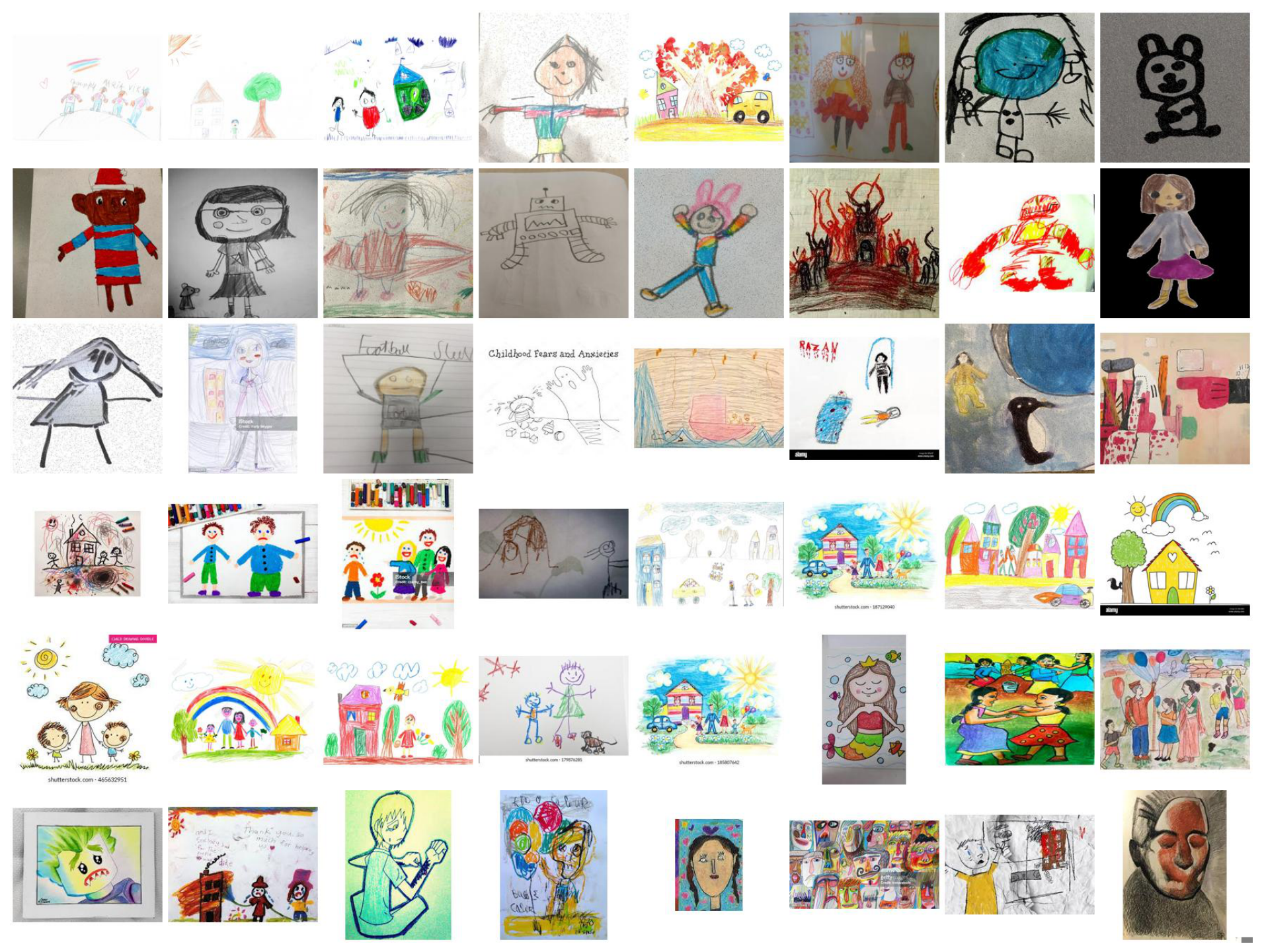
Figure 2.
An example of the drawing.
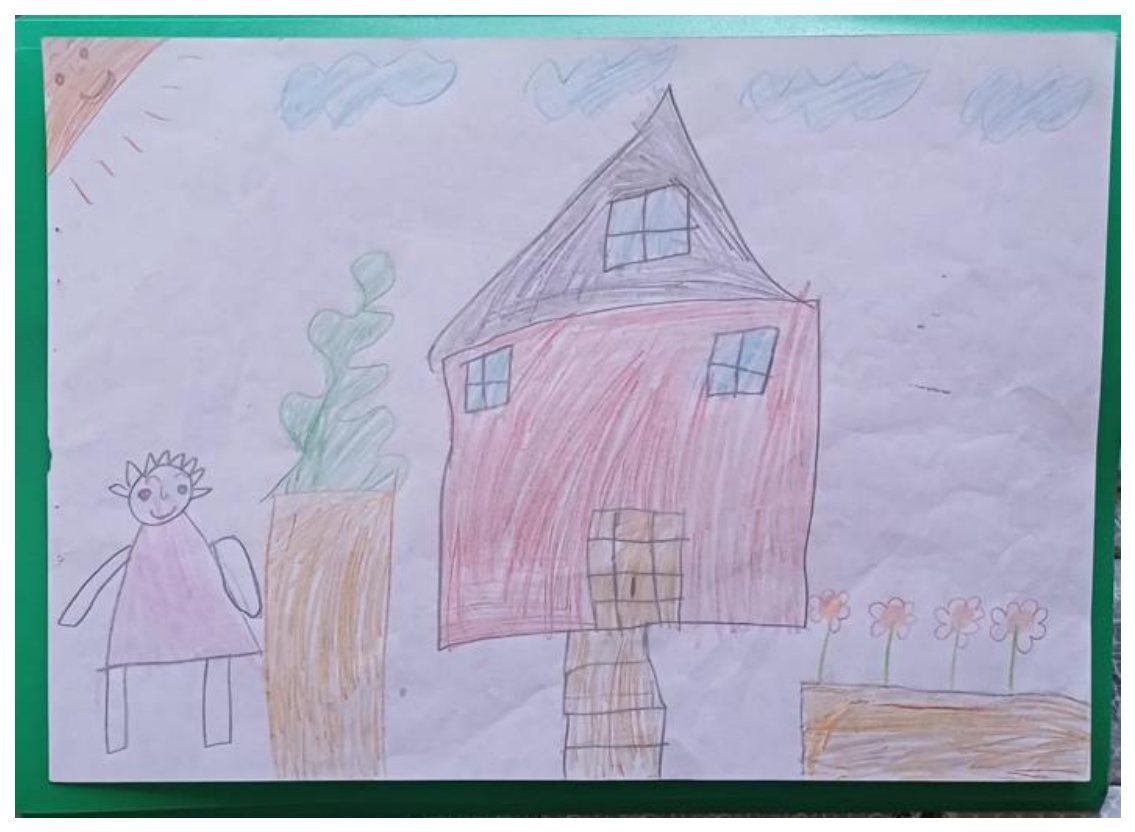
Figure 3.
Pairwise Sentiment Score Relationships Between Models.
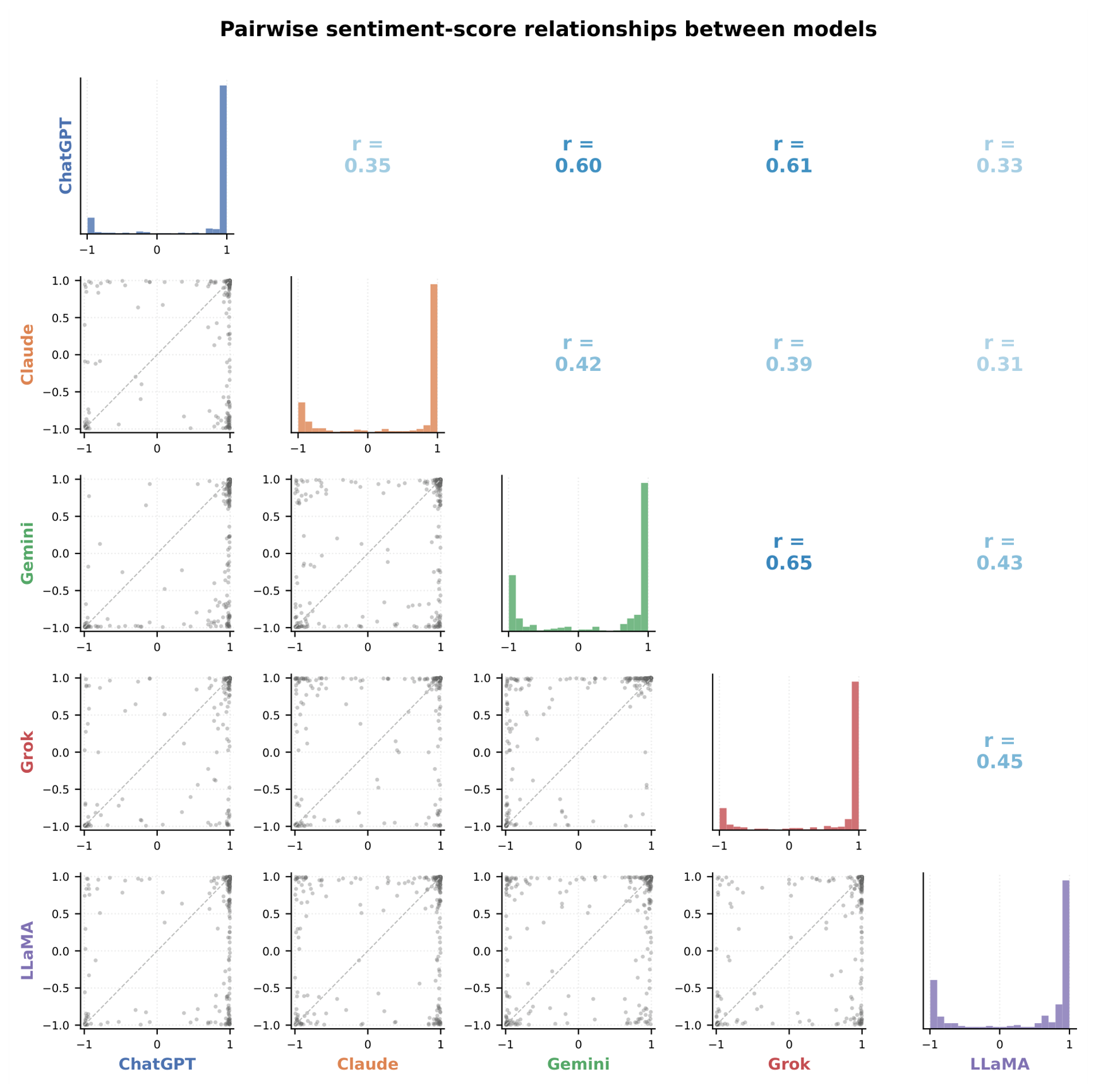
Figure 4.
Sentiment Distribution Across Language Models.
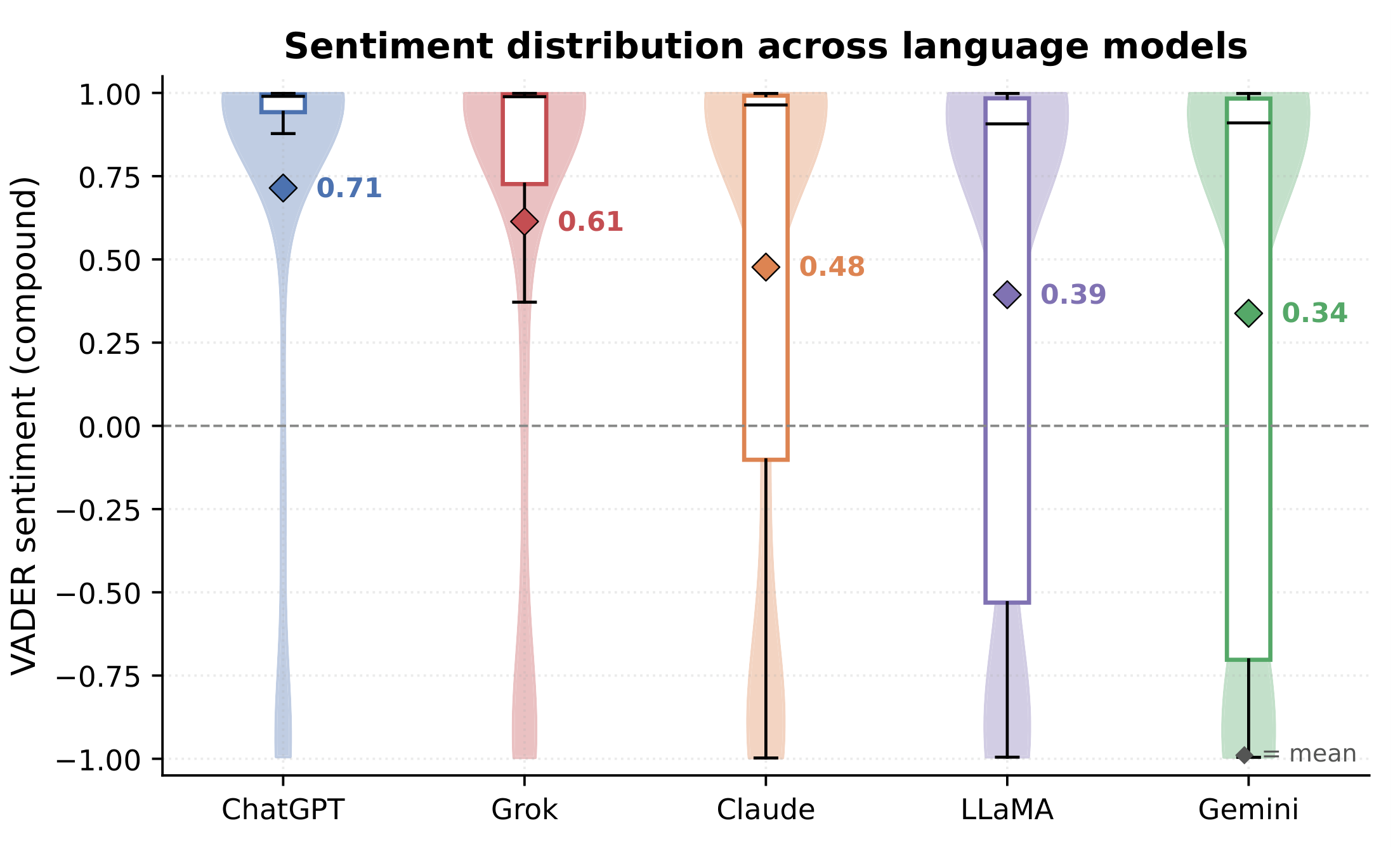
Figure 5.
Tukey HSD: Pairwise Mean Differences in Sentiment.
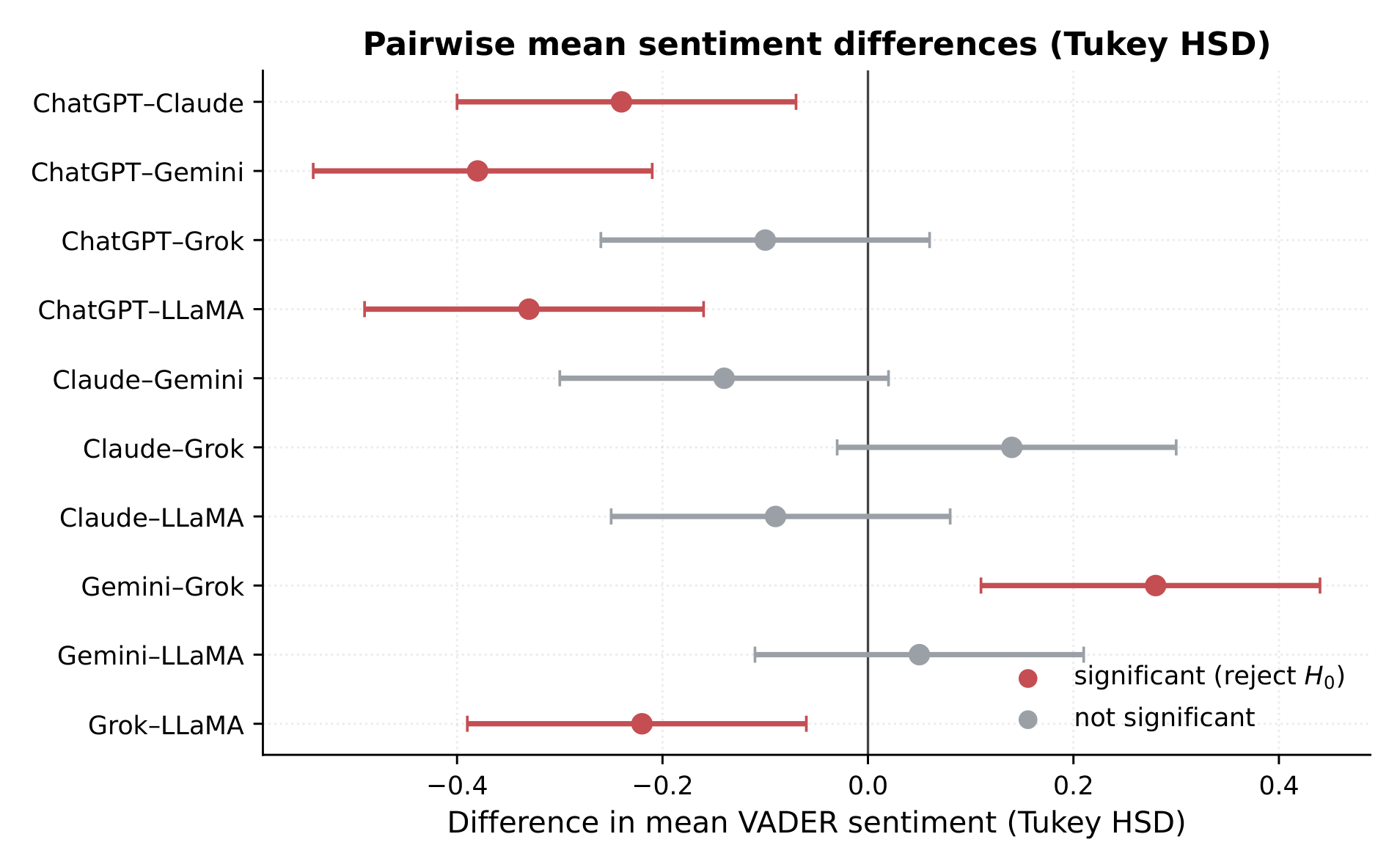
Figure 6.
Coarse and Fine-Grained Emotion Distribution per Model.
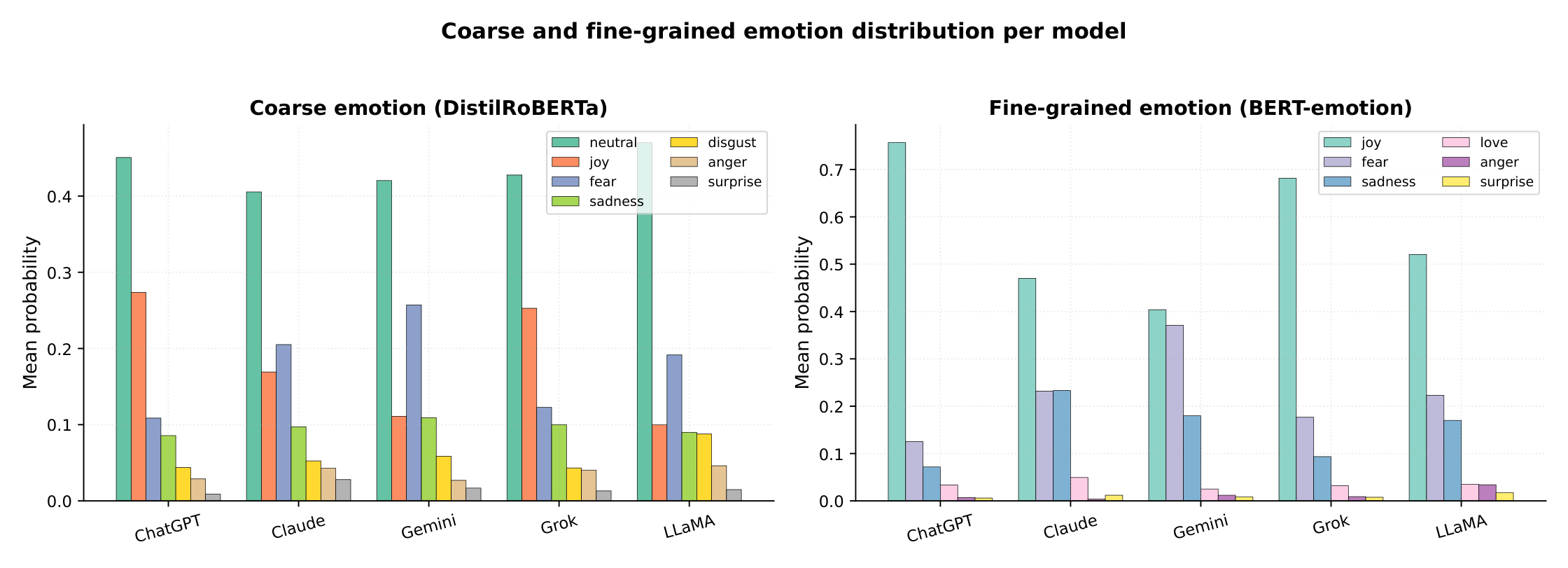
Figure 7.
Inter-Model Agreement in Emotion Classification Using Jaccard Similarity Index.
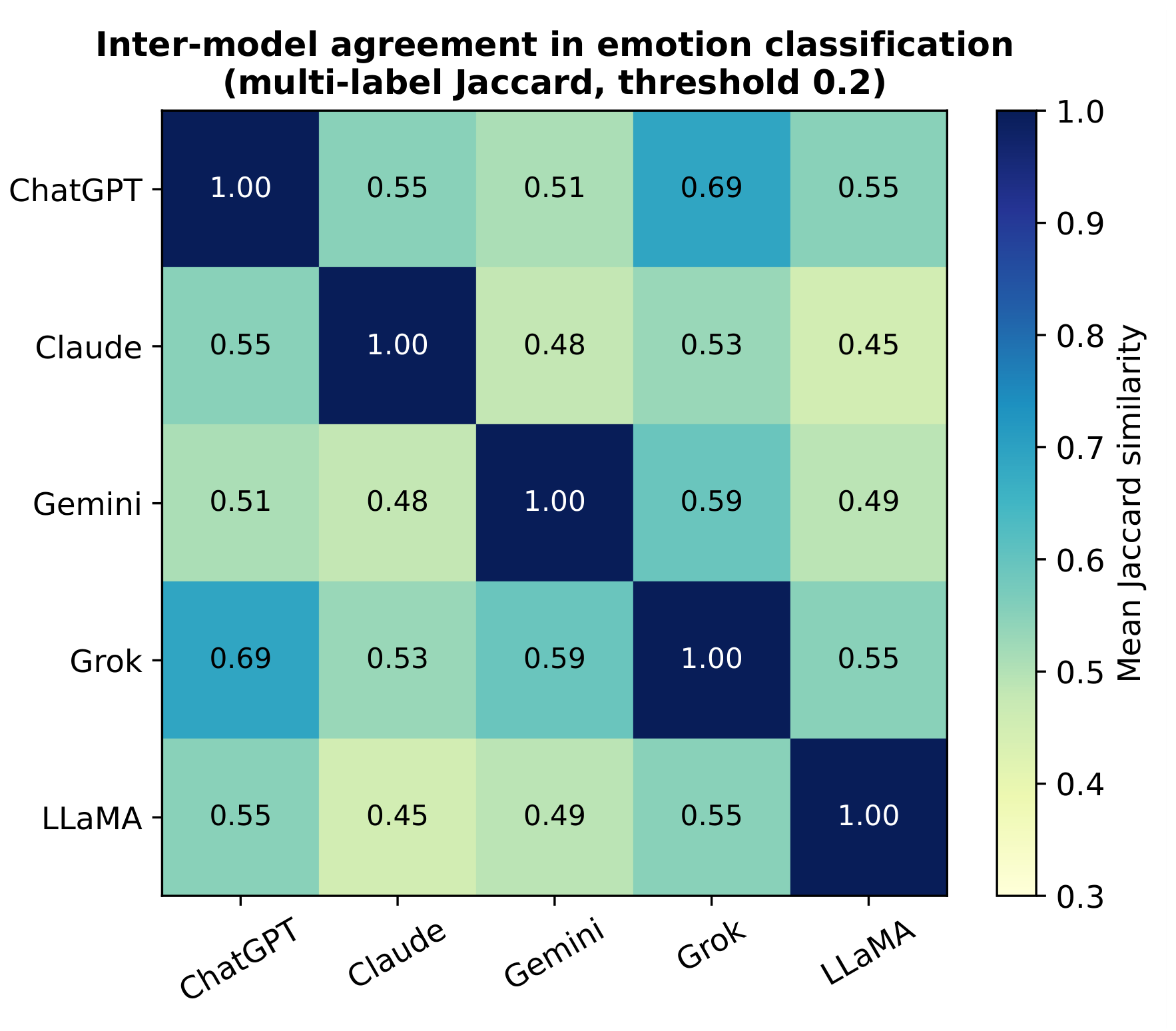
Figure 8.
Comparative Lexical Category Analysis - (A) Mean Usage, (B) Mean Counts, and (C) Distribution Across Five AI Language Models.
Figure 8.
Comparative Lexical Category Analysis - (A) Mean Usage, (B) Mean Counts, and (C) Distribution Across Five AI Language Models.
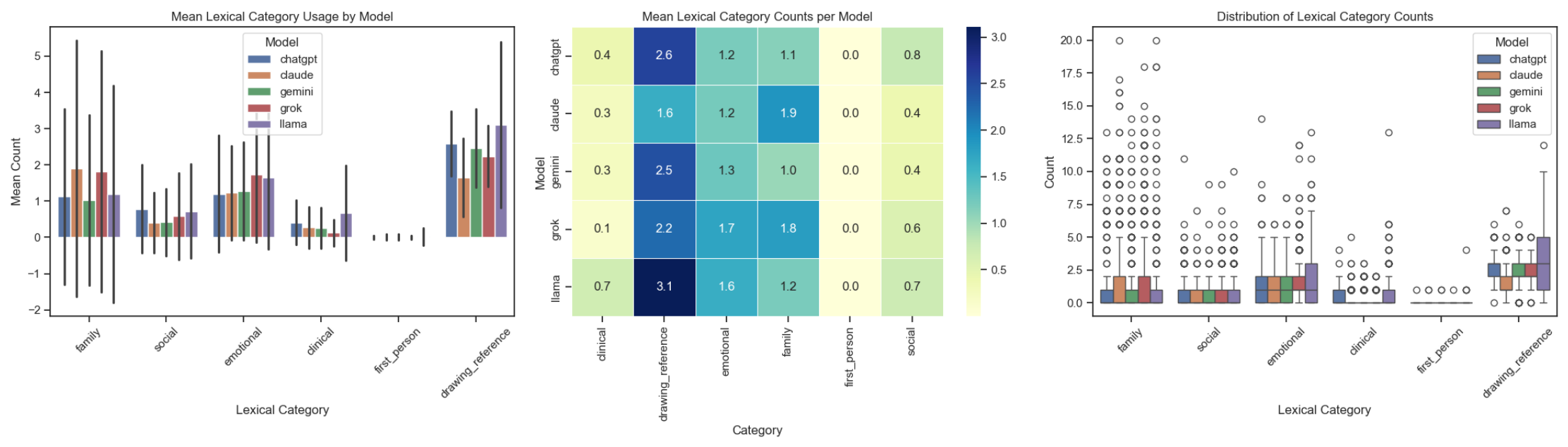
Figure 9.
Comparative Analysis of Readability Metrics - Grade Level, Sentence Length, and Vocabulary Richness by Model.
Figure 9.
Comparative Analysis of Readability Metrics - Grade Level, Sentence Length, and Vocabulary Richness by Model.
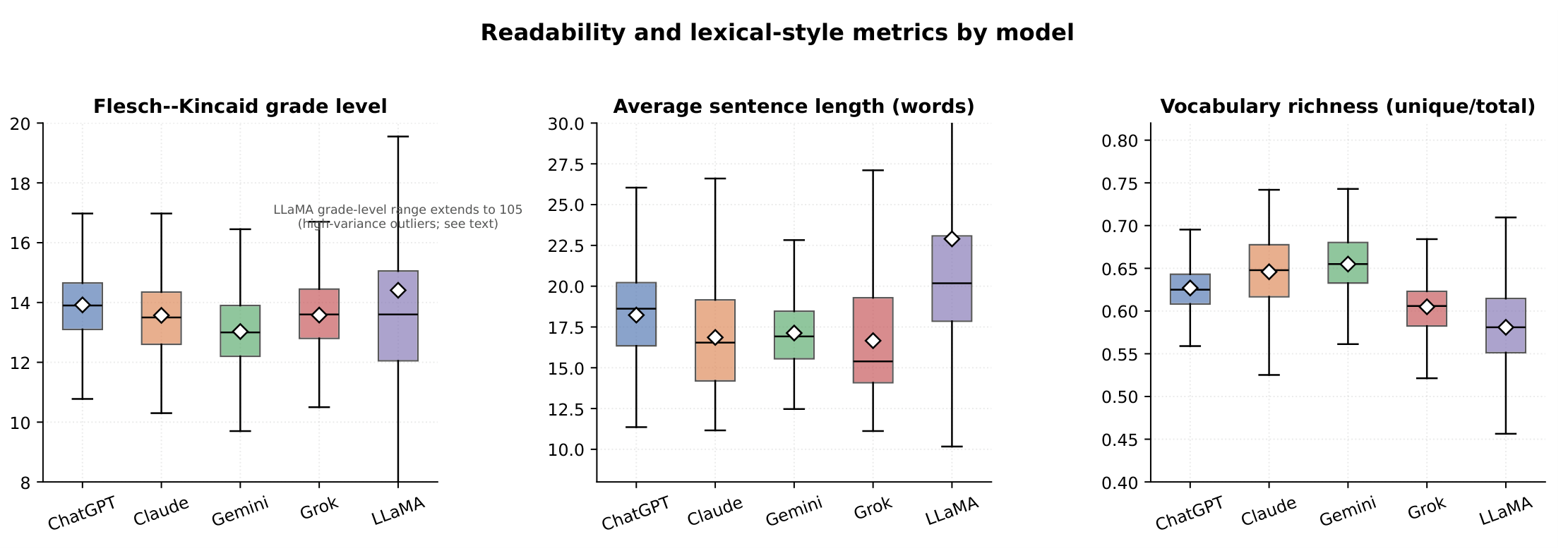
Figure 10.
Distribution of Tone Categories (Analytical/Supportive, Critical/Analytical, and Neutral/Objective) by AI Model.
Figure 10.
Distribution of Tone Categories (Analytical/Supportive, Critical/Analytical, and Neutral/Objective) by AI Model.
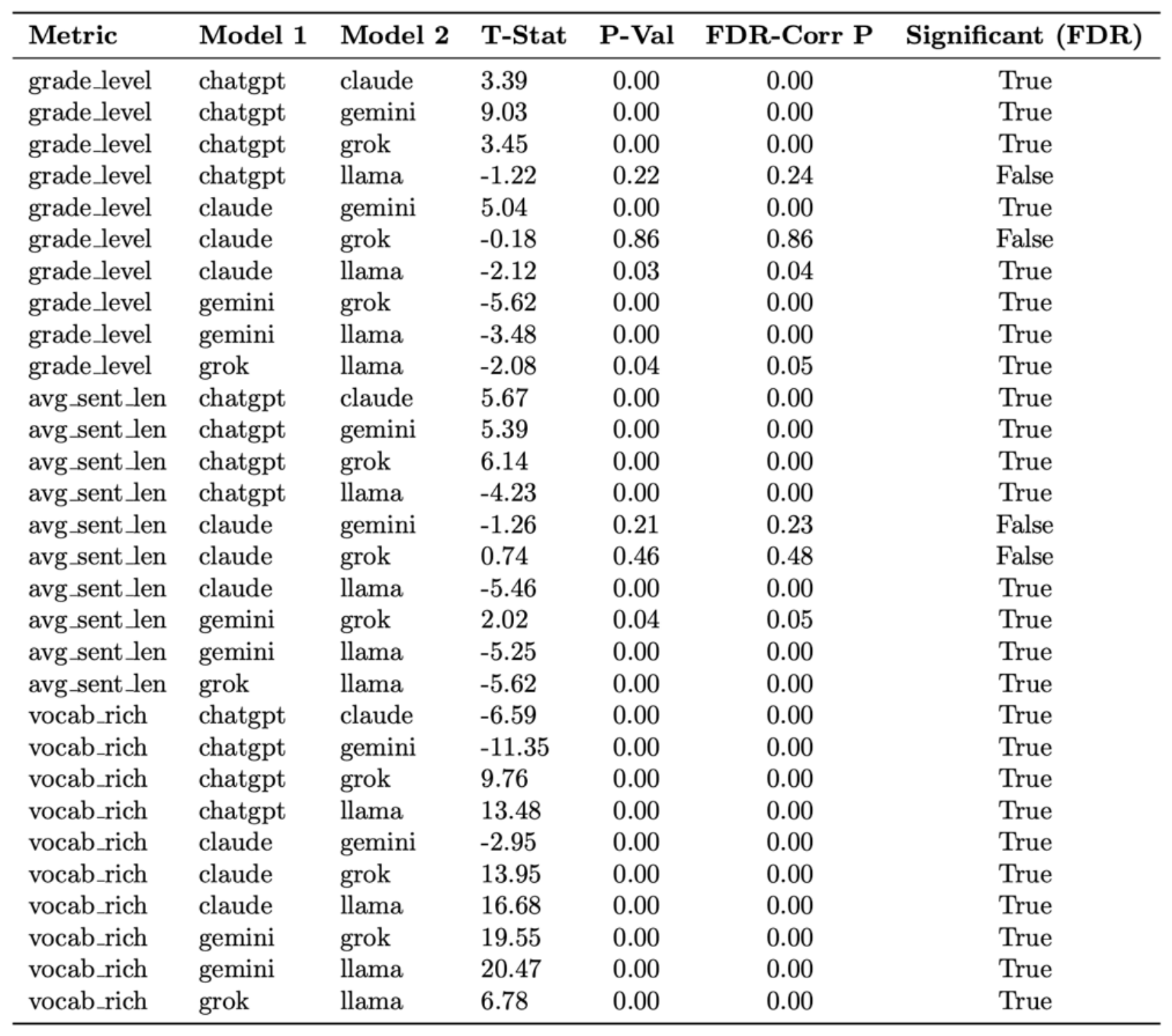
Figure 11.
Multi-Perspective Semantic Similarity Analysis Across AI Models: Histograms, Temporal Patterns, and Comparative Scatter Plots.
Figure 11.
Multi-Perspective Semantic Similarity Analysis Across AI Models: Histograms, Temporal Patterns, and Comparative Scatter Plots.
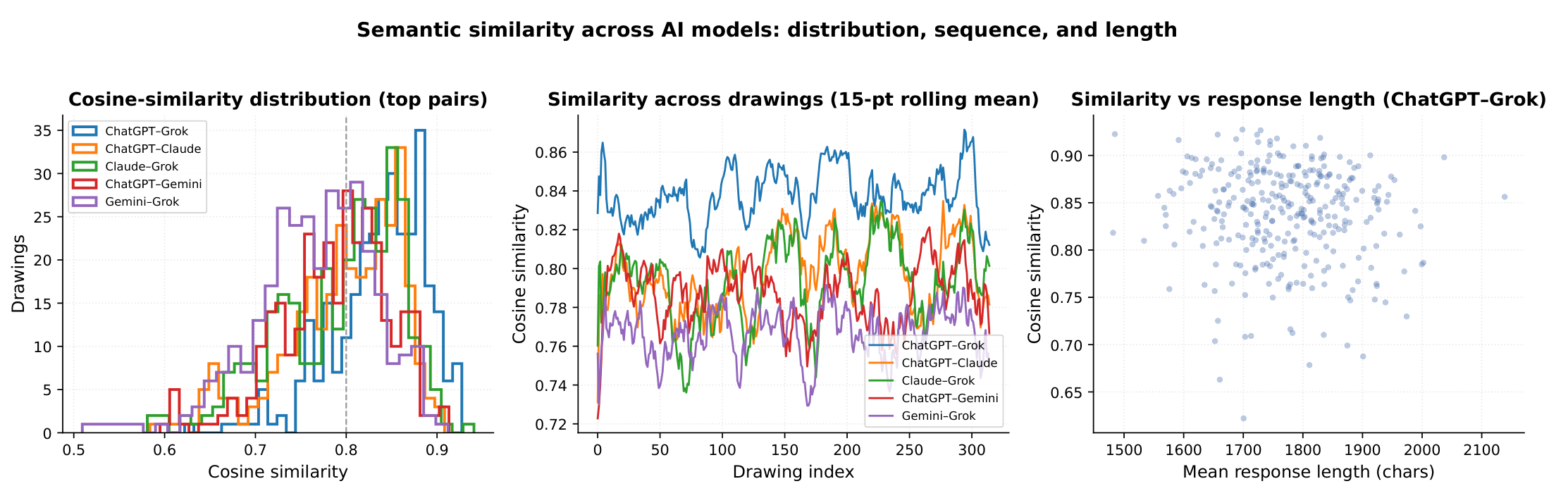
Figure 12.
BERT-Based Semantic Similarity Assessment - Distribution Analysis and Sequential Patterns Across AI Model Pairs.
Figure 12.
BERT-Based Semantic Similarity Assessment - Distribution Analysis and Sequential Patterns Across AI Model Pairs.
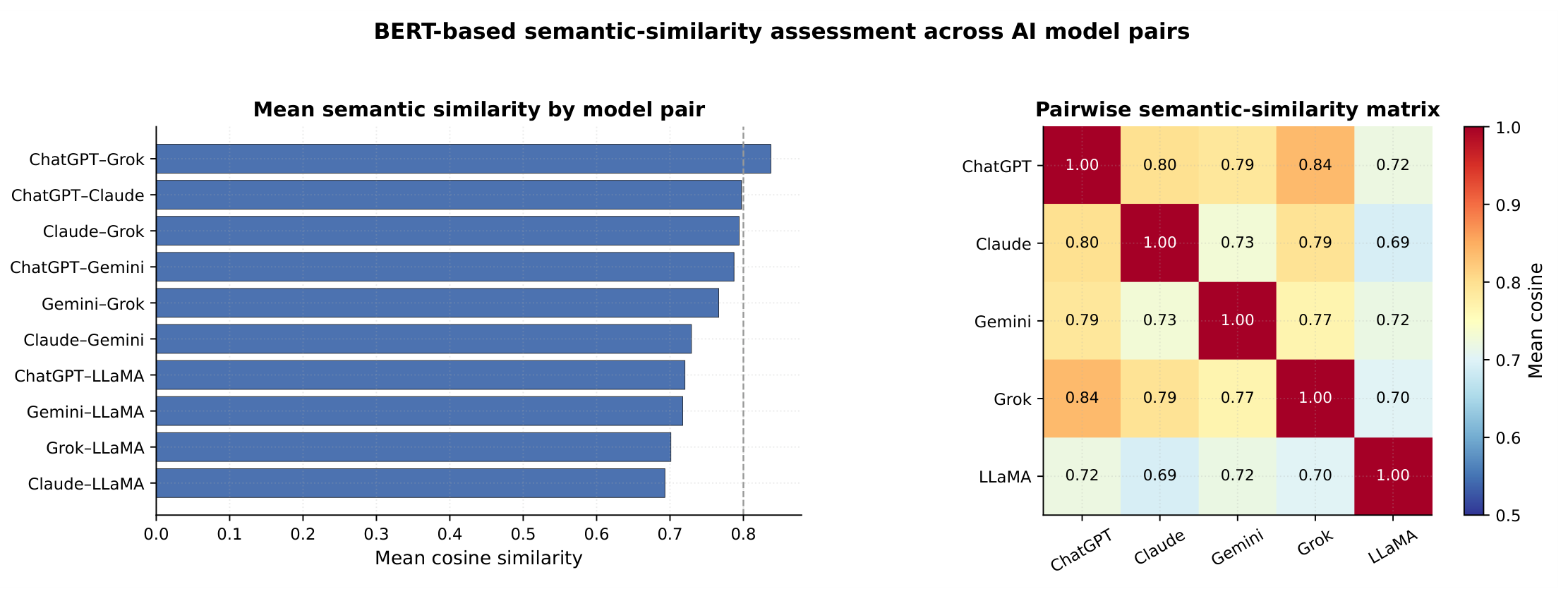
Figure 13.
Multi-Perspective t-SNE Analysis: Model-Based Clustering, Topic-Based Clustering, and Quantitative Topic Distribution.
Figure 13.
Multi-Perspective t-SNE Analysis: Model-Based Clustering, Topic-Based Clustering, and Quantitative Topic Distribution.
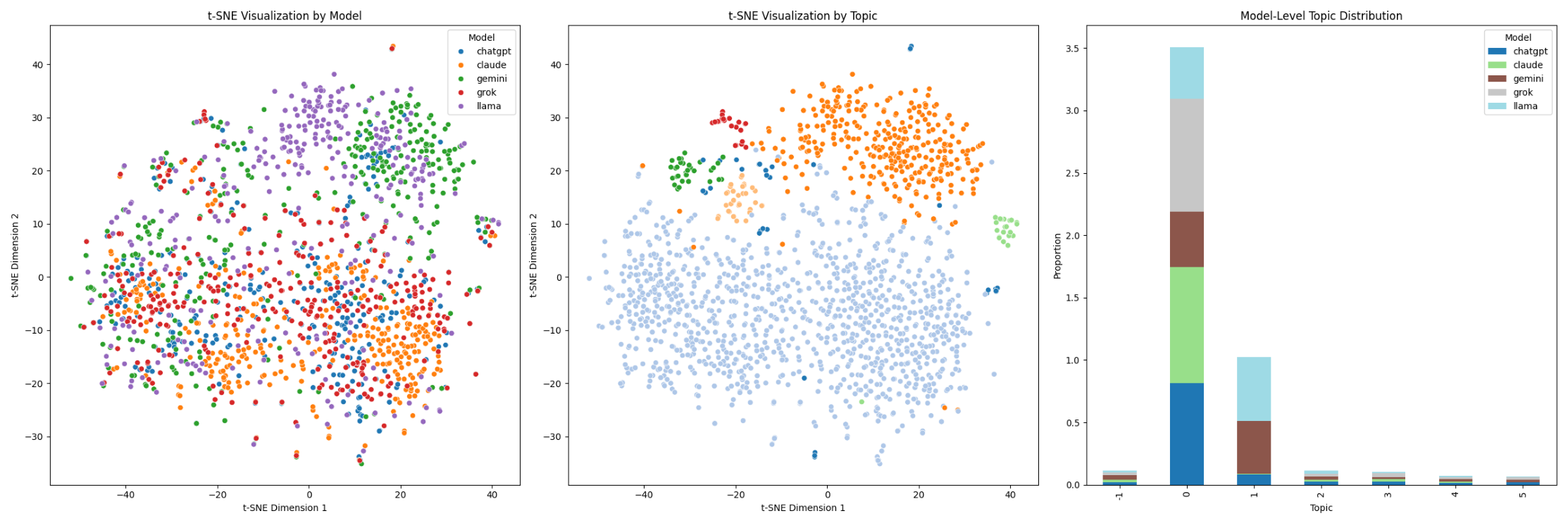
Table 1.
Descriptive Statistics of Sentiment Score Distributions by AI Model.
| Model | N | Mean | Std. Dev. | Min | Q1 | Median | Q3 |
|---|---|---|---|---|---|---|---|
| ChatGPT | 315.00 | 0.71 | 0.62 | -0.99 | 0.94 | 0.99 | 1.00 |
| Claude | 315.00 | 0.48 | 0.78 | -1.00 | -0.10 | 0.96 | 0.99 |
| Gemini | 315.00 | 0.34 | 0.83 | -1.00 | -0.70 | 0.91 | 0.98 |
| Grok | 315.00 | 0.61 | 0.70 | -1.00 | 0.73 | 0.99 | 1.00 |
| LLaMA | 315.00 | 0.39 | 0.80 | -0.99 | -0.53 | 0.90 | 0.98 |
Table 2.
Detailed T-test Results of VADER Sentiment Scores Between Language Models.
| Model 1 | Model 2 | T-stat | P-val | Sig | Cohen’s d | P-val (Bonf) | Sig (Bonf) | P-val (FDR) | Sig (FDR) |
|---|---|---|---|---|---|---|---|---|---|
| ChatGPT | Claude | 4.23 | 0.00 | Yes | 0.34 | 0.00 | Yes | 0.00 | Yes |
| ChatGPT | Gemini | 6.44 | 0.00 | Yes | 0.51 | 0.00 | Yes | 0.00 | Yes |
| ChatGPT | Grok | 1.91 | 0.06 | No | 0.15 | 0.56 | No | 0.07 | No |
| ChatGPT | LLaMA | 5.72 | 0.00 | Yes | 0.46 | 0.00 | Yes | 0.00 | Yes |
| Claude | Gemini | 2.17 | 0.03 | Yes | 0.17 | 0.31 | No | 0.04 | Yes |
| Claude | Grok | -2.33 | 0.02 | Yes | -0.19 | 0.20 | No | 0.03 | Yes |
| Claude | LLaMA | 1.40 | 0.16 | No | 0.11 | 1.00 | No | 0.18 | No |
| Gemini | Grok | -4.52 | 0.00 | Yes | -0.36 | 0.00 | Yes | 0.00 | Yes |
| Gemini | LLaMA | -0.79 | 0.43 | No | -0.06 | 1.00 | No | 0.43 | No |
| Grok | LLaMA | 3.77 | 0.00 | Yes | 0.30 | 0.00 | Yes | 0.00 | Yes |
Table 3.
Tukey HSD Post-hoc Test Results for VADER Sentiment Score Differences Between Models.
| Model 1 | Model 2 | Mean Diff | P-adj | Lower CI | Upper CI | Reject ( = 0.05) |
|---|---|---|---|---|---|---|
| ChatGPT | Claude | -0.24 | 0.00 | -0.40 | -0.07 | True |
| ChatGPT | Gemini | -0.38 | 0.00 | -0.54 | -0.21 | True |
| ChatGPT | Grok | -0.10 | 0.44 | -0.26 | 0.06 | False |
| ChatGPT | LLaMA | -0.33 | 0.00 | -0.49 | -0.16 | True |
| Claude | Gemini | -0.14 | 0.14 | -0.30 | 0.02 | False |
| Claude | Grok | 0.14 | 0.15 | -0.03 | 0.30 | False |
| Claude | LLaMA | -0.09 | 0.58 | -0.25 | 0.08 | False |
| Gemini | Grok | 0.28 | 0.00 | 0.11 | 0.44 | True |
| Gemini | LLaMA | 0.05 | 0.91 | -0.11 | 0.21 | False |
| Grok | LLaMA | -0.22 | 0.00 | -0.39 | -0.06 | True |
Table 4.
Multi-dimensional comparison of model outputs against clinical raters (validation subset, n = 31).
Table 4.
Multi-dimensional comparison of model outputs against clinical raters (validation subset, n = 31).
| Rank | Model | Thematic | Emotional | Lexical | Composite Score |
|---|---|---|---|---|---|
| 1 | Gemini | 0.71 | 0.78 | 0.41 | 0.64 |
| 2 | ChatGPT | 0.70 | 0.71 | 0.45 | 0.63 |
| 3 | Grok | 0.73 | 0.70 | 0.45 | 0.63 |
| 4 | Claude | 0.70 | 0.62 | 0.41 | 0.59 |
| 5 | LLaMA | 0.66 | 0.62 | 0.37 | 0.56 |
Disclaimer/Publisher’s Note: The statements, opinions and data contained in all publications are solely those of the individual author(s) and contributor(s) and not of MDPI and/or the editor(s). MDPI and/or the editor(s) disclaim responsibility for any injury to people or property resulting from any ideas, methods, instructions or products referred to in the content. |
© 2026 by the authors. Licensee MDPI, Basel, Switzerland. This article is an open access article distributed under the terms and conditions of the Creative Commons Attribution (CC BY) license.
Copyright: This open access article is published under a Creative Commons CC BY 4.0 license, which permit the free download, distribution, and reuse, provided that the author and preprint are cited in any reuse.