

Submitted:
23 September 2026
Posted:
24 September 2026
You are already at the latest version
Abstract
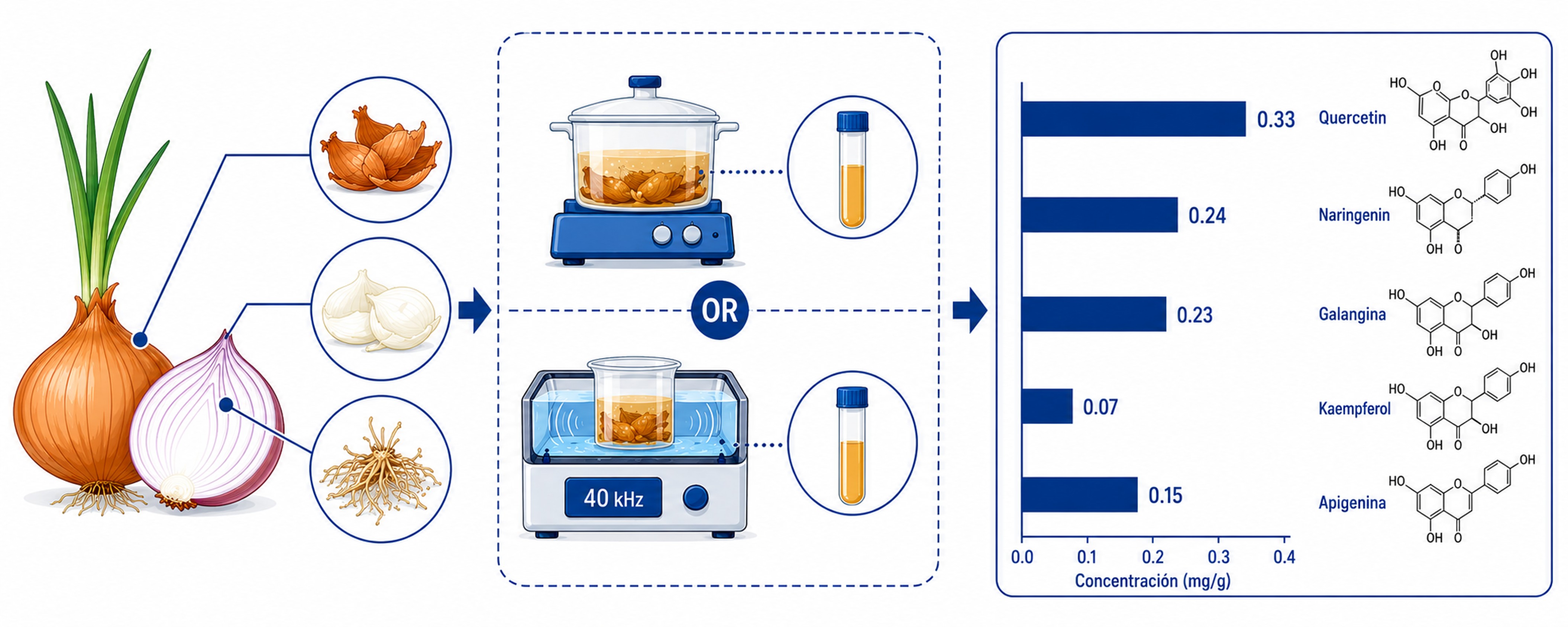
In this research, white onion (Allium cepa L.) residual organs and extraction methods were evaluated to determine optimal recovery conditions for flavanones (naringenin, apigenin) and flavonols (quercetin, kaempferol, and galangin). Ultrasound-assisted extraction (UAE) and decoction were compared using flower and leaf residues. Leaf decoction yielded higher concentrations of quercetin (0.33 mg g⁻¹), naringenin (0.24 mg g⁻¹), galangin (0.23 mg g⁻¹), and kaempferol (0.07 mg g⁻¹) compared to flower residues. Conversely, apigenin was highest in flower decoction (0.15 mg g⁻¹) and undetected via UAE. Phytochemical profiles were significantly influenced by both plant organ and extraction method. Non-metric Multidimensional Scaling (NMDS) revealed that quercetin, galangin, and naringenin predominated in leaf residues, showing strong positive vector correlations along NMDS1 (0.508, 0.507, and 0.509, respectively), whereas apigenin exhibited a negative correlation (-0.470). NMDS2 was primarily driven by kaempferol concentration (vector score of 0.793).
Keywords:
alternative
; compounds
; phytochemical
; extraction
1. Introduction
Onion (Allium cepa L.) is one of the most widely consumed and cultivated vegetables worldwide [1]. To comply growing global demand, onion production has reached approximately 106 million t, India as leading producer (32 million t) [2]. Mexico production’s has totaled 1.7 million t since 2022 [3]. However, despite these significant production figures, it is well-established that post-harvest processing (grading and selection) and storage generate a substantial accumulation of onion residues. These residues are unsuitable for animal feed due to characteristic pungent odors caused by high content of sulfur compounds [4]. Furthermore, the disposal of solid wastes in urban industries promotes the proliferation of pathogens (Sclerotium cepivorum), rendering inadequate for use as organic fertilizers or for landfill disposals. Additionally, onion waste disposal costs are high, imposing an extra economic burden on farmers for waste management [5].
Onion residues offer potential for valorization [6], as they contain numerous organosulfur compounds, as well as flavonoids, saponins, and vitamins (B1, B2, B6, C, and E), which contribute to antibacterial, antiviral, antioxidant, and anti-inflammatory activities. Quercetin, along with its free glycosides such as quercetin 4’-O-glucoside (a glucoside molecule on the 4th quercetin position) and quercetin 3,4’-di-O-glucoside (two glucoside molecules on 3rd and 4th quercetin positions), exhibits wound-healing effects by inhibiting the proliferation and contraction of fibroblasts isolated from keloids [7,8].
The use of plant extracts for wound-healing represents a cost-effective method and a natural source of medicinal substances with fewer side effects than synthetic chemical agents [9,10] due to the presence of alkaloids, flavonoids, tannins, terpenoids, saponins, and phenolic compounds [11].
As previously noted, onion (Allium cepa L.) production generates a critical volume of residual biomass. These residues—comprised of roots, stems, and leaf blades—negatively impact the soil from a phytopathological perspective and face limitations for use as livestock fodder. However, these discards possess a phytochemical profile of high industrial value. The lack of standardized protocols for the recovery of these metabolites from non-marketable organs represents a lost economic opportunity for the agricultural sector.
The objective of this research was to evaluate the phytochemical profile of non-marketable organs of Allium cepa L. from Salinas, S.L.P., México, by comparing two extraction methods and performing quantification via High-Performance Liquid Chromatography with Diode Array Detection (HPLC-DAD).
2. Materials and Methods
2.1. Plant Material
The first-generation waste used in this study was collected from plots in the community of Conejillo, Salinas, S.L.P., México (67% de state production and 66% of state cultivated area, SIAP, 2023 [12]). It consisted of non-marketable organs of white onion (Allium cepa L.) obtained from post-harvest activities, including: the root system (roots), the basal plate (true stem), floral scape residues (stem), leaf blades (green and dry leaves), and senescent reproductive structures (flowers/seeds and fruits). These parts, which are typically agricultural discards, were integrally processed to obtain the extracts.
Two different extraction procedures were employed to compare and identify the most suitable technique for recovering biocompounds from non-marketable onion organs. Decoction (15 min at boiling temperature) and ultrasound-assisted extraction (UAE; 40 kHz, 15 min) were adopted. The solid-to-liquid ratio consisted of 2.5 g of ground onion residues in various hydroalcoholic solution concentrations (0:100, 30:70, 70:30, and 100:0 v/v water/ethanol) to optimize the solvent ratio and maximize phenolic compound yield. Based on preliminary tests, extracts obtained with absolute ethanol (0:100 v/v) exhibited the highest recovery capacity for secondary metabolites; therefore, subsequent quantification and statistical comparison analyses focused on this solvent system.
2.2. HPLC Determination of Phenolic Compounds
Identification and quantification of secondary metabolites were performed using an Agilent 1200 Infinity series High-Performance Liquid Chromatography (HPLC) system (Agilent Technologies, Santa Clara, CA, USA) equipped with a Diode Array Detector (DAD) [13,14]. Chromatographic separation was achieved using a C18 reverse-phase column (250 x 4.6 mm, 5 µm). The mobile phase consisted of a gradient elution system comprising (A) water acidified with 0.1% glacial acetic acid and (B) acetonitrile [15,16].
The elution gradient was programmed as follows: 0–3 min, 30% B; 3–9 min, linear increase to 40% B; 9–13 min, to 50% B; 13–17 min, to 60% B; 17–20 min, to 75% B; 20–22 min, to 90% B; and 22–23 min, reaching 100% B. Finally, the system returned to initial conditions (30% B) from 23 to 26 min for column re-equilibration. The flow rate was maintained constant at 1 mL/min, with an injection volume of 20 µL [17,18].
Detection was performed at 290 nm for flavanones (naringenin) and 334 (apigenin) and at 365 nm for flavonols (quercetin, kaempferol, and galangin). Compounds were identified by comparing their retention times and UV-Vis spectra with those of commercial standards. Quantification was carried out using external calibration curves with a coefficient of determination R2 > 0.99 [19,20,21].
2.3. Statistical Analysis
Data analysis was performed using R statistical software (version 4.5.3). Data distribution was evaluated using the Shapiro-Wilk test. Since analyte concentrations did not meet the assumptions of normality (p < 0.05) and homogeneity of variances, a non-parametric approach was adopted using the Kruskal-Wallis test, followed by Dunn’s post-hoc test with Bonferroni adjustment (p < 0.05). To evaluate differences in the phytochemical profile among residual organs, a Permutational Multivariate Analysis of Variance (PERMANOVA) was conducted based on the Bray-Curtis similarity metric, using 999 permutations. Chemical groupings were visualized using Non-metric Multidimensional Scaling (NMDS), and the goodness of fit was determined by the Stress value [22].
3. Results
The Kruskal-Wallis non-parametric analysis of variance revealed significant differences in the concentration of all evaluated phenolic compounds (p < 0.05) based on the type of residue and the extraction method (Table 1). These variations demonstrate that the distribution of flavonoids across white onion residues is non-homogeneous. Consequently, Dunn’s post-hoc analysis revealed that the 0:100 v/v leaf extract (HD0) exhibited the highest concentrations of quercetin, galangin, and naringenin, showing significant differences compared to the flower extract obtained by decoction (FD0) in all cases (p < 0.05).
The behavior of apigenin was contrasting, recording its maximum value in the flower extract obtained by decoction (FD0; 0.15 mg g⁻¹), which was significantly higher than that obtained via ultrasound-assisted extraction (FU0) (p = 0.019). In the case of kaempferol, the ultrasound method resulted in non-detected (ND) concentrations, being statistically lower than the 0:100 v/v leaf decoction (p = 0.045).
Quercetin was the most abundant compound in the HD0 extract (0.33 mg g⁻¹), followed by the FU0 extract (0.27 mg g⁻¹). This is a significant finding, as quercetin is the primary phenolic constituent of onions (Figure 1).
Several studies have analyzed bioactive compounds in onion residues, primarily focusing on skins. For instance, [4] reported higher quercetin content (4.22 mg g⁻¹) and lower kaempferol values (0.09 mg g⁻¹) in red onion skins using deep eutectic solvents. Although the quercetin values obtained in the present study for white onion are numerically lower than those reported for red varieties, they remain within competitive ranges for white onion residues. This is further supported by the findings of [10], where quercetin and kaempferol contents were lower in both onion bulbs and leaves. This bioactive recovery is attributed to ethanol possessing the appropriate polarity to interact with the flavonoid nucleus [23] in contrast to excessively polar solvents that limit the molecular arrangement of the analyte [24,25]. This is also due to the fact that quercetin is lipid- and alcohol-soluble but insoluble in water [5].
Furthermore, [26] and [27] reported values of 1.61 mg g⁻¹ in the outer skin, which is relatively higher than the results of this study; however, they found only 0.046 mg g⁻¹ of quercetin in the bulb, a value significantly lower than those obtained from the FU0 and HD0 extracts. In this sense, Allium cepa residues exhibit a highly interesting phytochemical profile. While recent studies, such as that by [16], indicate that naringenin and apigenin concentrations in European varieties (Tropea, red, and yellow) are lower than those found in white onion residue extracts, the findings of this work demonstrate that white onion leaves and flowers possess significant bioactive potential.
Permutational Multivariate Analysis of Variance (PERMANOVA) confirmed that the overall phytochemical composition of A. cepa residues was significantly influenced by both the extraction method and the plant organ used (F(2,6)= 155.8; R2 = 0.981; p = 0.001). These data were further analyzed via Non-metric Multidimensional Scaling (NMDS), where the first two dimensions explained the spatial ordination (NMDS1: 68.60%, NMDS2: 31.30%), as shown in Table 2. The high R2 value indicates that the “Extract” factor explains 98.10% of the total variance observed in the profile.
To further explore the data structure, a Non-metric multidimensional Scalin was performed (Table 2). The Non-metric multidimensional Scalin revealed that quercetin (0.5080), galangin (0.5073), and naringenin (0.5093) exhibit a strong positive correlation with NMDS1, defining the predominant profile of the leaf residues. Conversely, apigenin (-0.4705) showed a negative loading on NMDS1, while kaempferol (0.7932) was the primary determinant for NMDS2.
Table 3 presents the score matrix by extract, which allows for the visualization of the discrimination between treatments. The leaf decoction extract (HD0) showed the highest predominance in NMDS1 (1.83), reflecting a profile characterized by high concentrations of quercetin, galangin, and naringenin. In contrast, the flower decoction extract (FD0) was located at the opposite end of NMDS1 (-1.87); however, its positive value in NMDS2 (0.69) highlights its distinctive apigenin content.
Finally, the flower ultrasound-assisted extract (FU0) exhibited a divergent phytochemical profile (NMDS2: -1.44), driven primarily by the absence of kaempferol and a lower flavone density. This multivariate separation confirms that both the plant organ and the type of energy employed during extraction (thermal vs. acoustic) dictate the chemical identity of the final extract, which is fundamental for its subsequent application in biotechnological formulations.

Table 2.
Compounds Contributing to the Non-Metric Multidimensional Scaling (NMDS) Ordination.
| NMDS1 | NMDS2 | |
|---|---|---|
| Quercetin | 0.5080 | -0.2700 |
| Kaempferol | 0.0605 | 0.7932 |
| Galangin | 0.5073 | 0.2729 |
| Naringenin | 0.5093 | 0.2648 |
| Apigenin | -0.4705 | 0.3914 |
Table 3.
Phytochemical profiles and NMDS ordination coordinates of onion residue extracts.
| Extrac | Quercetin | Kaempferol | Galangin | Naringenin | Apigenin | NMDS1 | NMDS2 |
| HD0 | 0.326 | 0.067 | 0.226 | 0.235 | 0.001 | 1.831 | 0.748 |
| FU0 | 0.271 | 0.000 | 0.058 | 0.063 | 0.000 | 0.042 | -1.446 |
| FD0 | 0.000 | 0.057 | 0.015 | 0.016 | 0.145 | -1.873 | 0.699 |
Figure 2 shows the spatial distribution of phenolic compounds among the different extracts from white onion waste. The separation of samples across the four quadrants confirms a distinct chemical differentiation, which is significantly influenced by both the plant organ and the extraction method.
In the upper right quadrant, the HD0 extract clusters closely with naringenin, quercetin, and galangin, confirming that the combination of leaf tissue and thermal energy is the most efficient for recovering these three metabolites. On the other hand, the FD0 extract is located in the upper left quadrant, a region characterized by the presence of apigenin and kaempferol, which creates a clear distance from the leaf profile due to a lower overall compound density. Finally, the FU0 extract is positioned in the lower quadrants, exhibiting a distant behavior that causes the vectors of the high-concentration analytes to point away. This suggests that ultrasound-assisted extraction, under the specific conditions of this study, is not suitable for white onion flowers.
This spatial visualization reaffirms that leaf decoction (HD0) not only maximizes total yield but also generates a more robust multivariate phytochemical profile compared to ultrasound-assisted extraction.
The integration of PERMANOVA and correlation analysis allows for a robust and nuanced understanding of the multivariate phytochemical structure of the residues [28]. The results reveal a clear dispersion of compound groups based on the extract type, evidencing a differential availability of metabolites depending on both the plant organ and the processing method.
Principal Component 1 (NMDS1) exerts the greatest influence on the grouping of bioactive compounds, serving as the determining axis for classifying the evaluated plant organs. This phytochemical discrimination between the leaf and the flower is consistent with the reports of [29] and [30], who suggest that the specialization of aerial tissues in the Allium genus responds to specific metabolic gradients. In this study, NMDS1 effectively separates the antioxidant and healing potential (based on quercetin and galangin content) of the leaf blades from the more specific profiles of the reproductive structures.
5. Conclusions
The present study demonstrates that white onion (Allium cepa L.) agricultural residues constitute a high-value source of bioactive compounds, with a phytochemical profile significantly influenced by both the plant organ and the extraction method. The integration of HPLC analysis with multivariate statistical tools (PERMANOVA and NMDS) allowed for a robust discrimination of the extracts, determining that white onion leaves exhibit a superior bioactive density compared to flowers and bulbs, which represents a promising raw material for developing antioxidant and healing formulations.
Furthermore, leaf decoction using 0:100 v/v (HD0) demonstrated the greatest effectiveness in compound recovery. As a traditional and more feasible method, it can be readily implemented by producers to recover bioactive compounds, supporting the transition toward a circular bioeconomy by transforming common agricultural waste into high-value ingredients. Meanwhile, NMDS confirmed that each residue possesses a unique chemical ‘fingerprint.’ While leaves are dominated by the quercetin-galangin-naringenin triad, flowers (FD0) offer a distinctive profile characterized by apigenin and kaempferol.
Author Contributions
Mónica de Jesús Álvarez-Castillo: Conceptualization and design, acquisition of data, analysis and interpretation. Francisco Javier Morales-Flores: Supervision, Project administration, Drafting the article, revising for intellectual content. Gerardo Loera-Alvarado: Drafting the article, revising for intellectual content. Jorge Cadena-Íñiguez: Writing - Final approval. Sandra Berenice Araujo-Díaz: Final approval. Juan Ángel Morales-Rueda: Final approval.
Data Availability Statement
All data associated with this article are provided in the manuscript and/or supplementary materials.
Conflicts of Interest
The authors declare that they have no known competing financial interests or personal relationships that could have appeared to influence the work reported in this paper.
Abbreviations
The following abbreviations are used in this manuscript:
| NMDS | Non-metric Multidimensional Scaling |
| FD0 | Flower decotion 0% |
| FU0 | Flower ultrasound 0% |
| HD0 | Leaf decotion 0% |
References
- Sagar, N. A., Khar, A., Vikas, Tarafdar, A., & Pareek, S. (2021). Physicochemical and Thermal Characteristics of Onion Skin of Fifteen Indian Varieties for Possible Food Applications. Journal of Food Quality, 2021, 1–13. [CrossRef]
- Kavita, V., Adiani, V., & Mishra, B. B. (2023). Gamma irradiation enhanced the flavor volatiles and certain biochemical compounds in onion (Allium cepa L.) during storage. Postharvest Biology and Technology, 206, 112690. [CrossRef]
- Servicio de Información Agroalimentaria y Pesquera (SIAP). (2026). Panorama Agroalimentario. Secretaría de Agricultura y Desarrollo Rural. https://www.gob.mx/siap.
- Pal, C. B. T., Jadeja, G. C. (2019). Microwave-assisted deep eutectic solvent extraction of phenolic antioxidants from onion (Allium cepa L.) peel: a Box-Behnken design approach for optimization. Journal of Food Science and Technology, 56(9), 4211–4223. [CrossRef]
- Osojnik Črnivec, I. G., Skrt, M., Šeremet, D., Sterniša, M., Farčnik, D., Štrumbelj, E., Poljanšek, A., Cebin, N., Pogačnik, L., Smole Možina, S., Humar, M., Komes, D., & Poklar Ulrih, N. (2021). Extract from onion peel waste as a source of bioactive phenols and antioxidants. Waste Management, 125, 324-335. [CrossRef]
- Gupta, A. J., Kaldate, S., Volaguthala, S., & Mahajan, V. (2025). Nutritional and nutraceutical composition of onion and therapeutic potential of its phytochemicals evaluated through pre-clinical and clinical studies. Journal of Functional Foods, 124, 106889. [CrossRef]
- Bhat, R. (2020). Compuestos bioactivos de especies de Allium. En Compuestos bioactivos en vegetales y legumbres subutilizados (págs. 1-20). Cham: Springer International Publishing. 10.1007/978-3-030-44578-2_17-1.
- Yan, J. K., Zhu, J., Liu, Y., Chen, X., Wang, W., & [otros autores]. (2023). Recent advances in Allium plants research: Functional ingredients, physiological activities, and applications in agricultural and food sciences. Critical Reviews in Food Science and Nutrition, 63(29), 9789–9811. [CrossRef]
- Silva, F. R. M. B., & Novoa, M. A. (2025). Effects of Plant Extracts on Human Health. Nutrients, 17(7), 1229. [CrossRef]
- Colombo, Francesca; Di Lorenzo, Chiara; Biella, Simone; Vecchio, Sarah; Frigerio, Gianfranco; Restani, Patrizia. (2020). Adverse effects to food supplements containing botanical ingredients. Journal of Functional Foods, 72(103990). [CrossRef]
- Sohn, E. J., Kim, J. M., Kang, S. H., Kwon, J., An, H. J., Lee, S. G., & Kim, W. Y. (2018). Restorative effects of quercetin, a natural antioxidant, on senescent human dermal fibroblasts. The American Journal of Chinese Medicine, 46(04), 853–873. [CrossRef]
- Lee, HJ, Lee, IY, Park, JH y Joo, N. (2025). Comparación de fitoquímicos y actividades antioxidantes de bulbos de cebolla ( Allium cepa L.), hojas de cebolla y hojas de cebolla verde ( Allium fistulosum L.). International Journal of Food Properties , 28 (1). [CrossRef]
- Lima, R. C., Carvalho, A. P. A., Silva, B. D., Torres Neto, L., Figueiredo, M. R. S., Chaves, P. H. T., Almeida, A. E. C. C., & Conte-Junior, C. A. (2023). Ultrasound-assisted green extraction of bioactive compounds from babassu (Attalea speciosa) mesocarp: Effects of extraction solid–liquid ratio, antioxidant capacity and antimicrobial activity. Food Applied Administration, 3(2), 100331.
- SIAP, 2023. Anuario Estadístico de la Producción Agrícola. Dirección General del Servicio de Información Agroalimentaria y Pesquera (SIAP). https://nube.agricultura.gob.mx/cierre_agricola/ (accessed 22 June 2026).
- Robards, K. Strategies for the determination of bioactive phenols in plants, fruit and vegetables. Journal of Chromatography A, (2003).
- Slimestad, R., Fossen, T., & Vågen, I. M. Onions: A source of unique dietary flavonoids. Journal of Agricultural and Food Chemistry, (2007). [CrossRef]
- Lombard, Kevin; Peffley, Ellen; Geoffriau, Emanuel; Thompson, Leslie; Herring, Andy. Quercetin in onion (Allium cepa L.) after heat-treatment simulating home preparation. Journal of Food Composition and Analysis. (2005). [CrossRef]
- Lohvina, H.; Sándor, M.; Wink, M. Effect of Ethanol Solvents on Total Phenolic Content and Antioxidant Properties of Seed Extracts of Fenugreek (Trigonella foenum-graecum L.) Varieties and Determination of Phenolic Composition by HPLC-ESI-MS. Diversity 2022, 14, 7. [CrossRef]
- Pukhrambam, Premi Devi, Devi, Khomdram Khedashwori, Maibam, Chingoileima, Mutum, Roseeta Devi, Devi, Moirangthem Lakshmipriyari, Das, Sudripta. Phenolics and flavonoids from Polygonum posumbu and comparision of flavonoid compounds content in different tissues (leaves, stems and roots). Fitoterapia, (2024). [CrossRef]
- Agilent. Agilent 1200 Infinity Series ELSD. User’s manual. (2013) https://www.agilent.com/cs/library/usermanuals/public/G4260-90001_ELSD_USR_EN.pdf.
- Benítez, V., Mollá, E., Martín-Cabrejas, M. A., Aguilera, Y., López-Andréu, F. J., Cools, K., Terry, L. A., & Esteban, R. M. Characterization of industrial onion wastes (Allium cepa L.): Dietary fibre and bioactive compounds. Plant Foods for Human Nutrition, (2011). [CrossRef]
- Anderson, M.J. Permutational Multivariate Analysis of Variance (PERMANOVA). In Wiley StatsRef: Statistics Reference Online (eds N. Balakrishnan, T. Colton, B. Everitt, W. Piegorsch, F. Ruggeri and J.L. Teugels). (2017). [CrossRef]
- Lefebvre, T., Destandau, E., & Lesellier, E. (2020). Selective extraction of carotenoids and chlorophylls from Rosemary with on-line supercritical fluid extraction-supercritical fluid chromatography. Journal of Chromatography A, 1631, 461709. [CrossRef]
- Picot-Allain, C., Mahomoodally, M. F., Ak, G., & Zengin, G. (2021). Conventional versus green extraction techniques — a comparative perspective. Current Opinion in Food Science, 40, 144–156. [CrossRef]
- Benítez, V., Mollá, E., Martín-Cabrejas, M. A., Aguilera, Y., López-Andréu, F. J., Cools, K., Terry, L. A., & Esteban, R. M. (2011). Characterization of industrial onion wastes (Allium cepa L.): Dietary fibre and bioactive compounds. Plant Foods for Human Nutrition, 66(1), 48–57. [CrossRef]
- Cozzolino, R., Malorni, L., Martignetti, A., Picariello, G., Siano, F., Forte, G., & De Giulio, B. (2021). Comparative analysis of volatile profiles and phenolic compounds of four southern Italy onion (Allium cepa L.) landraces. Journal of Food Composition and Analysis, 102, 103990. [CrossRef]
- Muscolo, A., Maffia, A., Marra, F., Battaglia, S., Oliva, M., Mallamaci, C., & Russo, M. (2025). Unlocking the Health Secrets of Onions: Investigating the Phytochemical Power and Beneficial Properties of Different Varieties and Their Parts. Molecules, 30(8), 1758. [CrossRef]
- Anderson, MJ (2017). Análisis multivariante permutacional de la varianza (PERMANOVA). En Wiley StatsRef: Statistics Reference Online (eds. N. Balakrishnan, T. Colton, B. Everitt, W. Piegorsch, F. Ruggeri y JL Teugels). [CrossRef]
- Jia, H.; Song, J.; Zhang, T.; Tan, Y.; Wang, M.; Zang, J.; Zhang, X.; Yang, W.; Pang, Y.; Yang, Y.; et al. Comprehensive Metabolite Characterization in Multiplier Onion Bulbs and Identification of Regulatory Genes for Nutritional Improvement. Foods 2025, 14, 3290. [CrossRef]
- Valenzuela-Cobos, J. D., Guevara-Viejó, F., Grijalva-Endara, A., Vicente-Galindo, P., & Galindo-Villardón, P. (2023). Multivariate statistical techniques: A new approach to identify the commercial properties of Lentinula edodes and cocoa shell flour mixtures. Journal of Fungi, 9(10), 991. [CrossRef]
Figure 1.
Phenolic compound concentration in white onion residue extracts.
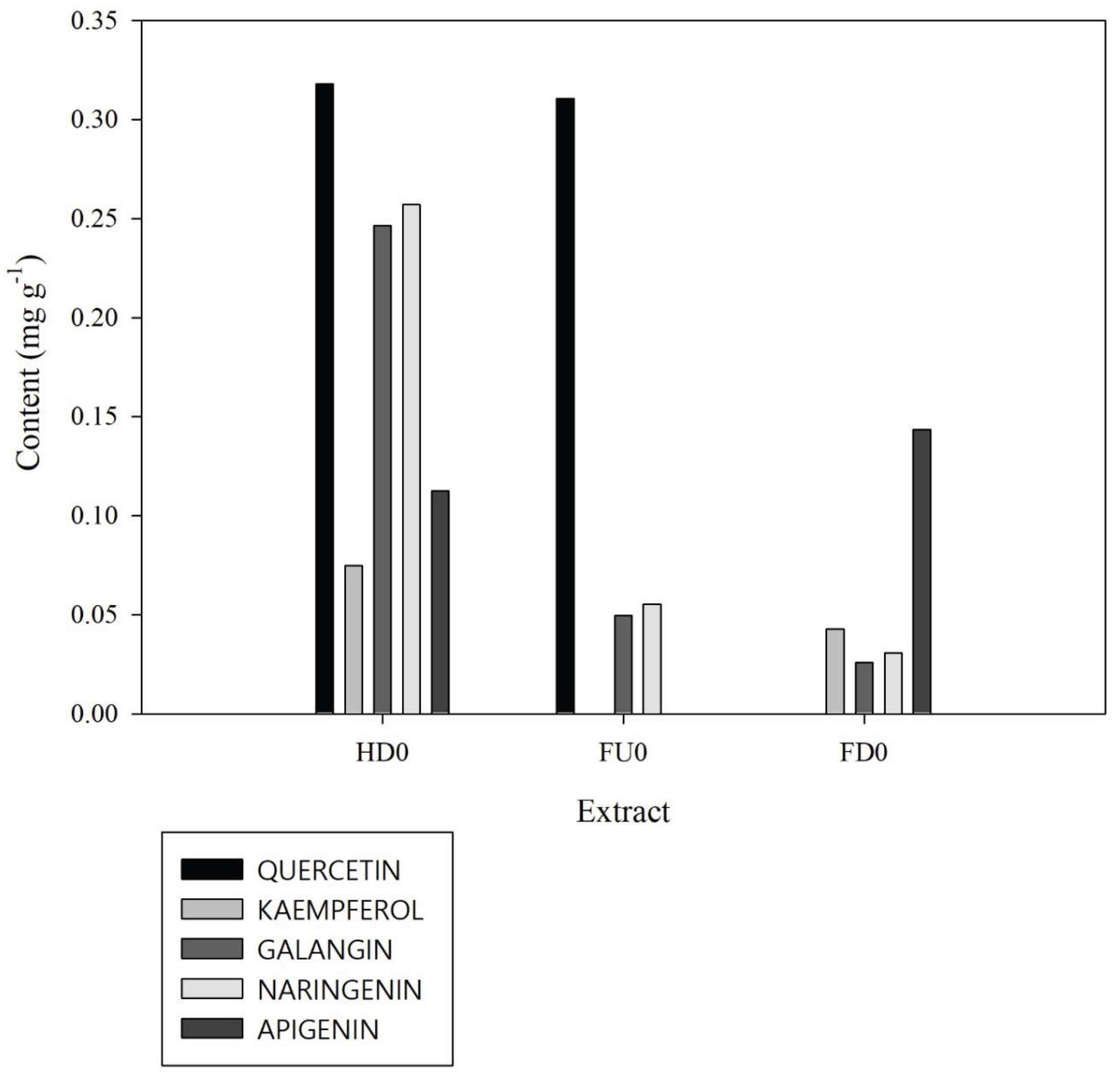
Figure 2.
Spatial Arrangement of Phytochemicals by Evaluated Extract (NMDS).
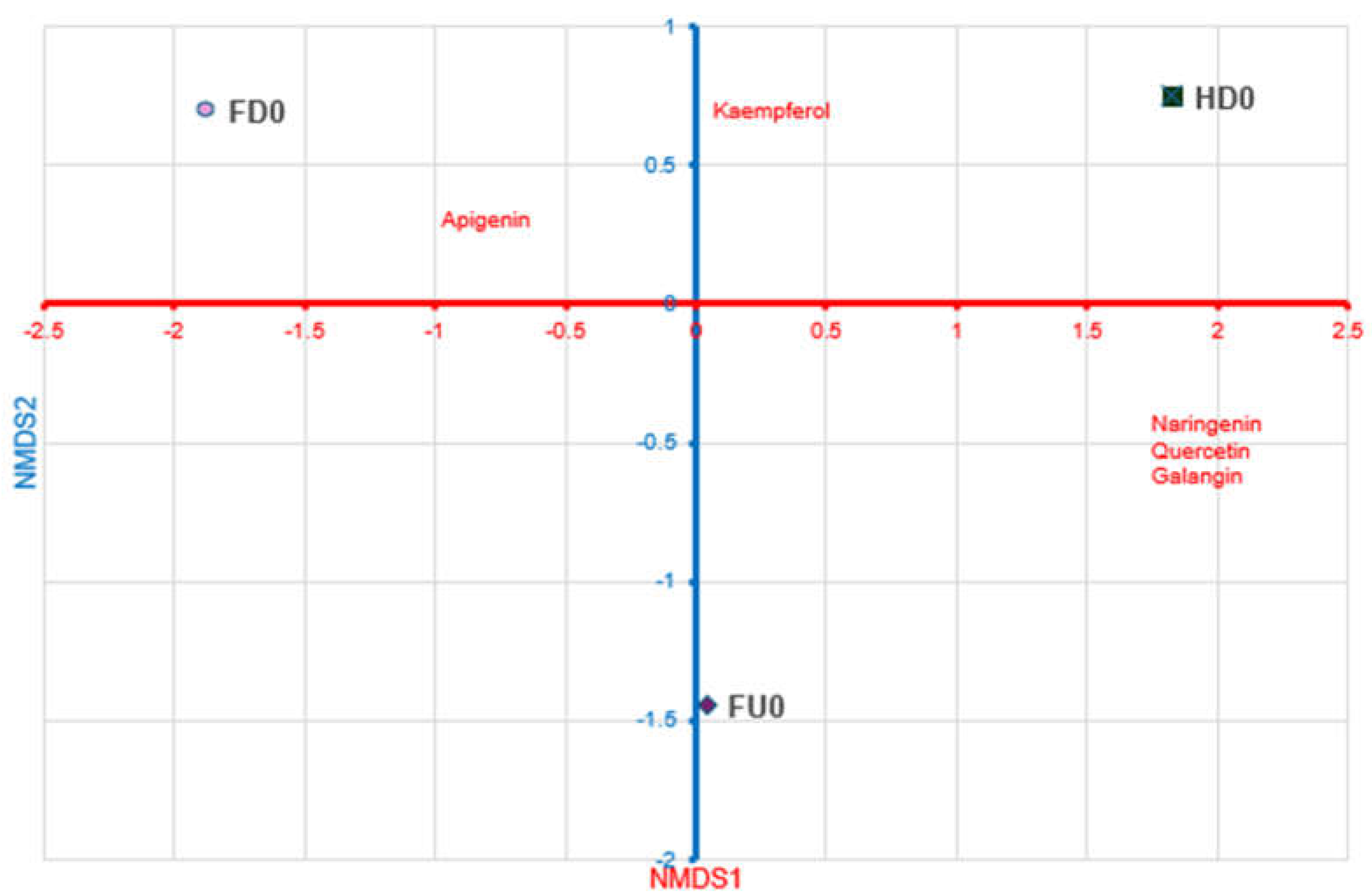
Table 1.
Phenolic compound profile in white onion (Allium cepa L.) residues (mg g-1).
| Extract | Apigenin | Galangin | Kaempferol | Naringenin | Quercetin |
|---|---|---|---|---|---|
| FD0 | 0.15±0.01a | 0.01±0.01b | 0.06±0.01ab | 0.02±0.01b | ND |
| FU0 | ND | 0.06±0.01ab | ND | 0.06±0.01ab | 0.27±0.03ab |
| HD0 | 0.11±0.00ab | 0.23±0.03a | 0.07±0.01a | 0.24±0.03a | 0.33±0.01a |
1 Values are expressed as mean ± standard deviation (n=3). Different letters within the same row indicate significant statistical differences according to the Kruskal-Wallis test and Dunn’s post-hoc test with Bonferroni adjustment (p < 0.05). ND: Not detected; HD0: Leaf decoction 0%; FU0: Flower ultrasound 0%; FD0: Flower decoction 0%.
Disclaimer/Publisher’s Note: The statements, opinions and data contained in all publications are solely those of the individual author(s) and contributor(s) and not of MDPI and/or the editor(s). MDPI and/or the editor(s) disclaim responsibility for any injury to people or property resulting from any ideas, methods, instructions or products referred to in the content. |
© 2026 by the authors. Licensee MDPI, Basel, Switzerland. This article is an open access article distributed under the terms and conditions of the Creative Commons Attribution (CC BY) license.
Copyright: This open access article is published under a Creative Commons CC BY 4.0 license, which permit the free download, distribution, and reuse, provided that the author and preprint are cited in any reuse.