

Submitted:
23 September 2026
Posted:
24 September 2026
You are already at the latest version
Abstract
Worldwide, consumption of ultra-processed foods (UPFs) is increasing in parallel with a rising incidence of obesity, type 2 diabetes, cardiovascular disease, kidney disease, and related cardiometabolic complications. Among the many features of UPFs that may drive these outcomes, industrial thermal processing is a defining characteristic that promotes the formation of advanced glycation end products (AGEs) and other food neo-contaminants, including acrylamide, furan, 5-hydroxymethylfurfural, heterocyclic amines, polycyclic aromatic hydrocarbons, 3-monochloropropane-1,2-diol, and glycidol. This review evaluates the hypothesis that AGEs and thermally generated neo-contaminants contribute significantly to the metabolic and toxicological effects of UPFs. After formation in food, these compounds may be partially absorbed in the gastrointestinal tract and act systemically, promoting tissue injury through protein cross-linking, oxidative stress, inflammation, endothelial dysfunction, and activation of the receptor for advanced glycation end products (RAGE). Several high-temperature neo-contaminants are linked to carcinogenicity, hepatotoxicity, neurotoxicity, and reproductive toxicity, while emerging evidence also implicates them in insulin resistance, adipogenesis, β-cell dysfunction, and cardiovascular risk. Overall, the evidence supports a biologically plausible link between thermal processing, AGE and neo-contaminant burden, and cardiometabolic disease, although the strength of evidence varies by compound. Improved exposure assessment, standardized analytical methods, mechanistic studies, and intervention trials are needed to define dose–response relationships and to determine whether reformulation and lower-temperature, moisture-rich cooking can reduce risk while maintaining food safety and acceptability.
Keywords:
AGEs
; neo-contaminants
; UPF
; cardiometabolic complications
1. Introduction
The incidence of diabetes and its cardiovascular, kidney, and metabolic complications—collectively recognized as cardiovascular-kidney-metabolic (CKM) syndrome—has risen markedly in recent years, paralleling a substantial increase in ultra-processed food (UPF) consumption [1,2,3]. Current data indicate that the United States and the United Kingdom have the highest levels of UPF intake, with such foods accounting for more than half of daily caloric intake; by contrast, countries with more traditional dietary patterns, such as Romania and Colombia, show some of the lowest levels of UPF consumption [4]. Despite strong epidemiological associations between UPF intake and adverse health outcomes, the specific factor or factors responsible for these harmful effects remain incompletely characterized.
A defining feature of many UPFs is the large-scale industrial use of thermal processing to enhance flavor, texture, microbiological safety, and shelf life. Although heat processing improves palatability, UPFs are also associated with increased appetite, excess energy intake, and the development of obesity [5]. Moreover, high-temperature processing creates conditions that favor the formation of AGEs and other neo-contaminants, including acrylamide, furan, 5-hydroxymethylfurfural, lipid oxidation products, and heterocyclic amines [6].
This review advances the hypothesis that AGEs and other thermally generated neo-contaminants are major contributors to the metabolic toxicity of UPFs, acting through pathways that promote oxidative stress, inflammation, insulin resistance, and tissue dysfunction. We synthesize current evidence on the formation, dietary exposure, and biological effects of these compounds and evaluate their relevance to metabolic disease risk in support of this hypothesis.
2. Dietary AGEs
2.1. Formation of AGEs in Food
AGEs arise mainly through the Maillard reaction, a non-enzymatic reaction between free amino groups and the carbonyl groups of reducing sugars; they also form through oxidative reactions involving sugars, lipids, and amino acids. Commonly measured and well-characterized AGEs include pentosidine, Nε-carboxymethyllysine (CML), Nε-carboxyethyllysine (CEL), and the methylglyoxal-derived MG-H1 [Nδ-(5-hydro-5-methyl-4-imidazolon-2-yl)-ornithine] [6]
CML is a prototypical AGE and one of the earliest identified glycoxidation products. It forms primarily when lysine residues react with glyoxal (GO), a highly reactive α-dicarbonyl generated during oxidative degradation of reducing sugars, advanced Maillard reactions, and autoxidation of Amadori products. Under high-temperature, low-moisture conditions, the ε-amino group of lysine reacts with glyoxal to produce stable CML adducts [7]. CML is also considered an advanced lipoxidation end product (ALE), reflecting its formation through lipid-derived pathways: peroxidation of polyunsaturated fatty acids generates reactive aldehydes, including glyoxal, which can produce CML independently of sugar availability. This pathway is especially relevant in fat-rich and ultra-processed foods, where lipid oxidation and Maillard chemistry often occur together [8]. Under glycoxidative conditions, Amadori products undergo metal-catalyzed oxidation, generating reactive dicarbonyls that further accelerate CML formation; this process links oxidative stress to AGE accumulation and helps explain why oxygen exposure during food processing and storage promotes CML generation [9].
CEL, another well-characterized AGE, is structurally related to CML but differs in precursor chemistry: it forms through the reaction of methylglyoxal (MGO) with the ε-amino group of lysine. Because MGO is more reactive than glyoxal, CEL formation is particularly relevant in carbohydrate-rich, thermally processed foods [10]. Methylglyoxal promotes post-translational modification of peptides and proteins, ultimately leading to AGEs including the arginine-derived hydroimidazolone MG-H1 and CEL [11]. CEL forms both in biological systems (in vivo) and during food processing (ex vivo). In the body, CEL generation is closely linked to intermediary metabolism, particularly under hyperglycemia or increased glycolytic flux, where MGO production is elevated—a process especially relevant in metabolic diseases such as diabetes mellitus, in which AGE accumulation contributes to tissue damage and chronic inflammation [12]. In processed foods, CEL formation also results from advanced Maillard reactions favored by high temperature and low moisture; during heating, degradation of sugars and lipids generates dicarbonyl compounds, including MGO, which react with food proteins to yield CEL and other AGEs [13]. Oxidative degradation of unsaturated fatty acids likewise generates MGO and related carbonyl species, reinforcing the interplay between Maillard chemistry and lipid oxidation in complex food systems; in experimental model systems, oxidized lipids markedly enhance CEL formation in protein-rich matrices [8].
2.2. Dietary Exposure to AGEs
Quantifying human exposure to dietary AGEs has advanced substantially over the past few decades, driven by the development of food composition databases and improvements in analytical chemistry. A foundational resource is the Uribarri et al. database [14], which catalogued AGE content in more than 500 foods prepared using diverse cooking methods. This database has enabled estimation of dietary AGE intake in both clinical and epidemiological studies and has been widely used to link high AGE intake to oxidative stress, inflammation, diabetes, and cardiovascular disease.
Despite its influence, the Uribarri database has important methodological constraints. AGE quantification relied primarily on immunochemical assays—particularly ELISA targeting CML—which capture only a narrow subset of the chemically diverse AGE family. Because AGEs encompass dozens of structurally distinct compounds formed through Maillard chemistry, lipid oxidation, and sugar degradation, reliance on a single marker likely underestimates total dietary exposure. Additional variability arises from differences in food preparation, moisture content, and thermal conditions, which can dramatically alter AGE formation yet are difficult to standardize across studies. The lack of standardization across analytical techniques, variability in preparation conditions, and the inherent difficulty of translating experimental measurements into real-world exposure estimates remain major challenges.
Recent advances have begun to address these limitations. The Glycation Database developed at Abertay University compiles thousands of analytically measured glycation compounds—including early Maillard intermediates, reactive dicarbonyls, and advanced AGEs—across a wide range of foods [15]. Parallel improvements in LC–MS/MS have markedly increased sensitivity and molecular specificity, enabling quantification of individual AGEs such as CML, CEL, and MG-H1, as well as their precursors. These technologies also allow examination of how processing variables—temperature, duration, pH, water activity, and oxygen exposure—influence AGE formation in real food systems [16].
Together, these developments highlight both progress and persistent uncertainty in estimating dietary AGE exposure. Although modern databases and mass spectrometry–based methods offer improved resolution, substantial challenges remain because of the complexity of food matrices and the dynamic nature of industrial processing. Consequently, dietary AGE estimates should be interpreted cautiously, particularly in epidemiological studies where exposure misclassification may obscure true associations with metabolic disease.
2.3. Transit of Food AGEs Through the Gastrointestinal Tract
Only a small fraction of food-derived AGEs is absorbed in the small intestine and reaches the circulation. Unabsorbed AGEs pass into the colon, where they may still exert systemic effects—either directly, by acting on the colonic wall to induce local inflammation, or indirectly, by interacting with the colonic microbiota to yield degradation products with or without harmful effects [6]. The influence of dietary AGEs on the colonic microbiota is an area of increasing interest [17].
2.4. Mechanisms of AGE-Induced Toxicity
AGEs exert pathogenic effects through two major mechanisms: direct biochemical modification of proteins, and activation of cellular signaling pathways via receptors such as RAGE (Figure 1). These complementary processes generate a self-amplifying cycle of oxidative stress, inflammation, and tissue dysfunction that is highly relevant to CKM syndrome [18].
1. Structural modification of proteins. AGEs irreversibly modify extracellular matrix proteins such as collagen and elastin, promoting cross-linking, stiffening, and loss of elasticity. These alterations impair vascular compliance, increase pulse-wave velocity, and contribute to hypertension and microvascular injury. AGE-mediated cross-linking also disrupts matrix turnover by reducing proteolytic susceptibility, accelerating the accumulation of dysfunctional matrix proteins in vascular, renal, and cardiac tissues. These changes are particularly pronounced for AGEs such as CML, CEL, and pentosidine, which accumulate under chronic hyperglycemia, oxidative stress, and high dietary AGE intake [19].
2. Activation of RAGE signaling. The second major mechanism involves binding of AGEs to RAGE, a multiligand pattern-recognition receptor expressed on endothelial cells, smooth muscle cells, immune cells, and adipocytes. Engagement of RAGE initiates a broad inflammatory and oxidative signaling program: AGE–RAGE interaction activates NADPH oxidase, driving reactive oxygen species (ROS) production, and stimulates transcription factors including NF-κB, MAPKs, and JAK/STAT [19,20]. Key downstream consequences include:
- Amplification of oxidative stress through NADPH oxidase activation and mitochondrial dysfunction
- NF-κB–driven inflammation, with increased expression of TNF-α, IL-6, IL-1β, VCAM-1, and ICAM-1
- Endothelial dysfunction via reduced nitric oxide bioavailability and eNOS uncoupling
- Enhanced leukocyte adhesion and vascular infiltration, promoting atherosclerotic plaque formation
- Positive-feedback upregulation of RAGE, sustaining chronic inflammatory activation
This self-reinforcing loop is central to the progression of vascular injury, insulin resistance, and metabolic dysfunction.
3. Metabolic consequences: insulin resistance and adipose dysfunction. AGE–RAGE signaling interferes with insulin receptor signaling by activating stress kinases (e.g., JNK, p38 MAPK) that inhibit IRS-1 phosphorylation and downstream PI3K–Akt signaling, leading to impaired glucose uptake, increased insulin resistance, and adipose tissue dysfunction. In adipose tissue, AGEs promote macrophage infiltration, reduce adiponectin secretion, and impair lipid handling, contributing to systemic insulin resistance and dyslipidemia [20].
4. An integrated toxicity model. Together, structural protein modification and RAGE-mediated signaling create a biochemical environment characterized by oxidative stress, chronic inflammation, endothelial dysfunction, and impaired metabolic regulation. These mechanisms provide a coherent framework linking high dietary AGE intake—particularly from UPFs—to the development and progression of diabetes, cardiovascular disease, kidney injury, and the broader CKM syndrome.
3. Food Neo-Contaminants Beyond AGEs
In addition to AGEs, thermal processing generates a diverse group of chemical contaminants—collectively termed neo-contaminants—that arise from Maillard chemistry, sugar dehydration, amino acid pyrolysis, and lipid oxidation. Neo-contaminants formed during cooking and industrial thermal processing include acrylamide, furan, 5-hydroxymethylfurfural (HMF), heterocyclic amines (HCAs), polycyclic aromatic hydrocarbons (PAHs), and chloropropanols such as 3-MCPD and glycidol. These compounds have traditionally been studied for carcinogenic potential, but accumulating evidence indicates that several also exert metabolic, endocrine, and inflammatory effects highly relevant to the toxicity profile of UPFs [21].
A unifying feature of these contaminants is their co-generation with Maillard-derived flavor compounds. Highly browned foods—fried snacks, roasted coffee, grilled meats—produce attractive aromas that activate reward pathways and may help explain the potentially addictive appeal of high-AGE, highly processed foods. This sensory reinforcement may amplify exposure to neo-contaminants while simultaneously driving excess caloric intake [22]. Figure 2 shows the chemical structures of several neo-contaminants of interest.
1. Acrylamide. Acrylamide forms predominantly through the Maillard reaction between asparagine and reducing sugars during high-temperature, low-moisture processing (>120 °C) [23]. It is classified as a probable human carcinogen, but its toxicological profile extends beyond carcinogenicity [24]. Acrylamide and its metabolite glycidamide induce oxidative stress, neurotoxicity, reproductive toxicity, and DNA adduct formation. Importantly, emerging evidence identifies acrylamide as a metabolic disruptor that promotes adipogenesis, dysregulates lipid and glucose metabolism, and exacerbates insulin resistance—effects that are particularly pronounced in individuals with diabetes [25]. These findings position acrylamide as a plausible obesogenic, linking UPF consumption to metabolic disease through endocrine-disrupting pathways [26].
2. Furan. Furan is a highly volatile compound generated from the thermal degradation of carbohydrates, amino acids, polyunsaturated lipids, carotenoids, and ascorbic acid. It is abundant in roasted coffee, jarred baby foods, canned products, and cereal-based snacks [27,28,29,30,31]. Classified as a possible human carcinogen, furan undergoes metabolic activation by CYP2E1 to form cis-2-butene-1,4-dial (BDA), a reactive electrophile that forms adduct with proteins and nucleic acids. Furan exposure induces hepatotoxicity, nephrotoxicity, oxidative stress, inflammation, and epigenetic alterations [32]. Margin-of-exposure analyses consistently indicate potential public health concern, especially for infants consuming thermally processed baby foods.
3. 5-Hydroxymethylfurfural (HMF). HMF arises from sugar dehydration and Maillard reactions in carbohydrate-rich foods such as baked goods, coffee, honey, fruit juices, and dairy products [33,34,35]. Although less acutely toxic than acrylamide or furan, HMF can convert to reactive derivatives—including chloromethylfurfural and sulfoxymethylfurfural—that exhibit mutagenic and cytotoxic properties. High HMF concentrations have been associated with mucosal irritation, oxidative stress, and potential contributions to neurodegenerative, cardiovascular, and metabolic disorders [33,34,35]. Notably, correlations between HMF and acrylamide levels in fried and baked foods suggest that HMF may serve as a practical indicator of acrylamide formation in industrial processing [36,37].
4. Heterocyclic amines (HCAs). HCAs form during high-temperature cooking of protein-rich foods, particularly meats and seafood, through reactions involving amino acids, creatine/creatinine, and sugars. They fall into two major categories [38]:
- Pyrolytic aminocarbolines (ACs), generated at >300 °C (grilling, roasting, frying)
- Amino-imidazo-azaarenes (AIAs), formed at 100–300 °C (pan-frying, baking)
Several HCAs—including MeIQx, PhIP, Glu-P-1, and IQ—are classified as Group 2A/2B carcinogens. Beyond mutagenicity, HCAs promote oxidative stress, inflammation, and endocrine disruption. Chronic exposure has been linked to colorectal, breast, and prostate cancer risk, and emerging evidence suggests that HCAs may impair metabolic homeostasis through mitochondrial stress and inflammatory signaling.
5. Polycyclic aromatic hydrocarbons (PAHs). PAHs form during incomplete combustion of organic matter, particularly in charred or smoked foods. Several PAHs (e.g., benzo[a]pyrene) are potent carcinogens and endocrine disruptors. Their lipophilicity facilitates bioaccumulation in adipose tissue, where they may contribute to chronic inflammation and metabolic dysfunction [39].
6. 3-MCPD and glycidol. Chloropropanols such as 3-monochloropropane-1,2-diol (3-MCPD) and glycidol form during high-temperature refining of vegetable oils and in baked or fried foods containing fats. Glycidol is highly genotoxic, forming DNA adducts and inducing heritable mutations. Both compounds impair reproductive function, disrupt steroidogenesis, and induce oxidative stress. Given the widespread use of refined oils in UPFs, chloropropanol exposure represents a significant and underappreciated metabolic risk [40].
Integrated Perspective
Although historically studied in isolation, these neo-contaminants share several mechanistic features with one another and with AGEs:
- Generation under industrial thermal conditions typical of UPFs
- Promotion of oxidative stress and inflammation
- Endocrine disruption and metabolic impairment
- Synergistic toxicity when multiple contaminants co-occur
- Coupling with reward-enhancing Maillard aromas that drive overconsumption
Collectively, these compounds form a chemical signature of UPFs that extends far beyond macronutrient composition. Their combined biological effects provide a compelling mechanistic framework linking UPF consumption to obesity, insulin resistance, diabetes, cardiovascular disease, and CKM syndrome [21].
4. Dietary AGEs and Food Neo-Contaminants as Determinants of UPF Toxicity
Food composition and processing are complex, and multiple mechanisms—acting independently or together—may explain the adverse effects of UPFs. AGE generation during industrial processing and home cooking satisfies several criteria implicating AGEs as major contributors to UPF toxicity [18]:
1. AGEs are generated in food during thermal treatment, whether industrial or domestic.
2. Specific food-derived AGEs, such as CML, are structurally and physiologically indistinguishable from their endogenous counterparts.
3. Specific AGEs, including CML, whether endogenous or exogenous, have been shown to injure multiple cell systems and tissues.
4. Oral administration of labeled AGE loads in humans demonstrates absorption into the circulation, with most eliminated in urine and some retained in the circulation and tissues.
5. AGE-enriched diets induce insulin resistance or type 2 diabetes in mouse models, whereas low-AGE diets prevent these outcomes [41,42].
6. Healthy human subjects consuming AGE-enriched diets show increased inflammatory and insulin-resistance markers [43].
7. Individuals with insulin resistance or type 2 diabetes who consume AGE-enriched diets show increased inflammatory and insulin-resistance markers, whereas low-AGE diets exert the opposite effect [44,45].
Taken together, the temporal relationship between AGE exposure and insulin resistance, along with their covariation, supports a plausible causal relationship.
Substantial evidence links AGEs with insulin resistance and diabetes. The food neo-contaminants discussed here have been most strongly associated with carcinogenicity and hepatotoxicity, whereas evidence for their metabolic effects is less consistent. Nevertheless, several of these compounds may contribute to insulin resistance, β-cell dysfunction, obesity, and ultimately type 2 diabetes. Because the strength of evidence varies considerably across compounds, compound-specific mechanistic and translational studies are needed.
In Table 1 we show Advanced glycation end product and neo-contaminants content in common UPF considering CML column from highest to lowest. Additionally heat map show harmonized concentrations (μg/kg ) of advanced glycation end products (CML and CEL) and neo-contaminants (acrylamide, furan, and 5-HMF). (Figure 3).
5. Strategies to Reduce Formation of AGEs and Other Neo-Contaminants During Processing and Cooking
5.1. Cooking Methods That Reduce AGE Formation
A substantial body of evidence indicates that dietary AGE exposure is influenced more strongly by cooking method than by the intrinsic composition of raw foods. This largely reflects activation of the Maillard reaction, a non-enzymatic process involving reducing sugars and proteins or lipids that depends strongly on heat, time, and moisture [14,46].
Dry-heat methods—grilling, baking, roasting, and frying—are consistently associated with markedly increased AGE formation. These techniques can raise AGE levels several-fold relative to raw foods, primarily because they involve high temperatures (>140 °C), low water activity, and enhanced lipid oxidation [14,47]. Under these conditions, well-characterized AGE compounds such as CML and MG-H1 form in substantial amounts, as elevated temperature and reduced moisture promote advanced stages of the Maillard reaction and accelerate protein modification and oxidative processes [16,47]. Frying is among the most potent promoters of AGE accumulation because high temperatures, lipid-rich environments, and prolonged cooking times enhance both glycation reactions and the formation of additional harmful compounds, including acrylamide [48]. Protein- and fat-rich foods, such as meats and cheeses, are especially susceptible to AGE formation during dry-heat cooking because of their high content of reactive amino groups and lipid-oxidation products [14].
Moist-heat methods—boiling, steaming, poaching, and low-temperature water-based cooking—are associated with substantially lower AGE formation, primarily because of lower temperatures (typically around 100 °C), higher moisture content, and reduced oxidative conditions (49). Water limits the Maillard reaction by diluting reactants and reducing thermal degradation, thereby inhibiting AGE formation; as a result, moist-heat methods generally produce substantially lower AGE concentrations than dry-heat techniques [46,49].
5.2. Emerging Technologies to Reduce AGEs in UPFs
Several emerging technologies for mitigating AGE formation in UPFs have been reported [21], including optimized thermal approaches such as low-temperature vacuum heating [50], vacuum microwave and infrared heating, and non-thermal technologies such as high-pressure processing [51], pulsed electric fields [52], ultrasound [53], and cold plasma [54]. These technologies reduce AGE formation by limiting thermal exposure, decreasing the accumulation of reactive carbonyl compounds, and reducing protein and lipid oxidation. Nanomaterials have also shown potential to reduce and control AGE generation [55]. Early work focused on metallic nanomaterials—including gold, silver, selenium, palladium, platinum, zinc oxide, and cadmium nanoparticles—which demonstrated effective AGE inhibition owing to their unique electronic structures and surface properties [56].
5.3. Exogenous Additives
Functional additives such as food gels are gaining attention for their ability to enhance the stability of bioactive compounds like polyphenols during processing, which may help reduce AGE formation [57,58]. Natural antioxidants have also shown potential to inhibit glycation pathways and scavenge reactive intermediates involved in AGE generation [59]. A recent review highlights encapsulated polyphenols and other bioactive-compound protection systems as promising strategies for reducing AGE formation during thermal processing [60]. However, few studies simulate AGE formation during thermal processing, and fewer still use real food systems. Wang et al. therefore suggested that future research incorporate high-temperature models—such as lysine–reducing sugar and arginine–reducing sugar systems—focusing on the stability of these additives and their inhibitory effects on AGEs [21].
5.4. Reversal of Glycation: Is It Possible?
AGEs have long been regarded as irreversible products of protein aging, but recent findings challenge this paradigm. Trabosh et al. demonstrated that CML can be enzymatically removed from proteins and aged human tissues using an engineered enzyme (CMLase), suggesting that at least some forms of glycation-derived protein damage may be reversible. Further studies are required to determine whether such molecular repair is feasible and whether it translates into functional recovery in vivo [61].
6. Conclusions
The available evidence supports the view that thermal processing contributes significantly to the adverse health profile of UPFs by promoting the formation of AGEs and multiple food neo-contaminants with inflammatory, oxidative, metabolic, and toxicological effects. Although the strength of evidence differs across compounds, the convergence of mechanistic, experimental, and human data suggests that reducing exposure to these processing-derived products may represent an important strategy for lowering cardiometabolic risk.
Future Directions. Future research should refine exposure assessment, identify the most biologically relevant compounds and food sources, clarify dose–response relationships, and evaluate whether practical changes in food processing, product formulation, and cooking practices can reduce AGE and neo-contaminant burden without compromising food safety, nutrition, or acceptability.
Author Contributions
M.E.G.-S., F.P. and J.U. conceived the review; M.E.G.-S., F.P. and J.U. wrote the draft and reviewed the final manuscript; M.E.G.-S., F.P. and J.U. have read and agreed to the latest version of the manuscript. All authors contributed to the design of the review, writing of the drafts and review of the final manuscript. All authors have read and agreed to the published version of the manuscript.
Funding
This research received no external funding.
Institutional Review Board Statement
Not applicable.
Informed Consent Statement
Not applicable.
Data Availability Statement
Not applicable.
Acknowledgments
The authors thank Reyna Rodríguez Mortera and Mario Ramón Espinoza Vargas for all the support provided and Manuel Alejandro González Hernández for the support in creating the heat map; from Departamento de Ciencias Médicas. Universidad de Guanajuato.
Conflicts of Interest
The authors declare no conflict of interest.
References
- Ong, K.L.; Stafford, L.K.; McLaughlin, S.A.; Boyko, E.J.; Vollset, S.E.; Smith, A.E.; Dalton, B.E.; Duprey, J.; Cruz, J.A.; Hagins, H.; et al. Global, Regional, and National Burden of Diabetes from 1990 to 2021, with Projections of Prevalence to 2050: A Systematic Analysis for the Global Burden of Disease Study 2021. Lancet 2023, 402, 203–234. [Google Scholar] [CrossRef] [PubMed]
- Khan, T.A.; Field, D.; Chen, V.; Ahmad, S.; Mejia, S.B.; Kahleováa, H.; Raheliác, D.; Salas-Salvadáo, J.; Leiter, L.A.; Uusitupa, M.; et al. Combination of Multiple Low-Risk Lifestyle Behaviors and Incident Type 2 Diabetes: A Systematic Review and Dose-Response Meta-Analysis of Prospective Cohort Studies. Diabetes Care 2023, 46, 643–656. [Google Scholar] [CrossRef] [PubMed]
- Chen, Z.; Khandpur, N.; Drouin-Chartier, J.P. Ultra-Processed Food Consumption and Risk of Type 2 Diabetes: Three Large Prospective U.S. Cohort Studies. Diabetes Care;Diabetes Care 2023, 46 47, 1335–1344 e24–e25. [Google Scholar] [CrossRef] [PubMed]
- Marino, M.; Puppo, F.; Del Bo’, C.; Vinelli, V.; Riso, P.; Porrini, M.; Martini, D. A Systematic Review of Worldwide Consumption of Ultra-Processed Foods: Findings and Criticisms. Nutrients 2021, 13. [Google Scholar] [CrossRef] [PubMed]
- Zhang, Q.; Wang, Y.; Fu, L. Dietary Advanced Glycation End-Products: Perspectives Linking Food Processing with Health Implications. Compr. Rev. Food Sci. Food Saf. 2020, 19, 2559–2587. [Google Scholar] [CrossRef] [PubMed]
- Garay-Sevilla, M.E.; Beeri, M.S.; De La Maza, M.P.; Rojas, A.; Salazar-Villanea, S.; Uribarri, J. The Potential Role of Dietary Advanced Glycation Endproducts in the Development of Chronic Non-Infectious Diseases: A Narrative Review. Nutr. Res. Rev. 2020, 33, 298–311. [Google Scholar] [CrossRef] [PubMed]
- Park, H.Y.; Oh, M.J.; Park, Y.; Kim, Y. N ε-(Carboxymethyl)Lysine Formation from the Maillard Reaction of Casein and Different Reducing Sugars. Food Sci. Biotechnol. 2020, 29, 487–491. [Google Scholar] [CrossRef] [PubMed]
- Yu, L.; He, Z.; Zeng, M.; Zheng, Z.; He, J.; Wang, M.; Chen, J. Effects of Oxidised Linoleic Acid on the Formation of Nε-Carboxymethyl-Lysine and Nε-Carboxyethyl-Lysine in Maillard Reaction System. Int. J. Food Sci. Technol. 2016, 51, 742–752. [Google Scholar] [CrossRef]
- Delgado-Andrade, C. Carboxymethyl-Lysine: Thirty Years of Investigation in the Field of AGE Formation. Food Funct. 2016, 7, 46–57. [Google Scholar] [CrossRef] [PubMed]
- Schalkwijk, C.G.; Stehouwer, C.D.A. Methylglyoxal, a Highly Reactive Dicarbonyl Compound, in Diabetes, Its Vascular Complications, and Other Age-Related Diseases. Physiol. Rev. 2020, 100, 407–461. [Google Scholar] [CrossRef] [PubMed]
- Rabbani, N.; Xue, M.; Thornalley, P.J. Dicarbonyl Stress, Protein Glycation and the Unfolded Protein Response. Glycoconj. J. 2021, 38, 331–340. [Google Scholar] [CrossRef] [PubMed]
- Oliveira, A.L.; de Oliveira, M.G.; Mónica, F.Z.; Antunes, E. Methylglyoxal and Advanced Glycation End Products (AGEs): Targets for the Prevention and Treatment of Diabetes-Associated Bladder Dysfunction? Biomedicines 2024, 12. [Google Scholar] [CrossRef] [PubMed]
- Zhou, P.; Dong, S.; Zeng, M. Formation of Nε-Carboxymethyl-Lysine and Nε-Carboxyethyl-Lysine in Pacific Oyster (Crassostrea Gigas) Induced by Thermal Processing Methods. Front. Nutr. 2022, 9, 1–11. [Google Scholar] [CrossRef] [PubMed]
- Uribarri, J.; Woodruff, S.; Goodman, S.; Cai, W.; Chen, X.; Pyzik, R.; Yong, A.; Striker, G.E.; Vlassara, H. Advanced Glycation End Products in Foods and a Practical Guide to Their Reduction in the Diet. J. Am. Diet. Assoc. 2010, 110, 911–916.e12. [Google Scholar] [CrossRef] [PubMed]
- Boiko, A.; Fiore, A.; Hay, A.; Troise, A. D.; De Pascale, S.; Scaloni, A.; Schalkwijk, C.; Fogliano, V.; Foerster, A.; Henle, T. The Glycation Database: From the Maillard Reaction in Foods to Biomolecular Insight.Data Set/Database. Abertay University. Available online: https://rke.abertay.ac.uk/en/publications/the-glycation-database-from-the-maillard-reaction-in-foods-to-bio/ (accessed on 7 September 2026).
- Chen, G. Dietary N-Epsilon-Carboxymethyllysine as for a Major Glycotoxin in Foods: A Review. Compr. Rev. Food Sci. Food Saf. 2021, 20, 4931–4949. [Google Scholar] [CrossRef] [PubMed]
- Qiang, X.; Wang, X.; Liang, S.; Li, S.; Lv, Y.; Zhan, J. Long-Term Effects of Nε-Carboxymethyllysine Intake on Intestinal Barrier Permeability: Associations with Gut Microbiota and Bile Acids. Food Res. Int. 2025, 201, 115543. [Google Scholar] [CrossRef] [PubMed]
- Uribarri, Jaime; Katherine, R. TuttleMaciste Habacuc Dietary Advanced Glycation End Products and Cardiovascular-Kidney-Metabolic Complications. CJASN 2026, 21, 332–345. [Google Scholar] [CrossRef] [PubMed]
- Senatus, L.M.; Schmidt, A.M. The AGE-RAGE Axis: Implications for Age-Associated Arterial Diseases. Front. Genet. 2017, 8, 1–10. [Google Scholar] [CrossRef] [PubMed]
- Rojas, A.; Lindner, C.; Schneider, I.; Gonzalez, I.; Uribarri, J. The RAGE Axis: A Relevant Inflammatory Hub in Human Diseases. Biomolecules 2024, 14, 1–24. [Google Scholar] [CrossRef] [PubMed]
- Wang, S.; Zheng, X.; Yang, Y.; Zheng, L.; Xiao, D.; Ai, B.; Sheng, Z. Emerging Technologies in Reducing Dietary Advanced Glycation End Products in Ultra-Processed Foods: Formation, Health Risks, and Innovative Mitigation Strategies. Compr. Rev. Food Sci. Food Saf. JOURNAL:JOURNAL:15414337;WGROUP:STRING:PUBLICATION. 2025, 24, e70130. [Google Scholar] [CrossRef] [PubMed]
- El Hosry, L.; Elias, V.; Chamoun, V.; Halawi, M.; Cayot, P.; Nehme, A.; Bou-Maroun, E. Maillard Reaction: Mechanism, Influencing Parameters, Advantages, Disadvantages, and Food Industrial Applications: A Review. Foods 2025, 14, 1–43. [Google Scholar] [CrossRef] [PubMed]
- Mottram, D.S.; Wedzicha, B.L.; Dodson, A.T. Acrylamide Is Formed in the Maillard Reaction. Nat. 2002 4196906 2002, 419, 448–449. [Google Scholar] [CrossRef] [PubMed]
- Halford, N.G.; Muttucumaru, N.; Powers, S.J.; Gillatt, P.N.; Hartley, L.; Elmore, J.S.; Mottram, D.S. Concentrations of Free Amino Acids and Sugars in Nine Potato Varieties: Effects of Storage and Relationship with Acrylamide Formation. J. Agric. Food Chem. 2012, 60, 12044–12055. [Google Scholar] [CrossRef] [PubMed]
- Törős, G.; Alibrahem, W.; Kharrat Helu, N.; Jevcsák, S.; Ferroudj, A.; Prokisch, J. Acrylamide in Food: From Maillard Reaction to Public Health Concern. Toxics 2026, 14, 1–23. [Google Scholar] [CrossRef] [PubMed]
- Buyukdere, Y.; Akyol, A. From a Toxin to an Obesogen: A Review of Potential Obesogenic Roles of Acrylamide with a Mechanistic Approach. Nutr. Rev. 2024, 82, 128–142. [Google Scholar] [CrossRef] [PubMed]
- Becalski, A.; Seaman, S. Furan Precursors in Food: A Model Study and Development of a Simple Headspace Method for Determination of Furan. J. AOAC Int. 2005, 88, 102–106. [Google Scholar] [CrossRef]
- Fan, X. Formation of Furan from Carbohydrates and Ascorbic Acid Following Exposure to Ionizing Radiation and Thermal Processing. J. Agric. Food Chem. 2005, 53, 7826–7831. [Google Scholar] [CrossRef] [PubMed]
- Limacher, A.; Kerler, J.; Conde-Petit, B.; Blank, I. Formation of Furan and Methylfuran from Ascorbic Acid in Model Systems and Food. Food Addit. Contam. 2007, 24, 122–135. [Google Scholar] [CrossRef] [PubMed]
- Limacher, A.; Kerler, J.; Davidek, T.; Schmalzried, F.; Blank, I. Formation of Furan and Methylfuran by Maillard-Type Reactions in Model Systems and Food. J. Agric. Food Chem. 2008, 56, 3639–3647. [Google Scholar] [CrossRef] [PubMed]
- Perez Locas, C.; Yaylayan, V.A. Origin and Mechanistic Pathways of Formation of the Parent Furan - A Food Toxicant. J. Agric. Food Chem. 2004, 52, 6830–6836. [Google Scholar] [CrossRef] [PubMed]
- Zhang, Y.; Zhang, Y. A Comprehensive Review of Furan in Foods: From Dietary Exposures and in Vivo Metabolism to Mitigation Measures. Compr. Rev. Food Sci. Food Saf. CTYPE:STRING:JOURNAL. 2023, 22, 809–841. [Google Scholar] [CrossRef] [PubMed]
- Capuano, E.; Fogliano, V. Acrylamide and 5-Hydroxymethylfurfural (HMF): A Review on Metabolism, Toxicity, Occurrence in Food and Mitigation Strategies. Lwt 2011, 44, 793–810. [Google Scholar] [CrossRef]
- Martins, F.C.O.L.; Alcantara, G.M.R.N.; Silva, A.F.S.; Melchert, W.R.; Rocha, F.R.P. The Role of 5-Hydroxymethylfurfural in Food and Recent Advances in Analytical Methods. Food Chem. 2022, 395. [Google Scholar] [CrossRef] [PubMed]
- Lee, C.H.; Chen, K.T.; Lin, J.A.; Chen, Y.T.; Chen, Y.A.; Wu, J.T.; Hsieh, C.W. Recent Advances in Processing Technology to Reduce 5-Hydroxymethylfurfural in Foods. Trends Food Sci. Technol. 2019, 93, 271–280. [Google Scholar] [CrossRef]
- Pedreschi, F.; Ferrera, A.; Bunger, A.; Alvarez, F.; Huamán-Castilla, N.L.; Mariotti-Celis, M.S. Ultrasonic-Assisted Leaching of Glucose and Fructose as an Alternative Mitigation Technology of Acrylamide and 5- Hydroxymethylfurfural in Potato Chips. Innov. Food Sci. Emerg. Technol. 2021, 73, 1–8. [Google Scholar] [CrossRef]
- Miao, Y.T.; Zhang, H.J.; Zhang, L.L.; Wu, S.J.; Sun, Y.J.; Shan, Y.; Yuan, Y. Acrylamide and 5-Hydroxymethylfurfural Formation in Reconstituted Potato Chips during Frying. J. Food Sci. Technol. 2014, 51, 4005–4011. [Google Scholar] [CrossRef] [PubMed]
- Batool, Z.; Singla, R.K.; Ullah, A.; Ahmed, S.; Shen, B. A Comprehensive Review on Dietary Heterocyclic Amines as Potential Carcinogens: From Formation to Cancer Incidence. Food Chem. 2025, 488, 144874. [Google Scholar] [CrossRef] [PubMed]
- Bansal, V.; Kim, K.H. Review of PAH Contamination in Food Products and Their Health Hazards. Environ. Int. 2015, 84, 26–38. [Google Scholar] [CrossRef] [PubMed]
- Yabani, D.S.; Ofosu, I.W.; Ankar-Brewoo, G.M.; Lutterodt, H.E. Toxicity of Dietary Exposure to 3-Monochloropropanediol, Glycidol, and Their Fatty Acid Esters. J. Food Qual. 2024. [Google Scholar] [CrossRef]
- Hofmann, S.M.; Dong, H.J.; Li, Z.; Cai, W.; Altomonte, J.; Thung, S.N.; Zeng, F.; Fisher, E.A.; Vlassara, H. Improved Insulin Sensitivity Is Associated with Restricted Intake of Dietary Glycoxidation Products in the Db/Db Mouse. Diabetes 2002, 51, 2082–2089. [Google Scholar] [CrossRef] [PubMed]
- Peppa, M.; He, C.; Hattori, M.; McEvoy, R.; Zheng, F.; Vlassara, H. Fetal or Neonatal Low-Glycotoxin Environment Prevents Autoimmune Diabetes in NOD Mice. Diabetes 2003, 52, 1441–1448. [Google Scholar] [CrossRef] [PubMed]
- Vlassara, H.; Cai, W.; Goodman, S.; Pyzik, R.; Yong, A.; Chen, X.; Zhu, L.; Neade, T.; Beeri, M.; Silverman, J.M.; et al. Protection against Loss of Innate Defenses in Adulthood by Low Advanced Glycation End Products (AGE) Intake: Role of the Antiinflammatory Age Receptor-1. J. Clin. Endocrinol. Metab. 2009, 94, 4483–4491. [Google Scholar] [CrossRef] [PubMed]
- Uribarri, J.; Cai, W.; Ramdas, M.; Goodman, S.; Pyzik, R.; Xue, C.; Li, Z.; Striker, G.E.; Vlassara, H. Restriction of Advanced Glycation End Products Improves Insulin Resistance in Human Type 2 Diabetes: Potential Role of AGER1 and SIRT1. Diabetes Care 2011, 34, 1610–1616. [Google Scholar] [CrossRef] [PubMed]
- Vlassara, H.; Cai, W.; Tripp, E.; Pyzik, R.; Yee, K.; Goldberg, L.; Tansman, L.; Chen, X.; Mani, V.; Fayad, Z.A.; et al. Oral AGE Restriction Ameliorates Insulin Resistance in Obese Individuals with the Metabolic Syndrome: A Randomised Controlled Trial. Diabetologia 2016, 59, 2181–2192. [Google Scholar] [CrossRef] [PubMed]
- Poulsen, M.W.; Hedegaard, R. V.; Andersen, J.M.; de Courten, B.; Bügel, S.; Nielsen, J.; Skibsted, L.H.; Dragsted, L.O. Advanced Glycation Endproducts in Food and Their Effects on Health. Food Chem. Toxicol. 2013, 60, 10–37. [Google Scholar] [CrossRef] [PubMed]
- Inan-Eroglu, E.; Ayaz, A.; Buyuktuncer, Z. Formation of Advanced Glycation Endproducts in Foods during Cooking Process and Underlying Mechanisms: A Comprehensive Review of Experimental Studies. Nutr. Res. Rev. 2020, 33, 77–89. [Google Scholar] [CrossRef] [PubMed]
- Rasool, A.; Luo, X.; Zhang, Q.; Jia, C.; Zhao, S.; Liu, R.; Rong, J.; Zhou, G.; Wang, B.; Kuai, J.; et al. Acrylamide and Advanced Glycation End Products in Frying Food: Formation, Effects, and Harmfulness. Foods 2025, 14, 1–24. [Google Scholar] [CrossRef] [PubMed]
- Wellens, J.; Vissers, E.; Dumoulin, A.; Hoekx, S.; Vanderstappen, J.; Verbeke, J.; Vangoitsenhoven, R.; Derrien, M.; Verstockt, B.; Ferrante, M.; et al. Cooking Methods Affect Advanced Glycation End Products and Lipid Profiles: A Randomized Cross-over Study in Healthy Subjects. Cell Rep. Med. 2025, 6. [Google Scholar] [CrossRef] [PubMed]
- Wei, J.; Chen, Y.; Dong, X.; He, F.; Shi, Y.; Chai, T. Water Holding Capacity and Microstructure of Sturgeon (Acipenser Gueldenstaedti) Fillets as Affected by Low Temperature Vacuum Heating. Int. J. Food Prop. 2021, 24, 1061–1073. [Google Scholar] [CrossRef]
- Amsasekar, A.; Mor, R.S.; Kishore, A.; Singh, A.; Sid, S. Impact of High Pressure Processing on Microbiological, Nutritional and Sensory Properties of Food: A Review. Nutr. Food Sci. 2022, 52, 996–1017. [Google Scholar] [CrossRef]
- Su, W.; Wang, Q.; Li, J.; Qiu, Z.; Qiu, Y. Effects of Pulsed Electric Field Technology on the Nutritional Value and Biological Function of Plant Food. Front. Sustain. Food Syst. 2024, 8, 1–9. [Google Scholar] [CrossRef]
- Antunes-Rohling, A.; Ciudad-Hidalgo, S.; Mir-Bel, J.; Raso, J.; Cebrián, G.; Álvarez, I. Ultrasound as a Pretreatment to Reduce Acrylamide Formation in Fried Potatoes. Innov. Food Sci. Emerg. Technol. 2018, 49, 158–169. [Google Scholar] [CrossRef]
- Barbhuiya, R.I.; Singha, P.; Singh, S.K. A Comprehensive Review on Impact of Non-Thermal Processing on the Structural Changes of Food Components. Food Res. Int. 2021, 149, 110647. [Google Scholar] [CrossRef] [PubMed]
- Onyeaka, H.; Passaretti, P.; Miri, T.; Al-Sharify, Z.T. The Safety of Nanomaterials in Food Production and Packaging. Curr. Res. Food Sci. 2022, 5, 763–774. [Google Scholar] [CrossRef] [PubMed]
- Peron, S.; Hadi, F.; Azarbani, F.; Ananda Murthy, H.C. Antimicrobial, Antioxidant, Anti-Glycation and Toxicity Studies on Silver Nanoparticles Synthesized Using Rosa Damascena Flower Extract. Green Chem. Lett. Rev. 2021, 14, 518–532. [Google Scholar] [CrossRef]
- Banerjee, S.; Bhattacharya, S. Food Gels: Gelling Process and New Applications. Crit. Rev. Food Sci. Nutr. 2012, 52, 334–346. [Google Scholar] [CrossRef] [PubMed]
- Jie, C.; Yue, G.; Die, Z. Starch-Based Gels as Polyphenol Delivery Systems: From Design to Food Application. Food Sci. 2024, 45, 307–316. [Google Scholar] [CrossRef]
- Zhang, S.; Li, X.; Zheng, L.; Zheng, X.; Yang, Y.; Xiao, D.; Ai, B.; Sheng, Z. Encapsulation of Phenolics in β-Lactoglobulin: Stability, Antioxidant Activity, and Inhibition of Advanced Glycation End Products. Lwt 2022, 162, 113437. [Google Scholar] [CrossRef]
- Patel, S.S.; Bains, A.; Sharma, M.; Kumar, A.; Stephen Inbaraj, B.; Chawla, P.; Sridhar, K. Recent Trends in Advanced Glycation End Products in Foods: Formation, Toxicity, and Innovative Strategies for Extraction, Detection, and Inhibition. Foods 2024, 13, 1–21. [Google Scholar] [CrossRef] [PubMed]
- Trabosh, N.; Smith, J.; Hsu, M.Y.H.; Panja, S.; Nagaraj, R.; Olsson, N.; McAllister, F.E.; Cravens, A. Reversal of Protein Chemical Aging by Enzymatic Deglycation. Nat. Commun. 2026, 17. [Google Scholar] [CrossRef] [PubMed]
- Yu, L.; Li, Y.; Gao, C.; Yang, Y.; Zeng, M.; Chen, J. Nε-Carboxymethyl-Lysine and Nε-Carboxyethyl-Lysine Contents in Commercial Meat Products. Food Res. Int. 2022, 155, 111048. [Google Scholar] [CrossRef] [PubMed]
- Tareke, E.; Rydberg, P.; Karlsson, P.; Eriksson, S.; Törnqvist, M. Analysis of Acrylamide, a Carcinogen Formed in Heated Foodstuffs. J. Agric. Food Chem. 2002, 50, 4998–5006. [Google Scholar] [CrossRef] [PubMed]
- Anese, M.; Manzocco, L.; Calligaris, S.; Nicoli, M.C. Industrially Applicable Strategies for Mitigating Acrylamide, Furan, and 5-Hydroxymethylfurfural in Food. J. Agric. Food Chem. 2013, 61, 10209–10214. [Google Scholar] [CrossRef] [PubMed]
- Xie, Y.; van der Fels-Klerx, H.J.; van Leeuwen, S.P.J.; Fogliano, V. Dietary Advanced Glycation End-Products, 2-Monochloropropane-1,3-Diol Esters and 3-Monochloropropane-1,2-Diol Esters and Glycidyl Esters in Infant Formulas: Occurrence, Formulation and Processing Effects, Mitigation Strategies. Compr. Rev. Food Sci. Food Saf. 2021, 20, 5489–5515. [Google Scholar] [CrossRef] [PubMed]
- Méndez-Alvarado, X.Y.; González-Tello, M.M.E.; Chávez-Servín, J.L.; de la Torre-Carbot, K.; García-Gasca, T.; Rangel-Peniche, D.B.; Ferriz-Martínez, R.A. Occurrence of 5-Hydroxymethylfurfural, Acrylamide, 3-Monochloro-1,2-Propanoldiol and Melamine in Infant Formulas: What Do We Know About These Compounds? Toxics 2025, 13. [Google Scholar] [CrossRef] [PubMed]
- Niquet-Léridon, C.; Tessier, F.J. Quantification of Nε-Carboxymethyl-Lysine in Selected Chocolate-Flavoured Drink Mixes Using High-Performance Liquid Chromatography-Linear Ion Trap Tandem Mass Spectrometry. Food Chem. 2011, 126, 655–663. [Google Scholar] [CrossRef]
- Delgado-Andrade, C.; Morales, F.J.; Mesías, M. Acrylamide and HMF Occurrence and Bioaccessibility in Instant Coffee and Coffee Substitutes. A Study on Isolated and Milk-Combined Beverages. Food Res. Int. 2024, 194, 114886. [Google Scholar] [CrossRef] [PubMed]
- Lachenmeier, D.W.; Schwarz, S.; Teipel, J.; Hegmanns, M.; Kuballa, T.; Walch, S.G.; Breitling-Utzmann, C.M. Potential Antagonistic Effects of Acrylamide Mitigation during Coffee Roasting on Furfuryl Alcohol, Furan and 5-Hydroxymethylfurfural. Toxics 2019, 7, 1–13. [Google Scholar] [CrossRef] [PubMed]
- Zhu, Z.; Fang, R.; Cheng, Y.; Khan, I.A.; Huang, J.; Li, B.; Huang, M. Content of Free and Protein-Binding Nε-Carboxymethyllysine and Nε-Carboxyethyllysine in Different Parts of Braised Chicken. Food Sci. Nutr. 2020, 8, 767–776. [Google Scholar] [CrossRef] [PubMed]
- Jost, T.; Henning, C.; Heymann, T.; Glomb, M.A. Comprehensive Analyses of Carbohydrates, 1,2-Dicarbonyl, and Advanced Glycation End Products in Industrial Bread. J. Agric. Food Chem. 2021, 69, 3720–3731. [Google Scholar] [CrossRef] [PubMed]
- Food, E.C.P. (EFSA P. on C. in the F.C. Scientific Opinion on Acrylamide in Food. EFSA J. 2015, 13. [Google Scholar] [CrossRef]
- Lemos, A.C.; de Borba, V.S.; Cerqueira, M.B.R.; Pereira, A.M.; Scaglioni, P.T.; Badiale-Furlong, E. White and Wholewheat Bread Consumption and the Risk of Exposure to Acrylamide and 5-Hydroxymethylfurfural. Food Chem. 2024, 460, 140662. [Google Scholar] [CrossRef] [PubMed]
- Žilić, S.; Aktağ, I.G.; Dodig, D.; Gökmen, V. Investigations on the Formation of Maillard Reaction Products in Sweet Cookies Made of Different Cereals. Food Res. Int. 2021, 144. [Google Scholar] [CrossRef] [PubMed]
- Roldán, M.; Mesias, M.; Morales, F.J. Balancing Nutrition and Safety: Acrylamide and HMF in Biscuits from Different Cereal Flours. Food Chem. X 2026, 34. [Google Scholar] [CrossRef] [PubMed]
- New EU Recommendation on Monitoring the Presence of Furan and Alkylfurans in Food - Mérieux NutriSciences. Available online: https://www.merieuxnutrisciences.com/regulation-methylfurans/ (accessed on 8 September 2026).
- Zhang, Y.; Cocklin, R.R.; Bidasee, K.R.; Wang, M. Rapid Determination of Advanced Glycation End Products of Proteins Using MALDI-TOF-MS and PERL Script Peptide Searching Algorithm. J. Biomol. Tech. 2003, 14, 224–230. [Google Scholar] [PubMed]
- Hull, G.L.J.; Woodside, J. V.; Ames, J.M.; Cuskelly, G.J. N*-(Carboxymethyl)Lysine Content of Foods Commonly Consumed in a Western Style Diet. Food Chem. 2012, 131, 170–174. [Google Scholar] [CrossRef]
- Verma, V.; Singh, Z.; Yadav, N. Effective Method of Minimizing the Acrylamide and 5-Hydroxymethylfurfural Formation in French Fries by Lactic Acid Fermentation. J. Food Meas. Charact. 2022, 16, 5032–5043. [Google Scholar] [CrossRef]
- Mesías, M.; Holgado, F.; Morales, F.J. Formation of Process Contaminants in Commercial and Homemade Deep-Fried Breadcrumbs. Food Res. Int. 2023, 164, 112357. [Google Scholar] [CrossRef] [PubMed]
Figure 1.
Biological actions of AGEs.Figure 1 illustrates the two main biological actions of Advanced Glycation End Products (AGEs). AGEs, represented as orange ovals, can follow two pathways, either binding to receptors on the cell membrane (RAGE) or modifying directly proteins leading to crosslinking and loss of normal protein function. The upper arrow shows binding to RAGE (purple structure) that initiates intracellular signaling: activating NADPH oxidase, which increases the production of ROS (reactive oxygen species) and also activating NF-κB, a key transcription factor involved in inflammation. NF-κB, in turn, stimulates the expression of pro-inflammatory genes, leading to the production of inflammatory cytokines. The release out of the cell of inflammatory cytokines and ROS, which may act locally or systemically, can initiate a vicious cycle of inflammation and oxidative stress. Protein crosslinking is shown here modifying proteins outside the cell, but AGEs can also modify intracellular proteins.
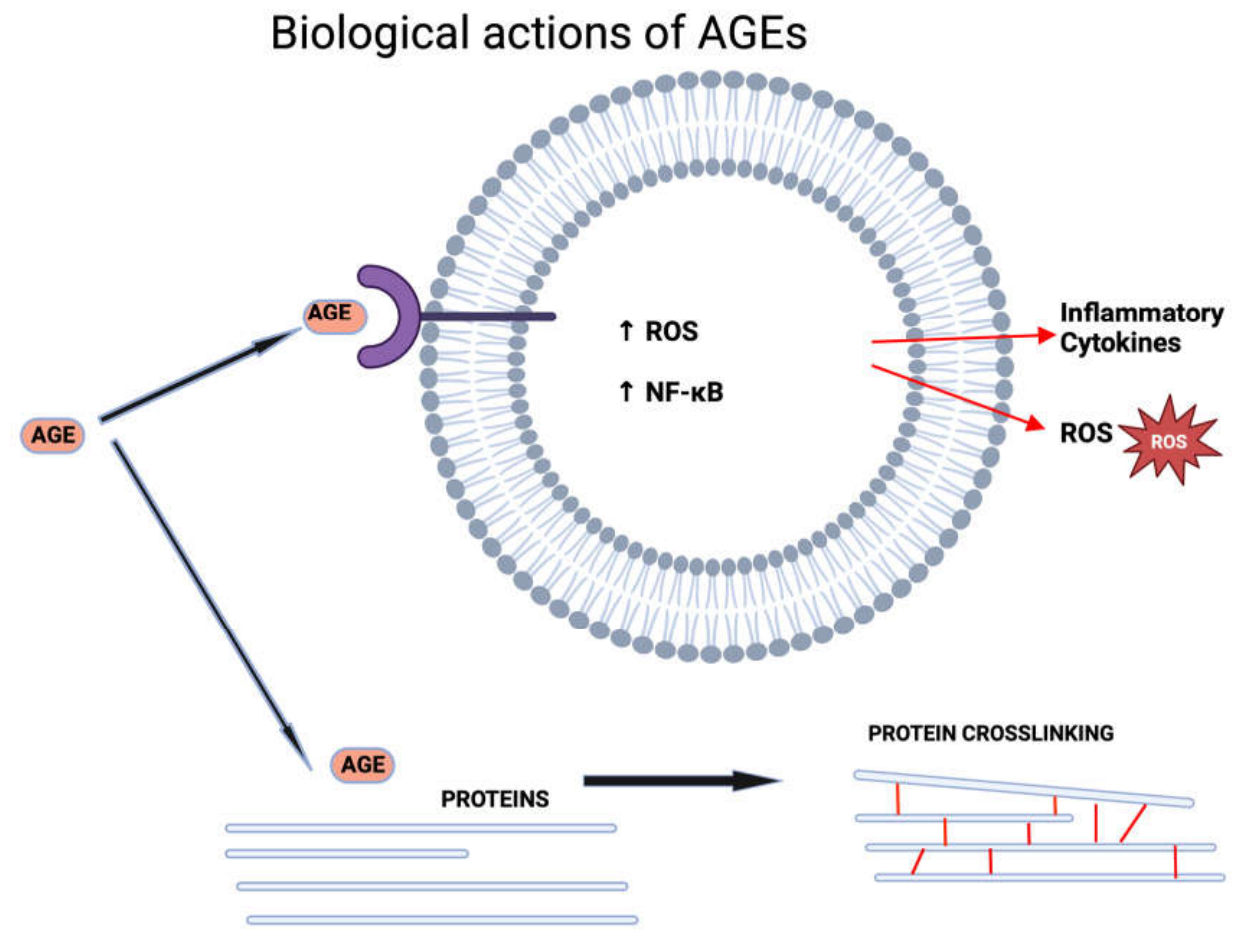
Figure 2.
Chemical structures of several neo-contaminants of interest found in ultra-processed foods: (i) Acrylamide; (ii) Furan; (iii) 5-hydroxymethylfurfural; (iv) Heterocyclic amines; (v) Polycyclic aromatic hydrocarbons; (vi) 3-monochloropropane-1,2-diol; (vii) Glycidol.
Figure 2.
Chemical structures of several neo-contaminants of interest found in ultra-processed foods: (i) Acrylamide; (ii) Furan; (iii) 5-hydroxymethylfurfural; (iv) Heterocyclic amines; (v) Polycyclic aromatic hydrocarbons; (vi) 3-monochloropropane-1,2-diol; (vii) Glycidol.
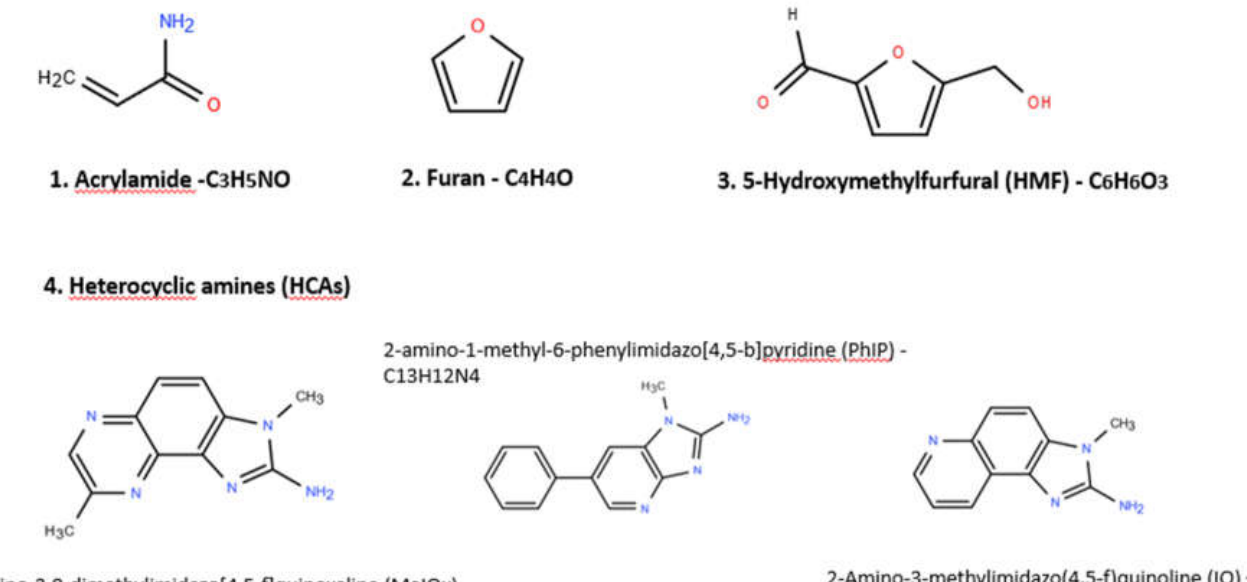
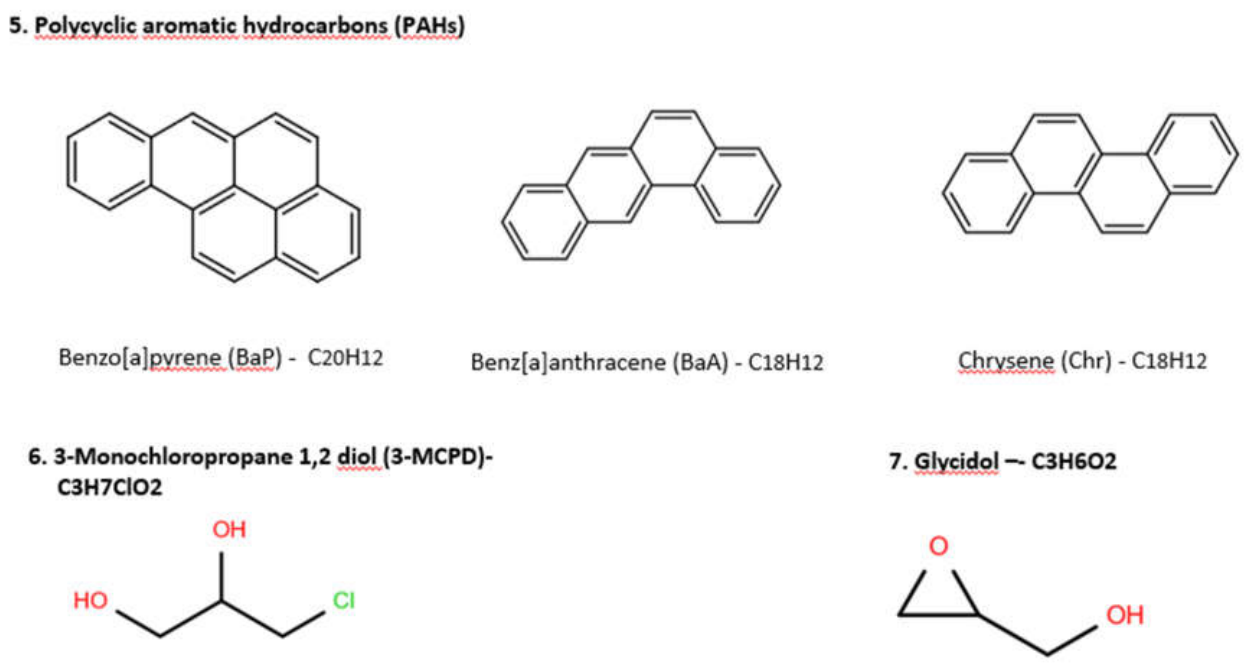
Figure 3.
Heat map showing harmonized concentrations (μg/kg ) of advanced glycation end products (CML and CEL) and neo-contaminants (acrylamide, furan, and 5-HMF) in selected ultra-processed foods. Color intensity reflects scaled concentration values, with darker colors indicating higher relative levels. Numbers in parentheses denote the bibliographic source of the reported concentration. Foods are arranged from highest to lowest CML content. NI = no information available; ND = not detected. CML = Nε-(Carboxymethyl)lysinE; CEL = Nε-(Carboxyethyl)lysine; 5-HMF = 5-Hydroxymethylfurfural.
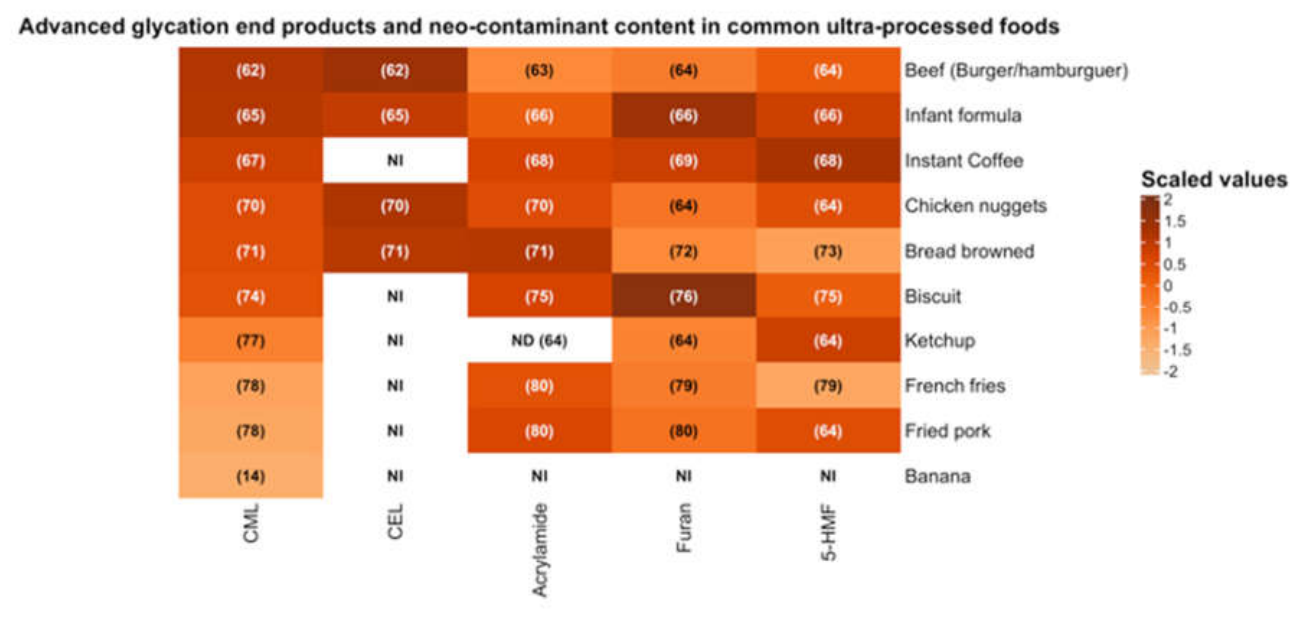

Table 1.
Advanced glycation end product and neo-contaminants content in common Ultra-Processed Food.
Table 1.
Advanced glycation end product and neo-contaminants content in common Ultra-Processed Food.
| Food | CML (µg/kg) | CEL (µg/kg) | Acrylamide (µg/kg) | Furan (µg/kg) | 5-HMF (µg/kg) |
|---|---|---|---|---|---|
| Beef burger/hamburger | 398,040 | 249,700 | 14 | 27.5 | 10,500 |
| Infant formula | 327,000 | 12,750 | 137 | 20,500 | 235,000 |
| Instant coffee | 82,350 | NI | 589 | 2,200 | 2,326,000 |
| Chicken nuggets | 30,000 | 55,000 | 350 | 45 | 42,500 |
| Bread browned | 24,570 | 24,740 | 1,884.5 | 10.5 | 15.5 |
| Biscuit | 17,350 | NI | 595.5 | 55,000 | 9,270 |
| Ketchup | 408.43 | NI | ND | 15.5 | 255,000 |
| French fries | 25.16 | NI | 256 | 27.5 | 7.55 |
| Fried pork | 17.53 | NI | 500 | 55 | 50,500 |
| Banana | 9 | NI | NI | NI | NI |
ND: No detected, NI: No information The values in the table were standardized to µg/kg to facilitate comparisons across different compounds and food items. CML column from highest to lowest values. Additionally, the heat map includes the corresponding bibliographic references, presented in the same order as in this table. CML = Nε-(Carboxymethyl)lysinE; CEL = Nε-(Carboxyethyl)lysine; 5-HMF = 5-Hydroxymethylfurfural.
Disclaimer/Publisher’s Note: The statements, opinions and data contained in all publications are solely those of the individual author(s) and contributor(s) and not of MDPI and/or the editor(s). MDPI and/or the editor(s) disclaim responsibility for any injury to people or property resulting from any ideas, methods, instructions or products referred to in the content. |
© 2026 by the authors. Licensee MDPI, Basel, Switzerland. This article is an open access article distributed under the terms and conditions of the Creative Commons Attribution (CC BY) license (http://creativecommons.org/licenses/by/4.0/).
Copyright: This open access article is published under a Creative Commons CC BY 4.0 license, which permit the free download, distribution, and reuse, provided that the author and preprint are cited in any reuse.