

Submitted:
23 September 2026
Posted:
24 September 2026
You are already at the latest version
Abstract
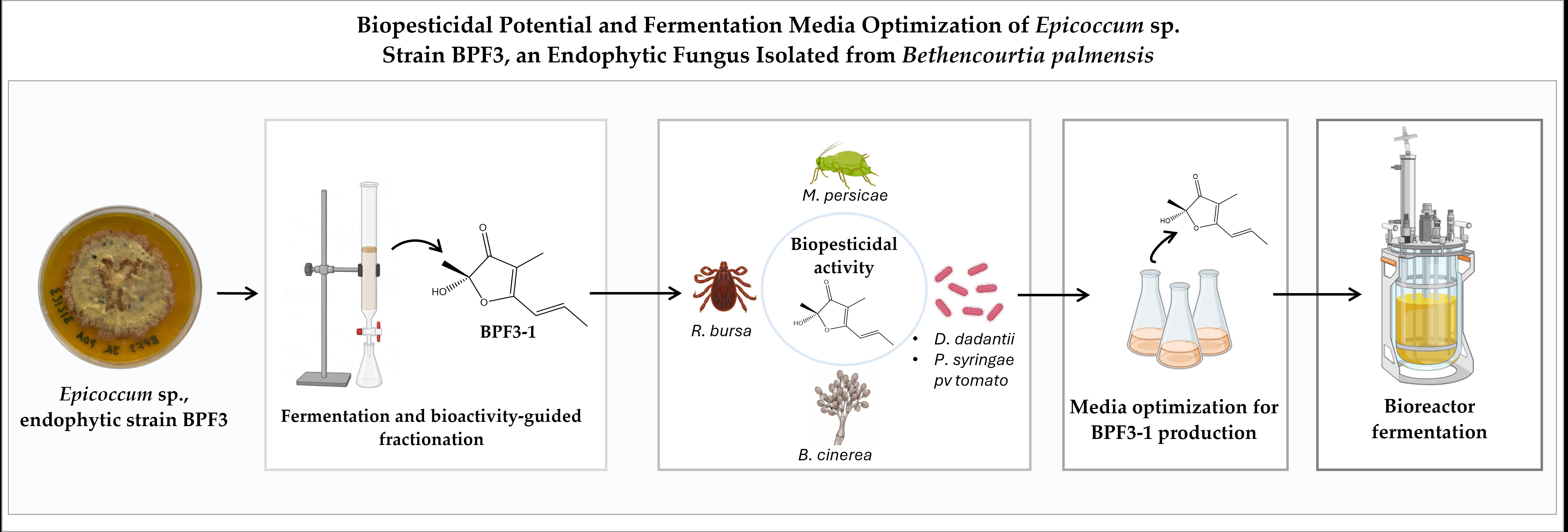
Endophytic fungi are an important source of bioactive compounds with potential applications in sustainable pest management. In this study, we isolated an Epicoccum species from Bethencourtia palmensis, an endemic plant from the Canary Islands, and performed bioactivity-guided fractionation of its ethyl acetate extract. The extract exhibited significant bioactivity against several agricultural pests, including Myzus persicae, Spodoptera littoralis, Botrytis cinerea, Dickeya dadantii and Pseudomonas syringae, and against the tick Rhipicephalus bursa. After bioguided fractionation, the major constituent of the extract and responsible for most of its bioactivity was identified as 2,3-dihydro-2-hydroxy-2,4-dimethyl-5-trans-propenylfuran-3-one (BPF3-1). Its structure was elucidated by 1D and 2D NMR experiments and high-resolution electrospray ionization mass spectrometry (HRESIMS) data analysis, and its absolute configuration was established by comparison of experimental and calculated electronic circular dichroism (ECD) spectra. This is the first report of BPF3-1 production by an Epicoccum species and the first documentation of its insect antifeedant and acaricidal activities. The culture medium was subsequently optimized to enhance BPF3-1 production. Maximum production was achieved using a medium supplemented with fructose and mycological peptone with a 487% production over control, and this formulation was selected for an initial fermentation scale-up in a bench-top bioreactor. Under these conditions, the maximum BPF3-1 concentration was reached three days earlier than in flask cultures, demonstrating the feasibility of process intensification and representing a first step toward industrial-scale production.
Keywords:
endophytic fungi
; biopesticides
; Epicoccum
; Bethencourtia palmensis
; bioactivity
; natural products
; optimization
1. Introduction
In recent years, there has been a significant increase in environmental and health awareness, particularly regarding food consumption and the associated production chain. Consequently, authorities and governments have redirected their focus towards the use of phytochemicals in agriculture, in response to growing concerns about the toxicity of certain products, as several researchers point out: neurotoxicity and oxidative damage [1,2] impacts on reproductive health [3,4], risk factors of cancer [5,6,7] and biodiversity reduction [8,9] among others. More recently, glyphosate, the most widely used herbicide worldwide, has been at the center of controversy due to reports associating it with certain pathologies [10]. Although its correlation with these conditions remains unclear, there is a growing tendency to reduce the global reliance on pesticides.
Biopesticides have emerged as a promising alternative to synthetic pesticides, offering solutions in response to the increasingly restrictive regulations on chemical pesticides and the toxicity issues surrounding widely used phytochemicals. The biopesticide market has experienced exponential growth in the past decade and continues to expand each year [11]. Numerous biopesticides are already commercially available [12]. However, they still have a small share in the global pesticides market [13].
Among the sources of biopesticides, microbes (particularly bacteria and fungi) display a high potential. Fungi have attracted significant interest due to their ability to produce a wide array of bioactive compounds, including terpenoids, small peptides and polyketides, among others [14]. In particular, fungal endophytes hold great promise as potential sources of novel bioactive compounds with multiple uses [15,16]. Endophytes are microorganisms that live symbiotically within plant tissues without causing harm to their host. In many cases, these endophytes provide notable benefits to the host plant, enhancing its fitness and resilience.
Most endophytes are not specific to any given plant species. However, in certain plants and regions, more specific interactions can occur, making these endophytes especially interesting when derived from endemic plants [17]. Endemic plants, often restricted to limited geographical areas, can exhibit unique chemical properties, in some cases leading to the discovery of new molecules [18,19,20]. That is the case of Bethencourtia palmensis, (formerly Senecio palmensis), an endemic plant from of Canary Islands that was reported to produce sesquiterpenes with insect antifeedant activities [21,22]. In this context, research on endemic plants may offer the potential to uncover novel fungal species and bioactive compounds, particularly when a unique relationship exists between the plant and its endophytes.
Given the vast diversity of endophytes, many of which remain undiscovered, there is a high potential for identifying new bioactive molecules with applications in medicine, pharmacology, and agriculture. This makes endophytes an exciting focus for ongoing research aimed at discovering novel compounds with significant ecological and economic value. However, one of the main challenges when working with non-conventional organisms such as endophytes is the low yield at which bioactive compounds are often produced, hindering subsequent scale-up of production. This issue is commonly addressed through two main approaches. The first involves the use of modified model organisms, such as Aspergillus nidulans, transformed with the gene or gene cluster responsible to produce the compound of interest. This strategy has been successfully applied to produce several compounds, such as sartorypyrone [23] or pyripyropene derivatives [24]. Although this is a reliable approach, it requires prior genetic characterization of the producing strain and identification of the biosynthetic genes involved, which can be challenging, especially when compound production is low or unstable. For example, this can be achieved through classical approaches such as one-factor-at-a-time (OFAT) optimization or more advanced statistical methodologies, including Plackett–Burman designs and Central Composite Design (CCD) [25]. Several studies have explored this approach for the production of fungal secondary metabolites, such as N-Methylsansalvamide [26] or fumigaclavine C and helvolic acid [27]. Additionally, these approaches can facilitate subsequent studies on gene expression under production-enhancing conditions and may even enable direct production of the target compounds at bioreactor scale in the native strain or through heterologous expression.
Epicoccum is a widely distributed fungal genus that is typically found as a saprophyte and endophyte and occasionally as a pathogen. It is well-recognized for its production of secondary metabolites with notable interest [28], including pigments with antifungal activity [29] and potential colorants [30]. This study presents the bioguided fractionation of an ethyl acetate extract obtained from the fermentation of the endophytic strain BPF3 of Epicoccum sp., isolated from B. palmensis that showed insect antifeedant bioactivity in previous studies [31]). Through a combination of chromatographic separation, bioassays, spectroscopic analysis and computacional methods, we isolated and characterized of 2,3-dihydro-2-hydroxy-2,4-dimethyl-5-trans-propenylfuran-3-one (BPF3-1) as the principal active compound of the extract. This study provides the first report of this compound being produced by this genus and characterizes its bioactivities against agricultural pests. Besides, culture medium has been improved to boost BPF3-1 production and a first attempt of scaling-up fermentation in a bioreactor has been carried out.
2. Materials and Methods
General Experimental Procedures
Optical rotations were measured on MCP 150-Anton Paar polarimeter (Anton Paar, Seelze-Letter, Germany) using MeOH as solvent. IR spectra were recorded on a Cary 630 FTIR spectrophotometer (Agilent, Santa Clara, CA, USA) and reported as wavenumbers (cm−1). The ECD spectra were obtained with a JASCO J-1500 CD spectrometer (JASCO, Tokyo, Japan). NMR spectra were acquired on a Bruker Avance II-500 MHZ spectrometer-equipped with a 5 mm TCI inverse detection cryo-probe (Bruker Biospin, Falländen, Switzerland). 1H and 13C NMR chemical shifts were expressed in ppm (δ) referenced to CDCl3 (Sigma-Aldrich, St. Louis, MO, USA, δH 7.26 and δC 77.0). NMR assignments were made using a combination of 1D and 2D NMR techniques. High-resolution mass spectra (HRMS) were recorded on a Waters LCT Premier XE mass spectrometer (Manchester, UK) in positive-ESI mode. Flash chromatography separations were carried out on a Biotage Isolera Prime (BIOTAGE, Uppsala, Sweeden) apparatus equipped with a UV detector (200–400 nm) using a prepacked RediSep flash column of silica gel (12 × 3 cm, 35 g Si; Teledyne Isco, Lincoln, NEB, USA). Thin-layer chromatography (TLC) was performed with precoated silica gel 60 F254 plates (Merck, Darmstadt, Germany) and silica gel 60 (40 ± 63 μm, Merck, Darmstadt, Germany) were used for column chromatography.
Fungal Strain and Fermentation
The selected strain was isolated from the flowers of Bethencourtia palmensis collected in Caldera de Taburiente National Park (La Palma, Canary Islands) and identified by ITS gene sequence in a previous work as Epicoccum sp. strain BPF3 [31] (Genbank accesion number PV938356).
Epicoccum sp. strain BPF3 was grown in Petri dishes with potato dextrose agar (PDA) medium for 10 days at 28ºC. Each plate was scrapped with a spatula after the addition of 10 mL of distilled water. A mycelium suspension (2 mL) was transferred to 250 mL Erlenmeyer flask containing 100 mL of Czapek-Dox-Mod medium [(NaNO3 (2 g/L), KH2PO4 (5 g/L), MgSO4 (0.5 g/L), FeSO4 (0.01 g/L), ZnSO4 (0.003 g/L), yeast extract (1 g/L) and glucose (60 g/L)] and incubated for three days at 25ºC under agitation at 120 rpm as seed culture.
Fermentation was carried out in 10L of Czapek-Dox-Mod medium in Elernmeyer flasks (500mL) containing 200 mL of medium. Each Erlenmeyer flask was inoculated with 5 mL of the preculture medium and liquid fermentation continued under constant agitation of 120 rpm at 25ºC for 14 days.
Extraction, Isolation, and Characterization of Active Compound
After fermentation, the mycelium was separated from the culture medium by filtration through a Buchner vessel and the medium was submitted to liquid-liquid extraction three times with ethyl acetate (1:1 v/v). Resulting extracts were dried over Na2SO4 and the organic solvent was evaporated under reduced pressure to yield 3.8 grams of crude extract.
The extract was chromatographed by vacuum-liquid chromatography (VLC) on silica gel column (12,5 cm height x 5 cm) eluted sequentially with a solvent polarity gradient of n-hexane-EtOAc (100:0, 90:10, 75:25, 50:50,0:100, v/v) and EtOAc-MeOH (99:1, 97:3, 95:5, 90:10, 75:25, 50:50, 0:100, v/v). The fractions obtained were analyzed by TLC, combining those the highest similarity to give 13 main fractions. The bioassays of these fractions (Figure S1) allowed the identification of the active fractions (Fractions. 6 and 7) and their metabolic profiles were examined by GC-MS.
Fraction 6 (200 mg, 5.4% total yield) was further submitted to flash chromatography eluted with a gradient of n-hexane-EtOAc (12%-50% EtOAc). The separation was performed on an Isolera Prime flash system (Biotage) with a pre-packed flash cartridge column with 35 g Si. After purification were obtained 110 mg of BPF3-1 as an amorphous white solid (2.9% yield).
2,3-dihydro-2-hydroxy-2,4-dimethyl-5-trans-propenylfuran-3-one (BPF3-1):
-10 (c 0.1, MeOH); IR νmax: 3307, 1685, 1636, 1576, 1419, 1222, 1150, 1047, 1022, 958 cm−1; ECD (MeOH) λ (Δε) 210 (+6.08), 229 (-15.80), 304 (+9.30) nm; 1H NMR (500 MHz, CDCl3): δ 1.53 (3H, s, H-9), 1.70 (3H, s, H-10), 1.97 (3H, d, J = 7.0 Hz, H-8), 4.48 (1H, brs, -OH), 6.34 (1H, dd, J=15.6, 1.7 Hz, H-7), 6.86 (dq, J=15.6, 6.9 Hz, H-6); 13C NMR (125 MHz, CDCl3): δ 102.1 (C-2), 202.8 (C-3), 107.0 (C-4), 177.1 (C-5), 139.8 (C-6), 119.0 (C-7), 19.1 (C-8), 22.3 (C-9), 5.4 (C-10); HRMS (ESI+) m/z 191.0685 [M+Na]+ (calcd. for C9H12O3Na, 191.0684).
Computational Methods of TDDFT-ECD Calculations.
An initial conformational analysis and Boltzmann population calculations were performed using Spartan’26 software [32], which revealed two low-energy conformers for each enantiomer of BPF3-1. Ground-state geometry optimization and frequency calculations were subsequently carried out for all conformers using the Gaussian 16 (Revision A.03) program package [33]. Quantum-chemical calculations were based on density functional theory (DFT) employing the B3LYP functional [34] and the 6-311+g(d,p) basis set. Solvation effects for methanol were incorporated using the Integral Equation Formalism Polarizable Continuum Model (IEFPCM) [35]. An ultrafine integration grid (int=ultrafine) was applied throughout all calculation steps. The lack of imaginary frequencies confirmed that all optimized structures represented true local minima on the potential energy surface. Time-dependent DFT (TD-DFT) calculations at the same PCM/B3LYP/6-311+g(d,p) level were subsequently performed to determine the electronic circular dichroism (ECD) properties (rotatory and oscillator strengths) by simulating the 60 lowest singlet excited states. The final ECD spectrum of each enantiomer was generated by Boltzmann-weighting the individual conformer spectra according to their relative populations at 298.15 K.J.
Culture Medium Variations to Enhance BPF3-1 Production
Czapek-Dox-Mod was modified to boost BPF3-1 production using a One-Factor-At-A-Time based approach. The fermentation basal media were prepared with modifications of the carbon source, inorganic nitrogen, and organic nitrogen content (Table 1). All subsequent fermentations were compared to a control fermentation in this medium.
Both pre-culture and fermentation were performed in 100 mL Erlenmeyer flasks containing 50 mL of medium. The same medium composition was used for both pre-culture and fermentation under each condition. Fermentation conditions, including stirring, temperature, and extract preparation, were as described above. Pre-cultures were inoculated with 1 mL of cell suspension obtained by scraping a plate culture. Fermentation cultures were subsequently inoculated with 2.5 mL of the corresponding pre-culture.
In order to determine peak production of BPF3-1 in the optimized medium, production was tracked along time. Secondary metabolites were extracted from time-course fermentations on days 2, 4, 7, 9, 11, 14, 16, 18 and 21 of the fermentation to determine the day of highest extract production and the day of highest BPF3-1 yield, following the aforementioned fermentation conditions and extraction procedures.
Scale-Up Cultivation in Stirred Tank 1.7 L Bioreactor
Fermentation of Epicoccum sp. strain BPF3 in the selected optimized FP medium was scaled-up to a 1.7 L SciVario benchtop double bioreactor (Eppendorf, Hamburg, Germany) with a working volume of 1.3 L, including automated temperature, shaking rate, pH, and aeration control, from 10 % (v/v) inoculum. The temperature was maintained at 25°C. Aeration was provided between 0.098 – 0.392 VVM (equivalent to 10-40 sL/h) (air volume per broth volume per minute) using sterilized air. The agitation speed was set between 100 and 900 rpm to maintain a dissolved oxygen (DO) level less than 30%. The DO% and pH values were automatically recorded using the software VisioNize Lab Suite. A polypropylene glycol antifoaming agent was used to control foaming [36,37]. Over a 14-day period, daily samples from the culture medium were collected and extracted to follow the production curve of BPF3-1.
Chromatographic Analyses
Gas chromatography-mass spectrometry (GC–MS) was carried out on a Shimadzu GC-2010 gas chromatograph coupled to a Shimadzu GC-MS-QP2010 Ultra mass detector with a single quadrupole analyzer, electron impact ionization source at 70 eV and helium as the carrier gas and equipped with a 30 m x 0.25 mm ID and 0.25 μm phase thickness capillary column (Teknokroma TRB-5, 5% phenyl, 95% dimethyl polysiloxane for plant extracts, or MEGA-5 MS 5% phenyl, 95% methyl polysiloxane for fungal extracts).
Working conditions: Dried extracts were dissolved in dichloromethane (4 mg/mL, DCM), filtered and analyzed by GC–MS. Portions of 1 μL were injected in split mode (split ratio 20/1) using a Shimadzu AOC-20i automatic injector, injector temperature 300°C, temperature of the transfer line connected to the mass spectrometer 250°C, and temperature of the ionization source 220°C. For plant extracts, the initial column temperature was 70°C, ramping up to 290°C at 6°C.min-1, and running at 290°C for 20 min. For fungal extracts, the initial column temperature was 110°C, ramping up to 290°C at 7°C.min-1, and running at 290°C for 20 min.
A full scan with m/z range 35-450 was performed. A sample of BPF3-1 injected as a standard to identify their chromatogram peaks of the extracts.
To quantify BPF3-1 in the extracts, a calibration curve was constructed by correlating peak area with known concentrations of the pure compound. Standard solutions were injected at 1.25, 1.00, 0.75, 0.50, 0.25, 0.10, 0.05, 0.01, and 0.00625 mg·mL-1. The resulting peak areas were used to generate a linear regression curve. Compound yield in the samples was then calculated by extrapolating the corresponding peak areas onto the calibration line.
Bioassays
Insects Antifeedant Assay
Colonies of Spodoptera littoralis and Myzus persicae were maintained on artificial diet [38] and bell pepper (Capsicum annuum) plants, respectively, at ICA-CSIC. These colonies and their host plants were kept in a growth chamber at 22 ± 1°C with over 70% relative humidity and a 16:8-hour light/dark photoperiod.
For antifeedant testing, the procedures described in Valcárcel et al.,(2021) [39] were followed. For M. persicae, plastic boxes with a thin 1% agar layer containing two 1 cm radius semicircles of pepper leaf attached to the agar were used. Extracts, fractions or products dissolved in ethanol were applied to one plant segment, and the other segment served as a solvent-only control. Ten aphids were placed on the lid of each box and left for 24 hours at 25°C with a 16/8-hour light/dark cycle. After incubation, the number of aphids settling on both the control and treated plant segments was counted, and the inhibition percentage of settlement was calculated.
For Spodoptera littoralis, the assay involved placing two sixth-instar larvae (more than 24 hours after moulting) into each of six Petri dishes. Each dish contained two leaf disks: one treated with the test solution and the other with the solvent as a control. The larvae were allowed to feed until 75% of the area of either disk was consumed.
Extracts and fractions were assayed at 100 µg/cm2, pure compounds were assayed at 50 µg/cm2. Those achieving over 70% feeding inhibition were classified as active.
Nematicidal Assay
A population of the root-knot nematode Meloidogyne javanica was maintained on tomato plants (Lycopersicon esculentum var. Marmande) cultivated in pots under controlled conditions (25 ± 1 °C and relative humidity above 70%). Second-stage juveniles (J2) that emerged within 24 hours from egg masses manually extracted from infected tomato roots were selected for use in the assays. Nematicidal activity was evaluated using 96-well plates as reported in Andrés et al., (2018) [40]. Each assay included four replicates, with each well containing 95 μL of water and 80-120 M. javanica J2 stage juveniles, along with 5 μL of the extract dissolved in DMSO containing 0.6% Tween 80. Pure compounds reached a final assay concentration of 0.5 mg·mL-1. The same solvent was used as a negative control. After 72 hours of incubation at 25°C, nematode mobility was assessed by counting the percentage of mobile versus immobile juveniles in each well. Results were compared to the control wells containing only the solvent.
Acaricidal Assay
Ticks were identified using specific keys [41,42]. Female Rhipicephalus bursa ticks collected from their hosts (cattle) in Plasencia, Spain, and kept at 22-24 °C and 70% relative humidity until oviposition and egg hatching. The resulting larvae were maintained under the same laboratory conditions and used in bioassays at 3 to 6 months of age.
Following the procedure described in Valcarcel et al. (2021) [39] compounds to be tested were formulated by mixing them with 25 mg of cellulose, followed by the evaporation of the solvent. Each assay consisted of three replicates, each with 20 larvae. After a 24-hour exposure to the treated cellulose, dead larvae were enumerated using a binocular magnifying glass. The effectiveness of the extract was measured as the percentage of mortality, corrected with the Orelli-Schneider formula [43].
Antifungal and Antibacterial Assay
MTT-based colorimetry assay was conducted to evaluate the effectiveness of the extracts and products based on the protocol reported in Ruiz-Vásquez et al., (2022) [44] against the fungal phytopathogen Botrytis cinerea and Fusarium oxysporium and bacterial phytopathogenes Dickeya dadantii (formerly Erwinia chrysantemi) and Pseudomonas syringae pv. tomato. The compounds to test were prepared in in 96-well plate at 80 mg/mL, using DMSO. Intermediate stocks were prepared by adding 20 µL of product to 780 µL of sterile distilled water, yielding concentrations of 400, 200, 100, 50 and 25 µg/mL. For testing, 160 µL of each intermediate stock was added to the first four wells of each column in a 96-well plate. Serial dilutions were performed across the plate by transferring 80 µL from each well to the next, with the final volume adjusted to 80 µL in each well.
Each well received 100 µL of culture medium and 20 µL of fungal spores or fresh bacteria. Culture medium used for antifungal assays is RPMI-MOPS (1% RPMI 1640, MOPS 0.165M, 20 mg/L of Streptomycin/Penicillin mix) and Mueller-Hinton (Difco) for both pre-culture and antibacterial assay. Fungal spores were inoculated at a stock concentration of 106 M/mL. Bacteria were inoculated at initial optical densities of 0.05 for D. dadantii, 0.25 for P. syringae. Negative controls, prepared by adding 20 µL of DMSO to 780 µL of sterile water, were included in four wells without dilution. The plates were covered with aluminum foil and incubated at 25ºC during 48 hours for B. cinerea and at 28°C during 24 hours for D. dadantii and P. syringae.
Following incubation, 25 µL of MTT solution (5 mg/mL) with menadione (1 mM) was added to each well. Plates were incubated at 28°C for 30 minutes for antibacterial assays and 25ºC during 3 hours for antifungal assays. After incubation, 200 µL of acidified isopropanol (2.5 mL of 1M HCl in 47.5 mL isopropanol) was added to each well, and the plate was incubated for 30 minutes. Absorbance was measured at 490 nm using a plate reader.
Statistical Calculation of Dose-Response Curves
After measuring biopesticidal activity, effectiveness of products was assessed by calculation of the EC50 (concentration at which a compound produces 50% of its maximum effect values). For antifungal, antibacterial and antifeedant assays, EC50 was calculated from linear regression analysis, with a minimum of three doses and doses with bioactivity points above and below 50% of bioactivity. For acaricidal assays, effectiveness was measured as the percentage of mortality, corrected with the Orelli-Schneider formula (Abou Lila et al., 2015) [43] and EC50 values with Probit Analysis.
All EC50 statistics were calculated using STATGRAPHICS Centurion XVI (v 16.1.02; Statpoint Technologies)
3. Results
Bioguided Fractionation and Bioactivity
Epicoccum sp. BPF3 had shown antifeedant activity against M. persicae in a previous study [31]. The extract obtained in this work reproduced this bioactivity, yielding 88.5% ± 3.2 settling inhibition of M. persicae (Table S1).
After chromatography, the 13 fractions of compounds obtained were assayed to determine which ones contained the bioactive(s) compound(s). Antifeedant activity was concentrated in fractions 6 (EtOAc-MeOH, 99:1), and 7 (EtOAc-MeOH, 97:3) (Table S1).
Both fractions contained BPF3-1, as major compound, which represents also the major compound present in the extract. This compound was subsequently purified and reproduced the potent antifeedant effects of the extract against M. persicae with an EC50 value of 16.2 µg/cm2 (Table 2).
Additionally, the extract and BPF3-1 were tested against other pests and phytopathogens in order to study its biopesticidal properties against a wider range of organisms. These included bioactivity tests against S. littoralis, M. javanica, B. cinerea, R. bursa, D. dadantii and P. syringae. Among them, the extract showed significant antifeedant effects against S. littoralis (91.8% feeding inhibition), was moderately active on spore germination of B. cinerea (66.5% inhibition), and exhibited moderate antimicrobial activity against D. dadantii (51.7%) and P. syringae (71.4%). Moreover, the extract had a strong ixodiocidal effects against the tick R. bursa with a 100% larval mortality (Table 2). No significant bioactivity was detected against M. javanica.
BPF3-1 showed bioactivity against four of these organisms, including strong acaricidal activity against R. bursa (EC50 value of 8.63 µg/mg), and moderate activity against the phytopathogenic bacteria D. dadantii (EC50 value of 56.5 µg/mL), P. syringae (EC50 value of 16.30 µg/mL) and the fungus B. cinerea (EC50 value of 335.8 µg/mL). No activity was detected against S. littoralis.
BPF3-1 Identification
The structure of the bioactive compound BPF3-1 was identified as 2,3-dihydro-2-hydroxy-2,4-dimethyl-5-trans-propenylfuran-3-one through spectroscopic data analysis of 1D and 2D NMR spectra and high-resolution electrospray ionization mass spectrometry (HRESIMS) (Figures S1-S7). This compound had previously been described in the fungus Stemphylium radicinum [45], and from the endophytic fungi Penicillium sp. [46] and Ascochyta saliconiae isolated from a marine alga [47].
The compound BPF3-1 (Figure 1) isolated in this research displayed an optical rotation value -10 (c 0.1, MeOH), with opposite sign to the optical rotation for this compound in the literature +1.8 (c 0.29, EtOH) [47] and +20.3 (c 0.022, MeOH) [46]. The absolute configuration 2S at C-2 for this compound was also determined by X-ray diffraction by Ibrahim et al. [48], however, its optical rotation was not described. In order to determine and confirm the absolute configuration of BPF3-1, the predicted ECD spectrum from TDDFT calculations was compared with the experimental electronic circular dichroism (ECD) spectrum, showing the experimental and simulated spectra with the S configuration at C-2. In this study, a conformational search was performed to identify the most stable conformers before ECD spectral calculations. This allowed exploration of the potential energy surface and the identification of low-energy conformations relevant to ECD predictions. Therefore, the absolute configuration of compound BPF3-1 was determined to be (2S) based on a comparison between the calculated theoretical spectrum and experimental ECD data (Figure S8).
Optimization of Culture Conditions to Enhance BPF3-1 Production
The fermentation yields and production of BPF3-1 across different culture medium variations are presented in Table 3 and Figure 2. The control (CT) produced 92.2 mg of extract, with a BPF3-1 yield of 18.6 mg/L (3.0% of the extract weight). Among all the tested conditions, two exceeded the control in extract production: G12 (152 mg) and F12 (219.3 mg), and three improved BPF3-1 yield: G12 (27.2 mg/L), F12 (30.19 mg/L), P 0.1 (70.9 mg/L). Using the BPF3-1 yield percent as an indicator of targeted production, showed that four conditions were better than the control: F6 (7.7%), N 0.6 (6.6%), N1 (6.7%) and P 0.1 (33.2%). The rest of the conditions were not better than the control, and two of them (A 0.6 and A 1, both containing ammonium dihydrogen phosphate) did not yield any BPF3-1.
Based on these results, the fermentation conditions with the highest yield and percentage of BPF3-1 (P 0.1 and F6), were mixed to formulate a new medium (FP medium) to further enhance BPF3-1 production. This medium showed the highest BPF3-1 yield (90.7 mg/L) with a percentage in the extract almost as high as that of P 0.1 alone (29.7%). Therefore, since FP was the most effective medium to promote BPF3-1 production.
BPF3-1 production over time was studied in a time-course fermentation to determine the moment of peak production in FP medium. Production of BPF3-1 increased over the 21-day period. During the initial stages of fermentation (days 2, 4 and 7), a lower quantity of compound was observed in the extracts. Conversely, a higher ratio of mg product per liter of extract was observed on days 14, 16, 18 and 21. Day 14 was found to be the extract with the highest content of BPF3-1 compound (94.2 mg product/L). Based on these results, the optimum conditions for extract and BPF3-1 production were set at 14 days of fermentation in FP medium.
Bioreactor Scale-Up of BPF3-1 Production
During the scale-up of the production process, significant changes were observed in the operational parameters of the bioreactor (Figure 3). Initially, pH increased from 5.0 to 7.5 within the first 50 hours, reflecting an exponential growth phase characterized by rapid substrate uptake and the production of metabolic byproducts that alkalinized the medium. This pH shift occurred without external intervention, suggesting natural environmental regulation by the microorganisms. The CO₂ production rate peaked at 16 mMol/h during this phase, correlating with high metabolic activity levels related to the beginning of the growth curve of the fungus.
As the process progressed, the pH, agitation rate, and gas flow rate stabilized. Agitation increased over time, reaching the maximum set up in 900 rpm after 250 h, while the gas injection rate stayed in a range between 28-40 sL/h, reaching its peak at 30 h to ensure adequate oxygen transfer in the maximum moment of demand. Concurrently, the CO₂ production rate showed a downward trend between 24 and 48 hours of fermentation. Toward the end of the process, around 175 hours from the start, the CO₂ production rate dropped and continued to decline, while gassing rate and stirrer speed kept increasing until they reached the maximum values set in the bioreactor conditions, indicating sustained oxygen demand by the fungus.
BPF3-1 production increased progressively during fermentation and reached its maximum at approximately 264 h (day 11) (Figure 4), after which the detected BPF3-1 signal declined. In comparison, the highest BPF3-1 production in shake-flask cultures using the same medium was observed on day 14, indicating that the production maximum occurred approximately three days earlier under bioreactor conditions. A marked change in fungal morphology was also observed during scale-up, with predominantly filamentous growth observed in the bioreactor compared with the clumps or pellets formed during shake-flask cultivation (Figure S9).
4. Discussion
Bioguided fractionation of the BPF3 strain extract led to the isolation of 2,3-dihydro-2-hydroxy-2,4-dimethyl-5-trans-propenylfuran-3-one (BPF3-1), marking the first report of its production by a species of the genus Epicoccum and its bioactivity against several agricultural pests (M. persicae, B. cinerea, D. dadantii and P. syringae) and acaricidal activity against the tick (R. bursa). Epicoccum is widely recognized for its production of pigments with antifungal properties, with potential applications as natural colorants [29,49]. However, this study highlights the potential of Epicoccum to produce additional bioactive metabolites with applications in plant protection.
BPF3-1 was isolated for the first time from phytopathogenic fungus Stemphylium radicinum [45]. The compound resurfaced in the literature in 1997 when it was identified from the fermentation extract of a Penicillium sp. isolated from Taxus brevifolia, with high activity against Staphylococcus aureus [46]. In 2000, Osterhage et al. isolated BPF3-1 from the marine fungus Ascochyta salicorniae, where it showed inhibition of tyrosine kinase, a target for cancer therapy, as well as antiparasitic activity against Trypanosoma brucei subsp. rhodesiense and Trypanosoma cruzi. It also exhibited weak antifungal activity against Microbotryum violaceum and Eurotium repens [47]. This metabolite has been also isolated from Mollisia nigrescens, an endophyte from Vaccinium angustifolium, noting slight inhibitory effects on E. coli and Bacillus subtilis [48]. This activity against bacteria is consistent with our results, where moderate antimicrobial activities against D. dadantii and P. syringae pv tomato are reported.
Additionally, BPF3-1 has been reported from two different endophytic Phomopsis strains, one isolated from Zizyphus angustifolius, where it showed antimicrobial activity against S. aureus [50], and another from patent CN102154116A, which reported its antifungal activity against Fusarium oxysporum [51]. However, in our study, the extract was not active against this fungus.
Furan rings and their derivatives are considered promising chemical scaffolds, exhibiting significant ability to interact with multiple enzymes [52,53,54]. This is the first report of the insect antifeedant and acaricidal activities of BPF3-1. However, other furan derivatives with bioactivity against pests have been reported. For example, compounds derived from 5-methylfurfural have strong acaricidal properties [55], and furanones have demonstrated both acaricidal and insecticidal effects [56]. Specifically, the fungal furanone seiridin has been identified as a promising biopesticide candidate due to its low phytotoxicity and activity against the aphid Acyrthosiphon pisum [57]. Another study screened 25 furanones for insecticidal activity and identified several compounds with strong potential against insect cell lines [58].
In general, the production of biomass and the different phases of fungal growth are influenced by both the characteristics of the medium and the fungal species used. Secondary metabolites synthesis is directly influenced by the nutrients present in the culture medium, especially by the carbon and nitrogen source [59]. In the case of the strain BPF3, the use of mycological peptone with fructose boosted the production of its bioactive compound. Other authors have obtained comparable results; using peptone as a source of organic nitrogen can increase the synthesis of some compounds, as it contributes nitrogen and sulfur to the culture medium and enhances production. This was observed with sclerothiorin, a pigment produced by Penicillium sclerotiorum 2AV2 [60]. Additionally, use of fructose as a carbon source favors the synthesis of some compounds such as furanones similar to BPF3-1 [61]. On the other hand, the use of ammonium-based nitrogen sources appears to drastically reduce the production of the compound of interest. This may be due to ammonium-induced repression of metabolic processes, similarly to what was observed in the biosynthesis of other fungal metabolites such as bikaverin [62,63].
During scale-up fermentation in the bioreactor with the optimized medium, the observed pH increase within the first 50 hours, coupled with a CO₂ production peak, suggests that microbial activity may naturally moderate the environment during exponential growth [64]. Furthermore, BPF3-1 production increased more sharply than in flask fermentation, where production appeared slower at the early stages (Figure 3 and Figure 4).
However encouraging, this first approach to a scale-up production can still be improved. For instance, the growth pattern varied between bioreactor and flask conditions (Figure S9). This may reflect differences in oxygen transfer, as suggested by other authors [65]. Productivity is closely linked to growth, both at the strain and compound level; there is no universal pattern, some fungi are more productive when forming large clumps, while others do not benefit from this type of morphology [66]. Since morphology could indirectly affect oxygen transfer, further optimization should consider which mycelliar morphology is best to increase productivity. In this case, bioreactor fermentation produced mycelia dispersed throughout the medium.
This form of growth hinders correct homogenization, and it may reduce oxygenation [67], thus affecting metabolic rates. As shown in Figure 3 and Figure 4, it a possible correlation exists between oxygen transfer and BPF3-1 production. The demand of oxygen increased progressively throughout the fermentation. When the system reached the maximum preset levels for agitation and aeration and could no longer satisfy the oxygen demand, a sharp decrease in BPF3-1 levels was observed, probably an effect parallel to nutrient decrease in the system that causes its metabolic transformation into other by-products. In turn, the decrease in BPF3-1 production observed during flask fermentation was less sharp after the peak. Testing lower inoculum concentrations and higher aeration rates in bioreactor combined with different agitation systems may help improve oxygen transfer and, consequently, BPF3-1 production. Overall, the bioreactor experiment should therefore be considered a preliminary scale-up assessment rather than a fully optimized production process. Nevertheless, the earlier BPF3-1 production maximum and the clear differences in fungal morphology provide useful information for subsequent optimization of inoculum size, aeration, agitation, and cultivation time.
5. Conclusions
This study demonstrates that endophytic fungi associated with endemic plant species constitute a valuable source of bioactive metabolites with potential applications in sustainable crop protection. Bioguided fractionation of the extract produced by Epicoccum sp. strain BPF3 isolated from Bethencourtia palmensis led to the identification of 2,3-dihydro-2-hydroxy-2,4-dimethyl-5-trans-propenylfuran-3-one (BPF3-1) as the major bioactive constituent responsible for most of the observed activity against agricultural pests and pathogens.
To our knowledge, this represents the first report of BPF3-1 production by an Epicoccum species and the first description of its insect antifeedant and acaricidal activities. Culture medium optimization substantially enhanced BPF3-1 production, with fructose and mycological peptone identified as the most favorable carbon and nitrogen sources, respectively, resulting in a marked increase in metabolite yield compared with the initial culture conditions. Preliminary scale-up experiments using the optimized medium demonstrated the feasibility of transferring BPF3-1 production to a bench-top bioreactor, where maximum metabolite levels were reached earlier than in flask cultures. However, additional optimization will be required to further improve productivity and process performance.
Overall, this work identifies BPF3-1 as a bioactive metabolite with potential application as biopesticide in plant protection and provides a foundation for future studies focused on large-scale production and identification of the genetic determinants for its production.
Supplementary Materials
The following supporting information can be downloaded at the website of this paper posted on Preprints.org, Table S1: Antifeedant activity of BPF3 extract and its fractions against M. persicae; Figure S1: IR spectrum of compound BPF3-1; Figure S2: HRESIMS of compound BPF3-1; Figure S3: 1H NMR spectrum (500 MHz) of compound BPF3-1 in CDCl3; Figure S4: 13C NMR spectrum (125 MHz) of compound BPF3-1 in CDCl3; Figure S5: HSQC spectrum (500 MHz) of compound BPF3-1 in CDCl3; Figure S6: COSY spectrum (500 MHz) of compound BPF3-1 in CDCl3; Figure S7: HMBC spectrum (500 MHz) of compound BPF3-1 in CDCl3; Figure S8: Calculated and experimental ECD spectra of compound BPF3-1; Figure S9: Cultivation of BPF3 in flask and bioreactor.
Author Contributions
Conceptualization, AGC and CED; methodology, JRLM, CED, NRC, JLLP; software, JRLM, JLLP, NRC; validation, JRLM, AGC and CED; formal analysis, JRLM and CED; investigation, JRLM and NRC; resources, AGC, CED, MFA, TFS and JI; data curation, JRLM and CED; writing—original draft preparation, JRLM; writing—review and editing, JRLM, CED, JI, TSF, AGC ; visualization, JRLM; supervision, AGC, CED, TFS and JI; project administration, AGC, CED, MFA and JI; funding acquisition, AGC, CED and MFA. All authors have read and agreed to the published version of the manuscript.
Funding
This research was supported by grant PID2024-156361OB-C22 (Spanish State Research Agency, 10.13039/501100011033).
Data Availability Statement
The original contributions presented in this study are included in the article/supplementary material. Further inquiries can be directed to the corresponding authors.
Conflicts of Interest
The authors declare no conflicts of interest
Abbreviations
The following abbreviations are used in this manuscript:
| DMSO | Dimethyl Sulfoxide |
| ECD | Electronic Circular Dichroism |
| ESI | Electrospray Ionization |
| EtOAc | Ethyl Acetate |
| GC-MS | Gas Chromatography-Mass Spectrometry |
| HRESIMS | High-Resolution Electrospray Ionization Mass Spectrometry |
| HRMS | High-Resolution Mass Spectrometry |
| ITS | Internal Transcribed Spacer |
| MeOH | Methanol |
| NMR | Nuclear Magnetic Resonance |
| PDA | Potato Dextrose Agar |
| TLC | Thin-Layer Chromatography |
| UV | Ultraviolet |
| VLC | Vacuum Liquid Chromatography |
References
- Wei, F.; Cheng, F.; Li, H.; You, J. Imidacloprid Affects Human Cells through Mitochondrial Dysfunction and Oxidative Stress. Sci. Total Environ. 2024, 951, 175422. [Google Scholar] [CrossRef] [PubMed]
- Huang, M.; Mao, S.; Pan, Y.; Zhang, Z.; Gui, F.; Tan, X.; Hong, Y.; Chen, R. Pesticide Metabolite 3, 5, 6-Trichloro-2-Pyridinol Causes Massive Damage to the Cochlea Resulting in Hearing Loss in Adult Mice. Environ. Pollut. 2024, 360, 124691. [Google Scholar] [CrossRef] [PubMed]
- Tian, T.; Liu, F.; Fu, Y.; Ao, J.; Lin, S.; Cheng, Q.; Kayim, K.; Kong, F.; Wang, L.; Long, X.; et al. Environmental Exposure Patterns to 94 Current-Use Pesticides in Women of Reproductive Age Who Are Preparing for Pregnancy. Sci. Total Environ. 2024, 948, 174624. [Google Scholar] [CrossRef] [PubMed]
- Rahimi, T.; Rafati, F.; Sharifi, H.; Seyedi, F. General and Reproductive Health Outcomes among Female Greenhouse Workers: A Comparative Study. BMC Womens Health 2020, 20, 103. [Google Scholar] [CrossRef] [PubMed]
- Parada, H.; Wolff, M.S.; Engel, L.S.; White, A.J.; Eng, S.M.; Cleveland, R.J.; Khankari, N.K.; Teitelbaum, S.L.; Neugut, A.I.; Gammon, M.D. Organochlorine Insecticides DDT and Chlordane in Relation to Survival Following Breast Cancer. Int. J. Cancer 2016, 138, 565–575. [Google Scholar] [CrossRef] [PubMed]
- Wielsøe, M.; Kern, P.; Bonefeld-Jørgensen, E.C. Serum Levels of Environmental Pollutants Is a Risk Factor for Breast Cancer in Inuit: A Case Control Study. Environ. Health 2017, 16, 56. [Google Scholar] [CrossRef] [PubMed]
- Koutros, S.; Silverman, D.T.; Alavanja, M.C.; Andreotti, G.; Lerro, C.C.; Heltshe, S.; Lynch, C.F.; Sandler, D.P.; Blair, A.; Beane Freeman, L.E. Occupational Exposure to Pesticides and Bladder Cancer Risk. Int. J. Epidemiol. 2016, 45, 792–805. [Google Scholar] [CrossRef] [PubMed]
- Sánchez-Bayo, F.; Wyckhuys, K.A.G. Worldwide Decline of the Entomofauna: A Review of Its Drivers. Biol. Conserv. 2019, 232, 8–27. [Google Scholar] [CrossRef]
- Woodcock, B.A.; Isaac, N.J.B.; Bullock, J.M.; Roy, D.B.; Garthwaite, D.G.; Crowe, A.; Pywell, R.F. Impacts of Neonicotinoid Use on Long-Term Population Changes in Wild Bees in England. Nat. Commun. 2016, 7, 12459. [Google Scholar] [CrossRef] [PubMed]
- Peillex, C.; Pelletier, M. The Impact and Toxicity of Glyphosate and Glyphosate-Based Herbicides on Health and Immunity. J. Immunotoxicol. 2020, 17, 163–174. [Google Scholar] [CrossRef] [PubMed]
- Marrone, P.G. The Market and Potential for Biopesticides; 2014; pp. 245–258. [Google Scholar]
- Arthurs, S.; Dara, S.K. Microbial Biopesticides for Invertebrate Pests and Their Markets in the United States. J. Invertebr. Pathol. 2019, 165, 13–21. [Google Scholar] [CrossRef] [PubMed]
- Marrone, P.G. Status of the Biopesticide Market and Prospects for New Bioherbicides. Pest Manag. Sci. 2024, 80, 81–86. [Google Scholar] [CrossRef] [PubMed]
- Keller, N.P.; Turner, G.; Bennett, J.W. Fungal Secondary Metabolism — from Biochemistry to Genomics. Nat. Rev. Microbiol. 2005, 3, 937–947. [Google Scholar] [CrossRef] [PubMed]
- Torres-Mendoza, D.; Ortega, H.E.; Cubilla-Rios, L. Patents on Endophytic Fungi Related to Secondary Metabolites and Biotransformation Applications. J. Fungi 2020, 6, 58. [Google Scholar] [CrossRef] [PubMed]
- Rojas López-Menchero, J.; Lyssaios, F.A.; Reyes Castillo, N.; Andrés, M.F.; González-Coloma, A.; Díaz, C.E. Fungal Endophytes and Their Secondary Metabolites for Crop Protection. J. Pest Sci. 2025. [Google Scholar] [CrossRef]
- Rojas López-Menchero, J.; Fé Andrés-Yeves, M.; González-Coloma, A.; González-García, V. Endophytic Fungi: Taxonomy, Isolation, and Current Applications. In The Diversity of the Fungal World; IntechOpen, 2024. [Google Scholar]
- Kıran Aydın, S.; Ertaş, A.; Boğa, M.; Erol, E.; Alim Toraman, G.Ö.; Kuşman Saygı, T.; Halfon, B.; Topçu, G. Di- and Triterpenoids Isolation and LC-MS Analysis of Salvia marashica Extracts with Bioactivity Studies. Rec. Nat. Prod. 2021, 15, 463–475. [Google Scholar] [CrossRef]
- Malmir, M.; Gohari, A.R.; Saeidnia, S.; Silva, O. A New Bioactive Monoterpene–Flavonoid from Satureja khuzistanica. Fitoterapia 2015, 105, 107–112. [Google Scholar] [CrossRef] [PubMed]
- Martins, V. de C.; Santiago, M.C.P. de A.; Pacheco, S.; Borguini, R.G.; Souza, M. da C.; de Carvalho, M.G.; Godoy, R.L. de O. Myrcia Eriopus DC. (Myrtaceae) Fruits, a New Endemic Brazilian Source of Bioactive Anthocyanins. Nat. Prod. Res. 2022, 36, 2853–2858. [Google Scholar] [CrossRef] [PubMed]
- Reina, M.; Nold, M.; Santana, O.; Orihuela, J.C.; González-Coloma, A. C-5-Substituted Antifeedant Silphinene Sesquiterpenes from Senecio palmensis. J. Nat. Prod. 2002, 65, 448–453. [Google Scholar] [CrossRef] [PubMed]
- Gonzalez-Coloma, A.; Reina, M.; Cabrera, R.; Castañera, P.; Gutierrez, C. Antifeedant and Toxic Effects of Sesquiterpenes From Senecio palmensis to Colorado Potato Beetle. J. Chem. Ecol. 1995, 21, 1255–1270. [Google Scholar] [CrossRef] [PubMed]
- Lin, S.-Y.; Oakley, C.E.; Jenkinson, C.B.; Chiang, Y.-M.; Lee, C.-K.; Jones, C.G.; Seidler, P.M.; Nelson, H.M.; Todd, R.B.; Wang, C.C.C.; et al. A Heterologous Expression Platform in Aspergillus Nidulans for the Elucidation of Cryptic Secondary Metabolism Biosynthetic Gene Clusters: Discovery of the Aspergillus Fumigatus Sartorypyrone Biosynthetic Pathway. Chem. Sci. 2023, 14, 11022–11032. [Google Scholar] [CrossRef] [PubMed]
- Jia, S.; Wu, Y.; Chen, Y.; Tang, Y.; Cui, Y.; Yin, Q.; Ji, D.; Wang, P.; Xu, J. Novel Pyripyropenes Produced by Gene Cluster Design and Heterologous Expression. Mycology 2026, 17, 543–551. [Google Scholar] [CrossRef] [PubMed]
- Singh, V.; Haque, S.; Niwas, R.; Srivastava, A.; Pasupuleti, M.; Tripathi, C.K.M. Strategies for Fermentation Medium Optimization: An In-Depth Review. Front. Microbiol. 2017, 7. [Google Scholar] [CrossRef] [PubMed]
- Shao, Y.; Bai, Y.; Cai, Z.; Pu, N.; Zhang, H. Optimization of Stationary Liquid Fermentation Conditions for N-Methylsansalvamide Production by the Endophytic Strain Fusarium Sp. R1. Fermentation 2024, 10, 140. [Google Scholar] [CrossRef]
- Wu, Q.; Song, Y.-C.; Xu, H.; Guo, Y.; Li, J.; Tan, R.-X. Medium Optimization for Enhanced Co-Production of Two Bioactive Metabolites in the Same Fermentation by a Statistical Approach. J. Asian Nat. Prod. Res. 2011, 13, 1110–1121. [Google Scholar] [CrossRef] [PubMed]
- Braga, R.M.; Padilla, G.; Araújo, W.L. The Biotechnological Potential of Epicoccum spp.: Diversity of Secondary Metabolites. Crit. Rev. Microbiol. 2018, 44, 759–778. [Google Scholar] [CrossRef] [PubMed]
- Lee, A.J.; Cadelis, M.M.; Kim, S.H.; Swift, S.; Copp, B.R.; Villas-Boas, S.G. Epipyrone A, a Broad-Spectrum Antifungal Compound Produced by Epicoccum nigrum ICMP 19927. Molecules 2020, 25, 5997. [Google Scholar] [CrossRef] [PubMed]
- Kaur, S.; Panesar, P.S.; Gurumayum, S.; Singh, J.; Assouguem, A.; Lazraq, A.; Ullah, R.; Ali, E.A.; Skender, A.; Rasane, P. Stability Kinetics of Orevactaene Pigments Produced by Epicoccum nigrum in Solid-State Fermentation. Open Chem. 2023, 21. [Google Scholar] [CrossRef]
- Rojas López-Menchero, J.; Imperial, J.; Díaz, C.E.; Andrés, M.F.; González-Coloma, A. Endophytic Fungi from Two Isolated Bethencourtia palmensis Populations : Metabolomic and Bioactivity Fingerprinting. Pest Manag. Sci. 2026. [Google Scholar] [CrossRef] [PubMed]
- Spartan'26; Wavefunction, Inc.: Irvine, CA, 2026.
- Frisch, M. J.; Trucks, G. W.; Schlegel, H. B.; Scuseria, G. E.; Robb, M. A.; Cheeseman, J. R.; Scalmani, G.; Barone, V.; Petersson, G. A.; Nakatsuji, H.; Li, X.; Caricato, M.; Marenich, A. V.; Bloino, J.; Janesko, B. G.; Gomperts, R.; Mennucci, B.; Hratchian, H. P.; Ortiz, J. V.; Izmaylov, A. F.; Sonnenberg, J. L.; Williams-Young, D.; Ding, F.; Lipparini, F.; Egidi, F.; Goings, J.; Peng, B.; Petrone, A.; Henderson, T.; Ranasinghe, D.; Zakrzewski, V. G.; Gao, J.; Rega, N.; Zheng, G.; Liang, W.; Hada, M.; Ehara, M.; Toyota, K.; Fukuda, R.; Hasegawa, J.; Ishida, M.; Nakajima, T.; Honda, Y.; Kitao, O.; Nakai, H.; Vreven, T.; Throssell, K.; Montgomery, J. A., Jr.; Peralta, J. E.; Ogliaro, F.; Bearpark, M. J.; Heyd, J. J.; Brothers, E. N.; Kudin, K. N.; Staroverov, V. N.; Keith, T. A.; Kobayashi, R.; Normand, J.; Raghavachari, K.; Rendell, A. P.; Burant, J. C.; Iyengar, S. S.; Tomasi, J.; Cossi, M.; Millam, J. M.; Klene, M.; Adamo, C.; Cammi, R.; Ochterski, J. W.; Martin, R. L.; Morokuma, K.; Farkas, O.; Foresman, J. B.; Fox, D. J. Gaussian 16, Revision A.03; Gaussian, Inc.: Wallingford, CT, 2016. [Google Scholar]
- Becke, A.D. Density-Functional Thermochemistry. III. The Role of Exact Exchange. J. Chem. Phys. 1993, 98, 5648–5652. [Google Scholar] [CrossRef]
- Tomasi, J.; Mennucci, B.; Cammi, R. Quantum Mechanical Continuum Solvation Models. Chem. Rev. 2005, 105, 2999–3094. [Google Scholar] [CrossRef] [PubMed]
- Camargo, A.F.; Kubeneck, S.; Bonatto, C.; Bazoti, S.F.; Nerling, J.P.; Klein, G.H.; Michelon, W.; Alves, S.L.; Mossi, A.J.; Fongaro, G.; et al. Trichoderma koningiopsis Fermentation in Airlift Bioreactor for Bioherbicide Production. Bioprocess Biosyst. Eng. 2024, 47, 651–663. [Google Scholar] [CrossRef] [PubMed]
- Routledge, S.J. Beyond De-Foaming: The Effects Of Antifoams On Bioprocess Productivity. Comput. Struct. Biotechnol. J. 2012, 3, e201210001. [Google Scholar] [CrossRef] [PubMed]
- Truzi, C.C.; Vieira, N.F.; de Souza, J.M.; De Bortoli, S.A. Artificial Diets With Different Protein Levels for Rearing Spodoptera frugiperda (Lepidoptera: Noctuidae). J. Insect Sci. 2021, 21. [Google Scholar] [CrossRef] [PubMed]
- Valcárcel, F.; Olmeda, A.S.; González, M.G.; Andrés, M.F.; Navarro-Rocha, J.; González-Coloma, A. Acaricidal and Insect Antifeedant Effects of Essential Oils From Selected Aromatic Plants and Their Main Components. Front. Agron. 2021, 3, 662802. [Google Scholar] [CrossRef]
- Andrés, M.F.; González-Coloma, A.; Muñoz, R.; De La Peña, F.; Julio, L.F.; Burillo, J. Nematicidal Potential of Hydrolates from the Semi Industrial Vapor-Pressure Extraction of Spanish Aromatic Plants. Environ. Sci. Pollut. Res. 2018, 25, 29834–29840. [Google Scholar] [CrossRef] [PubMed]
- Gil-Collado, J.; Guillén-Llera, J.L.; Zapatero-Ramos, L.M. Claves Para La Identificación de Los Ixodoidea Españoles (Adultos). Rev. Ibérica De Parasitolología 1979, 39, 107–118. [Google Scholar]
- Estrada-Peña, A.; Bouattour, A.; Camicas, J.-L.; Walker, A. Ticks of Domestic Animals in the Mediterranean Region. A Guide of Identification of Species; University of Zaragoza, 2004; ISBN 8-4962141-84. [Google Scholar]
- Abou Lila, A.; Taha, A.; Younis, M. Residual Effect Of Some Pesticides On Field Honybee Workers (Apis mellifera L.) At Behiera Governorate, Egypt. J. Plant Prot. Pathol. 2015, 6, 1349–1355. [Google Scholar] [CrossRef]
- Ruiz-Vásquez, L.; Ruiz Mesia, L.; Caballero Ceferino, H.D.; Ruiz Mesia, W.; Andrés, M.F.; Díaz, C.E.; Gonzalez-Coloma, A. Antifungal and Herbicidal Potential of Piper Essential Oils from the Peruvian Amazonia. Plants 2022, 11, 1793. [Google Scholar] [CrossRef] [PubMed]
- Grove, J.F. Metabolic Products of Stemphylium radicinum. Part IV. Minor Products. J. Chem. Soc. C Org. 1971, 2261. [Google Scholar] [CrossRef] [PubMed]
- Stierle, D.B.; Stierle, A.A.; Ganser, B. New Phomopsolides from a Penicillium sp. J. Nat. Prod. 1997, 60, 1207–1209. [Google Scholar] [CrossRef] [PubMed]
- Osterhage, C.; Kaminsky, R.; König, G.M.; Wright, A.D. Ascosalipyrrolidinone A, an Antimicrobial Alkaloid, from the Obligate Marine Fungus Ascochyta salicorniae. J. Org. Chem. 2000, 65, 6412–6417. [Google Scholar] [CrossRef] [PubMed]
- Ibrahim, A.; Sørensen, D.; Jenkins, H.A.; Ejim, L.; Capretta, A.; Sumarah, M.W. Epoxynemanione A, Nemanifuranones A–F, and Nemanilactones A–C, from Nemania serpens, an Endophytic Fungus Isolated from Riesling Grapevines. Phytochemistry 2017, 140, 16–26. [Google Scholar] [CrossRef] [PubMed]
- Mapari, S.A.S.; Meyer, A.S.; Thrane, U. Evaluation of Epicoccum nigrum for Growth, Morphology and Production of Natural Colorants in Liquid Media and on a Solid Rice Medium. Biotechnol. Lett. 2008, 30, 2183–2190. [Google Scholar] [CrossRef] [PubMed]
- Chai, K.L.; Latip, J.; Appleton, D.; Yap, W.B.; Santhanam, J. Endophytic Fungi from Maliau Basin, Sabah: Identification of Strains and Antimicrobial Compounds. Malays. J. Microbiol. 2018. [Google Scholar] [CrossRef]
- Wang, G.; Zhang, C.; Lin, F.; Xia, J.; Zhou, Z. Endophytic Fungus. Phomopsis Wenchengensis ZJWCF252 Manuf. Agric. Fungic. 2,3-Dihydro-2-Hydroxy-2,4-Dimethyl-5-Trans-Propenylfuran-3-One 2011. [CrossRef]
- Ahmed, W.; Yan, X.; Hu, D.; Adnan, M.; Tang, R.-Y.; Cui, Z.-N. Synthesis and Fungicidal Activity of Novel Pyrazole Derivatives Containing 5-Phenyl-2-Furan. Bioorg. Med. Chem. 2019, 27, 115048. [Google Scholar] [CrossRef] [PubMed]
- Mendes, L.L.; Varejão, J.O.S.; Terra, F.M.; Neto, J.H.D.A.; Varejão, E.V.V. Synthesis of Drynaran and Analogues. J. Mol. Struct. 2022, 1250, 131673. [Google Scholar] [CrossRef]
- Xiang, P.; Cao, Q.-H.; Dong, Q.-M.; Yang, X.-J.; Tang, J.-J.; Bai, H. Furan-Site Transformations of Obacunone as Potent Insecticidal Agents. Heliyon 2018, 4, e01064. [Google Scholar] [CrossRef] [PubMed]
- Choi, S.-A.; Park, J.-H.; Lee, H.-S.; Lee, J.-H. Acaricidal Properties of 5-Methylfurfural Identified from Valeriana fauriei and Its Structural Analogues against Synanthropic Mites and Asian Longhorned Tick with Color Alterations. Appl. Biol. Chem. 2021, 64, 94. [Google Scholar] [CrossRef]
- Bretschneider, T.; Benet-Buchholz, J.; Fischer, R.; Nauen, R. Spirodiclofen and Spiromesifen – Novel Acaricidal and Insecticidal Tetronic Acid Derivatives with a New Mode of Action. Chimia 2003, 57, 697. [Google Scholar] [CrossRef]
- Aznar-Fernández, T.; Cimmino, A.; Masi, M.; Rubiales, D.; Evidente, A. Antifeedant Activity of Long-Chain Alcohols, and Fungal and Plant Metabolites against Pea Aphid (Acyrthosiphon pisum) as Potential Biocontrol Strategy. Nat. Prod. Res. 2019, 33, 2471–2479. [Google Scholar] [CrossRef] [PubMed]
- Ren, Y.; He, L.; Jin, H.; Tao, K.; Hou, T. Cytotoxicity Evaluation and Apoptosis-Inducing Effects of Furanone Analogues in Insect Cell Line SL2. Food Agric. Immunol. 2018, 29, 964–975. [Google Scholar] [CrossRef]
- Mukherjee, G.; Singh, S.K. Purification and Characterization of a New Red Pigment from Monascus purpureus in Submerged Fermentation. Process Biochem. 2011, 46, 188–192. [Google Scholar] [CrossRef]
- Celestino, J.D.R.; De Carvalho, L.E.; Lima, M.D.P.; Lima, A.M.; Ogusku, M.M.; Souza, J.V.B. De Bioprospecting of Amazon Soil Fungi with the Potential for Pigment Production. Process Biochem. 2014, 49, 569–575. [Google Scholar] [CrossRef]
- Li, X.; Dai, L.; Liu, H.; Liu, W.; Pan, B.; Wang, X.; Deng, J.; Wang, C.; Zhang, D.; Li, Z. Molecular Mechanisms of Furanone Production through the EMP and PP Pathways in Zygosaccharomyces rouxii with D-Fructose Addition. Food Res. Int. 2020, 133, 109137. [Google Scholar] [CrossRef] [PubMed]
- Linnemannstöns, P.; Schulte, J.; Del Mar Prado, M.; Proctor, R.H.; Avalos, J.; Tudzynski, B. The Polyketide Synthase Gene Pks4 from Gibberella fujikuroi Encodes a Key Enzyme in the Biosynthesis of the Red Pigment Bikaverin. Fungal Genet. Biol. 2002, 37, 134–148. [Google Scholar] [CrossRef] [PubMed]
- Tudzynski, B. Nitrogen Regulation of Fungal Secondary Metabolism in Fungi. Front. Microbiol. 2014, 5. [Google Scholar] [CrossRef] [PubMed]
- Ullah, N.; Mujaddad-ur-Rehman, M.; Sarwar, A.; Nadeem, M.; Nelofer, R.; Irfan, M.; Idrees, M.; Ali, U.; Naz, S.; Aziz, T. Effect of Bioprocess Parameters on Alkaline Protease Production by Locally Isolated Bacillus cereus AUST-7 Using Tannery Waste in Submerged Fermentation. Biomass Convers. Biorefin. 2024, 14, 22977–22987. [Google Scholar] [CrossRef]
- Venkatachalam, M.; Mares, G.; Dufossé, L.; Fouillaud, M. Scale-Up of Pigment Production by the Marine-Derived Filamentous Fungus, Talaromyces albobiverticillius 30548, from Shake Flask to Stirred Bioreactor. Fermentation 2023, 9, 77. [Google Scholar] [CrossRef]
- Veiter, L.; Rajamanickam, V.; Herwig, C. The Filamentous Fungal Pellet—Relationship between Morphology and Productivity. Appl. Microbiol. Biotechnol. 2018, 102, 2997–3006. [Google Scholar] [CrossRef] [PubMed]
- Antecka, A.; Bizukojc, M.; Ledakowicz, S. Modern Morphological Engineering Techniques for Improving Productivity of Filamentous Fungi in Submerged Cultures. World J. Microbiol. Biotechnol. 2016, 32, 193. [Google Scholar] [CrossRef] [PubMed]
Figure 1.
2,3-dihydro-2-hydroxy-2,4-dimethyl-5-trans-propenylfuran-3-one (BPF3-1).
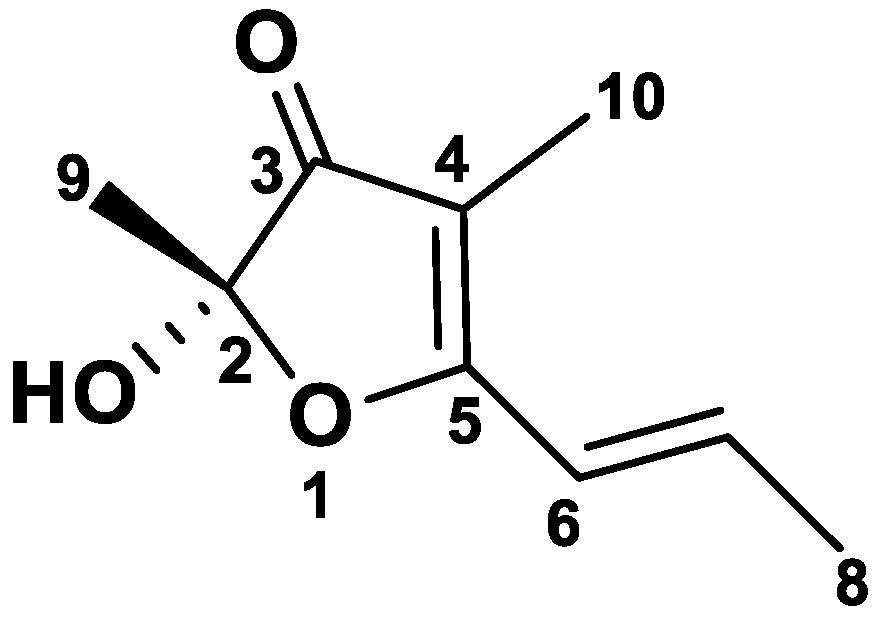
Figure 2.
Production of BPF3-1 during time-course fermentation in flasks.
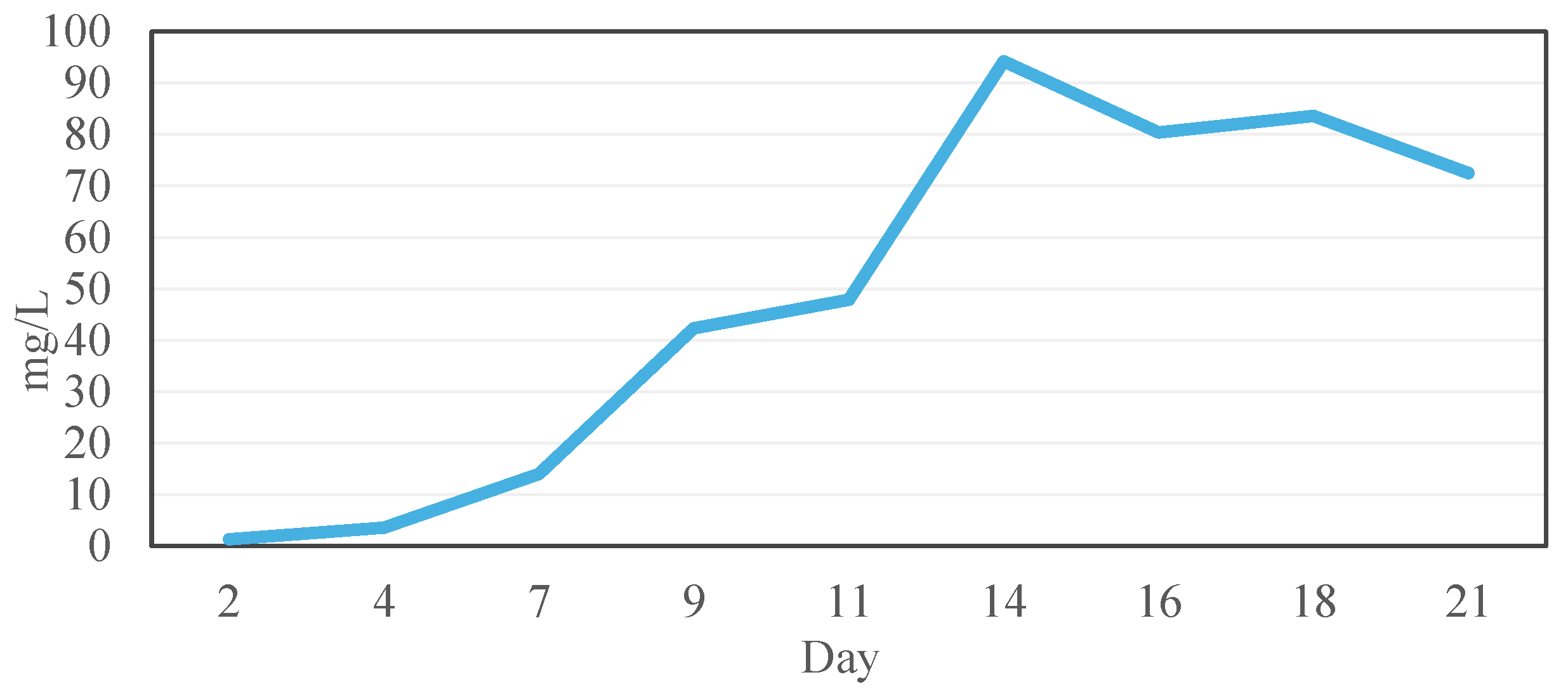
Figure 3.
Bioprocess profile of BPF3 in bioreactor fermentation.
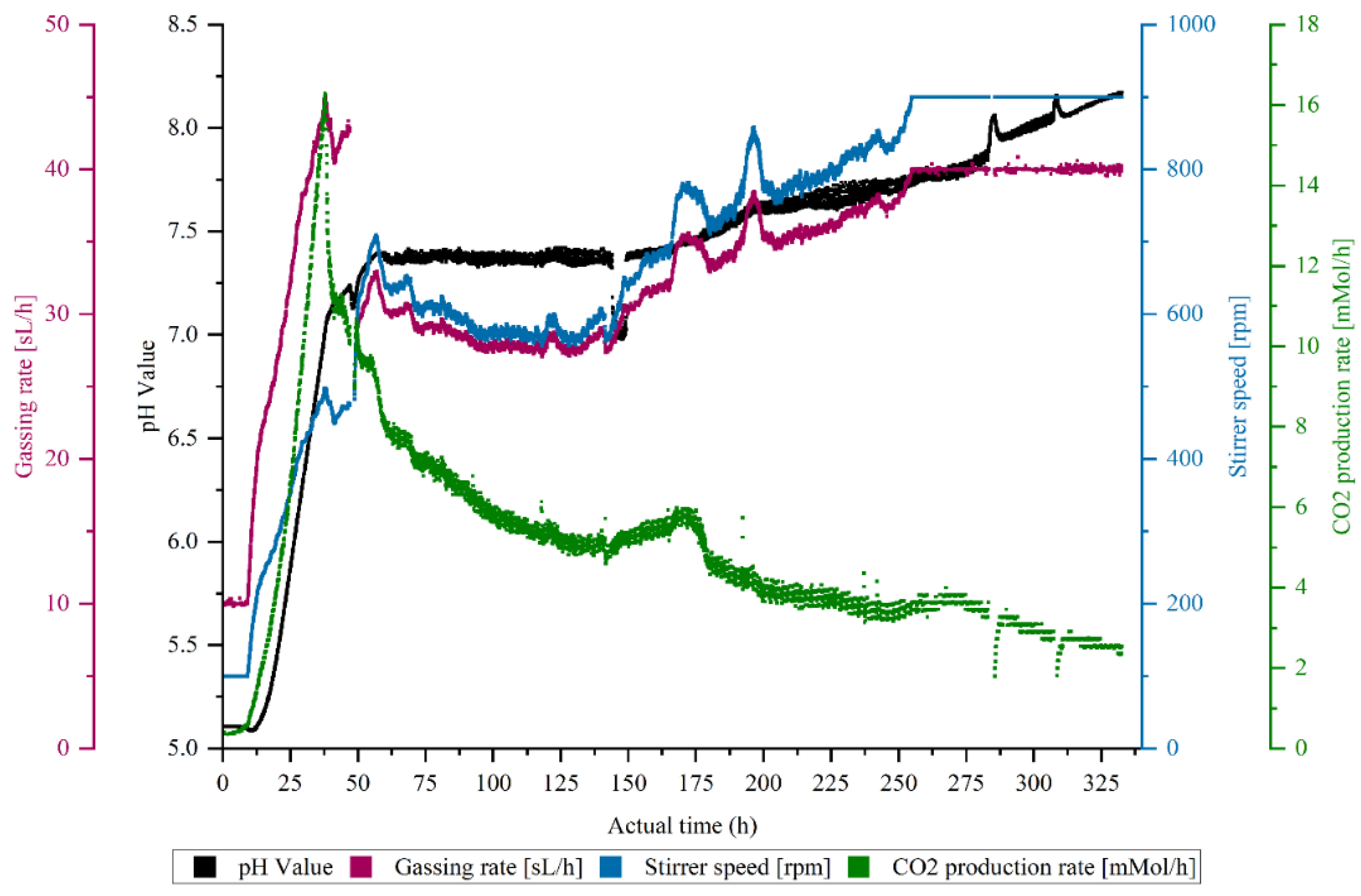
Figure 4.
BPF3-1 production over time in bioreactor fermentation.
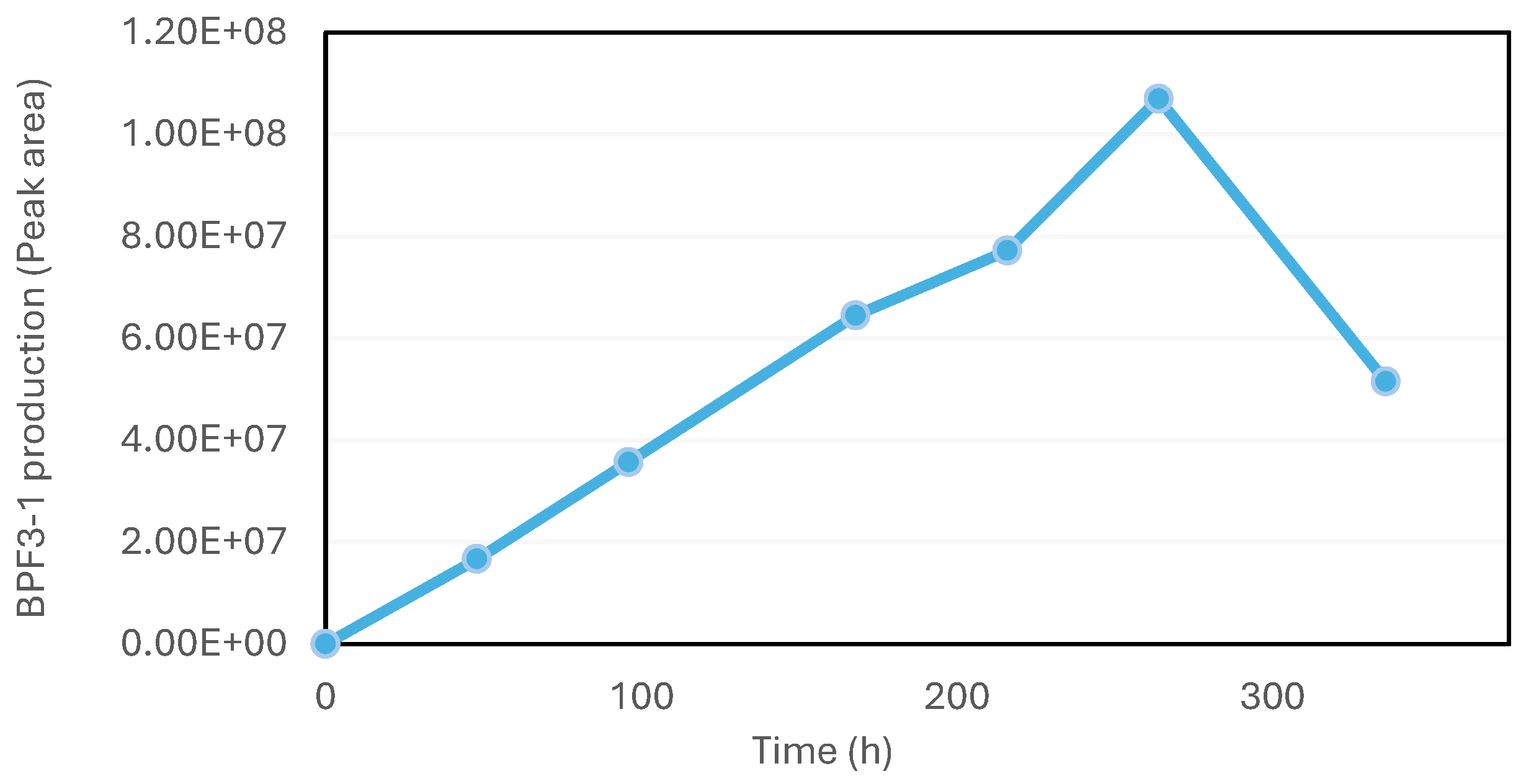

Table 1.
Modifications to the culture medium conditions.
| Modifications | Sample | Abbreviation |
|---|---|---|
| Base medium | Czapek-Dox-Mod | CT |
| Glucose 9% | G9 | |
| Glucose 12% | G12 | |
| Carbon source | Fructose 6% | F6 |
| Fructose 9% | F9 | |
| Fructose 12% | F12 | |
| Sodium nitrate 0.6% | N 0.6 | |
| Sodium nitrate 1% | N 1 | |
| Inorganic nitrogen source | Ammonium dihydrogen phosphate 0.2% | A 0.2 |
| Ammonium dihydrogen phosphate 0.6% | A 0.6 | |
| Ammonium dihydrogen phosphate 1% | A 1 | |
| Yeast extract 0.75% | Y 0.75 | |
| Yeast extract 1.5% | Y 1.5 | |
| Organic nitrogen source | Mycological peptone 0.1% | P 0.1 |
| Mycological peptone 0.75% | P 0.75 | |
| Peptone 1.5% | P 1.5 | |
| Mixed conditions | Fructose 6% Peptone 0.1% | FP |
Table 2.
Bioactivity of the macroextract and effective dose (EC50) of the bioactive compound BPF3-1.
Table 2.
Bioactivity of the macroextract and effective dose (EC50) of the bioactive compound BPF3-1.
| Target | Concentration | Macroextract bioactivity (%) | BPF3-1 EC50 |
| Myzus persicae | 100 µg/cm2 | 88.5 ± 3.2 | 16.2 [11.9-22.1] |
| Spodoptera littoralis | 100 µg/cm2 | 96.8 ± 3.2 | NA |
| Rhipicephalus bursa | 40 µg/mg | 100 ± 0 | 8.63 [8.39-8.85] |
| Botrytis cinerea | 800 µg/mL | 66.6 ± 2.3 | 335.8 [154.2-727.52] |
| Dickeya dadantii | 800 µg/mL | 51.7 ± 0.6 | 56.5 [42.07-74.69] |
| Pseudomonas syringae | 800 µg/mL | 71.4 ± 0.2 | 16.30 [12.32-20.76] |
NA= not active.
Table 3.
Production of extract, BPF3-1 per liter and % in extract in different culture medium modifications.
Table 3.
Production of extract, BPF3-1 per liter and % in extract in different culture medium modifications.
| Sample | Extract (mg) | mg BPF3-1·L-1 fermentation | % BPF3-1 in extract |
| CT | 92.2 | 18.6 | 3.0 |
| G9 | 37.2 | 6.6 | 2.7 |
| G12 | 152 | 27.2 | 2.6 |
| F6 | 24.7 | 12.7 | 7.7 |
| F9 | 48.2 | 1.6 | 0.5 |
| F12 | 219.3 | 30.1 | 2.0 |
| N 0.6 | 33.3 | 14.7 | 6.6 |
| N 1 | 33.1 | 16.6 | 6.7 |
| A 0.2 | 61.8 | 2.2 | 0.5 |
| A 0.6 | 53.1 | ND | ND |
| A 1 | 31.7 | ND | ND |
| Y 0.75 | 85.8 | 3.6 | 0.6 |
| Y 1.5 | 90.7 | 2.4 | 0.4 |
| P 0.1 | 32 | 70.9 | 33.2 |
| P 0.75 | 30.6 | 4.2 | 2.0 |
| P 1.5 | 63.3 | 3.8 | 0.9 |
| FP | 45.8 | 90.7 | 29.7 |
ND= non-detectable.
Disclaimer/Publisher’s Note: The statements, opinions and data contained in all publications are solely those of the individual author(s) and contributor(s) and not of MDPI and/or the editor(s). MDPI and/or the editor(s) disclaim responsibility for any injury to people or property resulting from any ideas, methods, instructions or products referred to in the content. |
© 2026 by the authors. Licensee MDPI, Basel, Switzerland. This article is an open access article distributed under the terms and conditions of the Creative Commons Attribution (CC BY) license (http://creativecommons.org/licenses/by/4.0/).
Copyright: This open access article is published under a Creative Commons CC BY 4.0 license, which permit the free download, distribution, and reuse, provided that the author and preprint are cited in any reuse.