

Submitted:
23 September 2026
Posted:
24 September 2026
You are already at the latest version
Abstract
The Sylvester-type equation has applications in many fields, such as control theory, scientific computing, and signal processing. However, research on the Sylvester-type equation over dual quaternions remains limited. In this paper, using generalized inverses and matrix rank , we provide necessary and sufficient conditions for the solvability of the dual quaternion matrix equation AX+BYC+ZD=E. When the solvability conditions are satisfied, the general expression of the solution is derived. Subsequently, a numerical example is presented to verify the obtained results. Finally, based on these results, an application in color image encryption and decryption is provided.
Keywords:
dual quaternion
; matrix equation
; generalized inverse
; solvability conditions
; general solution
1. Introduction
In 1843, Hamilton proposed the concept of quaternion [1]. After more than a hundred years of development, quaternions have been widely used in many fields up to now, including color face recognition, aerospace, system control, robotics industry, artificial intelligence [2,3,4,5,6] and so on. The set of quaternions, denotes the field of real numbers, denoted by as follows,
which is a non-commutative division ring. Beyond its theoretical foundations, recent work has demonstrated that quaternions offer a powerful tool for model optimization and solving [7]. Furthermore, advances in quaternion matrix calculations point to its broader applicability in emerging domains [8]. In addition, solving quaternion matrix equations is an important issue in many fields such as scientific computing and engineering applications. For more research on quaternions and quaternion matrix equations, please refer to [38,39,40,41,42,48].
Later, Clifford introduced the concept of dual numbers and dual quaternions [9]. Dual quaternions offer a unified mathematical representation for both the rotation and translation components of 3D rigid body motion, making them indispensable in numerous areas of mathematics and physics [10,11,12,13,14,15,16,17]. Dual quaternion matrix equations have also been investigated by a number of scholars and the scope of the research is extensive [44,45,46,47].
As an important type of matrix equations, the Sylvester and Sylvester-type matrix equations have been applied in many fields such as system design [18], control theory [19], sensitivity analysis [20] and data transmission [43]. For this reason, they have attracted the attention of many scholars. Early fundamental research on matrix equations was carried out in real and complex fields. The Sylvester-type matrix equation
was studied by Roth [21] over polynomial integer rings, while Baksalary and Kalamany [22] focused on its solvability and the structure of its general solutions, then He [23] made further investigations into matrix Equation (1). As research progresses, the investigations on Sylvester-type matrix equations have been extended to and in the last decades [49,52]. Scholars have deeply explored generalized Sylvester equations, and various extended matrix systems, and systematically studied solvability criteria, general solutions and constrained solutions such as Hermitian and positive definite solutions by means of generalized inverse, matrix rank method and iterative algorithm, which further enriched the theoretical connotation of non-commutative matrix equations [24,25,26,27,28,29,30]. For dual quaternion matrix equations. Xie and Wang [31] derived the solvability conditions for matrix Equation (1) , and presented the general form of its solution under solvable conditions. This result is of considerable importance to the study of matrix equations. Furthermore, for dual quaternion matrix equation
Li and Wang [32] investigated both this equation and another symmetric counterpart. Subsequent researches further expanded to bilateral coupled equations and constrained solution problems, but most of the research objects are limited to single-variable or two-variable simple structures [30,32,50,51]. The research on dual quaternion matrix equations with multiple unknown matrices is still relatively scarce, and the relevant theoretical achievements need to be further supplemented and perfected.
Motivated by the studies of the above equations and based on Equations (1) and (2), in this paper, we focus on dual quaternion matrix equation
We adopt Moore-Penrose inverse and rank equalities for matrices to investigate the solvability conditions for Equation (3) and, when it is solvable, to present its general solution expression.
The structure of this paper is organized as follows: Section 2 is devoted to several key definitions and lemmas. In Section 3, the main theorems concerning the dual quaternion matrix equation (3) are formally established. In Section 4, a numerical example is given to validate the main results. Their application to color image encryption and decryption is discussed in Section 5. Finally, Section 6 offers a concise summary of the paper.
2. Preliminaries
In this section, we introduce some fundamental definitions and properties of quaternions and dual quaternions, and present several lemmas that are useful for solving equations.
In this paper, all matrices over is denoted by , denotes the rank of A. In general, stands for the Moore-Penrose inverse of , which is defined as the solution of
Moreover, and are two projectors associated with A . I and 0 denote the identity matrix and zero matrix with appropriate sizes.
Definition 2.1([33]): Let . We say x is a dual quaternion if x has the form
where is the infinitesimal unit, satisfying , as the real part and the dual part of x , respectively.
The set of dual quaternions is denoted by
Now, we introduce the definition of dual quaternion matrix. Let . X is said to be a dual quaternion matrix if X has the form ; the set of dual quaternion matrices is denoted by
For , we have if and ; furthermore,
Lemma 2.1([34]): Let A, B, and C be arbitrary matrices over with appropriate dimensions. Then, the following equalities hold:
- (i)
- .
- (ii)
- , .
- (iii)
- , .
Lemma 2.2([35]): Suppose that , , and . Then, the quaternion matrix equation is consistent if and only if
In this case, the general solution can be expressed as
where are arbitrary.
Lemma 2.3 ([22]): Let and be given matrices with suitable sizes. Then, the Sylvester-type Equation is solvable if and only if
In this case, the general solution to the Equation can be expressed as
where and are arbitrary matrices with appropriate sizes.
For clarity in block matrix notation, we use commas as separators. For example, the block matrix is denoted as .
Lemma 2.4 ([36]): Let , , and . Set
Then, the following descriptions are equivalent.
- (i)
- The quaternion matrix equationis consistent.
- (ii)
- , , .
- (iii)
In this case, the general solution to the Equation can be expressed as
where are arbitrary matrices over with appropriate sizes.
Lemma 2.5 ([37]): Assume that , , , , and . Then, the following statements hold.
- (i)
- .
3. General Solutions of Equation (3)
In this section, we first establish the necessary and sufficient conditions for the solvability of the dual quaternion matrix equation (3). We then provide their general solution expressions under the condition of solvability.
Theorem 3.1: Let , , , , . Denote
Then, the following statements are equivalent.
(i) The dual quaternion matrix equation (3) is consistent.
(ii)
(iii)
In this case, the general solution X, Y and Z of equation (3) can be expressed as , , , where
with arbitrary .
Proof. The entire proof process consists of two steps: first, we prove that (i) ⇔ (ii) and derive the expression for the general solution; then, prove that (ii) ⇔ (iii) .
We assume that Equation (3) is solvable with solutions , and , which can be expressed as
Substituting these expressions into the Equation (3), we obtain that the dual quaternion matrix Equation (3) is equivalent to the following system of quaternion matrix equations
By manipulating the Equation (10), we obtain
From Lemma 2.3, we conclude that (12) is consistent if and only if the following condition holds
which is equivalent to
In this case, the general solution to (10) can be written as
By applying Lemma 2.3, we conclude that (15) is consistent if and only if
Simplifying (16), we obtain
(17) is consistent if and only if
This leads to the consistency condition
By Lemma 2.4, we conclude that (19) is consistent if and only if
In this case, the general solution of (19) can be written as
Substituting (20) and (21) into (17), and using Lemma 2.2, the general solution for can be written as
Substituting (20) , (21) and (22) into (15), and again using Lemma 2.3, the general solution for and can be written as
where are arbitrary matrices over with appropriate dimensions.
In summary, we have proven the equivalence of (i) and (ii) . Additionally, we have derived the expression for the general solution.
Finally, we prove the equivalence between (ii) and (iii). According to Lemma 2.5, it can be verified that (4) ⇔ (6).
It is straightforward to verify that , and form a particular solution to the quaternion matrix equation . Now, applying Lemma 2.5, we obtain
4. Numerical Example
Section 3 introduces Theorem 3.1 and presents the general solutions for Equation (3) when it is solvable. In this section, based on Theorem 3.1, we provide Algorithm 1 for solving Equation (3) and perform extensive numerical experiments to validate the error.
| Algorithm 1 Solving the Equation (3) over dual quaternions |
| 1. Input: The coefficient matrices A, B, C, D andE. |
| 2. By directly calculating the formulas (4) and (5) in Theorem 3.1. If all formulas hold, proceed |
| to the next step. If any formula does not hold, output ’The equation has no solution’. |
| 3. By using the coefficient matrices A, B, C , D andE determined above, and combining them |
| with formulas (8) in Theorem 3.1, the general solutions of , , , and , , and |
| can be calculated. |
| 4. Output: , , , and , , . |
For a matrix X, the expression denotes the submatrix consisting of all rows of X and the columns from i to j. Next, we present Example to validate the effectiveness of Algorithm 1.
Example: Given dual quaternion matrices , , and , as
Then we examine the solvability of Equation (3). By computing with M, N, T, P, Q, , , , and in Theorem 3.1, it can be calculated that
In this case, the Equation (3) is consistent. Using Matlab along with Algorithm 1, the general solution can be expressed as follows:
For the sake of conciseness, the numerical values of are not enumerated here. Specifically, if we select the random matrices and in (24) as:
thus, a specific solution of Equation (3) is
Therefore, we obtain
The Frobenius norm is sensitive to every element of the matrix, so any modification may change its value. Since we naturally desire a more accurate reflection of the error, the Frobenius norm is adopted for error computation.
Additionally, we randomly generated 10,000 different sets of and , all resulting errors were less than . Hence, Theorem 3.1 is effective for solving the dual quaternion matrix equation (3) within the permissible error range.
5. Applications
In this section, we present an image encryption and decryption scheme based on matrix equation (3), which is successfully validated through examples. A quaternion matrix is capable of representing a single colour image, while a dual quaternion matrix, which contains two quaternion matrices, can represent two colour images simultaneously, thereby making it more attractive in the field of image processing. In the proof of Theorem 3.1, it is known that equation (3) is equivalent to system (9). Our encryption and decryption procedures are carried out based on system (9), as shown in Figure 1 .
Now, we describe the overall framework for encryption and decryption. In matrix system (9), two equations involve six variables. By imposing , , and treating the image represented by as the key image, encryption and decryption procedures are facilitated with enhanced smoothness and efficiency. Figure 1 is composed of the following components. ,,,,,, and are encryption matrices, or the coefficient matrices. and denote two original images, is a key image. These images are encrypted using the formulas presented in Figure 1, yielding two encrypted images and . These encryption matrices are publicly accessible, only the receiver holds the key image , the receiver can restore original images from their encrypted counterparts. The detailed encryption and decryption processes are provided by Algorithm 2 and 3.
| Algorithm 2 Encryption Process |
| 1. Input: Two original colour images , one key image and encryption matrices . |
| 2. Let and represent two colour images respectively. represents the key image . |
| The encryption matrices are ,,,,,, and . |
| 3. Encrypt and using the encryption method in Figure 1. |
| 4.Two encrypted images, and , are obtained. |
| 5. Output: Two encrypted colour images. |
| Algorithm 3 Decryption Process |
| 1. Input: Two encrypted colour images , one key image and encryption matrices. |
| 2. and are two encrypted colour images. |
| 3. By applying Theorem 3.1 and setting , ,, the matrices and |
| can be derived. |
| 4. Two colour images, denoted as and , can be obtained. |
| 5. Output: Two decrypted colour images . |
Using two original images and one as the key, Algorithms 2 and 3 are applied so that the results shown in Figure 2 are obtained. To evaluate the performance,the Structural Similarity Index (SSIM), Feature Similarity Index (FSIM) and Peak Signal-to-Noise Ratio (PSNR) are computed, the results are recorded in Table 4.
From Table 4, it can be observed that the SSIM and FSIM values both equal 1, which implies perfect decryption with negligible information loss. In addition, the PSNR values consistently exceed 42, indicating outstanding image quality and a high degree of similarity to the original images. The results presented in Table 4 confirm the feasibility of the proposed scheme.
6. Conclusions
In this paper, we derive the necessary and sufficient conditions for the solvability of the dual quaternion matrix equation (3) by adopting the methods of generalized inverses and matrix rank equalities, and present the general solutions expression when the equation is solvable. Afterwards, we give a numerical example to verify the theoretical results. Finally, the application to color image encryption and decryption demonstrates that the model characterized in Figure 1 achieves satisfactory performance. Future work may involve further investigation of matrix equations over commutative quaternions.
Author Contributions
Methodology, C.L. and Q.-W.W.; Software, C.L.; Investigation, Q.-W.W.; Writing—original draft, C.L.; Writing—review and editing, Q.-W.W.; Supervision, Q.-W.W.; Funding acquisition, Q.-W.W. All authors have read and agreed to the published version of the manuscript.
Funding
This research is supported by the National Natural Science Foundation of China (grant number 12371023).
Data Availability Statement
No potential conflict of interest was reported by the authors.
Conflicts of Interest
Data are contained within the article.
References
- Hamilton, W.R. Lectures on quaternions; Hodges, Smith, Eds.; Dublin, 1853. [Google Scholar]
- Zou, Cuiming.; Kou, Kit Ian.; Wang, Yulong. Quarernion collaborative and sparse representation with application to color face recognition. IEEE Trans. Image Process. 2016, 25, 3287–3302. [Google Scholar] [CrossRef]
- Qi, Liqun.; Luo, Ziyan.; Wang, QingWen.; Zhang, Xinzhen. Quaternion Matrix Optimization: Motivation and Analysis. J. Optim. Theory Appl. 2022, 193, 621–648. [Google Scholar] [CrossRef]
- Pang, Denghao.; Pu, Yuanfan.; Liu, Kaixuan.; Jiang, Wei. Controllability of Nonlinear Quaternion-Valued Systems with Input-Delay. Qual.Theory Dyn.Syst. 2024, 23, 240. [Google Scholar] [CrossRef]
- McCarthy, J Michael. Quaternions in kinematics. Mech. Mach. Theory 2025, 209, 105949. [Google Scholar] [CrossRef]
- Zhou, Heng.; Zhong, Ping. Orthogonal and spherical quaternion features for weakly supervised learning with label confidence optimization. Appl. Intell. 2025, 55, 697. [Google Scholar] [CrossRef]
- Chen, Xin.; Cui, Chunfeng.; Han, Deren.; Qi, Liqun. Non-convex Pose Graph Optimization in SLAM via Proximal Linearized Riemannian ADMM. J. Optim. Theory Appl. 2025, 206, 78. [Google Scholar] [CrossRef]
- Yu, CuiE.; Liu, Xin.; Zhang, Yang. A New Complex Structure-Preserving Method for QSVD. J. Sci. Comput. 2024, 99, 37. [Google Scholar] [CrossRef]
- Clifford. Preliminary sketch of biquaternions. Proc. Lond. Math. Soc. 1897, 1, 381–395. [Google Scholar] [CrossRef]
- Yaqub, Zülal Derin; Schröcker, Hans-Peter. Rational motions of minimal quaternionic degree with prescribed plane trajectories. J. Comput. Appl. Math. 2026, 474, 116949. [Google Scholar] [CrossRef]
- Brambley, alen.; Kim, Jonghyuk. Unit dual quaternion-based pose optimisation for visual runway observations. IET Cyber-Syst. Robot. 2020, 2, 181–189. [Google Scholar] [CrossRef]
- Cheng, Jiantong.; Kim, Jonghyuk.; Jiang, Zhenyu.; Che, Wanfang. Dual quaternion-based graph SLAM. Robot. Auton. Syst. 2016, 77, 15–24. [Google Scholar] [CrossRef]
- Wang, Xiangke.; Yu, Changbin.; Lin, Zhiyun. A dual quaternion solution to attitude and position control for rigid body coordination. IEEE Trans. Rob. 2012, 28, 1162–1170. [Google Scholar] [CrossRef]
- Gao, Zihan.; Wang, Qingwen.; Xie, Lvming. A novel Moore–Penrose inverse to dual quaternion matrices with applications. Appl. Math. Lett. 2026, 172, 109727. [Google Scholar] [CrossRef]
- Zhong, Jin.; Zhong, Ping. A Mirsky-Type Unitarily Invariant Norm Inequality for Dual Quaternion Matrices and Its Applications. Symmetry 2025, 17, 1355. [Google Scholar] [CrossRef]
- Qi, Liqun.; Cui, Chunfeng. Eigenvalues of dual Hermitian matrices with application in formation control. SIAM J. Matrix Anal. Appl. 2024, 45, 2135–2154. [Google Scholar] [CrossRef]
- Qi, Liqun.; Cui, Chunfeng. Dual Markov chain and dual number matrices with nonnegative standard parts. Commun. Appl.Math. Comput. 2025, 7, 2442–2461. [Google Scholar] [CrossRef]
- Syrmos, Vassilis L.; Lewis, Frank L. Coupled and constrained Sylvester equations in system design. Circuits Syst. Signal Process. 1994, 13, 66–94. [Google Scholar] [CrossRef]
- Shahzad, Amir.; Jones, Bryn Ll.; Kerrigan, Eric C.; Constantinides, George A. An efficient algorithm for the solution of a coupled sylvester equation appearing in descriptor systems. Automatica 2011, 47, 24–48. [Google Scholar] [CrossRef]
- Barraud, Alain.; Lesecq, Suzanne.; Christov, Nicolai. From sensitivity analysis to random floating point arithmetics-application to Sylvester equations. In Lecture Notes in Computer Science; Berlin, Heidelberg, 2001; vol 1988, pp. 35–41. [Google Scholar] [CrossRef]
- Roth, William E. The equations AX-YB=C and AX-XB=C in matrices. Proc. Am. Math. Soc. 1952, 3, 392–396. [Google Scholar] [CrossRef]
- Baksalary, J.K.; Kala, R. The matrix equations AX-YB=C. Linear Algebra Appl. 1979, 25, 41–43. [Google Scholar] [CrossRef]
- He, Zhuoheng. Some new results on a system of Sylvester-type quaternion matrix equations. Linear Multilinear Algebra 2021, 69, 3069–3091. [Google Scholar] [CrossRef]
- Rehman, Abdur.; Kyrchei, Ivan. Hermitian solution to constraint system of generalized Sylvester quaternion matrix equations. Arab. J. Math. 2024, 13, 595–610. [Google Scholar] [CrossRef]
- Wang, Qingwen.; Rehman, Abdur.; He, Zhuoheng.; Zhang, Yang. Constraint generalized Sylvester matrix equations. Automatica 2016, 69, 60–64. [Google Scholar] [CrossRef]
- Mehany, Mahmoud Saad.; Wang, QingWen.; Gao, Jiale. Solvability conditions and the general solution to a system of quaternion tensor equations with applications. Comp. Appl. Math. 2026, 45, 198. [Google Scholar] [CrossRef]
- Wang, Hua.; Jin, Xiaoju.; Huang, Junjie. On Roth-type solvability criteria for generalized Sylvester matrix and operator equations. Adv. Oper. Theory 2025, 10, 64. [Google Scholar] [CrossRef]
- Şimşek, Sinem. Least-Squares Solutions of Generalized Sylvester-Type Quaternion Matrix Equations. Adv. Appl. Clifford Algebr. 2023, 33, 28. [Google Scholar] [CrossRef]
- Voet, Yannis. Preconditioning Techniques for Generalized Sylvester Matrix Equations. Numer Linear Algebra Appl. 2025, 32, e70020. [Google Scholar] [CrossRef]
- Wang, Xiang.; Li, Wenwei.; Mao, Liangzhi. On positive-definite and skew-Hermitian splitting iteration methods for continuous Sylvester equation AX+XB=C. Comput. Math. With Appl. 2013, 66, 2352–2361. [Google Scholar] [CrossRef]
- Xie, Lvming.; Wang, Qingwen.; He, Zhuoheng. The generalized hand-eye calibration matrix equation AX-YB=C over dual quaternions. Comp. Appl. Math. 2025, 44, 137. [Google Scholar] [CrossRef]
- Li, Yufei.; Wang, Qingwen.; Gao, Zihan. The solvability and general solutions to two dual quaternion matrix equations with applications. Int. J. Comput. Math. 2026, 103, 898–920. [Google Scholar] [CrossRef]
- Qi, Liqun.; Ling, Chen.; Yan, Hong. Dual quaternions and dual quaternion vectors. Commun. Appl. Math. Comput. 2022, 4, 1494–1508. [Google Scholar] [CrossRef]
- Wang, Qingwen.; Li, Chengkun. Ranks and the least-norm of the general solution to a system of quaternion matrix equations. Linear Algebra Appl. 2009, 430, 1626–1640. [Google Scholar] [CrossRef]
- He, Zhuoheng.; Wang, Qingwen. The general solutions to some systems of matrix equations. Linear Multilinear Algebra 2015, 63, 2017–2032. [Google Scholar] [CrossRef]
- Xie, Mengyan.; Wang, Qingwen. The reducible solution to a quaternion tensor equation. Front. Math. China 2020, 15, 1047–1070. [Google Scholar] [CrossRef]
- Matsaglia, George.; PH Styan, George. Equalities and inequalities for ranks of matrices. Linear Multilinear Algebra 1974, 2, 269–292. [CrossRef]
- Han, Sujia.; Song, Caiqin. H-representation method for the least squares symmetric solutions of the reduced biquaternion matrix equation and its application in color image restoration. Numer Algor 2026, 101, 1537–1566. [Google Scholar] [CrossRef]
- He, Zhuoheng.; Wang, Xiangxiang.; Zhao, Yunfan. Eigenvalues of Quaternion Tensors with Applications to Color Video Processing. J. Sci. Comput 2023, 94, 1. [Google Scholar] [CrossRef]
- Liu, Wankai.; Kou, Kit Ian.; Miao, Jifei.; Cai, Zhenfeng. Quaternion Scalar and Vector Norm Decomposition: Quaternion PCA for Color Face Recognition. IEEE Trans. Image Process. 2023, 32, 446–457. [Google Scholar] [CrossRef]
- Li, Tao.; Wang, Qingwen. QQMR: A structure preserving quaternion quasi-minimal residual method. Math. Comput. 2026, 95, 867–896. [Google Scholar] [CrossRef]
- Zhang, Xianzhe.; Song, Caiqin.; Vasil’ev, V.I.; Wang, Gang. Structure Preserving Quaternion Biconjugate Residual Algorithm with Application. J. Sci. Comput 2025, 104, 32. [Google Scholar] [CrossRef]
- He, Zhuoheng.; Qin, Weilu.; Tian, Jie.; Wang, Xiangxiang.; Zhang, Yang. A new Sylvester-type quaternion matrix equation model for color image data transmission. Comput. Appl. Math. 2024, 43, 227. [Google Scholar] [CrossRef]
- Xie, Lvming.; Wang, Qingwen. Some novel results on a classical system of matrix equations over the dual quaternion algebra. Filomat 2025, 39, 1477–1490. [Google Scholar] [CrossRef]
- Tu, Qiuxiang.; Song, Guangjing.; Dong, Changzhou.; Liu, Qi. Dual quaternion matrix formulation for robust 3D point cloud registration. Appl. Math. Lett. 2026, 175, 109853. [Google Scholar] [CrossRef]
- Zhang, Mingcui.; Li, Ying.; Wang, Tao.; Sun, Jianhua. QR decomposition of dual quaternion matrix and blind watermarking scheme. Numer. Algorithms 2025, 99, 1763–1790. [Google Scholar] [CrossRef]
- Wang, Tao.; Li, Ying.; Zhang, Mingcui.; Wei, Musheng.; Guo, Wenbin. A fast construction algorithm for compact singular value decomposition of dual quaternion matrix and its application. Numer Algor 2026, 101, 1073–1096. [Google Scholar] [CrossRef]
- Wang, Qingwen.; Xie, Lvming.; Gao, Zihan. A Survey on the Classical Matrix Equation AXB=C with Applications. Preprints 2025, 13, 450. [Google Scholar] [CrossRef]
- Wang, Qingwen.; Gao, Jiale. A Comprehensive Review on the Generalized Sylvester Equation AX-YB = C. Symmetry 2025, 17, 1686. [Google Scholar] [CrossRef]
- Wang, Qingwen.; Gao, Zihan.; Gao, Jiale. A Comprehensive Review on Solving the System of Equations AX = C and XB = D. Symmetry 2025, 17, 625. [Google Scholar] [CrossRef]
- Wang, Qingwen.; Gao, Zihan.; Li, Yufei. An Overview of Methods for Solving the System of Equations A1XB1 = C1 and A2XB2 = C2. Symmetry 2025, 17, 1307. [Google Scholar] [CrossRef]
- Wang, Qingwen.; Gao, Jiale. A Review on Solving Sylvester-Type Equations. Symmetry 2026, 18, 984. [Google Scholar] [CrossRef]
Figure 1.
Encryption and decryption scheme.

Figure 2.
Encryption and decryption result display.
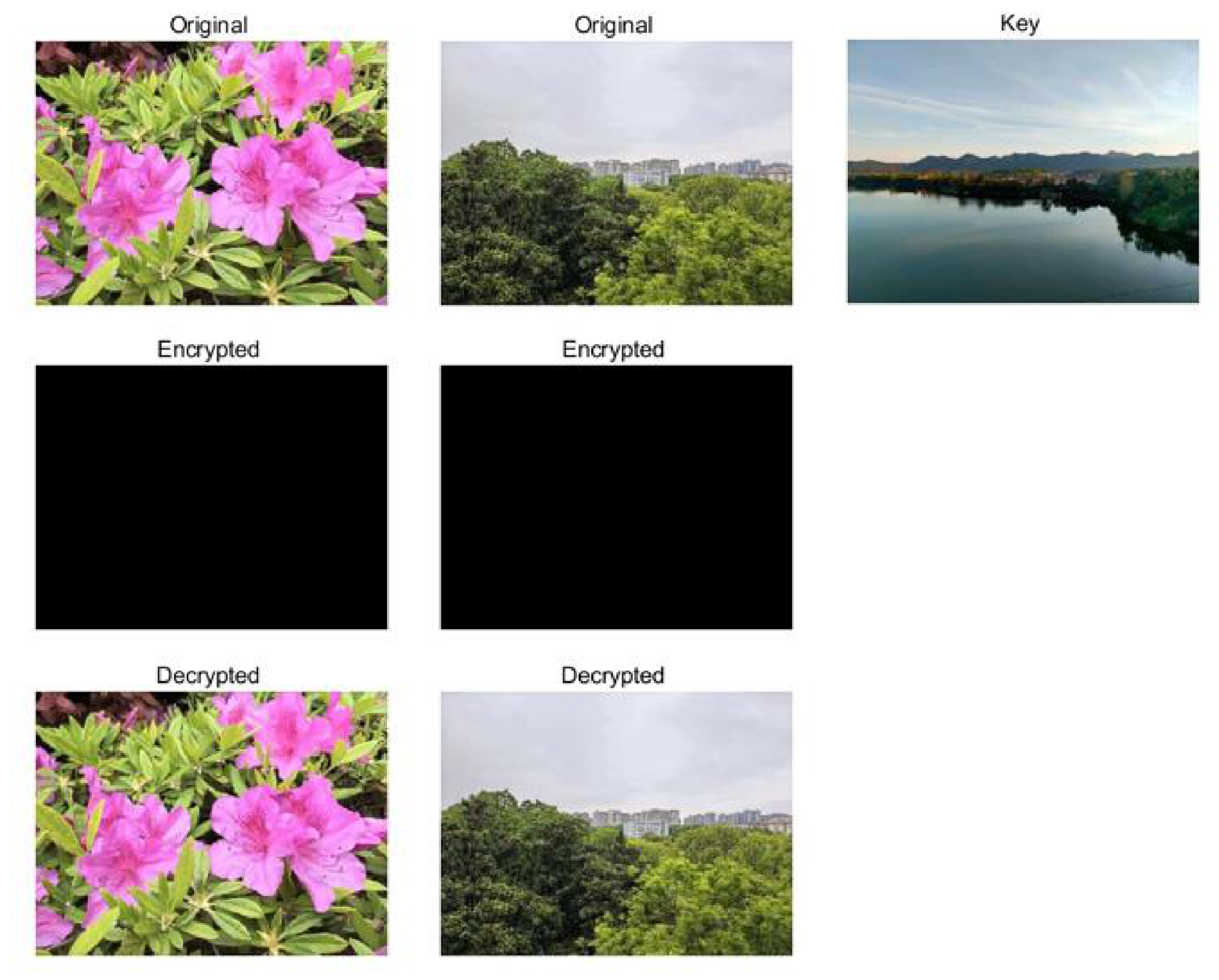

Table 1.
SSIM, FSIM and PSNR.
| SSIM | FSIM | PSNR | |
|---|---|---|---|
| Decrypted image of the original image 1 | 1 | 1 | 290.3473 |
| Decrypted image of the original image 2 | 1 | 1 | 289.2546 |
Disclaimer/Publisher’s Note: The statements, opinions and data contained in all publications are solely those of the individual author(s) and contributor(s) and not of MDPI and/or the editor(s). MDPI and/or the editor(s) disclaim responsibility for any injury to people or property resulting from any ideas, methods, instructions or products referred to in the content. |
© 2026 by the authors. Licensee MDPI, Basel, Switzerland. This article is an open access article distributed under the terms and conditions of the Creative Commons Attribution (CC BY) license.
Copyright: This open access article is published under a Creative Commons CC BY 4.0 license, which permit the free download, distribution, and reuse, provided that the author and preprint are cited in any reuse.