

Submitted:
22 September 2026
Posted:
24 September 2026
You are already at the latest version
Abstract
The integrated conceptualization of the two transformation processes surrounding digitalization and ecological sustainability is described as the Twin Transition and places enormous transformative pressure not only on society but also on the political-administrative system. Within the logic of the state system, this pressure is legitimized by society and its collectivized needs and is therefore also committed to a common-good-oriented shaping of impending disruptive processes such as digitalization or ecological sustainability. This implies the most targeted, efficient, and effective possible management of comprehensive transformation processes in accordance with democratically legitimized objectives, such as a digitalized public administration or climate neutrality. Various investigations and studies make clear that political steering and concrete goal-setting are necessary in the context of the Twin Transition in order to realize synergetic effects and to avoid negative interactions or rebound effects. The heuristic of the “Integrated Policy Cycle” seeks to provide a tool for investigating the Twin Transition. It outlines ideal-typical changes for the political management of the dual transformation under the condition of a digitalized state and a digitalized public administration. In a recent contribution, the “Integrated Policy Cycle” was already used for a market exploration and an examination of digital software solutions in the area of ESG reporting. The present contribution seeks, by means of qualitative, semi-structured expert interviews, to explore which changes experts in the field of the Twin Transition expect for its political management under the condition of a digitalized state. These findings are systematically prepared using a Framework Analysis and visualized in tabular form. Based on this visualization, a comparison is then conducted with the existing heuristic of the Integrated Policy Cycle.
Keywords:
twin transition
; integrated policy cycle
; public administration
; sustainability politics
; twin transformation
1. Introduction
The simultaneous and interconnected transformation processes of digitalization and ecological sustainability are frequently described as the Twin Transition (Fouquet & Hippe, 2022, pp. 1; Müller et al., 2024, p. 58; Montresor & Vezzani, 2023; Muench et al., 2022; Sabljić, 2025, p. 4096; Shajari & Istvan, 2025; Wintermann et al., 2022; Preziuso, 2026, p. 2). The term Twin Transition is often used as a political and macroeconomic concept describing the simultaneous occurrence of both a digital and a sustainable transformation. The term Twin Transformation is frequently employed as the business- and management-related application of the concept and idea of simultaneously occurring transformation processes concerning sustainability and digitalization. The present contribution therefore adopts the political and macroeconomic interpretation of the term Twin Transition and understands it both as a policy objective of the European Union and as an analytical category. The effects of anthropogenic cliamte change1 and digitalization are already perceptible to many. In this context, the state is placed under pressure not only by the transformation processes themselves, but their simultaneity also requires clear directives, a concrete framework, and a strategic orientation. Political frameworks, objectives, and targeted governance appear in several studies as key factors for the simultaneous success of both transformations (Bieser et al., 2020, p. 48; Boehme et al., 2023, pp. 23, 28; Digitalization for Sustainability, 2022, p. 3; Frank, 2025, p. 78; Fouquet & Hippe, 2022, p. 1; Hielscher et al., 2025, p. 10; Santarius et al., 2023, p. 11; cf. Sareen & Müller, 2023, p. 8; Stede et al., 2024, p. 78). In this regard, political steering of the Twin Transition should avoid adverse interactions such as rebound effects, lock-ins, or unintended consequences (de Haan et al., 2015; Golde, 2016, p. 9; Grosh et al., 2023, p. 5; Hilty et al., 2006; Hilty & Bieser, 2017; Niet, 2023, p. 452; Scholz et al., 2018). However, these effects are difficult to quantify and exhibit considerable variation depending on the technology, sector, or individual case (Accenture & Bitkom, 2024, p. 91; Golde, 2016, p. 7). Hilty and Bieser systematically identify corresponding rebound effects across various application scenarios (Hilty & Bieser, 2017, p. 31). The projected potential of digitalization for sustainability can scarcely be fully realized. Such potential is expected in the areas of productivity, energy, climate adaptation, agriculture, fiscal stability, inclusiveness, governance, mobility and logistics, urban planning, as well as warning and emergency systems (Bieser et al., 2023, pp. 6, 10; Charles et al., 2022, p. 14; cf. Meijer, 2024, p. 35; Paraná & Santaella-Gonçalves, 2025, p. 2; cf. Santarius, 2023, p. 12). In this context, digitalization is understood as an “opportunity” and a “lever” (Accenture & Bitkom, 2024, p. 3), or as an “enabler” of a low-carbon economy (Hilty & Bieser, 2017, p. 5). Overall, the question of whether digitalization harms or supports sustainability remains ambiguous and inconclusive (Ahmadova et al., 2022, p. 8; Hielscher et al., 2025, p. 29; Jetzke et al., 2019; Kovacic et al., 2024, p. 2252). Grosh et al. emphasize the necessity of comparing digital technologies and systems in relation to specific issues in order to enable targeted political decisions for sustainable development (Grosh et al., 2023, p. 15) and to evaluate the effects of policy decisions on an evidence-based basis (Bieser et al., 2023, p. 6). The World Economic Forum recommends a systemic approach (cf. Bieser et al., 2023, p. 7; Charles et al., 2022, p. 53), while Santarius et al. advocate strong steering of the Twin Transition (Santarius et al., 2023, p. 13). The necessity of debating the digitalization of politics and public administration within the context of the ecological transformation appears to be increasingly recognized (Bieser et al., 2022, p. 4; Bieser et al., 2023, p. 11; Diodato et al., 2023, p. 756; Grosh et al., 2023, p. 3; Jossin et al., 2017, pp. 12–13; Sabljić, 2025, p. 4096). The United Nations declared in 2015 that “we are determined to ensure that […] technological progress occurs in harmony with nature” (United Nations, 2015, p. 2; Simon, 2026, p. 127) and view digital technologies as having the potential to significantly accelerate the achievement of the United Nations Sustainable Development Goals (United Nations, 2024, p. 1; Simon, 2026, p. 127). Building on this international conceptualization of digital technology and sustainability, both the European Union and Germany have articulated political ambitions for shaping the Twin Transition and have formulated corresponding intentions at various levels (Boehme et al., 2023, pp. 4–5; Brueck et al., 2025, p. 1; Frank, 2025, pp. 78ff.; Frank & von Lucke, 2024, p. 89; Fouquet & Hippe, 2022, p. 2; Hielscher et al., 2025, p. 32; Gao, 2025, p. 1; Jetzke et al., 2019, p. 8; Kovacic et al., 2024, p. 2255; von Lucke & Frank, 2025, p. 4; Niet, 2023, p. 452; Paraná & Santaella-Gonçalves, 2025, p. 2). The idea of the Twin Transition appears to constitute a guiding principle of European policymaking and an object of strategic intent. The European Union has pursued an active climate policy since the 1990s and, since the Treaty of Lisbon, has possessed competences in climate and energy policy (Ringel, 2026, p. 39; cf. Skjærseth, 2016). At the European level, numerous documents explicitly link digitalization and ecological sustainability, including the “Green New Deal” (European Commission, 2019), the European Digital Strategy (European Commission, 2020a) and Data Strategy (European Commission, 2020b), the Passau Declaration “Smart Deal for Mobility” (German EU Council Presidency, 2020; Hielscher et al., 2025, p. 32), the “Strategic Foresight Report 2020” (European Commission, 2020c), the “Strategic Foresight Report 2022” (European Commission, 2022a), the Communication “Towards a Green, Digital and Resilient Economy” (European Commission, 2022b), the Communication “A Secure and Sustainable Supply of Critical Raw Materials in Support of the Twin Transition” (European Commission, 2023a), as well as the first European “Report on the State of the Digital Decade” (European Commission, 2023b) (cf. Boehme et al., 2023, p. 5; Frank, 2025, p. 78; Frank & Pidun, 2026, p. 149; cf. Niet, 2023, p. 452; Paraná & Santaella-Gonçalves, 2024, p. 2). The most recent Renewable Energy Directive (Renewable Energy Directive III) also contains references to digital technologies and applications aimed at improving the expansion, distribution, and monitoring of renewable energy within the European Union with regard to climate protection (European Parliament & European Commission, 2023). The objective of improving energy efficiency through digital technologies had already been communicated by the European Commission in 2008 (European Commission, 2008; Friedrichsen, 2017, p. 8). A consultation process subsequently took place, and a working group published a report in the same year examining the potential of information and communication technologies for energy efficiency within the European Union (Friedrichsen, 2017, p. 8). With the study “Towards a Digital and Green Future,” the Commission furthermore presented an assessment of the potentials of the twin transformation as well as related political and economic requirements (Muench et al., 2022). The recovery fund “Next Generation EU,” established in 2021, explicitly promotes digital and green technologies for the achievement of climate neutrality (Santos et al., 2023, p. 801; Pfeiffer et al., 2021, p. 11). Further initiatives, such as “GreenData4All” (European Commission, 2020b, p. 22; European Commission, 2024), the planned Digital Twin of the Earth (European Commission, 2020b, p. 22), and the funding programme “Horizon Europe” (Gao, 2025, p. 1), likewise address the targeted integration of the two transformation processes.
However, the conception of technology as a key to sustainable development is also subject to profound and fundamental criticism. This criticism is justified by the additional consumption of resources and energy, as well as the increasing amount of waste associated with digital technologies (Plöger, 2020, p. 261; Dachwitz & Hilbig, 2025). Others criticize societal and social impacts, such as the aforementioned rebound or lock-in effects, or technological solutionism, which may delegitimize or delay appropriate action (cf. Mesarovic & Pestel, 1974, p. 18; Rödel, 2025, p. 1). The Twin Transition itself is likewise the subject of scholarly criticism and various debates, which were addressed in the contribution on the Integrated Policy Cycle (von Lucke & Frank, 2025, p. 4). Paraná and Santaella-Gonçalves fundamentally criticize the narrative of the Twin Transition as one shaped by market logics and geopolitical competition, while existing research is dominated by techno-optimistic premises and narrowly defined case studies with limited explanatory power (Paraná & Santaella-Gonçalves, 2025, p. 1). They refer to alternative conceptualizations such as the digital economy (Arthur, 2011), data colonialism (Couldry & Mejias, 2019), as well as digital and surveillance capitalism (Paraná & Santaella-Gonçalves, 2025, p. 2). Although the two transformation processes are strongly framed as interconnected, they are in fact only weakly connected and often constitute an optimistic projection within the European Union that is accompanied by measurable implementation gaps (Kovacic et al., 2024; Paraná & Santaella-Gonçalves, 2025, p. 2; cf. Santarius et al., 2023, p. 12). Kovacic et al. regard the European Twin Transition as a discursive concept that does not adequately address sustainability challenges (Kovacic et al., 2024, p. 2254). Further studies question its effectiveness in reducing greenhouse gas emissions (Bianchini et al., 2022). Compounding these challenges is the fact that the impacts of digitalization on ecological sustainability are inherently difficult to measure in complex systems (Grosh et al., 2023, p. 15; Accenture & Bitkom, 2024, p. 91): “It will probably never be possible to determine whether the net effect of digitalization on environmental indicators in all production and consumption domains is positive or negative” (Santarius et al., 2023, p. 12). Additional contributions address the entrenchment of economic inequality (Maucorps et al., 2023), complex structures, inconsistent implementation, and fragmented financing (Raza, 2025; von Lucke & Frank, 2025), as well as the absence of ecological perspectives, for example in European AI regulation (Hacker, 2024; Perez Victorio et al., 2024). Niet identifies legislative gaps at the interfaces of the two systems due to the absence of clearly defined underlying “public values” (Niet, 2023, p. 453). Meijer criticizes the insufficient institutional focus of existing research (Meijer, 2024, p. 36). Gao demonstrates that the European Union is not a coherent actor in the implementation of the Twin Transition and that coherence is lacking between different administrative governance levels and policy arenas (Gao, 2025, p. 9; von Lucke & Frank, 2025). Several studies consistently identify a lack of concrete, cross-level federal strategies (Frank & von Lucke, 2024, p. 89; Jetzke et al., 2019, p. 8; Kovacic et al., 2024; von Lucke & Frank, 2025, p. 4; Santarius et al., 2023, p. 12), as well as gaps in conceptual and institutional research (Meijer, 2024, p. 36) and in the financing of local projects (Barbero et al., 2025, p. 1803).
The European approach to shaping the Twin Transition conveys an impression of fragmented steering, a lack of federal coherence, inadequate financing, and unresolved questions regarding effectiveness. Various approaches address questions of governance under the conditions of the Twin Transition (Abbas et al., 2025; Christmann et al., 2024, pp. 495f.; von Lucke & Frank, 2025; Pini et al., 2026, p. 12; Sharma, 2020, p. 4). With the “Integrated Policy Cycle,” a heuristic was presented at the “Data for Policy” Conference 2025 that seeks to address these research gaps and make visible the concrete requirements for the political steering of the Twin Transition (von Lucke & Frank, 2025). Drawing on the classical Policy Cycle, the impacts of digitalization on policymaking are divided into six phases, and the transition from analogue to digital steering is presented in tabular form (von Lucke & Frank, 2025, pp. 10–11). In a subsequent contribution, the heuristic was employed to compare available software solutions against ideal-typical requirements through a market analysis (Frank & Pidun, 2026). The heuristic has therefore not only found practical application but also provides a conceptual framework for understanding the Twin Transition and its political management. The present contribution follows the hypothesis that the accessibility of the Twin Transition remains rather limited and that models can help to improve the understanding of the Twin Transition.
The present contribution therefore examines the validity of the insights generated by the Integrated Policy Cycle and compares theory-based propositions with practical experience. By means of semi-structured interviews and a Framework Analysis, it investigates whether the described changes, processes, and applications correspond to, diverge from, or differ substantially from the observations and assessments of the interviewed experts, and whether digital systems are represented across all phases. In doing so, the subsequent contribution will primarily address the following research questions:
Research Question 1: To what extent does the digitalization of the state and public administration give rise to changes in different phases of the political management of the Twin Transition in Germany?
Research Question 2: Which digital data, systems, applications, and visualizations transform the political management of the Twin Transition in Germany?
Research Question 3: What added value can the Integrated Policy Cycle provide for the scientific analysis of the political management of the Twin Transition in Germany?
2. Materials and Methods
As the contribution seeks, on the one hand, to identify the concrete changes that arise for the political steering of the Twin Transition under the conditions of digitalization and, on the other hand, to assess whether the applications, data, and systems in use are adequately represented by the “Integrated Policy Cycle,” a transparent and verifiable methodology is required. Policy frameworks such as the “Integrated Policy Cycle” (von Lucke & Frank, 2025) require a high degree of credibility in order to provide both scientific value and practical utility for policymakers (cf. Belfrage et al., 2024, p. 1). The contribution employs a heuristic-guided expert survey based on a semi-structured interview guide (Appendix A.1) and analyses the resulting data through a heuristic-oriented Framework Analysis in order to draw conclusions regarding the expected changes in the policymaking of the Twin Transition as well as the validity of the Integrated Policy Cycle. The chapter first presents the heuristic itself and subsequently outlines the methods employed. It then explains the particular suitability of Framework Analysis for research characterized by specific research questions, limited time resources, a priori challenges, and a closed sample such as expert interviews (Srivastava & Thomson, 2009, p. 73), and finally describes the sample, data collection procedures, and further details of the survey.
2.1. The Integrated Policy Cycle
The heuristic of the “Integrated Policy Cycle” seeks to operationalize the Twin Transition and, through improved accessibility, make the changes and requirements associated with its governance visible (von Lucke & Frank, 2025, p. 1). The heuristic aims to describe the reality of the Twin Transition and the political processes associated with it and thereby contribute to the institutional and political governance of the Twin Transition. The heuristic was presented at the “Data for Policy 2025” Conference in The Hague and advocates the establishment of Public Administration Informatics as a perspective within policy analysis (von Lucke & Frank, 2025, p. 1). Public administrations are closely linked to the political system, are involved in all phases of policymaking (von Lucke & Frank, 2025, p. 2; Bogumil & Jann, 2020, p. 13; von Lucke & Gollasch, 2022, p. 15; Reinermann, 2010, p. 70), and are simultaneously understood as both drivers and actors of climate change and the Twin Transition. The contribution describes the changes expected in the phases of problem definition, agenda-setting, decision-making, implementation, monitoring, and evaluation under the conditions of a digitalized state and visually depicts the relevant digital systems and applications for each phase in a diagram (Figure 1). A table in the contribution summarizes both the applications and systems as well as the changes in policymaking associated with each phase.
Building on these findings, the heuristic was employed in a more recent contribution in a practice-oriented manner to investigate which phases of the Integrated Policy Cycle are addressed by existing ESG reporting 2 software solutions under the European Corporate Sustainability Reporting Directive (CSRD) requirements (Frank & Pidun, 2026). In this context, the Integrated Policy Cycle defines ideal-typical requirements for ESG software and demonstrates how such systems can support companies, as well as policymakers and public administrations, in decision-making related to ecological sustainability (Frank & Pidun, 2026, p. 148). Methodologically, the authors researched existing systems and compared them via the Capterra platform using criteria such as compliance management, KPI monitoring, reporting, emissions management, and workflow automation. The result was that none of the examined solutions satisfied the ideal-typical requirements; rather, the solutions tended to be designed from the perspective of users rather than from the perspective of political decision-makers (Frank & Pidun, 2026, p. 158). The heuristic thereby enabled the derivation of ideal-typical requirements as well as the comparability and evaluation of existing solutions, thus generating practical utility.
2.2. The Expert Interview
The validation of the “Integrated Policy Cycle” is based on qualitative, semi-structured expert interviews that are analysed using Framework Analysis. Expert interviews constitute a commonly applied method in the social sciences and are used across a wide range of research fields (cf. Bogner & Menz, 2002, p. 7; Liebold & Trinczek, 2009, p. 32; Meuser & Nagel, 2002, p. 72). They generate specific insider knowledge and allow research questions to be explored in depth without seeking to identify universal constitutive structures (cf. Liebold & Trinczek, 2009, p. 34; Meuser & Nagel, 2002, p. 90; cf. Wernitz, 2018, p. 6). They facilitate a comparatively uncomplicated entry into the research subject (Bogner & Menz, 2002, pp. 7–8) and are often characterized, in comparison to ordinary interviews, by a higher level of linguistic and social competence, stronger motivation, and better access to complex reflections (Bogner & Menz, 2002, p. 9). Expert status is relational and dependent upon the respective research interest (Abels & Behrens, 2002, p. 175; Liebold & Trinczek, 2009, p. 34; Meuser & Nagel, 2002, p. 73; Wernitz, 2018, p. 4). Experts should not be regarded uncritically as providers of objective knowledge; rather, this interview format requires reflection and theoretical grounding (Bogner & Menz, 2002, p. 16). The semi-structured approach is considered a technically valuable solution because it prevents the interviewer from appearing incompetent, keeps the conversation focused on the research question, and reduces the risk of becoming sidetracked by peripheral topics (Meuser & Nagel, 2002, p. 77). Nevertheless, the informational value of interviews may vary considerably, and factors such as sympathy or antipathy can only be controlled to a limited extent (Meuser & Nagel, 2002, p. 79). Of central importance is that the status of the subject is acknowledged by both interviewer and expert, as both simultaneously represent their respective organizations and function as subjects within the interview process (Abels & Behrens, 2002, p. 175). This format requires openness, exploration, and flexibility, as well as the ability to respond to comments and positionings (Abels & Behrens, 2002, p. 176). The interviewer adopts a neutral stance but may respond strategically to statements in order to elicit relevant information (Abels & Behrens, 2002, p. 177; cf. Wernitz, 2018, p. 6).
2.3. Framework Analysis
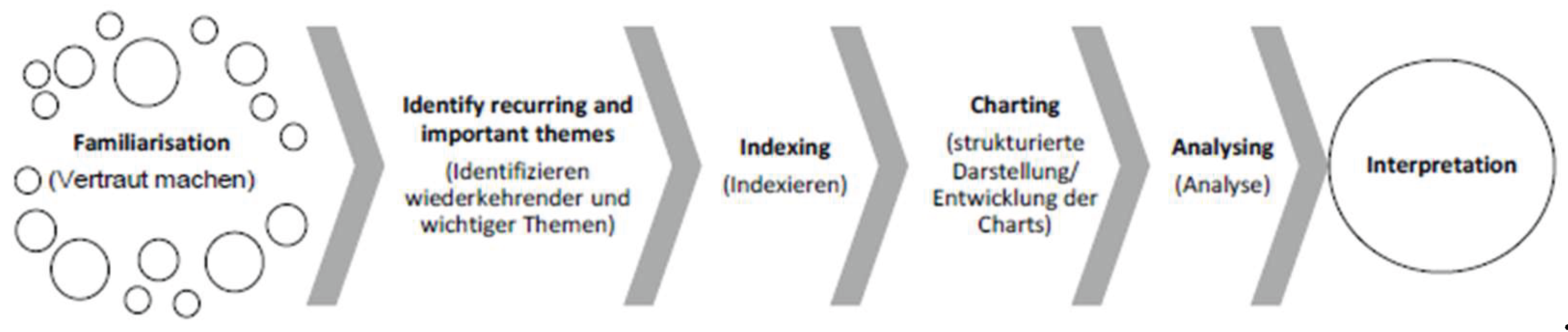
Framework Analysis is a highly systematized method of qualitative data analysis (Dunger & Schnell, 2018, p. 27; Srivastava & Thomson, 2009) that is frequently employed in applied political science research (Goldsmith, 2021, p. 2061). It was developed in the 1980s by the National Centre for Social Research (NatCen) and has its origins in policy research (Dunger & Schnell, 2018, p. 27; Klingberg et al., 2023, p. 1; Srivastava & Thomson, 2009, p. 73; cf. Goldsmith, 2021, p. 2062). Through its structured analytical approach, it addresses criticisms of qualitative research and provides a legitimate methodology for mixed-methods approaches (Dunger & Schnell, 2018, p. 27; Gale et al., 2013, p. 603). Compared to substantially more interpretive approaches such as Grounded Theory or hermeneutic phenomenology (Klingberg et al., 2023, p. 603), it is particularly suitable for studies with predefined objectives (Klingberg et al., 2023, pp. 603–604; Pope et al., 2000, p. 116): “[…] and data analysis is foundationally shaped and directed by theories, models, literature findings, and/or purposes that are established before analysis—and sometimes even before data collection—begins” (Klingberg et al., 2023, p. 604). This is particularly relevant for the present contribution, as the heuristic of the Integrated Policy Cycle provides the substantive theoretical framework and the method allows for corresponding structuring. In comparison to Mayring’s qualitative content analysis or thematic coding, Framework Analysis remains more closely anchored to the original text (Dunger & Schnell, 2018, p. 27), while nevertheless allowing for both deductive and inductive orientations (Goldsmith, 2021, p. 2062). Categories may still be modified, merged, removed, or supplemented until the final analytical framework has been established (Dunger & Schnell, 2018, p. 28). The method is fundamentally pragmatic and serves the purpose of transparent data analysis; however, it does not provide an independent theoretical framework, which must instead be selected in accordance with the specific research question (Dunger & Schnell, 2018, p. 29).
The present contribution follows the procedural model proposed by Dunger and Schnell (Dunger & Schnell, 2018, p. 29). Further descriptions of the methodology can be found in Goldsmith (Goldsmith, 2021, p. 2063).
Figure 2.
Process of Framework Analysis (Dunger & Schnell, 2018, p. 29).
2.4. Data Collection
The structure of the interviews, the analysis, and the analytical frameworks were aligned with the phases of the Integrated Policy Cycle, as its evaluation constituted the primary objective of the interviews. Following Gläser and Laudel (2010, p. 41), the study employed guideline-based expert interviews. In accordance with Wernitz (2018, p. 5), these can be classified as semi-structured, as the wording and sequence of the questions were predefined while response options remained open. The interview guide comprised 21 questions (Items 0 to 20) with a cumulative duration of 58 minutes, which was communicated to interviewees as a 60-minute interview. To ensure partial anonymity, given that a lack of anonymity may impede the recruitment of experts (Wernitz, 2018, p. 6), all experts are named, but individual statements cannot be attributed to specific persons, with the exception of the first interview. This initial interview served as a pretest with a colleague from the research field in order to identify and correct errors and inconsistencies in the interview guide (Wernitz, 2018, p. 6). Minor editorial and linguistic adjustments were subsequently made. The author initially compiled a list of potential interview partners from the fields of public administration, academia, politics, and civil society. This list was reviewed together with the director of TOGI (The Open Government Institute) to ensure a balanced representation of federal levels and German federal states. In two rounds of requests, a total of 81 individuals, offices, and institutions were contacted via email sent by the institute’s director. Where no response was received, a follow-up email was sent in each case. The first round comprised 47 requests (politics: 17, academia: 12, public administration: 10, civil society: 8), while the second round comprised 34 requests in total (politics: 5, academia: 10, public administration: 16, civil society: 3), most of which resulted from referrals generated during the first round. Across both rounds, requests were distributed among politics (22), academia (22), public administration (26), and civil society (11). A total of 12 interviews were conducted, corresponding to an interview participation rate of 14.8% of the 81 requests. Formally, no interviews were assigned to the field of politics. However, one interview was conducted with a municipal councillor affiliated with the VOLT party; due to the operational nature of her responsibilities and the public-interest mandate of her office, this interview was classified within the field of public administration. Five interviews were conducted with representatives from academia, five with representatives from public administration, and two with representatives from civil society. One interviewee from academia and one from public administration were already personally known to the author. Interview duration ranged from 37 to 67 minutes. Five interviewees were female and seven were male. Interviews were conducted with: Prof. Dr. Frank Hogrebe (Hessian University of Applied Sciences for Police and Administration, Wiesbaden), Prof. Dr. Ilona M. Otto (University of Graz), Prof. Dr. Jan Bieser (University of Zurich), Prof. Dr. Mike Schäfer (University of Zurich), Prof. Dr. Tim Pidun (University of Applied Sciences for Engineering and Economics Dresden), Dr. Christine Pohl (City of Wuppertal), Dr. Tobias Bringmann (Association of Municipal Enterprises), Eileen O’Sullivan (City of Frankfurt am Main), Elke Reicher (State Agency for Nature, Environment and Climate of North Rhine-Westphalia), Felix Hörmann (City of Munich), Friederike Hildebrandt (Bits & Bäume, Forum Computer Scientists for Peace and Social Responsibility), and Jörg Durr-Pucher (Uhl Windkraft GmbH and Deutsche Umwelthilfe e.V.). The interviews are numbered randomly in the following sections.
2.5. Data Analysis
The interviews were recorded as audio files and automatically transcribed using the open-source software Whisper developed by OpenAI, executed via Python on a Mac system. As a compromise between accuracy and processing speed, the Whisper “small” model was employed. Subsequently, the author cleaned the raw transcripts, removed filler words, and corrected transcription errors, which simultaneously facilitated the initial familiarization with the data required by Framework Analysis (Dunger & Schnell, 2018, p. 30). For each of the 12 interviews, a separate analytical table was created following the methodology of Framework Analysis, and the statements of the interviewees were analysed according to the phases specified by the interview guide (Appendix A.1) and derived from the Integrated Policy Cycle: Introduction, Problem Definition, Agenda-Setting, Decision-Making, Implementation, Monitoring, Evaluation, and Conclusion. The statements were indexed according to the format “IXFXAX – mm:ss”, where IX denotes Interview X, FX denotes Question X, and AX denotes Answer X. Accordingly, the first answer to the first question in the first interview received the index “I1F1A1 – 02:51”. The individual tables are included in the appendix of the paper (Appendix B.1–Appendix B.12). This procedure resulted in a systematic analysis of all interviews, as well as a uniform presentation and indexing of all statements made during the interviews. In a subsequent step, a consolidated summary table was created that systematically organized the statements from the different interviews according to the interview phases and documented them through the corresponding indices. Similar statements were grouped together, while divergent statements were distinguished and recorded separately. This approach enabled the rapid identification of substantive commonalities and differences across the 12 interviews. The consolidated summary table is included in the appendix (Appendix B.13) and, together with the statements contained in the individual interview tables, forms the basis for the subsequent analysis.
3. Analysis of the Interviews
The interviews proved to be highly differentiated and, depending on the perspectives of the interviewees, either strongly focused or closely oriented towards the respective experiences and impressions of the experts. Distinct substantive emphases resulting from the participants’ respective professional expertise became clearly apparent. As such, the interviews demonstrated a depth that proved highly valuable for the evaluation of the heuristic and the identification of potential gaps. Relative to the total number of requests, recruitment within academia was the most successful. Nevertheless, the fields of academia and public administration are equally represented with five interviews each and therefore exert a substantial influence on the analysis. Civil society is represented to a lesser extent with two interviews. Overall, the interviews were highly productive and, in the author's assessment, characterized by an open and candid atmosphere. Follow-up questions were possible and were occasionally posed for purposes of clarification and understanding. At the conclusion of each interview, following the final question included in the interview guide (Appendix A.1), respondents were additionally asked whether they wished to add anything that had not been covered by the questionnaire. The experts in Interviews 3, 6, and 7 made use of this opportunity. These responses were indexed according to the interview logic as Question 21, for example, I3F21A1. The experts in Interviews 5 and 7 qualified their statements by noting that they were far removed from day-to-day political practice and could therefore assess certain questions only to a limited extent. The expert in Interview 11 qualified his statements with regard to climate change and climate neutrality. Against this background, not all experts responded to every question and occasionally made use of the option to omit particular questions. Such omissions or non-responses are documented in the respective individual tables but not in the consolidated summary table. In particular, several interviewees did not provide responses to questions concerning the phases of decision-making and implementation.
3.1. Analysis of the Introduction Phase (Questions 1 to 4)
The experts demonstrated a broad and heterogeneous understanding of the concept of digitalization. Some understood it as the comprehensive automation and acceleration of work processes based on digital elements (I1F1A1 – 02:51; I7F1A1 – 07:26; I8F1A1 – 03:15), although Expert 8 simultaneously pointed to the potential exclusion or overburdening of older individuals (I8F1A1 – 03:15). Taking a narrower perspective, Expert 2 distinguished between digitization as the conversion of analogue data into digital formats and digitalization as the resulting societal transformation (I2F1A1 – 08:00). Similarly, Experts 6 and 9 described digitalization as the transformation of analogue processes into digital processes (I6F1A1 – 02:56; I9F1A1 – 02:17). Expert 10 explicitly challenged this interpretation, arguing that digitalization is not merely a process of conversion but rather entails a digitally adapted operational logic of processes, for example in the provision of public services. In this understanding, digitalization does not constitute an end in itself but serves as an instrument for addressing challenges such as demographic change (I10F1A1 – 03:04). In addition, digitalization was described as data-centricity (I1F1A2 – 03:07), as a technology-driven transformation of societal spheres characterized by reciprocal influences between humans and technology (I5F1A1 – 03:09; I5F1A2 – 04:01), as the interaction of digital management, change management, process management, and knowledge management (I11F1A1 – 02:18), as a central prerequisite for everyday work (I3F1A1 – 02:06), as a necessity for municipal action (I12F1A1 – 03:55), and as an instrument for sustainability, urban development, and resource efficiency (I4F1A1 – 04:01). Digitalization was distinguished from digital transformation, which, where such a distinction was made, was understood as a comprehensive process of societal and organizational change extending beyond software and hardware. This broader transformation was described as encompassing new actors, new value chains, and major digital corporations (I1F1A3 – 03:37; I3F1A2 – 02:22; I6F1A2 – 03:07; I9F1A2 – 03:10; I11F1A2 – 03:27; I12F1A2 – 05:00).
With regard to the significance of digitalization in their professional practice, a less uniform picture emerged. Experts 1, 6, 7, 8, 10, and 12 explicitly assessed its importance as high (I1F2A1 – 04:20; I6F2A1 – 04:03; I7F2A1 – 08:58; I8F2A1 – 06:40; I10F2A1 – 06:06; I12F2A1 – 06:03). Expert 1 qualified this assessment by noting that many processes had merely been electronified rather than genuinely digitalized (I1F2A1 – 04:20). Expert 12, in addition to highlighting the potential of intergovernmental cooperation across federal levels, also pointed to cybersecurity risks (I12F2A1 – 06:03). Further nuances were provided by Expert 4, who understood digitalization as a matter of democratic legitimacy and state capacity to act (I4F2A1 – 05:06); by Expert 5, who described a substantial surge in digitalization within higher education institutions while simultaneously emphasizing lock-in effects and challenges related to digital sovereignty (I5F2A1 – 06:18); and by Expert 9, whose assessment was significantly shaped by two projects funded by the German Environment Agency (I9F2A1 – 04:17). Expert 2 emphasized the necessity of governmental steering and the self-digitalization of the public sector as a means of strengthening competencies and enhancing efficiency (I2F2A1 – 10:30; I2F2A2 – 11:20). In contrast, Expert 11 evaluated the significance of digitalization more critically, arguing that public administrations adopt innovations only slowly (I11F2A1 – 05:45).
Climate change was generally attributed a high level of significance in the respondents’ professional contexts. For most experts, it forms part of their daily work and, in some cases, also constitutes an object of research (I2F3A1 – 13:49; I3F3A1 – 03:11; I4F3A1 – 08:03; I5F3A1 – 09:29; I6F3A1 – 05:40; I7F3A1 – 10:55; I8F3A1 – 07:40; I9F3A1 – 05:40; I10F3A1 – 08:36; I12F3A1 – 07:17). Particular emphasis was placed on time pressure and the need for new methods (I4F3A1 – 08:03), the alignment of public authorities towards climate neutrality (I7F3A1 – 10:55), and the climate-related digital twin within the broader digital twin of Wuppertal (I12F3A1 – 07:17). Experts 1 and 10 further described climate change as a directly observable everyday phenomenon, manifested, for example, in high temperatures, new construction standards, and extreme weather events (I1F3A1 – 06:19; I10F3A1 – 08:36). At the same time, Expert 1 assessed that the concept of sustainability had not yet developed extensively within his professional environment (I1F3A1 – 06:19). In addition, according to Expert 2, the higher education institution in which he works pursues strategies aimed at reducing emissions in its day-to-day operations (I2F3A2 – 14:02). Expert 6 emphasized that climate-related considerations are deliberately integrated into digital use cases, for example through the utilization of waste heat from data centres in a passive building (I6F3A1 – 05:40). For Expert 11, climate change has thus far played a role primarily in the context of broader environmental issues such as waste prevention, business travel, or document printing (I11F3A1 – 07:49). At the same time, he stressed that the Twin Transition should not be limited to climate-related issues but must equally take public administration, digitalization, and federal structures into account (I11F3A2 – 12:02).
Various interfaces between digitalization and climate change were identified within the experts’ professional contexts. Several experts emphasized their ambivalent effects on emissions: on the one hand, digital technologies enable greater flexibility and reduce the need for business travel; on the other hand, they generate substantial energy and resource consumption and create trade-offs, for example in relation to data centres and land use (I1F4A1 – 07:36; I2F4A1 – 15:38; I3F4A1 – 03:19; I6F4A1 – 07:33). Expert 9 drew particular attention to the increasing energy and resource demands of large language models in the context of artificial intelligence (I9F4A1 – 07:00). Other experts, by contrast, regarded digitalization as a key instrument for effective climate protection, for example through intelligent metering systems, substations, or the digital management of wastewater networks during heavy rainfall events (I8F4A1 – 08:33; I10F4A1 – 10:15). Furthermore, the provision of climate data as open data and interdisciplinary collaboration through digital twins were highlighted (I7F4A1 – 13:42; I12F4A1 – 09:05), as was the necessity of interdisciplinary and iterative climate research alongside the need to reduce business travel (I5F4A1 – 11:53). Concrete areas of application at the interface of the two domains were identified in urban planning and construction, including issues related to fires, land use, and energy-efficient refurbishment (I4F4A1 – 08:59).
3.2. Analysis of the Problem Definition Phase (Questions 5 and 6)
Several experts assessed the influence of digital data, applications, and systems on problem definition as very substantial. Digital technologies make problems more visible and insights more broadly accessible, while simultaneously creating additional opportunities for the manipulation of public problem definitions and the associated debates (I2F5A1 – 16:57; I5F5A1 – 13:03; I8F5A1 – 11:44; I9F5A1 – 10:42). It was further emphasized that the use of existing data reduces duplication of effort and thereby strengthens awareness of the need for action (I1F5A1 – 09:11). In addition, visualizations facilitate the understanding of complex issues and enhance the quality of public debate (I4F5A1 – 10:40). For the identification of policy needs, data availability, data quality, discoverability, accessibility, and legal certainty were regarded as particularly important (I1F6A1 – 11:55; I4F6A1 – 12:19; I7F6A1 – 15:50; I12F6A1 – 18:10). In this context, Expert 11 perceived particular value when data presentation is dynamic, for example through live simulations (I11F6A1 – 23:46), whereas Expert 1 pointed to the necessity of human verification of AI-supported pre-structuring processes (I1F6A1 – 11:55).
The central controversy emerging from the interviews concerned the effectiveness of this influence of digital technologies on problem definition. A larger group of experts qualified its significance, arguing that data and technologies are generally already available, while political action depends primarily on political will rather than on a lack of information (I6F5A1 – 10:56; I7F5A1 – 14:47; I10F5A1 – 14:57; I11F5A1 – 21:57). Expert 9 expressed this particularly clearly, identifying the lack of political action, rather than a lack of information, as the core problem of climate policy (I9F5A3 – 15:13). Accordingly, he located the need for data primarily at the operational rather than the political level (I9F6A1 – 16:18). Similar views were reflected in statements suggesting that political action is shaped more strongly by emotions than by knowledge and that dashboards may, in some cases, generate pressure rather than foster motivation (I1F5A2 – 11:06; I3F5A2 – 07:32). Several experts further emphasized that neither the quantity nor the quality of data is decisive; rather, what matters is the analysis, integration, and communication of data, in some cases also through emotional forms of engagement (I3F6A1 – 09:36; I10F6A1 – 18:29; I5F6A1 – 20:41). At the same time, excessive quantities of data may create additional complexity, making it necessary to selectively filter out relevant information (I2F6A1 – 19:40). The role of data and artificial intelligence was assessed ambivalently. Expert 3 pointed to the high energy consumption associated with large volumes of largely unused data (I3F5A1 – 06:13), while Expert 9 referred to what he regarded as pseudo-debates surrounding artificial intelligence, in which narratives of climate-protective AI stand in contrast to the withdrawal of major corporations from climate targets and rapidly increasing energy consumption (I9F5A2 – 11:52). Expert 12 observed that political practice lags significantly behind technological development, although a digital twin could accelerate the process of problem definition (I12F5A1 – 14:57).
3.3. Analysis of the Agenda-Setting Phase (Questions 7 and 8)
For the agenda-setting phase, the assessment of a strong influence of digital applications predominated. Through social media, participation platforms, and the provision of data, issues are brought onto the political agenda; demands emerging from digital participation formats are taken up by political parties, while politicians are exposed to increasing public pressure (I2F7A1 – 21:55; I6F7A1 – 14:08; I7F7A1 – 17:01; I8F7A1 – 17:12; I12F7A1 – 20:48). Expert 2 emphasized that the dissemination of content is no longer limited to organizations, but can now be undertaken by any individual with internet access. At the same time, algorithms particularly amplify extreme and polarizing content and shape opinions depending on the information channels used (I2F7A1 – 21:55; I2F7A2 – 23:26). Expert 3 likewise pointed to the manipulability of social media, deliberate attempts at influence, and the considerable variation in the perception of political issues across different actor groups (I3F7A1 – 11:29; I3F8A1 – 14:09). At the same time, it became evident that political actors, as well as non-governmental organizations, activists, and influencers, increasingly use digital communication channels strategically and in a target-group-specific manner, organize themselves digitally, and reach new audiences (I2F8A1 – 24:37; I5F8A1 – 24:25; I6F8A1 – 16:22). Examples cited included digitally organized movements such as Fridays for Future and Last Generation, whose activities have prompted responses from political actors (I6F8A1 – 16:22). Additionally, Expert 7 described a more intensive and increasingly evidence-based engagement of the actors involved with political issues as a result of digital technologies (I7F8A1 – 19:16).
Differences emerged primarily in the assessment of and the limits attributed to this identified influence. Expert 9 perceived a distortion resulting from a technofix, that is, the assumption that complex climate challenges can primarily be solved through technological means, thereby delaying effective policy measures and shaping the agenda accordingly (I9F7A1 – 18:10; I9F8A1 – 19:47). By contrast, Expert 10 emphasized emotions and personal affectedness, arguing that digital technologies influence agenda-setting primarily when they generate emotional engagement, whereas data alone has only limited impact (I10F7A1 – 21:07; I10F8A1 – 24:48). Experts 1 and 4 had thus far observed only a limited influence, but referred to a diffuse and only weakly coordinated agenda-setting process, as well as the increasing importance of transparency. In their view, opinion formation takes place primarily within the private digital sphere (I1F7A1 – 14:20; I4F7A1 – 14:20; I1F8A1 – 15:20; I4F8A1 – 16:29). Expert 5 noted that digital media continue to play a highly relevant role in attracting attention and shaping political agendas despite competition from other issues (I5F5A2 – 15:51). Expert 8 pointed to the difficulties of reaching target groups with limited digital affinity (I8F8A1 – 20:33). Expert 12 did not yet regard agenda-setting through digital technologies as an established political practice, but nevertheless recognized its potential to make emotionally charged debates more objective through the provision of additional information (I12F7A1 – 20:48).
3.4. Analysis of the Decision-Making Phase (Questions 9 and 10)
There was broad consensus that digital applications could make a constructive contribution, for example through improved participation, impact assessments using digital twins, modelling and simulation, as well as data-driven prioritization and the use of insights derived from previous monitoring activities (I1F9A1 – 16:17; I2F9A1 – 26:43; I4F9A1 – 17:55; I6F9A1 – 18:10; I7F9A1 – 21:05; I9F9A1 – 21:44; I10F9A1 – 28:32; I12F9A1 – 23:48). Particular examples mentioned included the development of decision-support systems (I4F9A1 – 17:55), the simulation of an additional water pumping station at Lake Constance for the purpose of weighing alternative courses of action (I10F9A2 – 30:46), as well as the practical use of GIS systems, digital maps, and the urban climate simulation tool PALM-4U (I12F9A1 – 23:48). In addition, Expert 5 referred to positive examples of digitally supported citizen participation (I5F9A1 – 27:56). Likewise, the prevailing view was that digital applications improve and accelerate decision-making processes through collaboration, documentation, forecasting, and evidence-based prioritization (I1F10A1 – 17:06; I2F10A1 – 28:50; I3F10A1 – 19:37; I5F10A1 – 31:32; I6F10A1 – 19:43; I8F10A1 – 24:58). In this context, Expert 2 noted that user-centeredness is more important for effectiveness than sophisticated visualizations (I2F10A2 – 31:53).
The differences identified in the interviews related less to the potential of digital applications as such than to their actual use and possible countervailing effects. Existing and potentially beneficial tools were often not utilized in political practice, while decisions were perceived as being shaped more strongly by emotions and prevailing public sentiments (I3F9A1 – 18:10). Furthermore, the impact of digital technologies was considered to vary across different stages of the decision-making process, as they were seen to play a less significant role in the finalization of legislative drafts than in impact assessment and policy evaluation (I8F9A1 – 21:50). In addition, digital media may complicate climate policy processes and decision-making through fragmentation and polarization (I5F9A2 – 29:11).
With regard to acceleration, several experts argued that decisions may become more informed and transparent, but are ultimately still taken through analogue processes (I10F10A1 – 32:08; I12F10A1 – 25:06). Furthermore, existing acceleration potential remains underutilized because delays are attributed more to political considerations than to the administration itself (I4F10A1 – 19:52; I6F10A1 – 19:43). In addition, deadlines were regarded as more effective than digitalization alone (I8F10A1 – 24:58), while protected spaces for political negotiation were perceived as becoming smaller and more fragile (I5F10A1 – 31:32). A low level of digitalization within public administration was also seen as limiting the influence of digital applications (I11F10A1 – 28:22). At the same time, the fundamental influence of digital technologies on decision-making was considered undisputed, despite the fact that some of its effects remain difficult to assess (I7F10A1 – 22:10).
3.5. Analysis of the Implementation Phase (Questions 11 and 12)
Within the implementation phase, there was broad agreement that the implementation of political decisions continues to take place predominantly through analogue processes and that automated implementation systems are largely absent. There are hardly any specialized administrative procedures or information systems dedicated to the actual implementation process, and procedures such as public hearings remain dependent on in-person formats for democratic reasons (I1F11A1 – 18:08; I1F11A2 – 19:20; I8F11A1 – 26:03). At the same time, experts suggested that fully automated systems capable of responding to events such as flooding or particulate matter pollution on the basis of predefined rules are no longer far from reality, as digital systems already generate notifications that trigger actions today (I7F11A1 – 24:19). In some areas, implementation is already substantially shaped by digital technologies, for example within the European Emissions Trading System or the carbon tax, both of which would be difficult to realize through purely analogue means (I3F11A1 – 21:06). Expert 10 emphasized that almost no analogue routines remain within the companies represented by his association and that inefficiencies are more commonly caused by poorly designed digital processes (I10F11A1 – 34:07), while Expert 12 observed that implementation is improved through insights derived from measurement series and data analyses (I12F11A1 – 26:29). There was also broad agreement that digitalization accelerates implementation through faster data analysis and AI-supported simplification processes, while simultaneously creating additional knowledge resources (I4F12A1 – 27:49; I6F12A1 – 27:04; I7F12A1 – 27:49; I10F12A1 – 36:40; I12F12A1 – 28:29). Moreover, it was considered to increase transparency towards both governance actors and the public, for example through mandatory fields within information systems (I1F12A1 – 19:50; I2F12A1 – 34:58).
The differences identified related primarily to the degree of digitalization achieved and the scope of its effects. Existing digital processes are often not fully digitalized, such that analogue intermediate steps continue to persist (I4F11A1 – 23:23). Furthermore, generational change is leading to implementation processes being conceived digitally from the outset with increasing frequency, although analogue routines have not been entirely replaced (I6F11A1 – 21:44). Regarding the contribution of digital technologies, it was emphasized that while digital tools facilitate administrative work, implementation continues to depend on contextual factors and political will (I3F12A1 – 22:37; I7F12A1 – 27:49). The influence of digitalization was thereby assessed both positively, in terms of acceleration, and negatively, in terms of generating additional complexity (I8F12A1 – 27:27). According to Expert 5, the impact of digitalization lies primarily in the stages preceding implementation, particularly within participation processes (I5F12A1 – 34:56). Expert 9 considered the automation of standardized procedures to be beneficial, but emphasized that it does not replace analogue implementation (I9F12A1 – 28:37). Moreover, digitalization must be accompanied by appropriate capacities and supportive institutional frameworks (I11F12A1 – 30:37). In the view of Expert 12, the frequently assumed acceleration effect has thus far not been empirically demonstrated, as comparisons between analogue and digital implementation are lacking (I12F12A1 – 28:29).
3.6. Analysis of the Monitoring Phase (Questions 13 and 14)
For the monitoring phase, there was consensus that digitalization increases visibility, transparency, and opportunities for participation. Goals and the achievement of those goals can be tracked more effectively, the accountability of political decision-makers is strengthened, and digital technologies are already being employed for monitoring emissions trading schemes, climate change, and political measures (I1F13A1 – 21:08; I2F13A1 – 35:40; I3F13A1 – 24:03; I5F13A1 – 38:08; I6F13A1 – 27:47; I7F13A1 – 29:18; I12F13A1 – 30:02). Furthermore, data-driven monitoring may contribute to the prioritization and acceleration of future measures (I10F13A1 – 39:38). At the same time, Expert 10 cautioned against relying on individual systems that may be influenced by particular interests. Data-driven monitoring should likewise not be based exclusively on AI systems provided by large U.S. corporations, as this would entail a transfer of political steering capacity (I10F13A2 – 43:09).
The differences identified related primarily to the prerequisites and limitations of monitoring. While Expert 4 recognized initial developments, he did not yet consider the technical prerequisites to be sufficiently advanced and regarded monitoring applications as rare in practice (I4F13A1 – 28:38). Expert 8 likewise attributed only limited influence to digitalization with regard to the perception of political success, arguing that such perceptions continue to depend heavily on analogue communication channels and activities such as groundbreaking ceremonies, municipal newsletters, or public assemblies (I8F13A1 – 28:43). With regard to the review of implementation measures, digitalization was predominantly credited with increasing transparency and traceability. This effect was described as operating partly in real time and across different stakeholder groups, thereby enabling the early identification of ineffective measures (I1F14A1 – 22:29; I3F14A1 – 25:25; I5F14A1 – 39:23; I7F14A1 – 30:54; I9F14A1 – 36:40; I10F14A1 – 46:16; I12F14A1 – 32:29). For Expert 1, however, this effect was not regarded as the primary benefit (I1F14A1 – 22:29). Expert 3 further pointed out that monitoring simultaneously increases both complexity and the volume of data that must be processed (I3F14A1 – 25:25). Expert 4 also anticipated increased transparency but did not yet consider the relevant technical developments sufficiently mature to fully realize this potential (I4F14A1 – 30:18). More substantial reservations were expressed by Experts 9 and 10. According to Expert 9, socio-ecological justice cannot be fully calculated or digitally represented, and only a portion of the relevant influencing factors can be monitored at all (I9F14A1 – 36:40). Expert 10 emphasized that transparency does not emerge automatically as long as algorithms and the contents of the systems themselves remain opaque (I10F14A1 – 46:16). It was further emphasized that transparency depends upon information being prepared in a manner that is both comprehensible and appropriate for its intended audience (I2F14A1 – 37:18; I8F14A1 – 29:50). Moreover, Expert 6 argued that transparency ultimately depends on political will, since its creation is fundamentally a political question (I6F14A1 – 29:31).
3.7. Analysis of the Evaluation Phase (Questions 15 and 16)
In the evaluation phase, the prevailing view was that digital systems enable continuous, evidence-based evaluation and policy adjustment that is no longer tied to specific points in time. At the same time, they allow the analysis of large volumes of data, such that evaluation without digital systems is now considered scarcely conceivable (I2F15A1 – 38:34; I3F15A1 – 28:52; I4F15A1 – 31:27; I7F15A1 – 31:41; I12F15A1 – 33:37). Digital data and systems were accordingly regarded as a central prerequisite for robust evaluations (I7F15A1 – 31:41). Furthermore, Expert 11 highlighted the possibility of conducting ex post evaluations of digital impact assessments that had already been employed during the decision-making phase (I11F15A1 – 35:24). It was likewise expected that evaluations would become more accessible and comprehensible, thereby making even complex issues easier for citizens to understand and strengthening democratic legitimacy (I1F16A1 – 26:03; I2F16A1 – 39:40; I3F16A1 – 31:10; I4F16A1 – 33:49; I7F16A1 – 32:43; I8F16A1 – 39:57; I9F16A1 – 39:06). Examples cited included the evaluation of qualitative factors following the model of navigation applications (I3F16A1 – 31:10) and ex post evaluations, for instance of heat development within an urban district in relation to the planning of a new neighbourhood (I6F16A1 – 33:14).
The differences identified related primarily to the extent to which evaluation has thus far been institutionalized and to the political use of evaluation findings. To date, evaluation is still conducted predominantly in a text-based manner, and it remains unclear to what extent digital applications are already being employed (I1F15A1 – 23:40). Semantic tools could transform this form of reporting and analysis in the future (I1F15A1 – 23:40). Expert 8 attributed only limited influence to digital technologies in the field of evaluation, arguing that evaluations continue to play a subordinate role in political processes and remain heavily paper-based (I8F15A1 – 32:57). Expert 6 pointed out that while smaller projects, for example in the field of smart water management, are subject to evaluation, no systematic evaluation of climate policy decisions currently takes place (I6F15A1 – 31:27). Expert 10 observed only few ex post evaluations at present, but identified considerable potential for more in-depth and continuous assessment processes (I10F15A1 – 48:23). According to several experts, the extent to which this potential will be realized remains uncertain and depends largely on political will (I5F16A1 – 46:32; I6F16A1 – 33:14). Furthermore, robust simulations are dependent upon appropriate models, parameters, and underlying assumptions (I2F16A1 – 39:40). Additional opportunities identified included more data-driven impact assessments (I10F16A1 – 49:54) and a deeper understanding of the effects of political measures, which could foster a greater sense of affectedness among stakeholders and citizens (I12F16A1 – 40:18).
3.8. Analysis of the Conclusion Phase (Questions 17 to 20 and Question 21)
In the concluding phase, the prevailing view was that digitalization has the potential to transform climate policy in a positive manner overall. It enables greater knowledge of the causes and drivers of climate change, broadens access to policymaking processes, accelerates data analysis and scenario modelling, and promotes interconnected decision-making as well as the overcoming of silo thinking and mono-disciplinarity (I2F17A1 – 41:32; I4F17A1 – 35:41; I6F17A1 – 36:38; I7F17A1 – 33:13; I8F17A1 – 41:08; I10F17A1 – 53:48; I12F17A1 – 42:04). These assessments were, however, contrasted by more critical perspectives. Expert 3 pointed out that emissions continue to increase despite growing data availability, expanding knowledge, and additional policy measures (I3F17A1 – 32:22). Expert 2 emphasized that whether digitalization reduces or increases emissions depends largely on the governance of digital systems, while it remains an open question whether such governance should focus on the technologies themselves or on the emission-intensive products and sectors in which they are embedded (I2F17A2 – 42:55). According to Experts 1 and 11, little has changed within political institutions thus far, as digital transformation has not yet permeated policymaking and many processes remain paper-based. Consequently, the effects of digitalization primarily affect the recipients of policy measures rather than policymaking processes themselves (I1F17A1 – 27:11; I11F17A1 – 37:56). Taking a more fundamental perspective, Expert 9 argued that climate policy is shaped less by digital or analogue procedures than by power relations and political considerations (I9F17A1 – 39:53).
With regard to challenges and risks, the interviews revealed a broad spectrum of concerns. In particular, experts referred to the complexity of digital data repositories and the need for their appropriate analysis and interpretation (I3F19A1 – 37:03; I7F19A1 – 37:31). Furthermore, discontinuities within political processes were identified as problematic, as digitally induced changes in opinion formation are often insufficiently recognized, the transition to legislation remains largely analogue, and evaluation findings are not systematically fed back into the policymaking process (I1F19A1 – 30:06; I5F19A1 – 53:26). Another challenge described was the still limited and heavily paper-based digitalization of the state and public administration (I11F19A1 – 40:27). Several experts further pointed to the political nature of decision-making and monitoring processes (I4F19A1 – 46:18; I6F19A1 – 40:37), to the risks associated with generative artificial intelligence, including flawed problem definitions, critical misjudgements, and dependencies on technology-providing companies (I9F19A1 – 45:41; I10F19A1 – 62:12), as well as to challenges related to data integration and the protection of critical infrastructures against manipulation and attacks (I12F19A1 – 45:26). Additionally, it was emphasized that digitally less-affine population groups must not be excluded from participation and access (I8F19A1 – 44:03).
To avoid trade-offs between digitalization and sustainability, the experts recommended breaking down silo structures and promoting integrated knowledge management (I2F18A1 – 49:10; I11F18A1 – 38:28; I12F18A1 – 43:11). Furthermore, policymaking should be understood as a learning system (I6F18A1 – 38:00; I10F18A1 – 57:21), the growing energy demand of digital technologies should be met through renewable energy sources (I7F18A1 – 34:46), and purely technology-centred approaches to problem-solving should be avoided (I9F18A1 – 42:01). At the same time, it was emphasized that such trade-offs occur frequently, are difficult to avoid, and have thus far received insufficient attention, despite the close interconnection between digitalization and sustainability (I1F18A1 – 28:15; I4F18A1 – 43:32). Consequently, political decision-makers should engage more intensively with these interrelationships (I8F18A1 – 42:42). Ultimately, according to Expert 3, it is not the data itself but human actors who solve the underlying problems (I3F18A1 – 34:05).
With regard to the potential within the policy cycle, there was consensus that this potential lies particularly in the phases of problem definition and monitoring. In particular, data-driven forms of policy adjustment as well as the projection of future impacts were highlighted (I2F20A1 – 52:55; I4F20A1 – 46:48; I7F20A1 – 36:33; I12F20A1 – 44:48). Additional potential was identified in more participatory and inclusive forms of political engagement (I1F20A1 – 32:21; I3F20A1 – 37:03; I8F20A1 – 47:59), in the early phases of opinion formation (I5F20A1 – 56:20), fundamentally across all phases of the policy cycle depending on the technologies employed and in light of the multifaceted nature of climate change (I6F20A1 – 39:50; I9F20A1 – 44:38; I10F20A1 – 61:22), and in simulations, forecasts, and real-time calculations for political decision-making (I11F20A1 – 41:43).
The concluding remarks reinforced this assessment. Artificial intelligence may support the processing of data and the reduction of complexity (I3F21A1 – 40:03). Digitalization should be understood as a means to an end rather than as an end in itself (I4F16A1 – 33:49). Furthermore, the importance of data for consistent policymaking has long been underestimated, while an appropriate political culture to make effective use of such data is still lacking (I6F21A1 – 42:48). Finally, the digitalization of the state and public administration must be accelerated considerably in light of existing time pressures, which simultaneously represents an important opportunity for climate protection (I7F21A1 – 38:43).
4. Results
The following presentation summarizes the results of the qualitative analysis of twelve semi-structured expert interviews. The statements were coded, structured along the six phases of the Integrated Policy Cycle, ranging from problem definition through agenda-setting, decision-making, implementation, and monitoring to evaluation, and framed by an introductory and a concluding section. The interviewees originated from different professional domains, which must be taken into account when interpreting and generalizing the findings. In accordance with their individual expertise and perspectives, the interviews generally provided accounts grounded in the subjectively experienced status quo rather than projections of future developments. Given the objective of this paper, namely the evaluation of the Integrated Policy Cycle, this constitutes the desired outcome. Nevertheless, this aspect should be acknowledged when interpreting the findings. In this respect, the methodological approach was well suited to the research interest, but also logically explains why certain gaps remain regarding the applications or potentials identified and why some aspects were not covered by the interviews. For example, the improvement of administrative specialist procedures through AI systems, as well as more traditional forms of text-based work such as the preparation of meeting minutes, statements, or evaluation reports, were surprisingly seldom mentioned throughout the interviews. Apart from these gaps, the reported level of digitalization varies considerably across the professional fields in which the experts operate. While, from the perspective of an interest association, almost no analogue routines remain, internal processes in politics and public administration are elsewhere still described as analogue and paper-based. Consequently, generalizations about public administration as a whole can only be made to a limited extent. Furthermore, many of the reported advantages represent expected rather than empirically verified effects. For example, the presumed acceleration of implementation has not yet been demonstrated empirically, as analogue and digital process flows have not been systematically compared. The prospective character of many statements must therefore be considered when interpreting the findings. With regard to the introductory questions, it can be concluded that digitalization and climate change are regarded by most experts as highly relevant issues within their professional activities. Their interaction, however, is predominantly described as ambivalent, conflict-ridden, and only occasionally addressed in a systematic manner. In addition, a heterogeneous understanding of digitalization becomes evident. The spectrum ranges from the mere conversion of analogue processes into digital ones, through the automation and acceleration of work processes, to broader understandings that conceptualize digitalization as a digitally adapted operational logic of processes, as a technology-driven transformation of all spheres of life involving the co-production of humans and technology, and as the interaction of digital management, change management, process management, and knowledge management.
Across all phases, a consistent overall picture emerges. The central cross-phase finding is a pronounced consensus that digital technologies, applications, systems, and data offer considerable potential in every phase of the Integrated Policy Cycle to shape the governance of the Twin Transition in accordance with an integrated logic of digitalization and sustainability. Across all phases of the policy cycle, digitalization is attributed significant potential to support a more knowledge-based, transparent, and responsive climate policy. However, the realization of this potential is regarded less as a question of technology than of political steering, institutional modernization, and governance. This consensus regarding the potential of digitalization is accompanied by an equally consistent finding: these potentials have thus far only been partially realized. The limiting factor is almost unanimously located not in technology itself but in politics. Examined phase by phase, this pattern becomes particularly visible at two extremes. Implementation emerges as the weakest point. The execution of political decisions through administrative action remains predominantly analogue, and automated implementation systems are still largely absent, although they are considered foreseeable. By contrast, the most advanced applications and technologies appear to be those associated with the phases of problem definition and monitoring. These phases are not only attributed the greatest potential but are also the areas in which technologies are already being used to varying degrees. Agenda-setting occupies a special position. The influence of digital media is regarded as substantial but is evaluated ambivalently, as it can foster both evidence-based and issue-oriented discourse while simultaneously promoting emotionalization, polarization, and distorted representations of problems, for example through the notion of a technological fix for addressing complex climate challenges. According to the interviewees, the greatest implementation deficits regarding digital technologies and applications, as well as the most limited potential, are found within the implementation phase. Robust conclusions concerning acceleration effects or the overall state of public administration prove difficult, as the findings are highly context- and field-dependent and are often prospective in nature. Above all, the net climate balance of digitalization and the governance of digitalization itself remain unresolved. Whether digital systems are designed, operated, and applied in a sustainable manner continues to depend on whether the deployment of these technologies is appropriately accompanied and governed. Suitable instruments and tools must therefore be established to provide such steering capacity. It also remains empirically impossible to determine conclusively or in general terms whether digitalization ultimately benefits or harms sustainability. This question can still usually only be answered in specific individual cases and with due consideration of the respective circumstances. Likewise, the use of artificial intelligence continues to be assessed ambivalently by the experts interviewed.
5. Discussion and Implications for the Integrated Policy Cycle
The interviews confirm both the basic architecture of the model, namely the phase-specific utilization of public administration informatics potentials across the policy cycle, and, in particular, the catalogue of technology-induced risks, potentials, and transformations. The findings of the interviews do not contradict the logic of the model; however, they qualify it in one central respect. A gap exists between the potential described by the model and its actual realization, the limiting factor of which lies not in technology but in political and institutional framework conditions. The Integrated Policy Cycle thus accurately describes an attainable target state in the sense of an ideal type, yet tends to overestimate its current degree of realization. Several implications arise from this observation. The heuristic can therefore be retained, but it should be more explicitly characterized as an ideal type of attainable potentials and supplemented by the framework conditions identified in the interviews, which determine whether these potentials are actually realized. The most important contribution of the interviews lies in shifting attention from the question of what digitalization can enable to the question of the political, institutional, and governance-related conditions under which this actually occurs. The phases of Problem Definition, Agenda-Setting, Decision-Making, and Monitoring can largely be considered empirically confirmed. By contrast, when compared with the practical experiences reported by the experts, the phases of Implementation and Evaluation should be understood more as target visions than as already existing and fully realized transformations.
In the problem-definition phase, digital data, artificial intelligence, and visualizations increase the visibility of societal problems and the accessibility of knowledge and thus correspond to the model’s assumption of data-driven, proactive problem identification (von Lucke & Frank, 2025, p. 6). In the agenda-setting phase, the experts confirm the strong influence of digital participation and platform logics, including the risks of manipulation identified by the model, as anticipated by the heuristic for participation and co-creation processes. In decision-making, simulations, digital twins, and impact assessments correspond to the model’s assumptions regarding the control radar and decision-support mechanisms. The use of GIS systems, the urban climate simulation PALM-4U, and modelling through digital twins constitute direct evidence in this regard. In the monitoring phase, real-time data, dashboards, anomaly detection, and increasing accountability confirm the model’s assumptions almost entirely. In the evaluation phase, the experts provide particularly strong support for the model’s central proposition of a transition from ex post evaluation to continuous, monitoring-supported evaluation with the possibility of early policy adjustment. Particularly noteworthy is the fact that the catalogue of practical risks developed within the heuristic (von Lucke & Frank, 2025, pp. 7–8) is largely confirmed empirically by the interviews. The danger of distorted or manipulated data and debates corresponds to references to the manipulability of digital environments, the algorithmic amplification of extreme content, and external threats posed by hostile actors. The risk of growing power asymmetries and the marginalization of digitally disadvantaged actors corresponds to concerns regarding the exclusion of individuals with limited digital affinity. The model’s assumption of a shift from evidence-based to evidence-informed policymaking is reflected in observations that available tools are often not utilized and that decisions continue to be made on political rather than evidential grounds. The danger of opaque proprietary systems is mirrored in demands for transparent algorithms and warnings about interest-driven systems. Criticism of an excessive reliance on technological solutions is directly reflected in the repeatedly mentioned phenomenon of technofix bias. Furthermore, the model’s assumption that many applications can be assigned simultaneously to multiple phases is reflected in the experts’ cross-phase observations. The empirical confirmation of the catalogue of risks in particular provides strong support for the robustness of the heuristic.
A contradiction to the optimistic interpretation of the model becomes apparent in the ideal-typical conception of the implementation phase and its current empirical reality. Whereas the heuristic envisages digital processes, smart contracts, as well as warning and emergency systems and thus a faster and more resilient implementation process (von Lucke & Frank, 2025, p. 10), the interviewed experts continue to describe implementation as predominantly analogue. Automated support and implementation systems are largely absent, and many experts refrained from providing an assessment of this phase. Furthermore, they emphasized that certain procedures should deliberately remain analogue for democratic reasons, such as in-person hearings. Owing to the ideal-typical character of the heuristic and the repeated reluctance of experts to assess the implementation phase, this apparent contradiction can be resolved insofar as the heuristic does not describe the current state of digitalization but rather assumes an ideal-typical condition of a digitalized state. Consequently, the transformations described by the heuristic for the implementation phase may still materialize in the future. A second, more fundamental objection concerns the scope of the public administration informatics perspective. Several experts locate the causes of insufficient climate policy effectiveness not in digital or analogue procedures but rather in power relations, political will, and political considerations. The Twin Transition thus appears less as a problem of knowledge generation and more as a problem of political capacity to act and willingness to pursue solutions. This does not call the validity of the model into question, but it does qualify its explanatory scope. The Integrated Policy Cycle explains how public administration informatics can support policymaking; it does not explain whether this support actually results in more effective climate policy. This depends on political factors that lie outside the core of the model. A third point concerns the acceleration and efficiency gains assumed by the model. The interviews support these assumptions only to a limited extent. Acceleration effects are regarded as difficult to assess and are in some cases attributed more to deadlines and political pressure than to digitalization itself. Consequently, the model’s claims regarding faster and more resilient implementation or more efficient decision-making processes should be interpreted as statements about potential rather than descriptions of current reality.
6. Conclusions
Aus Several additions emerge from the interviews that do not replace the heuristic but rather complement and refine it. First, the implementation gap between potential and actual realization should be explicitly incorporated as an overarching condition, as political will, power relations, and political considerations shape the entire cycle. Second, the net climate balance of digitalization itself should be included as an open governance question. Digital systems may both reduce and increase emissions, while it remains unclear whether regulatory interventions should primarily target digitalization itself or the emission-intensive sectors in which digital technologies are deployed. Third, greater attention should be paid to digital sovereignty and dependencies on large, in some cases non-European and predominantly U.S.-based AI providers, as data-driven monitoring based on such systems may entail a loss of political steering capacity. Fourth, the emotional and attention-related dimension should be incorporated, since agenda-setting and decision-making are substantially influenced by emotions and personal affectedness rather than by evidence alone. Fifth, the deliberate retention of necessary analogue elements should be established as a design principle of hybrid policymaking, as not every task can be automated and human action remains indispensable for problem-solving. Sixth, the interviews point to the importance of a political culture of data use as a prerequisite for realizing digital potentials, as well as to the highly uneven levels of digital maturity across policy fields and actors, which complicate the notion of a uniformly digitalized public administration. The contribution therefore proposes the following figure as the result and conclusion of the validation process:
Figure 2.
The Integrated Policy Cycle of the Twin Transition.
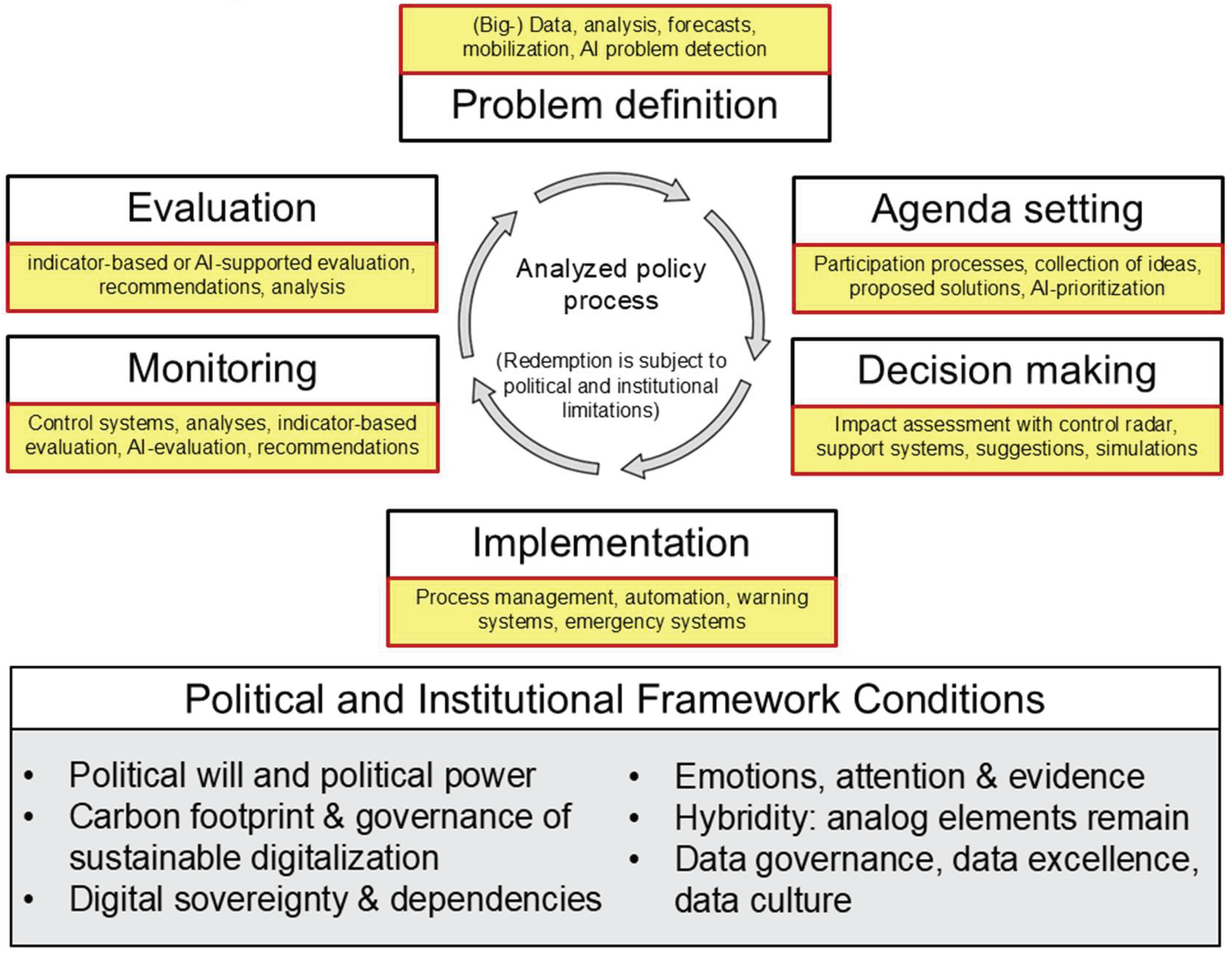
Appendix A

Table A1.
Interview Guide.
| Item | Phase | Question | Time | Cumulative Time |
| 0 | Introduction | Would you please briefly introduce yourself and your perceived functions? | 1 | 1 |
| 1 | Introduction | What is digitalization for you and what does digital transformation mean to you in this context? | 2 | 3 |
| 2 | Introduction | What importance does the digitalization of the state and administration and the associated digital transformation have in your everyday professional life? | 3 | 6 |
| 3 | Introduction | What importance do climate warming, the associated climate change and the politically targeted climate neutrality have in your everyday professional life? | 2 | 8 |
| 4 | Introduction | What interfaces are there between the topics of digitalization and climate warming in your everyday professional life? | 2 | 10 |
| 5 | Problem definition |
To what extent do digital applications and systems influence the perception, knowledge and understanding of the political need for action in the area of climate warming and climate neutrality? | 3 | 13 |
| 6 | Problem definition |
What importance do the availability and quality of digital data, digital applications and systems have for the identification of political needs for action in the area of climate warming and climate neutrality? What becomes easier or more difficult? | 3 | 16 |
| 7 | Agenda-Setting | What role do digital applications and systems play in influencing or shaping the political agenda in the area of climate warming [beyond studies, debates and committee meetings]? | 3 | 19 |
| 8 | Agenda-Setting | How has the digitalization of the state and administration changed the possibilities for political actors to influence the political agenda (of the parties, the parliamentary groups, the parliaments and the United Nations) on climate warming? Are there both positive and negative examples that have achieved political relevance? | 3 | 22 |
| 9 | Decision-making | To what extent do digital applications and systems influence the final political decision-making in the area of climate warming? Do they also contribute constructively to the further development of relevant solutions, to finding compromises and to the finalization of draft laws, impact assessment? | 3 | 25 |
| 10 | Decision-making | To what extent does the digitalization of the state and administration or digital communication of the state and administration influence the speed and effect of political decisions in the area of climate warming and climate neutrality? | 3 | 28 |
| 11 | Implementation | To what extent do digital applications and systems influence the implementation of political decisions in the administration in the area of climate warming? In which phases of implementation are digital systems actually used – and where do analog routines continue to dominate? | 3 | 31 |
| 12 | Implementation | To what extent can the digital transformation of the state and administration influence the implementation of political decisions in the area of climate warming at all? Positively and negatively? Delay or accelerate? | 3 | 34 |
| 13 | Monitoring | To what extent do digital applications and systems influence the implementation of political decisions in the area of climate warming and the perception of implementation successes and of a failure? | 3 | 37 |
| 14 | Monitoring | To what extent can the use of digital applications and systems be expected to result in a better, more transparent, more comprehensible or worse review of the implementation of political decisions by the administration in the area of climate warming? | 3 | 40 |
| 15 | Evaluation | To what extent do digital applications and systems influence the evaluation, assessment and readjustment after the end of the evaluation period for political decisions in the area of climate warming? What role does AI or data-based simulation play in the assessment of political programs and how are qualitative effects captured? | 3 | 43 |
| 16 | Evaluation | To what extent can the use of digital applications and systems be expected to result in a better or worse evaluation of policy-making in the area of climate warming? Do they also contribute constructively to the further development of relevant solutions through a post-perspective impact assessment? |
3 | 46 |
| 17 | Conclusion & Reflection | To what extent does the current digital transformation of the state and administration change policy-making in the area of climate warming and climate neutrality compared to analog, paper-based administrative and decision-making processes (of the 1980s)? | 3 | 49 |
| 18 | Conclusion & Reflection | How can policy-making in the age of the Twin Transformation learn and develop further in order to permanently avoid ruptures between digitalization and sustainability? | 3 | 52 |
| 19 | Conclusion & Reflection | Where do you see, in the various phases of policy-making – from problem definition through decision-making to monitoring – ruptures, incoherences, challenges and risks in the use of digital applications and systems? | 3 | 55 |
| 20 | Conclusion & Reflection | Where do you see, in the various phases of policy-making – from problem definition through decision-making to monitoring – strengths, opportunities and potentials in the use of digital applications and systems? | 3 | 58 |
*Interview Guide.
Appendix B
Appendix B.1: Evaluation Table Interview 1
| Interview No. 1 | Phase | Key Statements | Themes |
| I1F0A1 – 01:43: Professor of Administrative Informatics at the University of Applied Sciences for Technology and Economics Dresden. Engagement with management topics and information systems. Teaching and research. | Introduction |
I1F1A1 - 02:51: Digitalization as end-to-end automation of work processes. I1F1A2 – 03:07: Digitalization as data-centricity. I1F1A3 – 03:37: Digital transformation as societal awareness. I1F2A1 – 04:20: High importance of digitalization in everyday professional life. I1F3A1 – 06:19: Climate warming as a tangible phenomenon in everyday professional life. I1F4A1 – 07:36: Infrastructures and applications, otherwise relatively unconnected. |
I1F1A1 - 02:51: Digital elements as a foundation. I1F1A2 – 03:07: Provision of digital data and processes. I1F1A3 – 03:37: Complete tasks digitally and as automatically as possible. I1F2A1 – 04:20: Processes in the state and administration electronified instead of digitalized. I1F3A1 – 06:19: Temperatures and building standards. The idea of sustainability has not yet matured far in everyday professional life. I1F4A1 – 07:36: Energy consumption, redundancies. |
| Problem definition |
I1F5A1 – 09:11: Use of existing data could save duplicated efforts. I1F5A2 – 11:06: Dashboards and information systems are no basis for raising personal awareness. I1F6A1 – 11:55: Data as particularly important for identifying the need for action. |
I1F5A1 – 09:11: Once-Only, EFA principle and data minimization. Avoidance of duplicated effort. I1F5A2 – 11:06: A means of pressure rather than a means of motivation. I1F6A1 – 11:55: Politics is often based on anecdotal evidence and conjecture. It can accelerate and improve the process. |
|
| Agenda- Setting |
I1F7A1 – 14:20: Little influence on the political agenda. I1F8A1 – 15:20: The digitalization of the state and administration has changed possibilities little. Digitalization in the private world, however, strongly. |
I1F7A1 – 14:20: Political agenda-setting is rather diffuse; digital applications are unreliable and uncontrolled in this context. I1F8A1 – 15:20: Views on climate warming are exchanged in the private, digital space. |
|
| Decision-making |
I1F9A1 – 16:17: Digital applications and systems influenced decision-making. I1F10A1 – 17:06: Strong influence. |
I1F9A1 – 16:17: Improved participation and co-determination in political decisions. I1F10A1 – 17:06: Collaboration and documentation in decision-making. Forecasting and depiction of the impact of political decisions. |
|
| Implementation |
I1F11A1 – 18:08: Implementation very diffuse. I1F11A2 – 19:20: Automated implementation systems not available. I1F12A1 – 19:50: Digitalization ensures transparency in implementation. |
I1F11A1 – 18:08: Legal texts are there. Specialized procedures or information systems for implementation are lacking. I1F11A2 – 19:20: Warning systems already existed before digitalization. I1F12A1 – 19:50: Decisions to be implemented could be steered by information systems. |
|
| Monitoring |
I1F13A1 – 21:08: Increased visibility. I1F14A1 – 22:29: Improved verifiability and comparability. However, it is not in the foreground. |
I1F13A1 – 21:08: Visualizations and technical means. Improved comparability of goals and corresponding actions. I1F14A1 – 22:29: Increased transparency through data and visualizations. |
|
| Evaluation |
I1F15A1 – 23:40: Evaluation of political decisions already implemented. I1F16A1 – 26:03: Ex-post simulations conceivable. Further development of measures. |
I1F15A1 – 23:40: To what extent this evaluation is already based on digital applications cannot be assessed. Previous evaluation is generally text-based. I1F16A1 – 26:03: Data generated by processes could enable ex-post simulation and evaluation. |
|
| Conclusion |
I1F17A1 – 27:11: No change so far. Influence of digital transformation primarily on the addressees of politics and administration. I1F18A1 – 28:15: Topic hardly examined so far I1F19A1 – 30:06: Transition from policy-making to legal text very analog. I1F20A1 – 32:21: Information system that enables participation. |
I1F17A1 – 27:11: Digital transformation has not yet arrived internally in policy-making. I1F18A1 – 28:15: Digitalization and sustainability are mutually dependent, but this has not yet arrived. I1F19A1 – 30:06: Findings from evaluations have so far not been fed back sufficiently. Execution half digital, but decision-making is difficult to automate in terms of content. I1F20A1 – 32:21: In committees, collaborative information systems could be established. |
|
| *Evaluation Table Interview 1. | |||
Appendix B.2: Evaluation Table Interview 2
| Interview No. 2 | Phase | Key Statements | Themes |
|
I2F0A1 – 07:24: Professor of Digitalization and Sustainability. Investigates the environmental impacts of digitalization: Impact Assessment, technology assessment |
Introduction |
I2F1A1 – 08:00: Distinction between Digitization and Digitalization. I2F2A1 – 10:30: Necessity of governance and competence-building. I2F2A2 – 11:20: The state and administration should digitalize themselves. I2F3A1 – 13:49: Content of the work. I2F3A2 – 14:02: The organization of the university is affected by this and willing to reduce emissions. I2F4A1 – 15:38: Conflict of goals between travel and emissions. |
I2F1A1 – 08:00: Digitization: conversion of analog into digital data. Digitalization: a social-societal transformation process (communication, production, coexistence, mobility). I2F2A1 – 10:30: Avoid and mitigate negative effects. I2F2A2 – 11:20: Processes should be managed digitally. This enables efficiency gains. I2F3A1 – 13:49: Research field and content of teaching. I2F3A2 – 14:02: Strategies for avoiding emissions, e.g. video conferences instead of air travel. I2F4A1 – 15:38: Networking and conference attendance important in everyday work. |
| Problem definition |
I2F5A1 – 16:57: Great influence on problem definition. I2F6A1 – 19:40: Data as a challenge. |
I2F5A1 – 16:57: The manner of influence may not be conscious. Necessary for action and impact assessment. I2F6A1 – 19:40: Essential information would have to be filtered out. |
|
| Agenda- Setting |
I2F7A1 – 21:55: Played a major role. Participation no longer limited only to organizations. I2F7A2 – 23:26: Can influence attitudes. I2F8A1 – 24:37: Political actors increasingly used digital communication. |
I2F7A1 – 21:55: Both positive and negative information could be shared. Amplification of extreme and polarizing content. I2F7A2 – 23:26: Partly dependent on which content is served. I2F8A1 – 24:37: Also influences the political agenda in many ways. New target groups. |
|
| Decision-making |
I2F9A1 – 26:43: Can contribute constructively to decision-making. I2F10A1 – 28:50: Potentials for effectiveness and acceleration are given. I2F10A2 – 31:53: User-centricity very important. |
I2F9A1 – 26:43: Digital twins help to assess consequences. Modeling and observation of decisions. I2F10A1 – 28:50: Acceleration and increased effectiveness possible. However, to what extent this takes effect in everyday politics is difficult to assess. I2F10A2 – 31:53: For effectiveness, user-centricity is more decisive than attractive visualizations. |
|
| Implementation |
I2F11A1 – 33:06: Does not wish to comment. I2F12A1 – 34:58: Transparency for the population. |
I2F11A1 – 33:06: The expert does not know everyday politics sufficiently to assess the question validly. I2F12A1 – 34:58: The population can better understand and oversee implementation. |
|
| Monitoring |
I2F13A1 – 35:40: Enabled transparency and participation. I2F14A1 – 37:18: Increases transparency, participation and control by citizens and other policymakers. |
I2F13A1 – 35:40: Systems would have to provide transparent insights. Increased accountability. I2F14A1 – 37:18: Preparation and accessibility important. |
|
| Evaluation |
I2F15A1 – 38:34: Enables continuous evaluation and readjustment. I2F16A1 – 39:40: Improved evaluation possible. |
I2F15A1 – 38:34: Evaluation results no longer dependent on the time of evaluation. Continuously possible even years later without an additional expert report. I2F16A1 – 39:40: Dependent on usability and accessibility. |
|
| Conclusion |
I2F17A1 – 41:32: More knowledge about the causes and drivers of climate warming. I2F17A2 – 42:55: Digitalization can both increase and reduce emissions. I2F18A1 – 49:10: Breaking up silo thinking. I2F19A1 – 50:47: Does not wish to comment. I2F20A1 – 52:55: Greatest potentials in monitoring. |
I2F17A1 – 41:32: Enables more targeted and effective action. Affects society as a whole and can produce countervailing effects. I2F17A2 – 42:55: Governance and steering are decisive. I2F18A1 – 49:10: Close cooperation between digitalization and sustainability is necessary. I2F19A1 – 50:47: No reliable statement. I2F20A1 – 52:55: Opportunities for readjustment and information. |
|
| *Evaluation Table Interview 2. | |||
Appendix B.3: Evaluation Table Interview 3
| Interview No. 3 | Phase | Key Statements | Themes |
| I3F0A1 – 01:34: Professor of societal climate impacts. Head of a research group on social complexity and system transformation. | Introduction |
I3F1A1 – 02:06: Digitalization as an important component of everyday work. I3F1A2 – 02:22: Digital transformation as part of digitalization. I3F3A1 – 03:11: High importance. I3F4A1 – 03:19: Digitalization can affect emissions both negatively and positively. |
I3F1A1 – 02:06: Important for projects and scientific work. I3F1A2 – 02:22: Connects different regions and actors of the university. I3F3A1 – 03:11: Object of research. I3F4A1 – 03:19: On the one hand more flexibility and fewer travel routes, on the other hand high energy and resource consumption. |
| Problem definition |
I3F5A1 – 06:13: Data are important for the understanding of climate warming. I3F5A2 – 07:32: Knowledge not decisive in politics. I3F6A1 – 09:36: Quality and availability not decisive. |
I3F5A1 – 06:13: Nevertheless, a lot of data is generated that is not used and causes high energy demand. I3F5A2 – 07:32: Emotions lead to political action more than knowledge does. I3F6A1 – 09:36: Rather, preparation and communication via emotions are decisive in the context of problem definition. |
|
| Agenda- Setting |
I3F7A1 – 11:29: Digital applications and systems could influence agenda-setting. I3F8A1 – 14:09: Some systems could exert influence. |
I3F7A1 – 11:29: Actors and groups could exert much influence on social media. I3F8A1 – 14:09: The differences between actors in perception and frequency of contributions on social media are large. |
|
| Decision-making |
I3F9A1 – 18:10: Tools are available and helpful but are not used by politics. I3F10A1 – 19:37: Influences the speed of decision-making. |
I3F9A1 – 18:10: Political decisions, too, are based rather on emotions and moods. I3F10A1 – 19:37: Acceleration arises rather on the basis of trends and a high need for action. |
|
| Implementation |
I3F11A1 – 21:06: Partly already reality. I3F12A1 – 22:37: Tools made work in administration easier. |
I3F11A1 – 21:06: Cites European emissions trading and CO2 tax as examples. These would hardly be feasible in an analog way. I3F12A1 – 22:37: Political action, however, dependent on other factors. |
|
| Monitoring |
I3F13A1 – 24:03: Digitalization improves the monitoring and perception of political decisions. I3F14A1 – 25:25: More transparency and traceability. |
I3F13A1 – 24:03: The emission effects of policies are more observable. I3F14A1 – 25:25: Complexity, however, is also increased by data. |
|
| Evaluation |
I3F15A1 – 28:52: Systems could be used for readjustment. I3F16A1 – 31:10: Digital systems and applications could evaluate qualitative effects. |
I3F15A1 – 28:52: Example flood protection and climate adaptation. I3F16A1 – 31:10: Feedback in navigation apps as an example of social changes through digital technology. |
|
| Conclusion |
I3F17A1 – 32:22: Many changes for politics. I3F18A1 – 34:05: Data could be stored and preserved. I3F19A1 – 37:03: Ruptures and incoherences with too much complexity. I3F20A1 – 37:03: Potentials in participatory processes and monitoring. I3F21A1 – 40:03: AI could help to prepare data. |
I3F17A1 – 32:22: More data, knowledge and measures. Emissions rose nevertheless. I3F18A1 – 34:05: The human aspect remains decisive. People solve the problems, not data. I3F19A1 – 37:03: Overview is lost. I3F20A1 – 37:03: Involvement of citizens and institutions. I3F21A1 – 40:03: Reduction of complexity. |
|
| *Evaluation Table Interview 3. | |||
Appendix B.4: Evaluation Table Interview 4
| Interview No. 4 | Phase | Key Statements | Themes |
| I4F0A1 – 01:21: Project manager for the project “Connected urban Twins”. Department for urban planning and spatial planning. Internal process design. | Introduction |
I4F1A1 – 04:01: Relation to the understanding of Smart City. I4F2A1 – 05:06: High importance. Works in the administrative area. A question of democracy. I4F3A1 – 08:03: Great importance of climate warming. I4F4A1 – 08:59: Relation to the field of work. Infrastructure and buildings. |
I4F1A1 – 04:01: Digital tools to make municipalities more sustainable. I4F2A1 – 05:06: Expectations of the population regarding digital administration. I4F3A1 – 08:03: Enormous time pressure. Climate protection methods would have to be adapted accordingly. I4F4A1 – 08:59: Interface via fires and renovation of buildings. |
| Problem definition |
I4F5A1 – 10:40: Visualizations of complex content changed problem definition. I4F6A1 – 12:19: High importance. |
I4F5A1 – 10:40: Changes the nature and quality of discussions. Understanding increases. I4F6A1 – 12:19: Without data, empirical statements are difficult. Availability, legal certainty and quality are decisive. |
|
| Agenda- Setting |
I4F7A1 – 14:20: So far little influence on the field of work. I4F8A1 – 16:29: Little influence so far. |
I4F7A1 – 14:20: Transparency is gaining in importance. I4F8A1 – 16:29: Technically possible, but politicians have so far rarely used it. |
|
| Decision-making |
I4F9A1 – 17:55: Systems and applications influenced municipal decision-making. I4F10A1 – 19:52: The possibility of acceleration exists but is not used. |
I4F9A1 – 17:55: Mandate to develop corresponding tools. I4F10A1 – 19:52: Slow decisions arise rather from sensitivities than from administration. |
|
| Implementation |
I4F11A1 – 23:23: Digital tools already established, analog routines still normal. I4F12A1 – 27:49: Accelerates decisions that have been made. |
I4F11A1 – 23:23: Digital processes often not digitalized end-to-end. Systems, however, are partly applied. I4F12A1 – 27:49: Example of the use of funding. |
|
| Monitoring |
I4F13A1 – 28:38: Hardly used so far. I4F14A1 – 30:18: More transparency and monitoring of decisions is a stated goal. |
I4F13A1 – 28:38: Monitoring is much discussed, but one is not yet that far. I4F14A1 – 30:18: Approaches already exist, but one is technically not yet able. |
|
| Evaluation |
I4F15A1 – 31:27: Influenced future decisions and readjustment. I4F16A1 – 33:49: Improves policy-making and evaluation. |
I4F15A1 – 31:27: Potentials are very large, but it also always means a struggle for resources. I4F16A1 – 33:49: So far, evaluation is often based on gut feeling. |
|
| Conclusion |
I4F17A1 – 35:41: Positive influence of digitalization. But expectations have also risen. I4F18A1 – 43:32: Ruptures between digitalization and sustainability occur frequently. I4F19A1 – 46:18: Challenges are driven rather by politics. I4F20A1 – 46:48: Potentials in problem definition. |
I4F17A1 – 35:41: But one is only at the beginning of what would be possible. I4F18A1 – 43:32: Difficult to avoid these ruptures. I4F19A1 – 46:18: It can also be politically intended not to evaluate everything. I4F20A1 – 46:48: Politics is ready to move. |
|
| *Evaluation Table Interview 4. | |||
Appendix B.5: Evaluation Table Interview 5
| Interview No. 5 | Phase | Key Statements | Themes |
| I5F0A1 – 01:55: Professor of science communication. Director of a competence center for higher education and science research. | Introduction |
I5F1A1 – 03:09: Digitalization as a technology-driven change of various areas of life. I5F1A2 – 04:01: Change of capabilities. I5F2A1 – 06:18: Affected in the context of universities. I5F3A1 – 09:29: High importance of climate warming. I5F4A1 – 11:53: Climate research as an interface. |
I5F1A1 – 03:09: Different levels: individual, institutional, organizational and society-wide. I5F1A2 – 04:01: Extension, substitution and merger. I5F2A1 – 06:18: Clear digitalization boost. I5F3A1 – 09:29: Particularly high importance as an object of research. I5F4A1 – 11:53: In research, but also in business trips. |
| Problem definition |
I5F5A1 – 13:03: Strong influence through digital media. I5F5A2 – 15:51: In general, attention to climate topics has decreased. I5F6A1 – 20:41: Data are important but have long been available at many levels. I5F6A2 – 22:33: Those who do not see the problem are not convinced by data. |
I5F5A1 – 13:03: Media are now fundamentally digital and thereby influence the perception of the problem. I5F5A2 – 15:51: For the remaining attention to climate topics, social networks are central. I5F6A1 – 20:41: IPCC reports, for example, become more precise through data, but political action does not become more effective. I5F6A2 – 22:33: Have their own viewpoints and institutes. |
|
| Agenda- Setting |
I5F7A1 – 23:10 Reference to the answer to question 5. I5F8A1 – 24:25: Strong use for influencing the political agenda. |
I5F7A1 – 23:10: Reference to the answer to question 5. I5F8A1 – 24:25: NGOs, activists and influencers already use this a lot. |
|
| Decision-making |
I5F9A1 – 27:56: Positive examples of citizen participation exist. I5F9A2 – 29:11: Digital media could also hinder climate policy. I5F10A1 – 31:32: Accelerates decision-making. |
I5F9A1 – 27:56: Participation formats also through digital methods. I5F9A2 – 29:11: Can lead to fragmentation, polarization and damage to the debate as well as to false balance. I5F10A1 – 31:32: Digitalization has accelerated through communication. |
|
| Implementation |
I5F11A1 – 34:23: Does not wish to comment. I5F12A1 – 34:56: Dependent on what implementation is. |
I5F11A1 – 34:23: Does not wish to comment. I5F12A1 – 34:56: The formulation of regulations is a communication process influenced by digital technologies. |
|
| Monitoring |
I5F13A1 – 38:08: Digital monitoring systems already exist. I5F14A1 – 39:23: More transparency and traceability. |
I5F13A1 – 38:08: For example, tracking of policy successes, certificate trading and climate changes. I5F14A1 – 39:23: In real time and by different actors. |
|
| Evaluation |
I5F15A1 – 42:54: Does not wish to comment. I5F16A1 – 46:32: Digital systems could contribute to further development. |
I5F15A1 – 42:54: Does not wish to comment. I5F16A1 – 46:32: Potential exists but not yet implemented. |
|
| Conclusion |
I5F17A1 – 48:27: Does not wish to comment. I5F18A1 – 49:14: Does not wish to comment. I5F19A1 – 53:26: Rupture in political processes. I5F20A1 – 56:20: Many potentials rather in earlier phases. |
I5F17A1 – 48:27: Does not wish to comment. I5F18A1 – 49:14: Does not wish to comment. I5F19A1 – 53:26: Where opinions are taken up and lead to decisions, digitally induced changes in opinion formation are poorly perceived. I5F20A1 – 56:20: Aggregate opinions and translate them into decisions. |
|
| *Evaluation Table Interview 5. | |||
Appendix B.6: Evaluation Table Interview 6
| Interview No. 6 | Phase | Key Statements | Themes |
| I6F0A1 – 01:28: Head of department and city councilor in Hesse. Thematically responsible for the Office for Communication and Information Technology as well as the Digitalization Staff Unit. Political and strategic steering of the topics. | Introduction |
I6F1A1 – 02:56: Digitalization as the transfer of analog content into the digital. I6F1A2 – 03:07: Digital transformation as a process. I6F2A1 – 04:03: Plays a major role. I6F3A1 – 05:40: Is taken into account. I6F4A1 – 07:33: Questions on data centers and funding applications in the digital area with reference to climate topics. |
I6F1A1 – 02:56: Digitalization as a mere change of application. I6F1A2 – 03:07: Takes into account people, organizations and change beyond software and hardware. I6F2A1 – 04:03: In particular digital transformation. I6F3A1 – 05:40: Is taken into account and prioritized in use cases. I6F4A1 – 07:33: Conflicts of goals between data centers and land use. |
| Problem definition |
I6F5A1 – 10:56: Rather little influence on the necessity of action. I6F6A1 – 12:47: Dependent on the respective offices |
I6F5A1 – 10:56: The topic has arrived in the mainstream and is influenced by other factors. I6F6A1 – 12:47: More relevant for some offices than for others. |
|
| Agenda- Setting |
I6F7A1 – 14:08: Strong influence on the political agenda. I6F8A1 – 16:22: Enabled actors to organize themselves and generate attention. |
I6F7A1 – 14:08: Demands from participation portals are adopted. I6F8A1 – 16:22: Politicians have been able to respond to various actors digitally. |
|
| Decision-making |
I6F9A1 – 18:10: Could contribute constructively. I6F10A1 – 19:43: Political priorities are adjusted. |
I6F9A1 – 18:10: Evidence- and data-based solutions are consulted. I6F10A1 – 19:43: Data help to order priorities on an evidence basis. |
|
| Implementation |
I6F11A1 – 21:44: Administration implements political decisions independently of digitalization. I6F12A1 – 27:04: Potential to accelerate implementation. |
I6F11A1 – 21:44: A generational change leads to more digital and more innovative thinking. I6F12A1 – 27:04: A data basis can depict reality on a data basis. |
|
| Monitoring |
I6F13A1 – 27:47: Implementations could be prepared differently. I6F14A1 – 29:31: Depends on the political need for transparency. |
I6F13A1 – 27:47: A climate dashboard helps to set a different focus and to simplify. I6F14A1 – 29:31: A question of the political will of the decision-makers. |
|
| Evaluation |
I6F15A1 – 31:27: Can help to evaluate better. I6F16A1 – 33:14: Better evaluation possible. |
I6F15A1 – 31:27: For example in projects such as water management. I6F16A1 – 33:14: However, it depends on whether the potential is used politically. |
|
| Conclusion |
I6F17A1 – 36:38: Underlines the arguments for an evidence-based approach. I6F18A1 – 38:00: Policy-making can learn to avoid mistakes. I6F19A1 – 40:37: Decision-making and monitoring as the greatest challenges. I6F20A1 – 39:50: Potentials in every phase. I6F21A1 – 42:48: The importance of data long underestimated. |
I6F17A1 – 36:38: Data-based findings on climate warming and increase of transparency. I6F18A1 – 38:00: Through forecasts, mistakes in policy-making could be avoided. I6F19A1 – 40:37: Decisions and monitoring rather on the basis of political sensitivities. I6F20A1 – 39:50: Data and systems enabled evidence-based decisions in every phase. I6F21A1 – 42:48: Could help to make a tangible policy. |
|
| *Evaluation Table Interview 6. | |||
Appendix B.7: Evaluation Table Interview 7
| Interview No. 7 | Phase | Key Statements | Themes |
| I7F0A1 – 06:47: President of the State Office for Nature, Environment and Climate. Head of a technical-scientific authority. | Introduction |
I7F1A1 – 07:26: Digitalization as a comprehensive term. I7F2A1 – 08:58: High importance. I7F3A1 – 10:55: Very high importance. I7F4A1 – 13:42: Provides climate data digitally. |
I7F1A1 – 07:26: Digitalization of internal processes to increase effectiveness and acceleration. I7F2A1 – 08:58: Provides many figures and data in everyday work. I7F3A1 – 10:55: Climate in the name of the authorities and a specialist center for climate. Goal of climate neutrality of the state administration. I7F4A1 – 13:42: A climate atlas provides climate data as open-data resources. |
| Problem definition |
I7F5A1 – 14:47: Dependent on the will of politics. I7F6A1 – 15:50: Decisive role of data. |
I7F5A1 – 14:47: Figures, data, facts available, but action dependent on political will. I7F6A1 – 15:50: Only through availability, quality, findability, accessibility and manageability can a political need for action be derived. |
|
| Agenda- Setting |
I7F7A1 – 17:01: Provides support to ministries. I7F8A1 – 19:16: Changes the way politicians engage with topics. |
I7F7A1 – 17:01: Ministries use this data to shape political action. I7F8A1 – 19:16: A gateway to engage with topics more intensively and on an evidence basis. |
|
| Decision-making |
I7F9A1 – 21:05: Contribute constructively. I7F10A1 – 22:10: Influences decision-making, but difficult to assess. |
I7F9A1 – 21:05: Conclusions from past decisions. I7F10A1 – 22:10: Difficult to assess. |
|
| Implementation |
I7F11A1 – 24:19: Systems give feedback that led to action. I7F12A1 – 27:49: Can accelerate and create more knowledge about the circumstances. |
I7F11A1 – 24:19: There are no automated implementation systems, but one is no longer far away. I7F12A1 – 27:49: Data could be provided quickly and in an easily analyzable form. |
|
| Monitoring |
I7F13A1 – 29:18: Great importance for ministries. I7F14A1 – 30:54: Leads to more transparent and more comprehensible reviews. |
I7F13A1 – 29:18: Review of decisions made and of success. I7F14A1 – 30:54: Cannot oversee all policy fields, but expects higher transparency and traceability. |
|
| Evaluation |
I7F15A1 – 31:41: Influences the evaluation with regard to evidence and facts. I7F16A1 – 32:43: Improves evaluation. |
I7F15A1 – 31:41: Digital data and systems as the key to fact-based evaluation. I7F16A1 – 32:43: Clearly leads to improvement. |
|
| Conclusion |
I7F17A1 – 33:13: Policy-making would be accelerated. I7F18A1 – 34:46: Digitalization as a major energy consumer. I7F19A1 – 37:31: Analysis and assessment as a challenge. I7F20A1 – 36:33: Greatest potential in problem definition and monitoring. I7F21A1 – 38:43: The digitalization of the state and administration must be accelerated. |
I7F17A1 – 33:13: Faster data provision and analysis. I7F18A1 – 34:46: The rupture could be avoided through renewable energies. I7F19A1 – 37:31: Data must always be interpreted correctly. I7F20A1 – 36:33: Problem definition and monitoring data-driven. I7F21A1 – 38:43: Yields opportunities for climate protection in view of the time pressure to act. |
|
| *Evaluation Table Interview 7. | |||
Appendix B.8: Evaluation Table Interview 8
| Interview No. 8 | Phase | Key Statements | Themes |
| I8F0A1 – 01:46: Managing director of a consulting and investment company in the field of climate protection and renewable energies, as well as project developer of a company that plans and operates renewable energy facilities. Interest representative at the platform renewable energies in Baden-Württemberg. | Introduction |
I8F1A1 – 03:15: Attempt at process acceleration. Challenge for older people. I8F2A1 – 06:40: Necessary for approval processes. I8F3A1 – 07:40: Climate change and neutrality as a central component of the work. I8F4A1 – 08:33: Digitalization as a tool for climate protection. |
I8F1A1 – 03:15: Through shared data access. Process change. Partial overwhelming of older people. I8F2A1 – 06:40: Documents would have to be submitted digitally. I8F3A1 – 07:40: Everything work-related is oriented toward climate change and neutrality. I8F4A1 – 08:33: For example with smart meters or substations. |
| Problem definition |
I8F5A1 – 11:44: Massive influence on problem definition. I8F6A1 – 14:16: Ambivalent in the context of problem definition. |
I8F5A1 – 11:44: Makes findings accessible to everyone. I8F6A1 – 14:16: Both well-founded and opinion-based problem definitions reach more people. |
|
| Agenda- Setting |
I8F7A1 – 17:12: Extreme effect on agenda-setting. I8F8A1 – 20:33: Leads to challenges for addressees. |
I8F7A1 – 17:12: Politicians are under more pressure. Will increase. I8F8A1 – 20:33: People who are not digitally savvy have difficulty responding to digitalization-related political decisions. |
|
| Decision-making |
I8F9A1 – 21:50: Varied in this context. I8F10A1 – 24:58: Can accelerate decisions. |
I8F9A1 – 21:50: Impact assessment digitally influenced, finalization of draft laws not. I8F10A1 – 24:58: Deadlines, however, more effective. |
|
| Implementation |
I8F11A1 – 26:03: Implementation remains analog. I8F12A1 – 27:27: Both positive and negative. |
I8F11A1 – 26:03: In procedures such as hearings, democracy remains dependent on in-person meetings. I8F12A1 – 27:27: Positive through acceleration, negative through complexity. |
|
| Monitoring |
I8F13A1 – 28:43: Little influence on the perception of implementation successes. I8F14A1 – 29:50: Dependent on the concrete preparation. |
I8F13A1 – 28:43: Perception dependent on analog communication channels. I8F14A1 – 29:50: Comprehensibly prepared monitoring can create transparency. |
|
| Evaluation |
I8F15A1 – 32:57: Subordinate role in politics. I8F15A2 – 34:08: Reduction of complexity possible. I8F16A1 – 39:57: Evaluation becomes better and more accessible. |
I8F15A1 – 32:57: Oriented rather toward paper-based documents. I8F15A2 – 34:08: AI can filter, prepare and thus democratize central messages. I8F16A1 – 39:57: Enables evaluation and education also for laypeople. |
|
| Conclusion |
I8F17A1 – 41:08: Broader access to policy-making. I8F18A1 – 42:42: Policymakers would have to find a new balance. I8F19A1 – 44:03: Establish equal speed. I8F20A1 – 47:59: Includes more people in the political process. |
I8F17A1 – 41:08: Access no longer dependent on the inspection of documents made available for viewing. I8F18A1 – 42:42: Must engage more intensively with the topics. I8F19A1 – 44:03: Less digitally savvy people must not be left behind. I8F20A1 – 47:59: Other forms of access could be created. |
|
| *Evaluation Table Interview 8. | |||
Appendix B.9: Evaluation Table Interview 9
| Interview No. 9 | Phase | Key Statements | Themes |
| I9F0A1 – 01:24: Coordinator of a network of civil-society organizations such as environmental, tech and development organizations and trade unions. | Introduction |
I9F1A1 – 02:17: Digitalization as a broad term. I9F1A2 – 03:10: Digital transformation as a new industry. I9F2A1 – 04:17: Great importance. I9F3A1 – 05:40: Main concern in everyday professional life. I9F4A1 – 07:00: AI as the interface of the topics. |
I9F1A1 – 02:17: Digitalization as process change. I9F1A2 – 03:10: New actors, tools and supply chains. Political influence by large corporations. I9F2A1 – 04:17: Two state-funded digital projects. I9F3A1 – 05:40: An analytical lens for digital developments. I9F4A1 – 07:00: Energy consumption of large language models. Added value questionable. |
| Problem definition |
I9F5A1 – 10:42: Digital technologies play a decisive role. I9F5A2 – 11:52: AI has changed the climate goals of large corporations. I9F5A3 – 15:13: The problem of climate warming is not a lack of information. I9F6A1 – 16:18: Information necessary for climate policy. |
I9F5A1 – 10:42: Information on climate policy more broadly accessible. I9F5A2 – 11:52: Moved away from climate goals, announced an increase in energy consumption. I9F5A3 – 15:13: The problem is a lack of action. I9F6A1 – 16:18: Above all at the operational level. |
|
| Agenda- Setting |
I9F7A1 – 18:10: Techno-fix distorts agenda-setting. I9F8A1 – 19:47: Helps political actors to exert influence. |
I9F7A1 – 18:10: Wanting to solve complex problems technically distorts the debate. I9F8A1 – 19:47: Can create a narrative that postpones climate policy. |
|
| Decision-making |
I9F9A1 – 21:44: Contribute to this. I9F10A1 – 23:28: Does not wish to comment. |
I9F9A1 – 21:44: Helps climate research and statistics. I9F10A1 – 23:28: Does not wish to comment. |
|
| Implementation |
I9F11A1 – 27:11: Does not wish to comment. I9F12A1 – 28:37: Implementation automation partly sensible. |
I9F11A1 – 27:11: Does not wish to comment. I9F12A1 – 28:37: Does not, however, replace human decisions. |
|
| Monitoring |
I9F13A1 – 30:05: Does not wish to comment. I9F14A1 – 36:40: Data analysis can increase transparency. |
I9F13A1 – 30:05: Does not wish to comment. I9F14A1 – 36:40: Social-ecological justice cannot be calculated. |
|
| Evaluation |
I9F15A1 – 38:07: Does not wish to comment. I9F16A1 – 39:06: Improves evaluation. |
I9F15A1 – 38:07: Does not wish to comment. I9F16A1 – 39:06: Better availability helps to comprehend climate policy. |
|
| Conclusion |
I9F17A1 – 39:53: Climate policy does not depend on digital or analog administrative processes. I9F18A1 – 42:01: Rupture avoidable if no techno-fix arose. I9F19A1 – 45:41: AI as a challenge. I9F20A1 – 44:38: Dependent on the respective technologies. |
I9F17A1 – 39:53: Climate policy is rather a question of power and sensitivities. I9F18A1 – 42:01: Example of the EU's focus on AI in the Twin Transition. I9F19A1 – 45:41: Delivers poor problem definitions, distorts problems and partly makes critical decisions. I9F20A1 – 44:38: Data analyses could help in every phase. |
|
| *Evaluation Table Interview 9. | |||
Appendix B.10: Evaluation Table Interview 10
| Interview No. 10 | Phase | Key Statements | Themes |
| I10F0A1 – 01:56: Managing director of an association in the public-sector area in Baden-Württemberg. | Introduction |
I10F1A1 – 03:04: Digitalization as process change. I10F2A1 – 06:06: Digitalization has long since arrived in everyday professional life. I10F3A1 – 08:36: High importance. I10F4A1 - 10:15: Digitalization as a steering instrument. |
I10F1A1 – 03:04: New processes with new modes of operation. I10F2A1 – 06:06: Digitalization of the association's processes and digital office. I10F3A1 – 08:36: The member companies of the association would have to implement the climate goals. I10F4A1 - 10:15: Control of the sewage networks. |
| Problem definition |
I10F5A1 – 14:57: The challenges of climate warming are known. I10F6A1 – 18:29: There is no lack of data. |
I10F5A1 – 14:57: Further data do not reach ideologically motivated decision-makers. I10F6A1 – 18:29: There is rather a lack of corresponding analysis. |
|
| Agenda- Setting |
I10F7A1 – 21:07: Agenda-setting driven rather by emotions. I10F8A1 – 24:48: Digital instruments could create emotionalization. |
I10F7A1 – 21:07: Personal experience and emotions determine the agenda. I10F8A1 – 24:48: Emotionalization can enable agenda-setting. |
|
| Decision-making |
I10F9A1 – 28:32: Clearly contribute to this. I10F9A2 – 30:46: Simulations help with decision-making. I10F10A1 – 32:08: Decisions become more far-reaching. |
I10F9A1 – 28:32: Enabled data-driven prioritization and decision. I10F9A2 – 30:46: For example the simulation of an additional pumping station in Lake Constance. I10F10A1 – 32:08: Political decisions continue to be made in an analog way. |
|
| Implementation |
I10F11A1 – 34:07: Analog routines in implementation hardly present. I10F12A1 – 36:40: AI can accelerate implementation. |
I10F11A1 – 34:07: Implementation problems due to inefficient digital processes. I10F12A1 – 36:40: Generates acceleration through simplification. |
|
| Monitoring |
I10F13A1 – 39:38: Data-driven monitoring can accelerate. I10F13A2 – 43:09: One must not rely on the wrong systems. I10F14A1 – 46:16: Digital applications do not lead directly to transparency. |
I10F13A1 – 39:38: Measures could be better prioritized. I10F13A2 – 43:09: Can be exploited in an interest-driven way. I10F14A1 – 46:16: For this, algorithms would have to be transparent. |
|
| Evaluation |
I10F15A1 – 48:23: So far no follow-up evaluation. I10F16A1 – 49:54: Necessity of stronger impact assessment in politics. |
I10F15A1 – 48:23: Sees opportunities for far-reaching evaluations. I10F16A1 – 49:54: Data-based applications help to assess consequences. |
|
| Conclusion |
I10F17A1 – 53:48: Digitalization helps to make better use of the data base. I10F18A1 – 57:21: Policy-making must understand itself as a learning system. I10F19A1 – 62:12: Risks in the use of AI. I10F20A1 – 61:22: Potentials in the abundance of data and the interlinking of systems. |
I10F17A1 – 53:48: This leads to more networked decisions. I10F18A1 – 57:21: Is not always the case. I10F19A1 – 62:12: Dependence and influence by companies I10F20A1 – 61:22: Climate warming not monocausal, shaped by various influences. |
|
| *Evaluation Table Interview 10. | |||
Appendix B.11: Evaluation Table Interview 11
| Interview No. 11 | Phase | Key Statements | Themes |
| I11F0A1 – 01:15: Professor of Digitalization and Process Management. Formerly at a university of applied sciences for public administration. | Introduction |
I11F1A1 – 02:18: Digitalization as an interplay of several factors. I11F1A2 – 03:27: Digital transformation as digital management. I11F2A1 – 05:45: Rather low importance. I11F3A1 – 07:49: General environmental aspects relevant. I11F3A2 – 12:02: Change management necessary. I11F4A1 – 21:26: References question 3. |
I11F1A1 – 02:18: Digital management, change, process and knowledge management. I11F1A2 – 03:27: Technical transformation from analog to digital. I11F2A1 – 05:45: Administration is persistent, innovations difficult to implement. I11F3A1 – 07:49: Business trips, online meetings, waste avoidance and document printing. I11F3A2 – 12:02: The Twin Transition must not be limited to climate warming. I11F4A1 – 21:26: References question 3. |
| Problem definition |
I11F5A1 – 21:57: Political needs for action less digitally guided. I11F6A1 – 23:46: Data with possible influence under certain conditions. |
I11F5A1 – 21:57: Technologies available but do not lead to action. I11F6A1 – 23:46: Changed availability through live simulations. |
|
| Agenda- Setting |
I11F7A1 – 26:55: Does not wish to comment. I11F8A1 – 27:12: Does not wish to comment. |
I11F7A1 – 26:55: Does not wish to comment. I11F8A1 – 27:12: Does not wish to comment. |
|
| Decision-making |
I11F9A1 – 27:58: References question 6. I11F10A1 – 28:22: Administration still little digitalized. |
I11F9A1 – 27:58: References question 6. I11F10A1 – 28:22: Therefore little influence on decisions. |
|
| Implementation |
I11F11A1 – 30:01: Does not wish to comment. I11F12A1 – 30:37: Digitalization requires framework conditions. |
I11F11A1 – 30:01: Does not wish to comment. I11F12A1 – 30:37: Available capacities could help implementation. |
|
| Monitoring |
I11F13A1 – 34:09: Does not wish to comment. I11F14A1 – 34:14: Does not wish to comment. |
I11F13A1 – 34:09: Does not wish to comment. I11F14A1 – 34:14: Does not wish to comment. |
|
| Evaluation |
I11F15A1 – 35:24: Evaluation in connection with decision-making. I11F16A1 – 36:50: Does not wish to comment. |
I11F15A1 – 35:24: When digital technologies are used for decision-making, their significance could be evaluated in retrospect. I11F16A1 – 36:50: Does not wish to comment. |
|
| Conclusion |
I11F17A1 – 37:56: No discernible change in political processes. I11F18A1 – 38:28: Inclusion of the systems in decisions. I11F19A1 – 40:27: Digitalization little advanced. I11F20A1 – 41:43: Forecasts, live calculations and simulations. |
I11F17A1 – 37:56: Still largely paper-based. I11F18A1 – 38:28: Couple political decisions to climate neutrality. I11F19A1 – 40:27: Digitalization of the state and administration as a challenge. I11F20A1 – 41:43: Impact assessment in the decision-making process. |
|
| *Evaluation Table Interview 11. | |||
Appendix B.12: Evaluation Table Interview 12
| Interview No. 12 | Phase | Key Statements | Themes |
| I12F0A1 – 01:49: Employee in the municipal administration of Wuppertal. Project Urban Digital Twin. Department of surveying, cadastre and geodata. | Introduction |
I12F1A1 – 03:55: Digitalization as a necessity. I12F1A2 – 05:00: Digital transformation as a necessity. I12F2A1 – 06:03: Very high importance. I12F3A1 – 07:17: Very high importance. I12F4A1 – 09:05: Interface through the digital twin. |
I12F1A1 – 03:55: Administration with the vision and goal of digitalization in order to cope with challenges. I12F1A2 – 05:00: Is entering into professional work. I12F2A1 – 06:03: Holds potentials and risks. I12F3A1 – 07:17: Digital twin for climate and climate adaptation. I12F4A1 – 09:05: Interdisciplinary cooperation on climate warming via a digital platform. |
| Problem definition |
I12F5A1 – 14:57: Policy-making far removed from technical practice. I12F6A1 – 18:10: Data quality and applications help with problem identification. |
I12F5A1 – 14:57: Insofar as the digital twin is used, it accelerates problem perception. I12F6A1 – 18:10: Highest priority in order to make decisions quickly and use resources efficiently. |
|
| Agenda- Setting |
I12F7A1 – 20:48: Possibility of compiling information. I12F8A1 – 22:58: Does not wish to comment. |
I12F7A1 – 20:48: Information at the push of a button, which improved agenda-setting. I12F8A1 – 22:58: Does not wish to comment. |
|
| Decision-making |
I12F9A1 – 23:48: Contribute to decision-making. I12F10A1 – 25:06: Transparency and presence grow. |
I12F9A1 – 23:48: The use of digital technologies for decision support is common practice. I12F10A1 – 25:06: The level of the debate changes. Connections and options become visible. |
|
| Implementation |
I12F11A1 – 26:29: Help to improve implementation. I12F12A1 – 28:29: Possibly accelerates the existing processes. |
I12F11A1 – 26:29: Improved implementation through findings from measurement series. I12F12A1 – 28:29: This, however, has not yet been proven. |
|
| Monitoring |
I12F13A1 – 30:02: Deepened the understanding of decisions made. I12F14A1 – 32:29: Systems increased transparency. |
I12F13A1 – 30:02: Context and effects of decisions become more accessible. I12F14A1 – 32:29: Early identification of measures that do not work. |
|
| Evaluation |
I12F15A1 – 33:37: Digital systems help to analyze the data obtained. I12F16A1 – 40:18: Possible to generate a better understanding. |
I12F15A1 – 33:37: Evaluation without digital systems hardly still possible due to the complexity. I12F16A1 – 40:18: Decisions could be better explained and evoke a sense of concern. |
|
| Conclusion |
I12F17A1 – 42:04: Digitalization breaks up silos and monodisciplinary processes. I12F18A1 – 43:11: Digitalization enables knowledge management. I12F19A1 – 45:26: System communication and data integration. I12F20A1 – 44:48: Problem definition, decision-making and monitoring. |
I12F17A1 – 42:04: Processes become more networked and create shared responsibility. I12F18A1 – 43:11: Networked knowledge helps to avoid ruptures. I12F19A1 – 45:26: Threat through manipulation and attacks. I12F20A1 – 44:48: Problems and effects could be projected into the future |
|
| *Evaluation Table Interview 12. | |||
Appendix B.13: Summary Results Table of the Interviews
| Phase | Question | Key Statements | Indices |
| Introduction | F1 | Digitalization as a broad change and acceleration of work processes. | I1F1A1 - 02:51; I7F1A1 – 07:26; I8F1A1 – 03:15; I9F1A1 – 02:17; I10F1A1 – 03:04 |
| Digitalization as the transfer of analog content into the digital; distinction between Digitization (conversion of analog into digital data) and Digitalization (societal transformation process). | I2F1A1 – 08:00; I6F1A1 – 02:56 | ||
| Digitalization as data-centricity and provision of digital data. | I1F1A2 – 03:07 | ||
| Digitalization as a technology-driven change of various levels and capabilities as well as an interplay of several factors (management of change, processes and knowledge). | I5F1A1 – 03:09; I5F1A2 – 04:01; I11F1A1 – 02:18 | ||
| Digitalization as an important, necessary component of everyday work. | I3F1A1 – 02:06; I12F1A1 – 03:55 | ||
| Digitalization as the basis of Smart City: digital tools to make municipalities more sustainable. | I4F1A1 – 04:01 | ||
| Digital transformation as societal and organizational change beyond software and hardware, with new actors, tools and supply chains, and as a necessity. | I1F1A3 – 03:37; I3F1A2 – 02:22; I6F1A2 – 03:07; I9F1A2 – 03:10; I11F1A2 – 03:27; I12F1A2 – 05:00 | ||
| F2 | High to very high importance of digitalization in everyday professional life. | I1F2A1 – 04:20; I4F2A1 – 05:06; I5F2A1 – 06:18; I6F2A1 – 04:03; I7F2A1 – 08:58; I9F2A1 – 04:17; I10F2A1 – 06:06; I12F2A1 – 06:03 | |
| Necessary for concrete processes such as approvals, in which documents are submitted digitally. | I8F2A1 – 06:40 | ||
| Necessity of governance and competence-building; the state and administration should digitalize themselves in order to increase efficiency. | I2F2A1 – 10:30; I2F2A2 – 11:20 | ||
| Rather low importance, since the administration is persistent and innovations difficult to implement. | I11F2A1 – 05:45 | ||
| F3 | High to very high importance of climate warming, among other things as an object of research and as a central object of work (climate neutrality, digital twin, implementation of climate goals). | I3F3A1 – 03:11; I4F3A1 – 08:03; I5F3A1 – 09:29; I7F3A1 – 10:55; I8F3A1 – 07:40; I9F3A1 – 05:40; I10F3A1 – 08:36; I12F3A1 – 07:17 | |
| Tangible phenomenon in everyday life (temperatures, building standards), but the idea of sustainability has not yet matured far. | I1F3A1 – 06:19 | ||
| Is taken into account and prioritized in use cases. | I6F3A1 – 05:40 | ||
| Broader environmental aspects relevant (business trips, online meetings, waste avoidance); change management necessary, Twin Transition not limited to climate warming. | I11F3A1 – 07:49; I11F3A2 – 12:02 | ||
| Object of research and teaching; the university is willing to reduce emissions (e.g. video conferences instead of air travel). | I2F3A1 – 13:49; I2F3A2 – 14:02 | ||
| F4 | Digitalization as a tool or steering instrument for climate protection (smart meters, substations, sewage networks). | I8F4A1 – 08:33; I10F4A1 - 10:15 | |
| Provision of climate data (open data, climate atlas) and interdisciplinary cooperation via a digital twin or platform. | I7F4A1 – 13:42; I12F4A1 – 09:05 | ||
| Ambivalent effect on emissions (more flexibility and less travel versus high energy and resource consumption, redundancies); conflicts of goals for example with data centers and land use. | I1F4A1 – 07:36; I2F4A1 – 15:38; I3F4A1 – 03:19; I6F4A1 – 07:33 | ||
| AI as an interface: high energy consumption of large language models, added value questionable. | I9F4A1 – 07:00 | ||
| Climate research as an interface (research, but also business trips). | I5F4A1 – 11:53 | ||
| Interface via infrastructure and buildings (fires, renovation). | I4F4A1 – 08:59 | ||
| Problem definition |
F5 | Strong influence: digital technologies and media made the problem more visible and findings more broadly accessible. | I2F5A1 – 16:57; I5F5A1 – 13:03; I8F5A1 – 11:44; I9F5A1 – 10:42 |
| The use of existing data saves duplicated effort (e.g. Once Only, EFA and data minimization). | I1F5A1 – 09:11 | ||
| Visualizations of complex content improved understanding as well as the nature and quality of the discussion. | I4F5A1 – 10:40 | ||
| Influence limited: data and technologies are available, but political action depends on the will, not on a lack of information. | I6F5A1 – 10:56; I7F5A1 – 14:47; I9F5A3 – 15:13; I10F5A1 – 14:57; I11F5A1 – 21:57; I12F5A1 – 14:57. | ||
| Knowledge and data are less decisive in politics than emotions; dashboards acted more as a means of pressure than as a means of motivation. | I1F5A2 – 11:06; I3F5A2 – 07:32 | ||
| Attention to climate topics has decreased overall; the remaining attention runs strongly via social networks. | I5F5A2 – 15:51 | ||
| Ambivalence of data and AI: much unused data with high energy demand; AI has softened the climate goals of large corporations. | I3F5A1 – 06:13; I9F5A2 – 11:52 | ||
| F6 | Data are decisive for the identification of the need for action; availability, quality, accessibility and legal certainty are central; they could accelerate and improve the process. | I1F6A1 – 11:55; I4F6A1 – 12:19; I7F6A1 – 15:50; I9F6A1 – 16:18; I12F6A1 – 18:10 | |
| Not the quantity or quality of the data is decisive, but the analysis, preparation and communication (also via emotions). | I3F6A1 – 09:36; I10F6A1 – 18:29 | ||
| Data are important but have long been available at many levels; more data did not make political action more effective and did not convince skeptics. | I5F6A1 – 20:41; I5F6A2 – 22:33 | ||
| Data as a challenge: the essential must be filtered out. | I2F6A1 – 19:40 | ||
| Ambivalent: both well-founded and opinion-based problem definitions reached more people. | I8F6A1 – 14:16 | ||
| Dependent on the respective office or authority. | I6F6A1 – 12:47 | ||
| Possible influence under certain conditions, for example through changed availability via live simulations | I11F6A1 – 23:46 | ||
| Agenda- Setting |
F7 | Strong influence on agenda-setting: via social media, participation portals and data provision, topics and demands are taken up; politicians are under greater pressure. | I2F7A1 – 21:55; I2F7A2 – 23:26; I3F7A1 – 11:29; I6F7A1 – 14:08; I7F7A1 – 17:01; I8F7A1 – 17:12; I12F7A1 – 20:48 |
| Techno-fix distorts agenda-setting when complex problems are to be solved purely technically. | I9F7A1 – 18:10 | ||
| Agenda-setting driven rather by personal experience and emotions. | I10F7A1 – 21:07 | ||
| Little influence: political agenda-setting is diffuse and digital applications unreliable; so far little influence in one's own field of work, but transparency is gaining in importance. | I1F7A1 – 14:20; I4F7A1 – 14:20 | ||
| F8 | Political actors, NGOs, activists and influencers increasingly used digital communication to influence the agenda, reached new target groups and organized themselves. | I2F8A1 – 24:37; I5F8A1 – 24:25; I6F8A1 – 16:22 | |
| Aid to exerting influence, but can also create a narrative that postpones climate policy. | I9F8A1 – 19:47 | ||
| Digital instruments and emotionalization enabled agenda-setting. | I10F8A1 – 24:48 | ||
| Changed the way of engagement; a gateway for more intensive, evidence-based engagement with topics. | I7F8A1 – 19:16 | ||
| Some systems could exert influence, but the differences between actors (perception, frequency of contributions) are large. | I3F8A1 – 14:09 | ||
| Little influence so far: technically possible but rarely used by politicians; digitalization has an effect above all in the private sphere. | I1F8A1 – 15:20; I4F8A1 – 16:29 | ||
| Leads to challenges for the addressees: people who are not digitally savvy have difficulty responding. | I8F8A1 – 20:33 | ||
| Decision-making | F9 | Contribute constructively to decision-making: improved participation and co-determination, impact assessment through digital twins, modeling and simulation, data-driven prioritization as well as conclusions from past decisions. | I1F9A1 – 16:17; I2F9A1 – 26:43; I4F9A1 – 17:55; I6F9A1 – 18:10; I7F9A1 – 21:05; I9F9A1 – 21:44; I10F9A1 – 28:32; I10F9A2 – 30:46; I12F9A1 – 23:48 |
| Positive examples of citizen participation through digital methods already exist. | I5F9A1 – 27:56 | ||
| Tools are available and helpful but are not used by politics; decisions are based rather on emotions and moods. | I3F9A1 – 18:10 | ||
| Effect varied: impact assessment digitally influenced, but finalization of draft laws not. | I8F9A1 – 21:50 | ||
| Digital media could also hinder climate policy (fragmentation, polarization, false balance). | I5F9A2 – 29:11 | ||
| F10 | Digital applications accelerated and improved decision-making (collaboration, documentation, forecasting, evidence-based prioritization); effectiveness potentials given, but effect in everyday politics difficult to assess. | I1F10A1 – 17:06; I2F10A1 – 28:50; I3F10A1 – 19:37; I5F10A1 – 31:32; I6F10A1 – 19:43; I8F10A1 – 24:58 | |
| Decisions become more far-reaching and more transparent, options more visible, but political decisions continue to be made in an analog way. | I10F10A1 – 32:08; I12F10A1 – 25:06 | ||
| Acceleration potential exists but is not used; delays arise rather from sensitivities than from the administration. | I4F10A1 – 19:52 | ||
| Administration still little digitalized, therefore little influence on decisions. | I11F10A1 – 28:22 | ||
| User-centricity is more decisive for effectiveness than attractive visualizations. | I2F10A2 – 31:53 | ||
| Influences decision-making, but the effect is difficult to assess. | I7F10A1 – 22:10 | ||
| Implementation | F11 | Implementation remains largely analog; automated implementation systems were lacking (legal texts available, specialized procedures not), and procedures such as hearings remained dependent on physical presence. | I1F11A1 – 18:08; I1F11A2 – 19:20; I8F11A1 – 26:03 |
| Digital tools partly established but rarely fully digital; analog routines or inefficient digital processes persist. | I4F11A1 – 23:23; I10F11A1 – 34:07 | ||
| Administration implements decisions independently of digitalization; a generational change brings more digital and more innovative thinking. | I6F11A1 – 21:44 | ||
| Partly already reality (e.g. emissions trading and CO2 tax), which would hardly be feasible in an analog way. | I3F11A1 – 21:06 | ||
| Systems give feedback that led to action; automated systems are still lacking but are no longer far away. | I7F11A1 – 24:19 | ||
| Help to improve implementation through findings from measurement series. | I12F11A1 – 26:29 | ||
| F12 | Accelerates the implementation of decisions made and creates more knowledge (fast, easily analyzable data, simplification through AI), but partly not yet proven. | I4F12A1 – 27:49; I6F12A1 – 27:04; I7F12A1 – 27:49; I10F12A1 – 36:40; I12F12A1 – 28:29 | |
| Tools made administrative work easier, but political action depends on other factors. | I3F12A1 – 22:37 | ||
| Creates transparency in implementation, both for the steering of decisions to be implemented and for traceability by the population. | I1F12A1 – 19:50; I2F12A1 – 34:58 | ||
| Both positive (acceleration) and negative (complexity). | I8F12A1 – 27:27 | ||
| Dependent on what implementation means; the formulation of regulations is a digitally influenced communication process. | I5F12A1 – 34:56 | ||
| Implementation automation partly sensible but does not replace human decisions. | I9F12A1 – 28:37 | ||
| Digitalization requires framework conditions; available capacities could support implementation. | I11F12A1 – 30:37 | ||
| Monitoring | F13 | Increases visibility, transparency and participation in monitoring; emission effects and policy successes become more observable (visualizations, dashboards, tracking), accountability increases. | I1F13A1 – 21:08; I2F13A1 – 35:40; I3F13A1 – 24:03; I5F13A1 – 38:08; I6F13A1 – 27:47; I7F13A1 – 29:18; I12F13A1 – 30:02 |
| Data-driven monitoring can accelerate and prioritize measures better. | I10F13A1 – 39:38 | ||
| Risk: one must not rely on the wrong systems, since these could be exploited in an interest-driven way. | I10F13A2 – 43:09 | ||
| Hardly used so far; much discussed, but one is not yet that far. | I4F13A1 – 28:38 | ||
| Little influence on the perception of implementation successes; this depends on analog communication channels. | I8F13A1 – 28:43 | ||
| F14 | Increases transparency, traceability and control by citizens and policymakers, partly in real time, and enables early identification of measures that do not work; but is not in the foreground or is technically not yet fully implementable. | I1F14A1 – 22:29; I2F14A1 – 37:18; I3F14A1 – 25:25; I4F14A1 – 30:18; I5F14A1 – 39:23; I7F14A1 – 30:54; I12F14A1 – 32:29 | |
| Dependent on the concrete, comprehensible preparation of the monitoring. | I8F14A1 – 29:50 | ||
| Depends on the political need or will for transparency. | I6F14A1 – 29:31 | ||
| Digital applications did not lead directly to transparency (for that, algorithms would have to be transparent); social and ecological justice is not calculable. | I9F14A1 – 36:40; I10F14A1 – 46:16 | ||
| Evaluation | F15 | Enables continuous, fact-based evaluation and readjustment; analysis of large amounts of data, so that evaluation is hardly still possible without digital systems; influences future decisions, but also means a struggle for resources. | I2F15A1 – 38:34; I3F15A1 – 28:52; I4F15A1 – 31:27; I6F15A1 – 31:27; I7F15A1 – 31:41; I11F15A1 – 35:24; I12F15A1 – 33:37 |
| Previous evaluation is generally text-based; to what extent it is already based on digital applications is unclear. | I1F15A – 23:40 | ||
| So far no follow-up evaluation, but opportunities for far-reaching evaluations. | I10F15A1 – 48:23 | ||
| Subordinate role in politics, oriented rather toward paper-based documents. | I8F15A1 – 32:57 | ||
| Reduction of complexity through AI possible: filter, prepare and thus democratize central messages. | I8F15A2 – 34:08 | ||
| F16 | Improves evaluation, makes it more accessible (also for laypeople) and more fact-based rather than based on gut feeling; subsequent simulations conceivable. | I1F16A1 – 26:03; I2F16A1 – 39:40; I3F16A1 – 31:10; I4F16A1 – 33:49; I7F16A1 – 32:43; I8F16A1 – 39:57; I9F16A1 – 39:06 | |
| Better evaluation possible, but depends on whether the potential is used politically. | I6F16A1 – 33:14 | ||
| Enables stronger, data-based impact assessment and a better understanding of decisions that evokes a sense of concern. | I10F16A1 – 49:54; I12F16A1 – 40:18 | ||
| Potential for further development exists but not yet implemented. | I5F16A1 – 46:32 | ||
| Conclusion | F17 | Positive change: more knowledge about causes and drivers, broader access, accelerated and more networked policy-making; silos and monodisciplinary processes are broken up and shared responsibility emerges. | I2F17A1 – 41:32; I4F17A1 – 35:41; I6F17A1 – 36:38; I7F17A1 – 33:13; I8F17A1 – 41:08; I10F17A1 – 53:48; I12F17A1 – 42:04 |
| Ambivalence and limits: despite more data, knowledge and measures, emissions rose; digitalization can both increase and reduce emissions, decisive are governance and steering. | I2F17A2 – 42:55; I3F17A1 – 32:22 | ||
| So far hardly any internal change: digital transformation has not yet arrived in policy-making, processes remained paper-based; effect above all on the addressees of politics and administration. | I1F17A1 – 27:11; I11F17A1 – 37:56 | ||
| Climate policy does not depend on digital or analog administrative processes, but is a question of power and sensitivities. | I9F17A1 – 39:53 | ||
| F18 | Break up silo thinking and use networked knowledge management; include digital systems in decisions and couple them to climate neutrality. | I2F18A1 – 49:10; I11F18A1 – 38:28; I12F18A1 – 43:11 | |
| Understand policy-making as a learning system in order to avoid mistakes through forecasts. | I6F18A1 – 38:00; I10F18A1 – 57:21 | ||
| Digitalization as a major energy consumer; a rupture can be avoided through renewable energies. | I7F18A1 – 34:46 | ||
| Rupture avoidable provided no pure techno-fix arises (e.g. one-sided EU focus on AI in the Twin Transition) | I9F18A1 – 42:01 | ||
| Ruptures between digitalization and sustainability occur frequently and are difficult to avoid; the topic has so far hardly been examined, although both areas are mutually dependent. | I1F18A1 – 28:15; I4F18A1 – 43:32 | ||
| Policymakers would have to find a new balance and engage more intensively with the topics. | I8F18A1 – 42:42 | ||
| Data could be stored and preserved, but the human aspect remains decisive: people solved the problems, not data. | I3F18A1 – 34:05 | ||
| F19 | Complexity as well as analysis and interpretation of the data: with too much complexity the overview is lost, data must always be interpreted correctly. | I3F19A1 – 37:03; I7F19A1 – 37:31 | |
| Rupture in political processes: digitally induced changes in opinion formation are poorly perceived; the transition to legal text is very analog, findings are not fed back sufficiently and decision-making is difficult to automate. | I1F19A1 – 30:06; I5F19A1 – 53:26 | ||
| The digitalization of the state and administration is still little advanced and itself a challenge. | I11F19A1 – 40:27 | ||
| Challenges are driven rather politically; decision-making and monitoring take place on the basis of political sensitivities, and in part it is politically intended not to evaluate everything. | I4F19A1 – 46:18; I6F19A1 – 40:37 | ||
| Risks through AI: poor problem definitions, distortion and partly critical wrong decisions as well as dependence and influence by companies. | I9F19A1 – 45:41; I10F19A1 – 62:12 | ||
| System communication and data integration; threat through manipulation and attacks. | I12F19A1 – 45:26 | ||
| Establish equal speed so that less digitally savvy people are not left behind. | I8F19A1 – 44:03 | ||
| F20 | Greatest potentials in problem definition and monitoring (data-driven, with readjustment and projection of effects into the future). | I2F20A1 – 52:55; I4F20A1 – 46:48; I7F20A1 – 36:33; I12F20A1 – 44:48 | |
| Potentials in participatory processes and participation: involve citizens and institutions, create collaborative information systems and new forms of access. | I1F20A1 – 32:21; I3F20A1 – 37:03; I8F20A1 – 47:59 | ||
| Many potentials rather in earlier phases: aggregate opinions and translate them into decisions. | I5F20A1 – 56:20 | ||
| Potentials in every phase (evidence-based decisions, abundance of data and interlinking of systems), dependent on the respective technologies. | I6F20A1 – 39:50; I9F20A1 – 44:38; I10F20A1 – 61:22 | ||
| Potential in forecasts, real-time calculations and simulations for impact assessment in the decision-making process. | I11F20A1 – 41:43 | ||
| F21 | AI can help to prepare data and reduce complexity. | I3F21A1 – 40:03 | |
| The importance of data has long been underestimated; it could contribute to a tangible policy. | I6F21A1 – 42:48 | ||
| The digitalization of the state and administration must be accelerated, which opens up opportunities for climate protection in view of the time pressure to act. | I7F21A1 – 38:43 | ||
| *Summary Results Table of the Interviews | |||
| 1 | Evidence-based knowledge regarding anthropogenic climate change is well documented and is regarded as a scientific consensus (Chakrabarty 2023; Cook et al. 2013, 2016; Doran und Kendall Zimmermann 2009; Glaz, 2026, p. 77; Gries et al. 2017; Hegerl et al. 2019; Hein & Simonis, 2026, pp. 1; Lynas et al. 2021; Mitchell et al. 2006; Müller 2024, S. 28; Myers et al. 2021; Oppenheimer, 2022; Oreskes 2004; Plöger, 2020, pp. 11.; Santer et al. 2013; Sommer et al. 2022; Steffen et al. 2007; Stone et al. 2009; von Lucke und Frank 2025; Yan et al. 2021). |
| 2 | The European ESG Taxonomy (Environmental, Social, and Governance) requires European private, public, and mixed public-private enterprises, once specified thresholds regarding revenue, organizational size, and number of employees are exceeded, to measure, report, and disclose indicators relating to environmental, social, and governance performance (Frank & Pidun, 2026, p. 148). |
References
- Abbas, Q.; Alyas, T.; Alghamdi, T.; Alkhodre, A.B.; Albouq, S.; Niazi, M.; Tabassum, N. Redefining governance: a critical analysis of sustainability transformation in e-governance. In Front. Big Data; 2024; Volume 7, pp. 1–15. [Google Scholar]
- Abels, G.; Behrens, M. ExpertInnen-Interviews in der Politikwissenschaft. In Das Experteninterview; Bogner, A., Littig, B., Menz, W., Eds.; Springer: Wiesbaden, Germany, 2002; pp. 173–190. [Google Scholar]
- Accenture, Bitkom. Klimaeffekte der Digitalisierung 2.0. In Bitkom, Berlin, German; 2024; pp. 1–155. [Google Scholar]
- Ahmadova, G.; Delgado-Márquez, B.L.; Pedauga, L.E.; Leyva-de la Hiz, D.I. Too good to be true: The inverted U-shaped relationship between home-country digitalization and environmental performance. Ecol. Econ. 2022, Volume 196, 1–15. [Google Scholar] [CrossRef]
- Arthur, W. B. The second economy; McKinsey Quarterly: New York, October 2011; pp. 1–9. Available online: https://www.mckinsey.com/~/media/mckinsey/business%20functions/strategy%20and%20corporate%20finance/our%20insights/the%20second%20economy/the%20second%20economy.pdf?shouldIndex=false.
- Barbero, J.; Collado, L.A.; Rodríguez-Crespo, E.; Santos, A.M. The twin transition in the European Union: assessing regionalpatterns of EU-funded investments. Eur. Plan. Stud. 2025, Volume 33(10). [Google Scholar] [CrossRef]
- Belfrage, M.; Johansson, E.; Lorig, F.; Davidsson, P. [In]Credible Models – Verification, Validation & Accreditation of Agent-Based Models to Support Policy-Making. J. Artif. Soc. Soc. Simul. 2024, Volume 24(4), Pp. 1–19. [Google Scholar] [CrossRef]
- Bianchini, S.; Damioli, G.; Ghisetti, C. The environmental effects of the “twin” green and digital transition in European regions. Environ. Resour. Econ. 2022, Volume 84, 877–918. [Google Scholar] [CrossRef]
- Bieker, S.; Haffter, R.; Berg, M.; Grether, T.; Schmitt, A. Zukunftsfähig und nachhaltig – Umweltschutz und ländliche Räume durch digitale Technologien stärken; Umweltbundesamt: Dessau-Roßlau, Germany, 2023. [Google Scholar]
- Bieser, J.; Charles, A.; Challa, R.R. Using Digital Technology for a Green and Just Recovery in Cities; World Economic Forum: Geneva, Switzerland, August 2022; pp. 1–65. [Google Scholar]
- Bieser, J.; Charles, A.; Hussein, H.; Tong, K. Data for the City of Tomorrow: Developing the Capabilities and Capacity to Guide Better Urban Futures; World Economic Forum: Geneva, Switzerland, June 2023; pp. 1–39. [Google Scholar]
- Bieser, J.; Hintemann, R.; Beucker, S.; Schramm, S.; Hilty, L. Klimaschutz durch digitale Technologien – Chancen und Risiken; Bundesverband Informationswirtschaft, Telekommunikation und neue Medien e.V.: Berlin, Germany, 2020; pp. 1–59. [Google Scholar]
- Boehme, A.; Bahle, S.; Wille, S.; Hartwig, C.; Wichmann, D. Digitalisierung als Hebel der Nachhaltigkeitstransformation; Cassini Consulting AG: Düsseldorf, Berlin, Hamburg, Köln, Frankfurt am Main, Stuttgart, München, Germany, 2023; pp. 1–35. [Google Scholar]
- Bogner, A.; Menz, W. Expertenwissen und Forschungspraxis: die modemisierungstheoretische und die methodische Debatte um die Experten; Bogner, Das Experteninterview, Littig, A., Menz, B. W., Eds.; Springer: Wiesbaden, Germany, 2002; pp. 7–29. [Google Scholar]
- Bogumil, J.; Jann, W. Verwaltungswissenschaft(en) in Deutschland. In Verwaltung Und Verwaltungswissenschaften in Deutschland, 3rd Edn.; Bogumil, J., Jann, W., Eds.; Springer VS: Wiesbaden, Germany, 2020; pp. 7–58. [Google Scholar]
- Brueck, C.; Losacker, S.; Liefner, I. China’s digital and green (twin) transition: insights from national and regional innovation policies. Reg. Stud. 2025, Volume 59(1), 1–17. [Google Scholar] [CrossRef]
- Chakrabarty, D. Das Klima der Geschichte im planetarischen Zeitalter; Schriftenreihe, Bd 10967. Bundeszentrale für politische Bildung: Bonn, Germany, 2023; pp. 1–365. [Google Scholar]
- Charles, A.; Challa, R.R.; Tong, K. Delivering Climate Resilient Cities Using a Systems Approach. In sight Report August 2022; World Economic Forum: Geneva, Switzerland, 2022; pp. 1–65. [Google Scholar]
- Christmann, A.-S.; Crome, V.; Graf-Drasch, V.; Oberländer, A.M.; Schmidt, L. The twin transformation butterfly. Bus. Inf. Syst. Eng. 2024, Volume 66, 489–505. [Google Scholar] [CrossRef]
- Cook, J.; Nuccitelli, D.; Green, S.A.; Richardson, M.; Winkler, B.; Painting, R.; Way, R.; Jacobs, P.; Skuce, A. Quantifying the consensus on anthropogenic global warming in the scientific literature. In Environ Res Lett; 2013; Volume 8, pp. 1–7. [Google Scholar]
- Cook, J.; Oreskes, N.; Doran, P.T.; Anderegg, W.R.L.; Verheggen, B.; Maibach, E.W.; Calton, S.J.; Lewandowsky, S.; Skuce, A.G. Consensus on consensus: a synthesis of consensus estimates on human-caused global warming. In Environ Res Lett; 2016; Volume 11, pp. 1–7. [Google Scholar]
- Couldry, N.; Mejias, U.A. Data Colonialism: Rethinking Big Data’s Relation to the Contemporary Subject. Telev. New Media 2019, 20(4), 336–349. [Google Scholar] [CrossRef]
- Dachwitz, I.; Hilbig, S. Mythos grüne Digitalisierung. In Blätter für deutsche und internationale Politik; 2025, Volume 9/2025. [Google Scholar]
- de Haan, P.; Peters, A.; Semmling, E.; Marth, H.; Kahlenborn, W. Rebound-Effekte: Ihre Bedeutung für die Umweltpolitik. In Texte 31/2015; Umweltbundesamt: Dessau-Roßlau, Germany, 2015; pp. 1–108. [Google Scholar]
- Digitalization for Sustainability. Digital Reset. Redirecting Technologies for the Deep Sustainability Transformation. In Deutsche Kurzfassung des Reports; TU Berlin: Berlin, Germany, 2022; pp. 1–11.
- Diodato, D.; Huergo, E.; Moncada-Paternò-Castello, P.; Rentocchini, F.; Timmermans, B. Introduction to the special issue on “the twin (digital and green) transition: handling the economic and social challenges”. Ind. Innov. 2023, Volume 30(7). [Google Scholar] [CrossRef]
- Doran, P.T.; Kendall Zimmermann, M. Examining the Scientific Consensus on Climate Change; Eos, 2009; Volume 90, pp. 22–23. [Google Scholar]
- Dunger, C.; Schnell, M.W. Was ist die Framework Analysis. In 30 Gedanken zum Tod; Shnell, M.W., Schulz-Quach, C., Dunger, C., Eds.; Springer VS: Wiesbaden, Germany, 2018; pp. 27–40. [Google Scholar]
- European Commission. 2020 Strategic Foresight Report. Charting the Course towards a more resilient Europe; European Commission: Brussels, Belgium, 2020c; pp. 1–42. Available online: https://commission.europa.eu/document/download/497a17be-3824-4135-bf2b-1072d74272b3_en?filename=strategic_foresight_report_2020_1.pdf.
- European Commission. 2022 Strategic Foresight Report. Twinning the green and digital transitions in the new geopolitical context; European Commission: Brussels, Belgium, 2022a; pp. 1–36. Available online: https://commission.europa.eu/system/files/2022-06/strategic_foresight_report_2022.pdf.
- European Commission. A European strategy for data. Communication to the Commission to the European Parliament, the Council, the European Economic and social Committee and the Committee of the Regions; Brussels, Belgium, 2020b; pp. 1–34. Available online: https://eur-lex.europa.eu/legal-content/EN/TXT/PDF/?uri=CELEX:52020DC0066.
- European Commission. A secure and sustainable supply of critical raw materials in support of the twin transition. In Communication from the Commission to the European Parliament, the Council, the European Economic and Social Committee and the Committee of the Regions; Brussels, Belgium, 2023a; pp. 1–19. Available online: https://eur-lex.europa.eu/legal-content/EN/TXT/PDF/?uri=CELEX:52023DC0165.
- European Commission. Addressing the challenge of energy efficiency through information and communication technologies; Communication from the Commission to the European Parliament, the Council, the European Economic and Social Committee and the Committee: Brussels, Belgium, 2008; pp. 1–10. Available online: https://eur-lex.europa.eu/legal-content/EN/TXT/PDF/?uri=CELEX:52008DC0241.
- European Commission. Greendata4all: legislative proposal revising the INSPIRE directive, and the directive on public access to environmental information; European Commission: Brussels, Belgium, 2024; pp. 1–4. Available online: https://eur-lex.europa.eu/legal-content/EN/TXT/?uri=intcom:Ares%282024%291442613.
- European Commission. Report on the State of the digital Decade 2023; European Commission: Brussels, Belgium, 2023b; pp. pp. 1–41. Available online: https://ec.europa.eu/newsroom/dae/redirection/document/98641.
- European Commission. Shaping Europe’s digital future. Communication to the Commission to the European Parliament, the Council, the European Economic and social Committee and the Committee of the Regions; Brussels, Belgium, 2020a; pp. 1–15. Available online: https://eur-lex.europa.eu/legal-content/EN/TXT/PDF/?uri=CELEX:52020DC0067.
- European Commission. The European Green Deal. Communication from the Commission to the European Parliament, the European Council, the Council, the European Economic and social Committee and the Committee of the Regions; Brussels, Belgium, 2019; pp. 1–24. [Google Scholar]
- European Commission. Towards a green, digital and resilient economy: our European Growth Model; Communication to the European Parliament, the European Council, the European Economic and Social Committee and the Committee of the Regions: Brussels, Belgium, 2022b; pp. 1–16. Available online: https://eur-lex.europa.eu/legal-content/EN/TXT/PDF/?uri=CELEX:52022DC0083.
- European Parliament; European Council. Directive (EU) 2023/2413 of the European Parliament and of the European Council of 18 October 2023 amending Directive (EU) 2018/2001, Regulation (EU) 2018/1999 and Directive 98/70/EC as regards the promotion of energy from renewable sources, and repealing Council Directive (EU) 2015/652; Brussels, Belgium, 2023; pp. 1–77. [Google Scholar]
- Fouquet, R.; Hippe, R. Twin transitions of decarbonisation and digitalisation: A historical perspective on energy and information in European economies. Energy Res. Soc. Sci. 2022, Volume 91, 1–18. [Google Scholar] [CrossRef]
- Frank, S. Verknüpfung von Digitalisierung und ökologischer Nachhaltigkeit: Potentiale für die Steuerung und Erledigung von öffentlichen Aufgaben mit Klimarelevanz. In Die öffentliche Verwaltung unter Transformationsdruck; Boockmann, B., Braun, H., Dillbahner, A., Tonn, H., Eds.; Nomos: Baden-Baden, Germany, 2025; pp. 73–86. [Google Scholar]
- Frank, S.; Pidun, T. Digitale ESG-Lösungen und Dienste als praktisches Beispiel der Twin Transition. In HMD Prax. Wirtsch.; 2026; Volume 63, pp. 146–162. [Google Scholar]
- Frank, S.; von Lucke, J. Verwaltungsdigitalisierung als Hebel zur Nachhaltigkeitstransformation im öffentlichen Sektor: Eine vorbereitende Forschungsskizze. In 7. Fachtagung Rechts- und Verwaltungsinformatik (RVI 2024): Neue Wege der Zusammenarbeit und Vernetzung für digitale Transformation und Verwaltungsmodernisierung, Lecture Notes in Informatics (LNI); Wimmer, M.A., Räckers, M., Hünemohr, H., Eds.; Gesellschaft für Informatik e.V.: Bonn, Germany, 2024; pp. 87–99. [Google Scholar]
- Friedrichsen, N. Kurzstudie: Potenziale der Digitalisierung für den Klimaschutz. In Working Paper Sustainability and Innovation, No. S12/2017; Fraunhofer- Institut für System- und Innovationsforschung ISI: Karlsruhe, Germany, 2017. [Google Scholar]
- Gale, N.K.; Heath, G.; Cameron, E.; Rashid, S.; Redwood, S. Using the framework method for the analysis of qualitative data in multi-disciplinary health research. In BMC Medical Research Methodology; 2013; Volume 13, pp. 1–8. [Google Scholar]
- Gao, X. The EU’s twin transitions towards sustainability and digital leadership: a coherent or fragmented policy field? Reg. Stud. 2025, Volume 59, 11. [Google Scholar] [CrossRef]
- German EU Council Presidency. Passau Decleration on the occasion of the virtual Informal Meeting of EU and EFTA Ministers of Transport under the auspices of the German EU Council Presidency on 29th October 2020; German EU Council Presidency: Stockholm, 2020; pp. 1–26. [Google Scholar]
- Gläser, J.; Laudel, G. Experteninterviews und qualitative Inhaltsanalyse, 4rd ed.; VS Verlag für Sozialwissenschaften: Wiesbaden, Germany, 2010; pp. 1–347. [Google Scholar]
- Glaz, T. Nachhaltige und glaubwürdige Transformation geht nur ganzheitlich. In Die Nachhaltigkeitspolitik der Europäischen Union; Brunold, A., Kerscher, U., Eds.; Springer VS: Wiesbaden, Germany, 2026; pp. 77–91. [Google Scholar]
- Golde, M. Rebound-Effekte. Empirische Ergebnisse und Handlungsstrategie; Umweltbundesamt: Dessau-Roßlau, Germany, 2016; pp. 1–14. [Google Scholar]
- Gries, T.; Redlin, M.; Ugarte, J.E. Human-induced climate change: the impact of land-use change. Theor. Appl. Climatol. 2017, Volume 135, 1031–1044. [Google Scholar] [CrossRef]
- Grosh, D.; Wachsmann, D.; Jörs, V.; Schmidt, T. Wertebasierte Digitalisierung für nachhaltige Entwicklung im öffentlichen Sektor. In Kompetenzzentrum Öffentliche IT; Fraunhofer-Institut für Offene Kommunikationssysteme FOKUS: Berlin, Germany, 2023; pp. 1–38. [Google Scholar]
- Hacker, P. Sustainable AI regulation. Common Mark. Law Rev. 2024, Volume 6(2), 1–29. [Google Scholar]
- Hegerl, G.C.; Brönnimann, S.; Cowan, T.; Friedman, A.R.; Hawkins, E.; Iles, C.; Müller, W.; Schurer, A.; Undorf, S. Causes of climate change over the historical record. In Environ Res Lett; 2019; Volume 14, pp. 1–25. [Google Scholar]
- Hein, W.; Simonis, G. gesundheit und Klima als Globale öffentliche Güter im Zeitalter des Anthropozäns. In Globale Gesundheits- und Klimapolitik; Hein, W., Simonis, G., Eds.; Springer VS: Wiesbaden, Germany, 2026; pp. 1–13. [Google Scholar]
- Hielscher, S.; Klusch, C.; Lange, S.; Rubik, F.; Schmelzle, F.; Wanger, J.; Engel; Meysner, L.; Stainforth, A. T. Digitalisation and Sustainability in the European Union: Steps towards new governance approaches for a twin transition. In Umweltbundesamt 2025, Texte 35/2025; Dessau-Roßlau, Germany.
- Hilty, L.M.; Bieser, J. Opportunities and Risks of Digitalization for Climate Protection in Switzerland. In Informatics and Sustainability Research Group; University of Zurich, Switzerland, 2017; pp. 1–62.x. [Google Scholar]
- Hilty, L.M.; Köhler, A.; von Schéele, F.; Zah, R.; Ruddy, T. Rebound effects of progress in information technology. In Poiesis Prax; 2006; Volume 4, pp. 19–38. [Google Scholar]
- Imam, A.; Lahoud, C. The Block by Block Playbook; United Nations Human Settlements Programme: Nairobi, Kenya, 2021; pp. 1–92. [Google Scholar]
- Jetzke, T.; Richter, S.; Ferdinand, J.-P.; Schaat, S. Künstliche Intelligenz im Umweltbereich; Umweltbundesamt: Dessau-Roßlau, Germany, 2019; pp. 1–42. [Google Scholar]
- Jossin, J.; Grabow, B.; Assmannn, D.; Haubner, O.; Landua, D.; Riedel, H.; Vollmer, P.; Bertelsmann Stiftung. Monitor Nachhaltige Kommune – Bericht 2017; Bertelsmann Stiftung: Gütersloh, Germany, 2017; pp. 1–110. [Google Scholar]
- Klingberg, S.; Stalmeijer, R.E.; Varpio, L. Using framework analysis methods for qualitative research: AMEE Guide No. 164. 2023; Volume 46, pp. 603–610.
- Kovacic, Z.; García Casañas, C.; Argüelles, L.; Yáñez Serrano, P.; Ribera-Fumaz, R.; Prause, L.; March, H. The twin green and digital transition: High-level policy or science fiction? In Environ. Plann. E Nat. Space; 2024; Volume 7, pp. 2251–2278. [Google Scholar]
- Liebold, R.; Trinczek, R. Experteninterview. In Handbuch Methoden der Organisationsforschung; Kühl, S., Strodtholz, P., Taffertshofer, A., Eds.; VS Verlag: Wiesbaden, Germany, 2009; pp. 32–56. [Google Scholar]
- Lush, V.; Bastin, L.; Otsu, K.; Masó, J. Assessing FAIRness of citizen science data in the context of the Green Deal Data Space. Int. J. Digit. Earth 2024, Volume 17, 1–31. [Google Scholar] [CrossRef]
- Lynas, M.; Houlton, B.Z.; Perry, S. Greater than 99% consensus on human caused climate change in the peer-reviewed scientific literature. In Environ Res Lett; 2021; Volume 16, pp. 1–7. [Google Scholar]
- Mahecha, M.D.; Gans, F.; Brandt, G.; Christiansen, R.; Cornell, S.E.; Fomferra, N.; Kraemer, G.; Peters, J.; Bodesheim, P.; Camps-Valls, G.; Donges, J.F.; Dorigo, W.; Estupinan-Suarez, L.M.; Gutierrez-Velez, V.H.; Gutwin, M.; Jung, M.; Londoño, M.C.; Miralles, D.G.; Papastefanou, P.; Reichstein, M. Earth system data cubes unravel global multivariate dynamics. In Earth Syst. Dynam.; 2019; Volume 11, pp. 201–220. [Google Scholar]
- Maucorps, A.; Römisch, R.; Schwab, T.; Vujanović, N. The Impact of the Green and Digital Transition on Regional Cohesion in Europe. Intereconomics 2023, Volume 58(2), 102–110. [Google Scholar] [CrossRef]
- Meijer, A. Perspectives on the twin transition: Instrumental and institutional linkages between the digital and sustainability transition. Inf. Polity 2024, Volume 29(1), 35–51. [Google Scholar] [CrossRef]
- Mesarovic, M.; Pestel, E. Menschheit am Wendepunkt; Deutsche Verlags-Anstalt: Stuttgart, Germany, 1974; pp. 1–184. [Google Scholar]
- Meuser, M.; Nagel, U. ExpertInneninterviews - vielfach erprobt, wenig bedacht. In Das Experteninterview; Bogner, A., Littig, B., Menz, W., Eds.; Springer: Wiesbaden, Germany, 2002; pp. 71–93. [Google Scholar]
- Mitchell, J.F.B.; Lowe, J.; Wood, R.A.; Vellinga, M. Extreme events due to human-induced climate change. Phil. Trans. R. Soc. A 2006, Volume 364, 2117–2133. [Google Scholar] [CrossRef]
- Montresor, S.; Vezzani, A. Digital technologies and eco-innovation. Evidence of the twin transition from Italian firms. Ind. Innov. 2023, Volume 30, 766–800. [Google Scholar] [CrossRef]
- Muench, S.; Stoemer, E.; Jensen, K.; Asikainen, T.; Salvi, M.; Scapolo, F. Towards a green and digital future – Key requirements for successful twin transitions in the European Union; Publications Office of the European Union: Luxembourg, Luxembourg, 2022; pp. 1–109. [Google Scholar]
- Müller, M.; Lang, S.; Stöber, L.F. Twin Transition – Hidden Links between the Green and Digital Transition. J. Innov. Econ. Manag. 2024, Volume 45, 57–94. [Google Scholar] [CrossRef]
- Müller, T. Zwischen friedlicher Sabotage und Kollaps; Mandelbaum Verlag: Wien, Austria, 2024; pp. 1–303. [Google Scholar]
- Myers, K.F.; Doran, P.T.; Cook, P.; Kotcher, J.E.; Myers, T.A. Consensus revisited: quantifying scientific agreement on climate change and climate expertise among Earth scientists 10 years later. In Environ Res Lett; 2021; Volume 16, pp. 1–10. [Google Scholar]
- Niet, I. EU public values governing the twin transition. Rev. Eur. Comp. Int. Environ. Law 2023, 33:3, 452–461. [Google Scholar] [CrossRef]
- Oppenheimer, M. Die Entdeckung des Klimawandels. In Das Klima-Buch von Greta Thunberg; Thunberg, G., Ed.; S. Fischer: Frankfurt am Main, Germany, 2022; pp. 23–29. [Google Scholar]
- Oreskes, N. The scientific consensus on climate change. Science 2004, Volume 306, 1686. [Google Scholar] [CrossRef]
- Paraná, E.; Santaella-Gonçalves, R. Capital, code, and nature: problematizing the ‘Twin transition’. Glob. 2025, Special Issue, 1–21. [Google Scholar] [CrossRef]
- Perez Victorio, A.; Celeste, E.; Quintavalla, A. Greening AI? The new principle of sustainable digital products and services in the EU. Common Mark. Law Rev. 2024, Volume 61(4), Pp. 1019–1044. [Google Scholar]
- Pfeiffer, P.; Varga, J.; in ‘t Veld, J. Quantifying Spillovers of Next Generation EU Investment. In Discussion Paper 144; European Commission’s Directorate-General for Economic and Financial Affairs: Luxembourg, Luxembourg, 2021; pp. 1–66. [Google Scholar]
- Pini, B.; Petroni, A.; Bigliardi, B. Technological Innovation and Sustainability in Public Administration: A Systematic Review and Research Agenda. Adm. Sci. 2026, Volume 16(2). [Google Scholar] [CrossRef]
- Plöger, S. Zieht euch warm an, es wird heiss! 3rd ed.; Westend Verlag: Frankfurt am Main, Germany, 2020; pp. 1–318. [Google Scholar]
- Pope, C.; Ziebland, S.; Mays, N. Analysing qualitative data. The BMJ 2000, Volume 320, 114–116. [Google Scholar] [CrossRef]
- Preziuso, M. Aligning Inclusive Finance with the European Union’s Digital–Green Twin Transition. J. Risk Financ. Manag. 2026, Volume 19, pp. 1–28. [Google Scholar] [CrossRef]
- Raza, W. Towards a progressive industrial policy for the twin transformation in the European Union: Synthesis report, Research Report, No. 21/2025. Austrian Foundation for Development Research (ÖFSE): Vienna, Austria, 2025.
- Reinermann, H. Verwaltungspolitik auf digitalen Grundlagen. Verwalt. Manag. 2010, Volume 2, 69–72. [Google Scholar] [CrossRef]
- Ringel, M. Die Klimaschutzpolitik der Europäischen Union. In Die Nachhaltigkeitspolitik der Europäischen Union; Brunold, A., Kerscher, U., Eds.; Springer VS: Wiesbaden, Germany, 2026; pp. 39–52. [Google Scholar]
- Rödel, J. Verantwortung in der Polykrise. In Forschung und Lehre 2025; Deutscher Hochschulverband: Bonn, Germany; Volume 8.
- Sabljić, D. Twin Transition and the Dual Initiative Approach - Impacts of a Parallel Pursuit of Sustainability and Digital Transformation. In Proceedings of the 58th Hawaii International Conference on System Sciences, Hilton Waikoloa Village, Hawaii, 07.01.2025-10.01.2025. [Google Scholar]
- Santarius, T.; Dencik, L.; Diez, T.; Ferrenboeuf, H.; Jankowski, P.; Hankey, S.; Hilbeck, A.; Hilty, L.M.; Hojer, M.; Kleine, D.; Lange, S.; Pohl, J.; Reisch, L.; Ryghaug, M.; Schwanen, T.; Staab, P. Digitalization and Sustainability: A Call for a Digital Green Deal. Environ. Sci. Policy 2023, Volume 147, 11–14. [Google Scholar] [CrossRef]
- Santer, B.D.; Painter, J.F.; Mears, C.A.; Doutriaux, C.; Caldwell, P.; Arblaster, J.M.; Cameron-Smith, P.J.; Gillett, N.P.; Gleckler, P.J.; Lanzante, J.; Perlwitz, J.; Solomon, S.; Stott, P.A.; Taylor, K.E.; Terray, L.; Thorne, P.W.; Wehner, M.F.; Wentz, F.J.; Wigley, T.M.L.; Wilcox, L.J.; Zou, C.-Z. Identifying human influences on atmospheric temperature. Proc. Natl. Acad. Sci. U.S.A. 2013, Volume 110, 26–33. [Google Scholar] [CrossRef]
- Santos, A.; Barbero, J.; Salotti, S.; Diukanova, O.; Pontikakis, D. On the road to regional ‘Competitive Environmental Sustainability’: the role of the European structural funds. In Ind. Innov.; 2023; Volume 30, pp. 801–823. [Google Scholar]
- Sareen, S.; Müller, K. Digitisation and Low-Carbon Energy Transitions; Springer Nature: Cham, Switzerland, 2018; pp. 1–176. [Google Scholar]
- Scholz, W.R.; Bartelsman, E.J.; Diefenbach, S.; Franke, L.; Grunwald, A.; Helbing, D.; Hill, R.; Hilty, L.; Höjer, M.; Klauser, S.; Montag, C.; Parycek, P.; Prote, J.P.; Renn, O.; Reichel, A.; Schuh, G.; Steiner, G.; Viale Pereira, G. Unintended Side Effects of the Digital Transition: European Scientists’ Messages from a Proposition-Based Expert Round Table. Sustainability 2018, Volume 10(6), 1–48. [Google Scholar] [CrossRef]
- Shajari, B.; David, I. Bridging the Silos of Digitalization and Sustainability by Twin Transition: A Multivocal Literature Review. In Proceedings of the 11th International Conference on ICT for Sustainability (ICT4S), Dublin, Ireland, 09.06.2025; Available online: https://www.computer.org/csdl/proceedings-article/ict4s/2025/871700a023/2aqO1qsyErC.
- Sharma, G.D.; Yadav, A.; Chopra, R. Artificial intelligence and effective governance: A review, critique and research agenda. In Sustain. Futures; 2020; Volume 2, pp. 1–6. [Google Scholar]
- Simon, R. Human Dignity and Personhood in the Age of Technology. In Moral Hazards in Sustainability; De Gennaro, I., Lüfter, R., Simon, R., Eds.; Nomos: Baden-Baden, Germany, 2026; pp. 127–148. [Google Scholar]
- Skjærseth, J.B. Linking EU climate and energy policies: policy-making, implementation and reform. Int. Environ. Agreem. Polit. Law Econ. 2016, Volume 16, 509–523. [Google Scholar] [CrossRef]
- Sommer, B.; Schad, M.; Kadelke, P.; Humpert, F.; Möstl, C. Rechtspopulismus vs. Klimaschutz? Bundeszentrale für politische Bildung, Schriftenreihe: Bonn, Germany, 2022; Volume Bd 10885, pp. 1–144. [Google Scholar]
- Srivastava, A.; Thomson, S.B. Framework Analysis: A Qualitative Methodology for Applied Policy Research. J. Adm. Gov. 2009, Volume 4, 72–79. [Google Scholar]
- Stede, J.; Treperman, J.; Iglauer, T.; Nemec, B.; Geilhardt, G.; Garber, H.; Sosa, A. A.; Lautermann; Schöpflin, C.; Schmelzle, P.; Bluhm, F.; Wehde, H.; Nosova, H. M. Metastudie Nachhaltigkeitseffekte der Digitalisierung. Eine Auswertung aktueller Studien zur (quantitativen) Bemessung der Umwelteffekte durch die Digitalisierung; Technopolis Group & Institut für ökologische Wirtschaftsforschung, Institut für ökologische Wirtschaftsforschung: Berlin, Germany, 2024; pp. 1–97. [Google Scholar]
- Steffen, W.; Crutzen, P.J.; McNeill, J.T. The Anthropocene: Are Humans Now Overwhelming the Great Forces of Nature? Ambio, 2007; Volume 36, 8, pp. 614–621. [Google Scholar]
- Stone, D.A.; Allen, M.R.; Stott, P.A.; Pall, P.; Min, S.-K.; Nozawa, T.; Yukimoto, S. The Detection and Attribution of Human Influence on Climate. Annu. Rev. Environ. Resour. 2009, Volume 34, 1–16. [Google Scholar] [CrossRef]
- United Nations. Digital Global Compact, A/79/L.2; United Nations: New York City, United States of America, 2024; pp. 1–16. Available online: https://www.un.org/global-digital-compact/sites/default/files/2024-09/Global%20Digital%20Compact%20-%20English_0.pdf.
- United Nations. Transforming our world: the 2030 Agenda for Sustainable Development, A/RES/70/1; United Nations General Assembly: New York City, United States of America, 2015; pp. 1–35. Available online: https://docs.un.org/en/A/RES/70/1.
- von Lucke, J.; Frank, S. Potentials of administrative informatics for the analysis of policymaking: notes on the integration of administrative informatics into the policy cycle. Data Policy 2025, Volume 7, 1–15. [Google Scholar] [CrossRef]
- von Lucke, J.; Gollasch, K. Open Government; eGov, Ed.; Springer Gabler: Wiesbaden, Germany, 2022; pp. 1–192. [Google Scholar]
- Wernitz, F. Das Experteninterview als Datenerhebungsmethode in Prüfungsarbeiten. In IUBH Discussion Papers - Business & Management; 2018; Volume 2/2018, pp. 1–14. [Google Scholar]
- Wintermann, O.; Wintermann, B.; Bertelsmann Stiftung; Jöster-Morisse, C.; Daheim, C.; Wirz, J. Doppelte Transformation zur Nachhaltigkeit - Eine Annäherung an Zukunftsperspektiven; Bertelsmann Stiftung: Berlin, Germany, 2022; pp. 1–48. [Google Scholar]
- Yan, P.; Schroeder, R.; Stier, S. Is there a link between climate change scepticism and populism? An analysis of web tracking and survey data from Europe and the US. In Inf Commun Soc; 2021; Volume 25, pp. 1400–1439. [Google Scholar]
Figure 1.
The Integrated Policy Cycle (von Lucke & Frank, 2025, p. 9).
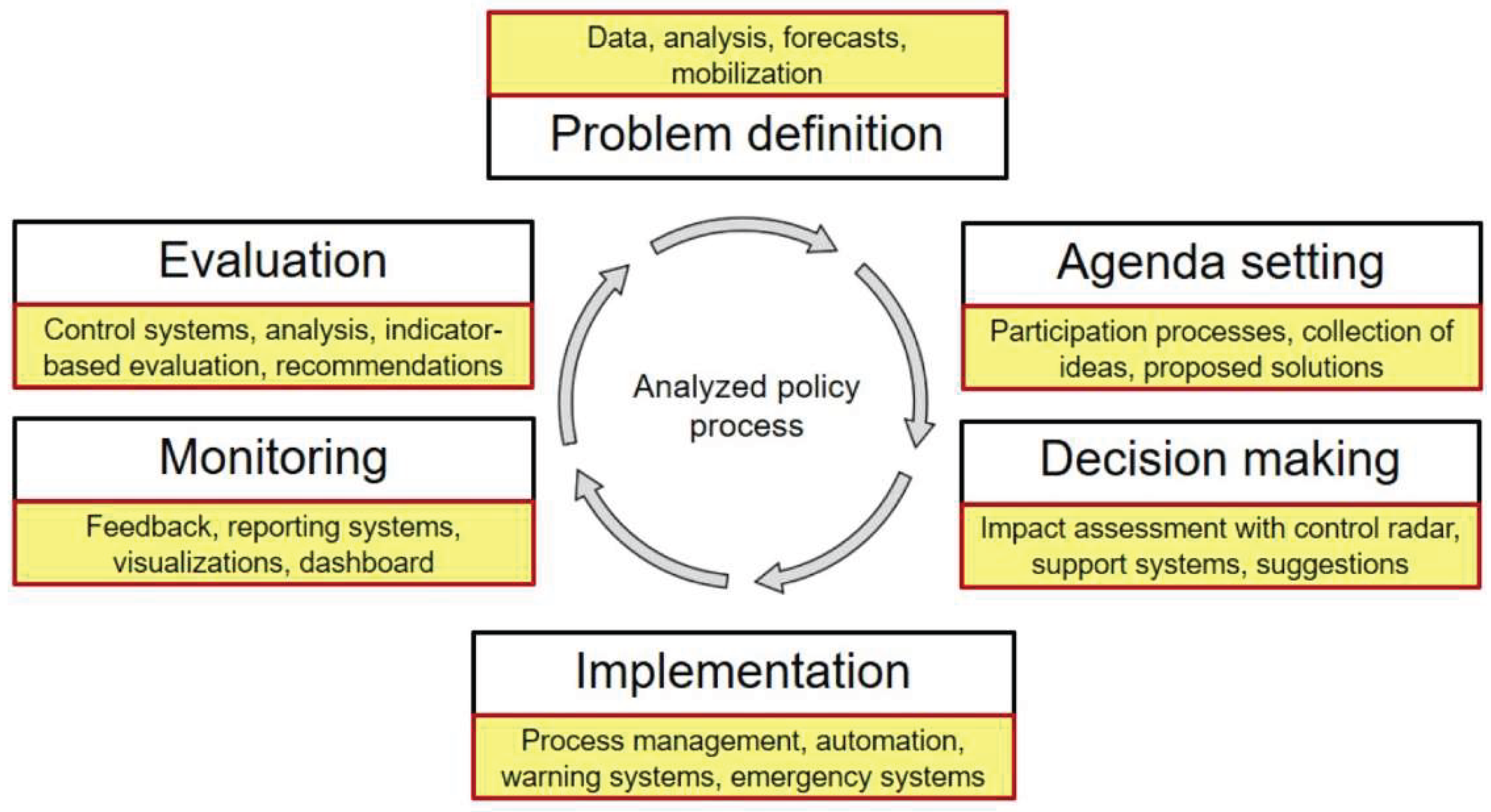
Disclaimer/Publisher’s Note: The statements, opinions and data contained in all publications are solely those of the individual author(s) and contributor(s) and not of MDPI and/or the editor(s). MDPI and/or the editor(s) disclaim responsibility for any injury to people or property resulting from any ideas, methods, instructions or products referred to in the content. |
© 2026 by the authors. Licensee MDPI, Basel, Switzerland. This article is an open access article distributed under the terms and conditions of the Creative Commons Attribution (CC BY) license (http://creativecommons.org/licenses/by/4.0/).
Copyright: This open access article is published under a Creative Commons CC BY 4.0 license, which permit the free download, distribution, and reuse, provided that the author and preprint are cited in any reuse.