
Submitted:
22 September 2026
Posted:
23 September 2026
You are already at the latest version
Abstract
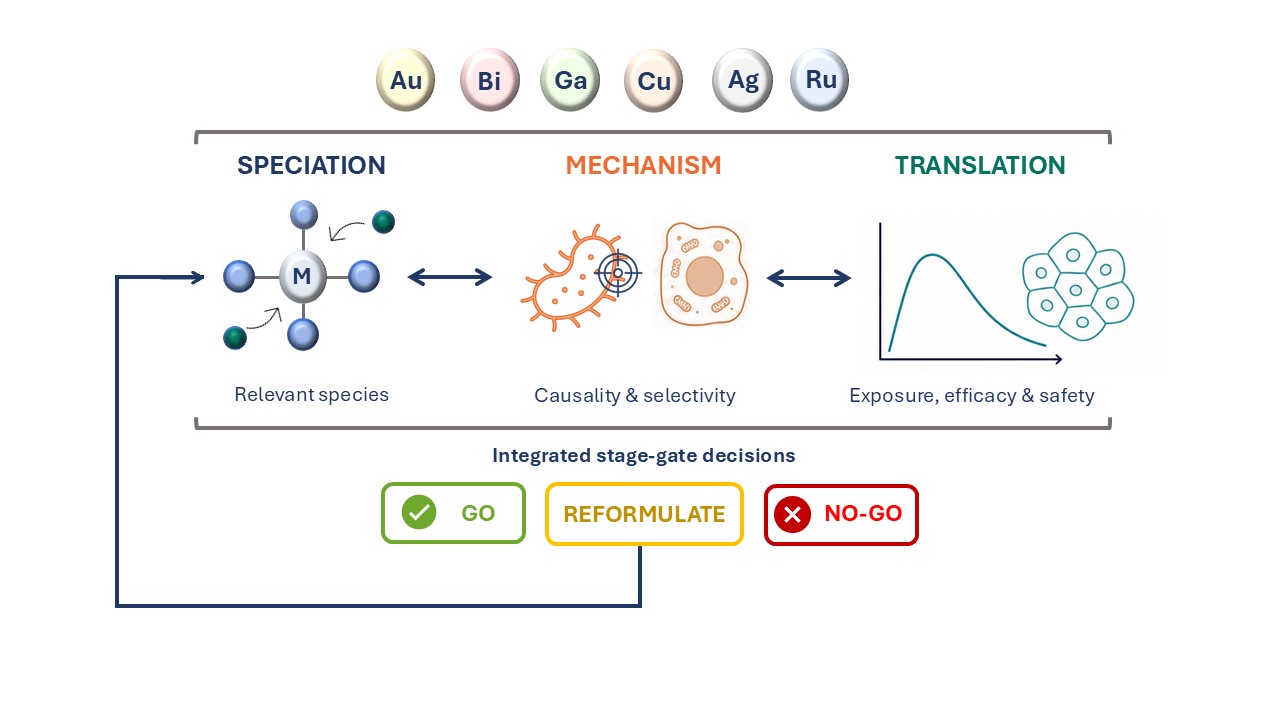
Antimicrobial resistance (AMR) in ESKAPE pathogens represents a major threat to infectious disease therapy and has stimulated interest in metal-based antibacterial agents as complements or alternatives to conventional organic antibiotics. Their diverse coordination geometries, tunable redox properties, ligand-exchange behaviour, and capacity to interact with multiple biological targets offer distinctive opportunities for antibacterial drug development. However, despite the potent in vitro activity reported for numerous compounds, progression towards clinical application remains limited. This critical narrative review examines the factors separating antibacterial activity from therapeutic development across six representative metal classes: gold, bismuth, gallium, copper, silver, and ruthenium compounds. Three recurrent limitations are identified: insufficient characterisation of metal-complex speciation under biologically relevant conditions; reliance on minimum inhibitory concentration (MIC) measurements and indirect assays without rigorous validation of molecular targets or causal mechanisms; and the scarcity and poor integration of pharmacokinetic, safety, and in vivo efficacy data. The available evidence reveals compound-specific advances, including the repurposing potential of auranofin, bismuth-mediated inhibition of New Delhi metallo-β-lactamase 1 (NDM-1), and the clinical evaluation of gallium nitrate in chronic Pseudomonas aeruginosa airway infection in people with cystic fibrosis. Nevertheless, these findings cannot be extrapolated to entire metal classes. Progress towards clinically viable metalloantibiotics requires an integrated development strategy combining biologically relevant speciation studies, causal mechanistic validation, standardised antibacterial testing, and early assessment of exposure, safety, and efficacy in indication-appropriate models.
Keywords:
metalloantibiotics
; ESKAPE pathogens
; antimicrobial resistance
; metal complexes
; metal speciation
; mechanism of action
; clinical translation
; drug development
Copyright: This open access article is published under a Creative Commons CC BY 4.0 license, which permit the free download, distribution, and reuse, provided that the author and preprint are cited in any reuse.