
Submitted:
22 September 2026
Posted:
23 September 2026
You are already at the latest version
Abstract
Learner wellbeing in schools depends on practitioners presumed competence of protecting it, yet little is known about how those practitioners appraise their own capacity. This qualitative exploratory study examined the perceptions of registered practitioners regarding their competence in assisting gay learners facing suicidal ideation in South African schools, and the rationale behind these judgements. A total of eleven practitioners from three provinces participated in online semi-structured interviews, with seven additionally taking part in a focus group. Data were analysed by reflexive theme analysis, guided by self-efficacy and minority stress theory. Out of eleven, ten reported no specific preparedness for sexual minority learners, with four answering in a single word. Appraisals nonetheless diverged sharply, and the divergence did not track training, which was uniformly negligible. Those who assess themselves as sufficiently prepared grounded their appraisals in registration and general education rather than experiential mastery; one also asserted that suicidal ideation are uniform across all learners. Colleagues reached a contrasting conclusion by regarding competence as a definable entity whose absence could be identified. We term the first pattern presumed competence: an efficacy appraisal warranted by institutional position in the acknowledged absence of relevant enactive experience. Making such competence a required rather than elective component of continuing professional development would align the warrant with what it certifies.
Keywords:
school counselling
; learner wellbeing
; sexual minority youth
; suicidal ideation
; self-efficacy
; professional competence
; continuing professional development
; South Africa
1. Introduction
Sifiso, a registered counsellor employed at a school lacking a specific counselling position, was asked how well prepared he felt to handle cases involving suicidal ideation among gay learners. He answered: “I do not feel prepared at all to assist such learners even though I do.” He does the work; he judges himself unequipped for it. Both assertions are concurrently valid, and there is no element within the professional framework that permits him to operate that acknowledges the inconsistency. The provision of wellbeing in schools is based on an unexamined premise: that the adults assigned to safeguard learner wellbeing possess the necessary competence. The policy designates the accountability, the registration authenticates the practitioner, and the learner presents themselves. What is yet to be scrutinised is the manner in which practitioners formulate assessments of their own abilities, and if those assessments correlate with any factors that would render them trustworthy. This inquiry pertains to social psychology rather than administration, as a competency evaluation is a conviction that influences behaviour. It influences a practitioner's decision to pursue additional training, make referrals, interact intensively with a troubled learner, or operate under the belief that their current competencies are adequate. Gay learners in South African schools occupy a position of documented psychological risk. Systematic review evidence records pervasive bullying and exclusion directed at lesbian, gay, bisexual, transgender and intersex learners (Mavhandu-Mudzusi & Sandy, 2020), and research on schooling and sexuality describes a silence around same-sex sexuality that leaves such learners without recognisable institutional support (Msibi, 2021). Minority stress theory attributes the heightened psychological distress not to sexual orientation itself, but to the persistent social stress stemming from stigma, prejudice, and anticipated rejection, which manifests through both distant discriminatory experiences and immediate processes of concealment and internalised stigma (Meyer, 2003; Meyer, 2015). In instances where these processes lead to suicidal ideation, the school counsellor becomes the focal point of policy, professional advice, and societal expectations. The international literature establishes that competence with sexual minority youth requires specific formation rather than general therapeutic skill, and that professional development focused on this population changes practice (Beck & Wikoff, 2020; Boekeloo et al., 2024). Abreu and colleagues position school counsellors within an oppressive framework, contending that a counsellor who fails to critically examine heteronormative educational systems inadvertently aligns with them (Abreu et al., 2016). Research from South Africa arrives at a similar institutional outcome from an alternative perspective: school support teams address homophobic bullying through standard disciplinary measures instead of a framework tailored to sexual diversity (Brown & Buthelezi, 2020), and students indicate that topics related to sexual diversity are consistently neglected (Nichols & Brown, 2021).
What has received less attention, particularly outside high-income settings, is the practitioner’s own appraisal. Self-efficacy theory holds that efficacy beliefs derive principally from enactive mastery experience, and secondarily from vicarious experience, verbal persuasion and physiological states, each of which must be cognitively appraised and weighted before it alters belief (Bandura, 1977; Bandura, 1997). Enactive mastery is emphasised in that context as successful performance offers the most genuine proof of ability. Counsellor self-efficacy correlates more with training and supervised experience than with credentials alone (Larson & Daniels, 1998), and extensive research highlights the inadequate alignment between self-evaluated and actual competence (Kruger & Dunning, 1999). What the literature delineates, meanwhile, is a shortfall that the practitioner is unable to perceive The present study examines a different case: an efficacy appraisal that survives the practitioner’s own explicit acknowledgement of the gap, warranted by an institutional credential in a domain the credential does not address.
Two interconnected problems ensue. At first, an effectiveness assessment based on a qualification is not adjusted by performance and hence remains unrectified. Secondly, when an evaluation is based on the assumption that the issue at hand is general rather than specific to a community, the practitioner lacks motivation to pursue population-specific insights, as none are seen necessary. Both are examined below.
Two questions guided the analysis. First, how do registered counsellors describe the preparation they have received for supporting gay learners experiencing suicidal ideation? Second, on what grounds do they judge themselves competent or not competent for that work?
1.1. Professional Regulation of School Counselling in South Africa
South Africa lacks a specific statutory classification for school counsellors. Professionals engaged in this field possess official accreditation and operate in many environments: private consulting offices, independent educational institutions, community schools, tertiary education, and the healthcare sector. The two registration entities are not identical, and this distinction is significant for the reasoning presented here. The Health Professions Council of South Africa (HPCSA) is a legal authority established by the Health Professions Act 56 of 1974, authorised to delineate the scope of practice and mandate ongoing professional development for continued registration. The Council for Counsellors in South Africa (C4CSA) is a non-statutory professional organization; its members adhere to a code of conduct voluntarily, without legal obligation, and it lacks the capacity to enforce mandatory practices. Registration is therefore a poor guide to the daily conditions of the work, and an uneven guarantee across bodies, while remaining the only formal assurance of capacity to do it. Bence (2020) documents the ambiguity of the registered counsellor role in Gauteng schools, and Pillay (2011) argued more than a decade ago that counsellors in South African schools face challenges that their training has not addressed.
Regulation mostly operates through registration and ongoing professional education. The HPCSA framework can delineate requirements when a domain is considered vital: psychologists registered with the Professional Board for Psychology are required to earn 30 continuing education units (CEUs) annually, with a minimum of five units focused on ethics, human rights, or health law, while the remaining 25 units can pertain to any clinically relevant subject chosen by the practitioner (HPCSA, 2023). Competence with sexual and gender minority learners is not among the ring-fenced categories and is therefore only one discretionary option among many.
Nor is the deficiency an absence of guidance. The Psychological Society of South Africa published practice guidelines for psychologists assisting sexually and gender-diverse individuals, marking the first such document in Africa (PsySSA, 2017), yet this organization is a voluntary professional association lacking the legal power to mandate their adoption (McLachlan et al., 2019). The resources required by a practitioner are accessible, thoroughly developed, and provided locally. No one is obligated to obtain it. This constitutes the regulatory framework under which the subsequent appraisals are established.2. Materials and Methods
2.1. Design
The study employed a qualitative exploratory interview design within an interpretive paradigm. Participants do not belong to any common institution, cohort, or location, hence the research is not classified as a case study. This article presents a portion of a more extensive dataset related to professional training and competency evaluation; additional analyses from the same research endeavour tackle different enquiries and are documented independently..
2.2. Participants
Eleven participants were recruited purposively through professional networks with subsequent snowball referral, across the Free State, Gauteng and Mpumalanga provinces of South Africa. Inclusion required current professional registration with the Health Professions Council of South Africa (HPCSA) or the Council for Counsellors in South Africa (C4CSA); a postgraduate qualification at Master’s level or above in counselling, psychology or a cognate field; more than five years of experience in counselling and guidance; and current or recent responsibility for supporting school-going learners, operationalised as having carried a caseload including school-going learners within the preceding two years. Two participants meet the last criterion through work in higher education and the health sector rather than in a school. All eleven met the criteria.
The professional standing varies within the sample, and the analysis does not presuppose uniformity. Nine individuals are registered as specialised counsellors, while two, Linda and Kath, are registered psychologists, a category attained by an extended training pathway and including a broader range of professional activities. All eleven possess a valid, acknowledged registration for autonomous practice with learners, which constitutes the institutional mandate addressed in this article. The comparative assertions presented below are limited accordingly: Linda is juxtaposed with Kath, and registered counsellors are evaluated against each other. The distinguishing factor within each category is the context in which the registration occurs. Racial and regional identifiers are omitted to prevent deductive disclosure, as their combination with role and experience could make numerous participants recognisable within a limited professional circle; similarly, due to the purposive nature of the sample, no assertions regarding its representativeness are presented. Characteristics are presented in Table 1.
2.3. Researchers
The research team consisted of two members. R1, a South African female researcher in the psychology of education with prior experience of school-based practice in under-resourced communities, conducted all interviews and the focus group discussion, transcribed the data and carried out the primary analysis. R2, a male professor with an established research programme on sexuality and schooling in southern Africa, contributed to the conceptual framing and to the development and review of themes, and did not participate in data generation.
R1’s professional history shaped the study in identifiable ways. It supplied access to the professional networks through which participants were recruited, and a prior conviction that school-level structures rather than individual practitioners are the appropriate object of critique, which could have led to over-reading institutional failure in participants’ accounts. R1 does not identify as a sexual minority. The analytical outcome was procedural instead of declarative: each excerpt related to a participant's sexual identity or personal experiences was independently coded by both researchers, discrepancies in interpretation were addressed by revisiting the recording or written submission, and R2 maintained the primary interpretive authority on those excerpts. R2's distance from the data generation served as a balancing factor during the interpretative phase overall. The team contemplated their positionality and assumptions at every phase from design to manuscript production..
2.4. Data Collection
2.4.1. Recruitment
Participants were recruited purposively through professional networks known to R1, with subsequent snowball referral. Interested practitioners were contacted directly, given detailed information about the study, and asked to provide written informed consent before an interview was scheduled. The interview schedule was sent in advance to allow participants to reflect and recall relevant experiences.
2.4.2. Interviews and Transcription
Data were generated through semi-structured individual interviews of approximately 45 minutes each and one 60-minute focus group discussion, all conducted via Microsoft Teams during August and September 2025. The individual schedule comprised 21 questions across nine domains: background and experience, understandings of suicidal ideation, counselling approaches, effectiveness of interventions, support systems and resources, challenges and barriers, training and professional development, practitioner support, and school climate. The focus group schedule comprised 10 questions across five domains: awareness and understanding; strategies and interventions; training, resources and collaboration; challenges and ethical considerations; and recommendations and reflections. Both schedules are reproduced in Appendix A. All sessions were conducted in English, the working language of all participants and the language of instruction in their settings; no translation was required.
All eleven participants completed an individual interview. Seven consented to the follow-up focus group discussion; the remaining four declined, citing confidentiality, professional exposure and the sensitivity of the subject matter. The focus group comprised one male and six female participants.
Due to the prior distribution of the schedule, several participants wrote written responses to various topics and presented them either beforehand or during the session, which formed the foundation for dialogue and subsequent questions. The dataset is hence heterogeneous. Extracts taken from written submissions are presented verbatim, encompassing any spelling, grammatical, and typographical inaccuracies, which remain unaltered and unannotated; extracts derived from the recordings are transcribed as outlined below. The differentiation pertains to interpretation, as conciseness in writing and conciseness in speaking do not possess equivalent evidential significance, and it is highlighted at the critical junctures in the Results.
Sessions were audio-recorded with consent and transcribed by R1. A denaturalised transcription approach was adopted for the spoken data, in which repetitions and verbal fillers were reduced and punctuation standardised to aid readability, while participants’ wording, tone and emphasis were preserved. Written submissions were not edited in any respect. R1 verified each transcript against the original recording and confirmed that these procedures did not alter the intended meaning of any account. Audio files, transcripts and written submissions were labelled with numerical codes, and identifying information was removed before analysis.
2.5. Data Analysis
Transcripts and written submissions were analysed using reflexive thematic analysis (Braun & Clarke, 2020; Braun & Clarke, 2022). The coding was performed by R1, adhering to a methodology that regards situated interpretation as an asset rather than a risk to reliability. The examination was guided by theoretical frameworks instead of being solely inductive, and this is conveyed accordingly. The self-efficacy theory influenced the research enquiries and was evident from the initial coding phase, since codes were created based on the rationales provided by participants for their evaluations; minority stress theory was incorporated subsequently, during the thematic development, upon the recognition of the equivalency assumption. Braun and Clarke clearly state that reflexive thematic analysis does not necessitate nor benefit from an assertion of complete induction. Interview and focus group material from the same participant were compared, and duplicated passages were counted once, so that a single account was not treated as two instances. Extracts were selected to represent every participant at least once, so that the analysis is not built on the most articulate accounts, and to include material running against the emerging argument.
2.6. Trustworthiness
Following Braun and Clarke (2022), the study adopted the following measures to support the quality of the analysis. R1 engaged at length with the material, having conducted, transcribed and verified each account, and reflected continuously on her own stance during data generation and analysis. Accounts were read across two data sources, individual interviews and the focus group discussion, with duplicated material counted once; no claim to triangulation is made, since that criterion presumes a single account to be converged upon and is not appropriate to reflexive thematic analysis. Extracts running against the emerging argument were deliberately sought and retained, and the clearest instance, Lerato’s account of her setting as open and supportive, is presented and engaged with in Section 3.3. A reflective journal was maintained throughout, documenting coding decisions and their rationale. R2 reviewed the coding and theme development, providing an interpretive perspective independent of the data generation. Extracts are presented alongside interpretation throughout the Results, so readers may assess the fit between what participants said and what is claimed on their behalf. Interpretations were not returned to participants for comment, and no claim to member checking is made. Reporting follows the consolidated criteria for reporting qualitative research, and the completed checklist is supplied as Supplementary Material.
2.7. Ethics
Ethical clearance was obtained from the university's research ethics committee where the study took place; the institution and reference number are provided on the title page. All individuals provided documented informed consent. Pseudonyms are employed consistently, and identifying information has been minimised in the documentation of personal narratives to prevent deductive identification based on the amalgamation of context, position, and tenure. Participants were cautioned from the beginning against revealing any identifying information about learners, and no learner may be recognised in the provided content. Due to the request for participants to recollect instances of learner suicidality, measures for participant discomfort were implemented according to the sanctioned protocol: participants were informed beforehand that they could halt, omit a question, or withdraw at any moment, and R1 concluded each session with a check-in. The reporting adheres to the recognised safe messaging protocols for suicide (World Health Organization, 2023): it refrains from detailing any methods, means, or specific incidents, and the examination is confined to the realm of professional practice.
3. Results
Five themes are presented. The first establishes the near-uniform absence of preparation specific to sexual minority learners. The second examines competence appraisals warranted by registration, and the third the contrasting appraisals of participants who treated competence as specifiable content, together with the counter-case of a participant for whom the question did not arise. The fourth considers competence acquired outside professional formation, and the fifth competence appraised from accumulated experience.
3.1. Preparation That Was Never Provided
Asked what training they had received on suicide prevention and working with LGBTQ+ learners, participants answered with a directness that left little room for interpretation. Ten of the eleven reported no preparation specific to sexual minority learners, and four answered in a single word or short phrase; the single exception was Olwethu, whose preparation came from volunteer work with a non-governmental organisation and is discussed in Section 3.4. Mandy, in a written submission, gave the fullest version:
“None. I am just a human who sees and lives to understand and empower other humans. I would love to receive training. I would feel more confident do dive deeper into their struggles if I could be trained how to. I feel like my lack of training could limit me at times, but yes, we do hope for better.”(Mandy)
Two features are remarkable. First and foremost, Mandy occupies the position with a classification, namely human, that is accessible to all and not confined to any particular occupation. Secondly, she correlates the absence directly to the extent of involvement she is prepared to undertake: her insufficient training constrains her, according to her own narrative, at the juncture where a learner's challenges should be addressed rather than only recognised. This represents a conviction of effectiveness linked to a behavioural outcome. Lindsay listed what she did have and arrived at the same place:
“Other than my Degree in Psychology, years of experience (real life ones) and continuously reading and upskilling myself – none.”(Lindsay)
Sifiso located the deficit in initial professional formation rather than in his own effort:
“I do not feel prepared at all to assist such learners even though I do. I mostly operate from my personal ethics and beliefs in supporting such learners because I was such a learner myself.”(Sifiso)
“Teacher training is very broad and I’d never had training on this particular context that learners might experience. Even though we are taught to be aware all of the different backgrounds and contexts that learners come from, we are being taught about these multiple contacts and not necessarily about what to do when you encounter such.”(Sifiso)
His formulation is precise about what generic preparation delivers and withholds: practitioners are taught that learners come from many contexts, but not what to do on encountering one. Sifiso does the work regardless, drawing on personal ethics and on having been such a learner himself, which is to say that his efficacy source is autobiographical rather than professional.
Sifiso also identified why referral does not resolve the difficulty. Continuing the same answer, he described the conditions under which the work falls to him:
“Given that not all schools have a school counsellor or in instances where there is a social worker, they service a large area where they work with many schools; and at times can only be able to see a learner that you referred after a few weeks if not a month. Given this, it becomes important for teachers to also receive this training as people who encounter the learners at grassroots level so that they can be more prepared to intervene and assist as they identify learners who show signs.”(Sifiso)
This bears directly on how the appraisal problem should be understood. Referral is the standard resolution where a practitioner judges themselves unequipped: the difficulty is transferred to someone better prepared. Sifiso describes a setting in which that route is either absent or delayed by weeks. Where referral is unavailable, the practitioner’s own appraisal is not one safeguard among several. It is the only one operating.
3.2. Competence Appraised from Registration
Against this near-uniform absence, two participants nonetheless judged themselves adequately equipped. Both grounded the appraisal in professional standing rather than in content relating to these learners. Tamryn, holding the only post formally designated for school counselling, gave both halves in one answer:
“I have not received any specific training relating to LGBTQ+ however it is a subtopic of the CPD program of the HPCSA for all registered professionals. Yes, I feel adequately equipped.”(Tamryn)
The key term is subtopic. Sexual and gender diversity is not a distinct category for ongoing professional development for practitioners enrolled with the Professional Board for Psychology; it is categorised under discretionary clinical units, as elaborated in Section 4.2. Tamryn's depiction is correct regarding availability but erroneous concerning necessity, and this divergence is exactly what her evaluation fails to acknowledge. Asked individually about her level of preparedness, Tamryn provided an additional assumption that operates autonomously. “I feel well prepared because suicide ideation and how to overcome it is usually the same for all learners it is not necessarily different because a person is labelled as gay, the challenges and experiences they encounter might be different. As HPCSA professions who have CPD (Continues professional development) which we must do yearly. Which I feel is sufficient.” (Tamryn)
Two claims are joined. The first is an equivalence premise: suicidal ideation and its treatment are held to be generic across learners, with difference located in learners’ experiences rather than in what the practitioner must know or do. The second is the credential premise already described. The equivalence premise is the more consequential, because it renders population-specific knowledge not merely unrequired but unnecessary. A practitioner holding it has no reason to seek such knowledge, and its absence generates no discomfort. Asked whether there were skills or knowledge she wished she had greater access to, Tamryn reasoned from caseload:
“I have not had many gay learners so far, therefor I do not think I need a specific skill or knowledge. The cases I had I handled with the skills and knowledge I acquired over the years.”(Tamryn)
Linda reasoned similarly, grounding the appraisal in generic formation and a dispositional criterion:
“I believe my training as a Psychologist/Psychotherapist has been effective-it is important that a therapist should be non-judgemental.”(Linda)
She confirmed feeling adequately equipped. In the same response set she then specified precisely what her formation had omitted:
“I feel that I am well prepared-psychologists’ relative lack of knowledge about LGB people and affirmative therapy, society stigma and discrimination that LGB people face and the significant mental health consequences that LGB people experience should be addressed/included in training.”(Linda)
The two clauses share a sentence. Linda is well prepared; psychologists as a class lack knowledge of the population, of affirmative therapy and of the mental health consequences of stigma. The personal appraisal is undisturbed by the collective diagnosis because the two rest on different evidence. Preparedness follows from being a psychologist. The deficit is a property of the curriculum.
Neither participant claims training she did not receive; both state the absence plainly. Neither is evasive: Linda volunteers the collective deficit unprompted, and Tamryn
characterises the subtopic status without being asked. What the accounts show is that the appraisal was made by reference to standing rather than to enactive experience with the population in question.
3.3. Competence Appraised from Content
Linda and Kath possess same registration categories, which suggests that category alone cannot elucidate why one regarded it as resolving the issue of competence while the other did not. Kath responded to the preparatory question with a compilation:
“Training in understanding the correct terminology to use, to be gender affirming, to be aware of personal prejudices or even systemic prejudices (e.g., church based schools the preach that homosexuality is a sin).”(Kath)
Kath does not treat her formation as settling the matter. She names terminology, gender-affirming practice and prejudice, personal and systemic, as identifiable content, locating the systemic instance concretely in faith-based schooling. Shazia, equally without specific training, substituted general capacities while explicitly withholding the appraisal:
“I certainly don’t feel adequately equipped on working with LGBTQ, yet sometimes simply making use of emotional intelligence enforcing human rights are of great assists.”(Shazia)
Jo-Ann refrained from providing the evaluation based on the contrary rationale to Linda, seeing her detachment from clinical registration and a background she characterised as predominantly intellectual rather than practical as justifications for feeling inadequately prepared. Her stance is encapsulated rather than directly cited, as no singular expression in her narrative fully represents it, and the substantiation for her argument is less robust than that of the others in that regard. Sifiso and Shazia arrive at the same specificity as Kath by a different route: one names what initial formation omits, the other what would have to be present for her to judge herself equipped.
Lerato provides the clearest counter-case in the dataset and is reported here for that reason. She indicated a complete lack of training, nevertheless characterised her environment as welcoming and encouraging for gay learners, and did not perceive the lack of preparation as a challenge like the other participants did. Her narrative holds significance on two levels. It indicates that the lack of preparedness is not equally felt, and that an environment regarded as welcoming can diminish the urgency of individual ability. This further complicates the argument presented thereafter, as her evaluation is justified neither by qualifications nor by substance: it relies on the apparent lack of an issue to be proficient in. This represents a third avenue for resolving the inquiry, distinct from the two previously outlined, and the accuracy of the perception cannot be determined just from the testimonies of practitioners.
3.4. Competence Sourced Outside Professional Formation
A fourth position appears in participants who had obtained relevant content, but from outside the systems that certify them. Olwethu traced her preparation to voluntary work:
“I used to volunteer for SADAG, they provided us with training regarding such sensitive issues.”(Olwethu)
What professional formation omitted was obtained through a route unrelated to her employment or registration. Preparation is thus distributed by biography rather than by design: Olwethu is better prepared than a colleague in the next classroom because she once volunteered. She also identified the condition that makes such preparation difficult to deploy:
“The is not a clear mandate in school in terms of addressing such issues, which makes it difficult for one to plan collaboration as one does not want to over step.”(Olwethu)
Privately acquired competence carries no institutional standing from which to act, and the risk of overstepping is borne by the individual. External acquisition supplies knowledge without supplying the mandate to use it. Both Olwethu and Conrad named the same remedy and located it outside their own formation. Conrad proposed workshops training teachers to handle discriminatory conduct towards gay learners and to create a safe environment for them, identifying what he lacked as more information about the LGBTQI+ community specifically within the schooling environment. Olwethu proposed inviting professionals to run workshops equipping teachers with information and skills for handling suicidal ideation among gay learners, adding that social workers in schools would assist. Both requests are specific, and both are addressed to an agent other than the body that registered them.
3.5. Competence Appraised from Experience
A final position treats accumulated practical experience as the relevant qualification. Lindsay, asked what professional development would be beneficial, proposed hearing directly from someone who had lived through a similar situation. Asked whether there were skills or knowledge areas she wished she had greater access to, she declined:
“No, real-life experience and testimonies always carries so much weight and insight.”(Lindsay)
This is the inverse of Kath’s position. Where Kath treats competence as specifiable content and can therefore name what is absent, Lindsay treats it as accumulated experiential insight, a form that cannot be itemised and whose absence therefore cannot be located. The appraisal is closed by a different route, but it is closed.

Table 2.
summarises the grounds on which appraisals were made.
| Basis of appraisal | Reasoning employed | Participants | Appraisal reached |
|---|---|---|---|
| Institutional warrant | Registration and generic formation taken to establish capacity | Linda, Tamryn | Adequately equipped |
| Dispositional substitution | General human capacities substituted for absent formation | Shazia, Mandy | Not equipped, coping |
| Content specification | Competence named as identifiable content whose absence is locatable | Kath, Sifiso, Jo-Ann | Deficit identified |
| External acquisition | Competence obtained outside professional formation | Conrad, Olwethu | Partially equipped |
| Experiential grounding | Practical and lived experience preferred over formal preparation | Lindsay | Equipped by experience |
| Climate substitution | A setting perceived as accepting removes the occasion for the question | Lerato | Question not engaged |
Categories are not mutually exclusive; participants are allocated according to the prevailing basis in their account. The predominance was established by R1 based on the quantity and significance of coded instances within each account, and this was concurred by R2; in cases where an account included instances of multiple bases, precedence was granted to the basis referenced in response to the direct inquiry regarding preparedness. The excerpts pertinent to each task are those found in Section 3.1 through 3.5. The appraisal reflects the participant's personal assessment rather than an external evaluation of their abilities.
4. Discussion
Three claims follow, and the inferential basis of each is stated below.
First, preparation specific to sexual minority learners was absent for this group. This is a descriptive claim about eleven accounts, not a population estimate. Its strength lies in uniformity across settings: private practice, a designated school counselling post, township schools and the health sector converge on the same absence. This is consistent with international evidence that professional development for this work is neither routine nor assumed (Beck & Wikoff, 2020) and with South African work on the training deficit of school-based practitioners (Pillay, 2011).
Second, and this is the article’s principal contribution, competence appraisals were warranted by professional standing rather than by content-specific preparation. We infer this from the structure of the accounts rather than from any statement to that effect: those judging themselves adequately equipped cited registration and generic formation as their grounds and named no content relating to these learners. Linda’s account is the clearest instance because both halves appear in one sentence. Because Linda and Kath hold the same registration category, the variation between them is instructive: Kath declines to treat the warrant as settling the question, and Shazia, a registered counsellor, declines likewise within her own category.
Third, the factor that differentiates participants capable of identifying a deficit from those unable to do so is not the training volume, which was minimal for all, but rather the perception of competence they possessed. In contexts where competence is regarded as definable content, its deficiency may be identified and documented; conversely, when it is perceived as a characteristic of status, an unquantifiable accumulation of experience, or deemed irrelevant due to the absence of challenges in the environment, the notion of absence lacks a context for manifestation. This conclusion is derived from the trends observed among accounts rather than from participants' own explanations of their reasoning, and it underpins the practical suggestions in Section 4.3.
4.1. Presumed Competence as an Efficacy Source
We define presumed competence as an efficacy appraisal in which an institutional warrant, that is, a registration, credential or completed formation, is treated by a practitioner as establishing capacity for a specific domain of practice, in the acknowledged absence of any content within that warrant addressing the domain. Three conditions must hold. The warrant must be authentic to ensure that the practitioner is appropriately registered or credentialed. The content specific to the domain must not be included in the warrant and must be recognised by the practitioner as absent. The practitioner must nonetheless regard the warrant as determining the issue of ability. The definition is intentionally falsifiable: a practitioner possessing a legitimate warrant, recognises the content deficiency, and still chooses pertinent ongoing professional development, seeks advice, or refers elsewhere would meet the initial two criteria but not the third, thus serving as evidence against the pattern rather than supporting it. No individual in this sample engaged in such behaviour; eleven reports fail to demonstrate the nonexistence of such a practitioner, and the survey suggested in Section 4.4 serves as the suitable assessment.
Self-efficacy theory identifies four principal sources of efficacy information, of which enactive mastery experience is the most authentic because performance accomplishment supplies direct evidence of capability (Bandura, 1977). Credential-derived efficacy fits none of the four cleanly. It is not mastery, since no relevant performance has occurred. It is not vicarious experience, since no model has been observed. It is closest to verbal persuasion, but differs from it in one important respect: persuasion is understood to be weak and unstable precisely because it is not grounded in performance, whereas a credential carries an institutional authority that makes the resulting appraisal stable and resistant to disconfirmation. A less robust and more justifiable interpretation exists, and we embrace it. According to Bandura's subsequent explanation, efficacy information from any origin must undergo cognitive evaluation and weighting prior to influencing belief (Bandura, 1997), thus the credential is more accurately perceived as a unique input filtered through persuasion and social-status mechanisms rather than as an independent fifth source. What eleven interviews can demonstrate is not a novel source inside a broader theory of effectiveness but rather a potential mechanism deserving of extensive research. Linda's account illustrates the appraisal's stability firsthand. She articulates the communal lack of knowledge and her personal readiness in one line without visible strain, as the evaluation does not depend on the knowledge she identifies as missing.
The pattern is also distinct from the calibration failure most often invoked in this connection. In the classic account of unskilled and unaware self-assessment, the deficit is invisible to the person who holds it, and the metacognitive capacity required to detect it is the same capacity that is lacking (Kruger & Dunning, 1999). Presumed competence is the converse case. The deficit is visible, and the practitioners here name it unprompted and without apparent discomfort; what is missing is not perception of the gap but any connection between that perception and the appraisal. This has a direct practical consequence. Interventions designed to raise awareness of a deficit will not reach practitioners who have already acknowledged it, and the target must instead be the inference from warrant to capacity.
A secondary mechanism functions concurrently with the primary one and is analytically separate. Tamryn's equivalence premise posits that suicidal thoughts are universal all learners, with variations stemming from their experiences rather than the knowledge required by practitioners. The credential assumption establishes a sense of resolution regarding content, while the equivalency premise entirely eliminates the inquiry: there is no specific domain expertise to be deficient in. The minority stress hypothesis elucidates the fallacy of this perspective. If heightened risk stems from stigma, anticipated rejection, secrecy, and internalised stigma (Meyer, 2003), the underlying causes vary even when the manifestations align, and a remedy targeting the manifestation without addressing its origins is insufficient. The assertion remains plausible at first glance, which contributes to its resilience: the practitioner does not assert that these learners are immune to their situations, but that her necessary skill set remains unaltered by them.
The behavioural implication is the rationale for its significance in wellbeing providing. Efficacy beliefs govern effort, perseverance, and the pursuit of assistance. An evaluation that disregards the underlying content deficiency is improbable to motivate the professional to further training, seek consultation, or make referrals. Mandy, who refrains from providing the evaluation, articulates the contrary process clearly: her insufficient training constrains the extent of her involvement. Concealed efficacy engenders prudence; credential-based efficacy elicits neither caution nor rectification.
The specimen additionally reveals what undermines the assumption. Kath, possessing the identical registration as Linda, regards competence as definable content and can hence identify language, gender-affirming practices, and institutional bias as areas in which she is deficient. Shazia, Sifiso and Jo-Ann do the same from different positions. What distinguishes these participants is not more training, since all report effectively none, but a conception of competence within which absence is detectable. Conversely, the equivalence premise, Lindsay’s experiential conception and Lerato’s climate-based appraisal close the question by three different routes: the first denies that domain-specific content exists, the second holds competence to be a form that cannot be itemised, and the third finds no occasion on which the question arises. Interventions aimed at improving preparation will therefore have limited effect unless they also address how practitioners conceptualise competence in this domain. A practitioner who does not believe there is anything specific to know will not attend training that offers it.
Figure 1 situates the credential alongside the four established sources.
Table 3 distinguishes the construct from adjacent literatures.
4.2. The Regulatory Conditions That Sustain It
The regulatory architecture set out in Section 1.1 supplies the conditions under which such appraisals become available. Tamryn's characterisation of sexual diversity as a subtopic is borne out by the documents: it falls within the discretionary clinical units rather than the ring-fenced ones. The warrant is genuine, the content genuinely absent, and nothing in the system marks the difference.
The consequence is a distinctive division of labour between the bodies involved. PsySSA has the expertise to specify what competence in this domain requires but no authority to mandate it; the HPCSA has that authority and has not exercised it; and the C4CSA, as a voluntary association, has neither. Practitioners bridge that division individually, which is what Section 3.4 documents them doing.
Minority stress theory elucidates the significance of the gap as being impactful rather than simply superficial. If learner distress originates from stigma frameworks instead of sexual orientation itself (Meyer, 2003), a practitioner who is warmly accepting yet uninformed about those frameworks addresses the emotional response while neglecting its underlying causes. Linda identifies non-judgment as her standard, asserting that it is a prerequisite for the task rather than a replacement. The identical rationale pertains to Lerato’s appraisal: a climate experienced by the practitioner as accepting is not evidence that learners experience it so, and concealment is precisely what minority stress theory predicts.
4.3. Implications for Wellbeing Provision in Schools
Wellbeing provision is typically evaluated by whether a service exists and whether learners reach it. These findings indicate a third condition that is currently unmeasured: whether the practitioner staffing the service holds an efficacy appraisal that tracks their actual preparation for the presenting difficulty. Where it does not, the service exists, the learner arrives, and nothing in the system registers the shortfall.
Three changes follow. For professional bodies, specifying competence with sexual and gender minority clients as a required rather than elective component of continuing professional development would align the warrant with what it is taken to certify. The content already exists; what is missing is the requirement. This does not necessarily imply the establishment of a new designated category. The current distribution of ethics, human rights, and health law encompasses five of the thirty annual units, and affirmative practices with sexual and gender minority clients are classified under human rights as defined by the HPCSA, making the inclusion of this content a significantly lesser regulatory demand than broadening the scope. The evident counterargument is that each constituency asserts its area ought to be mandatory, and the protective boundary cannot extend endlessly; this criticism is compelling, which is why we suggest relocation inside a current allocation instead of an expansion. The entities capable of taking action are the HPCSA Professional Board for Psychology, responsible for establishing the CEU framework, and the C4CSA, which can impose similar content as a membership requirement while lacking statutory authority.
A third change follows from the distribution of provision. Where a school has no counsellor, or where district personnel serve many schools and a referred learner waits weeks to be seen, the practitioner who first encounters that learner cannot transfer the difficulty onward. Preparation for this work therefore cannot be confined to those holding designated counselling posts, since the person who meets the learner first is frequently not that person. This bears on how wellbeing provision is planned as much as on how it is staffed, and it is addressed to the Department of Basic Education and the provincial education departments rather than to the professional councils.
4.4. Strengths and Limitations
The sample is small, purposive and drawn from three provinces, and no claim to representativeness is made. Registration is not uniform across it: nine participants are registered counsellors and two are psychologists, so comparative claims have been restricted to participants sharing a category, which reduces the number of comparisons the data can bear. The study cannot say how unregistered practitioners, or teachers without counselling registration, would reason, although Sifiso’s account suggests they carry a substantial share of this work. Most importantly, eleven adults speak here and no learner does; the article makes claims about what gay learners require that are sourced entirely from adult professional interpretation, and work placing learners’ own accounts alongside these is the necessary next study. Two threats pertaining to the primary descriptive conclusion deserve statement. The training was self-reported, and there is a high likelihood of recall error: participants might have encountered material on sexual and gender diversity integrated within more extensive coursework on diversity or ethics, failing to recognise it as relevant preparation for this demographic, suggesting that the documentation reflects a lack of memorable or applicable training rather than a complete absence of training. This would validate the descriptive assertion but not the analytic one, as an unremembered input cannot substantiate an efficacy evaluation either. Social desirability functions bidirectionally: indicating a lack of training might be the more prudent response in a field where asserting proficiency entails professional jeopardy, whereas asserting competence may be the more secure response for a practitioner whose employer presumes it. This design does not permit the exclusion of either. Four participants declined to take part in the focus group, citing confidentiality and professional exposure, so the group material represents the more willing, although that reluctance is itself informative. Data were generated online and in English, while much of the counselling described takes place in other languages. Some responses were supplied in writing, and written brevity should not be read as equivalent to spoken brevity. Withholding individual racial and provincial attribution carries an analytic cost: an analysis able to attribute accounts by race and place could ask whether presumed competence is distributed along those lines, and this one cannot. Finally, the study reports appraisals rather than performance. We do not claim that participants who judged themselves equipped practise less well than those who did not, and the design cannot establish this. The claim concerns the grounds on which the judgement rests and what those grounds imply for whether a practitioner will seek further preparation.
Four directions follow for future research. First, whether the equivalence premise documented here is widespread among registered practitioners is answerable by survey and would establish whether the mechanism generalises beyond this sample. Second, the relationship between conception of competence and training uptake is testable: if practitioners who treat competence as specifiable content are more likely to elect relevant continuing professional development, that has direct implications for how such development should be promoted. Third, a survey methodology could evaluate the refutation scenario presented in Section 4.1, specifically practitioners who recognise the content deficiency and pursue training despite possessing the credential. Fourth, the personal narratives of learners regarding the assistance they received would enable the evaluations mentioned above to be contrasted with the experiences of the recipients.
5. Conclusions
Registered practitioners supporting gay learners experiencing suicidal ideation in South African schools described receiving no preparation for that work. What varied was not training but the reasoning by which they appraised their own competence, and that reasoning tracked professional standing rather than experience with these learners. We term the resulting pattern presumed competence and offer it as a candidate mechanism that self-efficacy theory does not currently accommodate: an appraisal warranted by institutional position, stable precisely because it does not rest on the knowledge whose absence the practitioner can openly name.
The argument in question is not that these professionals lacked competence. Numerous individuals were evidently proficient, and everyone shown dedication. Professional regulation now ensures a competence that it fails to generate, leading to a situation where student wellness in educational institutions relies on an assumed capability rather than one that is substantiated. The solution is similarly unpretentious: pre-existing content, repositioned into an established necessity. Sifiso articulates the stance precisely. He feels entirely unprepared to support such students. He proceeds to do it regardless. Sifiso states the position exactly. He does not feel prepared at all to assist such learners. He does it anyway.
Author Contributions
Conceptualisation, T.B. and A.B.; methodology, T.B.; formal analysis, T.B.; investigation, T.B.; writing, original draft preparation, T.B.; writing, review and editing, T.B. and A.B.; supervision, A.B. All authors have read and agreed to the published version of the manuscript.
Institutional Review Board Statement
The study was conducted in accordance with the Declaration of Helsinki and approved by the research ethics committee of the university at which the study was conducted. Details are supplied on the title page and withheld here for anonymised review.
Informed Consent Statement
Written informed consent was obtained from all participants involved in the study.
Data Availability Statement
The data are not publicly available. Transcripts and written submissions contain information that could compromise the privacy of participants, who are drawn from a small professional community, and consent was obtained on the condition that they would not be shared. Anonymised extracts beyond those presented may be requested from the corresponding author, subject to ethics committee approval.
Acknowledgments
The authors thank the eleven practitioners who gave their time to this study.
Conflicts of Interest
The authors declare no conflict of interest.
Appendix A. Interview Schedules
Appendix A.1. Individual Interview Schedule
Background and experience. 1. Can you share your experience as a counsellor, psychologist or educator? 2. How long have you been working in that capacity? 3. Can you identify whether you have worked with gay school learners and offered support to them?
Understanding suicidal ideation. 4. In your professional opinion, what are some of the most common factors contributing to suicidal ideation among gay school learners? 5. Are there specific signs or behaviours you look for when identifying gay school learners at risk?
Counselling approaches. 6. Can you describe the counselling strategies or approaches you use when working with gay school learners who may be struggling with suicidal ideation? 7. Do you believe there are gay learners in schools who are afraid of judgement, and how do you identify this group? 8. How do you approach discussing sensitive topics such as sexual orientation and mental health with learners who may feel vulnerable?
Effectiveness of interventions. 9. In your experience, which interventions have been most effective in alleviating suicidal ideation among gay school learners? 10. Have you seen any patterns in how gay school learners respond to counselling, compared with their peers?
Support systems and resources. 11. What additional resources or support systems are available to gay learners who experience suicidal ideation, and how do you incorporate these into your work? 12. How important is the involvement of family, teachers and peers in your interventions, and can you give examples of successful collaboration?
Challenges and barriers. 13. What are some of the main challenges you face when working with gay school learners dealing with suicidal ideation? 14. Are there any barriers in the school system that make it difficult to provide effective counselling for these learners?
Training and professional development. 15. How well prepared do you feel to handle cases involving suicidal ideation among gay learners, and what training or professional development would be beneficial for school counsellors? 16. Are there any specific skills or knowledge areas you wish you had more access to?
Practitioner support. 17. How do you take care of your own mental health while dealing with such intense emotional situations? 18. Are there opportunities for you to debrief or seek support within the school system after handling such cases?
School climate. 19. How do you advocate for an inclusive school environment to prevent isolation and mental health crises among gay learners? 20. What changes would you recommend to better support gay learners dealing with suicidal ideation? 21. How do you think schools can create a more supportive and open environment for gay learners, in terms of mental health and overall wellbeing?
Appendix A.2. Focus Group Schedule
Participants were reminded at the outset to avoid disclosing specific client details, consistent with the informed consent form, and to maintain boundaries protecting the identity of the learners indirectly discussed.
Awareness and understanding. 1. What signs or risk factors have you observed that indicate a gay learner might be experiencing suicidal ideation? 2. How would you describe the unique challenges gay learners face in your school context that may contribute to mental distress?
Strategies and interventions. 3. Can you share specific strategies or interventions you have used to support gay learners with suicidal ideation? 4. How effective do you feel these strategies have been, and what indicators do you use to measure effectiveness?
Training, resources and collaboration. 5. What kind of training have you received on suicide prevention and working with LGBTQ+ learners, and do you feel adequately equipped? 6. How do you collaborate with teachers, parents or external stakeholders in managing these cases?
Challenges and ethical considerations. 7. What barriers or challenges do you think counsellors face in supporting gay learners with suicidal ideation in schools? 8. How do you ensure confidentiality and build trust with gay learners who may be vulnerable or closeted?
Recommendations and reflections. 9. Based on your experience, what can schools do better to prevent suicide among gay learners? 10. If you could make one policy or systemic change to better support this group, what would it be?
References
- Abreu, R.; Wheeler, W.; Mosley, D.; Fedewa, A. LGBTQ youth bullying experiences in schools: The role of school counsellors within a system of oppression. J. Creat. Ment. Health 2016, 11(3–4), 325–342. [Google Scholar] [CrossRef]
- Bandura, A. Self-efficacy: Toward a unifying theory of behavioural change. Psychol. Rev. 1977, 84(2), 191–215. [Google Scholar] [CrossRef] [PubMed]
- Bandura, A. Self-efficacy: The exercise of control; W. H. Freeman, 1997. [Google Scholar]
- Beck, M. J.; Wikoff, H. D. ‘Professional development is really key’: Experiences of school counsellors engaging in professional development focused on LGBTQ youth. Prof. Sch. Couns. 2020, 24(1), 1–11. [Google Scholar] [CrossRef]
- Bence, S. J. The roles and experiences of registered counsellors working in school settings in Gauteng, South Africa. Master’s dissertation, North-West University, 2020. [Google Scholar]
- Boekeloo, B.; Fish, J.; Turpin, R.; Aparicio, E. M.; Shin, R.; Vigorito, M. A.; Lare, S. M.; McGraw, J. S.; King-Marshall, E. LGBTQ+ cultural-competence training effectiveness. Clin. Psychol. Psychother. 2024, 31(1), e2893. [Google Scholar] [CrossRef] [PubMed]
- Braun, V.; Clarke, V. Conceptual and design thinking for thematic analysis. Qual. Psychol. 2020, 9(1), 3–26. [Google Scholar] [CrossRef]
- Braun, V.; Clarke, V. Thematic analysis: A practical guide; SAGE, 2022. [Google Scholar]
- Brown, A.; Buthelezi, J. School-based support team responses to sexual diversity and homophobic bullying in a South African school. Interchange 2020, 51(2), 1–17. [Google Scholar] [CrossRef]
- Collins, R. The credential society: An historical sociology of education and stratification; Academic Press, 1979. [Google Scholar]
- Health Professions Council of South Africa. Continuing professional development guidelines for health practitioners; HPCSA, 2023. [Google Scholar]
- Kruger, J.; Dunning, D. Unskilled and unaware of it: How difficulties in recognizing one’s own incompetence lead to inflated self-assessments. J. Personal. Soc. Psychol. 1999, 77(6), 1121–1134. [Google Scholar] [CrossRef] [PubMed]
- Larson, L. M.; Daniels, J. A. Review of the counselling self-efficacy literature. Couns. Psychol. 1998, 26(2), 179–218. [Google Scholar] [CrossRef]
- Mavhandu-Mudzusi, A. H.; Sandy, P. T. Bullying of lesbian, gay, bisexual, transgender and intersex learners in South African schools: A systematic review. J. LGBT Youth 2020, 17(3), 307–328. [Google Scholar]
- McLachlan, C.; Nel, J. A.; Pillay, S. R.; Victor, C. J. The Psychological Society of South Africa’s guidelines for psychology professionals working with sexually and gender-diverse people: Towards inclusive and affirmative practice. South Afr. J. Psychol. 2019, 49(3), 314–324. [Google Scholar] [CrossRef]
- Meyer, I. H. Prejudice, social stress, and mental health in lesbian, gay, and bisexual populations: Conceptual issues and research evidence. Psychol. Bull. 2003, 129(5), 674–697. [Google Scholar] [CrossRef] [PubMed]
- Meyer, I. H. Resilience in the study of minority stress and health of sexual and gender minorities. Psychol. Sex. Orientat. Gend. Divers. 2015, 2(3), 209–213. [Google Scholar] [CrossRef]
- Msibi, T. Same-sex sexuality in schools: The silences in South African schooling. Educ. As Change 2021, 25, 1–17. [Google Scholar]
- Nichols, H. J.; Brown, A. High school learners’ perceptions on the teaching of LGBT content in South African schools. Int. J. Learn. Change 2021, 13(6), 627–639. [Google Scholar] [CrossRef]
- Pillay, J. Challenges counsellors face while practicing in South African schools: Implications for culturally relevant in-service training. South Afr. J. Psychol. 2011, 41(3), 352–362. [Google Scholar] [CrossRef]
- Psychological Society of South Africa. Practice guidelines for psychology professionals working with sexually and gender-diverse people; PsySSA, 2017. [Google Scholar]
- Sue, D. W.; Arredondo, P.; McDavis, R. J. Multicultural counselling competencies and standards: A call to the profession. J. Multicult. Couns. Dev. 1992, 20(2), 64–88. [Google Scholar] [CrossRef]
- Tervalon, M.; Murray-García, J. Cultural humility versus cultural competence: A critical distinction in defining physician training outcomes in multicultural education. J. Health Care Poor Underserved 1998, 9(2), 117–125. [Google Scholar] [CrossRef] [PubMed]
- World Health Organization. Preventing suicide: A resource for media professionals (2023 update); World Health Organization, 2023. [Google Scholar]
Figure 1.
Sources of efficacy information in the appraisal of professional competence, with the institutional credential shown as a proposed additional input.
Figure 1.
Sources of efficacy information in the appraisal of professional competence, with the institutional credential shown as a proposed additional input.
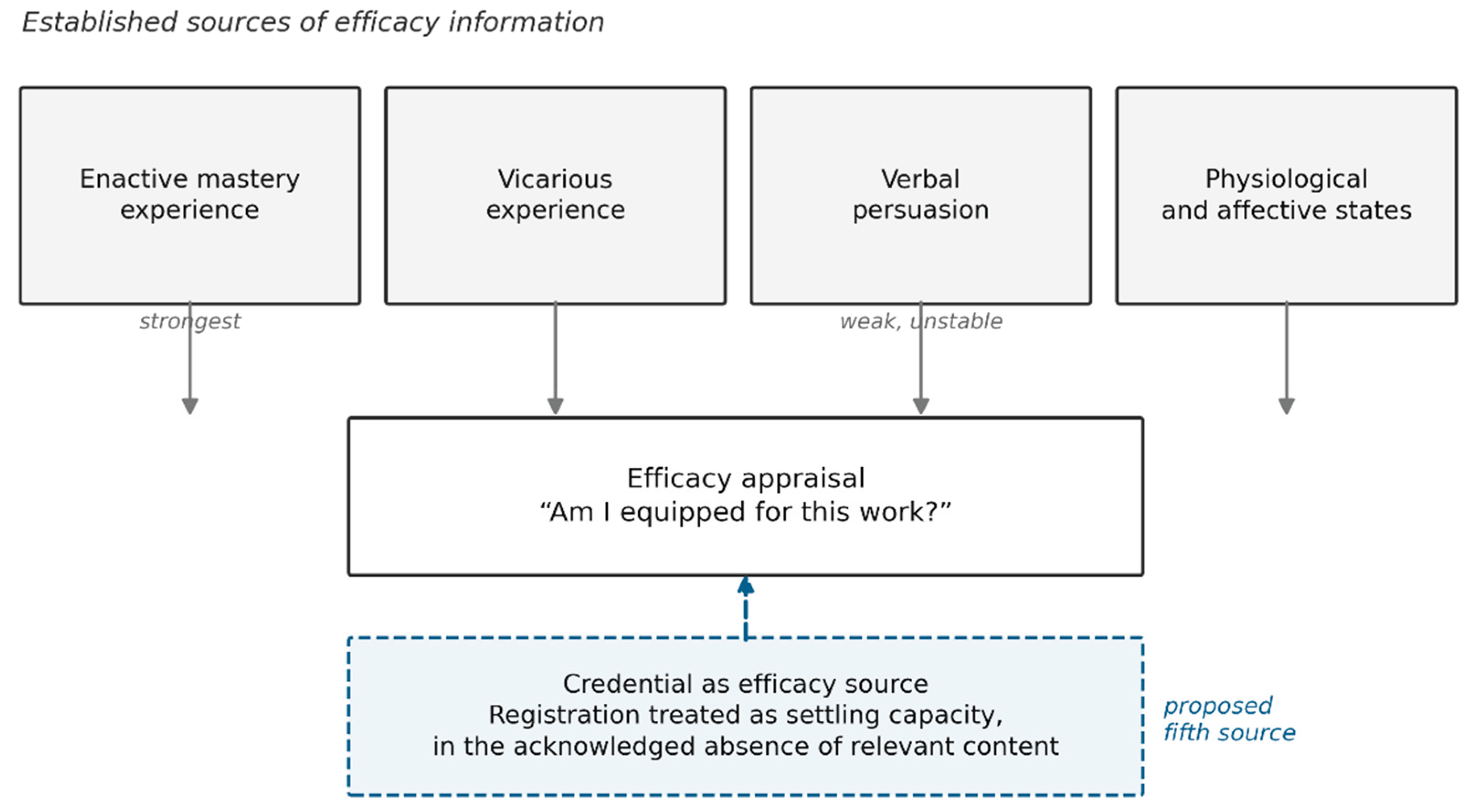
Table 1.
Participant characteristics.
| Pseudonym | Professional role | Practice setting | Experience | Data source |
|---|---|---|---|---|
| Mandy | Registered counsellor, educator role | Independent school | 6 years | Interview, FGD |
| Linda | Registered psychologist, clinical and counselling | Private practice | 20 years | Interview, FGD |
| Olwethu | Registered counsellor, learner support | Township school | 10 years | Interview |
| Conrad | Registered counsellor, learner support | Township school | 11 years | Interview, FGD |
| Shazia | Registered counsellor, school-based | School | 15 years | Interview, FGD |
| Jo-Ann | Registered counsellor, lecturing role | Higher education | 10 years | Interview, |
| Kath | Registered psychologist, counselling | Private practice | 25 years | Interview |
| Tamryn | Registered counsellor, school counsellor post | School | 18 years | Interview, FGD |
| Sifiso | Registered counsellor, learner support | Township school | 15 years | Interview |
| Lerato | Registered counsellor, health sector role | Health sector | 10 years | Interview, FGD |
| Lindsay | Registered counsellor, educator role | Independent school | 11 years | Interview, FGD |
FGD = participated in the focus group discussion. Nine participants hold registration as counsellors and two as psychologists. All data were generated in Microsoft Teams sessions.
Table 3.
Presumed competence distinguished from adjacent constructs.
| Construct | Core claim | Distinction from presumed competence |
|---|---|---|
| Cultural competence (Sue et al., 1992) | Practitioners acquire knowledge, awareness and skills for working across difference | Specifies content to be acquired; presumed competence describes what follows when acquisition is skipped but the warrant remains |
| Cultural humility (Tervalon & Murray-García, 1998) | Lifelong self-evaluation replaces detached mastery as the training outcome | A normative claim about how competence should be conceived; presumed competence is a descriptive claim about appraisal |
| Self-efficacy (Bandura, 1977) | Efficacy beliefs derive principally from enactive mastery experience | Identifies four sources; credential-derived efficacy is a distinctive input that the taxonomy does not separately accommodate |
| Credentialism (Collins, 1979) | Qualifications acquire social and economic value beyond the skills they certify | Concerns external signalling in labour markets; presumed competence concerns the practitioner’s own appraisal |
| Unrecognised incompetence (Kruger & Dunning, 1999) | The practitioner is unaware of the deficit | The deficit is unknown; in presumed competence it is explicitly acknowledged and the appraisal survives it |
Disclaimer/Publisher’s Note: The statements, opinions and data contained in all publications are solely those of the individual author(s) and contributor(s) and not of MDPI and/or the editor(s). MDPI and/or the editor(s) disclaim responsibility for any injury to people or property resulting from any ideas, methods, instructions or products referred to in the content. |
© 2026 by the authors. Licensee MDPI, Basel, Switzerland. This article is an open access article distributed under the terms and conditions of the Creative Commons Attribution (CC BY) license.
Copyright: This open access article is published under a Creative Commons CC BY 4.0 license, which permit the free download, distribution, and reuse, provided that the author and preprint are cited in any reuse.