

Submitted:
22 September 2026
Posted:
23 September 2026
You are already at the latest version
Abstract
Adenosine remains the first-line pharmacologic agent for terminating atrioventricular node-dependent supraventricular tachycardia (SVT), but it is still administered as a fixed 6 mg bolus, escalating to 12 mg, regardless of body weight or body mass index (BMI). Because the same absolute dose is given across a wide range of body sizes, effective milligram-per-kilogram exposure falls as body weight rises, raising the question of whether fixed dosing still delivers equivalent therapeutic exposure in an increasingly heavier patient population. This review examines whether elevated BMI reduces the efficacy of standard adenosine dosing in SVT and evaluates the evidence for alternative dosing strategies.Multiple retrospective cohorts show that increased body weight and lower mg/kg exposure are independently associated with reduced first-dose cardioversion success. These patients who convert consistently received higher relative doses (approximately 0.09–0.10 mg/kg) than those who failed. Emerging evidence further suggests that obesity blunts the electrophysiologic response itself: obese patients exhibit significantly shorter post-adenosine sinus pauses than non-obese patients at standard doses. Two strategies have been proposed to close this exposure gap — individualized weight-based dosing, which is pharmacologically ideal but lacks prospective validation, and higher initial fixed-dose administration, which improves first-dose success (particularly among severely obese patients) while preserving the simplicity of current protocols.Collectively, the available evidence — though predominantly observational — supports reframing adenosine dosing around achieving adequate therapeutic exposure rather than delivering a predetermined absolute dose. Prospective pharmacokinetic studies and randomized trials comparing dosing strategies are needed before guideline changes can be confidently recommended.
Keywords:
adenosine
; SVT
; cardioversion
; tachycardia
; BMI
Introduction
Supraventricular tachycardia (SVT) — a heterogeneous group of arrhythmias originating above the ventricles, most often atrioventricular nodal reentrant tachycardia (AVNRT) and atrioventricular reentrant tachycardia (AVRT) — is among the most common symptomatic tachyarrhythmias seen in emergency and outpatient care. These cause palpitations, dyspnea, and syncope and contribute to substantial healthcare utilization. [1,2,3,4] Acute management aims to restore sinus rhythm: hemodynamically unstable patients receive immediate synchronized cardioversion, while stable patients are treated first with vagal maneuvers, then pharmacologic therapy if these fail. [1,2,3,4]
Adenosine is the preferred first-line pharmacologic agent for terminating regular narrow-complex, AV node-dependent SVT. [2,3] Its plasma half-life is under ten seconds, requiring rapid intravenous bolus administration with an immediate saline flush. [5,6] It is still dosed as a fixed 6 mg bolus, escalating to 12 mg, regardless of body weight or BMI, so effective mg/kg exposure falls as weight rises [7,8]— a growing concern given rising obesity prevalence. [9,20]
This falling exposure has been linked to decreased first-dose cardioversion success, [7,8] motivating interests in dosing strategies that provide more consistent exposure across body sizes. [10] This review examines whether elevated BMI reduces adenosine's efficacy in SVT and evaluates the evidence for alternative dosing strategies.
Adenosine Pharmacology and Mechanism of Action
Adenosine is an endogenous purine nucleoside that acts through four G protein-coupled receptors — A1, A2A, A2B, and A3 — of which A1 is responsible for its clinical antiarrhythmic action. [5,11,12,13] Densely expressed in the sinoatrial and atrioventricular nodes, A1 receptors couple to inhibitory Gi proteins, lowering cyclic AMP and calcium influx while increasing outward potassium current — producing membrane hyperpolarization and suppressed nodal automaticity that slow impulse formation and nodal conduction. [5,11,12,13]
Clinically, adenosine's key effect is depressing AV nodal conduction and prolonging refractoriness, producing transient conduction slowing, or brief complete AV block. [11,12,14,15] Because AVNRT and AVRT depend on the AV node as part of their reentrant circuit, this brief interruption terminates the arrhythmia. [2,3,15]
Arrhythmias that do not depend on the AV node — atrial fibrillation, atrial flutter and focal atrial tachycardia — generally persist despite adenosine's transient blockade, resulting in slowing that can unmask underlying atrial activity, giving adenosine a diagnostic as well as therapeutic role. [2,3,14,15]
Adenosine's ultrashort half-life limits systemic exposure, contributing to a favorable safety profile: adverse effects — facial flushing, chest discomfort, dyspnea, nausea, dizziness, a sense of impending doom, and brief sinus pauses or asystole from AV nodal suppression — are transient, self-limited, and rarely require intervention. [5,6,11,14,15]
Current Adenosine Dosing Strategies
Historical Development and Contemporary Practice
Early trials established adenosine as effective for terminating paroxysmal SVT, with high conversion rates using escalating bolus doses; later multicenter studies refined this into the principle of giving progressively larger doses after a failed initial bolus. [11,14,16] A 1992 review of the accumulated early clinical experience — over 600 reported episodes — found a mean success rate of 93%, cementing adenosine's reputation as a safe, rapidly effective agent for AV node-dependent SVT. [17]
This evolved into today's standard regimen — an initial 6 mg bolus followed by 12 mg if needed — which has remained essentially unchanged for decades and is recommended by both North American and European guidelines as first-line therapy for stable SVT after failed vagal maneuvers. [2,3,16] Its simplicity has driven widespread adoption across emergency, outpatient, and prehospital settings. [1,4] The rationale for exceeding this standard regimen is not new, either: case reports and literature reviews have long described higher-dose adenosine use for refractory SVT that fails to convert with 6 or 12 mg. [18]
Limitations of Fixed-Dose Administration
This practicality comes with a tradeoff: the same 6 mg dose may be given to patients whose body mass differs more than twofold, so effective mg/kg exposure falls as weight rises. Despite rising obesity prevalence and average body weight — and the substantial disease burden obesity carries across cardiovascular and metabolic conditions [19]— guidelines have not incorporated weight- or BMI-based adjustments. [2,3,9] Whether fixed dosing still delivers equivalent therapeutic exposure across body sizes is unclear, motivating closer examination of how obesity affects drug disposition and cardioversion success.
Obesity Pharmacokinetics
Obesity as a Pharmacokinetic Determinant
Obesity alters pharmacokinetics through increased adipose mass, altered tissue perfusion, higher cardiac output, and expanded extracellular fluid volume — changes that affect volume of distribution in complex, medication-specific ways with no single body-size descriptor proving universally reliable. [20,21,22,23] As a result, a fixed dose may not produce equivalent peak concentrations across body sizes: larger patients who receive lower effective mg/kg exposure can experience blunted therapeutic effects. [20,22]
Relevance to Adenosine
Because adenosine's antiarrhythmic effect depends on a brief peak concentration at the AV node rather than prolonged systemic exposure, even modest differences in effective drug exposure could disproportionately affect its efficacy. [5,6,11]
No study has directly measured adenosine disposition in obese patients, but these obesity-related distribution changes offer a plausible explanation for variable responses at elevated BMI: An et al. [7] found that patients who converted after a 6 mg dose received a higher relative dose (~0.10 mg/kg) than those who failed (~0.079 mg/kg) — an association, not proof of causation, but consistent with unequal exposure across body sizes.
Obesity may also blunt the electrophysiologic response itself: Ozatak et al. [24] found that obese patients (BMI ≥30) had significantly shorter post-adenosine sinus pauses than non-obese patients at standard doses as discussed below.
Clinical Evidence and Emerging Alternative Dosing Strategies
Weight and BMI as Predictors of Failure
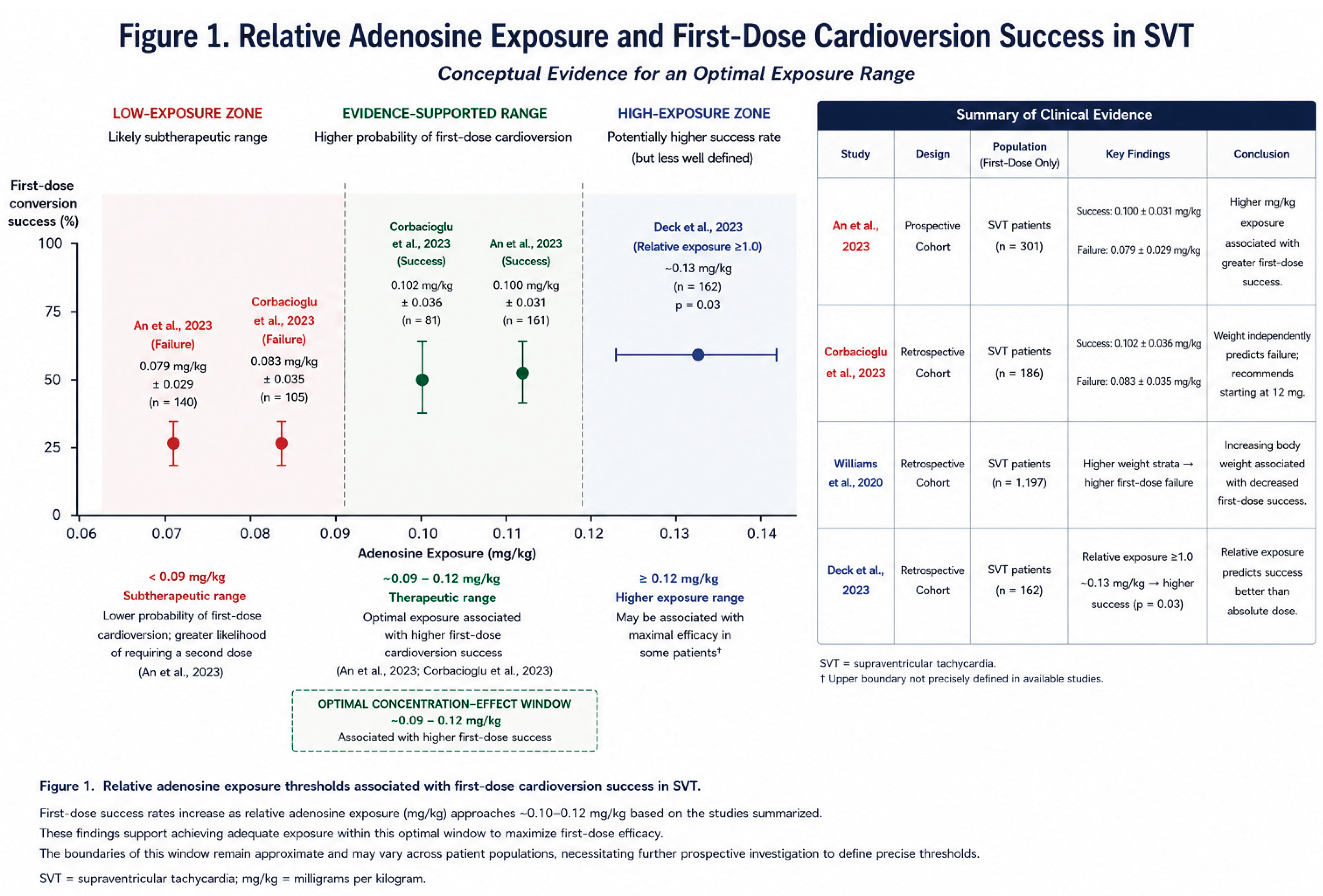
Because reduced relative exposure in larger patients may fall short of the blockade needed to terminate SVT, several studies have examined body weight as a predictor of cardioversion failure. An et al. and Corbacioglu et al. both identified body weight and lower mg/kg exposure as independent predictors of first-dose failure (Table 1). [7,8] Despite differing designs and populations, both studies show the same pattern: rising weight, falling mg/kg exposure, and lower conversion rates.
This association has since been observed across multiple independent cohorts, [10,25,28] suggesting a reproducible, biologically plausible phenomenon rather than an isolated finding — and raising the possibility that first-dose failure in heavier patients reflects relative underdosing rather than true pharmacologic resistance.
Figure 1.
Relative Adenosine Exposure and First-Dose Cardioversion Success in SVT. Proposed relationship between relative adenosine exposure (mg/kg) and first-dose cardioversion success in SVT. Multiple clinical studies demonstrate improved conversion rates with increasing relative exposure, suggesting an effective exposure range of approximately 0.085–0.10 mg/kg. This proposed threshold is hypothesis-generating and requires prospective validation. .
Figure 1.
Relative Adenosine Exposure and First-Dose Cardioversion Success in SVT. Proposed relationship between relative adenosine exposure (mg/kg) and first-dose cardioversion success in SVT. Multiple clinical studies demonstrate improved conversion rates with increasing relative exposure, suggesting an effective exposure range of approximately 0.085–0.10 mg/kg. This proposed threshold is hypothesis-generating and requires prospective validation. .
Weight and BMI as Predictors of Electrophysiologic Response
Because adenosine acts by transiently suppressing sinoatrial and AV nodal activity, the duration of the post-adenosine sinus pause can serve as a physiologic marker of effective drug exposure — a more direct readout than cardioversion success alone.
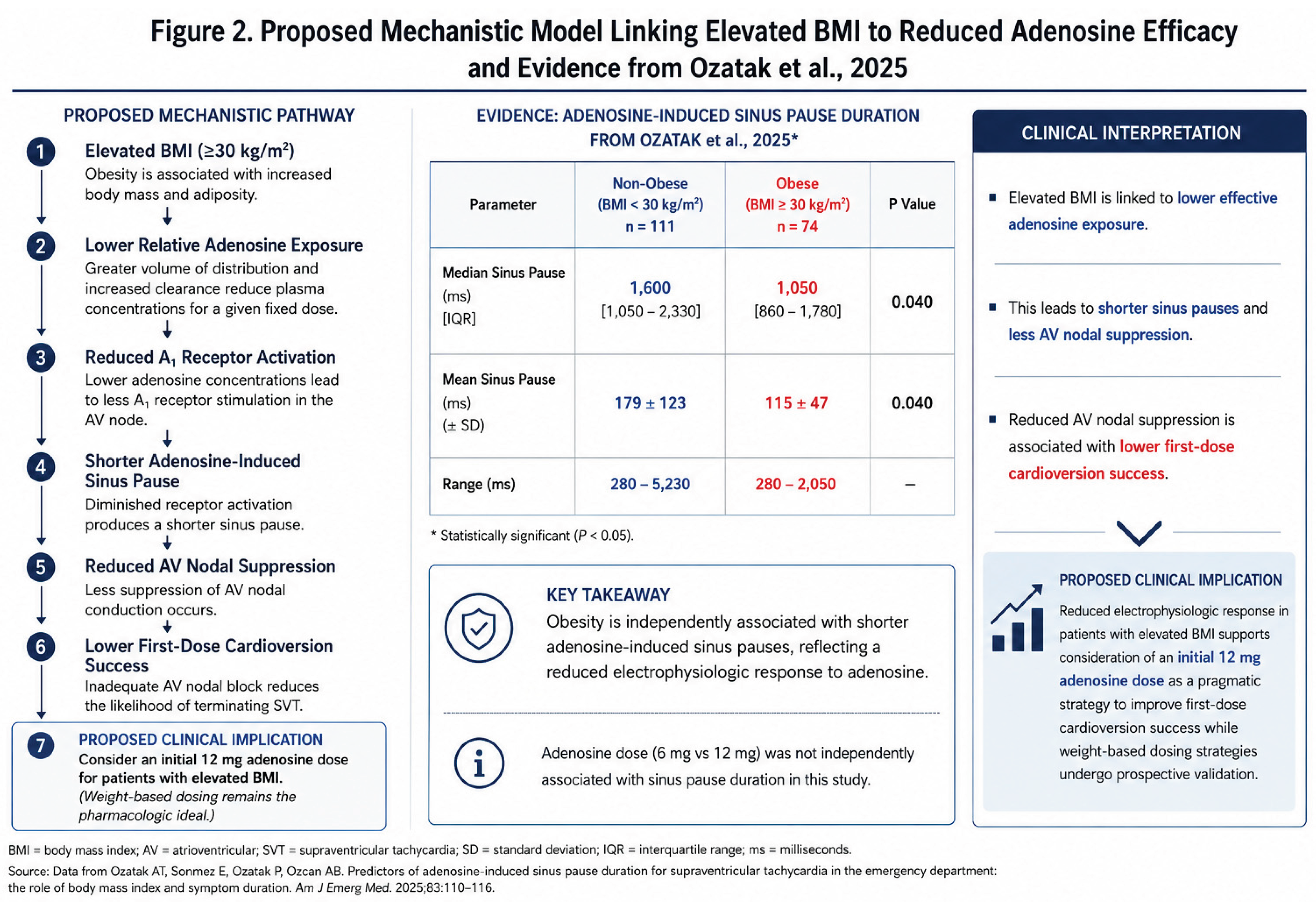
In a retrospective study of 89 emergency department patients, Ozatak et al. [24] found that BMI independently predicted pause duration, with obese patients (BMI ≥30) showing significantly shorter pauses than non-obese patients across both median and mean measures (Table 1). Older age and longer symptom duration were associated with longer pauses, while the administered dose itself (6 mg vs. 12 mg) was not an independent predictor — suggesting patient physiology matters more than nominal dose escalation.
These findings offer mechanistic support for reduced adenosine exposure in obesity: shorter pauses in obese patients likely reflect lower peak receptor concentrations after a fixed dose, providing a plausible explanation for the lower cardioversion rates reported elsewhere and strengthening the case for higher or weight-adjusted dosing.
Figure 2.
Proposed Mechanistic Model Linking Elevated BMI to Reduced Adenosine Efficacy and Evidence from Ozatak et al [24]. Proposed mechanism by which elevated BMI may reduce first-dose adenosine efficacy through lower relative drug exposure, resulting in shorter adenosine-induced sinus pauses, reduced AV nodal suppression, and decreased cardioversion success. The pathway incorporates findings from Ozatak et al. [24] and illustrates a hypothesis requiring prospective validation.
Figure 2.
Proposed Mechanistic Model Linking Elevated BMI to Reduced Adenosine Efficacy and Evidence from Ozatak et al [24]. Proposed mechanism by which elevated BMI may reduce first-dose adenosine efficacy through lower relative drug exposure, resulting in shorter adenosine-induced sinus pauses, reduced AV nodal suppression, and decreased cardioversion success. The pathway incorporates findings from Ozatak et al. [24] and illustrates a hypothesis requiring prospective validation.
Weight-Based Dosing: The Pharmacologic Ideal
Given this consistent link between rising weight, falling mg/kg exposure, blunted electrophysiologic response, and lower cardioversion success, individualized weight-based dosing — normalizing delivery on a mg/kg basis rather than giving every patient the same dose — offers a more physiologically rational approach. Because adenosine's blockade is concentration-dependent and short-lived, restoring equivalent relative exposure across patients should, in principle, produce more consistent receptor activation and efficacy.
Emerging evidence supports this: Deck et al., An et al., and Corbacioglu et al. each found that higher mg/kg exposure predicted first-dose success, converging on a threshold of roughly 0.09–0.10 mg/kg beyond which failure becomes progressively more likely (Table 1) — though this remains hypothesis-generating rather than a validated target. [7,8,10]
Weight-based dosing is conceptually appealing because it directly addresses the mechanism outlined above, aligning strategy with adenosine's concentration-dependent pharmacodynamics. However, no randomized trial has yet compared it against fixed-dose algorithms, no consensus exists on the ideal weight metric or target exposure, and individualized calculations add complexity during time-pressured acute care — meaning it remains the most biologically rational but least validated option.
Higher Initial BMI-Based Fixed-Dose Administration as a Pragmatic Alternative
Because emergency care favors treatments that are fast and simple to apply, raising the initial fixed dose offers a pragmatic approximation of weight-based dosing benefits without added complexity or workflow disruption.
Krug et al.'s [25] multicenter retrospective cohort found that an initial 12 mg bolus produced significantly higher first-dose success than the conventional 6 mg-first approach (P < .001; Table 1), though the improvement among severely obese patients (BMI ≥40) did not reach statistical significance. A separate 439-patient multicenter cohort similarly found higher first-dose conversion with 12 mg, [26] and a meta-analysis of 11,686 patients across three retrospective cohorts confirmed that higher initial dosing significantly improved first-dose success, [28] reinforcing that therapeutic exposure, not the absolute dose given, likely drives cardioversion success.
Prospective confirmation has also begun to emerge: Sert et al. [27] compared an initial 12 mg dose with 6 mg in 142 patients and, after propensity-score matching, still found substantially higher first-dose conversion with 12 mg (adjusted OR 4.12; Table 1), with similar rates of adverse effects between groups — an important complement to the retrospective evidence above, since it is not subject to the same selection bias.
Still, a larger universal dose only approximates individualized dosing: it raises average exposure but does not eliminate mg/kg variability between small and large patients. It remains, however, an attractive interim step, requiring no dose calculations while further prospective work refines optimal weight-based protocols.
Limitations of Existing Evidence
Several limitations temper these conclusions. Most of the evidence is retrospective and observational, vulnerable to selection bias and unmeasured confounders — differences in provider preference, IV access, or concurrent vagal maneuvers could affect outcomes independent of dose. A single prospective, propensity-matched study now supports the higher-dose findings, [27] but the broader literature relating body weight and mg/kg exposure to cardioversion success remains observational and cannot establish causation.
The literature is also heterogeneous: studies vary in obesity definitions, outcome measures, and how body size is reported, precluding a precise consensus exposure threshold despite the consistent overall direction of effect.
Most notably, no study has directly measured adenosine's pharmacokinetics in obese patients — the mechanism proposed here remains inferential rather than directly validated. And no randomized trial has yet compared conventional, higher-fixed-dose, and weight-based strategies head-to-head, nor is there consensus on weight metric, target exposure, or maximum dose. Prospective pharmacokinetic and randomized trial data are needed before guideline changes can be confidently recommended.
Discussion and Future Directions
Therapeutic Exposure as the Dosing Target
The evidence reviewed here suggests that adenosine's therapeutic goal should be adequate pharmacologic exposure, not a fixed absolute dose. Whether that is achieved through weight-based dosing or a higher fixed dose may depend on clinical setting, but framing therapy around exposure rather than nominal dose reconciles both approaches.
From Pharmacologic Precision to Clinical Practicality
Weight-based dosing most directly targets the mechanisms described here and is the most biologically rational option, but emergency workflow constraints may limit its adoption. A higher initial fixed dose is a pragmatic intermediary — not a competing alternative, but a way to bring the same principle into routine practice.
Future Research
The consistency of the observational evidence justifies further investigation, but future work should go beyond comparing success rates to establish mechanism, exposure targets, and implementation.
Priorities include direct pharmacokinetic studies of adenosine disposition across body sizes, since none currently exist; prospective dose-finding studies evaluating mg/kg dosing to identify an optimal exposure target; and randomized trials comparing conventional, higher-fixed, and weight-based dosing — assessing not just cardioversion success but adverse events, recurrence, tolerability, and resource use.
Beyond these trials, translating findings into practice will require dosing algorithms and simplified weight-based protocols that minimize workflow disruption. The broader shift this review argues for is reframing the question from "what is the correct dose?" to "what exposure reliably achieves AV nodal blockade?".
Conclusion
Adenosine has been the cornerstone of therapy for AV node-dependent SVT for over three decades, yet its dosing principles have not evolved alongside shifting patient demographics. The evidence reviewed here — though largely observational — converges across pharmacologic, electrophysiologic, and clinical outcome studies to indicate that fixed-dose administration delivers unequal exposure across body sizes, and that reduced mg/kg exposure is consistently linked to diminished electrophysiologic response and lower first-dose cardioversion success. Weight-based dosing remains the most pharmacologically rational way to achieve consistent exposure, while higher initial fixed dosing offers a pragmatic approximation suited to emergency care. Answering "what exposure reliably achieves cardioversion?" rather than "what is the correct dose?" through further pharmacokinetic and randomized trial work may allow adenosine dosing to evolve from delivering identical doses to delivering equivalent therapeutic exposure.
Generative Artificial Intelligence Disclosure
Generative artificial intelligence tools (ChatGPT, OpenAI) were used during manuscript preparation to assist with language editing, including improvements in clarity, grammar, and readability, and to assist in the generation of selected conceptual figures. All AI-assisted content and figures were reviewed, revised, and verified by the authors. The authors take full responsibility for the accuracy, interpretation, and final content of the manuscript.
References
- Link MS. Evaluation and initial treatment of supraventricular tachycardia. N Engl J Med. 2012;367(15):1438-1448. [CrossRef]
- Page RL, Joglar JA, Caldwell MA, et al. 2015 ACC/AHA/HRS guideline for the management of adult patients with supraventricular tachycardia. Circulation. 2016;133(14):e506-e574. [CrossRef]
- Brugada J, Katritsis DG, Arbelo E, et al. 2019 ESC guidelines for the management of patients with supraventricular tachycardia. Eur Heart J. 2020;41(5):655-720. [CrossRef]
- Peng G, Zei PC. Diagnosis and management of paroxysmal supraventricular tachycardia. JAMA. 2024;331(7):601-610. [CrossRef]
- Layland J, Carrick D, Lee M, Oldroyd K, Berry C. Adenosine: physiology, pharmacology, and clinical applications. JACC Cardiovasc Interv. 2014;7(6):581-591. [CrossRef]
- Singh S, McKintosh R. Adenosine. In: StatPearls. StatPearls Publishing; 2023. Accessed August 12, 2026. http://www.ncbi.nlm.nih.gov/books/NBK519049/.
- An J, Kim H, Ko Y, Yang H. Comparison of sinus conversion rates and body weights after 6 mg adenosine administration in supraventricular tachycardia. Am J Emerg Med. 2023;63:55-60. [CrossRef]
- Çorbacıoğlu ŞK, Uzunosmanoğlu H, Karaarslan FN, Dağar S, Emektar E, Çevik Y. The effect of patient weight on the success of converting sinus rhythm in patients with PSVT treated with standard dose adenosine. Am J Emerg Med. 2023;69:28-33. [CrossRef]
- Flegal KM, Kruszon-Moran D, Carroll MD, Fryar CD, Ogden CL. Trends in obesity among adults in the United States, 2005 to 2014. JAMA. 2016;315(21):2284-2291. [CrossRef]
- Deck CM, Dang B, Ashenburg N, Rice B. Improved first dose conversion of supraventricular tachycardia using weight-based adenosine. Cureus. 2023;15(3):e35995. [CrossRef]
- Belhassen B, Pelleg A. Adenosine triphosphate and adenosine: perspectives in the acute management of paroxysmal supraventricular tachycardia. Clin Cardiol. 1985;8(9):460-464. [CrossRef]
- Antonioli L, Fornai M, Pellegrini C, Pacher P, Haskó G. Adenosine signaling as target in cardiovascular pharmacology. Curr Opin Pharmacol. 2023;71:102393. [CrossRef]
- Parichatikanond W, Duangrat R, Nuamnaichati N, Mangmool S. Role of A1 adenosine receptor in cardiovascular diseases: bridging molecular mechanisms with therapeutic opportunities. Exp Mol Pathol. 2025;141:104952. [CrossRef]
- DiMarco JP, Sellers TD, Berne RM, West GA, Belardinelli L. Adenosine: electrophysiologic effects and therapeutic use for terminating paroxysmal supraventricular tachycardia. Circulation. 1983;68(6):1254-1263. [CrossRef]
- Glatter KA, Cheng J, Dorostkar P, et al. Electrophysiologic effects of adenosine in patients with supraventricular tachycardia. Circulation. 1999;99(8):1034-1040. [CrossRef]
- DiMarco JP, Miles W, Akhtar M, et al. Adenosine for paroxysmal supraventricular tachycardia: dose ranging and comparison with verapamil. Ann Intern Med. 1990;113(2):104-110. [CrossRef]
- Rankin AC, Brooks R, Ruskin JN, McGovern BA. Adenosine and the treatment of supraventricular tachycardia. Am J Med. 1992;92(6):655-664. [CrossRef]
- Bailey AM, Baum RA, Rose J, Humphries RL. High-dose adenosine for treatment of refractory supraventricular tachycardia in an emergency department of an academic medical center: a case report and literature review. J Emerg Med. 2016;50(3):477-481. [CrossRef]
- Blüher M. Obesity: global epidemiology and pathogenesis. Nat Rev Endocrinol. 2019;15(5):288-298. [CrossRef]
- Cheymol G. Effects of obesity on pharmacokinetics: implications for drug therapy. Clin Pharmacokinet. 2000;39(3):215-231. [CrossRef]
- Hanley MJ, Abernethy DR, Greenblatt DJ. Effect of obesity on the pharmacokinetics of drugs in humans. Clin Pharmacokinet. 2010;49(2):71-87. [CrossRef]
- Barras M, Legg A. Drug dosing in obese adults. Aust Prescr. 2017;40(5):189-193. [CrossRef]
- Gouju J, Legeay S. Pharmacokinetics of obese adults: not only an increase in weight. Biomed Pharmacother. 2023;166:115281. [CrossRef]
- Ozatak AT, Sonmez E, Ozatak P, Ozcan AB. Predictors of adenosine-induced sinus pause duration for supraventricular tachycardia in the emergency department: the role of body mass index and symptom duration. J Emerg Med. 2026;87:122-130. [CrossRef]
- Krug N, Baize P, Barre S, Barnes R, Weigartz K. Comparison of initial adenosine dose conversion rate for supraventricular tachycardia in the emergency department. Am J Emerg Med. 2024;85:117-122. [CrossRef]
- Ku K, Healy J, Lee CA, et al. Exploring treatment protocol adherence and variations in paroxysmal supraventricular tachycardia in the emergency department: a multicenter cohort study. Med Sci (Basel). 2025;13(2):58. [CrossRef]
- Sert ET, Kokulu K, Yürük O, Akar EH, Topuz MA. Initial 12 mg versus 6 mg adenosine for supraventricular tachycardia in the emergency department. Acad Emerg Med. 2026;33(5):e70309. [CrossRef]
- Macech A, Pruć M, Momot K, et al. Initial adenosine dosing in SVT: a meta-analysis comparing 6 mg versus 12 mg across prehospital and emergency settings. Med Res J. 2025;10(3):280-288. [CrossRef]

Table 1.
Clinical Evidence Supporting a Relationship Between Relative Adenosine Exposure and the Electrophysiologic and Clinical Response to Adenosine.
Table 1.
Clinical Evidence Supporting a Relationship Between Relative Adenosine Exposure and the Electrophysiologic and Clinical Response to Adenosine.
| Study | Design | N | Primary Outcome | Exposure/ Physiologic Findings |
Key Statistical Findings | Role in Hypothesis |
|---|---|---|---|---|---|---|
| An et al. [7] | Retrospective | 124 | First-dose cardioversion success | Successful conversion: 0.10 ± 0.02 mg/kg; Failed conversion: 0.079 ± 0.02 mg/kg | Lower effective dose independently associated with failure (P < .001) | Direct clinical evidence |
| Corbacioglu et al. [8] | Retrospective | 73 | First-dose cardioversion success | Successful conversion: 0.0889 ± 0.017 mg/kg; Failed conversion: 0.0737 ± 0.014 mg/kg; Weight: 70.4 vs 84.6 kg; BMI: 25.2 vs 30.1 kg/m2 | ROC cutoff: 0.0857 mg/kg; AUC: 0.751; Sensitivity: 71.4%; Specificity: 77.7% | Direct clinical evidence |
| Deck et al. [10] | Retrospective cohort | 76 | First-dose cardioversion success | ≥0.1 mg/kg: 92.7% success; <0.1 mg/kg: 59.6% success | P = .006 | Dose-threshold evidence |
| Krug et al. [25] | Multicenter retrospective | 213 | Initial conversion success | Initial 12 mg: 79.1%; Initial 6 mg: 56.4%; BMI ≥40 subgroup (not statistically significant): 69.2% vs 42.1% | P < .001 overall | Higher-dose evidence |
| Ku et al. [26] | Multicenter retrospective | 439 | Sinus rhythm conversion (adenosine subgroup) | Initial 12 mg: 54.2%; Initial 6 mg: 40.6% | P = .03 | Higher-dose evidence |
| Sert et al. [27] | Prospective (propensity-matched) | 142 (104 matched) | First-dose cardioversion success | Initial 12 mg: 83.1%; Initial 6 mg: 52.1%; Matched cohort: 82.7% vs 53.8% | Adjusted OR 4.12(95% CI 1.85–9.14); NNT 3.8 | Prospective confirmatory evidence |
| Macech et al. [28] | Meta-analysis | 11,686 | Initial conversion success | Pooled analysis favoring higher initial adenosine exposure | OR 1.89 (95% CI 1.66–2.15); I2 = 9% | Meta-analytic evidence |
| Ozatak et al. [24] | Retrospective | 89 | Post-adenosine sinus pause duration | Obese: 1060 ms [IQR 890–1310]; Non-obese: 1400 ms [IQR 1040–2220]; Mean pause: 1176 ± 530 ms vs 1770 ± 970 ms | BMI β = −0.0195(P = .031); Obesity subgroup: P = .004 | Mechanistic evidence |
The proposed effective adenosine exposure range of approximately 0.085–0.10 mg/kg is derived from convergent findings across multiple independent cohorts and should be considered hypothesis-generating, requiring prospective validation before adoption as a definitive therapeutic threshold.
Disclaimer/Publisher’s Note: The statements, opinions and data contained in all publications are solely those of the individual author(s) and contributor(s) and not of MDPI and/or the editor(s). MDPI and/or the editor(s) disclaim responsibility for any injury to people or property resulting from any ideas, methods, instructions or products referred to in the content. |
© 2026 by the authors. Licensee MDPI, Basel, Switzerland. This article is an open access article distributed under the terms and conditions of the Creative Commons Attribution (CC BY) license (http://creativecommons.org/licenses/by/4.0/).
Copyright: This open access article is published under a Creative Commons CC BY 4.0 license, which permit the free download, distribution, and reuse, provided that the author and preprint are cited in any reuse.