
Submitted:
14 September 2026
Posted:
23 September 2026
You are already at the latest version
Abstract
Probiotic effects in dogs may depend not only on the bacterial strain but also on host-related characteristics. Differences in body size are associated with distinct gastrointestinal and microbial features that may influence responses to nutritional interventions. This study evaluated the effects of Limosilactobacillus reuteri DSM 32203 in healthy small-breed dogs and investigated whether responses differed between Chihuahua and Dachshund dogs with different body weights. Healthy adult dogs were supplemented daily with L. reuteri DSM 32203, and body weight, body condition score, fecal score, fecal moisture, total lactobacilli, and total coliforms were evaluated throughout the study. Supplementation improved fecal quality, with increased consistency and reduced moisture, and fecal scores reaching or approaching the optimal value. An increase in total lactobacilli and a reduction in total coliforms was also observed. These findings are consistent with previous observations obtained with the same strain in other canine breeds. However, the greater reduction in total coliforms compared with our previous studies in larger breeds may suggest that the response to a defined probiotic strain varies among canine phenotypes. Although body size cannot be established as a direct causal factor, these findings provide preliminary evidence that host characteristics may contribute to probiotic responsiveness.
Keywords:
body condition score
; fecal score
; intestinal microbiota
; L. reuteri
; probiotics
; small-breed dogs
1. Introduction
The domestic dog (Canis lupus familiaris) represents a unique model in which marked differences in body size have developed within a single species because of selective breeding. Adult body weight may range from less than 2 kg in some toy breeds to more than 50 kg in giant breeds, and this variation is accompanied by differences in gastrointestinal anatomy and physiology. Body size has been associated with changes in gastrointestinal dimensions, colonic transit, intestinal permeability, fermentative activity, and fecal water content, suggesting that the digestive environment is not uniform across canine breeds [1,2,3,4,5]. These differences are of relevance when nutritional interventions are intended to modify intestinal function, because the physiological conditions encountered by a dietary component or microorganism may vary substantially among dogs of different sizes [2,3,6]. The intestinal microbiota is an integral component of the canine gastrointestinal ecosystem, contributing to nutrient metabolism and fermentation, modulation of intestinal barrier function, and bidirectional interactions with the host [7,8,9,10]. Although the general structure and functional relevance of the canine gut microbiota are increasingly well characterized, substantial inter-individual variation has been reported, with microbial composition influenced by multiple intrinsic and extrinsic factors, including breed, age, body condition, body size, diet, and living environment [11,12,13]. Importantly, evidence also suggests that body size may contribute to differences in the canine fecal microbial ecosystem. Middleton et al. [6] identified metabolic, clinical, and microbiota differences between small and larger dogs maintained on the same diet, suggesting that some metabolic and microbial characteristics may be associated with host body size rather than being solely attributable to dietary differences. More recently, a comprehensive review of canine digestive physiology highlighted associations between body size and several gastrointestinal and fecal parameters, particularly within the colonic compartment, including intestinal transit time, permeability, fiber degradation, fecal short-chain fatty acids, and fecal water content [3]. Subsequent experimental work further demonstrated that nutritional and physicochemical conditions representative of different dog sizes can reshape canine microbiota structure and function, including microbial fermentation activity [5]. These observations are particularly relevant to the use of probiotics. Probiotics are defined as live microorganisms that, when administered in adequate amounts, confer a health benefit on the host, and their effects are increasingly investigated as a means of modulating intestinal microbial communities and gastrointestinal function [14,15,16,17]. In dogs, probiotic supplementation has been associated with changes in fecal characteristics, intestinal microbial communities, microbial metabolites, and selected host responses. However, the available evidence remains heterogeneous, and comparisons among studies are complicated by differences in probiotic strains, doses, administration protocols, diets, host characteristics, and outcome measures [18,19]. Consequently, probiotic effects should not be attributed solely to the bacterial species, as strains belonging to the same species may exhibit distinct biological properties and probiotic potential [18,20]. The strain-dependent nature of probiotic effects raises an important question that has received comparatively little attention in canine nutrition: to what extent can characteristics of the host influence the response to a defined probiotic strain? Recent evidence in healthy dogs indicates that the magnitude of the microbiota response to probiotic supplementation can vary among individuals and is associated with the microbial profile at baseline, supporting the relevance of host-related factors in probiotic responsiveness [19]. If dogs of different sizes differ in gastrointestinal anatomy, intestinal transit, water handling, fermentation, and microbial composition, the intestinal environment in which an exogenous microorganism acts may also differ according to host size [3]. It is therefore plausible that the magnitude or temporal pattern of the response to a given probiotic strain may vary across canine phenotypes. Among lactic acid bacteria investigated for canine applications, Limosilactobacillus reuteri has attracted interest because of its potential to interact with the intestinal microbiota and influence microbial composition and activity [18,21]. Nevertheless, the biological effects of L. reuteri remain strain-dependent, and effects observed with one strain should not be assumed to be transferable to other strains of the same species [18,20]. The strain L. reuteri DSM 32203 has previously been investigated in dogs, including French Bulldog and Golden Retriever, and has shown potential to improve fecal consistency through a reduction in fecal moisture when administered as a feed additive [22,23,24]. The preparation containing L. reuteri DSM 32203 was subsequently authorized in the European Union as a zootechnical feed additive for dogs [25]. However, the response of small-breed dogs to this defined strain remains comparatively underexplored. Small-breed dogs are particularly relevant in this context because they cannot simply be considered scaled-down versions of larger dogs: body size is associated with differences in gastrointestinal anatomy and physiology, intestinal transit, fecal water content, fermentation-related parameters, and aspects of the fecal microbiota [3]. Studies comparing healthy dogs have also demonstrated that individual characteristics can be associated with measurable differences in fecal microbial communities, emphasizing the importance of considering host-related variables when interpreting microbiota-directed interventions [26]. Nevertheless, experimental studies investigating whether a defined probiotic strain produces consistent effects among dogs differing in body size remain limited. The present study was designed to investigate the effects of L. reuteri DSM 32203 supplementation in two small-breed populations, Chihuahua and Dachshund dogs. These breeds were selected because, despite both being classified as small dogs, they differ substantially in body weight and therefore provide an opportunity to investigate the response to the same probiotic strain in two distinct small-breed phenotypes. The effects of supplementation were evaluated longitudinally using body weight, body condition score, fecal score, fecal moisture, and selected fecal bacterial populations as outcome measures. The primary objective was to determine whether daily supplementation with L. reuteri DSM 32203 could improve fecal quality and modulate selected bacterial populations in healthy small-breed dogs. More broadly, the study aimed to extend previous observations obtained with the same probiotic strain in other canine breeds and to investigate whether the response to a defined probiotic strain is comparable between small-breed dogs differing in body weight. We hypothesized that L. reuteri DSM 32203 would improve fecal consistency and modify selected bacterial populations in both Chihuahua and Dachshund dogs, while the comparison of these two small-breed phenotypes would provide preliminary insight into whether the magnitude and pattern of the response to the same probiotic strain are broadly consistent or differ according to body weight.
2. Materials and Methods
2.1. Animals and Study Design
Sixty healthy Chihuahua (n=30) and Dachshund dogs (n=30), 26 males (12 Chihuahuas + 14 Dachshunds = 26) and 34 non-pregnant females (18 Chihuahuas + 16 Dachshunds = 34), age> 1 year were involved in the study and randomly assigned to the control group (CTR; n= 30: 15 Chihuahuas + 15 Dachshunds) and experimental group (LACTO; n= 30: 15 Chihuahuas + 15 Dachshunds). Animals were divided randomly (SurveyMonkey Excel) into the two groups and the group assignment was organized according to kennel management standard procedure. The experimental group was supplemented with Limosilactobacillus reuteri DSM 32203 while the control group did not receive the probiotic and was supplemented by maltodextrin used as placebo. The two dog breeds were analyzed individually to evaluate any differences inherent to the breed itself or to the diet administered. Table 1 reports age, sex and body weight of each dog of the two breeds belonging to the control and experimental groups. Cleaning and disinfecting procedures of the single fences were carried out and the animals have been individually stabulated. Moreover, the animals were evaluated daily by a veterinarian for any health and welfare concerns throughout the experimental period. The study lasted a total of 49 days: 35 days of study and 14 days of acclimatization.
2.2. Feed Supplement and Diet
All dogs had free access to potable water and were fed with two different commercial petfood: Chihuahua dogs consumed Royal Canin mini adult extruded feed while the dachshund dogs ate Eukanuba adult small breed food. For the entire duration of the study, feed was administered to each animal once a day based on the energy requirements of each dog (adult dogs: 110 kcal x BW0.75 kg) [27]; table 2 reports the analytical components of each petfood administered. Dogs belonging to the experimental group received commercial feed with the addition of 10 g/100 kg of Limosilactobacillus reuteri DSM 32203, corresponding to 5 x 10⁹ colony-forming units (CFU)/kg food; the process to obtain the right probiotic amount consisted in using 50 g of the feed additive (standard concentration ≥ 1.0 x 10¹¹ CFU/g), pre-mixed in laboratory with 9950 g of maltodextrins. Then, a total of 20 g of this pre-mixture was daily added to each 980 g of commercial feed in the bowl. The control group received the commercial diet, with the addition of 20 g of maltodextrin in 980 g of dog feed (placebo).

Table 2.
Analytical components of Royal Canin mini adult extruded feed (A) and Eukanuba adult small breed food (B).
Table 2.
Analytical components of Royal Canin mini adult extruded feed (A) and Eukanuba adult small breed food (B).
| A. Royal Canin mini adult extruded feed | |
| Parameter | Amount (%) |
| Crude protein | 27.00 |
| Crude fats | 16.00 |
| Raw fiber | 1.30 |
| Raw ash | 6.80 |
| Metabolizable energy | 3920 Kcal/Kg |
Composition: dehydrated poultry protein, wheat flour, maize flour, animal fats, maize, wheat gluten, barley, maize gluten, wheat, hydrolysed animal proteins, minerals, beet pulp, soya oil, yeast products, fructooligosaccharides, fish oil, algae oil.
Nutritional additives: Vitamin A: 15700 IU, Vitamin D3: 1000 IU, Iron (3b103): 36 mg, Iodine (3b201, 3b202): 3.6 mg, Copper (3b405, 3b406): 11 mg, Manganese (3b502, 3b504): 47 mg, Zinc (3b603, 3b605, 3b606): 133 mg, Selenium (3b801, 3b811, 3b812): 0.09 mg - Preservatives - Antioxidants.
| B. Eukanuba adult small breed food | |
| Parameter | Amount (%) |
| Crude protein | 30.00 |
| Crude fats | 18.00 |
| Raw fiber | 2.00 |
| Raw ash | 6.70 |
| Metabolizable energy | 3923 Kcal/Kg |
Composition: dehydrated chicken and turkey (28% of which chicken 17%, natural source of glucosamine, chondroitin sulphate and taurine), fresh chicken (15%), corn, wheat, poultry fat, oats, barley, millet, beet pulp (3.5%), chicken gravy, fish meal (natural source of Omega 3 fatty acids), minerals (including sodium hexametaphosphate 0.35%), dehydrated whole eggs, fructo-oligosaccharides (0.38%, natural prebiotics).
Nutritional additives: Vitamin A (47,749 IU/kg), Vitamin C (60 mg/kg), Vitamin D3 (1,584 IU/kg), Vitamin E (265 mg/kg), Beta-Carotene (5.2 mg/kg), L-Carnitine (50 mg/kg), Copper (9 mg/kg), Iodine (1.1 mg/kg), Manganese (4 mg/kg), Zinc (100 mg/kg), Selenium (0.01 mg/kg). Antioxidants: tocopherol-rich vegetable oil extracts (86 mg/kg); flavourings: organic rosemary extract (46 mg/kg), tea extract (23 mg/kg).
2.3. Data Collection
Body Weight (BW), Body condition Score (BCS), Fecal Score (FS) and Fecal Moisture (FM) were recorded at the beginning of the experiment (day 0= T0), after one week (T1), after 2 weeks (T2), after 3 weeks (T3), after 4 weeks (T4) and at the end of the study (T5) according to the American Animal Hospital Association (AAHA) Nutritional Assessment Guidelines for Dogs and Cats [28]. The Body Weight of each dog was measured by the same operator at the same time (morning, before feed administration), with the same instrument while the body composition assessment was carried out by visual examination and palpation of the animal on a scale between 1 and 9 where a score of 4 or 5 is reflecting the ideal body condition [29]. A 7-point scoring chart was used for the analysis of the fecal score according to the Nestle Purina Fecal Scoring System while for the analysis of fecal moisture (FM) the fecal samples were collected from each dog at T0, T1, T2, T3, T4 and T5 and then stored at +4°C until they are brought to the laboratory, where they are stored at −20°C. 5–10 g of stool was weighed and dried in an oven at a temperature of 105°C–110°C for 20–24 hours, cooled down in a desiccator for another 20–24 hours, after which the Fecal Moisture content was calculated as lost weight after desiccation. In addition, a microbiological analysis was conducted to identify and quantify specific intestinal bacterial species, one gram of fresh stool was used to carry out this analysis at four specific time points: T0, T1, T3 and T5. Briefly, fresh stool was diluted in sterile saline solution with a ratio of 1:10 and then vortexed for two minutes to have a homogeneous suspension which was plated on different culture media for total bacterial counts and identification; for Escherichia coli and total coliforms was used the eosin methylene blue agar (Oxoid, Italy) with an incubation of 24 hours at 37°C. E. coli colonies show growth with a green metallic reflex, while coliforms show growth with blue, red, or uncolored colonies. For lactobacilli identification was used the Man Rogosa and Sharpe agar (Oxoid) and the plates were incubated for 48 hours at 37°C under anaerobic condition. All the analysis was performed in duplicate.
2.4. Statistical Analysis
For the statistical analysis a Mixed Model with repeated measurements has been used, which allows to estimate the parameters considering both random effect and fixed effect [30]. The model has been estimated as the following:
yi,j,k =μ+Si +Gj +Tk +Gj * Tk +ei,j,k
where y = dependent variable (FM, FS, BW, BCS, LB, COLI); μ = overall mean; Si = fixed effect of the ith sex (I = 1, 2); Gj = fixed effect of the jth group (j = 1, 2); Tk = fixed effect of the kth time (k = 0, 5) and ei,j,k = error. The software used was R Core Team (2020), R: A language and environment for statistical computing [31] and for the different analysis was used the Mixed Model [32] and the Least Squares [33]. Time was used as repeated measurement and therefore each subject has been analyzed in every different temporal instant. The autoregressive covariance structure was used. Least Square Means were estimated, and they have been statistically tested using Student’s t test (with Tukey p-value adjustment). To be able to describe the goodness of the fit of the mixed model, we used the R squared described by Nakagawa et al. [34]. No outliers and missing data were found.
3. Results
The results of the study show how L. reuteri DSM 32203 supplementation has no influence on the weight (Table 3) and body condition (Table 4) of Chihuahua and Dachshund adult healthy dogs; in fact, the body weight of each dog remained almost constant throughout the entire duration of the study.
However, it is very interesting to see how fecal moisture (Table 5) decreased in the group of dogs treated with the probiotic L. reuteri DSM 32203 compared to the control one; similar results were reported in both Chihuahua and Dachshund dogs. At the end of the 35 days of study, Chihuahuas supplemented with L. reuteri DSM 32203 showed a decrease in fecal moisture of 0.20 (g/g) compared to T0 (beginning of the study), while the dachshund dogs showed a decrease of 0.24 (g/g) (Table 5).
Another interesting effect to consider is the improved fecal score reported in dogs that received the probiotic under study. Starting from the second week of study (T2), the Chihuahua group treated with L. reuteri DSM 32203 reported a Fecal score value of 2.09 (Table 6), very close to the value considered optimal, i.e. 2. The dachshund dogs reported the same excellent score starting from the fourth week of study (T4), while in the respective control group no similar improvement was observed (Table 6).
As regards the microbiological analysis, the trend of lactobacilli is very similar between Chihuahua and Dachshund dogs supplemented with L. reuteri DSM 32203; in both groups a clear increase of this bacterial genus is observed starting from the third week of the study and continuing to increase until the end of the experiment (Table 7, Figure 1). Specifically, in the group of Chihuahuas treated with L. reuteri DSM 32203, a significant increase in lactobacilli was recorded, going from an initial concentration of 4.72 ± 0.06 log CFU/g to 5.63 ± 0.06 log CFU/g after 35 days of study. As for the Dachshunds, the LACTO group went from an initial concentration of 4.80 ± 0.06 log CFU/g to reach a concentration of 5.62 ± 0.06 log CFU/g at the end of the experiment (Table 7).
In addition, total coliforms decreased in the probiotic-treated groups compared to the control groups. Specifically, the LACTO group in Chihuahua dogs reported an initial concentration of 4.65±0.08 log CFU/g and a final concentration of 3.94±0.08 log CFU/g, while the control group maintained an initial concentration of 4.73±0.08 log CFU/g and a final concentration of 4.71±0.08 log CFU/g (Table 8A, Figure 2A). A similar decrease was observed in Dachshunds: the LACTO group showed an initial coliform concentration of 4.55±0.08 log CFU/g, which dropped to 3.96±0.08 log CFU/g at the end of the trial, whereas the control group showed an initial count of 4.60±0.08 log CFU/g and a final count of 4.68±0.08 log CFU/g (Table 8B, Figure 2B).
3. Discussion
The potential beneficial effects of probiotic supplementation in dogs have been widely investigated; however, the biological effects of probiotics are highly dependent on the specific strain used. Strains belonging to the same bacterial species may differ substantially in their functional properties and in their interactions with the host, supporting the concept of strain-specificity in probiotic activity. Therefore, results obtained with one probiotic strain cannot necessarily be extrapolated to other strains, even when they belong to the same bacterial species. In dogs, relatively few studies have investigated the effects of Limosilactobacillus reuteri, and limited information is available on whether the response to a defined probiotic strain may vary according to host characteristics such as body size. This aspect is of particular interest in the domestic dog, which represents a unique species characterized by marked differences in body weight and morphology among breeds. As previously described, dogs may range from very small breeds such as Chihuahuas to giant breeds such as Saint Bernards [35]. Such differences are not limited to body weight but are also associated with relevant variations in gastrointestinal anatomy and physiology. Digestion in dogs is a complex process involving physicochemical, mechanical, and microbial mechanisms, and the gastrointestinal environment may differ substantially according to body size. The increasing recognition of the role of the intestinal microbiota in canine health has led to the widespread use of nutritional strategies aimed at modulating the intestinal microbial ecosystem, including probiotics, prebiotics, postbiotics, and other nutraceutical products. However, the potential effects of these interventions should be considered in relation to the physiological characteristics of the host. This concept is also reflected by the development of commercial diets formulated according to specific breed characteristics, body size, or predispositions [36,37,38,39]. Despite the relevance of these differences, the influence of body size on canine digestive physiology remains relatively poorly investigated. Deschamps et al. [3], in a comprehensive review of the available literature, identified a limited number of studies addressing digestive differences among dogs of different sizes, with a substantial proportion of the available evidence deriving from individual breeds rather than direct comparisons among size categories. This limited evidence makes it difficult to establish a comprehensive picture of how body size affects the different phases of canine digestion. The available data suggest that the relationship between body size and gastrointestinal motility is not uniform across the gastrointestinal tract. Studies evaluating gastric emptying and small intestinal transit have not consistently demonstrated a clear association with body weight, suggesting that these parameters may be influenced more strongly by factors such as food characteristics [40,41,42,43]. In contrast, differences in large intestinal physiology appear to be more closely related to body size. Hernot et al. [1] reported a longer large intestinal transit time in larger dogs and identified a correlation between transit time and body size. In addition, the length, area, and volume of the large intestine increase with body size, potentially contributing to differences in water handling, fermentation, and fecal characteristics. These physiological differences may also influence the intestinal microbial ecosystem. Although the overall functions performed by the intestinal microbiota appear to be broadly conserved among dogs, microbial composition can vary considerably between individuals and may be influenced by host-related factors, including body size [44]. Fecal concentrations of short-chain fatty acids have been reported to increase with increasing body weight [45], potentially reflecting differences in colonic fermentation. Longer colonic transit may provide microorganisms with more time for substrate utilization and fermentation, thereby influencing microbial metabolites and fecal characteristics. At the same time, excessive fermentation and the consequent accumulation of osmotically active metabolites may contribute to alterations in fecal water content. Increased intestinal permeability has also been described in large-breed dogs and may further contribute to differences in intestinal water and electrolyte handling [2]. Taken together, these observations indicate that dogs of different sizes may provide distinct gastrointestinal environments for the activity of dietary microorganisms. It is therefore reasonable to hypothesize that the response to the same probiotic strain may not necessarily be identical across canine phenotypes. This consideration provided the rationale for the present study, in which the effects of L. reuteri DSM 32203 were evaluated in two small-breed populations differing in body weight, namely Chihuahuas and Dachshunds. In the present study, supplementation with L. reuteri DSM 32203 was associated with an improvement in fecal quality in both breeds, as indicated by increased fecal consistency and reduced fecal moisture, with fecal scores reaching or approaching a score of 2, considered indicative of optimal fecal quality. These findings are consistent with previous evidence regarding the ability of this strain to improve fecal consistency in healthy dogs. The improvement in fecal parameters may reflect a more favorable intestinal environment and improved fecal water handling, although the present study does not allow direct conclusions to be drawn regarding intestinal nutrient absorption. The administration of the probiotic was also associated with an increase in total lactobacilli and a reduction in total coliforms. The increase in lactobacilli is consistent with the administration of a viable lactic acid bacterium and with the results previously obtained with the same strain in other canine breeds. In our previous studies conducted in Golden Retrievers and French Bulldogs, supplementation with L. reuteri DSM 32203 similarly resulted in an increase in total lactobacilli [22,23]. The reduction in total coliforms observed in the present study is also of interest, although coliform counts should be interpreted as an indicator of changes in this bacterial group rather than as a direct measure of pathogenic bacteria. When the present findings are considered together with our previous observations, the response of total coliforms appears to differ according to the canine population investigated. In particular, the reduction observed in Chihuahuas and Dachshunds appeared more pronounced than that previously observed in Golden Retrievers and French Bulldogs [22,23]. Although these observations cannot establish a direct effect of body size, they raise the possibility that the magnitude of the response to L. reuteri DSM 32203 may vary among dogs differing in body size. One possible explanation is that differences in gastrointestinal physiology, intestinal transit, water handling, and the composition of the resident microbiota may modify the intestinal environment in which the probiotic strain interacts with the host. However, this interpretation should be considered preliminary. The present study compared two small-breed populations and was not specifically designed to isolate the effect of body size from other breed-related characteristics. Breed-associated differences in diet, baseline microbiota, gastrointestinal physiology, and other host factors may also contribute to the observed responses. Therefore, the greater reduction in coliforms observed in the present study should not be interpreted as evidence that L. reuteri DSM 32203 is intrinsically more effective in small dogs. Rather, these findings provide preliminary evidence that the response to a defined probiotic strain may vary among canine phenotypes and support the need for further studies including dogs belonging to different and well-defined body-size categories under standardized experimental conditions. Overall, the present findings confirm the ability of L. reuteri DSM 32203 to positively influence selected fecal parameters and bacterial populations in healthy small-breed dogs. More importantly, when considered together with previous results obtained in other breeds, they suggest that host-related characteristics, including body size, may contribute to the magnitude of the response to a probiotic strain. Further controlled studies involving a broader range of canine body sizes will be necessary to determine whether the differences observed among breeds reflect a true size-related effect or a combination of body size and other breed-specific characteristics.
5. Conclusions
As previously mentioned, this study is the last in a series of 3 experiments performed to evaluate the efficacy of the probiotic Limosilactobacillus reuteri DSM 32203 on body condition, fecal parameters and intestinal microbiota of healthy adult dogs of different sizes. The result obtained from the present study suggest how L. reuteri DSM 32203 can improve also the fecal parameters of small dogs like Chihuahua and Dachshund managing to modulate the composition of the intestinal microbiota with an increase in beneficial bacterial species such as lactobacilli and a decrease in potentially harmful ones such as coliforms.
References
- Hernot DC, Dumon HJ, Biourge VC, Martin LJ, Nguyen PG. Evaluation of association between body size and large intestinal transit time in healthy dogs. Am. J. Vet. Res. 2006; 67: 342–7.
- Weber MP, Biourge VC, Nguyen PG. Digestive sensitivity varies according to size of dogs: a review. J. Anim. Physiol. Anim. Nutr. (Berl). 2017; 101: 1–9.
- Deschamps C, Humbert D, Zentek J, Denis S, Priymenko N, Apper E, Blanquet-Diot S. From Chihuahua to Saint-Bernard: how did digestion and microbiota evolve with dog sizes. Int. J. Biol. Sci. 2022, Vol. 18.
- Deschamps C, Humbert D, Chalancon S, Achard C, Apper E, Denis S, Blanquet-Diot S. Large intestinal nutritional and physicochemical parameters from different dog sizes reshape canine microbiota structure and functions in vitro. Bioengineered 2024, Vol. 15, No. 1, 2325713.
- Deschamps C, Denis S, Humbert D, Priymenko N, Chalancon S, De Bodt J, Van de Wiele T, Ipharraguerre I, Alvarez-Acero I, Achard C, Apper E, Blanquet-Diot S. Canine Mucosal Artificial Colon: development of a new colonic in vitro model adapted to dog sizes. Applied Microbiology and Biotechnology 2024, 108:166.
- Middleton RP, Lacroix S, Scott-Boyer MP, Dordevic N, Kennedy AD, Slusky AR, Carayol J, Petzinger-Germain C, Beloshapka A, Kaput J. Metabolic Differences between Dogs of Different Body Sizes. Journal of Nutrition and Metabolism 2017, 4535710.
- Baritugo KA, Bakhsh A, Kim B, Park S. Perspectives on functional foods for improvement of canine health and treatment of diseases. Journal of Functional Foods 2023, Vol. 109, 105744.
- Xia J, Cui Y, Guo Y, Liu Y, Deng B, Han S. The Function of Probiotics and Prebiotics on Canine Intestinal Health and Their Evaluation Criteria. Review. Microorganisms 2024, 12, 1248.
- Rindels JE, Loman BR. Gut microbiome – the key to our pets’ health and happiness? American Society of Animal Science 2024, Vol. 14, No. 3.
- Yang B, Zhong S, Wang J, Yu W. Dietary Modulation of the Gut Microbiota in Dogs and Cats and Its Role in Disease Management. Review. Microorganisms 2025, 13, 2669.
- You I, Kim MJ. Comparison of Gut Microbiota of 96 Healthy Dogs by Individual Traits: Breed, Age, and Body Condition Score. Animals 2021, 11, 2432.
- Hernandez J, Rhimi S, Kriaa A, Mariaule V, Boudaya H, Drut A, Jablaoui A, Mkaouar H, Saidi A, Biourge V, Borgi MA, Rhimi M, Maguin E. Domestic Environment and Gut Microbiota: Lessons from Pet Dogs. Review. Microorganisms 2022, 10, 949.
- Rojas CA, Park B, Scarsella E, Jospin G, Entrolezo Z, Jarett JK, Martin A, Ganz HH. Species-level characterization of the core microbiome in healthy dogs using full-length 16S rRNA gene sequencing. Front. Vet. Sci. 2024, Vol. 11.
- Pilla R, Suchodolski JS. The Gut Microbiome of Dogs and Cats, and the Influence of Diet. Veterinary Clinics of North America: Small Animal Practice 2021, 605-621.
- Suchodolski JS. Analysis of the gut microbiome in dogs and cats. Review. Vet. Clin. Pathol. 2022; 50(Suppl. 1): 6–17.
- Yang Q, Wu Z. Gut Probiotics and Health of Dogs and Cats: Benefits, Applications, and Underlying Mechanisms. Review. Microorganisms 2023, 11, 2452.
- Atuahene D, Mukarram SA, Balouei F, Antwi A. Gut Health Optimization in Canines and Felines: Exploring the Role of Probiotics and Nutraceuticals. Review. Pets 2024, 1, 135–151.
- Schmitz S, Suchodolski JS. Understanding the canine intestinal microbiota and its modification by pro-, pre- and synbiotics – what is the evidence? Vet. Med. Sci. 2016; 2:71–94.
- Tanprasertsuk J, Jha AR, Shmalberg J, Jones RB, Perry LM, Maughan H, Honaker RW. The microbiota of healthy dogs demonstrates individualized responses to synbiotic supplementation in a randomized controlled trial. Anim. Microbiome 2021; 3(1):36.
- Coman MM, Verdenelli MC, Cecchini C, Belà B, Gramenzi A, Orpianesi C, Cresci A, Silvi S. Probiotic characterization of Lactobacillus isolates from canine faeces. J. Appl. Microbiol. 2019; 126:1245–1256.
- Belà B, Coman MM, Verdenelli MC, Gramenzi A, Pignataro G, Fiorini D, Silvi S. In Vitro Assessment of Postbiotic and Probiotic Commercial Dietary Supplements Recommended for Counteracting Intestinal Dysbiosis in Dogs. Vet. Sci. 2024; 11(1):19.
- Belà B, Pignataro G, Di Prinzio R, Di Simone D, Crisi PE, Gramenzi A. Effects of Lactobacillus reuteri NBF 1 DSM 32203 Supplementation on Healthy Dog Performance. Biomed. J. Sci. Tech. Res. 2021.
- Belà B, Pignataro G, Di Prinzio R, Di Simone D, Crisi PE, Gramenzi A. Effects of Lactobacillus reuteri NBF 1 DSM 32203 Supplementation on Healthy Bouledogue Français Performance. Journal of Applied Microbiological Research 2022, Vol. 5 - Issue 2 (19-29).
- EFSA FEEDAP Panel. Assessment of the efficacy of a feed additive consisting of Limosilactobacillus reuteri DSM 32203 for dogs (NBF LANES). EFSA Journal 2022; 20(7):7436.
- European Commission. Commission Implementing Regulation (EU) 2023/256, 2023.
- Zhao D, Zhang R, Wang J, Zhang X, Liu K, Zhang H, Liu H. Effect of Limosilactobacillus reuteri ZJF036 on Growth Performance and Gut Microbiota in Juvenile Beagle Dogs. Curr Microbiol. 2023; 80(5):155.
- FEDIAF 2020: Nutritional guidelines.
- Baldwin K, Bartges J, Buffington T. AAHA nutritional assessment guidelines for dogs and cats. J. Am. Anim. Hosp. Assoc. 2010; 46:285–96.
- Freeman L., Becvarova I., Cave N., MacKay C., Nguyen P., Rama B., Takashima G., Tiffin R., Tsjimoto H., van Beukelen P. Practice Guideline WSAVA Nutritional Assessment Guidelines. J. Small Anim. Pract. 2011; 52(7): 385-96.
- Fusi E, Rizzi R, Polli M. Effects of Lactobacillus acidophilus D2/CSL (CECT 4529) supplementation on healthy cat performance. Veterinary Record Open 2019; 6:e000368.
- R Core Team R: A Language and Environment for Statistical Computing. R Foundation for Statistical Computing 2020; Vienna, Austria.
- Pinheiro J, Bates D, DebRoy S, Sarkar D and R Core Team. Linear and Nonlinear Mixed Effects Models. 2018. R Package Version 3.1-137.
- Russell V. Lenth. Least-Squares Means: The R Package lsmeans. Journal of Statistical Software 2016; 69(1), 1-33.
- Nakagawa S and Schielzeth H. A general and simple method for obtaining R2 from generalized linear mixed-effects models. Methods Ecol. Evol. 2013; 4: 133-142.
- Grandjean D, Haymann F. Encyclopédie du chien Royal Canin 2010.
- German AJ, Helps CR, Hall EJ, Day MJ. Cytokine mRNA expression in mucosal biopsies from German shepherd dogs with small intestinal enteropathies. Dig. Dis. Sci. 2000; 45: 7–17.
- Boillat CS, Gaschen FP, Hosgood GL. Assessment of the relationship between body weight and gastrointestinal transit times measured by use of a wireless motility capsule system in dogs. Am. J. Vet. Res. 2010; 71: 898–902.
- Osto M, Lutz TA. Translational value of animal models of obesity-Focus on dogs and cats. Eur. J. Pharmacol. 2015; 759: 240–52.
- Raffan E, Dennis RJ, O’Donovan CJ, et al. A Deletion in the Canine POMC Gene Is Associated with Weight and Appetite in Obesity-Prone Labrador Retriever Dogs. Cell Metab. 2016; 23: 893–900.
- Weber MP, Stambouli F, Martin LJ, Dumon HJ, Biourge VC, Nguyen PG. Influence of age and body size on gastrointestinal transit time of radiopaque markers in healthy dogs. American Journal of Veterinary Research 2002; 63: 677–82.
- Bourreau J, Hernot D, Bailhache E, et al. Gastric emptying rate is inversely related to body weight in dog breeds of different sizes. J. Nutr. 2004; 134: 2039S-2041S.
- Oswald H, Sharkey M, Pade D, Martinez MN. Canine gastrointestinal physiology: Breeds variations that can influence drug absorption. European Journal of Pharmaceutics and Biopharmaceutics 2015; 97: 192–203.
- Ménard O, Famelart M-H, Deglaire A, et al. Gastric Emptying and Dynamic In Vitro Digestion of Drinkable Yogurts: Effect of Viscosity and Composition. Nutrients 2018; 10.
- Guard BC, Suchodolski JS. HORSE SPECIES SYMPOSIUM: Canine intestinal microbiology and metagenomics: From phylogeny to function1. Journal of Animal Science 2016; 94: 2247–61.
- Weber MP, Hernot D, Nguyen PG, Biourge VC, Dumon HJ. Effect of size on electrolyte apparent absorption rates and fermentative activity in dogs. J. Anim. Physiol. Anim. Nutr. (Berl.) 2004; 88: 356–65.
Figure 1.
Box plot showing the effect of Limosilactobacillus reuteri DSM 32203 supplementation on total Lactobacilli count (LB) in Chihuahua (A) and Dachshund (B) healthy adult dogs during the overall period. CTR, control group; LACTO, experimental group.
Figure 1.
Box plot showing the effect of Limosilactobacillus reuteri DSM 32203 supplementation on total Lactobacilli count (LB) in Chihuahua (A) and Dachshund (B) healthy adult dogs during the overall period. CTR, control group; LACTO, experimental group.
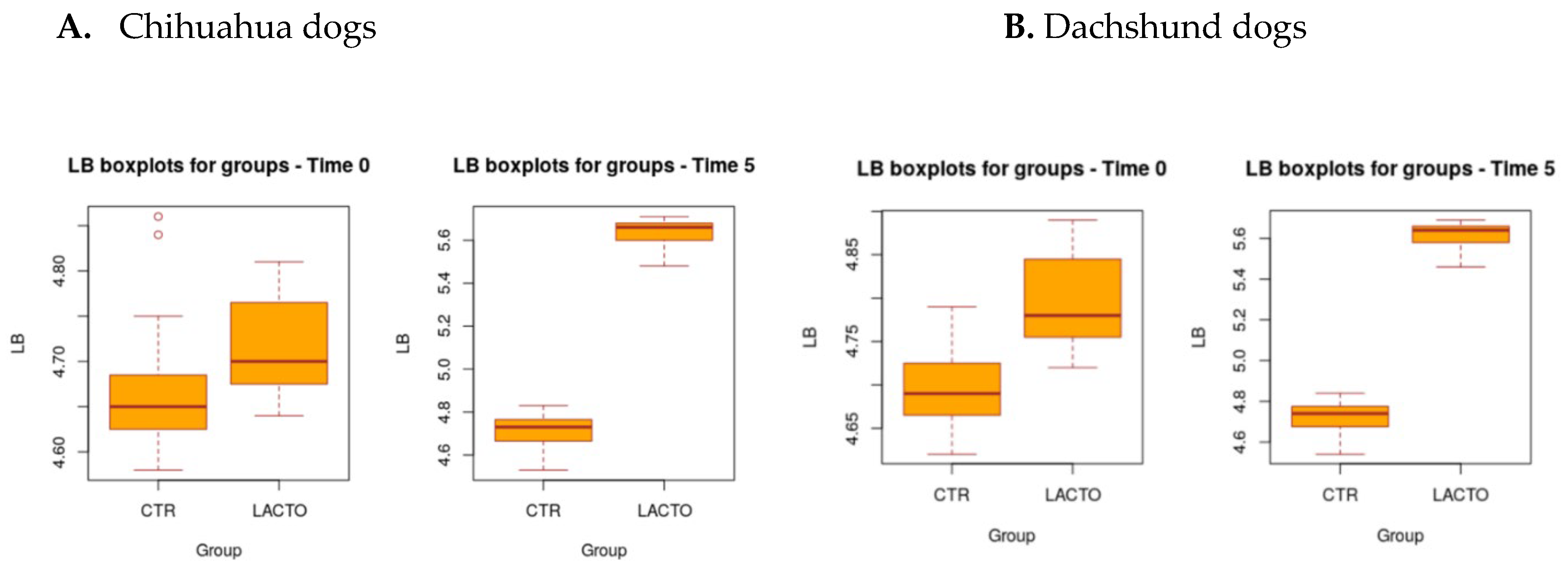
Figure 2.
Box plot showing the effect of Limosilactobacillus reuteri DSM 32203 supplementation on total coliforms (Coli) in Chihuahua (A) and Dachshund (B) healthy adult dogs during the overall period. CTR, control group; LACTO, experimental group.
Figure 2.
Box plot showing the effect of Limosilactobacillus reuteri DSM 32203 supplementation on total coliforms (Coli) in Chihuahua (A) and Dachshund (B) healthy adult dogs during the overall period. CTR, control group; LACTO, experimental group.
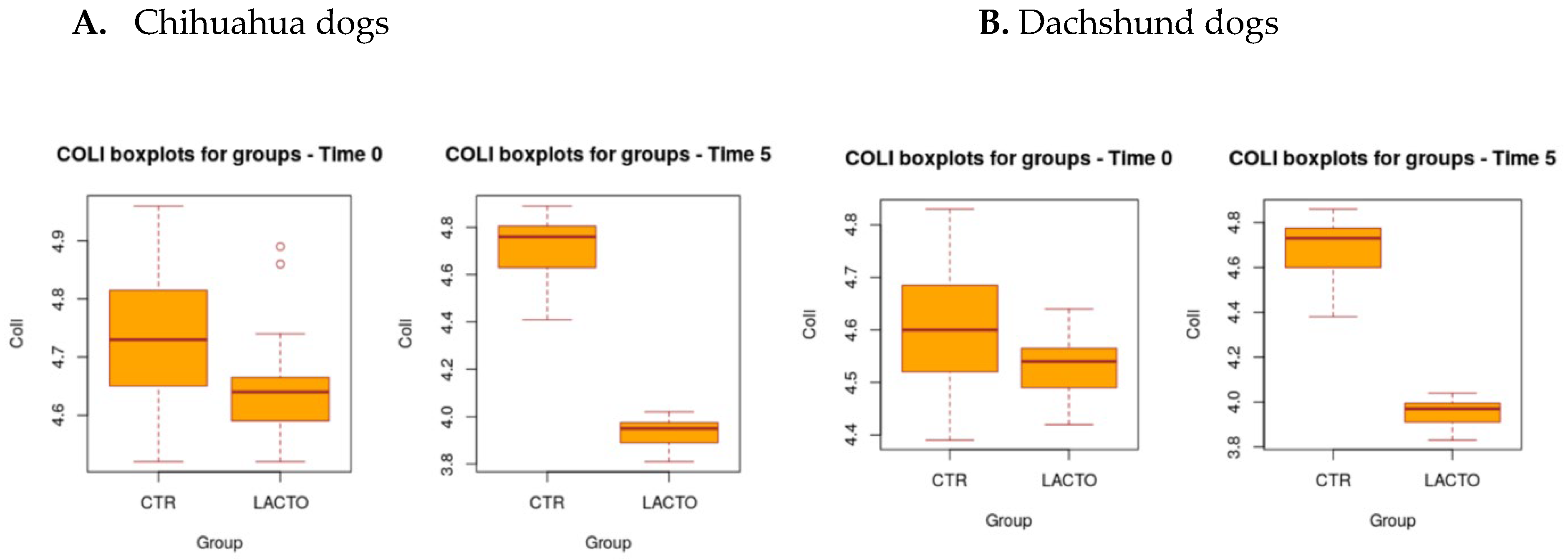
Table 1.
Age (month), sex, body weight (Kg) and breed of each dog enrolled in the study for both the LACTO and Control (CTR) groups.
Table 1.
Age (month), sex, body weight (Kg) and breed of each dog enrolled in the study for both the LACTO and Control (CTR) groups.
| Dogs (CTR group) | Age (months) | Sex | Body weight (Kg) | Breed |
| 1 | 14.8 | M | 2.60 | Chihuahua |
| 2 | 23.6 | M | 2.70 | Chihuahua |
| 3 | 23.6 | M | 2.50 | Chihuahua |
| 4 | 30.4 | M | 2.80 | Chihuahua |
| 5 | 14.8 | M | 2.90 | Chihuahua |
| 6 | 14.8 | M | 2.60 | Chihuahua |
| 7 | 30.4 | F | 1.80 | Chihuahua |
| 8 | 30.4 | F | 1.90 | Chihuahua |
| 9 | 23.6 | F | 1.70 | Chihuahua |
| 10 | 23.6 | F | 1.60 | Chihuahua |
| 11 | 14.8 | F | 1.80 | Chihuahua |
| 12 | 14.8 | F | 1.80 | Chihuahua |
| 13 | 23.6 | F | 1.80 | Chihuahua |
| 14 | 30.4 | F | 1.70 | Chihuahua |
| 15 | 30.4 | F | 1.60 | Chihuahua |
| 16 | 26.2 | M | 8.40 | Dachshund |
| 17 | 27.4 | M | 8.60 | Dachshund |
| 18 | 26.8 | M | 8.40 | Dachshund |
| 19 | 28.9 | M | 8.80 | Dachshund |
| 20 | 30.2 | M | 8.70 | Dachshund |
| 21 | 26.9 | M | 8.80 | Dachshund |
| 22 | 34.5 | M | 8.60 | Dachshund |
| 23 | 36.2 | F | 7.50 | Dachshund |
| 24 | 34.9 | F | 7.60 | Dachshund |
| 25 | 33.5 | F | 7.70 | Dachshund |
| 26 | 34.7 | F | 7.50 | Dachshund |
| 27 | 32.8 | F | 7.60 | Dachshund |
| 28 | 32.2 | F | 7.80 | Dachshund |
| 29 | 29.9 | F | 7.90 | Dachshund |
| 30 | 30.3 | F | 7.50 | Dachshund |
| Dogs (LACTO group) | Age (months) | Sex | Body weight (Kg) | Breed |
| 31 | 30.4 | M | 2.90 | Chihuahua |
| 32 | 30.4 | M | 2.80 | Chihuahua |
| 33 | 23.6 | M | 2.70 | Chihuahua |
| 34 | 14.8 | M | 2.90 | Chihuahua |
| 35 | 14.8 | M | 2.90 | Chihuahua |
| 36 | 23.6 | M | 2.80 | Chihuahua |
| 37 | 23.6 | F | 1.70 | Chihuahua |
| 38 | 23.6 | F | 1.70 | Chihuahua |
| 39 | 23.6 | F | 1.60 | Chihuahua |
| 40 | 14.8 | F | 1.80 | Chihuahua |
| 41 | 14.8 | F | 1.90 | Chihuahua |
| 42 | 30.4 | F | 1.80 | Chihuahua |
| 43 | 30.4 | F | 1.70 | Chihuahua |
| 44 | 30.4 | F | 1.70 | Chihuahua |
| 45 | 14.8 | F | 1.80 | Chihuahua |
| 46 | 28.8 | M | 8.80 | Dachshund |
| 47 | 26.6 | M | 8.90 | Dachshund |
| 48 | 25.4 | M | 8.70 | Dachshund |
| 49 | 24.5 | M | 8.70 | Dachshund |
| 50 | 29.7 | M | 8.60 | Dachshund |
| 51 | 27.8 | M | 8.50 | Dachshund |
| 52 | 30.5 | M | 8.80 | Dachshund |
| 53 | 33.2 | F | 7.50 | Dachshund |
| 54 | 35.6 | F | 7.50 | Dachshund |
| 55 | 34.2 | F | 7.60 | Dachshund |
| 56 | 31.7 | F | 7.70 | Dachshund |
| 57 | 34.5 | F | 7.80 | Dachshund |
| 58 | 34.2 | F | 7.70 | Dachshund |
| 59 | 33.3 | F | 7.60 | Dachshund |
| 60 | 31.5 | F | 7.90 | Dachshund |
Table 3.
Effect of Limosilactobacillus reuteri DSM 32203 supplementation on body weight of Chihuahua (A) and Dachshund (B) adult healthy dogs.
Table 3.
Effect of Limosilactobacillus reuteri DSM 32203 supplementation on body weight of Chihuahua (A) and Dachshund (B) adult healthy dogs.
| (A) Effect of Limosilactobacillus reuteri on body weight (LS Mean ± SE) of Chihuahua dogs | |||
| Time | CTR group | LACTO group | p-value |
| Overall | 2.20±0.05 | 2.23±0.05 | 0.306 |
| T0 | 2.22±0.08 | 2.28±0.08 | 0.850 |
| T1 | 2.21±0.08 | 2.21±0.08 | 1.000 |
| T2 | 2.21±0.08 | 2.22±0.08 | 1.000 |
| T3 | 2.17±0.08 | 2.23±0.08 | 0.850 |
| T4 | 2.20±0.08 | 2.19±0.08 | 1.000 |
| T5 | 2.19±0.08 | 2.27±0.08 | 0.510 |
| (B) Effect of Limosilactobacillus reuteri on body weight (LS Mean ± SE) of Dachshund dogs | |||
| Time | CTR group | LACTO group | p-value |
| Overall | 8.08±0.06 | 8.13±0.06 | 0.160 |
| T0 | 8.13±0.10 | 8.19±0.10 | 0.960 |
| T1 | 8.09±0.10 | 8.13±0.10 | 0.990 |
| T2 | 8.10±0.10 | 8.08±0.10 | 1.000 |
| T3 | 8.08±0.10 | 8.10±0.10 | 1.000 |
| T4 | 8.01±0.10 | 8.11±0.10 | 0.612 |
| T5 | 8.05±0.10 | 8.17±0.10 | 0.340 |
Table 4.
Effect of Limosilactobacillus reuteri DSM 32203 supplementation on body condition score of Chihuahua (A) and Dachshund (B) adult healthy dogs.
Table 4.
Effect of Limosilactobacillus reuteri DSM 32203 supplementation on body condition score of Chihuahua (A) and Dachshund (B) adult healthy dogs.
| (A) Effect of Limosilactobacillus reuteri on body condition score (LS Mean ± SE) of Chihuahua dogs | |||
| Time | CTR group | LACTO group | p-value |
| Overall | 4.73±0.010 | 4.69±0.010 | 0.483 |
| T0 | 4.71±0.24 | 4.65±0.24 | 1.000 |
| T1 | 4.75±0.24 | 4.71±0.24 | 1.000 |
| T2 | 4.71±0.24 | 4.71±0.24 | 1.000 |
| T3 | 4.78±0.24 | 4.68±0.24 | 0.990 |
| T4 | 4.71±0.24 | 4.68±0.24 | 1.000 |
| T5 | 4.71±0.24 | 4.68±0.24 | 1.000 |
| (B) Effect of Limosilactobacillus reuteri on body condition score (LS Mean ± SE) of Dachshund dogs | |||
| Time | CTR group | LACTO group | p-value |
| Overall | 4.68±0.10 | 4.72±0.10 | 0.660 |
| T0 | 4.64±0.24 | 4.70±0.24 | 1.000 |
| T1 | 4.70±0.24 | 4.74±0.24 | 1.000 |
| T2 | 4.70±0.24 | 4.70±0.24 | 1.000 |
| T3 | 4.67±0.24 | 4.77±0.24 | 1.000 |
| T4 | 4.67±0.24 | 4.70±0.24 | 1.000 |
| T5 | 4.67±0.24 | 4.70±0.24 | 1.000 |
Table 5.
Effect of Limosilactobacillus reuteri DSM 32203 supplementation on fecal moisture (expressed as g/g) of Chihuahua (A) and Dachshund (B) adult healthy dogs: results of mixed models showing least squares means ± SE in the CTR (control group) and LACTO (experimental group) dogs, for the six individual sampling times and overall, throughout the study.
Table 5.
Effect of Limosilactobacillus reuteri DSM 32203 supplementation on fecal moisture (expressed as g/g) of Chihuahua (A) and Dachshund (B) adult healthy dogs: results of mixed models showing least squares means ± SE in the CTR (control group) and LACTO (experimental group) dogs, for the six individual sampling times and overall, throughout the study.
| (A) Effect of Limosilactobacillus reuteri on fecal moisture (LS Mean ± SE) of Chihuahua dogs | |||
| Time | CTR group | LACTO group | p-value |
| Overall | 0.68±0.01 | 0.60±0.01 | <0.001 |
| T0 | 0.68±0.02 | 0.67±0.02 | 0.950 |
| T1 | 0.71±0.02 | 0.69±0.02 | 0.410 |
| T2 | 0.68±0.02 | 0.63±0.02 | <0.001 |
| T3 | 0.68±0.02 | 0.58±0.02 | <0.001 |
| T4 | 0.67±0.02 | 0.52±0.02 | <0.001 |
| T5 | 0.69±0.02 | 0.48±0.02 | <0.001 |
| (B) Effect of Limosilactobacillus reuteri on fecal moisture (LS Mean ± SE) of Dachshund dogs | |||
| Time | CTR group | LACTO group | p-value |
| Overall | 0.68±0.01 | 0.57±0.01 | <0.001 |
| T0 | 0.68±0.02 | 0.67±0.02 | 0.960 |
| T1 | 0.68±0.02 | 0.64±0.02 | 0.001 |
| T2 | 0.67±0.02 | 0.60±0.02 | <0.001 |
| T3 | 0.67±0.02 | 0.56±0.02 | <0.001 |
| T4 | 0.68±0.02 | 0.50±0.02 | <0.001 |
| T5 | 0.69±0.02 | 0.43±0.02 | <0.001 |
Table 6.
Effect of Limosilactobacillus reuteri DSM 32203 supplementation on the fecal score of Chihuahua (A) and Dachshund (B) adult healthy dogs: results of mixed models showing least squares means ± SE in CTR (control group) and LACTO (experimental group) dogs, for the six individual sampling times and overall, throughout the study.
Table 6.
Effect of Limosilactobacillus reuteri DSM 32203 supplementation on the fecal score of Chihuahua (A) and Dachshund (B) adult healthy dogs: results of mixed models showing least squares means ± SE in CTR (control group) and LACTO (experimental group) dogs, for the six individual sampling times and overall, throughout the study.
| (A) Effect of Limosilactobacillus reuteri on fecal score (LS Mean ± SE) of Chihuahua dogs | |||
| Time | CTR group | LACTO group | p-value |
| Overall | 2.55±0.08 | 2.07±0.08 | <0.001 |
| T0 | 2.26±0.30 | 2.66±0.30 | 0.980 |
| T1 | 2.26±0.30 | 2.26±0.20 | 0.037 |
| T2 | 2.49±0.22 | 2.09±0.18 | 0.001 |
| T3 | 2.62±0.18 | 1.99±0.18 | <0.001 |
| T4 | 2.46±0.18 | 1.79±0.18 | <0.001 |
| T5 | 2.62±0.18 | 1.62±0.18 | <0.001 |
| (B) Effect of Limosilactobacillus reuteri on fecal score (LS Mean ± SE) of Dachshund dogs | |||
| Time | CTR group | LACTO group | p-value |
| Overall | 2.91±0.15 | 2.31±0.15 | <0.001 |
| T0 | 2.93±0.25 | 2.96±0.25 | 1.000 |
| T1 | 2.86±0.25 | 2.56±0.25 | 0.300 |
| T2 | 3.00±0.25 | 2.23±0.25 | <0.001 |
| T3 | 2.86±0.25 | 2.10±0.25 | <0.001 |
| T4 | 2.86±0.25 | 2.00±0.25 | <0.001 |
| T5 | 2.93±0.25 | 2.00±0.25 | <0.001 |
Table 7.
Effect of Limosilactobacillus reuteri DSM 32203 supplementation, expressed as log CFU/g, on the total amount of Lactobacilli present in the intestinal microflora of Chihuahua (A) and Dachshund (B) adult healthy dogs: results of mixed models showing least squares means ± SE in CTR (control group) and LACTO (experimental group) dogs, for the four individual sampling times and overall, throughout the study.
Table 7.
Effect of Limosilactobacillus reuteri DSM 32203 supplementation, expressed as log CFU/g, on the total amount of Lactobacilli present in the intestinal microflora of Chihuahua (A) and Dachshund (B) adult healthy dogs: results of mixed models showing least squares means ± SE in CTR (control group) and LACTO (experimental group) dogs, for the four individual sampling times and overall, throughout the study.
| (A) Effect of Limosilactobacillus reuteri on total amount of Lactobacilli (LS Mean ± SE) in Chihuahua dogs | |||
| Time | CTR group | LACTO group | p-value |
| Overall | 4.70±0.04 | 5.11±0.04 | <0.001 |
| T0 | 4.67±0.06 | 4.72±0.06 | 0.780 |
| T1 | 4.71±0.06 | 4.89±0.06 | <0.001 |
| T3 | 4.70±0.06 | 5.22±0.06 | <0.001 |
| T5 | 4.71±0.06 | 5.63±0.06 | <0.001 |
| (B) Effect of Limosilactobacillus reuteri on total amount of Lactobacilli (LS Mean ± SE) in Dachshund dogs | |||
| Time | CTR group | LACTO group | p-value |
| Overall | 4.72±0.04 | 5.15±0.04 | <0.001 |
| T0 | 4.71±0.06 | 4.80±0.06 | 0.102 |
| T1 | 4.73±0.06 | 4.96±0.06 | <0.001 |
| T3 | 4.72±0.06 | 5.24±0.06 | <0.001 |
| T5 | 4.72±0.06 | 5.62±0.06 | <0.001 |
Table 8.
Effect of Limosilactobacillus reuteri DSM 32203 supplementation, expressed as log CFU/g, on the amount of coliforms present in the intestinal microflora of Chihuahua (A) and Dachshund (B) adult healthy dogs: results of mixed models showing least squares means ± SE in CTR (control group) and LACTO (experimental group) dogs, for the four individual sampling times and overall, throughout the study.
Table 8.
Effect of Limosilactobacillus reuteri DSM 32203 supplementation, expressed as log CFU/g, on the amount of coliforms present in the intestinal microflora of Chihuahua (A) and Dachshund (B) adult healthy dogs: results of mixed models showing least squares means ± SE in CTR (control group) and LACTO (experimental group) dogs, for the four individual sampling times and overall, throughout the study.
| (A) Effect of Limosilactobacillus reuteri on total amount of coliforms (LS Mean ± SE) in Chihuahua dogs | |||
| Time | CTR group | LACTO group | p-value |
| Overall | 4.70±0.04 | 4.31±0.04 | <0.001 |
| T0 | 4.73±0.08 | 4.65±0.08 | 0.514 |
| T1 | 4.66±0.08 | 4.45±0.08 | <0.001 |
| T3 | 4.70±0.08 | 4.21±0.08 | <0.001 |
| T5 | 4.71±0.08 | 3.94±0.08 | <0.001 |
| (B) Effect of Limosilactobacillus reuteri on total amount of coliforms (LS Mean ± SE) in Dachshund dogs | |||
| Time | CTR group | LACTO group | p-value |
| Overall | 4.64±0.04 | 4.28±0.05 | <0.001 |
| T0 | 4.60±0.08 | 4.55±0.08 | 0.912 |
| T1 | 4.57±0.08 | 4.40±0.08 | 0.004 |
| T3 | 4.72±0.08 | 4.23±0.08 | <0.001 |
| T5 | 4.68±0.08 | 3.96±0.08 | <0.001 |
Disclaimer/Publisher’s Note: The statements, opinions and data contained in all publications are solely those of the individual author(s) and contributor(s) and not of MDPI and/or the editor(s). MDPI and/or the editor(s) disclaim responsibility for any injury to people or property resulting from any ideas, methods, instructions or products referred to in the content. |
© 2026 by the authors. Licensee MDPI, Basel, Switzerland. This article is an open access article distributed under the terms and conditions of the Creative Commons Attribution (CC BY) license (http://creativecommons.org/licenses/by/4.0/).
Copyright: This open access article is published under a Creative Commons CC BY 4.0 license, which permit the free download, distribution, and reuse, provided that the author and preprint are cited in any reuse.