
Submitted:
22 September 2026
Posted:
23 September 2026
You are already at the latest version
Abstract
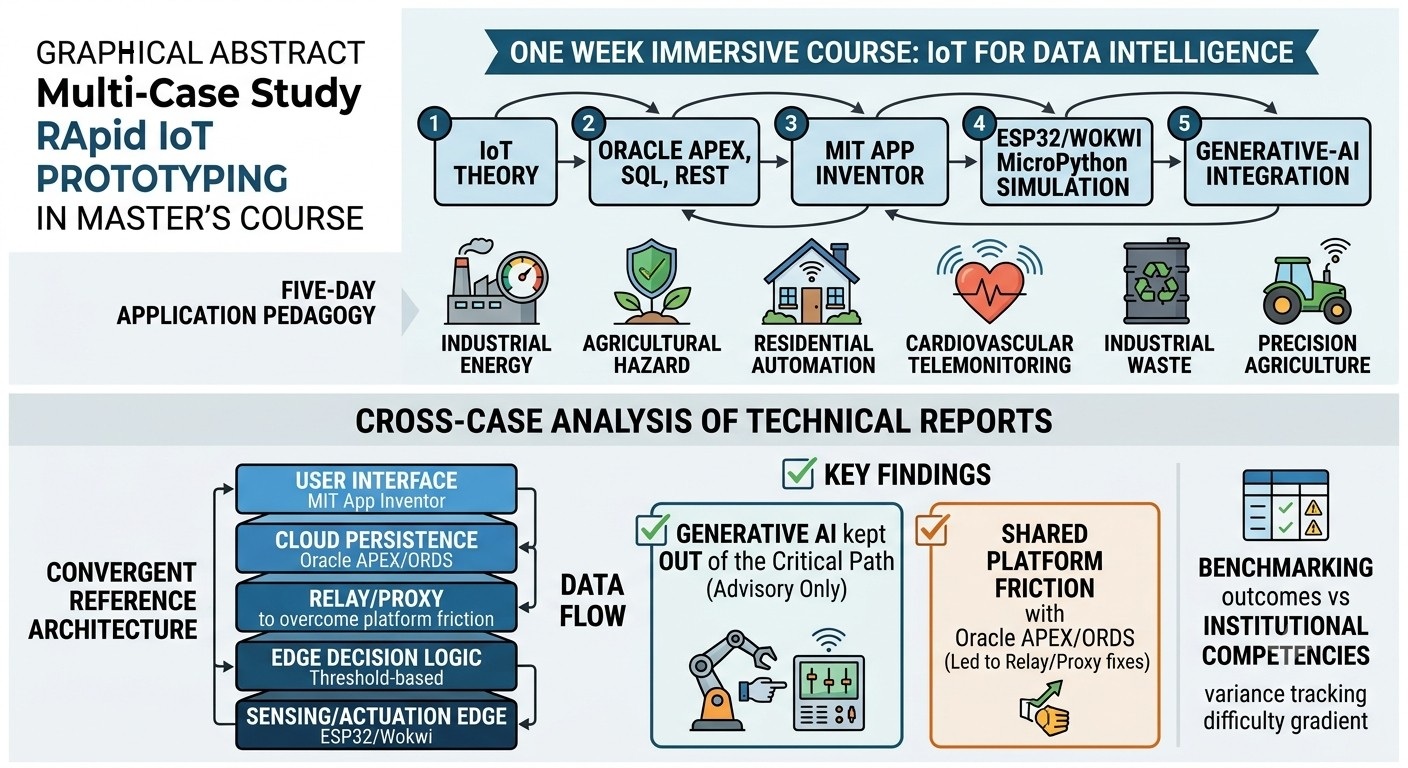
This paper reports a document-based, multiple-case study of six Internet-of-Things (IoT) prototypes designed and simulated during a one-week immersive course, “IoT for Data Intelligence,” delivered in July 2026 within the professional Master in Applied Artificial Intelligence (Maestría en Inteligencia Artificial Aplicada, MNA) at Tecnológico de Monterrey. Six teams followed the same five-day toolchain IoT theory; Oracle Application Express (APEX), SQL, and REST service design; MIT App Inventor; ESP32/Wokwi simulation; and generative-AI integration and produced Wokwi-simulated prototypes spanning industrial energy monitoring, agricultural hazard response, residential automation, cardiovascular telemonitoring, industrial waste reduction, and precision agriculture. A fixed coding framework was applied across architecture, AI-integration pattern, platform-level failure modes, security debt, and Sustainable Development Goal alignment, distinguishing findings that the course structure itself prescribes from findings the teams introduced independently. The six cases converged on a shared five-layer architecture and, in a pattern only partly prescribed by the course, on keeping generative AI in an advisory or fail-safe-wrapped role. Deposited results were also compared, for illustrative purposes only, against the course’s internal competency rubric. An observed proposal from a Pontifical Catholic University of Chile’s collaboration is discussed as an informal reference point rather than as evidence for generalization. This paper discusses the implications and limits of this small, single-institution, single-cohort, simulation-only case set.
Keywords:
internet of things education
; rapid prototyping
; ESP32
; oracle APEX
; MIT app inventor
; multiple-case study
; generative AI in IoT
; engineering education
; competency-based education
; low-cost sensing
Copyright: This open access article is published under a Creative Commons CC BY 4.0 license, which permit the free download, distribution, and reuse, provided that the author and preprint are cited in any reuse.