

Submitted:
22 September 2026
Posted:
23 September 2026
You are already at the latest version
Abstract
MIsCORE–RIUD Paper I established recurrent event-native merger-local morphology as an auditable observational object without assigning a unique physical origin. Paper II asks whether those local objects connect into ordered multiscale paths and whether the frozen higher-order object remains supported after projection into unsubtracted H1/L1 strain without reopening discovery freedom. A corrected 25-event atlas first showed that path construction was not automatic: 16/25 events contained at least one path, 9/25 contained no path, and 14/25 were multi-pattern. The canonical lock then fixed 13 events, 172 nodes, 26 H1/L1 raw-strain files, a merger-relative center window of −0.12 to +0.03 s, and the complete 10–60 ms width family, with no post-outcome event replacement, threshold retuning, or BEST_WIDTH selection. The frozen residual-derived coordinates were projected directly into 4-s, 4096-Hz H1/L1 strain in the locked 40–400 Hz band, with no raw-strain path reselection. The primary equal-weight statistic was 1.171221; 0/100,000 empirical-null draws reached the observation, giving p(+1)=9.9999×10⁻⁶, equivalent to approximately 4.265σ on a one-sided Gaussian tail only as a descriptive calibration of this finite empirical null. Every leave-one-event-out omission remained supported (maximum p=5.99994×10⁻⁵; ≈3.85σ one-sided), and support persisted without the 60-Hz notch and under a locked-coordinate ablation. A separate prelocked 62,400-job nuisance program constrained four coherent or independent artifact families while retaining weaker H1-only and L1-only transient alternatives. A selector-aware phase layer reran the exact selector on 2,600 real off-source controls; the observed equal-event real component was 0.3671572579932161, and 0/100,000 conditional phase-randomization draws exceeded it (p(+1)=9.9999×10⁻⁶; ≈4.265σ one-sided descriptive equivalent). The boundary remains explicit: population/map-level detector-resolved support is present, whereas the stricter eventwise coherence criterion yields zero FDR05 survivors and a separate 16-event physical-attribution audit yields zero global FDR05 survivors in both direct and visibility-controlled families. Paper II therefore establishes a connected multiscale observational path with fixed-coordinate raw-strain support and separate conditional phase directionality, while unique physical origin and exhaustive detector-artifact closure remain unresolved.
Keywords:
gravitational waves
; binary black hole mergers
; gravitational-wave residuals
; post-model data
; undiscovered layer
; connected multiscale paths
; time-frequency analysis
; raw strain
; H1/L1
; fixed projection
; empirical null
; leave-one-event-out
; nuisance calibration
; complex phase
; detector coherence
; reproducibility
1. Introduction
Paper I [22] closed a lower-order question: recurrent merger-local post-model morphology can be defined, audited, and carried across a population without first assigning a unique physical cause. Paper II begins exactly at that boundary. It does not reopen the Paper-I discovery problem; it asks whether the already-defined local objects remain isolated or connect into a higher-order structure.
A localized object is still point-like. It has a time, frequency, temporal support scale, detector relation, and versioned observational provenance, but recurrence alone does not show whether neighboring local objects belong to the same evolving structure. If the feature changes scale while it evolves, exact equality of the lower-order cell can fragment one higher-order object into several detections that are locally different but topologically connected.
Paper II therefore asks two serial, non-equivalent questions. First: do the frozen local structures form ordered connected multiscale paths across time, frequency, and temporal scale? Second: once that path is frozen, does the same path population receive support in H1/L1 raw strain without a second discovery search? The first question constructs the higher-order object; the second tests whether that object survives a change of representation.
This shift changes what must remain invariant. Paper I needed exact local coordinates because its scientific question was where recurrent local morphology existed. Paper II instead asks whether those localized objects are connected. Exact width identity is therefore not promoted into a universal invariant: a path may preserve temporal ordering and connectivity while moving through compatible temporal scales.
The second shift concerns validation freedom. During path construction, observed data and matched controls must receive symmetric search freedom. After the path is frozen, however, reopening a free search in raw H1/L1 strain would answer a different question: whether some favorable raw path can be found. Paper II instead closes the coordinates before raw projection so that the raw-strain stage tests survival of the same object. A later dynamics analysis must restore control-native map and path freedom because the scientific object changes again, from path survival to path-generating dynamics.
The Paper-II source archive contains 68 preserved executions. They are not 68 independent hypothesis tests. The archive contains successful results, negative criteria, technical recovery, reruns, hardening, alternative representations, nuisance branches, and computational-reproduction steps. Its role is provenance: to preserve which experiment created, changed, weakened, blocked, or reproduced the path object.
The final claim is intentionally narrower than several intermediate interpretations. The path receives population support under fixed raw-strain projection, survives event-influence and conditioning attacks, and shows a separate phase-directionality result under its own null. At the same time, the strictest eventwise coherence criterion does not pass, simple eventwise source-parameter attribution does not explain the path, and single-detector transient nuisance families remain viable alternatives. Those negative results are part of the endpoint, not exceptions removed from it.
This standalone manuscript is source-audited against the preserved 68-execution Paper-II results ledger and frozen authority-package provenance. Historical cohorts and denominators are kept separate whenever they answer different scientific questions.
1.1. Scientific Handoff: From Local Objects to Connected Paths
Paper II is best read as a sequence of changes in scientific object and evidential constraint.
| Evidential constraint | Change, decisive consequence, and surviving claim |
| Local recurrence does not establish connectivity | Raise the object from node to ordered multiscale path. Exact lower-order cell identity is relaxed where it fragments continuity. Survives: the connected path becomes the target. |
| Path algorithms can manufacture attractive lines | Audit path construction and scorer geometry; make path-search/model-selection freedom explicit and mirror it in controls. Survives: only the more symmetric path construction. |
| Residual-map support may be representation-specific | Freeze the path and project it into raw H1/L1 strain. No second raw free search is allowed. Survives: cross-representation fixed-path support. |
| One event may dominate a population result | Leave one event out at a time. Every omission remains below the frozen threshold. Survives: population support is not single-event driven. |
| Conditioning or one coordinate convention may create the result | Remove the 60-Hz notch and perform a locked-coordinate ablation. Both variants remain supported. |
| A nuisance family may mimic the population | Prelock six nuisance families over 62,400 jobs. Four coherent/independent families fail to reproduce baseline; single-detector transients remain weaker alternatives. |
| Population support does not imply phase directionality | Add a separate selector-aware phase statistic. 0/100,000 conditional phase draws exceed the observed value. Survives: conditional directionality under its own null. |
| “Detector coherence” can mean different tests | Preserve population/map and strict eventwise criteria separately. Population/map support survives; strict eventwise FDR05 survivors = 0. |
| A path may simply encode known source parameters | Run the strict physical-attribution audit. Global FDR05 survivors = 0 in direct and visibility-controlled families. Simple eventwise source-parameter attribution is not established. |
| A frozen path must be reproducible without importing prior outputs | Reacquire and cleanly replay from frozen selector/rule assets. Fixed branch is reproduced without reselection; prior result import is prohibited as input. |
1.2. Relation to Paper I and Established Residual, Unmodeled, and Path/Track Analyses
Paper I [22] asked whether recurrent merger-local post-model morphology could be made into a stable scientific object before physical attribution. Paper II does not redefine that object retroactively. It takes the surviving local object as its lower-order input and asks whether local instances are connected. This distinction separates Paper II from ordinary residual consistency testing and from a second unmodeled search. Standard residual tests ask whether post-model data are compatible with expected noise or whether additional coherent power remains after subtraction [2,3,12]. Flexible unmodeled approaches such as BayesWave reconstruct transient morphology [13]. Population residual approaches such as SCoRe ask whether specified residual quantities show source-dependent organization [14,15,16]. Connected tracks and graph-like time-frequency objects are not, by themselves, new ideas. Seedlessclustering methods search spectrograms for extended gravitational-wave tracks, including applications to compact-binary coalescences [17,18,19]. Wavegraph uses graph-constrained time-frequency clustering inside a model-independent transient-search architecture [20]. More generally, chirplet path pursuit treats connected time-frequency trajectories as detection objects in noisy data [21]. Paper II therefore does not claim invention of path finding, graph clustering, or time-frequency track detection. Its distinction is evidential ordering. The path is built from already-audited post-model local objects, the path detector itself is attacked for morphology-inducing bias, the path-search and model-selection freedom granted to the observed construction is mirrored in matched controls, and only after that object is frozen is it projected at fixed coordinates into raw H1/L1 strain. The raw stage is therefore not another track search.
It is a cross-representation attack on a previously defined object. The paper consequently separates four questions that neighboring methods may combine or answer under different contracts:
- Can the Paper-I local objects be connected under a frozen multiscale rule without forcing a path in every event?
- Can the path construction survive an audit of the scorer and its own search freedom?
- Does the already-defined path receive support in raw strain without coordinate reselection?
- What physical or instrumental mechanism generates the path? Paper II closes the first three within their recorded roles and leaves the fourth open. The contribution is therefore not “a new way to draw lines in a spectrogram.” It is the promotion of a lower-order residual object into a frozen connected object, followed by a validation contract that changes when the representation changes.
1.3. Central Evidential Claim
Paper II contains two serial scientific acts that must not be conflated:
| Act | Object | What establishes it | What does not establish it |
| Construction | Connected multiscale residual-derived path | Frozen node provenance, multiscale connectivity, scorer-bias audit, matched construction freedom, and path-free counterexamples. | The later raw p-value by itself. |
| Projection | Support for that already-defined path in raw H1/L1 strain | Fixed coordinates, no raw reselection, population null, LOEO, conditioning/ablation, nuisance and phase roles. | A second raw-domain path discovery. |
The central claim is therefore not “a line was found with a small p-value.” The evidential object is serial: a connected path is first defined and hardened under a path-construction contract, then the frozen coordinates are challenged in raw strain under a fixed-projection contract. The raw-strain result is meaningful because coordinate freedom has been closed before the representation change.
For readers accustomed to Gaussian-tail language, the finite-null probabilities can be translated descriptively: p=9.9999×10⁻⁶ corresponds to approximately 4.265σ one-sided, and the worst leave-one-event-out p=5.99994×10⁻⁵ corresponds to approximately 3.85σ one-sided. These conversions do not create a new test, do not imply a Gaussian null, and are not used as universal discovery labels; the empirical p-values and their finite-null resolution remain primary.
This distinction also provides the bridge to the rest of the paper: Section 2 and Section 3 define the higher-order path and close its search freedom; Section 4, Section 5, Section 6 and Section 7 test survival, influence, nuisance alternatives, and conditional phase directionality; Section 8, Section 9 and Section 10 preserve negative boundaries and reproducibility; Section 11, Section 12, Section 13 and Section 14 state the method, interpretation, limitations, and endpoint.
2. From Local Nodes to Connected Multiscale Paths
Paper II first raises the observational object from a local node to an ordered multiscale path. This section defines that promotion before any raw-strain validation is considered.
2.1. Why Exact Point Identity Could Not Remain Universal
Paper I localizes morphology in time, frequency, temporal width, detector lag, and detector relation. Those coordinates are necessary when the object is a local node. They are not automatically the correct invariants when the object becomes a path. Suppose two adjacent local structures occupy nearby time-frequency coordinates but have different widths. If exact width equality is required, they become separate objects even when their ordering and continuity suggest one evolving structure. A lower-order detector can therefore over-segment a higher-order object. Paper II treats this as a representation problem rather than a license to erase provenance. The original node remains frozen. Its lower-order coordinates are not rewritten. What changes is the higher-order equivalence rule: compatible changes in scale may be connected when the path criterion is satisfied. The canonical multiscale width family spans: 10, 20, 30, 40, 50, 60 ms. The scientific principle is: Lower-order precision can become higher-order nuisance. This does not mean that precision is undesirable. It means that a coordinate useful for identifying one object may become an unnecessary identity constraint when the next object is a relation among those objects.
2.2. Path Object
For event e, let a frozen local node be represented schematically as:
where t is local time, f is frequency, w is temporal width or scale, ell is detector lag, m is the detector-relation label, s is the version-specific local score, and q is the provenance object.
x(e,j) = [t(e,j), f(e,j), w(e,j), ell(e,j), m(e,j), s(e,j), q(e,j)]
A path is not defined by equality of all coordinates across nodes. It is an ordered higher-order object:
P(e) = [x(e,1), x(e,2), ..., x(e,n_e)]
Its admissibility is determined by the frozen Paper-II connectivity contract:
- Candidate nodes retain their original lower-order provenance rather than being rewritten after connection.
- Nodes are ordered in merger-local time.
- Neighboring nodes satisfy the frozen edge-continuity rule in time, frequency, and scale.
- Temporal support may move within the locked 10/20/30/40/50/60 ms width family.
- Weak intermediate nodes may carry topological information when they satisfy connectivity rather than being discarded solely by a point-only strength threshold.
- Exact lower-order width or frequency-cell identity is not promoted into a universal path invariant.
- Observed path-search and model-selection freedom is reproduced in the matched construction null.
- Detector, lag, score, source file, and version provenance remain attached to constituent nodes and the path.
The exact numerical edge thresholds and implementation-specific branch logic remain authority-bound to the frozen rule files and reproducibility package. The manuscript states the scientific contract without replacing the executable implementation with an invented cosmetic equation.
Paper II relaxes identity, not provenance. A node discovered at one width does not become a different historical node after connection; the higher-order path simply stops requiring every lower-order coordinate to remain invariant while scale changes.
2.3. Path-Construction Bias Became a Scientific Target
An attractive path can be manufactured by the path detector itself. Earlier scorer forms exposed precisely this risk: directional or rising rewards, jump restrictions, saturation behavior, detector dominance, or single-width dominance could favor visually persuasive line-like structures even when the underlying data did not justify them. Those earlier forms were therefore not treated as final evidence. The Paper II lineage audits the path-construction machinery itself, removes or neutralizes morphology-inducing preferences that were not required by the scientific question, and requires the matched null to repeat the same path-search and model selection freedom used on the observed data.
The governing rule is: A path cannot be validated by allowing the observed data to optimize connectivity while forcing controls to evaluate only the observed path. This makes scorer design part of the falsification program rather than a hidden preprocessing choice. The final fixed raw-strain projection occurs only after the higher-order path object has survived this construction stage and has been frozen. Discovery freedom belongs upstream; projection is downstream.
2.4. Corrected 25-Event Atlas: Path Existence Was Not Guaranteed by Construction
Before the final 13-event population was frozen, the path representation was exercised in a corrected fixed 25-event candidate atlas. That stage is useful because it provides a direct answer to a basic construction objection: does the path algorithm simply produce a path whenever it is given an event? It did not. The corrected atlas recorded:
- fixed candidate events: 25;
- events with one or more paths: 16;
- events with zero path: 9;
- multi-pattern events: 14. The scientific verdict for that stage was
FIXED25_FULL_CANDIDATE_PATTERN_ATLAS_CORRECTED_COMPLETE. The existence of nine zero-path events is important. A connectivity algorithm that mechanically turns every candidate into a path would make downstream population support difficult to interpret. The atlas instead shows a mixture of path-bearing and path-free outcomes under the same higher-order construction framework. The multi-pattern count is equally important. Fourteen of the 25 candidates admitted more than one pattern representation. Paper II therefore did not begin from the assumption that one rigid universal sequence already existed. The later family-dependence audit formalized this multiplicity more directly. This atlas is a development-stage object, not the canonical raw-projection denominator. It is retained here because it explains why the eventual 13-event path population is a selected frozen observational object rather than an inevitable output of the path code.
2.5. Canonical Lock: Window, Width Family, and Outcome Independence
The canonical 13-event stage was explicitly design-locked as a fixed internal validation using a merger-relative center window of -0.12 s <= t_center <= +0.03 s. The design lock bound the analysis to the exact frozen path rule inherited from the earlier engine and recorded outcome_driven_change = false. The accompanying rule lock states:
- LOCK_ROLE = FROZEN_BEFORE_PATH_OUTCOME_REPLAY;
- PATH_OUTCOME_USED_TO_SELECT_PANEL = false;
- EVENT_REPLACEMENT_AFTER_OUTCOME = false;
- THRESHOLD_RETUNING_AFTER_OUTCOME = false. This matters because a path population can be made artificially clean if events are replaced after outcomes are known or if the connectivity threshold is retuned until the desired population survives. Those freedoms were explicitly excluded at the canonical lock. The width policy was also frozen before outcome interpretation. All six widths, 10, 20, 30, 40, 50, 60 ms, were retained for path composition and leave-one-width-out diagnostics. The source lock explicitly records no BEST_WIDTH verdict. The multiscale representation was therefore not reduced after the fact to whichever width happened to produce the strongest final statistic. A technically incomplete 14-event long-window acquisition branch illustrates the same no-replacement policy from another angle. One event failed acquisition after repeated H1 fetch timeouts. That stage was recorded as SCIENTIFIC_VERDICT = NOT_TESTED and TECHNICAL_VERDICT = LOCKED_LONG_WINDOW_ACQUISITION_INCOMPLETE, with the next action RETRY_FAILED_EVENTS_NO_REPLACEMENT. The failure was not converted into a scientific null and the event was not silently replaced by an easier case.
2.6. Frozen Path Population
The canonical Paper-II population contains:
- 13 events;
- 172 locked nodes;
- 26 H1/L1 raw-strain files. These denominators define the primary fixed-path population role.
The 13 events are not interpreted as a random sample from all binary-black-hole mergers, and the 172 nodes are not treated as independent astrophysical detections. They are a frozen connected-path population carried forward from the path-construction lineage.
| Event | Locked path nodes | Paper-II role |
| GW150914_095045 | 7 | canonical frozen path population |
| GW200129_065458 | 14 | canonical frozen path population |
| GW200224_222234 | 11 | canonical frozen path population |
| GW230824_033047 | 16 | canonical frozen path population |
| GW230831_015414 | 16 | canonical frozen path population |
| GW230904_051013 | 16 | canonical frozen path population |
| GW231206_233901 | 16 | canonical frozen path population |
| GW231221_135041 | 6 | canonical frozen path population |
| GW240629_145256 | 16 | canonical frozen path population |
| GW240919_061559 | 10 | canonical frozen path population |
| GW240920_124024 | 12 | canonical frozen path population |
| GW241006_015333 | 16 | canonical frozen path population |
| GW241231_054133 | 16 | canonical frozen path population |
The path-provenance package preserves event identity, residual family, node count, time range, frequency range, width range, lag mode, source path, and SHA-256 provenance for each frozen path. The standalone manuscript uses those records as the authority for path membership rather than reconstructing membership from later outcome tables.
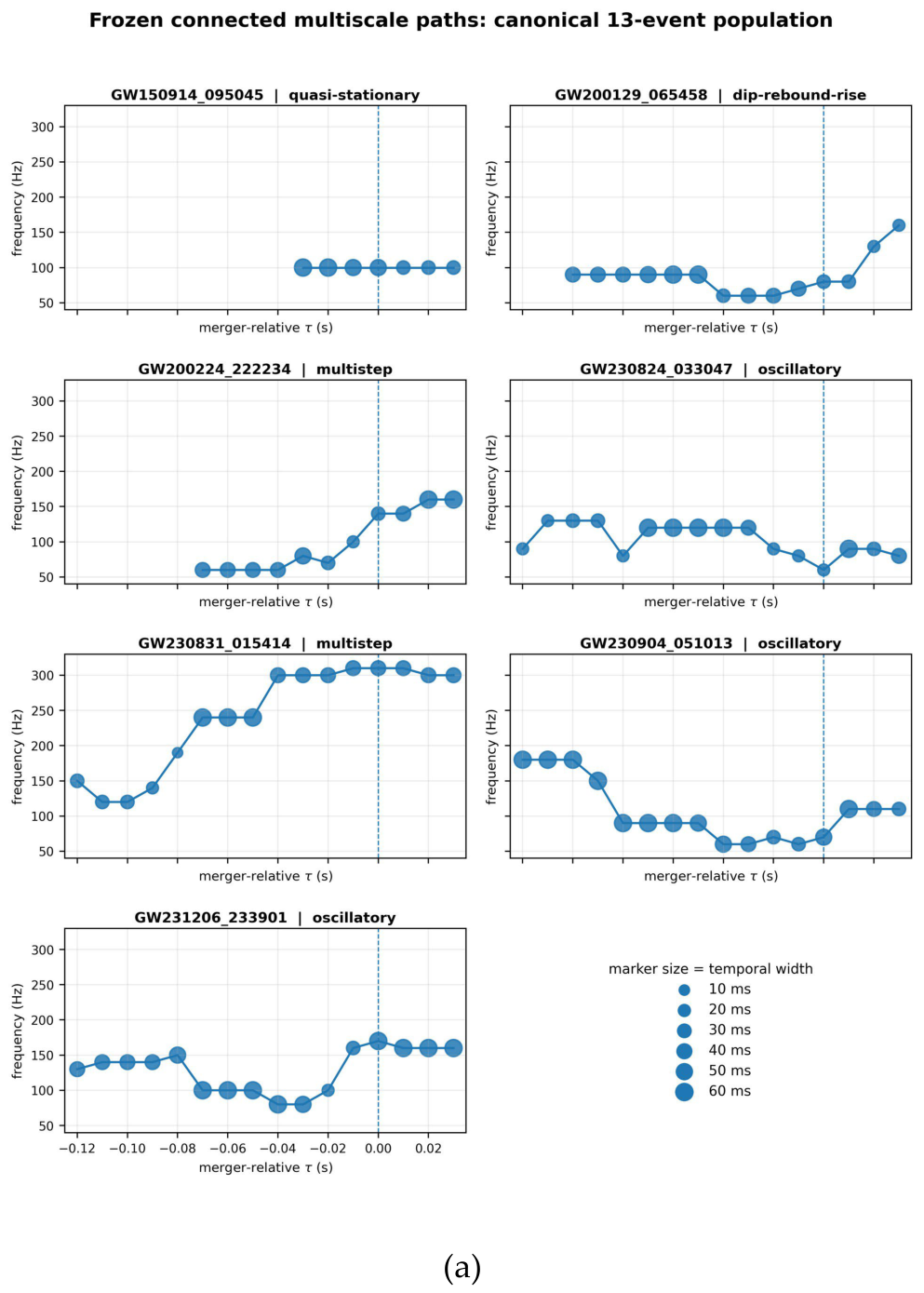
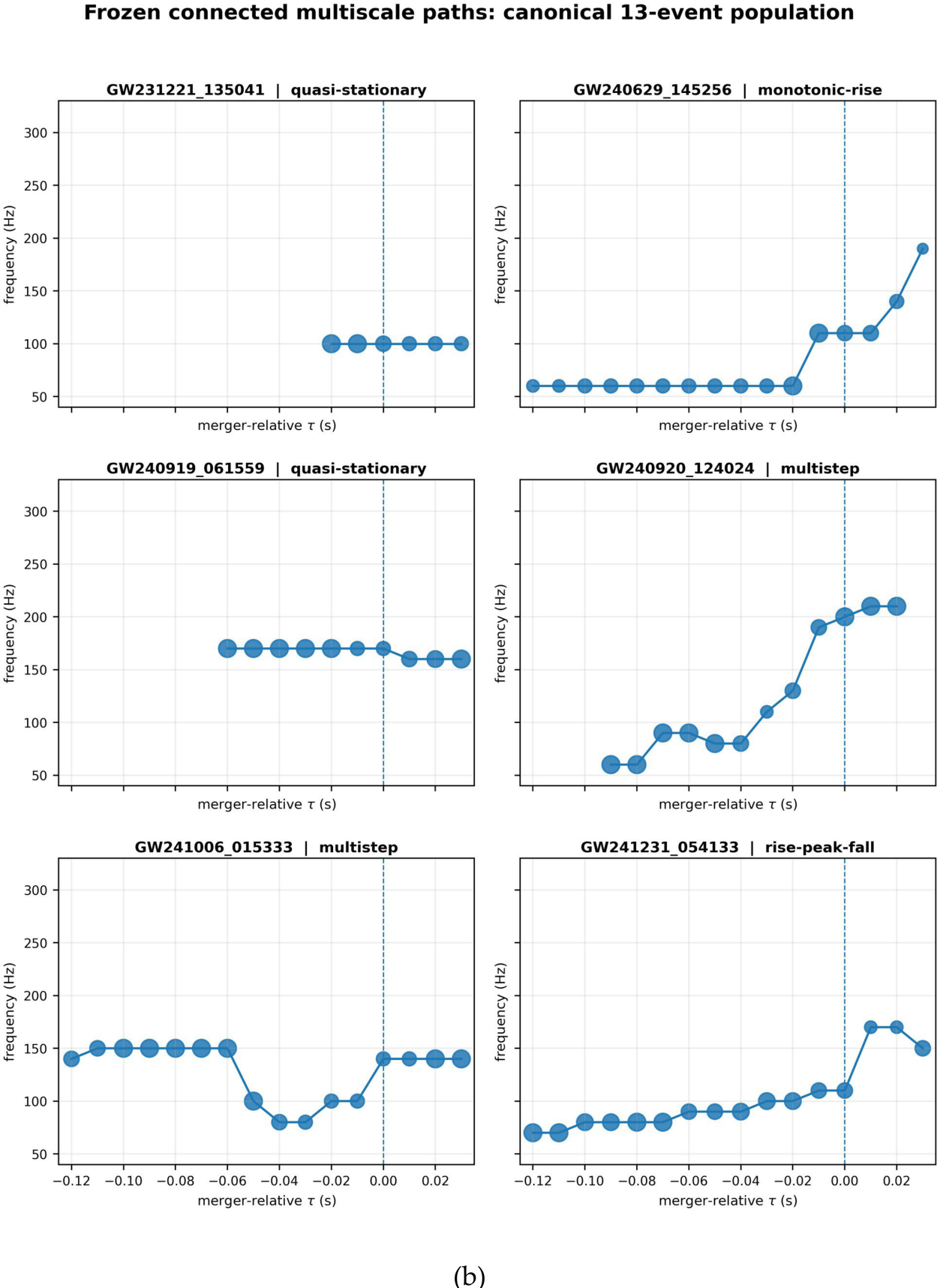
Figure 1.
A. Frozen connected multiscale paths for the first seven canonical events. Each line connects successive nodes from the archived per-event observed_path_nodes.csv asset in frozen path order; marker size encodes temporal width. No interpolation, smoothing, or synthetic trajectory construction is used. B. Frozen connected multiscale paths for the remaining six canonical events. Axes and marker encoding match Figure 1A. Together, Figure 1A–1B display all 13 canonical paths and all 172 frozen nodes used by the Paper-II path population.
Figure 1.
A. Frozen connected multiscale paths for the first seven canonical events. Each line connects successive nodes from the archived per-event observed_path_nodes.csv asset in frozen path order; marker size encodes temporal width. No interpolation, smoothing, or synthetic trajectory construction is used. B. Frozen connected multiscale paths for the remaining six canonical events. Axes and marker encoding match Figure 1A. Together, Figure 1A–1B display all 13 canonical paths and all 172 frozen nodes used by the Paper-II path population.
2.7. Canonical Population Versus Archaeology Cohorts
Paper-II archaeology also contains wider 16-event roles. Those roles must not be collapsed into the 13-event primary population. In particular, the family-dependence/effective-multiplicity audit spans 16 events and reports 55 event-family tests, 55 exact unique top paths, Jaccard80 near-duplicate structure in four events, and median effective family count 2.951545. A separate strict physical-attribution role also spans 16 events. These wider roles answer different questions: how many path-family alternatives were effectively present, and whether simple eventwise source parameters explain path features. They do not alter the canonical raw-projection denominator of 13 events / 172 nodes / 26 detector files. This denominator separation is retained throughout the paper.
3. Why Raw Strain Is Not Searched Again
With the path now frozen, the analysis changes role from construction to representation testing. The raw-strain stage therefore inherits coordinates rather than reopening them.
3.1. The Fixed-Projection Question
After the residual-derived path has been frozen, raw strain is not a new discovery field in Paper II. The question is not: Can a strong path be found somewhere in raw H1/L1 data?
The question is: Does the already-defined path receive support at its frozen coordinates in raw H1/L1 data? These questions require different freedom. A free raw search could choose new times, frequencies, widths, detector relations, or path geometry after seeing the raw data. A positive result would then mix the original residual discovery with a second raw-domain discovery and would be difficult to interpret as support for the same object. Paper II therefore uses fixed projection.
Statistical form of the distinction. Let θ̂ₑ denote the residual-derived path coordinates frozen before raw evaluation. Paper II tests T_raw(Dₑ; θ̂ₑ), not max_θ T_raw(Dₑ; θ). The maximized quantity would be a new raw-domain search and would require a new search-aware null with the same optimization freedom. Holding θ̂ₑ fixed therefore does not make the validation easier by fiat; it makes the hypothesis narrower and prevents raw data from choosing a second favorable coordinate system after the residual path is known.
3.2. Fixed Coordinates, Frozen Roles
Let P_e denote the frozen residual-derived path for event e. Let R_{e,d}(P_e) denote the version-locked raw-strain response evaluated at the path coordinates for detector d. The manuscript does not substitute a simplified analytic kernel for the authoritative executable implementation. The scientific contract is more important than a cosmetic closed form:
- the path coordinates are inherited from the frozen path object;
- raw H1/L1 data are conditioned under the recorded preprocessing contract;
- the raw representation does not select new path coordinates;
- event contributions are aggregated under a prespecified equal-weight population rule;
- controls are generated under the corresponding fixed-projection null;
- invalid or unavailable records remain explicitly invalid or unavailable rather than being converted to zero. For each canonical event, the fixed raw role uses frozen 4-s, 4096-Hz H1 and L1 strain files, giving 26 detector files. The locked evaluation band is 40–400 Hz. The primary preprocessing configuration is WHITEN_BP40_400_NOTCH60 with equal event weighting; prespecified variants include band-passed/no-notch processing, visibility weighting, and a locked-coordinate-drop ablation. Public O4 4096-Hz products are downsampled from 16384 Hz and retain the documented calibration, data-quality, and anti-aliasing limitations of the public release [5,6,7,8,9,10]. No coordinate is moved to improve a raw-strain result. The raw projection authority also records 52/52 event-variant rows completed, corresponding to 13 events across four frozen raw-processing roles, with 400 controls per event/variant used in the event-level support layer and 100,000 valid global null draws for the primary population statistic. These counts belong to different levels of the calculation and are not multiplied into one synthetic sample size. The primary population statistic under this contract is 1.171221.
3.3. Why the Freedom Rule Changes at the Next-Order Question
Paper II asks whether the already-found path survives a new representation, so its coordinates are frozen. A later dynamics question would ask whether the process that generates and organizes paths is recurrent. In that different test, controls would need to construct their own maps, paths, trajectories, and family labels; forcing observed coordinates into controls would merely test coordinate rarity again. The apparent contrast disappears once the scientific object is stated correctly.
4. Canonical Fixed-Path Population Result
The fixed-projection contract now permits a direct population test: the question is whether the frozen path population receives support at the same coordinates in raw H1/L1 strain.
4.1. Primary Equal-Weight Stack
The frozen population statistic is T_obs = 1.171221. The empirical null contains 100,000 valid draws, with k=0 observed-or-more-extreme exceedances. Using the plus-one rule, p(+1)=(k+1)/(N+1)=1/100001=9.9999×10⁻⁶. As a descriptive one-sided Gaussian-tail translation, this is approximately 4.265σ. The empirical probability remains the primary result: the σ value does not imply that the null is Gaussian, does not increase the finite-null resolution, and is not assigned to individual events. This probability belongs to the specific fixed-path population null; it is not a catalog-wide false-alarm probability or a prevalence estimate.
4.2. Event-Level Evidence is Subordinate to the Population Contract
Paper II does not require every event to be individually significant under an eventwise test. The primary object is the population of frozen paths under the prespecified aggregate statistic. This is important because a population object can be supported by a distributed pattern that no single event reproduces at the same strength. Converting the Paper-II claim into “13 individually detected paths” would misstate the statistical role. The relevant influence test is therefore leave-one-event-out rather than a requirement that all 13 eventwise p-values cross one threshold.
Unit-of-inference guard. The equal-weight population statistic is event-weighted. The 172 nodes define the frozen geometry inside the 13 event paths; they are not treated as 172 independent astrophysical trials. This prevents node-rich events from inflating the effective sample size and keeps the primary claim at the population-of-events level.
5. Population Robustness: Leave-One-Event-Out, Conditioning, and Ablation
5.1. Leave-One-Event-Out
Each event is omitted in turn and the frozen population calculation is repeated. Every leave-one-event-out omission remains supported under the frozen threshold. The largest empirical probability is p_LOEO,max = 5.99994×10⁻⁵, corresponding descriptively to approximately 3.846σ on a one-sided Gaussian tail. Thus no single event can be removed and make the population result disappear. This does not imply equal contribution across events; it establishes robustness to single-event omission under the recorded population statistic.
5.2. No-Notch Replay
A replay without the 60-Hz notch gives: p = 9.999×10⁻⁴ (≈3.090σ one-sided, descriptive). The result weakens numerically relative to the canonical fixed-path test but remains supported. The path population therefore does not depend entirely on that specific notch operation. The no-notch replay is a conditioning robustness test. It is not an independent discovery experiment and is not pooled with the primary p-value.
5.3. Locked-Coordinate Ablation
A locked-coordinate ablation gives: p = 1.99998×10⁻⁵ (≈4.107σ one-sided, descriptive). This branch tests sensitivity to the declared coordinate structure without reopening a free raw search. Its purpose is to ask whether the population evidence collapses when a predeclared coordinate component is removed or altered under the frozen ablation design. Again, this is a robustness layer, not a second independent discovery probability.
5.4. What These Variants Jointly Establish
The primary result survives deletion of any single event, a no-notch conditioning variant, and a locked-coordinate ablation. These tests constrain different explanations and remain non-poolable.
5.5. Finite-Null Calibration and why σ is Secondary
The empirical p-values remain the inferential quantities. For readers who use Gaussian-tail language as a familiar scale, this revision reports the one-sided descriptive transform z = Φ⁻¹(1−p). The transform changes neither the empirical null nor its finite resolution. In particular, 0 exceedances in 100,000 draws means p(+1)=1/100001, not p=0 and not infinite σ. The values below are not pooled and do not represent independent discoveries.
| Role | Empirical p(+1) | Descriptive one-sided z | Interpretive role |
| Primary fixed-path population | 9.9999×10⁻⁶ | 4.265σ | Primary fixed-coordinate population null |
| Worst LOEO omission | 5.99994×10⁻⁵ | 3.846σ | Single-event influence robustness |
| No-60-Hz-notch replay | 9.999×10⁻⁴ | 3.090σ | Conditioning robustness |
| Locked-coordinate ablation | 1.99998×10⁻⁵ | 4.107σ | Coordinate-ablation robustness |
6. Prelocked Nuisance Calibration
Population support alone does not identify cause. The next layer therefore asks which predeclared nuisance families can reproduce the same fixed-path response without changing the path.
6.1. Why Nuisance Testing Must Be Prelocked
A path statistic that separates real data from a generic null can still be reproduced by specific artifact families. Paper II therefore includes an explicit nuisance-calibration program rather than treating a small empirical p-value as causal identification. The nuisance program was prelocked at 62,400 jobs. The baseline nuisance-comparison population statistic was: T_nuisance,baseline = 4.468201, with empirical p = 9.9999×10⁻⁶. The prelocked nuisance families were:
- common-mode linear chirp;
- common-mode same phase;
- common-mode opposite phase;
- independent detector ringing;
- H1-only transient;
- L1-only transient. The design used prelocked amplitude levels rather than selecting a favorable artifact strength after observing the result.
6.2. Calibration Accounting and Parity Closure
The final nuisance/population rerun was not a single opaque batch. The authority record resolves the 62,400 scorer jobs into a reproducibility accounting layer:
- passing shards: 104;
- basis-amplitude cells: 24;
- locked leave-one-event-out calibration rows: 312;
- in-memory scorer jobs passed: 62,400;
- map-summary parity passes: 62,400;
- exact-adapter parity passes: 62,400;
- failed jobs: 0;
- imported prior-pass jobs from the superseded B13B result layer: 0. The purpose of reporting these counts is not to inflate the statistical denominator. They are execution-integrity counts. The empirical population probability remains defined by its own null contract. The 62,400-job accounting instead shows that the nuisance/calibration layer was rerun under a single frozen scor-ing contract without silently importing completed positive outcomes as if they were newly executed jobs. The later evidence-freeze stage records FULL62400_SCORER_AND_POPULATION_PASS = true and freezes the raw and calibration panels together. The source package contains separate tables for the 24cell calibration panel, 312-row LOEO calibration panel, 13-event integrated evidence panel, nuisancefamily summary, raw global variants, raw global LOEO, raw-input manifest, and residual-path provenance.
6.3. Nuisance Outcomes
The tested common-mode linear chirp, same-phase common mode, opposite-phase common mode, and independent detector-ringing families did not reproduce the baseline population behavior. The H1-only and L1-only transient families remained significant under the scorer but were weaker than the baseline across the prelocked amplitude levels. The correct interpretation is therefore not “detector artifacts have been excluded.” The correct interpretation is that several predeclared coherent and independent nuisance families fail to reproduce the baseline path population, while weaker single-detector transient families remain surviving alternatives. This boundary matters. A nuisance program is valuable only if it is permitted to leave nuisance explanations alive.
| Nuisance family | Frozen Paper-II outcome | Claim consequence | ||
| Common-mode linear chirp | baseline not reproduced | constrained within tested amplitudes | ||
| Common-mode same phase | baseline not reproduced | constrained within tested amplitudes | ||
| Common-mode opposite phase | baseline not reproduced | constrained within tested amplitudes | ||
| Independent detector ringing | baseline not reproduced | constrained within tested amplitudes | ||
| H1-only transient | weaker surviving alternative | remains scientifically live | ||
| L1-only transient | weaker surviving alternative | remains scientifically live | ||
6.4. No Omnibus Artifact p-Value
The nuisance families test different mechanisms and amplitude structures. Paper II does not combine them into one synthetic “all systematics excluded” number. The nuisance result constrains a specified artifact space and records what survives within it.
7. Selector-Aware Conditional Complex Phase
The nuisance analysis constrains several amplitude/morphology alternatives but does not answer whether the selected path also carries directional complex-phase structure. That question is tested separately under its own selector-aware null.
7.1. A separate Scientific Question
The fixed-path population result asks whether the frozen path receives support in raw strain. It does not establish whether cross-event phase information has directional organization. Paper II therefore adds a separate selector-aware complex-phase statistic under a different null. The observed equal-event values are:
- zero-direction real component = 0.3671572579932161;
- imaginary component = 0.020037823041199183;
- resultant length = 0.3677036394289937;
- mean phase = 0.0545214997095115 rad.
The direct frozen-real-data stage also retained two diagnostics rather than reporting only the primary equal-event number. A pooled-node complex average had real component 0.319976381974908, imaginary component -0.01116049149998053, and resultant length 0.320170956821935. A mode-flip diagnostic produced real component -0.3199763819749081, imaginary component 0.011160491499980635, and the same resultant length 0.3201709568219351. The preserved transformation reverses the complex direction while retaining the magnitude, providing an implementation-level directional diagnostic rather than an additional independent discovery statistic. The direct on-source phase stage used all 172 locked nodes. Event-level node counts were 7, 14, 11, 16, 16, 16, 16, 6, 16, 10, 12, 16, and 16 in the canonical event order listed above. No path coordinates were reselected for this calculation.
7.2. Selector Rerun on Real Off-Source Controls
Real H1/L1 off-source controls were rerun through the exact selector at 200 controls per event. For 13 events, this produced 2,600 selector executions. The frozen observed path is reproduced for all 13 events under the selector-aware equivalence contract: 8 events by exact coordinate match and 5 by eventwise constant-tau-frame equivalence. Across the equivalence cases, the recorded maximum absolute shift is 0.032 s, and the maximum residual numerical mismatch is 1.2143 x 10^-17 s. This step matters because the phase statistic is evaluated only after the selector has defined the relevant path-level material. The off-source controls therefore pass through the same selector machinery rather than receiving a simplified downstream treatment.
7.3. Observed Phase Geometry and Conditional Randomization
The direct equal-event complex statistic is C_eq = 0.3671572579932161 + 0.020037823041199183 i, with resultant length 0.3677036394289937 and mean phase 0.0545214997095115 rad. A separate pooled-node diagnostic gives Re = 0.319976381974908, Im = -0.01116049149998053, and resultant length = 0.320170956821935. A mode-flip diagnostic reverses the complex direction while preserving the resultant length, as expected for that transformation. These are diagnostics of the frozen phase construction; they are not additional independent detection probabilities.
The primary conditional phase-randomization null contains 100,000 draws. Exceedances are 0/100,000, giving p(+1)=9.9999×10⁻⁶ and a descriptive one-sided Gaussian-tail equivalent of approximately 4.265σ. The observed statistic also exceeded the largest primary-null realization, 0.34150643201659386; the primary-null 99th percentile was 0.16333814077083206. These values describe the frozen null distribution and are not additional p-values. A separate joint path-existence randomization also gives 0/100,000 with the same plus-one empirical value. The phase result remains conditional on the selector-aware contract and must not be relabeled as an empirical off-source detector-phase false-alarm probability.
7.4. Explicit Missing Layer
Paper II does not contain a complete empirical off-source detector-phase null in the sense of reconstructing the entire complex-phase statistic directly from an empirical off-source phase distribution. The real off-source data rerun the selector. The final conditional phase statistic is evaluated by its own randomization contract. The supported statement is therefore: Selector-aware conditional phase directionality is supported under the specified randomization null. The prohibited statement is that an empirical off-source detector-phase distribution has been completely rejected.
8. Detector Coherence Has Two Non-Equivalent Answers
8.1. Population/Map-Level Coherence
At the population and map level, detector-resolved regeneration supported coherence across the frozen path population. This evidence contributes to the interpretation that the path is not merely a collection of unrelated single-detector local maxima.
8.2. Stricter Eventwise Locked-Survivor Criterion
A stricter preregistered eventwise coherence gate asked a different question. All 13/13 events were technically evaluated. The result was FDR05 survivors = 0. That criterion is negative. Paper II therefore preserves both statements: population/map-level detector-coherence evidence is present, and the stricter locked-survivor eventwise preregistered coherence criterion is not supported. The later population evidence does not repair or overwrite the failed eventwise criterion.
8.3. Technical Repair Did Not Convert a Failed Criterion Into a PASS
The strict eventwise coherence branch is especially useful for distinguishing technical recovery from scientific outcome. An intermediate run ended with five technical failures and the verdict SURVIVOR_PATH_DETECTOR_COHERENCE_PARTIAL_TECHNICAL_FAILURE. The recorded next action was to resolve only the failed events. After the technical failures were repaired, the same locked criterion completed on all 13/13 events with 0 technical failures. The resulting scientific answer was still negative: 0 FDR05 survivors against the preregistered requirement. Thus the chronology is: technical incompleteness -> outcome-blind repair of failed cases -> complete execution -> scientific null. That sequence is preserved because it demonstrates why TECHNICAL and SCIENTIFIC_NULL cannot be merged into one status. Repairing the computation did not repair the hypothesis.
8.4. Why the Distinction Matters
If these two levels were collapsed, Paper II could be made to look artificially cleaner than the source record. The correct interpretation is more informative. The path receives population-level cross-detector support, but the evidence is not strong enough to declare eventwise coherence under the strictest preserved criterion. That is a scientific boundary, not a technical defect.
9. Family Multiplicity and Physical-Attribution Boundary
9.1. Path Multiplicity
The family-dependence/effective-multiplicity audit is a separate 16-event archaeology role, not the 13-event canonical raw-projection denominator. It contains 55 event-family tests and 55 exact unique top paths. No event has an exact duplicate top-family path across the tested family set; near-duplicate Jaccard80 structure appears in four events. The median effective family count is 2.9515451975560807. The same audit records 41 event-family FDR05 survivors and 13 event-level max-T FDR05 survivors within its own declared role. Those counts are not imported into the primary fixed-path p-value and do not create a second 16-event Paper-II population claim. Their purpose here is structural: the path search contains genuine family multiplicity rather than one rigid exact sequence copied across events. The common Paper-II object is therefore higher-order connectivity under the frozen path rule, while exact family identity remains heterogeneous.
9.2. Strict Physical-Attribution Audit
A separate strict physical-attribution role spans 16 events. The audit contains:
- 192 physical source tables;
- 65 recovered variables;
- 58 strict testable features;
- 580 direct tests;
- 560 visibility-controlled tests. The direct global FDR05 survivor count is 0. The visibility-controlled global FDR05 survivor count is also 0. Simple eventwise source-parameter attribution therefore does not close the path explanation. This is not evidence that source physics is irrelevant. It means that the tested direct low-order mappings from available source parameters to path features do not survive the stated multiplicity-controlled audit.
9.3. Why Physical Failure Does Not Erase the Path
Paper II separates the observational object from its cause.
A frozen path can receive strong cross-representation support while a simple source-parameter explanation fails. The physical-attribution null therefore reduces interpretation, not the existence of the already-supported observational path. This follows the same logic used in Paper I: a failed interpretation is removed at the interpretation layer unless the observational object itself fails under the corresponding test.
10. Uniform Reacquisition and Clean Computational Reproduction
10.1. Uniform GWOSC Reacquisition
A separate uniform GWOSC reacquisition reobtained the fixed 13-event / 172-node branch without reselection and reproduced the strong waveform-robustness result. The historical data path had been assembled through five acquisition branches; the reacquisition reduced this to one uniform GWOSC acquisition branch. Under the frozen path object, the recorded comparison gave:
- maximum absolute event-mean log-ratio change = 0.0;
- median absolute node log-ratio change = 0.0;
- maximum absolute node log-ratio change = 0.0. This exact numerical parity under a uniform reacquisition is stronger than merely stating that the qualitative conclusion looked similar. It shows that the fixed result was not numerically dependent on the historical mixture of five acquisition branches. This stage strengthens provenance. It does not create a new blind discovery because the target branch and its role were already known. The proper term is reacquisition or frozen replay.
10.2. Clean End-to-End Reproduction
The Paper-II clean-reproduction lineage restored the frozen selector source and frozen rule source, rebuilt the required assets, and executed a fresh end-to-end path from the frozen selection machinery to fresh outputs. The clean DAG explicitly separated source assets from prior frozen result tables. Prior PASS/final-statistic CSVs were not allowed to function as hidden numerical inputs to the reproduction. This matters because a nominal “reproduction” can accidentally become a filecopy operation if historical outputs are imported upstream. The clean replay therefore tests computational reconstruction under the frozen contract rather than mere agreement with a stored number.
10.3. Reproducibility Levels
Paper II distinguishes:
- static verification: source tables, roles, denominators, and locked outputs agree;
- local executable replay: a clean computational path reconstructs the frozen calculation using restored source/rule assets;
- external independent scientific reproduction: a separate person or group independently reconstructs the scientific result. Paper II strengthens the first two. The third remains outside the internal evidence record.
10.4. Later Canonical-XP Parity Recovery: A Stopped Reproducibility Branch
A later recovery experiment attempted a stricter canonical-XP parity reconstruction. Its outcome is deliberately kept separate from the successful uniform reacquisition and clean Paper-II replay. The six reconstructed XP cases all passed the declared numerical-tolerance check, but none achieved byte equality:
- numerical-tolerance pass: 6/6;
- byte-equality pass: 0/6;
- canonical-XP parity pass: 0/6. The stage therefore recorded SCIENTIFIC_CANONICAL_XP_PARITY_FAIL, set SCIENTIFIC_VERDICT = NOT_RUN, and stopped before a new scientific test. It did not invalidate the previously frozen Paper-II evidence because it asked a later, stricter provenance/parity question with its own gate. It also did not contribute any new positive scientific result. This branch is retained because reproducibility evidence should be allowed to fail at the layer at which it was tested. A numerical-tolerance match is not silently relabeled as byte-identical provenance.
11. Methods Architecture
11.1. Frozen Scientific Objects
Paper II uses three related but non-interchangeable scientific objects:
- local frozen nodes inherited from the lower-order morphology stage;
- the connected multiscale residual-derived path;
- the fixed raw-strain projection of that already-defined path.
11.2. Search Freedom by Stage
| Stage | Question | Freedom |
| Local object discovery | Where is the morphology? | Open relevant axes; controls receive matched freedom. |
| Path construction | Are nodes connected? | Relax exact cell identity; path/model selection is mirrored in controls. |
| Paper-II raw projection | Does the frozen path survive a raw representation? | No second raw free search. |
| Next-order dynamics analysis | Is the path-generating process recurrent? | Controls must build their own maps, paths, trajectories, and families. |
11.3. Multiscale Continuity
The canonical path representation allows the temporal-support scale to move through the width family W = {10, 20, 30, 40, 50, 60} ms. A valid path must satisfy the frozen ordering/connectivity rules. Exact equality of all lower-order node coordinates is not required.
11.4. Fixed Raw Projection
Once P_e is frozen, raw strain receives only the fixed coordinates associated with P_e. No event can move its path to a more favorable raw coordinate after inspection. For the canonical role, each event contributes frozen 4-s, 4096-Hz H1 and L1 strain, evaluated in the locked 40–400 Hz band. The primary conditioning is WHITEN_BP40_400_NOTCH60, and the population uses equal event weights. Variants are predeclared robustness roles, not coordinate-discovery opportunities. The raw response is aggregated under the frozen equal-weight population contract. The primary empirical tail uses the plus-one rule: p(+1) = (k + 1)/(N + 1). For k=0 and N=100000, p(+1) = 9.9999 x 10^-6.
11.5. Influence Audit
The population statistic is recomputed after omitting each event once. A population claim is weakened if a single event controls the result. All Paper-II LOEO omissions remain supported under the frozen threshold.
11.6. Conditioning and Ablation
Conditioning variants and coordinate ablations are fixed-role robustness tests. They are not treated as new discoveries and their probabilities are not combined with the primary population probability.
11.7. Nuisance Calibration
Nuisance families are specified before evaluating the final comparison. The nuisance program records both failures to reproduce the baseline and nuisance families that remain viable. A surviving nuisance alternative remains surviving.
11.8. Phase Layer
The selector-aware phase statistic has a separate denominator and null. The phase result is therefore not multiplied, combined, or Fisher-pooled with the fixed-path population p-value.
11.9. Multiplicity and Physical Attribution
The family-dependence/effective-multiplicity audit and the physical-attribution audit both use separate 16-event roles. Neither denominator is substituted for the canonical 13-event raw-projection population. The strict physical-attribution audit applies a global FDR05 criterion across its declared test family. Zero global survivors are retained as a negative result. No post-hoc physical feature is promoted because it looks attractive before correction.
11.10. No-Replacement and Fail-Closed Rules
Several development branches encountered missing or incomplete technical assets. Paper II preserves a simple rule: a failed acquisition or missing detector file does not become a negative scientific observation, and an unavailable event is not replaced after the outcome is known merely to restore the intended count. The locked 14-event long-window acquisition is the clearest example. One event failed after repeated H1 fetch timeouts. The branch remained NOT_TESTED scientifically and explicitly requested a retry of the failed event with no replacement. A separate rollback-replay branch likewise recorded a missing H1 long-strain asset for one event as a technical problem rather than a physical null. These branches do not enter the primary p-value. Their relevance is procedural: the canonical population was not cleaned by turning technical inconvenience into favorable scientific selection.
11.11. Status Taxonomy
Paper II preserves distinct operational states: SUPPORTED within a frozen role, NULL under a valid locked test, BLOCKED interpretation, TECHNICAL failure, UNAVAILABLE data or implementation, REPLAY/reacquisition, and HOLD at the surviving claim boundary. A technical failure is not a scientific null, and a negative eventwise criterion is not overwritten by a positive population criterion.
12. Discussion
The evidence layers can now be read in order: object construction, fixed-coordinate representation survival, influence robustness, nuisance calibration, conditional phase directionality, and explicit negative boundaries. Their strength comes from this ordering rather than from pooling p-values.
12.1. The Paper-II Discovery is a Path, Not a Stronger Point
A shallow interpretation of Paper II would describe it as Paper I with a smaller p-value. That would miss the scientific change. Paper I established local recurrent objects. Paper II asks whether those objects can be raised into connected multiscale structure. The path is therefore a new observational object. Its defining information is not merely the local score at each node, but the ordering, connectivity, and ability to remain coherent while temporal scale changes. The decisive conceptual move is that the lower-order node remains true while its exact discovery cell ceases to be the complete identity of the higher-order object.
12.2. The Path Is Not Confined to the Residual-Map Score
The primary raw-strain projection is important because it does not search raw strain for a new path. The path is defined upstream. Its fixed coordinates are then tested in raw H1/L1 strain. The strong empirical separation, survival of every LOEO omission, persistence under no-notch and coordinate-ablation variants, and separate nuisance program jointly support the statement that the path is not merely an internal artifact of one residual-map discovery score.
This remains a cross-representation support claim, not a source-mechanism claim.
12.3. A Smaller p-Value Is Not the Reason the Evidence is Stronger
Paper II contains several finite-tail results at 9.9999 x 10^-6, but the scientific advance is architectural. The evidence is stronger because different potential failure modes are separated: population rarity under a fixed-path null, event influence, conditioning dependence, coordinate dependence, nuisance-family mimicry, conditional phase directionality, detector-coherence level, simple source-parameter attribution, and computational provenance. These are different questions. A single pooled significance would erase that structure. The expanded execution archaeology adds another reason not to compress Paper II into one p-value. The corrected Fixed25 atlas contains both path-bearing and zero-path events; the canonical lock preserves no-replacement and no-best-width rules; strict eventwise coherence remains null after technical repair; the uniform reacquisition reproduces the frozen result exactly while a later stricter XP byte-parity recovery fails. These outcomes live at different scientific and computational layers. Their coexistence is the evidence architecture.
12.4. Negative Coherence and Physical-Attribution Results Strengthen the Boundary
The strict eventwise coherence criterion yields zero FDR05 survivors. The strict eventwise physical-attribution audits also yield zero global FDR05 survivors. These results prevent two overstatements. First, the population-level detector relation cannot be promoted into “every event is individually detector-coherent under the strictest criterion.” Second, the path cannot be reduced to a simple tested source-parameter relation. The correct claim is therefore both stronger and narrower: a frozen path population receives cross-representation support, but its eventwise coherence and physical source identity remain incompletely resolved.
12.5. Single-Detector Transients Remain a Real Nuisance Boundary
The nuisance program is not a ritual appendix in which every alternative conveniently dies.
H1-only and L1-only transient families remain weaker surviving alternatives. That means Paper II does not close the detector-artifact space. The value of the nuisance program lies precisely in this bounded outcome. Four predeclared coherent/independent families fail to reproduce the baseline, while two single-detector families remain scientifically alive.
12.6. Why a Next-Order Dynamics Test is Necessary
Paper II establishes the path as a higher-order observational object and supports it outside the residual-map discovery score. It still does not answer whether path motion itself is recurrent. Repeating the same fixed coordinates in another null would only ask again whether the observed path coordinates are rare. The next-order question is whether independently generated control paths exhibit the same family-level dynamical organization as the observed paths. That question requires control-native freedom. Each control must construct its own map, path, trajectory, and family label. The scientific object therefore changes again, from path existence to pathgenerating dynamics.
13. Limitations
Paper II does not establish:
- a raw-strain free-search discovery;
- a catalog-wide prevalence of the connected path;
- a catalog-wide false-alarm probability;
- a Gaussian null model or a Gaussian-equivalent σ value used as a universal discovery label; the reported σ values are descriptive translations of finite empirical p-values only;
- a unique astrophysical source mechanism;
- independence from every possible waveform or detector-systematic alternative;
- complete exclusion of single-detector transient nuisance classes;
- eventwise coherence under the strict locked-survivor FDR05 criterion;
- a simple eventwise source-parameter law explaining the path;
- an empirical off-source detector-phase null for the final complex-phase statistic;
- a universal rigid path shared identically by all events;
- a universal deterministic trajectory law;
- external independent-team scientific reproduction;
- byte-identical success of the later canonical-XP recovery branch;
- or that every development candidate necessarily contains a path.
The 13-event canonical path population, the separate 16-event family-dependence role, the separate 16-event physical-attribution role, the 62,400-job nuisance program, the 2,600 selector executions, the 100,000-draw fixed-path null, and the 100,000-draw conditional phase null belong to different denominators and scientific questions. They must not be pooled. The 68-execution archive is likewise a provenance universe, not a 68-test multiplicity denominator. It contains construction, hardening, negative criteria, reruns, alternative representations, and reproducibility work.
14. Conclusions
MIsCORE–RIUD Paper II begins where Paper I ends: with recurrent merger-local morphology already defined as a bounded observational object. Paper II raises that lower-order object into an ordered connected multiscale path, then changes the evidential task from construction to validation. A corrected 25-event atlas shows that the path rule does not force a path in every event. The canonical lock then fixes 13 events, 172 nodes, 26 H1/L1 raw-strain files, the −0.12 to +0.03 s center window, and the complete 10–60 ms width family without post-outcome event replacement, threshold retuning, or BEST_WIDTH selection.
After the path is frozen, raw-strain search freedom is closed. The residual-derived coordinates are projected directly into raw H1/L1 strain. The primary equal-weight statistic is 1.171221 with 0/100,000 empirical-null exceedances, p(+1)=9.9999×10⁻⁶ (≈4.265σ one-sided only as a descriptive translation). Every leave-one-event-out omission remains supported; no-notch conditioning and locked-coordinate ablation also remain supported. A separate 62,400-job nuisance program constrains four predeclared coherent or independent artifact families while preserving weaker H1-only and L1-only transient alternatives. A distinct selector-aware phase analysis yields 0/100,000 conditional-null exceedances under its own non-poolable contract.
the raw-strain search freedom. The residual-derived coordinates were projected directly into raw H1/L1 strain without reselection. The primary equal-weight fixed-path statistic was 1.171221, with 0 exceedances in 100,000 empirical-null draws. Every leave-one-event-out omission remained supported. The result persisted under no-notch conditioning and locked-coordinate ablation. A separate 62,400-job nuisance program constrained several coherent and independent artifact families while retaining weaker H1-only and L1-only transients as surviving alternatives. A distinct selector-aware complex-phase analysis showed directional support under its own 100,000-draw conditional null. Recovered execution history also preserved two important negative results: the strict eventwise coherence criterion did not produce FDR05 survivors, and a large multiplicity-controlled physical-attribution audit did not identify a simple source-parameter explanation. The Paper-II endpoint is therefore:
The resulting claim is deliberately bounded: a frozen residual-derived multiscale path population receives fixed-coordinate support in raw H1/L1 strain, with robustness to single-event deletion, conditioning change, coordinate ablation, several nuisance families, and a separate selector-aware phase test. This does not establish a raw free-search discovery, eventwise coherence under the strictest FDR05 gate, exhaustive detector-artifact closure, or a unique physical source law. Paper II therefore closes the path-survival question while leaving the next-order problem, recurrent path-generating dynamics, to a different scientific object and null design.
contracts. The result does not require a raw free-search discovery or a unique physical identity. The remaining question has changed. It is no longer whether the path is present outside the residual-map score. It is whether the way such paths are generated and organized is itself recurrent. That next-order dynamics question lies beyond the scope of Paper II.
Data, code, and reproducibility
The analysis uses publicly released gravitational-wave strain and catalog products distributed through the Gravitational Wave Open Science Center [4,5,6,7,8,9,10]. The frozen Paper-II evidence package preserves the canonical event panel, residual-path provenance, raw-strain scorer outputs, nuisance-calibration panels, selector-aware control summaries, conditional phase-null assets, source bindings, and SHA-256 manifests. The internal clean-reproduction branch restores the frozen selector and rule sources and forbids prior final-result tables from functioning as upstream numerical inputs. That establishes an internal executable-reproduction tier. It does not substitute for an external team independently implementing the frozen scientific contract from public strain to final figures.
Author Contributions
Jae-Hyun Min conceived the RIUD framework, designed the analysis, directed the computational workflow, interpreted the frozen outputs, reconstructed the experimental genealogy, and wrote the manuscript.
Conflicts of Interest
The author declares no competing interests.
Appendix A. Paper-II Execution Accounting
The preserved Paper-II source census contains 68 executions. The archive is used as a causal and provenance record rather than as a multiple-testing denominator.
A.1. Canonical Denominators and Non-Poolable RolesA.2 Source-Lock Anchors
| Role | Frozen denominator | Statistical/evidential meaning |
| Canonical connected-path population | 13 events / 172 nodes | primary Paper-II observational object |
| Raw detector files | 26 H1/L1 files | fixed-coordinate cross-representation evaluation |
| Primary population null | 100,000 draws | fixed-path population statistic |
| Leave-one-event-out | 13 omissions | influence audit |
| Nuisance calibration | 62,400 jobs | six prelocked nuisance families across fixed amplitude roles |
| Nuisance calibration structure | 104 passing shards / 24 basis-amplitude cells / 312 locked LOEO rows | calibration accounting, not independent-event count |
| Selector-aware off-source rerun | 13 x 200 = 2,600 selector executions | same selector applied to real off-source controls |
| Conditional phase null | 100,000 draws | phase randomization conditional on selector role |
| Joint path-existence randomization | 100,000 draws | separate path/phase question |
| Strict eventwise coherence | 13 events | locked-survivor eventwise criterion |
| Family dependence/effective multiplicity | 16 events / 55 event-family tests | archaeology role; not canonical raw denominator |
| Strict physical attribution | 16 events / 580 direct tests | source-parameter attribution role |
| Visibility-controlled attribution | 16-event role / 560 tests | attribution after visibility control |
| Paper-II execution census | 68 executions | provenance universe, not multiplicity denominator |
Two central frozen Paper-II tables are preserved in the authority package with recorded SHA-256 hashes:
- R26C37_INTEGRATED_13EVENT_EVIDENCE_PANEL.csv — SHA-256:
- ee4fad365044f25bceba1549f47f3a2b5b472be309575104c1b343593a90679b
- R26C37_RESIDUAL_PATH_PROVENANCE_13EVENT.csv — SHA-256:
- d9f7c46317e5b048e50a9f3539482200852e5f735375347b32202e8dfba10964
These hashes identify the frozen tables used for standalone reconstruction. They are provenance anchors, not scientific statistics.
A.3 Selected Execution Chronology and StatusA.4 Load-Bearing Execution Roles
| Execution role | Preserved outcome | Why it matters to Paper II |
| Locked 14-event long-window acquisition | REVIEW / NOT_TESTED; one failed event; retry failed cases with no replacement | technical failure not converted into science |
| Canonical 13-event lock | PASS; 13 events; frozen before outcome replay; no event replacement or threshold retuning | canonical population contract |
| Corrected Fixed25 path atlas | PASS; 16 path-bearing, 9 zero-path, 14 multi-pattern of 25 | path not guaranteed by construction |
| Detector-resolved map regeneration | PASS; 13/13 audited; population/map coherence supported | population-level detector layer |
| Strict locked-survivor eventwise coherence | initial 5 technical failures; repaired to 13/13 complete; 0 FDR05 survivors | scientific null preserved after technical repair |
| Full authoritative nuisance/population rerun | PASS; 104 shards; 62,400 scorer jobs; 0 failed jobs | prelocked nuisance/calibration execution integrity |
| Raw fixed-path coherent stack | PASS; primary p=9.9999 x 10^-6; all LOEO pass | primary cross-representation result |
| Paper-II evidence freeze | PASS; raw + calibration + provenance panels frozen | source authority for manuscript |
| Direct frozen real-data complex phase | PASS; 13 events / 172 nodes; directional complex support | on-source phase statistic |
| Selector-aware phase null | PASS; 2,600 selector reruns; 0/100,000 | conditional phase support |
| Uniform GWOSC reacquisition | PASS; five acquisition branches -> one; zero recorded log-ratio deltas | uniform-source provenance robustness |
| Later canonical-XP recovery | parity FAIL; numeric tolerance 6/6, byte equality 0/6; science NOT_RUN | later reproducibility failure retained, not promoted |
- lower-order node-to-path construction
- multiscale path representation
- path-scorer and construction-bias audit
- frozen 13-event / 172-node path population
- H1/L1 raw fixed projection
- 100,000-draw primary population null
- leave-one-event-out influence audit
- no-notch conditioning replay
- locked-coordinate ablation
- prelocked 62,400-job nuisance calibration
- selector rerun on real off-source controls
- conditional complex-phase randomization
- joint path-existence randomization
- population/map detector-coherence regeneration
- strict eventwise locked-survivor coherence test
- path-family multiplicity audit
- strict physical-attribution audit
- visibility-controlled attribution audit
- uniform GWOSC reacquisition without reselection
- clean end-to-end computational reproduction
Superseded or failed branches remain part of the execution lineage but are not silently promoted into the final Paper-II claim.
Appendix B. Core Quantitative Checkpoints
| Scientific role | Source-locked checkpoint | Permitted interpretation | |
| Frozen path population | 13 events; 172 nodes; 26 H1/L1 raw files | canonical Paper-II object | |
| Primary fixed-path statistic | 1.171221 | observed population statistic | |
| Primary empirical null | 0/100,000; p=9.9999 x 10^-6 | fixed-path population support | |
| Leave-one-event-out | all pass; max p=5.99994 x 10^-5 | not single-event driven | |
| No-notch replay | p=9.9999 x 10^-4 | conditioning robustness | |
| Locked-coordinate ablation | p=1.99998 x 10^-5 | coordinate robustness within frozen ablation | |
| Nuisance program | 62,400 jobs | prelocked nuisance calibration | |
| Nuisance baseline | statistic 4.468201; p=9.9999 x 10^-6 | baseline not reproduced by four tested families | |
| Single-detector nuisances | H1-only and L1-only survive more weakly | artifact space not closed | |
| Phase zero-direction real | 0.3671572579932161 | observed conditional phase statistic | |
| Phase resultant length | 0.3677036394289937 | observed conditional phase concentration | |
| Phase mean | 0.0545214997095115 rad | observed phase direction | |
| Raw input contract | 4 s x 4096 Hz x H1/L1; 40-400 Hz; WHITEN_BP40_400_NOTCH60 | primary frozen fixed-projection data role | |
| Selector off-source reruns | 200/event = 2,600 total | selector applied to real off-source controls | |
| Selector reproduction fidelity | 8 exact + 5 constant-tau equivalent; max shift 0.032 s; max mismatch 1.2143 x 10^-17 s | frozen path-equivalence contract preserved | |
| Conditional phase null | 0/100,000; p=9.9999 x 10^-6 | phase directionality under conditional null | |
| Joint path-existence randomization | 0/100,000; p=9.9999 x 10^-6 | separate path/phase support layer | |
| Strict eventwise coherence | 13/13 evaluated; FDR05 survivors 0 | strict eventwise criterion not supported | |
| Path family audit | separate 16-event role; 55 tests; 55 exact unique top paths | multiplicity/heterogeneity preserved | |
| Near-duplicate structure | Jaccard80 in four events | some family similarity without exact universality | |
| Effective family count | median ~2.9515 | multiple path families | |
| Physical attribution | 192 source tables; 65 variables; 58 features; 580 tests | strict source-parameter audit | |
| Direct global FDR05 | 0 survivors | no simple direct physical attribution | |
| Visibility-controlled audit | 560 tests; 0 global FDR05 survivors | attribution remains negative after visibility control | |
| Corrected Fixed25 atlas | 25 events; 16 with paths; 9 zero-path; 14 multi-pattern | development-stage construction boundary | |
| Canonical lock | center window -0.12 to +0.03 s; frozen before path-outcome replay; no event replacement/threshold retuning | outcome-independent canonical role | |
| Width policy | 10/20/30/40/50/60 ms all retained; no BEST_WIDTH verdict | no post-outcome width cherry-pick | |
| Nuisance execution integrity | 104 shards; 62,400 in-memory jobs; 62,400 map-summary parity; 62,400 exact-adapter parity; 0 failed jobs | reproducibility accounting, not statistical denominator | |
| Direct complex-phase imaginary | 0.020037823041199183 | observed equal-event complex statistic | |
| Pooled-node phase diagnostic | Re=0.319976381974908; Im=-0.01116049149998053; resultant=0.320170956821935 | secondary diagnostic | |
| Primary phase-null depth | q99=0.16333814077083206; max=0.34150643201659386; observed Re=0.3671572579932161 | observed statistic exceeds entire 100,000-draw primary null | |
| Uniform GWOSC reacquisition | 5 historical acquisition branches -> 1 uniform branch; event/node log-ratio deltas 0.0 | provenance/reacquisition support | |
| Later canonical-XP parity | numeric tolerance 6/6; byte equality 0/6; scientific test NOT_RUN | failed later parity/recovery branch; no new science | |
| Clean reproduction | frozen selector/rule restored; prior final-result files forbidden as upstream inputs | internal executable reproducibility strengthened | |
Appendix C. Claim Boundary Matrix
| Claim | Paper-II status |
| Local Paper-I objects can be connected into a multiscale path object | SUPPORTED within frozen path-construction lineage |
| Frozen 13-event / 172-node path receives support in raw H1/L1 strain | SUPPORTED |
| Primary population result is driven by one event | NOT SUPPORTED |
| Result depends entirely on the 60-Hz notch | NOT SUPPORTED |
| Result collapses under locked-coordinate ablation | NOT SUPPORTED |
| Four tested coherent/independent nuisance families reproduce baseline | NOT SUPPORTED |
| H1-only / L1-only transient nuisances are completely excluded | NOT ESTABLISHED |
| Selector-aware conditional phase directionality | SUPPORTED under its conditional randomization |
| Empirical off-source detector-phase null is complete | NOT ESTABLISHED |
| Population/map detector coherence | SUPPORTED within that role |
| Strict eventwise locked-survivor coherence | NOT SUPPORTED; FDR05 survivors=0 |
| One rigid exact path family explains all events | NOT SUPPORTED |
| Simple eventwise source-parameter attribution | NOT ESTABLISHED; global FDR05 survivors=0 |
| Uniform frozen branch can be reacquired without reselection | SUPPORTED within reacquisition role |
| Clean internal computational replay | SUPPORTED within internal reproducibility scope |
| Raw-strain free-search discovery | NOT CLAIMED |
| Unique physical mechanism | NOT ESTABLISHED |
| Exhaustive detector-artifact exclusion | NOT ESTABLISHED |
| Corrected 25-event atlas forces a path in every event | NOT SUPPORTED; 9/25 zero-path |
| Canonical event panel was selected after path outcome | NOT SUPPORTED by frozen rule lock |
| One temporal width was chosen after outcome as the best width | NOT SUPPORTED; all six widths retained and no BEST_WIDTH verdict |
| Later canonical-XP recovery achieved byte-identical parity | NOT SUPPORTED; 0/6 byte-equality, science not run |
| External independent-team reproduction | NOT ESTABLISHED |
Appendix D. Permitted Wording and Prohibited Inference
| Permitted wording | Prohibited inference |
| Frozen residual-derived paths receive fixed-coordinate raw-strain support | A new path was independently rediscovered by a free raw-strain search |
| 0/100,000 under the fixed-path population null | Catalog-wide false-alarm probability or universal Gaussian sigma |
| Every LOEO omission passes | Every event is individually significant |
| No-notch and coordinate-ablation variants remain supported | Conditioning and coordinate choices are irrelevant in all possible analyses |
| Four nuisance families do not reproduce baseline | Detector artifacts are completely excluded |
| H1-only and L1-only transients remain weaker nuisance alternatives | Single-detector artifacts are disproven |
| Conditional phase statistic is significant under its randomization | Empirical off-source detector-phase distribution has been rejected |
| Population/map detector coherence is supported | Strict eventwise coherence also passes |
| Strict eventwise coherence has zero FDR05 survivors | Population/map coherence is therefore false |
| Physical attribution has zero global FDR05 survivors | Source physics has no role |
| Uniform reacquisition reproduces the frozen branch | New blind independent discovery |
| Clean computational replay reconstructs the result | External-team independent scientific reproduction |
| Fixed25 atlas includes path-free events | Path construction guarantees a path for every candidate |
| Canonical panel was frozen before path-outcome replay | The same lock proves catalog-wide random sampling |
| Uniform reacquisition gives zero recorded result deltas | Every historical acquisition detail is scientifically irrelevant |
| Later XP recovery failed byte parity and stopped before science | Numerical-tolerance agreement can be called byte-identical reproduction |
Appendix E. Figure and Table Source Map
The main-text figure set is restricted to source-derived quantitative evidence. Figure 1A–1B is newly assembled from the actual archived per-event observed_path_nodes.csv assets recovered from the frozen R30 path package. The plotted coordinates are the recorded path nodes themselves; no synthetic geometry, interpolation, or smoothing is introduced. Figure 2, Figure 3, Figure 4 and Figure 5 are the source-locked quantitative panels preserved in the prior actual-maps edition.
Figure 2.
Frozen event-level evidence for the 13 locked paths. Event-level support is heterogeneous; the Paper-II claim is population-level and does not require every event to be individually significant. Source-derived from the prior source-locked actual-maps edition.
Figure 2.
Frozen event-level evidence for the 13 locked paths. Event-level support is heterogeneous; the Paper-II claim is population-level and does not require every event to be individually significant. Source-derived from the prior source-locked actual-maps edition.
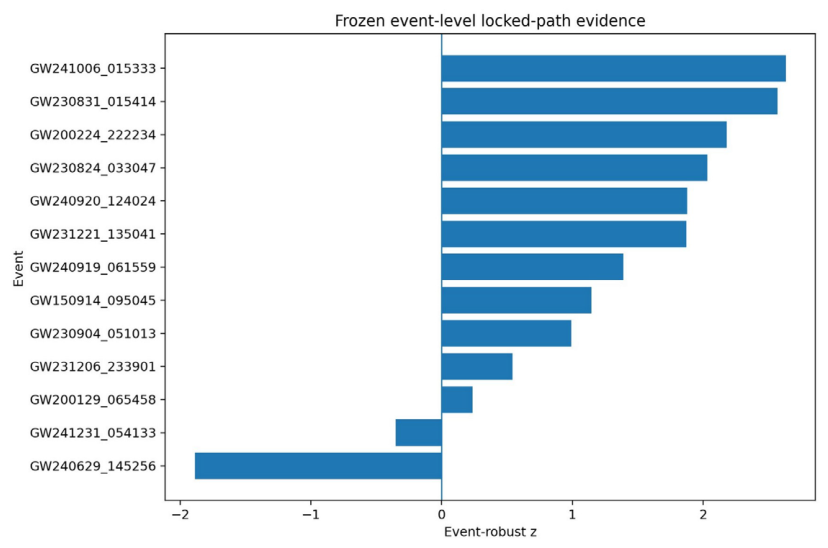
Figure 3.
Raw-strain fixed-path robustness variants under equal and visibility-weighted assignments. The panel compares frozen raw representations, notch choice, and the locked-coordinate-drop variant without reopening raw-domain search freedom. Source-derived from the prior source-locked actual-maps edition.
Figure 3.
Raw-strain fixed-path robustness variants under equal and visibility-weighted assignments. The panel compares frozen raw representations, notch choice, and the locked-coordinate-drop variant without reopening raw-domain search freedom. Source-derived from the prior source-locked actual-maps edition.
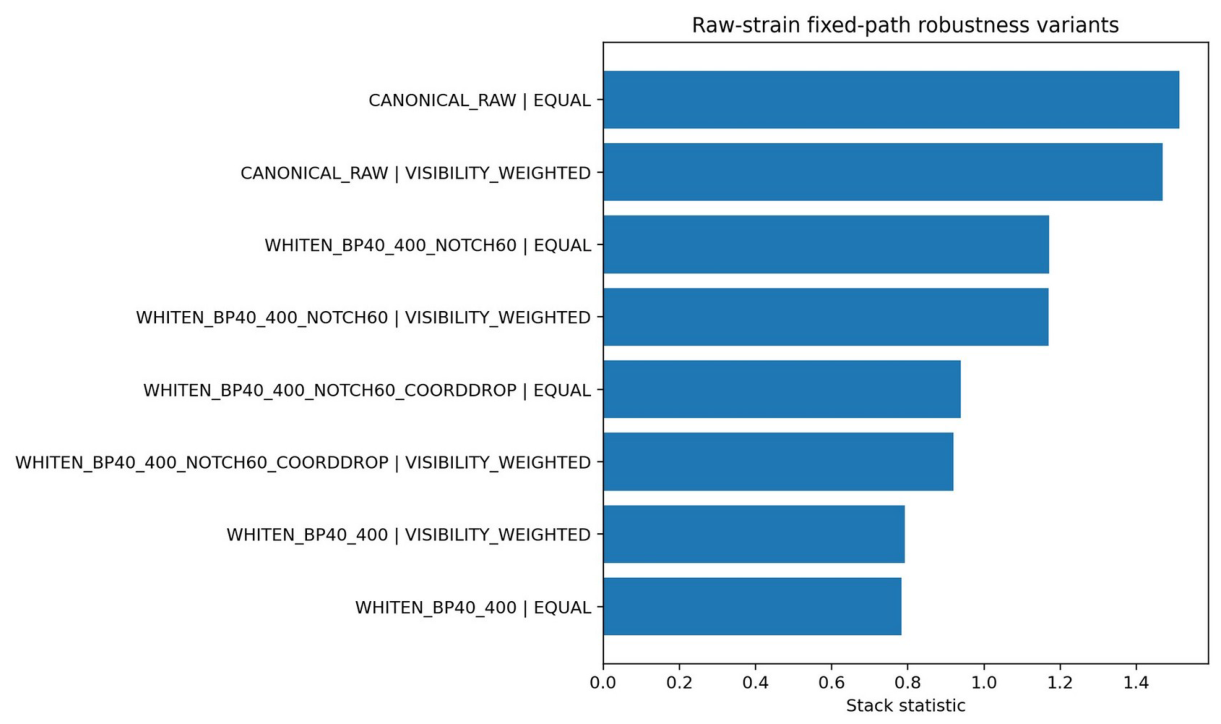
Figure 4.
Prelocked nuisance-family fingerprints. The plot shows the median change in the internal global statistic relative to baseline across the four prelocked amplitude levels. The internal z scale is scorer-standardized, not Gaussian sigma. Source-derived from the prior source-locked actual-maps edition.
Figure 4.
Prelocked nuisance-family fingerprints. The plot shows the median change in the internal global statistic relative to baseline across the four prelocked amplitude levels. The internal z scale is scorer-standardized, not Gaussian sigma. Source-derived from the prior source-locked actual-maps edition.
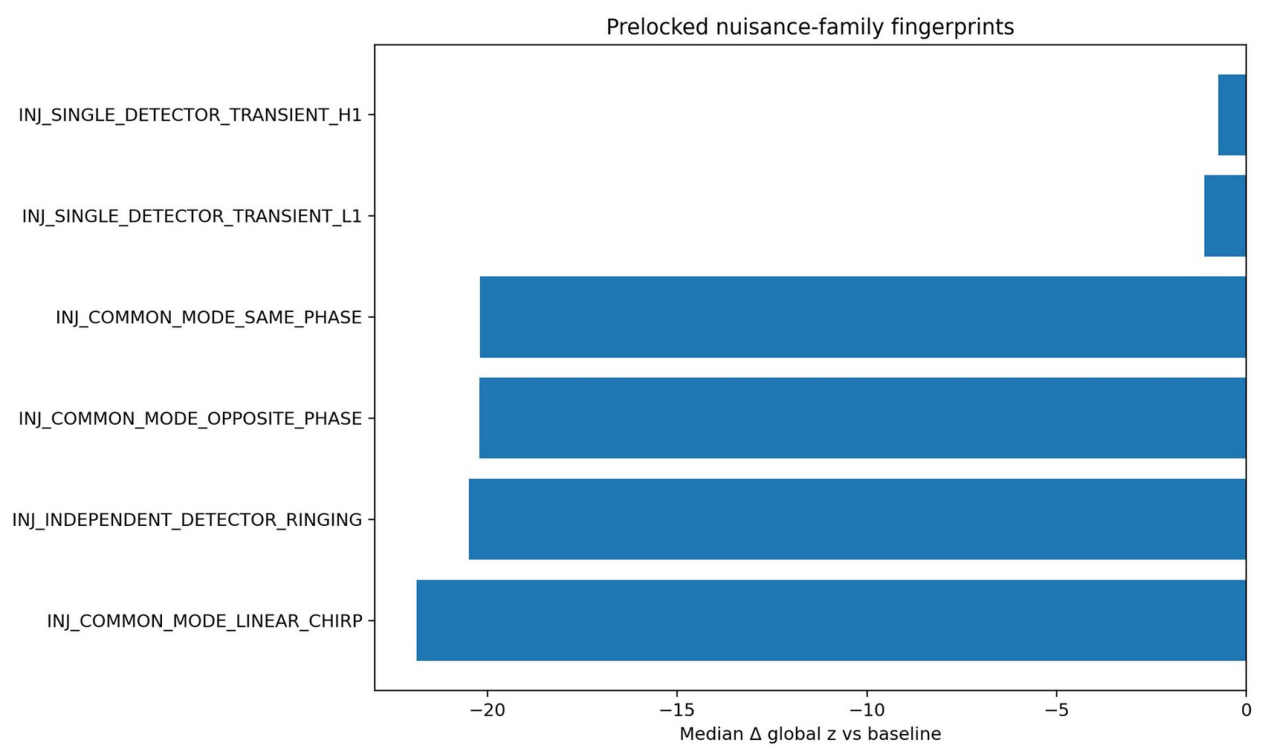
Figure 5.
Selector-aware conditional complex-phase result. The observed zero-direction real component exceeds the largest realization in the 100,000-draw primary conditional null. This is a conditional phase-randomization result, not an empirical off-source detector-phase null. Source-derived from the prior source-locked actual-maps edition.
Figure 5.
Selector-aware conditional complex-phase result. The observed zero-direction real component exceeds the largest realization in the 100,000-draw primary conditional null. This is a conditional phase-randomization result, not an empirical off-source detector-phase null. Source-derived from the prior source-locked actual-maps edition.
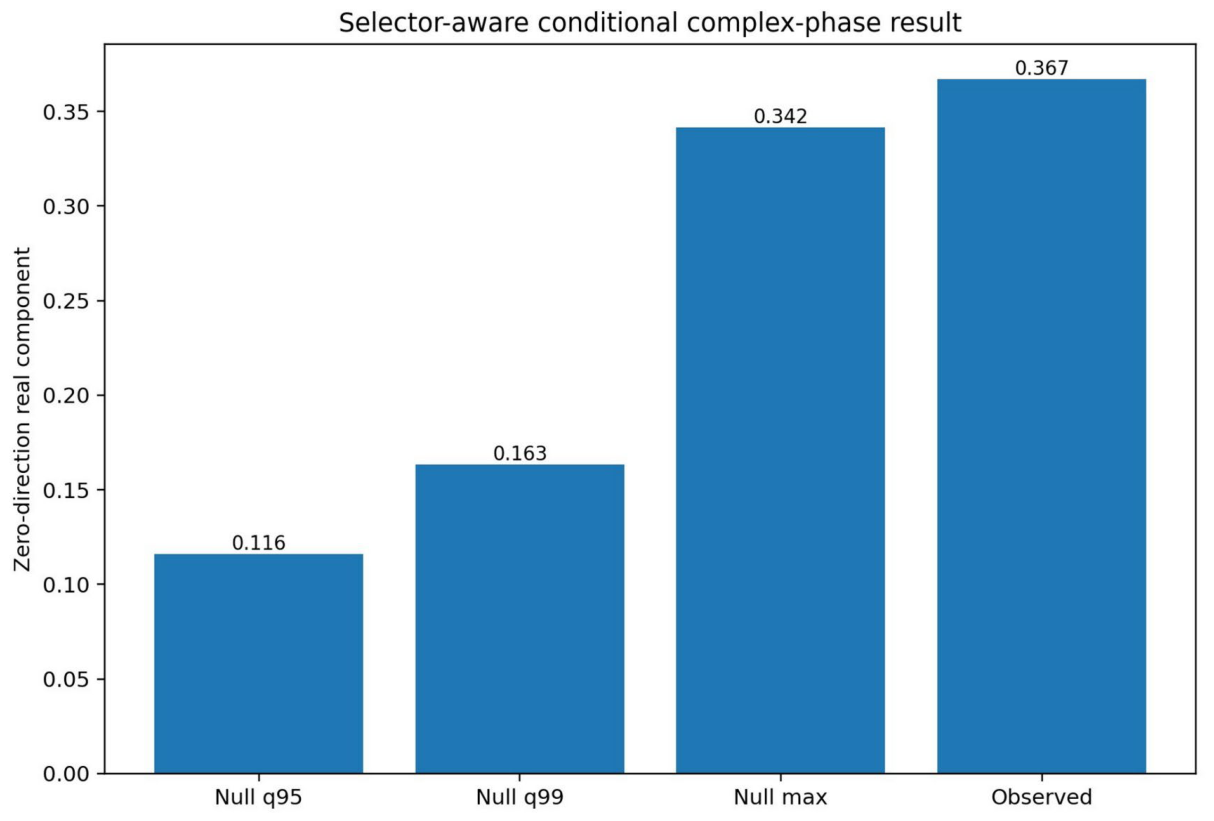
| Main-text figure | Scientific role | Frozen numerical authority |
| Figure 1A–1B - frozen connected multiscale paths | actual time-frequency-scale path geometry for all 13 canonical events | archived R30 per-event observed_path_nodes.csv assets; 172 total nodes |
| Figure 2 - frozen event-level locked-path evidence | event-level heterogeneity inside the 13-event population | R26C37_INTEGRATED_13EVENT_EVIDENCE_PANEL.csv and associated R26C36/R26C37 event-support outputs |
| Figure 3 - raw fixed-path robustness variants | representation, weighting, notch, and coordinate-ablation robustness | R26C37_RAW_GLOBAL_VARIANT_P ANEL.csv; R26C37_RAW_GLOBAL_LOO_PANE L.csv; R26C36 global stack outputs |
| Figure 4 - prelocked nuisance fingerprints | six predeclared nuisance families and 62,400-job calibration role | R26C37_PRELOCKED_NUISANCE_F AMILY_SUMMARY.csv; calibration global/LOEO panels |
| Figure 5 - selector-aware complex phase | observed phase direction versus primary conditional null | R26C42C direct phase summary; R26C42G NULL_SUMMARY.csv; R26C42H complex-phase result table |
Core manuscript tables remain bound to the frozen sources. The canonical event/node table belongs to R26C37_RESIDUAL_PATH_PROVENANCE_13EVENT.csv; primary numerical result tables belong to the R26C36/R26C37 raw panels; and the phase result table belongs to the R26C42H frozen integration output.
Appendix F. Manuscript Completeness Audit for the Load-Bearing Paper-II Claims
| Central statement | Minimum evidence that must remain visible |
| The path is a real higher-order target, not automatic output | scorer-bias audit + corrected Fixed25 atlas with 9/25 zero-path events |
| The canonical population was not outcome-cleaned | frozen-before-outcome lock + no replacement + no threshold retuning + no BEST_WIDTH verdict |
| Raw strain supports the same object | fixed coordinates + no raw free search + 13 events / 172 nodes / 26 files + 100,000-draw population null |
| The population result is distributed | 13/13 LOEO omissions pass |
| The result is not one conditioning choice | no-notch + locked-coordinate ablation + frozen weighting variants |
| Named artifact families were tested without claiming total closure | 62,400-job prelocked nuisance calibration + surviving H1/L1-only alternatives |
| Phase is a separate evidence layer | selector rerun on 2,600 real off-source controls + conditional 100,000-draw phase randomization + explicit missing empirical phase null |
| Coherence is level-specific | population/map support + repaired 13/13 strict eventwise test with zero FDR05 survivors |
| Simple physical attribution did not close | separate 16-event 580/560-test audits with zero global FDR05 survivors |
| Reproducibility is not retroactive evidence manufacture | uniform reacquisition + clean DAG + later XP parity failure kept separate |
References
- Abbott, B. P., et al. (LIGO Scientific Collaboration and Virgo Collaboration). Observation of gravitational waves from a binary black hole merger. Physical Review Letters 116, 061102 (2016). [CrossRef]
- Abbott, B. P., et al. (LIGO Scientific Collaboration and Virgo Collaboration). Tests of generalrelativity with GW150914. Physical Review Letters 116, 221101 (2016). [CrossRef]
- Abbott, B. P., et al. (LIGO Scientific Collaboration and Virgo Collaboration). Tests of generalrelativity with the binary black hole signals from the LIGO-Virgo catalog GWTC-1. Physical Review D 100, 104036 (2019). [CrossRef]
- Abbott, R., et al. (LIGO Scientific Collaboration, Virgo Collaboration, and KAGRA Collaboration).GWTC-3: Compact binary coalescences observed by LIGO and Virgo during the second part of the third observing run. Physical Review X 13, 041039 (2023). [CrossRef]
- Abbott, R., et al. (LIGO Scientific Collaboration, Virgo Collaboration, and KAGRA Collaboration).Open data from the third observing run of LIGO, Virgo, KAGRA, and GEO. The Astrophysical Journal Supplement Series 267, 29 (2023). [CrossRef]
- Abac, A. G., et al. (LIGO Scientific Collaboration, Virgo Collaboration, and KAGRA Collaboration).Open data from LIGO, Virgo, and KAGRA through the first part of the fourth observing run. The Astrophysical Journal 1004, 232 (2026). [CrossRef]
- Abac, A. G., et al. (LIGO Scientific Collaboration, Virgo Collaboration, and KAGRA Collaboration).GWTC-4.0: An introduction to version 4.0 of the Gravitational-Wave Transient Catalog. The Astrophysical Journal Letters 995, L18 (2025). [CrossRef]
- Abac, A. G., et al. (LIGO Scientific Collaboration, Virgo Collaboration, and KAGRA Collaboration).GWTC-4.0: Updating the Gravitational-Wave Transient Catalog with observations from the first part of the fourth LIGO-Virgo-KAGRA observing run. The Astrophysical Journal Letters 1004, L22 (2026). [CrossRef]
- LIGO Scientific Collaboration, Virgo Collaboration, and KAGRA Collaboration. GWTC-5.0:Observations from the second part of the fourth LIGO-Virgo-KAGRA observing run and updates to the Gravitational-Wave Transient Catalog. arXiv:2605.27225 (2026).
- LIGO Scientific Collaboration, Virgo Collaboration, and KAGRA Collaboration. Open data fromLIGO, Virgo, and KAGRA through the second part of the fourth observing run. arXiv:2605.27090 (2026).
- Abbott, B. P., et al. (LIGO Scientific Collaboration). Calibration of the Advanced LIGO detectors forthe discovery of the binary-black-hole merger GW150914. Physical Review D 95, 062003 (2017). [CrossRef]
- Nielsen, A. B., Nitz, A. H., Capano, C. D., and Brown, D. A. Investigating the noise residuals aroundthe gravitational wave event GW150914. Journal of Cosmology and Astroparticle Physics 2019(02),019 (2019). [CrossRef]
- Cornish, N. J. and Littenberg, T. B. BayesWave: Bayesian inference for gravitational wave burstsand instrument glitches. Classical and Quantum Gravity 32, 135012 (2015). arXiv:1410.3835.
- Dideron, G., Mukherjee, S., and Lehner, L. New framework to study unmodeled physics fromgravitational wave data. Physical Review D 107, 104023 (2023). arXiv:2209.14321.
- Dideron, G., Mukherjee, S., and Lehner, L. Detecting unmodeled, source-dependent signals ingravitational waves with SCoRe. Physical Review D 111, 064029 (2025). arXiv:2411.04198.
- Dideron, G., Mukherjee, S., and Lehner, L. Agnostically decoding gravitational wave modeldeficiencies in GWTC-3. arXiv:2604.27185 (2026).
- Thrane, E. and Coughlin, M. Searching for gravitational-wave transients with a qualitative signalmodel: Seedless clustering strategies. Physical Review D 88, 083010 (2013). [CrossRef]
- Thrane, E. and Coughlin, M. Seedless clustering in all-sky searches for gravitational-wave transients.Physical Review D 89, 063012 (2014). [CrossRef]
- Coughlin, M., Thrane, E., and Christensen, N. Detecting compact binary coalescences with seedlessclustering. Physical Review D 90, 083005 (2014). [CrossRef]
- Gayathri, V., Bacon, P., Pai, A., Chassande-Mottin, E., Salemi, F., and Vedovato, G. Astrophysicalsignal consistency test adapted for gravitational-wave transient searches. Physical Review D 100,124022 (2019). [CrossRef]
- Candès, E. J., Charlton, P. R., and Helgason, H. Detecting highly oscillatory signals by chirplet pathpursuit. Applied and Computational Harmonic Analysis 24(1), 14–40 (2008). [CrossRef]
- Min, J.-H. MIsCORE–RIUD: Paper I — Recurrent Merger-Local Morphology in Gravitational-Wave Post-Model Data. Preprints (2026), 202609.1515.v1. [CrossRef]
Disclaimer/Publisher’s Note: The statements, opinions and data contained in all publications are solely those of the individual author(s) and contributor(s) and not of MDPI and/or the editor(s). MDPI and/or the editor(s) disclaim responsibility for any injury to people or property resulting from any ideas, methods, instructions or products referred to in the content. |
© 2026 by the authors. Licensee MDPI, Basel, Switzerland. This article is an open access article distributed under the terms and conditions of the Creative Commons Attribution (CC BY) license (http://creativecommons.org/licenses/by/4.0/).
Copyright: This open access article is published under a Creative Commons CC BY 4.0 license, which permit the free download, distribution, and reuse, provided that the author and preprint are cited in any reuse.