

Submitted:
22 September 2026
Posted:
22 September 2026
You are already at the latest version
Abstract
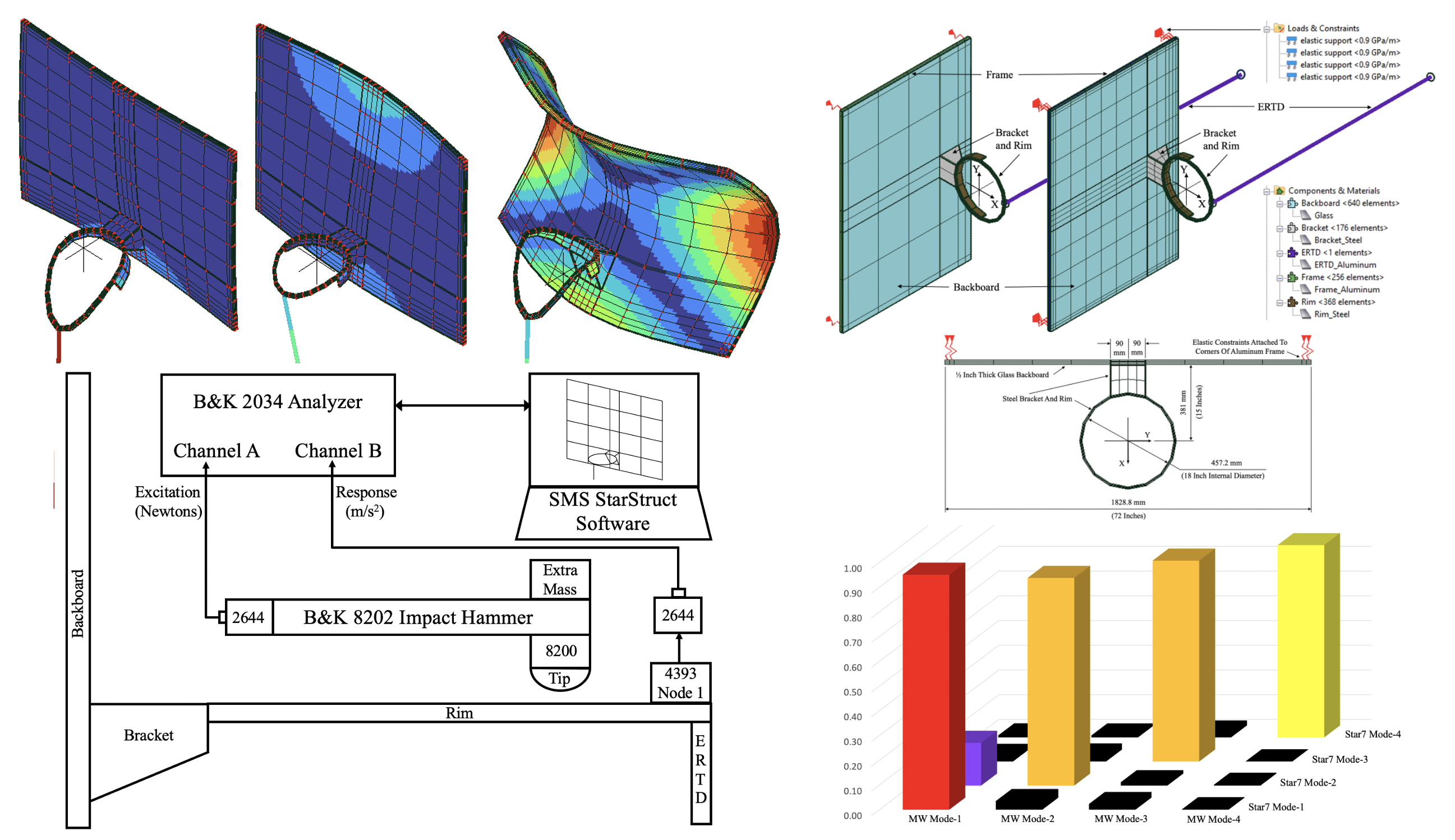
This research focuses on our bidirectional Greedy pairing of the mechanical vibrations of a Hydra-Rib basketball rim and backboard, which had an National Collegiate Athletic Association (NCAA) and Fédération Internationale de Basketball (FIBA) mandated Energy Rebound Testing Device (ERTD) suspended from it. The Experimental Modal Analysis (EMA) used Brüel & Kjær vibration instrumentation to gather vibration data which was then processed by the Spectral Dynamics STAR7 package into mode-shapes and frequencies. A MECWAY Finite Element Analysis (FEA) analytical model of the basketball rim, backboard, and frame was created using hexahedral elements, and the ERTD which hung from the outer end of the basketball rim was modeled as a 3kg truss element. The EMA and FEA mode-shapes were then exported for processing by our GNU Octave programming, which employed a bidirectional Greedy selection algorithm to pair those EMA and FEA modes which most closely matched, to generate our Cross Application Modal Assurance Criterion (CrossMAC). This CrossMAC showed high values along its main-diagonal, showing good agreement between like mode-shapes, and low off-diagonal values, indicating desired orthogonality, and we achieved a Frequency MAPE of 23.3% and a Mode-Shape MAPE of 5.974%.
Keywords:
modal assurance criterion
; experimental modal analysis
; finite element analysis
; basketball
; energy rebound testing device
; Greedy
; mean absolute percentage error
Copyright: This open access article is published under a Creative Commons CC BY 4.0 license, which permit the free download, distribution, and reuse, provided that the author and preprint are cited in any reuse.