

Submitted:
21 September 2026
Posted:
22 September 2026
You are already at the latest version
Abstract
The Mekong Delta of Vietnam is one of Southeast Asia’s most important food-producing regions, supporting intensive rice cultivation, globally significant aquaculture, and diverse inland and rice-field fisheries that contribute to food security, rural livelihoods, and ecosystem functioning. However, hydraulic engineering, agricultural intensification, aquaculture expansion, urbanization, upstream river development, and climate-related pressures have progressively altered the hydrological and ecological processes sustaining these interconnected systems. This review synthe-sizes evidence on the transformation of rice-field fisheries and aquatic animal production in the Lower Mekong Basin, with particular emphasis on the Mekong Delta, and evaluates how effectively pollution governance addresses cumulative pressures on aquatic ecosystems. Peer-reviewed studies, official statistics, policy and legal documents, Mekong River Commission reports, and international institutional publications were assessed through a systematic critical review com-bining evidence mapping with structured narrative synthesis. The synthesis reveals a marked transition from hydrologically connected, multispecies production landscapes toward increasingly specialized rice and aquaculture systems. In the Mekong Delta region, recorded inland wild-fish catch declined from approximately 165,000 tonnes in 1995 to 30,000 tonnes in 2024, while aquaculture production increased more than eightfold, from ap-proximately 78,000 to 650,000 tonnes, and rice production more than doubled, from 3.5 to 7.6 million tonnes. These contrasting trends coincided with high-dyke development, reduced flood-plain connectivity, altered sediment and flow regimes, habitat modification, and greater agro-chemical dependence. Major pollution pressures include nutrient and organic enrichment, pesticides, antibiotics and pharmaceuticals, domestic and industrial wastewater, micro-plastics, and acid-sulfate-soil drainage. Nevertheless, fishery decline cannot be attributed to pollution alone, because hydropower development, migration barriers, fishing pressure, habitat fragmentation, altered flood pulses, sediment deficits, and changing fishing participation interact across spatial and temporal scales. Although Vietnam has established increasingly comprehensive fisheries, environment, water-resource, regional-planning, and climate-adaptation frameworks, implementation remains fragmented. Priority actions include integrated basin-to-field monitoring, cumula-tive-risk assessment, pollution prevention at source, stronger discharge controls, restoration of seasonal floodplain connectivity, protection of aquatic refuges, community co-management, and wider adoption of context-appropriate floating-rice, rice–fish, and rice–shrimp systems in this Delta region.
Keywords:
Mekong Delta
; rice-field fisheries
; rice-fish systems
; aquaculture
; rice intensification
; water pollution
; environmental governance
1. Introduction
Freshwater fisheries or inland capture fisheries are important components of global food systems, particularly in low- and middle-income countries where fish and other aquatic animals provide affordable animal protein, essential micronutrients, employment, income, and livelihood security. Their contribution is often underestimated because subsistence harvests, informal trade, and dispersed small-scale fisheries are inadequately represented in conventional production statistics. Household-based estimates indicate that freshwater catches may be substantially higher than officially reported, highlighting the importance of inland fisheries to populations that have limited access to alternative sources of nutritious food [1,2]. At the same time, freshwater biodiversity is particularly vulnerable to interacting pressures from overexploitation, pollution, flow modification, habitat degradation, and other forms of river-basin development [3].
The Lower Mekong Basin exemplifies these close relationships among hydrology, aquatic biodiversity, fisheries, and human well-being. Its fisheries depend strongly on seasonal flood pulses, longitudinal and lateral connectivity, fish migration, and access to floodplain feeding, spawning, and nursery habitats [4]. Seasonal inundation connects rivers with wetlands, canals, ponds, and rice fields, transferring water, sediments, nutrients, organisms, and organic matter across the river–floodplain landscape. This connectivity supports not only fish but also a diverse assemblage of other aquatic animals, including crustaceans, molluscs, amphibians, and aquatic insects. Historically, these resources have made major contributions to food consumption and rural livelihoods throughout the Lower Mekong Basin [3,5,6]. Long-term Mekong River Commission (MRC) monitoring further demonstrates the basin's exceptional aquatic diversity, recording 617 fish species across monitored sites during 2007–2018.
At the downstream terminus of this river system, the Mekong Delta region of Vietnam is both a highly productive food-producing region and a strongly modified river–floodplain environment. Rice cultivation, freshwater aquaculture particularly Pangasius catfish and brackish-water shrimp (including white legs shrimp: Litopenaeus vannamei) farming have become economically important production sectors. However, wild fish and other aquatic organisms harvested from rivers, canals, wetlands, ponds, ditches, and seasonally flooded rice fields remain important for household food supply, informal markets, and livelihood diversification. Rice landscapes should therefore not be considered exclusively as crop-production areas. When connected to surrounding aquatic habitats, they form seasonally dynamic ecosystems that support naturally recruited fish and other aquatic organisms. In this review, rice-field fisheries refer to wild or naturally recruited aquatic organisms harvested from rice fields and associated canals, ditches, ponds, wetlands, and floodplains, distinguishing them from deliberately stocked rice–aquatic animal systems and conventional pond or cage aquaculture.
The ecological functioning of these landscapes has changed substantially with agricultural modernization and increasingly intensive water management. Since the late twentieth century, high-dyke construction and controlled irrigation have enabled the expansion of double- and triple-rice cropping by reducing seasonal inundation [7]. Although these interventions have increased the predictability and intensity of rice production, they have also restricted river–floodplain connectivity, reduced sediment and nutrient deposition, and limited fish access to seasonally inundated feeding and nursery habitats. Intensive rice production has simultaneously increased dependence on fertilizers, pesticides, pumping, and other external inputs [8,9,10]. Recent farmer-based evidence from An Giang Province similarly indicates perceived reductions in sediment and nutrient inflows, water quality, wild-fish yields, and fish diversity following high-dyke development, together with increased use of synthetic fertilizers [11,12].
These landscape transformations have occurred alongside reported declines in inland fishery yields in several parts of the Mekong Delta region. Importantly, such declines should not be interpreted as evidence of a single causal mechanism. Analyses of long-term fishery trends indicate that changes in catches are associated with combinations of fishing pressure, altered flood magnitude and duration, habitat loss, reduced connectivity, agricultural intensification, and broader hydrological change [4]. Upstream hydropower development and sediment trapping can further modify flows and sediment delivery, while groundwater extraction, land subsidence, channel modification, and salinity intrusion increase environmental pressures on the Delta [13,14]. Fishery responses therefore emerge from cumulative processes acting at different spatial and temporal scales rather than from pollution, hydrological alteration, or exploitation in isolation.
Water pollution and contaminant exposure nevertheless represent increasingly important components of this cumulative pressure. The Mekong Delta’s dense canal network simultaneously receives agricultural drainage, aquaculture effluent, domestic wastewater, and industrial discharges while supplying water for irrigation, aquaculture, capture fisheries, household activities, and navigation. Intensive agriculture introduce nutrients and pesticide residues into receiving waters, whereas aquaculture generate localized loads of suspended solids, organic matter, nitrogen, phosphorus, veterinary pharmaceuticals, and disinfectants. Pangasius catfish production, for example, may contribute a relatively small proportion of total basin-scale nutrient loads while still producing substantial localized pollution where untreated pond wastewater enters small canals or receiving waters [15]. Pesticide residues have been detected in surface water, sediments, and drinking-water sources, and recent studies have documented microplastic contamination in both surface water and sediments [4,16,17,18].
Pollution exposure is also spatially and temporally heterogeneous. Monitoring across the Mekong Delta of Vietnam has demonstrated substantial variation in microbial contamination, salinity, metals, organic pollution, and other water-quality parameters among seasons and locations, with smaller waterways influenced by intensive land use and settlements potentially experiencing greater degradation than major channels [19]. This spatial variability is particularly important for fisheries because contaminant effects may interact with temperature, dissolved oxygen, salinity, habitat quality, food availability, and hydrological connectivity [4,20]. Consequently, detection of a contaminant does not itself demonstrate a population-level effect on fisheries. Robust attribution requires evidence linking pollution sources to exposure, biological responses, recruitment, population dynamics, and ultimately fishery yields. Such causal evidence remains comparatively limited for many pollutant mixtures in the Mekong Delta.
Aquaculture further complicates this relationship. Its expansion has increased aquatic-food production, employment, and commercial value, but farmed production cannot necessarily substitute for all functions of wild fisheries. Wild and cultured aquatic foods differ in species diversity, accessibility, nutritional composition, ownership, market dependence, and livelihood functions. At the same time, integrated systems can provide opportunities to reconcile production with ecological processes. Comparative research in the Mekong Delta indicates that rice–fish systems combined with reduced agrochemical dependence can provide economically and environmentally attractive alternatives to intensive high-dyke rice monoculture [21]. Such findings emphasize that maintaining aquatic production requires management of both production practices and the ecological connectivity on which aquatic organisms depend.
A further challenge lies in governance. Water, fisheries, rice production, aquaculture, pesticides, wastewater, hydropower, and environmental protection are managed through different institutions and regulatory frameworks, whereas water, sediments, fish, and contaminants move across sectoral and administrative boundaries. Research on Mekong water governance has identified mismatches between the spatial scale of environmental processes and existing institutional arrangements, including policy fragmentation and insufficient integration of transboundary hydrological change into regional planning [22,23]. Effective pollution governance therefore requires more than regulatory standards; it requires coordinated monitoring, source identification, data sharing, enforcement, ecological assessment, and institutional cooperation across farms, canals, provinces, and the wider basin.
Despite extensive research on Mekong’s fisheries, rice intensification, dyke development, aquaculture, water quality, individual contaminants, and hydrological change, these topics have largely developed as separate fields of inquiry. Few syntheses have explicitly connected the transformation of rice-field fisheries with aquaculture development, contaminant pathways, basin-scale hydrological pressures, and pollution governance. This review addresses this gap by conceptualizing the Mekong Delta of Vietnam as a coupled agri-aqua-culture system embedded within the wider Lower Mekong Basin. The review aims to: (i) examine the historical transformation of rice landscapes, rice-field fisheries, and aquatic animal production; (ii) critically evaluate evidence linking hydrological alteration, agricultural intensification, water quality contamination and pollution to rice-field fisheries/inland fisheries and aquatic ecosystem responses; (iii) assess the coherence and implementation of relevant fisheries, water, environmental, and” pollution-governance instruments; and (iv) identify management transitions and research priorities capable of reconciling food production with aquatic biodiversity, environmental quality, livelihood security, and climate resilience.
2. Review Approach and Analytical Framework
This study employed a systematic critical review combining systematic evidence mapping [24] with structured narrative synthesis [25]. The review built on the evidence compiled in the IPEN technical reports on chemical pollution and fisheries in the Mekong River, Vietnam [26,27], and subsequently expanded, updated, and critically reassessed this evidence base.
Four questions guided the synthesis: (i) how rice intensification and hydraulic modification have transformed rice-field fisheries and aquatic production; (ii) which pollutants, contaminants, and exposure pathways are most strongly supported by available evidence; (iii) how effectively existing governance instruments address these pressures; and (iv) which production and governance transitions could improve ecological and livelihood resilience. The Mekong Delta was the primary study area, while evidence from Cambodia, Lao PDR, and Thailand was included where relevant to transboundary hydrology, sediment transport, fish migration, water quality, pollution, or governance.
The evidence base comprised peer-reviewed articles, books, official statistics, legislation and policy documents, Mekong River Commission reports, and publications from international organizations both English and Vietnamese Language. Searches were conducted in Web of Science, Scopus, CAB Abstracts, and Aquatic Sciences and Fisheries Abstracts, supplemented by ScienceDirect, Google Scholar, publisher databases, and institutional repositories. Search terms combined geographic descriptors with keywords related to “rice fields and floodplains”, “fisheries”, “rice–fish and rice–shrimp systems”, “nutrients-sediments”, “pesticides”, “antibiotics”, “wastewater”, “plastics”, “acid-sulfate soils”, “water quality”, “regulation”, “monitoring”, and “climate adaptation”.
Sources were critically appraised for methodological quality, geographic relevance, temporal resolution, transparency, and data traceability. Meta-analysis was not undertaken because of substantial ecological and methodological heterogeneity among studies. Consequently, relationships among hydrological alteration, agricultural intensification, contaminant exposure, and fishery change were interpreted as interacting cumulative pressures rather than single-factor causal effects.
3. Results and Discussions
3.1. Prevalence and Productivity of Rice-Field Fisheries and Their Contribution to National Fisheries in the Lower Mekong Basin Countries
Rice-field fisheries are a widespread yet poorly enumerated component of food production in the Lower Mekong Basin. They comprise connected aquatic landscapes of seasonally inundated paddies, canals, ditches, ponds, and permanent refuges, rather than harvests taken only within cropped fields. These habitats support finfish and other aquatic animals, including crustaceans, molluscs, amphibians, and aquatic insects. Because catches are dispersed, seasonal, and used largely for household consumption, exchange, or small-scale sale, their contribution is commonly obscured in production and employment statistics [6,28,29,30]. Evidence from Cambodia, where rice-field fisheries have been most extensively quantified, illustrates this statistical invisibility. In a survey of 37 villages, 58% of households whose members fished did not identify fishing as a primary or secondary occupation [31]. Similarly, during three years and 19 sampling rounds, 35% of surveyed households never reported selling their catch [32]. Occupational statistics indicating that only 20–26% of Cambodian households participated in fishing therefore excluded many occasional, subsistence, and landless fishers [33].
Catch-based estimates also demonstrate substantial productivity. Freed, Kura, Sean, Mith, Cohen, Kim, Thay and Chhy [32] estimated annual finfish yields of 66.8 ± 10.7 to 104 ± 16.0 kg/ha/year, depending on assumptions about household participation, and an upper-bound other aquatic animals yield of 34 ± 7.9 kg/ha/year. These values are consistent with a synthesis estimate of 112 kg fish/ha/year and a wider range of 25–209 kg fish/ha/year for rainfed rice landscapes in Cambodia and Thailand [34]. In Battambang, monitored wet-season catch averaged 119 kg/ha, comprising approximately 76% finfish and 24% other aquatic animals [35]. These figures describe harvested yield, not ecological production, and are sensitive to fishing effort, sampled area, gear coverage, and inclusion of dry-season catch.
Estimates of the national contribution of Cambodian rice-field fisheries consequently range from about 30% in official accounts to 60–70% in field-based extrapolations [32,34]. This divergence reflects alternative definitions of rice-field habitat, uncertain inundated areas, incomplete recording of subsistence catch, and spatially variable yield. Sites near Tonle Sap and well-connected Community Fish Refuges may also be unusually productive, whereas drought during the 2013–2015 assessment probably depressed catch. Cambodian values should therefore not be extrapolated uncritically across the Lower Mekong Delta. Nevertheless, evidence from Lao PDR confirms the importance of rice-based aquatic biodiversity to household diets [36], while earlier Vietnamese Mekong Delta studies reported contrasting yields in acid-affected and non-acid floodplain rice landscapes (summarized by Hortle, Troeung and Lieng [35]). Later research links rice intensification, high dikes, reduced habitat connectivity, and greater agrochemical use with declining availability of wild aquatic foods [10,37]. The principal governance implication is that omitting subsistence harvests causes assessments to undervalue losses associated with pollution and hydrological modification. National monitoring should therefore include landless and occasional fishers; year-round catch-and-effort diaries; finfish and other aquatic animals identification; standardized habitat areas; hydrological conditions; and separation of wild, stocked, and cultured production. Linking these observations with contaminant measurements in water, sediment, and biota would provide a defensible basis for evaluating fishery productivity, food-safety risks, and the benefits of pollution control.
3.2. Regional and Global Consumption of Rice, Rice-Field Fisheries (Inland Fisheries), and Aquatic Animal Foods
Apparent consumption refers to food available for human consumption at the national or regional level, rather than the amount actually eaten. Food balance sheets estimate it from production, trade, stocks, and competing uses. Although useful for comparing broad trends, they inadequately capture household waste, unequal access, informal trade, subsistence harvesting, or intra-household allocation [38]. This is especially problematic for inland and rice-field fisheries, whose catches are often consumed directly or exchanged informally. Moreover, rice is reported in milled-rice equivalent and aquatic foods in live-weight equivalent, so their quantities are not directly comparable.
Rice remains the principal staple across most of Asia and is increasingly important in Africa. It supplies dietary energy for more than half of the global population and may provide up to 50% of caloric intake among rice-dependent, low-income groups [39]. The OECD–FAO baseline for 2023–2025 estimated global consumption at 50.7 kg per person per year. Consumption was highest in Asia (72.2 kg), followed by Africa (26.0 kg), Latin America and the Caribbean (25.4 kg), Oceania (19.0 kg), North America (11.5 kg), and Europe (6.8 kg) (OECD–FAO, 2026). These averages conceal substantial variation. Consumption remains high in mainland Southeast and South Asia but has declined in wealthier East Asian economies as urbanization and rising incomes encourage dietary diversification. Global demand will nevertheless rise mainly through population growth. By 2035, per-capita consumption is projected to remain nearly unchanged globally at 50.8 kg, decline marginally in Asia to 72.1 kg, and increase in Africa to 29.6 kg [40].
Aquatic animal food availability has grown more rapidly, from 9.1 kg per person in 1961 to 20.7 kg in 2022 and 21.1 kg in 2023. Aquaculture now supplies approximately 59% of aquatic animal foods available for direct consumption [41]. In 2023, availability averaged 26.3 kg in Asia, 22.1 kg in North America, 21.2 kg in Europe, 20.6 kg in Oceania, 10.1 kg in Latin America and the Caribbean, and 9.1 kg in Africa. Asia accounted for nearly three-quarters of global availability and approximately 89% of aquaculture production. Increasing supply does not necessarily imply equitable access or better diets. South and Southeast Asia are shifting from diverse wild freshwater fisheries towards farmed species and commercial value chains. Aquaculture has increased the volume and stability of supplies but cannot automatically replace the ecological, nutritional, cultural, and livelihood functions of capture fisheries. Wild and farmed foods differ in species, price, nutrient density, acceptability, and accessibility; rising production may therefore conceal declining dietary diversity or access to common-pool resources [42].
Rice-field fisheries occupy an important but poorly quantified position within this rice–aquatic food nexus. They include naturally recruited fish, prawns, crabs, molluscs, frogs, snakes, aquatic insects, and edible plants harvested from seasonally flooded rice fields and connected aquatic habitats. Unlike rice–fish aquaculture, they depend mainly on natural recruitment, floodplain connectivity, habitat diversity, and access to harvesting grounds. Neither FAOSTAT nor most national food balance sheets record these catches separately. Substantial quantities are omitted because they are consumed within households, processed domestically, exchanged locally, or sold informally. Surveys defining fishing as a formal occupation may also exclude rice farmers, women, children, and seasonal fishers. The absence of a reliable global time series is therefore a systematic measurement gap, not evidence of low importance [40].
Southeast Asian studies demonstrate the magnitude of this “hidden harvest.” In Cambodia’s Tonle Sap region, 158 wild aquatic species were recorded in rice-field landscapes, and these fisheries supplied approximately 60% of the fish and other aquatic animals consumed by surveyed households during both flood and dry seasons [32,43]. Official estimates attribute about 30% of Cambodian inland fishery production to rice-field systems, although field evidence suggests a larger contribution. In northern Lao PDR, most rice-field aquatic production is retained for household consumption, emphasizing its importance as food, supplementary income, and a buffer against seasonal shocks [44].
The trajectory has been less favourable in intensively cultivated areas of the Mekong Delta of Vietnam. High-dyke systems, controlled irrigation, triple-rice cropping, agrochemical use, and reduced floodplain connectivity have increased the predictability of rice production while diminishing aquatic habitats and fish recruitment. Farmers in An Giang province perceived declines of 68–83% in wild fish yield and 75–81% in fish diversity after high-dyke construction, together with reduced sediment inflows and a 26–37% increase in synthetic fertilizer use [11,12]. These findings illustrate a critical trade-off: rice intensification may increase crop production while reducing wild foods, natural soil-fertility processes, dietary diversity, and livelihood resilience [43,45]. For the Lower Mekong Basin, Hortle [6], Hortle and Bush [46] synthesis of 20 household surveys estimated annual consumption of inland fish and other aquatic animals at 33.7 kg/person: 36.8 kg in Cambodia, 28.6 kg in Lao PDR, 29.0 kg in the Thai portion of the basin, and 39.0 kg in the Vietnamese portion. These foods supplied an estimated 47–80% of animal protein. Although based largely on conditions around 2000 and therefore unsuitable as current estimates, the findings remain an important benchmark showing how official statistics may underestimate artisanal catches, preserved products, other aquatic animals, and subsistence consumption.
Rice and aquatic foods are nutritionally complementary rather than interchangeable. Rice supplies dietary energy but relatively few essential micronutrients, whereas aquatic animals provide high-quality protein, essential fatty acids, iron, zinc, calcium, selenium, and vitamins A, D, and B₁₂. Small indigenous fish eaten whole are often particularly nutrient-dense because their bones, heads, eyes, skin, and viscera are consumed [47,48]. Modelled evidence suggests that inland small-scale fisheries potentially provide about 24% of micronutrient intake for 360 million people in Asia (Basurto et al., 2025). Replacing diverse wild catches with equivalent quantities of rice or a few large farmed species may therefore maintain aggregate food supply while reducing micronutrient density, affordability, and access.
Food-security assessments should consequently integrate rice, aquaculture, inland capture fisheries, and rice-field biodiversity within a single food-system framework. Monitoring should combine apparent availability with household intake, species and nutrient composition, seasonal access, prices, informal trade, subsistence harvesting, and socioeconomic inequality. Hydrological connectivity, flood duration, biodiversity, and access to fishing habitats should also be treated as determinants of food security. Otherwise, increases in rice and aquaculture production may obscure simultaneous losses of wild aquatic foods and the ecosystem services sustaining rural nutrition and resilience [45].
3.3. The production Trends of Rice-Field Fisheries and Aquatic Animal Foods in Lower Mekong River
The Lower Mekong Basin supports one of the world’s largest and most diverse inland fisheries. Mekong River Commission monitoring conducted between 2007 and 2018 recorded 617 fish species across 25 monitoring sites, demonstrating considerable spatial and temporal variation in fish abundance, diversity, and catch [49]. These fisheries include migratory river species, resident floodplain fishes, and numerous fish and other aquatic animals harvested from rice fields, canals, ponds, wetlands, estuaries, and coastal habitats [6,50,51]. In the Vietnamese Mekong Delta, these resources have historically supplied animal protein, micronutrients, income, and seasonal employment, particularly for land-poor households with limited access to commercial aquaculture [4,6,50]. The contribution of small-scale fisheries is not adequately represented in official production statistics. Government records generally capture commercial landings more effectively than subsistence harvesting, household consumption, informal exchange, or catches sold through dispersed local markets. Rice-field harvests may include fish, eels, shrimp, crabs, molluscs, frogs, snakes, insects, and edible aquatic plants. Their dietary and livelihood value may therefore be considerably greater than indicated by reported fish tonnage. This under-recording also complicates the interpretation of long-term trends: reductions in official catch may reflect declining fish abundance, decreasing fishing participation, changes in market channels or reporting practices, or a combination of these processes.
Since the 1990s, total aquatic production in the Vietnamese Delta has increased substantially, driven principally by the development of Pangasius catfish and brackish-water shrimp aquaculture. These industries have generated employment, processing capacity, export revenue, and more predictable commodity supplies. However, their expansion contrasts sharply with the trajectory of inland capture fisheries. In An Giang, Dong Thap, Can Tho, Vinh Long, Hau Giang, and other freshwater provinces, catches generally increased during the late 1990s before declining after the early 2000s. Interviews with 1,020 fishers in the Mekong Delta showed that 68–90% perceived declining catch rates, although trends differed among locations and fishing practices [4]. Aquaculture growth should therefore not be interpreted as evidence that wild fisheries have remained stable or that farmed commodities have fully replaced their nutritional and livelihood functions.
Basin-wide evidence reinforces this interpretation. Long-term monitoring reveals substantial geographical and temporal heterogeneity, indicating that fishery changes cannot be represented by a single basin-wide trajectory. Nevertheless, reductions in catch per unit effort and the increasing dominance of smaller fishes have been reported in several areas. Uy, et al. [52] also documented declining body sizes across 257 species, with particularly pronounced reductions among large-bodied and threatened fishes. Declining body size is consistent with cumulative fishing and environmental pressures because it can indicate the selective removal of large individuals, impaired growth, altered recruitment, or habitat degradation. However, it is not diagnostic of any single causal mechanism. Rice-field fisheries provide the clearest example of the trade-offs accompanying agricultural transformation. Rice intensification and flood-control infrastructure may have increased crop production but have reduced seasonal connectivity between rivers, floodplains, canals, and fields. Household research demonstrates that increased rice production too often coincide with declining collection and consumption of wild fish, other aquatic animals, and vegetables, with the greatest losses experienced by poorer households [10,12]. The contrasting trends therefore reflect a transition from hydrologically connected, multispecies food systems towards increasingly specialized and commercially oriented rice and aquaculture production. Future assessments should integrate official production data with household-consumption surveys, fishing participation, catch per unit effort, species composition, body-size distributions, and nutritional indicators. Such an approach is essential for determining whether growth in marketed production is being achieved at the expense of aquatic biodiversity, equitable food access, and the resilience of floodplain-dependent livelihoods.
3.4. Land-Use Change of Rice Production and Agrochemical Pressures on Rice-Field Fisheries (Inland Fisheries) and Aquatic Animal in the Lower Mekong Basin
Rice fields, floodplains, wetlands, canals, ponds, and rivers form a hydrologically interconnected aquatic landscape throughout the Lower Mekong Basin. During the monsoon, rising water connects permanent channels with seasonally inundated rice fields, enabling wild fish and other aquatic organisms including crustaceans, molluscs, amphibians, reptiles, and aquatic insects to migrate, reproduce, feed, and use floodplains as nursery and refuge habitats. Rice-growing landscapes therefore function not only as agricultural areas but also as seasonal wetlands that support aquatic biodiversity, household nutrition, and rural livelihoods. Consequently, changes in rice production cannot be evaluated independently of alterations in floodplain connectivity, water quality, habitat accessibility, and the availability of wild aquatic foods [32].
National production indices for 2000–2024 reveal contrasting trajectories among Cambodia, Lao PDR, Thailand, and Viet Nam [40,53] (Figure 1). Cambodia’s rice-production index increased to more than three times its 2000 level, while its reported inland-capture-fisheries index fluctuated but remained above the baseline. Lao PDR also recorded increases in rice production and reported inland catches. By contrast, inland-fisheries indices declined substantially in Thailand and Viet Nam, although rice production remained close to or above its initial level. Fertilizer use followed similarly divergent patterns, increasing markedly in Cambodia and Lao PDR, rising more moderately in Viet Nam, and declining in Thailand. These trends provide no evidence of a uniform basin-wide relationship among rice production, fertilizer use, and inland-fishery output (Figure 1).
Instead, they demonstrate that comparable agricultural changes can coexist with different fishery trajectories, depending on infrastructure, habitat condition, fishing effort, climate variability, markets, and statistical reporting. The comparative data for 2000–2024 reveal two contrasting patterns among the four Lower Mekong Basin countries (Table 1). Reported inland catch increased substantially in Cambodia and Lao PDR, whereas it declined in Thailand and Viet Nam. Meanwhile, rice production and fertilizer use increased in all four countries, although changes in harvested area differed. Cambodia recorded the largest inland catch in 2024, at 467,344 tonnes, representing an increase of 90.3% since 2000 and a 35.3% increase when the first and last five-year averages are compared. During the same period, rice production increased by 252.7%, harvested area by 104.8%, and fertilizer use by 157.8%. Nevertheless, the mean official-data share for the fishery series was 0%, giving Cambodia a “very low” quality classification (Table 1). The entire catch trajectory was therefore derived from estimated or imputed observations rather than consistently reported official statistics. Cambodia’s increasing catch should not be interpreted as evidence of fish-stock recovery or a positive fertilizer–fishery relationship. This statistical limitation is especially important because Cambodian rice-field fisheries are highly diffuse and subsistence-oriented. In the Tonle Sap region, 158 wild aquatic species were documented, and rice-field catches supplied approximately 60% of the fish and other aquatic animals consumed by surveyed households [32,43]. Much of this production does not pass through formal landing sites and can therefore be omitted or modelled in national statistics. Lao PDR displayed an even larger reported increase: inland catch reached 78,795 tonnes in 2024, 169.4% above the 2000 levels, while the last-five-year average exceeded the first-five-year average by 142.2%. Rice production, harvested area, and fertilizer use increased by 70.4%, 26.9%, and 252.6%, respectively. However, only 4% of the fishery observations were classified as official, resulting in a “low” quality signal (Table 1). The unusually smooth co-movement of catch and agricultural inputs may consequently reflect estimation procedures rather than a genuine ecological response. Field research in southern Lao PDR shows that irrigation effects are more complex: weirs reduced household catches, whereas dams redistributed fishing effort and catches from rivers towards reservoirs without producing a significant overall decline [62]. National totals may therefore conceal substantial changes in fishing locations, habitat composition, species assemblages, and household access.
The declining trends in Thailand and Viet Nam are supported by considerably stronger reporting coverage. Thailand’s inland catch declined by 46.4% between 2000 and 2024 and by 44.5% between the first and last five-year periods, reaching 107,869 tonnes in 2024. Over the same period, rice production increased by 34.5%, harvested area by 15.8%, and fertilizer use by 72.7% (Table 1). Because the official-data share was 100%, the downward fishery trend is more credible than the increases reported for Cambodia and Lao PDR.
Nevertheless, it cannot be attributed exclusively to rice intensification because fishing effort, reservoir development, hydropower infrastructure, habitat conversion, climate variability, urbanization, and statistical classification remain uncontrolled.
Viet Nam recorded 155,569 tonnes of inland catch in 2024, representing declines of 25.9% from the 2000 levels and 31.4% between the first and last five-year averages. Rice production increased by 33.6% despite a 7.9% reduction in harvested area, indicating rising yield and cropping intensity, while fertilizer use increased by 24.8%. With 93.3% of fishery observations classified as official, the series received a “moderate–higher” quality rating. The trend is consistent with evidence from the Vietnamese Mekong Delta, where high dikes, multiple rice cropping, flood exclusion, and reduced river–field connectivity have diminished wild-fish habitat and household access to aquatic foods [9,61]. In An Giang Province, farmers perceived substantial declines in wild-fish yield and diversity following high-dike construction, together with greater dependence on synthetic fertilizer [4,12,27]. However, the national series covers all Vietnamese inland waters and cannot specifically identify conditions in the Mekong Delta or rice-field habitats. In general, the Table 1 provides stronger evidence of divergent trends than of a causal relationship. Fertilizer use should therefore be interpreted as a proxy for agricultural intensification rather than as an independent driver of fishery change, because increased fertilizer application often coincides with greater pesticide use, intensified water control, shortened fallow periods, and multiple cropping. Evidence from the Vietnamese Mekong Delta indicates that intensive pesticide use can reduce fish survival and undermine farm profitability, whereas integrated rice–fish systems with lower agrochemical inputs may deliver better economic and ecological outcomes [21,63,64]. Future analyses should integrate official national statistics with subnational catch assessments, catch-per-unit-effort estimates, household consumption surveys, species-level data, hydrological indicators, and transparent documentation of imputed observations. Such an integrated approach is necessary to distinguish genuine ecological change from variations in fishing effort, habitat use, and statistical reporting.
3.5. Transformation and Decline of Rice-Field Fisheries and Aquatic Animal Production in the Vietnamese Mekong Delta
Rice-field fisheries occupy the least-managed end of the rice–fish production continuum. They encompass rice paddies and hydrologically connected habitats, including canals, streams, ponds, ditches, and seasonally inundated wetlands [43]. Wild fish are generally more abundant where seasonal flooding is maintained, water-control infrastructure is limited, and agrochemical use remains low [4,43,65,66]. Small canals, ponds, and adjacent floodplain water bodies function as dry-season refuges, while trap ponds concentrate fish as floodwaters recede. Fishers use traps, fence systems, nets, hooks, and other small-scale gears to harvest fish migrating between rivers, wetlands, and rice fields. The resulting catch includes wild fish and other aquatic animals, such as eels, shrimp, freshwater crabs, molluscs, frogs, and snakes. Edible aquatic plants are also collected from these landscapes. These rice-field aquatic resources make important contributions to household nutrition, income diversification, and ecosystem functioning, including nutrient cycling, biological pest regulation, and the maintenance of aquatic biodiversity. Nevertheless, rice-field fisheries remain poorly represented in agricultural planning, fishery statistics, and aquaculture-oriented policy frameworks because much of the catch is consumed within households or traded informally [4,67]. Historically, these fisheries have supported food and nutrition security and rural livelihoods across Asian low- and middle-income countries, including Bangladesh, Cambodia, Lao PDR, Myanmar, Thailand, and Viet Nam [36,43,62].
The Vietnamese Mekong Delta contains diverse freshwater, brackish-water, and coastal habitats, including rivers, floodplains, wetlands, mangroves, mudflats, seagrass beds, riparian zones, rice paddies, and peatlands [68,69]. Although rice cultivation and aquaculture are now dominant livelihood activities, inland capture fisheries and rice-field fisheries remain important supplementary sources of food and income, particularly for land-poor and resource-dependent households. During the 1970s and much of the 1980s, the delta was less intensively modified than it is today; extensive high-dyke networks, widespread triple-rice cropping, and large-scale commercial aquaculture had not yet reached their present extent. Seasonal floods therefore maintained greater connectivity among rivers, canals, wetlands, and rice fields, supporting diverse and productive wild fisheries [49,70,71,72].
These fisheries have subsequently declined as the delta has been transformed by intensive rice production, hydraulic engineering, aquaculture expansion, and wider land-use change. High-yielding rice varieties and double- and triple-cropping systems have increased rice output, but their implementation has frequently required high dykes, sluice gates, irrigation canals, rapid drainage, and increased agrochemical inputs. At the same time, freshwater fish ponds and coastal shrimp farms have expanded to supply domestic and export markets. These changes have altered rural employment patterns, with many households moving from seasonal fishing and aquatic-resource collection towards wage labour, intensive agriculture, or commercial aquaculture [4,12,49,70,71].
The production series presented in Figure 2 illustrate these contrasting trajectories. Between 1995 and 2024, recorded inland wild-fish catch declined from approximately 165,000 to 30,000 tonnes, an 82% reduction. Over the same period, aquaculture production including fish and shrimp increased more than eightfold, from approximately 78,000 to 650,000 tonnes, while rice production rose by 117%, from about 3.5 to 7.6 million tonnes. Aquaculture surpassed recorded inland catch around 2000 and, by 2024, its reported output was more than 20 times greater. Rice and aquaculture production expanded most rapidly between 2000 and 2015. Rice production subsequently stabilized, aquaculture continued to increase more moderately, and inland catch declined further. Because rice production is plotted on a separate vertical axis, however, the relative distances among the three series should be interpreted cautiously. Moreover, these trends demonstrate temporal association rather than direct causation.
Nevertheless, the decline in inland catch is consistent with evidence linking fishery productivity to the Mekong flood pulse. Seasonal flooding historically connected rivers, canals, wetlands, ponds, and rice fields, providing essential spawning, feeding, and nursery habitats for migratory and floodplain-dependent species. High dykes, sluice gates, drainage systems, and intensive irrigation have fragmented these habitats and reduced the extent and duration of seasonal inundation. Although such infrastructure has enabled more predictable double- and triple-rice cropping, it has also restricted fish migration, reduced access to floodplain habitats, and limited the exchange of water, sediment, and nutrients. Long-term datasets and interviews with 1,020 fishers showed that fish yields were positively associated with flood magnitude but negatively associated with rice intensification, particularly in high-dyke areas supporting three annual rice crops [4]. Similar effects on wild-food availability, household consumption, and rural livelihoods have been reported elsewhere in the delta [9,10,61].
Hydrological modification interacts with multiple additional pressures. Intensive rice cultivation commonly involves herbicides, fungicides, insecticides, and chemical fertilizers that may directly affect aquatic organisms or indirectly alter water quality, habitat conditions, and food-web structure [9,12,64,73]. Fishing pressure, destructive or illegal gears, declining spawning populations, hydropower development, sediment trapping, sand mining, and altered seasonal flows further contribute to fishery degradation [4,13]. High-dyke systems may also reduce natural sediment deposition and soil-fertility renewal, increasing dependence on purchased fertilizers and other agricultural inputs [21,45,74]. The decline in wild fisheries should therefore be understood as the cumulative outcome of interacting hydrological, ecological, agricultural, and fishery pressures rather than being attributed to a single driver.
Aquaculture expansion represents a parallel shift towards controlled, input-dependent, and commercially oriented aquatic production. This growth has been supported by hatchery development, improved seed and feed supplies, processing infrastructure, technological intensification, export markets, and investment in Pangasius catfish and whiteleg shrimp (Litopenaeus vannamei) production [75,76,77]. Although aquaculture generates employment, export earnings, and a more predictable supply of aquatic products, farmed fish and shrimp cannot fully replace the ecological, nutritional, and livelihood functions of wild fisheries. Wild aquatic resources comprise diverse species harvested for household consumption and informal exchange, whereas commercial aquaculture is concentrated on relatively few species and is often oriented towards higher-value markets. Poorly managed intensive aquaculture may also increase nutrient discharge, organic sludge, disease risks, chemical use, and competition for land and water [78,79].
The observed trends indicate a transition from hydrologically connected, multispecies, and partly common-pool food systems towards increasingly specialized rice and aquaculture production. Official catch statistics should nevertheless be interpreted cautiously because subsistence harvests, informal trade, small-scale fishing, and household consumption remain substantially under-recorded [6,55]. Management should therefore integrate rice cultivation, aquaculture, inland fisheries, and floodplain biodiversity within a unified food-system framework. Priorities include restoring seasonal connectivity, retaining low-dyke and controlled-flooding areas, incorporating fish-friendly structures into irrigation systems, protecting dry-season aquatic refuges, reducing agrochemical risks, and promoting integrated rice–fish and rice–shrimp systems. Future monitoring should distinguish freshwater aquaculture from brackish-water shrimp production and incorporate household catches, fishing effort, and catch per unit effort.
3.6. Pollutants, Exposure Pathways, and Mechanisms of Fishery Decline
3.6.1. Multiple Mechanisms of Fishery Decline
Evidence indicates that declining catches in Mekong fisheries cannot be attributed to a single driver. Rather, they arise from interacting pressures operating at basin, floodplain, and local scales. Overfishing and small-mesh or destructive gears remove juveniles and spawning adults, while habitat conversion, invasive species, and declining broodstock reduce recruitment. Hydropower dams impose an additional basin-scale constraint by obstructing migration between feeding, refuge, and spawning habitats and altering downstream flows, sediment transport, and seasonal cues [60,80]. Development scenarios consequently project substantial losses of fish biomass, biodiversity, protein supply, and associated ecosystem services [81,82]. Sediment trapping and flow regulation interact with high-dyke and irrigation systems in the Mekong Delta, where diminished floodplain connectivity restricts nursery habitat, nutrient exchange, and fish migration [9,13].
Rice intensification reinforces these pressures by shortening inundation and ecological recovery periods while increasing agrochemical applications. Pesticides may cause mortality or sublethal impairment of fish growth, behaviour, enzyme function, reproduction, and prey availability; repeated or sequential applications may prolong these effects [83,84,85]. Low-flow conditions can simultaneously contract aquatic habitat and reduce pollutant dilution. Declining catches may therefore reflect reduced abundance and recruitment, altered catchability, lower fishing effort, and incomplete statistical reporting. The most defensible interpretation is cumulative causation: hydrological fragmentation, habitat degradation, exploitation, pollution, and livelihood change jointly undermine fishery resilience [4].
3.6.2. Impacts of Water-Infrastructure Development as an Intensifier of Pollution on Inland and Rice-Field Fisheries
Large-scale water infrastructure including hydropower and irrigation dams, reservoirs, diversion structures, high-dyke polders, sluice gates, pumps, and engineered canals has fundamentally altered the hydrological functioning of the Lower Mekong Basin. Although these structures are designed to provide electricity, irrigation, flood protection, navigation, and water supply, their planning and operation also reflect political and economic priorities that determine how environmental benefits and risks are distributed. Infrastructure does not necessarily generate pollutants directly; instead, it modifies their dilution, transport, retention, transformation, and biological availability. It may therefore reduce pollution under some operating conditions but intensify contaminant exposure where water exchange and flushing are restricted [86,87].
At the basin scale, reservoirs transform free-flowing rivers into slower, deeper water bodies with longer residence times. These conditions can promote thermal stratification, oxygen depletion, nutrient transformation, and algal proliferation. Deep-water releases may subsequently alter downstream temperature and dissolved-oxygen regimes [88]. Regulation of discharge also changes the river’s capacity to dilute agricultural, industrial, and domestic effluents. During reservoir filling or periods of restricted downstream release, reduced flow may increase contaminant concentrations; conversely, controlled dry-season releases may improve dilution. Consequently, pollution outcomes depend on reservoir operating rules, season, hydrological conditions, and pollutant properties. Basin-wide monitoring nevertheless indicates that hydropower development, sediment trapping, and expanding point and non-point pollution are associated with deteriorating water quality in several Lower Mekong Delta reaches [20].
Reservoirs also retain suspended sediment, nutrients, organic matter, and particle-associated contaminants. Kondolf, et al. [89] estimated that a modeled full-development scenario without sediment-management measures could trap approximately 96% of the Mekong’s historical sediment load. Although this represents a scenario rather than the current condition, it illustrates the potential magnitude of downstream sediment starvation. Reduced sediment delivery can diminish floodplain fertility and aquatic productivity while promoting channel incision, bank erosion, and habitat degradation in Cambodia and the Vietnamese Mekong Delta [89]. These effects interact with the direct obstruction of fish migration and the alteration of flood-pulse cues that regulate spawning, larval drift, dispersal, and recruitment [60,80,90,91].
Within the Vietnamese Mekong Delta, high dykes and sluice-controlled canals enable triple-rice cultivation but reduce seasonal flooding, sediment deposition, fish movement, and water exchange. In An Giang, concentrations of COD, ammonium, nitrate, phosphate, electrical conductivity, and turbidity were significantly higher inside full-dyke compartments than in semi-dyke or unprotected areas [92]. Restricted flushing can prolong exposure to fertilizers, pesticides, organic matter, pathogens, and aquaculture effluent. Surveyed farmers similarly perceived declining water quality and estimated reductions of 68–83% in wild-fish yield and 75–81% in fish diversity following high-dyke development; however, these results represent farmer assessments rather than controlled ecological measurements [12].
For rice-field fisheries, these combined pressures reduce access to spawning grounds, nursery habitats, natural foods, and dry-season refuges. Inland fisheries may experience altered species composition, reduced recruitment, and localized fish mortality, while aquaculture and other aquatic-animal production systems face poorer intake-water quality, increased disease risk, hypoxia, and greater aeration or treatment costs. Management should therefore integrate pollution-source control with environmental flows, sediment passage, fish-friendly infrastructure, seasonal opening of floodplain compartments, coordinated reservoir–sluice operation, and event-based monitoring of contaminants, fish recruitment, and aquaculture performance. Basin-wide cumulative-impact assessments are essential because environmental costs commonly occur far downstream from the infrastructure generating the benefits.
3.6.3. Pollution Pressures on Inland Fisheries/ Rice-Field Fisheries and Aquatic Ecosystems
Regional monitoring indicates that much of the Mekong mainstem maintains generally good water quality, whereas secondary canals and densely populated or intensively farmed areas experience greater pollution pressure. Conditions vary spatially and seasonally in nutrients, organic matter, dissolved oxygen, salinity, acidity, microbial indicators, and pesticide residues [19,20,93,94]. The principal concern is not a single contaminant, but the interaction of hydrological stress, habitat modification, and contaminant mixtures.
Table 2 identifies seven interrelated pressures on wild fisheries and aquatic ecosystems: hydrological and sediment alteration, nutrient and organic enrichment, pesticides, antibiotics and pharmaceuticals, industrial and domestic effluent, micro-plastics, and acid-sulfate-soil drainage. Because these pressures frequently interact, the evidence should be interpreted as a synthesis of exposure pathways, not as a ranking of individual causes of fishery decline.
Altered Flow, Sediment Deficit and Hydromorphological Change Impact on Rice-Field Fisheries and Aquatic Systems
Hydrological alteration and sediment depletion are major system-level pressures affecting aquatic ecosystems throughout the Lower Mekong Basin, with particularly important consequences for the Vietnamese Mekong Delta. The ecological productivity of the Mekong has historically depended on the seasonal flood pulse, which connects rivers, floodplains, wetlands, canals, ponds, and rice fields and facilitates the transport of water, sediment, nutrients, fish, and other aquatic organisms. Increasing flow regulation by upstream reservoirs, together with sand extraction, channel modification, groundwater abstraction, and high-dike construction, has progressively altered these processes. These changes affect flood magnitude and duration, sediment deposition, channel morphology, floodplain inundation, and fish access to spawning, nursery, feeding, and refuge habitats [95,96]. Sediment trapping by hydropower reservoirs is central to this transformation. Long-term monitoring indicates that upstream dam development reduced the sediment budget reaching the Mekong Delta by approximately 74.1%, while contributing to riverbed incision [95,97,98]. This reduction is further intensified by sand mining. Hackney, et al. [99] estimated that only about 6.18 ± 2.01 million tonns/year of sand naturally enters the Delta, compared with extraction rates of approximately 50 million tonns year⁻¹during the study period. The resulting sediment imbalance can deepen river channels, destabilize riverbanks, alter water levels and tidal propagation, and increase susceptibility to salinity intrusion. These effects interact with groundwater-induced land subsidence, further increasing vulnerability to flooding, coastal erosion, and relative sea-level rise [100,101,102]. High-dike systems impose additional ecological constraints by reducing lateral exchanges between rivers and floodplains. Although such infrastructure supports intensive rice cultivation and flood protection, it also limits seasonal inundation, sediment deposition, and hydrological connectivity among canals, wetlands, rice fields, and permanent water bodies [103]. These changes are particularly important for rice-field fisheries because many migratory and floodplain-dependent species rely on seasonally inundated habitats for feeding, growth, reproduction, and refuge. Reduced sediment replenishment may also decrease natural soil fertility and increase dependence on external fertilizer inputs. However, quantitative relationships between sediment depletion, floodplain disconnection, and fish recruitment or fishery yields remain poorly defined.
Nutrient Enrichment, Organic Pollution, and Eutrophication
Intensification of rice cultivation and aquaculture has increased nutrient and organic-matter inputs to aquatic environments in the Vietnamese Mekong Delta. Basin-scale assessments indicate increasing inorganic nitrogen fluxes in the Mekong River, with agriculture constituting an important source [128]. Fertilizer losses from rice fields nevertheless vary with soil characteristics, hydrological conditions, fertilizer rate and timing, rainfall, cropping intensity, and water management. Evidence from a triple-rice system in the VMD showed that ammonium, orthophosphate, and total phosphorus concentrations increased immediately after fertilizer application. These nutrients were exported predominantly through surface runoff rather than subsurface leaching, demonstrating that drainage timing is a major determinant of nutrient transfer from rice fields to canals [129].
Aquaculture represents an additional, spatially concentrated source of nutrients and oxygen-demanding organic matter. These wastes originate from uneaten feed, faeces, metabolic excretion, dead plankton, pond sludge, and water exchange. Nutrient budgets for integrated agriculture–aquaculture ponds showed that only approximately 5–6% of nitrogen, organic carbon, and phosphorus inputs were recovered in harvested fish. Approximately 29% of nitrogen, 81% of organic carbon, and 51% of phosphorus accumulated in pond sediments, while substantial residual fractions were exported through water exchange [106]. High-exchange ponds discharged 10–14 times more nutrients than low-exchange systems. Pangasius catfish production also generates substantial nitrogen and phosphorus loads, although actual riverine emissions depend on feed efficiency, sedimentation, sludge removal, and reuse in crop production [105].
The relationship between nutrient enrichment and fisheries productivity is nonlinear. Moderate nutrient availability may enhance phytoplankton, periphyton, zooplankton, and benthic production, thereby increasing natural food availability for fish and other aquatic animals [66,130]. Beyond the assimilative capacity of the ecosystem, however, nutrient enrichment combined with organic loading, warm temperatures, prolonged retention, and restricted flushing accelerates eutrophication. Algal respiration and microbial decomposition then generate pronounced diel fluctuations in dissolved oxygen and pH, potentially culminating in hypoxia or anoxia.
Shallow rice fields and enclosed canals may be particularly vulnerable because their high temperatures increase metabolic oxygen demand while limited water depth and connectivity reduce access to oxygenated refuges. Hypoxia can impair feeding, growth, reproduction, egg and larval survival, and predator–prey interactions; prolonged events may cause fish displacement or mortality and shift communities toward pollution-tolerant species [131]. Consequently, eutrophication may reduce rice-field fish recruitment, aquatic-invertebrate availability, inland-fishery catch rates, and species diversity. In aquaculture ponds, cultured animals cannot readily escape deteriorating conditions. Low dissolved oxygen suppresses feed intake and growth, increases physiological stress and disease susceptibility, and may produce mass mortality when oxygen demand exceeds natural reaeration and mechanical aeration capacity [132,133].
Comparative monitoring in the Saigon–Dong Nai system documented nutrient enrichment, high phytoplankton biomass, and severe oxygen depletion associated with anthropogenic inputs [134]. Although this system lies outside the Mekong Delta, the underlying processes are relevant to nutrient-enriched water bodies throughout southern Vietnam. Cyanobacterial blooms and microcystins have also been detected in regional fish ponds, canals, rivers, lakes, and reservoirs, indicating additional risks to fish health, aquaculture production, and food safety [135]. Management should integrate fertilizer optimization, controlled field drainage, improved feed conversion, reduced unnecessary pond-water exchange, solids and sludge recovery, and beneficial effluent reuse [136,137]. Biological treatment, constructed wetlands, biofloc and recirculating systems may further reduce nutrient emissions [109]. However, farm-level interventions must be complemented by landscape-scale nutrient budgets because agricultural drainage, aquaculture effluent, domestic wastewater, and industrial discharges converge in the same canal–river network. Long-term monitoring should therefore combine nutrient and oxygen measurements with fish recruitment, community composition, mortality, and catch-per-unit-effort data to establish whether eutrophication is producing population-level fishery effects.
Pesticides and Mixture Toxicity
Agricultural pesticides enter rice fields, canals, wetlands, and rivers through surface runoff, field drainage, spray drift, irrigation return flows, and inappropriate disposal of unused chemicals and containers. Monitoring in the Vietnamese Mekong Delta has detected insecticides, herbicides, fungicides, and their transformation products in surface water, drinking-water sources, soils, and sediments. The year-round occurrence and co-occurrence of several active ingredients demonstrate that aquatic organisms may experience repeated or chronic exposure rather than isolated contamination events [16]. Legacy organochlorine pesticides and other persistent contaminants have also been reported in deltaic sediments and aquatic environments [110]. Moreover, pesticide residues occur in permanent-rice, alternating rice–shrimp, and permanent-shrimp systems, indicating contaminant transfer among interconnected agricultural and aquaculture landscapes (Braun et al., 2019).
Pesticide use in Vietnam expanded markedly alongside agricultural intensification. Imports increased from approximately 20,300 tonnes in the late 1980s to 72,560 tonnes by 2010, while average application rates in the Vietnamese Mekong Delta rose from 0.3 kg active ingredient (a.i.)/ha/year in 1981–1986 to 2.54 kg a.i./ha/year in 2001–2010 [16,138]. Farmer surveys further indicate substantial overuse, with >60–80% of respondents applying pesticides above recommended rates [112]. Monitoring in An Giang and Can Tho detected widespread contamination of water sources by isoprothiolane, fenobucarb, fipronil, and other pesticides, raising concerns for drinking-water safety and aquatic organisms [85,112]. Regulatory controls have subsequently removed several hazardous compounds, including carbendazim, paraquat, chlorpyrifos ethyl, fipronil, and glyphosate. MARD [139] reported that Vietnam have registered 1,847 active-ingredient entries and 4,229 trade names across agricultural pesticide categories in 2020 (Table 3).
Exposure is strongly influenced by pesticide formulation, application frequency, rainfall, drainage timing, water depth, sediment adsorption, and hydraulic connectivity. Fixed-interval monitoring may therefore underestimate short-lived concentration peaks occurring immediately after spraying or field drainage. In An Giang and Can Tho, isoprothiolane, fenobucarb, and fipronil were detected in almost all surface-water samples, with canal water generally containing the highest concentrations [112]. Risk modelling based on pesticide-use patterns in Can Tho and Tien Giang identified several pyrethroid, organophosphate, carbamate, and pyrazole insecticides as potential hazards to fish and aquatic arthropods. Predicted risks were generally lower in integrated pest management (IPM) and rice–fish systems than in conventional rice monocultures [85].
Biological effects extend well beyond acute mortality. Organophosphate and carbamate insecticides inhibit acetylcholinesterase (AChE), disrupting neural transmission, swimming, feeding, predator avoidance, and other behaviours essential for survival. Field exposure to diazinon caused substantial brain cholinesterase inhibition in snakehead (Channa striata) [140]. Similarly, chlorpyrifos applied at rates commonly used by rice farmers significantly inhibited brain AChE activity in climbing perch (Anabas testudineus). Although chlorpyrifos concentrations declined below analytical detection limits within three days, biomarker effects persisted for more than 12 days [84]. Thus, the apparent disappearance of a chemical from water does not necessarily indicate biological recovery. Mixture toxicity further complicates assessment because compounds with similar or different modes of action may produce additive, synergistic, or antagonistic responses. Sequential field applications of fenobucarb and chlorpyrifos caused prolonged AChE inhibition in climbing perch [84]. Laboratory experiments showed that their combined effect was greater than that of fenobucarb alone but less persistent than that of chlorpyrifos alone [141]. This response demonstrates that mixture effects cannot be inferred reliably from individual-compound toxicity values [142].
Antibiotics, Pharmaceuticals, and Resistance
Antibiotics are used in Vietnamese aquaculture to treat and, less appropriately, prevent bacterial diseases, particularly in intensive fish-production systems. A global review reported that Vietnam used 39 of the 67 antibiotic compounds documented among major aquaculture-producing countries during 2008–2018; this indicates a high diversity of compounds rather than per-capita consumption [119]. A national farm survey found antibiotic use in 64% of surveyed fish farms and 24% of shrimp farms, including fluoroquinolones, sulfonamides, tetracyclines, and combination treatments [114,119]. In An Giang Province, small-scale tilapia, striped-catfish, and giant-river-prawn farmers reported non-prescription access and prophylactic treatment prompted by weather changes or disease outbreaks on neighbouring farms [115]. Following administration, unabsorbed antibiotics and their metabolites enter pond water and sediments through uneaten medicated feed, faeces, urinary excretion, water exchange, and sludge disposal. Sulfamethoxazole, sulfadiazine, trimethoprim, and enrofloxacin have been detected in aquaculture-affected canals in Can Tho and An Giang, including canals receiving direct farm effluent and wastewater first discharged through rice fields [17]. Enrofloxacin and ciprofloxacin also accumulated in sediments downstream from a Pangasius farm, demonstrating that sediments can prolong exposure after concentrations in the water column decline [143].
The principal concern is antibiotics resistance (AMR). Repeated exposure selects resistant bacteria and maintains resistance genes in ponds, sediments, effluent canals, and receiving rivers. Resistant Pseudomonas and Aeromonas isolated from Mekong Delta catfish carried mobile genetic elements capable of facilitating resistance transfer [144]. Metagenomic analysis of a river receiving wastewater from small-scale aquaculture also detected antibiotic residues, resistance genes, and comparatively low bacterial diversity [145]. For aquaculture, AMR can reduce treatment effectiveness, prolong disease outbreaks, increase mortality and production costs, and encourage escalation to broader-spectrum or critically important antibiotics. Residues in harvested fish and shrimp additionally create food-safety and market-access risks [116,117].
Antibiotics may also alter microbial communities responsible for organic-matter decomposition, nutrient cycling, and primary production. However, one the Mekong Delta risk assessment found only minor predicted ecological risks from measured enrofloxacin and ciprofloxacin concentrations, illustrating that resistance selection may be more important than direct toxicity at environmentally observed concentrations [143]. Direct population-level effects on rice-field and inland fisheries remain poorly quantified.
Evidence for non-antibiotic pharmaceuticals and personal-care products in the VMD is still limited, despite their widespread detection and biological activity in freshwater environments globally [118]. Priorities include prescription-based antibiotic access, diagnostic testing, vaccination and biosecurity, treated effluent and sludge management, withdrawal-period enforcement, and integrated monitoring of residues, resistant bacteria, resistance genes, microbial functions, fish health, and fishery recruitment.
Industrial and Domestic Wastewater
Industrial and domestic wastewater constitutes an important, although spatially uneven, pressure on aquatic ecosystems in the Vietnamese Mekong Delta. Wastewater-treatment infrastructure has historically lagged behind urban and industrial development. A regional assessment published in 2019 identified only eight municipal wastewater-treatment plants, providing capacity equivalent to approximately 6.9% of estimated demand; these figures should be interpreted as a historical baseline rather than the current situation [120]. Field studies similarly show that urban and lower-order canals receiving household and commercial discharges generally exhibit poorer water quality than well-flushed main channels, with pronounced seasonal and tidal variability in organic matter, ammonium, dissolved oxygen, salinity, and microbial contamination [19,146,147].
Industrial effluent varies markedly among sectors. Seafood and food-processing wastewater typically contains high concentrations of biodegradable organic matter, suspended solids, fats, nutrients, and sometimes salts, whereas textile, chemical, metal-processing, and related industries may release dyes, solvents, metals, and other persistent or toxic compounds. Where treatment is inadequate, microbial decomposition of organic matter increases biochemical and chemical oxygen demand, causing oxygen depletion in receiving canals. Ammoniacal nitrogen presents an additional hazard because the proportion occurring as toxic unionized ammonia increases with temperature and pH, potentially impairing fish gill function, feeding, growth, reproduction, and survival [148,149].
These effects are particularly relevant to rice-field fisheries because fields, drainage channels, floodplains, and rivers form a seasonally connected habitat network. Contaminated irrigation or drainage water can expose fish, crustaceans, molluscs, and aquatic insects during critical spawning, nursery, and feeding periods. Hypoxia, ammonia toxicity, sediment contamination, and loss of pollution-sensitive invertebrates may reduce recruitment and alter food-web structure. In inland capture fisheries, severely polluted canal reaches may function as ecological barriers, restrict fish movement, cause localized mortality, and reduce catchability or catch per unit effort. Nevertheless, direct attribution of population-level fishery decline to wastewater remains limited because wastewater effects interact with hydrological modification, pesticides, nutrient enrichment, fishing pressure, and habitat loss.
For aquaculture and other aquatic-animal production, contaminated intake water may increase disease risk, physiological stress, mortality, aeration requirements, treatment costs, and food-safety concerns. Metal and bacterial contamination reported in cultivated fish from the Delta illustrates the need to monitor both environmental and product quality [150]. Priority actions include industrial pretreatment, expanded municipal sewerage and treatment, improved effluent enforcement, protection of aquaculture intakes, and monitoring that integrates dissolved oxygen, BOD, COD, ammonia, pathogens, priority toxicants, fish biomarkers, recruitment, and fishery yields.
Plastics and Microplastics
Plastic pollution is an emerging pressure on aquatic ecosystems in the Vietnamese Mekong Delta. A national review estimated that Vietnam generated more than 1.8 million tonnes of plastic waste annually and ranked seventh globally at the time of assessment; however, such rankings depend on reference year and estimation method [151]. Important regional sources include inadequately collected household waste, wastewater-borne fibres, agricultural packaging, fertilizer and pesticide containers, aquaculture feed bags, pond liners, ropes, nets, cages, and discarded fishing gear.
Riverbed surveys in the Delta recorded an average macroplastic burden of 33.4 g/100m², increasing to 923.2 g/100m² near major urban centres. Accumulation was significantly greater in shallow, low-flow channels and during the low-water season; during flooding, riverbed loads decreased approximately 2.5-fold. Plastic mass was positively associated with the abundance of several fish and decapod species, suggesting that debris may be used as substrate or shelter [122]. This association should not be interpreted as an ecological benefit, because plastic debris may also cause ingestion, entanglement, habitat modification, and obstruction of water-control structures.
Microplastics are also present in regional water, sediment, and aquatic organisms. In the Saigon River, outside the Mekong Delta but relevant as comparative evidence, anthropogenic fibres reached 172,000–519,000 items/m³, whereas fragments ranged from 10 to 223 items/m³ [123]. In the northern Delta, mean concentrations were 53.8 ± 140.7 items/m³ in Tien River surface water and 6.0 ± 2.0 items/g dry weight in sediment, with fibres predominating [18]. The large differences among reported concentrations partly reflect differences in sampling mesh, particle-size limits, fibre classification, and polymer-confirmation methods.
For rice-field fisheries, plastics transported through irrigation and drainage networks may obstruct fish movement, degrade seasonal nursery habitats, and expose fish, crustaceans, molluscs, and aquatic insects through ingestion. For inland fisheries and aquaculture, experimental syntheses indicate possible reductions in feeding, growth, development, reproduction, and survival, although responses vary substantially among taxa, polymers, particle shapes, and exposure concentrations [152,153]. Microplastics have been detected in Vietnamese fish, shrimp, and cultivated clams, but evidence linking environmentally realistic exposure to fishery recruitment, farm productivity, or human-health outcomes remains insufficient.
Management should prioritize source reduction, extended producer responsibility, collection and recovery of agricultural and aquaculture plastics, retrieval of lost fishing gear, and improved wastewater filtration. Decision 1316/QD-TTg [154]provides a national framework, but implementation requires sector-specific targets and standardized monitoring incorporating polymer identification, contamination controls, biological endpoints, and field-realistic chronic exposures.
Acid-Sulfate-Soil Drainage
Acid sulfate soils occupy approximately 1.6 million ha, equivalent to about 40–41% of the Vietnamese Mekong Delta [155]. Drainage, excavation, canal construction, and raised-bed reclamation expose sulfide-bearing soil layers to oxidation, generating acidity and mobilising aluminium, iron, and other solutes into adjacent waterways [125,126,156]. During a floodplain fishery survey conducted in the 1992 monsoon, the estimated minimum fish yield was 42 kg/ha/year at Phu Thanh, which lies within a moderate-to-severe acid-sulfate area, compared with 80 kg/ha/year at Binh Long [157]. However, because the study compared two observational sites, the yield difference cannot be attributed exclusively to acidity.
Evidence from acid-sulfate-soil-affected aquatic systems indicates that acidic drainage and mobilised aluminium can damage fish gills, disrupt ion regulation, reduce embryonic and larval survival, alter aquatic invertebrate communities, and contribute to fish-kill events [158,159,160]. These effects depend on pH, metal concentrations and speciation, water hardness, and salinity. Management measures include minimising unnecessary soil disturbance, maintaining appropriate groundwater and surface-water levels, applying controlled or staged flushing, retaining or treating acidic drainage, and monitoring pH and dissolved metals during early-rainfall or first-flush events [156,161,162]. An important trade-off remains: flushing may improve root-zone conditions for crops while transferring acidity and dissolved metals to canals, floodplain fisheries, and aquaculture systems [126,161].
3.7. Evolution of the Policy Framework for Pollution and Fisheries Governance in Vietnam
Vietnamese fisheries policy has evolved from production expansion toward a broader emphasis on resource protection, licensing, ecosystem management, and co-management. Earlier policies promoted offshore capacity and export growth, while the 2003 Fisheries Law provided a more comprehensive legal foundation for aquaculture and capture-fisheries management. Analyses of small-scale fisheries nevertheless identified persistent tensions between production objectives, livelihood needs, and enforcement capacity [163,164]
The Law on Fisheries No. 18/2017/QH14, effective from 2019 and consolidated with relevant amendments in 2024, covers aquatic-resource protection, aquaculture, capture fisheries, co-management, environmental monitoring, traceability, and responsibilities across levels of government [165]. The Law on Environmental Protection No. 72/2020/QH14, effective from 2022, strengthened environmental licensing, impact assessment, waste management, monitoring, disclosure, and liability [166]. The Law on Water Resources No. 28/2023/QH15 adds integrated management of water quantity and quality, river-basin planning, minimum flows, pollution restoration, water reuse, and interoperable water information [167] (Table 3). Together, these laws provide authority to address many pressures identified in this review, although their practical integration remains incomplete.
Strategic instruments further reorient development. Resolution No. 120/NQ-CP of 2017 promotes sustainable and climate-resilient development in the Mekong Delta and emphasizes adaptation based on natural conditions [168,171]. Decision No. 287/QD-TTg of 2022 approved the regional plan for 2021-2030 with a vision to 2050 [169]. Decision No. 339/QD-TTg of 2021 approved Vietnam's fisheries development strategy to 2030 with a vision to 2045 [170]. These instruments create an opportunity to link ecological subregions, aquaculture, rice, fruit production, water management, and livelihood transitions.
3.8. Evidence Gaps and Research Priorities
Despite expanding research on fisheries, aquaculture, hydrological change, and pollution in the Lower Mekong Basin, causal attribution remains weak. Most studies are spatially restricted, short-term, or address single stressors, making it difficult to separate the effects of fishing, altered flows, habitat fragmentation, agricultural intensification, contamination, and climate variability [172]. Long-term monitoring should therefore integrate fishing effort, catch and recruitment, hydrology, floodplain connectivity, sediment transport, land use, water quality, and contaminant exposure. Before–after–control–impact and other quasi-experimental designs are needed to evaluate dike opening, habitat reconnection, community fish refuges, and pollution-control interventions.
Contaminant surveillance requires improved temporal and chemical resolution. Sampling should target pesticide application, rainfall, field drainage, and flood recession, when routine monitoring may miss exposure peaks [26]. Analyses should include transformation products, sediment and biota residues, mixture-risk models, and bioassays. Pesticide and antibiotic residues across rice, rice–shrimp, and shrimp systems demonstrate potential cross-system transfer [16,173]. Antibiotic-resistance research should apply a One Health framework linking farm use with residues, resistant bacteria and genes, receiving waters, aquatic foods, and human exposure [145,174]. Standardized baselines are also required for pharmaceuticals and microplastics [18,123].
A further priority is to connect exposure with population- and production-level consequences. Laboratory tests should be combined with field measurements of biomarkers, survival, reproduction, recruitment, community composition, catch per unit effort, and farm yield under realistic mixtures and interacting salinity, temperature, and hypoxia. Aquaculture research should quantify full-cycle balances of nutrients, antibiotics, water, and sludge and compare treatment, reuse, constructed wetlands, and integrated farming systems.
Social and governance research must make subsistence fisheries and implementation outcomes visible. Household studies should quantify informal harvests, nutrition, food-safety risks, gendered labour, income, and access to land and water [32]. Finally, licensing, discharge standards, certification, producer organizations, and community management should be evaluated using indicators of pollution reduction, habitat condition, fish stocks, compliance, livelihood distribution, and cost-effectiveness. Studies of Vietnamese aquaculture and Cambodian fish refuges show that institutional capacity strongly conditions outcomes [175,176] (Ha & Bush, 2010; Anh et al., 2011; [176] et al., 2019).
6. Conclusions and Recommendations
6.1. Conclusions
This review demonstrates that rice-field fisheries are integral components of the Lower Mekong Basin’s food systems rather than incidental by-products of rice cultivation. Seasonally connected rice fields, canals, wetlands, ponds, and floodplains provide habitats for fish and other aquatic animals while supporting nutrition, income, and biodiversity. In the Vietnamese Mekong Delta, agricultural modernization has increased rice and aquaculture production. However, high-dyke construction, intensified cropping, habitat conversion, and reliance on external inputs have simplified aquatic landscapes, nutrient-alluvial water and restricted seasonal connectivity.
The decline of rice-field and inland fisheries cannot be attributed to pollution alone. It reflects the interacting effects of altered flow and sediment regimes, migration barriers, floodplain disconnection, fishing pressure, salinity intrusion, climate variability, and contaminant exposure. Nutrient enrichment, pesticides, antibiotics, untreated wastewater, plastics, and acid-sulfate-soil drainage has the potential to degrade habitats and increase stress, disease susceptibility, and mortality. Nevertheless, evidence directly linking these exposures to population-level fishery decline remains limited. Aquaculture is increasingly important, but it cannot fully replace the nutritional, livelihood, and ecosystem functions of wild fisheries. Although Vietnam has strengthened its environmental, water-resource, and fisheries frameworks, implementation remains constrained by fragmented responsibilities, inconsistent enforcement, limited source disclosure, and inadequate ecological monitoring.
6.2. Recommendations
Future management should establish a basin-linked monitoring system integrating hydrology, sediment transport, habitat connectivity, water quality, contaminant mixtures, antibitic resistance, fish recruitment, fishing effort, catch per unit effort, and household aquatic-food use.. Pollution control should prioritize integrated pest management, fertilizer and feed optimization, antibitic stewardship, wastewater and sludge treatment, effluent reuse, and plastic reduction.
Seasonal connectivity should be restored where feasible through modified dykes and sluices, protected migration corridors, and maintained nursery and dry-season refuges. Context-appropriate floating-rice, rice–fish, and rice–shrimp systems should be supported through extension, farmer organizations, finance, and markets rewarding verified environmental performance. Finally, cross-sector institutions should adopt shared indicators, transparent reporting, community co-management, and enforceable corrective measures. Together, these actions provide a practical pathway for reconciling food production with aquatic biodiversity, livelihood security, and climate resilience in the Mekong Delta.
Author Contributions
Conceptualization and acquisition of funding: Chau Thi Da., Hakan Berg. Data collection: Chau Thi Da., Hakan Berg, Thai Huynh Phuong Lan, Nguyen Thanh Tam. Formal analysis and writing—original draft preparation: Chau Thi Da., Hakan Berg., Thai Huynh Phuong Lan., Nguyen Thanh Tam. Writing—review and editing: Hakan Berg, Thai Huynh Phuong Lan. Final approval of manuscript: Hakan Berg, Chau Thi Da., Thai Huynh Phuong Lan., Nguyen Thanh Tam. All authors have read and agreed to the published version of the manuscript.
Funding
Financial support was provided by Formas-a Swedish Research Council for Sustainable. Development Grant decision number FR-2020/0008.
Institutional Review Board Statement
Not applicable.
Informed Consent Statement
Not applicable.
Data Availability Statement
No new primary data were generated for this review. The evidence synthesized in the manuscript is available in the cited peer-reviewed publications, official statistics, legal instruments, and institutional reports.
Acknowledgments
This work was conducted in close cooperation with staffs of Department of Agriculture and Natural in the Dong Thap, An Giang, Can Tho, Dong Thap, Long An, Hau Giang provinces, who generously contributed with their time and knowledge. Financial support was provided by Formas, a Swedish research council for sustainable development. Grant decision number FR-2020/0008. Valuable comments were provided by two anonymous reviewers.
Conflicts of Interest
The authors declare no conflict of interest.
References
- McIntyre, Peter B.; Liermann, Catherine A. Reidy; Revenga, Carmen. Linking Freshwater Fishery Management to Global Food Security and Biodiversity Conservation. Proceedings of the National Academy of Sciences 2016, 113(45), 12880–85. [Google Scholar] [CrossRef] [PubMed]
- Fluet-Chouinard, Etienne; Funge-Smith, Simon; McIntyre, Peter B. Global Hidden Harvest of Freshwater Fish Revealed by Household Surveys. Proc. Natl. Acad. Sci. 2018, 115(29), 7623–28. [Google Scholar] [CrossRef] [PubMed]
- Dudgeon, David; Arthington, Angela H.; Gessner, Mark O.; Kawabata, Zen-Ichiro; Knowler, Duncan J.; Lévêque, Christian; Naiman, Robert J.; Prieur-Richard, Anne-Hélène; Soto, Doris; Stiassny, Melanie L. J.; Sullivan, Caroline A. Freshwater Biodiversity: Importance, Threats, Status and Conservation Challenges. Biol. Rev. 2006, 81(2), 163–82. [Google Scholar] [CrossRef] [PubMed]
- Vu, Van An; Hortle, Kent G.; Nguyen, Du N. Factors Driving Long Term Declines in Inland Fishery Yields in the Mekong Delta. Water 2021, 13(8), 1005. [Google Scholar] [CrossRef]
- Junk, Wolfgang J.; Soares, Maria Gercilia Mota; Bayley, Peter B. Freshwater Fishes of the Amazon River Basin: Their Biodiversity, Fisheries, and Habitats. Aquat. Ecosyst. Health Manag. 2007, 10(2), 153–73. [Google Scholar] [CrossRef]
- Hortle, K. G. Consumption and the Yield of Fish and Other Aquatic Animals from the Lower Mekong Basin. In MRC Technical Paper No. 16 Mekong River Commission; 2007. [Google Scholar] [CrossRef]
- Dang, Thanh Duc; Cochrane, Thomas A.; Arias, Mauricio E.; Van, Pham Dang Tri; de Vries, Tonny T. Hydrological Alterations from Water Infrastructure Development in the Mekong Floodplains. Hydrol. Process. 2016, 30(21), 3824–38. [Google Scholar] [CrossRef]
- Tong, Yen Dan. Rice Intensive Cropping and Balanced Cropping in the Mekong Delta, Vietnam — Economic and Ecological Considerations. Ecol. Econ. 2017, 132, 205–12. [Google Scholar] [CrossRef]
- Kien; Van, Nguyen; Pittock, Jamie; Connell, Daniel. Dikes, Rice, and Fish: How Rapid Changes in Land Use and Hydrology Have Transformed Agriculture and Subsistence Living in the Mekong Delta. Reg. Environ. Change 2019, 19(7), 2069–77. [Google Scholar] [CrossRef]
- Kien; Van, Nguyen; Dumaresq, David; Pittock, Jamie. Impacts of Rice Intensification on Rural Households in the Mekong Delta: Emerging Relationships between Agricultural Production, Wild Food Supply and Food Consumption. Food Security 2018, 10(6), 1615–29. [Google Scholar] [CrossRef]
- Da, Chau Thi; Lan, Thai Huynh Phương; Tam, Nguyen Thanh; Berg, Hakan. A Review of Rice–Fish Farming in the Mekong Delta, Vietnam: Practices, Challenges and Future Perspectives. Aquac. Fish. Fish. 2026, 6, 4. [Google Scholar] [CrossRef]
- Da, Chau Thi; Lan, Thai Huynh Phuong; Labor, Felicia; Long, Tran Xuan; Tran The Dinh; Tam, Nguyen Thanh; Vu, Tien-Duc; Berg, Håkan. Farmers’ Perceived Impact of High-Dikes on Rice and Wild Fish Yields, Water Quality, and Use of Fertilizers in the Mekong Delta, Vietnam. ACS ES&T Water 2024. [Google Scholar] [CrossRef]
- Kondolf, G. M.; Schmitt, R. J. P.; Carling, P.; Darby, S.; Arias, M.; Bizzi, S.; Castelletti, A.; Cochrane, T. A.; Gibson, S.; Kummu, M.; Oeurng, C.; Rubin, Z.; Wild, T. Changing Sediment Budget of the Mekong: Cumulative Threats and Management Strategies for a Large River Basin. Sci. Total Environ. 2018, 625, 114–34. [Google Scholar] [CrossRef] [PubMed]
- Jordan, Christian; Tiede, Jan; Lojek, Oliver; Visscher, Jan; Apel, Heiko; Nguyen, Hong Quan; Nguyen, Chau; Quang, Xuan; Schlurmann, Torsten. Sand Mining in the Mekong Delta Revisited - Current Scales of Local Sediment Deficits. Sci. Rep. 2019, 9(1), 17823. [Google Scholar] [CrossRef] [PubMed]
- Anh; Thi, Pham; Kroeze, Carolien; Bush, Simon R; Mol, Arthur P J. Water Pollution by <italic>Pangasius</italic> Production in the Mekong Delta, Vietnam: Causes and Options for Control. Aquac. Res. 2010, 42(1), 108–28. [Google Scholar] [CrossRef]
- Van Toan, Pham; Sebesvari, Zita; Bläsing, Melanie; Rosendahl, Ingrid; Renaud, Fabrice G. Pesticide Management and Their Residues in Sediments and Surface and Drinking Water in the Mekong Delta, Vietnam. Sci. Total Environ. 2013, 452-453, 28–39. [Google Scholar] [CrossRef] [PubMed]
- Giang; Chau, Nguyen Dang; Sebesvari, Zita; Renaud, Fabrice; Rosendahl, Ingrid; Minh, Quang Hoang; Amelung, Wulf. Occurrence and Dissipation of the Antibiotics Sulfamethoxazole, Sulfadiazine, Trimethoprim, and Enrofloxacin in the Mekong Delta, Vietnam. PLoS ONE 2015, 10, 7. [Google Scholar] [CrossRef] [PubMed]
- Kieu-Le, Thuy-Chung; Thuong, Quoc-Thinh; Truong, Tran-Nguyen-Sang; Le, Thi-Minh-Tam; Tran, Quoc-Viet; Strady, Emilie. Baseline Concentration of Microplastics in Surface Water and Sediment of the Northern Branches of the Mekong River Delta. Mar. Pollut. Bull. 2023, 187, 14605–05. [Google Scholar] [CrossRef] [PubMed]
- Wilbers, Gert-Jan; Becker, Mathias; Nga, La Thi; Sebesvari, Zita; Renaud, Fabrice G. Spatial and Temporal Variability of Surface Water Pollution in the Mekong Delta. Sci. Total Environ. 2014, 485-486, 653–65. [Google Scholar] [CrossRef] [PubMed]
- Sor, Ratha; Ngor, Peng B.; Soum, Savoeurn; Chandra, Sudeep; Hogan, Zeb S.; Null, Sarah E. Water Quality Degradation in the Lower Mekong Basin. Water 2021, 11. [Google Scholar] [CrossRef]
- Berg, Håkan; Lan, Thai Huynh Phuong; Tam, Nguyen Thanh; Trang, Duong Huyen; Van, Pham Huynh Thanh; Duc, Huynh Ngoc; Da, Chau Thi. An Ecological Economic Comparison between Integrated Rice-Fish Farming and Rice Monocultures with Low and High Dikes in the Mekong Delta. Ambio 2013, 2(35), 1–13. [Google Scholar] [CrossRef] [PubMed]
- Tran, Thong Anh; Tortajada, Cecilia. Responding to Transboundary Water Challenges in the Vietnamese Mekong Delta: In Search of Institutional Fit. Environ. Policy Gov. 2022, 32(4), 331–47. [Google Scholar] [CrossRef]
- Du, Haomiao; Dang, Kim Khoi; Nguyen, Hong Quan; van Rijswick, Helena F. M. W. A Framework for Reviewing Laws and Policies for Climate Resilience: The Case of the Vietnamese Mekong Delta. J. Environ. Plan. Manag. 2023, 66(6), 1280–304. [Google Scholar] [CrossRef]
- James, Katy L.; Randall, Nicola P.; Haddaway, Neal R. A Methodology for Systematic Mapping in Environmental Sciences. Environ. Evid. 2016, 5(1), 1–7. [Google Scholar] [CrossRef]
- Popay, Jennie; Roberts, Helen; Sowden, Amanda; Petticrew, Mark; Arai, Lisa; Rodgers, Mark; Britten, Nicky; Roen, Katrina; Duffy, Steven. Guidance on the Conduct of Narrative Synthesis in Systematic Reviews. A Product from the Esrc Methods Programme 2006. [Google Scholar] [CrossRef]
- Landos, M.; Da, Chau Thi. From Pristine to Polluted: How Chemicals and Pollutants Drive Fishery Declines and Ecosystem Collapse: A Synthesis from Three Case Studies. International Pollutants Elimination Network. 2024. Available online: https://ipen.org/wp-content/uploads/2024/03/ipen-fisheries-report-2024-draft.pdf.
- Da, Chau Thi; Phong, Le Thanh; Thanh, Vo Duy; Long, Tran Xuan; Tran The Dinh; Phuong, Nuyen Vo Xuan; Landos, Matt. From Pristine to Polluted: How Chemicals and Pollutants Drive Fishery Declines and Ecosystem Collapse. Case Study: Mekong River, Vietnam. International Pollutants Elimination Network (IPEN) 2024. [Google Scholar]
- Halwart, Matthias. Biodiversity and Nutrition in Rice-Based Aquatic Ecosystems. Journal of Food Composition and Analysis 2006, 19(6), 747–51. [Google Scholar] [CrossRef]
- Funge-Smith, Simon; Bennett, Abigail. A Fresh Look at Inland Fisheries and Their Role in Food Security and Livelihoods. Fish. Fish. 2019, 20(6), 1176–95. [Google Scholar] [CrossRef]
- Freed, Sarah; Barman, Benoy; Dubois, Mark; Flor, Rica Joy; Funge-Smith, Simon; Gregory, Rick; Hadi, Buyung A. R.; Halwart, Matthias; Haque, Mahfuzul; Jagadish, S. V. Krishna; Joffre, Olivier M.; Karim, Manjurul; Kura, Yumiko; McCartney, Matthew; Mondal, Manoranjan; Nguyen, Van Kien; Sinclair, Fergus; Stuart, Alexander M.; Tezzo, Xavier; Yadav, Sudhir; Cohen, Philippa J. Maintaining Diversity of Integrated Rice and Fish Production Confers Adaptability of Food Systems to Global Change. Front. Sustain. Food Syst. 2020, 4, 2020. [Google Scholar] [CrossRef]
- Nasielski, J.; Kc, K. B.; Johnstone, G.; Baran, E. When Is a Fisher (Not) a Fisher? Factors That Influence the Decision to Report Fishing as an Occupation in Rural Cambodia. Fish. Manag. Ecol. 2016, 23(6), 478–88. [Google Scholar] [CrossRef]
- Freed, Sarah; Kura, Yumiko; Sean, Vichet; Mith, Samonn; Cohen, Philippa; Kim, Miratori; Thay, Somony; Chhy, Savry. Rice Field Fisheries: Wild Aquatic Species Diversity, Food Provision Services and Contribution to Inland Fisheries. Fisheries Research 2020, 229, 105–615. [Google Scholar] [CrossRef]
- Ministry of Planning. Census of Agriculture of the Kingdom of Cambodia 2013: National Report on Final Census Results. National Institute of Statistics, Phnom Penh. 2015. Available online: https://openknowledge.fao.org/server/api/core/bitstreams/84af5379-7322-47fe-b999-381e320fc188/content?utm_source=chatgpt.com.
- Chheng, P.; Un, S.; Tress, J.; Simpson, V.; Sieu, C. Fish Productivity by Aquatic Habitat and Estimated Fish Production in Cambodia. Inland Fisheries Research and Development Institute and WorldFish, Phnom Penh. WorldFish Record. 2016. Available online: https://digitalarchive.worldfishcenter.org/items/7bd8a23f-25a2-4f95-ae1d-7c2fcd54b446/full?utm_source=chatgpt.com.
- Hortle, K.G.; Troeung, R.; Lieng, S. Yield and Value of the Wild Fishery of Rice Fields in Battambang Province, near the Tonle Sap Lake, Cambodia. MRC Technical Paper No. 18. Mekong River Commission, Vientiane. MRC publication Record. 2008. Available online: https://archive.iwlearn.net/mrcmekong.org/free_download/research.htm?utm_source=chatgpt.com.
- Garaway, Caroline Jane; Photitay, Chantone; Roger, Khampet; Khamsivilay, Lieng; Halwart, Matthias. Biodiversity and Nutrition in Rice-Based Ecosystems: The Case of Laos Pdr. Hum. Ecol. 2013, 41(4), 547–62. [Google Scholar] [CrossRef]
- Berg, Håkan; Söderholm, Agnes Ekman; Söderström, Anna-Sara; Tam, Nguyen Thanh. Recognizing Wetland Ecosystem Services for Sustainable Rice Farming in the Mekong Delta, Vietnam. Sustain. Sci. 2017, 12(1), 137–54. [Google Scholar] [CrossRef] [PubMed]
- FAO. Food Balance Sheets 2010–2023: Global, Regional and Country Trends; Food and Agriculture Organization of the United Nations 4: Rome, Italy, 2025. [Google Scholar]
- Muthayya, Sumithra; Sugimoto, Jonathan D.; Montgomery, Scott; Maberly, Glen F. An Overview of global rice production, Supply, Trade, and Consumption. Ann. N. Y. Acad. Sci. 2014, 1324(1), 7–14. [Google Scholar] [CrossRef] [PubMed]
- OECD; FAO. Oecd–Fao Agricultural Outlook 2026–2035; OECD Publishing and Food and Agriculture Organization of the United Nations, 2026. [Google Scholar] [CrossRef]
- FAO. The State of World Fisheries and Aquaculture 2026; Food and Agriculture Organization of the United Nations 4: Rome, Italy, 2026. [Google Scholar]
- Tezzo, Xavier; Bush, Simon R.; Oosterveer, Peter; Belton, Ben. Food System Perspective on Fisheries and Aquaculture Development in Asia. Agriculture and Human Values 2021, 38(1), 73–90. [Google Scholar] [CrossRef]
- Freed, Sarah; Barman, Benoy; Dubois, Mark; Flor, Rica Joy; Funge-Smith, Simon; Gregory, Rick; Hadi, Buyung A. R.; Halwart, Matthias; Haque, Mahfuzul; Jagadish, S. V. Krishna; Joffre, Olivier M.; Karim, Manjurul; Kura, Yumiko; McCartney, Matthew; Mondal, Manoranjan; Nguyen, Van Kien; Sinclair, Fergus; Stuart, Alexander M.; Tezzo, Xavier; Yadav, Sudhir; Cohen, Philippa J. Maintaining Diversity of Integrated Rice and Fish Production Confers Adaptability of Food Systems to Global Change. Front. Sustain. Food Syst. 2020, 4(207), 1–17. [Google Scholar] [CrossRef]
- Li, Youdan; Phonexay, Mali; Zhang, Zili; Li, Chenhong; Li, Jiayao; Zhang, Wenbo. Status of Rice-Fish Farming and Rice Field Fisheries in Northern Laos. Front. Sustain. Food Syst. 2023, 7, 1–13. [Google Scholar] [CrossRef]
- Berg, Håkan; Tam, Nguyen Thanh; Lan, Thai Huynh Phuong; Long, Tran Xuan; Da, Chau Thi. Identifying Sustainable Rice Farming Strategies in the Mekong Delta through Systems Analysis. Environmental Challenges 2025, 19, 101165. [Google Scholar] [CrossRef]
- Hortle, Kent G; Bush, S.R. Consumption in the Lower Mekong Basin as a Measure of Fish Yield. New approaches for the improvement of inland capture fishery statistics in the Mekong Basin 2003, 1, 76–88. [Google Scholar]
- Atkins, Molly; Byrd, Kendra A.; Pincus, Lauren; Naziri, Diego; Opeyemi Agboola, Jeleel; Yossa, Rodrigue. Fish, Roots, Tubers and Bananas: Opportunities and Constraints for Agri-Food System Integration. Int. J. Agric. Sustain. 2020, 18(4), 334–50. [Google Scholar] [CrossRef]
- Byrd, Kendra A.; Thilsted, Shakuntala H.; Fiorella, Kathryn J. Fish Nutrient Composition: A Review of Global Data from Poorly Assessed Inland. Public Health Nutr. 2020, 24(3), 476–86. [Google Scholar] [CrossRef] [PubMed]
- MRC. Status and Trends of Fish Abundance and Diversity in the Lower Mekong Basin During 2007–2018; Mekong River Commission (MRC). Technical Paper No. 66; MRC Secretariat: Vientiane, 2021. [Google Scholar] [CrossRef]
- Hortle, K. G.; Bamrungrach, P. Fisheries Habitat and Yield in the Lower Mekong Basin. Mekong River Commission Secretariat 2015. [Google Scholar] [CrossRef]
- Poulsen, A. F.; Ouch, Sintavong V.P.; Ubolratana, S.; Nguyen, T. T. Fish Migrations of the Lower Mekong River Basin. Implications for Development, Planning and Environmental Management. Mrc Technical Paper No. 8, Mrc, Phnom Penh, P 62. 2002.
- Uy, Sophorn; Hogan, Zeb S.; Grenouillet, Gaël; Lek, Sovan; Chandra, Sudeep; Ngor, Peng Bun. Declining Fish Sizes across the Lower Mekong Basin Highlights Urgent Conservation Needs. Biol. Conserv. 2025, 310, 111–384. [Google Scholar] [CrossRef]
- FAO. Global Production: March 2026 Update: <italic>Fisheries Division (NFI) of FAO FishStat, Food and Agriculture Organization of the United Nations</italic> <bold>2026</bold><italic>. 2026. Available online: https://www.fao.org/statistics/events/events-detail/global-production.-march-2026-update/en.
- FAO FishStat (database). Fao. Fishstat: Global Capture Production Database. Food and Agricultural Organization. 2026. Available online: https://www.fao.org/fishery/collection/capture/en?utm_source=chatgpt.com.
- Coates, D. Inland Capture Fishery Statistics of Southeast Asia: Current Status and Information Needs. FAO Regional Office for Asia and the Pacific, RAP Publication No. 2002/11 2002. Available online: https://openknowledge.fao.org/server/api/core/bitstreams/2bd5cf38-ef62-47e8-aa93-28b28ceb1ad2/content.
- FAO. Review of the State of World Fishery Resources: Inland Fisheries: <italic>FAO Fisheries and Aquaculture Circular No. 942, Rev. 2</italic> <bold>2012</bold>. 2012. Available online: https://www.fao.org/4/i2484e/i2484e00.pdf?utm_source=chatgpt.com.
- Welcomme, R. L.; Cowx, G. Ian, Coates. David, Béné. Christophe, Funge-Smith. Simon, Halls. Ashley, and Lorenzen. Kai. Inland Capture Fisheries. Philos. Trans. R. Soc. B 2010, 365, 2881–96. [Google Scholar] [CrossRef] [PubMed]
- Granger, C. W. J.; Newbold, P. Spurious Regressions in Econometrics. J. Econom. 1974, 2(2), 111–20. [Google Scholar] [CrossRef]
- Phillips, P. C. B. Understanding Spurious Regressions. J. Econom. 1986, 33(3), 311–40. [Google Scholar] [CrossRef]
- Ziv, Guy; Baran, Eric; Nam, So; Rodríguez-Iturbe, Ignacio; Levin, Simon A. Trading-Off Fish Biodiversity, Food Security, and Hydropower in the Mekong River Basin. Proc. Natl. Acad. Sci. 2012, 109(15), 5609–14. [Google Scholar] [CrossRef]
- Tran; Duc, Dung; van Halsema, Gerardo; Hellegers, Petra J. G. J.; Ludwig, Fulco; Wyatt, Andrew. Questioning Triple Rice Intensification on the Vietnamese Mekong Delta Floodplains: An Environmental and Economic Analysis of Current Land-Use Trends and Alternatives. J. Environ. Manag. 2018, 217, 429–41. [Google Scholar] [CrossRef] [PubMed]
- Khoa; Nguyen, Sophie; Lorenzen, Kai; Garaway, Caroline; Chamsinhg, Bounthanom; Siebert, Darrell; Randone, Mauro. Impacts of Irrigation on Fisheries in Rain-Fed Rice-Farming Landscapes. J. Appl. Ecol. 2025, 42(5), 892–900. [Google Scholar] [CrossRef]
- Berg, Håkan; Tam, Nguyen Thanh; Lan, Thai Huynh Phuong; Da, Chau Thi. Enhanced Food-Production Efficiencies through Integrated Farming Systems in the Hau Giang Province in the Mekong Delta, Vietnam. Agriculture 2024, 14(8), 1234. [Google Scholar] [CrossRef]
- Berg, Håkan; Tam, Nguyen Thanh. Decreased Use of Pesticides for Increased Yields of Rice and Fish-Options for Sustainable Food Production in the Mekong Delta. Sci. Total Environ. 2018, 619-620, 319–27. [Google Scholar] [CrossRef] [PubMed]
- Halwart, Matthias. Trends in Rice-Fish Farming. FAO Aquac. Newsl. 1998, 18, 3–11. [Google Scholar] [CrossRef]
- Halwart, M.; Gupta, M. V. Culture of Fish in Rice Fields: <italic>FAO; WorldFish Center</italic> <bold>2004</bold><italic>. 2004; Available online: https://hdl.handle.net/20.500.12348/2059.
- Gregory, R. Rice Fisheries Handbook, Cambodia-Irri-Australia Project, Cambodia <bold>1997</bold>, 38. Available online: Http://Www.Knowledgebank.Irri.Org/Training/Fact-Sheets/Crop-Establishment/Item/Rice-Fish-Systems-Fact-Sheet.
- Schneider, Pia; Asch, Folkard. Rice Production and Food Security in Asian Mega Deltas—a Review on Characteristics, Vulnerabilities and Agricultural Adaptation Options to Cope with Climate Change. J. Agron. Crop Sci. 2020, 206(4), 491–503. [Google Scholar] [CrossRef]
- World Bank. Vietnam: Mekong Delta Integrated Climate Resilience and Sustainable Livelihoods Project (P153544): <italic>(Project Appraisal Document, Report No. PAD1610). Environment and Natural Resources Global Practice, East Asia and Pacific Region, World Bank, Washington, DC</italic> <bold>2016</bold><italic>. Available online: https://documents.worldbank.org/en/publication/documents-reports/documentdetail/840701467996680631?utm_source=chatgpt.com.
- Hirsch, Philip. Beyond the Nation State: Natural Resource Conflict and "National Interest: in Mekong Hydropower Development, 29 Golden Gate U. L. Rev. 1999, 29(3), 1–15. Available online: http://digitalcommons.law.ggu.edu/ggulrev.
- MRC. Mekong River Commission Secretariat Environmental Program. A Review of Biological Assessment of Freshwater Ecosystems. Mekong River Comm. Final Draft 2002. [Google Scholar]
- FAO; WorldFish Center. Culture of Fish in Rice Fields: <italic>FAO, Viale delle Terme di Caracalla, 00100 Rome, Italy and the WorldFish Center, PO</italic> Box 500 <italic>GPO, 10670 Penang, Malaysia. Edited by Matthias Halwart and Modadugu, V. Gupta</italic> <bold>2004</bold>, 83.
- Berg, H.; Tam, N. T. Use of Pesticides and Attitude to Pest Management Strategies among Rice and Rice-Fish Farmers Inthemekong Delta, Vietnam. Int. J. Pest Manag. 2012, 58(2), 153–64. [Google Scholar] [CrossRef]
- Tran; Duc, Dung; Huu, Loc Ho; Hoang, Long Phi; Pham, Tien Duy; Nguyen, Au Hai. Sustainability of Rice-Based Livelihoods in the Upper Floodplains of Vietnamese Mekong Delta: Prospects and Challenges. Agric. Water Manag. 2021, 243, 106495. [Google Scholar] [CrossRef]
- Phan, T. L.; Tam, B. M.; Thuy, N. T. T.; Geoff, G. J.; Brett, I. A.; Hao, N. V.; Phuong, N. T.; Silva, S. S. D. Current Status of Farming Practices of Striped Catfish, <italic>Pangasianodon Hypophthalmus</italic> in the Mekong Delta, Vietnam. Aquaculture 2009, 296(3–4), 227–36. [Google Scholar] [CrossRef]
- Silva, S. S. D.; Phuong, N. T. Striped Catfish Farming in the Mekong Delta, Vietnam: A Tumultuous Path to a Global Success. Rev. Aquac. 2011, 3, 45–73. [Google Scholar] [CrossRef]
- Joffre, Olivier M.; Klerkx, Laurens; Khoa, Tran N. D. Aquaculture Innovation System Analysis of Transition to Sustainable Intensification in Shrimp Farming. Agron. Sustain. Dev. 2018, 38(3), 34. [Google Scholar] [CrossRef]
- Anh, Pham Thi; Kroeze, Carolien; Bush, Simon R.; Mol, Arthur P. J. Water Pollution by Intensive Brackish Shrimp Farming in South-East Vietnam: Causes and Options for Control. Agric. Water Manag. 2010, 97(6), 872–82. [Google Scholar] [CrossRef]
- Bosma, Roel; Anh, Pham; Potting, José. Life Cycle Assessment of Intensive Striped Catfish Farming in the Mekong Delta for Screening Hotspots as Input to Environmental Policy and Research Agenda. Int. J. Life Cycle Assess. 2011, 16(9), 903–15. [Google Scholar] [CrossRef]
- Dugan, P.J.; Barlow, C.; Agostinho, A.A.; Baran, E.; Cada, G.F.; Chen, D.; Cowx, I.G.; Ferguson, J.W.; Jutagate, T.; Mallen-Cooper, M.; Marmulla, G.; Nestler, J.; Petrere, M.; Welcomme, R.L.; Winemiller, K.O. Fish Migration, Dams, and Loss of Ecosystem Services in the Mekong Basin. AMBIO A J. Hum. Environ. 2010. [Google Scholar] [CrossRef] [PubMed]
- Orr, Stuart; Pittock, Jamie; Chapagain, Ashok; Dumaresq, David. Dams on the Mekong River_Lost Fish Protein and the Implications for Land and Water Resources. Glob. Environ. Change 2012, 22(4), 925–32. [Google Scholar] [CrossRef]
- Yoshida, Yuichiro; Lee, Han Soo; Trung, Bui Huy; Tran, Hoang-Dung; Lall, Mahrjan Keshlav; Kakar, Kifayatullah; Xuan, Tran Dang. Impacts of Mainstream Hydropower Dams on Fisheries and Agriculture in Lower Mekong Basin. Sustainability 2020, 12(6), 2408. [Google Scholar] [CrossRef]
- Tam, Nguyen Thanh; Berg, Håkan; Nguyen, Hang Thi Thuy; Van Nguyen, Cong. Effects of Chlorpyrifos Ethyl on Acetylcholinesterase Activity in Climbing Perch Cultured in Rice Fields in the Mekong Delta. Ecotoxicol. Environ. Saf. 2015, 117, 34–40. [Google Scholar] [CrossRef] [PubMed]
- Tam; Thanh, Nguyen; Berg, Håkan; Laureus, Jenny; Van Cong, Nguyen; Tedengren, Michael. Effects of Sequential Applications of Bassa 50ec (Fenobucarb) and Vitashield 40ec (Chlorpyrifos Ethyl) on Acetylcholinesterase Activity in Climbing Perch (Anabas Testudineus) Cultured in Rice Fields in the Mekong Delta, Vietnam. Bull. Environ. Contam. Toxicol. 2016, 97(1), 98–104. [Google Scholar] [CrossRef] [PubMed]
- Stadlinger, Nadja; Berg, Håkan; Van den Brink, Paul J.; Tam, Nguyen T.; Gunnarsson, Jonas S. Comparison of Predicted Aquatic Risks of Pesticides Used under Different Rice-Farming Strategies in the Mekong Delta, Vietnam. Environ. Sci. Pollut. Res. 2018, 25(14), 13322–34. [Google Scholar] [CrossRef]
- Snowsill, Anthea; Hamilton, Rebecca; Schneider, Larissa; Mahanty, Sango; Doron, Assa. Re-Viewing Pollution: A Tale of Two Basin. Environ. Sci. Policy 2024, 156, 103751. [Google Scholar] [CrossRef]
- Hecht, Jory S.; Lacombe, Guillaume; Arias, Mauricio E.; Duc Dang, Thanh; Piman, Thanapon. Hydropower Dams of the Mekong River Basin: A Review of Their Hydrological Impacts. J. Hydrol. 2019, 568, 285–300. [Google Scholar] [CrossRef]
- Campbell, Ian; Barlow, Chris. Hydropower Development and the Loss of Fisheries in the Mekong River Basin. Front. Environ. Sci. 2020, 8. [Google Scholar] [CrossRef]
- Kondolf, G. M.; Rubin, Z. K.; Minear, J. T. Dams on the Mekong: Cumulative Sediment Starvation. Water Resour. Res. 2014, 50(6), 5158–69. [Google Scholar] [CrossRef]
- Dugan, Patrick; Dey, Madan M.; Sugunan, V. V. Fisheries and Water Productivity in Tropical River Basins: Enhancing Food Security and Livelihoods by Managing Water for Fish. Agric. Water Manag. 2006, 80(1), 262–75. [Google Scholar] [CrossRef]
- Ngor, Peng Bun; McCann, Kevin S.; Grenouillet, Gaël; So, Nam; McMeans, Bailey C.; Fraser, Evan; Lek, Sovan. Evidence of Indiscriminate Fishing Effects in One of the World’s Largest Inland Fisheries. Sci. Rep. 2018, 8(1), 8947. [Google Scholar] [CrossRef] [PubMed]
- Minh, Huynh V.; Kurasaki, Masaaki; Ty, Tran V.; Tran, Dat Q.; Le, Kieu N.; Avtar, Ram; Rahman, Md M.; Osaki, Mitsuru. Effects of Multi-Dike Protection Systems on Surface Water Quality in the Vietnamese Mekong Delta. Water 2019, 5. [Google Scholar] [CrossRef]
- Mekong River Commission. Assessment of Basin-Wide Development Scenarios. Technical Note 4: Impacts on River Morphology. Basin Development Plan Programme, Phase 2, Mekong River Commission 2022, 62. [Google Scholar]
- Minh, Thu; Vuong, Huynh; Avtar, Ram; Kumar, Pankaj; Ngoc Le, Kieu; Kurasaki, Masaaki; Van Ty, Tran. Impact of Rice Intensification and Urbanization on Surface Water Quality in an Giang Using a Statistical Approach. Water 2020, 12(6), 1710. [Google Scholar] [CrossRef]
- Binh; Van, Doan; Kantoush, Sameh; Sumi, Tetsuya. Changes to Long-Term Discharge and Sediment Loads in the Vietnamese Mekong Delta Caused by Upstream Dams. Geomorphology 2020, 353, 107011. [Google Scholar] [CrossRef]
- Kummu, Matti; Varis, Olli. Sediment-Related Impacts Due to Upstream Reservoir Trapping, the Lower Mekong River. Geomorphology 2007, 85(3–4), 275–93. [Google Scholar] [CrossRef]
- Van Binh, Doan; Kantoush, Sameh A.; Sumi, Tetsuya; Mai, Nguyen Phuong; Ngoc, Trieu Anh; Trung, La Vinh; An, Tran Dang. Effects of Riverbed Incision on the Hydrology of the Vietnamese Mekong Delta. Hydrol. Process. 2021, 35, 2. [Google Scholar] [CrossRef]
- Van Binh, Doan; Kantoush, Sameh A.; Saber, Mohamed; Mai, Nguyen Phuong; Maskey, Shreedhar; Phong, Dang Tuan; Sumi, Tetsuya. Long-Term Alterations of Flow Regimes of the Mekong River and Adaptation Strategies for the Vietnamese Mekong Delta. J. Hydrol. Reg. Stud. 2020, 32, 100742. [Google Scholar] [CrossRef]
- Hackney, Christopher R.; Darby, Stephen E.; Parsons, Daniel R.; Leyland, Julian; Best, James L.; Aalto, Rolf; Nicholas, Andrew P.; Houseago, Robert C. River Bank Instability from Unsustainable Sand Mining in the Lower Mekong River. Nat. Sustain. 2020, 3(3), 217–25. [Google Scholar] [CrossRef]
- Anthony, Edward J.; Brunier, Guillaume; Besset, Manon; Goichot, Marc; Dussouillez, Philippe; Nguyen, Van Lap. Linking Rapid Erosion of the Mekong River Delta to Human Activities. Sci. Rep. 2015, 5(1), 14745. [Google Scholar] [CrossRef] [PubMed]
- Minderhoud, P. S. J.; Erkens, G.; Pham, V. H.; Bui, V. T.; Erban, L.; Kooi, H.; Stouthamer, E. Impacts of 25 Years of Groundwater Extraction on Subsidence in the Mekong Delta, Vietnam. Environ. Res. Lett. 2017, 12(6), 064006. [Google Scholar] [CrossRef] [PubMed]
- Schmitt, R. J. P.; Rubin, Z.; Kondolf, G. M. Losing Ground - Scenarios of Land Loss as Consequence of Shifting Sediment Budgets in the Mekong Delta. Geomorphology 2017, 294, 58–69. [Google Scholar] [CrossRef]
- Lawler, Sharon Patricia. Rice Fields as Temporary Wetlands: A Review. Isr. J. Zool. 2001, 47(4), 513–28. [Google Scholar] [CrossRef]
- Li, Xing; Liu, J. Paul; Saito, Yoshiki; Nguyen, Van Lap. Recent Evolution of the Mekong Delta and the Impacts of Dams. Earth-Sci. Rev. 2017, 175, 1–17. [Google Scholar] [CrossRef]
- De Silva, Sena; Ingram, Brett; Nguyen, Phuong; Bui, Tam; Gooley, Geoff; Turchini, Giovanni. Estimation of Nitrogen and Phosphorus in Effluent from the Striped Catfish Farming Sector in the Mekong Delta, Vietnam. AMBIO A J. Hum. Environ. 2010, 39(7), 504–14. [Google Scholar] [CrossRef] [PubMed]
- Nhan, Dang K.; Verdegem, Marc C. J.; Milstein, Ana; Verreth, Johan A. V. Water and Nutrient Budgets of Ponds in Integrated Agriculture–Aquaculture Systems in the Mekong Delta, Vietnam. Aquac. Res. 2008, 39(11), 1216–28. [Google Scholar] [CrossRef]
- World Bank. Aquaculture Pollution: An Overview of Issues with a Focus on China, Vietnam, and the Philippines: <italic>The World Bank’s Agriculture and Environment and Natural Resources Global Practices: World Bank Regional Agricultural Pollution Study</italic> Working paper . 2017; pp. 1–15.
- Tovar, A.; Moreno, C.; Manuel-Vez, M. P.; Garcia-Vargas, M. Environmental Impacts of Intensive Aquaculture in Marine Waters. Water Resour. 2000, 34(1), 334−42. [Google Scholar] [CrossRef]
- Crab, Roselien; Avnimelech, Yoram; Defoirdt, Tom; Bossier, Peter; Verstraete, Willy. Nitrogen Removal Techniques in Aquaculture for a Sustainable Production. Aquaculture 2007, 270(1), 1–14. [Google Scholar] [CrossRef]
- Carvalho, Fernando P.; Villeneuve, J. P.; Cattini, C.; Tolosa, I.; Thuan, Dao Dinh; Duc Nhan, Dang. Agrochemical and Polychlorobyphenyl (Pcb) Residues in the Mekong River Delta, Vietnam. Mar. Pollut. Bull. 2008, 56(8), 1476–85. [Google Scholar] [CrossRef]
- Hoi, P. V.; Mol, A. P. J.; Oosterveer, P.; van den Brink, P. J.; Huong, P. T. M. Pesticide Use in Vietnamese Vegetable Production: A 10-Year Study. Int. J. Agric. Sustain. 2016, 14.3, 325–338. [Google Scholar] [CrossRef]
- Chau, N. D. G.; Sebesvari, Z.; Amelung, W.; Renaud, F. G. Pesticide Pollution of Multiple Drinking Water Sources in the Mekong Delta, Vietnam: Evidence from Two Provinces. Environ. Sci. Pollut. Res. 2015, 22(12), 9042–58. [Google Scholar] [CrossRef] [PubMed]
- Nguyen, T. A.; Dinh, Q. T.; Pham, T. T. H.; Nguyen, P. D.; Le Nguyen, T. K.; Le, T. B. T.; Estoppey, N.; de Alencastro, L. F. Antibiotics and Pesticides in Water and Sediments from Intensive Shrimp Farms in Southern Vietnam. Vietnam J. Sci. Technol. 2016, 54(4B), 146–53. [Google Scholar] [CrossRef]
- Luu, Quynh Huong; Nguyen, Thi Bich Thuy; Nguyen, Thi Lan Anh; Do, Thi Thu Thuy; Dao, Thi Ha Thanh; Padungtod, Pawin. Antibiotics Use in Fish and Shrimp Farms in Vietnam. Aquac. Rep. 2021, 20, 100711. [Google Scholar] [CrossRef]
- Ström, Gunilla Hallenberg; Björklund, Hanna; Barnes, Andrew C.; Da, Chau Thi; Nhi, Nguyen Huu Yen; Lan, Trinh Thi; Magnusson, Ulf; Haldén, Anna Norman; Boqvist, Sofia. Antibiotic Use by Small-Scale Farmers for Freshwater Aquaculture in the Upper Mekong Delta, Vietnam. J. Aquat. Anim. Health 2019, 31(3), 290–98. [Google Scholar] [CrossRef] [PubMed]
- Pham, T. D.; Van, K. P.; Nguyen, N. T. T.; Nguyen, T. L. Antimicrobial Use in Vietnamese Shrimp Aquaculture: Current Status and Challenges. Rev. Aquac. 2015, 11(3), 694–706. [Google Scholar]
- Uchida, Kotaro; Konishi, Yoshimasa; Harada, Kazuo; Okihashi, Masahiro; Yamaguchi, Takahiro; Do, Mai Hoang Ngoc; Bui, Long Thi; Nguyen, Thinh Duc; Do Nguyen, Phuc; Khong, Diep Thi; Tran, Hoa Thi; Nguyen, Thang Nam; Le, Ha Viet; Van Chau, Vien; Van Dao, Khanh Thi; Nguyen, Hue Thi Ngoc; Kajimura, Keiji; Kumeda, Yuko; Pham, Khanh Tran; Pham, Khai Ngoc; Bui, Chien Trong; Vien, Mai Quang; Le, Ninh Hoang; Van Dang, Chinh; Hirata, Kazumasa; Yamamoto, Yoshimasa. Monitoring of Antibiotic Residues in Aquatic Products in Urban and Rural Areas. J. Agric. Food Chem. 2016, 64(31), 6133–38. [Google Scholar] [CrossRef] [PubMed]
- Ebele; Jennifer, Anekwe; Abdallah, Mohamed Abou-Elwafa; Harrad, Stuart. Pharmaceuticals and Personal Care Products (Ppcps) in the Freshwater Aquatic Environment. Emerg. Contam. 2017, 3(1), 1–16. [Google Scholar] [CrossRef]
- Lulijwa, Ronald; Rupia, Emmanuel Joseph; Alfaro, Andrea C. Antibiotic Use in Aquaculture, Policies and Regulation, Health and Environmental Risks: A Review of the Top 15 Major Producers. Rev. Aquac. 2020, 12(2), 640–63. [Google Scholar] [CrossRef]
- Huyen, D. T. T.; Lai, T. D. Assessment of Wastewater Management in Mekong River Delta Region. J. Sci. Technol. Civ. Eng. NUCE 2019, 13(2), 08. [Google Scholar] [CrossRef]
- Siwei, Tan. Wastewater Management in Industrial Zones of the Vietnamese Mekong Delta: A Socio-Spatial Analysis of Environmental Management in a Transition Economy. Disertation in Rheinischen Friedrich-Wilhelms-Universität Bonn, 2014. [Google Scholar]
- Karpova, E.; Abliazov, E.; Statkevich, S.; Dinh, C. N. Features of the Accumulation of Macroplastic on the River Bottom in the Mekong Delta and the Impact on Fish and Decapods. Environ. Pollut. 2022, 297, 118747. [Google Scholar] [CrossRef] [PubMed]
- Lahens, Lisa; Strady, Emilie; Kieu-Le, Thuy-Chung; Dris, Rachid; Boukerma, Kada; Rinnert, Emmanuel; Gasperi, Johnny; Tassin, Bruno. Macroplastic and Microplastic Contamination Assessment of a Tropical River (Saigon River, Vietnam) Transversed by a Developing Megacity. Environ. Pollut. 2018, 236, 661–71. [Google Scholar] [CrossRef] [PubMed]
- Nguyen-Viet, Hung; Lam, Steven; Nguyen-Mai, Huong; Trang, Dao Thu; Phuong, Vu Thi; Tuan, Nguyen Do Anh; Tan, Dang Quang; Thuy, Nguyen Thu; Linh, Dang Thuy; Pham-Duc, Phuc. Decades of Emerging Infectious Disease, Food Safety, and Antimicrobial Resistance Response in Vietnam: The Role of One Health. One Health 2022, 14, 100361. [Google Scholar] [CrossRef] [PubMed]
- Kawahigashi, Masayuki; Do, Nhut Minh; Nguyen, Ve Bao; Sumida, Hiroaki. Effects of Drying on the Release of Solutes from Acid Sulfate Soils Distributed in the Mekong Delta, Vietnam. Soil Sci. Plant Nutr. 2008, 54(4), 495–506. [Google Scholar] [CrossRef]
- Minh, L. Q.; Tuong, T. P.; van Mensvoort, M. E. F.; Bouma, J. Contamination of Surface Water as Affected by Land Use in Acid Sulfate Soils in the Mekong River Delta, Vietnam. Agric. Ecosyst. Environ. 1997, 61(1), 19–27. [Google Scholar] [CrossRef]
- de Graaf, G. J.; Xuan, T. T. Extensive Shrimp Farming, Mangrove Clearance and Marine Fisheries in the Southern Provinces of Vietnam. Mangroves Salt Marshes 1998, 2(3), 159–66. [Google Scholar] [CrossRef]
- Liljeström, Ina; Kummu, Matti; Varis, Olli. Nutrient Balance Assessment in the Mekong Basin: Nitrogen and Phosphorus Dynamics in a Catchment Scale. Int. J. Water Resour. Dev. 2012, 28(2), 373–91. [Google Scholar] [CrossRef]
- Ngan, N.V.C.; Thao, H.V.; Giang Nam, N.D. Nutrient Dynamics in Water and Soil under Conventional Rice Cultivation in the Vietnamese Mekong Delta [Version 2; Peer Review: 1 Approved, 2 Approved with Reservations]. F1000Research 2023, 10, 1145. [Google Scholar] [CrossRef] [PubMed]
- Sinclair, James S.; Fraker, Michael E.; Hood, James M.; Reavie, Euan D.; Ludsin, Stuart A. Eutrophication, Water Quality, and Fisheries: A Wicked Management Problem with Insights from a Century of Change in Lake Erie. Ecol. Soc. 2023, 28(3), 10. [Google Scholar] [CrossRef]
- Breitburg, Denise. Effects of Hypoxia, and the Balance between Hypoxia and Enrichment, on Coastal Fishes and Fisheries. Estuaries 2002, 25(4), 767–81. [Google Scholar] [CrossRef]
- Boyd, Claude E.; D'Abramo, Louis R.; Glencross, Brent D.; Huyben, David C.; Juarez, Lorenzo M.; Lockwood, George S.; McNevin, Aaron A.; Tacon, Albert G. J.; Teletchea, Fabrice; Tomasso, Joseph R., Jr.; Tucker, Craig S.; Valenti, Wagner C. Achieving Sustainable Aquaculture: Historical and Current Perspectives and Future Needs and Challenges. Journal of the World Aquaculture Society 2020, 51(3), 578–633. [Google Scholar] [CrossRef]
- Boyd, Claude E.; Torrans, Eugene L.; Tucker, Craig S. Dissolved Oxygen and Aeration in Ictalurid Catfish Aquaculture. J. World Aquac. Soc. 2018, 49(1), 7–70. [Google Scholar] [CrossRef]
- Nguyen, T. T. N.; Némery, J.; Gratiot, N.; Strady, E.; Tran, V. Q.; Nguyen, A. T.; Aimé, J.; Peyne, A. Nutrient Dynamics and Eutrophication Assessment in the Tropical River System of Saigon - Dongnai (Southern Vietnam). Sci. Total Environ. 2019, 653, 370–83. [Google Scholar] [CrossRef] [PubMed]
- Trung, Bui; Dao, Thanh-Son; Faassen, Elisabeth; Lürling, Miquel. Cyanobacterial Blooms and Microcystins in Southern Vietnam. Toxins 2018, 11. [Google Scholar] [CrossRef] [PubMed]
- Da, Chau Thi; Phuoc, Le Huu; Duc, Huynh Ngoc; Troell, Max; Berg, Håkan. Use of Wastewater from Striped Catfish (Pangasianodon Hypophthalmus) Pond Culture for Integrated Rice–Fish–Vegetable Farming Systems in the Mekong Delta, Vietnam. Agroecol. Sustain. Food Syst. 2015, 39(5), 580−97. [Google Scholar] [CrossRef]
- Boyd, Claude E.; McNevin, Aaron A. Resource Use and Pollution Potential in Feed-Based Aquaculture. Rev. Fish. Sci. Aquac. 2024, 32(2), 306–33. [Google Scholar] [CrossRef]
- Nguyen, T. H. An Overview of Agricultural Pollution in Vietnam: The Crops Sector: <italic>Washington, DC: World Bank Group. This report provides a national synthesis of pesticide-use trends, agricultural intensification, and crop-related pollution</italic>. 2017. Available online: https://documents.worldbank.org/en/publication/documents-reports/documentdetail/681201516788003445?utm_source=chatgpt.com.
- MARD. Circular No. 10/2020/Tt-Bnnptnt Dated 9 September 2020 Promulgating the List of Plant Protection Products Permitted and Prohibited for Use in Vietnam. Hanoi, Vietnam. Hanoi, Vietnam, 2020. Available online: https://Vbpl.Vn/Tw/Pages/Vbpq-Thuoctinh.Aspx?Itemid=143963&Utm_Source=Chatgpt.Com.
- Cong; Van, Nguyen; Thanh Phuong, Nguyen; Bayley, Mark. Brain Cholinesterase Response in the Snakehead Fish (Channa Striata) after Field Exposure to Diazinon. Ecotoxicol. Environ. Saf. 2008, 71(2), 314–18. [Google Scholar] [CrossRef] [PubMed]
- Tam; Thanh, Nguyen; Berg, Håkan; Van Cong, Nguyen. The Combined Effect of Bassa 50ec and Vitashield 40ec on the Brain Acetylcholinesterase Activity in Climbing Perch (Anabas Testudineus). Environ. Sci. Pollut. Res. 2018, 25(17), 17207–15. [Google Scholar] [CrossRef] [PubMed]
- Backhaus, Thomas; Faust, Michael. Predictive Environmental Risk Assessment of Chemical Mixtures: A Conceptual Framework. Environ. Sci. Technol. 2012, 46(5), 2564–73. [Google Scholar] [CrossRef] [PubMed]
- Andrieu, Margot; Rico, Andreu; Phu, Tran Minh; Huong, Do Thi Thanh; Phuong, Nguyen Thanh; Van den Brink, Paul J. Ecological Risk Assessment of the Antibiotic Enrofloxacin Applied to Pangasius Catfish Farms in the Mekong Delta, Vietnam. Chemosphere 2015, 119, 407–14. [Google Scholar] [CrossRef] [PubMed]
- Nguyen, Hoang Nam Kha; Van, Thi Thu Hao; Nguyen, Huu Thinh; Smooker, Peter M.; Shimeta, Jeff; Coloe, Peter J. Molecular Characterization of Antibiotic Resistance in Pseudomonas and Aeromonas Isolates from Catfish of the Mekong Delta, Vietnam. Vet. Microbiol. 2014, 171(3), 397–405. [Google Scholar] [CrossRef] [PubMed]
- Nakayama, Tatsuya; Tuyet Hoa, Tran Thi; Harada, Kazuo; Warisaya, Minae; Asayama, Megumi; Hinenoya, Atsushi; Lee, Joon Won; Phu, Tran Minh; Ueda, Shuhei; Sumimura, Yoshinori; Hirata, Kazumasa; Phuong, Nguyen Thanh; Yamamoto, Yoshimasa. Water Metagenomic Analysis Reveals Low Bacterial Diversity and the Presence of Antimicrobial Residues and Resistance Genes in a River Containing Wastewater from Backyard Aquacultures in the Mekong Delta, Vietnam. Environ. Pollut. 2017, 222, 294–306. [Google Scholar] [CrossRef] [PubMed]
- Ozaki, Hirokazu; Co, Thi Kinh; Le, Anh Kha; Pham, Viet Nu; Nguyen, Van Be; Tarao, Mitsunori; Nguyen, Huu Chiem; Le, Viet Dung; Nguyen, Hieu Trung; Sagehashi, Masaki; Ninomiya-Lim, Sachi; Gomi, Takashi; Hosomi, Masaaki; Takada, Hideshige. Human Factors and Tidal Influences on Water Quality of an Urban River in Can Tho, a Major City of the Mekong Delta, Vietnam. Environ. Monit. Assess. 2014, 186(2), 845–58. [Google Scholar] [CrossRef] [PubMed]
- Wehrheim, Carolin; Lübken, Manfred; Stolpe, Harro; Wichern, Marc. Identifying Key Influences on Surface Water Quality in Freshwater Areas of the Vietnamese Mekong Delta from 2018 to 2020. Water 2023, 7. [Google Scholar] [CrossRef]
- Camargo, Julio A.; Alonso, Álvaro. Ecological and Toxicological Effects of Inorganic Nitrogen Pollution in Aquatic Ecosystems: A Global Assessment. Environ. Int. 2006, 32(6), 831–49. [Google Scholar] [CrossRef] [PubMed]
- Anh; Hong, Hoang Thi; Shahsavari, Esmaeil; Bott, Nathan J.; Ball, Andrew S. Options for Improved Treatment of Saline Wastewater from Fish and Shellfish Processing. Front. Environ. Sci. 2021, 9. [Google Scholar] [CrossRef]
- Chanpiwat, Penradee; Sthiannopkao, Suthipong; Widmer, Kenneth; Himeno, Seiichiro; Miyataka, Hideki; Vu, Ngoc-Ut; Tran, Van-Viet; Pham, Thi-Tuyet-Ngan. Assessment of Metal and Bacterial Contamination in Cultivated Fish and Impact on Human Health for Residents Living in the Mekong Delta. Chemosphere 2016, 163, 342–50. [Google Scholar] [CrossRef] [PubMed]
- Salhofer, Stefan; Jandric, Aleksander; Soudachanh, Souphaphone; Le Xuan, Thinh; Tran, Trinh D. Plastic Recycling Practices in Vietnam and Related Hazards for Health and the Environment. Int. J. Environ. Res. Public Health 2021, 8. [Google Scholar]
- Salerno, Martina; Berlino, Manuel; Mangano, M. Cristina; Sarà, Gianluca. Microplastics and the Functional Traits of Fishes: A Global Meta-Analysis. Glob. Change Biol. 2021, 27(12), 2645–55. [Google Scholar] [CrossRef] [PubMed]
- Foley, Carolyn J.; Feiner, Zachary S.; Malinich, Timothy D.; Höök, Tomas O. A Meta-Analysis of the Effects of Exposure to Microplastics on Fish and Aquatic Invertebrates. Sci. Total Environ. 2018, 631-632, 550–59. [Google Scholar] [CrossRef] [PubMed]
- Decision 1316/QD-TTg. Decision 1316/Qd-Ttg on Strengthening Management of Plastic Wastes in Vietnam. 2021. Available online: https://English.Luatvietnam.Vn/Decision-No-1316-Qd-Ttg-Approving-the-Scheme-for-Strengthening-Management-of-Plastic-Wastes-in-Vietnam-206004-Doc1.Html?Utm_Source=Chatgpt.Com.
- Morton; Wright, Lois; Nguyen, Nghia K.; Demyan, M. Scott. Salinity and Acid Sulfate Soils of the Vietnam Mekong Delta: Agricultural Management and Adaptation. J. Soil Water Conserv. 2023, 78(4), 85A–92A. [Google Scholar] [CrossRef]
- Phong; Dang, Ngo; Hoanh, Chu Thai; Tuong, To Phuc; Malano, Hector. Effective Management for Acidic Pollution in the Canal Network of the Mekong Delta of Vietnam: A Modeling Approach. J. Environ. Manag. 2014, 140, 14–25. [Google Scholar] [CrossRef] [PubMed]
- de Graaf, G. J.; Chinh, N. D. Floodplain Fisheries in the Southern Provinces of Vietnam; Annual report; Ministry of Fisheries/Institute of Fisheries Economics and Planning: Hanoi, Vietnam, 1992; p. 9. [Google Scholar]
- Sammut, J.; Melville, M. D.; Callinan, R. B.; Fraser, G. C. Estuarine Acidification: Impacts on Aquatic Biota of Draining Acid Sulphate Soils. Aust. Geogr. Stud. 1995, 33(1), 89–100. [Google Scholar] [CrossRef]
- Hyne, Ross V.; Wilson, Scott P. Toxicity of Acid-Sulphate Soil Leachate and Aluminium to the Embryos and Larvae of Australian Bass (Macquaria Novemaculeata) in Estuarine Water. Environ. Pollut. 1997, 97(3), 221–27. [Google Scholar] [CrossRef] [PubMed]
- Rasmusson, Lina M.; Strokirk, Nathalie; Tedengren, Michael; Giese, Markus. Acid Sulfate Soils and Their Pathways of Impact: A Swedish Case Study. Ecol. Evol. 2025, 15, 7. [Google Scholar] [CrossRef] [PubMed]
- Hanhart, K.; Van Ni, Duong; Bakker, N.; Bil, F.; Postma, I.; van Mensvoort, M. E. F. Surface water management under varying drainage conditions for rice on an acid sulphate soil in the Mekong Delta, Vietnam. Agric. Water Manag. 1997, 33(2), 99–116. [Google Scholar] [CrossRef]
- Powell, B.; Martens, M. A Review of Acid Sulfate Soil Impacts, Actions and Policies That Impact on Water Quality in Great Barrier Reef Catchments, Including a Case Study on Remediation at East Trinity. Mar. Pollut. Bull. 2005, 51(1), 149–64. [Google Scholar] [CrossRef] [PubMed]
- Pomeroy, Robert; Nguyen, Kim Anh Thi; Thong, Ha Xuan. Small-Scale Marine Fisheries Policy in Vietnam. Marine Policy 2009, 33(2), 419–28. [Google Scholar] [CrossRef]
- Ha, Tran Thi Phung; van Dijk, Han; Bosma, Roel; Sinh, Le Xuan. Livelihood Capabilities and Pathways of Shrimp Farmers in the Mekong Delta, Vietnam. Aquac. Econ. Manag. 2013, 17(1), 1–30. [Google Scholar] [CrossRef]
- Office of the National Assembly of Vietnam. Consolidated Document No. 01/Vbhn-Vpqh Consolidating the Law on Fisheries [Văn Bản Hợp Nhất Số 01/Vbhn-Vpqh Hợp Nhất Luật Thủy Sản]: Official Gazette of the Socialist Republic of Vietnam 2024. Available online: https://congbao.chinhphu.vn/van-ban/van-ban-hop-nhat-so-01-vbhn-vpqh-42908.htm.
- National Assembly of Vietnam. Law on Environmental Protection (Law No. 72/2020/Qh14) [Luật Bảo Vệ Môi Trường]: Government of Vietnam Legal Document Portal 2020. Available online: https://vanban.chinhphu.vn/?docid=202613&pageid=27160.
- National Assembly of Vietnam. Law on Water Resources (Law No. 28/2023/Qh15) [Luật Tài Nguyên Nước]: Government of Vietnam Legal Document Portal . 2023. Available online: https://chinhphu.vn/?classid=1&docid=209626&orggroupid=1&pageid=27160.
- Government of Vietnam. Resolution No. 120/Nq-Cp on Sustainable and Climate-Resilient Development of the Mekong Delta [Nghị Quyết Số 120/Nq-Cp Về Phát Triển Bền Vững Đồng Bằng Sông Cửu Long Thích Ứng Với Biến Đổi Khí Hậu]: Official Gazette of the Socialist Republic of Vietnam 2017. Available online: https://congbao.chinhphu.vn/van-ban/nghi-quyet-so-120-nq-cp-25048.htm.
- Prime Minister of Vietnam. Decision No. 287/Qđ-Ttg Approving the Mekong Delta Regional Plan for 2021–2030, with a Vision to 2050 [Quyết Định Phê Duyệt Quy Hoạch Vùng Đồng Bằng Sông Cửu Long Thời Kỳ 2021–2030, Tầm Nhìn Đến Năm 2050]: Government of Vietnam Legal Document Portal . 2022. Available online: https://vanban.chinhphu.vn/?docid=205414&pageid=27160.
- Prime Minister of Vietnam. Decision No. 339/Qđ-Ttg Approving the Strategy for Development of Vietnam’s Fisheries to 2030, with a Vision to 2045 [Quyết Định Phê Duyệt Chiến Lược Phát Triển Thủy Sản Việt Nam Đến Năm 2030, Tầm Nhìn Đến Năm 2045]: Government of Vietnam Legal Document Portal 2021. Available online: https://vanban.chinhphu.vn/default.aspx?docid=202798&pageid=27160.
- National Assembly of Vietnam. Law on Fisheries (Law No. 18/2017/Qh14) [Luật Thủy Sản]." Government of Vietnam Legal Document Portal. 2017. Available online: https://vanban.chinhphu.vn/default.aspx?docid=192336&pageid=27160.
- Morovati, Khosro; Tian, Fuqiang; Pokhrel, Yadu; Someth, Paradis; Shi, Lidi; Zhang, Keer; Nakhaei, Pouria; Ly, Sarann. Fishery and Agriculture Amidst Human Activities and Climate Change in the Mekong River: A Review of Gaps in Data and Effective Approaches Towards Sustainable Development. J. Hydrol. 2024, 644, 132043. [Google Scholar] [CrossRef]
- Braun, G.; Braun, M.; Kruse, J.; Amelung, W.; Renaud, F. G.; Khoi, C. M.; Duong, M. V.; Sebesvari, Z. Pesticides and Antibiotics in Permanent Rice, Alternating Rice-Shrimp and Permanent Shrimp Systems of the Coastal Mekong Delta, Vietnam. Environ. Int. 2019, 127, 442–51. [Google Scholar] [CrossRef] [PubMed]
- Brunton, Lucy A.; Desbois, Andrew P.; Garza, Maria; Wieland, Barbara; Mohan, Chadag Vishnumurthy; Häsler, Barbara; Tam, Clarence C.; Le, Phuc Nguyen Thien; Phuong, Nguyen Thanh; Van, Phan Thi; Nguyen-Viet, Hung; Eltholth, Mahmoud M.; Pham, Dang Kim; Duc, Phuc Pham; Linh, Nguyen Tuong; Rich, Karl M.; Mateus, Ana L. P.; Hoque, Md Ahasanul; Ahad, Abdul; Khan, Mohammed Nurul Absar; Adams, Alexandra; Guitian, Javier. Identifying Hotspots for Antibiotic Resistance Emergence and Selection, and Elucidating Pathways to Human Exposure: Application of a Systems-Thinking Approach to Aquaculture Systems. Sci. Total Environ. 2019, 687, 1344–56. [Google Scholar] [CrossRef]
- Ha, Tran; Bush, Simon. Transformations of Vietnamese Shrimp Aquaculture Policy: Empirical Evidence from the Mekong Delta. Environ. Plan. C Gov. Policy 2010, 28, 1101–19. [Google Scholar] [CrossRef]
- Fiorella, Kathryn J.; Bageant, Elizabeth R.; Kim, Miratori; Sean, Vichet; Try, Vanvuth; MacDonell, Hillary J.; Baran, Eric; Kura, Yumiko; Brooks, Alan C.; Barrett, Christopher B.; Thilsted, Shakuntala H. Analyzing Drivers of Fish Biomass and Biodiversity within Community Fish Refuges in Cambodia. Ecol. Soc. 2019, 24, 3. [Google Scholar] [CrossRef]
Figure 1.
Index trends in inland capture fisheries, rice production, and agrochemical fertilizer use in the Lower Mekong Basin (Main finding: national trajectories diverge recorded inland catch rose in Cambodia and Lao PDR but declined in Thailand and Vietnam. Strong correlations in levels mostly vanish after detrending or differencing, so the data do not establish that rice production, harvested area or fertilizer use caused changes in fish catch). Note: Critical evidence limit: the national fishery series does not separately identify wild fish and other aquatic animals harvested from rice fields. FAO documents systematic under-recording of diffuse subsistence and rice-field catches. See Data Quality and Methods & Sources before citing any trend as an ecological change.
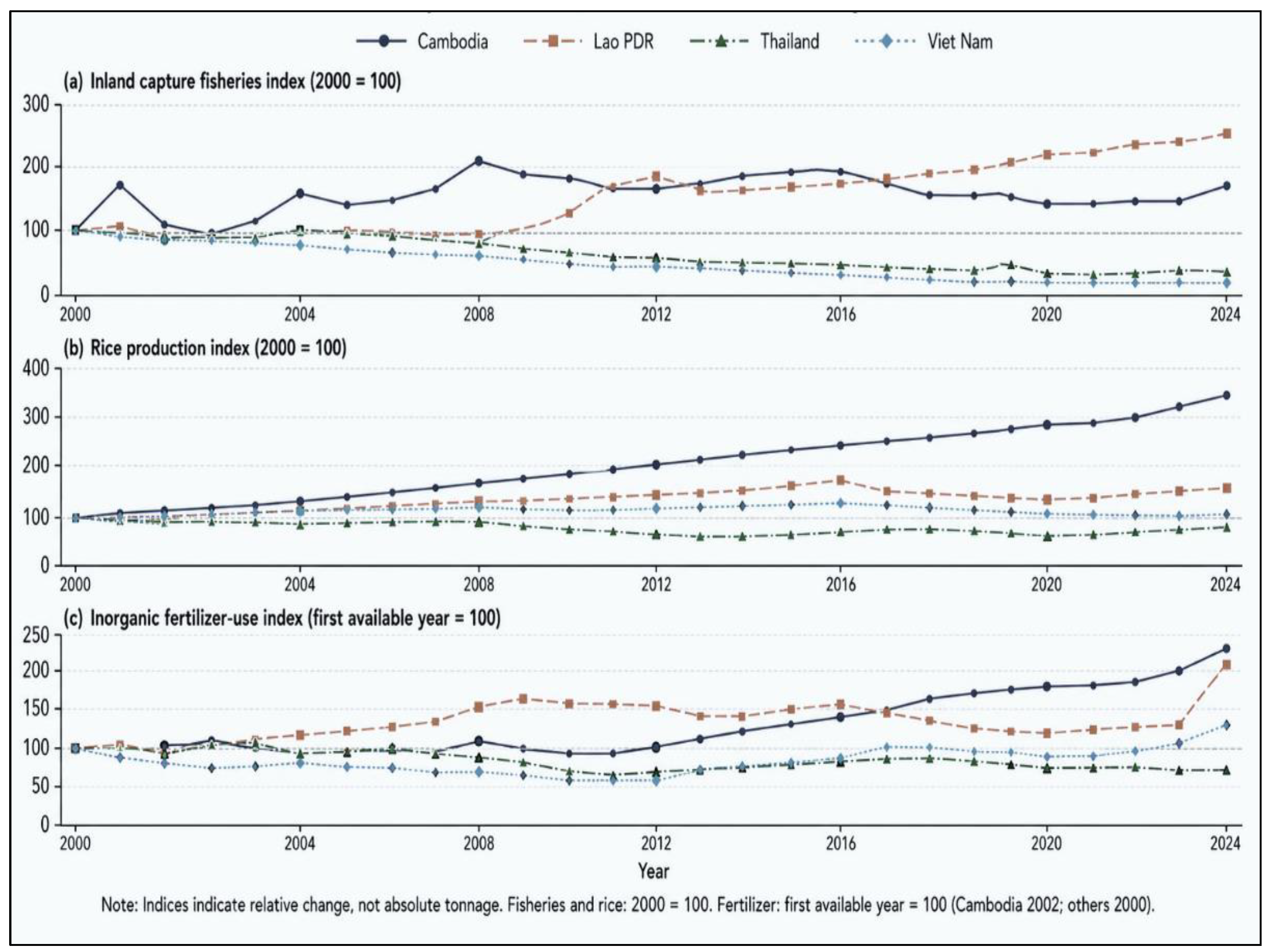
Figure 2.
Contrasting Trends in inland wild-fish catch (including rice-field fisheries), Aquaculture Production (including shrimp and fish), and high variety rice Production in the Vietnamese Mekong Delta, 1995–2024.
Figure 2.
Contrasting Trends in inland wild-fish catch (including rice-field fisheries), Aquaculture Production (including shrimp and fish), and high variety rice Production in the Vietnamese Mekong Delta, 1995–2024.
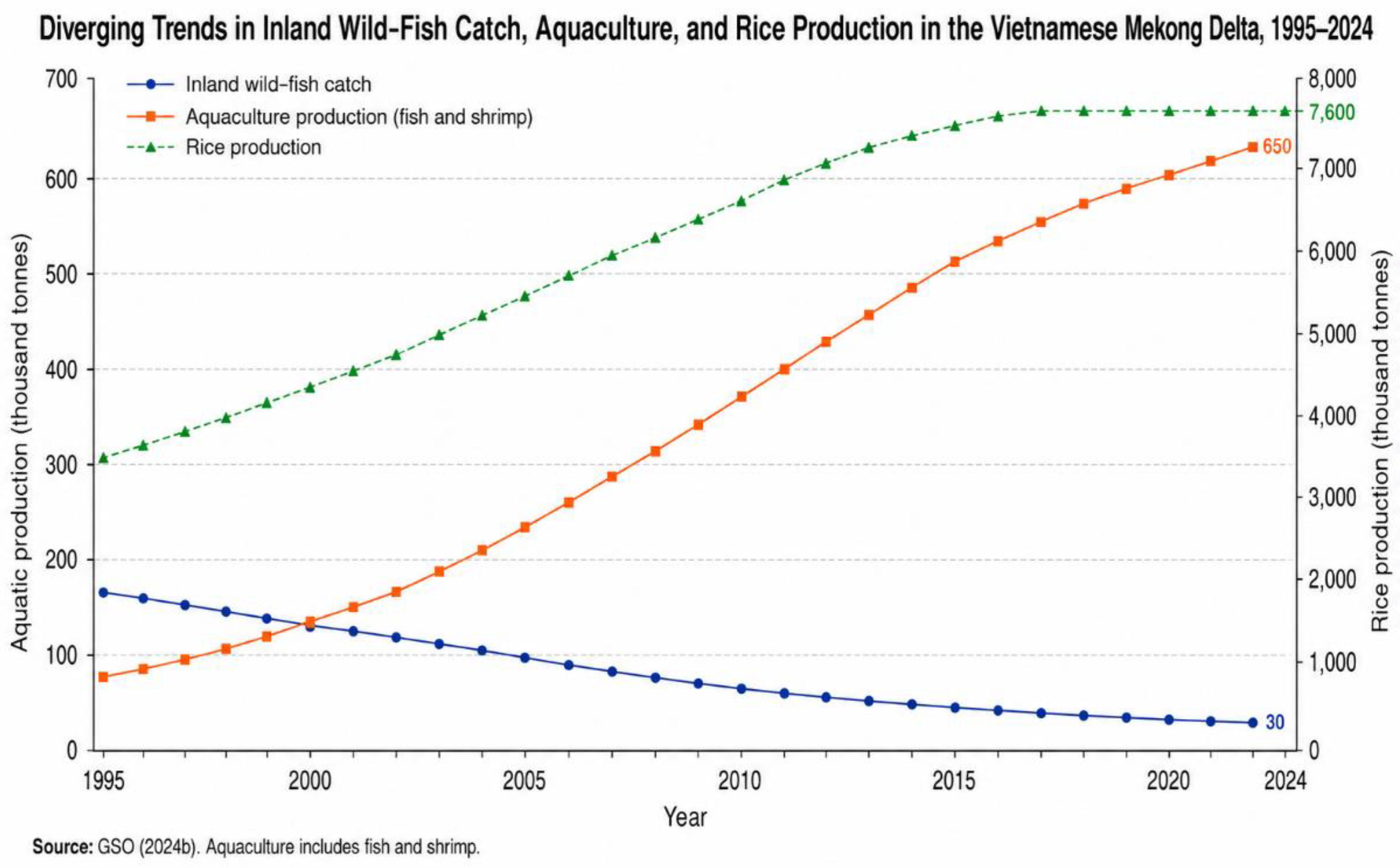

Table 1.
National trends in inland capture fisheries, rice production, harvested area, and fertilizer use, across four Lower Mekong Basin Countries, 2000–2024.
Table 1.
National trends in inland capture fisheries, rice production, harvested area, and fertilizer use, across four Lower Mekong Basin Countries, 2000–2024.
| Country | 2024 inland catch (t) | Catch change 2000–24 | Catch changes | Rice production change | Rice harvested-area change | Fertilizer-use change | Critical interpretation | References |
| Cambodia | 467,344 | 90.3% | 35.3% | 252.7% | 104.8% | 157.8% |
|
FAO FishStat (database) [54], Coates [55], FAO [56], Welcomme, et al. [57]. |
| Lao PDR | 78,795 | 169.4% | 142.2% | 70.4% | 26.9% | 252.6% |
|
Vu, Hortle and Nguyen [4], FAO FishStat (database) [54], Coates [55], FAO [56], Granger and Newbold [58], Phillips [59], Ziv, et al. [60]. |
| Thailand | 107,869 | -46.4% | -44.5% | 34.5% | 15.8% | 72.7% |
|
Vu, Hortle and Nguyen [4], Coates [55], FAO [56], Ziv, Baran, Nam, Rodríguez-Iturbe and Levin [60]. |
| Vietnam | 155,569 | -25.9% | -31.4% | 33.6% | -7.9% | 24.8% |
|
Kien, Pittock and Connell [9], Da, Lan, Labor, Long, Dinh, Tam, Vu and Berg [12], Berg, Lan, Tam, Trang, Van, Duc and Da [21], Granger and Newbold [58], Phillips [59], Tran, et al. [61]. |
Note: Vietnam • Cambodia • Lao PDR • Thailand | FAO FishStat and FAOSTAT | Updated analysis: 29 August 2026.
Table 2.
Major pollution and hydromorphological pressures affecting inland fisheries and aquatic systems in the Mekong Delta.
Table 2.
Major pollution and hydromorphological pressures affecting inland fisheries and aquatic systems in the Mekong Delta.
| Pressure | Sources and pathway | Evidence synthesized | Aquatic relevance and major gap |
| Flow and sediment alteration | Upstream reservoirs, sand extraction, groundwater withdrawal, high dykes | Long-term reductions in suspended sediment and localized channel incision [95,96,104]. | Changes habitat, fertility, turbidity, and delta stability; cumulative ecological thresholds remain uncertain |
| Nutrients and organic matter | Fertilizers, feed, livestock, pond water and sludge, processing and domestic wastewater | Pond budgets show limited nutrient recovery in fish and substantial sediment accumulation or discharge [78,105,106,107,108,109]. | Eutrophication, hypoxia, blooms, and disease risk; field-scale mass balances are sparse |
| Pesticides | Rice, orchards, aquaculture, household use; runoff, drainage, spray drift, discarded containers | Multiple residues found in water, sediment, and aquatic organisms; risk screening identifies compounds of concern [16,85,110,111,112]. | Acute and chronic mixture effects; event-based exposure and population consequences are poorly resolved |
| Antibiotic and pharmaceuticals and personal care products (PPCPs) | Aquaculture, livestock, hospitals, households, untreated wastewater | Farm use and residues documented in fish and shrimp production [113,114,115,116,117,118,119]. | Resistance selection and microbiome effects; limited environmental surveillance beyond selected antibiotics |
| Industrial and domestic effluent | Industrial zones, seafood processing, settlements, incomplete sewerage and treatment | Assessments identify capacity, compliance, finance, and institutional constraints [120,121]. | Oxygen demand, microbes, metals, and persistent chemicals; source attribution and public disclosure are limited |
| Plastics | Urban waste, packaging, fishing and aquaculture materials, wastewater | Macroplastics and microplastics reported in river sediments, water, fish, and shrimp [122,123,124]. | Physical and chemical effects remain uncertain; protocols and biologically relevant thresholds need standardization |
| Acid-sulfate-soil drainage | Canal excavation, raised beds, dry-season oxidation, first-flush runoff | Acidity and aluminium mobilization documented in soils and drainage [125,126,127]. | Gill and ion-regulation stress; event-based monitoring and treatment effectiveness need evaluation |
Table 3.
Categories of active ingredients and trade names of pesticides registered for agricultural use in Vietnam, 2020 (source: Ministry of Agriculture and Rural Development, 2020).
Table 3.
Categories of active ingredients and trade names of pesticides registered for agricultural use in Vietnam, 2020 (source: Ministry of Agriculture and Rural Development, 2020).
| Pesticide category | Active ingredients (n) | % of total | Trade names (n) | % of total |
| Insecticides | 861 | 46.6 | 1,821 | 43.1 |
| Fungicides | 587 | 31.8 | 1,282 | 30.3 |
| Herbicides | 241 | 13.0 | 702 | 16.6 |
| Rodenticides | 8 | 0.4 | 26 | 0.6 |
| Molluscicides | 31 | 1.7 | 151 | 3.6 |
| Growth regulators | 54 | 2.9 | 157 | 3.7 |
| Pheromones | 8 | 0.4 | 8 | 0.2 |
| Enhancers / wetting agents | 5 | 0.3 | 6 | 0.1 |
| Other | 52 | 2.8 | 76 | 1.8 |
| Total | 1,847 | 100 | 4,229 | 100 |
Table 3.
Selected national instruments and implementation priorities for integrated fisheries and pollution governance.
Table 3.
Selected national instruments and implementation priorities for integrated fisheries and pollution governance.
| Instrument | Primary contribution | Implementation priority for aquatic outcomes |
| Law on Fisheries No. 18/2017/QH14, consolidated 2024 [165] | Aquatic-resource protection, co-management, aquaculture requirements, environmental monitoring, licensing, and enforcement | Connect fisheries decisions to pollution sources, floodplain habitat, and provincial water-quality data |
| Law on Environmental Protection No. 72/2020/QH14 [166] | Environmental licensing, assessment, waste control, monitoring, disclosure, remediation, and liability | Translate permits into verified load reductions and transparent corrective action in shared canal systems |
| Resolution No. 120/NQ-CP [168] | Nature-based, climate-resilient development of the Mekong Delta | Use ecological subregions and seasonal hydrology to guide production, infrastructure, and restoration |
| Decision No. 287/QD-TTg [169]. | Regional plan for 2021-2030 with a vision to 2050 | Align provincial land, water, wastewater, fisheries, and climate investments with cumulative-impact indicators |
| Decision No. 339/QD-TTg [170] | Fisheries development strategy to 2030 with a vision to 2045 | Balance output and export goals with aquatic health, biosecurity, effluent performance, and small-scale livelihoods |
| Pesticide registration and phase-out decisions | Removal of selected highly hazardous active ingredients and promotion of safer production | Track replacement chemicals, actual field use, container disposal, aquatic exposure, and farmer transition costs |
| Law on Water Resources No. 28/2023/QH15 | Integrated quantity-quality management, river-basin planning, minimum flow, water-source restoration, water reuse, and connected information systems | Link water-source functions, environmental flows, discharge control, fisheries indicators, and polluted-water restoration across provincial boundaries |
| Decision No. 1316/QD-TTg on plastic-waste management | National source reduction, collection, reuse, recycling, treatment, and institutional coordination | Set measurable riverine, agricultural, fishing-gear, and aquaculture-plastic targets and disclose implementation outcomes |
Disclaimer/Publisher’s Note: The statements, opinions and data contained in all publications are solely those of the individual author(s) and contributor(s) and not of MDPI and/or the editor(s). MDPI and/or the editor(s) disclaim responsibility for any injury to people or property resulting from any ideas, methods, instructions or products referred to in the content. |
© 2026 by the authors. Licensee MDPI, Basel, Switzerland. This article is an open access article distributed under the terms and conditions of the Creative Commons Attribution (CC BY) license (http://creativecommons.org/licenses/by/4.0/).
Copyright: This open access article is published under a Creative Commons CC BY 4.0 license, which permit the free download, distribution, and reuse, provided that the author and preprint are cited in any reuse.