

Submitted:
20 September 2026
Posted:
22 September 2026
You are already at the latest version
Abstract
Altermagnetism has emerged as the third fundamental magnetic phase alongside ferromagnetism and antiferromagnetism, generating a rapidly growing literature that is increasingly difficult to curate by hand. Here we present a physics-grounded knowledge-base pipeline for altermagnetic materials that combines symmetry-based material seeding, layout-aware document reading, LLM-assisted extraction, auditing, and vector-database retrieval within a distributed inference stack. The workflow begins from crystallographically screened candidate materials, harvests relevant literature from arXiv, transforms papers into structure-preserving text representations, and finally builds validated records through either single-agent or crew-based extraction paths before serving grounded question answers over our knowledge base. Across benchmark tests at two model scales, our structured single and crew pipelines greatly outperform the bare LLM baseline in recovering paper-grounded values, with the smaller model remaining consistently faster. Our analysis shows that scientifically useful performance is driven primarily by structured retrieval and high-fidelity document reading, with agentic complexity acting as a secondary design choice rather than the central source of accuracy gains.
Keywords:
LLM model
; Altermagnets
; database
1. Introduction
Magnetism has been one of the most extensively studied phenomena in condensed matter physics for over a century, yet the traditional classification into two fundamental magnetic phases—ferromagnetism and antiferromagnetism—has recently been expanded by the theoretical identification and experimental confirmation of a third phase termed altermagnetism [1,2]. Altermagnets combine the vanishing net magnetization characteristic of antiferromagnets with the spin-split electronic band structure and anomalous transport properties typically associated with ferromagnets [3,4,5]. This unconventional combination arises from non-relativistic spin symmetries in which opposite-spin sublattices are related by crystal rotations or mirror operations rather than by inversion or translation, leading to a momentum-dependent alternating spin polarization that can exhibit d-wave, g-wave, or i-wave character [1,6,7]. The identification of this phase has spurred intense research activity, with experimental confirmations in materials such as MnTe [8], and theoretical predictions extending to hundreds of candidate compounds spanning metals, semiconductors, and insulators [2].
The rapidly expanding body of literature on altermagnetism poses a significant challenge for researchers seeking to maintain a comprehensive understanding of the field. Hundreds of papers now report on altermagnetic candidate materials, their electronic and transport properties, and potential device applications. Manually surveying, extracting, and organizing the relevant information—material compositions, symmetry types, measured or computed physical quantities, experimental methods, and theoretical frameworks—is becoming impractical. This bottleneck is not unique to altermagnetism; it reflects a broader crisis in scientific knowledge management across the sciences, where the volume of published literature far outpaces the capacity for manual curation [9,10,11].
Large language models (LLMs) have recently emerged as powerful tools for automating knowledge extraction from scientific text [12,13]. Retrieval-augmented generation (RAG) methods, which combine LLMs with external knowledge retrieval, have been shown to substantially reduce hallucination and improve factual grounding in domain-specific applications [14,15]. Multi-agent architectures, in which specialized LLM agents collaborate on complex tasks, have further demonstrated the ability to decompose and parallelize intricate reasoning processes [16,17]. In materials science specifically, LLMs have been applied to structured information extraction, property prediction, and hypothesis generation, establishing a growing ecosystem of AI-assisted research tools [11,18,19].
The central thesis of this work is a shift in where LLM reading work is done: from query time to ingestion time. PaperQA and its successor PaperQA2 [12,13] answer each user question by dispatching an agent to retrieve and read raw PDFs on demand, so every query re-incurs the cost and variance of full-document LLM reading. We instead perform all expensive multi-agent extraction, auditing, and schema-mapping offline, once per paper, yielding versioned structured records; query time reduces to an embedding lookup over those records followed by a single generation call. The resulting system is faster and cheaper per query and, because every answer is traceable to a specific record derived from a specific paper, it is auditable in a way that on-the-fly retrieval agents are not.
Beyond this core distinction, the present work differs from prior approaches along three further axes. First, rather than delegating extraction to a single general-purpose LLM, we employ a specialized multi-agent crew in which each expert agent reads the document with a focused domain-specific objective—deliberately mitigating the context-pollution and lost-in-the-middle failure modes that degrade accuracy when one model must simultaneously attend to theory, experiment, and methodology across a long document [20]. Second, in contrast to classical NLP pipelines based on named entity recognition and relation extraction—including domain-adapted transformer models [21] and rule-based toolkits such as ChemDataExtractor [22]—our LLM-agent approach requires no annotated training corpora and performs open-ended extraction unconstrained by predefined entity types or relation patterns; the resulting outputs are subsequently mapped into a structured schema by a dedicated structurer agent, combining the flexibility of free-form LLM reading with the consistency of schema-compliant records. This allows the system to naturally accommodate the structural heterogeneity of condensed-matter physics papers: multi-column layouts, inline mathematical expressions, conditional numerical statements, and rapidly evolving terminology. Third, unlike text-mining systems that operate on semantic content alone, our pipeline is physics-grounded: the candidate material space is seeded by symmetry-based screening of experimentally characterized magnetic structures with amcheck, ensuring that only crystallographically validated, physically consistent compounds enter the knowledge base before any LLM reads a single sentence.
In this work, we present an end-to-end framework—hereafter referred to as the Altermagnet Talking Database (ATD)—that leverages a multi-agent LLM crew to build, maintain, and query a structured knowledge base for altermagnetic materials directly from the scientific literature. This system integrates five key stages: (i) generation of a curated altermagnetic materials database through symmetry analysis of experimentally known magnetic structures; (ii) automated harvesting of relevant publications from arXiv with structure-aware PDF enrichment via Marker; (iii) a hierarchical multi-agent extraction pipeline in which domain-specialized chunk experts, expert leads, an integration agent, and a structurer agent collaboratively produce schema-compliant structured records, with material canonicalization, an LLM-backed hallucination guard, and post-integration quality control; (iv) a validation pipeline that fact-checks each record against the source text; and (v) embedding into a vector database and natural-language querying through a multi-phase retrieval-augmented generation interface with query classification, material-name expansion, hybrid semantic and structured retrieval, and tool-augmented answer generation. The pipeline supports batch ingestion of new literature from arXiv, enabling a continuously growing knowledge base. All model requests are routed through a distributed LLM inference fabric to workers on HPC nodes with cache-aware scheduling and admission control (described in Appendix A).
The remainder of this paper is organized as follows. Section 2 describes the construction of the altermagnetic materials database from MAGNDATA [23] using symmetry-based filtering. Section 3 details the corpus generation and structured output pipeline, including the multi-agent architecture for parallel paper processing. Section 4 presents the embedding and retrieval system that enables natural-language querying. Section 5 describes the batch update pipeline for incorporating new literature. Section 6 presents a controlled benchmark quantifying the accuracy gains from retrieval-augmented generation over plain LLM baselines at two model scales. Section 7 discusses the implications, limitations, and future directions. Appendix A presents the distributed LLM inference fabric that routes model requests across HPC nodes, and Appendix B provides technical details of the computational infrastructure and performance considerations. We refer to Figure 1, Figure 2, Figure 3 and Figure 4 throughout the text to illustrate the pipeline architecture, operation and performance.
2. Altermagnet Database Generation
The foundation of our knowledge base is a curated list of altermagnetic materials derived from experimentally characterized magnetic structures. We source the magnetic structures from MAGNDATA [24,25], the comprehensive database hosted on the Bilbao Crystallographic Server, which as of 2026 contains over 2,000 entries described using magnetic space groups and magnetic superspace groups in a standardized mcif format. MAGNDATA provides the crystallographic and magnetic structural information necessary for symmetry-based classification, including atomic positions, lattice parameters, and experimentally determined magnetic moment configurations obtained primarily from neutron diffraction studies.
To identify which of these magnetic structures are altermagnetic, we employ amcheck [26], an open-source symmetry analysis tool that determines whether a compensated collinear magnet is an antiferromagnet or an altermagnet based purely on its crystal structure and magnetic pattern. The tool operates by analyzing whether the symmetry operations relating the opposite-spin sublattices are trivial or altermagnetic. This approach relies exclusively on crystallographic and magnetic structural information, skipping the need for computationally expensive electronic structure calculations and making it well suited for high-throughput screening identifying around 198 altermagnet candidates [26,27].
Our screening pipeline proceeds as follows. We first download the full set of commensurate magnetic structures from MAGNDATA. Each structure is then passed to amcheck in an automated fashion, with spin designations assigned according to the magnetic moment directions recorded in the mcif files. The tool classifies each material as either antiferromagnetic or altermagnetic. The resulting altermagnet candidate list, which includes material identifiers, space group information, and magnetic configurations, forms the seed database that anchors the subsequent literature search. ArXiv queries are constructed both from this materials list (e.g., all:material) and from the keyword "altermagnet" to ensure coverage of newly reported compounds not yet represented in MAGNDATA.
3. Corpus Generation and Structured Output Pipeline
3.1. Literature Harvesting and Document Processing
With the altermagnetic materials list established, the next stage is to systematically collect and process the relevant scientific literature. We query the arXiv API using a two-pronged search strategy: first, we search for the keyword “altermagnet” (and its morphological variants) to capture papers that explicitly discuss altermagnetic phenomena; second, we search for the specific material names and chemical formulas present in our curated database to capture papers that study these materials even if they do not use the altermagnet terminology. The arXiv API returns metadata including titles, authors, abstracts, and arXiv identifiers, and we download the corresponding PDF files for all relevant results.
The downloaded PDFs are enriched via Marker, a structure-aware PDF parsing tool that extracts section boundaries, figure captions, table data, and inline mathematical expressions into structured markdown documents. Each paper is then chunked along logical boundaries—typically sections or subsections identified by Marker—into markdown segments of up to 8,000 characters, capped at 30 chunks per paper. Because chunk boundaries follow the document’s semantic structure rather than a fixed character offset, numerical values remain co-located with their units, surrounding caveats, and captioning context, and no overlap margin is required at the agent-input stage. A simpler page-based backend, which groups 3 PDF pages per chunk without section awareness, is retained as a control condition for the benchmark comparisons in Section 6. The resulting segments are stored in a database indexed by arXiv identifier; this document store serves as the persistent corpus on which the multi-agent processing crew operates. A finer-grained chunking ( 2,000-character segments with a 300-character overlap) is applied separately when building the retrieval index described in Section 4, where overlap guards against boundary effects at query time.
Table 1 summarizes the resulting corpus and the cost and quality of the four extraction configurations evaluated in this work. At the time of this writing, 1,709 papers were ingested and processed; 103 distinct materials from the MAGNDATA-derived candidate list are represented across the corpus, and the per-paper chunk count is tightly concentrated (median 5, 90th percentile 9–10) with a long tail up to 34 chunks on the longest reviews. Validation pass rates—defined as records judged either legitimate or acceptable with minor issues by the downstream auditor (Section 3.C)—exceed 99% in every configuration, while the harder legitimate tier alone ranges from 25.4% (plain crew) to 39.6% (marker single). The minor issues tier should not be read as content-level inaccuracy: these flags are predominantly QC-contract mismatches–coverage-threshold misses, schema-field formatting drift, or expected-vs-emitted key differences—rather than factual errors against the source paper. Such mismatches are an expected failure mode of multi-agent pipelines, where information can be dropped or subtly reshaped as it passes between expert, lead, integrator, and structurer stages, and where the QC contract itself must be kept in lockstep with each agent’s output schema; a mismatch indicates a contract-drift event to investigate, not a hallucination. Consistent with this interpretation, the minor issues rate is highest (73.6%) for the plain-crew configuration, which has both the most agent-to-agent hand-offs and the least structure-aware input, and lowest (60.2%) for the marker-single configuration, which has neither. The crew pipeline costs 7.7–25.9× more wall-clock time per paper than the single-agent baseline; the accuracy trade-off this buys is analyzed in Section 6.
3.2. Multi-Agent Paper Processing Crew
The core of the structured output generation is a multi-agent LLM crew designed to extract, validate, and integrate scientific information from each paper (Figure 1). The crew architecture comprises nine agents organized in a four-tier hierarchy: one orchestration agent, three domain chunk experts, three domain expert leads, one integration agent, and one structurer agent. This division of labor is a deliberate mitigation strategy for two well-documented failure modes of single-agent long-document processing: context pollution, in which irrelevant or tangential sections degrade extraction quality when a single model must jointly attend to an entire paper, and the lost-in-the-middle effect, in which long-context models systematically miss or distort key details that appear at mid-document positions [20]. By assigning each expert agent a focused, domain-specific reading objective, we reduce the effective context burden each agent must resolve, while the integration agent provides structured reconciliation of expert outputs rather than one-shot summarization of the full paper.
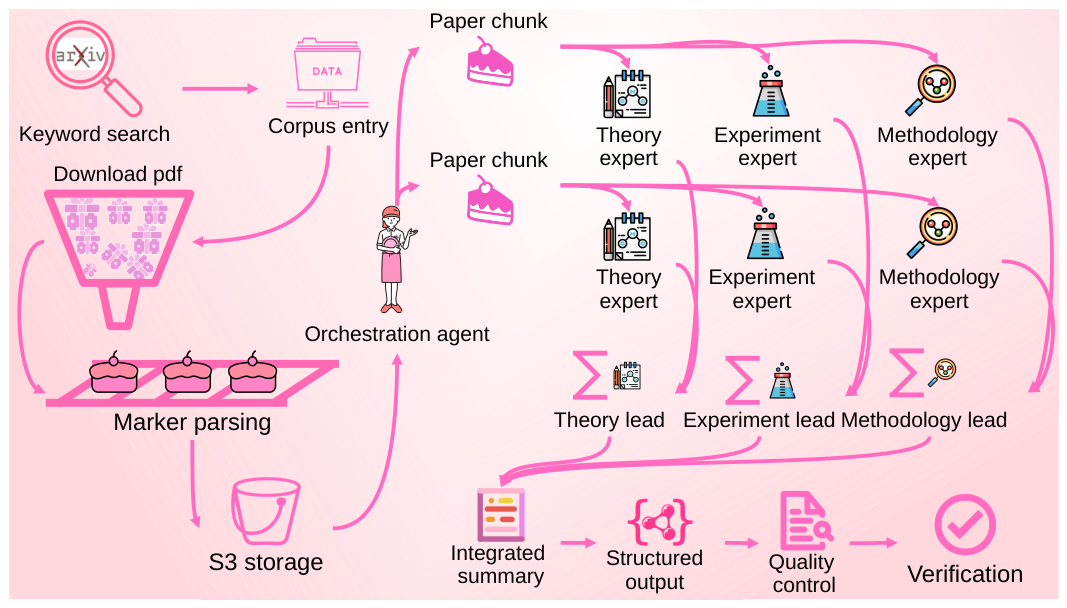
Figure 1.
Schematic of the corpus generation and structured output pipeline. Papers identified through arXiv keyword searches are entered into the corpus database, downloaded, and enriched via structure-aware PDF parsing (Marker), with parsed outputs stored in S3-compatible object storage. The orchestration agent distributes paper chunks to domain chunk experts (theory, experiment, methodology) operating in parallel across multiple chunks; domain-specific expert leads then refine and reconcile the chunk-level outputs into coherent domain-level summaries. An integration agent synthesizes the lead outputs into a unified structured summary, which is mapped into schema-compliant JSON by a structurer agent. The structured output passes through a quality control stage—comprising material canonicalization, an LLM-backed hallucination guard, and post-integration coverage checks—followed by a verification step that fact-checks each record against the source text before it enters the knowledge base.
The orchestration agent manages the overall workflow for each paper. It retrieves the parsed chunks from the document database and distributes the chunks to the appropriate expert agents. Critically, the chunks are dispatched to the expert agents in parallel to maximize throughput and minimize wall-clock processing time per paper.
The three domain expert agents process the distributed chunks concurrently. The theory expert focuses on extracting information related to theoretical frameworks, model Hamiltonians, symmetry analyses, predicted physical properties, and computed quantities such as band splittings and anomalous Hall conductivities. The experiment expert identifies and extracts experimental methods, measured quantities, sample preparation details, and reported numerical values such as Néel temperatures, lattice parameters, and transport coefficients. The methodology expert catalogs the computational and experimental techniques employed, including density functional theory parameters, basis sets, exchange-correlation functionals, neutron scattering configurations, and measurement setups (e.g. photoemission). Each expert agent is equipped with a tailored system prompt that encodes domain-specific vocabulary, expected output schemas, and instructions for handling ambiguous or incomplete information.To ensure reproducibility and transparency of the multi-agent pipeline, the exact system prompts used for the Theory, Experiment, Methodology, Integration, and Structurer agents are made publicly available in a dedicated GitHub repository [28]. Because the behavior of LLM-based agents is highly sensitive to prompt design, releasing these prompts enables full replication and auditing of the extraction and integration process.
The three domain-specific expert leads — one each for theory, experiment, and methodology — then refine and reconcile the chunk-level outputs into coherent domain-level summaries. The theory lead enforces consistency of predicted quantities such as band splittings and exchange couplings across the chunks; the experiment lead reconciles measured values, ensuring that Néel temperatures, lattice parameters, and transport coefficients are not duplicated or contradicted; and the methodology lead separates technique parameters (k-mesh, energy cutoff, basis set) from quantitative results, routing each to the appropriate output field. This lead-refinement stage reduces noise and redundancy before integration, providing the integrator with reconciled, domain-audited inputs.
The integration agent receives the three lead summaries and synthesizes them into a completeness-focused structured markdown document organized into mandated sections: bottom line, study type, tags, materials (with per-material sub-headers), numbers (labeled quantities with units), and sections (thematic subsections). This intermediate representation prioritizes content completeness without imposing JSON formatting constraints. A dedicated structurer agent then mechanically maps the markdown document into schema-compliant JSON records, applying field-level rules encoded in its system prompt together with JSON-schema validation on its output.
A natural alternative to this two-stage design would be to apply API-level constrained decoding [29,30] directly at the integration step, forcing the integrator to emit schema-valid JSON in a single call. We deliberately reject this design for two coupled reasons. First, the integrator markdown produced in practice is not always perfectly structured: expert-lead summaries occasionally contain mid-paragraph qualifications, conditional numerical statements, and ambiguous material references that resolve cleanly into prose but resist direct schema projection. A constrained-decoding integrator faced with such inputs is forced either to truncate content to fit the grammar or to emit schema-valid but semantically degraded records, since the only escape valve the constraint leaves open is content loss. Second, the integration step is by far the most expensive in the pipeline in input tokens, because it conditions on all three lead summaries simultaneously; any formatting failure at that stage wastes the full upstream cost of three parallel expert and lead passes. Splitting synthesis from schema mapping isolates these two failure modes: the integrator is free to optimize for content completeness in a permissive markdown target, and the cheap downstream structurer—operating on short, already-organized markdown rather than a full paper—carries the JSON-schema enforcement. When the structurer fails validation, only the structurer call is retried; the expensive multi-expert and integration tokens are preserved. In short, we use a dedicated structurer not as a substitute for constrained decoding but as the stage at which constrained decoding is cheapest and least content-destructive to apply.
In addition to the expert crew pipeline, the system supports a single-agent mode in which one researcher agent reads the paper as a single contiguous excerpt (up to 80,000 characters) and produces the structured JSON record directly, without chunk decomposition, lead refinement, or two-stage integration. This single-agent pipeline serves as a controlled baseline for evaluating the accuracy gains of the multi-agent architecture; see Section 6.
3.3. Quality Assurance Through Automated Auditing
A key design consideration is the reliability of the LLM-generated structured outputs. To address this, every record produced by the structurer agent passes through three safeguards before entering the knowledge base. First, material names are canonicalized into standardized forms and filtered through a two-stage material guard. A deterministic pass removes names that (i) are absent from the concatenated expert-lead role summaries, (ii) are flagged as cited-only or labelled non-studied, or (iii) match generic placeholders such as "material" or "system". Only names rejected under (i) are then passed to an LLM fallback that re-reads the source text and reinstates any whose absence from the role summaries was a formatting, Unicode, or formula-variant artifact; all other rejections are final (fail-closed). Across the 1,709 papers processed to date, the guard activated on 5.2% of papers under the plain-crew backend and 10.9% under the marker-crew backend, removing on average 0.11 and 0.20 candidate materials per triggered paper, respectively. The LLM fallback reinstated at least one deterministically-rejected material from only 0.12% (plain) and 0.37% (marker) of papers, confirming that the guard’s primary teeth are deterministic: the LLM is used to recover false-positive rejections, not to adjudicate inclusion, so sycophantic agreement between the extractor and auditor cannot quietly re-admit hallucinations. The roughly twofold-higher trigger rate under the marker backend reflects the richer candidate-material set produced by structure-aware parsing rather than a higher hallucination rate. Second, a post-integration quality-control stage enforces coverage constraints by comparing the final record’s materials, numerical values, and study-type labels against the lead-derived expectations from the expert lead stage, flagging records that fall below the configurable coverage thresholds. Third, a separate validation pipeline fact-checks each record against the original paper text: an LLM reads both the generated record and the source document, before producing a structured verdict indicating whether each field (materials, tags, numbers, bottom line) is verified or requires correction. Records that fail validation are flagged for reprocessing in subsequent batch runs.
4. Embedding, Retrieval, and Querying
Once the structured records and their associated markdown summaries have been generated and validated, they are prepared for embedding-based retrieval to enable natural-language querying of the knowledge base (Figure 2a).
The markdown summary for each paper is split into chunks of controlled size and embedded into a high-dimensional vector space using nvidia/llama-embed-nemotron-8b as the embedding model. The resulting vectors, along with the structured metadata tags (material name, arXiv ID, methods, and classification labels), are indexed in a Qdrant vector database. These metadata tags enable hybrid retrieval strategies that combine semantic similarity search with metadata filtering, allowing users to restrict queries to specific materials, methods, or property types.
When a user submits a natural-language query through the chat interface (Figure 2b), the system processes it through a multi-phase pipeline. A prompt normalization step first reformulates the query and expands material names into aliases, doping variants, and broader material classes, ensuring that relevant papers are not missed due to naming inconsistencies. A decision phase then classifies the query — distinguishing value questions (e.g., "What is the Néel temperature of MnTe?"), aggregation queries (e.g., "Which materials have the most publications?"), and general questions — to select the appropriate retrieval strategy. The expanded query is embedded and matched against the Qdrant vector database using semantic search; simultaneously, structured queries are issued against MongoDB to retrieve papers containing matching quantitative data (e.g., specific Néel temperatures or band splittings). For aggregation queries, a dedicated MongoDB aggregation pipeline replaces vector search entirely.
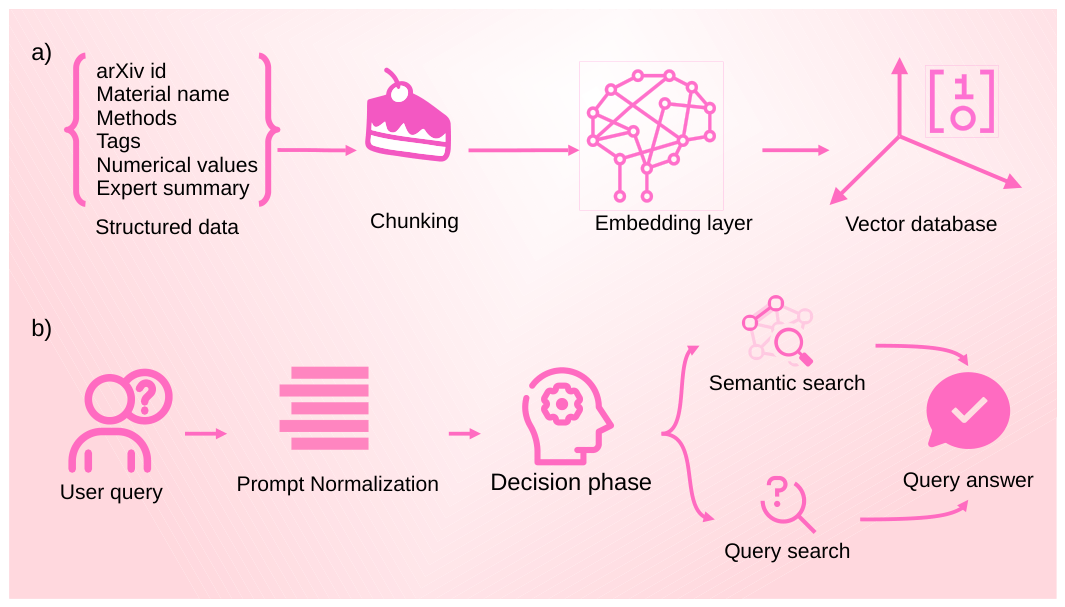
Figure 2.
Schematic of the embedding and retrieval pipeline. (a) Indexing: Structured records from each processed paper—including arXiv identifiers, material names, methods, tags, numerical values, and expert summaries—are split into controlled-size chunks, passed through an embedding layer, and indexed in a vector database alongside structured metadata. (b) Querying: At query time, a prompt normalization step reformulates the user question and expands material names into aliases, doping variants, and broader material classes. A decision phase then routes the query to semantic search (vector matching against the embedded chunks) or structured query search (numeric and metadata lookups in MongoDB), or both; for aggregation questions a dedicated MongoDB pipeline is used instead. Retrieved context is passed to the answer-generation LLM, which can invoke database tool calls for follow-up lookups, ensuring contextually grounded, corpus-constrained answers.
The retrieved context — combining semantic chunks and structured records — is passed to the answer-generation LLM, which may additionally invoke database tool calls for follow-up lookups when the initial context is insufficient. By anchoring every response in the pre-processed, validated knowledge base rather than relying on the LLM’s parametric knowledge, this approach ensures corpus-constrained, low-hallucination answers with traceable provenance. An example interaction is shown in Figure 3, where a user queries the Néel temperature of MnTe and the system returns a grounded answer citing multiple source papers with consistent values extracted from the knowledge base.
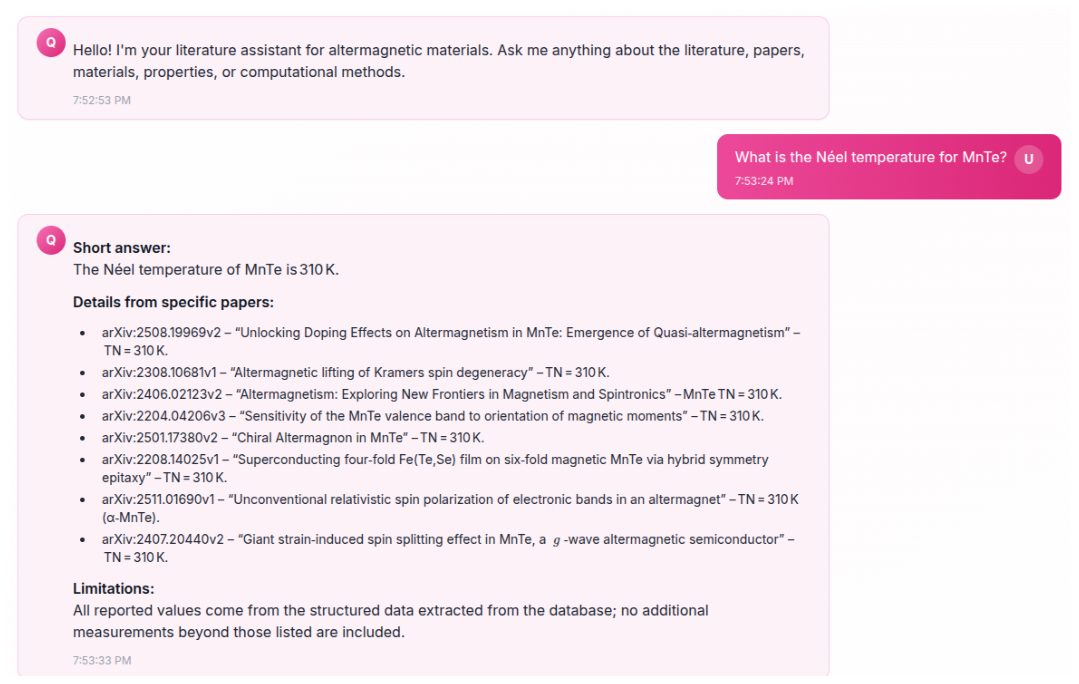
Figure 3.
Illustration of the user interface. A user submits a question about altermagnetic materials, and the system returns a grounded answer synthesized from the pre-processed knowledge base, with references to the source papers.
Figure 3.
Illustration of the user interface. A user submits a question about altermagnetic materials, and the system returns a grounded answer synthesized from the pre-processed knowledge base, with references to the source papers.
5. Database Update Pipeline
A key design goal of our Altermagnet Talking Database is that every stage of the pipeline — from arXiv querying through PDF download, parsing, multi-agent processing, auditing, and embedding — is fully scriptable and requires no manual intervention within a given run. This end-to-end automation enables straightforward scheduling of periodic updates via standard mechanisms such as cron jobs or CI/CD pipelines.
A typical update cycle proceeds as follows. The arXiv ingestion pipeline is invoked with the current material list and the altermagnet keyword, downloading and parsing any papers not already present in the document database. New papers are processed through the full multi-agent crew pipeline, and the resulting structured records are audited and embedded into the vector database. The altermagnet material list can also be refreshed by re-running the MAGNDATA screening with amcheck to incorporate newly deposited magnetic structures, after which additional arXiv searches are triggered for any newly identified candidate materials. Because each stage is idempotent — the ingestion pipeline skips already-indexed papers, and the Marker and crew pipelines skip already-processed documents — repeated runs naturally extend the knowledge base without reprocessing existing content.
This design transforms the knowledge base from a static resource into one that can be kept current with the rapidly evolving altermagnet literature through periodic batch updates, while the automated auditing layer maintains data quality throughout the growth process.
6. Benchmarks
To quantify the benefit of grounding LLM responses in the pre-processed knowledge base, we conducted a controlled benchmark comparing five configurations: (1) a plain LLM baseline with no retrieval context, and a full 2×2 ablation over extraction architecture and PDF parsing— (2) plain single, and (3) marker single, which retrieve from records produced by the single-agent extraction pipeline using raw page text and Marker-enriched input respectively, (4) plain crew, and (5) marker crew, the corresponding variants of the multi-agent expert crew pipeline. Comparing the single and crew variants at fixed PDF input isolates the effect of the multi-agent architecture, while comparing plain and marker variants at fixed extraction architecture isolates the effect of structure-aware PDF parsing.
A benchmark set of 235 questions was generated through a test-isolated procedure designed to avoid circularity with the extraction pipeline. For each benchmark item, an independent LLM agent—separate from the extraction crew and with no access to the structured records—reads the full source paper end-to-end, locates a numerical result reported therein, and produces both a natural-language question targeting that quantity and the corresponding ground-truth value sourced directly from the paper text. The LLM generated ground-truth values are also spot checked to use the human approved values for the test. The structured database is used only to sample which material–property pairs to probe; the reference answers themselves are regenerated per evaluation from the primary source, so the benchmark measures the end-to-end pipeline (extraction, indexing, and retrieval-augmented answering) against the underlying literature rather than against its own records. Two accuracy metrics were evaluated: whether the returned numeric value falls within of the ground truth (within-10%), and whether the exact ground-truth value appears verbatim in the response (exact). The experiment was run on two open-source models: gpt-oss:20B ( GB, single consumer GPU) and gpt-oss:120B (multi-GPU server) see Appendix B for details.
The results (Figure 4) show that all four RAG configurations substantially outperform the plain LLM baseline at both model scales. The largest accuracy jump occurs between the plain LLM and any RAG backend: for the 20B model, within-10% accuracy rises from 39.6% to 82.6–85.5%, and exact accuracy from 11.1% to 66.4–70.6%; for the 120B model, within-10% rises from 54.9% to 85.1–87.7% and exact from 20.9% to 66.4–71.9%. Among the RAG backends, the multi-agent crew provides a small advantage over the single-agent baseline on within-10% accuracy ( 1 pp at both scales), but is essentially tied with the single-agent pipeline on exact-match, suggesting that both extraction architectures produce comparably useful structured records for downstream question answering (see Section 7 for analysis). Structure-aware PDF parsing via Marker yields a similarly modest improvement: marker crew outperforms plain crew by 1–2 percentage points on within-10% and 2–4 percentage points on exact accuracy, with the advantage most pronounced on exact-match retrieval where precise numerical values and units must be reproduced verbatim.
A striking finding is the asymmetry of the RAG benefit across model scales. Without the knowledge base, the 20B model trails the 120B model by 15 percentage points on within-10% accuracy (39.6% vs. 54.9%); with marker crew, this gap shrinks to 2 percentage points (85.5% vs. 87.7%). A consumer-grade GPU hosting the 20B model paired with the marker crew knowledge base achieves 85.5% within-10% accuracy—substantially exceeding the 54.9% achieved by the unaugmented 120B model on a multi-GPU cluster. The structured knowledge base thus largely compensates for a six-fold reduction in model parameters, substantially lowering the computational requirements for high-quality scientific question answering.
Throughput decreases with retrieval but remains within interactive range. On the 20B model, the plain LLM processes 11.9 queries/s whereas the RAG configurations operate at 2.0–2.8 queries/s ( 0.4 s per query). On the 120B model, plain LLM throughput is 3.0 queries/s and the RAG configurations fall to 0.4–0.6 queries/s ( 1.7–2.5 s per query); the slowest backend, marker crew, thus stays under three seconds per query, well within conversational latency for a research chat interface.
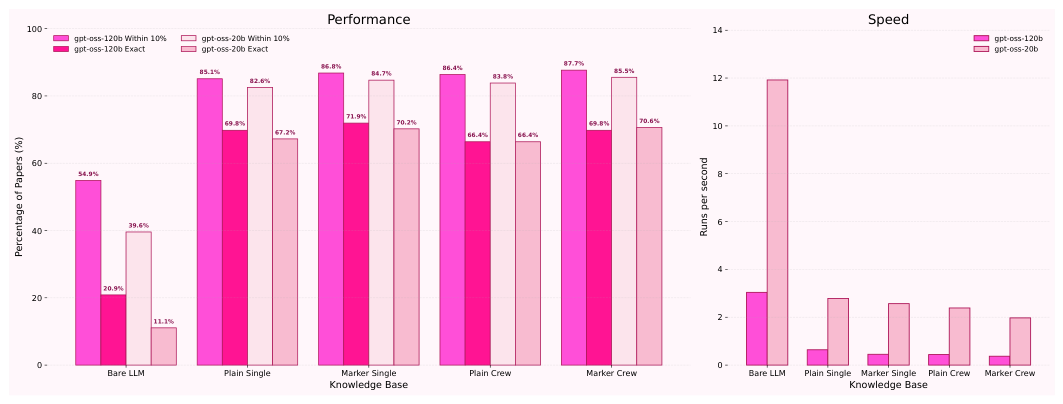
Figure 4.
Benchmark results across 235 questions at two model scales (gpt-oss:20B and gpt-oss:120B). Left and center panels: Accuracy for the five configurations measured by within- and exact-match metrics shown as paired bars. All RAG configurations substantially outperform the plain LLM; marker-enriched backends achieve the highest accuracy, with single- and multi-agent pipelines closely matched. Right panel: Query throughput in queries per second.
7. Discussion
The benchmarks in Section 6 confirm the efficacy of the central design thesis of our Altermagnet Talking Database: grounding LLM responses in a pre-processed, physics-constrained knowledge base substantially improves factual accuracy and nearly eliminates the performance gap between small and large models. Several design principles and empirical findings merit discussion. In contrast to approaches that process the raw literature on the fly in response to each user query [12,13], our pipeline front-loads the expensive extraction and validation work. This offline front-loading yields three compounding advantages: low query-time latency, since retrieval at inference reduces to a single embedding lookup and one generation call; deterministic versioning of the knowledge base, since the structured records represent a fixed, audited snapshot that does not change with each query; and the ability to enforce quality gates—unit verification, internal consistency checks, and contradiction detection—before any answer is ever served to a user. Because the structured records and vector embeddings persist independent of the LLM, the knowledge base remains accessible across model upgrades and service interruptions without data loss. Every response is traceable to specific publications and specific claims within those publications—a critical advantage in a scientific context where factual accuracy and attribution are paramount.
A distinguishing architectural feature of our approach is that it is physics-grounded rather than purely text-driven. Conventional literature-mining pipelines—LLM-based or otherwise—operate on semantic content alone, leaving them susceptible to ingesting speculative predictions, keyword-driven false positives, and hallucinated entities that are not physically realizable. By anchoring the material candidate space in symmetry-constrained, experimentally characterized magnetic structures from MAGNDATA and applying the amcheck symmetry analysis before any LLM processes a single paper, our pipeline enforces hard physical constraints as a first-pass filter. This grounds the knowledge base in established crystallographic reality, ensuring that the LLM-extraction stage operates on a well-defined, physically consistent input space. The design is therefore best characterized as AI augmented by hard physical constraints rather than unconstrained semantic inference—a distinction that substantially reduces the risk of populating the knowledge base with physically implausible entries.
Our multi-agent crew architecture is a hypothesis-driven design choice to address the known failure modes of single-agent long-document extraction schemes. Context pollution and the lost-in-the-middle effect [20] limit extraction accuracy when one model must simultaneously resolve theory, experiment, and methodology content from a full-length physics paper. Specializing our three expert agents to a narrower set of objectives reduces the effective context burden on each agent, while the integration agent enforces structured reconciliation across all three expert outputs. The controlled benchmark in Section 6 reveals a metric-dependent picture: the multi-agent crew pipeline gains roughly 1 percentage point over the single-agent baseline on within-10% accuracy, but is essentially tied with—and on the 120B model slightly behind—the single-agent pipeline on exact-match, where marker single reaches the highest exact accuracy observed (71.9%). This result constrains the claims that can be made for the multi-agent design: for the specific task of extracting structured records queried via RAG, a single well-prompted agent reading the full paper captures comparable information, with the crew’s benefit concentrated at coarser numerical tolerance rather than at verbatim reproduction. The multi-agent architecture may still offer advantages not captured by the current benchmark: greater robustness on very long or structurally complex papers where context-window limits force aggressive truncation in the single-agent path, better interpretability through domain-separated intermediate outputs that can be independently inspected and debugged, and potentially higher extraction completeness—whether every numerical value and material in the paper was captured—which our benchmark does not assess, since it evaluates accuracy at the record level through downstream QA rather than measuring recall of the source content. Designing completeness-oriented benchmarks is a clear direction for future work.
Perhaps the most practically significant finding from the benchmarks is that structure-aware PDF parsing via Marker and the choice of extraction architecture contribute modest, approximately comparable accuracy gains— 1–2 pp on within-10% and 2–4 pp on exact accuracy for Marker at fixed extraction architecture, and 1 pp on within-10% with essentially no exact-match gain from the crew pipeline. Neither lever dominates, and both are dwarfed by the jump from plain LLM to any RAG backend ( 30–45 pp). This suggests that the primary bottleneck in literature-to-knowledge-base pipelines is whether a structured, pre-extracted knowledge base is consulted at all; secondary gains come from the fidelity of the document representation fed to the extractor. Marker’s ability to resolve section boundaries, preserve inline mathematical expressions, disentangle multi-column layouts, and extract table structures with proper column alignment provides downstream agents—whether one or nine—with cleaner representations of the source text. The advantage is most pronounced on exact-match retrieval, where precise numerical values with their units and measurement conditions must survive the full extraction pipeline intact: when the PDF parser drops a subscript, merges adjacent columns, or truncates a table row, even a perfect LLM agent cannot recover the lost information. For factual, value-oriented scientific question answering, investment in document parsing infrastructure therefore yields returns roughly on par with further sophistication of the agent architecture, while the single largest return comes from having a structured knowledge base at all.
Looking beyond information retrieval, the structured records in the knowledge base open a natural pathway toward automated computational workflows. Each record stores not only material identifiers and reported physical properties but also the computational parameters used to obtain them—exchange-correlation functionals, plane-wave cutoffs, k-mesh densities, and basis-set specifications—alongside crystallographic data anchored in MAGNDATA. This information is precisely what is needed to initialize first-principles calculations: crystal structures can be reconstructed from the stored structural data, and DFT input files can be generated using the extracted computational parameters as starting points. Recent work on autonomous DFT agents, notably VASPilot [31], has demonstrated that multi-agent frameworks built on CrewAI and the Model Context Protocol can fully automate VASP workflows—from structure retrieval and input-file generation through Slurm job submission, error parsing, and parameter adjustment. Coupling the Altermagnet Talking Database to such an autonomous simulation agent would create a closed loop in which literature-extracted knowledge seeds new calculations, and the results of those calculations feed back into the knowledge base, enabling systematic computational validation of reported properties and exploration of materials that have been predicted but not yet computed.
More broadly, our LLM-agent framework stands in deliberate contrast to classical materials NLP pipelines based on named entity recognition and relation extraction [21] or rule-based chemical data toolkits such as ChemDataExtractor [22]. These approaches are powerful within their design envelopes but require fixed extraction schemas and, for supervised models, annotated training corpora that are costly to produce for specialized subfields. They also struggle with the structural heterogeneity of condensed-matter physics papers: multi-column layouts, inline LaTex mathematical expressions, tables with compound column headers, and conditional numerical statements that embed measurement conditions alongside reported values. Our LLM-agent approach is schema-flexible—new structured fields can be introduced by adjusting agent system prompts without retraining—and semantically richer, capturing measurement conditions, caveats, and provenance alongside extracted numerical values. We are candid, however, that LLM-based extraction is not inherently more reliable; our contribution is the end-to-end system design—multi-agent specialization, automated auditing, and physics-grounded material seeding—that makes large-scale LLM extraction tractable and auditable in a scientific context.
Our framework also presents limitations and opportunities for improvement. The integration agent remains a throughput bottleneck; future work could explore hierarchical integration strategies or streaming synthesis to reduce per-paper latency. The multi-agent crew pipeline, while offering interpretability and potential completeness advantages, incurs higher per-paper processing cost than the single-agent baseline for only a modest downstream accuracy gain on value-oriented questions; the cost-benefit tradeoff may favor the simpler pipeline for resource-constrained deployments. The current auditing mechanism, while effective for catching obvious errors, cannot guarantee the correctness of every extracted value; incorporating cross-paper consistency checks and comparison with established databases could further improve reliability. The strong dependence of answer accuracy on Marker parsing quality implies that the system’s performance ceiling is partly set by the PDF parser; papers with scanned-only pages, image-heavy layouts, or unusual formatting may produce lower-fidelity structured records regardless of agent sophistication. The benchmark evaluates 235 value-oriented questions with numeric ground truths; accuracy on qualitative, multi-hop, or comparative queries remains to be assessed. Additionally, extending the corpus beyond arXiv to include content from journals with restrictive access policies would broaden coverage but requires addressing copyright and access considerations. The distributed LLM inference fabric (Section A) addresses the immediate throughput and availability requirements, but its brokered architecture introduces operational complexity; simplifying deployment and reducing the number of infrastructure dependencies is an area for future engineering effort. Finally, while the current system is specialized for altermagnetic materials, the architecture is domain-agnostic and could be adapted to any subfield of materials science or condensed matter physics by replacing the material database seed and adjusting the expert agent prompts.
8. Conclusions
We have presented the Altermagnet Talking Database, an end-to-end framework for constructing, maintaining, and querying a structured knowledge base for altermagnetic materials directly from the scientific literature. The system combines symmetry-based material screening via MAGNDATA and amcheck, multi-agent parallel paper processing with domain-specialized experts and a two-stage integrator–structurer pipeline, automated quality auditing through material guards and LLM-driven validation, and a multi-phase retrieval-augmented generation interface for natural-language querying. A distributed LLM inference fabric routes all model traffic to remote vLLM workers on HPC nodes, providing the throughput and reliability required for corpus-scale processing.
A controlled benchmark on 235 questions at two model scales reveals three key findings. First, grounding responses in the pre-processed knowledge base raises within-10% accuracy from 39.6–54.9% (plain LLM) to 82.6–87.7% (RAG), with the smaller 20B model benefiting disproportionately—nearly closing the gap to the unaugmented 120B model and demonstrating that offline knowledge bases can substantially offset the need for large-scale compute. Second, structure-aware PDF parsing via Marker and the choice of extraction architecture contribute comparable, modest gains—∼1–2 pp on within-10% and ∼2–4 pp on exact accuracy for Marker, and ∼1 pp on within-10% with essentially no exact-match gain from the multi-agent crew over the single-agent baseline—with the jump from plain LLM to any RAG backend dwarfing both. Third, the multi-agent and single-agent extraction architectures produce comparably accurate structured records for value-oriented question answering, with the crew’s advantage concentrated at coarser numerical tolerance rather than at verbatim reproduction; the multi-agent design retains potential advantages in interpretability, robustness on long documents, and extraction completeness that merit further investigation.
By front-loading knowledge extraction into pre-processed, audited structured records, the framework achieves low-hallucination and traceable responses grounded in the primary literature. The modular, domain-agnostic architecture positions this approach as a template for AI-assisted knowledge management across materials science and beyond.
Acknowledgments
The authors acknowledge the Texas Advanced Computing Center (TACC) at The University of Texas at Austin for resources made available to NIST under contract number 1333ND25PNB180410. The authors acknowledge computational resources provided by the National Energy Research Scientific Computing Center (NERSC). The work at Northeastern University was supported by the National Science Foundation through the Expand-QISE award NSF-OMA-2329067 and benefited from the resources of Northeastern University’s Advanced Scientific Computation Center, the Explorer Cluster, the Massachusetts Technology Collaborative award MTC-22032, and the Quantum Materials and Sensing Institute. S.C. and S.E. acknowledge the support provided by the National Science Foundation through the ExpandQISE award No. 2329087. S.M. was supported by the U.S. Department of Energy (DOE), Office of Science, and Basic Energy Sciences under Award No. DE-SC0022216. The research at Howard University used the resources of Accelerate ACCESS PHYS220127 and PHYS2100073. Figure icons were sourced from SVG Repo (https://www.svgrepo.com). Unless otherwise noted, all NIST work was funded solely by the US government. We identify certain commercial equipment, instruments, and materials in this article to specify adequately the experimental procedures. In no case does such identification imply recommendation or endorsement by the National Institute of Standards and Technology nor does it imply that the materials or equipment identified are necessarily the best available for the purpose.
Appendix A. Distributed LLM Inference Fabric
Processing hundreds of papers through a nine-agent crew pipeline, each requiring multiple LLM calls per stage, generates a sustained high volume of inference requests. The multi-agent extraction pipeline issues parallel calls for chunk experts, expert leads, the integrator, and the structurer, while the validation pipeline and material guard contribute additional LLM invocations per paper. When operating at corpus scale—processing hundreds of papers with configurable concurrency at both the paper and chunk level—the system can saturate a single GPU-hosted model endpoint, leading to queuing delays, timeouts, and reduced throughput. Moreover, the HPC environments hosting LLMs are often geographically distributed and subject to intermittent availability, making reliable connectivity a first-order engineering concern.
To address these requirements, we developed a distributed LLM inference fabric that decouples the pipeline from any single model endpoint (Figure A1). The fabric exposes an OpenAI-compatible HTTP API, allowing the multi-agent pipeline, the validation system, and the chat interface to issue standard /v1/chat/completions and /v1/embeddings requests without awareness of the underlying worker topology. Internally, the fabric comprises four microservices coordinated through a NATS message broker.
Figure A1.
Architecture of the distributed LLM inference fabric. The API gateway receives OpenAI-compatible requests from the multi-agent pipeline, validation system, and chat interface. A scheduler selects the best available worker using cache-aware, site-aware routing informed by real-time worker state maintained in Redis by the registry service. Worker agents deployed on HPC nodes connect outbound to the central NATS broker over WebSocket, forwarding inference requests to local vLLM instances and streaming responses back through NATS. Admission control at the gateway and per-worker concurrency budgets at the scheduler prevent overload. Prometheus and Grafana provide real-time observability of request rate, latency, and per-worker utilization.
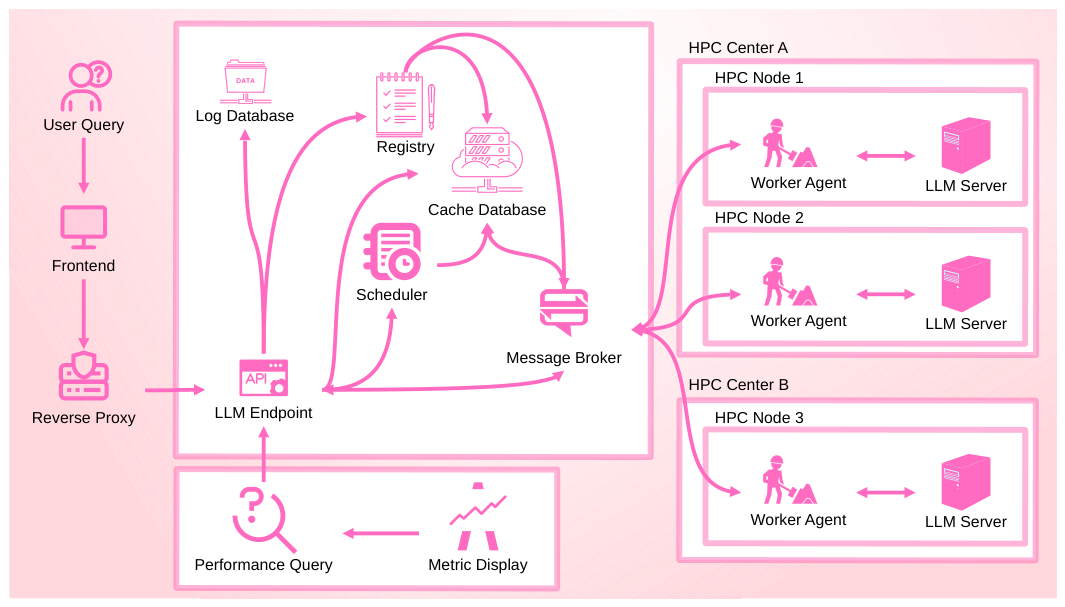
The API gateway is a FastAPI service that receives client requests, calls the scheduler for worker selection, publishes inference requests to NATS, and streams token-by-token responses back to the caller. The gateway enforces admission control—configurable limits on concurrent in-flight requests (globally and per model)—and returns 429/503 responses with Retry-After headers when the system is at capacity. Per-tenant rate limiting provides fairness when multiple pipeline instances share the fabric.
The scheduler is a stateless selection service that, given a model name and optional session metadata, returns the best available worker. The default scheduling policy is cache-aware and site-aware: it preferentially routes requests to workers whose vLLM key–value cache already contains relevant prefix context, reducing time-to-first-token for repeated or related queries. Workers whose in-flight count has reached their declared concurrency budget are skipped, preventing KV-cache eviction cascades on overloaded GPUs.
The registry is a NATS subscriber that maintains real-time worker state in Redis. Each worker agent publishes periodic heartbeat and health-status messages; the registry updates per-worker metadata (model list, queue depth, health, site label) and expires stale entries via configurable TTLs. The API and scheduler read from this shared Redis state to make routing decisions.
The worker agent is a lightweight process deployed alongside each vLLM instance on HPC nodes. The agent connects outbound to the central NATS broker over WebSocket, registers its available models and capabilities, and subscribes to an inference request subject keyed by its worker ID. On receiving a request, it forwards it to the local vLLM server and publishes response chunks back through NATS. This outbound-only connectivity model avoids the need to open inbound ports on HPC firewalls, simplifying deployment in secured cluster environments. Worker agents can be deployed via systemd, Docker, shell scripts, or Slurm job submissions.
Our brokered architecture provides several operational advantages for corpus-scale processing. Adding GPU capacity requires only starting a new worker agent pointed at the central NATS URL; the registry detects it within one heartbeat interval and the scheduler begins routing requests to it immediately. Conversely, when a worker becomes unhealthy (e.g., the underlying vLLM process crashes or a GPU develops an error), the registry marks it as unavailable and the scheduler removes it from the candidate pool. If a worker times out or returns an error during inference, the API places it in a configurable cooldown period during which no new requests are routed to it, preventing cascading failures.
Observability is provided through Prometheus metrics exported by the API gateway—request rate, latency percentiles, token throughput, and per-worker utilization—visualized in a pre-provisioned Grafana dashboard. These metrics are used both for real-time monitoring during batch processing runs and for capacity planning when scaling the worker pool for large corpus updates.
In our deployment, the fabric serves openai/gpt-oss-120b model distributed across multiple HPC nodes, with the multi-agent pipeline configured to process papers with concurrent workers at both the paper and chunk levels. The same fabric simultaneously serves the embedding model, nvidia/llama-embed-nemotron-8b, used for Qdrant indexing and the chat-interface query pipeline, consolidating all LLM and embedding traffic through a single gateway with unified admission control and monitoring.
Appendix B. Technical Details
The computational backbone of the pipeline is built around locally hosted open-source LLMs to ensure data independence, reproducibility, and cost control. We use gpt-oss:120B as the primary LLM for all agent tasks—chunk experts, expert leads, the integrator, the structurer, the material guard, the validation pipeline, and response generation—served through the distributed inference fabric described in Appendix A. The embedding model is nvidia/llama-embed-nemotron-8b, selected for its strong performance on semantic similarity benchmarks in scientific text. The document store is implemented in MongoDB, chosen for its flexible schema-free JSON document model that naturally accommodates the heterogeneous structure of parsed scientific papers. The vector database is Qdrant, which provides efficient approximate nearest-neighbor search with support for metadata-filtered queries.
Inference performance is critically dependent on the hardware configuration and numerical precision support. On a 4×H100 GPU node at TACC, the 120B-parameter model runs with MXFP4 (Microscaling Floating Point 4-bit) precision—a hardware-accelerated format native to the Hopper architecture’s Transformer Engine—achieving approximately 30,000 tokens per second of aggregate throughput. On a 4×A100 (80 GB) node at NERSC, the same model must run at higher numerical precision because the Ampere architecture lacks native MXFP4 support, resulting in approximately 3,000 tokens per second—a tenfold reduction. This hardware-dependent performance gap underscores the importance of matching GPU architecture to low-precision inference capabilities for LLM-intensive scientific pipelines. All benchmark results reported in Section 6 were obtained using the NERSC A100 configuration.
The pipeline is designed for maximum parallelism. Multiple papers are processed concurrently (configurable via the number of paper workers), and within each paper, chunk-level expert extraction runs in parallel across the three domain experts. However, the expert lead refinement stage must wait for all chunk outputs, and the integrator must wait for all lead summaries, introducing sequential dependencies that bound the minimum per-paper processing time. For long papers, the number of chunks (determined by a configurable pages-per-chunk ratio) and the per-chunk character budget must be managed to avoid exceeding the context window limits of the expert and integration agents.
The pipeline’s modular, CLI-driven design allows each stage—arXiv ingestion, Marker enrichment, multi-agent extraction, validation, and Qdrant indexing—to be triggered independently or composed into end-to-end batch runs. This facilitates debugging, selective reprocessing of failed records, and incremental updates to the knowledge base.
References
- Šmejkal, L.; Sinova, J.; Jungwirth, T. Beyond conventional ferromagnetism and antiferromagnetism: A phase with nonrelativistic spin and crystal rotation symmetry. Phys. Rev. X 2022a, 12, 031042. [Google Scholar] [CrossRef]
- Šmejkal, L.; Sinova, J.; Jungwirth, T. Emerging research landscape of altermagnetism. Phys. Rev. X 2022b, 12, 040501. [Google Scholar] [CrossRef]
- Šmejkal, L.; González-Hernández, R.; Jungwirth, T.; Sinova, J. Crystal time-reversal symmetry breaking and spontaneous Hall effect in collinear antiferromagnets. Sci. Adv. 2020, 6, eaaz8809. [Google Scholar] [CrossRef] [PubMed]
- Mazin, I. I.; Koepernik, K.; Johannes, M. D.; González-Hernández, R.; Šmejkal, L. Prediction of unconventional magnetism in doped FeSb2. Proc. Natl. Acad. Sci. U.S.A. 2021, 118, e2108924118. [Google Scholar] [CrossRef] [PubMed]
- Feng, Z.; Zhou, X.; Šmejkal, L.; Wu, L.; Zhu, Z.; Guo, H.; González-Hernández, R.; Wang, X.; Yan, H.; Qin, P.; Zhang, X.; Wu, H.; Chen, H.; Meng, Z.; Liu, L.; Xia, Z.; Sinova, J.; Jungwirth, T.; Liu, Z. An anomalous Hall effect in altermagnetic ruthenium dioxide. Nat. Electron. 2022, 5, 735. [Google Scholar] [CrossRef]
- González-Hernández, R.; Šmejkal, L.; Výborný, K.; Yahagi, Y.; Sinova, J.; Jungwirth, T.; Železný, J. Efficient electrical spin splitter based on nonrelativistic collinear antiferromagnetism. Phys. Rev. Lett. 2021, 126, 127701. [Google Scholar] [CrossRef] [PubMed]
- Šmejkal, L.; Birk Hellenes, A.; González-Hernández, R.; Sinova, J.; Jungwirth, T. Giant and tunneling magnetoresistance in unconventional collinear antiferromagnets with nonrelativistic spin-momentum coupling. Phys. Rev. X 2022c, 12, 011028. [Google Scholar] [CrossRef]
- Krempáský, J.; Šmejkal, L.; D’Souza, S. W.; Hajlaoui, M.; Springholz, G.; Uhlířová, K.; Alarab, F.; Constantinou, P. C.; Strocov, V.; Usanov, D.; Pudelko, W. R.; González-Hernández, R.; Birk Hellenes, A.; Jansa, Z.; Reichlová, H.; Šobáň, Z.; Gonzalez Betancourt, R. D.; Wadley, P.; Sinova, J.; Kriegner, D.; Minár, J.; Dil, J. H.; Jungwirth, T. Altermagnetic lifting of Kramers spin degeneracy. Nature 2024, 626, 517. [Google Scholar] [CrossRef] [PubMed]
- Schilling-Wilhelmi, M.; Ríos-García, M. n.; Shabih, S.; Gil, M. V.; Miret, S.; Koch, C. T.; Márquez, J. A.; Jablonka, K. M. From text to insight: Large language models for chemical data extraction. Chem. Soc. Rev. 2025. [Google Scholar] [CrossRef] [PubMed]
- Dagdelen, J.; Dunn, A.; Lee, S.; Walker, N.; Rosen, A. S.; Ceder, G.; Persson, K. A.; Jain, A. Structured information extraction from scientific text with large language models. Nat. Commun. 2024, 15, 1418. [Google Scholar] [CrossRef] [PubMed]
- Zimmermann, Y.; Bazgir, A.; et al. Reflections from the 2024 large language model (llm) hackathon for applications in materials science and chemistry. arXiv 2025, arXiv:2411.15221. [Google Scholar]
- Lála, J.; O’Donoghue, O.; Shtedritski, A.; Cox, S.; Rodriques, S. G.; White, A. D. PaperQA: Retrieval-augmented generative agent for scientific research, arXiv 10.48550/arXiv.2312.07559 (2023), arXiv:2312.07559. arXiv:2312.07559.
- Skarlinski, M. D.; Cox, S.; Laurent, J. M.; Braza, J. D.; Hinks, M.; Hammerling, M. J.; Ponnapati, M.; Rodriques, S. G.; White, A. D. Language agents achieve superhuman synthesis of scientific knowledge, arXiv 10.48550/arXiv.2409.13740 (2024), arXiv:2409.13740. arXiv:2409.13740.
- Lewis, P.; Perez, E.; Piktus, A.; Petroni, F.; Karpukhin, V.; Goyal, N.; Küttler, H.; Lewis, M.; Yih, W.-t.; Rocktäschel, T.; Riedel, S.; Kiela, D. Retrieval-augmented generation for knowledge-intensive NLP tasks. Adv. Neural Inf. Process. Syst. 2020, Vol. 33, 9459–9474. [Google Scholar]
- Gao, Y.; Xiong, Y.; Gao, X.; Jia, K.; Pan, J.; Bi, Y.; Dai, Y.; Sun, J.; Wang, H. Retrieval-augmented generation for large language models: A survey, arXiv 10.48550/arXiv.2312.10997 (2023), arXiv:2312.10997. arXiv:2312.10997.
- Chan, C.-M.; Chen, W.; Su, Y.; Yu, J.; Xue, W.; Zhang, S.; Fu, J.; Liu, Z. ChatEval: Towards better LLM-based evaluators through multi-agent debate, arXiv 10.48550/arXiv.2308.07201 (2023), arXiv:2308.07201. arXiv:2308.07201.
- Wang, L.; Ma, C.; Feng, X.; Zhang, Z.; Yang, H.; Zhang, J.; Chen, Z.; Tang, J.; Chen, X.; Lin, Y.; Zhao, W. X.; Wei, Z.; Wen, J.-R. A survey on large language model based autonomous agents. Front. Comput. Sci. 2024, 18, 186345. [Google Scholar] [CrossRef]
- Xu, J.; You, J.; Zhang, C.; Huang, H.; Tao, J.; Yi, J. MatSciES: Automated knowledge extraction and summarization from materials science literature with large language models, in Knowledge Science, Engineering and Management (KSEM 2025), Lecture Notes in Computer Science, Vol. 15922 (2025).
- Foppiano, L.; Lambard, G.; Akamatsu, T.; Ishii, M. Mining experimental data from materials science literature with large language models: An evaluation study. Sci. Technol. Adv. Mater. Methods 2024, 4, 2356506. [Google Scholar] [CrossRef]
- Liu, N. F.; Lin, K.; Hewitt, J.; Paranjape, A.; Bevilacqua, M.; Petroni, F.; Liang, P. Lost in the middle: How language models use long contexts. Trans. Assoc. Comput. Linguist. 2024, 12, 157. [Google Scholar] [CrossRef]
- Trewartha, A.; Walker, N.; Huo, H.; Lee, S.; Cruse, K.; Dagdelen, J.; Dunn, A.; Persson, K. A.; Ceder, G.; Jain, A. Quantifying the advantage of domain-specific pre-training on named entity recognition tasks in materials science. Patterns 2022, 3, 100488. [Google Scholar] [CrossRef] [PubMed]
- Swain, M. C.; Cole, J. M. ChemDataExtractor: A toolkit for automated extraction of chemical information from the scientific literature. J. Chem. Inf. Model. 2016, 56, 1894. [Google Scholar] [CrossRef] [PubMed]
- Gallego, S. V.; Perez-Mato, J. M.; Elcoro, L.; Tasci, E. S.; Hanson, R. M.; Momma, K.; Aroyo, M. I.; Madariaga, G. MAGNDATA: towards a database of magnetic structures. I. the commensurate case. J. Appl. Crystallogr. 2016a, 49, 1750. [Google Scholar] [CrossRef]
- Gallego, S. V.; Perez-Mato, J. M.; Elcoro, L.; Tasci, E. S.; Hanson, R. M.; Momma, K.; Aroyo, M. I.; Madariaga, G. MAGNDATA: Towards a database of magnetic structures. I. The commensurate case. J. Appl. Crystallogr. 2016b, 49, 1750. [Google Scholar] [CrossRef]
- Gallego, S. V.; Perez-Mato, J. M.; Elcoro, L.; Tasci, E. S.; Hanson, R. M.; Aroyo, M. I.; Madariaga, G. MAGNDATA: Towards a database of magnetic structures. II. The incommensurate case. J. Appl. Crystallogr. 2016c, 49, 1941. [Google Scholar] [CrossRef]
- Smolyanyuk, A.; Šmejkal, L.; Mazin, I. I. amcheck—a tool to check whether a symmetry-compensated collinear magnetic material is antiferro- or altermagnetic. SciPost Phys. Codebases 2024, 30. [Google Scholar] [CrossRef]
- Sufyan, A.; Marfoua, B.; Larsson, J. A.; van Loon, E.; Armiento, R. High-throughput quantification of altermagnetic band splitting, arXiv 10.48550/arXiv.2509.14729 (2025), arXiv:2509.14729. arXiv:2509.14729.
- S. Exists, Queer Literature: Agentic LLM Pipeline and Prompt Repository. 2026. Available online: https://github.com/susyexists/queer-literature (accessed on 2026-04-14).
- Willard, B. T.; Louf, R. Efficient guided generation for large language models, arXiv preprint arXiv:2307.09702 10.48550/arXiv.2307.09702. arXiv:2307.09702.
- Beurer-Kellner, L.; Fischer, M.; Vechev, M. Prompting Is Programming: A Query Language for Large Language Models, in PLDI. 2023. [Google Scholar]
- Liu, J.; Zhu, T.; Ye, C.; Fang, Z.; Weng, H.; Wu, Q. VASPilot: MCP-facilitated multi-agent intelligence for autonomous VASP simulations. Chin. Phys. B 2025, 34, 117106. [Google Scholar] [CrossRef]

Table 1.
Corpus summary and per-configuration extraction statistics. “Passed” denotes the sum of fully legitimate records and records with minor non-critical issues, while “Legitimate” is the strict subset with no flagged issues. Time per paper is the mean.
Table 1.
Corpus summary and per-configuration extraction statistics. “Passed” denotes the sum of fully legitimate records and records with minor non-critical issues, while “Legitimate” is the strict subset with no flagged issues. Time per paper is the mean.
| Single-agent | Multi-agent crew | |||
| Metric | Plain | Marker | Plain | Marker |
| Papers processed | 1709 | |||
| Materials covered | 103 | |||
| Chunks / paper (median) | — | — | 5 | 5 |
| Chunks / paper (mean) | — | — | 5.48 | 5.84 |
| Chunks / paper (p90) | — | — | 10 | 9 |
| Passed validation (%) | 99.12 | 99.77 | 99.08 | 99.47 |
| of which legitimate (%) | 38.8 | 39.6 | 25.4 | 29.6 |
| Time / paper (s) | 1.37 | 1.00 | 10.5 | 25.9 |
| Total runtime | 38.9 min | 28.5 min | 4.98 h | 12.24 h |
Disclaimer/Publisher’s Note: The statements, opinions and data contained in all publications are solely those of the individual author(s) and contributor(s) and not of MDPI and/or the editor(s). MDPI and/or the editor(s) disclaim responsibility for any injury to people or property resulting from any ideas, methods, instructions or products referred to in the content. |
© 2026 by the authors. Licensee MDPI, Basel, Switzerland. This article is an open access article distributed under the terms and conditions of the Creative Commons Attribution (CC BY) license (http://creativecommons.org/licenses/by/4.0/).
Copyright: This open access article is published under a Creative Commons CC BY 4.0 license, which permit the free download, distribution, and reuse, provided that the author and preprint are cited in any reuse.