

Submitted:
21 September 2026
Posted:
22 September 2026
You are already at the latest version
Abstract
Noble metal-supported catalysts exhibit superior catalytic activity, versatility, and accessibility, making them highly promising for the catalytic oxidation of HCHO under ambient conditions. In the process of defining catalytic performance, metal-support interactions (MSIs), which are characterized by the alteration of active site availability, electronic structure tuning, and increased dispersion of metal nanoparticles, play a vital role. These interactions are among the many influencing aspects that play a role. This review comprehensively analyzes recent advancements in the mechanisms underlying MSIs, particularly focusing on strong metal-support interactions (SMSI) and electronic metal-support interactions (EMSI). It is to establish a comprehensive theoretical framework for atomic-level catalyst design optimization by clarifying how SMSI and EMSI accurately control charge transfer and catalytic active site creation. Furthermore, the review highlights current challenges and future perspectives in utilizing MSIs for efficient formaldehyde (HCHO) oxidation, facilitating the development of advanced catalysts toward practical industrial applications.
Keywords:
HCHO
; catalysis
; metal-support interactions
; electron transfer
; volatile organic compounds
1. Introduction
Indoor air pollution caused by volatile organic compounds (VOCs) has long been a focal point of research [1], especially considering that modern humans spend more than 90% of their time indoors [2]. HCHO, a prototypical VOC, predominantly originates from sources including paints, decorative materials, and adhesives [3,4]. The World Health Organization (WHO) has classified HCHO as a Group 1 carcinogen, underscoring its potential for causing serious health issues [5]. Chronic exposure to HCHO can result in a variety of severe health problems, including asthma, cancer, and leukemia, and may even pose a life-threatening risk [6,7,8]. These health impacts highlight the urgent need for effective measures to mitigate indoor HCHO levels. Therefore, the development of effective and eco-friendly HCHO removal technologies has become a critical area of research in environmental catalysis.
Current methods for HCHO removal include photocatalysis [9], adsorption [10], and catalytic oxidation [11]. Among these approaches, catalytic oxidation is distinguished as the most promising technique due to its capability decompose HCHO into carbon dioxide (CO2) and water (H2O), offering high efficiency without generating secondary pollution [12,13]. Transition metal oxides are commonly utilized as catalysts in HCHO oxidations due to their cost-effectiveness and abundant availability. However, these catalysts face challenges in achieving complete HCHO decomposition at ambient temperatures. Conversely, supported noble metal catalysts exhibit superior catalytic activity, maintaining exceptional performance at room temperature or even lower [14,15], making them the most promising candidates for HCHO oxidation. The essential active component in this technique is noble metal nanoparticles. Their catalytic performance is influenced by factors such as geometric morphology, electronic structure, and the spatial distribution [16]. The support plays a crucial role in immobilizing the nanoparticles and control these properties. When the support is not inert, the contact between metal nanoparticles and the support results in a new interfacial phenomenon known as metal-support interaction (MSI). MSIs facilitate charge transfer between the metal and support [17], modify the distribution of active sites [18], and enhance catalytic performance through the modulation of electronic structure [19]. Modulating the strength and type of MSIs offers innovative approaches for atom-level catalyst design and active site optimization, significantly improving catalytic efficiency and selectivity.
Since Tauster et al. [20] first reported the phenomenon of strong metal-support interactions (SMSI) in 1978, characterized by the diminished adsorption capacity of small molecules on platinum group metals supported on TiO2 under high-temperature reduction, this field has continued to evolve. In 2007, D. Labou et al. [21] extended this concept by introducing electronic metal-support interactions (EMSI), similar to SMSI, involve electron transfer between metals, supports, and their surrounding environments. EMSI, however, specifically focuses on the influence of electronic interactions in promoting catalytic activity. The underlying mechanism of MSI is based on differences in the Fermi levels of the metal and support, leading to the formation of Schottky barriers [22,23]. These differences drive electron transfer, which significantly alters the distribution of electron density. This, in turn, influences the adsorption, activation, and conversion of reactants on the catalyst surface [24]. In HCHO catalytic oxidation, MSIs play a vital role in modulating the electronic structure and surface properties of both the metal and the support. For example, Chen et al. [25] developed a redox-driven hydrolysis precipitation method to achieve atomic dispersion of Pt on TiO2 by incorporating high-valence Mn cations as the “anchor” on the TiO2 surface. The strong interaction between Pt and the support, coupled with the high dispersion of Pt, enhances the redox properties of the catalyst, particularly by promoting the reactivity of lattice oxygen in the support’s surface layer. This approach resulted in excellent performance for low-temperature HCHO oxidation. Similarly, He et al. [26] improved the dispersion of Pd nanoparticles by modulating the charge transfer between Pd and reduced TiO2 through EMSI. This modification increased the number of anchoring sites and electron-rich sites, leading to enhanced catalytic efficiency and durability during the oxidation of HCHO. These examples illustrate that MSIs not only regulates electron transfer and the distribution of active sites but also play a crucial role in improving the stability and selectivity of catalysts. Therefore, a comprehensive and systematic understanding of MSIs is essential for the theoretical and practical design of high-performance catalysts.
This review explores the application of MSIs in HCHO catalytic oxidation, focusing on the following aspects: (1) MSIs formation principles and classification, (2) MSIs occurrence and performance-enhancing mechanisms in typical noble metal-supported catalysts (including Pt, Pd, Au, and Ag), and (3) MSIs challenges and future prospects in HCHO catalytic oxidation. The SMSI and EMSI phenomena are most frequently observed in the oxidation of HCHO. The majority of recent studies concentrate on a single category of phenomena. The SMSI and EMSI phenomena in noble metal-supported catalysts are methodically summarized in this review. Additionally, this review integrates recent advancements in characterization techniques, such as in-situ spectroscopy and electron microscopy, along with computational methods like density functional theory (DFT), to gain deeper insights into the intrinsic MSIs mechanisms that influence HCHO catalytic performance. These insights provide a solid foundation for developing cost-effective, stable, and high-performance noble metal supported heterogeneous catalysts.
2. Mechanisms of Metal-Support Interactions
2.1. Electronic Structural Modifications
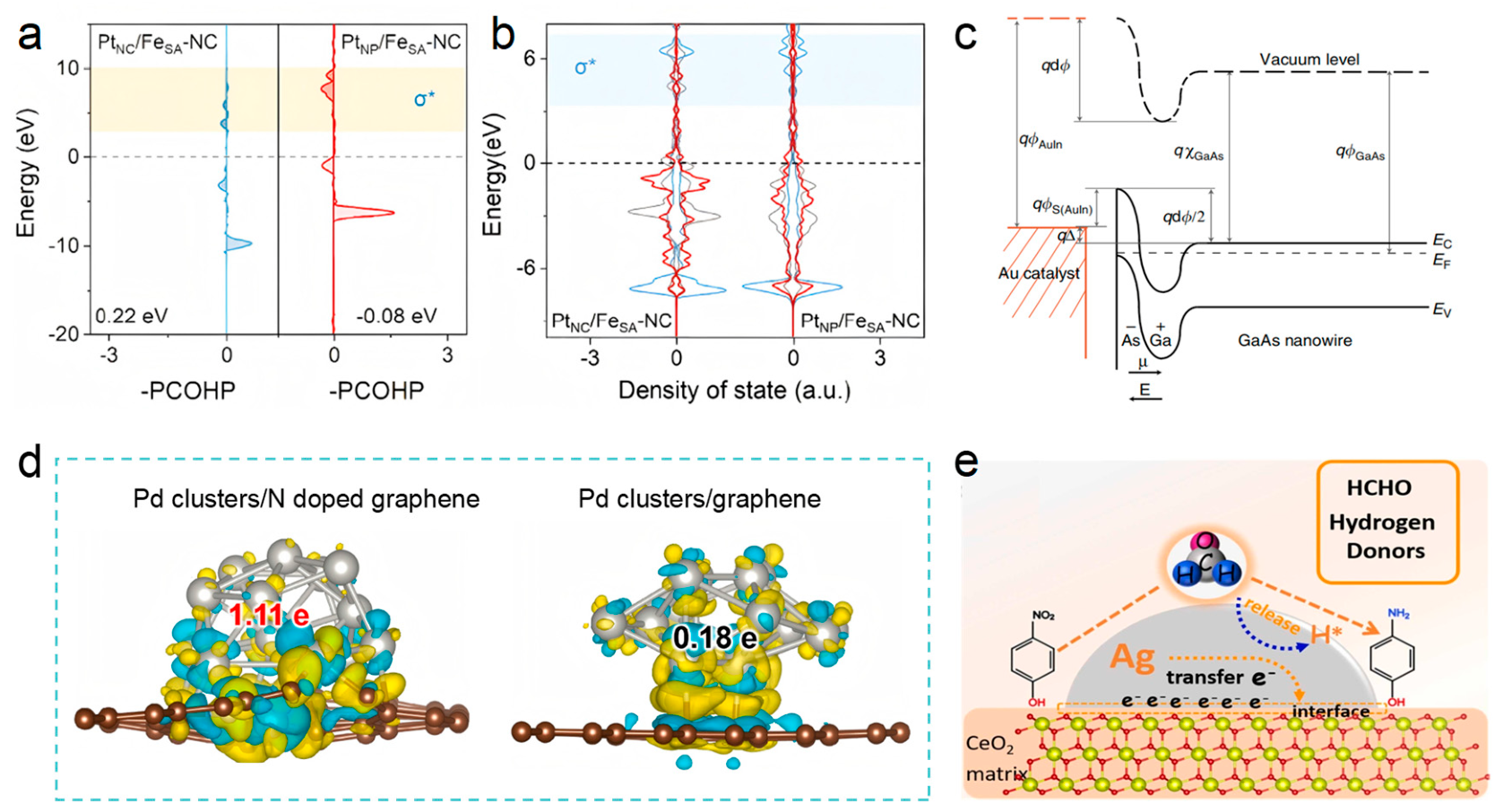
Density of States (DOS) Analysis. MSIs significantly influence catalytic processes through alterations in the electronic structure at the metal-support interface. The DOS provides an essential theoretical tool for describing electron distribution and understanding how the support modulates metal nanoparticles' electronic properties. Specifically, the DOS reflects the energy distribution of electrons available for chemical reactions, which directly influences catalytic activity. When noble metal nanoparticles (such as Pt, Au, Pd, Ag) are supported on metal oxides (e.g., TiO2, CeO2, MnO2), the metal d-band states strongly hybridize with the oxygen p-band states of the oxide support. This hybridization modifies the d-band center position of the metal nanoparticles [27,28]. According to the d-band center theory, downward shifts of the metal d-band center relative to the Fermi level typically reduce adsorption strength of reaction intermediates, whereas upward shifts strengthen adsorption. For instance, a high-efficiency catalyst for the oxygen reduction reaction was achieved by facilitating MSI in the Pt/FeSA-NC system, which induces spin-matching effects that effectively diminishes *OH adsorption and enhance its desorption (Figure 1a,b) [29]. Adjustments of this balance, mediated by MSI, thus critically impact catalytic activity and selectivity in reactions such as HCHO oxidation.
Fermi Level and Schottky Barrier Formation Mechanism. Differences in the Fermi levels of noble metals and oxide supports play a fundamental role in forming the MSI. When a noble metal is placed in contact with an oxide support, electrons transfer spontaneously across the metal-support interface until the Fermi levels of the metal and the oxide achieve equilibrium. Typically, noble metals have a higher Fermi levels compared to oxide supports, driving electrons from the metal toward the support. This electron transfer induces an interfacial electronic potential barrier known as the Schottky barrier. The formation of a Schottky barrier redistributes electrons at the interface, creating electron-deficient regions in the metal and electron-rich regions at the oxide interface. For instance, Suyatin et al. discovered that an ultra-low n-type Schottky barrier (~0.35 eV) can form at the epitaxial interface between Au-In alloy catalyst particles and GaAs nanowires via MSI (Figure 1c) [30]. Such redistribution profoundly influences catalytic properties, modifying the ability of the catalyst to adsorb and activate molecular oxygen and HCHO molecules [22,23]. These electronic perturbations enable a more effective dissociation of O2 into reactive oxygen species and facilitate intermediate transformations, thereby significantly enhancing catalytic oxidation efficiency [16,31].
Electron Transfer Mechanism. The electron transfer mechanism at the metal-support interface can be illustrated clearly by combining theoretical calculations (e.g., Density Functional Theory, DFT) and spectroscopic analyses (X-ray photoelectron spectroscopy, XPS; X-ray absorption spectroscopy, XAS). DFT simulations typically reveal electron density changes around the metal and support atoms upon contact, displaying regions of electron accumulation and depletion. Spectroscopic analyses corroborate these findings experimentally by identifying changes in valence states of metal and oxide components at the interface. Specifically, electrons migrate from metal nanoparticles into the conduction bands or oxygen vacancy states of the support material, altering the oxidation state of the surface metal atoms (e.g., partial oxidation of Au0 to Auδ+ or reduction of Ti4+ to Ti3+ at the interface). This electron transfer is crucial for generating oxygen vacancies, activating molecular oxygen, and creating active sites essential for HCHO adsorption and decomposition [32]. Weng et al. found that in nitrogen-doped carbon materials loaded with Pd, electrons efficiently move from the C-N polar link to the N-Pd polar bond, and subsequently to the Pd site (Figure 1d). They then combine with oxygen molecules to produce oxygen species that effectively decompose HCHO at ambient temperature [33]. Furthermore, by controlling the d-band center of Ag via electron transfer between Ag and CeO2, HCHO can be activated and the H element removed (Figure 1e) [34].
In summary, the electronic structural basis of MSI (characterized by DOS shifts, Fermi level equilibrium, low Schottky barrier formation, and electron transfer processes) provides a profound mechanistic understanding necessary for rational catalyst design aimed at improved performance in HCHO catalytic oxidation reactions.
Figure 1.
Calculated (a) projected crystal orbital hamilton population (pCOHP) and (b) projected density of states (PDOS) diagram of PtNC/FeSA-NC and PtNP/FeSA-NC with OH* in associative pathway [29]. (c) Ideal Schottky model with included electric surface dipole layer formed because of As termination of the GaAs NW [30]. (d) differential charge density map and bader charge change [33]. (e) Schematic depiction of the Ag-to-CeO2 electron transfer and HCHO as hydrogen donors [34].
2.2. Classification of Metal-Support Interactions
Metal-support interactions (MSIs) profoundly influence the catalytic behavior of supported metal catalysts, especially noble metal nanoparticles immobilized on oxide supports. Based on the electronic structure rearrangement, structural changes, and chemical bonding characteristics at the metal-support interface, MSIs can be broadly classified into four types: Strong metal-support interactions (SMSI), Electronic metal-support interactions (EMSI), Oxidative metal-support interactions (OMSI), and Covalent metal-support interactions (CMSI), as shown in Figure 2. These distinct types of interactions exhibit different influence mechanisms and play crucial roles in catalytic processes.
Strong metal-support interactions (SMSI). These phenomena were first proposed by Tauster et al. (1978) [20], describe the interactions between noble metal nanoparticles (e.g., Pt, Au, Pd) and reducible oxide supports (such as TiO2, CeO2), typically activated by high-temperature reduction treatments. These interactions lead to partial encapsulation of the metal particles by a reduced oxide phase, formation of oxygen vacancies, and significant electron transfer across the metal-support interface [35]. A hallmark of SMSI is a drastic suppression in small molecule adsorption (e.g., H2, CO) on the metal surfaces, coupled with improved catalytic stability and selectivity in oxidation reactions [36]. Mechanistically, the electron transfer induced by differences in Fermi level between the metal and the oxide support generates a Schottky barrier, creating electron-deficient metal sites and electron-rich oxide interface sites, fundamentally enhancing catalyst performance [37,38].
Electronic metal-support interactions (EMSI). Electronic metal-support interactions primarily emphasize electronic effects at the interface, distinguishing them from the structural modifications’ characteristic of SMSI. EMSI was introduced by Labou et al. (2007) [21], highlighting how electronic interactions alter the catalytic activity without significant morphological changes. When noble metal nanoparticles are supported on metal oxide, strong hybridization occurs between metal d-band states and oxygen p-band states of the oxide support. This hybridization shifts the metal d-band center position relative to the Fermi level [28,39]. According to the d-band center theory established by Hammer and Nørskov, downward shifts of the metal d-band center reduce adsorption strength of reaction intermediates, while upward shifts strengthen adsorption [40]. Thus, EMSI significantly regulates catalytic reaction pathways by fine-tuning surface adsorption energetics [41].
Oxidative Strong Metal-Support Interaction (OSMSI). Oxidative metal-support interactions extend the SMSI concept to oxidative atmospheres rather than reductive environments. In OMSI, the electron redistribution at the metal-support interface occurs predominantly under oxidizing conditions, resulting in the generation of stable metal cationic species (Mδ+) and increased oxide support reducibility [42,43]. For instance, Au nanoparticles supported on CeO₂ exhibit OMSI under oxidative atmospheres, where Au is partially oxidized (Auδ⁺) due to electron transfer toward CeO2, creating oxygen vacancies and active sites essential for enhanced HCHO catalytic oxidation reactions [42]. Thus, OMSI broadens the applicability of SMSI in various catalytic oxidation processes, providing opportunities to design catalysts effective in practical ambient conditions.
Covalent Metal-Support Interactions (CMSI). Covalent metal-support interactions describe scenarios in which noble metals form strong covalent bonds directly with the support atoms, particularly in the context of single-atom catalysts (SACs). CMSI substantially alters the electronic environment around the metal sites, resulting in robust catalyst stability and precisely defined active sites at the atomic scale [44]. For example, single Pt atoms anchored on TiO2 through Pt-O-Ti covalent bonds exhibit distinctly higher stability and catalytic performance compared to loosely adsorbed or physically immobilized Pt atoms [45]. CMSI enhances catalyst durability and reactivity through well-defined atomic configurations and direct electronic perturbations at the active metal site, which are highly desirable for advanced catalytic applications.
The intricate interplay among these four MSI categories (SMSI, EMSI, OMSI, and CMSI) governs catalytic behavior by modulating electronic states, adsorption properties, structural stability, and the active site environment. These interactions collectively determine the activation, conversion, and selectivity of reactants at the metal-support interface. Particularly in HCHO oxidation, a comprehensive understanding and precise control of these interactions at the atomic scale are therefore essential for the rational design of catalysts with enhanced reactivity, selectivity, and durability.
Our primary focus in this review is on SMSI an EMSI, which have been extensively studied and widely applied in HCHO oxidation reactions. While OMSI and CMSI represent important conceptual extensions of SMSI and EMSI, the current body of study on these two subtypes remains relatively limited. As such, they are not discussed in detail here, but are briefly introduced for completeness. The following sections will systematically examine the mechanistic roles of SMSI and EMSI and highlight their specific contributions to enhancing the catalytic performance of HCHO oxidation systems.
3. Applications of MSI in Noble Metal Catalysts for HCHO Oxidation
The catalytic oxidation of HCHO at room temperatures requires catalysts with high activity, selectivity, and long-term stability. Noble metals such as Pt, Au, Pd, and Ag have demonstrated excellent performance under ambient conditions, largely due to their favorable electronic structures. However, the catalytic efficiency of these systems is increasingly understood to depend not only on the intrinsic properties of the metals, but also on the nature of MSIs, particularly SMSI and EMSI. In this section, we provide a comparative analysis of MSI behaviors across representative noble metal systems supported on oxide materials, focusing on how SMSI and EMSI modulate active site formation, oxygen activation, and HCHO conversion. The metals are discussed in order of their mechanistic clarity and prevalence in the literature, beginning with platinum. This comparative framework aims to clarify the structure-activity relationships across systems and to offer strategic insights into the rational design of high-performance catalysts for environmental applications.
3.1. Platinum-Based Catalysts
Platinum-based catalysts have been the most intensively studied systems for HCHO oxidation, owing to their outstanding low-temperature activity and robust redox properties [46,47,48,49]. The extensive study of Pt metal and its ability to form strong interfacial interactions with oxide supports make them an ideal model for exploring MSIs phenomena [40,41]. This section reviews recent advances in Pt-based catalysts, focusing on how the strength and nature of SMSI and EMSI modulate oxygen activation, Pt dispersion, and the formation of active sites.
3.1.1. SMSI Between Platinum and the Support
The SMSI is considered one of the most effective methods for stabilizing metal nanoparticles [37,45], due to it can induce overlayer formation and encapsulation of the nanoparticles. Beck et al. [50] found that the treatment protocols impact the formation of overlayer, which could be stable at high temperature in oxygen and therefore enable Pt/TiO2 catalyst to operate in harsh conditions up to 900°C without evaporation (Figure 3a). In HCHO oxidation, SMSI can profoundly enhance the performance of Pt-based catalysts by enhancing Pt dispersion and improving stability [51]. In Figure 3b, Sun et al. [52] reported that Pt nanoclusters supported on defective TiO2 nanosheets exhibit enhanced SMSI behavior, with a thin TiOx overlayer partially covering the Pt surface, leading to small Pt nanoclusters stabilizing and electron transfer from Pt to TiO2. The electron-deficient Pt will enhance the adsorptions of H2O/O2, facilitating the generation of reactive oxygen species essential for ambient HCHO oxidation [53,54].
Furthermore, SMSI enhances the transformation of lattice oxygen to oxygen vacancy (Vo) at interface of Pt and supports. Peng et al. showed that constructing a strong Pt-ZrO2 interface promotes the formation of Zr3+ species and oxygen vacancies, which synergistically enhance the redox cycle between Pt0/Zr4+ and Ptδ+/Zr3+ under reaction conditions [55]. The Vo associated SMSI captures and activates molecular O2, and redox interplay enables continuous regeneration of surface reactive oxygen, promoting complete HCHO oxidation at room temperature (Figure 4a). Chen et al. [25] also found that the strong interaction between Pt and Mn-TiO2 support promotes the reactivity of lattice oxygen, then obeys Mars-van-Krevelen mechanism during the catalytic oxidation of HCHO (Figure 4b).
The SMSI effect can also be regulated by modifying the support structure and reduction environment. For example, the introduction of high-energy crystal facets [56,57] or defect engineering in supports (e.g. Ti3+ sites in TiO2) can intensify metal-support contact and promote SMSI formation [58]. Additionally, Ye et al. reported light irradiation could boost SMSI, promoting the generation of surface-active oxygen at the Pt/Bi2MoO6 interface and enhancing HCHO catalytic performance [59].
In summary, SMSI in Pt-based catalysts serves not only to stabilize nanoparticles but also to enhance redox properties and oxygen activation through interfacial electronic reconfiguration. These effects collectively result in improved catalytic activity, selectivity, and durability, making SMSI a vital design strategy in the development of high-performance HCHO oxidation catalysts.
3.1.2. EMSI Between Platinum and the Support
Researchers have employed alkali metals to further enhance the catalytic activity of Pt/TiO2 catalysts [47]. EMSI can modulate the d-band electrons of precious metals. Wang et al. [60] used Na as a promoter to regulate the d-band electrons of Pt in the Pt/SiO₂ system through EMSI. By activating alkali metals, they prepared Pt-Ox(OH)-Na clusters, as shown in Figure 5a, achieving 100% conversion efficiency at room temperature. The role of Na is primarily to provide charge to Pt, thereby increasing the number of electron transfers, while the SiO2 support induces charge accumulation on Pt and modulates EMSI.
Yaroslava et al. [61] investigated the interaction between metal-support interactions and stability on Pt/Co3O4(111) model catalysts. Wang et al. [62] explored the catalytic activity of sheet-like MnO₂, where the Pt/MnO2 catalyst exhibited excellent performance at 50°C. This was attributed to extensive oxygen adsorption and the MSI between Pt and MnO2, which significantly altered the reduction characteristics of MnO2. The low crystallinity of MnO2 resulted in a large specific surface area, further enhancing catalytic performance [63]. Cui et al. [64] synthesized highly crystalline octahedral Fe3O4 using a co-precipitation method. The Pt/Fe3O4 catalyst exhibited the highest catalytic activity at 80°C, attributed to the MSI between Pt and Fe3O4, which induced the formation of high-density active interface sites Pt-O-FeOx on the catalyst. The intensity of MSI can be adjusted by varying the heat treatment temperature, thereby influencing the catalytic activity of the Pt/Fe3O4 catalyst.
CeO2 is widely employed as a support material for precious metal catalysts due to its excellent redox properties and stability. It forms MSI with Pt, facilitating the high dispersion of Pt on the CeO2 support and preventing Pt particle sintering, thus improving catalytic performance. EMSI influences catalytic activity by adjusting the local electronic structure of metal particles and the metal-support interface. Yan et al. [65] prepared a CeO2/AlOOH-supported Pt catalyst that efficiently removed HCHO at room temperature. Its outstanding performance is attributed to the abundant surface hydroxyl groups, oxygen storage capacity of CeO2, high dispersion of Pt nanoparticles, and the adsorption properties of AlOOH. Zhang et al. [41] controlled the intensity of the interaction between Pt and the CeO2 support by adjusting activation conditions. As shown in Figure 5b, the catalytic oxidation performance of HCHO and CO exhibited a clear trend based on the varying intensity of the interaction. The EMSI of Pt/CeO2 catalysts led to electronic structure hybridization, and by adjusting activation conditions, the catalyst achieved optimal activity, enhancing oxidation performance for both CO and HCHO under environmental conditions.
3.2. Gold-Based Catalysts
The catalytic oxidation of HCHO has been a subject of intense research in recent years, driven by the unique electronic properties and exceptional catalytic performance of loaded gold nanocatalysts [66,67,68]. The catalytic activity of gold is influenced by various factors, including nanoparticle size [69], carrier morphology [70], and catalyst structure [71]. Importantly, the MSI between gold and the carrier has emerged as a crucial means of regulating the valence state of gold and, consequently, its catalytic activity.The MSI can operate through multiple mechanisms to enhance the stability and dispersion of metal particles, induce charge transfer, and activate surface oxygen species, all of which are essential for modulating the overall catalytic performance.
3.2.1. SMSI Between Gold and the Support
SMSI of gold exhibits excellent regulatory capabilities, particularly in low-temperature catalytic reactions, where electron redistribution at the metal-support interface significantly enhances catalytic activity. Yan et al. [72] investigated the interaction between gold nanoparticles (AuNPs) and ZnO nanorods, achieving complete low-temperature catalytic oxidation of HCHO using the Au/ZnO catalyst. After high-temperature air treatment, Au+ species formed on the surface and interacted with ZnO, leading to the migration of ZnO to the AuNPs' surface, thus forming SMSI. This interaction prevented AuNP sintering and caused the Au surface to become positively charged, greatly improving HCHO catalytic performance. In addition to metallic Au, a significant presence of Au+ species was observed, indicating substantial electron transfer between the AuNPs and the support. Liu et al. [73] further demonstrated that pre-treatment with H2 and O2 induced SMSI in Au/ZnO catalysts, optimizing the catalyst's activity, selectivity, and stability. Similarly, Chen et al. [74] found that H2 pre-treatment on Au/HZSM-5 significantly enhanced catalytic performance, attributing the improvement to SMSI between Au species and the HZSM-5 support, which facilitated the dispersion of Au nanoparticles and reduced their size, thereby preventing deactivation due to aggregation. In contrast, Au particles supported on SiO2 were more prone to aggregation into larger particles, leading to catalyst deactivation and poor stability [75]. The selection of an appropriate support and effective regulation of SMSI are essential for improving both catalytic efficiency and stability.
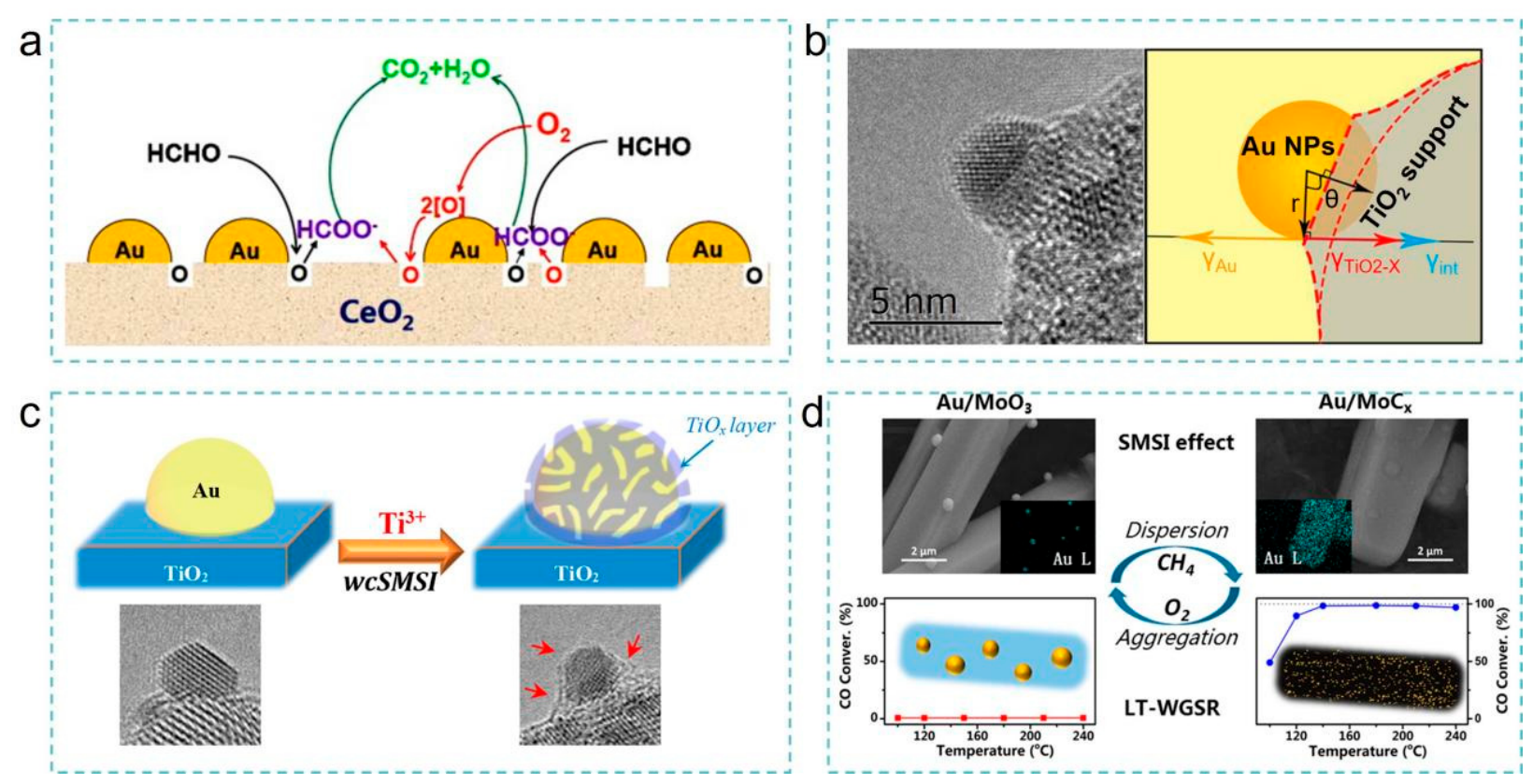
CeO2 known for its abundant oxygen vacancies and excellent redox properties, plays a crucial role in SMSI. Li et al. [76] compared the catalytic performance of Au supported on various materials (Al2O3, CeO2, SiO2, TiO2) and found that Au/CeO2 exhibited highly efficient catalytic oxidation of HCHO at 40°C, with catalytic efficiency exceeding 80%. Bu et al. [77] observed that SMSI between Au and CeO₂-R significantly promoted the formation of oxygen vacancies and Au3+ at the interface, accelerating the formation and decomposition of formate, thus improving catalytic performance. Furthermore, Chen et al. [78] prepared Au/CeO2 catalysts via urea precipitation, which demonstrated nearly 100% HCHO conversion at room temperature with high stability. SMSI between Au and CeO2 weakened the Ce-O bond, enhancing the activation of surface oxygen. Au can adsorb onto the oxygen vacancies of CeO2, facilitating electron transfer, which promotes the oxidation of Au and the reduction of Ce4+, as illustrated in Figure 6a.
The size effect in core-shell structured materials can also regulate SMSI. Chen et al. [79] studied core-shell Au-based catalysts and found that when the Au core size was 5 nm and the SiO2 shell thickness was 50 nm, the Au/SiO2 catalyst exhibited optimal HCHO catalytic activity. This was attributed to SMSI in the core-shell structure, which facilitated electron transfer and the formation of highly oxidized Au. Similarly, Zhang et al. [70] and Du et al. [80] observed the classic SMSI size effect in Au/TiO2 catalysts, finding that larger Au nanoparticles were more likely to be encapsulated than smaller ones (Figure 6b). This suggests that larger Au nanoparticles can be selectively encapsulated during catalytic reactions to improve the performance of catalysts with uneven particle size distributions [81].
Zhang et al. [43] introduced the concept of Wet Chemical SMSI (wcSMSI), which differs from classical SMSI by occurring in a liquid environment at room temperature. As shown in Figure 6c, wcSMSI enhances catalyst activity through redox reactions between Auδ+ and Ti3+. In metal/non-oxide catalysts, SMSI is not limited to redox reactions but can also be applied in electroreduction processes [82]. Dong et al. [83] demonstrated that the Au/MoCx catalyst exhibited highly dispersed gold overlayers and strong metal-support interface charge transfer, showing extremely high activity for the water-gas shift reaction. After oxidation treatment, Au particles aggregated significantly, weakening the interface interaction and decreasing activity. These two interface states can be regulated by alternating between carburization and oxidation (Figure 6d).
Figure 6.
(a) Catalytic elimination of HCHO at ambient temperature utilizing supported gold catalysts with diminished Ce-O bonding [78]. (b) The representative high-resolution transmission electron microscopy (HRTEM) image of Au-3 nm-H400 is shown, along with a schematic that illustrates the encapsulation of the Au particle (within a spherical segment) by the TiO2 support. The radius of the Au particle is indicated by r (black arrow), while the surface tensions of the Au particle, TiO2 support, and their interface are represented by γAu (orange arrow), γTiO2-x (red arrow), and γint (blue arrow) [80]. (c) Wet-chemistry SMSIs in Titania-supported Au catalysts [43]. (d) The Au/MoCx catalysts have highly distributed Au overlayers, significant interfacial charge transfer, and outstanding activity in the low-temperature water-gas shift reaction (LT-WGSR), indicating an active SMSI state [83].
3.2.2. EMSI Between Gold and the Support
Electron Metal-Support Interactions (EMSI) between gold and its support also have a profound impact on catalytic performance, particularly in regulating the oxidation state, reactivity, and selectivity of metal species. EMSI plays a unique and important role in enhancing catalytic activity. Qin et al. [32] were the first to report co-catalysis of HCHO and CO using Au/TiO2 catalysts, exploring the existence of independent catalytic sites. The study showed that after O2 pre-treatment, the Au/TiO2 catalyst efficiently catalyzed both HCHO oxidation and CO oxidation. This was attributed to the increased presence of Au⁰ species on the surface of the Au/Ti-O catalyst after pre-treatment, which enhanced CO oxidation performance by promoting the formation of Au top sites. In contrast, before O2 pre-treatment, the Au/Ti-F catalyst predominantly exposed Au-Ti interface active sites, which were the primary catalytic sites for HCHO, as shown in Figure 7a. O2 treatment may also cause Au nanoparticles to be encapsulated, though no encapsulation of Au species was observed on the Au/Ti-O catalyst, indicating that O2 treatment had a limited effect on the structure of Au nanoparticles and the metal-support interface.
Jing et al. [84] conducted density functional theory calculations to investigate the interaction between Au and different CeO2 crystal faces, finding that AuCe1-xO2 catalysts with defect sites on the (110) surface exhibited Au species migration, which induced the formation of more stable configurations and improved HCHO catalytic performance. The enhancement in catalytic efficiency was attributed to the synergistic effect of the Langmuir-Hinshelwood (L-H) and Mars-van Krevelen (MvK) mechanisms. In this process, HCHO and O2 participate in the reaction, and the doped Au atoms activate surface oxygen, lowering the formation energy of oxygen vacancies and reducing the reaction energy barrier, thereby facilitating HCHO catalytic oxidation. This study provides new insights into the electronic interactions between Au and CeO2, offering valuable guidance for optimizing the design of metal catalysts (Figure 7b).
3.3. Palladium-Based Catalysts
The high catalytic activity, selectivity, and stability of palladium have led to its widespread use in various volatile organic compound catalytic applications. This catalytic performance is primarily attributed to the surface structure and electronic properties of palladium. Specifically, the introduction of alkali metals or the induction of MSI on reducible metal oxides can facilitate charge redistribution and transfer processes at the interface between palladium nanoparticles and the support material. This, in turn, enhances the dispersion of palladium and exposes more active sites, ultimately improving the catalytic activity for the oxidation of HCHO [85].
3.3.1. SMSI Between Palladium and the Support
High-temperature pre-treatment is a common method for inducing MSIs. This process creates defects on the catalyst surface, prevents sintering of precious metal particles, and improves metal dispersion. Wang et al. [86] used high-temperature pre-treatment to introduce Ti3+ defect sites on Pd/TiO2 catalysts. Under SMSI, these defects trapped Pd ions, improving Pd dispersion, while hydrogen spillover generated more oxygen vacancies on the surface, further increasing the electronic density of Pd species. Pd/TiO2 catalysts treated at 600°C exhibited the highest number of surface defects, enabling complete HCHO oxidation at high space velocity and room temperature. Similarly, Zhang et al. [87] achieved SMSI by high-temperature hydrogen pre-treatment, which stabilized Pd nanoparticles and enhanced Pd dispersion on the Pd/TiO2 catalyst. Additionally, Li et al. [88] prepared Pd/TiO2 catalysts that, after a 450°C high-temperature pre-treatment, exhibited reduced Pd particle size. This was due to partial encapsulation and trapping of Pd clusters by TiO2, leading to the formation of more oxygen vacancies, which facilitated oxygen activation and surface hydroxyl formation, thus improving HCHO oxidation efficiency.
Alkali metal doping can further enhance metal-support interactions, improving metal dispersion and increasing the number of surface hydroxyl radicals. Li et al. [89] doped Na into Pd/TiO2 catalysts, inducing SMSI to stabilize well-dispersed Pd species [90] and promoting water and oxygen activation, thereby enhancing catalytic performance [91]. Wang et al. [92] regulated SMSI intensity by inducing surface defects on TiO2 using different high-temperature atmospheres, stabilizing Pd species in their metallic state. The Pd/TiO2-800°C-H2 catalyst exhibited the strongest interaction and the highest HCHO catalytic performance, as shown in Figure 8a. Further doping with alkali metals such as Li, Na, K, and Cs improved the catalytic performance of Pd/TiO2 catalysts at low temperatures. Among these, the K-Pd/TiO2 catalyst showed the best activity at room temperature, with 48.2% maximum Pd dispersion, smaller Pd particles, and more metal-support interfaces, which promoted the chemical adsorption and dissociation of oxygen, leading to the formation of surface hydroxyl groups. Huang et al. [93] also confirmed that hydroxyl radicals generated by water dissociation played a crucial role in the adsorption and transfer of oxygen, thereby enhancing HCHO oxidation.
The metal palladium species ratio, which is determined by the morphology of CeO2, is critical for low-temperature HCHO catalytic oxidation. A higher proportion of metallic palladium at room temperature results in more efficient catalytic activity. Tan et al. [94] prepared Pd/CeO2 catalysts with different morphologies (nano-cuboids, nano-octahedra, and nanorods). The interaction between Pd and CeO2 in these catalysts allowed Pd/Cube to maintain a metallic state more easily in air, becoming electron-rich. As a result, approximately 54% of the palladium ions in the Pd/Cube catalyst remained in the metallic state, exhibiting a high hydrogen reduction temperature and significantly higher activity than the other catalysts. Even at low temperatures (0°C), Pd/Cube achieved a conversion rate of 35% (Figure 8b).
3.3.2. EMSI Between Palladium and the Support
Oxygen activation is a key step in HCHO oxidation, as it generates the active species necessary for the reaction. The catalytic performance is closely linked to the EMSI-induced modification of the electronic structure of metal nanoparticles. He et al. [95] prepared a reduced TiO2-supported Pd catalyst with oxygen vacancies for room-temperature HCHO oxidation. The reduced TiO2 (TiO2-R) induced by EMSI formed negatively charged Pd nanoparticles through electron transfer, enhancing oxygen association. EMSI also created more anchoring and electron-rich sites, significantly improving Pd dispersion and reduction. The oxygen vacancies in TiO2-R effectively altered the electronic structure of Pd, facilitating water dissociation on TiO2 to form surface hydroxyls and adsorbed oxygen. On the Pd/TiO2-R catalyst, the oxygen vacancies enhanced electron transfer from the support to the metal, hindered CO adsorption, and suppressed the adsorption of small molecules like CO and H2, confirming the presence of electron-rich Pd and the EMSI effect in Pd/TiO2-R (Figure 9a).
The work of Chen et al. [96] similarly leveraged the electronic interaction between the promoter and the metal (EIPM) to enhance the catalytic performance of HCHO oxidation in Ba-doped Pd-Ba/TiO2 catalysts. Specifically, the Ba species acted as an electron donor, generating EIPM and facilitating charge transfer with Pd. This led to a high dispersion of Ba on the TiO2 support, while also improving the stability and dispersion of the Pd groups, resulting in an increased number of monatomic Pd sites. Furthermore, the enhanced electron density of the Pd nanoparticles improved the oxygen activation capacity, which in turn enhanced the migration of chemisorbed oxygen on the catalyst surface. This facilitated the direct oxidation of formate intermediates to CO2 and H2O, as illustrated in Figure 9b.
The study of palladium catalysts for low-temperature catalytic applications has shown promising potential (Figure 9c) [97]. Our previous work [98] reported a series of manganese oxide catalysts with varying morphologies through hydrogen reduction, as depicted in Figure 9d, they proposed a bifunctional Pd/Mn3O4-MnO tandem catalyst capable of completely catalyzing HCHO HCHO oxidation at 18°C, significantly outperforming single-component catalysts. Theoretical studies indicated that Pd/Mn3O4 exhibited a lower activation barrier for the HCHO → HCOOH step, while in Pd/MnO, the HCOOH → H2CO3 reaction occurred more readily. Moreover, the nanoscale intimacy between Pd/Mn3O4 and MnO enhanced the sensitivity to Mn-O bond cleavage, promoting the formation of abundant oxygen vacancies. These vacancies facilitated the migration of lattice oxygen and induced interactions between Pd and the dual-support interface active sites. This interaction led to lattice disorder, which promoted interface reconstruction, thereby supporting sustained HCHO oxidation in the tandem catalytic process. The catalytic mechanism for the bifunctional tandem catalyst is illustrated in Figure 9d. This study demonstrates that tandem catalysis provides a versatile platform for designing catalysts with tailored oxidation reaction functionalities.
3.4. Silver-Based Catalysts
Ag nanoparticles are commonly supported on metal oxide catalysts for oxidation reactions [99,100], and are also frequently used in electrode design [101] and the development of bifunctional tandem catalysts [102]. MSI can modulate both the geometric structure and electronic state of the catalytic center. Catalysts with high electronic density and strong oxidation capacity at the active sites are particularly effective in enhancing catalytic efficiency [103]. MSI can also alter the electronic state of single-atom catalysts, thereby improving the catalytic activity and durability of HCHO oxidation catalysts at room temperature [104].
3.4.1. SMSI Between Silver and the Support
Defects on reducible oxides serve as primary anchoring sites for metal loading through SMSI [105]. Nanostructured CeO2, with its large surface area and high concentration of surface oxygen vacancies, is an ideal support for silver nanoparticles [106]. Ma et al. [107] reported an Ag/CeO₂ nanosphere catalyst, where sodium was used as a promoter. The SMSI between Ag and CeO2 nanospheres created numerous oxygen vacancies on the CeO2 surface [108], leading to the formation of Ag+ clusters. The high surface area of CeO2 nanospheres significantly increased the concentration of surface hydroxyl groups, which adsorbed HCOO- and directly reacted to produce CO2 and H2O. This optimized the HCHO oxidation pathway, thereby enhancing the catalyst’s overall activity.
Porous metal oxides, owing to their unique pore structures, large surface areas, and controllable pore sizes, have garnered considerable attention in catalytic applications. Bai et al. [109] developed a 3D mesoporous Ag/MnO2 catalyst for HCHO oxidation. In this catalyst, Ag nanoparticles were uniformly distributed on the polycrystalline walls of MnO2, maintaining the 3D mesoporous structure while reducing pore size and surface area. The exceptional catalytic performance of the Ag/3D-MnO2 catalyst was attributed to the abundant surface lattice oxygen species, oxygen vacancies, and lattice defects induced by the interaction between Ag and MnO2. In another study, Bai et al. [110] synthesized a K-doped Ag/Co3O4 catalyst. The introduction of K+ ions enhanced the metal-support interaction, promoting more lattice defects and a higher concentration of surface active oxygen species.
Regulating the crystal phase of metal oxides is another effective way to control SMSI strength. Chen et al. [111] reported a cooperative mechanism involving multiple sites on Ag/TiO2 for HCHO oxidation, noting significant differences in catalytic activity depending on the TiO2 crystal phase. Among the phases, anatase (Ag/A) exhibited the highest performance. The activity of these catalysts was influenced by the strength of the metal-support interactions, which varied across different crystal phases. For the same size Ag nanoparticles, oxygen activation ability differed significantly across TiO2 phases. HCHO oxidation on Ag/TiO2 catalysts was shown to depend on the cooperative effects of multiple active sites, including surface oxygen, Ag2O, and Ag species. Surface oxygen and Ag2O species primarily facilitated low-temperature HCHO oxidation, while Ag species played a key role in high-temperature oxidation, as shown in Figure 10a.
SMSI can lead to the formation of a bimetallic structure via oxygen ligands between the metals and the support when two metals are both used in tandem. Huang et al. [112] reported a dual-site Ag-Fe/SBA-15 catalyst, which exhibited a 25-fold improvement in HCHO conversion at 65°C compared to the single-site Ag/SBA-15 catalyst. The incorporation of Fe into the SBA-15 framework, facilitated by SMSI between Fe and SBA-15 led to the formation of Fe-O-Si bonds and generate Lewis acid sites on the catalyst surface. Meanwhile, Ag nanoparticles were more evenly dispersed, with smaller average sizes. The synergy between the Lewis acid sites and Ag nanoparticles significantly enhanced the HCHO catalytic performance, as shown in Figure 10b.
3.4.2. EMSI Between Silver and the Support
EMSI plays a crucial role in modifying the electronic density and dispersion of silver (Ag) nanoparticles. Li et al. [113] synthesized Ag/Fe-MnOx catalysts with varying Fe loadings and found that the Ag/Fe-0.1-MnOx catalyst achieved 100% HCHO conversion at room temperature. This exceptional performance was attributed to EMSI, which enhanced the electronic density and dispersion of Ag species, increasing surface oxygen adsorption and, consequently, improving catalytic activity. Chen et al. [114] proposed a top-down approach for synthesizing atomically dispersed metal catalysts by controlling EMSI. Through thermal diffusion, they demonstrated that Ag nanoparticles could be transformed into atomically dispersed catalysts under the influence of the support. The driving force behind this process was the Ag-O interaction at the Ag-HMO interface, which caused electronic perturbations in the frontier orbitals of Ag (Figure 11a).
Manganese oxides, which serve both as supports and promoters in catalytic systems, as shown in Figure 11b, the HRTEM image demonstrates the interaction between MnOx nanosheets and Ag nanoparticles [115]. Li et al. [116] developed Ag/Mn-C and Ag/Mn-R catalysts for ozone decomposition. They observed that the Ag nanoparticles on Ag/Mn-R remained in the metallic state, whereas on Ag/Mn-C, the metal-support interaction facilitated electron transfer and the formation of Ag-O-Mn bonds, thereby lowering the reaction barrier (Figure 11c).
Non-thermal plasmas which composed of electrons, molecules, ions, free radicals, photons, and excited species, are effective for catalyst preparation due to their ability to induce EMSI and electron transfer. These non-thermal plasmas alter the valence state and distribution of active species on the catalyst surface, thereby enhancing HCHO oxidation performance. Li et al. [117] employed non-thermal plasma and conventional calcination to obtain three different Ag species distributions in Ag-Co/CeO2 catalysts. The non-thermal plasma activation resulted in a mixed Ag valence state with approximately 50% Agδ+, a small amount of Ag0 and a trace amount of Ag+, leading to the best HCHO catalytic performance, as shown in Figure 11d.
4. Summary and Outlook
HCHO is a carcinogenic VOC that poses significant risks to human health and the atmospheric environment. The development of efficient HCHO removal technologies has thus become a key research focus in environmental catalysis. Catalytic oxidation can decompose HCHO into water and carbon dioxide, eliminating secondary pollution to the atmosphere. Among the catalysts, precious metal-supported catalysts offer superior catalytic performance at room or low temperatures, making them the most promising candidates for HCHO oxidation. The interface charge transfer between the precious metal and its support, driven by differences in their electronic structures, is referred to as MSI, which can induce charge transfer, alter the distribution of active sites, and regulate the electronic structure to enhance catalyst performance. As a result, researchers have focused on controlling the type and strength of MSI to improve both catalytic efficiency and selectivity. In this context, we review the mechanisms of various types of MSI, as well as the latest developments in the application of SMSI and EMSI in HCHO catalysis. Furthermore, we propose several potential research directions that could offer new approaches for the regulation and utilization of MSI in the field of HCHO catalysis.
a) Support Selection for Precious Metal-Supported Catalysts. In the synthesis of precious metal-supported catalysts, the catalyst performance is primarily controlled by the geometric morphology and preparation methods, aiming to maximize the exposure of active sites. Studies have shown that a close, nanoscale interaction between the metal and the support promotes MSI, resulting in significantly better performance than a simple physical interaction. This is due to the close binding of metal nanoparticles to oxygen vacancies, surface hydroxyl groups, or Lewis acid-base sites on the support surface, which helps stabilize reactants or intermediate products. Metal oxide supports not only regulate the electronic structure of active sites and facilitate metal dispersion but also act as adsorption sites for reactants and intermediates. Additionally, porous metal oxides, with their unique pore structures and controllable pore sizes and volumes, can also serve as supports in catalysts. Improving the porosity of oxide supports is a promising avenue for further research. By directly controlling the support during the reaction process, metal-support interactions are transforming the design of catalysts at the atomic level.
b) Metal Control in Precious Metal-Supported Catalysts. To design high-performance catalysts that maximize MSI, it is crucial that each metal nanoparticle atom directly interacts with the support’s metal atoms. The adhesion energy at the metal-support interface plays a significant role, and the morphology of the precious metals has a considerable impact on catalytic performance. For two commonly used precious metals in VOC catalysis, size effects dictate that metal nanoparticle size cannot be reduced indefinitely to expose more active sites. In contrast, metal single atoms interact directly with the support surface, which is fully covered by the metal, thus exposing all active sites. Recent studies have focused on understanding the mechanisms behind the formation of metal-support interactions in catalysts. However, a universal mechanism for the MSI phenomena in both nanoparticles and single atoms is still lacking. Investigating the metal-support morphology in catalysts is an essential step toward designing and predicting catalyst behavior.
c) Practical Use of DFT Calculations. Given the influence of active sites on metal-support interactions, DFT calculations provide a method to compare the catalytic activity of different active sites. To improve the accuracy of DFT simulations and align them more closely with experimental results, several key factors should be considered. These include the distance between adjacent active sites, the strength of multi-site synergistic effects, and the positioning of active sites within the support’s pores or on its surface. A deeper understanding of the formation mechanisms of active sites and MSI can aid in the rational design and manufacture of efficient HCHO catalysts, making them highly suitable for practical applications.
d) Synergistic Mechanism of Bimetallic Sites. When the encapsulation structure or charge transfer between the metal and support plays a role in catalysis, promoters can be used to modify the catalyst and further enhance performance. Common promoters include alkali metals and certain metal oxides, which increase the number of hydroxyl radicals on the catalyst surface, promoting charge transfer and improving metal dispersion. Due to the multiple possible reaction pathways and intermediates in HCHO catalytic oxidation, doping promoters into the catalyst structure via metal-support interactions facilitates the formation of new mixed bimetallic structures and dissociation steps under oxygen ligand interactions, reducing reaction energy. The modification by promoters leads to atomic rearrangement and charge redistribution, resulting in unique metal-support interface structures that determine catalytic performance. Additionally, MSI can be used to control electronic transfer at the interface to create electron-rich or electron-deficient metal species, further improving the catalyst for higher atomic precision.
Funding
This research was funded by the National Natural Science Foundation of China (22506154) and the Shaanxi Province Postdoctoral Foundation (2023BSHEDZZ305).
Data Availability Statement
No new data were created or analyzed in this study. Data sharing is
not applicable to this article.
Conflicts of Interest
The authors declare no conflicts of interest.
References
- Gong, Y.; Li, J.; Li, H.; Gao, J.; Wang, W.; Ge, M. Recent progress on VOC pollution control via the catalytic method. Front. Environ. Sci. 2026, 14, 1925033. [Google Scholar]
- Morawska, L.; Allen, J.; Bahnfleth, W.; Bennett, B.; Bluyssen, P.M.; Boerstra, A.; Buonanno, G.; Cao, J.J.; Dancer, S.J.; Floto, A.; et al. Mandating indoor air quality for public buildings. Science 2024, 383, 1418–1420. [Google Scholar] [CrossRef] [PubMed]
- Wang, Y.; Chen, X.; Zhao, Y.; Chi, Y.; Ding, L.; Zheng, J.; Liang, Y.; Zhu, X.; Zhu, J.; Chen, S.; Wang, Y. Charge-induced interfacial assembly synergizing photocatalytic air purification with structural color decoration. Small 2026, 22, e74446. [Google Scholar] [CrossRef] [PubMed]
- Cereceda-Balic, G.; Vidal-Vega, M.; Núñez-Decap, M.; Fuentealba-Becerra, C. An implementation strategy for VOC emissions eco-labeling in wood products for the chilean market with international projection. Sustainability 2026, 18, 5901. [Google Scholar] [CrossRef]
- Chen, G.Y.; Zhang, F.J.; Shen, L.Y.; Yi, J.X.; Jiang, P.; Wei, Y.H.; Hou, J.X.; Liu, Y.N.; Cao, J.; Sun, X.H.; Wen, Z. HCHO degradation by soft-sliding-electrification-induced air ionization. Nano Energy 2024, 123, 109431. [Google Scholar] [CrossRef]
- Li, Y.; Zhao, Y.; Kleeman, M.J. Formaldehyde exposure racial disparities in southeast texas. Environ. Sci. Technol. 2024, 58, 4680−4690. [Google Scholar] [CrossRef] [PubMed]
- Wang, J.; Huang, H.; Pan, Z.; Zhao, Y.; Zhao, M.; Wang, T.; Shi, X.; Fan, Y.; Yang, Y. For on-site detection: Portable sensor integrating a bimetallic organic framework-based ternary composite for efficient detection of residual HCHO in aquatic products. Chem. Eng. J. 2026, 545, 179893. [Google Scholar] [CrossRef]
- Li, Y.H.; Dong, T.; Huang, P.L.; Ji, J.; Huang, H.B. Efficient HCHO oxidation at room temperature via maximizing catalytic sites in 2D coralloid δ-MnO2@GO. Appl. Catal. B Environ. Energy 2024, 341, 123322. [Google Scholar] [CrossRef]
- Xiong, R.; Gao, T.; Lin, S.; Chen, L.; Lin, S. Formaldehyde as a hydrogen shuttle: redefining spillover pathways on nonreducible oxide surfaces. J. Am. Chem. Soc. 2026. [Google Scholar] [CrossRef]
- Han, G.; Fan, H.; Bian, M.; Guo, M.; Li, F.; Guo, Q.; Yu, G.; Held, C. Polymerization-based anchorage of formaldehyde in [CAM][SO4] nanodots supported on MIL-101(Cr) for reduction of concentration by 5 orders of magnitude. Adv. Fun. Mater. 2026, 36, e76945. [Google Scholar]
- Chang, F.; Cai, X.; Xu, J.; Hong, F.; Yang, H.; Liu, D.-G. Recent advances in ZrO2-based catalysts for the catalytic oxidation of formaldehyde. Catalysts 2026, 16, 415. [Google Scholar] [CrossRef]
- Bi, Q.; Wang, K.; Zhang, Y.; Shi, Y.; Zhang, C.; Zhao, S.; Xue, J. Oxygen vacancies and surface hydroxyl groups in NiFe/Mn-MOF-74 synergistically drive indoor formaldehyde mineralization. Environ. Sci. Technol. 2026, 60, 24804−24817. [Google Scholar] [CrossRef] [PubMed]
- Chen, X.; Wang, C.; Wang, J.; Liu, X.; Zhang, Y.; Lou, Y.; Liu, Y.; Li, Y.; Shan, W.; He, H. Different activation mechanisms of oxygen and water during formaldehyde oxidation on Pt/anatase catalysts: The effect of Pt geometric configurations. ACS Catal. 2026, 16, 11664−11677. [Google Scholar] [CrossRef]
- Ayub, A.; Ahmad, W.; Hossain, S.M.; Seo, J.E.; Koo, C.M.; Lee, H.; Yoon, J.; Lee, S.-C.; Han, S.; Oh, T.; Kwon, D.W.; Oh, Y. Strong metal-support interaction at Ti3+-oxygen vacancy-Pt-interfaces in MXene-derived TiO2 for room-temperature formaldehyde oxidation. Chem. Eng. J. 2026, 536, 175705. [Google Scholar] [CrossRef]
- Zhang, H.; Wang, Z.; Lin, H.; Liu, Y.; Dai, H.; Deng, J. Catalytic oxidation of volatile organic compounds over supported noble metal and single atom catalysts: A review. J. Environ. Sci. 2025, 155, 858–888. [Google Scholar] [CrossRef] [PubMed]
- Xu, M.; Peng, M.; Tang, H.; Zhou, W.; Qiao, B.; Ma, D. Renaissance of Strong Metal-Support Interactions. J. Am. Chem. Soc. 2024, 146, 2290–2307. [Google Scholar] [CrossRef] [PubMed]
- Wang, Y.; Chen, C.; Sun, Z.; Chen, J.; Hu, P.; Ma, W. Activity−stability volcano in supported electrocatalysis: Single entity correlation of Au25 nanoclusters between oxygen reduction activity and metal−support interaction. J. Am. Chem. Soc. 2026, 148, 37677−37686. [Google Scholar] [CrossRef] [PubMed]
- Wei, J.; Tang, H.; Sheng, L.; Wang, R.; Fan, M.; Wan, J.; Wu, Y.; Zhang, Z.; Zhou, S.; Zeng, J. Site-specific metal-support interaction to switch the activity of Ir single atoms for oxygen evolution reaction. Nat. Commun. 2024, 15, 559–567. [Google Scholar] [CrossRef] [PubMed]
- Jiang, Z.; Gu, H.; Yan, H.; Zhu, J.; Chen, H.; Zhu, M.; Li, D.; Zhu, M. Tunable metal−support interactions between copper and cobalt oxides for enhanced methanol steam reforming. ACS Catal. 2026, 16, 5722−5733. [Google Scholar] [CrossRef]
- Tauster, S.J.; Fung, S.C.; Garten, R.L. Strong metal-support interactions-group-8 noble metals supported on TiO2. J. Am. Chem. Soc. 1978, 100, 170–175. [Google Scholar] [CrossRef]
- Labou, D.; Neophytides, S.G. Promotional effects on a PtRu/C catalyst-electrode interfaced with aqueous electrolytes: electrochemical metal support interaction (EMSI) and electrochemical promotion of catalysis (EPOC). Top. Catal. 2007, 44, 451–460. [Google Scholar] [CrossRef]
- van Deelen, T.W.; Mejía, C.H.; de Jong, K.P. Control of metal-support interactions in heterogeneous catalysts to enhance activity and selectivity. Nat. Catal. 2019, 2, 955–970. [Google Scholar] [CrossRef]
- He, X.; Kim, K.-H. Schottky barrier engineering via coordination chemistry: A pathway to advanced photocatalytic VOC mineralization. Coord. Chem. Rev. 2026, 558, 217757. [Google Scholar] [CrossRef]
- Hojo, H.; Nakashima, M.; Yoshizaki, S.; Einaga, H. Lattice-plane-dependent distribution of Ce3+ at Pt and CeO2 interfaces for Pt/CeO2 catalysts. ACS Nano 2024, 18, 4775–4782. [Google Scholar] [CrossRef] [PubMed]
- Chen, J.; Jiang, M.; Xu, W.; Chen, J.; Hong, Z.; Ji, H. Incorporating Mn cation as anchor to atomically disperse Pt on TiO2 for low-temperature removal of HCHO. Appl. Catal. B Environ. Energy 2019, 259, 118013. [Google Scholar] [CrossRef]
- He, M.; Cao, Y.; Ji, J.; Li, K.; Huang, H. Superior catalytic performance of Pd-loaded oxygen-vacancy-rich TiO2 for HCHO oxidation at room temperature. J. Catal. 2021, 396, 122–135. [Google Scholar] [CrossRef]
- van Deelen, T.W.; Mejía, C.H.; de Jong, K.P. Control of metal-support interactions in heterogeneous catalysts to enhance activity and selectivity. Nat. Catal. 2019, 2, 955–970. [Google Scholar] [CrossRef]
- Cui, H.Z.; Zhang, J.Q.; Chen, C. Designing single-atom catalysts: bridging metal-support interaction and adsorption energy optimization. Chem. Sci. 2026, 17, 2001–2027. [Google Scholar] [CrossRef] [PubMed]
- Du, C.-Y.; Ge, Z.-Q.; Ouyang, L.-H.; Xu, H.-Y.; Ma, H.-Y.; Wang, X.-T.; Liu, Z.-Q. Spin-matching effect triggering enhanced oxygen reduction reaction in acidic and alkaline media. Angew. Chem. Int. Ed. 2026, 65, e15517. [Google Scholar] [CrossRef] [PubMed]
- Suyatin, D.B.; Jain, V.; Nebol’sin, V.A.; Tra¨gårdh, J.; Messing, M.E.; Wagner, J.B.; Persson, O.; Timm, R.; Mikkelsen, A.; Maximov, L.; Samuelson, L.; Pettersson, H. Strong Schottky barrier reduction at Au-catalyst/GaAs-nanowire interfaces by electric dipole formation and Fermi-level unpinning. Nat. Commun. 2014, 5, 3221. [Google Scholar] [CrossRef] [PubMed]
- Lee, G.R.; Song, K.; Hong, D.; An, J.; Roh, Y.; Kim, M.; Kim, D.; Jung, Y.S.; Park, J.Y. Unraveling oxygen vacancy-driven catalytic selectivity and hot electron generation on heterointerfaces using nanostructured platform. Nat. Commun. 2025, 16, 2909. [Google Scholar] [CrossRef] [PubMed]
- Qin, X.; Chen, M.; Chen, X.; Zhang, J.; Wang, X.; Fang, J.; He, H.; Zhang, C. Regulating the surface Au sites of Au/TiO2 catalyst for achieving co-oxidation of HCHO and CO at room temperature. Appl. Catal. B Environ. 2023, 330, 122663. [Google Scholar] [CrossRef]
- Weng, Y.; Zhang, S.; Wu, Y.; Chang, S.; Zhou, C.; Peng, G.; Yuan, W. Mechanism insight into triggering reactive oxygen species generation and HCHO oxidation derived from efficient electron transfer on polar bonds. J. Environ. Chem. Eng. 2026, 14, 122776. [Google Scholar] [CrossRef]
- Cai, R.; Sun, Z.; Lin, Y.; Gui, Y.; Liu, L. Boosting catalytic transfer hydrogenation via d-band engineering in Ag/CeO2 nanobelts using formaldehyde as hydrogen donor. J. Environ. Chem. Eng. 2026, 14, 121454. [Google Scholar] [CrossRef]
- Li, Y.; Zhang, C.; Ma, J.; Chen, M.; Deng, H.; He, H. High temperature reduction dramatically promotes Pd/TiO2 catalyst for ambient formaldehyde oxidation. Appl. Catal. B Environ. Energy 2017, 217, 560–569. [Google Scholar] [CrossRef]
- Tang, H.; Su, Y.; Zhang, B.; Lee, A.F.; Isaacs, M.A.; Wilson, K.; Li, L.; Ren, Y.; Huang, J.; Haruta, M.; Qiao, B.; Liu, X.; Jin, C.; Su, D.; Wang, J.; Zhang, T. Classical strong metal-support interactions between gold nanoparticles and titanium dioxide. Sci. Adv. 2017, 3, e1700231. [Google Scholar] [CrossRef] [PubMed]
- Pu, T.; Zhang, W.; Zhu, M. Engineering heterogeneous catalysis with strong metal–support interactions: characterization, theory and manipulation. Angew. Chem. Int. Ed. 2023, 62, e202212278. [Google Scholar] [CrossRef] [PubMed]
- Tauster, S.J.; Fung, S.C.; Baker, R.T.K.; Horsley, J.A. Strong interactions in supported-metal catalysts. Science 1981, 211, 1121–1125. [Google Scholar] [CrossRef] [PubMed]
- Zhang, J.; Shan, R.; Xiao, H.; Hu, S.; Sheng, Z.; Qin, X.; Zhang, Y.; Wang, L.; Li, J.; Zhang, C. Environ. Sci. Technol. 2022, 56, 17331−17340.
- Yang, J.; Li, W.; Wang, D.; Li, Y. Electronic metal-support interaction of single-atom catalysts and applications in electrocatalysis. Adv. Mater. 2020, 32, e2003300. [Google Scholar] [CrossRef] [PubMed]
- Zhang, J.; Qin, X.; Chu, X.; Chen, M.; Chen, X.; Chen, J.; He, H.; Zhang, C. Tuning metal−support interaction of Pt-CeO2 catalysts for enhanced oxidation reactivity. Environ. Sci. Technol. 2021, 55, 16687−16698. [Google Scholar] [CrossRef] [PubMed]
- Bu, Y.; Chen, Y.; Jiang, G.; Hou, X.; Li, S.; Zhang, Z. Understanding of Au-CeO2 interface and its role in catalytic oxidation of formaldehyde. Appl. Catal. B Environ. 2020, 260, 118138. [Google Scholar] [CrossRef]
- Zhang, J.; Wang, H.; Wang, L.; Ali, S.; Wang, C.; Wang, L.; Meng, X.; Li, B.; Su, D.S.; Xiao, F.-S. Wet-chemistry strong metal−support interactions in Titaniasupported Au catalysts. J. Am. Chem. Soc. 2019, 141, 2975−2983. [Google Scholar] [CrossRef] [PubMed]
- Yang, J.; Huang, Y.; Qi, H.; Zeng, C.; Jiang, Q.; Cui, Y.; Su, Y.; Du, X.; Pan, X.; Liu, X.; Li, W.; Qiao, B.; Wang, A.; Zhang, T. Modulating the strong metal-support interaction of single-atom catalysts via vicinal structure decoration. Nat. Commun. 2022, 13, 4244. [Google Scholar] [CrossRef] [PubMed]
- Ji, W.; Wang, X.; Tang, M.; Yang, L.; Rui, Z.; Tong, Y.; Lin, J.Y.S. Strategy for stabilizing noble metal nanoparticles without sacrificing active sites. Chem. Commun. 2019, 55, 6846–6849. [Google Scholar] [CrossRef] [PubMed]
- Zhang, C.; Liu, F.; Zhai, Y.; Ariga, H.; Yi, N.; Liu, Y.; Asakura, K.; Flytzani-Stephanopoulos, M.; He, H. Alkali-metal-promoted Pt/TiO2 opens a more efficient pathway to formaldehyde oxidation at ambient temperatures. Angew. Chem. Int. Ed. 2012, 51, 9628–9632. [Google Scholar] [CrossRef] [PubMed]
- Cao, W.; Xia, G.-J.; Yao, Z.; Zeng, K.H.; Qiao, Y.; Wang, Y.G. Aldehyde hydrogenation by Pt/TiO2 catalyst in aqueous phase: Synergistic effect of oxygen vacancy and solvent water. JACS Au 2023, 3, 143–153. [Google Scholar] [CrossRef] [PubMed]
- Zhang, Z.; He, G.; Li, Y.; Zhang, C.; Ma, J.; He, H. Effect of hydroxyl groups on metal anchoring and formaldehyde oxidation performance of Pt/Al2O3. Environ. Sci. Technol. 2022, 56, 10916−10924. [Google Scholar] [CrossRef]
- Wang, C.Y.; Li, Y.B.; Zheng, L.R.; Zhang, C.B.; Wang, Y.; Shan, W.P.; Liu, F.D.; He, H. A nonoxide catalyst system study: Alkali metal-promoted Pt/AC catalyst for formaldehyde oxidation at ambient temperature. ACS Catal. 2020, 11, 456–465. [Google Scholar] [CrossRef]
- Beck, A.; Frey, H.; Huang, X.; Clark, A.H.; Goodman, E.D.; Cargnello, M.; Willinger, M.; van Bokhoven, J.A. Controlling the strong metal-support interaction overlayer structure in Pt/TiO2 catalysts prevents particle evaporation. Angew. Chem. Int. Ed. 2023, 62, e202301468. [Google Scholar] [CrossRef] [PubMed]
- Huang, S.; Zhu, X.; Cheng, B.; Yu, J. Flexible nickel foam decorated with Pt/NiO nanoflakes with oxygen vacancies for enhanced catalytic formaldehyde oxidation at room temperature. Environ. Sci. Nano 2017, 4, 2215–2224. [Google Scholar] [CrossRef]
- Sun, S.; Wu, X.; Huang, Z.; Shen, H.; Zhao, H.; Jing, G. Engineering stable Pt nanoclusters on defective two-dimensional TiO2 nanosheets by introducing SMSI for efficient ambient formaldehyde oxidation. Chem. Eng. J. 2022, 435, 135035. [Google Scholar] [CrossRef]
- Ye, J.; Yu, Y.; Fan, J.; Cheng, B.; Yu, J.; Ho, W. Room-temperature formaldehyde catalytic decomposition. Environ. Sci. Nano 2020, 7, 3655–3709. [Google Scholar] [CrossRef]
- Ye, J.; Cheng, B.; Yu, J.; Ho, W.; Wageh, S.; Al-Ghamdi, A.A. Hierarchical Co3O4-NiO hollow dodecahedron-supported Pt for room-temperature catalytic formaldehyde decomposition. Chem. Eng. J. 2022, 430, 132715. [Google Scholar] [CrossRef]
- Peng, S.; Li, R.; Huang, Y.; Zhang, Y.; Cao, J.; Lee, S. Interfacial dependent reactive oxygen species generation over Pt-ZrO2 nanoparticles for catalytic oxidation of formaldehyde at room temperature. Appl. Sur. Sci. 2022, 600, 154056. [Google Scholar] [CrossRef]
- Yan, Z.X.; Xu, Z.H.; Cheng, B.; Jiang, C.J. Co3O4 nanorod-supported Pt with enhanced performance for catalytic HCHO oxidation at room temperature. Appl. Sur. Sci. 2017, 404, 426–434. [Google Scholar] [CrossRef]
- Wang, Z.; Wang, W.Z.; Zhang, L.; Jiang, D. Surface oxygen vacancies on Co3O4 mediated catalytic HCHO oxidation at room temperature. Catal. Sci. Techn. 2016, 6, 3845–3853. [Google Scholar] [CrossRef]
- Ahmad, W.; Jeong, H.; Nahm, H.-H.; Lee, Y.; Park, E.; Lee, H.; Ali, G.; Kim, Y.-H.; Jurng, J.; Oh, Y. Metal-anchoring, metal oxidation-resistance, and electron transfer behavior of oxygen vacancy-rich TiO2 in supported noble metal catalyst for room temperature HCHO conversion. Chem. Eng. J. 2023, 467, 143412. [Google Scholar] [CrossRef]
- Ye, J.W.; Wang, L.X.; Zhu, B.C.; Cheng, B.; He, R.A. Light-enhanced metal-support interaction for synergetic photo/thermal catalytic HCHO oxidation. J. Mater. Sci. Technol. 2023, 167, 74–81. [Google Scholar] [CrossRef]
- Wang, J.Y.; He, G.Z.; Wang, C.Y.; Chen, X.D.; Liu, X.F.; Li, Y.B.; Shan, W.P.; He, H. HCHO oxidation on Pt-Na/SiO2 catalyst with ultralow Pt loading: New insight into the effect of Si support and Na promoter. Appl. Catal. B Environ. Energy 2024, 347, 123787. [Google Scholar] [CrossRef]
- Lykhach, Y.; Faisal, F.; Skála, T.; Neitzel, A.; Tsud, N.; Vorokhta, M.; Dvorák, F.; Beranová, K.; Kosto, Y.; Prince, K.C.; Matolín, V.; Libuda, J. Interplay between the metal-support interaction and stability in Pt/Co3O4(111) model catalysts. J. Mater. Chem. A 2018, 45, 23078–23086. [Google Scholar] [CrossRef]
- Wang, M.; Zhang, L.X.; Huang, W.M.; Zhou, Y.J.; Zhao, H.; Lv, J.; Tian, J.J.; Kan, X.T.; Shi, J.L. Pt/MnO2 nanosheets: Facile synthesis and highly efficient catalyst for ethylene oxidation at low temperature. RSC Adv. 2017, 7, 14809–14815. [Google Scholar] [CrossRef]
- Geng, L.; Rong, C.; Lin, A.; Shi, H.; Zhang, M.; Zhang, N.; Chen, B. Pt/MnO2 catalyst for high-efficiency catalytic wet oxidation of HCHO wastewater at low temperature. Chin. Sci. Bull. 2021, 66, 2898–2907. [Google Scholar] [CrossRef]
- Cui, W.Y.; Xue, D.; Tan, N.D.; Zheng, B.; Jia, M.J.; Zhang, W.X. Pt supported on octahedral Fe3O4 microcrystals as a catalyst for removal of HCHO under ambient conditions. Chin. J. Catal. 2018, 39, 1534–1542. [Google Scholar] [CrossRef]
- Yan, Z.X.; Xu, Z.H.; Yu, J.G.; Jaroniec, M. Enhanced HCHO oxidation on CeO2/AlOOH-supported Pt catalyst at room temperature. Appl. Catal. B Environ. Energy 2016, 199, 458–465. [Google Scholar] [CrossRef]
- Guo, J.H.; Lin, C.X.; Jiang, C.J.; Zhang, P.Y. Review on nobble metal-based catalysts for formaldehyde oxidation at room temperature. Appl. Sur. Sci. 2019, 475, 237–255. [Google Scholar] [CrossRef]
- Scirè, S.; Liotta, L.F. Supported gold catalysts for the total oxidation of volatile organic compounds. Appl. Catal. B Environ. Energy 2012, 125, 222–246. [Google Scholar] [CrossRef]
- Zhan, W.C.; He, Q.; Liu, X.F.; Guo, Y.L.; Wang, Y.Q.; Wang, L.; Guo, Y.; Borisevich, A.Y.; Zhang, J.S.; Lu, G.Z.; Dai, S. A sacrificial coating strategy toward enhancement of metal–support interaction for ultrastable Au nanocatalysts. J. Am. Chem. Soc. 2016, 138, 16130–16139. [Google Scholar] [CrossRef] [PubMed]
- Wang, S.Y.; Zeng, B.; Li, C. Effects of Au nanoparticle size and metal-support interaction on plasmon-induced photocatalytic water oxidation. Chin. J. Catal. 2018, 39, 1219–1227. [Google Scholar] [CrossRef]
- Zhang, Y.S.; Liu, J.X.; Jia, A.P.; Li, D.; Shi, L.; Hu, J.; Zhu, J.F.; Huang, W.X. Structure sensitivity of Au-TiO2 strong metal-support interactions. Angew. Chem. Int. Ed. 2021, 60, 12074–12081. [Google Scholar] [CrossRef] [PubMed]
- Liu, S.F.; Xu, W.; Niu, Y.M.; Zhang, B.S.; Zheng, L.R.; Liu, W.; Li, L.; Wang, J.H. Ultrastable Au nanoparticles on titania through an encapsulation strategy under oxidative atmosphere. Nat. Commun. 2019, 10, 5790. [Google Scholar] [CrossRef] [PubMed]
- Yan, X.Q.; Duan, X.X.; Zhou, X.; Chen, S.; Liang, S.P.; Guo, Z.W.; Du, L.L.; Qian, K.C.; Zhu, X.H.; Li, R.H. The interplay of Au nanoparticles and ZnO nanorods for oxygen-promoted, base-free, complete formaldehyde reforming into H2 and CO2. Catal. Commun. 2018, 117, 5–8. [Google Scholar] [CrossRef]
- Liu, W.; Liu, H.P.; Cui, R.H.; Cao, Z.L.; Dong, Z.J.; Luo, L.L. Deciphering the metal–support interaction of Au/ZnO catalyst induced by H2 and O2 pretreatment. Small 2024, 20, 2305122. [Google Scholar] [CrossRef] [PubMed]
- Chen, B.B.; Zhu, X.B.; Wang, Y.D.; Yu, L.M.; Lu, J.Q.; Shi, C. Nano-sized gold particles dispersed on HZSM-5 and SiO2 substrates for catalytic oxidation of HCHO. Catal. Today 2017, 281, 512–519. [Google Scholar] [CrossRef]
- Pan, X.W.; Wang, L.Q.; Ling, F.; Li, Y.H.; Han, G.X.; Pang, Q.; Jia, L.S. A novel biomass assisted synthesis of Au–SrTiO3 as a catalyst for direct hydrogen generation from formaldehyde aqueous solution at low temperature. Int. J. Hydrog. Energ. 2015, 40, 1752–1759. [Google Scholar] [CrossRef]
- Li, H.F.; Liu, X.S.; Guo, C.X.; Liu, T.; Luo, M.F.; Lu, J.Q. Support effect on catalytic oxidation of formaldehyde over supported gold catalysts. Chin. J. Catal. 2009, 30, 1001–1006. [Google Scholar]
- Bu, Y.B.; Chen, Y.F.; Jiang, G.M.; Hou, X.M.; Li, S.; Zhang, Z.T. Understanding of Au-CeO2 interface and its role in catalytic oxidation of formaldehyde. Appl. Catal. B Environ. 2020, 260, 118138. [Google Scholar] [CrossRef]
- Chen, B.B.; Shi, C.A.; Crocker, M.; Wang, Y.; Zhu, A.M. Catalytic removal of formaldehyde at room temperature over supported gold catalysts. Appl. Catal. B Environ. 2013, 132, 245–255. [Google Scholar] [CrossRef]
- Chen, D.; Shi, J.; Shen, H.Y. High-dispersed catalysts of core-shell structured Au@SiO2 for formaldehyde catalytic oxidation. Chem. Eng. J. 2020, 385, 123887. [Google Scholar] [CrossRef]
- Du, X.R.; Huang, Y.K.; Pan, X.L.; Han, B.; Su, Y.; Jiang, Q.K.; Li, M.R.; Tang, H.L.; Li, G.; Qiao, B.T. Size-dependent strong metal-support interaction in TiO2 supported Au nanocatalysts. Nat. Commun. 2020, 11, 5811. [Google Scholar] [CrossRef] [PubMed]
- Wang, H.; Dong, X.; Hui, Y.; Niu, Y.M.; Zhang, B.S.; Liu, L.J.; Cao, J.; Yabushita, M.; Nakagawa, Y.; Tomishige, K.; Qin, Y.C.; Song, L.J.; Xiao, J.P.; Wang, L.; Xiao, F.S. Oxygen-saturated strong metal-support interactions triggered by water on Titania supported catalysts. Adv. Fun. Mater. 2023, 33, 2304303. [Google Scholar] [CrossRef]
- Kim, J.H.; Woo, H.; Choi, J.W.; Jung, H.W.; Kim, Y.T. CO2 electroreduction on Au/TiC: enhanced activity due to metal–support interaction. ACS Catal. 2017, 7, 2101–2106. [Google Scholar] [CrossRef]
- Dong, J.H.; Fu, Q.; Jiang, Z.; Mei, B.B.; Bao, X.H. Carbide-supported Au catalysts for water-gas shift reactions: A new territory for the strong metal-support interaction effect. J. Am. Chem. Soc. 2018, 140, 13808–13816. [Google Scholar] [CrossRef] [PubMed]
- Jing, M.Z.; Song, W.Y.; Li, Y.F.; Zhao, Z.; Liu, J.; Henkelman, G. Theoretical study of structure sensitivity on Au doped CeO2 surfaces for formaldehyde oxidation: The effect of crystal planes and Au doping. Chem. Eng. J. 2022, 433, 133599. [Google Scholar] [CrossRef]
- Li, K.; Ji, J.; Huang, H.B.; He, M. Efficient activation of Pd/CeO2 catalyst by non-thermal plasma for complete oxidation of indoor formaldehyde at room temperature. Chemosphere 2020, 246, 125762. [Google Scholar] [CrossRef] [PubMed]
- Wang, C.Y.; Li, Y.B.; Zhang, C.B.; Chen, X.Y.; Liu, C.L.; Weng, W.Z.; Shan, W.P.; He, H. A simple strategy to improve Pd dispersion and enhance Pd/TiO2 catalytic activity for formaldehyde oxidation: The roles of surface defects. Appl. Catal. B Environ. 2021, 282, 119540. [Google Scholar] [CrossRef]
- Zhang, L.N.; Zhang, B.J.; Xue, P.; Li, J.W.; Zhang, Z.; Yang, Y.L.; Wang, S.; Lin, J.D.; Liao, H.G.; Wang, Y.; Yao, Y.L.; Wan, S.L.; Xiong, H.F. The effect of pretreatment on the reactivity of Pd/Al2O3 in room temperature formaldehyde oxidation. ChemCatChem 2021, 13, 4133–4141. [Google Scholar] [CrossRef]
- Li, Y.B.; Zhang, C.B.; Ma, J.Z.; Chen, M.; Deng, H.; He, H. High temperature reduction dramatically promotes Pd/TiO2 catalyst for ambient formaldehyde oxidation. Appl. Catal. B Environ. 2017, 217, 560–569. [Google Scholar] [CrossRef]
- Li, Y.B.; Zhang, C.B.; He, H.; Zhang, J.H.; Chen, M. Influence of alkali metals on Pd/TiO2 catalysts for catalytic oxidation of formaldehyde at room temperature. Catal. Sci. Technol. 2016, 6, 2289–2295. [Google Scholar] [CrossRef]
- Li, Y.B.; Zhang, C.B.; He, H. Significant enhancement in activity of Pd/TiO2 catalyst for formaldehyde oxidation by Na addition. Catal. Today 2017, 281, 412–417. [Google Scholar] [CrossRef]
- Zhang, C.B.; Li, Y.B.; Wang, Y.F.; He, H. Sodium-promoted Pd/TiO2 for catalytic oxidation of formaldehyde at ambient temperature. Environ. Sci. Technol. 2014, 48, 5816–5822. [Google Scholar] [CrossRef] [PubMed]
- Wang, C.; Liu, X.; Wang, J.; Li, Y.; Xie, S.; Liu, F.; Zhang, C.; Zheng, Y.; Shan, W.; He, H. Tuning SMSI to stabilize metallic Pd species: A case study on Pd/TiO2 for HCHO oxidation. Chin. Chem. Lett. 2024, 35, 108739. [Google Scholar] [CrossRef]
- Huang, H.; Ye, X.; Huang, H.; Zhang, L.; Leung, D.Y.C. Mechanistic study on HCHO removal over Pd/TiO2 catalysts: Oxygen transfer and role of water vapor. Chem. Eng. J. 2013, 230, 73–79. [Google Scholar] [CrossRef]
- Tan, H.Y.; Wang, J.; Yu, S.Z.; Zhou, K.B. Support morphology-dependent catalytic activity of Pd/CeO2 for formaldehyde oxidation. Environ. Sci. Technol. 2015, 49, 8675–8682. [Google Scholar] [CrossRef] [PubMed]
- He, M.; Cao, Y.Q.; Ji, J.; Li, K.; Huang, H.B. Superior catalytic performance of Pd-loaded oxygen-vacancy-rich TiO2 for formaldehyde oxidation at room temperature. J. Catal. 2021, 396, 122–135. [Google Scholar] [CrossRef]
- Chen, X.D.; Qin, Q.; Wang, J.Y.; Wen, W.; Liu, X.F.; Wang, C.Y.; Zhou, L.P.; Deng, H.; Li, Y.B. Strong interaction between promoter and metal in Pd-Ba/TiO2 catalysts for HCHO oxidation. J. Colloid Interf. Sci. 2024, 678, 520–531. [Google Scholar] [CrossRef] [PubMed]
- Huang, H.B.; Leung, D.Y.C. Complete oxidation of HCHO at room temperature using TiO2 supported metallic Pd nanoparticles. ACS Catal. 2011, 1, 348–354. [Google Scholar] [CrossRef]
- Liu, X.H.; Lu, T.; Jiao, X.G.; Jiang, Z.Y.; Chen, C.W.; Wang, Y.D.; Jian, Y.F.; He, C. HCHO ambient-temperature decomposition over Pd/Mn3O4-MnO driven by active sites’ self-tandem catalysis. Environ. Sci. Technol. 2024, 58, 1752–1762. [Google Scholar] [CrossRef] [PubMed]
- Li, J.X.; Li, Z.; Wang, C.X.; Liang, Y.F.; Pang, Y.T.; Ma, J.Z.; Wang, F.; Ning, P.; He, H. Capture of single Ag atoms through high-temperature-induced crystal plane reconstruction. Nat. Commun. 2024, 15, 3874. [Google Scholar] [CrossRef] [PubMed]
- Dong, N.; Ye, Q.; Zhang, D.; Xiao, Y.; Dai, H.X. Reduced graphene oxide as an effective promoter to the layered manganese oxide-supported Ag catalysts for the oxidation of ethyl acetate and carbon monoxide. J. Hazard. Mater. 2022, 431, 128518. [Google Scholar] [CrossRef] [PubMed]
- Li, Y.H.; He, X.L.; Zhu, R.Q.; Chen, X.Y.; Wang, T.; Pu, X.Y.; Chen, H.; Cao, Q.; Li, X.H. Enhanced corrosion resistance of Ag electrode through ionized 2-Mercaptobenzothiazole in inverted perovskite solar cells. Adv. Fun. Mater. 2024, 35, 2413245. [Google Scholar] [CrossRef]
- Li, N.; Huang, B.; Dong, X.; Luo, J.S.; Wang, Y.; Wang, H.; Miao, D.Y.; Pan, Y.; Jiao, F.; Xiao, J.P.; Qu, Z.P. Bifunctional zeolites-silver catalyst enabled tandem oxidation of formaldehyde at low temperatures. Nat. Commun. 2022, 13, 2209. [Google Scholar] [CrossRef] [PubMed]
- Hu, P.P.; Amghouz, Z.; Huang, Z.W.; Xu, F.; Chen, Y.X.; Tang, X.F. Surface-confined atomic silver centers catalyzing formaldehyde oxidation. Environ. Sci. Technol. 2015, 49, 2384–2390. [Google Scholar] [CrossRef] [PubMed]
- Fujiwara, K.; Okuyama, K.; Pratsinis, S.E. Metal-support interactions in catalysts for environmental remediation. Environ. Sci.-Nano 2017, 4, 2076–2092. [Google Scholar] [CrossRef]
- Wang, F.; Li, K.; Li, B.L.; Wang, C.X.; Li, Z.; Zhang, Y.; Shan, W.P.; Yu, Y.B.; Zhang, C.B.; Fu, Q.; Ning, P.; Francisco, J.S.; Zeng, X.C.; He, H. Identification of direct anchoring sites for monoatomic dispersion of precious metals (Pt, Pd, Ag) on CeO2 support. Angew. Chem. Int. Ed. 2024, 63, e202318492. [Google Scholar] [CrossRef] [PubMed]
- Zhang, S.; Tian, Z.M.; Ma, Y.N.; Qu, Y.Q. Adsorption of molecules on defective CeO2 for advanced catalysis. ACS Catal. 2023, 13, 4629–4645. [Google Scholar] [CrossRef]
- Ma, L.; Seo, C.Y.; Chen, X.Y.; Li, J.H.; Schwank, J.W. Sodium-promoted Ag/CeO2 nanospheres for catalytic oxidation of formaldehyde. Chem. Eng. J. 2018, 350, 419–428. [Google Scholar] [CrossRef]
- Yu, L.; Peng, R.S.; Chen, L.M.; Fu, M.L.; Wu, J.L.; Ye, D.Q. Ag supported on CeO2 with different morphologies for the catalytic oxidation of HCHO. Chem. Eng. J. 2017, 334, 2480–2487. [Google Scholar] [CrossRef]
- Bai, B.Y.; Qiao, Q.; Arandiyan, H.; Li, J.H.; Hao, J.M. Three-dimensional ordered mesoporous MnO2-supported Ag nanoparticles for catalytic removal of formaldehyde. Environ. Sci. Technol. 2016, 50, 2635–2640. [Google Scholar] [CrossRef] [PubMed]
- Bai, B.Y.; Li, J.H. Positive effects of K+ ions on three-dimensional mesoporous Ag/Co3O4 catalyst for HCHO oxidation. ACS Catal. 2014, 4, 2753–2762. [Google Scholar] [CrossRef]
- Chen, X.Y.; Wang, H.H.; Chen, M.; Qin, X.X.; He, H.; Zhang, C.B. Co-function mechanism of multiple active sites over Ag/TiO2 for formaldehyde oxidation. Appl. Catal. B Environ. 2021, 282, 119543. [Google Scholar] [CrossRef]
- Huang, B.; Chang, Y.C.; Wang, H.; Qu, Z.P. Synergistic effects of acid-metal dual-site of Ag-Fe/SBA-15 catalyst boosting the elimination of formaldehyde. Chem. Eng. J. 2024, 484, 149658. [Google Scholar] [CrossRef]
- Li, D.D.; Yang, G.L.; Li, P.L.; Wang, J.L.; Zhang, P.Y. Promotion of formaldehyde oxidation over Ag catalyst by Fe doped MnOx support at room temperature. Catal. Today 2016, 277, 257–265. [Google Scholar] [CrossRef]
- Chen, Y.X.; Huang, Z.W.; Gu, X.; Ma, Z.; Chen, J.M.; Tang, X.F. Top-down synthesis strategies: Maximum noble-metal atom efficiency in catalytic materials. Chin. J. Catal. 2017, 38, 1588–1596. [Google Scholar] [CrossRef]
- Zhang, L.; Xie, Y.Q.; Jiang, Y.W.; Li, Y.B.; Wang, C.Y.; Han, S.C.; Luan, H.M.; Meng, X.J.; Xiao, F.S. Mn-promoted Ag supported on pure siliceous Beta zeolite (Ag/Beta-Si) for catalytic combustion of formaldehyde. Appl. Catal. B Environ. 2020, 265, 118461. [Google Scholar]
- Li, X.T.; He, G.Z.; Ma, J.Z.; Shao, X.F.; Chen, Y.F.; He, H. Boosting the dispersity of metallic Ag nanoparticles and ozone decomposition performance of Ag-Mn catalysts via manganese vacancy-dependent metal-support interactions. Environ. Sci. Technol. 2021, 55, 16143–16152. [Google Scholar] [CrossRef]
- Li, K.; Ji, J.; Gan, Y.L.; Huang, H.B. Regulation of mixed Ag valence state by non-thermal plasma for complete oxidation of formaldehyde. Chin. Chem. Lett. 2022, 33, 434–437. [Google Scholar] [CrossRef]
Figure 2.
Schematic illustration of various types of catalysts with MSIs.
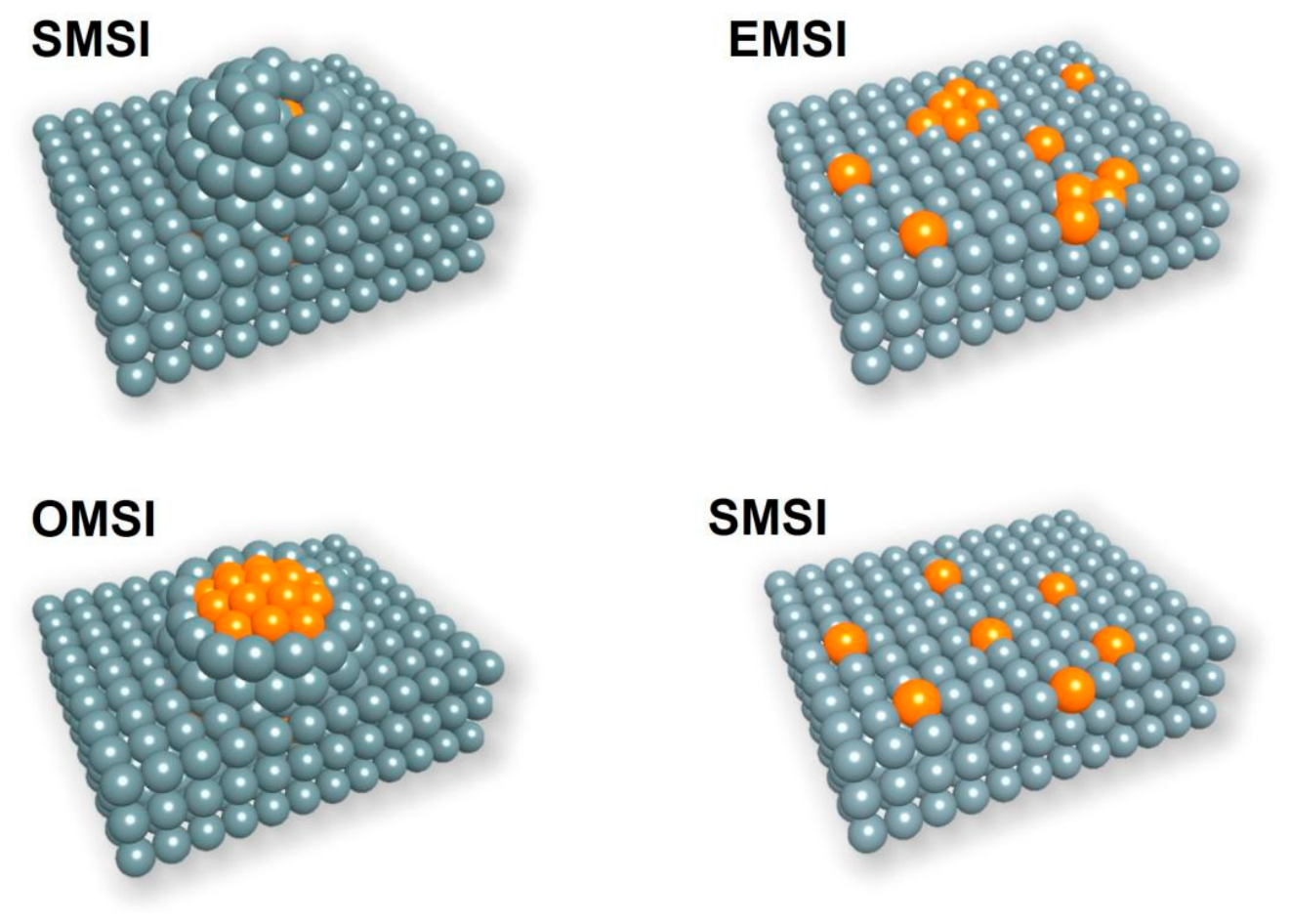
Figure 3.
(a) Schematic diagram of the structural evolution of the platinum-titania catalyst under different temperatures and atmospheres [50]. (b) Schematic diagram of the catalytic oxidation of HCHO over the 0.1Pt/TiO2-NS catalyst [52].
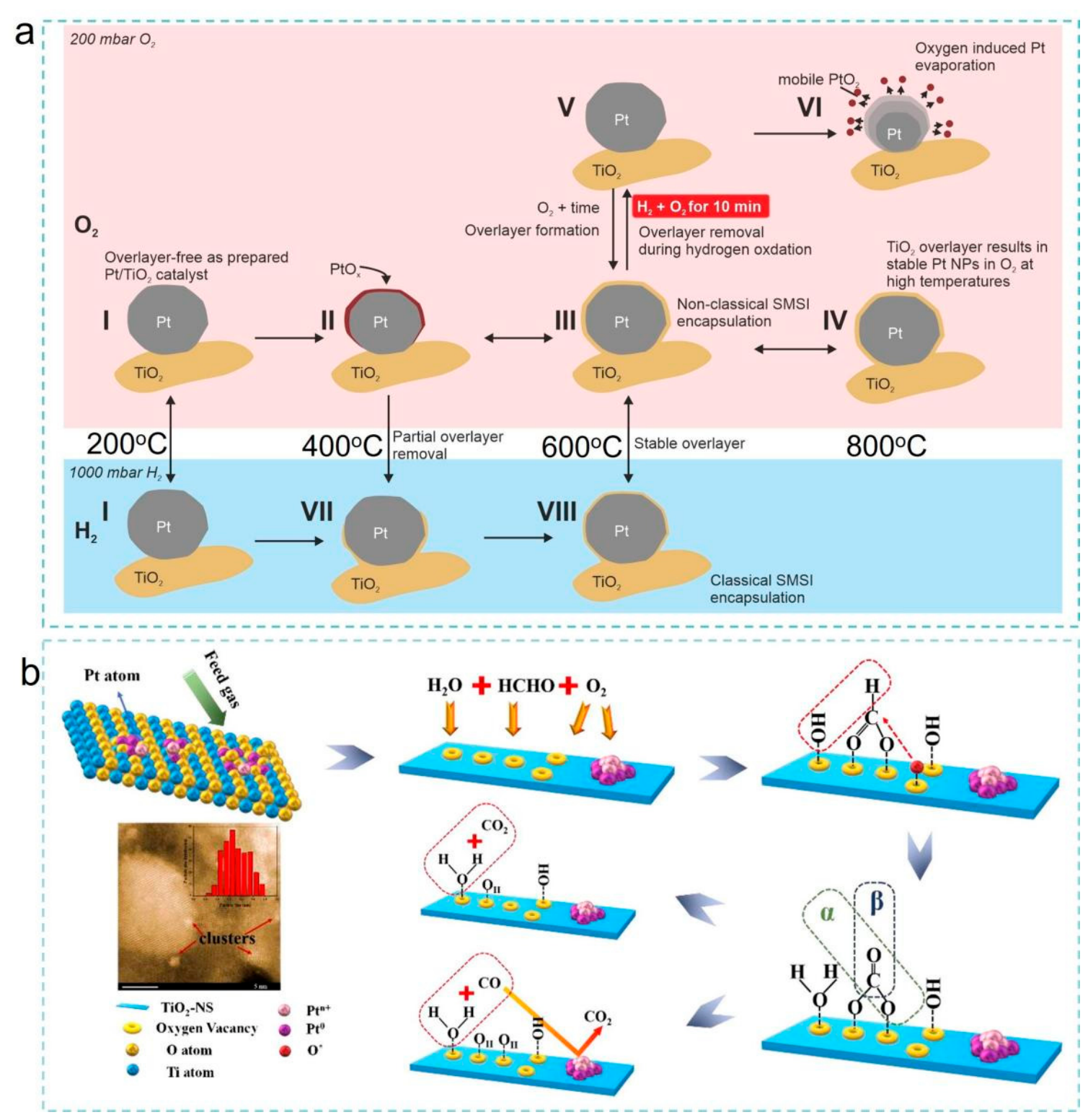
Figure 4.
(a) Schematic illustration of oxygen-vacancy associated SMSI interface of Pt-ZrO2 nanoparticles for the catalytic degradation of HCHO [55]. (b) Cs-HAADF-STEM images of 0.5% Pt/Mn-TiO2 and reaction mechanism illustration for the catalytic oxidation of HCHO on Pt/Mn-TiO2 [25].
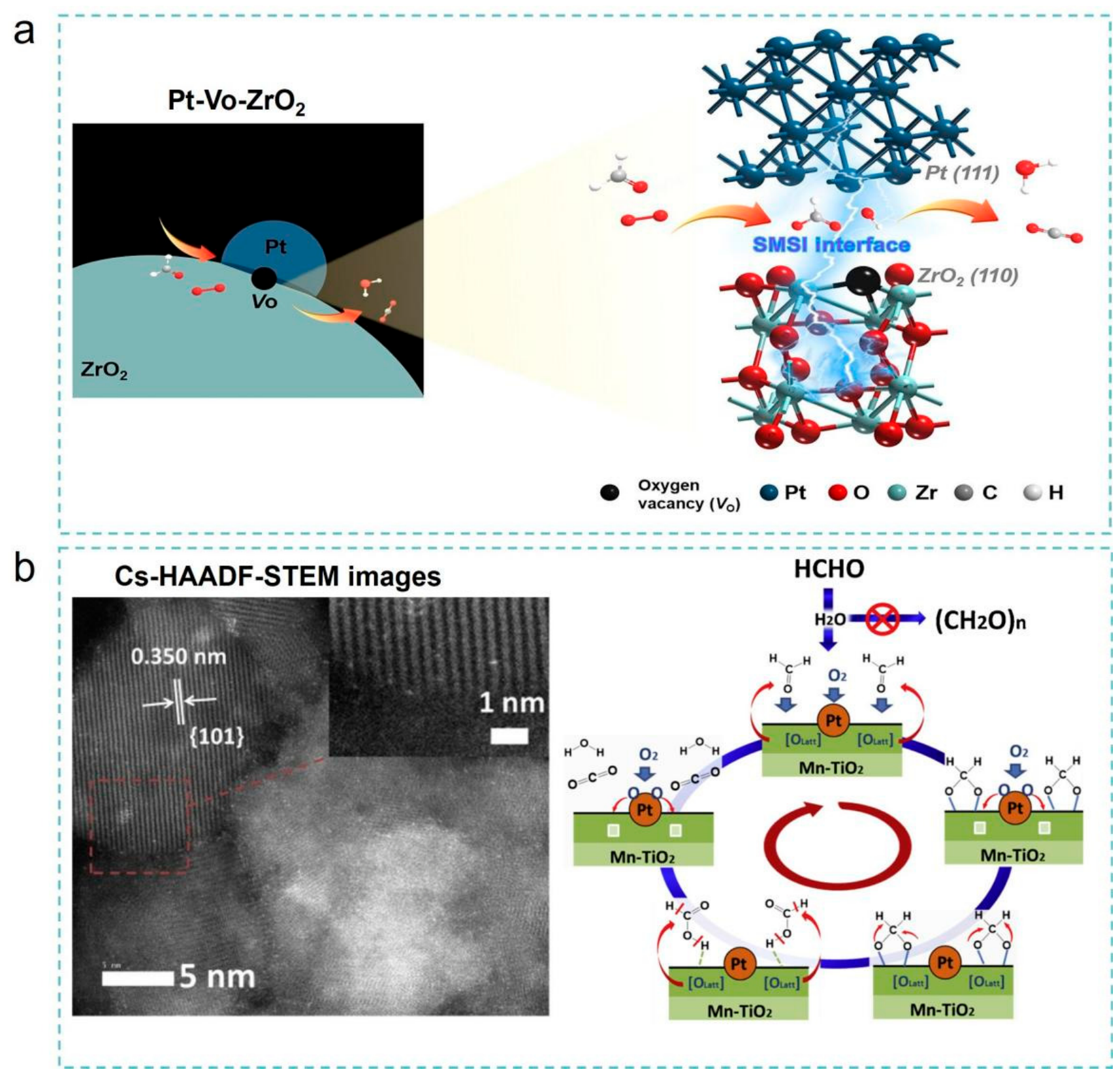
Figure 5.
(a) HAADF-STEM image of Pt-Na/SiO2 and HCHO conversion curves of Pt-based catalysts (The inset shows the differential charge density of Pt-Na/SiO2) [60]. (b)Tuning metal-support interaction of Pt-CeO2 catalysts for enhanced oxidation reactivity [41].
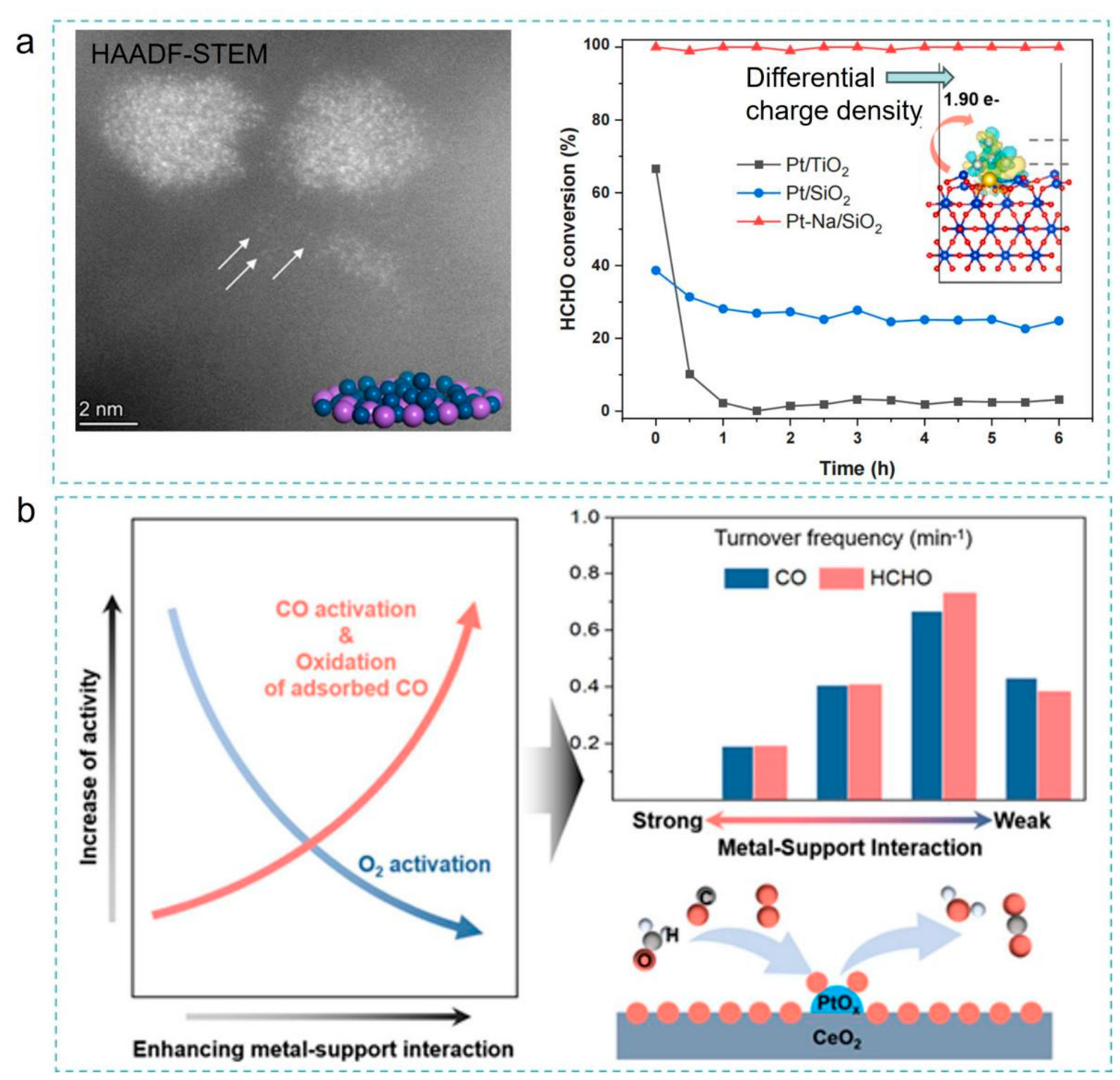
Figure 7.
(a) Schematic depiction of the technology used to achieve high-efficiency co-oxidation performance for HCHO and CO in Au/TiO2 catalysts by improving the MSI between Au and TiO2 [32]. (b) Co-adsorption configurations of HCHO and O2 on the faulty AuCe1-xO2-y(110) surface, as well as the catalytic reaction mechanism for HCHO oxidation on the defective surface [84].
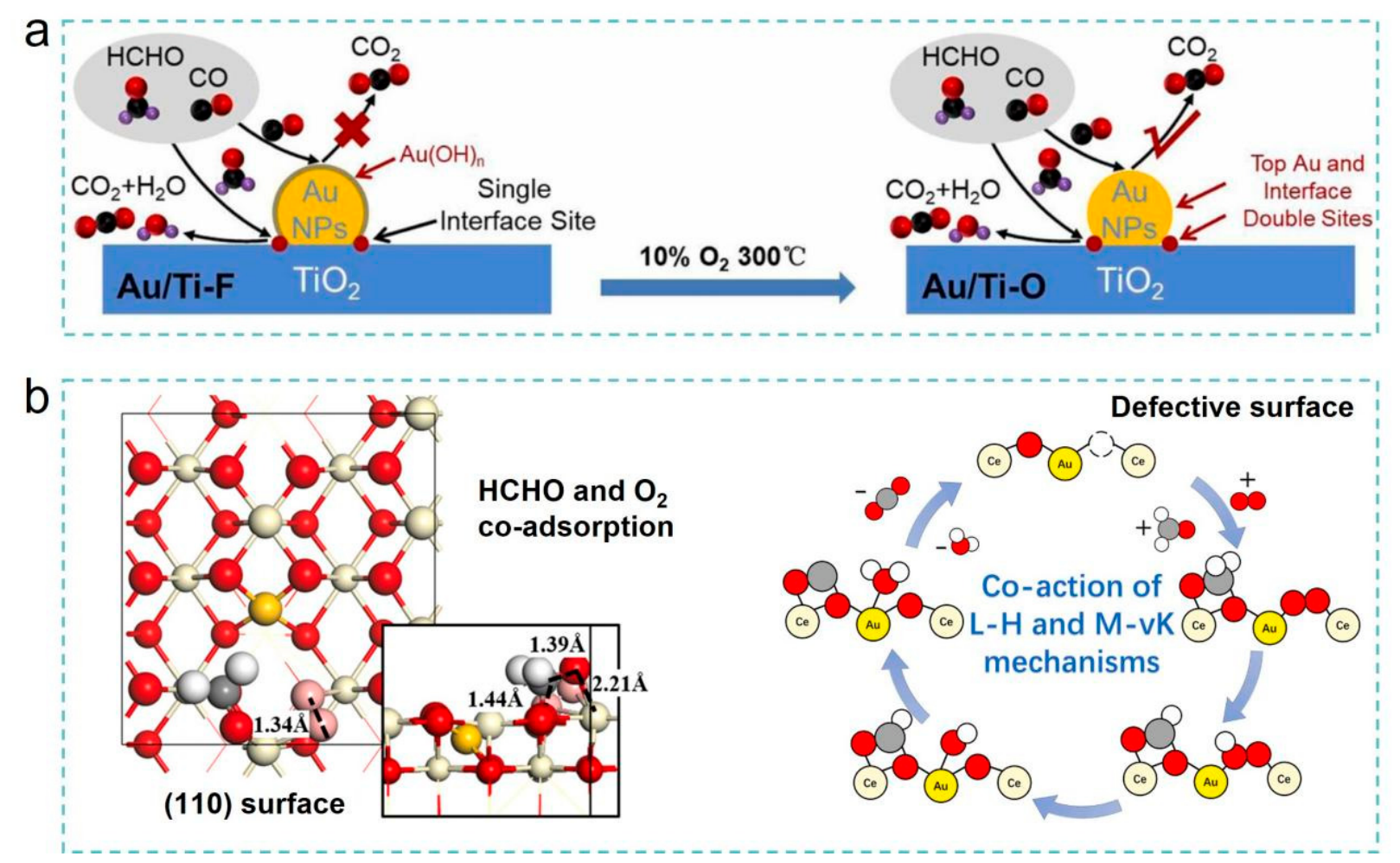
Figure 8.
(a) Tuning SMSI to stabilize metallic Pd species for HCHO oxidation [92]. (b) HCHO conversion and H2-TPR profiles of Pd/CeO2 catalysts with variations in morphology at different temperatures [94].
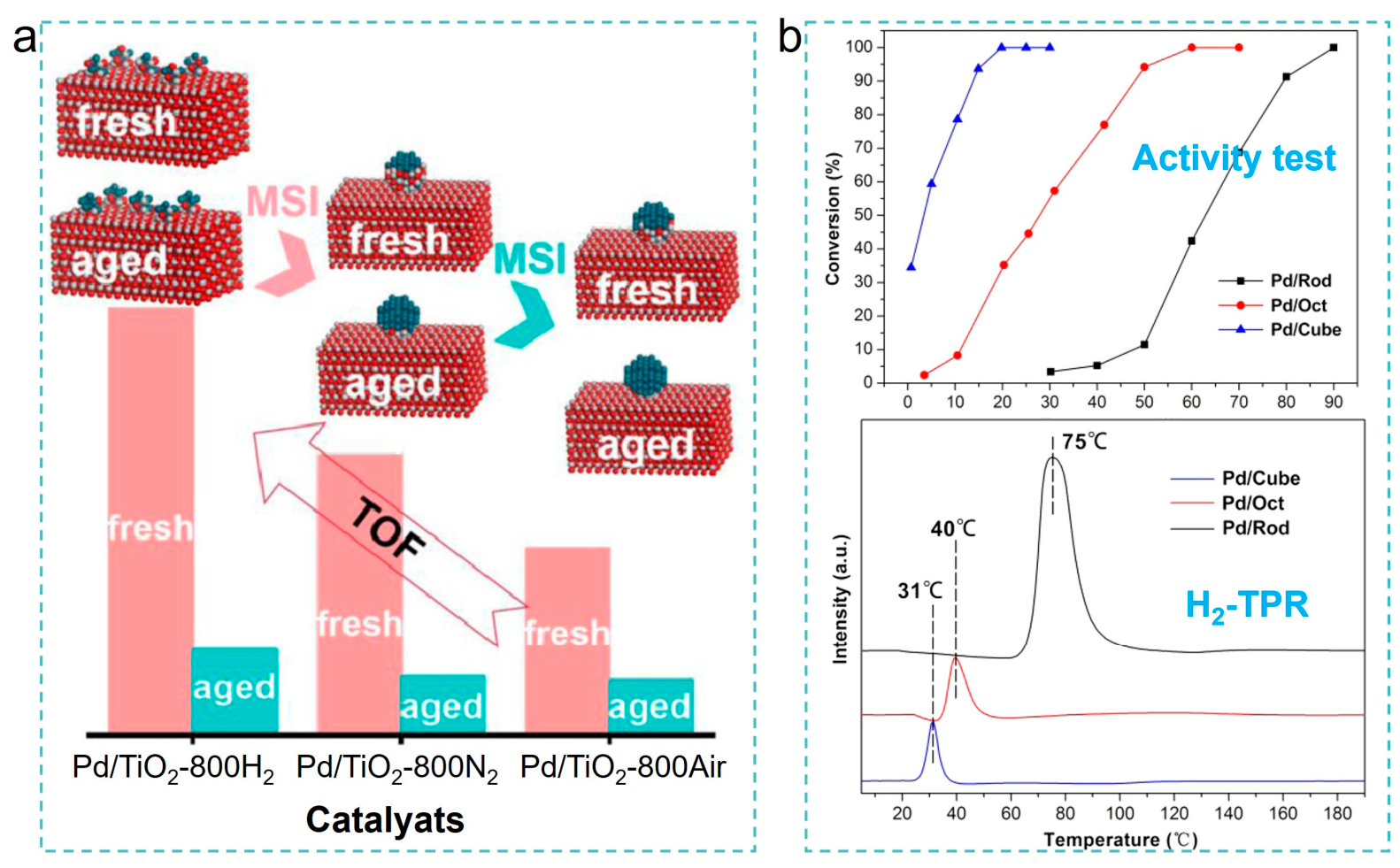
Figure 9.
(a) Charge density distributions for Pd/TiO2 and Pd/Ov-TiO2. Reduced TiO2 causes a SMSI by transferring electrons from the support to Pd, resulting in negatively charged Pd nanoparticles that increase oxygen binding and high performance for HCHO oxidation [95]. (b) The Ba-Pd electronic interaction between promoter and metal (EIPM) facilitates the formation of monatomic Pd, adjusts the electronic environment, optimizes the Pd d-band structure, and enhances oxygen activation, enabling direct HCHO oxidation [96]. (c) HCHO elimination efficiency in comparison to pure TiO2, TiO2-NaBH4, and 1 %Pd/TiO2 catalysts [97]. (d) Conversion of HCHO over prepared catalysts and proposed mechanism for the catalytic oxidation of HCHO over Pd/Mn3O4−MnO [98].
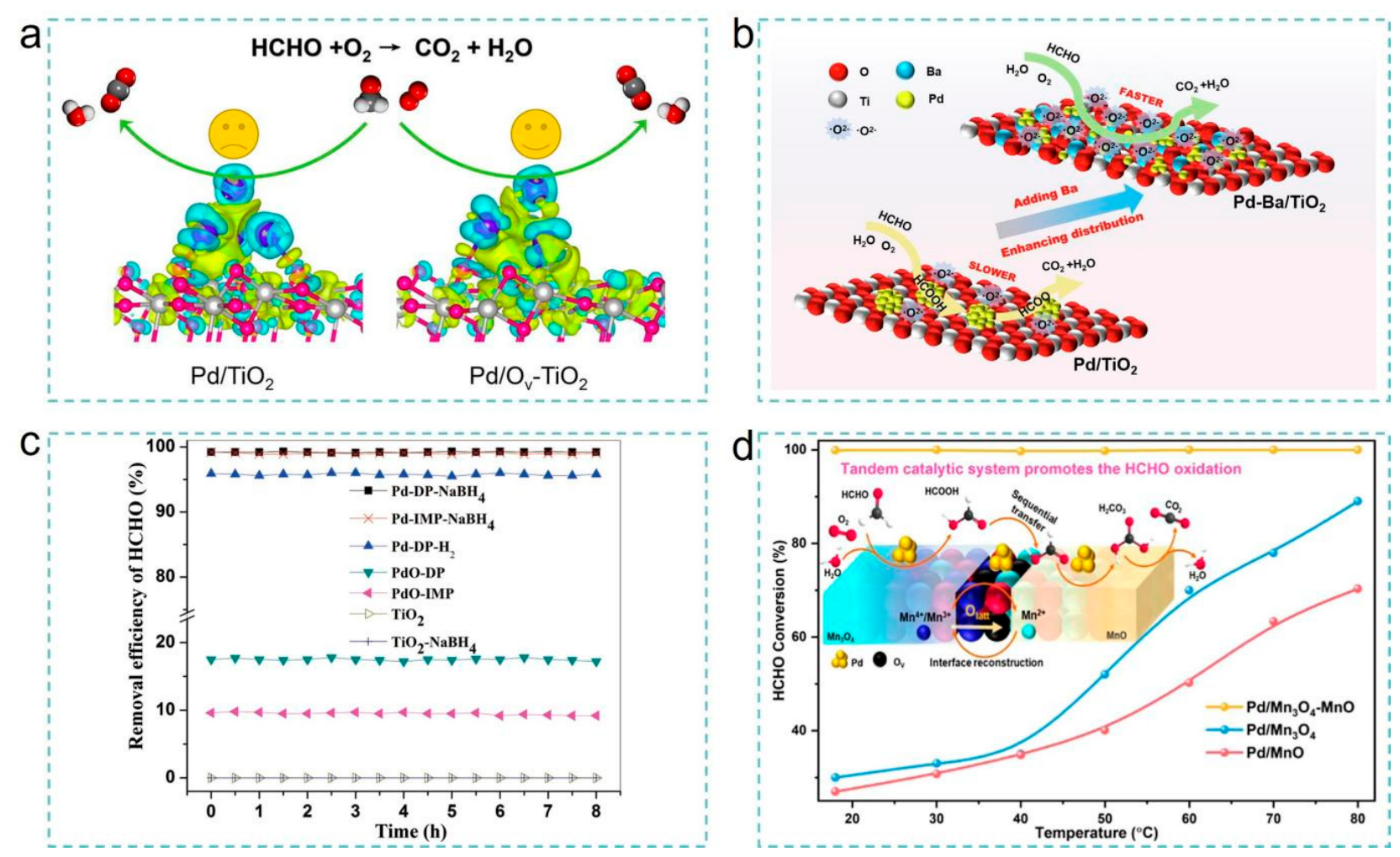
Figure 10.
(a) A schematic diagram exhibiting the notion that the crystal structure of the TiO2 support influences the activity of the Ag/TiO2 catalyst in catalyzing the oxidation of HCHO, as well as XRD curves of several catalysts [111]. (b) The mechanism of HCHO oxidation over Ag/SBA-15 and Ag-xFe/SBA-15, as well as its conversion over Ag-xFe/SBA-15 [112].
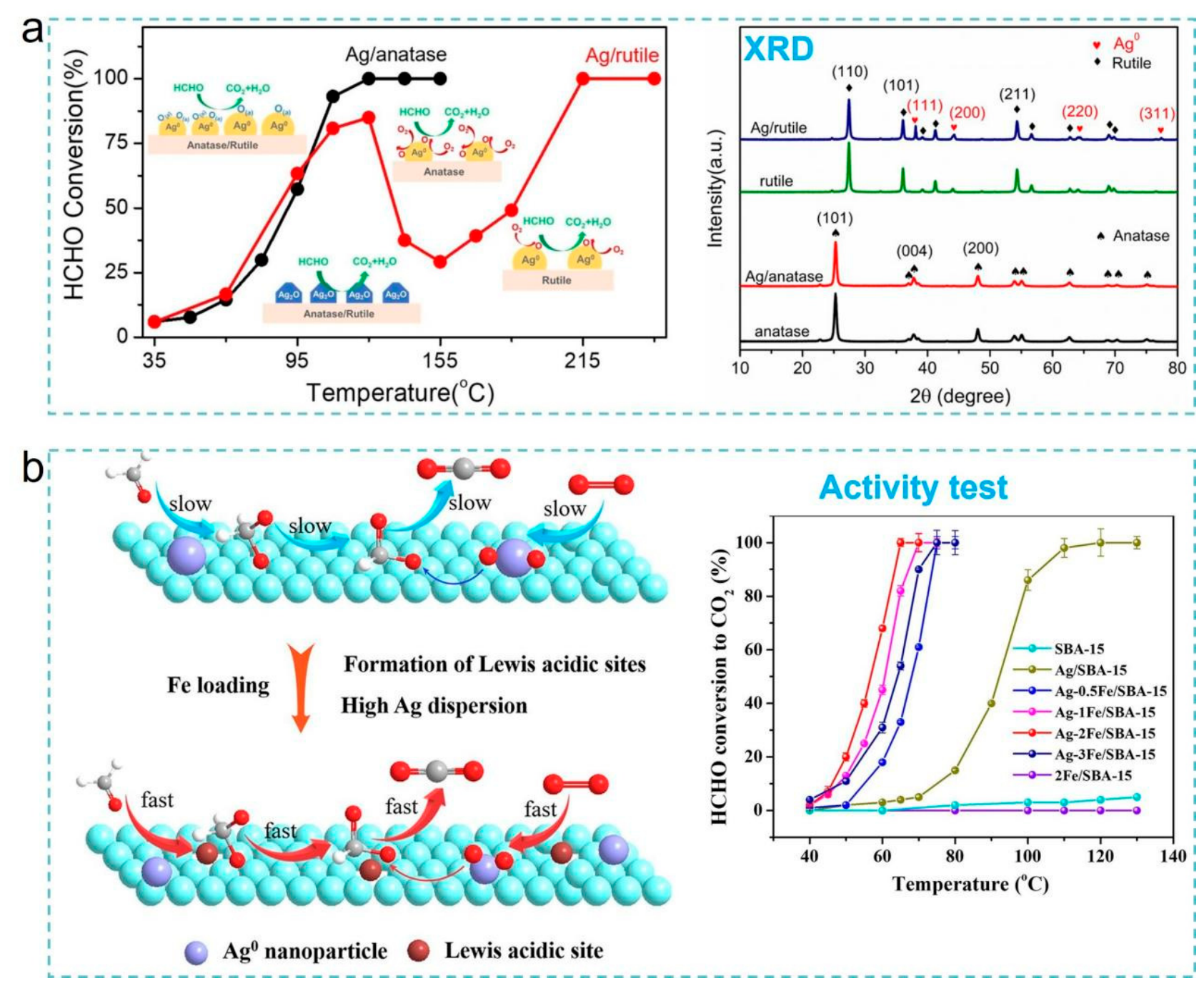
Figure 11.
(a) Schematic illustration of the top-down synthesis process involving the transformation of Ag NPs into single Ag sites assisted by the support surface, as well as the DOS of the Ag 4d orbitals in Ag1/HMO [114]. (b) HCHO conversion depends on reaction temperature in HCHO oxidation over Ag/Beta-Si and AgMn/Beta-Si catalysts, as well as a HRTEM image of the AgMn/Beta-Si catalyst [115]. (c) Schematic depiction of the microstructure of Ag-Mn catalysts with various support morphologies, as well as ozone decomposition performance curves [116]. (d) The influence of Ag valence state on HCHO conversion with temperature [117].
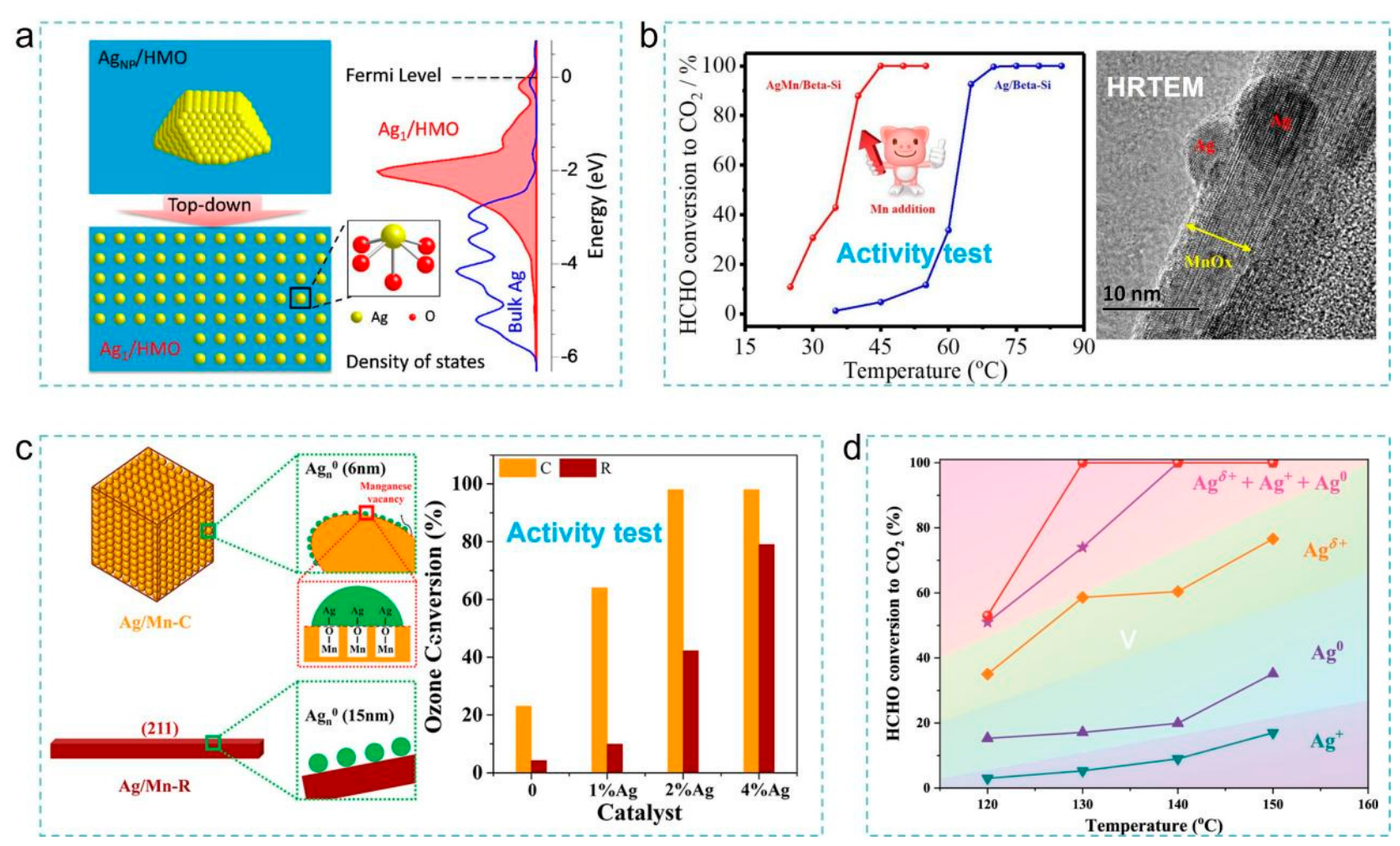
Disclaimer/Publisher’s Note: The statements, opinions and data contained in all publications are solely those of the individual author(s) and contributor(s) and not of MDPI and/or the editor(s). MDPI and/or the editor(s) disclaim responsibility for any injury to people or property resulting from any ideas, methods, instructions or products referred to in the content. |
© 2026 by the authors. Licensee MDPI, Basel, Switzerland. This article is an open access article distributed under the terms and conditions of the Creative Commons Attribution (CC BY) license (http://creativecommons.org/licenses/by/4.0/).
Copyright: This open access article is published under a Creative Commons CC BY 4.0 license, which permit the free download, distribution, and reuse, provided that the author and preprint are cited in any reuse.