

Submitted:
20 September 2026
Posted:
21 September 2026
You are already at the latest version
Abstract
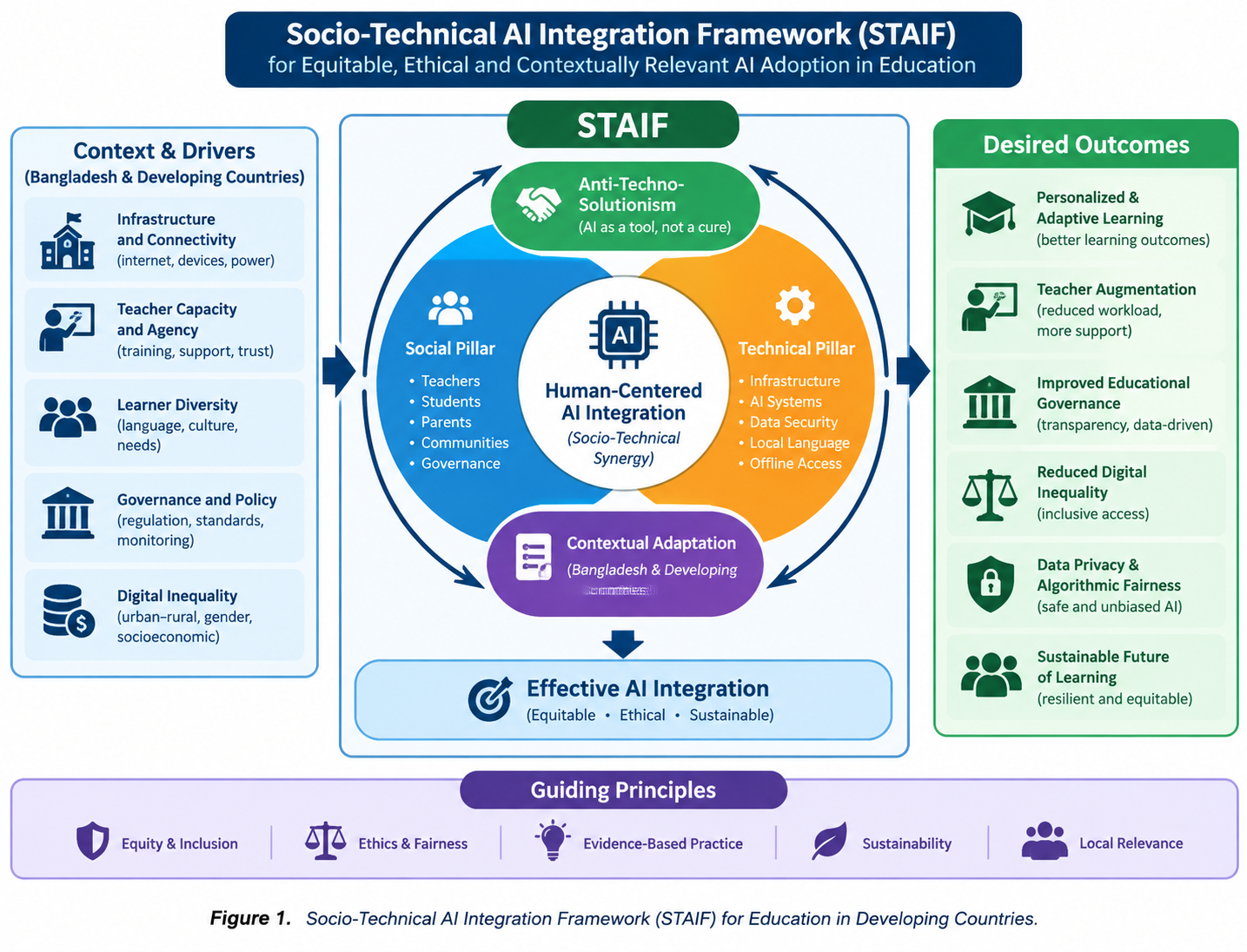
Artificial Intelligence (AI) is increasingly transforming education through personalized learning, intelligent tutoring, automated assessment, learning analytics, teacher support, and generative AI applications. However, the benefits of AI are not distributed equally, particularly in developing countries where digital infrastructure, teacher readiness, affordability, data governance, language diversity, and institutional capacity remain significant challenges. This study critically examines the opportunities, challenges, and future implications of AI in education, with particular attention to developing-country contexts and Bangladesh. A PRISMA-informed Systematic Critical Literature Review (SCLR) was conducted using peer-reviewed research, systematic reviews, meta-analyses, and authoritative institutional reports published primarily between 2018 and 2026. The review synthesizes evidence concerning personalized learning, teacher augmentation, generative AI, assessment, academic integrity, AI literacy, digital inequality, privacy, bias, and contextual adaptation. Bangladesh-specific evidence is incorporated to examine the country's readiness and the practical requirements for responsible AI adoption in education. The review indicates that AI can improve personalization, student engagement, feedback, learning efficiency, teacher productivity, and access to educational support. Recent experimental evidence also suggests that generative AI can produce positive learning effects when integrated with appropriate instructional design. Nevertheless, these benefits depend heavily on teacher involvement, infrastructure, institutional governance, and responsible implementation. Risks include misinformation, academic dishonesty, algorithmic bias, privacy violations, overreliance on automated systems, unequal access, and the marginalization of local languages and cultures. Based on the synthesis, this study proposes the Socio-Technical AI Integration Framework (STAIF), consisting of seven interconnected pillars: infrastructure-first deployment, teacher-in-the-loop implementation, local-language and cultural adaptation, offline-first accessibility, equity safeguards, responsible data governance, and continuous monitoring and evaluation. The framework provides a practical pathway for developing countries such as Bangladesh to move from fragmented AI experimentation toward equitable, sustainable, and human-centred AI integration in education.
Keywords:
artificial intelligence
; education
; generative AI
; ChatGPT
; developing countries
; bangladesh
; digital divide
; AI literacy
; teacher readiness
; educational technology
Copyright: This open access article is published under a Creative Commons CC BY 4.0 license, which permit the free download, distribution, and reuse, provided that the author and preprint are cited in any reuse.