

Submitted:
20 September 2026
Posted:
21 September 2026
You are already at the latest version
Abstract
The need of a better understanding of how sensory ion channels respond to different stimuli has led to the development of numerous experimental and theoretical approaches. In this context, the response of ion channels to external stimuli is highly complex in general, as it depends on the specific sensing mechanism, as well as the number and nature of conformational states involved. Multi-state ion channels models provide a more comprehensive physical description of their stimuli response than the simplest two-state paradigm, but can suffer from severe overparameterization, which limits physical interpretation. To address this limitation, we developed a theoretical framework demonstrating that the response of a multi-state ion channel to a given stimulus can be modeled as that of an equivalent two-state channel. This equivalence holds regardless of the number of states, conductivities, their nature, or possible transition pathways, thus overcoming overparameterization. The present equivalent model is defined by effective kinetic constants for non-conductive-to-conducting (Keff.+) and conducting-to-non-conductive (Keff.-) transitions, which act as statistically weighted “kinetic centers” of the individual rate constants (analogous to the classical center of gravity). In the steady state, and assuming the Eyring model for the individual rates, such effective constants adopt a multiexponential dependence on the stimuli. Since the Müntz-Szász theorem for Dirichlet-to-Taylor series equivalence establishes that multiexponential functions can always fit any smooth curve, the experimental Keff.+/- (X) vs X curves can (in principle) always be fitted by the model proposed here. Each kinetically indistinguishable state adds a new exponential term in the fitting.
Keywords:
ion channel
; gating
; multi-state model
; over-parametrization
; rate constant
; Markov model
Introduction
Sensory ion channels play a crucial role in various sensations including pain, touch, vision, taste, olfaction, thermal, and other physiological or signaling processes involving the detection and/or transport of molecules, ions, and electrical perturbations [1,2,3]. Since sensory channels are involved in many diseases and disorders, understanding the sensory functioning of ion channels is necessary for the designing of strategies which could result their regulation, drug designing, or generally speaking, intervening such processes where they are involved [4,5,6]. That is why much effort have been devoted in this direction either experimentally, theoretically, and in combination of both [1,2,3,4,5,6].
For a better understanding of how sensory ion channels work, it is very important to study the thermodynamic, statistical, and kinetic basis of their response to different stimuli. Modeling the stimuli response (open probability) of ion channels is, in general, a complex problem which depends on their mechanistic and number of states involve in the conformational changes [7]. Typically, two-state models are of relatively physical and mathematical simplicity and offer straightforward interpretations. This fact makes them attractive as a first approach even in complex problems [8,9,10], but constitute a reduced vision of their complexity in most cases. In contrast, modeling ion channels with multiple states constitutes a more complete physical description of the mechanistic involved in their stimulus/response behavior than that obtained from the base of two-states models [2,11,12,13,14,15]. Thus, multi-state models eventually represent a powerful tool in extracting thermodynamic and kinetic parameters from experiments, in addition to the physical interpretation of the corresponding mechanistic. The multi-state behavior, including interactions between internal sensing subunits, of many ion channels (including TRP) have been widely characterized both functionally and structurally with satisfactory results in recent years [6,11,16,17]. Nevertheless, since the number of states increases the number of required parameters for the physical description, such multiple states models have significant tendencies of overparameterization (thus losing the physical meaning). For example, if coupling between temperature and voltage sensors and pore gating is considered in TRP channels, at least 16 states (conformational events), with the corresponding 9 parameters, will be required for modeling the open probability [18]. The number of parameters could be even larger when ligand-gated channels (10 parameters) [19] or Piezo channels (up to 20 parameters) [14,15] are modeled as discrete multi-states Markov processes. Overparameterizations imply that many combinations of the same group of thermodynamics parameters can yield high quality fittings to the experimental observation, which limits the physical interpretation. Moreover, overparameterization can imply that models with qualitatively different physical bases yield good fittings to the same experimental results [20] or 104 times of difference between the same equilibrium constant from analogous data [21]. So, the drawbacks of the multi-state models is not about their flexibility to match complex problems or the quality of the resulting fittings, but it is about the possible physical meanings and derived interpretations [20]. Thus, although much progress has been reached in the biophysics of ion channels [8,9,10,11,12,13,14,15,16,17,18,19,20,21], there is still much room in establishing the probabilistic and thermodynamic determinants of the sensitivity of ion channels.
In this work we developed a theoretical framework showing that the open probability of a multi-state ion channel can be modeled as that of an equivalent two-state channel, regardless of the number of states, conductivities, their nature, or possible transition pathways, thereby avoiding overparameterization. The model defines effective kinetic constants for non-conductive-to-conducting () and conducting-to-non-conductive () transitions, which act as statistically weighted “kinetic centers” of the individual rate constants (analogous to the classical center of gravity). In the steady state, assuming the Eyring model, these effective constants become multiexponential functions of the stimuli. According to the Müntz-Szász theorem for Dirichlet-to-Taylor series equivalence, such effective constant can fit any smooth curve. Consequently, the experimental curves can always be fitted by the model proposed here, where each kinetically indistinguishable state adds a new exponential term.
2. The Open Probability and Stimuli Sensitivity of the Two-State Channel Model
As it was commented, multi-state channel models eventually represent a more complete physical description of ion channels, but they have a significant propensity to overparameterization and should be applied with care. The main features of multi-state models will be discussed later, and we center our attention on the simpler two-state model in the present section. Although the two-state Markov description constitutes a rather rough approximation, it captures the key phenomenological features of the gating dynamics of ion channels, i.e., their dichotomous nature and the stimulus-modulated open probability. Furthermore, by construction, the two-state model yields the right mean open/closed dwelling times, and the steady state probability for the open channel. So, such a simple model is still being frequently used, including systems with complex mechanistic [7,8,9,10].
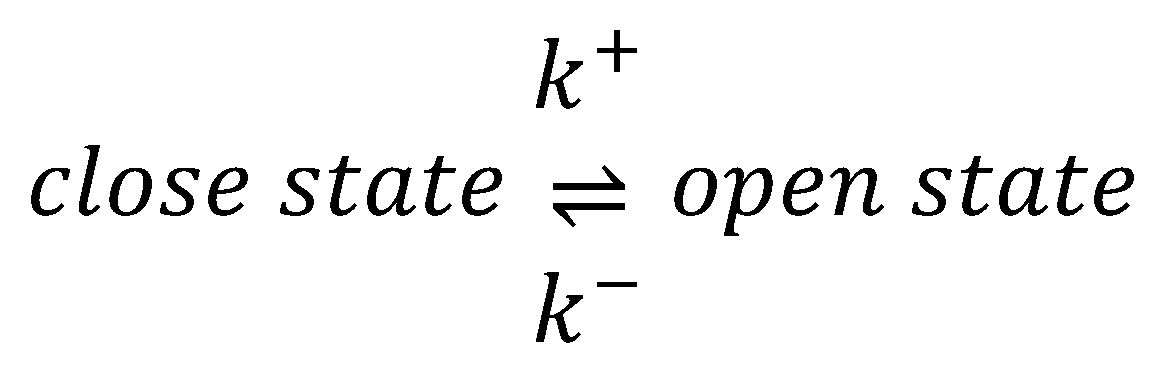
The transition dynamics of a two-state channel model can be represented by the simple kinetic Scheme 1.
The corresponding rate equation for the open state, in combination with the normalization condition of the two states, is given by:
Where is the open probability, while and are the stimuli-dependent rate constants for the close to open, and open to close state transitions, respectively. In the steady state () the open probability adopts the following general form:
The ratio is known as the equilibrium constant of the reaction represented in the Scheme 1, and equation 4 can also be read as . As it has been presented in previous papers, assuming the Eyring’s kinetic model, which obeys the Maxwell-Boltzmann distribution for the activation energy barriers determining the rate constants of the opening and closing dynamics [7,8,9,10,22,23,24,25], the equilibrium constant and the total free energy change correlate as , and the open probability in the steady for the two-state channel model is given by:
in equation (5) can be expressed as:
Where is the conformational free energy change, associated to the transition from the close to the open state at constant temperature, membrane potential, in the absence of ligands, membrane tension, radiation or any other external field forces. represents the additional free energy component to , under the action of external force fields. It is important to remark that in the particular case of ligands (L), or chemical species in general, their contribution as a component in is given by , where [L] is the ligand concentration, b is the number of binding sites, Kd is the ligand affinity of a single agonist binding site when the channel is open and ΔΔHMax is the maximal change in enthalpy in saturation conditions [26], and this expression is independent on the channel sensitivity to other nonchemical stimuli. So, equation (5) also includes these cases. External fields which reduce with respect to ( < 0) will favor the channel opening, while those increasing ( > 0) will cause the opposite effect.
For the sake of simplicity, let’s define the parameter :
which accounts for how many times is nominally contained in (the relative total free energy change). stands for the environmental or external stimulus ( = V, , T, [L], etcetera; membrane potential, surface tension, temperature, and ligand concentration, respectively). Understanding that the relative total free energy change is a function of , from now we will refer to this parameter simply as instead of , for the sake of simplicity (as it is with ). Thus, by deriving equation (3) the general form for the channel sensitivity to a stimulus ()can be written as:
This relation constitutes a generalized form of the ones obtained in a previous work [in preparation] for the cases of . The term () in equation (6) accounts for the sensitivity of the thermodynamic state of the channel (the relative total free energy) to be perturbated by the action of . The corresponding minus sign indicates that if the relative total free energy of the channel is reduced by the action of the external field (), favoring the channel opening, the corresponding sensitivity will be positive. Additionally, the term also contains the effect of the “coupling factor”, as it was defined and developed for the particular case of mechano-sensitivity in a previous paper [in preparation].
3. The Two-State Equivalent of Multi-State Channel Models
As it was mentioned above, although multi-state models can potentially offer a more complete description of the gating dynamics, they have a natural tendency of overparameterization, which not only can lead to numerically divergent kinetic parameters of the same system [21], but also limits physical interpretations (the overdetermination problem), or could even lack physical meaning. In this section we introduce some parameters which account for the pondered contribution of the kinetic rate constants for transitions between the different channel’s states (independently of their nature, conductivity, or any other condition), which gives rise to an equivalent two-state channel model. Thus, the results obtained above regarding the open probability and the sensitivity of the two-state model can be qualitatively extrapolated to the case of multi-state channel models, regardless of the number of states, circumventing the potential problem of overparameterization.
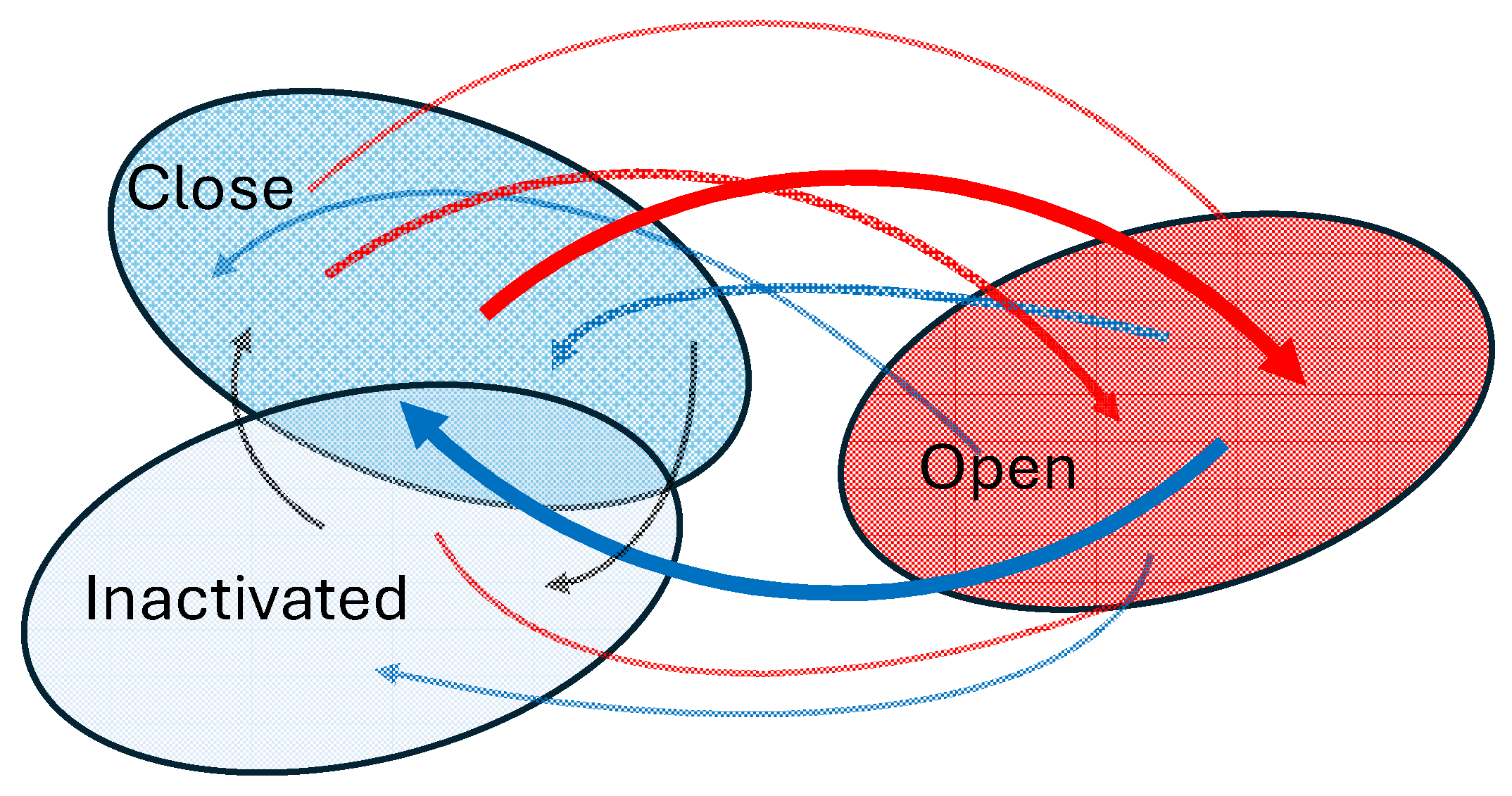
Let’s consider a single channel with n open states (O), m close states (C), and l inactive states (I). Each open state can have a different conductivity, while the close and inactive states have zero conductivity; see the schematic representation Scheme 2.
Then, the corresponding n rate equations for the open states have the following form (we only included here that of the k-th open state for representative purposes):
Where POk, PCj, and PIj, are the probabilities that the channel is in the open state k (Ok), the close state j (Cj), and the inactive state j (Ij), respectively. kCj-Ok, kIj-Ok, kOj-Ok, are the kinetic rate constants for Cj → Ok, Ij → Ok, and Oj → Ok transitions, respectively; while kOk-Cj, kOk-Ij, kOk-Oj are the kinetic rate constants corresponding to Ok → Cj, Ok → Ij, and Ok → Oj transitions, respectively. Note that in equation (7) the positive terms of the sum account for the total rate at which the Ok state is occupied from any other state, while the negative terms of the sum account for the total rate at which the Ok state transits to any other state. By summing the set of n equations represented in (7) we have:
In equation (8), the two first terms of the sum account for the total rate at which any conductive state (O) is occupied from any other non-conductive state (C or I), the third term accounts for total rate at which any conductive state (O) transit to any other non-conductive state (C or I), while the fourth term accounts for the net transition rate between all the different open states (O). It is important to note that this last term is zero because the net rate at which the state Oi is occupied from the state Oj appears as a positive contribution in the equation of , but exactly the same amount appears as negative contribution in the equation of (the rate at which Oj transits to Oi). Thus, multiplying and dividing the two first terms in equation (14) by (the probability of the occurrence of any C or I state), and considering that (from the normalization condition), and multiplying and dividing the third term by (the probability of the occurrence of any O state) we have:
Note that the bracket in first in the term is the statistically-pondered (or average) kinetic constant for the transitions from any non-conductive state (C or I) to any conductive state (O). So, the more populated a given non-conductive state is (and larger the corresponding transitions rate), the greater its weight in the average kinetic constant for non-conductive → conductive states transitions. Thus, the statistical weight of every state (in mechanical statistics terms [27]) ponders the contribution of the corresponding conformation to the transition rate dynamic of the channel. This idea can be paralleled, since it conserves the same mathematical form, to that of the more familiar concept of gravity center from Classical Mechanics. That is a kind of “kinetic rate center” of such transitions or equivalently, an effective kinetic rate constant. Analogously, the bracket in the second term in equation (9) is the pondered (or average) kinetic constant for the transitions from any conductive state (O) to any non-conductive state (C or I). The more populated a conductive state is (and larger the corresponding transitions rate), the bigger its statistical weight in the average kinetic constant for conductive → non-conductive states transitions. Then, the effective (pondered or “gravity center-like”) kinetic constant (which in general depend on time and on the stimuli) for non-conductive → conducting states transitions () and conductive → non-conductive states transitions () can be mathematically defined as:
From the typical assumption (experimentally supported) of Boltzmann statistics for the rate constants (kCj-Oi, kIj-Oi, kOi-Cj, kOi-Ij) of channel opening and closing in thermal equilibrium with the environment, such parameters can be modeled as exponentially-dependent on the stimuli (the Eyring model) [7,8,40]. So, the stimuli dependence of and in the steady state can be obtained by multiexponential fitting of the corresponding experimental data, note that the statistical weights (; Y=C,I,O) in (10) and (11) are the coefficients of the exponentials while the stimuli are in their arguments (if only one thermodynamic sate were present in the conductive or non-conductive conformations, a single exponential would be observed). That is, the paradigm of the Eyring model implies that the effective kinetic constants () have the same mathematical form to that resulting from the Müntz-Szász theorem (in the context of Dirichlet series equivalence to Taylor series) which states that any smooth function can be represented in the form . This fact means that the experimental curves can always be fitted by a multiexponential curve, with the proper number of exponentials (accounting for the different kinetically indistinguishable states).
The advantage of knowing (with a physical support) that multiexponential fitting is the key to obtain and from experiments is that it can allow to find the number of states, their statistical weights, and their ΔGij in a multi-state channel, without any initial assumption in this regard, as it is currently done. Substituting definitions (10) and (11) in equation (9), the last can be rewritten as:
As we mentioned above, the probability of the occurrence of any O state is , thus:
Note that equation (13) has the same form as that of the two-state channel model (1) with stimuli and time dependent kinetic constants. In other words, a multi-state channel behave like a two-state model (non-conductive ↔ conductive; Scheme 3), where the non-conductive state is a virtual one with an occurrence probability of and a transition rate constant to the conductive state of ; while the conductive state is a virtual one characterized by an occurrence probability of and a transition rate constant to the non-conductive state of .
In the steady state and are constant; accordingly, for a single channel with a non-zero average current in experimental terms (a channel which does not spent most of the time in non-conductive states, just to prevent the trivial solution), the solution of equation (13) is analogous to that of the general relation for the two-state channel model in (2).
Thus, from the experimental steady state open probability of the single channel, the corresponding time-independent equilibrium constant () can be straightforwardly obtained. Note that for chemical reactions at the equilibrium (in this case, the two-state “reaction” at a given temperature and pressure which reached the steady state), under the “dilute conditions” approximation (the intrinsic physical properties of the channels are not interfered by the proximity of other channels), and from purely thermodynamic principles the general relation between the free energy change and the equilibrium constant is derived [28,29,30]. In the steady state, the results in the previous section 2 regarding the open probability and the correspondent sensitivity can be extrapolated here in the same way. Otherwise, the more general (time-dependent or not ) relation for the sensitivity holds:
Note that equation (15) has the same mathematical form to that of equation (6), so it is its generalized form in multi-state channels. As well, the term accounts for the stimuli sensitivity of the equilibrium shift (Scheme 3), which can be interpreted as and effective thermodynamic state (as discussed in the previous section).
Conclusions
The open probability and the sensitivity of a multi-state ion channel can be expressed in terms of those of an equivalent two-state channel model, independently on the number of states, their conductivities, or their nature, offering an alternative to overcome the problem of overparameterization. Such equivalent two-state channel model is defined by the effective kinetic constant for non-conductive → conducting states transitions () and conductive → non-conductive states transitions (), which constitute pondered or statistically-weighted “kinetic centers” (analogous to the concept of gravity center from Classical Mechanics). In the steady state, and under the paradigm of the Eyring model, the effective kinetic constants () have the same mathematical form to that resulting from the Müntz-Szász theorem (in the context of Dirichlet series equivalence to Taylor series). This fact implies that the experimental curves can always be fitted by a multiexponential curve, adding a new exponential for each kinetically indistinguishable state.
References
- Advances in TRP channel drug discovery: from target validation to clinical studies. Koivisto, AP., Belvisi, M.G., Gaudet, R. et al. Nat Rev Drug Discov 21, 41–59 (2022). [CrossRef]
- Sensory TRP Channels in Three Dimensions. Melinda M. Diver, John V. Lin King, David Julius, and Yifan Cheng. Annual Review of Biochemistry. 2022. 91:629–49. [CrossRef]
- The physiological sensor channels TRP and piezo: Nobel Prize in Physiology or Medicine 2021. Scott Earley, L. Fernando Santana, and W. Jonathan Lederer. 2022, Physiol Rev 102: 1153–1158. [CrossRef]
- Chapter 7 - Protein engineering and design in ion channels and receptors. Nadira Khatoon a, Sushanth Adusumilli a, Poulomi Dey a, Rachita Sharma a, Pradeepti Kampani a, Jayasha Shandilya b, Tapan K. Nayak. Methods in Cell Biology, Volume 169, 2022, Pages 143-168. [CrossRef]
- Simulation and Machine Learning Methods for Ion-Channel Structure Determination, Mechanistic Studies and Drug Design. Zhengdan Zhu, Zhenfeng Deng, Qinrui Wang, Yuhang Wang, Duo Zhang, Ruihan Xu, Lvjun Guo and Han Wen. Front. Pharmacol. (2022) 13:939555. [CrossRef]
- Structural bases of TRP channel TRPV6 allosteric modulation by 2-APB. Appu K. Singh, Kei Saotome, Luke L. McGoldrick & Alexander I. Sobolevsky. Nat. Commun., 9 (1) (2018), p. 2465. [CrossRef]
- Voets, T. (2012). Quantifying and Modeling the Temperature-Dependent Gating of TRP Channels. In: , et al. Reviews of Physiology, Biochemistry and Pharmacology. Reviews of Physiology, Biochemistry and Pharmacology, vol 162. Springer, Berlin, Heidelberg. [CrossRef]
- Physics of mechanotransduction by Piezo ion channels. Michael Young, Amanda H. Lewis, Jörg Grandl. J Gen Physiol (2022) 154 (7): e202113044. [CrossRef]
- Elastic properties and shape of the Piezo dome underlying its mechanosensory function. Christoph A. Haselwandter, Yusong R. Guo, Ziao Fu, and Roderick MacKinnon. PNAS, 2022, Vol. 119 No. 40 e2208034119. [CrossRef]
- Two-state model explaining thermodynamic regulation of thermogating channels Xuejun C. Zhang,Zhuoya Yu. Biophys Rep 2022, 8(4):205−211. [CrossRef]
- An Unorthodox Mechanism Underlying Voltage Sensitivity of TRPV1 Ion Channel. Fan Yang, Lizhen Xu, Bo Hyun Lee, Xian Xiao, Vladimir Yarov-Yarovoy, Jie Zheng. Adv. Sci.2020,7, 2000575. [CrossRef]
- Progress in the Structural Basis of thermoTRP Channel Polymodal Gating. Gregorio Fernández-Ballester,Asia Fernández-Carvajal and Antonio Ferrer-Montiel. Int. J. Mol. Sci. 2023, 24(1), 743. [CrossRef]
- Energetic landscape of polycystin channel gating. Leo CT Ng, Brandon J Harris, Megan Larmore, My C Ta, Thuy N Vien, Valerie L Tokars, Vladimir Yarov-Yarovoy, Paul G DeCaen. EMBO Reports (2023) e5678. [CrossRef]
- Microscopic mechanism of PIEZO1 activation by pressure-induced membrane stretch. Tharaka D. Wijerathne, Alper D. Ozkan, and Jerome J. Lacroix. J. Gen. Physiol. 2023 Vol. 155 No. 5, e202213260. [CrossRef]
- Yoda1’s energetic footprint on Piezo1 channels and its modulation by voltage and temperature. Tharaka D. Wijerathnea, Alper D. Ozkana, and Jerome J. Lacroix. PNAS 2022, Vol. 119, No. 29, e220226911. [CrossRef]
- Structural insights into the gating mechanisms of TRPV channels. Ruth A. Pumroy, Edwin C. Fluck III, Tofayel Ahmed, Vera Y. Moiseenkova-Bell. Cell Calcium. Volume 87, May 2020, 102168. [CrossRef]
- Structural and evolutionary insights point to allosteric regulation of TRP ion channels. Jacob K. Hilton, Minjoo Kim, and Wade D. Van Horn. Acc Chem Res. 2019 Jun 18; 52(6): 1643–1652. [CrossRef]
- Voltage is a partial activator of rat thermosensitive TRP channels. Jos ́e A. Matta and Gerard P. Ahern. J Physiol585.2 (2007) pp 469–482. [CrossRef]
- Stochastic shielding and edge importance for Markov chains with timescale separation. Schmidt DR, Galán RF, Thomas PJ. PLoS Comput Biol 14(6), (2018): e1006206. [CrossRef]
- A historical biophysical dogma vs. an understanding of the structure and function of voltage-gated tetrameric ion channels. A review. Rolando Guidelli. Biochimica et Biophysica Acta (BBA) – Biomembranes, Volume 1864, Issue 12, 1 December 2022, 184046. [CrossRef]
- Brauchi, S.; Orio, P.; Latorre, R. (2004). Clues to understanding cold sensation: Thermodynamics and electrophysiological analysis of the cold receptor TRPM8. Proceedings of the National Academy of Sciences, 101(43), 15494–15499. [CrossRef]
- Landau, Lev Davidovich & Lifshitz, Evgeny Mikhailovich (1980). Statistical Physics. Course of Theoretical Physics. Vol. 5 (3 ed.). Oxford: Pergamon Press. ISBN 0-7506-3372-7. Translated by J.B. Sykes and M.J. Kearsley. See section 28.
- The Generalized Boltzmann Distribution is the Only Distribution in Which the Gibbs-Shannon Entropy Equals the Thermodynamic Entropy. Xiang Gao, Emilio Gallicchio, Adrian E. Roitberg. J. Chem. Phys. 151, 034113 (2019). [CrossRef]
- Gao, Xiang (March 2022). The Mathematics of the Ensemble Theory. Results in Physics. 34: 105230. [CrossRef]
- Gibbs, Josiah Willard (1902). Elementary Principles in Statistical Mechanics. New York: Charles Scribner’s Sons.
- Neuronal TRP channels: thermometers, pathfinders and life-savers. Karel Talavera, Bernd Nilius and Thomas Voets. Trends Neurosci. 2008 Jun;31(6):287-9. [CrossRef]
- Statistical Mechanics of Monod–Wyman–Changeux (MWC) Models. Sarah Marzen, Hernan G. Garcia, Rob Phillips. Journal of Molecular Biology. Volume 425, Issue 9, 13 May 2013, Pages 1433-1460. [CrossRef]
- P. W. Atkins and J. de Paula, Physical Chemistry, 11th ed., Oxford University Press, 2018.
- IUPAC Gold Book, “Gibbs energy change of a reaction”, and “equilibrium” entries.
- LibreTexts chemistry, “Gibbs free energy and chemical equilibrium” (http://chem.libretexts.org).
Scheme 1.
Schematic representation of the transition dynamics of a two-state channel model.
Scheme 2.
Schematic representation of the transition dynamics of a multi-state channel model. The different sets of an indeterminate number of closed, open, or inactivated states are represented by ovals (energies and rate constants overlapping are eventually possible). The arrows represent the possible transitions between the different states (which is in principle an indeterminate number, and all transitions are possible); the thicker arrows represent higher transition rates.
Scheme 2.
Schematic representation of the transition dynamics of a multi-state channel model. The different sets of an indeterminate number of closed, open, or inactivated states are represented by ovals (energies and rate constants overlapping are eventually possible). The arrows represent the possible transitions between the different states (which is in principle an indeterminate number, and all transitions are possible); the thicker arrows represent higher transition rates.
Scheme 3.
Schematic representation of the equivalent two-state channel model of a multi-state channel.
Scheme 3.
Schematic representation of the equivalent two-state channel model of a multi-state channel.

Disclaimer/Publisher’s Note: The statements, opinions and data contained in all publications are solely those of the individual author(s) and contributor(s) and not of MDPI and/or the editor(s). MDPI and/or the editor(s) disclaim responsibility for any injury to people or property resulting from any ideas, methods, instructions or products referred to in the content. |
© 2026 by the authors. Licensee MDPI, Basel, Switzerland. This article is an open access article distributed under the terms and conditions of the Creative Commons Attribution (CC BY) license (http://creativecommons.org/licenses/by/4.0/).
Copyright: This open access article is published under a Creative Commons CC BY 4.0 license, which permit the free download, distribution, and reuse, provided that the author and preprint are cited in any reuse.