

Submitted:
15 September 2026
Posted:
21 September 2026
You are already at the latest version
Abstract
Loperamide is an inexpensive μ-opioid receptor (MOR) agonist whose central action is normally restricted by low systemic exposure and ATP-binding cassette subfamily B member 1 (ABCB1/P-glycoprotein) efflux. Its major metabolite, N-desmethyl loperamide (dLop), is an informative matched molecular pair: dLop retains high MOR affinity but inhibits hERG less potently than loperamide, while remaining strongly effluxed and retaining other liabilities. We propose that the scaffold can be redesigned only if four overlapping maps—MOR function, ABCB1 transport, cardiac ion-channel inhibition, and developability—are measured separately and then recombined. Ten modification axes are analysed, with their evidence, favourable and adverse consequences, interaction logic, and synthetic burden. Single-variable pairs establish attribution; higher-order candidates combine only validated, non-redundant modules. We also compare original-plus-original, modified-plus-original, and modified-plus-modified products, while rejecting transporter or metabolic inhibition as a shortcut to brain exposure. Case reports of dependence, withdrawal-motivated misuse, malignant arrhythmia, and death motivate a co-primary abuse-liability programme and layered prevention strategy. The lowest-complexity programme is a dLop-centred, common-intermediate platform that first combines one safety module, one disposition module, and, only when justified, one efficacy-shaping module. The framework fails if improved central exposure or cardiac selectivity cannot be separated from lost MOR function or from respiratory, behavioural, gastrointestinal, addiction-related, and cardiac toxicity.
Keywords:
loperamide
; N-desmethyl loperamide
; μ-opioid receptor
; ABCB1
; P-glycoprotein
; hERG
; Nav1.5
; drug repurposing
; medicinal chemistry
; analgesia
1. Design Premise and Evidence Anchor
Analgesic access depends on procurement, regulation, clinical capacity, and misuse risk as well as manufacturing cost 1,2. Here, moderate-intensity analgesia is a target product profile—titration between inadequate non-opioid treatment and high-potency opioid exposure—not a receptor-affinity category. The scientific question is whether an old, potentially low-cost scaffold can be re-engineered without carrying forward its principal barriers.
Loperamide separates target engagement from target access. It is a potent MOR agonist in vitro 3, whereas ABCB1 activity and low systemic exposure normally restrict brain action; loss or inhibition of P-glycoprotein increases central exposure and opioid effects 4,5. Dose escalation is unsafe because loperamide inhibits hERG and Nav1.5 at high exposure 6. dLop supplies the strongest internal clue: changing the terminal N,N-dimethyl amide to an N-methyl amide retains subnanomolar MOR binding in one screen yet shifts hERG inhibition from approximately 33 to 245 nM 7,8. dLop nevertheless remains an avid ABCB1 substrate in human PET and transporter studies 9,10. The amide edit therefore separates part of the cardiac-liability map from MOR binding but does not solve delivery.
Central hypothesis. The MOR, ABCB1, cardiac-channel, and developability maps overlap without being identical. Single-variable series can reveal which local edits move each map; a viable lead will require a deliberately combined set of orthogonal edits. The hypothesis fails if every gain in brain exposure or cardiac selectivity proportionately destroys MOR function, or if analgesic exposure cannot be separated from major opioid and cardiac harms.
2. Single-Variable Evidence and Multivariable Candidates
Changing one variable at a time is an inference rule, not a final-molecule rule. A matched molecular pair estimates the contribution of one edit. Double edits test additivity, synergy, or antagonism. Three- and four-module candidates should then combine only benefits that survive those comparisons. Otherwise, success cannot be assigned to a cause and failure teaches little.
Interaction must be evaluated separately for MOR function, ABCB1 efflux, hERG/Nav1.5 activity, solubility, clearance, and synthetic burden: the same combination may be synergistic for cardiac safety and antagonistic for receptor activity. Evidence below is graded A for direct loperamide/dLop evidence, B for related diaryl-hydroxypiperidine or piperazine scaffolds, and C for general mechanistic rationale requiring direct testing.
3. Computational Methods
3.1. Compound Set and Provenance
The primary computational set was intentionally limited to three publicly documented members of one amide-demethylation series: loperamide (PubChem CID 3955), dLop (CID 9805944), and N-didesmethyl loperamide (CID 25129795) 27–29. This avoids inventing an untested high-potency structure while providing a chemically exact matched series. PubChem connectivity SMILES were used without stereochemical assignment because the database records and parent drug are represented without a single defined configuration.
3.2. Reproducible Descriptor and Conformer Protocol
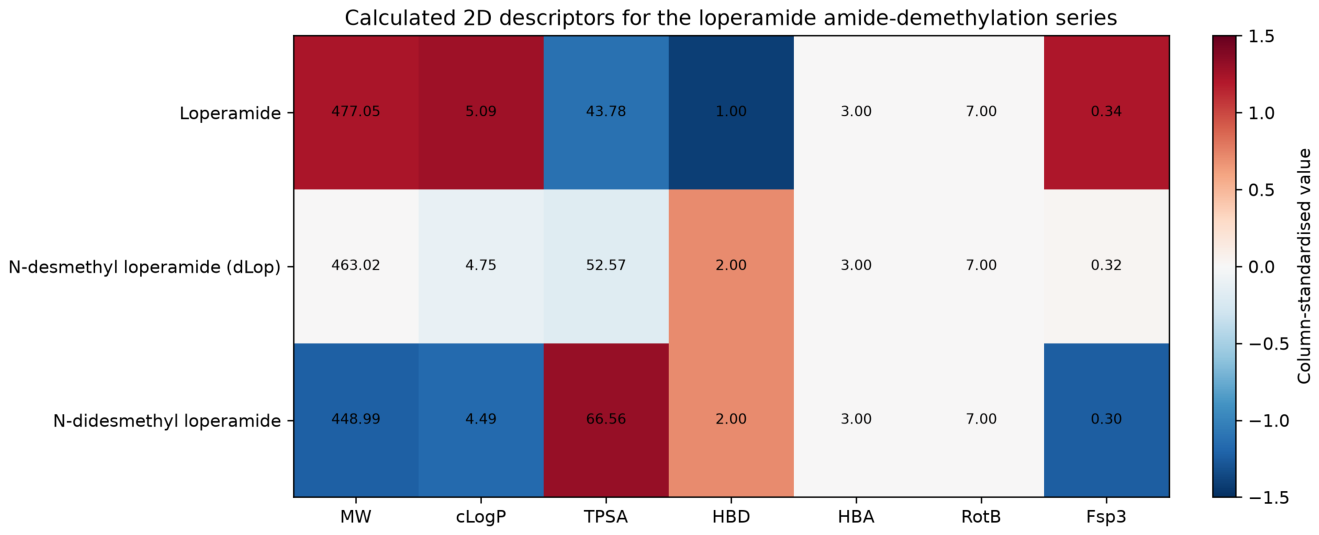
Calculations used RDKit 2026.03.6. Molecular weight, Crippen cLogP, topological polar surface area (TPSA), hydrogen-bond donors and acceptors, rotatable bonds, fraction sp3 carbon, and molar refractivity were calculated for the neutral PubChem connectivity. For three-dimensional analysis, the piperidine nitrogen was represented in a protonated microstate, explicit hydrogens were added, and 100 conformers per compound were requested with ETKDGv3 using a fixed random seed of 20260910 and a 0.35 Å pruning threshold 30. Conformers were minimised with MMFF94s; the 20 lowest-energy conformers within each compound were used for geometry summaries. MMFF energies were not compared between compounds.
The pharmacophore geometry comprised distances from the basic piperidine nitrogen to the amide carbonyl oxygen, 4-hydroxyl oxygen, nearest aromatic-ring centroid, and mean aromatic-ring centroid. Radius of gyration, asphericity, and normalised principal-moment ratios described molecular shape. The complete script, input structures, metadata, per-conformer table, and figures accompany this manuscript.
3.3. Target-Structure and Docking Validity Audit
MOR has relevant experimental structures, but a valid retrospective docking benchmark is not automatic. PDB 6DDF is an active MOR–Gi complex with the peptide agonist DAMGO at 3.5 Å resolution 17,31. PDB 5C1M is a higher-resolution active MOR structure with BU72, but the ligand model was subsequently reinterpreted as a covalent adduct 32. These facts complicate small-molecule redocking and score calibration. No docking score or score-derived Ki/Kd is therefore reported here. Docking should be added only after receptor-state selection, protonation and water handling, native- or reference-ligand redocking, pose-recovery criteria, decoy discrimination, and sensitivity analysis are prospectively specified. A Vina score is an empirical ranking score, not an experimental binding free energy.
4. Computational Results
4.1. Stepwise Amide Demethylation Changes Polarity More than core Topology
Figure 1.
Structures of the three-compound matched series.
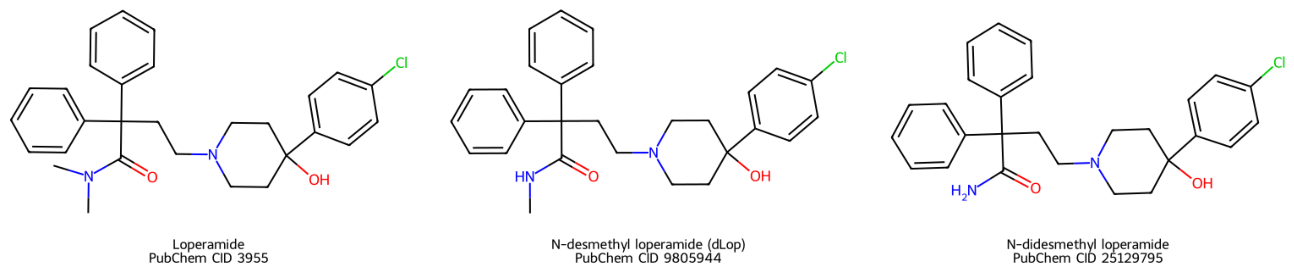

Table 1.
Calculated molecular descriptors for the loperamide amide-demethylation series.
| Compound | MW (Da) | RDKit cLogP | TPSA (Ų) | HBD | HBA | Rotatable bonds | Fraction sp3 | Mean radius of gyration (Å) |
| Loperamide | 477.05 | 5.088 | 43.78 | 1 | 3 | 7 | 0.345 | 5.143 |
| dLop | 463.02 | 4.746 | 52.57 | 2 | 3 | 7 | 0.321 | 5.009 |
| N-didesmethyl loperamide | 448.99 | 4.485 | 66.56 | 2 | 3 | 7 | 0.296 | 5.131 |
Removing the first amide methyl decreased calculated cLogP by 0.342 and increased TPSA by 8.79 Ų; removing the second decreased cLogP by a further 0.261 and increased TPSA by 13.99 Ų. Rotatable-bond count remained seven. These values quantify the direction already suggested by the loperamide–dLop pharmacology: amide demethylation systematically reduces calculated lipophilicity and increases exposed polarity. They do not establish BBB penetration, ABCB1 transport, solubility, or hERG activity.
Figure 2.
Calculated descriptor heatmap.
4.2. The Low-Energy Pharmacophore Geometry Remains Broadly Overlapping
Across the 20 lowest-energy MMFF94s conformers, the mean basic-N-to-carbonyl-O distance was 3.62 ± 0.41 Å for loperamide, 3.55 ± 0.27 Å for dLop, and 3.51 ± 0.32 Å for the didesmethyl compound. Basic-N-to-hydroxyl-O means were 3.34 ± 0.34, 3.25 ± 0.36, and 3.48 ± 0.23 Å, respectively; distances to the nearest aromatic centroid were 4.97 ± 0.53, 4.96 ± 0.50, and 4.81 ± 0.62 Å. Radius of gyration and principal-moment descriptors likewise overlapped substantially.
Figure 3.
Three-dimensional pharmacophore-distance distributions.
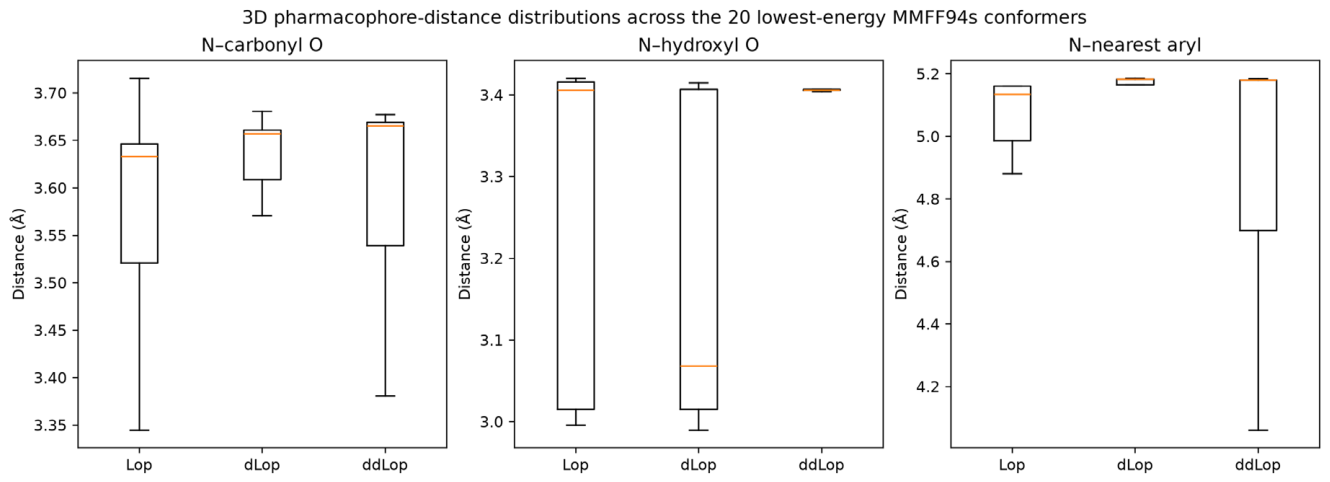
The absence of a large calculated shift in these coarse intramolecular distances is informative. It suggests that the measured hERG difference between loperamide and dLop need not require wholesale disruption of the cationic–aromatic MOR pharmacophore; local polarity, hydrogen bonding, desolvation, and pocket-specific orientation remain sufficient explanations. Conversely, the larger TPSA of the didesmethyl member predicts no automatic transport advantage and may reduce passive entry. This result supports Direction 1 as a local safety/disposition axis but argues against assuming that progressive demethylation monotonically improves the full profile.
5. Ten Structural Modification Axes
Table 2.
Structural modification axes, evidence grades, expected effects and development burden.
| No. | Design axis | Evidence | Possible benefit | Main adverse/null outcome | Burden |
| 1 | Terminal amide state: parent tertiary amide, dLop secondary amide, less-substituted boundary members, then a small carbonyl-isostere set | A 7,8; B 13 | Lower lipophilicity, altered hERG orientation, changed H-bonding/clearance | MOR loss, excessive polarity, faster metabolism; isosteres change several variables | Low from one carbonyl precursor; medium–high for isosteres |
| 2 | Basic-centre tuning: change the electronic environment of the piperidine nitrogen while initially retaining the ring | C 12,16,17 | A modestly lower cationic fraction may reduce hERG binding and alter efflux | The conserved MOR ionic interaction may weaken; permeability or stability may fall | Low–medium if local; higher with a new ring precursor |
| 3 | 4-Hydroxyl interrogation: retain, attenuate, mask, remove, or replace the alcohol in a bounded series | B 13,15 | Altered H-bond recognition may reduce efflux or improve passive entry | Loss of a MOR contact; higher logD may worsen hERG/solubility | Low–medium from a shared alcohol intermediate |
| 4 | Conformational restriction: introduce one local restriction in linker or ring | C 11 | Remove ABCB1-compatible conformers or improve selectivity | Lock the wrong MOR/hERG geometry; stereochemical or metabolic liabilities | Medium and route-dependent |
| 5 | Hydrophobic-surface reduction/redistribution: remove rather than add nonessential aromatic or lipophilic contribution | C 8,16 | Better solubility; lower hERG/Nav1.5 risk | Lower passive entry or MOR affinity; new metabolic soft spots | Medium with commercial aryl blocks; high by late aryl editing |
| 6 | Positional halogen scan: a small H/F/Cl comparison as an electronic/conformational probe | B/C 12,13 | Fine control of conformation, metabolism, local electronics | Persistence, lipophilicity, or hERG may rise; F is not a generic BBB switch | Low–medium when encoded upstream |
| 7 | Steric environment near the basic nitrogen: minimal local shielding while retaining the cationic centre | C 12 | Disrupt transporter/channel accommodation while preserving MOR ionic recognition | Reduced MOR access, increased logD, stereoisomer mixtures | Medium; best installed before final assembly |
| 8 | Stereochemical control: compare defined configurational states | C 17 | Composition-neutral separation of receptor, transporter, and channel recognition | No useful separation; resolution wastes material and raises cost | High by resolution; medium if a selective precursor exists |
| 9 | Linker editing: vary one feature of length, branching, or flexibility between diaryl, carbonyl, and amine regions | B 13–15 | Rephase pharmacophore geometry, reduce flexible efflux conformers, remove metabolic liabilities | High MOR-loss risk; branching may raise lipophilicity | Medium–high; upstream rebuild |
| 10 | Ring bioisosteres: bounded related nitrogen heterocycles after local SAR is known | B 14,15 | Larger changes in pKa, solubility, conformation, metabolism may escape coupled liabilities | Too many properties change; may create different pharmacology | High discovery burden |
Direction 1 is the primary safety branch because the parent–dLop comparison directly links one edit to retained MOR affinity and weaker hERG inhibition 7,8. It does not prove that complete amide dealkylation or ketone replacement will retain MOR activation; these are boundary probes. Directions 2, 5, and 6 overlap physicochemically but are not interchangeable. Lower basicity threatens MOR ionic recognition 17; lower hydrophobic surface threatens passive permeability; positional fluorination is location- and conformation-dependent 12. Indiscriminate methylation or lipophilicity increase is poorly justified because it may intensify hERG binding and tissue distribution 16.
Directions 3, 4, 7, and 9 alter the conformational ensemble presented to MOR, ABCB1, and ion channels. Loperamide transport appears conformationally gated 11, but the favourable conformation is unknown. Each edit therefore requires paired receptor function, passive permeability, bidirectional transport, and electrophysiology. Directions 8 and 10 are powerful contingency branches but are expensive and multivariate; they should follow cheaper local mapping.
6. Interaction Map: Pairs and Higher-Order Combinations
6.1. Pairwise Interaction Hypotheses
Table 3.
Pairwise modification hypotheses and anticipated interaction risks.
| Combination | Expected relationship | Main benefit hypothesis | Main failure mode | Priority |
| 1 + 5 | Complementary; possible safety synergy | Reduce two distinct contributors to hERG affinity and bulk lipophilicity | Combined polarity/contact loss abolishes MOR function or BBB entry | High after singles pass |
| 1 + 4 | Complementary | Direct cardiac improvement plus possible removal of efflux-compatible conformers | Restriction favours hERG or disfavors MOR | High–medium |
| 1 + 6 | Practical, potentially additive | Separate local regions; compatible with convergent diversification | Halogen restores lipophilicity removed by amide change | High for a small matrix |
| 2 + 5 | Safety synergy but MOR-antagonism risk | Attenuate cationic and lipophilic channel-binding components | Over-correction destroys MOR, permeability, or oral exposure | Low initially |
| 2 + 6 | Often redundant if spatially close | Both may operate through pKa/conformation | Double counts one electronic effect and overshoots | Low unless independent |
| 3 + 5 | Potential balancing pair | Reduced donor character may aid entry; surface reduction counters logD rise | Removes two separate MOR contacts | Medium |
| 4 + 7 | Possible shape/steric synergy | Alter global conformation and local channel/transporter access | Severe MOR loss and stereochemical complexity | Medium–low |
| 4 + 8 | Mechanistically coupled | A rigid analogue requires defined stereochemistry | Cost and route burden undermine access | Medium as probe |
| 4 + 9 | Usually opposing | One narrows and the other broadens the conformational ensemble | Incoherent design and poor attribution | Avoid initially |
| 5 + added methyl/lipophilicity | Directly opposing | None without a precise geometric rationale | Safety gain is cancelled | Avoid initially |
| 10 + an unvalidated edit | Confounded | Possible scaffold escape | Failure is uninterpretable; library size explodes | Defer |
6.2. Higher-Order Design Modules
High-order combinations should be modular, not indiscriminate. Four modules are useful:
• S—cardiac-safety module: Direction 1 as the evidence-anchored default, optionally Direction 5 if it independently improves channel margins.
• T—transport/conformation module: one validated member of Directions 3, 4, 6, 7, or 9 that lowers ABCB1 efflux without lowering passive entry.
• E—efficacy-shaping module: an edit shown to retain MOR potency while producing a desirable maximal-efficacy or signalling profile. No current literature proves which loperamide edit supplies this module.
• D—developability module: an edit that improves solubility, metabolic stability, solid-state handling, or route convergence without erasing S, T, or E.
The preferred progression is S, then S+T, then S+T+D, and only then S+T+E+D if the efficacy module is empirically justified. This allows three or four structural changes in a candidate while preserving causal lineage. A higher-order combination should be rejected when two modules rely on the same mechanism, when one module reverses another's property gain, or when route complexity grows faster than the therapeutic margin.
Three illustrative architectures follow without nominating an exact molecule:
– Minimal-cost architecture: 1 + 6 + D. A dLop-like amide, one independently favourable positional aryl edit, and solid-state/formulation optimisation rather than a third covalent edit. This is most compatible with a common-intermediate route, but may leave ABCB1 efflux unresolved.
– Balanced architecture: 1 + 4 + 5 + D. An amide safety anchor, one validated restriction, and one hydrophobic-surface reduction. Potential safety and transport complementarity is offset by a high risk of cumulative MOR loss; all singles and doubles are prerequisites.
– Scaffold-escape architecture: 2 + 8 + 10 + D. A re-tuned basic centre in a defined stereochemical ring bioisostere. This may escape coupled liabilities but is least clearly a loperamide derivative, least interpretable, and most expensive; it is a contingency route after failure of local edits.
A full factorial library is unnecessary and rapidly becomes unaffordable. A fractional-factorial or sequential design can estimate dominant interactions using controls, singles, selected doubles, and a few pre-specified higher-order candidates. Chemistry and assay selection should be fixed before results are known to reduce retrospective optimisation narratives.
7. Low-Complexity Synthesis and Manufacturing Strategy
The programme should use a common-intermediate, late-diversification architecture rather than an independent route for every analogue. At retrosynthetic level, the published diarylbutyramide framework can be divided into a reusable core bearing a terminal carbonyl precursor, a small amide-diversification branch, and an amine/ring fragment joined through an established convergent stage 13. This is route logic rather than an experimental protocol.
Three route classes can be ranked:
– Lowest expected cost—terminal-amide branching. One advanced carbonyl-bearing intermediate supplies the parent/dLop-related amide-state set at the final diversification stage. This minimises unique intermediates, purification development, and analytical-method changes. It favours Direction 1 and 1+6 when the aryl variant is encoded in a commercially available upstream block.
– Moderate expected cost—shared hydroxypiperidine branching. One alcohol-bearing intermediate supplies a bounded retain/attenuate/remove series, supporting Direction 3 and selected 3+5 combinations while preserving route commonality.
– Higher expected cost—upstream rebuilds. Directions 4 and 7–10 commonly need distinct intermediates, stereochemical control, or separate process development. They should advance only when property gains justify additional operations and lower convergence.
Affordability favours a short longest linear sequence, commercially available achiral building blocks, late analogue differentiation, crystallisation-based isolation, and few protecting-group or chromatographic operations. It disfavors scarce catalysts, repeated resolution, specialised low-temperature or pressure-dependent equipment, and a unique route per analogue. These are route-selection criteria, not claims of yield. Without process experiments, isolated yield, process mass intensity, impurity control, reproducibility, and cost of goods remain unknown.
The first-generation set should include parent and dLop controls, a narrow Direction-1 boundary series, one low-burden Direction-6 series, and their selected 1+6 combinations. A second wave can add one validated Direction-3 or Direction-4 edit, including selected triples. This sequence produces causal information and a manufacturing platform without early commitment to resolution or ring replacement.
7.1. Complete Route Concept at Development Level
The route concept comprises six decision stages. Stage A selects commercially available aryl and nitrogen-heterocycle building-block families so that Directions 5, 6, and 10 are encoded before expensive material is accumulated. Stage B constructs a shared diaryl-carbonyl core while preserving a handle for terminal-amide differentiation. Stage C converges that core with a 4-substituted piperidine-family fragment; the parent-like hydroxyl state is retained as the reference branch. Stage D performs late terminal-amide differentiation to generate the loperamide/dLop controls and the bounded Direction-1 series from the same advanced precursor. Stage E applies at most one validated local conformation or hydroxyl edit to selected members, thereby creating informative doubles and triples rather than a full combinatorial library. Stage F selects an isolable salt or solid form and compares crystallisation, impurity purge, stability, and formulation performance.
At each stage, the cheapest branch is not automatically the branch with the highest chemical yield. The preferred route is the one that maximises material convergence and acceptable isolated output across the whole analogue family. A branch is discontinued if it requires repeated chromatography, repeated chiral resolution, a unique advanced intermediate for each product, or specialised equipment without a compensating pharmacological advantage. Exact reagents, conditions, quantities, and executable procedures are intentionally outside this hypothesis paper; these would require laboratory validation and compound-specific safety controls.
8. Combination-Product Strategies
A fixed-dose combination cannot rescue an intrinsically unsafe opioid analogue. Each active component should first demonstrate an interpretable exposure-response and safety profile alone. Combination development should then ask whether the partner lowers the opioid exposure needed for analgesia, protects a predictable peripheral toxicity, or deters manipulation without creating a new pharmacokinetic hazard.
Table 4.
Combination-product strategies and development positioning.
| Product class | Concept | Potential rationale | Main risk | Proposed status |
| Original + original | Loperamide plus an established non-opioid analgesic; alternatively, an existing non-opioid/non-opioid regimen as an active comparator | Low cost and established supply; tests whether a peripheral opioid contribution adds anything beyond multimodal analgesia | Ordinary loperamide is unlikely to provide reliable central analgesia; partner organ toxicity and overlapping adverse effects remain | Comparator or restricted peripheral-pain hypothesis, not the preferred central product |
| Modified + original | One selected loperamide-derived analgesic plus an established non-opioid analgesic | Most plausible opioid-sparing formulation: complementary mechanisms may lower required opioid exposure | Fixed ratio may overexpose one component; hepatic, renal, gastrointestinal, or bleeding risks may replace opioid risk; separate titration is lost | Preferred combination-development branch after analogue monotherapy is characterised |
| Modified + original | One selected analogue plus an established peripherally acting antagonist or an abuse-deterrent formulation technology | May reduce gastrointestinal effects or deter selected forms of manipulation | Antagonist exposure may reduce analgesia or precipitate withdrawal; deterrence never eliminates intact-tablet overuse or addiction | Conditional, requiring formulation-specific PK and abuse-deterrence evidence |
| Modified + modified | A central, bounded-efficacy analogue plus a co-developed peripherally restricted antagonist-like component | In principle separates central analgesia from peripheral MOR effects and allows both structures to be tuned | Highest CMC, interaction, regulatory, and cost burden; accidental brain entry of the antagonist could erase efficacy | Late contingency route only |
| Modified + modified | Two analgesic analogues with complementary kinetics | Could theoretically broaden duration while limiting peak exposure | Pharmacodynamic stacking, metabolite interactions, harder attribution, diversion risk, and no clear cost advantage | Generally inferior to optimising one analogue |
| No-go combination | Loperamide or an analogue with a systemic ABCB1 or metabolic inhibitor to force central exposure | May increase measured brain entry | Unpredictable exposure, interaction-dependent overdose, respiratory depression, and worsened cardiac toxicity | Reject as a development strategy 5,24 |
The favoured sequence is therefore monotherapy first, followed by modified + established non-opioid only if a clinically relevant opioid-sparing interaction is demonstrated. Original + original belongs mainly as a low-cost comparator. Modified + modified is justified only when one component solves a specific peripheral or formulation problem that cannot be solved within a single molecule.
9. Case-Report Signals and Addiction-Risk Hypothesis
Case reports do not estimate incidence or prove causality, but they identify credible failure modes. A published dependence case described chronic escalating loperamide use, unsuccessful discontinuation with opioid-like withdrawal symptoms, and subsequent fatal outcome 18. Other reports and case series document QRS/QTc abnormalities, polymorphic ventricular arrhythmias, cardiac arrest, and death after intentional supratherapeutic exposure 19–21. These reports converge on two motives: attempted relief of opioid withdrawal and pursuit of central opioid effects. They also show that severe toxicity can be prolonged and clinically difficult to manage.
Population-level signals support the relevance of those observations. Poison-centre analysis found a marked rise in intentional loperamide abuse and misuse during 2010–2015 22. A later analysis of 2010–2022 cases reported serious outcomes and deaths concentrated among intentional abuse, misuse, and suspected self-harm; the authors observed a decline after warnings, labelling changes, and packaging restrictions, while appropriately treating that policy relationship as observational 23. The combination of case reports and surveillance data means that centralising the scaffold would remove one of loperamide's original barriers to reinforcement and should be presumed to increase abuse liability until disproved.
9.1. Risk Patterns Relevant to Product Design
The principal foreseeable patterns are repeated dose escalation, use to suppress opioid withdrawal without clinical supervision, pursuit of rapid or intense central effects, accumulation during chronic use, manipulation of modified-release dosage forms, bulk acquisition, and co-use with substances that inhibit transport/metabolism or depress the central nervous system. These are risk categories, not instructions. A compound with faster brain entry, higher unbound exposure, longer effective half-life, a steep concentration-effect curve, or rewarding subjective effects would warrant a particularly high concern. Cardiac-channel activity makes escalation additionally dangerous because reinforcement and electrophysiological toxicity may rise in the same exposure range.
9.2. Prospective Abuse-Liability Assessment
Addiction risk should be a co-primary development axis rather than a late regulatory exercise. The programme should proceed from receptor pharmacology and comparative pharmacokinetics to validated nonclinical drug-discrimination, self-administration, physical-dependence/withdrawal, respiratory-safety, and reward-related behavioural assessments, with appropriate comparators. If development continues, human abuse-potential studies and post-market surveillance should follow applicable regulatory guidance 25. A favourable analgesic assay cannot compensate for a strong reinforcement signal.
Abuse-deterrent claims require a separate evidence chain. FDA guidance distinguishes laboratory manipulation/extraction studies, comparative pharmacokinetic studies, clinical abuse-potential studies, and post-market evidence, while emphasising that deterrent properties neither make abuse impossible nor prevent addiction during prescribed use 26. The product should therefore be evaluated against both conventional and relevant abuse-deterrent comparators.
9.3. Prevention by Molecule, Formulation, Packaging, and Care Pathway
Risk reduction should use several independent layers: bounded MOR efficacy where pharmacologically achievable; avoidance of rapid peak brain exposure; predictable metabolism with few interaction-sensitive pathways; physical or chemical barriers against manipulation; unit-dose packaging and limited pack size; prescription-only distribution rather than over-the-counter availability; clear interaction and overdose warnings; screening for opioid use disorder and concurrent sedatives; limited quantities and structured follow-up; access to evidence-based addiction treatment; and take-home overdose-reversal medication where clinically indicated. Packaging and access controls are supported by the observed temporal association between US regulatory actions and declining poison-centre reports 23, but they cannot replace molecular safety.
No formulation should depend on an aversive toxicant, an easily defeated antagonist design, or a transporter/metabolism inhibitor. A sequestered or peripherally acting antagonist concept must demonstrate that intended use preserves analgesia, manipulation does not increase danger, and altered physiology does not unexpectedly increase antagonist brain exposure. The paper should use abuse-deterrent, never abuse-proof.
10. Property Gates and Selection Logic
Each analogue should be treated as a vector: MOR binding, potency and maximal efficacy; δ- and κ-opioid activity; pKa; logD; solubility; passive permeability; ABCB1 bidirectional efflux and recovery; protein binding; metabolic stability and metabolite identity; hERG and Nav1.5 electrophysiology; and unbound brain-to-plasma exposure. dLop's reported secondary pharmacology warrants a focused off-target screen 7.
The gates are: (1) retained but bounded MOR function; (2) genuine reduction of ABCB1 transport rather than loss of membrane entry; (3) cardiac margin relative to unbound exposure rather than isolated IC50; and (4) route feasibility, impurity burden, and cost. Only compounds passing all four should enter studies comparing analgesia with respiratory depression, sedation, gastrointestinal inhibition, motor impairment, reinforcement-related behaviour, dependence liability, and electrocardiographic effects.
Selection should be Pareto-based: no candidate advances if another is equal or better in MOR function, efflux, channel margin, and route simplicity. A weighted single score can conceal a fatal liability. Moderate intensity must ultimately arise from controllable exposure–response and efficacy, not from arbitrarily lowering receptor affinity.
11. Falsification and Boundaries
The programme should stop if reduced efflux repeatedly tracks with lost passive entry; if hERG improvement exposes equal or worse Nav1.5 or metabolite liability; if combinations show systematic negative interaction at MOR; or if useful analgesia cannot precede respiratory and behavioural harms. Mouse knockout and human radiotracer evidence establish the role of ABCB1 but not a safe therapeutic dose 4,9. Docking generates hypotheses but cannot replace transport, receptor-function, or electrophysiology measurements 8.
Central MOR agonism retains class risks regardless of scaffold: respiratory depression, misuse, opioid use disorder, tolerance, dependence, and withdrawal. Reducing ABCB1 efflux may also increase sensitivity to patient transporter variation and drug interactions. The programme should seek the minimum reproducible brain exposure compatible with titratable analgesia, not complete transporter escape as an isolated maximum.
12. Discussion and Conclusion
Loperamide provides two natural experiments: peripheral MOR activity under transporter restriction, and a one-methyl metabolite edit that improves one cardiac endpoint without solving efflux. The opportunity is not simply to make loperamide more lipophilic or more brain penetrant; it is to map four objectives and recombine validated, non-redundant modules.
The primary research product should be a causal design map. The primary development product, if that map permits one, should be a low-complexity dLop-centred combination assembled from a shared intermediate. Direction 1 is the strongest safety anchor; Direction 6 is a tractable local probe; Directions 3 or 4 should be added only after independent benefit is shown. Directions 8–10 are contingency routes rather than first choices for an affordable medicine. The framework identifies which modification classes, pairwise tests, and higher-order architectures deserve study; which are likely to cancel one another; and what evidence is required before old-drug modification becomes a credible new-analgesic programme.
Ethics Approval and Consent
Not applicable; no new human or animal research is reported.
Data and Code Availability
New in-silico descriptor and conformer data were generated from public structures. The analysis script, input SMILES, metadata, summary table, per-conformer table, and figures accompany this manuscript. No wet-laboratory or clinical data were generated.
Funding, Competing Interests, Author Contributions
AI-Assisted Writing Disclosure
OpenAI Codex was used for drafting, reference formatting and local document quality assurance. The human author remains responsible for scientific verification and final approval.33
References
- World Health Organization. Left behind in pain: extent and causes of global variations in access to morphine for medical use and actions to improve safe access [Internet]; World Health Organization: Geneva, 2023; Available online: https://www.who.int/publications/b/68664.
- Berterame, S.; Erthal, J.; Thomas, J.; Fellner, S.; Vosse, B.; Clare, P.; et al. Use of and barriers to access to opioid analgesics: a worldwide, regional, and national study. Lancet 2016, 387(10028), 1644–56. [Google Scholar] [CrossRef] [PubMed]
- DeHaven-Hudkins, D.L.; Burgos, L.C.; Cassel, J.A.; Daubert, J.D.; DeHaven, R.N.; Mansson, E.; et al. Loperamide (ADL 2-1294), an opioid antihyperalgesic agent with peripheral selectivity. J. Pharmacol. Exp. Ther. 1999, 289(1), 494–502. [Google Scholar] [CrossRef]
- Schinkel, A.H.; Wagenaar, E.; Mol, C.A.; van Deemter, L. P-glycoprotein in the blood-brain barrier of mice influences the brain penetration and pharmacological activity of many drugs. J. Clin. Invest. 1996, 97(11), 2517–2524. [Google Scholar] [CrossRef] [PubMed]
- Sadeque, A. Increased drug delivery to the brain by P-glycoprotein inhibition. Clin. Pharmacol. Ther. 2000, 68(3), 231–237. [Google Scholar] [CrossRef] [PubMed]
- Kang, J.; Compton, D.R.; Vaz, R.J.; Rampe, D. Proarrhythmic mechanisms of the common anti-diarrheal medication loperamide: revelations from the opioid abuse epidemic. Naunyn-Schmiedeberg's Arch. Pharmacol. 2016, 389(10), 1133–1137. [Google Scholar] [CrossRef] [PubMed]
- Lazarova, N.; Zoghbi, S.S.; Hong, J.; Seneca, N.; Tuan, E.; Gladding, R.L.; et al. Synthesis and Evaluation of [N-methyl-11C]N-Desmethyl-loperamide as a New and Improved PET Radiotracer for Imaging P-gp Function. J. Med. Chem. 2008, 51(19), 6034–6043. [Google Scholar] [CrossRef] [PubMed]
- Vaz, R.J.; Kang, J.; Luo, Y.; Rampe, D. Molecular determinants of loperamide and N-desmethyl loperamide binding in the hERG cardiac K+ channel. Bioorganic Med. Chem. Lett. 2018, 28(3), 446–451. [Google Scholar] [CrossRef] [PubMed]
- Kreisl, W.C.; Liow, J.S.; Kimura, N.; Seneca, N.; Zoghbi, S.S.; Morse, C.L.; et al. P-Glycoprotein Function at the Blood–Brain Barrier in Humans Can Be Quantified with the Substrate Radiotracer 11C-N-Desmethyl-Loperamide. J. Nucl. Med. 2010, 51(4), 559–566. [Google Scholar] [CrossRef] [PubMed]
- Kannan, P.; Brimacombe, K.R.; Zoghbi, S.S.; Liow, J.S.; Morse, C.; Taku, A.K.; et al. N-desmethyl-Loperamide Is Selective for P-Glycoprotein among Three ATP-Binding Cassette Transporters at the Blood-Brain Barrier. Drug Metab. Dispos. 2010, 38(6), 917–922. [Google Scholar] [CrossRef] [PubMed]
- Gibbs, M.E.; Wilt, L.A.; Ledwitch, K.V.; Roberts, A.G. A Conformationally Gated Model of Methadone and Loperamide Transport by P-Glycoprotein. J. Pharm. Sci. 2018, 107(7), 1937–1947. [Google Scholar] [CrossRef] [PubMed]
- Conrad, J.; Paras, N.A.; Vaz, R.J. Model of P-Glycoprotein Ligand Binding and Validation with Efflux Substrate Matched Pairs. J. Med. Chem. 2024, 67(7), 5854–5865. [Google Scholar] [CrossRef] [PubMed]
- Stokbroekx, R.A.; Vandenberk, J.; Van Heertum, A.H.M.T.; Van Laar, G.M.L.W.; Van der Aa, M.J.M.C.; Van Bever, W.F.M.; et al. Synthetic antidiarrheal agents. 2,2-Diphenyl-4-(4'-aryl-4'-hydroxypiperidino)butyramides. J. Med. Chem. 1973, 16(7), 782–786. [Google Scholar] [CrossRef] [PubMed]
- KOMOTO, T.; OKADA, T.; SATO, S.; NIINO, Y.; OKA, T.; SAKAMOTO, T.; New. MU.-Opioid Receptor Agonists with Piperazine Moiety. Chem. Pharm. Bull. 2001, 49(10), 1314–1320. [Google Scholar] [CrossRef] [PubMed]
- Sato, S.; Komoto, T.; Kanamaru, Y.; Kawamoto, N.; Okada, T.; Kaiho, T.; et al. New mu-opioid receptor agonists with phenoxyacetic acid moiety. Chem. Pharm. Bull. 2002, 50(2), 292–297. [Google Scholar] [CrossRef] [PubMed]
- Waring, M.J.; Johnstone, C. A quantitative assessment of hERG liability as a function of lipophilicity. Bioorganic Med. Chem. Lett. 2007, 17(6), 1759–1764. [Google Scholar] [CrossRef] [PubMed]
- Koehl, A.; Hu, H.; Maeda, S.; Zhang, Y.; Qu, Q.; Paggi, J.M.; et al. Structure of the µ-opioid receptor–Gi protein complex. Nature 2018, 558(7711), 547–552. [Google Scholar] [CrossRef] [PubMed]
- MacDonald, R.; Heiner, J.; Villarreal, J.; Strote, J. Loperamide dependence and abuse. BMJ Case Rep. 2015, 2015, bcr2015209705. [Google Scholar] [CrossRef] [PubMed]
- Eggleston, W.; Clark, K.H.; Marraffa, J.M. Loperamide Abuse Associated With Cardiac Dysrhythmia and Death. Ann. Emerg. Med. 2017, 69(1), 83–86. [Google Scholar] [CrossRef] [PubMed]
- O’Connell, C.W.; Schricker, A.A.; Schneir, A.B.; Metushi, I.G.; Birgersdotter-Green, U.; Minns, A.B. High-dose loperamide abuse–associated ventricular arrhythmias. Hear. Case Rep. 2016, 2(3), 232–236. [Google Scholar] [CrossRef] [PubMed]
- Cicci, J.D.; Jagielski, S.M.; Clarke, M.M.; Rayson, R.A.; Cavender, M.A. Loperamide overdose causing torsades de pointes and requiring Impella temporary mechanical support: a case report. Eur. Heart J.-Case Rep. 2019, 3(4), 1–6. [Google Scholar] [CrossRef] [PubMed]
- Vakkalanka, J.P.; Charlton, N.P.; Holstege, C.P. Epidemiologic Trends in Loperamide Abuse and Misuse. Ann. Emerg. Med. 2017, 69(1), 73–78. [Google Scholar] [CrossRef] [PubMed]
- Patel, A.; Rine, N.I.; Spiller, H.A.; Hays, H.; Badeti, J.; Zhu, M.; et al. Loperamide cases reported to United States poison centers, 2010–2022. Inj. Epidemiol. 2023, 10(1), 61. [Google Scholar] [CrossRef] [PubMed]
- US Food and Drug Administration. FDA limits packaging for anti-diarrhea medicine loperamide to encourage safe use [Internet]; US Food and Drug Administration: Silver Spring (MD), 2018; Available online: https://www.fda.gov/files/FDA-limits-packaging-for-anti-diarrhea-medicine-loperamide-%28Imodium%29-to-encourage-safe-use_PDF.pdf.
- US Food and Drug Administration. Assessment of abuse potential of drugs: guidance for industry [Internet]; US Food and Drug Administration: Silver Spring (MD), 2017; Available online: https://www.fda.gov/regulatory-information/search-fda-guidance-documents/assessment-abuse-potential-drugs.
- US Food and Drug Administration. Abuse-deterrent opioids: evaluation and labeling: guidance for industry [Internet]; US Food and Drug Administration: Silver Spring (MD), 2015; Available online: https://www.fda.gov/files/drugs/published/Abuse-Deterrent-Opioids-Evaluation-and-Labeling.pdf.
- National Center for Biotechnology Information. PubChem compound summary for CID 3955, loperamide [Internet]. National Library of Medicine (US): Bethesda (MD), 10 Sep 2026. Available online: https://pubchem.ncbi.nlm.nih.gov/compound/3955.
- National Center for Biotechnology Information. PubChem compound summary for CID 9805944, N-desmethyl loperamide [Internet]; National Library of Medicine (US): Bethesda (MD), 10 Sep 2026; Available online: https://pubchem.ncbi.nlm.nih.gov/compound/9805944.
- National Center for Biotechnology Information. PubChem compound summary for CID 25129795, N-didesmethyl loperamide [Internet]; National Library of Medicine (US): Bethesda (MD), 10 Sep 2026; Available online: https://pubchem.ncbi.nlm.nih.gov/compound/25129795.
- Riniker, S.; Landrum, G.A. Better Informed Distance Geometry: Using What We Know To Improve Conformation Generation. J. Chem. Inf. Model. 2015, 55(12), 2562–2574. [Google Scholar] [CrossRef] [PubMed]
- RCSB Protein Data Bank. Mu opioid receptor-Gi protein complex (PDB ID: 6DDF) [dataset]. 2018. [Google Scholar] [CrossRef]
- Munro, T.A. Reanalysis of a μ opioid receptor crystal structure reveals a covalent adduct with BU72. BMC Biol. 2023, 21(1), 213. [Google Scholar] [CrossRef] [PubMed]
- Kassis, T.; Agarwal, V.; He, Y.; Patel, D.; Brueckner, A.M. Scientific Agent Skills: a library of procedural knowledge for research agents [preprint]. arXiv 2026. [Google Scholar] [CrossRef]
Disclaimer/Publisher’s Note: The statements, opinions and data contained in all publications are solely those of the individual author(s) and contributor(s) and not of MDPI and/or the editor(s). MDPI and/or the editor(s) disclaim responsibility for any injury to people or property resulting from any ideas, methods, instructions or products referred to in the content. |
© 2026 by the authors. Licensee MDPI, Basel, Switzerland. This article is an open access article distributed under the terms and conditions of the Creative Commons Attribution (CC BY) license (http://creativecommons.org/licenses/by/4.0/).
Copyright: This open access article is published under a Creative Commons CC BY 4.0 license, which permit the free download, distribution, and reuse, provided that the author and preprint are cited in any reuse.