

Submitted:
18 September 2026
Posted:
21 September 2026
You are already at the latest version
Abstract
Background: The blasting gallery (BG) method extracts thick coal seams in a single lift through floor-level development, long-hole ring blasting, remote load-haul-dump loading, and controlled caving. Its Indian record contains local successes but uncertain and sustained scalability. Methods: A retrospective multi-case synthesis examined seven Indian applications using 75 sources available until August 14, 2026. The evidence was classified as complete-cycle execution (L1), panel success (L2), sustained performance (L3), or cross-coalfield scalability (L4). Five coupled control functions and five interruption pathways were assessed. Results: All seven applications supported L1, and four supported stronger L2 evidence. L3 was limited or localised in four cases, uncertain in one case, and not located in two; L4 was not established. Three interacting pathways were identified: drilling and charging variability impairing fragmentation and remote loading, delayed caving increasing unsupported span and dynamic demand, and leakage-promoting self-heating. This interruption amplified all three. Conclusions: BG evidence demonstrates technical feasibility and selected panel success, but not comparable cross-site scalability. Assessment should prioritise full-cycle availability, retreat momentum, interruption tolerance, verified goaf control and remote resolution of abnormal states. The detailed methods, case matrices, and evidence audit trails are provided in the Supplementary Material.
Keywords:
blasting gallery method
; thick-seam coal mining
; lifecycle performance
; operational brittleness
; roof caving
; spontaneous combustion
1. Introduction
Thick coal seams create a combined method-selection problem: recovery must be increased without allowing strata movement, gas flow, spontaneous heating, equipment limits, or work organisation to exceed available control margins. In India, conventional bord-and-pillar workings recover only the roadway-height portion of seams thicker than approximately 4.5–4.8 m. Multi-slice extraction, continuous miner depillaring, cable-bolting systems, single-pass longwall, and longwall top-coal caving (LTCC) each address this loss under different geological and operational conditions [1,2,3].
The blasting gallery (BG) method was introduced in India in the late 1980s. Galleries are developed near the seam floor; fan-shaped long holes fragment the roof coal; remotely operated load-haul-dump (LHD) machines recover coal from supported roadways; and roof caves naturally or after being induced. Applications in East Katras Chora No. 10 Pit, GDK-8, GDK-10, GDK-11/11A, No. 21 Incline and Vakilpalli demonstrated major Indian advances in staggered layouts, ring blasting, non-NG charging systems, induced caving, remote loading, and goaf inertisation [2,4,5,6,7,8,9,10,11,12,13,14,15,16,17,18,19,20,21,22,23,24,25,26,27,28].
However, evidence that a component was operated or that one panel was extracted cannot establish sustained or cross-site performance. Previous studies have generally examined method selection or individual controls rather than the complete operating chain [1,4,5,6,7,8,9,10,11,12,13,14,15,16,17,18,19,20,21,22,23,54,66]. They also used the word success for dissimilar outcomes: a completed blast, recovered block, completed panel, repeated performance, or diffusion across the coalfields. This creates a feasibility–scalability gap that is obscured by peak production and isolated technical advancements.
This study addresses four questions: (1) which lifecycle level was demonstrated; (2) which interactions convert local deviations into panel-level loss of control; (3) which Indian adaptations improved performance but retained dependencies; and (4) which assurance principles can be transferred to continuous miners or LTCC systems without assuming mechanical equivalence. Operational brittleness is defined as the rapid loss of control margin when the variation or delay in one function increases the demand on other functions faster than the system can recover. This contribution is an evidence-graded life cycle framework linked to a coupled-control model and a conditional operating envelope.
2. Materials and Methods
A retrospective multi-case synthesis treated each named mine application as the unit of analysis. Seventy-five citable sources available until August 14, 2026, were assembled from an earlier Indian BG bibliography, Google Scholar, publisher and DOI pages, citation chaining, and DGMS, Ministry of Coal/CMPDI, Coal India, and SCCL repositories. The corpus comprised 28 India-BG or related thick-seam sources, 14 mechanism sources, 22 continuous miner/LTCC comparators, eight analytical or assurance sources, and three regulatory or principal-hazard documents. Because the historical screening logs were incomplete, this is a transparent documentary synthesis rather than a claimed systematic review [29,30,31,32,33,34,35]. The full eligibility, source appraisal, and extraction rules are provided in Supplementary Sections S1–S3 and Table S1–S2.
Evidence was coded for five coupled functions: drilling and charge placement, fragmentation and remote loading, roof caving and support response, ventilation, leakage, gas and inertisation, and cyclic continuity. A pathway was retained only when a named case converged with independent mechanism evidence or when more than one source type supported it. Claim confidence was reduced in the case of missing denominators, unclear panel boundaries, or unresolved conflicts.
Four ordinal evidence levels were applied. L1 requires the execution of the intended BG cycle. L2 requires an identifiable panel or block, plus completion, sealing or recovery evidence. L3 required at least two successive panels or two operating years, an output or recovery denominator, and some accounts of recurrent delays or control performance. L4 requires comparable panel life evidence across at least two coalfields with materially different roof and fire regimes. Missing criteria produced a limited or uncertain rating rather than an advancement by inference. The case-level audit trail and evidence concept matrix are presented in Supplementary Table S6 and Table S7, respectively.
3. Results
3.1. Coupled Operating Architecture
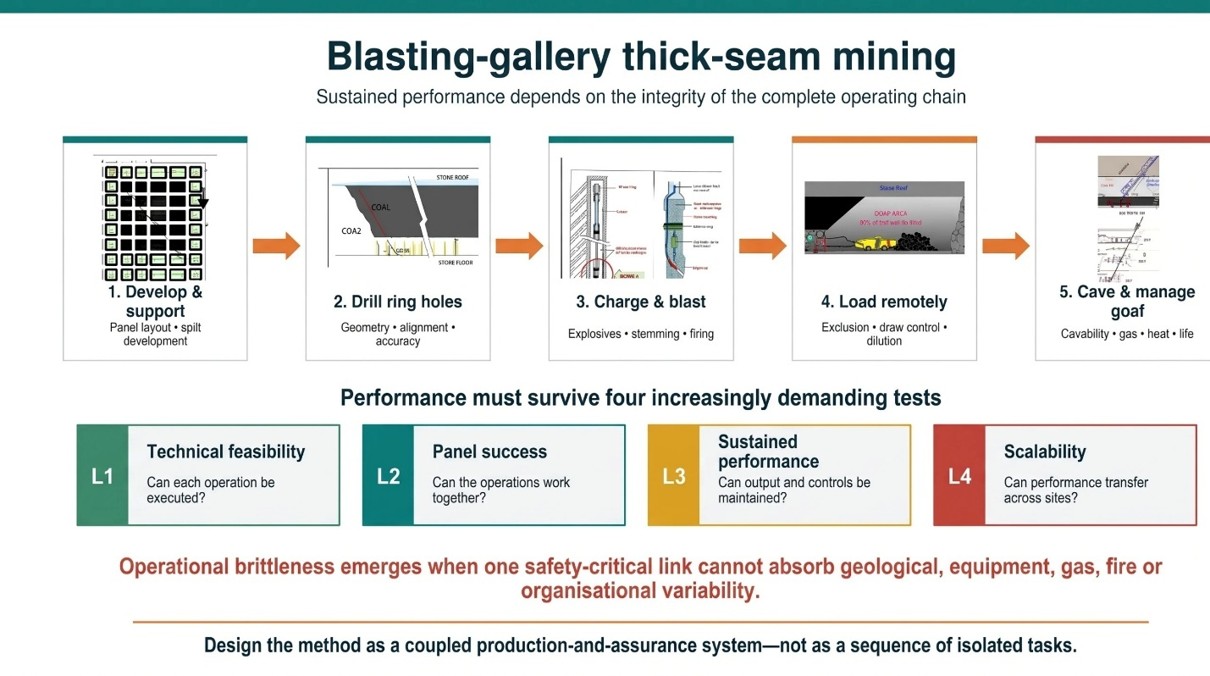
The BG safety case combines the production sequence with a parallel assurance loop. Development and support establish access; drilling and distributed charging determine fragmentation; blasting and fume clearance permit re-entry; remote LHD loading maintains separation from unsupported ground; and controlled caving limits the suspended span. Atmospheric testing, exclusion, isolation, post-blast ventilation, strata observation, gas surveillance, inertization, and rapid sealing must remain synchronized with the cycle (Figure 1 and Figure 2). Indian precedents, such as approximately 1.2–1.5 m ring spacing and about 43 mm holes, illustrate practice but are not universal design values [8,9,10,11,12,13,19,20,21,22,23].
The separation barrier is the strongest during normal loading and is most vulnerable during exceptions. Oversize, bridging, damaged support, poor visibility, communication loss or an immobilised LHD can stop retreat and create pressure for entry near the brow. Therefore, remote operation is effective only when credible abnormal states can be detected, isolated, and recovered without exposing the personnel.
3.2. Lifecycle Performance
All seven applications supported L1. Stronger L2 evidence was found for GDK-8, GDK-10, and No. 21 Incline and Vakilpalli; East Katras, Chora No. 10 Pit and GDK-11/11A had incomplete boundaries, denominators or outcome histories. L3 evidence was limited or localised in four cases, uncertain in one case, and not located in two cases. Repetition in the Godavari Valley Coalfield shows that BG extended beyond a single trial; however, accessible reports rarely combine repeated panels with comparable recovery, delay, availability, and full-panel denominators. L4 was therefore not established, although absence of evidence is not evidence that future transfer is impossible (Figure 3, Supplementary Table S3 and Table S6) [2,4,5,6,7,8,9,10,11,12,13,14,15,16,17,18,19,20,21,22,23,24,25,26,27,28].
3.3. Coupled Degradation Pathways
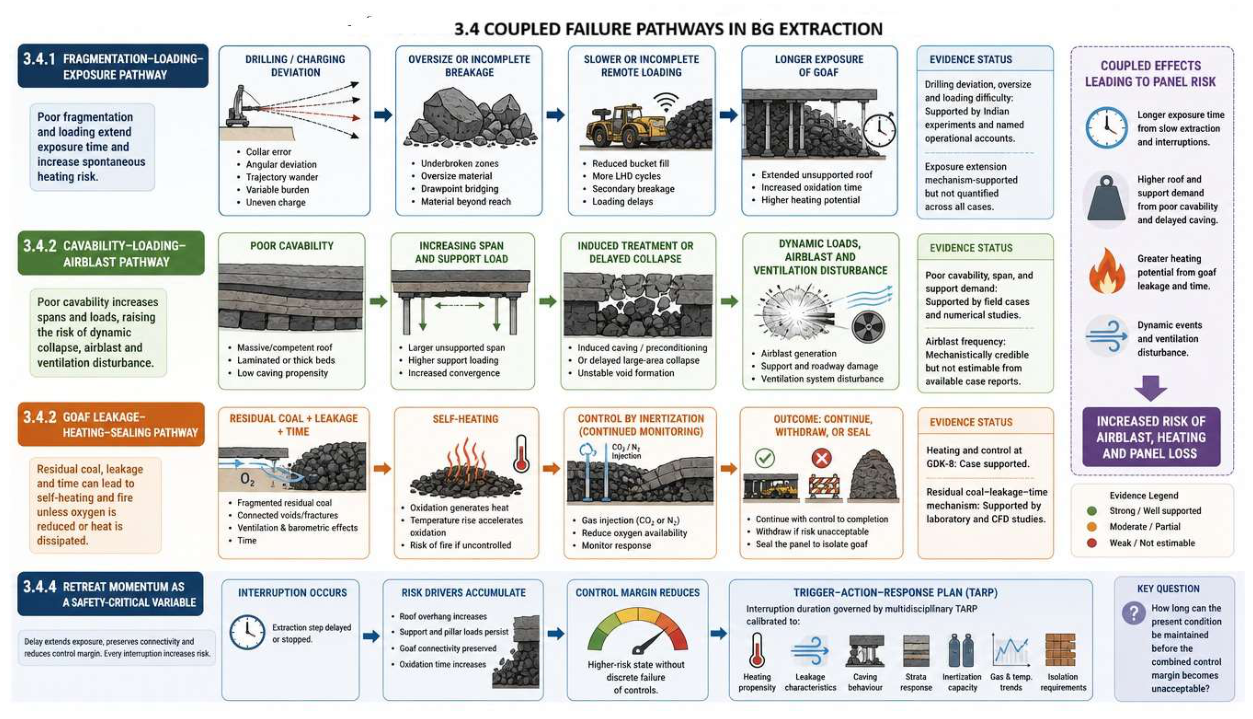
Three recurrent pathways explain how local deviations can propagate (Figure 4). First, drilling or charge-placement errors produce incomplete breakage or oversize, slowing remote loading and extending roof and goaf exposures [10,11,12,13,19,21,22,23]. Second, poor cavability enlarges the suspended span and support demand; delayed or sudden collapse can create dynamic loading, air blasts, and ventilation disturbances [4,5,6,7,8,9,10,20,42,43,44]. Third, residual fragmented coal, leakage, and time promote self-heating, requiring verified inertisation, withdrawal or sealing [14,15,16,17,18,22,47,48,49,50]. Comparable event frequencies or effect sizes could not be estimated in this study.
The interruption duration is associated with these pathways. Delayed clearance can preserve roof overhang, pillar and support loading, leakage connectivity and oxidation time, even when no single control has failed. Candidate interruptions include support realignment, prolonged charging, oversized clearance, floor dressing, LHD recovery, and removal of entrained reinforcement [19,20,23]. Thus, the rated component capacity is a poor proxy for panel performance; full-cycle availability, retreat rate, delay categories, and panel life denominators are required.
3.4. Adaptations and Operating Envelope
Indian adaptations improved specific functions but retained dependencies. Staggered layouts redistribute loads but require a calibrated three-dimensional geometry; distributed charging improves fragmentation and fumes but remains sensitive to hole accuracy and confinement; induced caving requires verification of the actual roof response; monitoring and inertisation remain sensitive to sampling lag, leakage paths, and distribution; and remote loading depends on communication, visibility, and exception recovery [2,4,5,6,7,8,9,10,11,12,13,14,15,16,17,18,46]. Supplementary Table S4 and Table S5 summarise the residual dependencies and screening conditions, respectively.
A favourable BG-like application therefore requires predictable cavability, calibrated geometry, a heating and leakage regime that permits detection and response, measurable drilling and charge reconciliation, remotely recoverable abnormal states, and demonstrated isolation and inertisation capacity. Massive roofs without effective preconditioning, severe unmeasured drilling deviation, high fire propensity without rapid control, repeated remote equipment failure, and weak critical control verification require redesign or exclusion rather than reliance on historical precedent.
4. Discussion
The seven-case record shows a clear distinction between feasibility and scalability. The BG can execute its essential unit operations and complete the selected panels; however, sustained performance depends on the reliability and timing of the entire control chain. Therefore, operational brittleness is a more useful interpretation than qualified success or failure. This explains how individually manageable deviations can combine over time: poor fragmentation slows loading, slower retreat enlarges geotechnical and fire exposure, and abnormal recovery can defeat the separation.
Project appraisal should consequently separate four denominators: in-situ panel reserves, coal that is fragmented or caved, coal loaded into transport, and saleable coal after dilution. The rated capacity, best-shift or best-day output, operating period average, and panel life average should also be reported separately. Availability loss should be coded by geology, maintenance, support, ventilation, fire control, relocation, and abnormal recovery rather than being absorbed into a single utilisation factor.
The framework supports the integration of geomechanical, ventilation, and thermal models. Caving changes bulking, fracture connectivity, compaction, and permeability; these properties govern leakage and gas transport, whereas heat generation changes the tolerable duration of stoppage [45,47,48,49,50,55,56,57,58,59,60,61,62,63,64,65,66,67,68,69,70]. A prospective interruption envelope can link the caving span, support response, leakage, oxidation, inertisation response and isolation time. The resulting trigger-action-response plan (TARP) should specify the indicators of declining margins and the authority to stop recovery or seal the panel.
Modern sensing can place drilling deviation, charge reconciliation, oversize, LHD availability, caving span, support load, convergence, pressure, inert-gas flow, O₂, CO, CO₂, and temperature on one timeline. Its purpose is causal diagnosis, not a larger dashboard. Verification should test performance at the point of work: trajectory and blast outcome for drilling, measured roof response for induced caving, oxygen and pressure response for inertisation, and remote recovery for abnormal machine states. These principles align with critical control, ground control, and principal hazard guidelines [36,41,73,74,75].
The transfer to continuous miner depillaring and LTCC is limited to the assurance architecture. These methods use different cutting, support, caving, and material flow mechanisms; however, BG cases cannot determine their geometry, settings, or risk magnitude. Technology-specific evidence remains the primary source of evidence [3,44,51,52,53,54,55,56,57,58,59,60,61,62,63,64,65,66,67,68,69,70,71,72]. The transferable questions are whether cavability is demonstrated, full-cycle denominators are reported, time-dependent responses are defined, goaf controls are verified, and credible exceptions can be resolved remotely.
The study is limited by heterogeneous documents, incomplete panel chronologies, and sparse delay, availability, and abnormal state data. Therefore, the operating envelope is a structured and partly normative decision aid, rather than a universal threshold model. The priority work is to digitise surviving records into a common panel life dataset, calibrate coupled geomechanical-flow-thermal models, validate interruption limits prospectively, and quantify exposure created by exception recovery.
5. Conclusions
The Indian BG experience establishes technical feasibility and selected panel success; however, the accessible record does not establish comparable, sustained cross-coalfield scalability. The principal lesson is systems-based: drilling, fragmentation, remote loading, caving, gas control, and cyclic continuity must retain sufficient combined margins during routine operations and interruptions.
Future BG-like projects should treat retreat momentum and interruption duration as safety-relevant state variables, evaluate complete panel recovery, availability, and delays rather than peak output, verify controls by observing performance, and require abnormal states to be recoverable without entry near unsupported ground. These propositions require prospective validation and should guide site-specific assurance rather than serve as a universal verdict on BG, continuous miner depillaring, or LTCC mining methods.
Supplementary Materials
The following supporting information can be downloaded at the website of this paper posted on Preprints.org: detailed methods, case matrices, and evidence audit trails (Supplementary Sections S1–S3, Table S1–S7).
Author Contributions
Conceptualization, N.B.; Methodology, N.B.; Investigation, N.B.; Data Curation, N.B.; Formal Analysis, N.B.; Visualization, N.B.; Writing—Original Draft Preparation, N.B. Writing—Review and Editing, N.B. The author has read and agreed to the published version of the manuscript.
Funding
This research did not receive any external funding.
Data Availability Statement
The classifications and analytical claims rely on the cited sources. Detailed eligibility rules, case-level decisions, and evidence boundaries are provided in the Supplementary Material.
Acknowledgments
During the preparation of this manuscript, the author used Paperpal and ChatGPT (OpenAI) for language revision, structural organisation, and reference format checking. The author reviewed and edited all outputs and takes full responsibility for the content of this publication.
Conflicts of Interest
The authors declare no conflicts of interest.
References
- Kumar, R.; Singh, A.K.; Mishra, A.K.; Singh, R. Underground mining of thick coal seams. Int. J. Min. Sci. Technol. 2015, 25, 885–896. [Google Scholar] [CrossRef]
- Singh, R. Staggered development of a thick coal seam for full-height working in a single lift by the blasting gallery method. Int. J. Rock Mech. Min. Sci. 2004, 41, 745–759. [Google Scholar] [CrossRef]
- Kumar, R.; Mishra, A.K.; Singh, A.K.; Singh, A.K.; Ram, S.; Singh, R. Depillaring of total thickness of a thick coal seam in single lift using cable bolts: A case study. Int. J. Min. Sci. Technol. 2016, 26, 223–233. [Google Scholar] [CrossRef]
- Satyanarayana, I.; Budi, G. Evaluation of induced vertical stress during depillaring in blasting gallery panel workings. Int. J. Geo-Eng. 2015, 6, 2. [Google Scholar] [CrossRef]
- Satyanarayana, I.; Budi, G.; Deb, D. Strata behaviour during depillaring in blasting gallery panel by field instrumentation and numerical study. Arab J. Geosci. 2015, 8, 6931–6947. [Google Scholar] [CrossRef]
- Jayanthu, S.; Singh, T.N.; Singh, D.P. Stress distribution during extraction of pillars in a thick coal seam. Rock Mech. Rock Eng. 2004, 37, 171–192. [Google Scholar] [CrossRef]
- Reddy, S.K.; Sastry, V.R. Stress distribution on the blasting gallery barrier pillar due to goaf formation during extraction. J. Inst. Eng. India Ser. D. 2016, 97, 205–213. [Google Scholar] [CrossRef]
- Pal Roy, P.; Sawmliana, C.; Bhagat, N.K.; Madhu, M. Induced caving by blasting: Innovative experiments in blasting gallery panels of underground coal mines of India. Min. Technol. 2003, 112, 57–63. [Google Scholar] [CrossRef]
- Sawmliana, C.; Pal Roy, P. A new blastability index for hard-roof management in the blasting gallery method. Geotech. Geol. Eng. 2012, 30, 1357–1367. [Google Scholar] [CrossRef]
- Sawmliana, C.; Pal Roy, P.; Murthy, V.M.S.R. Model tests and field experiments for fragmentation assessment during ring-hole blasting in BG panels. Fragblast 2003, 7, 257–273. [Google Scholar] [CrossRef]
- Roy, S.K.; Singh, R.R.; Kumar, R.; Dey, U.K. Studies into the possible use of air decking in solid blasting in underground coal mines. Min. Technol. 2008, 117, 83–92. [Google Scholar] [CrossRef]
- Roy, S.K.; Singh, R.R.; Kumar, R.; Dey, U.K. Effect of using plastic spacers on toxic-fume generation by permitted explosives. J. S Afr. Inst. Min. Metall. 2008, 108, 691–699. [Google Scholar]
- Roy, S.K.; Singh, R.R.; Ramana Rao, V.V.; Prakash, O. Development of non-nitroglycerine-based explosive-cord system for blasting gallery method in India. Min. Technol. 2009, 118, 59–66. [Google Scholar] [CrossRef]
- Mohalik, N.K.; Khan, A.M.; Ray, S.K.; Mishra, D.; Varma, N.K.; Singh, R.V.K.; et al. Application of CFD techniques to assess spontaneous heating/fire during extraction of thick coal seam using the blasting gallery method. Combust. Sci. Technol. 2020, 192, 1772–1784. [Google Scholar] [CrossRef]
- Mohalik, N.K.; Mishra, D.; Ray, S.K.; Sahay, N. Laboratory investigation to assess spontaneous combustion/fire during extraction of thick coal seam. J. Inst. Eng. India Ser. D. 2019, 100, 229–242. [Google Scholar] [CrossRef]
- Mohalik, N.K.; Singh, R.V.K.; Pandey, J.; Singh, V.K. Application of nitrogen as a preventive and controlling subsurface fire: Indian context. J. Sci. Ind. Res. 2005, 64, 273–280. [Google Scholar]
- Singh, R.V.K.; Sural, G.; Pandey, J.; Mohalik, N.K.; Barnwal, R.P.; Singh, V.K. Early detection of occurrences of spontaneous heating in blasting gallery method: A case study. J. Mines Met. Fuels 2004, 52(5–6), 95–101. [Google Scholar]
- Ahmad, I.; Sahay, N.; Varma, N.K.; Sinha, A. Spontaneous heating problem in BG panels: A major constraint in coal extraction in SCCL mines. J. Mines Met. Fuels 2002, 50, 351–356. [Google Scholar]
- Rao, B.K.; Sarathi, Y.V. Blasting gallery method at Singareni Collieries Company Limited: An overview. J. Mines Met. Fuels 1998, 46, 45–49. [Google Scholar]
- Samanta, B. Mechanisation in bord-and-pillar by blasting gallery method at Chora No. 10 Pit Colliery, ECL. J. Mines Met. Fuels 1997, 45(9–10), 291–295. [Google Scholar]
- Mangal, A.; Paul, P.S.; Dash, A.K.; Bhattacharjee, R.M. Role of convergence behaviour for superior recovery of thick coal seams in underground mines by blasting galleries. J. Mines Met. Fuels 2016, 64, 63–73. [Google Scholar]
- Prabhakar Rao, N.; Veera Reddy, B. Unique experience of controlling active spontaneous heating in the working BG panel goaf at GDK-8 Incline, RG-II Area: A case study. In Proceedings of the Eighth International Mine Ventilation Congress, Brisbane, Australia, 2005; pp. 339–344. [Google Scholar]
- Kumar, A.S.; Ravi Kumar, A.; Anil, T.; Raviender Reddy, K.; Pavan Kalyan, J. Case study on blasting gallery method. Int. Res. J. Eng. Technol. 2020, 7, 5828–5836. [Google Scholar]
- Ministry o Coal; Central Mine Planning and Design Institute. Highlights of research in the coal and lignite sector; Government of India: New Delhi, 2004. [Google Scholar]
- Coal India Limited. Annual report 1987–88; Coal India Limited.: Calcutta, 1988. [Google Scholar]
- Coal India Limited. Annual report and accounts 2015–16; Coal India Limited.: Kolkata, 2016. [Google Scholar]
- Singareni Collieries Company Limited. Half-yearly compliance report of environmental clearance conditions: No. 21 Incline Underground Coal Mine, Yellandu Area, up to 31 March 2014; SCCL: Kothagudem, 2014. [Google Scholar]
- Singareni Collieries Company Limited. Revised mining plan and mine closure plan of Vakilpalli Mine; SCCL: Kothagudem, 2018. [Google Scholar]
- Page, M.J.; McKenzie, J.E.; Bossuyt, P.M.; et al. The PRISMA 2020 statement: An updated guideline for reporting systematic reviews. BMJ 2021, 372, n71. [Google Scholar] [CrossRef]
- Snyder, H. Literature review as a research methodology: An overview and guidelines. J. Bus. Res. 2019, 104, 333–339. [Google Scholar] [CrossRef]
- Grant, M.J.; Booth, A. A typology of reviews: An analysis of 14 review types and associated methodologies. Health Inf. Libr J. 2009, 26, 91–108. [Google Scholar] [CrossRef]
- Adams, J.; Hillier-Brown, F.C.; Moore, H.J.; et al. Searching and synthesising grey literature and grey information in public health: Critical reflections on three case studies. Syst. Rev. 2016, 5, 164. [Google Scholar] [CrossRef]
- Mahood, Q.; Van Eerd, D.; Irvin, E. Searching for grey literature for systematic reviews: Challenges and benefits. Res. Synth. Methods 2014, 5, 221–234. [Google Scholar] [CrossRef]
- Paez, A. Grey literature: An important resource in systematic reviews. J. Evid. Based Med. 2017, 10, 233–240. [Google Scholar] [CrossRef]
- Tyndall, J. AACODS checklist for appraising grey literature; Flinders University: Adelaide, 2010. [Google Scholar]
- International Council on Mining and Metals. Health and safety critical control management: Good practice guide; ICMM: London, 2015. [Google Scholar]
- Sheorey, P.R. A theory for in-situ stresses in isotropic and transversely isotropic rock. Int. J. Rock Mech. Min. Sci. Geomech. Abstr. 1994, 31, 23–34. [Google Scholar] [CrossRef]
- Singh, R.; Singh, T.N.; Dhar, B.B. Coal pillar loading for shallow mining conditions. Int. J. Rock Mech. Min. Sci. Geomech. Abstr. 1996, 33, 757–768. [Google Scholar] [CrossRef]
- Ghasemi, E.; Shahriar, K.; Sharifzadeh, M.; Hashemolhosseini, H. Quantifying the uncertainty of pillar safety factor by Monte Carlo simulation: A case study. Arch. Min. Sci. 2010, 55, 623–635. [Google Scholar]
- Venkateswarlu, V.; Ghose, A.K.; Raju, N.M. Rock-mass classification for design of roof supports: A statistical evaluation of parameters. Min. Sci. Technol. 1989, 8, 97–107. [Google Scholar] [CrossRef]
- Emery, J.C.; Canbulat, I.; Zhang, C. Fundamentals of modern ground control management in Australian underground coal mines. Int. J. Min. Sci. Technol. 2020, 30, 573–582. [Google Scholar] [CrossRef]
- Gao, R.; Yu, B.; Xia, H.; Duan, H. Controlling mine pressure by subjecting high-level hard rock strata to ground fracturing. Int. J. Coal Sci. Technol. 2021. [Google Scholar] [CrossRef]
- Wojtecki, L.; Konicek, P.; Schreiber, J. Geophysical evaluation of effectiveness of blasting for roof caving during longwall mining of coal seam. Pure Appl. Geophys 2020. [Google Scholar] [CrossRef]
- Huang, B.; Wang, Y.; Cao, S. Cavability control by hydraulic fracturing for top coal caving in hard thick coal seams. Int. J. Rock Mech. Min. Sci. 2015, 74, 45–57. [Google Scholar] [CrossRef]
- Guo, H.; Yuan, L.; Shen, B.; Qu, Q.; Xue, J. An integrated approach to the study of strata behaviour and gas flow dynamics and its application. Int. J. Coal Sci. Technol. 2015. [Google Scholar] [CrossRef]
- Szlazak, N.; Obracaj, D.; Korzec, M. Enhancing safety in the Polish high-methane coal mines: An overview. In Min Metall Explor; 2020. [Google Scholar] [CrossRef]
- Geng, H.J.; et al. The application of nitrogen curtain technology to longwall goaf to prevent the spontaneous combustion of coal: A case study in Shajihai Coalmine, China. Fire 2023, 6, 363. [Google Scholar] [CrossRef]
- Zhang, Z.; et al. Mitigating coal spontaneous combustion risk within goaf of gob-side entry retaining by roof cutting: Investigation of air leakage characteristics and effective control. Fire 2024, 7, 98. [Google Scholar] [CrossRef]
- Shao, Z.; et al. Effect of periodic wide atmospheric pressure change on CO emission in a coal mine goaf. Int. J. Coal Sci. Technol. 2023. [Google Scholar] [CrossRef]
- Wu, X.; Dong, J.; Hu, R.; Pang, B.; Si, G. CFD modelling of prevention and mitigation of coal spontaneous combustion in longwall goaf: A comprehensive review and future outlook. Arch. Comput Methods Eng. 2026. [Google Scholar] [CrossRef]
- Ram, S.; Singh, R.; Kumar, A.; Singh, A.K.; Kumar, R.; Rao, A.R.; et al. Stability assessment of heightened rib/snook during extraction of a thick coal seam by a continuous miner in a single lift. Geomech. Geophys Geo-Energy Geo-Resour. 2022, 8, 74. [Google Scholar] [CrossRef]
- Mandal, P.K.; Das, A.J.; Kumar, N.; Bhattacharjee, R.; Tewari, S.; Kushwaha, A. Assessment of roof convergence during driving roadways in underground coal mines by continuous miner. Int. J. Rock Mech. Min. Sci. 2018, 108, 169–178. [Google Scholar] [CrossRef]
- Vakili, A.; Hebblewhite, B.K. A new cavability assessment criterion for longwall top-coal caving. Int. J. Rock Mech. Min. Sci. 2010, 47, 1317–1329. [Google Scholar] [CrossRef]
- Le, T.D.; Mitra, R.; Oh, J.; Hebblewhite, B. A review of cavability evaluation in longwall top coal caving. Int. J. Min. Sci. Technol. 2017, 27, 907–915. [Google Scholar] [CrossRef]
- Le, T.D.; Oh, J.; Hebblewhite, B.; Zhang, C.; Mitra, R. A discontinuum modelling approach for investigation of longwall top coal caving mechanisms. Int. J. Rock Mech. Min. Sci. 2018, 106, 84–95. [Google Scholar] [CrossRef]
- Le, T.D.; Zhang, C.; Oh, J.; Mitra, R.; Hebblewhite, B. A new cavability assessment for longwall top coal caving from discontinuum numerical analysis. Int. J. Rock Mech. Min. Sci. 2019, 115, 11–20. [Google Scholar] [CrossRef]
- Unver, B.; Yasitli, N.E. Modelling of strata movement with a special reference to the caving mechanism in thick-seam coal mining. Int. J. Coal Geol. 2006, 66, 227–252. [Google Scholar] [CrossRef]
- Xie, Y.S.; Zhao, Y.S. Numerical simulation of the top coal caving process using the discrete element method. Int. J. Rock Mech. Min. Sci. 2009, 46, 983–991. [Google Scholar] [CrossRef]
- Wang, J.; Yang, S.; Li, Y.; et al. Caving mechanisms of loose top-coal in longwall top-coal caving mining method. Int. J. Rock Mech. Min. Sci. 2014, 71, 160–170. [Google Scholar] [CrossRef]
- Wang, J.; Zhang, J.; Song, Z.; Li, Z. Three-dimensional experimental study of loose top-coal drawing law for longwall top-coal caving mining method. J. Rock Mech. Geotech. Eng. 2015, 7, 318–326. [Google Scholar] [CrossRef]
- Wang, J.; Yu, B.; Kang, H.; et al. Key technologies and equipment for a fully mechanized top-coal caving operation with a large mining height at ultra-thick coal seams. Int. J. Coal Sci. Technol. 2015, 2, 97–161. [Google Scholar] [CrossRef]
- Yang, S.; Zhang, J.; Chen, Y.; Song, Z. Effect of upward angle on the drawing mechanism in longwall top-coal caving mining. Int. J. Rock Mech. Min. Sci. 2016, 85, 92–101. [Google Scholar] [CrossRef]
- Zhang, Q.; Yue, J.; Liu, C.; Feng, C.; Li, H. Study of automated top-coal caving in extra-thick coal seams using the continuum-discontinuum element method. Int. J. Rock Mech. Min. Sci. 2019, 122, 104033. [Google Scholar] [CrossRef]
- Song, Z.; Konietzky, H.; Herbst, M. Drawing mechanism of fractured top coal in longwall top coal caving. Int. J. Rock Mech. Min. Sci. 2020, 130, 104329. [Google Scholar] [CrossRef]
- Wang, J.; Yang, L.; Li, F.; Wang, C. Force chains in top coal caving mining. Int. J. Rock Mech. Min. Sci. 2020, 127, 104218. [Google Scholar] [CrossRef]
- Wang, J.; Yang, S.; Wei, W.; Zhang, J.; Song, Z. Drawing mechanisms for top coal in longwall top coal caving (LTCC): A review of two decades of literature. Int. J. Coal Sci. Technol. 2021, 8, 1171–1196. [Google Scholar] [CrossRef]
- Wang, Z.; Tang, Y.; Gong, H. Longwall top-coal caving mechanism and cavability optimisation with hydraulic fracturing in thick coal seam: A case study. Energies 2021, 14, 4832. [Google Scholar] [CrossRef]
- Lv, H.; Cheng, Z.; Liu, F. Study on the mechanism of a new fully mechanical mining method for extremely thick coal seam. Int. J. Rock Mech. Min. Sci. 2021, 142, 104788. [Google Scholar] [CrossRef]
- Celik, A.; Ozcelik, Y. Investigation of the effect of caving height on the efficiency of the longwall top coal caving production method applied in inclined and thick coal seams by physical modelling. Int. J. Rock Mech. Min. Sci. 2023, 162, 105304. [Google Scholar] [CrossRef]
- Guo, J.; et al. Stability analysis of longwall top-coal caving face in extra-thick coal seams based on an innovative numerical hydraulic support model. Int. J. Min. Sci. Technol. 2024. [Google Scholar] [CrossRef]
- Pan, W.; Zhao, Z.; Gao, P.; et al. Comprehensive mining method of group drawing and automated drawing during longwall top coal caving. Int. J. Coal Sci. Technol. 2025, 12, 36. [Google Scholar] [CrossRef]
- Zhang, Y.; Tong, L.; Lai, X.; Cao, S.; Yan, B.; Yang, Y.; et al. Research on coal-rock identification method and data augmentation algorithm of comprehensive working face based on FL-Segformer. Int. J. Coal Sci. Technol. 2024, 11, 48. [Google Scholar] [CrossRef]
- Ministry of Labour and Employment; Government of India. Coal Mines Regulations, 2017. Gazette of India, G.S.R. 1449(E), 27 November 2017. [Google Scholar]
- NSW Resources Regulator. Code of practice: Strata control in underground coal mines; New South Wales Government, 2015. [Google Scholar]
- WorkSafe New Zealand. Ground or strata instability in underground mines and tunnels: Approved code of practice; WorkSafe New Zealand: Wellington, 2016. [Google Scholar]
Figure 1.
Core unit operations in BG extraction: development and support, ring-hole drilling, slot creation, charge distribution, charging/stemming and remote LHD loading.
Figure 1.
Core unit operations in BG extraction: development and support, ring-hole drilling, slot creation, charge distribution, charging/stemming and remote LHD loading.
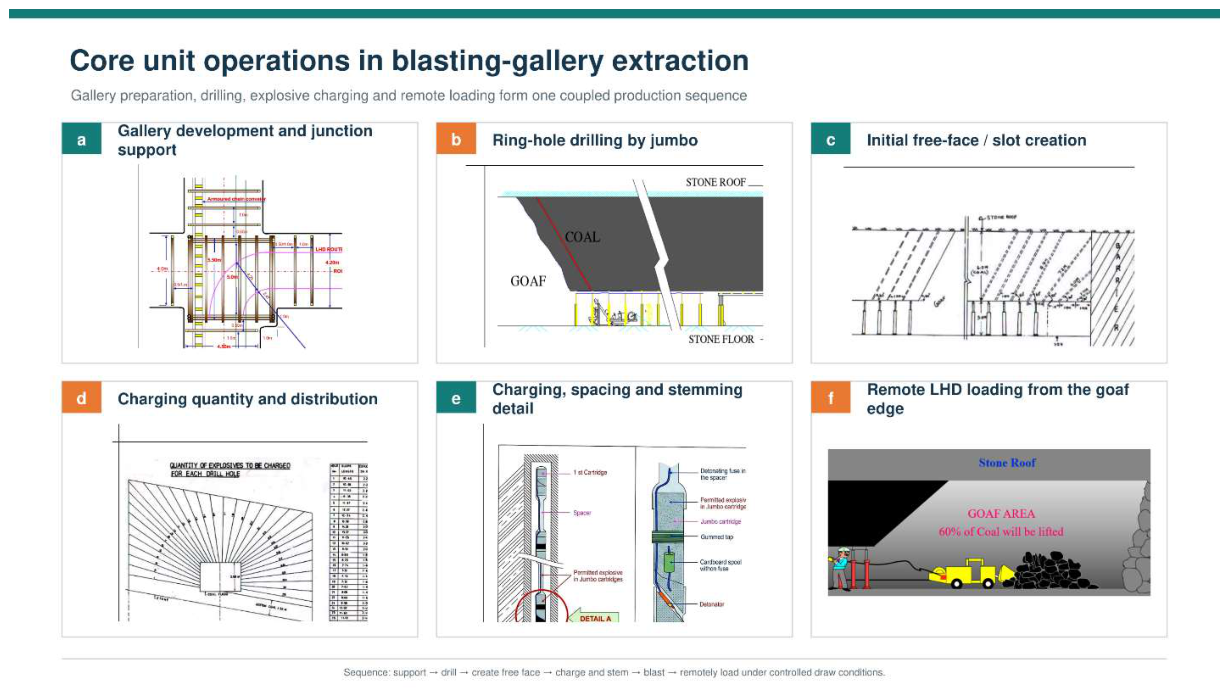
Figure 2.
Safety-critical operations around the BG cycle: atmosphere testing, isolation, blasting and ventilation, authorised re-entry, induced caving, inertisation and goaf monitoring.
Figure 2.
Safety-critical operations around the BG cycle: atmosphere testing, isolation, blasting and ventilation, authorised re-entry, induced caving, inertisation and goaf monitoring.
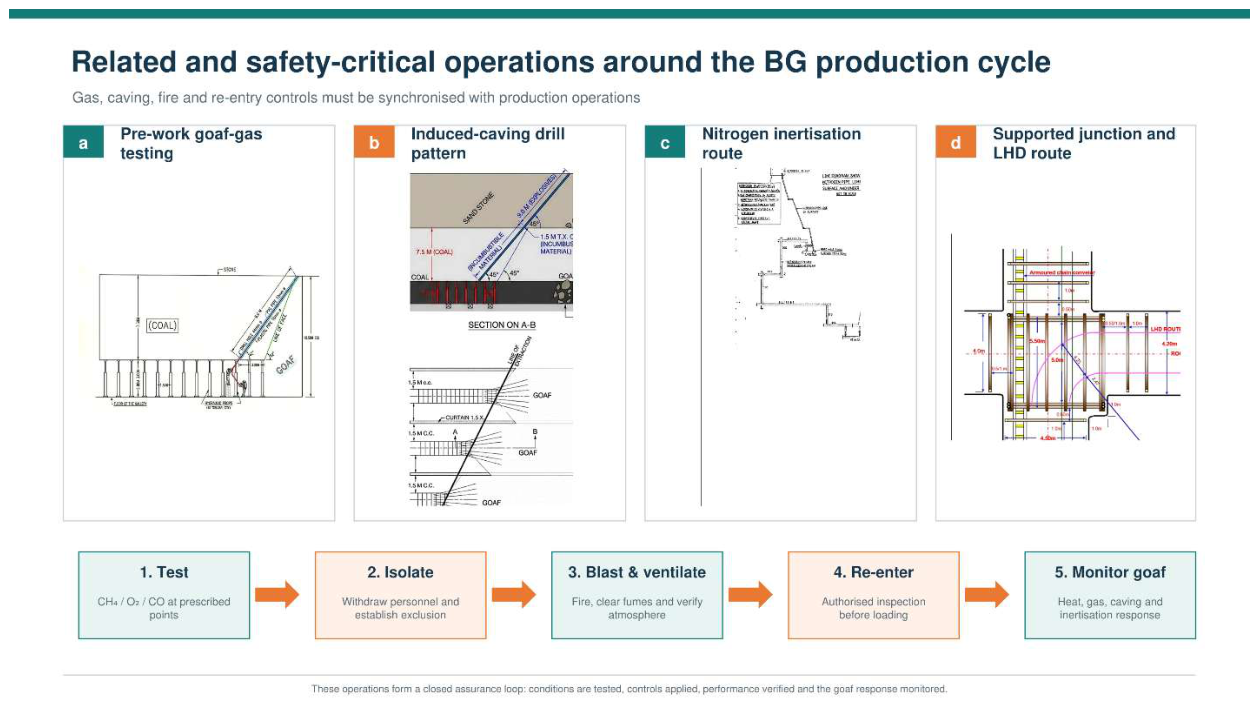
Figure 3.
Lifecycle evidence across the seven Indian BG applications, distinguishing technical feasibility, panel success, sustained performance and scalability.
Figure 3.
Lifecycle evidence across the seven Indian BG applications, distinguishing technical feasibility, panel success, sustained performance and scalability.
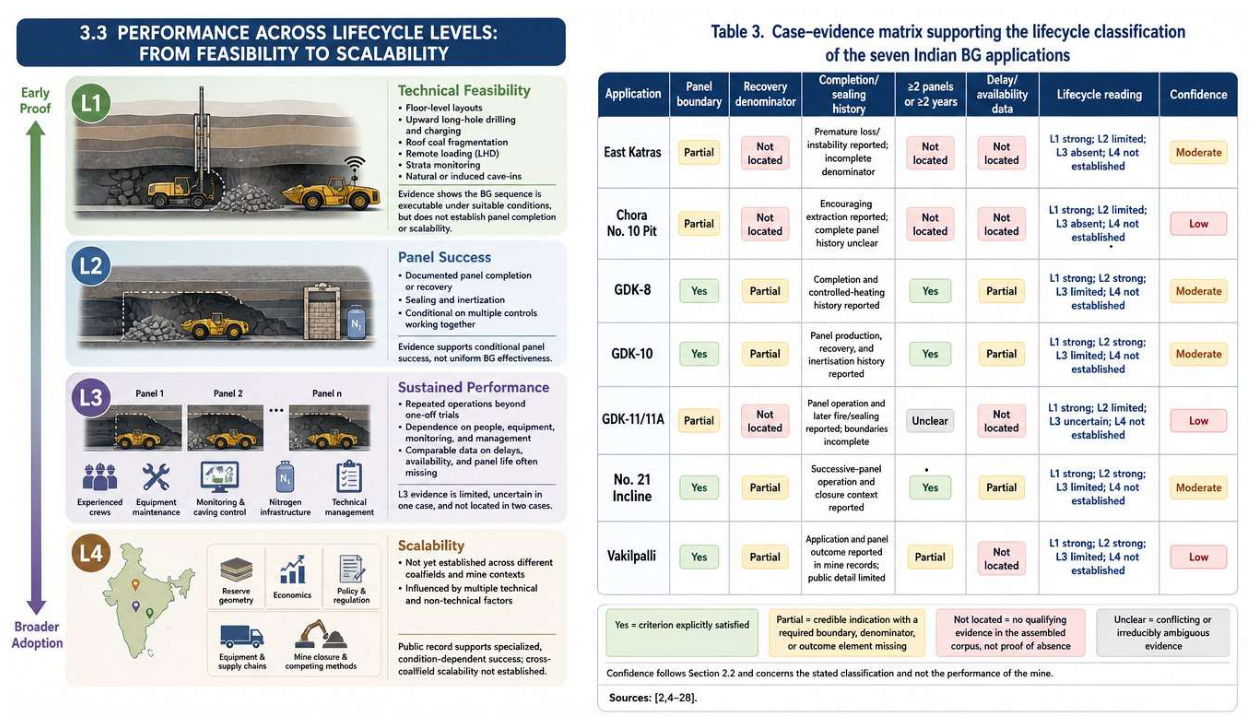
Figure 4.
Coupled degradation pathways linking fragmentation, cavability, goaf leakage, and interruption to panel-level risk.
Figure 4.
Coupled degradation pathways linking fragmentation, cavability, goaf leakage, and interruption to panel-level risk.
Disclaimer/Publisher’s Note: The statements, opinions and data contained in all publications are solely those of the individual author(s) and contributor(s) and not of MDPI and/or the editor(s). MDPI and/or the editor(s) disclaim responsibility for any injury to people or property resulting from any ideas, methods, instructions or products referred to in the content. |
© 2026 by the author. Licensee MDPI, Basel, Switzerland. This article is an open access article distributed under the terms and conditions of the Creative Commons Attribution (CC BY) license.
Copyright: This open access article is published under a Creative Commons CC BY 4.0 license, which permit the free download, distribution, and reuse, provided that the author and preprint are cited in any reuse.