Submitted:
18 September 2026
Posted:
21 September 2026
You are already at the latest version
Abstract
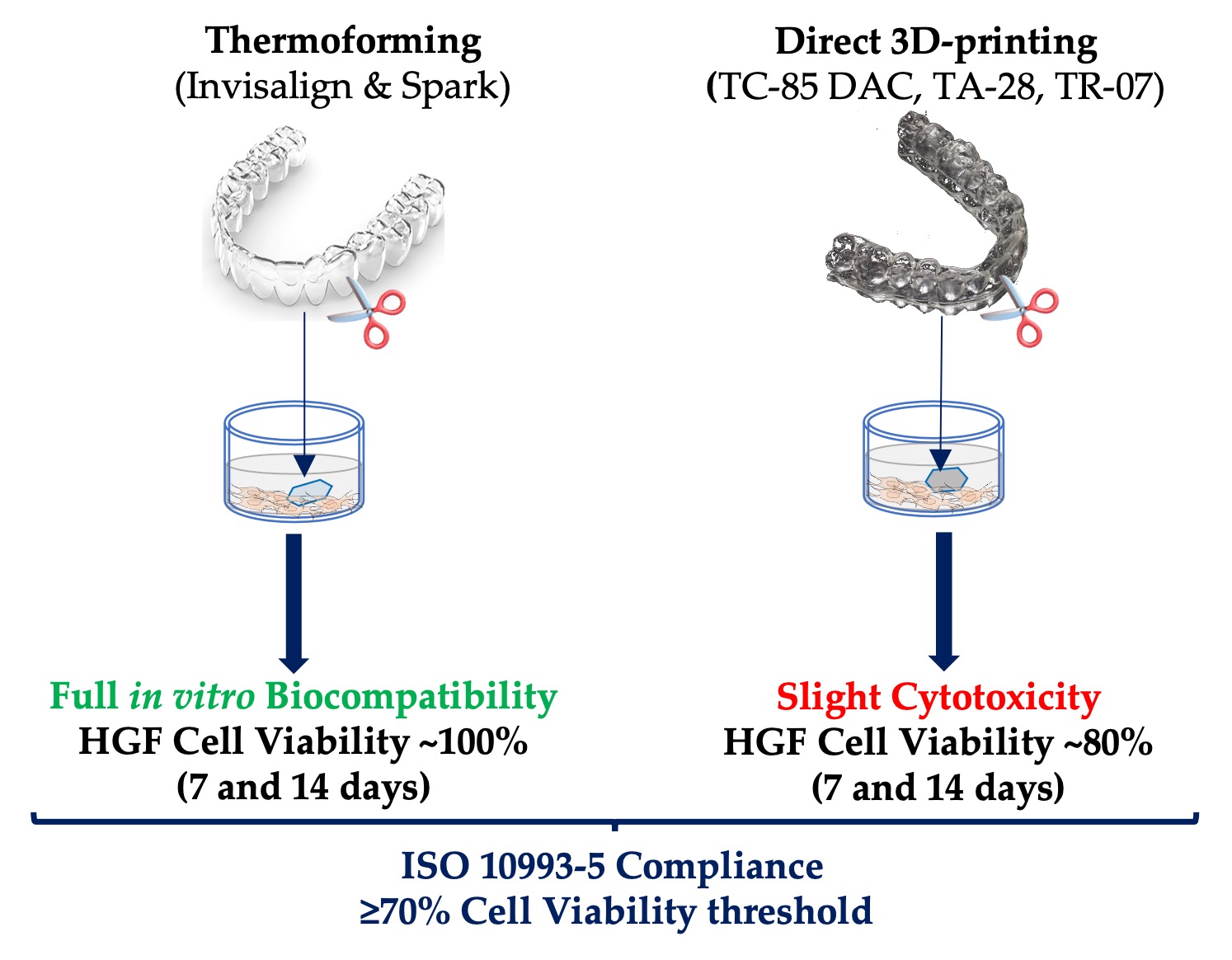
Three-dimensional (3D)-printed clear aligners represent a new alternative for treating orthodontic malocclusions. However, their biocompatibility remains a critical factor requiring careful evaluation. In the current study, the in vitro cytotoxicity of three innovative 3D-printed resins (Tera Harz TC-85 DAC, TA-28, and TR-07, Graphy, Seoul, Korea) and two conventional thermoformed materials (Smart Track, Invisalign, Align Technology, USA, and TruGEN, Spark, Ormco, USA) was assessed by measuring the cell viability of human primary gingival fibroblasts (HGFs) exposed to specimens via direct contact. The MTT assay revealed that, at 7 days, 3D-printed resins exhibited a statistically significant reduction in HGF metabolic activity compared to both the control group and the thermoformed groups (p < 0.0001). This was categorized as "slight cytotoxicity" according to the Ahrari et al. classification. A similar overall biological trend was observed at 14 days, with no progressive impairment in HGF viability, indicating that the materials maintain a stable in vitro biocompatibility profile over time. Notably, all tested materials maintained cell viability levels above the 70% threshold, in compliance with the International Organization for Standardization (ISO) 10993-5 standards. While thermoformed materials are currently considered the conventional reference in orthodontics, the tested 3D-printed resins revealed no relevant in vitro cytotoxic risk, aligning with their ongoing integration into clinical orthodontic practice.