
Submitted:
18 September 2026
Posted:
20 September 2026
You are already at the latest version
Abstract
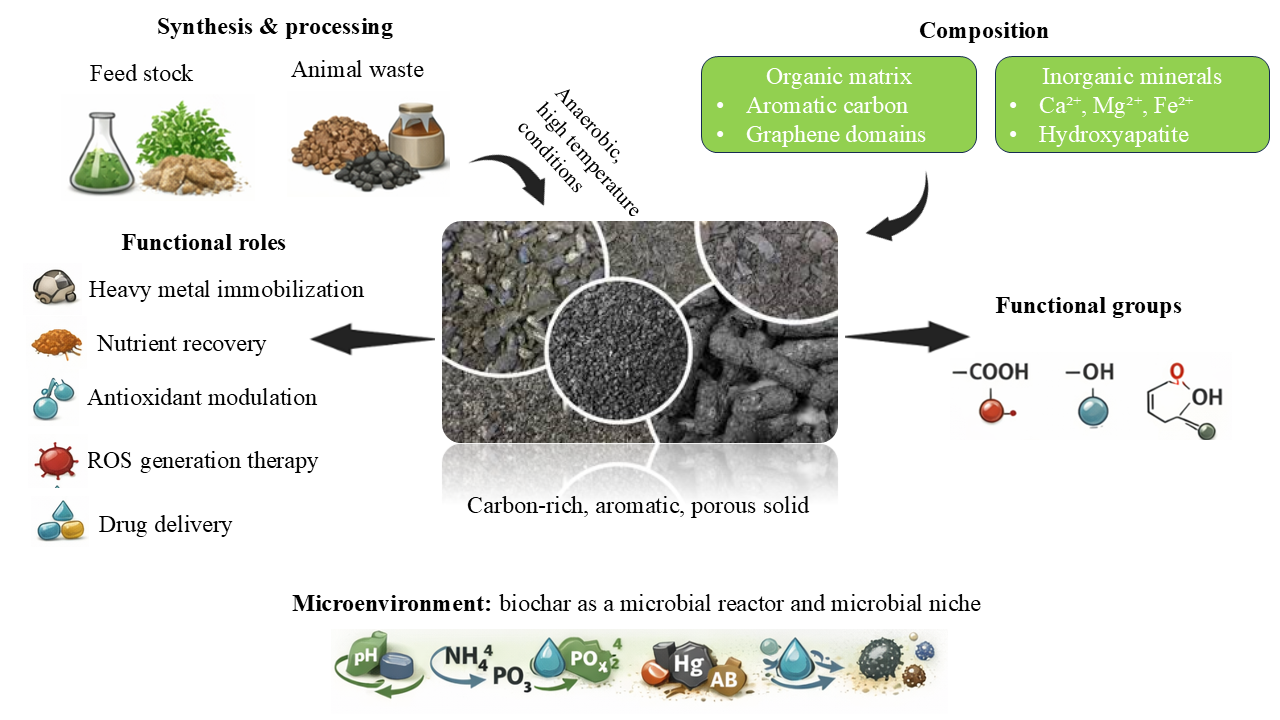
Biochar is increasingly being explored beyond its established environmental and agricultural uses as a functional material that interacts with microorganisms, cells, and biological molecules. However, biochar is not a uniform material, and its biological effects cannot be interpreted independently of feedstock composition, production conditions, particle size, surface chemistry, and post-production modification. This review synthesizes current knowledge on the relationships between these physicochemical characteristics and the biological responses associated with biochar and biochar-based materials. Particular attention is given to adsorption, electron transfer, microbial habitat formation, biomolecule binding, and mineral precipitation as mechanisms that may underlie changes in oxidative balance, antimicrobial activity, animal physiology, cellular responses, and tissue regeneration. The review also critically considers emerging nanobiochar and engineered composites investigated as drug carriers, wound-healing materials, regenerative scaffolds, and platforms for anticancer therapy. Importantly, reported effects often depend on highly heterogeneous materials and experimental models, and the biological contribution of the biochar matrix is not always clearly distinguished from that of incorporated metals, polymers, drugs, or other functional components. Current evidence therefore supports biochar as a tunable platform rather than a universally bioactive material. Its successful development for biological and biomedical applications will require standardized production and characterization, and mechanism-oriented experimental designs.
Keywords:
biomass
; biochar
; sustainability
; circular economy
; carbon sequestration
; microbiome regulation
; environmental remediation
; biomineralization
; regenerative medicine
; climate mitigation
Copyright: This open access article is published under a Creative Commons CC BY 4.0 license, which permit the free download, distribution, and reuse, provided that the author and preprint are cited in any reuse.