

Submitted:
19 September 2026
Posted:
20 September 2026
You are already at the latest version
Abstract
How subjective time arises from experience remains unresolved. We propose TpMT, a measure-theoretic framework grounded in minimal axioms for streams of conscious states. Like the rationals—dense yet of zero measure—countable streams of zero-measure experiences have no duration. Nonzero subjective time requires an uncountable experiential stream with at least countably infinite recurrence of experiential structures. Distinct experiences may densely coexist within the same interval, linking phenomenal multiplicity to the real continuum. TpMT thereby formalizes a necessary structural condition for awareness and provides a criterion for identifying systems that fail to meet it. The theory also yields a structural idempotence law. An exploratory analysis of sleep electroencephalography illustrates its potential for estimating perceived duration.
Keywords:
time perception
; measure theory
The rapid progress of large language models and artificial intelligence [1] has made it increasingly urgent to establish principled criteria for determining whether a system can be considered conscious [1,2], a question with profound implications for how intelligent machines are evaluated, governed, and ethically treated.
Over the past decades, a number of influential theories have sought to explain the nature of consciousness from complementary perspectives, such as integrated information theory (IIT) [3], the global workspace theory [4], and the free energy principle [5], with later unifying attempts exemplified by the integrated world modeling theory [6]. Despite these advances, formal mathematical accounts of consciousness, particularly of its experiential structure, remain rare, with recent efforts [7,8] underscoring the need for a deeper theoretical foundation. The duration and continuity of conscious experience have also been identified as central challenges for theories of consciousness [9].
Even if these theories are reasonable, and a system surpasses the critical IIT threshold [3] to become conscious, it would still experience nothing if its subjective time collapses to zero. Hence, a framework capable of quantifying the length of experience is needed—one that sidesteps debates about the origin or attribution of consciousness that have repeatedly stalled progress in consciousness theory, and targeting the measurable structure instead. Without such a notion, even the attribution of consciousness lacks a well-defined experiential referent.
Here we approach the problem through standard measure theory [10,11], interpreting conscious experience in terms of its subjective duration. Two different forms of infinity enter the answer. For time to have nonzero measure, the complete stream must contain uncountably many experiential fragments. For a fragment to be perceived, its structure must repeat infinitely often arbitrarily close to that occurrence. Other fragments can remain imperceptible—or dark—while collectively carrying temporal extent. These are necessary, not sufficient, conditions within the theory; dense repetition provides an important example rather than a universal requirement. This distinction offers a structural criterion for consciousness, including consciousness in artificial systems.
To make this precise, we model conscious experience as composed of fundamental experiential units (or experiential fragments). One might attempt to assign a fixed positive measure to each such unit. However, such a move immediately leads to a difficulty: it selects a particular numerical scale with no invariant meaning across observers or representational frames, and thus risks introducing arbitrariness at the most basic level. Moreover, assigning a definite nonzero value without further justification appears to violate the Principle of Sufficient Reason (PSR), since no rationale would exist for preferring one specific positive constant over another. For these reasons, while the arguments suggest that a positive assignment is untenable, we treat the statement that the intrinsic measure of a fundamental conscious moment is zero as a working postulate, for rigor and broader acceptability. Meanwhile, an observer’s experience can be modeled as a sequence of discrete system–environment states (see section “A finite mind–world model”), where the index set I is at most countably infinite [12]. These two premises, vanishing intrinsic measure for individual moments (as a postulate) and the countable structure of experiential sequences, lead to a paradox: standard measure theory [11] implies that a countable union of measure-zero sets remains measure zero. Yet, subjectively, we do experience time. We refer to this tension as the measure problem of conscious experience (Figure 1).
To address the measure problem, we develop a time-perception measure theory (TpMT) of conscious experience by representing conscious states as vectors in a Hilbert space and, via a Dedekind-cut mapping, embedding ordered collections of primitive fragments (elementary constituents of experience, defined in section “A finite mind–world model”) into the real line so that intervals of experience inherit a consistent, nonzero time measure. To keep the framework solid, we adopt minimal, natural assumptions (section “Postulates for subjective time”) and, after the mapping to , let all substantive results rest on standard measure theory (section “From experiential order to time measure”); basic properties of the reals (completeness, density, countable additivity on Borel sets) then transparently link temporal measure to the recurrence structure of experience. Measure alone does not suffice: an experiential fragment (a superposition of a set of primitive fragments) that occurs only once is present yet never lived, much as a single, isolated frame inserted into a film typically goes unnoticed by the viewer (Figure 1). We show that awareness requires countably infinite recurrence of experiential structures and that multiple distinct streams can be densely interwoven within the same interval, aligning phenomenology with the structure of the real line (section “Awareness through dense structural repetition”). Further, by focusing on finite-dimensional models of TpMT (section “A finite mind–world model”), we elucidate the mathematical structure of conscious experience and show that TpMT has the capacity to describe and distinguish different modes of experience.
The immediate aim is a mathematical account of the conditions for experienced time, not a complete explanation of consciousness or its physical origin. Such conditions offer a principled starting point for assessing artificial systems without equating intelligent behavior with awareness. An exploratory sleep-EEG application illustrates how the theory might also guide approximate duration estimates.
Postulates for Subjective Time
We formulate five foundational postulates. Deliberately minimal, they specify the experiential domain, the composition and temporal order of experiential fragments, the measure of elementary occurrences, and the link between structural repetition and awareness. Ontology and dynamics are set aside.
Postulate 1: Existence of Experience.
Conscious experience is assumed to exist. Its content is represented relative to an observer M and a world W, whose joint state specifies the experiential content. No claim is made here about their ultimate ontology or dynamical origin.
Postulate 2: Hilbert Space Representation.
The joint states of M and W are represented by admissible nonzero vectors in . Within the present framework, each such vector represents an experiential fragment of M, and every well-defined nonzero superposition of experiential fragments is again an experiential fragment; infinite sums must converge in Hilbert norm. This representation is purely kinematic and does not presuppose quantum dynamics, quantum probabilities, or quantum effects in consciousness.
Postulate 3: Sequential Accessibility.
A countable family of primitive experiential fragments (defined in section “A finite mind–world model”), each described by a product state , is endowed with an intrinsic order. A composite fragment becomes temporally accessible no earlier than any of its primitive constituents; its temporal position is determined by the latest constituent, or by the supremum of their labels in the infinite-dimensional case.
Postulate 4: Zero Duration of Fundamental Experiential Units.
Each fundamental experiential unit has zero intrinsic temporal measure.
Postulate 5: Principle of Awareness.
For a given experiential fragment P occurring in the experiential stream of observer M, if an open experiential neighbourhood contains that occurrence but no structurally equivalent fragment at another temporal label, that occurrence cannot be consciously perceived. Neighbourhoods are T-intervals defined below.
Remarks on Postulates 2, 3, 4 and 5. For Postulate 2, we use the standard linear superposition in Hilbert space purely as a representational device; no probabilistic interpretation is assumed and normalization is not required. Importantly, the induced experiential structure defined in section “A finite mind–world model” differs sharply from ordinary quantum superposition: it is insensitive to nonzero local reweightings of primitive components (cf. Fig. S1). In particular, we prove a Structural Idempotence of Conscious Experience (section “A finite mind–world model”): superposing an experience with any of its included sub-experiences does not change its mathematical structure. For Postulate 3, the sequential constraint orders the temporal accessibility of primitive and composite fragments (see Sect. I in SI). For Postulate 4, the zero-measure assumption is adopted for the following two reasons. First, by the Principle of Sufficient Reason (PSR), assigning an arbitrary finite positive constant to a fundamental experiential unit would lack justification, whereas zero or infinity avoids this arbitrariness. Second, while one could in principle regard such a quantity as a relative unit, analogous to the speed of light serving as a unit of velocity [13], this would imply that different observers might adopt incompatible experiential scales. Given the intrinsic privacy of consciousness, such cross-observer convertibility seems implausible. A self-consistent theory based on nonzero experiential units may nevertheless remain possible, though we consider it less likely. For these reasons, we treat the zero-measure assignment as a cautious working postulate. Postulate 5 is motivated by the intuition that an isolated, unrelated movie frame can go unnoticed (Figure 1); this is an analogy, not an empirical derivation. The postulate concerns the selected occurrence, not equivalent fragments elsewhere, and applies at every temporal scale without selecting a universal window length. It entails non-isolation, not dense repetition or a sufficient condition for awareness (SI, Sec. VI).
Throughout, is a -valued measure on the completed temporal -algebra defined below. We write and define only when , the set of all subexperiences of , is measurable. Postulate 4 assigns zero measure to each singleton: .
A Finite Mind–World Model
We first consider finite-dimensional Hilbert spaces to represent conscious experience. The observer (M) and world (W) are described by orthonormal bases and . A conscious experience corresponds not to a basis state itself but to a state vector involving M, typically formed through superpositions with W. The simplest case is a separable product state , i.e., the tensor product of a single mind-basis vector with an otherwise general world state. We call such states primitive experiences. Such states contain no entanglement between M and W, and hence represent the minimal, structurally trivial form of experience.
The solution to the problem of primitive non-entanglement is straightforward: by Postulate 2, superposing primitive experiences yields new, non-trivial experiences. Normalization of the superposed vectors is not required in this construction. For instance, consider the experience vector where the entanglement entropy between M and W is generally nonzero (see Figure 2A). The temporal accessibility of these experiences follows from Postulate 3, with the formal ordering scheme described in SI, Section I. Note that the `biggest’ experience is the vector showing in Figure 2A.
To analyze the observer’s effective experience, we may factorize the experience as , where the world Hilbert space is partitioned into two subsystems: a minimal subsystem E—referred to as the precursor system—that remains entangled with M, and a complementary environment that is unentangled with the composite. Here “minimal’’ means that, among all such unentangled factorizations, the chosen one yields the smallest possible dimension of . In this decomposition, the system forms a temporarily isolated unit, and the residual system does not contribute directly to the observer’s experience in this experience vector. We define the component as the minimum experience associated with the experience , representing the irreducible experiential content available to M. Methods for obtaining such decompositions, and an explicit non-uniqueness example, are discussed in SI, Sect. III. The same vector may admit distinct minimum precursor embeddings. Subsequent structural statements are relative to specified compatible embeddings and precursor choices; uniqueness of perceptible content is not established here.
Consistent with Postulate 2, we now propose the following foundational principle of conscious experience: any pure state vector defined on a Hilbert space that includes the observer system M constitutes a legitimate experience of M, with all experiences, including primitive or minimal experiences, being pure by definition. That is, the experience is identified not with the reduced density matrix of M, which merely encodes relational information, but with the full state vector itself. This distinction acknowledges that conscious experience may include intrinsic or ineffable components that are not reducible to observable correlations alone, thereby offering a partial resolution to the so-called hard problem of consciousness [14]. In recent years, a growing number of researchers [7,8] have acknowledged the existence of ineffable aspects in conscious experience. However, much of the attention has been directed toward the referential indeterminacy problem (see also Sec. II in SI).
Within TpMT, we take as given an ordered collection of primitive experiences, set aside their origin and ordering dynamics, and analyze experiential structure via superposition and subsystem decompositions. It is worth noting that in this framework the mind and world bases are taken as a priori fixed, reflecting the transcendental givenness of conscious experience, which makes the coefficient representation particularly convenient. By contrast, the subsystems within the world are not pre-defined: their identification depends on how the world Hilbert space is factorized, especially through the definition of the precursor system (see Sec. III in SI). As emphasized by Zanardi [15], the notion of a “system’’ in quantum information theory itself arises from the choice of tensor–product structure (TPS), and our M–W model likewise treats subsystem decomposition as a structural, not ontological, feature.
Structural Organization of Experience
The Modality Problem of Experience
Although the finite-dimensional M-W framework enables non-trivial superpositions and precursor systems, it faces two challenges. First, for a fixed finite primitive family, quotienting out nonzero branch amplitudes leaves only finitely many supports; their total measure is zero under the singleton-zero postulate. This concerns that support model, not finite-dimensional Hilbert spaces in general. Second, there is a deeper structural challenge. The Modality Problem of Experiences: How can we formally define the mathematical structure underlying different modalities of conscious experience?
For instance, visual experience appears to possess an inherently quasi-two-dimensional structure while acoustic perception is experienced as a one-dimensional temporal stream. How can such structure be represented formally within the M-W framework? As illustrated heuristically in Figure 2B, one might consider representing the perceived color at different spatial locations as tensor products of individual perceptual states, such as . However, this approach suffers from two immediate issues: first, in the absence of additional relational or geometric structure, a mere tensor-product decomposition does not intrinsically encode spatial organization, i.e., the ordering of tensor factors is physically arbitrary and meaningful distinctions between locations cannot be recovered from the product structure alone; second, the observer M remains unentangled with the relevant subsystem E, and thus has no informational access to it. These limitations highlight the need for a more rigorous formalism to capture the internal structure of conscious experience.
We propose that the structure of a conscious experience should be defined by its relations to other experiences. This perspective is consistent with the recent emphasis by Kleiner and Ludwig on the need for a rigorous definition of mathematical structures of conscious experience, rather than merely assigning mathematical spaces to phenomenological properties by intuition [8]. They proposed identifying such structures by examining the correspondence between mathematical relations and structural aspects of experience. Building on this relational perspective, we focus on a complementary question: how the internal structure of an experience and its relations within a structured stream of experiences give rise to a measurable temporal organization. These relations naturally fall into two categories: (1) internal relations, those among experiential elements contained within the experience, which together constitute its internal mathematical structure; and (2) external relations, those linking the experience to others not included within it. The formal definition of terms such as “included” or “inside” is provided in the SI and later subsections.
Coarse-Graining of Observers
Before we can rigorously define the mathematical structure of an experience, we must first introduce the concept of the coarse-grained observer, defined as follows. If the precursor systems of several distinct states coincide, i.e., they share the same precursor subsystem E, then we may define a composite system as a new observer, referred to as the coarse-grained observer of M. Importantly, not all primitive experiences accessible to M are necessarily accessible to its coarse-grained counterpart . For example, as illustrated in Figure 2C, the fourth primitive experience cannot be experienced by .
We say that the coarse-grained observer is included in if there exists a decomposition , for some auxiliary system . In principle, an observer can experience the raw experiences of all its coarse-grained observers. To discuss the mathematical structure of an experience, it is essential to first specify the reference observer. In what follows, we shall take the base observer M as the designated reference.
Mathematical Structure of Conscious Experience
Here, we define basic relations between two experiences and using the four-value function . indicates that the two experiences are disjoint both in experience and in system (Figure 2D ). We say that and are disjoint in experience if their index sets do not overlap, i.e., , referring purely to the decomposition into primitive components. They are disjoint in system if their precursor systems and share no common degrees of freedom, meaning that the subsystems entangled with the observer M to realize the two experiences are distinct (see Sec. IV of the SI for explicit realizations). Accordingly, corresponds to being disjoint only in experience (Figure 2E ), to being disjoint only in system (Figure 2F ), and to being connected in both experience and system (Figure 2G ).
We also define a saturated function for an experience . When the union of the precursor systems of all sub experiences of is equal to the precursor system of , i.e. , we call the experience saturated and , and unsaturated () otherwise (see Figure 2D and 2H). Conceptually, reflects whether the precursor systems of the constituent sub-experiences are sufficient to fully account for the total experience. When they are sufficient, the experience is saturated; when additional precursor systems are required to integrate or connect the sub-experiences into a coherent whole, it is unsaturated.
For composite experiences with , let . Smaller fragments remain constituents, but are not assigned a standalone signature by Eq. 1. Assume that the index set is equipped with a fixed ordering. This ordering induces a deterministic enumeration of , which we denote by . The mathematical structure of the experience relative to the observer M is defined as
The ordered sequence provides a convenient representation for one-by-one comparison; the underlying mathematical structure itself is independent of the particular enumeration chosen. The signature records exact factorization and subsystem-incidence relations, not entanglement-entropy values; it remains relative to the admissible subsystem embeddings.
Two such experiences and are structurally equivalent if a bijection preserves every indexed entry of the signature, sending to . For brevity, we write when the two experiences are equivalent. In this case, necessarily . For different observers, the same criterion applies to their effective constituent sets; comparing different constituent cardinalities requires an additional, explicit coarse-graining correspondence.
Five typical types of mathematical structures of experiences are shown in Figure 2D–H, and realizations of Figure 2D–G are presented in the SI. The unsaturated case in Figure 2H is formally defined; its realizability remains to be established. This definition captures the internal relational structure of an experience: any two experiences that yield the same are internally isomorphic (relative to the specified observers).
Minimum precursors need not be unique (SI, Sect. III). All subsystem comparisons are therefore made within specified compatible embeddings, with ties resolved by a fixed rule on the admissible factorization families, not by branch amplitudes or entropy values. The signature is relative to these background choices, suppressed in the notation.
From Finite to Infinite Experiential Structure.
The same relational description extends to an infinite experience without assigning a new structure at each scale. For a Hilbert-norm-convergent with countably infinite , we evaluate on all admissible finite pairs , retaining the fixed compatible embeddings and precursor choices. These pairs form a countable family and define the infinite relational signature. Structural equivalence requires one bijection preserving all these relations simultaneously, not unrelated matches between separate finite fragments. This specifies the structure retained by TpMT; it neither reconstructs every property of the infinite vector nor introduces entanglement-entropy values (SI, Sec. III).
Theorem (Structural Idempotence of Conscious Experience):
For , any and any , .
Proof.
Keep the basis fixed and set , where projects onto the observer branches indexed by X. Then , and A has a bounded inverse. Any admissible factorization is carried to , and recovered by . Applied to every finite subexperience, this preserves all admissible precursor choices, their selected minima, and ; hence is unchanged. □
This is structural invariance under nonvanishing branch rescaling (SI, Sec. III): adding an already present subexperience does not create a new relational form. Idempotence is not imposed by definition; an independently specified structure is first constructed, and its invariance is then proved. The result justifies working with nonzero-support representatives in the time-measure construction below, while their interpretation as experiential form remains a modeling hypothesis.
Complex and Emergent Experiential Structures
As previously discussed, the mode or form of an experience is entirely determined by its mathematical structure . We now revisit the problem introduced in Figure 2B. As illustrated in Figure 2I, suppose the experience corresponds to the visual perception of ‘red’, to ‘green’, and to ‘blue’. If we define two experiences to be “adjacent” when they intersect in precursor system (i.e., share some subsystem), then a topological relation between experiences naturally emerges. This framework offers a potential resolution to the spatial organization problem posed in Figure 2B. A complete account of visual structure remains a subject for future research, but our approach may serve as a conceptual starting point. At this stage, the construction captures only topology; a possible route to a metric is sketched via hierarchical rescaling and repeated-structure embeddings (see Sec. IX in SI).
Figure 2J presents another important example of experiential structure: that of self-similarity. Consider a nested sequence of observers satisfying , and suppose there exists an experience such that its structure satisfies the following recursive identity:
where represents one of the minimal experiences of the observer . In this case, we say that exhibits a self-similar experiential structure. We will return to this concept in later sections.
From Experiential Order to Time Measure
Infinite M-W Model
Under Postulate 4, every elementary occurrence has zero measure. With countably many discrete experiences, standard -additive measure theory then collapses the total experiential measure to zero [11], i.e., the measure problem of conscious experience.
To resolve this, we extend the finite-dimensional M-W model to an infinite-dimensional one. In the finite case, the total state is , where and are the dimensions of the observer and world systems. In the infinite case, we generalize to . Here ensures Hilbert-norm convergence of the state and all support subseries. For the continuum model, we additionally take the primitive temporal order to be countable, dense, and without endpoints, hence order-isomorphic to . This is an ordering assumption, not a consequence of a bijection ; the latter reindexes the convergent sum but does not preserve the usual order of . With these labels, (Figure 3A).
The Mapping Between Experiences and the Real Numbers
Based on primitive experiences, we can construct three kinds of open intervals (see Figure 3B and detailed description is referred to Sec. V in SI).
First, the Q-interval, denoted by , is essentially the collection of primitive experiences lying between two rational numbers. Each rational number in the Q-interval corresponding to a primitive experience.
Second, the P-interval, denoted by , arises naturally from Postulate 2, which states that superpositions of primitive experiences also qualify as valid experiences; this makes the power set of a Q-interval the natural construction. Because is invariant under any nonzero component-wise reweighting of included primitives (Structural Idempotence), the measure-theoretic construction may work on representatives determined solely by nonzero support, for which the power-set (P-interval) is canonical. The resulting set is uncountable, but such intervals do not in themselves respect the experiential ordering required by Postulate 3 and .
To respect temporal accessibility, we introduce the T-interval, or experiential interval, with . Each nonempty, bounded-above support E receives the time label : a composite becomes accessible only once its constituents are available.Equivalently, , where is an interval of real time labels; the elements of remain experiences. Half-open T-intervals are defined analogously. T-intervals recover the disjoint decomposition . The supremum identifies a Dedekind cut and hence a real time coordinate; equal labels identify times, not experiential structures (Figure 3C; SI, Sec. V).
The real-line measure can then be transferred to the corresponding measurable temporal sets, without identifying distinct experiences within a time fibre.
Measure Theory of Conscious Experience
On , define , where ℓ is Lebesgue measure. Surjectivity of g makes this well-defined and countably additive; in particular, . We use its completion, so individual experiences, as subsets of null time fibres, are measurable and have zero measure (SI, Sec. V). We call this chosen reference measure the physical time measure, distinguished from the phenomenological measure below.
The embedding fixes an order, not a unique metric. Lebesgue measure in the chosen coordinate is a reference calibration. A coordinate relabelling must transport this measure, rather than reset it to Lebesgue measure in the new coordinate (SI, Sec. VI). A possible observer-relative calibration remains future work (SI, Sec. IX).
Thus a continuum of zero-measure experiences can carry nonzero reference time. The continuum construction addresses the measure problem without asserting that every represented experience is consciously perceived.
Awareness and Structural Repetition
The Problem of Null Awareness
A nonzero experiential interval does not guarantee awareness. If all its structures occur only in isolation, none is consciously perceived under Postulate 5, even though their totality carries nonzero reference time. We call these imperceptible fragments dark experiences.
This is the null-awareness problem: temporal extent alone does not make an experience lived. The measure problem concerns how a stream acquires duration; the null-awareness problem concerns which structures can be perceived within it.
Repetition as the Key to Experiential Realization
The second problem directs attention to repeated structure. If a fragment is perceived, every open neighbourhood of that occurrence must contain infinitely many other occurrences of the same structure. Otherwise, one could shrink the neighbourhood until the occurrence was isolated, contrary to Postulate 5. At least countably infinite repetition is therefore necessary, but its number alone is not enough: a globally infinite sequence may still consist entirely of isolated occurrences.
Dense repetition is a particularly clear realization of this condition, not its only possibility. A structure can recur without filling any interval densely, and non-isolation alone need not provide positive duration. SI, Sec. VI distinguishes these cases precisely. The self-similar structure in Figure 2J suggests one possible route to repeated experiential organization.
From Repeated Structure to Perceived Duration
We model phenomenological time as the duration supported by recurring structures in an actual stream of experience. A mathematically admissible superposition or an internal component need not occur separately. The contribution of a recurring structure is assigned to its temporal support, determined by its non-isolated repetitions and their limiting times within the actual stream (SI, Sec. VI). This allows a structure to support duration even at times when that particular structure does not occur.
We set when an actual experience at time lies within the temporal support of at least one recurring structure, and otherwise. We then define the phenomenological time measure by . Overlapping structures count once, and times outside the actual stream contribute nothing. This duration assignment supplements Postulate 5 without making repetition sufficient for awareness. The precise support construction and measurability conditions are given in SI, Sec. VI.
Whereas other proposals model subjective time through consciousness–time coupling [16] or internal reconfiguration rates [17], TpMT defines duration through the temporal support of recurring experiential structures.
The indicator is not directly observable in neural recordings. However, the contrast between reduced reportable experience in anesthesia or deep sleep and vivid wakeful or dream experience motivates seeking physiological approximations [18,19,20]. Reproducible neural patterns and multiscale repetition statistics may yield a bounded surrogate , much as other state-sensitive indices are obtained from neurophysiological recordings [21]. Finite data cannot establish the theory’s infinities, and an absent report does not establish absent experience; the following application is correspondingly exploratory.
An Exploratory Sleep-EEG Application
TpMT does not identify a unique neural observable, but it motivates asking whether finite-resolution recurrence in Electroencephalogram (EEG) might provide an approximate indicator of phenomenological time. We therefore combined multiscale self-similarity with a smaller correction for neighboring repetition to construct a preliminary bounded indicator, using the Zhang–Wamsley and Kumral sleep datasets for empirical calibration [22,23,24,25]. Its definitions, preprocessing, and calibration constraints are given in the Supplementary Information.
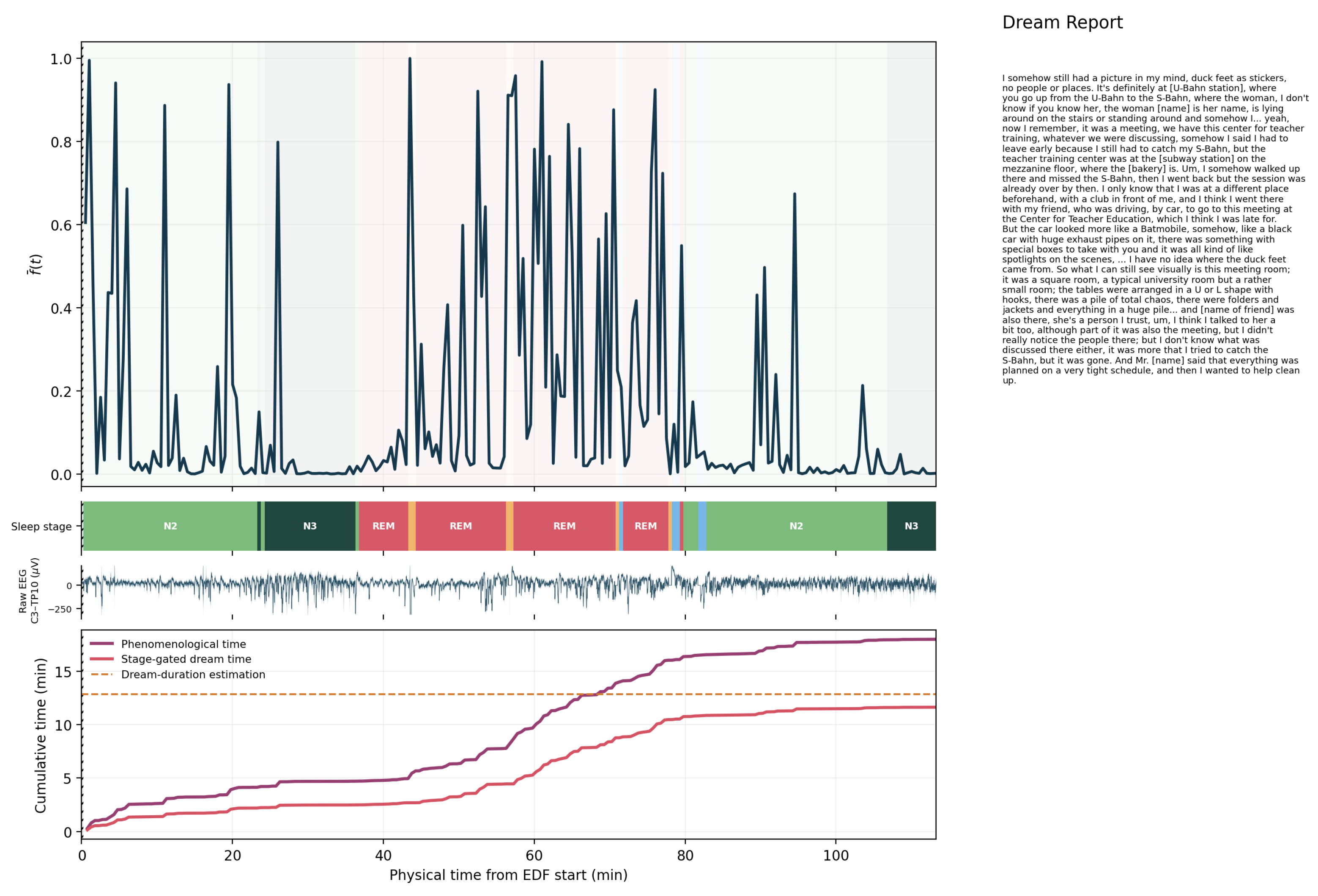
The post-awakening dream reports in the Kumral dataset were then used to refine the indicator at intermediate values, with separately estimated report durations serving only as rough calibration targets. The sleep-stage weighting, classifier assessment, training–test division, and optimization procedure are described in the Supplementary Information. Applied to an EEG recording, the resulting construction provides coarse cumulative estimates of phenomenological time and dream time, as illustrated for annotation ID 035 in Figure 4.
These estimates have only preliminary reference value and are not suitable for individual-level inference. This worked example is included solely to illustrate how TpMT might inspire future empirical methods; it neither provides evidence for, nor tests, proves, or validates, TpMT.
Coexistence of Multiple Experiential Modes
Multiple distinct experiential structures can share one temporal interval without dividing it into separate durations. Disjoint dense occurrence sets provide an explicit example: each structure extends throughout the interval, although no two need occur at the same label (Figure 3D; SI, Sec. VII). The example captures how diverse modes can be temporally interwoven; it establishes mathematical possibility rather than a claim about their physical realization.
SI, Secs. VIII–X explore further connections among observer-relative geometry, self-similarity, and interaction with the world. These proposals suggest directions for extending the framework, but the duration construction does not depend on a particular Hausdorff realization or on the existence of a maximizing observer.
Implications and Outlook
TpMT starts from a simple tension: a countable stream of zero-measure fragments, like the rational numbers, has no duration, yet experience takes time. Convergent superposition and a supremum construction extend the experiential domain to a continuum capable of carrying nonzero measure. Awareness introduces a different requirement: a perceived structure must repeat infinitely often arbitrarily close to its occurrence. Individually imperceptible, dark fragments may carry the temporal background within which such repetition acquires phenomenological duration. Dense repetition gives an explicit example, allowing distinct modes to share the same interval. We also establish structural idempotence: adding an included subexperience without cancelling its branches preserves the independently defined relational structure.
Together, these results provide necessary structural criteria for assessing consciousness in artificial systems. The relevant question is not simply how many computations an AI performs, but whether its realization possesses the experiential organization required by the theory; computational complexity alone, including that of transformers [27,28], does not answer it. The exploratory EEG application illustrates a possible route from this framework to approximate duration estimates, not a validation of its premises. Connecting the proposed structures to physical dynamics and empirical observations remains the next task.
Acknowledgments
The author thanks Wei Lin (School of Mathematical Sciences, Fudan University) for helpful discussions and suggestions concerning the measure-theoretic aspects of this work.
Funding
J.L. was supported by the National Natural Science Foundation of China (52394272). Additional support came from the National Key Research and Development Program of China (2023YFA0915300) and the Shanghai Science and Technology Innovation Action Plan (24JD1400700).
Author Contributions
J.L. conceived the study and developed the conceptual and mathematical framework.
Competing interests
The author declares no competing financial interests. [Author confirmation required: disclose any nonfinancial competing interests, or confirm that there are none.]
Data, code and materials availability
The mathematical definitions and derivations are provided in the main text and Supplementary Materials. The sleep-EEG analyses use the publicly archived Zhang–Wamsley and Kumral datasets [23,25]; the sleep-stage model is GSSC v0.0.9 [26]. The analysis code, fitted parameters, derived data, and figure-generation instructions have been assembled in a reproducibility package (github.com/JianfengFD/tpmt-sleep-eeg-time-proxy). No physical materials were generated in this work.
Ethics
Use of AI-assisted tools
ChatGPT assisted with mathematical counterexamples and coding. Language models were also used to estimate report-based dream durations as described in the Supplementary Materials. The author has carefully confirmed the counterexamples and the coding.
Supplementary materials
The following supporting information can be downloaded at the website of this paper posted on Preprints.org. Supplementary Text, sections I–X
Materials and Methods, section XI
Figure S1
References cited in the supplement are included in the main References and Notes.
References and Notes
- Bubeck, S.; Chandrasekaran, V.; Eldan, R.; Gehrke, J.; Horvitz, E.; Kamar, E.; Lee, P.; Lee, Y.T.; Li, Y.; Lundberg, S.; et al. Sparks of Artificial General Intelligence: Early experiments with GPT-4. arXiv 2023, arXiv:2303.12712. [Google Scholar]
- Chalmers, D.J. Could a Large Language Model be Conscious? Boston Rev. 2023. [Google Scholar] [CrossRef]
- Tononi, G.; Boly, M.; Massimini, M.; Koch, C. Integrated information theory: from consciousness to its physical substrate. Nat. Rev. Neurosci. 2016, 17, 450–461. [Google Scholar] [CrossRef]
- Baars, B.J. In the Theater of Consciousness: The Workspace of the Mind; Oxford University Press: Oxford, 1997. [Google Scholar]
- Friston, K. The free-energy principle: a unified brain theory? Nat. Rev. Neurosci. 2010, 11, 127–138. [Google Scholar] [CrossRef]
- Safron, A. An Integrated World Modeling Theory (IWMT) of Consciousness: Combining Integrated Information and Global Neuronal Workspace Theories With the Free Energy Principle and Active Inference Framework. Front. Artif. Intell. 2020, 3, 30. [Google Scholar] [CrossRef]
- Kleiner, J. Mathematical Models of Consciousness. Entropy 2020, 22, 609. [Google Scholar] [CrossRef]
- Kleiner, J.; Ludwig, T. What is a Mathematical Structure of Conscious Experience? Synthese 2024, 203, 89. [Google Scholar] [CrossRef]
- Kent, L.; Wittmann, M. Time consciousness: the missing link in theories of consciousness. Neurosci. Conscious. 2021, 2021, niab011. [Google Scholar] [CrossRef]
- Halmos, P.R. Measure Theory; D. Van Nostrand Company, Inc.: New York, 1950. [Google Scholar]
- Tao, T. An Introduction to Measure Theory. Graduate Studies in Mathematics; American Mathematical Society: Providence, 2011; Vol. 126. [Google Scholar]
- Reed, M.; Simon, B. Methods of Modern Mathematical Physics. Vol. I: Functional Analysis; Academic Press: New York, 1972. [Google Scholar]
- Dragan, A.; Ekert, A. Quantum principle of relativity. New J. Phys. 2020, 22, 033038. [Google Scholar] [CrossRef]
- Chalmers, D.J. Facing Up to the Problem of Consciousness. J. Conscious. Stud. 1995, 2, 200–219. [Google Scholar]
- Zanardi, P. Virtual Quantum Subsystems. Phys. Rev. Lett. 2001, 87, 077901. [Google Scholar] [CrossRef]
- Nguyen, K. Unified Temporal Consciousness Theory: A Mathematical Framework for Subjective Time. TechRxiv 2025, version 1. [Google Scholar] [CrossRef]
- Hu, X. Subjective Time Perception as Information Dynamics: An Ontological Formalisation of Psychological Time within the Logical Universe Framework. PhilArchive, Preprint, version 1.0, English translation; 2026. [Google Scholar]
- Alkire, M.T.; Hudetz, A.G.; Tononi, G. Consciousness and anesthesia. Science 2008, 322, 876–880. [Google Scholar] [CrossRef]
- Brown, E.N.; Lydic, R.; Schiff, N.D. General anesthesia, sleep, and coma. N. Engl. J. Med. 2010, 363, 2638–2650. [Google Scholar] [CrossRef]
- Siclari, F.; Baird, B.; Perogamvros, L.; Bernardi, G.; LaRocque, J.J.; Riedner, B.; Boly, M.; Postle, B.R.; Tononi, G. The neural correlates of dreaming. Nat. Neurosci. 2017, 20, 872–878. [Google Scholar] [CrossRef]
- Casali, A.G.; Gosseries, O.; Rosanova, M.; Boly, M.; Sarasso, S.; Casali, K.R.; Casarotto, S.; Bruno, M.A.; Laureys, S.; Tononi, G.; et al. A theoretically based index of consciousness independent of sensory processing and behavior. Sci. Transl. Med. 2013, 5, 198ra105. [Google Scholar] [CrossRef]
- Zhang, J.; Wamsley, E.J. EEG predictors of dreaming outside of REM sleep. Psychophysiology 2019, 56, e13368. [Google Scholar] [CrossRef]
- Wamsley, E.; Zhang, J.; Collins, M. Zhang & Wamsley 2019 Final. figshare dataset, version 1. 2023. [Google Scholar]
- Kumral, D.; Palmieri, J.; Gais, S.; Schönauer, M. Pre-sleep experiences shape neural activity and dream content in the sleeping brain. iScience 2025, 28, 113032. [Google Scholar] [CrossRef]
- Kumral, D.; Palmieri, J.; Gais, S.; Schönauer, M. Daytime experiences shape neural activity and dream content. FreiData dataset, version 1; DREAM Set 19. 2024. [Google Scholar]
- Hanna, J.; Flöel, A. An accessible and versatile deep learning-based sleep stage classifier. Front. Neuroinformatics 2023, 17, 1086634. [Google Scholar] [CrossRef]
- Vaswani, A.; Shazeer, N.; Parmar, N.; Uszkoreit, J.; Jones, L.; Gomez, A.N.; Kaiser, L.; Polosukhin, I. Attention is all you need. In Proceedings of the Advances in neural information processing systems, 2017; Vol. 30. [Google Scholar]
- Radford, A.; Narasimhan, K.; Salimans, T.; Sutskever, I. Improving language understanding by generative pre-training. OpenAI Blog 2018. [Google Scholar] [CrossRef]
- Shoemaker, S. The Inverted Spectrum. J. Philos. 1982, 79, 357–381. [Google Scholar] [CrossRef]
- Stalnaker, R. Comparing Qualia Across Persons. Philos. Top. 1999, 26, 385–406. [Google Scholar] [CrossRef]
- Nagel, T. What Is It Like to Be a Bat? Philos. Rev. 1974, 83, 435–450. [Google Scholar] [CrossRef]
- Musacchio, J.M. The Ineffability of Qualia and the Word-Anchoring Problem. Lang. Sci. 2005, 27, 403–435. [Google Scholar] [CrossRef]
- Li, J. The Art of Silence: Fundamental Theory of the Science of Consciousness; In Chinese; Social Sciences Academic Press, 2018. [Google Scholar]
- Kolda, T.G.; Bader, B.W. Tensor Decompositions and Applications. SIAM Rev. 2009, 51, 455–500. [Google Scholar] [CrossRef]
- Stucky, B. We Are the Sensors of Consciousness! A Review and Analysis on How Awakenings During Sleep Influence Dream Recall. Nat. Sci. Sleep 2025, 17, 709–729. [Google Scholar] [CrossRef]
- Wong, W.; Herzog, R.; Andrade, K.C.; et al. A dream EEG and mentation database. Nat. Commun. 2025, 16, 7495. [Google Scholar] [CrossRef]
Figure 1.
Two obstacles to experienced time. Countably many zero-measure fragments cannot provide nonzero duration; an uncountable stream supplies a domain capable of carrying time. Temporal extent alone does not ensure awareness: isolated fragments remain imperceptible, or dark. Infinitely repeated structures provide the second ingredient, with dense repetition as an example rather than a universal requirement. The dark background can carry reference time while repeated patterns determine phenomenological duration. The film-frame analogy is heuristic; the construction supplies necessary conditions, not a sufficient test for consciousness.
Figure 1.
Two obstacles to experienced time. Countably many zero-measure fragments cannot provide nonzero duration; an uncountable stream supplies a domain capable of carrying time. Temporal extent alone does not ensure awareness: isolated fragments remain imperceptible, or dark. Infinitely repeated structures provide the second ingredient, with dense repetition as an example rather than a universal requirement. The dark background can carry reference time while repeated patterns determine phenomenological duration. The film-frame analogy is heuristic; the construction supplies necessary conditions, not a sufficient test for consciousness.
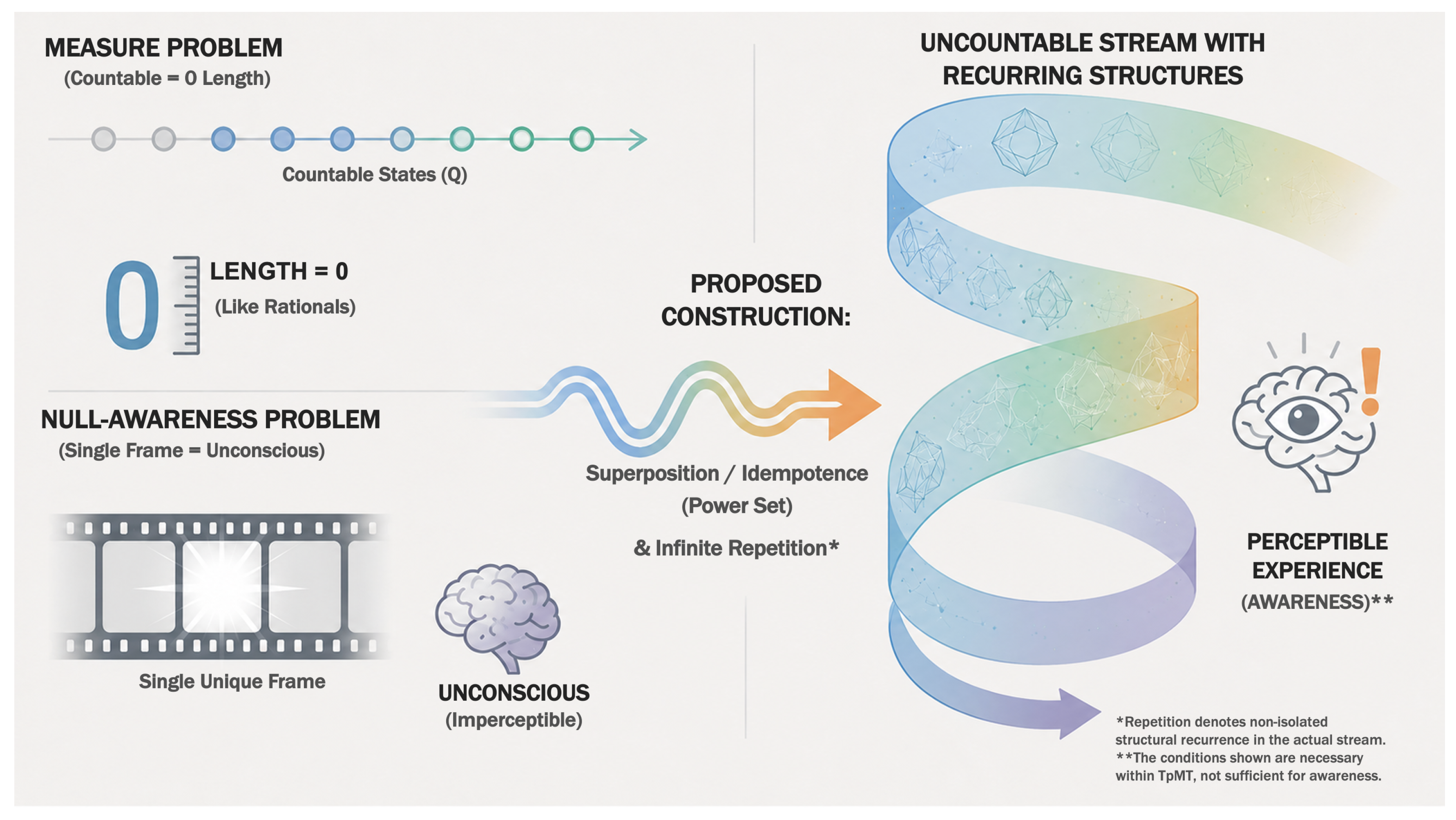
Figure 2.
Mathematical structure of conscious experiences. A. Schematic illustration of the mind–world (M–W) model. B. Modality problem in the M–W model. C. Observer coarse graining. D–H. Relations between experiences (dashed rounded rectangles indicate minimal experiences). D. and are disjoint in both experience and system: ; is saturated (). E. Disjoint only in experience (). F. Disjoint only in system (). G. Connected in both experience and system (). H. Schematic unsaturated case (); realizability remains to be established. I–J. Representative mathematical structures of experience. I. is adjacent to and . J. Self-similar experiential structure. All panels are schematic; precise definitions appear in main text and SI.
Figure 2.
Mathematical structure of conscious experiences. A. Schematic illustration of the mind–world (M–W) model. B. Modality problem in the M–W model. C. Observer coarse graining. D–H. Relations between experiences (dashed rounded rectangles indicate minimal experiences). D. and are disjoint in both experience and system: ; is saturated (). E. Disjoint only in experience (). F. Disjoint only in system (). G. Connected in both experience and system (). H. Schematic unsaturated case (); realizability remains to be established. I–J. Representative mathematical structures of experience. I. is adjacent to and . J. Self-similar experiential structure. All panels are schematic; precise definitions appear in main text and SI.
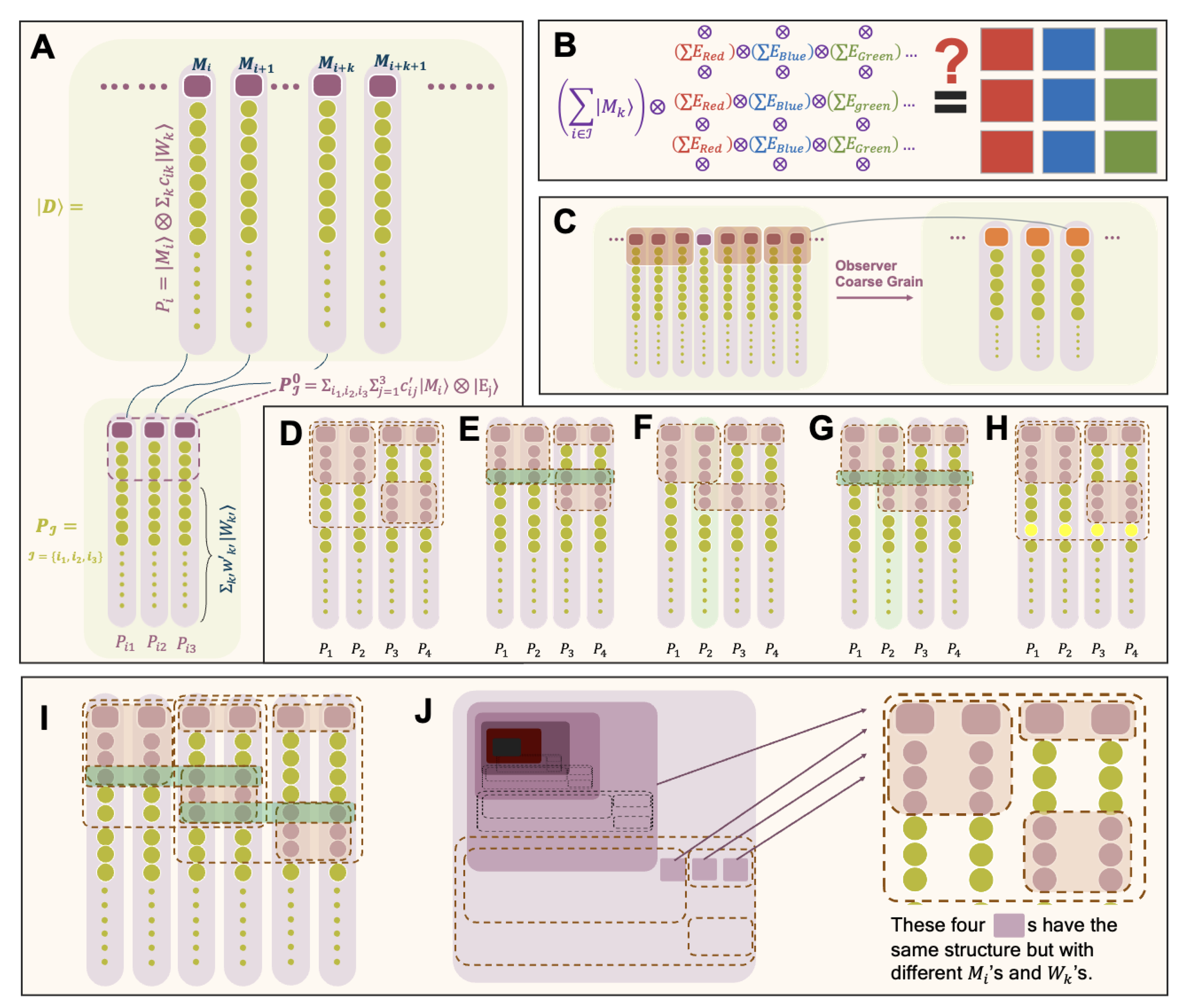
Figure 3.
Experiential order, measure, and co-embedded recurrence. A. The mind–world model with an additionally assumed dense primitive order. B. Q-, P-, and T-intervals; endpoint conventions are specified in SI, Sec. V. C. Bounded-above primitive supports map many-to-one to real suprema. D. Dense repetition as a full-duration example: distinct modes recur on disjoint countable sets within an uncountable experiential background, sharing support without adding durations. Rational cosets, with one representative per class, give a construction (SI, Sec. VII). Dark points denote individually nonrecurrent occurrences, not zero total phenomenological duration at their labels.
Figure 3.
Experiential order, measure, and co-embedded recurrence. A. The mind–world model with an additionally assumed dense primitive order. B. Q-, P-, and T-intervals; endpoint conventions are specified in SI, Sec. V. C. Bounded-above primitive supports map many-to-one to real suprema. D. Dense repetition as a full-duration example: distinct modes recur on disjoint countable sets within an uncountable experiential background, sharing support without adding durations. Rational cosets, with one representative per class, give a construction (SI, Sec. VII). Dark points denote individually nonrecurrent occurrences, not zero total phenomenological duration at their labels.
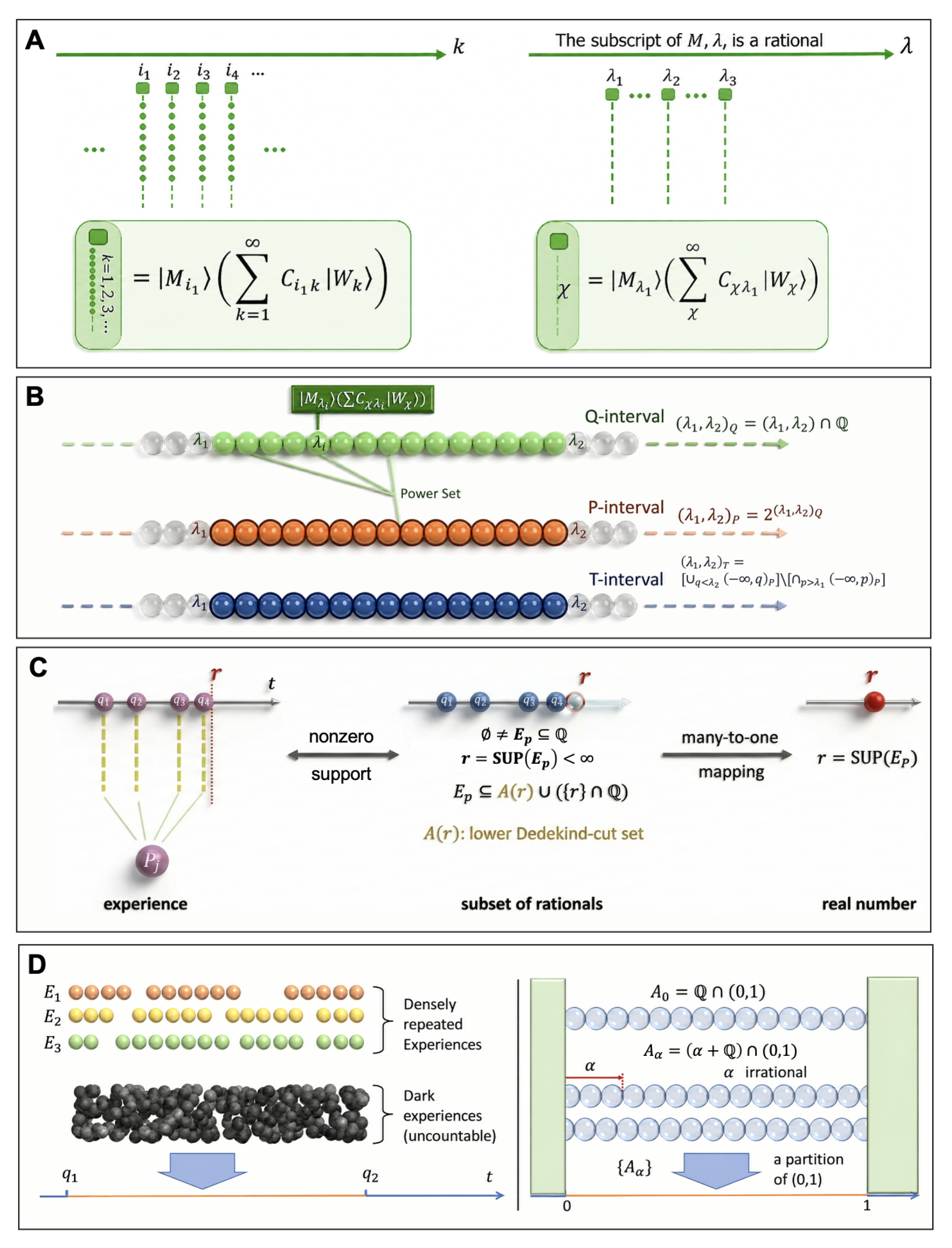
Figure 4.
Exploratory EEG-derived proxies for phenomenological and dream time. Annotation ID 035 is Sub-006_task_sleep-awak003.edf from the Kumral dataset [24,25]. At left, the panels show , GSSC-predicted sleep stage [26], the C3–TP10 EEG summarized in one-second envelopes, and cumulative phenomenological and stage-gated dream time against the report-derived duration estimate (see SI); the unedited report is shown at right.
Figure 4.
Exploratory EEG-derived proxies for phenomenological and dream time. Annotation ID 035 is Sub-006_task_sleep-awak003.edf from the Kumral dataset [24,25]. At left, the panels show , GSSC-predicted sleep stage [26], the C3–TP10 EEG summarized in one-second envelopes, and cumulative phenomenological and stage-gated dream time against the report-derived duration estimate (see SI); the unedited report is shown at right.
Disclaimer/Publisher’s Note: The statements, opinions and data contained in all publications are solely those of the individual author(s) and contributor(s) and not of MDPI and/or the editor(s). MDPI and/or the editor(s) disclaim responsibility for any injury to people or property resulting from any ideas, methods, instructions or products referred to in the content. |
© 2026 by the authors. Licensee MDPI, Basel, Switzerland. This article is an open access article distributed under the terms and conditions of the Creative Commons Attribution (CC BY) license (http://creativecommons.org/licenses/by/4.0/).
Copyright: This open access article is published under a Creative Commons CC BY 4.0 license, which permit the free download, distribution, and reuse, provided that the author and preprint are cited in any reuse.