

Submitted:
19 September 2026
Posted:
20 September 2026
You are already at the latest version
Abstract
Since the crystallization of metal-organic frameworks (MOFs) were introduced based on strong coordi-nation bonds between metal ions and charged organic linkers in 1995, MOFs have been extensively studied for a wide range of applications. The number of reported MOFs has increased dramatically, and virtual screening approaches have been employed to identify promising candidates for specific purposes. However, traditional screening methods face challenges such as high computational cost and limited scalability. In recent years, research on artificial intelligence (AI)-driven materials discovery has advanced rapidly, significantly accelerating the screening and design of MOFs. This review summarizes the recent advances in integrating machine learning (ML) into database construction, multiscale simulation strategies, machine learning potential (MLP), synthesis optimization, knowledge graph (KG) and large language model (LLM) agents for automated workflows.
Keywords:
MOFs
; virtual screening
; AI
; database construction
; multiscale simulation
; MLP
; KG
; LLM agents
1. Introduction
MOFs are a structurally diverse class of porous crystalline materials that exhibit exceptional modularity, tunable physicochemical properties, and extensive chemical diversity[1,2,3,4]. The significance of MOFs was further recognized in 2025, when Susumu Kitagawa, Richard Robson, and Omar M. Yaghi were awarded the Nobel Prize in Chemistry for the development of MOFs. The unique structural and chemical versatility of MOFs has enabled their application in diverse fields, including energy storage[5,6,7,8,9,10,11,12,13,14,15,16,17], carbon capture[18,19,20,21,22,23], chemical sensing[24,25,26,27,28,29,30,31,32,33,34,35], heterogeneous catalysis[36,37,38,39,40,41,42,43], and drug delivery[44,45,46,47,48,49]. This versatility stems from the intrinsic structural tunability of MOFs, which are assembled via reticular synthesis from metal-containing secondary building units (SBUs) and organic linkers to generate diverse, highly ordered, and predictable framework topologies[50,51,52,53].
As illustrated in Figure 1, a quintessential example of this modularity is the systematic tuning of pore dimensions through variation in the connectivity of organic linkers, including ditopic, tritopic, tetratopic, and higher-connected geometries. This strategy enables precise control over framework porosity and surface area[54]. Leveraging principles of reticular chemistry, thermodynamically stable MOFs can be rationally designed to enable highly selective adsorption of target guest molecules[55,56,57,58]. To further enhance functional diversity, MOF complexity can be increased by incorporating multiple distinct organic linkers and/or metal ions within a single framework, giving rise to multivariate MOFs (MTV-MOFs)[59], including systems with mixed-metal compositions and interpenetrated network structures. Consequently, the incorporation of different metal centers enables the rational design of MOFs for specific functions, such as Fe-based MOFs for magnetic properties[60] and Ti-based MOFs for photocatalytic processes[61].
As delineated in Figure 2, the development of MOF chemistry was catalyzed in the early stages of the field with the demonstration of permanent porosity in MOF-5 reported by Omar M. Yaghi and co-workers[62]. Shortly thereafter, HKUST-1 (also known as Cu-BTC)[63] was reported, featuring coordinatively unsaturated metal sites generated upon removal of terminal ligands during activation. These early archetypal materials established key concepts of reticular chemistry. In the early 21st century, a series of representative frameworks were developed, including the flexible MIL-53[64], which exhibits a reversible “breathing” behavior, and MIL-101[65], noted for its exceptionally high surface area and large pore volume. MOF-74[66], with its one-dimensional channels and high density of open metal sites, further highlighted the importance of accessible metal centers, while the zirconium-based UiO-66[67] emerged as a benchmark system for defect engineering and chemical stability. Since the late 2000s, MOF research has expanded rapidly, with annual publications exceeding 1,000. Numerous framework families have since been developed, including isoreticular MOFs (IRMOFs)[62], zeolitic imidazolate frameworks (ZIFs, e.g., ZIF-8)[68], porous coordination networks (e.g., PNC-222)[69], NU-series MOFs (e.g., NU-100)[70], DUT-series MOFs (e.g., DUT-49)[71], and others. Representative functional systems include SBMOF-1 for Xe/Kr separation[72], MOF-801 for atmospheric water harvesting[73], and CALF-20, reported in 2020, which has demonstrated strong potential for industrial carbon capture applications[74].
With the continuous advancement of computational power and molecular simulation techniques[75], high-throughput screening (HTS) has become a widely adopted paradigm in MOF research since the early 2010s. More recently, ML methods have emerged as powerful complementary tools for accelerating materials discovery, enabling data-driven prediction of MOF properties and guiding candidate selection within the rapidly expanding chemical space. In parallel, recent breakthroughs in artificial intelligence, particularly artificial neural networks (ANNs), highlighted by the 2024 Nobel Prize in Physics awarded to John J. Hopfield and Geoffrey E. Hinton—have further accelerated the integration of AI into scientific research. These developments have also contributed to transformative advances in protein structure prediction, exemplified by the AlphaFold system developed by DeepMind. Driven by the combinatorial explosion of possible MOF structures, exhaustive enumeration and screening of all candidates using conventional HTS approaches has become increasingly intractable. As a result, data-driven and AI-assisted strategies are rapidly gaining prominence. In this context, we summarize how AI methodologies have been integrated into MOF research, including database construction, virtual screening, inverse design, and synthesis prediction, thereby accelerating materials discovery across diverse application domains.
Figure 2.
Number of papers published for two query combinations (TS=(“MOF” OR "MOFs" OR "Metal organic framework" OR “Metal organic frameworks” OR “Metal-organic framework” OR “Metal-organic frameworks”) AND TS=(”simulation” OR ”calculation” OR ”computation” OR ”artificial intelligence” OR ”AI” OR ”deep learning” OR ”machine learning” OR ”neural network”) (data collected through 2025/10/16). All information extracted from web of science.
Figure 2.
Number of papers published for two query combinations (TS=(“MOF” OR "MOFs" OR "Metal organic framework" OR “Metal organic frameworks” OR “Metal-organic framework” OR “Metal-organic frameworks”) AND TS=(”simulation” OR ”calculation” OR ”computation” OR ”artificial intelligence” OR ”AI” OR ”deep learning” OR ”machine learning” OR ”neural network”) (data collected through 2025/10/16). All information extracted from web of science.
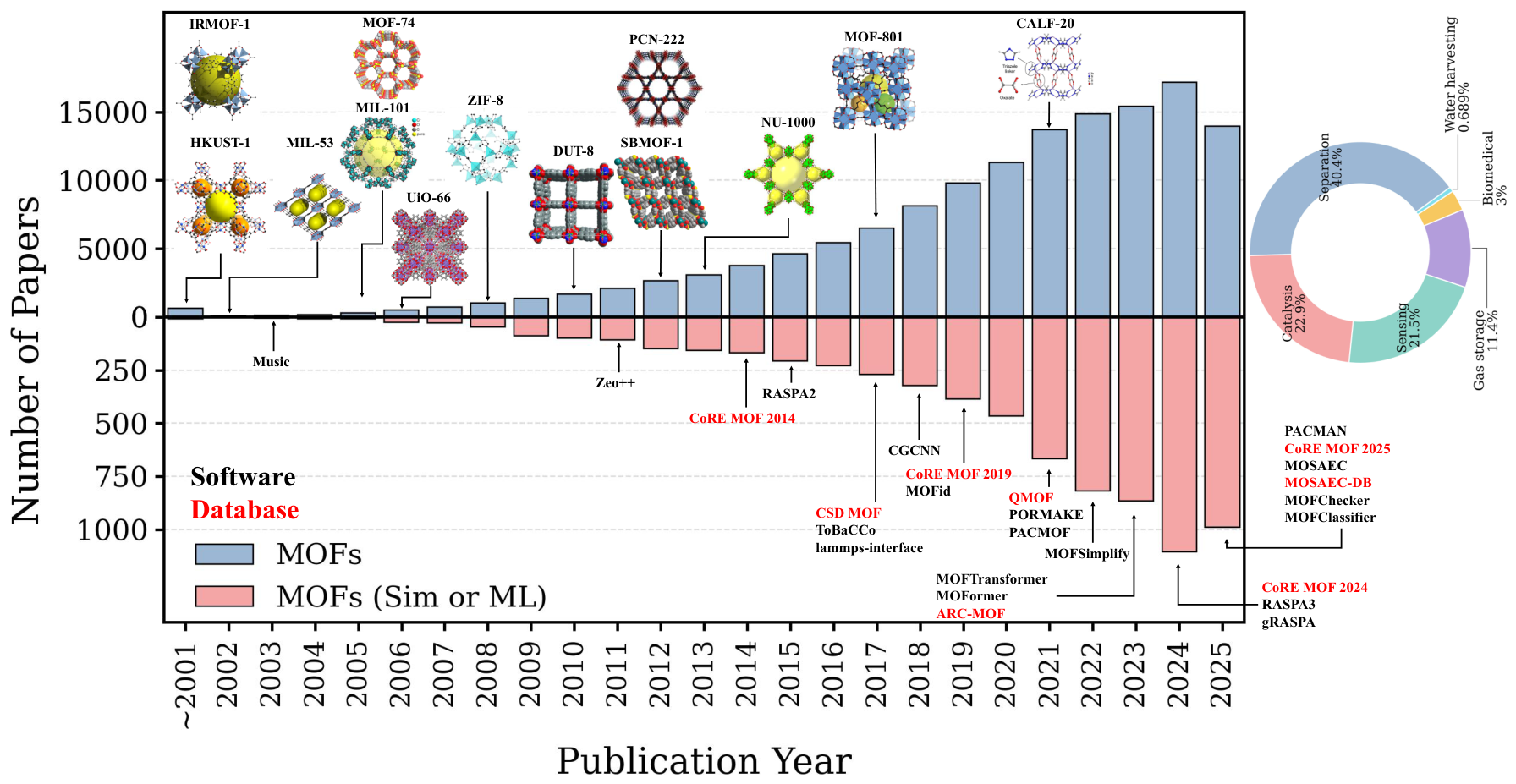
Figure 3.
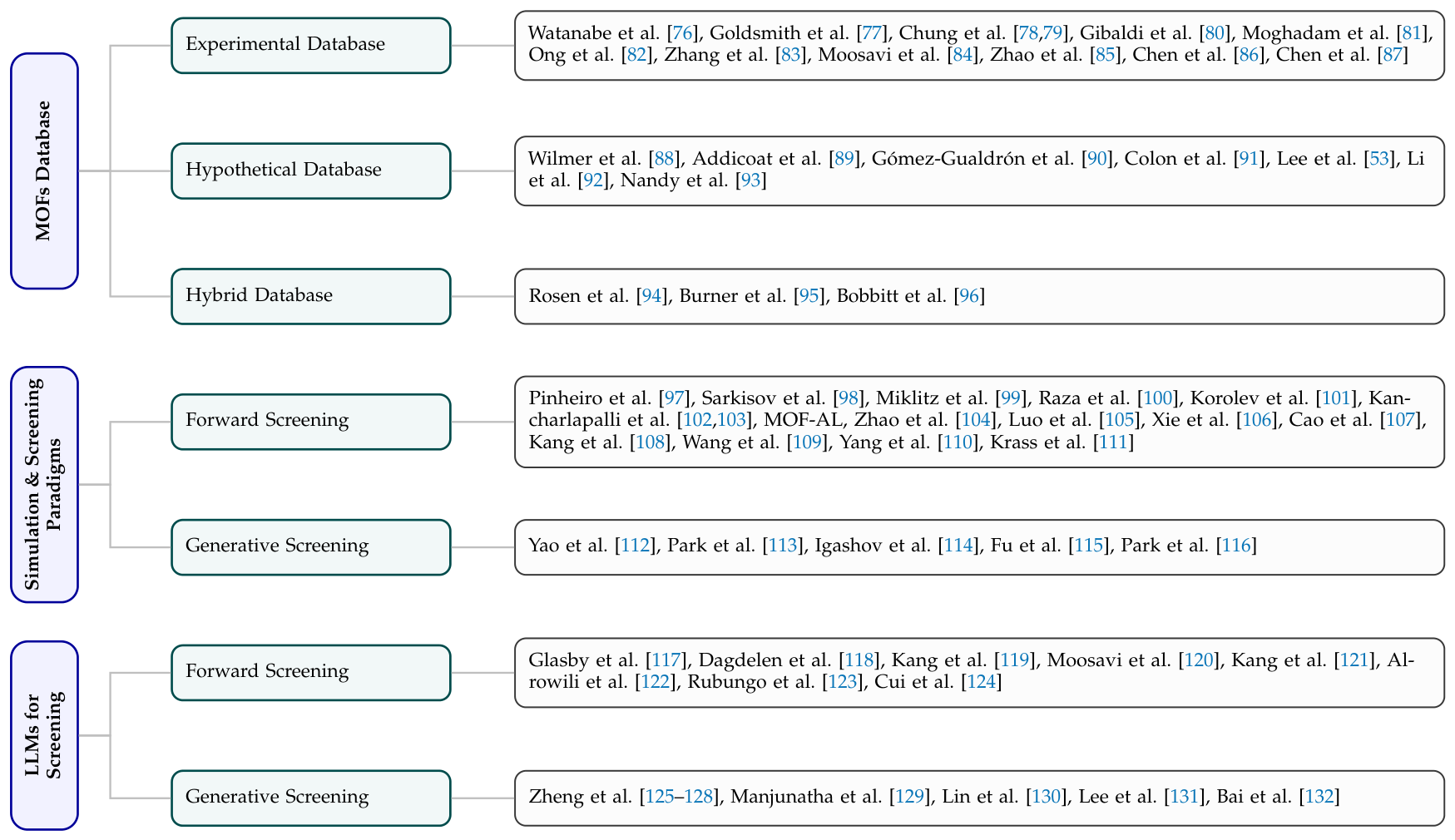
Taxonomy of AI methodologies for MOFs across database construction, multiscale simulation, and large language models.
Figure 3.
Taxonomy of AI methodologies for MOFs across database construction, multiscale simulation, and large language models.
2. Data Representation and Databases
High-quality data representation and well-curated databases constitute the foundation of AI-accelerated MOF discovery. For machine learning models, a MOF is not directly perceived as a “crystal” in the way chemists interpret it, but is instead transformed into a numerical, graph-based, grid-based, string-based, or textual representation. The choice of representation determines which structural information is preserved, which chemical features are simplified, and which downstream tasks can be effectively addressed. Therefore, before discussing MOF databases, it is necessary to first clarify how MOFs are encoded for AI models.
The quality of MOF databases is critical because they provide the structural foundation for virtual screening. As illustrated in Figure 4, MOF databases can be broadly classified into experimental, hypothetical, and hybrid databases.
- 1)
-
Experimental DatabaseExperimental MOF (eMOF) databases are curated collections of MOF structures extracted from reported experimental crystal structures that are ready for direct computational simulation. Each structure in an experimental database corresponds to an actual synthesis protocol documented in the literature, thereby providing an executable “recipe” for synthesizing computationally screened high-performance candidates. The construction of a curated MOF database typically involves three steps: crystallographic information file (CIF) collection, structural preprocessing, and structural validation.
-
CIFs collectionAlthough comprehensive databases such as the Cambridge Structural Database (CSD) provide abundant crystallographic data, they are not specifically tailored for MOFs. Manually identifying and extracting MOF structures from resources like the CSD is a labor-intensive task, and this challenge is expected to intensify as the number of published structures continues to grow. Consequently, using the entire database to train AI models is often impractical, prompting the development of MOF-specific curated subsets.In 2012, Watanabe et al. [76] extracted approximately 30,000 extended MOF compounds from the CSD and conducted high-throughput screening studies for separation. In 2013, Goldsmith et al. [77] extracted 38,800 metal-organic compounds from the CSD and subsequently generated 22,700 computable MOF samples for high-throughput screening of hydrogen storage. In 2014, Chung et al. [78] established the “Computation-Ready, Experimental MOFs” (CoRE MOF) database by mining the CSD for experimentally synthesized MOF structures. Through automated workflows, they removed both free and bound solvent molecules and corrected disorder to produce a curated, computation-ready set of MOF structures designed for high-throughput simulations, which initially contained ∼5,000 MOF structures [78] and was later expanded to approximately 14,000 entries by 2019 [79]. The CoRE MOF database quickly became widely recognized and has been extensively used in computational MOF research for high-throughput screening. Building on the CSD as well, Moghadam et al. [80] developed another MOF subset that is continuously updated. Due to its broader inclusion criteria, this database has grown rapidly, surpassing 100,000 entries [81], doubling in size within just seven years.
-
Structure preprocessingBefore being used for computation, crystal structures are typically converted to primitive cells and desymmetrized to reduce system size and avoid potential computational errors, which can be achieved using software such as Materials Studio [133] or Python Materials Genomics (pymatgen) [82]. Experimentally reported crystal structures may contain residual solvent molecules, often arising from incomplete activation or solvent inclusion during crystallization. For CoRE MOF 2014 [78], more than 5,000 MOF structures were obtained by filtering approximately 600,000 crystal structures, with solvent removal performed for each structure, resulting in two types of structures: (free solvent removal) FSR and (all solvent removal) ASR. Conventional solvent removal methods rely mainly on graph theory or bonding information within the crystal structure (CoRE MOF tools [134], MOFid [50], molSimplify [135,136,137], SAMOSA [138], CSD MOF Tools [81]). In contrast, smartCIF [83] attempts to combine structural analysis with natural-language reasoning over the original literature, enabling chemically informed decisions tailored to the user’s specific computational objectives. However, indiscriminate solvent removal may damage the crystal structures of MOFs. To address this issue, Nandy et al. [84] extracted experimental conclusions on activation stability from a large number of literature by text mining and trained models for solvent removal stability prediction of MOFs. This approach enables a more rigorous solvent removal process by ensuring that solvent removal does not lead to framework collapse.
-
Structure validationCurrent MOF databases still contain many structures that are not computation-ready (NCR) [139,140,141]. Data calculated from crystal structures with disorder are invalid and usually overestimate or underestimate the true properties of the material. The reasons originate from crystallographic structures resolved from X-ray diffraction (XRD) data, which may contain missing hydrogen atoms, unresolved disorder, or atomic overlaps caused by linker rotation. Structure validation methods based on geometric information, bond-order assignment, or other rule-based criteria can misidentify problematic structures owing to the rigidity of their predefined rules [87,142,143]. MOFClassifier [85], structure error type classification (SETC) [86], and related tools have explored graph neural network-based binary classification strategies to flag chemically invalid structures, thereby reducing unnecessary computational screening efforts. Recent studies have shown that nearly half of the database entries contain substantial structural errors, and these errors propagate through high-throughput screening and machine learning workflows, limiting the reliability of data-driven discovery.
-
- 2)
-
Hypothetical DatabaseIn addition to eMOF databases, an alternative approach involves the use of computational methods to construct hypothetical MOF (hMOF) databases. The generation methods for hMOFs can be broadly classified into "bottom-up" and "top-down" strategies. Bottom-up methods sequentially connect SBUs until a periodic crystal structure is obtained. In 2012, Wilmer et al. [88] pioneered this strategy by extracting 102 SBUs—including metal clusters and organic linkers—from experimentally reported MOFs and recombining them to generate 137,953 hypothetical MOFs, establishing the first large-scale publicly available hMOF database. This method does not require predefined topological information, but the resulting structures exhibit limited topological diversity—over 90% of the structures concentrate on the pcu (primitive cubic) topology, with only six topological nets emerging naturally [91]. Addicoat et al. [89] developed AuToGraFS, which similarly employs a bottom-up strategy by combining metal nodes and organic linkers to generate hMOFs. Top-down methods, in contrast, first design crystal topologies and framework nodes, then map SBUs onto these predefined nodes. In 2016, Gómez-Gualdrón et al. [90] adopted this strategy, first designing crystal topologies and framework nodes, then mapping SBUs onto the predefined nodes, resulting in 13,512 hMOF structures spanning 41 topological networks, significantly enhancing topological diversity. Boyd and Woo [91] developed the topologically based crystal constructor (ToBaCCo), which also belongs to the top-down category, utilizing graph theory to generate hMOFs and constructing a database comprising over 300,000 structures and more than 1,000 topological networks. Additionally, tools such as PORMAKE [53] and MOFBuilder [92] fall into this category. Combinatorial assembly can generate an enormous number of hypothetical MOFs [144,145,146,147,148,149,150,151,152,153,154]; however, the feasibility of most of these structures has not been experimentally validated. More recently, Kulik and co-workers [93] constructed a database of ultrastable MOFs by recombining fragments from stable MOFs, building a diverse database sampling more linker networks and metal species.
- 3)
-
Hybrid DatabaseHybrid databases integrate the advantages of experimental databases (real synthesis pathways) and hypothetical databases (large-scale structural exploration) by unifying both sources under a high-throughput computational framework, thereby providing data foundations for machine learning that combine scale with physical meaning.The Quantum MOF (QMOF) database [94] and the ab initio REPEAT charge MOF (ARC–MOF) database [95] are two representative hybrid databases. QMOF contains DFT-computed results for over 20,000 experimental and hypothetical MOFs, including geometry-optimized structures, band gaps, and DDEC6 charges, with structural sources spanning the CSD, CoRE MOF, and various hypothetical MOF databases. ARC–MOF further expands to approximately 280,000 structures, providing DFT-derived REPEAT partial atomic charges and multiple precomputed descriptors for each MOF, ready for direct use in machine learning model development. MOFX-DB [96] focuses on adsorption properties, calculating adsorption isotherms for nitrogen, carbon dioxide, methane, hydrogen, argon, xenon, and krypton, and integrating standardized adsorption data for over 160,000 MOFs and zeolites. These databases place experimental and hypothetical structures within a comparable data space through unified computational frameworks, laying a solid foundation for subsequent machine learning tasks.
3. Multiscale Simulation and AI-Driven Screening Paradigms
Traditional high-throughput computational screening (HTCS) of MOFs heavily relies on exhaustive searches over established or empirical databases, which suffers from massive computational costs and is strictly constrained by the boundaries of known chemical space. Fortunately, data-driven algorithms have profoundly reshaped the screening and construction paradigms of MOFs. These methodologies can be broadly categorized into two paradigms: (1) Forward Screening, which utilizes machine learning models to capture intrinsic patterns from large datasets, enabling the rapid prediction of key physical and chemical properties and shedding light on underlying mechanisms for designated structures; and (2) Generative Screening, which leverages deep generative models to directly output novel materials with targeted properties, circumventing the search-space limitations of conventional databases.
3.1. Machine Learning
To implement an effective forward screening workflow, high-fidelity physical data generation and preliminary screening based on structural descriptors are essential. Before virtual screening, the structural features of each MOF need to be characterized. During pre-screening, MOFs with specific metals, pore sizes, hydrophobicity[155], stability, heat capacity[156], metal oxidation[157] and other properties are selected for HTS. Based on Voronoi decomposition, Zeo++ can determine the accessibility of nodes in a network, the dimensionality of the channel system, and perform Monte Carlo sampling of the accessible surface area, accessible volume, pore size distribution histograms, and other descriptors[97,158,159,160,161,162]. In addition, PoreBlazer[98] and pywindow[99] can also be used to analyze the pores, surface areas, and window diameters of MOFs, as well as to obtain distributions of window diameter from trajectory files generated by molecular dynamics simulations. Rampi et al[163]. and Kulik et al[84,164]. extracted stability data, including water stability, thermal stability, and activation stability, from a large body of literature through text mining and trained ML models.
3.2. Convolutional Neural Networks
When simulating polar molecules, electrostatic interactions between the molecules and the framework need to be considered. The partial atomic charges of the framework are usually fitted from charge densities calculated by DFT. However, this process is highly time-consuming; therefore, researchers have developed several machine learning models for different types of partial atomic charges in various nanoporous materials (see Table 1). Most screening studies are based on this approach, and different molecular simulation methods, such as grand canonical Monte Carlo (GCMC)[165,166,167,168,169], Widom Insertion[75,170], and molecular dynamics, can be used to investigate the performance of different gases or application (carbon capture[134,171,172,173], hydrogen storage[174,175], Xe/Kr separation[72,176,177], and so on) in rigid or flexible MOFs[178,179].
Consequently, with the integration of ML techniques, different architectures and algorithms have been applied to HTCS to accelerate materials discovery. A more efficient methodological framework has been widely adopted: high-fidelity simulations are performed on a representative subset of structures to generate high-quality datasets, which are subsequently utilized to train ML models for the rapid and accurate property prediction of the remaining vast library of frameworks. From linear regression[191,192] and tree-based methods[193,194,195,196] to crystal graph convolutional neural networks (CGCNN)[106] and transformers[197], numerous models have been reported to rapidly and accurately predict adsorption properties[198,199,200,201,202,203,204,205,206,207,208,209,210,211,212], band gaps, surface area[213] and other material properties.
To accelerate high-accuracy dynamical simulations, MLPs have been developed. Because MOF systems are relatively large, long-timescale Ab initio MD (AIMD) simulations are often infeasible for exploring framework flexibility, such as breathing and gating effects. MOFs with OMSs require specific force field rather than the use of universal force fields. This also reflects a major challenge in classical MD simulations, where the simulation results depend on the accuracy of the force-field description; this issue does not need to be considered for MLPs. To address this issue, an effective strategy is to perform partial AIMD simulations using umbrella sampling, followed by fine-tuning machine learning interatomic potentials (MLIPs) to improve their accuracy and apply them to simulations of the target system. These approaches have been successfully fine-tuned on MOFs such as MOF-5, ZIF-8, MOF-74, and CALF-20[110,214,215,216,217,218,219,220]. In addition, Moosavi et al[111]. benchmarked various MLIPs in terms of bulk modulus, cell volume, heat capacity, and other properties, and found that eSEN-30M-OAM showed the best performance for MOFs.
3.3. Transformer
As shown in Figure 5, there are three transformer architectures that can predict gas adsorption data under different conditions using different input and encoding formats. These include the use of MOFid[50,221], which contains information on the metal cluster, organic linker, catenation and topology, as well as the generation of corresponding crystal graphs and energy grids from CIFs[108,222,223]. Subsequently, Zou et al. incorporated the vision transformer into the architecture and achieved superior performance over MOFTransformer in adsorption prediction tasks[224]. Chen et al. proposed a transferable Vision Transformer (ViT) model for identifying MOFs from spectroscopic data, including XRD and FTIR spectra[225]. EGMOF introduces a modular diffusion–transformer framework that enables data-efficient and generalizable inverse design of MOFs by mapping target properties to chemically meaningful descriptors before generating structures[226].
3.4. Generative Models
Unlike forward prediction, which relies on searching predefined databases, generative screening offers a novel paradigm for active exploration and inverse optimization within continuous chemical spaces. By utilizing deep generative models, this approach performs biased sampling directly within high-dimensional structural spaces. Consequently, it circumvents the search-space limitations of conventional databases, enabling the direct, targeted design of novel and plausible MOF topologies tailored to specified performance targets.
In 2021, Yao et al.[112] proposed the supramolecular variational autoencoder (SmVAE), which deconstructs MOFs into secondary building units and underlying topological networks. This work marked the first attempt to map MOF structures into a continuous latent space for generative decoding and reconstruction. Subsequently, researchers began to explore more targeted, component-level, or local generative strategies. For instance, rather than focusing on global framework generation, Park et al.[113] utilized DiffLinker[114] to concentrate specifically on the targeted derivation of organic linkers. By extracting molecular fragments from high-performance MOFs as starting seeds, they generated a large ensemble of novel linkers. These generated linkers were then assembly-routed back into fixed metal nodes (such as copper or zinc paddlewheels) and specific topological networks. Combined with forward property-prediction models, this approach successfully achieved the targeted design of high-performance MOFs for capture.
To further reduce the structural complexity of MOFs and escape the constraints of predefined topological templates, Fu et al.[115] proposed a generative framework based on coarse-grained building block representations. This framework directly generates coarse-grained building blocks within three-dimensional spatial coordinates and introduces a post-processing workflow to automatically optimize their spatial orientations and chemical connectivities. Simultaneously, by applying conditional constraints to the latent vectors via a co-trained regression model, they achieved the biased, selective generation of MOF structures with targeted adsorption capacities.
However, the inverse design of porous materials often suffers from oversimplified property constraints, failing to accommodate complex, multimodal data. To address this issue, Park et al.[116] further developed a diffusion model designed for multi-conditional generation. Their work introduced signed distance functions (SDFs) to mathematically describe the intricate 3D pore geometries of MOFs, which significantly enhanced the structural validity of the generated frameworks. More importantly, this framework exhibits exceptional multimodal conditioning capabilities, enabling the simultaneous integration of numerical (physicochemical properties), categorical (topological types), and textual (target descriptions) data streams to guide the inverse generation process of the diffusion model.
4. LLMs for Screening
As a revolutionary breakthrough in artificial intelligence, LLMs are emerging as a novel human-computer interaction interface in reticular chemistry and MOF design. Compared with traditional machine learning models that heavily rely on numerical or structural features, the core advantage of LLMs lies in their powerful semantic understanding, enabling them to directly parse heterogeneous academic literature, follow natural language instructions, and handle complex scientific tasks by generating structured data (such as JSON/CSV) and scheduling external tools. However, due to the lack of intrinsic three-dimensional geometric perception and chemical priors, general-purpose LLMs often exhibit significant "hallucinations" in tasks involving reaction mechanisms, unit conversions, or quantitative numerical predictions. Recent benchmarking indicates that even state-of-the-art closed-source models exhibit catastrophic deviations in quantitative MOF property predictions—for example, the mean absolute error (MAE) of GPT-4o in density prediction is as high as 9.86, while that of GPT-5-mini in void fraction (VF) prediction also reaches 9.63[124]. To overcome this intrinsic limitation, MOF-oriented LLM workflows are evolving to achieve domain-specific adaptation through techniques such as prompt engineering, retrieval-augmented generation (RAG), parameter-efficient fine-tuning (e.g., LoRA[227]), and multimodal structural encoders.
4.1. Forward Screening
LLMs were initially employed as highly efficient unstructured literature mining tools to construct structured material property and synthesis databases. From the early DigiMOF[117], which relied on the ChemDataExtractor rule parser to extract synthetic parameters in an unsupervised manner, to the work of Dagdelen et al.[118], which established a general zero-shot schema extraction paradigm without hard-coded rules via prompt engineering, the format robustness of scientific text mining has been fundamentally enhanced. Kang et al.[119] further scaled this paradigm to over 40,000 papers, curating a large-scale structured property dataset. To prevent the extracted information from being confined to isolated "flat tables," Moosavi et al.[120] proposed the MOF-ChemUnity framework, which aligns and integrates literature-extracted synthetic records, crystal structures, and computational results into a heterogeneous knowledge graph. This overcomes the limitations of cross-retrieving multi-source heterogeneous data and, when combined with subsequent RAG systems, provides a traceable and trustworthy evidence chain for MOF question-answering interactions[228].
On the basis of structured data, researchers began utilizing LLMs to directly predict the physicochemical properties of MOFs. ChatMOF[121] pioneered the concept of an agent "dispatch hub" by translating user natural language questions into invocation sequences targeting internal classical computational tools (such as Zeo++ and RASPA) and databases, thereby lowering the barrier for non-expert users to leverage high-throughput computational results. Concurrently, domain-specific fine-tuning and pre-training have driven the development of end-to-end property prediction. For instance, small open-source models optimized through benchmark tuning have demonstrated the potential to approach closed-source systems at a much lower computational cost[229]. Granite-MOF[122] performed domain-specific continual pre-training on a 2B model using literature and took one-dimensional MOFid strings[50] as input, achieving performance comparable to three-dimensional graph networks such as CGCNN[106] in bandgap and adsorption property prediction, revealing that the quality of domain corpora takes precedence over pure scale. LLM-Prop[123] explicitly encoded crystal structures as templated text at the input end, further confirming that mapping structural information into language space is crucial for breaking the performance bottleneck of LLMs in property prediction. To overcome the intrinsic fidelity limitations of one-dimensional textual representations in capturing complex, three-dimensional periodic crystal geometries, the first multimodal large model for MOFs, OF[124], froze a 3D crystal encoder and aligned three-dimensional structural features to the Qwen2.5[230] language backbone via a projection bridge, followed by joint fine-tuning on the MOF-SPK dataset containing 133,737 experimental CIFs as well as property and knowledge fields. This multimodal adaptation completely mitigated the catastrophic numerical hallucinations of general LLMs (with the pore limiting diameter (PLD) prediction error plunging from 1.99 Å for the best closed-source LLM to 0.55 Å), but also revealed that dense 3D structural encoding can act as an information bottleneck in local symbolic matching tasks such as building-block extraction. This suggests that the design of multimodal representations must adaptively balance language, topology, and geometric channels based on specific task requirements.
4.2. Generative Screening
The remarkable semantic understanding and generation capabilities of LLMs have also prompted researchers to explore how they can be leveraged to inversely design brand-new candidate structures and synthetic pathways under targeted performance constraints. In this direction, Zheng et al.[125,126,127,128] pioneered a "Human-in-the-Loop" co-design paradigm, embedding GPT-4 into iterative reticular chemistry experimental workflows (as shown in Figure 6). By utilizing prompt engineering and in-context learning, the model was driven to propose mutations and modifications to existing linkers and assist in mining corresponding crystallization synthetic conditions from massive scientific literature. This ultimately led to the successful experimental synthesis of ten "long-arm" multivariate MOFs, significantly improving the crystallinity and water-adsorption performance of several representative frameworks[125,126,127,128]. This achievement demonstrated for the first time the bridging role of large models in linking human expertise with physical experiments. In contrast, end-to-end autoregressive generative models entirely delegate structural proposals to algorithms, aiming to further reduce dependency on expert heuristic interventions. Building upon the basic capability of ChatMOF[121] to directly generate frameworks from natural language constraints, MOFGPT[129] simplified the MOF backbone into a sequence object. It directly trained a generative Transformer using one-dimensional MOFid strings to learn its "structural language" and integrated a property predictor as a reward mechanism for reinforcement learning alignment. This autoregressive design completely bypasses the heavy reliance of traditional 3D geometric generators (such as diffusion models) on predefined topological templates and 3D atomic coordinates. It establishes a critical "symbolic-geometric" complementarity: 3D diffusion models excel at ensuring geometric plausibility in physical space, whereas autoregressive LLMs exhibit superior flexibility and adaptability to complex multimodal conditional constraints within the symbolic space.
With advancements in the tool-calling and workflow orchestration capabilities of large models, generative screening is evolving from simple backbone design into automated closed-loop agents that schedule external scientific tools to execute "generation-simulation-evaluation." On the experimental synthesis side, the MOFsyn agent[130] seamlessly combines RAG with automated data analysis to achieve adaptive optimization of highly sensitive synthetic parameters such as solvents, reaction temperatures, and templates. To overcome the common vulnerability and lack of auditability in sequential LLM call chains, the El Agente Gráfico[132] framework introduces structured execution graphs, which explicitly represent complex scientific exploration tasks, tool calls, and intermediate logic as directed acyclic graphs (DAGs), greatly improving the reliability, transparency, and reproducibility of multi-agent collaborative workflows. On the computational simulation side, the SimMOF agent[131] completely liberates researchers from tedious simulation script configurations. It leverages RAG to extract physical parameters and adaptively dispatches a full toolchain including Zeo++, RASPA, VASP, and LAMMPS, establishing a full-stack high-throughput computing workflow spanning geometric characterization, molecular simulation, and DFT calculations. These pioneering practices demonstrate that the ultimate role of LLMs in reticular chemistry is to organically orchestrate digital tools, theoretical models, and experimental logic into self-evolving, closed-loop systems, pointing the way toward industrial-scale autonomous discovery.
5. Open Challenges and Future Directions
The field of computational MOF research still requires further integration of AI to improve materials design and accelerate high-throughput screening. During dataset construction, many failure cases may arise in steps such as solvent removal, structural validation, structure repair, and feature calculation. For example, MOFs containing charge-balancing ions may fail to be assigned revised autocorrelation (RAC) features, or these ions may be mistakenly removed as solvents. AI can also facilitate automated screening workflows, where a user-defined task specified through prompts can be executed automatically, from preparing input files and running simulations to analyzing the results. However, when introducing AI into MOF research, it is essential to incorporate more chemical and materials knowledge rather than blindly treating AI models as black-box predictors. Chemical interpretability can not only improve model performance but also provide theoretical support for the predictions. This is particularly important when using AI agents for materials screening, where the parameters of input files must be carefully examined instead of being fully entrusted to the knowledge of large language models. Overall, we should actively embrace AI and promote its integration with MOF research. Advanced AI techniques can improve the efficiency of MOF simulations and help address problems that are difficult to solve using traditional algorithms. At the same time, AI should be used cautiously, especially in cases involving invalid features for model training or hallucinated explanations generated by large language models.
6. Conclusion
The development of AI has not only advanced computational research on MOFs but also made it possible to provide optimized synthetic strategies for experimental studies. In computational research, its impact is mainly reflected in improving MOF databases and accelerating materials screening. By reducing substantial manual effort, AI enables tasks that were previously difficult to realize because of their enormous workload. In the future, MOF research is expected to be more deeply integrated with the broader AI ecosystem, ultimately moving toward fully automated MOF discovery and development. At the same time, the role of AI in MOF research should be viewed rationally. Researchers should not blindly rely on the convenience of AI and abandon in-depth, hypothesis-driven investigations. Instead, AI should be carefully integrated when researchers have sufficient confidence in their theoretical understanding. We believe that MOF-specific LLMs will be reported in the future. Before that, sufficient patience is required to guide agents to complete the tasks they are capable of performing.
This article is licensed under a Creative Commons Attribution 4.0 International License, which permits use, sharing, adaptation, distribution and reproduction in any medium or format, as long as you give appropriate credit to the original author(s) and the source, provide a link to the Creative Commons licence, and indicate if changes were made. The images or other third party material in this article are included in the article’s Creative Commons licence, unless indicated otherwise in a credit line to the material. If material is not included in the article’s Creative Commons licence and your intended use is not permitted by statutory regulation or exceeds the permitted use, you will need to obtain permission directly from the copyright holder. To view a copy of this licence, visit visit http://creativecommons.org/licenses/by/4.0/.
Acknowledgments
This work was supported supported from the National University of Singapore Start-Up Grant (NUS grant A-0010269-00-00) and the high-performance computing resources supported by NUS Information Technology (NUS-IT) in Singapore. This research is supported by the National Key R&D Program of China (No. 2023YFC3303800).
Conflicts of Interest
The authors declare that they have no competing interests or financial conflicts to disclose.
References
- Zhou, H.C.; Long, J.R.; Yaghi, O.M. Introduction to metal–organic frameworks. Chem. Rev. 2012, 112, 673–674. [Google Scholar] [CrossRef] [PubMed]
- Zhou, H.C.; Kitagawa, S. Metal–organic frameworks (MOFs). Chem. Soc. Rev. 2014, 43, 5415–5418. [Google Scholar] [CrossRef] [PubMed]
- MacGillivray, L.R. Metal-organic frameworks: design and application; John Wiley & Sons, 2010. [Google Scholar]
- Furukawa, H.; Ko, N.; Go, Y.B.; Aratani, N.; Choi, S.B.; Choi, E.; Yazaydin, A.Ö.; Snurr, R.Q.; O’Keeffe, M.; Kim, J.; et al. Ultrahigh porosity in metal-organic frameworks. Science 2010, 329, 424–428. [Google Scholar] [CrossRef] [PubMed]
- Zhao, Y.; Song, Z.; Li, X.; Sun, Q.; Cheng, N.; Lawes, S.; Sun, X. Metal organic frameworks for energy storage and conversion. Energy Storage Mater. 2016, 2, 35–62. [Google Scholar] [CrossRef]
- Wang, L.; Han, Y.; Feng, X.; Zhou, J.; Qi, P.; Wang, B. Metal–organic frameworks for energy storage: Batteries and supercapacitors. Coord. Chem. Rev. 2016, 307, 361–381. [Google Scholar] [CrossRef]
- Wang, H.; Zhu, Q.L.; Zou, R.; Xu, Q. Metal-organic frameworks for energy applications. Chem 2017, 2, 52–80. [Google Scholar] [CrossRef]
- Hou, C.C.; Xu, Q. Metal–organic frameworks for energy. Adv. Energy Mater. 2019, 9, 1801307. [Google Scholar] [CrossRef]
- He, B.; Zhang, Q.; Pan, Z.; Li, L.; Li, C.; Ling, Y.; Wang, Z.; Chen, M.; Wang, Z.; Yao, Y.; et al. Freestanding metal–organic frameworks and their derivatives: an emerging platform for electrochemical energy storage and conversion. Chem. Rev. 2022, 122, 10087–10125. [Google Scholar] [CrossRef] [PubMed]
- Xia, W.; Mahmood, A.; Zou, R.; Xu, Q. Metal–organic frameworks and their derived nanostructures for electrochemical energy storage and conversion. Energy Environ. Sci. 2015, 8, 1837–1866. [Google Scholar] [CrossRef]
- Wu, H.B.; Lou, X.W. Metal-organic frameworks and their derived materials for electrochemical energy storage and conversion: Promises and challenges. Sci. Adv. 2017, 3, eaap9252. [Google Scholar] [CrossRef] [PubMed]
- Zhou, X.; Jin, H.; Xia, B.Y.; Davey, K.; Zheng, Y.; Qiao, S.Z. Molecular cleavage of metal-organic frameworks and application to energy storage and conversion. Adv. Mater. 2021, 33, 2104341. [Google Scholar] [CrossRef] [PubMed]
- Miao, Y.R.; Su, Z.; Suslick, K.S. Energy storage during compression of metal–organic frameworks. J. Am. Chem. Soc. 2017, 139, 4667–4670. [Google Scholar] [CrossRef] [PubMed]
- Hong, C.N.; Crom, A.B.; Feldblyum, J.I.; Lukatskaya, M.R. Metal-organic frameworks for fast electrochemical energy storage: Mechanisms and opportunities. Chem 2023, 9, 798–822. [Google Scholar] [CrossRef]
- Sanati, S.; Abazari, R.; Albero, J.; Morsali, A.; García, H.; Liang, Z.; Zou, R. Metal–organic framework derived bimetallic materials for electrochemical energy storage. Angew. Chem. Int. Ed. 2021, 60, 11048–11067. [Google Scholar] [CrossRef] [PubMed]
- Indra, A.; Song, T.; Paik, U. Metal organic framework derived materials: progress and prospects for the energy conversion and storage. Adv. Mater. 2018, 30, 1705146. [Google Scholar] [CrossRef] [PubMed]
- Getman, R.B.; Bae, Y.S.; Wilmer, C.E.; Snurr, R.Q. Review and analysis of molecular simulations of methane, hydrogen, and acetylene storage in metal–organic frameworks. Chem. Rev. 2012, 112, 703–723. [Google Scholar] [CrossRef] [PubMed]
- Trickett, C.A.; Helal, A.; Al-Maythalony, B.A.; Yamani, Z.H.; Cordova, K.E.; Yaghi, O.M. The chemistry of metal–organic frameworks for CO2 capture, regeneration and conversion. Nat. Rev. Mater. 2017, 2, 1–16. [Google Scholar] [CrossRef]
- Sumida, K.; Rogow, D.L.; Mason, J.A.; McDonald, T.M.; Bloch, E.D.; Herm, Z.R.; Bae, T.H.; Long, J.R. Carbon dioxide capture in metal–organic frameworks. Chem. Rev. 2012, 112, 724–781. [Google Scholar] [CrossRef] [PubMed]
- Simmons, J.M.; Wu, H.; Zhou, W.; Yildirim, T. Carbon capture in metal–organic frameworks—a comparative study. Energy Environ. Sci. 2011, 4, 2177–2185. [Google Scholar] [CrossRef]
- Ding, M.; Flaig, R.W.; Jiang, H.L.; Yaghi, O.M. Carbon capture and conversion using metal–organic frameworks and MOF-based materials. Chem. Soc. Rev. 2019, 48, 2783–2828. [Google Scholar] [CrossRef] [PubMed]
- Lin, H.; Yang, Y.; Hsu, Y.C.; Zhang, J.; Welton, C.; Afolabi, I.; Loo, M.; Zhou, H.C. Metal–organic frameworks for water harvesting and concurrent carbon capture: a review for hygroscopic materials. Adv. Mater. 2024, 36, 2209073. [Google Scholar] [CrossRef] [PubMed]
- Song, X.; Zhang, M.; Chen, C.; Duan, J.; Zhang, W.; Pan, Y.; Bai, J. Pure-supramolecular-linker approach to highly connected metal–organic frameworks for CO2 capture. J. Am. Chem. Soc. 2019, 141, 14539–14543. [Google Scholar] [CrossRef] [PubMed]
- Lu, K.; Aung, T.; Guo, N.; Weichselbaum, R.; Lin, W. Nanoscale metal–organic frameworks for therapeutic, imaging, and sensing applications. Adv. Mater. 2018, 30, 1707634. [Google Scholar] [CrossRef] [PubMed]
- Hu, Z.; Deibert, B.J.; Li, J. Luminescent metal–organic frameworks for chemical sensing and explosive detection. Chem. Soc. Rev. 2014, 43, 5815–5840. [Google Scholar] [CrossRef] [PubMed]
- Campbell, M.G.; Liu, S.F.; Swager, T.M.; Dinca, M. Chemiresistive sensor arrays from conductive 2D metal–organic frameworks. J. Am. Chem. Soc. 2015, 137, 13780–13783. [Google Scholar] [CrossRef] [PubMed]
- Stassen, I.; Burtch, N.; Talin, A.; Falcaro, P.; Allendorf, M.; Ameloot, R. An updated roadmap for the integration of metal–organic frameworks with electronic devices and chemical sensors. Chem. Soc. Rev. 2017, 46, 3185–3241. [Google Scholar] [CrossRef] [PubMed]
- Lustig, W.P.; Mukherjee, S.; Rudd, N.D.; Desai, A.V.; Li, J.; Ghosh, S.K. Metal–organic frameworks: functional luminescent and photonic materials for sensing applications. Chem. Soc. Rev. 2017, 46, 3242–3285. [Google Scholar] [CrossRef] [PubMed]
- Wu, S.; Min, H.; Shi, W.; Cheng, P. Multicenter metal–organic framework-based ratiometric fluorescent sensors. Adv. Mater. 2020, 32, 1805871. [Google Scholar] [CrossRef] [PubMed]
- Kreno, L.E.; Leong, K.; Farha, O.K.; Allendorf, M.; Van Duyne, R.P.; Hupp, J.T. Metal–organic framework materials as chemical sensors. Chem. Rev. 2012, 112, 1105–1125. [Google Scholar] [CrossRef] [PubMed]
- Koo, W.T.; Jang, J.S.; Kim, I.D. Metal-organic frameworks for chemiresistive sensors. Chem 2019, 5, 1938–1963. [Google Scholar] [CrossRef]
- Li, H.Y.; Zhao, S.N.; Zang, S.Q.; Li, J. Functional metal–organic frameworks as effective sensors of gases and volatile compounds. Chem. Soc. Rev. 2020, 49, 6364–6401. [Google Scholar] [CrossRef] [PubMed]
- Zhang, L.T.; Zhou, Y.; Han, S.T. The role of metal–organic frameworks in electronic sensors. Angew. Chem. 2021, 133, 15320–15340. [Google Scholar] [CrossRef]
- Lei, J.; Qian, R.; Ling, P.; Cui, L.; Ju, H. Design and sensing applications of metal–organic framework composites. TrAC Trends Anal. Chem. 2014, 58, 71–78. [Google Scholar] [CrossRef]
- Yuan, H.; Li, N.; Fan, W.; Cai, H.; Zhao, D. Metal-organic framework based gas sensors. Adv. Sci. 2022, 9, 2104374. [Google Scholar] [CrossRef] [PubMed]
- Dhakshinamoorthy, A.; Li, Z.; Garcia, H. Catalysis and photocatalysis by metal organic frameworks. Chem. Soc. Rev. 2018, 47, 8134–8172. [Google Scholar] [CrossRef] [PubMed]
- Huang, Y.B.; Liang, J.; Wang, X.S.; Cao, R. Multifunctional metal–organic framework catalysts: synergistic catalysis and tandem reactions. Chem. Soc. Rev. 2017, 46, 126–157. [Google Scholar] [CrossRef] [PubMed]
- Zhu, L.; Liu, X.Q.; Jiang, H.L.; Sun, L.B. Metal–organic frameworks for heterogeneous basic catalysis. Chem. Rev. 2017, 117, 8129–8176. [Google Scholar] [CrossRef] [PubMed]
- Corma, A.; Garcia, H.; Llabrés i Xamena, F. Engineering metal organic frameworks for heterogeneous catalysis. Chem. Rev. 2010, 110, 4606–4655. [Google Scholar] [CrossRef] [PubMed]
- Lee, J.; Farha, O.K.; Roberts, J.; Scheidt, K.A.; Nguyen, S.T.; Hupp, J.T. Metal–organic framework materials as catalysts. Chem. Soc. Rev. 2009, 38, 1450–1459. [Google Scholar] [CrossRef] [PubMed]
- Jiao, L.; Wang, Y.; Jiang, H.L.; Xu, Q. Metal–organic frameworks as platforms for catalytic applications. Adv. Mater. 2018, 30, 1703663. [Google Scholar] [CrossRef] [PubMed]
- Pascanu, V.; González Miera, G.; Inge, A.K.; Martín-Matute, B. Metal–organic frameworks as catalysts for organic synthesis: a critical perspective. J. Am. Chem. Soc. 2019, 141, 7223–7234. [Google Scholar] [CrossRef] [PubMed]
- Chen, L.; Xu, Q. Metal-organic framework composites for catalysis. Matter 2019, 1, 57–89. [Google Scholar] [CrossRef]
- Menon, D.; Fairen-Jimenez, D. Guiding the rational design of biocompatible metal-organic frameworks for drug delivery. MATTER 2025, 8. [Google Scholar] [CrossRef]
- Filiz, A.; Bayazit, S.S.; Barlas, F.B. Metal-organic frameworks (MOFs) in drug Delivery: Emerging trends functional enhancements, and biocompatibility challenges. J. DRUG Deliv. Sci. Technol. 2025, 112. [Google Scholar] [CrossRef]
- Bilal, H.; Zahoor, S.; Choudhary, M.I.; Shaheen, F.; Dej-adisai, S.; Liang, H.; Chen, Z.F. Carboxylate embedded metal organic frameworks for potential applications in drug delivery and controlled release. Coord. Chem. Rev. 2025, 538. [Google Scholar] [CrossRef]
- Sheng, Y.; Ma, K. Exploration of covalent-organic frameworks and metal-organic frameworks for drug delivery applications. Front. Chem. 2026, 14. [Google Scholar] [CrossRef] [PubMed]
- Saini, A.; Yadav, N. Recent advances in coordination chemistry-driven metal-organic frameworks for cancer drug delivery and therapeutics. Coord. Chem. Rev. 2026, 556. [Google Scholar] [CrossRef]
- Zheng, H.; Zhang, Y.; Liu, L.; Wan, W.; Guo, P.; Nystrom, A.M.; Zou, X. One-pot Synthesis of Metal Organic Frameworks with Encapsulated Target Molecules and Their Applications for Controlled Drug Delivery. J. Am. Chem. Soc. 2016, 138, 962–968. [Google Scholar] [CrossRef] [PubMed]
- Bucior, B.J.; Rosen, A.S.; Haranczyk, M.; Yao, Z.; Ziebel, M.E.; Farha, O.K.; Hupp, J.T.; Siepmann, J.I.; Aspuru-Guzik, A.; Snurr, R.Q. Identification schemes for metal–organic frameworks to enable rapid search and cheminformatics analysis. Cryst. Growth Des. 2019, 19, 6682–6697. [Google Scholar] [CrossRef]
- Boyd, P.G.; Chidambaram, A.; García-Díez, E.; Ireland, C.P.; Daff, T.D.; Bounds, R.; Gładysiak, A.; Schouwink, P.; Moosavi, S.M.; Maroto-Valer, M.M.; et al. Data-driven design of metal–organic frameworks for wet flue gas CO2 capture. Nature 2019, 576, 253–256. [Google Scholar] [CrossRef] [PubMed]
- Wilmer, C.E.; Leaf, M.; Lee, C.Y.; Farha, O.K.; Hauser, B.G.; Hupp, J.T.; Snurr, R.Q. Large-scale screening of hypothetical metal–organic frameworks. Nat. Chem. 2012, 4, 83–89. [Google Scholar] [CrossRef] [PubMed]
- Lee, S.; Kim, B.; Cho, H.; Lee, H.; Lee, S.Y.; Cho, E.S.; Kim, J. Computational screening of trillions of metal–organic frameworks for high-performance methane storage. ACS Appl. Mater. Interfaces 2021, 13, 23647–23654. [Google Scholar] [CrossRef] [PubMed]
- Moghadam, P.Z.; Chung, Y.G.; Snurr, R.Q. Progress toward the computational discovery of new metal–organic framework adsorbents for energy applications. Nat. Energy 2024, 9, 121–133. [Google Scholar] [CrossRef]
- Yuan, S.; Feng, L.; Wang, K.; Pang, J.; Bosch, M.; Lollar, C.; Sun, Y.; Qin, J.; Yang, X.; Zhang, P.; et al. Stable metal–organic frameworks: design, synthesis, and applications. Adv. Mater. 2018, 30, 1704303. [Google Scholar] [CrossRef] [PubMed]
- Kirlikovali, K.O.; Hanna, S.L.; Son, F.A.; Farha, O.K. Back to the basics: developing advanced metal–organic frameworks using fundamental chemistry concepts. ACS Nanosci. Au 2022, 3, 37–45. [Google Scholar] [CrossRef] [PubMed]
- Furukawa, H.; Cordova, K.E.; O’Keeffe, M.; Yaghi, O.M. The chemistry and applications of metal-organic frameworks. Science 2013, 341, 1230444. [Google Scholar] [CrossRef] [PubMed]
- Baumann, A.E.; Burns, D.A.; Liu, B.; Thoi, V.S. Metal-organic framework functionalization and design strategies for advanced electrochemical energy storage devices. Commun. Chem. 2019, 2, 86. [Google Scholar] [CrossRef]
- Helal, A.; Yamani, Z.H.; Cordova, K.E.; Yaghi, O.M. Multivariate metal-organic frameworks. Natl. Sci. Rev. 2017, 4, 296–298. [Google Scholar] [CrossRef]
- Han, G.Y.; Sun, M.; Zhao, R.; Junaid, Q.M.; Hou, G.; Mohmand, N.Z.K.; Jia, C.; Liu, Y.; Van Der Voort, P.; Shi, L.; et al. Defect engineered Ti-MOFs and their applications. Chem. Soc. Rev. 2025, 54, 5081–5107. [Google Scholar] [CrossRef] [PubMed]
- Zhang, S.; Zhang, Y.; Baig, F.; Liu, T.F. Synthesis and applications of stable iron-based metal–organic framework materials. Cryst. Growth Des. 2021, 21, 3100–3122. [Google Scholar] [CrossRef]
- Chui, S.S.Y.; Lo, S.M.F.; Charmant, J.P.; Orpen, A.G.; Williams, I.D. A chemically functionalizable nanoporous material [Cu3(TMA)2(H2O)3]n. Science 1999, 283, 1148–1150. [Google Scholar] [CrossRef] [PubMed]
- Serre, C.; Millange, F.; Thouvenot, C.; Noguès, M.; Marsolier, G.; Louër, D.; Férey, G. Very large breathing effect in the first nanoporous chromium (III)-Based solids: MIL-53 or CrIII (OH)⊙{O2C-C6H4-CO2}⊙{HO2C-C6H4-CO2H} x⊙ H2O y. J. Am. Chem. Soc. 2002, 124, 13519–13526. [Google Scholar] [PubMed]
- Férey, G.; Mellot-Draznieks, C.; Serre, C.; Millange, F.; Dutour, J.; Surblé, S.; Margiolaki, I. A chromium terephthalate-based solid with unusually large pore volumes and surface area. Science 2005, 309, 2040–2042. [Google Scholar] [CrossRef] [PubMed]
- Li, H.; Eddaoudi, M.; O’Keeffe, M.; Yaghi, O.M. Design and synthesis of an exceptionally stable and highly porous metal-organic framework. nature 1999, 402, 276–279. [Google Scholar] [CrossRef]
- Rosi, N.L.; Kim, J.; Eddaoudi, M.; Chen, B.; O’Keeffe, M.; Yaghi, O.M. Rod packings and metal- organic frameworks constructed from rod-shaped secondary building units. J. Am. Chem. Soc. 2005, 127, 1504–1518. [Google Scholar] [CrossRef] [PubMed]
- Cavka, J.H.; Jakobsen, S.; Olsbye, U.; Guillou, N.; Lamberti, C.; Bordiga, S.; Lillerud, K.P. A new zirconium inorganic building brick forming metal organic frameworks with exceptional stability. J. Am. Chem. Soc. 2008, 130, 13850–13851. [Google Scholar] [CrossRef] [PubMed]
- Park, K.S.; Ni, Z.; Côté, A.P.; Choi, J.Y.; Huang, R.; Uribe-Romo, F.J.; Chae, H.K.; O’Keeffe, M.; Yaghi, O.M. Exceptional chemical and thermal stability of zeolitic imidazolate frameworks. Proc. Natl. Acad. Sci. 2006, 103, 10186–10191. [Google Scholar] [CrossRef] [PubMed]
- Morris, W.; Volosskiy, B.; Demir, S.; Gándara, F.; McGrier, P.L.; Furukawa, H.; Cascio, D.; Stoddart, J.F.; Yaghi, O.M. Synthesis, structure, and metalation of two new highly porous zirconium metal–organic frameworks. Inorg. Chem. 2012, 51, 6443–6445. [Google Scholar] [CrossRef] [PubMed]
- Farha, O.K.; Özgür Yazaydın, A.; Eryazici, I.; Malliakas, C.D.; Hauser, B.G.; Kanatzidis, M.G.; Nguyen, S.T.; Snurr, R.Q.; Hupp, J.T. De novo synthesis of a metal–organic framework material featuring ultrahigh surface area and gas storage capacities. Nat. Chem. 2010, 2, 944–948. [Google Scholar] [CrossRef] [PubMed]
- Krause, S.; Bon, V.; Senkovska, I.; Stoeck, U.; Wallacher, D.; Többens, D.M.; Zander, S.; Pillai, R.S.; Maurin, G.; Coudert, F.X.; et al. A pressure-amplifying framework material with negative gas adsorption transitions. Nature 2016, 532, 348–352. [Google Scholar] [CrossRef] [PubMed]
- Banerjee, D.; Simon, C.M.; Plonka, A.M.; Motkuri, R.K.; Liu, J.; Chen, X.; Smit, B.; Parise, J.B.; Haranczyk, M.; Thallapally, P.K. Metal–organic framework with optimally selective xenon adsorption and separation. Nat. Commun. 2016, 7, ncomms11831. [Google Scholar] [CrossRef] [PubMed]
- Furukawa, H.; Gándara, F.; Zhang, Y.B.; Jiang, J.; Queen, W.L.; Hudson, M.R.; Yaghi, O.M. Water adsorption in porous metal–organic frameworks and related materials. J. Am. Chem. Soc. 2014, 136, 4369–4381. [Google Scholar] [CrossRef] [PubMed]
- Lin, J.B.; Nguyen, T.T.; Vaidhyanathan, R.; Burner, J.; Taylor, J.M.; Durekova, H.; Akhtar, F.; Mah, R.K.; Ghaffari-Nik, O.; Marx, S.; et al. A scalable metal-organic framework as a durable physisorbent for carbon dioxide capture. Science 2021, 374, 1464–1469. [Google Scholar] [CrossRef] [PubMed]
- Frenkel, D.; Smit, B. Understanding molecular simulation: from algorithms to applications; 2023. [Google Scholar]
- Watanabe, T.; Sholl, D.S. Accelerating applications of metal–organic frameworks for gas adsorption and separation by computational screening of materials. Langmuir 2012, 28, 14114–14128. [Google Scholar] [CrossRef] [PubMed]
- Goldsmith, J.; Wong-Foy, A.G.; Cafarella, M.J.; Siegel, D.J. Theoretical limits of hydrogen storage in metal–organic frameworks: opportunities and trade-offs. Chem. Mater. 2013, 25, 3373–3382. [Google Scholar] [CrossRef]
- Chung, Y.G.; Camp, J.; Haranczyk, M.; Sikora, B.J.; Bury, W.; Krungleviciute, V.; Yildirim, T.; Farha, O.K.; Sholl, D.S.; Snurr, R.Q. Computation-ready, experimental metal–organic frameworks: A tool to enable high-throughput screening of nanoporous crystals. Chem. Mater. 2014, 26, 6185–6192. [Google Scholar] [CrossRef]
- Chung, Y.G.; Haldoupis, E.; Bucior, B.J.; Haranczyk, M.; Lee, S.; Zhang, H.; Vogiatzis, K.D.; Milisavljevic, M.; Ling, S.; Camp, J.S.; et al. Advances, updates, and analytics for the computation-ready, experimental metal–organic framework database: CoRE MOF 2019. J. Chem. Eng. Data 2019, 64, 5985–5998. [Google Scholar] [CrossRef]
- Gibaldi, M.; Kapeliukha, A.; White, A.; Luo, J.; Mayo, R.A.; Burner, J.; Woo, T.K. MOSAEC-DB: a comprehensive database of experimental metal–organic frameworks with verified chemical accuracy suitable for molecular simulations. Chem. Sci. 2025, 16, 4085–4100. [Google Scholar] [CrossRef] [PubMed]
- Moghadam, P.Z.; Li, A.; Wiggin, S.B.; Tao, A.; Maloney, A.G.; Wood, P.A.; Ward, S.C.; Fairen-Jimenez, D. Development of a Cambridge Structural Database subset: a collection of metal–organic frameworks for past, present, and future. Chem. Mater. 2017, 29, 2618–2625. [Google Scholar] [CrossRef]
- Ong, S.P.; Richards, W.D.; Jain, A.; Hautier, G.; Kocher, M.; Cholia, S.; Gunter, D.; Chevrier, V.L.; Persson, K.A.; Ceder, G. Python Materials Genomics (pymatgen): A robust, open-source python library for materials analysis. Comput. Mater. Sci. 2013, 68, 314–319. [Google Scholar] [CrossRef]
- Zhang, Q.; Zhang, C.; Wang, L. SmartCIF: a context-aware multi-agent system for automated preprocessing and curation of MOF CIFs. Phys. Chem. Chem. Phys. 2026, 28, 9566–9575. [Google Scholar] [CrossRef] [PubMed]
- Nandy, A.; Duan, C.; Kulik, H.J. Using Machine Learning and Data Mining to Leverage Community Knowledge for the Engineering of Stable Metal-Organic Frameworks. J. Am. Chem. Soc. 2021, 143, 17535–17547. [Google Scholar] [CrossRef] [PubMed]
- Zhao, G.; Zhao, P.; Chung, Y.G. Mofclassifier: a machine learning approach for validating computation-ready metal–organic frameworks. J. Am. Chem. Soc. 2025, 147, 33343–33349. [Google Scholar] [CrossRef] [PubMed]
- Gibaldi, M.; Luo, J.; White, A.J.; Mayo, R.A.; Pereira, C.; Woo, T.K. Generalizable classification of crystal structure error types using graph attention networks. J. Mater. Chem. A 2025, 13, 32255–32270. [Google Scholar] [CrossRef]
- Chen, T.; Manz, T.A. Identifying misbonded atoms in the 2019 CoRE metal–organic framework database. RSC Adv. 2020, 10, 26944–26951. [Google Scholar] [CrossRef] [PubMed]
- Wilmer, C.E.; Leaf, M.; Lee, C.Y.; Farha, O.K.; Hauser, B.G.; Hupp, J.T.; Snurr, R.Q. Large-scale screening of hypothetical metal–organic frameworks. Nat. Chem. 2012, 4, 83–89. [Google Scholar] [CrossRef] [PubMed]
- Addicoat, M.A.; Coupry, D.E.; Heine, T. AuToGraFS: automatic topological generator for framework structures. J. Phys. Chem. A 2014, 118, 9607–9614. [Google Scholar] [CrossRef] [PubMed]
- Gómez-Gualdrón, D.A.; Colón, Y.J.; Zhang, X.; Wang, T.C.; Chen, Y.S.; Hupp, J.T.; Yildirim, T.; Farha, O.K.; Zhang, J.; Snurr, R.Q. Evaluating topologically diverse metal–organic frameworks for cryo-adsorbed hydrogen storage. Energy Environ. Sci. 2016, 9, 3279–3289. [Google Scholar] [CrossRef]
- Colon, Y.J.; Gomez-Gualdron, D.A.; Snurr, R.Q. Topologically Guided, Automated Construction of Metal-Organic Frameworks and Their Evaluation for Energy-Related Applications. Cryst. GROWTH Des. 2017, 17, 5801–5810. [Google Scholar] [CrossRef]
- Li, C.; Ahlquist, M.S.G. MOFBuilder: automated end-to-end modeling of MOF dynamics for high-throughput screening. npj Comput. Mater. 2026, 12. [Google Scholar] [CrossRef]
- Nandy, A.; Yue, S.; Oh, C.; Duan, C.; Terrones, G.G.; Chung, Y.G.; Kulik, H.J. A database of ultrastable MOFs reassembled from stable fragments with machine learning models. MATTER 2023, 6, 1585–1603. [Google Scholar] [CrossRef]
- Rosen, A.S.; Iyer, S.M.; Ray, D.; Yao, Z.; Aspuru-Guzik, A.; Gagliardi, L.; Notestein, J.M.; Snurr, R.Q. Machine learning the quantum-chemical properties of metal–organic frameworks for accelerated materials discovery. Matter 2021, 4, 1578–1597. [Google Scholar] [CrossRef]
- Burner, J.; Luo, J.; White, A.; Mirmiran, A.; Kwon, O.; Boyd, P.G.; Maley, S.; Gibaldi, M.; Simrod, S.; Ogden, V.; et al. ARC-MOF: A Diverse Database of Metal-Organic Frameworks with DFT-Derived Partial Atomic Charges and Descriptors for Machine Learning. Chem. Mater. 2023. [Google Scholar] [CrossRef]
- Bobbitt, N.S.; Shi, K.; Bucior, B.J.; Chen, H.; Tracy-Amoroso, N.; Li, Z.; Sun, Y.; Merlin, J.H.; Siepmann, J.I.; Siderius, D.W.; et al. MOFX-DB: An Online Database of Computational Adsorption Data for Nanoporous Materials. J. Chem. Eng. DATA 2023, 68, 483–498. [Google Scholar] [CrossRef]
- Pinheiro, M.; Martin, R.L.; Rycroft, C.H.; Jones, A.; Iglesia, E.; Haranczyk, M. Characterization and comparison of pore landscapes in crystalline porous materials. J. Mol. Graph. Model. 2013, 44, 208–219. [Google Scholar] [CrossRef] [PubMed]
- Sarkisov, L.; Bueno-Perez, R.; Sutharson, M.; Fairen-Jimenez, D. Materials informatics with PoreBlazer v4. 0 and the CSD MOF database. Chem. Mater. 2020, 32, 9849–9867. [Google Scholar] [CrossRef]
- Miklitz, M.; Jelfs, K.E. pywindow: Automated structural analysis of molecular pores. J. Chem. Inf. Model. 2018, 58, 2387–2391. [Google Scholar] [CrossRef] [PubMed]
- Raza, A.; Sturluson, A.; Simon, C.M.; Fern, X. Message passing neural networks for partial charge assignment to metal–organic frameworks. J. Phys. Chem. C 2020, 124, 19070–19082. [Google Scholar] [CrossRef]
- Korolev, V.V.; Mitrofanov, A.; Marchenko, E.I.; Eremin, N.N.; Tkachenko, V.; Kalmykov, S.N. Transferable and extensible machine learning-derived atomic charges for modeling hybrid nanoporous materials. Chem. Mater. 2020, 32, 7822–7831. [Google Scholar] [CrossRef]
- Kancharlapalli, S.; Gopalan, A.; Haranczyk, M.; Snurr, R.Q. Fast and accurate machine learning strategy for calculating partial atomic charges in metal–organic frameworks. J. Chem. Theory Comput. 2021, 17, 3052–3064. [Google Scholar] [CrossRef] [PubMed]
- Pham, T.D.; Joodaki, F.; Formalik, F.; Snurr, R.Q. Predicting partial atomic charges in metal–organic frameworks: An extension to ionic MOFs. J. Phys. Chem. C 2024, 128, 17165–17174. [Google Scholar] [CrossRef]
- Zhao, G.; Chung, Y.G. PACMAN: A robust partial atomic charge predicter for nanoporous materials based on crystal graph convolution networks. J. Chem. Theory Comput. 2024, 20, 5368–5380. [Google Scholar] [CrossRef] [PubMed]
- Luo, J.; Said, O.B.; Xie, P.; Gibaldi, M.; Burner, J.; Pereira, C.; Woo, T.K. MEPO-ML: a robust graph attention network model for rapid generation of partial atomic charges in metal-organic frameworks. npj Comput. Mater. 2024, 10, 224. [Google Scholar] [CrossRef] [PubMed]
- Xie, T.; Grossman, J.C. Crystal graph convolutional neural networks for an accurate and interpretable prediction of material properties. Phys. Rev. Lett. 2018, 120, 145301. [Google Scholar] [CrossRef] [PubMed]
- Cao, Z.; Magar, R.; Wang, Y.; Farimani, A.B. MOFormer: Self-Supervised Transformer Model for Metal-Organic Framework Property Prediction. J. Am. Chem. Soc. 2023. [Google Scholar] [CrossRef] [PubMed]
- Kang, Y.; Park, H.; Smit, B.; Kim, J. A multi-modal pre-training transformer for universal transfer learning in metal-organic frameworks. Nat. Mach. Intell. 2023, 5, 309–318. [Google Scholar] [CrossRef]
- Wang, J.; Liu, J.; Wang, H.; Zhou, M.; Ke, G.; Zhang, L.; Wu, J.; Gao, Z.; Lu, D. A comprehensive transformer-based approach for high-accuracy gas adsorption predictions in metal-organic frameworks. Nat. Commun. 2024, 15. [Google Scholar] [CrossRef] [PubMed]
- Yang, C.T.; Pandey, I.; Trinh, D.; Chen, C.C.; Howe, J.D.; Lin, L.C. Deep learning neural network potential for simulating gaseous adsorption in metal-organic frameworks. Mater. Adv. 2022, 3, 5299–5303. [Google Scholar] [CrossRef]
- Krass, H.; Huang, J.; Moosavi, S.M. MOFSimBench: evaluating universal machine learning interatomic potentials in metal-organic framework molecular modeling. npj Comput. Mater. 2025, 12. [Google Scholar] [CrossRef] [PubMed]
- Yao, Z.; Sanchez-Lengeling, B.; Bobbitt, N.S.; Bucior, B.J.; Kumar, S.G.H.; Collins, S.P.; Burns, T.; Woo, T.K.; Farha, O.K.; Snurr, R.Q.; et al. Inverse design of nanoporous crystalline reticular materials with deep generative models. Nat. Mach. Intell. 2021, 3, 76–86. [Google Scholar] [CrossRef]
- Park, H.; Yan, X.; Zhu, R.; Huerta, E.A.; Chaudhuri, S.; Cooper, D.; Foster, I.; Tajkhorshid, E. A generative artificial intelligence framework based on a molecular diffusion model for the design of metal-organic frameworks for carbon capture. Commun. Chem. 2024, 7, 21. [Google Scholar] [CrossRef] [PubMed]
- Igashov, I.; Stärk, H.; Vignac, C.; Satorras, V.G.; Frossard, P.; Welling, M.; Bronstein, M.; Correia, B. Equivariant 3D-Conditional Diffusion Models for Molecular Linker Design, 2022. arXiv arXiv:cs.
- Fu, X.; Xie, T.; Rosen, A.; Jaakkola, T.; Smith, J. Mofdiff: Coarse-grained diffusion for metal-organic framework design. Proc. Int. Conf. Learn. Represent. 2024, Vol. 2024, 16510–16532. [Google Scholar]
- Park, J.; Lee, Y.; Kim, J. Multi-modal conditioning for metal-organic frameworks generation using 3D modeling techniques. 2024. [Google Scholar] [CrossRef]
- Glasby, L.T.; Gubsch, K.; Bence, R.; Oktavian, R.; Isoko, K.; Moosavi, S.M.; Cordiner, J.L.; Cole, J.C.; Moghadam, P.Z. DigiMOF: a database of metal–organic framework synthesis information generated via text mining. Chem. Mater. 2023, 35, 4510–4524. [Google Scholar] [CrossRef] [PubMed]
- Dagdelen, J.; Dunn, A.; Lee, S.; Walker, N.; Rosen, A.S.; Ceder, G.; Persson, K.A.; Jain, A. Structured information extraction from scientific text with large language models. Nat. Commun. 2024, 15. [Google Scholar] [CrossRef] [PubMed]
- Kang, Y.; Lee, W.; Bae, T.; Han, S.; Jang, H.; Kim, J. Harnessing Large Language Models to Collect and Analyze Metal-Organic Framework Property Data Set. J. Am. Chem. Soc. 2025, 147, 3943–3958. [Google Scholar] [CrossRef] [PubMed]
- Pruyn, T.M.; Aswad, A.; Khan, S.T.; Huang, J.; Black, R.; Moosavi, S.M. MOF-ChemUnity: Literature-Informed Large Language Models for Metal-Organic Framework Research. J. Am. Chem. Soc. 2025, 147, 43474–43486. [Google Scholar] [CrossRef] [PubMed]
- Kang, Y.; Kim, J. ChatMOF: an artificial intelligence system for predicting and generating metal-organic frameworks using large language models. Nat. Commun. 2024, 15. [Google Scholar] [CrossRef] [PubMed]
- Alrowili, S.; Eswaran, M.K.; Godbole, S. Accelerating Material Discovery for Metal Organic Frameworks using Large Language Models. In Proceedings of the AI for Accelerated Materials Design-NeurIPS 2025, 2025. [Google Scholar]
- Niyongabo Rubungo, A.; Arnold, C.; Rand, B.P.; Dieng, A.B. LLM-Prop: predicting the properties of crystalline materials using large language models. npj Comput. Mater. 2025, 11, 186. [Google Scholar] [CrossRef]
- Cui, J.; Wu, F.; Zhao, H.; Feng, M.; Evangelopoulos, X.; Cooper, A.I.; Choi, Y. L 2M 3OF: A Large Language Multimodal Model for Metal-Organic Frameworks. arXiv 2025, arXiv:2510.20976. [Google Scholar]
- Zheng, Z.; Alawadhi, A.H.; Chheda, S.; Neumann, S.E.; Rampal, N.; Liu, S.; Nguyen, H.L.; Lin, Y.h.; Rong, Z.; Siepmann, J.I.; et al. Shaping the Water-Harvesting Behavior of Metal-Organic Frameworks Aided by Fine-Tuned GPT Models. J. Am. Chem. Soc. 2023, 145, 28284–28295. [Google Scholar] [CrossRef] [PubMed]
- Zheng, Z.; Rong, Z.; Rampal, N.; Borgs, C.; Chayes, J.T.; Yaghi, O.M. A GPT-4 Reticular Chemist for Guiding MOF Discovery. Angew. Chem.-Int. Ed. 2023, 62. [Google Scholar] [CrossRef] [PubMed]
- Zheng, Z.; Zhang, O.; Nguyen, H.L.; Rampal, N.; Alawadhi, A.H.; Rong, Z.; Head-Gordon, T.; Borgs, C.; Chayes, J.T.; Yaghi, O.M. ChatGPT Research Group for Optimizing the Crystallinity of MOFs and COFs. ACS Cent. Sci. 2023, 9, 2161–2170. [Google Scholar] [CrossRef] [PubMed]
- Zheng, Z.; Zhang, O.; Borgs, C.; Chayes, J.T.; Yaghi, O.M. ChatGPT Chemistry Assistant for Text Mining and the Prediction of MOF Synthesis. J. Am. Chem. Soc. 2023, 145, 18048–18062. [Google Scholar] [CrossRef] [PubMed]
- Badrinarayanan, S.; Magar, R.; Antony, A.; Meda, R.S.; Barati Farimani, A. MOFGPT: Generative design of metal–organic frameworks using language models. J. Chem. Inf. Model. 2025, 65, 9049–9060. [Google Scholar] [CrossRef] [PubMed]
- Lin, J.; Zhao, D.; Lu, S.; Li, R.; Xu, X.; Wang, Z.; Li, W.; Ji, Y.; Zhang, C.; Shi, L.; et al. Conversational Large-Language-Model Artificial Intelligence Agent for Accelerated Synthesis of Metal-Organic Frameworks Catalysts in Olefin Hydrogenation. ACS NANO 2025, 19, 23840–23858. [Google Scholar] [CrossRef] [PubMed]
- Lee, J.; Bae, T.; Kim, J. SimMOF: AI agent for Automated MOF Simulations. arXiv 2026, arXiv:cs. [Google Scholar]
- Bai, J.; Aldossary, A.; Swanick, T.; Müller, M.; Kang, Y.; Zhang, Z.; Lee, J.W.; Ko, T.W.; Vakili, M.G.; Bernales, V.; et al. El Agente Gráfico: Structured Execution Graphs for Scientific Agents. arXiv 2026, arXiv:cs. [Google Scholar]
- Meunier, M.; Robertson, S. Materials Studio 20th anniversary. Mol. Simul. 2021, 47, 537–539. [Google Scholar] [CrossRef]
- Zhao, G.; Brabson, L.M.; Chheda, S.; Huang, J.; Kim, H.; Liu, K.; Mochida, K.; Pham, T.D.; Terrones, G.G.; Yoon, S.; et al. CoRE MOF DB: A curated experimental metal-organic framework database with machine-learned properties for integrated material-process screening. Matter 2025, 8. [Google Scholar] [CrossRef]
- Nandy, A.; Duan, C.; Janet, J.P.; Gugler, S.; Kulik, H.J. Strategies and Software for Machine Learning Accelerated Discovery in Transition Metal Chemistry. Ind. Eng. Chem. Res. 2018, 57, 13973–13986. [Google Scholar] [CrossRef]
- Ioannidis, E.I.; Gani, T.Z.H.; Kulik, H.J. molSimplify: A toolkit for automating discovery in inorganic chemistry. J. Comput. Chem. 2016, 37, 2106–2117. [Google Scholar] [CrossRef] [PubMed]
- Terrones, G.G.; Michel, R.G.S.; Toney, J.W.; Ball, A.K.; Wang, Y.; Garrison, A.G.; Nandy, A.; Meyer, R.; Edholm, F.; Oh, C.; et al. molSimplify 2.0: Improved Structure Generation for Automating Discovery in Inorganic Molecular and Reticular Chemistry. J. Chem. Inf. Model. 2026, 66, 2753–2767. [Google Scholar] [CrossRef] [PubMed]
- Gibaldi, M.; Kapeliukha, A.; White, A.; Woo, T.K. Incorporation of Ligand Charge and Metal Oxidation State Considerations into the Computational Solvent Removal and Activation of Experimental Crystal Structures Preceding Molecular Simulation. J. Chem. Inf. Model. 2024, 65, 275–287. [Google Scholar] [CrossRef] [PubMed]
- Chung, Y.G.; Lah, M.S. Hunting Structural Demons in Digital Reticular Chemistry: Lessons from Metal-Organic Frameworks. arXiv 2026, arXiv:cond. [Google Scholar]
- Daglar, H.; Gulbalkan, H.C.; Avci, G.; Aksu, G.O.; Altundal, O.F.; Altintas, C.; Erucar, I.; Keskin, S. Effect of Metal-Organic Framework (MOF) Database Selection on the Assessment of Gas Storage and Separation Potentials of MOFs. Angew. Chem.-Int. Ed. 2021, 60, 7828–7837. [Google Scholar] [CrossRef] [PubMed]
- Altintas, C.; Avci, G.; Daglar, H.; Azar, A.N.V.; Erucar, I.; Velioglu, S.; Keskin, S. An extensive comparative analysis of two MOF databases: high-throughput screening of computation-ready MOFs for CH4 and H2 adsorption. J. Mater. Chem. A 2019, 7, 9593–9608. [Google Scholar] [CrossRef]
- Jin, X.; Jablonka, K.M.; Moubarak, E.; Li, Y.; Smit, B. MOFChecker: a package for validating and correcting metal–organic framework (MOF) structures. Digit. Discov. 2025, 4, 1560–1569. [Google Scholar] [CrossRef] [PubMed]
- White, A.J.; Gibaldi, M.; Burner, J.; Mayo, R.A.; Woo, T.K. High structural error rates in “computation-ready” MOF databases discovered by checking metal oxidation states. J. Am. Chem. Soc. 2025, 147, 17579–17583. [Google Scholar] [CrossRef] [PubMed]
- Majumdar, S.; Moosavi, S.M.; Jablonka, K.M.; Ongari, D.; Smit, B. Diversifying Databases of Metal Organic Frameworks for High-Throughput Computational Screening. ACS Appl. Mater. INTERFACES 2021, 13, 61004–61014. [Google Scholar] [CrossRef] [PubMed]
- Gu, C.; Yu, Z.; Liu, J.; Sholl, D.S. Construction of an Anion-Pillared MOF Database and the Screening of MOFs Suitable for Xe/Kr Separation. ACS Appl. Mater. INTERFACES 2021, 13, 11039–11049. [Google Scholar] [CrossRef] [PubMed]
- Lan, Y.; Yan, T.; Tong, M.; Zhong, C. Large-scale computational assembly of ionic liquid/MOF composites: synergistic effect in the wire-tube conformation for efficient CO2/CH4 separation. J. Mater. Chem. A 2019, 7, 12556–12564. [Google Scholar] [CrossRef]
- Anderson, R.; Gomez-Gualdron, D.A. Increasing topological diversity during computational “synthesis” of porous crystals: how and why. CRYSTENGCOMM 2019, 21, 1653–1665. [Google Scholar] [CrossRef]
- Anderson, R.; Rodgers, J.; Argueta, E.; Biong, A.; Gomez-Gualdron, D.A. Role of Pore Chemistry and Topology in the CO2 Capture Capabilities of MOFs: From Molecular Simulation to Machine Learning. Chem. Mater. 2018, 30, 6325–6337. [Google Scholar] [CrossRef]
- Mercado, R.; Fu, R.S.; Yakutovich, A.V.; Talirz, L.; Haranczyk, M.; Smit, B. In Silico Design of 2D and 3D Covalent Organic Frameworks for Methane Storage Applications. Chem. Mater. 2018, 30, 5069–5086. [Google Scholar] [CrossRef]
- Li, S.; Chung, Y.G.; Simon, C.M.; Snurr, R.Q. High-Throughput Computational Screening of Multivariate Metal-Organic Frameworks (MTV-MOFs) for CO2 Capture. J. Phys. Chem. Lett. 2017, 8, 6135–6141. [Google Scholar] [CrossRef] [PubMed]
- Boyd, P.G.; Woo, T.K. A generalized method for constructing hypothetical nanoporous materials of any net topology from graph theory. CRYSTENGCOMM 2016, 18, 3777–3792. [Google Scholar] [CrossRef]
- Bao, Y.; Martin, R.L.; Haranczyk, M.; Deem, M.W. In silico prediction of MOFs with high deliverable capacity or internal surface area. Phys. Chem. Chem. Phys. 2015, 17, 11962–11973. [Google Scholar] [CrossRef] [PubMed]
- Gomez-Gualdron, D.A.; Gutov, O.V.; Krungleviciute, V.; Borah, B.; Mondloch, J.E.; Hupp, J.T.; Yildirim, T.; Farha, O.K.; Snurr, R.Q. Computational Design of Metal-Organic Frameworks Based on Stable Zirconium Building Units for Storage and Delivery of Methane. Chem. Mater. 2014, 26, 5632–5639. [Google Scholar] [CrossRef]
- Martin, R.L.; Lin, L.C.; Jariwala, K.; Smit, B.; Haranczyk, M. Mail-Order Metal-Organic Frameworks (MOFs): Designing Isoreticular MOF-5 Analogues Comprising Commercially Available Organic Molecules. J. Phys. Chem. C 2013, 117, 12159–12167. [Google Scholar] [CrossRef]
- Wu, X.; Jiang, J. Can large language models predict the hydrophobicity of metal–organic frameworks? J. Mater. Chem. A 2025, 13, 19307–19315. [Google Scholar] [CrossRef]
- Moosavi, S.M.; Novotny, B.A.; Ongari, D.; Moubarak, E.; Asgari, M.; Kadioglu, O.; Charalambous, C.; Ortega-Guerrero, A.; Farmahini, A.H.; Sarkisov, L.; et al. A data-science approach to predict the heat capacity of nanoporous materials. Nat. Mater. 2022, 21, 1419+. [Google Scholar] [CrossRef] [PubMed]
- Jablonka, K.M.; Ongari, D.; Moosavi, S.M.; Smit, B. Using collective knowledge to assign oxidation states of metal cations in metal-organic frameworks. Nat. Chem. 2021, 13, 771+. [Google Scholar] [CrossRef] [PubMed]
- Pinheiro, M.; Martin, R.L.; Rycroft, C.H.; Haranczyk, M. High accuracy geometric analysis of crystalline porous materials. CrystEngComm 2013, 15, 7531–7538. [Google Scholar] [CrossRef]
- Ongari, D.; Boyd, P.G.; Barthel, S.; Witman, M.; Haranczyk, M.; Smit, B. Accurate characterization of the pore volume in microporous crystalline materials. Langmuir 2017, 33, 14529–14538. [Google Scholar] [CrossRef] [PubMed]
- Martin, R.; Haranczyk, M.; Deem, M. Structure models of crystalline porous polymers: Construction, characterization and design. Cryst. Growth Des. 2014, 14, 2431–40. [Google Scholar] [CrossRef]
- Willems, T.F.; Rycroft, C.H.; Kazi, M.; Meza, J.C.; Haranczyk, M. Algorithms and tools for high-throughput geometry-based analysis of crystalline porous materials. Microporous Mesoporous Mater. 2012, 149, 134–141. [Google Scholar] [CrossRef]
- Martin, R.L.; Smit, B.; Haranczyk, M. Addressing challenges of identifying geometrically diverse sets of crystalline porous materials. J. Chem. Inf. Model. 2012, 52, 308–318. [Google Scholar] [CrossRef] [PubMed]
- Batra, R.; Chen, C.; Evans, T.G.; Walton, K.S.; Ramprasad, R. Prediction of water stability of metal-organic frameworks using machine learning. Nat. Mach. Intell. 2020, 2, 704+. [Google Scholar] [CrossRef]
- Terrones, G.G.; Huang, S.P.; Rivera, M.P.; Yue, S.; Hernandez, A.; Kulik, H.J. Metal-Organic Framework Stability in Water and Harsh Environments from Data-Driven Models Trained on the Diverse WS24 Data Set. J. Am. Chem. Soc. 2024, 146, 20333–20348. [Google Scholar] [CrossRef] [PubMed]
- Dubbeldam, D.; Calero, S.; Ellis, D.E.; Snurr, R.Q. RASPA: molecular simulation software for adsorption and diffusion in flexible nanoporous materials. Mol. Simul. 2016, 42, 81–101. [Google Scholar] [CrossRef]
- Ran, Y.; Sharma, S.; Balestra, S.; Li, Z.; Calero, S.; Vlugt, T.; Snurr, R.; Dubbeldam, D. RASPA3: A Monte Carlo code for computing adsorption and diffusion in nanoporous materials and thermodynamics properties of fluids. J. Chem. Phys. 2024, 161. [Google Scholar] [CrossRef] [PubMed]
- Dubbeldam, D.; Torres-Knoop, A.; Walton, K.S. On the inner workings of Monte Carlo codes. Mol. Simul. 2013, 39, 1253–1292. [Google Scholar] [CrossRef]
- Dubbeldam, D.; Snurr, R. Recent developments in the molecular modeling of diffusion in nanoporous materials. Mol. Simul. 2007, 33, 305–325. [Google Scholar] [CrossRef]
- Dubbeldam, D.; Walton, K.S.; Vlugt, T.J.; Calero, S. Design, parameterization, and implementation of atomic force fields for adsorption in nanoporous materials. Adv. Theory Simul. 2019, 2, 1900135. [Google Scholar] [CrossRef]
- Widom, B. Some topics in the theory of fluids. J. Chem. Phys. 1963, 39, 2808–2812. [Google Scholar] [CrossRef]
- Karra, J.R.; Walton, K.S. Molecular simulations and experimental studies of CO2, CO, and N2 adsorption in metal- organic frameworks. J. Phys. Chem. C 2010, 114, 15735–15740. [Google Scholar] [CrossRef]
- Daglar, H.; Keskin, S. Computational screening of metal–organic frameworks for membrane-based CO2/N2/H2O separations: Best materials for flue gas separation. J. Phys. Chem. C 2018, 122, 17347–17357. [Google Scholar] [CrossRef] [PubMed]
- Zhang, Z.; Li, Z.; Li, J. Computational study of adsorption and separation of CO2, CH4, and N2 by an rht-type metal–organic framework. Langmuir 2012, 28, 12122–12133. [Google Scholar] [CrossRef] [PubMed]
- Liu, K.; Chen, H.; Islamoglu, T.; Rosen, A.S.; Wang, X.; Farha, O.K.; Snurr, R.Q. Computational investigation of the impact of metal–organic framework topology on hydrogen storage capacity. Mol. Syst. Des. Eng. 2025, 10, 817–835. [Google Scholar] [CrossRef]
- Liu, K.; Chen, Z.; Islamoglu, T.; Lee, S.J.; Chen, H.; Yildirim, T.; Farha, O.K.; Snurr, R.Q. Exploring the chemical space of metal–organic frameworks with Rht topology for high capacity hydrogen storage. J. Phys. Chem. C 2024, 128, 7435–7446. [Google Scholar] [CrossRef]
- Zhao, G.; Chen, Y.; Chung, Y.G. High-Throughput, Multiscale Computational Screening of Metal–Organic Frameworks for Xe/Kr Separation with Machine-Learned Parameters. Ind. Eng. Chem. Res. 2023, 62, 15176–15189. [Google Scholar] [CrossRef]
- Ren, E.; Coudert, F.X. Thermodynamic exploration of xenon/krypton separation based on a high-throughput screening. Faraday Discuss. 2021, 231, 201–223. [Google Scholar] [CrossRef] [PubMed]
- Zheng, R.; Mohamed, S.A.; Liu, Q.; Wu, X.; Jiang, J. CO 2 adsorption-induced anisotropic mechanical response in an 8-fold interpenetrated diamondoid metal–organic framework. J. Mater. Chem. A 2026, 14, 15721–15734. [Google Scholar] [CrossRef]
- Zheng, R.; Wu, X.; Mohamed, S.A.; Jiang, J. Unraveling Guest-Induced Structural Transition in a Flexible Metal–Organic Framework for C4 Alkane/Alkene Separation. Chem. Mater. 2025, 37, 4807–4817. [Google Scholar] [CrossRef]
- Manz, T.A.; Limas, N.G. Introducing DDEC6 atomic population analysis: part 1. Charge partitioning theory and methodology. RSC Adv. 2016, 6, 47771–47801. [Google Scholar] [CrossRef]
- Limas, N.G.; Manz, T.A. Introducing DDEC6 atomic population analysis: part 2. Computed results for a wide range of periodic and nonperiodic materials. RSC Adv. 2016, 6, 45727–45747. [Google Scholar] [CrossRef]
- Manz, T.A. Introducing DDEC6 atomic population analysis: part 3. Comprehensive method to compute bond orders. RSC Adv. 2017, 7, 45552–45581. [Google Scholar] [CrossRef]
- Limas, N.G.; Manz, T.A. Introducing DDEC6 atomic population analysis: part 4. Efficient parallel computation of net atomic charges, atomic spin moments, bond orders, and more. RSC Adv. 2018, 8, 2678–2707. [Google Scholar] [CrossRef] [PubMed]
- Campañá, C.; Mussard, B.; Woo, T.K. Electrostatic potential derived atomic charges for periodic systems using a modified error functional. J. Chem. Theory Comput. 2009, 5, 2866–2878. [Google Scholar] [CrossRef] [PubMed]
- Marenich, A.V.; Jerome, S.V.; Cramer, C.J.; Truhlar, D.G. Charge model 5: An extension of Hirshfeld population analysis for the accurate description of molecular interactions in gaseous and condensed phases. J. Chem. Theory Comput. 2012, 8, 527–541. [Google Scholar] [CrossRef] [PubMed]
- Bader, R.F.; Matta, C.F. Atomic charges are measurable quantum expectation values: a rebuttal of criticisms of QTAIM charges. J. Phys. Chem. A 2004, 108, 8385–8394. [Google Scholar] [CrossRef]
- Ongari, D.; Yakutovich, A.V.; Talirz, L.; Smit, B. Building a consistent and reproducible database for adsorption evaluation in covalent–organic frameworks. ACS Cent. Sci. 2019, 5, 1663–1675. [Google Scholar] [CrossRef] [PubMed]
- McCusker, L.B.; Baerlocher, C. Zeolite structures. In Studies in surface science and catalysis; Elsevier, 2007; Vol. 168, pp. 13–37. [Google Scholar]
- Komissarov, L.; Verstraelen, T. Zeo-1, a computational data set of zeolite structures. Sci. Data 2022, 9, 61. [Google Scholar] [CrossRef] [PubMed]
- Nazarian, D.; Camp, J.S.; Sholl, D.S. A comprehensive set of high-quality point charges for simulations of metal–organic frameworks. Chem. Mater. 2016, 28, 785–793. [Google Scholar] [CrossRef]
- Tibshirani, R.; et al. Regression shrinkage and selection via the lasso: a retrospective. J. R. Stat. Soc. Ser. B (Statistical Methodology) 2011, 73, 273–282. [Google Scholar] [CrossRef]
- Regression, N. An introduction to kernel and nearest-neighbor. Am. Stat. 1992, 46, 175–185. [Google Scholar] [CrossRef]
- Freund, Y.; Schapire, R.E. A desicion-theoretic generalization of on-line learning and an application to boosting. In Proceedings of the European conference on computational learning theory, 1995; Springer; pp. 23–37. [Google Scholar]
- Joachims, T. Making large-scale SVM learning practical. Technical report, Technical report, 1998. [Google Scholar]
- Liaw, A.; Wiener, M.; et al. Classification and regression by randomForest. R News 2002, 2, 18–22. [Google Scholar]
- Park, D.C.; El-Sharkawi, M.; Marks, R.; Atlas, L.; Damborg, M. Electric load forecasting using an artificial neural network. IEEE Trans. Power Syst. 1991, 6, 442–449. [Google Scholar] [CrossRef]
- Vaswani, A.; Shazeer, N.; Parmar, N.; Uszkoreit, J.; Jones, L.; Gomez, A.N.; Kaiser; Polosukhin, I. Attention is all you need. Adv. Neural Inf. Process. Syst. 2017, 30. [Google Scholar]
- Simon, C.M.; Mercado, R.; Schnell, S.K.; Smit, B.; Haranczyk, M. What Are the Best Materials To Separate a Xenon/Krypton Mixture? Chem. Mater. 2015, 27, 4459–4475. [Google Scholar] [CrossRef]
- Pardakhti, M.; Moharreri, E.; Wanik, D.; Suib, S.L.; Srivastava, R. Machine Learning Using Combined Structural and Chemical Descriptors for Prediction of Methane Adsorption Performance of Metal Organic Frameworks (MOFs). ACS Comb. Sci. 2017, 19, 640–645. [Google Scholar] [CrossRef] [PubMed]
- Bucior, B.J.; Bobbitt, N.S.; Islamoglu, T.; Goswami, S.; Gopalan, A.; Yildirim, T.; Farha, O.K.; Bagheri, N.; Snurr, R.Q. Energy-based descriptors to rapidly predict hydrogen storage in metal-organic frameworks. Mol. Syst. Des. Eng. 2019, 4, 162–174. [Google Scholar] [CrossRef]
- Anderson, R.; Biong, A.; Gomez-Gualdron, D.A. Adsorption Isotherm Predictions for Multiple Molecules in MOFs Using the Same Deep Learning Model. J. Chem. THEORY Comput. 2020, 16, 1271–1283. [Google Scholar] [CrossRef] [PubMed]
- Fanourgakis, G.S.; Gkagkas, K.; Tylianakis, E.; Froudakis, G.E. A Universal Machine Learning Algorithm for Large-Scale Screening of Materials. J. Am. Chem. Soc. 2020, 142, 3814–3822. [Google Scholar] [CrossRef] [PubMed]
- Fanourgakis, G.S.; Gkagkas, K.; Tylianakis, E.; Froudakis, G. A Generic Machine Learning Algorithm for the Prediction of Gas Adsorption in Nanoporous Materials. J. Phys. Chem. C 2020, 124, 7117–7126. [Google Scholar] [CrossRef]
- Wu, Y.; Duan, H.; Xi, H. Machine Learning-Driven Insights into Defects of Zirconium Metal-Organic Frameworks for Enhanced Ethane-Ethylene Separation. Chem. Mater. 2020, 32, 2986–2997. [Google Scholar] [CrossRef]
- Liang, H.; Jiang, K.; Yan, T.A.; Chen, G.H. XGBoost: An Optimal Machine Learning Model with Just Structural Features to Discover MOF Adsorbents of Xe/Kr. ACS OMEGA 2021, 6, 9066–9076. [Google Scholar] [CrossRef] [PubMed]
- Daglar, H.; Keskin, S. Combining Machine Learning and Molecular Simulations to Unlock Gas Separation Potentials of MOF Membranes and MOF/Polymer MMMs. ACS Appl. Mater. INTERFACES 2022, 14, 32134–32148. [Google Scholar] [CrossRef] [PubMed]
- Chen, P.; Jiao, R.; Liu, J.; Liu, Y.; Lu, Y. Interpretable Graph Transformer Network for Predicting Adsorption Isotherms of Metal-Organic Frameworks. J. Chem. Inf. Model. 2022, 62, 5446–5456. [Google Scholar] [CrossRef] [PubMed]
- Zhao, Y.; Zhao, Y.; Gong, Q.; Wang, Z. Graph Transformer with Convolution Parallel Networks for Predicting Single and Binary Component Adsorption Performance of Metal-Organic Frameworks. ACS Appl. Mater. INTERFACES 2023, 15, 49527–49537. [Google Scholar] [CrossRef] [PubMed]
- Wang, Y.; Jiang, Z.J.; Wang, D.R.; Lu, W.; Li, D. Machine Learning-Assisted Discovery of Propane-Selective Metal-Organic Frameworks. J. Am. Chem. Soc. 2024, 146, 6955–6961. [Google Scholar] [CrossRef] [PubMed]
- Chen, Y.; Zhao, G.; Yoon, S.; Habibi, P.; Hong, C.S.; Li, S.; Moultos, O.A.; Dey, P.; Vlugt, T.J.H.; Chung, Y.G. Computational Exploration of Adsorption-Based Hydrogen Storage in Mg-Alkoxide Functionalized Covalent-Organic Frameworks (COFs): Force-Field and Machine Learning Models. ACS Appl. Mater. INTERFACES 2024, 16, 61995–62009. [Google Scholar] [CrossRef] [PubMed]
- Wang, Y.; Jiang, Z.J.; Lu, W.; Li, D. Machine Learning-Assisted Exploration of Chemical Space of MOF-5 Analogs for Enhanced C2H6/C2H4 Separation. Angew. Chem.-Int. Ed. 2025, 64. [Google Scholar] [CrossRef] [PubMed]
- Zou, J.; Lv, Z.; Tan, W.; Wang, T.; Lin, R.; Wang, Z.; Yang, Y.; Li, Q.; Li, X.; Yan, B.; et al. A data-efficient foundation model for porous materials based on expert-guided supervised learning. Nat. Commun. 2026, 17. [Google Scholar] [CrossRef] [PubMed]
- Datar, A.; Chung, Y.G.; Lin, L.C. Beyond the BET analysis: the surface area prediction of nanoporous materials using a machine learning method. J. Phys. Chem. Lett. 2020, 11, 5412–5417. [Google Scholar] [CrossRef] [PubMed]
- Vandenhaute, S.; Cools-Ceuppens, M.; DeKeyser, S.; Verstraelen, T.; Van Speybroeck, V. Machine learning potentials for metal-organic frameworks using an incremental learning approach. npj Comput. Mater. 2023, 9. [Google Scholar] [CrossRef]
- Goeminne, R.; Vanduyfhuys, L.; Van Speybroeck, V.; Verstraelen, T. DFT-Quality Adsorption Simulations in Metal-Organic Frameworks Enabled by Machine Learning Potentials. J. Chem. THEORY Comput. 2023, 19, 6313–6325. [Google Scholar] [CrossRef] [PubMed]
- Wieser, S.; Zojer, E. Machine learned force-fields for an Ab-initio quality description of metal-organic frameworks. npj Comput. Mater. 2024, 10. [Google Scholar] [CrossRef]
- Liu, S.; Dupuis, R.; Fan, D.; Benzaria, S.; Bonneau, M.; Bhatt, P.; Eddaoudi, M.; Maurin, G. Machine learning potential for modelling H2 adsorption/diffusion in MOFs with open metal sites. Chem. Sci. 2024, 15, 5294–5302. [Google Scholar] [CrossRef] [PubMed]
- Oktavian, R.; Goeminne, R.; Glasby, L.T.; Song, P.; Huynh, R.; Qazvini, O.T.; Ghaffari-Nik, O.; Masoumifard, N.; Cordiner, J.L.; Hovington, P.; et al. Gas adsorption and framework flexibility of CALF-20 explored via experiments and simulations. Nat. Commun. 2024, 15. [Google Scholar] [CrossRef] [PubMed]
- Sharma, A.; Sanvito, S. Quantum-accurate machine learning potentials for metal-organic frameworks using temperature driven active learning. npj Comput. Mater. 2024, 10. [Google Scholar] [CrossRef] [PubMed]
- Yue, Y.; Mohamed, S.A.; Loh, N.D.; Jiang, J. Toward a Generalizable Machine-Learned Potential for Metal-Organic Frameworks. ACS NANO 2024, 19, 933–949. [Google Scholar] [CrossRef] [PubMed]
- Situ, Y.; Chen, Y.; Li, W.; Qiao, Z.; Ding, L.; Yang, Q. Efficient and explainable transformer-based language models for property prediction in metal-organic frameworks. Chem. Eng. J. 2025, 524. [Google Scholar] [CrossRef]
- Zhao, Y.; Zhao, Y.; Gong, Q.; Wang, Z. Graph Transformer with Convolution Parallel Networks for Predicting Single and Binary Component Adsorption Performance of Metal–Organic Frameworks. ACS Appl. Mater. Interfaces 2023, 15, 49527–49537. [Google Scholar] [CrossRef] [PubMed]
- Chen, P.; Jiao, R.; Liu, J.; Liu, Y.; Lu, Y. Interpretable Graph Transformer Network for Predicting Adsorption Isotherms of Metal–Organic Frameworks. J. Chem. Inf. Model. 2022, 62, 5446–5456. [Google Scholar] [CrossRef] [PubMed]
- Zou, J.; Lv, Z.; Tan, W.; Wang, T.; Lin, R.; Wang, Z.; Yang, Y.; Li, Q.; Li, X.; Yan, B.; et al. A data-efficient foundation model for porous materials based on expert-guided supervised learning. Nat. Commun. 2026, 17. [Google Scholar] [CrossRef] [PubMed]
- Chen, Z.; Xie, Y.; Wu, Y.; Lin, Y.; Tomiya, S.; Lin, J. An interpretable and transferrable vision transformer model for rapid materials spectra classification. Digit. Discov. 2024, 3, 369–380. [Google Scholar] [CrossRef]
- Han, S.; Kang, Y.; Bae, T.; Bernales, V.; Aspuru-Guzik, A.; Kim, J. EGMOF: Efficient Generation of Metal-Organic Frameworks Using a Hybrid Diffusion- Transformer Architecture. In Proceedings of the AI4X – Accelerate Conference 2026, 2026. [Google Scholar]
- Hu, E.J.; shen, yelong; Wallis, P.; Allen-Zhu, Z.; Li, Y.; Wang, S.; Wang, L.; Chen, W. LoRA: Low-Rank Adaptation of Large Language Models. In Proceedings of the International Conference on Learning Representations, 2022. [Google Scholar]
- An, Y.; Greenberg, J.; Uribe-Romo, F.J.; Gomez-Gualdron, D.A.; Langlois, K.; Furst, J.; Kalinowski, A.; Zhao, X.; Hu, X. Knowledge Graph Question Answering for Materials Science (KGQA4MAT). In 17th Research Conference on Metadata and Semantic Research (MTSR) Proceedings of the METADATA AND SEMANTIC RESEARCH, MTSR 2023;Communications in Computer and Information Science; Milan, ITALY, Garoufallou, E., Sartori, F., Eds.; 2024; Vol. 2048, p. 18–29 OCT 25-27. [Google Scholar] [CrossRef]
- Bai, X.; Xie, Y.; Zhang, X.; Han, H.; Li, J.R. Evaluation of Open-Source Large Language Models for Metal-Organic Frameworks Research. J. Chem. Inf. Model. 2024, 64, 4958–4965. [Google Scholar] [CrossRef] [PubMed]
- Bai, J.; Bai, S.; Chu, Y.; Cui, Z.; Dang, K.; Deng, X.; Fan, Y.; Ge, W.; Han, Y.; Huang, F.; et al. Qwen Technical Report. arXiv 2023, arXiv:cs. [Google Scholar]
Figure 1.
Schematic representation of the composition of MOF crystal structures. Based on the same metal cluster (C6O13Zn4), MOFs with different pore size can be designed by employing various organic linkers; the three structures shown as examples belong to the IRMOF series (IRMOF-1, IRMOF-10, IRMOF-16).
Figure 1.
Schematic representation of the composition of MOF crystal structures. Based on the same metal cluster (C6O13Zn4), MOFs with different pore size can be designed by employing various organic linkers; the three structures shown as examples belong to the IRMOF series (IRMOF-1, IRMOF-10, IRMOF-16).
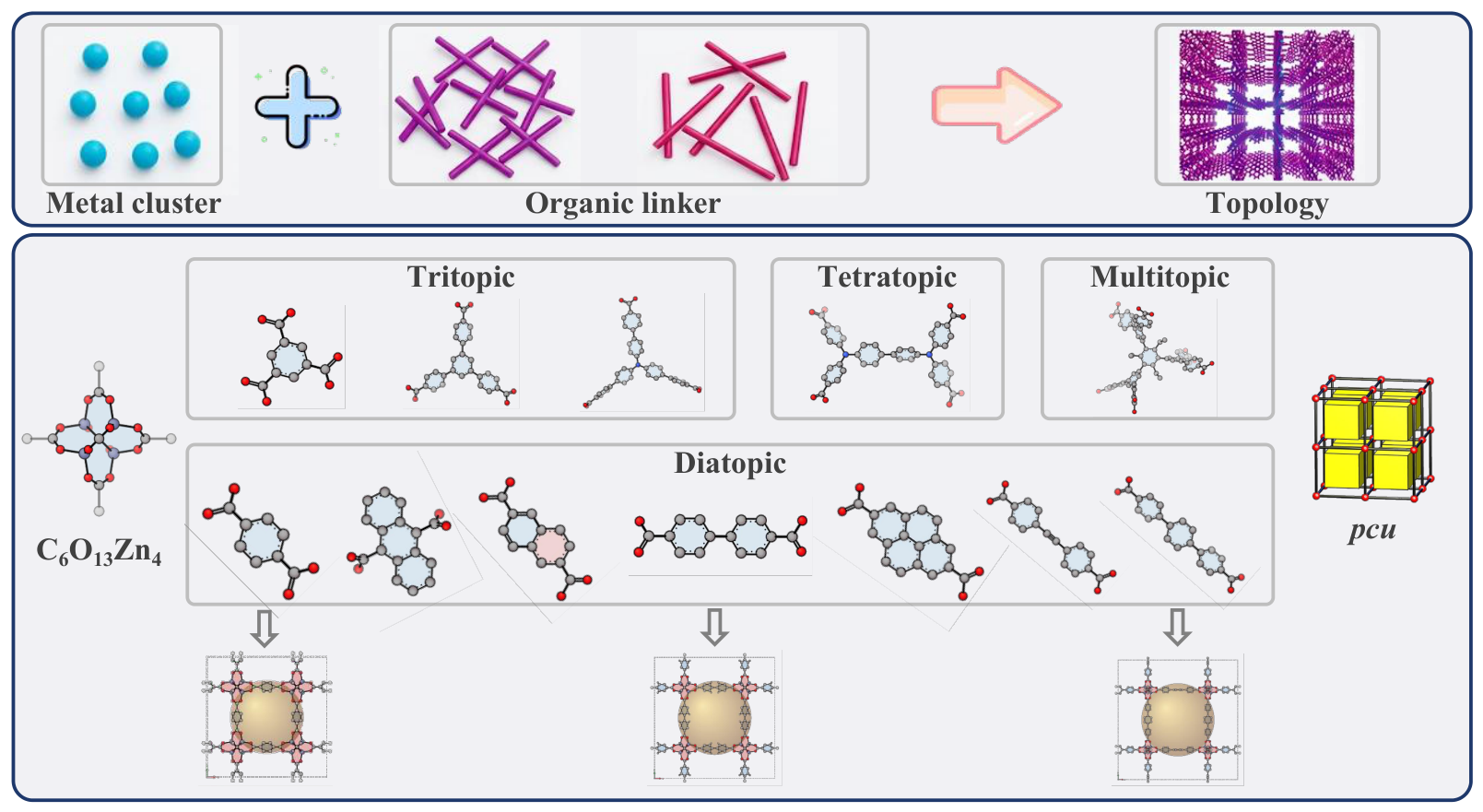
Figure 4.
The reported experimental, hypothetical, and hybrid MOF databases.
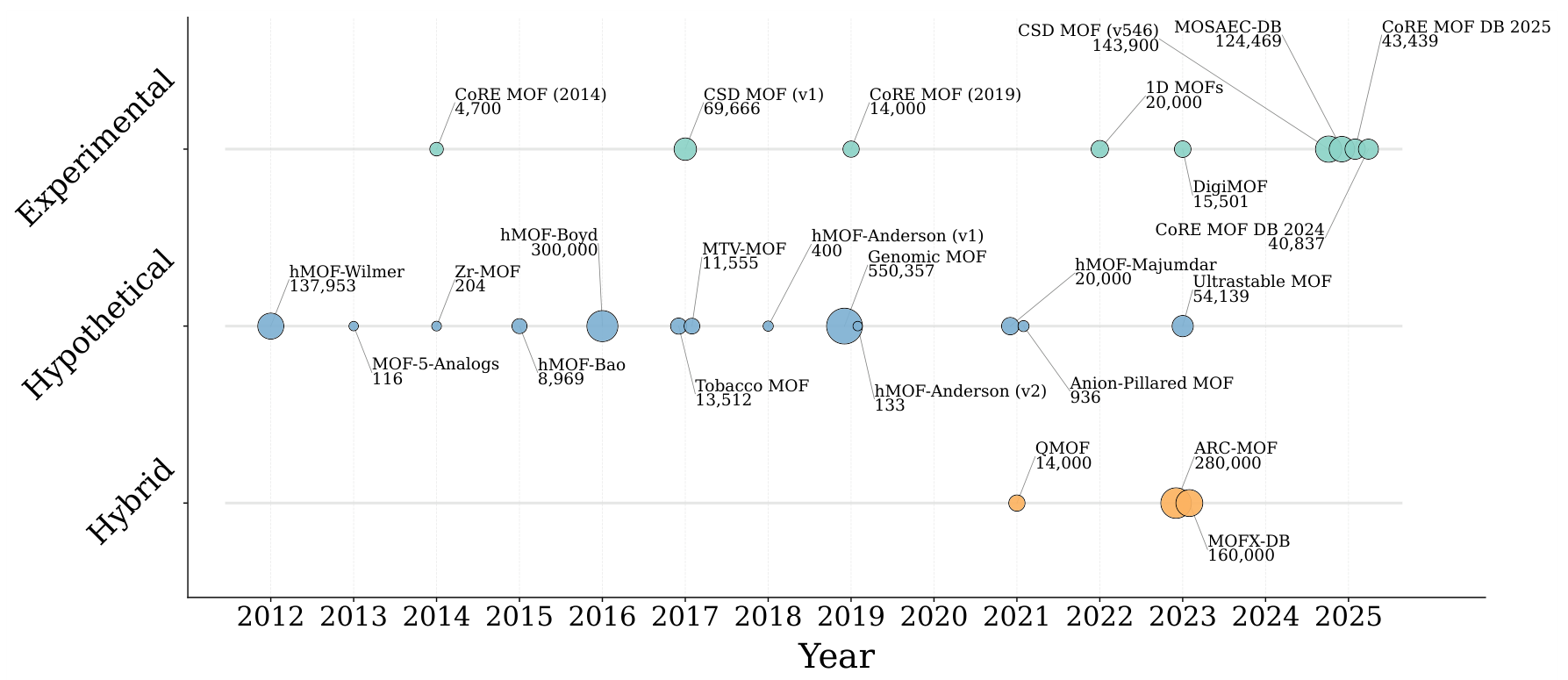
Figure 5.
The Overall schematics for (A) MOFormer (Reproduced with permission. Copyright 2023, American Chemical Society[107]), (B) MOFTransformer (Reproduced with permission. Copyright 2023, Springer Nature[108]) and (C) Uni-MOF (Reproduced with permission. Copyright 2024, Springer Nature[109]).
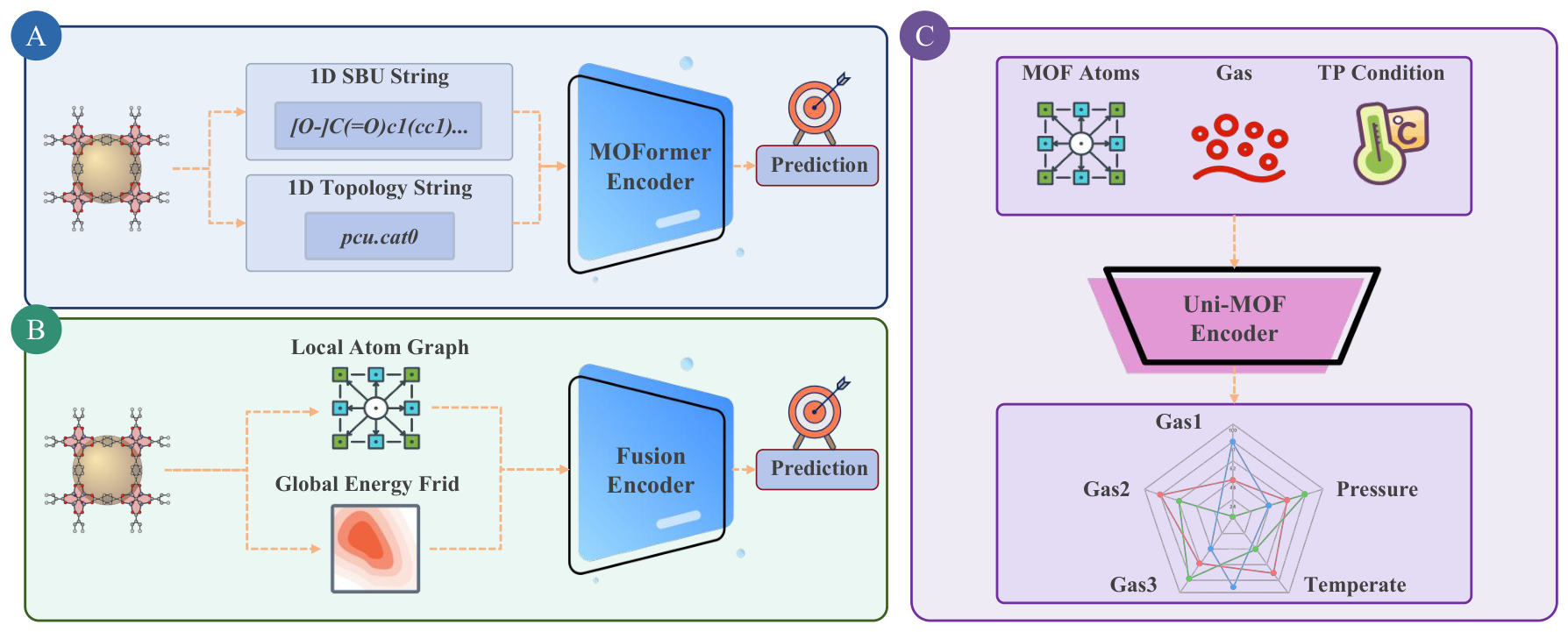
Figure 6.
The Overall schematics for (A) Schematic representation of the GPT-4 based framework functioning as an advanced reticular chemist through strategic prompt engineering and in-context learning informed by human feedback. Copyright 2023, Wiley-VCH GmbH[126]), (B) LLM agents for matching and extracting MOF data. Copyright 2025, American Chemical Society[120]) and (C) Fully automated data analysis workflow of the MOFsyn agent. Copyright 2025, American Chemical Society[130]).
Figure 6.
The Overall schematics for (A) Schematic representation of the GPT-4 based framework functioning as an advanced reticular chemist through strategic prompt engineering and in-context learning informed by human feedback. Copyright 2023, Wiley-VCH GmbH[126]), (B) LLM agents for matching and extracting MOF data. Copyright 2025, American Chemical Society[120]) and (C) Fully automated data analysis workflow of the MOFsyn agent. Copyright 2025, American Chemical Society[130]).
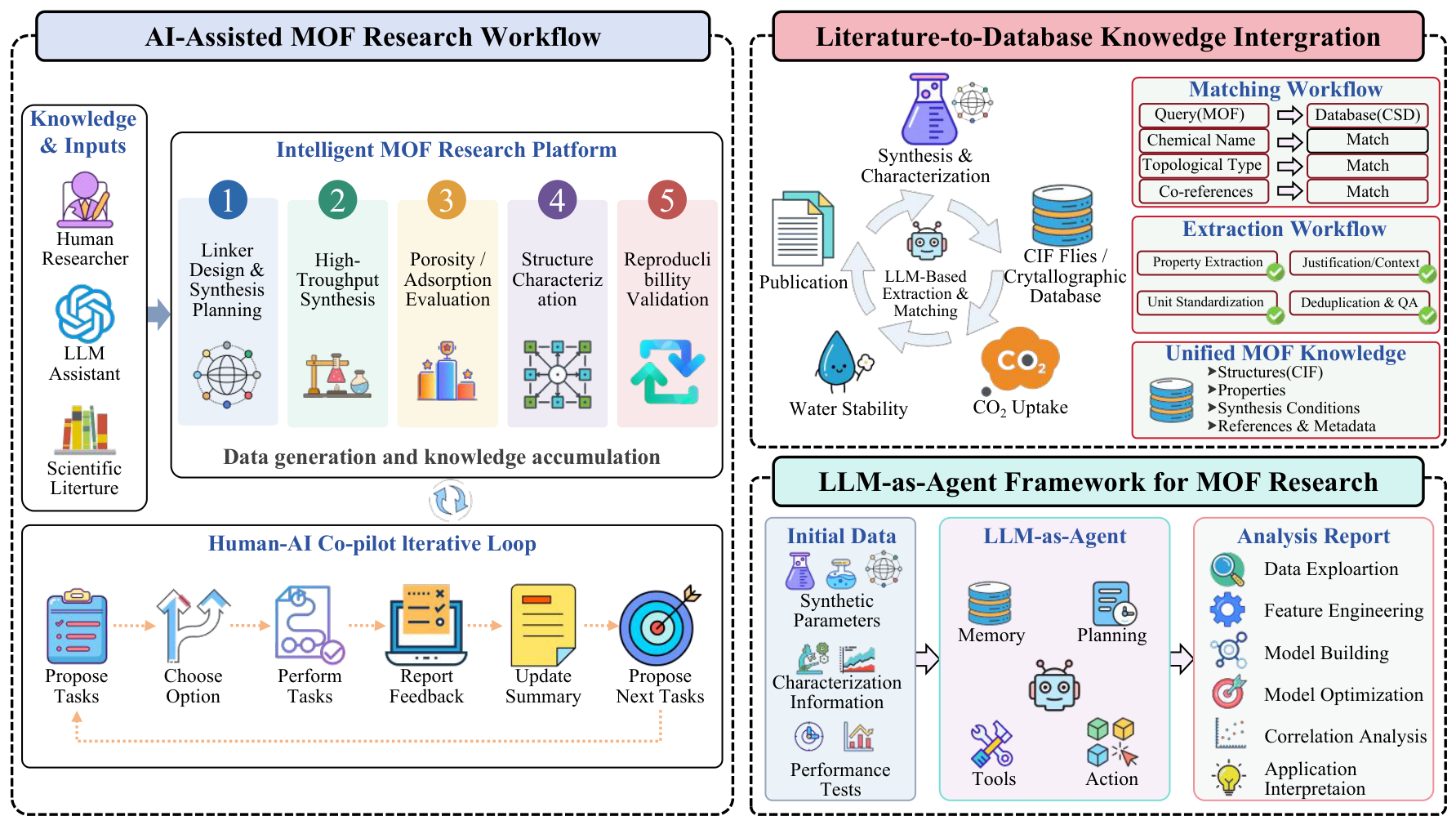

Table 1.
The ML models for different types of partial atomic charges (DDEC: density-derived electrostatic and chemical[180,181,182,183]; REPEAT: repeating electrostatic potential extracted atomic[184]; CM5: charge model 5[185]; Bader: bader charge[186]) prediction.
| Models | Best MAE | Support types | Support Ion | COF[a]/Zeolite[b] | Year |
|---|---|---|---|---|---|
| MPNN-charge[100] (message passing neural network) |
0.0250 | DDEC[c] | N | -/- | 2020 |
| MLDA[101] (gradient boosting decision tree) |
0.0100 | DDEC[c] | - | 0.050/- | 2020 |
| PACMOF-v1[102] (random forest) |
0.0100 | DDEC, CM5[d] | N | -/- | 2021 |
| MOF-AL (graph neural network) |
0.0239 | DDEC6, REPEAT[e][f] | - | -/0.0368 | 2024 |
| PACMAN-charge[104] (graph convolutional network) |
0.0032 | DDEC6, CM5, REPEAT, Bader[e][f] | Y | 0.0095/0.0245 | 2024 |
| MEPO-ML[105] (graph attention network) |
0.0250 | REPEAT[f] | Y | -/- | 2024 |
| PACMOF-v2[103] (random forest) |
0.0239 | DDEC6[d][e][g] | Y | 0.0200/0.0290 | 2024 |
Disclaimer/Publisher’s Note: The statements, opinions and data contained in all publications are solely those of the individual author(s) and contributor(s) and not of MDPI and/or the editor(s). MDPI and/or the editor(s) disclaim responsibility for any injury to people or property resulting from any ideas, methods, instructions or products referred to in the content. |
© 2026 by the authors. Licensee MDPI, Basel, Switzerland. This article is an open access article distributed under the terms and conditions of the Creative Commons Attribution (CC BY) license (http://creativecommons.org/licenses/by/4.0/).
Copyright: This open access article is published under a Creative Commons CC BY 4.0 license, which permit the free download, distribution, and reuse, provided that the author and preprint are cited in any reuse.