

Submitted:
20 September 2026
Posted:
20 September 2026
You are already at the latest version
Abstract
Layered transition-metal dichalcogenides provide an ideal platform to explore the competition between charge-density-wave (CDW) order and superconductivity. The 3R-stacked TaSe2 hosts intrinsic CDW and superconductivity without chemical doping, yet systematic high-pressure experimental evidence remains lacking. Here we report on systematic studies of pressure phase diagrams up to 2 GPa in high-quality single crystals of 3R-TaSe2. At ambient pressure, a CDW transition emerges near 100 K, and bulk superconductivity onset occurs at Tc ≈ 2.8 K. Upon hydrostatic compression, the CDW transition temperature is monotonically suppressed, while Tc increases to ~3.1 K at 2 GPa, clearly revealing an antagonistic relationship between these two quantum phases. Hall and thermopower measurements suggest CDW-driven Fermi-surface reconstruction and single-band carrier behaviour. From pressure-dependent transport we construct the P(T) phase diagram, and anisotropic upper-critical-field data demonstrate quasi-two-dimensional superconductivity in bulk 3R-TaSe2. This work offers key experimental insights into competing correlated states in van der Waals layered materials.
Keywords:
charge density wave
; superconductivity
; hydrostatic pressure
; 3R-TaSe₂
Introduction
Chemical doping, intercalation, electrostatic gating, strain, and hydrostatic pressure are common methods for tuning the electronic structure of transition-metal dichalcogenides (TMDs) [1,2,3,4,5]. These layered materials consist of covalently bonded X-M-X trilayers, which are stacked via weak van der Waals interactions. The subtle interplay between intralayer electronic states and interlayer coupling underpins a rich variety of exotic quantum phenomena, including charge-density-wave (CDW) order, superconductivity, Mott insulating behavior, and even topological electronic states [6,7,8,9]. Chemical doping introduces impurity scattering centers and compromises lattice integrity. Electrostatic gating modulates only the electronic states of a thin surface layer and is inherently incapable of inducing continuous evolution of bulk properties [10]. In contrast, hydrostatic pressure uniformly modulates the interlayer spacing, thereby continuously tuning the strength of interlayer orbital hybridization and electron-phonon coupling without introducing extrinsic defects. As such, pressure serves as a clean, reversible, and quantitatively controllable tuning parameter, ideally suited for systematically probing the interplay between CDW order and superconductivity [11,12,13].
As a prototypical layered transition-metal dichalcogenide, TaSe2 exhibits multiple polymorphs, including 1T, 2H, and 3R. The structural and electronic distinctions arise from differences in the coordination geometry of Ta atoms (octahedral versus trigonal prismatic) and the interlayer stacking sequence (AA, AB, or ABC) [14]. These structural variations give rise to markedly different CDW superlattice structures, Fermi-surface topologies, and superconducting pairing mechanisms. In 1T-TaSe2, Ta atoms adopt octahedral coordination and stack in an AA fashion. Each unit cell comprises a single Se-Ta-Se trilayer [14]. Strong interlayer coupling stabilizes a high-temperature, commensurate CDW characterized by star-of-David motifs [14]. However, bulk superconductivity is absent under ambient pressure. Superconductivity can be induced only via external perturbations such as hydrostatic pressure or chemical doping [15]. 2H-TaSe2 crystallizes in hexagonal symmetry with trigonal-prismatic Ta coordination and AB stacking, whose unit cell encloses two Se-Ta-Se layers [14]. It undergoes successive incommensurate-to-commensurate CDW transitions and exhibits weak intrinsic superconductivity at ambient pressure [16]. Its Fermi-surface nesting is dominated by one main carrier type without double sign reversal in transport measurements. 3R-TaSe2 is a rhombohedral polymorph with trigonal-prismatic Ta coordination and ABC-type three-layer stacking. Its unit cell contains three Se-Ta-Se trilayers, leading to lowered crystal symmetry and split Fermi surfaces with coexisting electron and hole pockets, which gives rise to multiband transport behaviors. However, research on 3R-TaSe2 remains notably deficient: early work mainly addressed single-crystal structure and ambient-pressure basic transport [16], while existing high-pressure experiments despite establishing pressure as a clean tuning knob for competing CDW and superconductivity [17], covered only isolated pressure points, lacking systematic multiband verification and anisotropic critical field data. There is a lack of quantitative evolution relationships between TCDW and Tc over a pressure range, and multi-dimensional thermodynamic evidence, anisotropic critical fields, and multiband carrier signatures are missing. To date, a P(T) phase diagram has not been established, preventing a clear quantitative description of the antagonistic strength between CDW and superconductivity.
In this letter, we report how hydrostatic pressure can efficiently tune both the CDW order and superconductivity in 3R-TaSe2, as revealed by electrical resistivity measurements. High-quality single crystals of 3R-TaSe2 were synthesized via the chemical vapor transport (CVT) method, using iodine as the transport agent. Powder X-ray diffraction and optical microscopy confirmed the phase-pure 3R rhombohedral stacking and high crystalline quality of the as-grown samples. We carried out comprehensive characterizations including temperature-dependent electrical transport, Hall effect, magnetoresistance and thermopower at ambient pressure. These measurements revealed a CDW transition near 100 K and bulk superconductivity with a critical temperature Tc ≈ 2.8 K. Angle-dependent upper critical-field measurements further demonstrated the quasi-two-dimensional nature of superconducting in bulk 3R-TaSe2. Using a piston-cylinder diamond-anvil cell, we systematically investigated the pressure-dependent transport properties under hydrostatic pressure up to 2 GPa. With increasing pressure, the CDW transition temperature is monotonically suppressed, whereas the superconducting critical temperature Tc is distinctly enhanced, manifesting the antagonistic competition between CDW order and superconductivity. Based on these pressure-dependent experimental results, we constructed the P(T) phase diagram for pristine 3R-TaSe2.
Experimental Methods
Millimeter-sized single crystals of 3R-TaSe2 were synthesized via the chemical vapor transport method. High-purity tantalum powder (99.99%) and selenium powder (99.999%) were sealed in a quartz tube at a molar ratio of 1:2.05, with a slight excess of Se to compensate for high-temperature volatilization. Iodine was employed as the transport agent at a concentration of approximately 5 mg/cm3. A temperature gradient of 950 °C to 850 °C was maintained for 14 days, followed by natural cooling, which yielded shiny, flake-like 3R-TaSe2 single crystals [7]. The crystal phase and structural quality were characterized by powder X-ray diffraction (XRD) using θ-2θ scanning from 10° to 80° [Figure 1(a)]. The XRD pattern exclusively displays the (001) characteristic diffraction peaks of the 3R phase, including the 003, 006, 009, 0012, and 0015 reflections, while no impurity peaks corresponding to the 2H phase are detected. The sharp diffraction profiles and pure peak assignments confirm the successful growth of single-phase 3R-TaSe2 with high crystallinity. Optical microscopy observations verify that the obtained crystals exhibit uniform sizes of 1-3 mm with smooth and crack-free surfaces, further demonstrating high crystal quality. Figure 1b,c illustrate the atomic stacking configuration of 3R-TaSe2. In the layered structure, Ta atoms construct an in-plane hexagonal sublattice, and Se atoms are symmetrically sandwiched between adjacent Ta layers [14]. Neighboring atomic slabs are stacked along the c-axis and held together by weak van der Waals forces, which dominates the intrinsic layered feature of 3R-phase TaSe2 [14].
All ambient-pressure and low-temperature electrical measurements were carried out on a Quantum Design Physical Property Measurement System (PPMS-9T), covering a temperature range of 2 - 300 K and a maximum magnetic field of 9 T. The longitudinal resistance R(T), transverse Hall resistivity ρxy(H), and magnetoresistance were measured via the standard four-probe technique. The magnetoresistance is defined as:
The superconducting anisotropy was investigated by measuring the upper critical field under magnetic fields applied parallel (H∥ab) and perpendicular (H⊥ab) to the crystal ab-plane. The upper critical field at each temperature was determined by the vanishing of zero-resistance state in Figure 2a,c. High-pressure electrical measurements were conducted using a piston-cylinder diamond anvil cell (DAC), with Daphne 7373 oil serving as the hydrostatic pressure medium. The applied pressure was calibrated at room temperature based on the superconducting transition temperature of a lead (Pb) standard. As shown in Figure 3(a), measurements were performed at fixed pressures of 0, 0.6, 1.0, 1.4, and 2.0 GPa. The low-temperature normalized resistance curves were further analyzed to characterize the evolution of the superconducting critical temperature Tc under pressure in Figure 3(b). The full-range temperature-dependent resistance curves under different pressures were collected, where TCDW was precisely determined from the minimum of the dR/dT curves in Figure 3(c).
Results and Data Analysis
The ambient-pressure R(T) curve in Figure 4(a) exhibits typical metallic behavior from room temperature down to 100 K, with a clear resistance inflection at TCDW ≈ 100 K, which corresponds to the CDW lattice distortion and Fermi-surface nesting transition [5]. The residual resistivity ratio (RRR), defined as ρ300K/ρ10K with ρ denoting resistivity, serves as an indicator for crystalline quality. We obtain RRR ≈ 3.5, consistent with prior reports on 3R-TaSe2 single crystals [7]. Upon further cooling to ~2.8 K, the resistance abruptly drops to zero, marking the superconducting transition . The Hall resistivity in Figure 4(b) shows a prominent sign reversal as temperature varies: for T > 100 K (CDW-disordered phase), ρxy is positive, indicative of hole-dominated transport; for T < 100 K (CDW-ordered phase), ρxy turns negative, revealing electron-dominated transport. This phenomenon arises from Fermi-surface folding induced by the CDW superstructure. Some hole pockets open energy gaps while electron pockets remain intact, which accounts for the carrier-type reversal [18].
Using a single-band approximation, we extract the apparent carrier density napp = 1/(e·dρxy/dH) and mobility μapp = ρxy/(ρxx·H) as functions of temperature in Figure 4c,d. We emphasize that these are effective quantities in a multiband system, rather than absolute carrier concentrations of individual bands. Their temperature evolution, however, tracks the CDW-driven Fermi-surface reconstruction: above TCDW, the positive Hall coefficient corresponds to hole-dominated transport with low mobility, while below TCDW, the sign reversal and sharp increase in μapp reflect the suppression of hole pockets and the reduction of interband scattering. As shown in Figure 4(e), the MR curves form symmetric parabolas over the entire temperature range, with the MR amplitude increasing substantially below TCDW. This enhancement is attributed to the CDW gap, which suppresses interband scattering and enhances the single-band contribution, thereby further supporting the picture of CDW-induced Fermi-surface reconstruction. The thermopower S(T) in Figure 4(f) changes sign from positive at low temperatures to negative above ~ 100 K, consistent with the coexistence of electron- and hole-type carriers and a multiband Fermi surface [18]. This behavior is qualitatively consistent with the carrier-type reversal observed in the Hall measurements, although the sign of S is also influenced by scattering mechanisms [19].
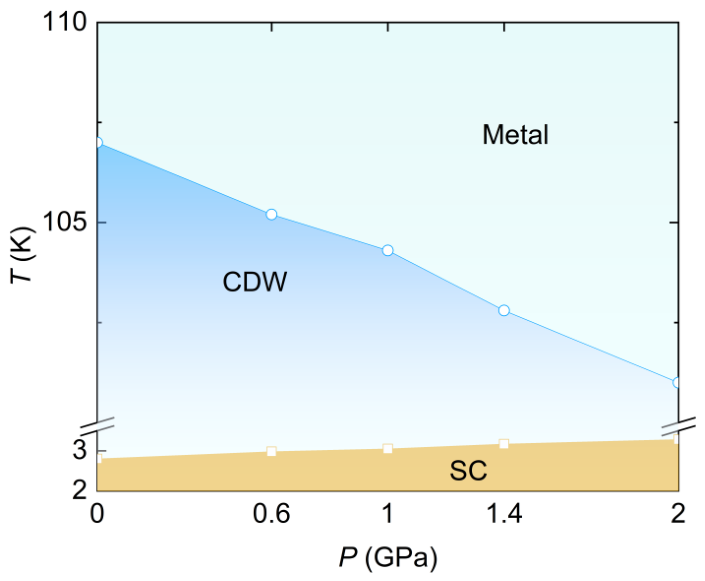
The minimum of the dR/dT curves corresponds to the CDW transition temperature: as pressure increases from 0 to 2 GPa, TCDW monotonically decreases from 107 K to 100 K, exhibiting an approximately linear pressure dependence. The physical origin lies in hydrostatic compression of the interlayer spacing, which weakens the in-plane Ta-Se orbital hybridization and reduces Fermi-surface nesting, thereby suppressing the CDW lattice distortion [14]. The resistivity ρ(T) curves shift downward with increasing pressure. at a given temperature, higher pressure yields lower resistivity, indicating enhanced orbital hybridization and improved carrier mobility. The resistance step associated with the CDW transition gradually weakens with pressure, reflecting a gradual suppression of the CDW order. Normalized superconducting resistance R/R10K curves show that with increasing pressure, the superconducting transition window shifts continuously to higher temperatures, and Tc rises monotonically, in direct opposition to the decreasing TCDW clear evidence of mutual competition between CDW and superconductivity. Field-dependent superconducting resistance transitions were measured for two field orientations in Figure 2. H⊥ab (field perpendicular to layers): superconductivity is destroyed at low fields, with low Hc2 values. H∥ab (field parallel to layers): superconductivity can withstand fields up to 5 T, with Hc2 much larger than the perpendicular case, consistent with classical 2D superconductors such as NbSe2 [12] and TaS2 [13].
As shown in Figure 5, we summarized TCDW and Tc as a function of pressure from resistivity measurements. The light-blue region represents the CDW-ordered metallic phase, the light-green region is the normal metallic phase, and the bottom yellow narrow band denotes the superconducting phase. The CDW phase boundary slopes downward monotonically with pressure, while the superconducting region gradually widens with increasing Tc, clearly illustrating the competition relationship between the two quantum phases and providing quantitative constraints for theoretical analysis.
Discussion
CDW and superconductivity share the same Fermi-surface electrons, giving rise to a natural competition [20]: the CDW transition opens a gap via Fermi-surface nesting, consuming Fermi-surface density of states N(EF). In BCS theory, Tc is positively correlated with N(EF), so the loss of density of states directly suppresses Cooper-pair formation, resulting in a low ambient-pressure Tc [21]. Upon applying hydrostatic pressure, the interlayer spacing is reduced, which weakens the in-plane Ta-Se distortion, mismatches the nesting vector, and progressively closes the CDW gap. Consequently, N(EF) is restored and electron-phonon coupling is enhanced, leading to an increase in Tc [4]. In this pressure range, within the 0 - 2 GPa range no other ordered phases (e.g., spin-density wave or Mott insulator) emerge, the phase evolution is dominated solely by CDW-superconductivity competition, without additional degrees of freedom, making this an ideal two-order-parameter competition model for theoretical studies.
Compared with the widely studied 2H-TaSe2 [18,22], the 3R phase features a triple-layer stacking that lowers crystal symmetry and splits the Fermi surface into more electron and hole pockets, resulting in the double sign reversal observed in both Hall and thermopower a multiband transport behavior [14]. In the 2H phase, Fermi-surface nesting gives rise to only a single dominant carrier type, lacking this characteristic. this serves as a key transport identifier distinguishing the two polytypes. The strong anisotropy of superconductivity confirms that bulk 3R-TaSe2 is a quasi-two-dimensional superconductor [10]: interlayer van der Waals coupling is much weaker than intralayer covalent hybridization, so the superconducting coherence length along the c-axis is extremely short [14]. A perpendicular magnetic field easily destroys Cooper pairs, whereas an in-plane field only affects the intralayer supercurrent, requiring a much higher critical field-consistent with classic 2D superconductors such as NbSe2 [12] and TaS2 [13].
Future efforts could extend pressure measurements to higher regimes, exceeding 2 GPa, in order to determine whether a superconducting dome emerges following the suppression of the CDW phase and whether a quantum critical point exists. These measurements would be complemented by high-pressure angle-resolved photoemission spectroscopy (ARPES) to directly observe the pressure-induced closure of the charge gap and the evolution of the Fermi surface, thereby verifying the reconstruction scenario inferred from transport experiments [19]. In addition, ionic intercalation with species such as Li+ and K+ will be performed to independently tune the interlayer spacing and carrier concentration. A systematic comparison between chemical intercalation and hydrostatic pressure will help disentangle the effects of lattice compression from those of charge doping [23]. Furthermore, ultrafast spectroscopy and nuclear magnetic resonance could be employed to probe collective excitations and spin dynamics in the CDW state, providing deeper insight into the microscopic coupling between the CDW and superconductivity.
Conclusion
In summary, we have grown the 3R-TaSe2 single crystal by the chemical vapor transport method. The CDW transition emerges at ~100 K, and bulk superconducting transition appears below ~2.8 K under ambient pressure. Hall effect and thermopower measurements jointly demonstrate that the CDW transition induces Fermi-surface reconstruction, with coexisting electron and hole pockets and a carrier-type reversal across TCDW. Hydrostatic pressure monotonically suppresses CDW order while simultaneously enhancing superconductivity, establishing a clear antagonistic competition. The pressure-induced interlayer compression weakens lattice distortion and closes the CDW gap, thereby restoring Fermi-surface density of states and strengthening electron-phonon coupling. Further, the large difference between in-plane and out-of-plane upper critical fields confirms that bulk 3R-TaSe2 is a quasi-two-dimensional superconductor, with weak interlayer van der Waals coupling as the origin of anisotropy. Based on all pressure-dependent data, a P(T) phase diagram is constructed, quantitatively illustrating the mutual suppression and evolution of the CDW and superconducting phases. This work clearly reveals the competitive physical picture between CDW and superconductivity in undoped 3R-TaSe2, providing a clean and comprehensive experimental benchmark for understanding correlated electronic order competition in layered van der Waals materials, and offering experimental support and theoretical guidance for pressure-engineering of correlated electronic states and design of novel low-dimensional superconducting systems.
Acknowledgments
This work was supported by the National Key Research and Development Program of China (Grants No. 2022YFA1602800, 2022YFA1403903, No. 2021YFA1401800, and No. 2022YFA1402203), the National Natural Science Foundation of China (Grants No. 12134018, No. 11921004, No. 11634015, No. 12321004, No. 12234003, No. U2006218, No. 12104490), the Strategic Priority Research Program and Key Research Program of Frontier Sciences of the Chinese Academy of Sciences (Grant No. XDB33010100), the Youth Beijing Scholars program (No. 93), the Project of Construction and Support for high-level Innovative Teams of Beijing Municipal Institutions (BPHR20220124), the R&D Program of Beijing Municipal Education Commission (KM202411232008), and the Synergetic Extreme Condition User Facility (SECUF).
References
- Kuc; Heine, T.; Kis, A. Electronic properties of transition-metal dichalcogenides. MRS Bull. 2015, 40, 577. [Google Scholar] [CrossRef]
- Elson, F.; Philippe, J.; Simutis, G.; et al. Lifshitz-enhanced superfluid density in two-gap superconducting TiSe₂. npj Quantum Mater. 2026, 11, 4. [Google Scholar] [CrossRef]
- Wang, S.; Liu, Y.; Ishigaki, K.; Matsubayashi, K.; Cheng, J.; Lu, W.; Sun, Y.; Uwatoko, Y. Pressure-induced bulk superconductivity in a layered transition-metal dichalcogenide 1T-tantalum selenium. Phys. Rev. B 2017, 95, 220501. [Google Scholar] [CrossRef]
- Tymoshenko, Y.; Haghighirad, A. A.; Heid, R.; et al. Charge-density-wave quantum critical point under pressure in 2H-TaSe₂. Commun. Phys. 2025, 8, 352. [Google Scholar] [CrossRef]
- Hammo, M. M.; Mohamed, M. A. A.; Moustafa, E. K.; Wolf, D.; Froeschke, S.; Soliman, A.; Dufouleur, J.; Giraud, R.; Büchner, B.; Mertig, M.; Hampel, S. Thermodynamically guided synthesis of 3R-TaSe2 nanocrystals and their superconducting behavior. Nanoscale 2026, 18, 9273. [Google Scholar] [CrossRef]
- Deng, Y.; Liu, Y. M.; Zhao, X. X.; Wang, X. W.; Zhu, C.; Huang, K.; Zhu, C.; Zhou, J. D.; Zeng, Q. S.; Duan, R. H.; Fu, Q. D.; Kang, L. X.; Liu, Y.; Pennycook, S. J.; Wang, X. R.; Liu, Z. Controlled Growth of 3R Phase Tantalum Diselenide and Its Enhanced Superconductivity. J. Am. Chem. Soc. 2020, 142, 2948. [Google Scholar] [CrossRef]
- Xie, Z.; Chen, Z.; Yang, M.; et al. Ising Superconductivity and Signatures of Orbital FFLO State in Non-Centrosymmetric 3R-TaSe₂ Thin Flakes. Adv. Funct. Mater. 2025, 32, 35. [Google Scholar] [CrossRef]
- Wang, W. X.; Jiang, Z. Y.; Zhang, X. D.; Zheng, J. M.; Du, H. W.; Zhang, Z. Y. A theoretical study of Lifshitz transition for 2H-TaS₂. Phys. Chem. Chem. Phys. 2024, 26, 15868. [Google Scholar] [CrossRef]
- Patrick, K.; Yang, B.; Takaki, M.; Moulding, O.; Buhot, J.; Sayers, C. J.; Da, C. E.; Friedemann, S. Fermi Surface Reconstruction and Electron Dynamics at the Charge-Density-Wave Transition in TiSe₂. Phys. Rev. Lett. 2020, 124, 167602. [Google Scholar] [CrossRef]
- Inosov; Zabolotnyy, V.; Evtushinsky, D.; Kordyuk, A.; Büchner, B.; Follath, R.; Berger, H.; Borisenko, S. Fermi surface nesting in several transition metal dichalcogenides. New J. Phys. 2008, 10. [Google Scholar] [CrossRef]
- Sur, Y.; Gim, D. H.; Bhoi, D.; et al. Enhanced superconductivity near a pressure-induced quantum critical point of strongly coupled charge density wave order in 2H-Pd0.05TaSe2. NPG Asia Mater. 2025, 17, 8. [Google Scholar] [CrossRef]
- Zhang; Qiao, S.; Xiao, H.; Hu, T. Anisotropy of 2H-NbSe₂ in the superconducting and charge density wave states. Chin. Phys. B 2023, 32, 047201. [Google Scholar] [CrossRef]
- Agarwal, T.; Patra, C.; Kataria, A.; Chowdhury, R. R.; Singh, R. P. Quasi-two-dimensional anisotropic superconductivity in Li-intercalated 2H-TaS2. Phys. Rev. B 2023, 107, 174509. [Google Scholar] [CrossRef]
- Louca; Dharmasiri, K.; Avdeev, M. Charge density wave and superconductivity modulated by c-axis stacking in the TaSe2 polytypes. arXiv. 2026. Available online: https://arxiv.org/abs/2602.11582.
- Lin, T.; Wang, X.; Chen, X.; Liu, X.; Luo, X.; Li, X.; Jing, X.; Dong, Q.; Liu, B.; Liu, H.; Li, Q.; Zhu, X.; Liu, B. Retainable superconductivity and structural transition in 1T-TaSe₂ under high pressure. Inorg. Chem. 2021, 60, 11385. [Google Scholar] [CrossRef]
- Luo, H.; Xie, W.; Tao, J.; Inoue, H.; Gyenis, A.; Krizan, J.W.; Yazdani, A.; Zhu, Y.; Cava, R.J. Polytypism, polymorphism, and superconductivity in TaSe2−xTex. Proc. Natl. Acad. Sci. U.S.A. 2015, 112, 1174. [Google Scholar] [CrossRef]
- Ali, A.; Alshaali, F.; Almheiri, M.; Abdel-Hafiez, M. Interplay between charge-density-waves, disorder, and superconductivity in transition metal dichalcogenides. Results Phys. 2025, 70, 108154. [Google Scholar] [CrossRef]
- Domaine; Hirschmann, M. M.; Parshukov, K.; et al. Tunable Octdong and Spindle-Torus Fermi Surfaces in Kramers Nodal Line Metals. Nat. Commun. 2025, 16, 11128. [Google Scholar] [CrossRef]
- Sakai; Ikeura, K.; Bahramy, M. S.; Ogawa, N.; Hashizume, D.; Fujioka, J.; Tokura, Y.; Ishiwata, S. Critical enhancement of thermopower in a chemically tuned polar semimetal MoTe2. Sci. Adv. 2016, 2, e1601378. [Google Scholar] [CrossRef]
- Chikina; Fedorov, A.; Bhoi, D.; et al. Turning charge-density waves into Cooper pairs. npj Quantum Mater. 2020, 5, 22. [Google Scholar] [CrossRef]
- Bhoi, D.; Khim, S.; Nam, W.; et al. Interplay of charge density wave and multiband superconductivity in 2H-PdₓTaSe2. Sci. Rep. 2016, 6, 24068. [Google Scholar] [CrossRef]
- Ni, S. L.; Zhou, M. H.; Shi, K.; Chen, L. W.; Yi, J. K.; Zhang, M. J.; Han, Y. Q.; Wu, J. T.; Li, Z. F.; Xu, Z. H.; Xi, C. Y.; Ren, Z. A.; Wang, Z. S. Large in-plane upper critical field significantly violating the Pauli limit in single crystal 2H-Pd0.04TaS2. Phys. Rev. B 2024, 110, 174511. [Google Scholar] [CrossRef]
- Wu, Y. S.; Xing, H.; Lian, C. S.; Lian, H. L.; He, J. M.; Duan, W. H.; Liu, J. Y.; Mao, Z. Q.; Liu, Y. Ion intercalation engineering of electronic properties of two-dimensional crystals of 2H-TaSe₂. Phys. Rev. Mater. 2019, 3, 104003. [Google Scholar] [CrossRef]
Figure 1.
(a) X-ray diffraction pattern of 3R-TaSe2 single crystal. The red line and vertical bars represent the measured data and ICDD PDF card results, respectively. The inset shows an optical image of the 3R-TaSe2 single crystal. (b) Crystal structure of 3R-TaSe2 projected onto the ab plane. (c) The framework of Ta and Se atoms on the (100) plane of 3R-TaSe2.
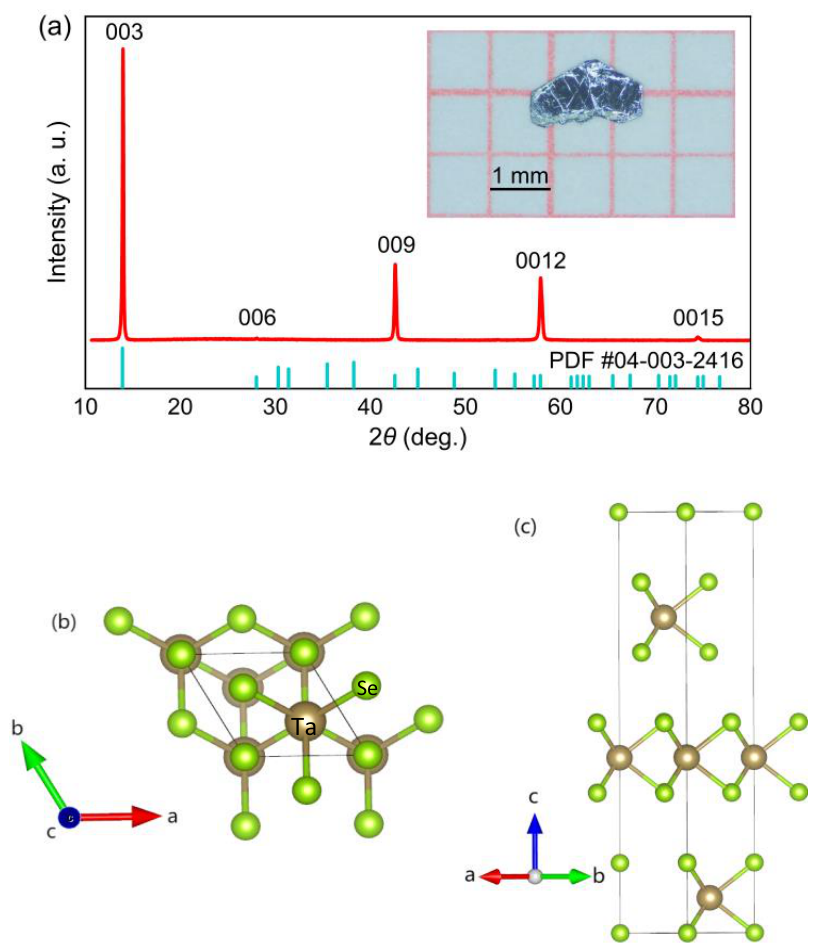
Figure 2.
(a) Temperature dependence of normalized resistivity ρ/ρ10K under magnetic fields applied parallel to the ab plane (H∥ab). Curves of different colors correspond to different applied magnetic fields. (b) Temperature dependence of normalized resistivity ρ/ρ10K for magnetic fields perpendicular to the ab plane (H⊥ab). (c) Upper critical field Hc2 as a function of superconducting transition temperature Tc. Red circles denote (H∥ab), and black triangles denote (H⊥ab).
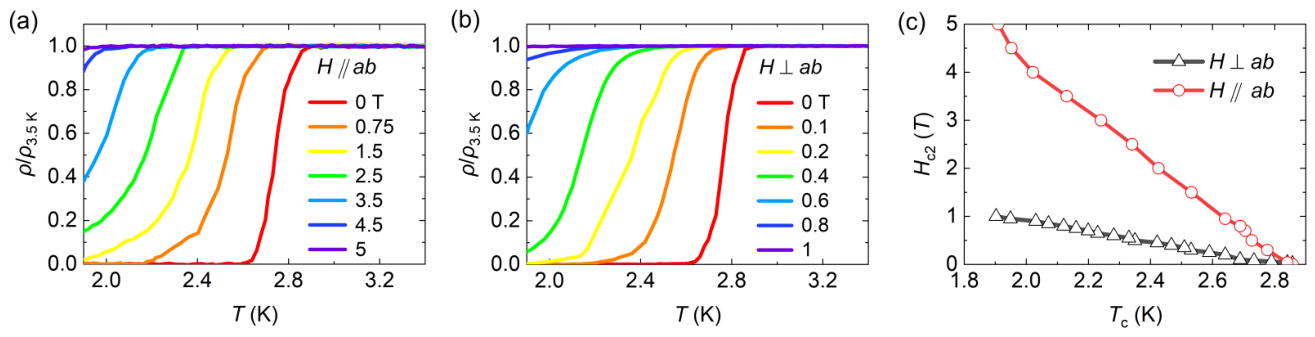
Figure 3.
(a) Temperature dependence of resistivity ρ(T) under various pressures up to 2 GPa. (b) Normalized superconducting transition within an enlarge region at low temperature at different pressures. (c) dR/dT curves as a function of temperature at different pressures. The arrows indicate the CDW phase transition (black).
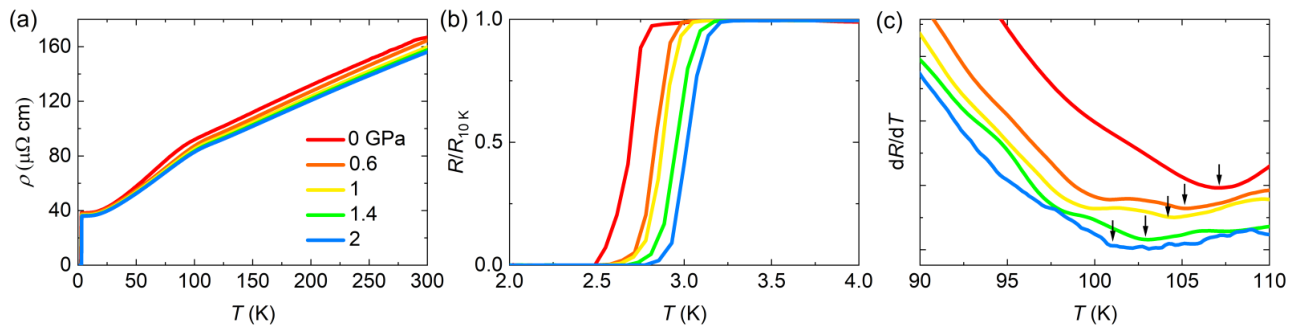
Figure 4.
(a) Temperature-dependent in-plane normalized electrical resistivity (ρ/ρ300K) of 3R-TaSe2. Inset shows the ρ/ρ300K at 2 K - 4 K, enlarged view of the superconducting transition with the onset temperature Tconset and zero temperature Tczero of 2.93 K and 2.65 K, respectively. (b) H-dependent Hall resistivity ρxy of 3R-TaSe2 at different temperatures. (c) Temperature-dependent carrier concentration n(T). (d) Temperature-dependent mobility μ(T). (e) Magnetoresistance at temperatures of 30, 50, 70, 80, 90, 100, 150, 200, 250, 300 K. (f) Temperature-dependent thermopower S(T).
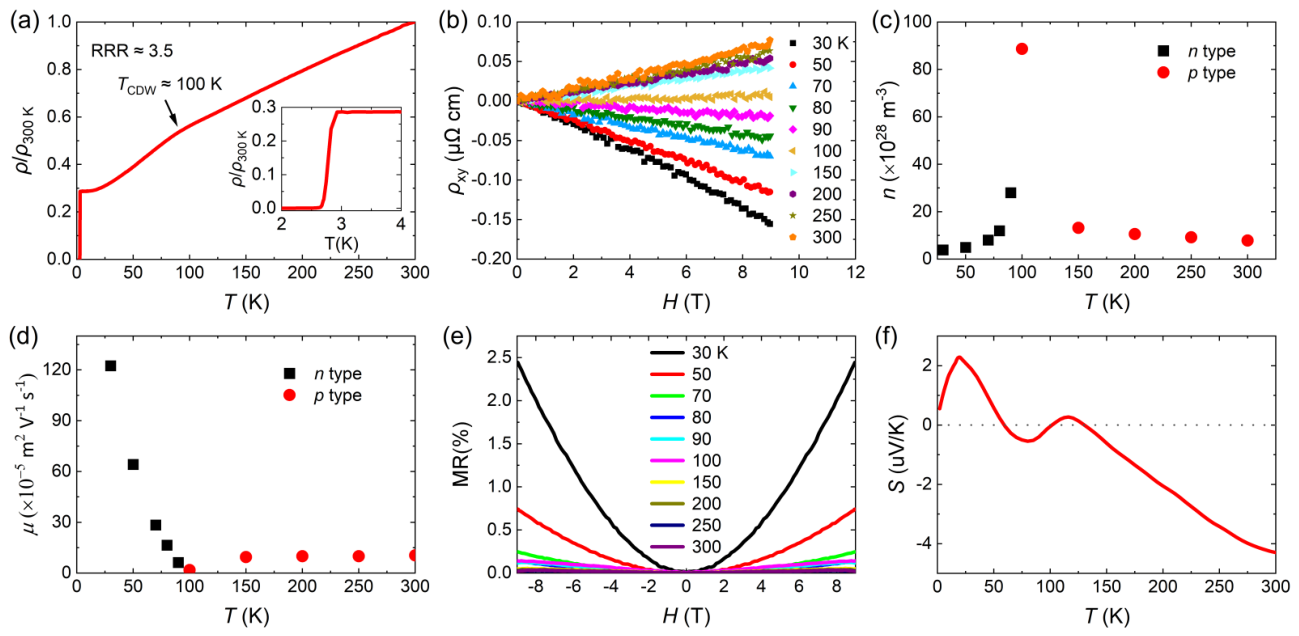
Figure 5.
The phase diagram of 3R-TaSe2. Hollow circles represent TCDW from the electrical resistivity measurements, and the hollow squares correspond to Tc.
Figure 5.
The phase diagram of 3R-TaSe2. Hollow circles represent TCDW from the electrical resistivity measurements, and the hollow squares correspond to Tc.
Disclaimer/Publisher’s Note: The statements, opinions and data contained in all publications are solely those of the individual author(s) and contributor(s) and not of MDPI and/or the editor(s). MDPI and/or the editor(s) disclaim responsibility for any injury to people or property resulting from any ideas, methods, instructions or products referred to in the content. |
© 2026 by the authors. Licensee MDPI, Basel, Switzerland. This article is an open access article distributed under the terms and conditions of the Creative Commons Attribution (CC BY) license.
Copyright: This open access article is published under a Creative Commons CC BY 4.0 license, which permit the free download, distribution, and reuse, provided that the author and preprint are cited in any reuse.