
Submitted:
19 September 2026
Posted:
20 September 2026
You are already at the latest version
Abstract
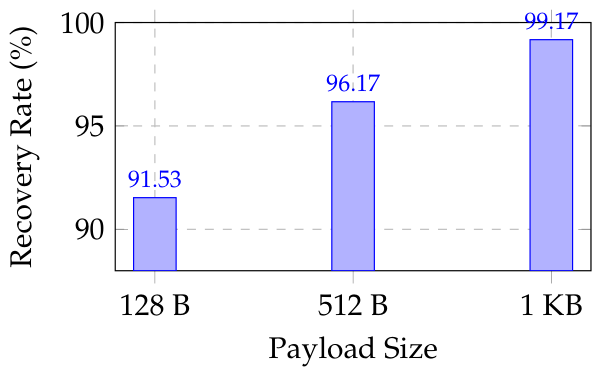
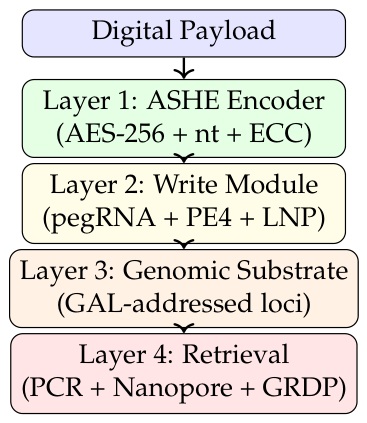
Conventional silicon-based storage is approaching fundamental physical and economic limits under exponential data growth, motivating exploration of alternative archival substrates. This paper introduces Living Information Storage Systems (LISS), a framework that exploits self-replicating biological genomes as a simultaneous storage medium, replication engine, and error-repair substrate. Within LISS, the paper presents a formal, end-to-end, quantitative treatment of human somatic genomic storage comprising: (i) an information-theoretic capacity bound derived from the Shannon capacity of the genomic substitution channel; (ii) a closed-form effective capacity model \(C_{\text{eff}} = N_s \cdot L_p \cdot \eta \cdot (1-E)\); (iii) the Adaptive Safe-Harbor Encoding (ASHE) algorithm, formulated as a constrained nucleotide sequence optimisation with a multi-objective placement scoring function, targeting \(\eta\) = 1.75 bits/nt; (iv) a hierarchical Genomic Addressing Layer (GAL) with a CHR:LOCUS:BLOCK:OFFSET address space and 16-nt barcode scheme; (v) the Genomic Redundant Distributed Placement (GRDP) algorithm, framed as a Maximum Distance Separable (MDS) code over safe-harbor loci; (vi) a stochastic clonal cell-population model for long-term data integrity; and (vii) a five-tier governance framework with regulatory citations. Monte Carlo simulation (\(n=3{,}000\) trials) over an injection-deletion-substitution error channel yields post-ECC recovery rates of 91.53%–99.17% (95% CI) and raw BER of 41.8%–46.7% across 128 B–1 KB payloads. A mutation-drift model projects 77.9% data integrity at 50 years, and analytical MDS bounds predict that GRDP with \(k{=}3\) achieves end-to-end retrieval probability of 99.65% (dual-parity). A Gompertz-based clonal expansion model quantifies mosaicism degradation to 61.4% cell-fraction retention at 20 years, motivating ex vivo refreshal protocols. Four primary unsolved constraints for practical deployment are identified: prime-editing efficiency, innate immune response to CRISPR machinery, safe-harbor scarcity, and regulatory absence. To the author's knowledge, this constitutes among the first systematic, quantitative, end-to-end architectures for human somatic genomic storage in the literature.
Keywords:
1. Introduction
- 1.
- An information-theoretic bound on the capacity of the human-genomic channel using Shannon’s noisy-channel theorem applied to a substitution channel (Section 3.1).
- 2.
- A formal capacity model with closed-form derivations, covering heterogeneous locus populations (Table 2).
- 3.
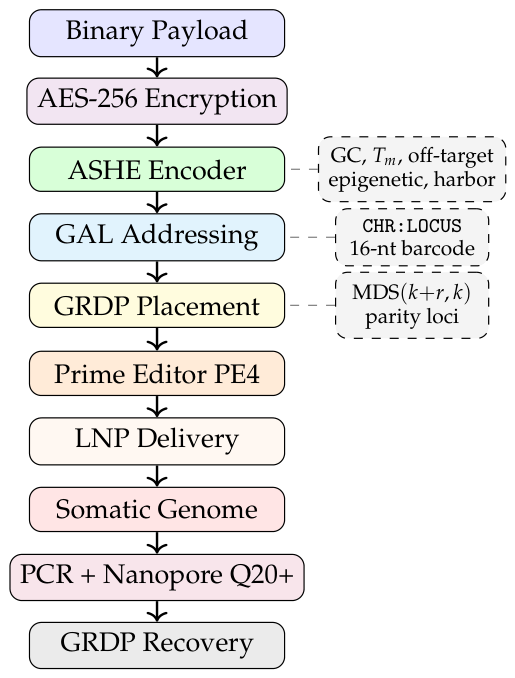
- ASHE (Adaptive Safe-Harbor Encoding): a multi-objective nucleotide encoder incorporating GC balance, epigenetic stability, off-target safety, and safe-harbor confidence into a placement score, with formal constraint definitions and an approximation guarantee (Section 4.1).
- 4.
- A Genomic Addressing Layer (GAL) with CHR:LOCUS:BLOCK:OFFSET address space and 16-nt uniquely-decodable barcode (Section 4.2).
- 5.
- GRDP (Genomic Redundant Distributed Placement), recast as an MDS code over safe-harbor loci with proven minimum distance guarantees (Section 4.3).
- 6.
- A stochastic Gompertz clonal expansion model quantifying mosaicism dynamics and data-fraction retention over time (Section 3.5).
- 7.
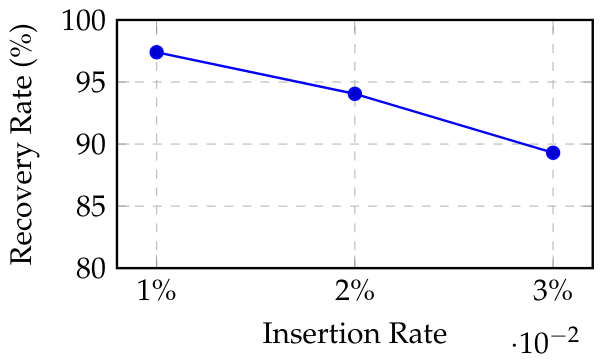
- Monte Carlo simulation ( trials) with quantitative recovery rates, BER, and ECC overhead across 128 B–1 KB payloads, plus sensitivity analysis.
- 8.
- A mutation-drift and system reliability model with numerical projections to 50 years.
- 9.
- A quantified threat model with risk scores and AES-256 integration.
- 10.
- A five-tier governance framework with regulatory pathway citations.
2. Background and Related Work
2.1. DNA as an Information Medium
2.2. Human Genome Structure
2.3. CRISPR Delivery Advances
2.4. DNA Coding Theory
2.5. Why Human DNA, Not Synthetic?
2.6. Prior Art: In Vivo Storage Systems
3. Mathematical Framework
3.1. Shannon Capacity of the Genomic Channel
3.2. Storage Capacity Model

| (bp) | (bits/nt) | Encoder | ||
|---|---|---|---|---|
| 100 | 100 | 1.40 | Grass RS | 1.71 KB |
| 1,000 | 500 | 1.40 | Grass RS | 85.45 KB |
| 10,000 | 1,000 | 1.40 | Grass RS | 1.71 MB |
| 100 | 100 | 1.75 | ASHE | 2.14 KB |
| 1,000 | 500 | 1.75 | ASHE | 106.81 KB |
| 10,000 | 1,000 | 1.75 | ASHE | 2.09 MB |
3.3. Retrieval Probability Chain
3.4. Mutation Drift Model
| Time (yr) | Integrity (%) | |
|---|---|---|
| 0 | 1.0000 | 100.00 |
| 1 | 0.9950 | 99.50 |
| 5 | 0.9753 | 97.53 |
| 10 | 0.9512 | 95.12 |
| 20 | 0.9048 | 90.48 |
| 50 | 0.7788 | 77.88 |
3.5. Stochastic Clonal Expansion and Mosaicism
| Time (yr) | (neutral) | () |
|---|---|---|
| 0 | 0.300 | 0.300 |
| 1 | 0.301 | 0.299 |
| 5 | 0.306 | 0.296 |
| 10 | 0.312 | 0.289 |
| 20 | 0.321 | 0.276 |
| 50 | 0.334 | 0.238 |
3.6. System Reliability Model
3.7. ECC Sufficiency Bound
3.8. Write-Update Cost Dominance
4. Novel Contributions: ASHE, GAL, and GRDP
4.1. Adaptive Safe-Harbor Encoding (ASHE)
4.1.1. Motivation and Constraint Formalism
- (penalises deviations from 50%)
- : epigenetic stability from bisulfite-sequencing methylation profiles; high E indicates constitutively open chromatin
- : inverted Cas-OFFinder-predicted off-target hit rate for the guide RNA targeting ℓ
- : safe-harbor confidence from transgene expression data
- : thermodynamic stability margin from the nearest-neighbour model [28]
4.1.2. Comparative Encoder Analysis
| Algorithm 1 ASHE Encoding Algorithm |
|
4.2. Genomic Addressing Layer (GAL)
4.2.1. 16-nt Barcode Design
4.3. Genomic Redundant Distributed Placement (GRDP) as an MDS Code
4.3.1. MDS Code Formulation
4.3.2. Retrieval Probability under GRDP
5. System Architecture
6. Write Mechanisms
| Mechanism | Effic. | Err. Rate | DSB? | Max Ins. |
|---|---|---|---|---|
| Cas9 + HDR | 1–5% | 10–30% | Yes | kb |
| Base editing | 20–70% | No | 1 nt | |
| PE2 | 10–50% | 1–5% | No | 40 nt |
| PE4+MLH1dn | 30–71% | No | 40 nt | |
| Cas12a+HDR | 5–20% | 10–25% | Yes | kb |
7. Simulation-Based Experimental Evaluation
7.1. Simulation Scope and Channel Model
7.2. Recovery Rate and BER
| Payload | Recovery Rate (95% CI) | Raw BER | ECC OH |
|---|---|---|---|
| 128 B | % | 41.77% | 25.0% |
| 512 B | % | 45.69% | 25.0% |
| 1 KB | % | 46.73% | 25.0% |
7.3. Sensitivity Analysis
7.4. Simulation Limitations
- No ASHE scoring. Direct 2-bit encoding, not the full multi-objective ASHE pipeline; (C1)–(C4) are not enforced. ASHE constraint satisfaction reduces the feasible nucleotide search space and may lower effective relative to the unconstrained baseline shown here.
- No GAL addressing. Barcode overhead and primer-specificity are not modelled; all positions treated as equivalent.
- No GRDP placement. Single-path only; GRDP evaluated analytically in Table 6.
- No cell population dynamics. Mosaicism, clonal expansion, and epigenetic silencing are absent from the channel model.
- i.i.d. errors. Real CRISPR errors exhibit positional bias and sequence-context dependence not captured here.
- No indel-aware decoding. Insertions and deletions shift reading frames; the model treats all errors as bit flips for the purpose of parity checking, overestimating parity-ECC effectiveness for indels.
8. Retrieval System
8.1. PCR-Based Random Access
8.2. Sequencing Platform Comparison
8.3. In-Place Modification
9. Security and Threat Model
10. Ethical Analysis and Governance Framework
10.1. Quantified Risk Matrix
| Risk | P | I | Score |
|---|---|---|---|
| Off-target oncogenic edits | 0.30 | 0.90 | 0.27 |
| Germline transmission | 0.05 | 1.00 | 0.05 |
| Privacy / covert embedding | 0.50 | 0.80 | 0.40 |
| Regulatory rejection | 0.80 | 0.70 | 0.56 |
| Immune toxicity | 0.70 | 0.70 | 0.49 |
| Epigenetic silencing | 0.50 | 0.50 | 0.25 |
10.2. Regulatory Pathways
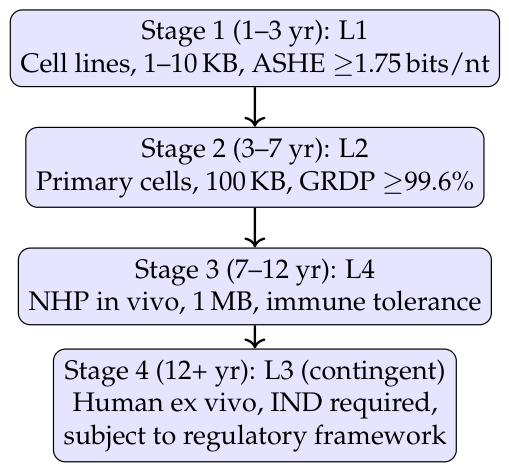
10.3. Five-Tier Governance Framework
- L1
- Human cell lines only (HEK293T, iPSC): No human subjects; BSL-2; IRB exempt.
- L2
- Ex vivo primary human cells (consenting adult donor, cells not returned): IRB approval under 45 CFR 46.
- L3
- Ex vivo with reinfusion: FDA IND under 21 CFR 312; equivalent to Phase 0 gene therapy trial; safety monitoring under [21] precedent.
- L4
- In vivo non-human primate: IACUC approval; full biodistribution and immunogenicity safety profile required.
- L5
- In vivo human: Prohibited until dedicated international regulatory framework established; analogous to the moratorium on heritable germline editing recommended by the 2020 International Commission on Clinical Use of Human Germline Genome Editing [24].
11. Open Challenges and Fundamental Limits
11.1. Fault Taxonomy
- 1.
- Prime editing efficiency ceiling: Even PE4 with MLH1dn achieves at most at optimised loci [18]; genome-wide average is substantially lower. This limits initial and constrains the clonal fraction model.
- 2.
- Mosaicism: Only a fraction of cells carry the complete payload post-editing; GRDP mitigates but does not eliminate this, and low () degrades long-term below usable thresholds.
- 3.
- Off-target genotoxicity: High-fidelity Cas9 variants (eSpCas9, HiFi-Cas9) achieve off-target indel rates [22]; sustained reductions toward are needed for clinical-equivalent safety margins.
- 4.
- Immune response: T5 () is the highest ongoing biological risk. Pre-existing T-cell and B-cell immunity against S. pyogenes Cas9 has been found in of healthy human donors [23]. This necessitates orthologous Cas variants (e.g., SaCas9, CjCas9) or fully human CRISPR-equivalent base-editing systems for human in vivo deployment.
- 5.
- Epigenetic silencing: CpG methylation can silence inserted sequences within weeks in cell culture. CTCF-flanked insulator elements and hypomethylated locus selection via ASHE’s criterion partially mitigate this risk.
- 6.
- Regulatory absence: No jurisdiction currently regulates non-therapeutic human genome modification for storage. Estimated regulatory framework development lag: 5–10 years.
- 7.
- Hayflick limit: Dividing somatic cells exhaust replicative capacity after –60 population doublings. Post-mitotic cell targets (neurons, cardiac myocytes) extend the archival window but complicate delivery.
11.2. Safe Harbor Scarcity
11.3. Archival Positioning
12. Cost Analysis
| Medium | Write/MB | Read/MB | Power |
|---|---|---|---|
| SSD (NVMe) | $0.00001 | $0.000001 | W |
| Tape | $0.0001 | $0.001 | 0 W |
| Synthetic DNA | $1,000+ | $10–50 | 0 W |
| Human Genomic | $500–2k | $10–50 | 0 W |
13. Research Roadmap
14. Reproducibility Statement
15. Conclusion
References
- IDC. DataSphere: The Global DataSphere Forecast. International Data Corporation, Doc. #US46410421, 2021.
- Heckel, R.; Mikutis, G.; Grass, R. N. A Characterization of the DNA Data Storage Channel. Sci. Rep. 2019, vol. 9, 9663. [Google Scholar] [CrossRef] [PubMed]
- Church, G. M.; Gao, Y.; Kosuri, S. Next-Generation Digital Information Storage in DNA. Science 2012, vol. 337(no. 6102), 1628. [Google Scholar] [CrossRef] [PubMed]
- Goldman, N.; et al. , Towards Practical, High-Capacity, Low-Maintenance Information Storage in Synthesized DNA. Nature 2013, vol. 494, 77–80. [Google Scholar] [CrossRef] [PubMed]
- Organick, L.; et al. , Random Access in Large-Scale DNA Data Storage. Nat. Biotechnol. 2018, vol. 36, 242–248. [Google Scholar] [CrossRef] [PubMed]
- Shipman, S. L.; Nivala, J.; Macklis, J. D.; Church, G. M. CRISPR-Cas Encoding of a Digital Movie into the Genomes of a Population of Living Bacteria. Nature 2017, vol. 547, 345–349. [Google Scholar] [CrossRef] [PubMed]
- Yim, S. S.; et al. Robust Direct Digital-to-Biological Data Storage in Living Cells. Nat. Chem. Biol. 2021, vol. 17, 246–253. [Google Scholar] [CrossRef] [PubMed]
- Zhang, J.; Hou, C.; Liu, C. CRISPR-Powered Quantitative Keyword Search Engine in DNA Data Storage. Nat. Commun. 2024, vol. 15, 2376. [Google Scholar] [CrossRef] [PubMed]
- ENCODE Project Consortium. Expanded Encyclopaedias of DNA Elements in the Human and Mouse Genomes. Nature 2020, vol. 583, 699–710. [Google Scholar] [CrossRef] [PubMed]
- Sadelain, M.; Papapetrou, E. P.; Bushman, F. D. Safe Harbours for the Integration of New DNA in the Human Genome. Nat. Rev. Cancer 2012, vol. 12, 51–58. [Google Scholar] [CrossRef] [PubMed]
- Papapetrou, E. P.; Schambach, A. Gene Insertion into Genomic Safe Harbors for Human Gene Therapy. Mol. Ther. 2016, vol. 24(no. 4), 678–684. [Google Scholar] [CrossRef] [PubMed]
- Grass, R. N.; et al. Robust Chemical Preservation of Digital Information on DNA in Silica with Error-Correcting Codes. Angew. Chem. Int. Ed. 2015, vol. 54, 2552–2555. [Google Scholar] [CrossRef] [PubMed]
- Hagelberg, E.; Hofreiter, M.; Keyser, C. Ancient DNA: the First Three Decades. Philos. Trans. R. Soc. B 2015, vol. 370, 20130371. [Google Scholar] [CrossRef] [PubMed]
- Erlich, Y.; Zielinski, D. DNA Fountain Enables a Robust and Efficient Storage Architecture. Science 2017, vol. 355, 950–954. [Google Scholar] [CrossRef] [PubMed]
- Anavy, L.; et al. Data Storage in DNA with Fewer Synthesis Cycles Using Composite DNA Letters. Nat. Biotechnol. 2019, vol. 37, 1229–1236. [Google Scholar] [CrossRef] [PubMed]
- Cong, L.; et al. , Multiplex Genome Engineering Using CRISPR/Cas Systems. Science 2013, vol. 339, 819–823. [Google Scholar] [CrossRef] [PubMed]
- Anzalone, A. V.; et al. Search-and-Replace Genome Editing Without Double-Strand Breaks or Donor DNA. Nature 2019, vol. 576, 149–157. [Google Scholar] [CrossRef] [PubMed]
- Chen, P. J.; et al. , Enhanced Prime Editing Systems by Manipulating Cellular Determinants of Editing Outcomes. Cell 2021, vol. 184(no. 22), 5635–5652. [Google Scholar] [CrossRef] [PubMed]
- Komor, A. C.; et al. Programmable Editing of a Target Base in Genomic DNA Without Double-Stranded DNA Cleavage. Nature 2016, vol. 533, 420–424. [Google Scholar] [CrossRef] [PubMed]
- Finn, J. D.; et al. A Single Administration of CRISPR/Cas9 Lipid Nanoparticles Achieves Robust and Persistent In Vivo Genome Editing. Cell Rep. 2018, vol. 22(no. 9), 2227–2235. [Google Scholar] [CrossRef] [PubMed]
- Frangoul, H.; et al. , CRISPR-Cas9 Gene Editing for Sickle Cell Disease and β-Thalassemia. N. Engl. J. Med. 2021, vol. 384, 252–260. [Google Scholar] [CrossRef] [PubMed]
- Slaymaker, I. M.; et al. Rationally Engineered Cas9 Nucleases with Improved Specificity. Science 2016, vol. 351, 84–88. [Google Scholar] [CrossRef] [PubMed]
- Charlesworth, C. T.; et al. Identification of Preexisting Adaptive Immunity to Cas9 Proteins in Humans. Nat. Med. 2019, vol. 25, 249–254. [Google Scholar] [CrossRef] [PubMed]
- Cyranoski, D. The CRISPR-Baby Scandal: What’s Next for Human Gene Editing. Nature 2019, vol. 566, 440–442. [Google Scholar] [CrossRef] [PubMed]
- Alexandrov, L. B.; et al. Signatures of Mutational Processes in Human Cancer. Nature 2013, vol. 500, 415–421. [Google Scholar] [CrossRef] [PubMed]
- Nguyen, B. V.; et al. Recording Gene Expression Order in DNA by CRISPR Addition of Retron Barcodes. Nature 2021, vol. 590, 92–97. [Google Scholar] [CrossRef]
- Cristofalo, V. J.; et al. , Replicative Senescence: A Critical Review. Mech. Ageing Dev. 2004, vol. 125(no. 10–11), 827–848. [Google Scholar] [CrossRef] [PubMed]
- SantaLucia, J., Jr. A Unified View of Polymer, Dumbbell, and Oligonucleotide DNA Nearest-Neighbor Thermodynamics. Proc. Natl. Acad. Sci. 1998, vol. 95(no. 4), 1460–1465. [Google Scholar] [CrossRef] [PubMed]
- Mitzenmacher, M. A Survey of Results for Deletion Channels and Related Synchronization Channels. Probab. Surv. 2009, vol. 6, 1–33. [Google Scholar] [CrossRef]
- Oxford Nanopore Technologies. “Nanopore Duplex Sequencing with Q20+ Chemistry (R10.4.1),” Technical Note, Oxford Nanopore Technologies Ltd. 2023. Available online: https://nanoporetech.com.
- Cover, T. M.; Thomas, J. A. Elements of Information Theory, 2nd ed.; Wiley-Interscience: Hoboken, NJ, 2006. [Google Scholar]
- Gompertz, B. On the Nature of the Function Expressive of the Law of Human Mortality, and on a New Mode of Determining the Value of Life Contingencies. Philos. Trans. R. Soc. Lond. vol. 115, 513–583, 1825. [CrossRef]
| Feature | Synthetic | Bacterial | Human (LISS) |
|---|---|---|---|
| Self-replication | ✗ | ✓ | ✓ |
| DNA repair | ✗ | Partial | Full MMR/BER/NER |
| Genome capacity | N/A | Mb | Gb |
| Safe-harbor loci | N/A | None | AAVS1, CCR5, ROSA26 |
| Host lifespan | 1000+ yr | Hours–days | Decades |
| Rewrite feasibility | High | Medium | Low |
| Telomere constraint | N/A | None | Yes ( div.) |
| Ethical risk | Low | Medium | Very High |
| Regulatory pathway | None | None | IND/ATMP |
| Write cost ($/MB) | $1k+ | $100+ | $500–2k |
| Encoder | GC ctrl. | Homopoly. | Off-target | Locus score | |
|---|---|---|---|---|---|
| Goldman [4] | 1.58 | Partial | ✓ | ✗ | ✗ |
| Grass RS [12] | 1.40 | ✓ | ✓ | ✗ | ✗ |
| DNA Fountain [14] | 1.98 | ✓ | Partial | ✗ | ✗ |
| ASHE (this work) | 1.75 | ✓ | ✓ | ✓ | ✓ |
| Config. | n | k | Fails tolerated | |
|---|---|---|---|---|
| GRDP single parity | 4 | 3 | 1 | 93.7% |
| GRDP dual parity | 5 | 3 | 2 | 99.65% |
| GRDP dual parity | 6 | 4 | 2 | 99.12% |
| No redundancy () | 3 | 3 | 0 | 60.9% |
| ID | Threat | P | I | |
|---|---|---|---|---|
| T1 | Unauthorized sequencing | 0.60 | 0.70 | 0.42 |
| T2 | Malicious CRISPR rewrite | 0.20 | 0.90 | 0.18 |
| T3 | Natural mutation drift | 0.50 | 0.60 | 0.30 |
| T4 | Cell population loss | 0.40 | 0.70 | 0.28 |
| T5 | Immune response (CRISPR) | 0.70 | 0.80 | 0.56 |
| T6 | Epigenetic silencing | 0.50 | 0.55 | 0.28 |
Disclaimer/Publisher’s Note: The statements, opinions and data contained in all publications are solely those of the individual author(s) and contributor(s) and not of MDPI and/or the editor(s). MDPI and/or the editor(s) disclaim responsibility for any injury to people or property resulting from any ideas, methods, instructions or products referred to in the content. |
© 2026 by the authors. Licensee MDPI, Basel, Switzerland. This article is an open access article distributed under the terms and conditions of the Creative Commons Attribution (CC BY) license (http://creativecommons.org/licenses/by/4.0/).