

Submitted:
19 September 2026
Posted:
20 September 2026
You are already at the latest version
Abstract
Background: Wearable and smartphone sensing can generate longitudinal physiological and behavioral data between conventional clinical encounters, while telemedicine and remote patient monitoring can extend care beyond facility walls. The unresolved translational problem is how to move from repeated signals to proportionate clinical action without converting noisy consumer measurements into diagnoses or overwhelming clinicians with alerts. In Indonesia, this question is increasingly concrete because SATUSEHAT Mobile already supports selected wearable pairing and longitudinal Health Diary data, while SATUSEHAT Platform provides HL7 FHIR-based interoperability.Objective: To develop a two-stage, evidence-gated framework that links low-burden longitudinal health monitoring with triggered targeted assessment, human-supervised clinical triage, and proportionate escalation of care.Methods: We used an evidence-informed conceptual framework-development approach. Source concepts were decomposed into sensing, measurement validity, longitudinal interpretation, trigger logic, remote assessment, triage, escalation, interoperability, governance, and implementation domains. A targeted evidence update through 19 September 2026 prioritized systematic reviews, validation studies, consensus recommendations, current Indonesian digital-health infrastructure, and related conceptual preprints. Proposed functions were classified as near-term capabilities, translational hypotheses, or functions not assumed without prospective validation.Results: RemoteMed360 is specified as a two-stage closed loop. Stage A uses low-burden longitudinal sensing to establish personal trajectories after quality and provenance gating. A trigger may arise from an explicit safety rule, persistent within-person deviation, user concern, multimodal concordance, or clinician request. Stage B activates TRIAGENT as a targeted assessment layer using only validated measurements required by the use case, followed by uncertainty-aware triage support and human clinical review. Responses are graded from continued observation to urgent escalation. A FHIR-oriented interoperability pathway is proposed for validated derived objects, while raw high-frequency data remain outside the clinical exchange layer. An eight-stage validation ladder separates measurement validity, data integrity, longitudinal validity, trigger validity, triage validity, human factors and governance, prospective care-process evaluation, and controlled implementation.Conclusions: RemoteMed360 should be evaluated as a research program for translating longitudinal health signals into proportionate care, not as an autonomous diagnostic or emergency system. Its central testable question is whether a two-stage sensing architecture can improve the timing and appropriateness of remote assessment and escalation while maintaining acceptable false-alert burden, clinician workload, equity, privacy, and safety.
Keywords:
remote patient monitoring
; wearable sensors
; digital biomarkers
; triage
; telemedicine
; clinical decision support
; SATUSEHAT
; HL7 FHIR
; artificial intelligence
; human oversight
; Indonesia
1. Introduction
Clinical care is usually organized around encounters, yet physiology and function continue to change between encounters. A blood-pressure reading in a clinic, an electrocardiogram during symptoms, or a structured history during a consultation can be clinically meaningful because each measurement is obtained in a defined context. Wearables and smartphones alter that temporal structure by making repeated measurement technically possible outside the facility. Recent reviews show that remote monitoring now spans activity, heart rate, temperature, blood pressure, oxygen saturation, biopotentials, and other variables across multiple chronic-disease settings [2]. The resulting density of data, however, creates an interpretive problem: the existence of more measurements does not by itself establish that a clinically meaningful change has occurred.
Measurement validity is uneven across devices, outcomes, and contexts. A living umbrella review of consumer wearables found that only a minority of marketed devices had been validated for at least one biometric outcome, with relatively good average heart-rate performance but substantial heterogeneity in sleep, activity, energy expenditure, oxygen saturation, and other measurements [3]. Device-specific studies demonstrate that smartwatch electrocardiography and oxygen-saturation measurement can be technically useful in selected settings [9,10], while cuffless blood-pressure technologies require dedicated validation procedures because calibration, posture, motion, and physiological change can alter performance [11]. These discrepancies matter because a remote system can create false precision when it treats every sensor output as an equally reliable clinical fact.
Remote monitoring also becomes clinically consequential only when a feedback pathway exists. Digital alerting has shown potential to improve selected outcomes in some remote-monitoring cohorts, but pooled evidence is heterogeneous and does not support a universal assumption that more alerts improve care [5]. Recent heart-failure telemonitoring reviews similarly describe mixed effects across mortality, readmission, quality of life, patient engagement, and implementation design [6]. The scientific problem is therefore located between sensing and action: which signal should trigger additional assessment, what additional information should be requested, who should interpret the result, and when should responsibility move to a clinician or emergency pathway?
Indonesia provides an unusually relevant setting for this question. SATUSEHAT Mobile’s Health Diary permits manual input, screening, and pairing with selected wearable devices, including data such as steps, calories, heart rate, blood pressure, and other health measurements [15]. SATUSEHAT Platform uses HL7 FHIR for health-data exchange and exposes clinical resource types that can support structured observations, assessments, encounters, service requests, and tasks [13,14]. The first technological step imagined in the original wearable-SATUSEHAT student proposal, connecting personal digital measurements to a national health ecosystem, is therefore no longer purely hypothetical. The harder problem is what should happen after connectivity exists.
The source concepts addressed complementary parts of that problem. The original PKM-GFT proposal envisioned longitudinal wearable data, artificial intelligence, and SATUSEHAT integration for prevention and earlier recognition of health risk. The RemoteMed360/TRIAGENT concept extended the pathway toward targeted remote sensing, specialist routing, teleconsultation, emergency referral, community health workers, and resource-constrained settings. Some original scenarios, however, moved too quickly from sensor output to autonomous treatment instructions. A research manuscript requires a stricter distinction between measurement, inference, triage support, and clinical responsibility.
Related Indonesian conceptual preprints provide methodological precedents for that reconstruction. NutriAgent+ separates sensing from interpretation, requires quality and uncertainty gates before AI-mediated recommendations, and treats national interoperability as a later translational stage [19]. SeniorBot uses longitudinal personal trajectories, graded response orchestration, and meaningful human oversight across heterogeneous sensing domains [20]. MindCare+ applies similar principles to behavioral trajectories, active confirmation, stepped support, and explicit high-risk escalation [21]. RemoteMed360 extends this lineage into a different translational question: how longitudinal physiological and symptom-related signals can trigger proportionate active assessment and then enter human-supervised clinical triage.
The objective of this paper is therefore to define RemoteMed360 as an evidence-gated, device-agnostic, human-supervised architecture linking longitudinal monitoring, triggered remote assessment, clinical triage, escalation, and feedback to the health record. The central hypothesis is deliberately falsifiable: a two-stage sensing architecture may improve the timing and appropriateness of assessment by keeping continuous monitoring low burden and reserving higher-specificity measurements for triggered situations, but its value depends on demonstrating measurement validity, acceptable false-alert burden, safe triage, workflow feasibility, equity, and prospective benefit.
2. Methods
2.1. Study Design and Framework-Development Approach
This study used an evidence-informed conceptual framework-development approach rather than a clinical trial or systematic review. The starting material consisted of two student innovation concepts developed in the same broader academic environment: a PKM-GFT proposal centered on wearable/smartphone data integration with SATUSEHAT for longitudinal preventive health monitoring, and a RemoteMed360/TRIAGENT concept centered on remote targeted assessment, specialty triage, teleconsultation, and escalation. The source concepts were treated as design hypotheses rather than evidence of efficacy.
The reconstruction had four purposes: to preserve the clinically meaningful intuition of continuous monitoring; to separate low-burden longitudinal sensing from targeted active assessment; to place measurement validity, uncertainty, and human responsibility before consequential action; and to convert a calendar-based implementation vision into a sequence of evidence gates that can stop or revise the program when a component fails. No participant-level data were generated and no statistical hypothesis testing was performed.
2.2. Evidence Domains and Source Use
A targeted evidence update was conducted through 19 September 2026. Priority was given to systematic reviews and validation studies on consumer wearables and remote patient monitoring; consensus recommendations for measurement domains with known validation challenges; prospective or systematic evidence on AI-supported triage; literature on digital sensor alerting and alert fatigue; and official Indonesian sources describing SATUSEHAT, Health Sandbox pathways, and personal-data protection [1,2,3,4,5,6,7,8,9,10,11,12,13,14,15,16,17,18,22,23,24,25]. Related conceptual preprints were used only as methodological precedents, not as evidence of clinical effectiveness [19,20,21].
This was not an exhaustive database search. No formal risk-of-bias synthesis or quantitative pooling was performed. Evidence was used only to establish component plausibility, measurement boundaries, governance requirements, or translational uncertainty. Absence of evidence for the complete RemoteMed360 architecture was treated as a limitation rather than filled by analogy.
2.3. Evidence-Boundary Classification
Proposed functions were classified into three maturity categories. Near-term capabilities include permissioned wearable or smartphone sensing, user-entered symptoms, validated cuff blood-pressure measurement, selected pulse oximetry and electrocardiographic acquisition, store-and-forward transmission, teleconsultation, clinician dashboards, and referral workflows. Translational hypotheses include individualized trajectory-deviation detection, multimodal trigger logic, automated requests for additional measurements, algorithmic prioritization, and cross-setting risk routing. Functions explicitly not assumed include autonomous diagnosis, unsupervised medication recommendations, deterministic prediction of specific diseases from consumer-grade signals, passive emergency disposition without a validated protocol, and guaranteed cost savings or reduction in hospital use.
2.4. Conceptual Synthesis Rules
Seven rules governed the framework. First, sensing is not interpretation: a measurable value must not be treated as a diagnosis. Second, continuous monitoring should be broad but low burden, whereas clinically informative sensing should become more targeted after a trigger. Third, data quality, provenance, calibration, missingness, and uncertainty precede model inference. Fourth, longitudinal interpretation should combine within-person trajectories with validated population-level safety thresholds rather than rely exclusively on either. Fifth, system autonomy decreases as potential harm increases; clinically consequential outputs require meaningful human review [1]. Sixth, interoperability follows local validity: encoding a noisy signal in FHIR does not make it clinically meaningful. Seventh, resource-constrained deployment must degrade gracefully, preserving identity, measurement validity, essential communication, and human escalation before optional automation.
2.5. Prespecified Conceptual Outputs
The prespecified outputs were: (1) a two-stage closed-loop RemoteMed360 architecture; (2) an evidence-bounded hierarchy of candidate sensing domains; (3) explicit trigger logic linking Stage A monitoring to Stage B TRIAGENT assessment; (4) a graded response ladder with human oversight; (5) use-case reformulations for the original febrile-child, chest-pain, and hypertensive-pregnancy scenarios; (6) a conceptual SATUSEHAT/FHIR interoperability pathway; (7) a graceful-degradation model for 3T (tertinggal, terdepan, dan terluar; disadvantaged/frontier/outermost areas) and other resource-constrained settings; and (8) an evidence-gated translational validation pathway.
3. Results
3.1. Intended Use and Central Testable Question
RemoteMed360 is intended as a research and care-navigation architecture for people who knowingly participate in remote monitoring or remote assessment. It is not conceived as covert population surveillance and is not restricted to a single disease. The intended unit of analysis is a longitudinal person-in-context trajectory, supplemented by targeted measurements when a clinically relevant question emerges.
The central testable question is whether repeated low-burden sensing can identify situations in which additional assessment is justified, and whether a targeted, human-supervised response pathway can improve the timing and appropriateness of care without producing unacceptable false alerts, workload, privacy burden, inequity, or clinical harm. A valid outcome can therefore be negative: a sensor, trigger rule, or triage component may be removed if it fails to add useful information beyond simpler alternatives.
3.2. Human-Supervised Two-Stage Closed-Loop Architecture
Figure 1 summarizes the proposed architecture. Stage A provides longitudinal context through low-burden wearable, smartphone, and user-entered data. Those inputs pass through a quality and provenance gate before they contribute to a personal trajectory model. A trigger can arise from a user concern, a validated safety threshold, persistent within-person deviation, concordant change across independent modalities, or a clinician request. A trigger does not equal a diagnosis; it opens Stage B, where TRIAGENT requests a smaller set of targeted measurements appropriate to the question. Triage support then summarizes and routes information while exposing uncertainty. Clinically consequential decisions remain with qualified humans operating within validated protocols. Outcomes return to the health record and update the context for future monitoring.
3.3. Stage A: Low-Burden Longitudinal Sensing
Stage A is designed to answer a narrow question: is the person’s recent physiological or functional trajectory sufficiently different, persistent, or concerning to justify another assessment step? It is not designed to continuously assign disease labels. Candidate inputs include heart rate, activity, selected sleep and recovery features, user-entered symptoms, and context such as known diagnoses or medications where consent and governance permit. The data burden should be the smallest set that can support a defined decision.
The architecture treats measurement classes asymmetrically. Heart rate derived from photoplethysmography may be relatively robust in many everyday contexts, whereas sleep staging, cuffless blood pressure, and some oxygen-saturation outputs can carry larger or more context-dependent error [3,10,11,12]. A high data frequency does not compensate for poor measurement validity. RemoteMed360 therefore permits an input stream to be ignored when its uncertainty exceeds its expected decision value.

Table 1.
Candidate RemoteMed360 input streams and evidence boundaries. The table defines intended roles rather than claiming universal clinical validity for a device category.
Table 1.
Candidate RemoteMed360 input streams and evidence boundaries. The table defines intended roles rather than claiming universal clinical validity for a device category.
| Candidate stream | Candidate source | Role in RemoteMed360 | Evidence boundary |
|---|---|---|---|
| Heart rate / pulse features | Wrist PPG; ECG as reference where needed | Longitudinal autonomic/cardiovascular context; personal resting-pattern deviation | Device and activity context matter. Do not infer a specific disease from HR alone [3]. |
| Activity / mobility | Accelerometer; phone/wearable steps | Functional trajectory, recovery, inactivity change | Behavioral context only; reduced activity is nonspecific and may reflect environment or preference [2,3,4]. |
| Sleep-related features | Wearable accelerometry + PPG | Circadian/recovery context; persistence of change | Consumer devices estimate sleep imperfectly; sleep-stage claims require caution and use-case validation [12]. |
| SpO₂ | Medical-grade or specifically validated oximeter; selected smartwatch as adjunct | Triggered respiratory/cardiopulmonary assessment | Smartwatch agreement can be acceptable on average but outliers occur; consequential decisions require confirmatory context [10]. |
| Blood pressure | Validated upper-arm cuff preferred; validated wearable cuff where appropriate | Triggered assessment for hypertension, pregnancy, symptoms | Cuffless methods require dedicated validation and recalibration; not assumed equivalent to validated cuff measurement [11]. |
| ECG | Validated single-lead wearable or portable ECG; multi-lead reference when clinically required | Targeted ECG waveform acquisition, rhythm-relevant assessment, and transmission | Smartwatch ECG can capture useful waveforms in selected settings but does not replace reference ECG or clinician interpretation [9]. |
| Temperature / respiratory rate | Validated thermometer; device-specific respiratory measurement | Triggered infection/respiratory context | Use only validated measurement methods; deviations are nonspecific and require symptom/context integration [2,4]. |
| Symptoms / user report | Structured questionnaire or guided check-in | Defines what the person feels and why active assessment is being performed | User report independently complements and contextualizes sensor data [4]; explicit user concern may serve as a prespecified RemoteMed360 trigger. |
| Clinical context | Consented record: diagnoses, medications, pregnancy, prior results | Sets contraindications, baseline risk, and routing context | Must carry provenance and purpose limitation; absence of data should remain visible rather than inferred [1,16,18]. |
3.4. Data-Quality, Provenance, and Uncertainty Gate
Before any model interprets a signal, the system should determine whether the measurement is usable. Minimum checks include device identity, timestamp, sampling completeness, wear time, motion or acquisition artifact, plausible range, calibration status where relevant, signal-quality indicators, and whether the data were measured actively or passively [4]. Provenance must remain attached to derived summaries because a heart-rate value from a validated clinical device and a vendor-derived wellness metric should not become indistinguishable after data fusion.
Uncertainty should change system behavior. A low-confidence condition may produce no alert, request another measurement, or recommend human review rather than amplify autonomy. This is particularly important when multimodal systems create the visual appearance of precision by combining several weak inputs. RemoteMed360 therefore treats ‘insufficient information’ and ‘remain silent’ as legitimate outputs.
3.5. Longitudinal Trajectory and Trigger Logic
The personal trajectory layer compares recent data with the person’s own prior state while retaining validated clinical thresholds as safety boundaries. The baseline is not permanent: medication changes, pregnancy, acute illness, rehabilitation, ageing, and changes in activity can establish a new steady state. Longitudinal baseline methods therefore need to accommodate evolving trends rather than assume that an early observation window defines lifelong normality [22]. In RemoteMed360, validated fixed safety thresholds are retained as independent guardrails so that an adapting personal baseline cannot by itself normalize clinically important change.
A RemoteMed360 trigger should be attributable to a reason that can be displayed and audited. Candidate trigger classes are: (1) direct user concern; (2) a predefined safety threshold from a validated measurement; (3) a persistent within-person deviation; (4) concordant change across independent modalities; and (5) clinician-initiated assessment. Trigger validity must be evaluated prospectively, because an architecture that detects every minor fluctuation will create alert fatigue and eventually reduce attention to meaningful signals [8].
3.6. Stage B: TRIAGENT as Targeted Active Assessment
TRIAGENT is positioned as an active assessment module rather than a continuously autonomous diagnostician. After a trigger, it asks the smallest set of additional questions or measurements needed to clarify urgency. The required measurement stack should vary by use case. Chest symptoms may justify a structured symptom assessment and a validated ECG [24]. Additional physiological measurements such as pulse or SpO₂ should be included only where a validated use-case protocol specifies them. High blood pressure in pregnancy requires a validated blood-pressure measurement plus gestational context and warning symptoms [25]. A febrile child requires an age-specific pathway; for children under 5 years, remote-assessment guidance emphasizes measured temperature, serious-illness warning features, hydration/behavioral status, and caregiver concern [23]. A future implementation may use rules, statistical models, machine learning, or language models to organize the interaction, but the model class is secondary to validation of the decision pathway.
3.7. Graded Response and Meaningful Human Oversight
RemoteMed360 should not convert every deviation into a referral. Table 2 defines a graded response ladder. The intended behavior is conservative: autonomy may be higher for low-risk information gathering, reminders, or requests for a repeat measurement, but decreases as clinical consequence rises. AI-supported triage evidence is promising but heterogeneous, and prospective studies support its role as decision support rather than a replacement for triage professionals [1,7].
3.8. Reformulating the Original TRIAGENT Use Cases
The original RemoteMed360 concept illustrated pediatric febrile illness, chest pain, and hypertensive pregnancy. Those scenarios are retained because they stress different sensing and routing requirements, but the decision boundaries are rewritten to remove autonomous medication or disease-labeling claims.
Table 3.
Evidence-bounded reconstruction of three original RemoteMed360/TRIAGENT scenarios. The framework preserves the clinical routing intuition while relocating diagnosis and treatment responsibility to validated human-supervised pathways.
Table 3.
Evidence-bounded reconstruction of three original RemoteMed360/TRIAGENT scenarios. The framework preserves the clinical routing intuition while relocating diagnosis and treatment responsibility to validated human-supervised pathways.
| Use case | Original design intuition | RemoteMed360 evidence-bounded reformulation | Required evidence / oversight |
|---|---|---|---|
| Febrile child | Temperature and other signals identify risk and route to pediatric care; remote logistics may support access. | TRIAGENT confirms age, measured temperature, respiratory or neurologic warning signs, hydration/behavioral status and caregiver concern; the system may prioritize pediatric review or emergency escalation without diagnosing a febrile seizure from sound or temperature alone. For children under 5 years, remote fever assessment should follow an age-specific validated pathway [23]. | Age-specific protocol, validated temperature/SpO₂ if used, caregiver usability, false-negative analysis, pediatric clinical governance [23]. |
| Chest pain in older adult | Portable ECG and SpO₂ support recognition of possible cardiac emergency and transmission to hospital. | TRIAGENT obtains symptom timing, severity and associated features plus a validated ECG where available. Additional physiological measurements are collected only where a validated use-case protocol specifies them. Algorithmic support may flag urgency and transmit data, but ischemia diagnosis and medication instructions require clinician/protocol responsibility [24]. | ECG acquisition validity, comparison with reference clinical assessment, under-triage safety, time-to-review and emergency routing performance [9,24]. |
| High BP in pregnancy | Automated BP measurement identifies pre-eclampsia risk and routes to obstetric care. | TRIAGENT requires validated BP measurement, gestational context and warning symptoms; repeated severe values or red-flag symptoms trigger urgent human obstetric review. Medication or MgSO₄ decisions are not automated [25]. | Validated pregnancy-appropriate BP device, obstetric protocol, connectivity fallback, referral completion and maternal safety outcomes [11,25]. |
3.9. SATUSEHAT Interoperability as a Late Translational Layer
SATUSEHAT provides a practical national interoperability context because its platform is based on HL7 FHIR and exposes resources relevant to observations, diagnostic reports, risk assessments, encounters, service requests, and tasks [13,14]. RemoteMed360 should nevertheless avoid equating technical exchange with clinical validity. Raw high-frequency waveforms and vendor-derived features may require a dedicated longitudinal store, with only validated, semantically defined summaries entering the operational exchange layer.
A conceptual mapping is shown in Table 4. The mapping is intentionally provisional because actual SATUSEHAT use cases, profiles, authorization, terminology requirements, and production governance must be defined with the platform and regulators. The framework assumes neither national deployment nor reimbursement.
3.10. Resource-Constrained Deployment and Graceful Degradation
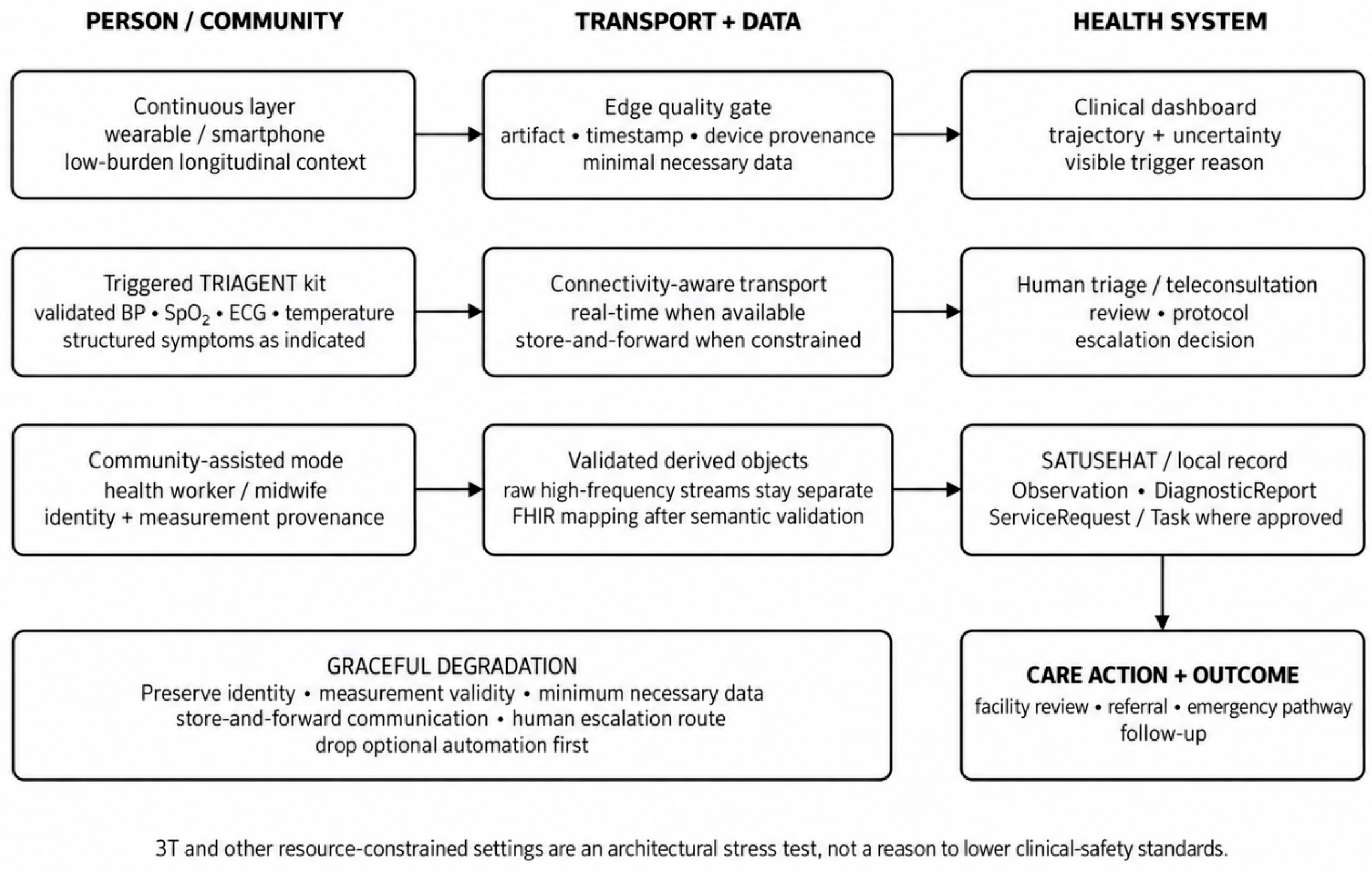
The RemoteMed360 source concept explicitly targeted 3T (tertinggal, terdepan, dan terluar) and other settings in which connectivity, specialist access, logistics, and device availability may be constrained. In the rebuilt framework, these settings are treated as an architectural stress test rather than a reason to lower safety standards. The system should degrade by dropping optional automation first, while preserving patient identity, measurement provenance, the minimum clinically necessary dataset, store-and-forward transmission, and a human escalation route.
A community health worker or midwife may therefore become the measurement and communication interface when direct consumer-device use is impractical. Real-time cloud connectivity is useful but not structurally mandatory for every step. Local caching and asynchronous transmission can preserve the assessment chain until connectivity returns. Drone delivery, smart ambulances, satellite links, or other logistics remain optional implementation modules whose value must be tested separately from the clinical sensing and triage architecture.
Figure 2.
RemoteMed360 deployment and interoperability stack. The architecture supports real-time or store-and-forward transport and prioritizes graceful degradation in resource-constrained settings. Optional logistics modules are downstream of measurement and clinical-safety requirements.
Figure 2.
RemoteMed360 deployment and interoperability stack. The architecture supports real-time or store-and-forward transport and prioritizes graceful degradation in resource-constrained settings. Optional logistics modules are downstream of measurement and clinical-safety requirements.
3.11. Evidence-Gated Translational Validation Pathway
The original PKM-GFT roadmap was organized around a multi-year development schedule. For research purposes, calendar time is less informative than evidence gates. Figure 3 and Table 5 define eight stages in which each stage can produce a go, revise, or stop decision. A component that fails one stage should not be rescued by downstream AI or interoperability.
3.12. Stakeholder and Implementation Ecosystem
Implementation requires narrower role definitions than the original stakeholder list. Biomedical engineering and technology teams are responsible for measurement architecture, device integration, software reliability, observability, cybersecurity, and provenance. Clinical specialties define intended use, escalation thresholds, contraindications, and reference standards. Primary-care facilities and community health workers define feasible workflows and continuity. Human-factors researchers and users co-design consent, notifications, and interfaces. Legal, ethics, privacy, and security expertise is required before patient-generated data are linked to clinical systems. At national level, Kementerian Kesehatan and relevant SATUSEHAT governance structures determine permissible interoperability, while Health Sandbox offers an existing staged pathway for testing and evaluation of health-technology innovation [17].
4. Discussion
4.1. Principal Finding of the Conceptual Synthesis
The principal result of this reconstruction is a shift in the scientific object. RemoteMed360 is not primarily a smartwatch project, a telemedicine platform, an AI triage model, a drone network, or a SATUSEHAT integration proposal. Its proposed contribution is the transition mechanism between longitudinal signal and proportionate clinical action. That transition is made explicit through two sensing stages, evidence gates, graded responses, and a feedback loop.
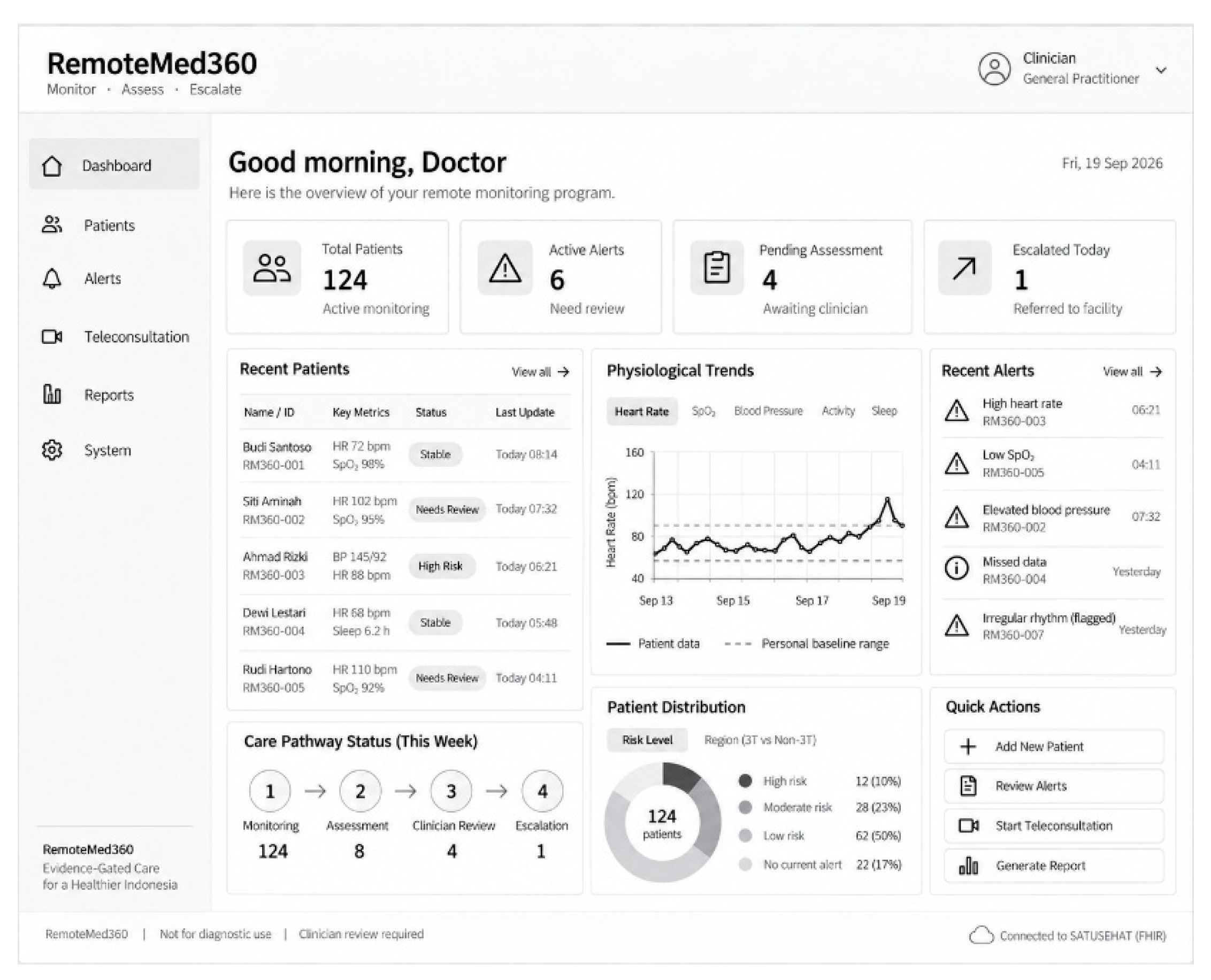
Figure 4.
Conceptual clinician-facing RemoteMed360 dashboard. The interface summarizes longitudinal monitoring, patient trajectories, active alerts, pending assessments, graded care-pathway status, and teleconsultation or escalation workflows, while keeping clinical review separate from automated signal detection. SATUSEHAT/FHIR connectivity is shown as an interoperability layer rather than as evidence of diagnostic validity or autonomous decision-making.
Figure 4.
Conceptual clinician-facing RemoteMed360 dashboard. The interface summarizes longitudinal monitoring, patient trajectories, active alerts, pending assessments, graded care-pathway status, and teleconsultation or escalation workflows, while keeping clinical review separate from automated signal detection. SATUSEHAT/FHIR connectivity is shown as an interoperability layer rather than as evidence of diagnostic validity or autonomous decision-making.
The two-stage design addresses a recurring problem in digital health: continuous monitoring and diagnostic assessment require different measurement strategies. A low-burden wearable can be useful for identifying a change in trajectory even when it lacks the specificity required for diagnosis. Conversely, an ECG, validated blood-pressure measurement, or structured symptom assessment may be too burdensome or unnecessary for continuous acquisition but valuable after a trigger. Separating those roles reduces the temptation to turn every consumer sensor into a diagnostic instrument.
4.2. RemoteMed360 Versus Telemedicine and Conventional Remote Patient Monitoring
Conventional telemedicine primarily relocates a clinical encounter: history, visual assessment, communication, and professional decision-making occur remotely. Remote patient monitoring adds repeated data between encounters. RemoteMed360 is conceptually distinct because it proposes an intermediate transition: longitudinal monitoring determines when a more specific active assessment is justified, and the resulting information then enters a human-supervised triage and care-navigation pathway.
This distinction matters because remote-monitoring effectiveness is not uniform. Digital sensor alerting and telemonitoring studies show that benefits depend on cohort, feedback mechanism, clinician response, engagement, and implementation design [5,6]. The framework therefore does not claim that continuous data collection is inherently superior. A RemoteMed360 implementation should justify its complexity by showing improved timing, safety, continuity, or access beyond simpler follow-up models.
4.3. Methodological Relationship to NutriAgent+, SeniorBot, and MindCare+
RemoteMed360 deliberately inherits several methodological principles from related Indonesian conceptual preprints while applying them to a different care problem. NutriAgent+ contributes the separation of measurement validity, quality gating, uncertainty, bounded autonomy, and later-stage interoperability [19]. SeniorBot contributes trajectory-based interpretation, multimodal concordance, and graded escalation [20]. MindCare+ contributes the idea that passive longitudinal signals should prompt an additional assessment step rather than directly assign a clinical label, with human escalation for consequential states [21]. RemoteMed360 adds a more explicit bridge between Stage A monitoring and Stage B targeted physiological assessment, then carries that bridge through triage, referral, and health-system feedback.
4.4. Clinical Safety, Alert Fatigue, and Limits of Automation
The most consequential design error would be to treat triage probability as clinical authority. AI-supported emergency triage has shown potentially useful performance in prospective studies, yet the evidence base remains small and heterogeneous [7]. RemoteMed360 therefore uses algorithms to organize, prioritize, request information, and support routing. Diagnosis, medication changes, and emergency disposition require separate validation and accountable clinical ownership [1,7].
Alert burden is equally important. Alert fatigue is widely cited in clinical decision support, while its operational definition is itself inconsistent across the literature [8]. RemoteMed360 should therefore treat alert quantity, response rate, repeated dismissal, false-positive burden, and sustained changes in appropriate response as implementation outcomes. A model with excellent retrospective discrimination can still fail if it produces too many low-value interruptions in real use.
4.5. Health-System and Economic Implications as Hypotheses
The original wearable proposal linked prevention and earlier detection to potential reduction of BPJS expenditure. The rebuilt framework treats that relationship as a health-economic hypothesis rather than an expected outcome. Earlier recognition can increase short-term utilization by generating more assessments, referrals, and diagnostic tests before it reduces any downstream high-acuity care. Economic evaluation should therefore measure total pathway cost, avoided or added utilization, clinician time, device and connectivity costs, false-alert work, equity effects, and patient-incurred costs. RemoteMed360 would be economically defensible only if those added resources produce sufficient improvement in safety, access, timing, outcomes, or efficiency relative to simpler alternatives.
4.6. Privacy, Data Governance, and Equity
Longitudinal health monitoring creates a privacy burden that is qualitatively different from a single clinical encounter. Continuous or repeated data can reveal routines, mobility, sleep, pregnancy-related information, disease status, and other sensitive patterns. Indonesia’s Personal Data Protection Law explicitly includes health information among specific personal data, and SATUSEHAT’s own privacy notice links processing to applicable health and data-protection law [16,18]. RemoteMed360 therefore requires purpose limitation, data minimization, user control, role-based access, auditable access, retention rules, incident response, and clear separation between research, clinical care, and secondary uses.
Equity also operates at several levels. Requiring an expensive smartwatch can exclude the people who might benefit most from remote care; algorithm performance can vary across device types and populations; and connectivity can determine whether a technically sound protocol is practically available. The framework therefore favors device-agnostic interfaces, community-assisted measurement, and graceful degradation. National integration should occur only after subgroup performance and access constraints are evaluated prospectively.
4.7. Proposed Empirical Research Sequence
A minimum viable research program can proceed without building the full futuristic ecosystem. First, a technical and observational phase should establish measurement reliability, data completeness, provenance, and normal within-person variability for a deliberately small sensor set. Second, trigger algorithms should be evaluated in silent mode, where alerts are generated but do not change care, allowing comparison with structured active assessments and clinician judgement. Third, a human-factors phase should test whether users can understand prompts, complete targeted measurements, and withdraw consent, and whether clinicians can interpret summaries without unacceptable workload.
Only after those gates should a controlled care-navigation pilot evaluate event-triggered assessment, teleconsultation, referral completion, time to appropriate review, safety events, alert burden, and equity. SATUSEHAT interoperability and Health Sandbox evaluation are late-stage translation questions rather than prerequisites for proving the clinical logic. Logistics such as drone delivery or smart ambulances should be tested as separable modules after the sensing-to-triage pathway is safe and useful.
4.8. Limitations
This paper is a conceptual synthesis and reports no empirical RemoteMed360 performance. The evidence base is heterogeneous because measurement validation, remote monitoring, telemedicine, triage, human factors, and interoperability are separate literatures. Evidence supporting one component does not establish the effectiveness of their integration. The targeted evidence update was not a systematic review and may omit relevant studies.
The framework is intentionally device-agnostic, which improves durability but prevents a single statement of technical performance. Clinical protocols will also differ by age, disease, pregnancy status, geography, device access, and level of care. The conceptual FHIR mapping does not represent an approved SATUSEHAT RemoteMed360 implementation. Finally, the source RemoteMed360 scenarios contain technology-specific ideas such as drones and smart ambulances that remain optional logistics hypotheses rather than validated components of the core architecture.
5. Conclusion
RemoteMed360 reframes two earlier student innovation concepts into a single evidence-gated research architecture. Its central mechanism is a two-stage transition from low-burden longitudinal monitoring to triggered active assessment. Data are admitted to interpretation only after quality and provenance checks; deviation is interpreted against personal trajectory and validated safety boundaries; TRIAGENT requests targeted measurements when additional specificity is needed; algorithmic triage support remains uncertainty-aware; and consequential action returns to human clinical responsibility.
The framework is designed to fail informatively. A sensor can be removed, a trigger can be recalibrated, a triage rule can be stopped, or an implementation model can be rejected without invalidating every other component. Whether RemoteMed360 improves access, timeliness, continuity, outcomes, or cost remains an empirical question. Its next scientific step is therefore not national deployment, but staged validation of the smallest clinically meaningful loop from signal, to assessment, to human-reviewed action, and back to longitudinal context.
Author Contributions
Author contributions follow the documented contribution record of the source PKM-GFT proposal and the 2026 manuscript reconstruction. Husnul Riziq: drafting the general structure of the introduction, core concept, and conclusion. Dewi Sugiarti: data collection and revision of the introduction. Hanum Annisa Hapsari: revision of the core concept and conclusion. Ahmad Mahdi: original figure design, report framework, and appendices. Alya Rahma Fadila: systematic and language review of the original proposal. Qorry Amanda: design guidance, supervision, proposal alignment, manuscript reframing, evidence updating, citation verification, and writing and revision of the 2026 manuscript. All authors reviewed and approved the final manuscript.
Funding
This research received no external funding.
Ethics statement
Not applicable to the present manuscript. This paper is a conceptual framework and reports no research involving human participants, animals, or newly generated identifiable patient data. Future prospective studies will require appropriate ethics, privacy, regulatory, and health-system review according to study design and intended use.
Data availability
No new participant-level dataset was generated or analyzed for this conceptual manuscript. The framework was developed from the authors’ source innovation documents, publicly available literature, and official Indonesian digital-health and regulatory materials.
Conflicts of Interest
The authors declare no conflicts of interest.
Generative AI assistance
Generative AI tool ChatGPT 5.6 was used for language editing and structural refinement. All authors remain responsible for verifying the manuscript, citations, interpretations, figures, and final submitted content.
References
- World Health Organization. Ethics and governance of artificial intelligence for health: WHO guidance; World Health Organization: Geneva, 2021; Available online: https://www.who.int/publications/i/item/9789240029200ISBN 978-92-4-002920-0.
- Tegegne, M.D.; Niakan Kalhori, S.R.; Haas, P.; Sobotta, V.M.G.; Warnecke, J.; Deserno, T.M. Wearable Devices for Remote Monitoring of Chronic Diseases: Systematic Review. JMIR Mhealth Uhealth 2026, 14, e74071. [Google Scholar] [CrossRef]
- Doherty, C.; Baldwin, M.; Keogh, A.; Caulfield, B.; Argent, R. Keeping Pace with Wearables: A Living Umbrella Review of Systematic Reviews Evaluating the Accuracy of Consumer Wearable Technologies in Health Measurement. Sports Med. 2024, 54(11), 2907–2926. [Google Scholar] [CrossRef]
- Daniore, P.; Nittas, V.; Haag, C.; Bernard, J.; Gonzenbach, R.; von Wyl, V. From wearable sensor data to digital biomarker development: ten lessons learned and a framework proposal. npj Digit Med. 2024, 7, 161. [Google Scholar] [CrossRef]
- Iqbal, F.M.; Lam, K.; Joshi, M.; Khan, S.; Ashrafian, H.; Darzi, A. Clinical outcomes of digital sensor alerting systems in remote monitoring: a systematic review and meta-analysis. npj Digit Med. 2021, 4, 7. [Google Scholar] [CrossRef]
- Kwaah, P.A.; Olumuyide, E.; Farhat, K.; Malaga-Espinoza, B.; Abdullah, A.; Beasley, M.H.; et al. Non-Invasive Telemonitoring in Heart Failure: A Systematic Review. Medicina 2025, 61(7), 1277. [Google Scholar] [CrossRef]
- Yi, N.; Baik, D.; Baek, G. The effects of applying artificial intelligence to triage in the emergency department: A systematic review of prospective studies. J. Nurs. Scholarsh. 2025, 57(1), 105–118. [Google Scholar] [CrossRef]
- Ray, C.E.; Wilson, G.M.; Hughes, A.M.; Goedken, C.C.; Liu, E.P.F.; Fitzpatrick, M.A.; et al. Alert fatigue measurement in clinical decision support: a systematic review. J. Am. Med. Inf. Assoc. 2026, 33(8), 1523–1531. [Google Scholar] [CrossRef]
- van der Zande, J.; Strik, M.; Dubois, R.; Ploux, S.; Abu Alrub, S.; Caillol, T.; et al. Using a Smartwatch to Record Precordial Electrocardiograms: A Validation Study. Sensors 2023, 23(5), 2555. [Google Scholar] [CrossRef]
- Windisch, P.; Schröder, C.; Förster, R.; Cihoric, N.; Zwahlen, D.R. Accuracy of the Apple Watch Oxygen Saturation Measurement in Adults: A Systematic Review. Cureus 2023, 15(2), e35355. [Google Scholar] [CrossRef]
- Stergiou, G.S.; Avolio, A.P.; Palatini, P.; Kyriakoulis, K.G.; Schutte, A.E.; Mieke, S.; et al. European Society of Hypertension recommendations for the validation of cuffless blood pressure measuring devices. J. Hypertens. 2023, 41(12), 2074–2087. [Google Scholar] [CrossRef]
- Schyvens, A.M.; Van Oost, N.C.; Aerts, J.M.; Masci, F.; Peters, B.; Neven, A.; et al. Accuracy of Fitbit Charge 4, Garmin Vivosmart 4, and WHOOP Versus Polysomnography: Systematic Review. JMIR Mhealth Uhealth 2024, 12, e52192. [Google Scholar] [CrossRef]
- Kementerian Kesehatan Republik Indonesia. SATUSEHAT Platform: FHIR. Available online: https://satusehat.kemkes.go.id/platform/docs/id/fhir/ (accessed on 19 September 2026).
- Kementerian Kesehatan Republik Indonesia. SATUSEHAT Platform: Interoperabilitas / FHIR Resources. Available online: https://satusehat.kemkes.go.id/platform/docs/id/fhir/resources/ (accessed on 19 September 2026).
- Kementerian Kesehatan Republik Indonesia. Syarat dan Ketentuan Penggunaan SATUSEHAT Mobile, section 5.10 Diari Kesehatan. Effective 16 August 2024. Available online: https://satusehat.kemkes.go.id/mobile/faq/topic/1bea5c3f-e863-4ca0-98c2-3bc0905a8371 (accessed on 19 September 2026).
- Kementerian Kesehatan Republik Indonesia. Pemberitahuan Privasi SATUSEHAT Mobile. Available online: https://satusehat.kemkes.go.id/mobile/faq/topic/214790a9-6894-46e9-9f13-0565ba3201f6 (accessed on 19 September 2026).
- Kementerian Kesehatan Republik Indonesia. Sandbox Kesehatan. Available online: https://sandbox.kemkes.go.id/ (accessed on 19 September 2026).
- Republic of Indonesia. Undang-Undang Nomor 27 Tahun 2022 tentang Pelindungan Data Pribadi. 17 October 2022. Available online: https://peraturan.bpk.go.id/Details/229798/uu-no-27-tahun-2022%20/.
- Haq, S.F.; Syahhada, J.R.; Shandy, I.C.Y.S.; Amanda, Q. NutriAgent+: A Conceptual Framework for Agentic AI, Multimodal Wearable Biosensing, and Precision Nutrition in Indonesia. Preprints.org [Preprint]. 2026. Available online: https://www.preprints.org/manuscript/202608.1845. [CrossRef]
- Dhiyaulhaq, D.; Caesaria, I.A.; Syarief, H.; Lidina, F.Z.; Fitriyah, A.L.; Amanda, Q. SeniorBot: A Human-Supervised Multiscale Gerontechnology Framework for Longitudinal Health-Trajectory Monitoring and Adaptive Robotic Assistance. Preprints.org [Preprint]. 2026. Available online: https://www.preprints.org/manuscript/202608.2121. [CrossRef]
- Faradis, M.I.; Fahrani, P.D.; Kholid, A.; Fairuz, A.D.; Hafid, S.M.; Amanda, Q. MindCare+: A Digital Phenotyping Framework for Mental Health Monitoring and Support in Indonesia. Preprints.org [Preprint]. Version 2. 2026. Available online: https://www.preprints.org/manuscript/202609.1140. [CrossRef]
- Just, S.A.; Tedeschi, E.; Holsbø, E.; Mikalsen, K.Ø.; Bongo, L.A.; Homan, P.; Elvevåg, B. The challenges of implementing hybrid baselines for the interpretation of longitudinal behavioral data from individuals. npj Digit Med. 2026, 9, 331. [Google Scholar] [CrossRef]
- National Institute for Health and Care Excellence. Fever in under 5s: assessment and initial management. NICE guideline NG143. 7 November 2019; updated 26 November 2021. Available online: https://www.nice.org.uk/guidance/NG143 (accessed on 19 September 2026).
- Gulati, M.; Levy, P.D.; Mukherjee, D.; et al. 2021 AHA/ACC/ASE/CHEST/SAEM/SCCT/SCMR Guideline for the Evaluation and Diagnosis of Chest Pain: A Report of the American College of Cardiology/American Heart Association Joint Committee on Clinical Practice Guidelines. J. Am. Coll. Cardiol. 2021, 78(22), e187–e285. [Google Scholar] [CrossRef]
- Magee, L.A.; Brown, M.A.; Hall, D.R.; et al. The 2021 International Society for the Study of Hypertension in Pregnancy classification, diagnosis & management recommendations for international practice. Pregnancy Hypertens. 2022, 27, 148–169. [Google Scholar] [CrossRef]
Figure 1.
RemoteMed360 human-supervised closed-loop architecture. Low-burden longitudinal sensing is separated from triggered active assessment. Quality, provenance, uncertainty, and human-responsibility gates prevent a direct jump from consumer signal to clinical action.
Figure 1.
RemoteMed360 human-supervised closed-loop architecture. Low-burden longitudinal sensing is separated from triggered active assessment. Quality, provenance, uncertainty, and human-responsibility gates prevent a direct jump from consumer signal to clinical action.
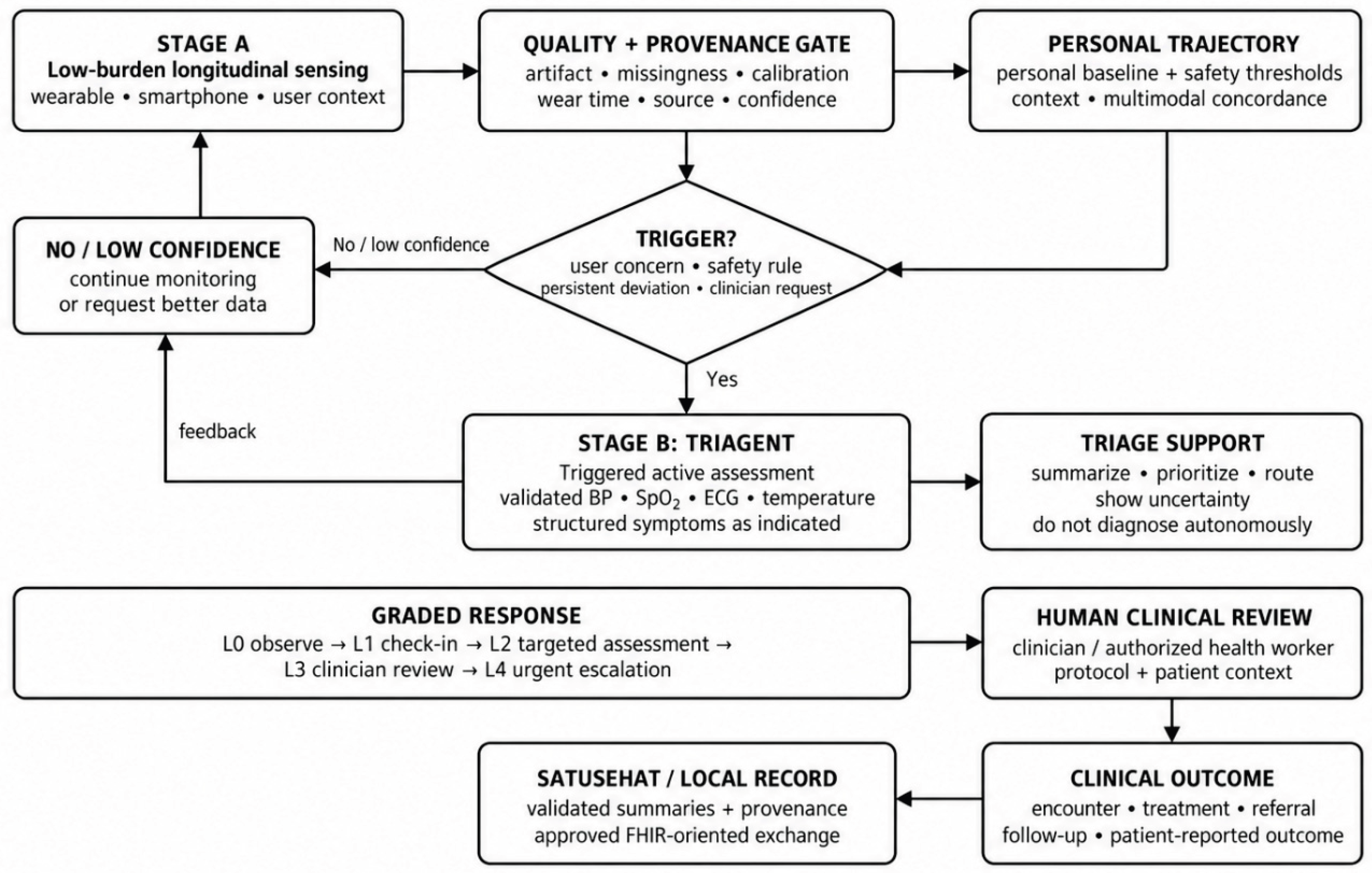
Figure 3.
Evidence-gated translational pathway for RemoteMed360. The pathway defines a staged progression from measurement validation to controlled implementation, with advancement determined by prespecified evidence and safety criteria rather than by calendar time. Eight sequential gates evaluate measurement validity, data integrity and provenance, longitudinal validity, trigger validity, triage validity, human factors and governance, prospective care-process performance, and scalability under continuous monitoring. At each stage, the relevant module may proceed, require revision, or stop if validation criteria are not met. Importantly, successful maturation of one component does not imply validation of the full architecture, preserving a modular and fail-safe approach to translational development.
Figure 3.
Evidence-gated translational pathway for RemoteMed360. The pathway defines a staged progression from measurement validation to controlled implementation, with advancement determined by prespecified evidence and safety criteria rather than by calendar time. Eight sequential gates evaluate measurement validity, data integrity and provenance, longitudinal validity, trigger validity, triage validity, human factors and governance, prospective care-process performance, and scalability under continuous monitoring. At each stage, the relevant module may proceed, require revision, or stop if validation criteria are not met. Importantly, successful maturation of one component does not imply validation of the full architecture, preserving a modular and fail-safe approach to translational development.
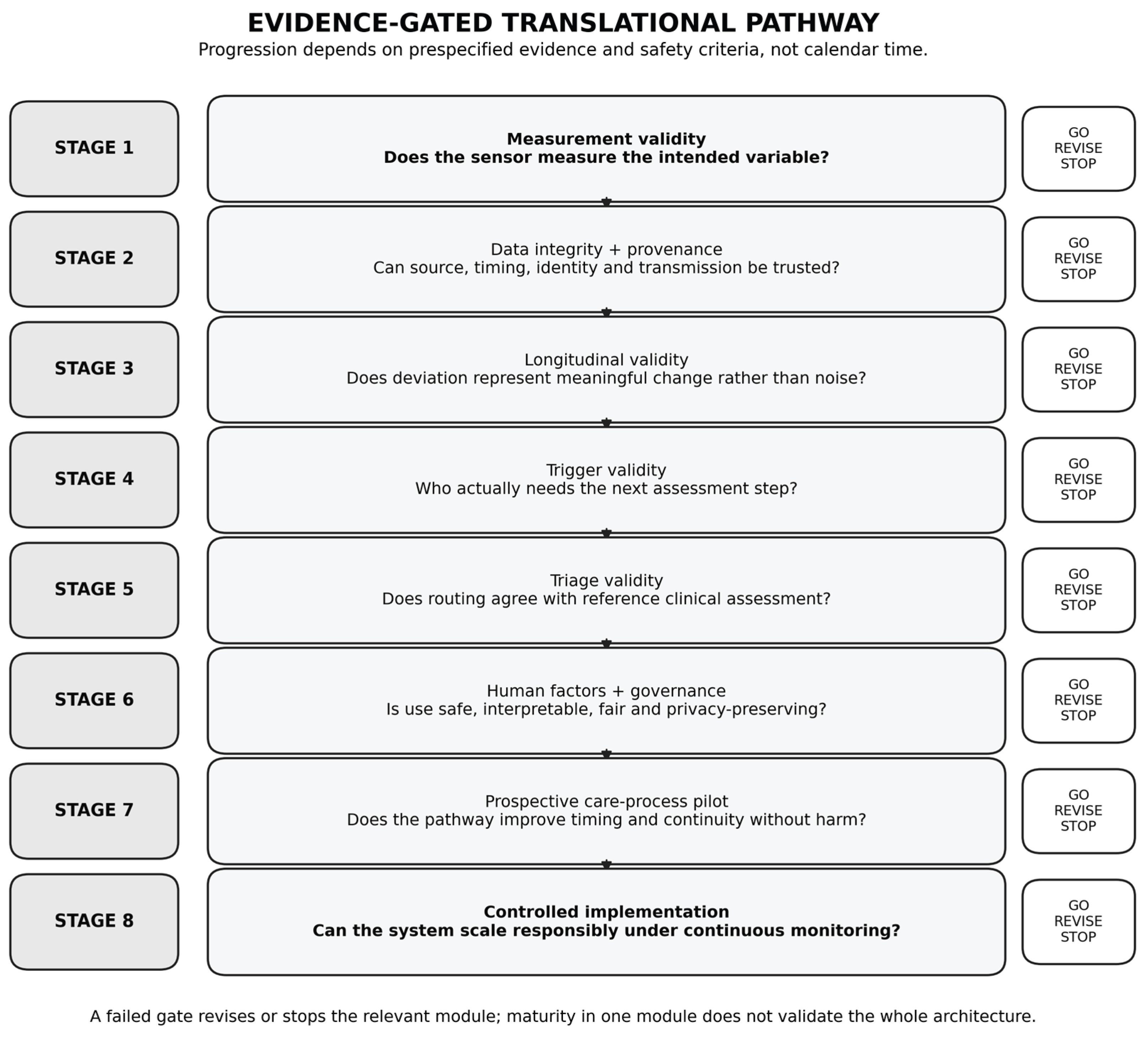
Table 2.
RemoteMed360 graded response ladder. The system may automate information gathering and routing more readily than diagnosis, treatment, or emergency disposition.
Table 2.
RemoteMed360 graded response ladder. The system may automate information gathering and routing more readily than diagnosis, treatment, or emergency disposition.
| Level | System state | Permitted automated function | Human responsibility |
|---|---|---|---|
| L0 | No concerning change / insufficient evidence | Continue monitoring; suppress low-value alerts; request better data when needed | None beyond routine governance and user control. |
| L1 | Low-risk deviation or self-management opportunity | Neutral check-in, education, repeat measurement, routine reminder | Human review not mandatory if output is low risk and non-diagnostic. |
| L2 | Persistent deviation or symptom-triggered uncertainty | Activate TRIAGENT targeted assessment; summarize evidence and uncertainty | Protocol ownership and periodic clinical audit required. |
| L3 | Clinically relevant concern | Prioritize teleconsultation or facility review; package relevant data | Qualified clinician or authorized health worker reviews and determines action. |
| L4 | Validated urgent safety condition or explicit severe symptom pathway | Facilitate emergency contact/referral, transmit data, support logistics | Emergency disposition and treatment remain protocol-governed human clinical responsibility. |
Table 4.
Conceptual SATUSEHAT/FHIR mapping for validated RemoteMed360 outputs. Resource availability does not imply that a RemoteMed360-specific national use case is currently approved.
Table 4.
Conceptual SATUSEHAT/FHIR mapping for validated RemoteMed360 outputs. Resource availability does not imply that a RemoteMed360-specific national use case is currently approved.
| RemoteMed360 object | Candidate FHIR-oriented object | Purpose | Boundary |
|---|---|---|---|
| Validated vital-sign or derived summary | Observation | Transmit a clinically interpretable measurement with units, time and provenance | Only after measurement and semantic validation; raw sensor streams should not be dumped into the clinical record. |
| Clinician-interpreted test result | DiagnosticReport / Observation bundle | Package interpreted ECG or other targeted assessment results | Requires an accountable interpreting workflow and appropriate reference to source data. |
| Structured risk/triage summary | RiskAssessment or ClinicalImpression where appropriate | Represent bounded risk interpretation or clinical impression | Not a substitute for diagnosis; use-case profile must be formally defined. |
| Referral / additional assessment request | ServiceRequest | Request facility review, diagnostic testing or specialist input | Must match an approved workflow and accountable requester. |
| Operational follow-up | Task / Encounter | Track teleconsultation, referral completion, or care process | Workflow state should not be confused with clinical outcome. |
Table 5.
Stage-specific research questions and evidence gates for RemoteMed360. Evidence maturity is modular: success in one sensor or use case does not validate the entire framework.
Table 5.
Stage-specific research questions and evidence gates for RemoteMed360. Evidence maturity is modular: success in one sensor or use case does not validate the entire framework.
| Stage | Core question | Example endpoints | Go / revise / stop logic |
|---|---|---|---|
| 1. Measurement validity | Does each sensor measure what it claims for the intended use? | Agreement with reference, repeatability, missingness, artifact, calibration stability | Stop or replace a modality if analytical performance is inadequate. |
| 2. Data integrity + provenance | Can each datum be traced, transmitted, and interpreted correctly? | Timestamp integrity, device identity, packet loss, unit/terminology correctness, offline recovery | Revise architecture if provenance or transport errors can change clinical meaning. |
| 3. Longitudinal validity | Does trajectory deviation correspond to meaningful change? | Within-person variability, baseline drift, temporal persistence, relation to active assessment | Proceed only if deviation adds information beyond noise and simpler baselines. |
| 4. Trigger validity | Does the trigger identify who needs the next assessment step? | Sensitivity, specificity, calibration, false-alert rate, missed-event rate | Thresholds must be tuned prospectively; false-alert burden is a primary endpoint. |
| 5. Triage validity | Does routing agree with a reference clinical assessment? | Under-triage, over-triage, agreement, time-to-review, subgroup performance | Unsafe under-triage or unstable subgroup performance stops consequential use. |
| 6. Human factors + governance | Can users and clinicians operate the system safely and acceptably? | Usability, comprehension, alert fatigue, workload, trust, privacy, fairness, incident response | Redesign when burden, inequity, or misunderstanding exceeds benefit. |
| 7. Prospective care-process pilot | Does the pathway improve care processes? | Assessment timing, referral completion, clinician workload, safety events, patient-reported benefit/harm | Proceed only if process gains are not offset by safety or workload harms. |
| 8. Controlled implementation | Can the system scale responsibly? | Interoperability, workforce capacity, cost, equity, cyber resilience, post-deployment monitoring | Scale gradually through sandbox/regulatory pathways with continuous monitoring. |
Disclaimer/Publisher’s Note: The statements, opinions and data contained in all publications are solely those of the individual author(s) and contributor(s) and not of MDPI and/or the editor(s). MDPI and/or the editor(s) disclaim responsibility for any injury to people or property resulting from any ideas, methods, instructions or products referred to in the content. |
© 2026 by the authors. Licensee MDPI, Basel, Switzerland. This article is an open access article distributed under the terms and conditions of the Creative Commons Attribution (CC BY) license (http://creativecommons.org/licenses/by/4.0/).
Copyright: This open access article is published under a Creative Commons CC BY 4.0 license, which permit the free download, distribution, and reuse, provided that the author and preprint are cited in any reuse.