

Submitted:
17 September 2026
Posted:
18 September 2026
You are already at the latest version
Abstract
Background: Indonesia has a substantial adolescent mental-health burden and a persistent service gap. The Indonesia-National Adolescent Mental Health Survey estimated that 34.9% of adolescents had a mental-health problem and 5.5% met criteria for a mental disorder in the previous 12 months, while only 2.6% of adolescents with a mental-health problem had accessed support or counselling [1,2]. Digital phenotyping may add longitudinal behavioral and physiological context, but evidence available through 2026 remains heterogeneous, methodologically fragmented, and insufficient to support autonomous psychiatric inference [4 ,6–14]. Objective: To refine the original MindCare+ student innovation concept into an evidence-bounded, human-supervised research architecture for longitudinal mental-health risk monitoring and support navigation in Indonesia, while explicitly incorporating 2025–2026 evidence on youth sensing, implementation, psychometrics, consent, and governance. Methods: We used an evidence-informed conceptual framework-development approach rather than a systematic review. The original proposal was decomposed into sensing, measurement validity, interpretation, screening, support, professional integration, governance, and implementation domains. A targeted evidence update through 15 September 2026 prioritized systematic reviews, meta-analyses, major implementation syntheses, youth-specific ethics and co-design literature, Indonesian psychometric studies, and current Indonesian regulatory or innovation pathways. Proposed functions were classified as near-term capabilities, translational hypotheses, or functions that should not be assumed without prospective validation. Results: MindCare+ is specified as a consent-based closed loop linking smartphone-derived behavioral features, optional wearable physiology, active validated self-report, privacy and data-quality gating, longitudinal personal baselines, contextual multimodal interpretation, visible uncertainty, stepped support, and human escalation. Passive signals are treated as risk-relevant context rather than psychiatric labels. The 2026 adolescent meta-analysis, which found a small overall association between passive smartphone sensing and mental-health outcomes across 45 samples (N=2939), reinforces the need to use such signals as complementary rather than determinative evidence [12]. An evidence-gated pathway is proposed from data-capture reliability and psychometric localization through prospective clinical comparison, human-factors testing, fairness and privacy evaluation, and controlled implementation. Conclusions: MindCare+ should be evaluated as a research and care-navigation architecture rather than an autonomous mental-health detector. Its central testable question is whether the smallest acceptable set of privacy-preserving longitudinal measurements, combined with context-sensitive active assessment and meaningful human oversight, can improve recognition of clinically relevant change and access to appropriate support without producing unacceptable false alerts, surveillance burden, inequity, or harm.
Keywords:
digital phenotyping
; mental health
; adolescents
; smartphone sensing
; wearable sensors
; screening
; artificial intelligence
; human oversight
; Indonesia
1. Introduction
Mental-health need in adolescence is not adequately represented by diagnosed disorders alone. The World Health Organization has emphasized a persistent global burden and major gaps in access to mental-health care [3]. In Indonesia, I-NAMHS estimated that 34.9% of adolescents experienced a mental-health problem and 5.5% met criteria for a mental disorder within a 12-month period [1,2]. Anxiety disorders were the most common diagnostic group, while only 2.6% of adolescents with a mental-health problem accessed support or counselling; school staff were among the most frequently accessed sources of help [1]. This pattern creates a problem of recognition, timing, continuity, and access in addition to diagnostic capacity.
Digital mental-health technologies are often proposed as one way to narrow this gap. Digital phenotyping, also described in adjacent literatures as personal sensing or behavioral sensing, uses passively generated data from smartphones and other connected devices as markers of behavior, context, or health-related change [4,5]. Candidate streams include mobility, physical activity, sleep timing, device interaction, communication metadata, and optional wearable-derived physiological variables. Their main scientific attraction is repeated measurement: trajectories between encounters may contain information that a single questionnaire or appointment cannot capture.
The evidence base, however, has become more precise about both promise and limitation. Reviews through 2024 reported associations between mental-health outcomes and mobility, activity, sleep, social interaction, and phone-use patterns, but with substantial heterogeneity, missing data, and limited external validation [6,7,8]. Two broad reviews published in 2025 reinforced those concerns. Heckler and colleagues synthesized 74 studies and identified sample-selection bias and missing data among the recurrent challenges, while Linardon and colleagues reviewed 112 papers and emphasized variation in sensors, feature extraction, platforms, and reporting [9,10]. A 2026 implementation-focused systematic review similarly found wide heterogeneity across devices, sensing modalities, preprocessing, feature definitions, and analytic techniques, with most evidence arising from high-income settings [11].
Youth-specific evidence further constrains what can reasonably be inferred. A 2026 multilevel meta-analysis of passive smartphone sensing included 45 independent adolescent and young-adult samples (N=2939) and found a small overall association with mental-health outcomes (r=0.12), with substantial between-study heterogeneity and weaker associations in student than non-student samples [12]. This result is important for MindCare+: passive smartphone features may contain clinically relevant information, but the average signal is modest and context-sensitive. An implementation synthesis of 111 studies involving 19,945 participants across mood-monitoring and ambulatory assessment protocols reached a compatible conclusion: these tools can add granularity and confirmation, but they are not sufficiently robust to replace existing outcomes and require personalization, context, and user-centered design [13]. Current reviews therefore support a role for digital phenotyping as an adjunct to clinical assessment rather than a replacement for it [14,15].
Local empirical evidence supports feasibility without establishing clinical validity. In the pilot study “Feasibility of Using Passive Digital Phenotyping Data from Smartphones as Emerging Health Sensors in Medical Students,” co-authored by Amanda and Faradis, routine smartphone records provided steps, sleep duration, screen time, notifications, pickups, and dominant app-use category in 43 Indonesian medical students; screen time was inversely associated with sleep, while notification frequency was strongly associated with pickups [17]. The study demonstrates that candidate behavioral inputs can be captured in an Indonesian setting, but it does not establish psychiatric diagnosis, crisis prediction, or individualized clinical utility.
Wearables can add physiological and circadian context, but the same evidentiary boundary applies. Sleep-wake features have shown predictive value for mood episodes in a prospective clinical cohort [16], yet such findings do not establish that consumer sleep, heart-rate, activity, electrodermal, or temperature signals can diagnose depression, anxiety, bipolar disorder, or stress in an unselected adolescent population. The scientific problem is therefore not merely whether data can be collected, but whether measurement validity, temporal context, individual variability, missingness, and downstream clinical consequences are handled explicitly [4,9,10,11,12,13,14].
The ethical stakes are unusually high in adolescent mental health. Digital phenotyping can expose location, routine, social patterns, device use, and health-related information that users may experience as intimate even when message content is never collected. Existing ethical analyses emphasize consent, transparency, practitioner responsibility, fairness, user control, and the risk that algorithmic interpretation may be mistaken for clinical judgement [18,19]. More recent adolescent-focused work adds relational autonomy, trust, developmental agency, power asymmetry, and the need for youth co-design, especially for passive data collection and AI-mediated systems [20,21]. A technically accurate system can still be unacceptable if it transforms support into surveillance.
The original MindCare+ proposal was developed as a student innovation concept integrating smartphone data, wearable signals, questionnaire screening, artificial intelligence, personalized recommendations, and professional psychological or psychiatric involvement. Its central intuition remains scientifically relevant: repeated behavior and physiology may provide context between formal encounters, and a digital system may lower the threshold for support. The original formulation, however, sometimes moved too quickly from signal collection to disease detection and from technical feasibility to assumed population impact. The present Version 2 therefore treats MindCare+ as an evidence-bounded, falsifiable, human-supervised translational architecture. Its proposed contribution is architectural rather than component-level novelty: the framework specifies how sensing, data quality, personal baselines, contextual inference, active assessment, stepped support, human responsibility, and Indonesian governance should be connected before clinical claims are made.
2. Methods
2.1. Study Design and Framework-Development Approach
This study used an evidence-informed conceptual framework-development approach. The starting material was the original MindCare+ innovation proposal, which described a digital-phenotyping platform using smartphone behavior, wearable sensing, questionnaire screening, artificial intelligence, personalized intervention, and integration with psychologists and psychiatrists. The concept was reconstructed as a research architecture rather than a claim that a completed or clinically effective system already exists.
The development process had four goals: to preserve the clinically meaningful service-gap problem addressed by the original concept; to distinguish observable signals from psychiatric interpretation; to identify where human oversight is required; and to define a validation sequence that can convert the concept into testable research. The terminology of unrestricted “surveillance” was intentionally excluded from the intended use. MindCare+ is defined as consent-based longitudinal monitoring for a specified health or research purpose, with minimization, user control, and revocable permissions.
2.2. Targeted Evidence Update and Source Use
Version 2 incorporated a targeted evidence update through 15 September 2026. Searches prioritized peer-reviewed systematic reviews, meta-analyses, and major syntheses on digital phenotyping, smartphone and wearable sensing, youth mental health, ambulatory monitoring, implementation, data quality, and clinical utility; youth-specific ethics and co-design literature; Indonesian psychometric studies relevant to active screening; and official Indonesian legal or health-innovation sources. Recent evidence was used to test whether the original architecture remained defensible rather than to maximize the number of citations.
This was not a systematic review. No exhaustive database search, formal duplicate screening, comprehensive risk-of-bias synthesis, or quantitative evidence pooling was performed by the MindCare+ authors. Accordingly, the literature is used to establish plausibility, boundaries, and translational requirements rather than to claim an unbiased estimate of efficacy. When high-level syntheses were available, they were preferred for broad claims. Primary studies were retained when they addressed a specific local or mechanistic question not adequately represented by those syntheses.
Absence of evidence for the complete MindCare+ architecture was treated as a limitation rather than filled by analogy. Group-level associations, internally validated prediction models, or findings from selected clinical populations were not treated as proof that the same feature is valid for individual adolescents in general use. Indonesian validation of a questionnaire in one population was similarly not treated as automatic validation for another age group, setting, language register, threshold, or crisis workflow.
2.3. Evidence-Boundary Classification
Proposed functions were classified into three maturity categories. Near-term capabilities include permissioned smartphone sensing, device-use summaries, commercial wearable activity or sleep signals where measurement validity is adequate for the intended use, active questionnaire administration, reminders, educational content, user-controlled check-ins, and referral workflows. These functions are technically feasible but still require usability, privacy, workflow, and population-specific validation.
Translational functions include individualized anomaly detection across multiple behavioral and physiological streams, estimation of persistent deviation from a personal baseline, and risk stratification that combines passive data with active self-report. These functions are plausible research hypotheses but should not be presented as established clinical capabilities because contemporary reviews continue to report heterogeneous performance, inconsistent feature definitions, missingness, small or unrepresentative samples, and limited external validation [9,10,11,12,13,14].
Functions explicitly not assumed include autonomous psychiatric diagnosis, deterministic attribution of anxiety or depression from heart rate or screen time, passive identification of suicidal intent, continuous capture of private communication content by default, or automated clinical disposition during a crisis. Future studies could investigate carefully bounded versions of some functions, but safety and validity cannot be inferred from sensor availability or machine-learning capability alone.
2.4. Conceptual Synthesis Rules
Seven synthesis rules governed the architecture. First, data minimization and explicit permission precede collection. Second, a digital signal is not a diagnosis. Third, interpretation prioritizes within-person trajectories, temporal persistence, context, and agreement across independent modalities rather than a universal threshold. Fourth, data quality and uncertainty are represented before AI-mediated interpretation. Fifth, active assessment and qualified human review are confirmatory layers when consequences become clinically meaningful. Sixth, system autonomy decreases as potential harm increases. Seventh, evidence gates can produce a “stop” decision; technical feasibility is not sufficient justification for deployment.
2.5. Prespecified Conceptual Outputs
The prespecified outputs were: (1) a human-supervised closed-loop MindCare+ architecture; (2) an evidence-bounded hierarchy of sensing and assessment domains; (3) a measurement-to-inference model centered on personal trajectories and uncertainty; (4) a stepped support and escalation model; (5) adolescent-sensitive privacy, consent, and co-design requirements; (6) an evidence-gated validation ladder; and (7) testable propositions for future prospective research.
3. Results
3.1. Population Need and Intended Use
The intended use is longitudinal risk monitoring and support navigation for adolescents and young adults who have knowingly opted into the system, rather than population-wide covert screening. The architecture addresses a service-gap problem: mental-health difficulties can evolve between formal encounters, while many young people do not access counselling or professional care even when problems are present [1,2]. MindCare+ therefore aims to create additional opportunities for self-recognition, low-friction check-in, validated assessment, and appropriate referral.
The target outcome is not “detecting depression from a phone.” A more defensible target is whether repeated, privacy-preserving signals can identify meaningful deviation from a person’s own recent functional trajectory and prompt an appropriate next assessment step. The system must also be able to remain silent when data are insufficient, low quality, internally inconsistent, or plausibly explained by context.
3.2. Human-Supervised Closed-Loop Architecture
Figure 1 summarizes the operational architecture. Consented inputs are filtered through privacy and data-quality controls before longitudinal interpretation. The analytic layer estimates deviation, persistence, context, and uncertainty rather than assigning a psychiatric label. Support is stepped according to the strength and persistence of evidence, while clinically consequential escalation requires human review. Explicit high-risk self-report or direct crisis disclosure bypasses ordinary passive-sensing inference and enters a predefined human or emergency pathway.
3.3. Candidate Digital Phenotype and Assessment Layers
The input stack is intentionally multimodal because no single behavioral or physiological variable has adequate specificity for mental health. Reviews suggest that mobility, activity, sleep, phone use, and social-interaction proxies can be associated with stress, anxiety, depression, or relapse, but effect sizes and directions vary across populations, devices, and contexts [6,7,8,9,10,11,12,13,14]. Table 1 therefore defines each stream by its intended role and evidence boundary rather than presenting every available sensor as clinically equivalent.
Figure 2.
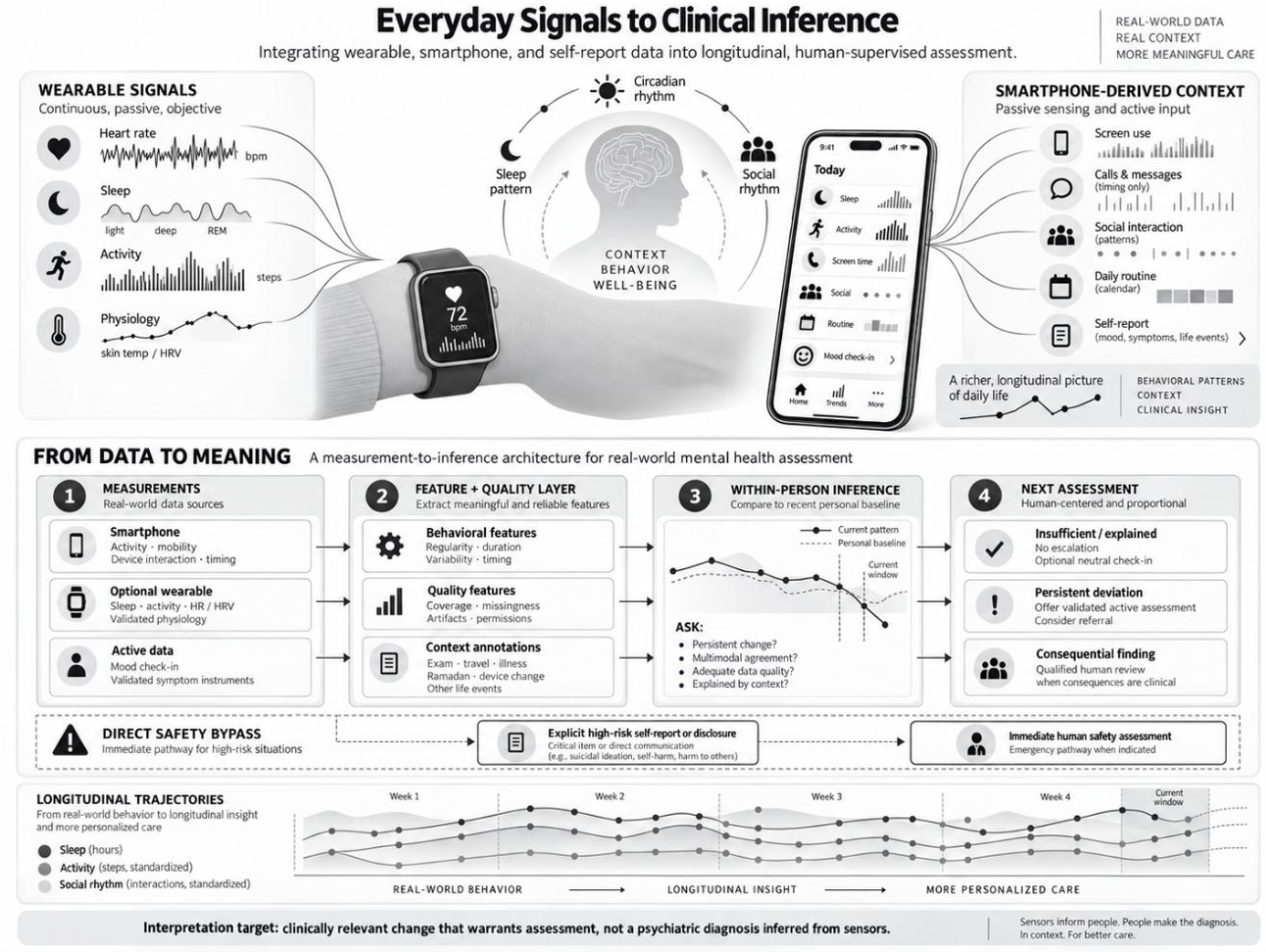
Integrated architecture linking everyday digital signals to longitudinal, human-supervised clinical assessment. Wearable-derived physiological and behavioral signals, smartphone-derived context, and active self-report are treated first as measurements rather than diagnoses. These inputs pass through a feature and quality layer that evaluates behavioral regularity, variability, timing, signal coverage, missingness, artifacts, permissions, and contextual annotations. Inference is then performed within person by comparing the current pattern with the individual’s recent baseline and asking whether the observed change is persistent, supported across modalities, based on adequate data quality, and plausibly explained by context. Depending on this interpretation, the next step may be no escalation, a neutral check-in, validated active assessment, referral, or qualified human review when findings are clinically consequential. Explicit high-risk self-report follows a separate safety bypass that triggers immediate human safety assessment rather than waiting for passive longitudinal inference. The lower panel illustrates how repeated real-world measurements are transformed into longitudinal trajectories, with emphasis on change over time rather than isolated values. The intended output is therefore a clinically relevant change that may warrant further assessment, not a psychiatric diagnosis inferred directly from sensors.
Figure 2.
Integrated architecture linking everyday digital signals to longitudinal, human-supervised clinical assessment. Wearable-derived physiological and behavioral signals, smartphone-derived context, and active self-report are treated first as measurements rather than diagnoses. These inputs pass through a feature and quality layer that evaluates behavioral regularity, variability, timing, signal coverage, missingness, artifacts, permissions, and contextual annotations. Inference is then performed within person by comparing the current pattern with the individual’s recent baseline and asking whether the observed change is persistent, supported across modalities, based on adequate data quality, and plausibly explained by context. Depending on this interpretation, the next step may be no escalation, a neutral check-in, validated active assessment, referral, or qualified human review when findings are clinically consequential. Explicit high-risk self-report follows a separate safety bypass that triggers immediate human safety assessment rather than waiting for passive longitudinal inference. The lower panel illustrates how repeated real-world measurements are transformed into longitudinal trajectories, with emphasis on change over time rather than isolated values. The intended output is therefore a clinically relevant change that may warrant further assessment, not a psychiatric diagnosis inferred directly from sensors.
3.4. Longitudinal Baseline, Quality Gating, Missingness, and Uncertainty
MindCare+ treats trajectory deviation as the primary analytic object. A person’s usual sleep timing, mobility, device use, and physiological patterns can differ substantially from population averages. The analytic question is therefore whether relevant domains are changing together, whether change persists, whether the underlying measurements are trustworthy, and whether a non-psychiatric explanation is plausible. This design does not eliminate bias, but it reduces dependence on a single universal definition of “normal.”
A personal baseline is not permanent. School calendars, examinations, Ramadan, travel, illness, relationship changes, medication, developmental change, changes in employment or caregiving, and device replacement can establish new patterns. Baseline models therefore require drift handling and an explicit route for context annotation. The system should support outputs such as “insufficient data,” “possible change with low confidence,” or “persistent multimodal deviation” rather than a binary normal/abnormal label.
Data-quality gating occurs before interpretation. The system should check permission state, sampling completeness, sensor availability, device or operating-system changes, missingness, implausible values, motion artifact where relevant, and disagreement between modalities. Missing data are not neutral, but they are also not automatically clinical. A user may disable sensing because of battery limitations, privacy discomfort, financial constraints, loss of interest, device failure, or worsening wellbeing. Contemporary reviews repeatedly identify missingness and inconsistent data quality as unresolved threats to inference [9,10,11,12,13,14]. Treating missingness itself as a disease signal without prospective validation risks circular and intrusive interpretation.
3.5. Active Screening and Stepped Psychological Support
Passive sensing should determine whether additional assessment may be useful, not whether a disorder exists. When a persistent or meaningful deviation occurs, the system can first ask whether the change is expected and whether the user wants a check-in. If the user agrees, a validated symptom instrument can provide structured information. PHQ-9 and GAD-7 have substantial screening literatures [22,23], and Indonesian versions have been studied in selected populations [24,25]. However, those data do not establish a universal cutoff for Indonesian adolescents. Indonesian adolescent validation is also available for other measures, including CESD-R/K10/K6 and SCARED, illustrating why instrument choice should follow intended construct, age, population, and service setting rather than platform convenience [26,27]. A positive screen remains screening information, not a diagnosis.

Table 2.
Proposed stepped support and escalation logic. Escalation is based on consented assessment and human responsibility, not on passive sensing alone.
Table 2.
Proposed stepped support and escalation logic. Escalation is based on consented assessment and human responsibility, not on passive sensing alone.
| Tier | Trigger example | System response | Boundary / human role |
|---|---|---|---|
| 0 | Stable trajectory; inconsistent data; or insufficient data | Remain silent or provide user-requested general wellbeing tools | No psychiatric inference. Ask for permissions or context only when necessary. |
| 1 | Low-confidence or short-lived deviation | Optional neutral check-in; sleep/activity reflection; educational content | Avoid alarming language. User can dismiss, annotate context, or reduce monitoring. |
| 2 | Persistent multimodal deviation; repeated concern; or positive active screen | Offer repeat assessment, appointment scheduling, school/primary-care/mental-health referral, or trusted-support options | Qualified human review is required for clinically consequential interpretation. Screening is not diagnosis. |
| 3 | Explicit high-risk disclosure; direct statement of imminent danger; or critical questionnaire response | Activate predefined immediate human contact and emergency-resource pathway | Bypass passive prediction. The algorithm does not independently determine crisis severity, discharge, or treatment. |
3.6. Human Oversight and Professional Integration
Psychologists, psychiatrists, physicians, counsellors, and other appropriately trained professionals should be positioned as interpreters and escalation owners rather than downstream recipients of an algorithmic verdict. A clinician-facing view should show data source, measurement window, missingness, uncertainty, relevant context, active self-report, and the reason a signal was surfaced. It should not display an opaque composite risk score without interpretable provenance.
Human review protects against contextual error. Reduced movement may be expected during examinations, religious observance, convalescence, bad weather, or transport disruption. Increased screen time may reflect an online class, remote work, family communication, or accessibility needs. A user should be able to explain, correct, or contest an interpretation. Ethical analyses similarly argue that digital phenotyping is most defensible when it augments practitioner judgement and therapeutic alliance rather than superseding them [19].
The feedback loop should be designed for evaluation rather than automatic self-training. When a professional or user identifies an alert as contextually inappropriate, the event can be recorded for audit and, where scientifically justified, later model refinement. Feedback should not automatically become a training label because clinician disagreement, user preference, contextual explanation, and measurement error are distinct phenomena.
3.7. Privacy, Consent, and Adolescent Safeguards
Mental-health information, location history, behavioral routines, and many wearable variables are sensitive even when they are not conventional medical records. Indonesia’s Law Number 27 of 2022 on Personal Data Protection classifies health information, biometric data, genetic data, and children’s data as specific personal data [28]. MindCare+ should therefore treat privacy as part of the safety architecture rather than as a post-development legal checklist.
Consent should be granular, comprehensible, and revocable. A user might agree to accelerometry and sleep timing but decline geolocation or communication metadata. Refusing one sensor should not remove access to basic support. The interface should state what is collected, why it is needed, how long it is retained, who can see it, whether it contributes to an algorithmic feature, and what happens when permission is withdrawn. Raw-content collection should be avoided unless a specific study has a compelling purpose, separate consent, and approved governance.
Adolescent deployment requires safeguards around assent, parental or guardian consent where legally and ethically appropriate, confidentiality, school access, mandatory reporting obligations, and the possibility of coercive use. Recent ethics work emphasizes that adolescent consent cannot be reduced to a one-time procedural click: trust, relational autonomy, developmental agency, and power asymmetry matter [20]. Youth co-design should therefore be treated as a governance mechanism for identifying acceptable boundaries and inequities, not merely as interface testing [21]. A school, parent, insurer, employer, or platform should not be able to convert a voluntary wellbeing system into opaque behavioral surveillance.
3.8. Evidence-Gated Validation Pathway
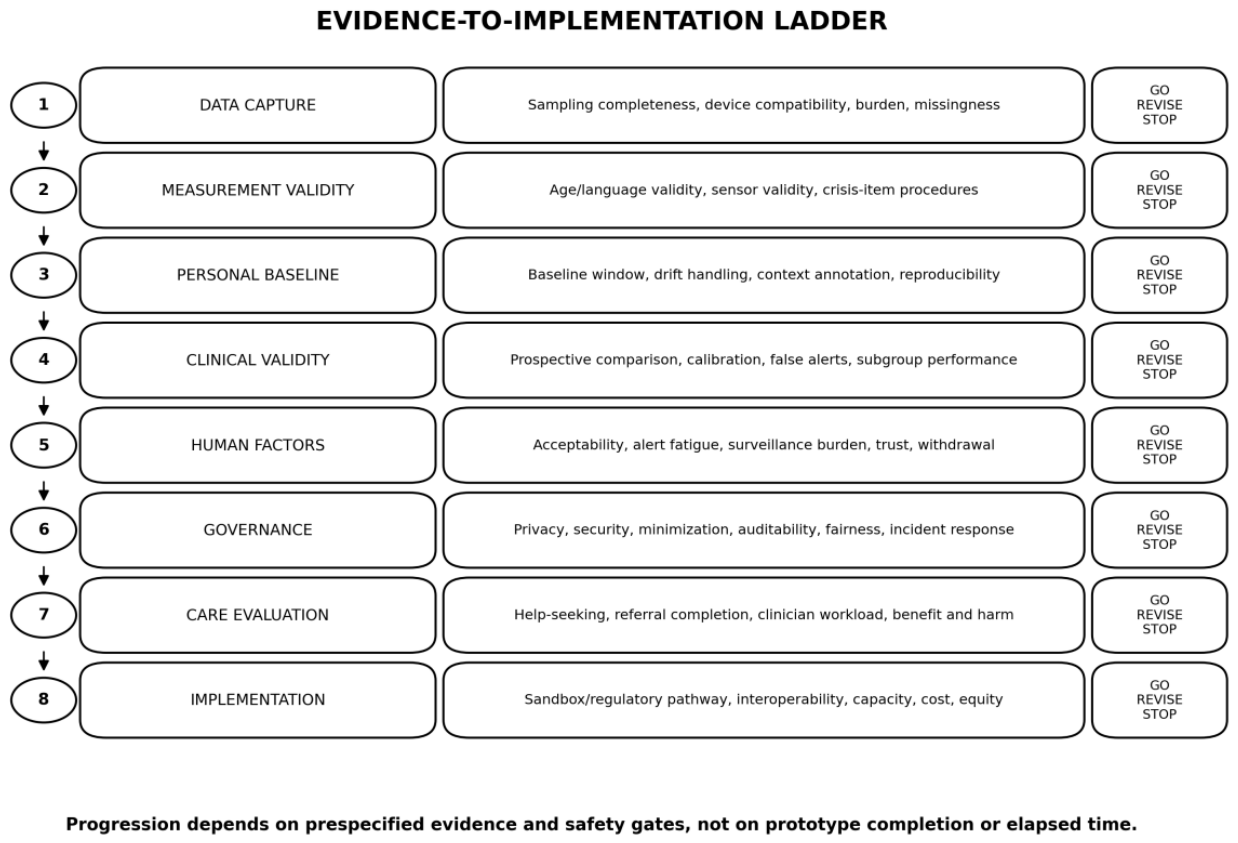
The original innovation concept included a multiyear development sequence. Version 2 reframes that timeline as an evidence-gated ladder in which progression depends on predefined performance, safety, and acceptability criteria rather than elapsed time. This is consistent with the current field, where heterogeneity, engagement, adverse effects, representativeness, and real-world integration remain major translational problems despite increasing technical feasibility [11,12,13,14,15].
Table 3.
Evidence-gated validation ladder for MindCare+. Progression depends on prespecified evidence and safety gates rather than a fixed calendar.
Table 3.
Evidence-gated validation ladder for MindCare+. Progression depends on prespecified evidence and safety gates rather than a fixed calendar.
| Stage | Question | Example gate before progression |
|---|---|---|
| 1 | Can the intended data be captured reliably? | Sampling completeness, battery burden, device compatibility, artifact handling, permission stability, and transparent missing-data reporting. |
| 2 | Are measurements and active assessments valid for target users? | Sensor validity plus Indonesian-language, age- and setting-appropriate psychometrics, defined thresholds, crisis-item procedures, and referral capacity. |
| 3 | Can a personal baseline be estimated without overfitting? | Prospectively specified baseline window, drift handling, context annotation, and reproducible anomaly definitions. |
| 4 | Does multimodal monitoring add clinically useful information? | Prospective comparison against active assessments and clinician evaluation; report sensitivity, specificity, calibration, false-alert rate, incremental value, and subgroup performance. |
| 5 | Is the system usable and psychologically acceptable? | Human-factors testing, alert fatigue, perceived surveillance, trust, comprehension of uncertainty, disengagement, and withdrawal behavior. |
| 6 | Is governance adequate? | Privacy and security testing, data minimization, access controls, auditability, fairness evaluation, incident response, and independent oversight. |
| 7 | Does stepped support improve care processes? | Controlled pilot measuring help-seeking, referral completion, timeliness, user-reported benefit and harm, clinician workload, and safety events. |
| 8 | Can implementation scale responsibly? | Health Sandbox or other applicable regulatory evaluation, interoperability, workforce capacity, cost, equity, and post-deployment monitoring. |
Figure 3.
Evidence-to-implementation ladder. Each stage requires a go, revise, or stop decision. A technically successful prototype does not automatically progress to clinical or population deployment.
Figure 3.
Evidence-to-implementation ladder. Each stage requires a go, revise, or stop decision. A technically successful prototype does not automatically progress to clinical or population deployment.
3.9. Stakeholder and Implementation Ecosystem
Implementation requires explicit division of responsibility. Technology and biomedical-engineering teams are responsible for measurement architecture, device integration, software reliability, cybersecurity, and observability. Mental-health professionals define clinical meaning, screening pathways, escalation thresholds, and limits of automation. Human-factors researchers and young people should co-design consent, notification, and dashboard interactions. Legal, ethics, data-protection, and security expertise is required before high-sensitivity behavioral data are collected.
At health-system level, the Ministry of Health, participating health facilities, schools or universities, and relevant data-governance institutions determine permissible implementation pathways. Indonesia’s current Health Sandbox provides a contemporary program for testing, mentoring, and evaluating health-technology innovations across maturity levels, with attention to access, quality, safety, scalability, sustainability, and integration [29]. MindCare+ should treat such pathways as staged evaluation opportunities rather than as evidence of clinical effectiveness or automatic authorization for national deployment.
4. Discussion
4.1. Principal Findings and Alignment With the 2026 Evidence Base
The principal result of this conceptual synthesis is a change in what MindCare+ claims to do. The original concept was framed around real-time detection of mental disorders from behavioral and wearable data. The evidence available through September 2026 supports a more cautious and scientifically tractable formulation: digital data may reveal patterns associated with mental-health states, but those patterns require measurement validation, context, quality assessment, active evaluation, and clinical judgement before they become actionable [4,9,10,11,12,13,14,15]. MindCare+ is therefore better understood as a longitudinal risk-monitoring and support-navigation architecture.
The 2026 evidence strengthens rather than weakens this reframing. The adolescent meta-analysis by Leijse and colleagues found a statistically significant but small average association between passive smartphone sensing and mental-health outcomes (r=0.12), with marked heterogeneity across studies [12]. Alam and colleagues documented methodological fragmentation across clinical digital-phenotyping studies, including variation in devices, preprocessing, features, and analytic strategies [11]. Astill Wright and colleagues, synthesizing 111 studies and 19,945 participants, concluded that ambulatory monitoring can add granularity and confirmation but is not sufficiently robust to replace current outcomes and requires personalization, user-centered design, and context [13]. These findings fit an architecture in which passive sensing raises a question, active assessment refines it, and qualified humans retain responsibility for consequential decisions.
This reframing is not a reduction of ambition. It moves the research program from the broad question “Can AI continuously detect mental illness?” to testable questions: Can a stable and privacy-acceptable feature set be captured? Do within-person changes precede or accompany validated symptom changes? Does multimodal fusion add information beyond self-report alone? Can contextual annotation and quality gating reduce false alerts? Does a stepped workflow improve help-seeking or referral completion without increasing distress, stigma, or clinician burden? Negative answers to any of these questions are informative results and should be allowed to stop or reshape the program.
4.2. The Contribution Is Architectural Rather Than Sensor-Level Novelty
Smartphone sensing, wearables, active questionnaires, personalized baselines, and human oversight are not individually novel in 2026 [9,10,11,12,13,14,15]. MindCare+ should therefore avoid claiming novelty because it combines familiar components. Its more defensible contribution is the explicit arrangement of those components into an evidence-bounded translational architecture for Indonesia: consent precedes sensing; data quality precedes inference; personal trajectory and context precede escalation; passive signals lead to optional active assessment rather than diagnosis; and increasing consequence produces decreasing automation. The validation ladder then links measurement, clinical utility, human factors, governance, and implementation rather than assuming that a technically working model is ready for care.
Related local companion frameworks, including NutriAgent+ and SeniorBot, use similar principles of data-quality gating, within-person trajectories, and risk-bounded autonomy [31,32]. These preprints are methodological precedents rather than external validation. Their value here is to show a coherent design language emerging across different health domains, while the mental-health context requires tighter boundaries because stigma, therapeutic trust, crisis management, and adolescent privacy amplify the consequences of false inference.
4.3. Digital Phenotypes Should Be Trajectories, Not Diagnoses
The strongest conceptual role for passive data is longitudinal context. A low-mobility day has little psychiatric meaning without knowing the person’s baseline and circumstances. A persistent reduction in movement, delayed sleep, declining routine regularity, and worsening self-reported mood may be more informative, but even multimodal concordance should be interpreted as a reason to ask a better question rather than proof of a diagnosis. The small pooled association in adolescent sensing research reinforces this distinction [12].
This is especially important for adolescents because behavior is shaped by school schedules, household rules, examinations, peer relationships, transport access, sports, religious observance, family responsibilities, and rapidly changing developmental routines. Most studies in the 2026 adolescent meta-analysis were conducted in North America and a majority used student samples, while Asian evidence remained a minority [12]. A population model that learns an average relationship between phone behavior and distress can therefore penalize people whose daily structure differs from the training sample. Within-person comparison does not solve representational bias, but it changes the primary reference from “this adolescent versus an average adolescent” to “this adolescent versus their own recent trajectory.”
4.4. Wearables Add Context but Should Not Medicalize Ordinary Physiology
Wearable sensing may improve temporal resolution of sleep, activity, and autonomic context. Longitudinal sleep and circadian features can carry predictive information in carefully characterized clinical cohorts [16]. MindCare+ can use such evidence to justify research on sleep-wake trajectories, but not to infer that a commercial watch can identify bipolar disorder or depression in the general population.
Heart rate, heart-rate variability, electrodermal activity, and skin temperature are especially easy to overinterpret. They are affected by exercise, posture, hydration, caffeine, fever, pain, medication, menstrual cycle, environmental temperature, autonomic fitness, and emotion. A rise in heart rate may be compatible with stress but is not a stress diagnosis. The architecture therefore treats wearable physiology as contextual evidence whose meaning depends on sensor validity, temporal pattern, and concordance with other information.
4.5. Passive Sensing and Active Assessment Are Complementary
Passive data and questionnaires solve different measurement problems. Passive sensing can describe behavior between encounters with relatively low entry burden, while validated questionnaires ask directly about symptoms that sensors cannot observe. The PHQ-9 and GAD-7 have extensive screening literatures [22,23], but Indonesian studies show why localization must go beyond translation: performance and thresholds depend on clinical population and intended use [24,25]. For adolescents, Indonesian evidence on CESD-R/K10/K6 and SCARED provides additional options that may be more appropriate for particular constructs or settings [26,27]. MindCare+ should therefore treat the active-assessment layer as instrument-agnostic at architecture level and prespecify the measure only for a particular study or implementation.
This complementarity can also reduce unnecessary monitoring. If a user reports that a detected change is explained by travel, examination week, acute physical illness, religious observance, or another expected circumstance, the system can suppress escalation rather than collecting increasingly invasive data to resolve uncertainty. More data are not automatically safer, fairer, or more informative.
4.6. Stepped Care Requires Human Responsibility
A mental-health system that can influence whether someone seeks care, fears a diagnosis, or receives a crisis response cannot be governed only by predictive accuracy. Ethical digital-phenotyping scholarship emphasizes practitioner responsibility, transparency, user control, and therapeutic relationships [18,19,20,21]. WHO guidance on AI for health and on large multimodal models likewise emphasizes autonomy, safety, transparency, accountability, equity, stakeholder participation, and post-deployment evaluation [30].
The human-in-the-loop requirement should therefore be operational rather than ceremonial. A professional must know what evidence generated an alert, whether the input data were reliable, what contextual information is present, and what the system does not know. Users must know whether they are seeing a general wellbeing suggestion, a screening result, or a clinician-reviewed concern. High-risk responses require direct, predefined human processes. A disclaimer cannot compensate for an architecture that otherwise behaves as an autonomous clinician.
4.7. Indonesian Implementation and the Difference From Telepsychology
I-NAMHS indicates that the access problem is large enough to justify research on additional pathways to support, but it also shows why deployment should connect to existing human systems. School staff are already an important point of contact for adolescents seeking help [1]. Depending on setting, pilots could therefore test MindCare+ alongside school counselling, university mental-health services, primary care, or specialist services rather than as a standalone consumer diagnosis application.
Implementation must also respect Indonesian data-protection requirements. Health and child data are specific personal-data categories under Law Number 27 of 2022 [28]. A system collecting geolocation, routines, or physiological data should assume that profiling and re-identification risks can remain even after obvious identifiers are removed. Security architecture, retention limits, role-based access, breach response, withdrawal, and deletion pathways should be tested before clinical-effectiveness claims.
The Ministry of Health Health Sandbox offers a current staged innovation pathway, including testing and mentoring for health-technology innovations at different maturity levels [29]. This is more compatible with MindCare+ than assuming immediate national deployment. Demonstrating technical feasibility, acceptability, and clinically useful incremental information in one carefully governed setting should precede claims of scalability.
Table 4.
Conceptual distinction between conventional telepsychology/telepsychiatry and MindCare+. MindCare+ complements rather than replaces remote or face-to-face professional care.
Table 4.
Conceptual distinction between conventional telepsychology/telepsychiatry and MindCare+. MindCare+ complements rather than replaces remote or face-to-face professional care.
| Dimension | Conventional telepsychology / telepsychiatry | MindCare+ concept |
|---|---|---|
| Primary unit of care | A scheduled clinical encounter delivered remotely. | A longitudinal individual trajectory observed between encounters. |
| When data are obtained | Mainly during appointments, forms, messages, or clinician-requested follow-up. | Repeated passive and active measurements can be collected over time with consent. |
| Role of smartphone | Communication, video consultation, messaging, scheduling, questionnaires. | Also a sensing source for permissioned behavioral features such as device use, activity, sleep-related patterns, and mobility. |
| Reference point | Symptoms, diagnostic criteria, clinical history, and comparison with prior visits. | The person’s own recent baseline, interpreted with context, uncertainty, and population-level safety rules. |
| Meaning of passive data | Usually peripheral or absent from routine care. | Risk-relevant context only; passive signals are not psychiatric labels or diagnoses. |
| Screening | May be administered before or during consultation. | May be offered as an active confirmation layer after persistent change or user concern. |
| Role of clinicians | Direct assessors and treatment providers within the telehealth encounter. | Retain clinical responsibility while receiving longitudinal context and uncertainty-aware summaries. |
| High-risk pathway | Managed through clinician assessment and existing emergency or crisis procedures. | Explicit high-risk disclosure bypasses passive inference and enters a predefined human or emergency pathway. |
| Primary purpose | Deliver psychological or psychiatric care remotely. | Support earlier recognition, timing, navigation, and continuity around human care. |
| Distinctive risks | Confidentiality, access inequality, communication limitations, emergency constraints. | All telehealth risks plus surveillance burden, false inference, sensor bias, alert fatigue, longitudinal privacy, and inequitable device access. |
4.8. Testable Propositions and Future Research
P1. Within-person multimodal trajectory deviation will add clinically relevant information beyond periodic self-report alone in at least some target populations.
P2. Data-quality gating and contextual annotation will reduce false alerts compared with models that treat every missing or abnormal sensor value as informative.
P3. A stepped workflow that offers low-friction check-in and human referral will produce more acceptable help-seeking or referral completion than passive monitoring without an explicit support pathway.
P4. A privacy-minimized feature set that excludes raw communication content will retain sufficient utility for meaningful longitudinal monitoring, reducing the need for more intrusive sensing.
P5. Youth co-design and granular control over permissions will improve trust, retention, and willingness to disclose context compared with fixed all-or-nothing consent.
P6. Personalized models will not generalize uniformly across adolescents; subgroup differences in device access, socioeconomic conditions, gender, geography, disability, and daily-life structure will require prospective fairness evaluation.
P7. The incremental value of passive sensing will vary by population and care setting; in some contexts, active assessment plus human navigation may perform as well as more sensor-intensive architectures.
4.9. Limitations
This manuscript is a conceptual framework, not an empirical validation study. It does not establish that MindCare+ improves mental-health outcomes, detects deterioration earlier than existing care, reduces prevalence, or is cost-effective. The evidence update was targeted rather than systematic and may omit relevant studies. Even recent systematic reviews include heterogeneous populations, sensors, feature engineering, labels, follow-up periods, and modeling methods, limiting direct transfer into one architecture [9,10,11,12,13,14].
The proposed active-assessment instruments are illustrative. Existing Indonesian validation does not remove the need to prespecify the construct, target age, setting, language version, threshold, licensing conditions where applicable, and response to critical items for each prospective study [24,25,26,27]. Crisis pathways remain intentionally high level because emergency response must be designed with local services, professional standards, and institutional governance rather than invented inside a conceptual paper.
A within-person design also does not eliminate structural inequity. Users with unstable devices, limited data plans, shared phones, irregular work, geographic constraints, disability-related patterns, or reduced access to wearables may generate different quantities and types of data. Algorithms can therefore become more confident for those who are easiest to measure rather than those with greatest need. These are empirical outcomes that should be measured directly through subgroup performance, missingness, withdrawal, user experience, and access to downstream care.
Finally, an architecture that emphasizes privacy and human oversight can still fail socially. Users may experience monitoring as coercive, clinicians may face alert burden, families and schools may disagree about confidentiality, and a technically safe prototype may not fit actual care capacity. The evidence-gated ladder is designed to make such failures visible early enough to revise or stop the program.
5. Conclusions
MindCare+ is most defensible as a human-supervised research architecture for longitudinal mental-health risk monitoring and stepped support, not as an autonomous detector of psychiatric disorders. Its proposed contribution is to combine consented behavioral sensing, optional wearable context, validated active assessment, personal trajectories, data-quality gating, visible uncertainty, and professional escalation in one testable workflow, with explicit evidence and governance gates before implementation.
The next scientific step is not to add more sensors. It is to determine whether the smallest acceptable set of measurements can identify clinically meaningful change with adequate validity, privacy, equity, and user trust, whether passive monitoring adds enough information to justify its burden, and whether the resulting support pathway actually improves access or outcomes. Until those questions are answered prospectively, MindCare+ should remain a conceptual research program with explicit boundaries around what its data can and cannot mean.
Author Contributions
Majdi Ilaf Faradis contributed to the initial conceptualization and drafting of the introduction, framework, and conclusion. Paramitha Dwi Fahrani contributed to evidence collection and revision of the introduction. Akhmad Kholid contributed to conceptual refinement and revision of the framework and conclusion. Ahmad Daud Fairuz contributed to visualization and manuscript architecture. Sabrina Mutia Hafid contributed to structural and language quality review. Qorry Amanda supervised the conceptual design, evidence alignment, and manuscript revision. All authors reviewed and approved the final version.
Funding
This research received no external funding.
Institutional Review Board Statement
Not applicable. This manuscript develops a conceptual framework and does not report research involving human participants, human tissue, or identifiable participant-level data.
Informed Consent Statement
Not applicable.
Data Availability Statement
No new participant-level dataset was generated or analyzed for this conceptual manuscript.
Acknowledgments
Generative AI Chat-GPT v. 5.6 tools were used for language editing and structural refinement. All authors remain responsible for the manuscript, citations, interpretations, declarations, and final submitted content.
Conflicts of Interest
The authors declare no conflicts of interest.
References
- Center for Reproductive Health; University of Queensland; Johns Hopkins Bloomberg School of Public Health. Indonesia-National Adolescent Mental Health Survey (I-NAMHS) Report; Center for Reproductive Health, Faculty of Medicine, Public Health, and Nursing, Universitas Gadjah Mada: Yogyakarta, 2022. [Google Scholar]
- Wahdi, A.E.; Wilopo, S.A.; Erskine, H.E. The prevalence of adolescent mental disorders in Indonesia: an analysis of Indonesia-National Mental Health Survey (I-NAMHS). J. Adolesc. Health 2023, 72(3), S70. [Google Scholar] [CrossRef]
- World Health Organization. World mental health report: transforming mental health for all; World Health Organization: Geneva, 2022; ISBN 9789240049338. [Google Scholar]
- Huckvale, K.; Venkatesh, S.; Christensen, H. Toward clinical digital phenotyping: a timely opportunity to consider purpose, quality, and safety. npj Digit Med. 2019, 2, 88. [Google Scholar] [CrossRef] [PubMed]
- Mohr, D.C.; Shilton, K.; Hotopf, M. Digital phenotyping, behavioral sensing, or personal sensing: names and transparency in the digital age. npj Digit Med. 2020, 3, 45. [Google Scholar] [CrossRef] [PubMed]
- Choi, A.; Ooi, A.; Lottridge, D. Digital phenotyping for stress, anxiety, and mild depression: systematic literature review. JMIR Mhealth Uhealth 2024, 12, e40689. [Google Scholar] [CrossRef] [PubMed]
- Leaning, I.E.; Ikani, N.; Savage, H.S.; Leow, A.; Beckmann, C.; Ruhé, H.G.; Marquand, A.F. From smartphone data to clinically relevant predictions: a systematic review of digital phenotyping methods in depression. Neurosci. Biobehav Rev. 2024, 158, 105541. [Google Scholar] [CrossRef] [PubMed]
- Beames, J.R.; Han, J.; Shvetcov, A.; Zheng, W.Y.; Slade, A.; Dabash, O.; et al. Use of smartphone sensor data in detecting and predicting depression and anxiety in young people (12-25 years): a scoping review. Heliyon 2024, 10(15), e35472. [Google Scholar] [CrossRef] [PubMed]
- Heckler, W.F.; Feijó, L.P.; Carvalho, J.V.; Barbosa, J.L.V. Digital phenotyping for mental health based on data analytics: a systematic literature review. Artif. Intell. Med. 2025, 163, 103094. [Google Scholar] [CrossRef] [PubMed]
- Linardon, J.; Chen, K.; Gajjar, S.; Eadara, A.; Wang, S.; Flathers, M.; Burns, J.; Torous, J. Smartphone digital phenotyping in mental health disorders: a review of raw sensors utilized, machine learning processing pipelines, and derived behavioral features. Psychiatry Res. 2025, 348, 116483. [Google Scholar] [CrossRef] [PubMed]
- Alam, N.B.; Haque, T.; Subedar, S.; Giacco, D.; Singh, S.P.; Jilka, S. Digital phenotyping for mental health conditions: a systematic review of implementation and application. Front Digit Health 2026, 8, 1772744. [Google Scholar] [CrossRef] [PubMed]
- Leijse, M.M.L.; Hansen, A.; Semeijn, I.K.; Breuning, E.; Staaks, J.P.C.; van der Pol, T.M.; Stams, G.J.J.M.; Popma, A.; van Dam, L. A multilevel meta-analysis of passive smartphone sensing of adolescent mental health. npj Digit Med. 2026, 9, 628. [Google Scholar] [CrossRef] [PubMed]
- Astill Wright, L.; Rawsthorne, M.; Nixon, N.; Guo, B.; Morriss, R. Recommendations for research and clinical implementation of ambulatory assessment, mood monitoring, digital phenotyping, and remote measurement technology in mood disorders: synthesis of systematic review findings. JMIR Ment. Health 2026, 13, e79501. [Google Scholar] [CrossRef] [PubMed]
- Chen, K.; Torous, J.; Cheong, J. The current state/trends in digital phenotyping for mental health research and care. Psychiatr. Clin. North Am. 2026, 49(2), 273–287. [Google Scholar] [CrossRef] [PubMed]
- Torous, J.; Linardon, J.; Goldberg, S.B.; Sun, S.; Bell, I.; Nicholas, J.; Hassan, L.; Hua, Y.; Milton, A.; Firth, J. The evolving field of digital mental health: current evidence and implementation issues for smartphone apps, generative artificial intelligence, and virtual reality. World Psychiatry 2025, 24, 156–174. [Google Scholar] [CrossRef] [PubMed]
- Lim, D.; Jeong, J.; Song, Y.M.; Cho, C.H.; Yeom, J.W.; Lee, T.; et al. Accurately predicting mood episodes in mood disorder patients using wearable sleep and circadian rhythm features. npj Digit Med. 2024, 7, 324. [Google Scholar] [CrossRef] [PubMed]
- Amanda, Q.; Faradis, M.I.; Dhiyaulhaq, D.; Riziq, H. Feasibility of using passive digital phenotyping data from smartphones as emerging health sensors in medical students: a pilot exploratory study. Dian Med. J. 2026, 1(2), 1–15. [Google Scholar] [CrossRef]
- Martinez-Martin, N.; Insel, T.R.; Dagum, P.; Greely, H.T.; Cho, M.K. Data mining for health: staking out the ethical territory of digital phenotyping. npj Digit Med. 2018, 1, 68. [Google Scholar] [CrossRef] [PubMed]
- D’Alfonso, S.; Coghlan, S.; Schmidt, S.; Mangelsdorf, S. Ethical dimensions of digital phenotyping within the context of mental healthcare. J. Technol. Behav. Sci. 2025, 10, 132–147. [Google Scholar] [CrossRef]
- Schweiger, G. The ethics of AI-assisted digital phenotyping in adolescent mental health: a framework for informed consent and trust. AI Ethics 2025, 5, 5867–5887. [Google Scholar] [CrossRef]
- Figueroa, C.A.; Ramos, G.; Psihogios, A.M.; et al. Advancing youth co-design of ethical guidelines for AI-powered digital mental health tools. Nat. Ment. Health 2025, 3, 870–878. [Google Scholar] [CrossRef]
- Negeri, Z.F.; Levis, B.; Sun, Y.; He, C.; Krishnan, A.; Wu, Y.; et al. Accuracy of the Patient Health Questionnaire-9 for screening to detect major depression: updated systematic review and individual participant data meta-analysis. BMJ 2021, 375, n2183. [Google Scholar] [CrossRef] [PubMed]
- Plummer, F.; Manea, L.; Trepel, D.; McMillan, D. Screening for anxiety disorders with the GAD-7 and GAD-2: a systematic review and diagnostic meta-analysis. Gen. Hosp. Psychiatry 2016, 39, 24–31. [Google Scholar] [CrossRef] [PubMed]
- Budikayanti, A.; Larasari, A.; Malik, K.; Syeban, Z.; Indrawati, L.A.; Octaviana, F. Screening of generalized anxiety disorder in patients with epilepsy: using a valid and reliable Indonesian version of Generalized Anxiety Disorder-7 (GAD-7). Neurol. Res. Int. 2019, 2019, 5902610. [Google Scholar] [CrossRef] [PubMed]
- Jaya, E.S.; Novrianto, R.; Pillny, M.; Wiguna, T. Indonesian patient health questionnaire’s clinical utility in psychiatric outpatients: ruling out conditions per ICD-11 criteria. Asian J. Psychiatr. 2024, 100, 104184. [Google Scholar] [CrossRef] [PubMed]
- Tran, T.D.; Kaligis, F.; Wiguna, T.; Willenberg, L.; Nguyen, H.T.M.; Luchters, S.; Azzopardi, P.; Fisher, J. Screening for depressive and anxiety disorders among adolescents in Indonesia: formal validation of the Centre for Epidemiologic Studies Depression Scale-Revised and the Kessler Psychological Distress Scale. J. Affect Disord. 2019, 246, 189–194. [Google Scholar] [CrossRef] [PubMed]
- Kaligis, F.; Cassandra, I.; Diatri, H.; Wiguna, T.; Suarthana, E. Cross-cultural adaptation, reliability and validity tests of Screen for Child Anxiety and Related Emotional Disorders (SCARED) Child Version and SCARED-5-items in Indonesian adolescents. SAGE Open Pediatr. 2025, 12, 30502225251319877. [Google Scholar] [CrossRef] [PubMed]
- Republic of Indonesia. Law No. 27 of 2022 on Personal Data Protection (Pelindungan Data Pribadi); Jakarta, 2022. [Google Scholar]
- Kementerian Kesehatan Republik Indonesia. Kemenkes RI Selenggarakan Evaluasi Akhir Sandbox Kesehatan Skema Pengembangan Inovasi. 29 July 2026. (accessed on 15 September 2026).
- World Health Organization. Ethics and governance of artificial intelligence for health: guidance on large multi-modal models; World Health Organization: Geneva, 2025; ISBN 9789240084759. [Google Scholar]
- Haq, S.F.; Syahhada, J.R.; Shandy, I.C.Y.S.; Amanda, Q. NutriAgent+: a conceptual framework for agentic AI, multimodal wearable biosensing, and precision nutrition in Indonesia. Preprints.org [Preprint] . 2026. [Google Scholar] [CrossRef]
- Dhiyaulhaq, D.; Caesaria, I.A.; Syarief, H.; Lidina, F.Z.; Fitriyah, A.L.; Amanda, Q. SeniorBot: a human-supervised multiscale gerontechnology framework for longitudinal health-trajectory monitoring and adaptive robotic assistance. Preprints.org [Preprint] . 2026. [Google Scholar] [CrossRef]
Figure 1.
MindCare+ operational workflow. Consented passive and active inputs pass through privacy and data-quality gates before within-person baseline comparison and contextual interpretation. Stepped responses remain bounded by human oversight. Explicit high-risk disclosure bypasses passive inference and enters a predefined human or emergency pathway.
Figure 1.
MindCare+ operational workflow. Consented passive and active inputs pass through privacy and data-quality gates before within-person baseline comparison and contextual interpretation. Stepped responses remain bounded by human oversight. Explicit high-risk disclosure bypasses passive inference and enters a predefined human or emergency pathway.
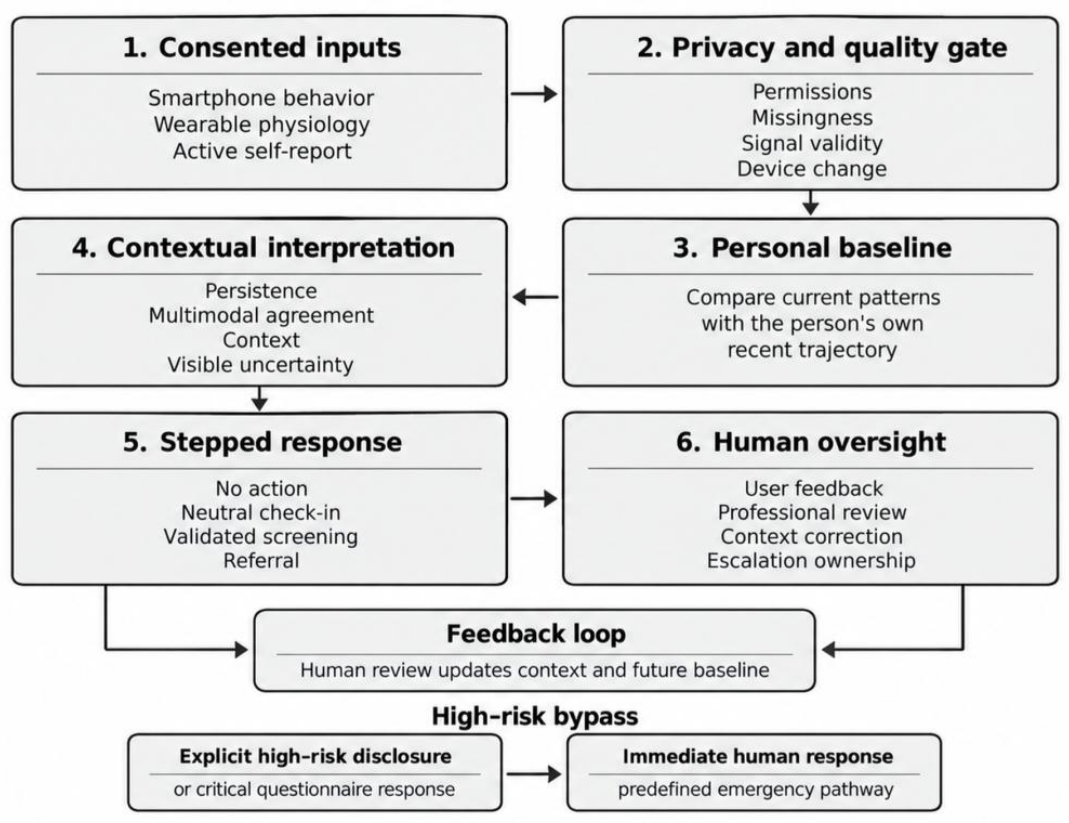
Table 1.
Candidate MindCare+ data and assessment layers. “Maturity” refers to the intended MindCare+ use, not a universal technology-readiness score.
Table 1.
Candidate MindCare+ data and assessment layers. “Maturity” refers to the intended MindCare+ use, not a universal technology-readiness score.
| Data stream | Candidate features | Intended role | Evidence / maturity boundary |
|---|---|---|---|
| Smartphone device interaction | Screen-on patterns; session timing; optional app-category duration; notification burden | Behavioral context and temporal routine | Near-term capture. Interpretation is context-dependent. Raw content is not required and should be off by default. |
| Mobility and activity | Accelerometry; step pattern; mobility radius; location regularity; time outside home | Functional trajectory and change in routine | Associated with mental-health measures across studies, but not specific to psychiatric states. Geolocation requires heightened minimization and consent [6,7,8,9,10,11,12]. |
| Sleep and circadian behavior | Sleep timing; duration; fragmentation; regularity; day-night activity pattern | Longitudinal temporal organization | Potentially informative when device measurement is valid. Findings from mood-disorder cohorts do not generalize automatically to population screening [16]. |
| Optional wearable physiology | Heart rate; HRV; electrodermal activity; skin temperature where device validity is established | Physiological arousal and context | Adjunctive only. Exercise, fever, medication, caffeine, hydration, menstrual cycle, posture, and environment can alter signals. |
| Active self-report | Mood check-ins; age- and setting-appropriate depression/anxiety/distress scales; sleep/stress items | Structured symptom assessment and confirmation layer | Instrument, language, age, threshold, licensing, and crisis-item workflow must match the target setting. Indonesian evidence exists for several tools but is population-specific [22,23,24,25,26,27]. |
| Optional social-context metadata | Interaction frequency or timing with explicit opt-in and minimization | Contextual change, not relationship quality or emotion | High privacy sensitivity. Message, call, image, microphone, or social-media content should not be collected by default [18,19,20,21]. |
Disclaimer/Publisher’s Note: The statements, opinions and data contained in all publications are solely those of the individual author(s) and contributor(s) and not of MDPI and/or the editor(s). MDPI and/or the editor(s) disclaim responsibility for any injury to people or property resulting from any ideas, methods, instructions or products referred to in the content. |
© 2026 by the authors. Licensee MDPI, Basel, Switzerland. This article is an open access article distributed under the terms and conditions of the Creative Commons Attribution (CC BY) license (http://creativecommons.org/licenses/by/4.0/).
Copyright: This open access article is published under a Creative Commons CC BY 4.0 license, which permit the free download, distribution, and reuse, provided that the author and preprint are cited in any reuse.