

Submitted:
28 August 2026
Posted:
28 August 2026
You are already at the latest version
Abstract
Background: Indonesia is undergoing rapid population ageing. In 2025, approximately 34.7 million Indonesians were aged 60 years or older, representing 12.33% of the population, with the proportion projected to reach 20.31% by 2045 [1]. Population ageing increases the need for care models that preserve functional ability, autonomy, social connection, and the capacity to remain safely in the community. Wearable sensing, patient-facing conversational AI, and care robotics are developing rapidly, but the supporting evidence remains distributed across modality-specific literatures with uneven clinical maturity rather than one validated integrated care architecture [5,14,25]. Objective: This paper proposes SeniorBot, a human-supervised multiscale gerontechnology framework integrating periodic molecular context, dense longitudinal sensing, contextual AI interpretation, assistive interaction, tiered escalation, and a future morphofunctional robotic embodiment to support ageing in place. Methods: We performed an evidence-informed conceptual synthesis of the original SeniorBot proposal and targeted literature spanning healthy ageing, wearable and molecular biosensing, digital biomarkers, longitudinal anomaly detection, conversational and socially assistive AI, human oversight, privacy and age-inclusive design, and reconfigurable robotics. Evidence was used to establish component plausibility, maturity, and boundary conditions rather than to estimate pooled effectiveness. The framework was constructed using explicit distinctions between near-term capability, emerging capability, and future embodiment hypotheses. Results: SeniorBot conceptualizes health as a trajectory rather than a collection of isolated measurements. Sparse molecular information, including selected genomic, epigenomic, proteomic, and metabolomic data, may provide slow-changing biological context. Wearable physiological signals, gait, mobility, sleep, voice, behavioral interaction, and environmental exposures provide denser longitudinal information. Before escalation, the framework combines data-quality assessment, population safety rules, individual longitudinal baselines, multimodal concordance, context, and uncertainty. AI-generated signals are not medical diagnoses and do not independently prescribe or modify treatment. SeniorBot defines a future pathway toward a reconfigurable mobility-support configuration. This does not assume that a human-bearing transformable robot is currently clinically available. Instead, it is grounded in demonstrated engineering principles such as appendage repurposing, modular reconfiguration, continuous 3D shape morphing, geometric locking, and deformable load-bearing robotic structures [17–19]. The conceptual synthesis produced a closed-loop architecture in which molecular context and dense longitudinal sensing pass through data-quality and contextual gates before contributing to a personal health-trajectory model, graded response orchestration, and meaningful human oversight. Proposed longitudinal domains include cardiovascular and respiratory signals, mobility and gait, falls, sleep and circadian behavior, voice and interaction, cognition-related microphenotypes, social behavior, and environmental exposure. The maturity synthesis was asymmetric: wearable sensing and conversational assistance have direct feasibility evidence [5,14,25], longitudinal multimodal state modeling remains translational [26–29], and continuous physical autonomy or human-bearing morphofunctional reconfiguration remains frontier engineering requiring a separate validation track [25,30–32]. Conclusions: SeniorBot is proposed not as a finished robot but as a testable convergence architecture linking molecular context, longitudinal digital phenotypes, contextual AI, meaningful human oversight, and adaptive physical assistance. Whether such integration improves safety, independence, caregiver experience, or healthcare utilization remains an empirical question.
Keywords:
artificial intelligence
; ageing in place
; older adults
; gerontechnology
; digital biomarkers
; wearable biosensors
; multi-omics
; longitudinal monitoring
; assistive robotics
; reconfigurable robotics
; human oversight
; Indonesia
1. Introduction
Indonesia has entered a period of rapid population ageing. Bappenas reported that approximately 34.7 million Indonesians were aged 60 years or older in 2025, representing 12.33% of the population, and projected that the proportion would rise to 20.31% by 2045 [1]. This transition strengthens the need for systems that allow older adults to maintain function, dignity, social connection, and appropriate access to care while remaining in their homes and communities whenever possible.
The clinical problem is not adequately described by disease counts alone. Older adults may simultaneously experience multimorbidity, medication exposure, reduced physiological reserve, mobility limitations, sensory impairment, cognitive change, and altered social support. The World Health Organization Integrated Care for Older People (ICOPE) framework therefore emphasizes intrinsic capacity, functional ability, person-centred assessment, individualized care plans, monitoring, social needs, and caregiver support [2]. SeniorBot is conceived as a technological layer that could complement such a continuum, not replace geriatric assessment or professional care.
Technology has already begun to observe parts of this landscape. Wearable devices can capture mobility, sleep, activity, fall-related events, cardiac signals, and other physiological measures, although reliability, real-world validity, usability, privacy, and cost remain important limitations [5]. Home-based digital biomarkers derived from gait, activity, sleep, heart rate, hand movement, and room transition have shown potential for frailty classification, while longitudinal prognostic validation remains incomplete [6].
The central scientific problem is therefore not whether one more sensor can be added. It is how heterogeneous observations should be integrated through time, how uncertainty should be represented, when an AI system should remain silent, when it may support the user, and when a human must take responsibility for escalation. This manuscript reframes the original SeniorBot concept around that integration problem.
Recent frontier preprints help clarify this uneven maturity. Foundation-model care robots are currently concentrated in voice-centered conversational and reasoning roles, while multimodal grounding and continuous physical autonomy remain substantially less developed [25]. This distinction is central to SeniorBot: the near-term system should be evaluated first as a bounded sensing, communication, and escalation platform rather than judged by the maturity of its most futuristic embodiment.
2. Methods
2.1. Study Design and Framework-Development Approach
This study used an evidence-informed conceptual framework-development approach. The starting material was the original SeniorBot innovation concept, which proposed an artificial-intelligence-assisted robotic companion for health monitoring, daily assistance, social support, and emergency notification in older adults. The concept was reformulated as a falsifiable gerontechnology research architecture rather than an efficacy claim or a description of a completed medical device.
The purpose of the synthesis was to determine which proposed SeniorBot functions are supported as existing technical capabilities, which remain translational or emerging, and which should be retained only as future engineering hypotheses. The process did not generate participant-level data and did not involve statistical hypothesis testing.
2.2. Evidence Domains and Source Use
Evidence was selected to establish the plausibility and limitations of the major architectural domains: healthy ageing and integrated care; wearable and ambient sensing; home-based frailty and mobility biomarkers; fall-related sensing; personalized anomaly detection; epigenomic, proteomic, and metabolomic ageing measures; wearable biochemical biosensing; speech-derived biomarkers; conversational AI and socially assistive agents; human oversight; privacy, data protection, co-design, and ageism; Indonesian implementation pathways; and reconfigurable or shape-changing robotics.
This was not a systematic review. No exhaustive database search, formal risk-of-bias assessment, or quantitative evidence pooling was undertaken. References were used only where they supported a defined component, feasibility statement, uncertainty boundary, or translational requirement. Absence of evidence for the complete SeniorBot architecture was treated as a limitation rather than filled by analogy.
Several arXiv preprints were included specifically to characterize frontier technical maturity in rapidly changing areas where peer-reviewed literature may lag, including foundation-model care robots, longitudinal multimodal health representation, human digital twins, multi-omics aging models, and reconfigurable robotics [25,26,27,28,29,30,31,32]. These preprints were not treated as evidence of clinical effectiveness. A related Indonesian conceptual preprint, NutriAgent+, was used only as a methodological precedent for evidence hierarchy, quality gating, bounded AI autonomy, and staged validation [24].
2.3. Evidence-Boundary Classification
SeniorBot is defined as a human-supervised multiscale gerontechnology architecture integrating periodic molecular information, dense longitudinal physiological and behavioral sensing, contextual AI-mediated interpretation, assistive interaction, tiered escalation, and potentially morphofunctional robotic assistance. The scientific object is the architecture rather than any single hardware platform.
Three maturity categories are maintained throughout the framework. Near-term capabilities include established sensing and interaction functions such as inertial monitoring, selected validated physiological measurements, conversational interfaces, and event detection. Emerging capabilities include personalized anomaly detection, speech-derived biomarkers, broader wearable biochemical sensing, and multimodal longitudinal forecasting. Future embodiment hypotheses include human-bearing morphological transformation. These categories prevent technical plausibility from being mistaken for clinical validation.
2.4. Conceptual Synthesis Rules
Five rules were applied during framework construction. First, sensing was separated from interpretation so that a measurable signal was not treated as a clinically meaningful endpoint by default. Second, data quality, missingness, context, and uncertainty were placed before AI-mediated inference. Third, population-level safety boundaries were distinguished from an individual longitudinal baseline. Fourth, AI autonomy was constrained according to clinical and physical risk, with consequential escalation requiring meaningful human oversight. Fifth, future physical transformation was treated as an embodiment research pathway whose enabling engineering principles can be discussed without claiming that a safe human-bearing transformable SeniorBot currently exists.
This logic intentionally parallels the evidence-bounded architecture used in the NutriAgent+ preprint, where multimodal fusion is downstream of input validity and quality gating rather than a substitute for them [24]. SeniorBot extends that principle from precision nutrition into longitudinal gerontechnology and embodied physical assistance.
2.5. Prespecified Conceptual Outputs
The prespecified outputs of the conceptual synthesis were: (1) a multiscale model of ageing-related health trajectories; (2) a human-supervised closed-loop SeniorBot architecture; (3) a hierarchy of candidate molecular, wearable, behavioral, and environmental input streams; (4) a set of longitudinal data domains for predictive-health research; (5) explicit AI, privacy, and escalation boundaries; (6) a staged morphofunctional robotic embodiment pathway; and (7) a translational validation agenda for future empirical testing.
3. Results
The conceptual synthesis produced a multiscale, device-agnostic SeniorBot framework. The principal outputs are summarized below as design results rather than clinical outcomes.
3.1. Multiscale Health-Trajectory Model
Conventional monitoring frequently produces snapshots: one blood-pressure reading, one laboratory panel, one cognitive assessment, or one gait test. Yet ageing is dynamic. A value may be meaningful only when interpreted against previous values, concurrent activity, medication, sleep, environment, and the person’s usual recovery pattern. SeniorBot therefore treats the evolving personal health trajectory, rather than the isolated measurement, as the conceptual unit of analysis.
SeniorBot separates slow and fast biological timescales. For framework purposes, genomic information is treated as a comparatively stable background layer that may contribute susceptibility or pharmacogenomic context, whereas selected epigenetic, proteomic, and metabolomic measurements are treated as periodic molecular anchors. Epigenetic ageing clocks are increasingly sophisticated but remain subject to interpretation, cell-type heterogeneity, and methodological limitations [10]. Metabolomic ageing clocks and tissue-specific proteomic ageing trajectories similarly demonstrate the scientific plausibility of molecular ageing signatures without establishing routine clinical use [11,12].
Dense bio-digital data operate on much shorter timescales. Heart rate, rhythm-related signals, activity, respiration, glucose, gait, sleep, voice, interaction patterns, and environmental exposures may change from seconds to days. SeniorBot does not require every layer to be sampled continuously. Its proposed value is the integration of data that naturally arrive at different frequencies.
Aging-related vulnerability may also be reflected in response and recovery. Exercise, illness, poor sleep, postural change, or meals perturb physiology. A system with adequate longitudinal density could eventually examine perturbation → response → recovery patterns, such as heart-rate recovery after exertion, restoration of mobility after illness, or return of sleep regularity after disruption. These resilience features remain research hypotheses rather than established SeniorBot outputs.
3.2. Human-Supervised Closed-Loop Architecture
SeniorBot is intentionally device-agnostic. A future implementation may use different wearables, cameras, inertial sensors, processors, communication protocols, or robotic bodies as long as each component satisfies validation requirements for its intended function. This makes the architecture scientifically durable even as hardware changes.
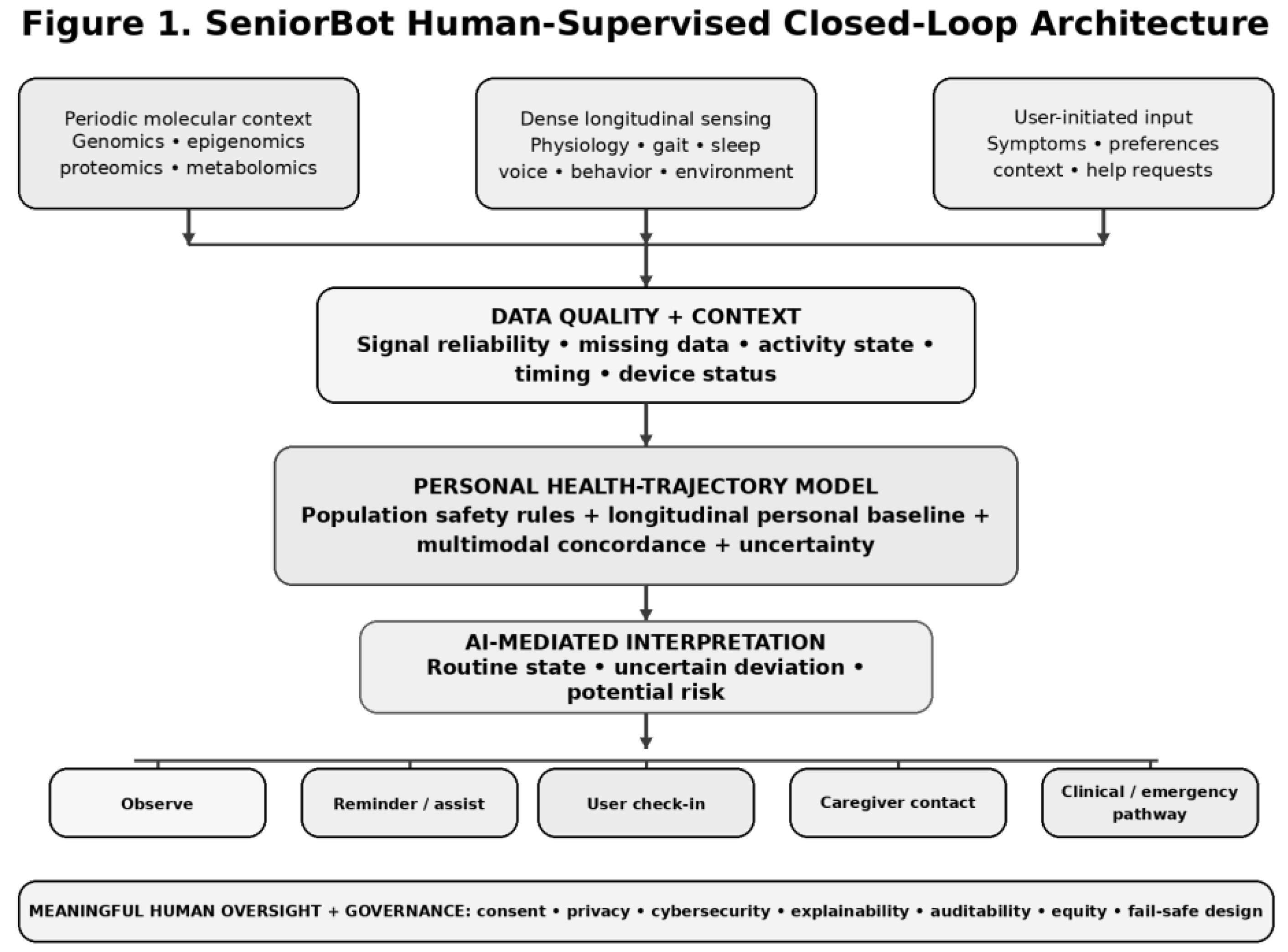
The closed-loop framework contains six interacting functions: multiscale biological and digital inputs; data-quality and contextual assessment; longitudinal personal-state modeling; AI-mediated interpretation; response orchestration; and meaningful human oversight. Privacy, autonomy, cybersecurity, explainability, auditability, equity, and fail-safe operation form a governance envelope around the entire loop.
Figure 1.
SeniorBot human-supervised closed-loop architecture. Molecular context and dense longitudinal sensing enter a data-quality and contextual layer before contributing to a personal health-trajectory model, graded response orchestration, and meaningful human oversight.
Figure 1.
SeniorBot human-supervised closed-loop architecture. Molecular context and dense longitudinal sensing enter a data-quality and contextual layer before contributing to a personal health-trajectory model, graded response orchestration, and meaningful human oversight.
3.3. Multiscale Bio-Digital Phenotyping and Candidate Sensing Layers
Omics should not be conflated with wearable biosensing. Omics platforms typically profile a large number of molecular features and usually require laboratory processing. In SeniorBot they are therefore conceptualized as periodic molecular anchors rather than continuous home measurements. Epigenomics may contribute biological-age information; proteomics may capture systemic or tissue-related ageing trajectories; and metabolomics may reflect downstream molecular state across multiple biological and environmental influences [10,11,12]. Genomic data, if included, would function as comparatively stable background context rather than a longitudinal sensor stream.
The framework deliberately avoids assuming that an ageing clock is a definitive representation of biological age or that a molecular risk signature should directly trigger an automated clinical action. Molecular information would require strict governance and clinically meaningful interpretation before it could influence escalation.
Wearable biosensor research now extends beyond conventional accelerometers and photoplethysmography toward alternative biofluids including sweat, saliva, tears, and interstitial fluid. Reviews describe candidate measurements including glucose, lactate, cortisol, electrolytes, and pH, while emphasizing unresolved challenges in clinical validation, biocompatibility, matrix-specific interpretation, and manufacturing scalability [13,33]. SeniorBot therefore accepts modular sensing inputs only according to the analytical validity, physiological interpretability, and intended use of each modality.

Table 1.
Potential SeniorBot data layers, sampling timescales, and proposed maturity.
| Data layer | Examples | Timescale | Role / maturity |
| Genomic background | Inherited susceptibility; pharmacogenomic context | Once / rarely repeated | Background context; not treated as dynamic monitoring |
| Epigenomic, proteomic, metabolomic anchors | Biological-age signatures; inflammatory/metabolic state | Months-years | Research-grade periodic context; emerging clinical interpretation [10,11,12] |
| PPG / ECG / validated BP | Heart rate, rhythm-related features, pulse morphology, blood pressure | Seconds-days | Established sensing classes, but device- and use-case-specific validity is required [5] |
| Continuous glucose monitoring | Interstitial glucose trajectory | Minutes-days | Available continuous interstitial-fluid modality; interpretation remains use-case specific [33] |
| Wearable biochemical biosensors | Sweat/ISF/saliva/tear glucose, lactate, cortisol, electrolytes, pH | Minutes-hours | Emerging; analyte- and matrix-specific analytical and physiological validation required [13,33] |
| Mobility and gait | Steps, gait speed, cadence, turning, sit-to-stand, room transitions | Seconds-weeks | Near-term digital phenotype; prognostic use requires validation [6] |
| Sleep and circadian behavior | Sleep timing, fragmentation, regularity, day-night activity | Hours-weeks | Near-term longitudinal phenotype; measurement interpretation remains device/use-case specific [5,6] |
| Voice and interaction | Speech rate, pauses, response latency, verbal fluency | Seconds-months | Emerging; opt-in, culturally appropriate, and clinically validated use required [8] |
| Environment | Temperature, humidity, PM2.5, CO₂, noise, light, home hazards | Seconds-weeks | Contextual input layer; health interpretation requires use-case validation |
Table note. Maturity labels refer to the intended SeniorBot use rather than a universal technology-readiness score; clinical interpretation remains modality- and use-case-specific.
3.4. Longitudinal Data Domains for Predictive-Health Research
SeniorBot’s predictive ambition should be framed as trajectory-deviation estimation rather than deterministic disease prediction. Longitudinal observations can reveal whether multiple dimensions of the same person are changing together, whether a change persists, and whether recovery is becoming slower. The relevant scientific question becomes whether this individual is moving meaningfully away from their own previous functional and physiological trajectory.
Cardiovascular and respiratory variables may include resting and nocturnal heart rate, rhythm irregularity, heart-rate response to routine activity, heart-rate recovery, validated blood-pressure trends, respiratory rate, breathing pattern, and oxygen-saturation trends. Interpretation should focus on persistence, context, multimodal concordance, and signal reliability rather than one isolated threshold.
Mobility may be one of the richest functional phenotypes because walking integrates musculoskeletal strength, neurological coordination, cardiovascular reserve, balance, sensory input, cognition, motivation, and environmental navigation. Candidate variables include walking speed, cadence, stride variability, turning speed, sit-to-stand transitions, walking-bout distribution, stair use, room transitions, and nocturnal mobility. Home-based digital-biomarker studies already identify gait, activity, sleep, heart rate, hand movement, and room transitions as potential frailty markers [6].
Fall detection, fall prediction, and fall prevention must remain distinct. A 2026 meta-analysis of wearable fall prediction reported pooled sensitivity of 0.55 and specificity of 0.89, suggesting usefulness for screening or risk stratification rather than deterministic prediction [7].
Repeated sleep and circadian data may include sleep duration and timing, fragmentation, nocturnal awakenings, daytime inactivity, and regularity. A gradual loss of temporal organization may be more informative than one poor night, particularly when co-occurring with declining mobility or changing physiology.
With explicit consent, a conversational robot could quantify speech rate, pauses, response latency, vocal intensity, prosody, articulation, verbal fluency, lexical diversity, and repetition. A 2025 meta-analysis of speech biomarkers for mild cognitive impairment reported pooled accuracy around 80%, sensitivity 80%, and specificity 77% [8]. These results concern diagnostic classification across study populations, not validated within-person change detection. SeniorBot therefore proposes, rather than treats as established, an opt-in within-person speech-drift signal that could prompt formal assessment when warranted.
Optional social and environmental variables could include interaction frequency, family-contact patterns, time outside the home, mobility radius, room use, indoor temperature, humidity, particulate matter, CO₂, noise, and light exposure. Behavioral change must not be equated automatically with emotion or disease.
3.5. Contextual AI Interpretation, Personalization, and Uncertainty
SeniorBot proposes a layered interpretation strategy: population-level safety rules identify predefined signals that deserve attention; a longitudinal individual baseline describes the person’s usual state; contextual information describes what was happening when the measurement occurred; and multimodal concordance assesses whether independent domains changed in the same direction. Personalized anomaly detection is plausible but not universally superior. Recent home-monitoring research has shown that individualized anomaly models may perform moderately in one population yet generalize poorly to another [9].
An older adult’s baseline is not permanent. Medications change, chronic disease progresses, activity adapts, and recovery after illness may establish a new steady state. SeniorBot therefore requires methods for baseline drift rather than assuming that an early observation window represents lifelong normality.
The system should distinguish sensor anomaly from biological anomaly. Device status, missingness, motion artifact, implausible values, and multimodal disagreement should be assessed before escalation. Uncertainty should remain visible through outputs such as insufficient data, low-confidence deviation, possible anomaly, or high-confidence safety signal.
3.6. Assistive Interaction, Graded Escalation, and Human Oversight
Potential low-risk functions include medication and appointment reminders, meal or hydration prompts, routine support, structured check-ins, health-information navigation, communication facilitation, collection of user-reported concerns, and companionship-oriented conversation. The evidence base for patient-facing LLM chatbots in older-person care remains early. A 2026 living systematic review identified only nine eligible studies, generally small and exploratory, with no evidence of clinical or cost-effectiveness in fully integrated clinical workflows [14].
Socially assistive agents may reduce loneliness in some older-adult settings, but effects vary by context and intervention, and benefits do not automatically extend to overall quality of life or happiness [15]. The appropriate design goal is supportive interaction and facilitation of human-human connection, not replacement of family, caregivers, or clinicians.
SeniorBot should not convert every deviation into an emergency. The response pathway is graded: Level 0, passive observation; Level 1, low-risk reminder or assistance; Level 2, structured user check-in; Level 3, notification of an authorized caregiver according to predefined criteria; and Level 4, clinical or emergency escalation according to validated use-case-specific protocols.
AI-generated signals should not independently establish diagnosis, prescribe medication, change doses, override professional advice, or perform high-risk physical action solely because a model is confident. WHO guidance emphasizes protecting autonomy; promoting well-being and safety; transparency and explainability; responsibility and accountability; inclusiveness and equity; and responsive, sustainable AI [3]. More recent analysis cautions that human-in-the-loop oversight can become symbolic when real workflow conditions prevent clinicians or caregivers from meaningfully interrogating and overriding algorithmic outputs [16]. SeniorBot therefore requires meaningful human oversight in which the responsible person can inspect the reason for an alert, see uncertainty, disagree, override, and intervene.
3.7. Future Morphofunctional Robotic Embodiment
The original SeniorBot concept included a more ambitious possibility: a robotic assistant that could reconfigure into a mobility-support form resembling a wheelchair. A literal cinematic Transformer capable of rapid, compact, autonomous human-bearing transformation is not currently available. However, the underlying engineering premise that one machine can change morphology and repurpose the same physical structures across functions has already been demonstrated in several robotic systems.
The Multi-Modal Mobility Morphobot (M4) repurposes appendages as wheels, legs, and aerial thrusters and demonstrates autonomous operation in selected locomotion modes; the authors explicitly note that autonomous switching across all modes still requires further development [17]. This demonstrates morphofunctionality: a component need not be permanently mapped to one function. In 2025, transforming machines using continuously morphable actuators demonstrated programmable three-dimensional shape change together with geometric locking and stiffness variation [18]. Modular tensegrity blocks have also demonstrated deformable self-assembling structures and load-bearing configurations [19]. None of these systems is a geriatric wheelchair, but together they show that morphology-dependent functional repurposing is experimentally real.
The gap between a morphing research robot and a human-bearing assistive device is substantial. Major constraints are conservation of mass and packaging, center-of-mass control, collision-free transformation paths, actuator torque, structural load, mechanical locking, energy density, repeated-cycle durability, manual override, and human safety. Crushing, pinching, tipping, uncontrolled motion, power failure, and actuator failure are unacceptable failure modes.
A plausible development sequence would progress from a mobile companion, to an object-carrying assistant, to deployable support structures, to transformation into an unoccupied mobility platform, and only much later to human-supervised or automated human-bearing reconfiguration after extensive engineering and clinical safety validation.
3.8. Concept Maturation and Evidence-Gated Validation Pathway
The frontier literature indicates that SeniorBot components do not mature at the same rate. In patient and elderly care, foundation models are currently most mature as conversational or reasoning layers over socially assistive embodiments, whereas multimodal grounding and continuous physical autonomy remain limited [25]. Personal-health LLM research demonstrates proof-of-concept reasoning over longitudinal wearable time series [26], while human-digital-twin frameworks and joint EHR-wearable representation learning illustrate rapidly advancing approaches for multimodal longitudinal state modeling [27,28]. A recent multi-omics aging preprint further illustrates research-grade integration of molecular, clinical, behavioral, and environmental data, but does not imply continuous home multi-omics sensing [29].
The robotics track remains further from clinical deployment. Recent arXiv work demonstrates environment-assisted modular self-reconfiguration, dual-level reconfigurable modules, and variable-stiffness malleable structures [30,31,32]. Together with peer-reviewed morphobot, shape-locking, and tensegrity studies [17,18,19], these studies support physical plausibility of reconfiguration while also showing that current evidence remains predominantly prototype- and laboratory-level. Because these heterogeneous literatures do not report harmonized technology-readiness levels, Figure 2 is presented as an evidence-gated maturation pathway rather than a formal TRL score.
Figure 2.
SeniorBot dual-track translational maturation pathway. The bio-digital/AI track and robotic-embodiment track require separate analytical, human-factors, and safety evidence before integration. Current care-robot evidence supports greater maturity for conversational assistance than for continuous physical autonomy [25], while reconfigurable robotics remains primarily a prototype engineering domain [30,31,32]. Progression depends on prespecified evidence gates rather than calendar time, and success in one track does not imply maturity of the other.
Figure 2.
SeniorBot dual-track translational maturation pathway. The bio-digital/AI track and robotic-embodiment track require separate analytical, human-factors, and safety evidence before integration. Current care-robot evidence supports greater maturity for conversational assistance than for continuous physical autonomy [25], while reconfigurable robotics remains primarily a prototype engineering domain [30,31,32]. Progression depends on prespecified evidence gates rather than calendar time, and success in one track does not imply maturity of the other.
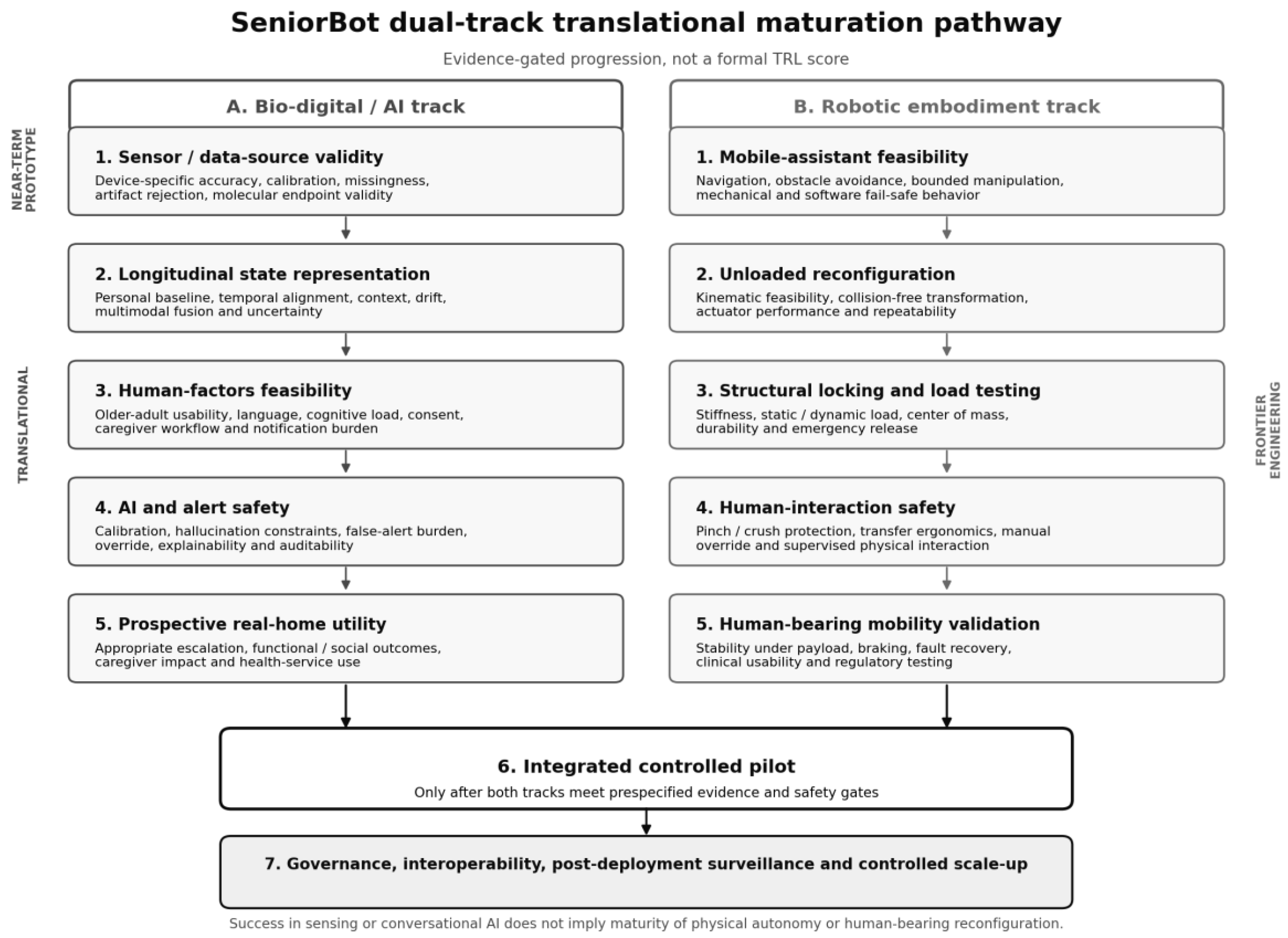
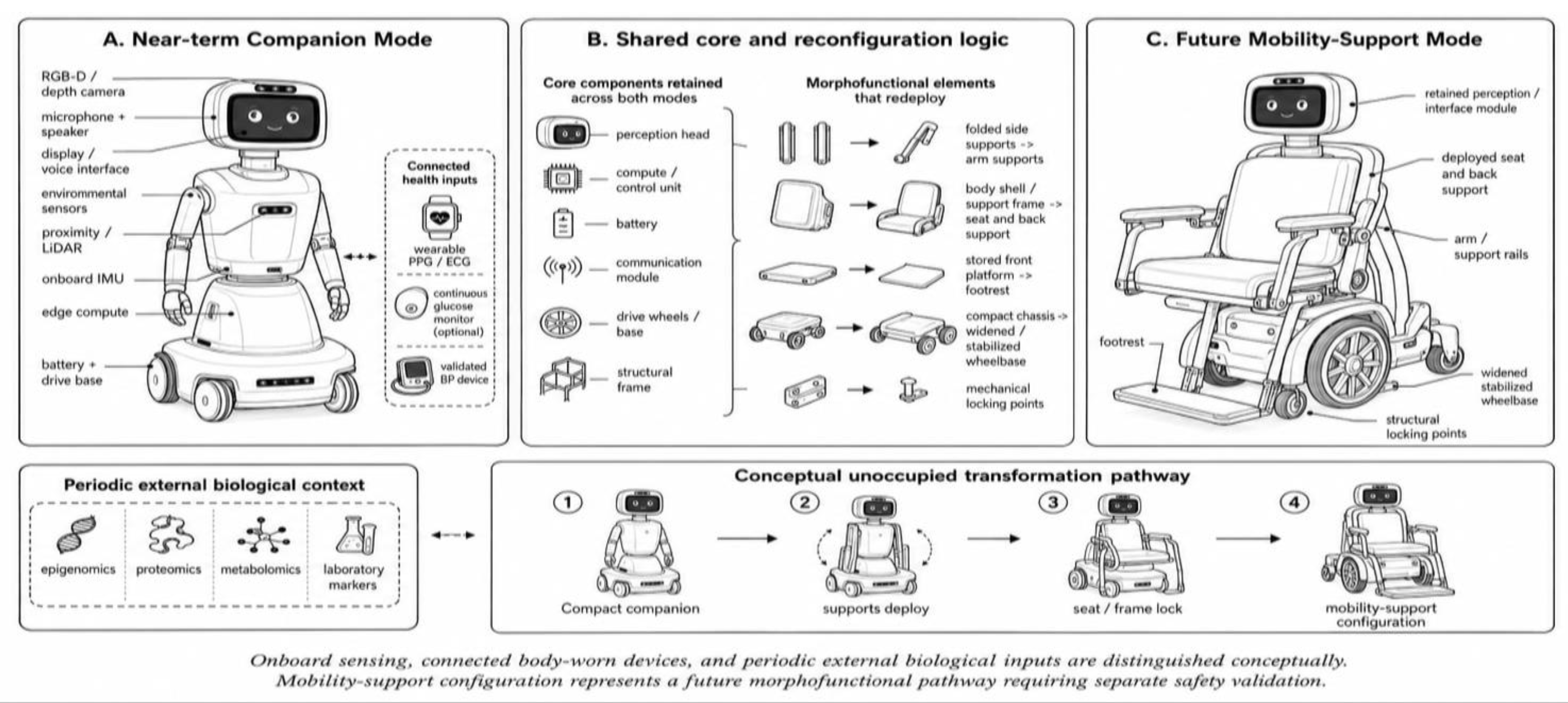
Figure 3.
Illustrative SeniorBot product concept. Left: a near-term companion mode combining conversational interaction, sensing, wearable integration, and mobile navigation. Right: a future mobility-support configuration using repurposed structural components. The right-hand configuration is retained as an engineering target, not a validated present capability.
Figure 3.
Illustrative SeniorBot product concept. Left: a near-term companion mode combining conversational interaction, sensing, wearable integration, and mobile navigation. Right: a future mobility-support configuration using repurposed structural components. The right-hand configuration is retained as an engineering target, not a validated present capability.
4. Discussion
4.1. Principal Conceptual Findings
The central result of this conceptual study is that SeniorBot is more defensible as a multiscale, longitudinal, human-supervised research architecture than as a claim about a single finished robot. The framework preserves the original ambition of integrating health monitoring, daily assistance, social support, emergency escalation, and adaptive physical embodiment, while separating each layer according to evidence maturity and risk.
Three conceptual shifts are especially important. First, health is represented as a trajectory rather than a sequence of isolated abnormal values. Second, molecular and digital signals are allowed to operate at different timescales rather than being forced into a fictional continuous multi-omics model. Third, physical reconfiguration is framed as a future morphofunctional research pathway grounded in demonstrated engineering principles, without implying that the final human-bearing transformation has already been achieved.
The evidence-gating logic is deliberately consistent with the related NutriAgent+ conceptual preprint, which separates sensing from interpretation, requires quality gating and uncertainty representation before AI reasoning, and treats clinical utility as a later validation stage rather than an assumed consequence of multimodal fusion [24]. SeniorBot adds two complexities that warrant a separate maturation pathway: older-adult care workflows and physically consequential robotic embodiment.
4.2. Implications of Multiscale Sensing for Ageing Research
The multiscale formulation provides a way to connect slow biological context with fast physiological and behavioral change. Genomic information may remain largely stable, periodic epigenomic, proteomic, or metabolomic observations may reflect slower biological state, and dense wearables can represent shorter-term physiology, mobility, sleep, behavior, and environmental exposure. The framework therefore avoids treating sampling frequency as a marker of biological importance.
The conceptual emphasis on trajectory deviation also avoids a common overstatement in predictive digital health. SeniorBot is not proposed to forecast disease deterministically. A more defensible initial goal is to test whether repeated multimodal observations can identify clinically meaningful departures from an individual baseline and whether those departures improve decisions compared with simple threshold systems.
4.3. Predictive-Health Interpretation and Physiological Resilience
A further implication is that response and recovery may be as informative as static values. Longitudinal sensing could eventually support research on physiological resilience by examining how an individual responds to routine perturbations such as exertion, illness, altered sleep, postural change, or meals and how rapidly the measured system returns toward its previous state. This proposition remains exploratory and requires endpoint-specific prospective validation.
Personalization itself should also remain falsifiable. The source evidence used in this framework shows that personalized anomaly detection can perform differently across populations [9]. SeniorBot therefore requires explicit treatment of baseline drift, model recalibration, missingness, and subgroup performance rather than assuming that an individualized model is automatically more accurate.
4.4. Why Transformer-like Embodiment Is Theoretically Plausible but Not Yet Clinically Available
The future wheelchair-like transformation should be interpreted through engineering decomposition rather than cinematic analogy. Existing robotics has separately demonstrated appendage repurposing, multimodal locomotion, continuous three-dimensional shape morphing with locking, and modular deformable load-bearing structures [17,18,19]. Frontier preprints add environment-assisted self-reconfiguration, dual-level modular reconfiguration, and variable-stiffness malleable structures [30,31,32]. These demonstrations establish that morphology can be changed and that physical components can acquire different functions after reconfiguration.
The clinical maturity of embodied AI must nevertheless be separated from mechanical plausibility. A 2026 perspective on foundation-model robots in patient and elderly care concludes that current systems are dominated by conversational assistance, while continuous closed-loop physical autonomy remains underexplored and care-outcome evidence is still concentrated in proximal measures such as usability, engagement, communication, and participation [25]. This places a Transformer-like SeniorBot mobility mode several evidence gates beyond a conversational companion prototype.
They do not establish the feasibility of a safe human-bearing SeniorBot. The remaining gap includes packaging efficiency, actuator torque, center-of-mass management, collision-free transformation paths, structural locking, energy density, repeated-cycle durability, pinch and crush protection, emergency release, manual override, and regulatory testing. The most scientifically defensible pathway is therefore staged, beginning with non-human-loaded transformation before any human-bearing reconfiguration is attempted.
4.5. Privacy, Autonomy, Ageism, and Data Governance
The same architecture that makes SeniorBot scientifically interesting also makes it privacy-sensitive. Physiological signals, movement, sleep, voice, social behavior, environmental context, and molecular information could together generate an unusually detailed model of daily life. Privacy therefore must be architectural rather than a secondary compliance step.
A 2025 systematic analysis of privacy policies from 17 major consumer-wearable manufacturers found substantial variability in transparency, data minimization, third-party sharing, security, and user rights [20]. SeniorBot should incorporate explicit consent, purpose limitation, data minimization, role-based access, encryption, secure updates, audit trails, user-controlled caregiver permissions, retention limits, and mechanisms for revocation and deletion.
Molecular information requires an even higher threshold. Indonesia’s Law No. 27 of 2022 on Personal Data Protection identifies health information, biometric data, and genetic data as specific personal data [21]. Any future omics layer would therefore require governance beyond ordinary activity tracking.
Older adults should participate in design rather than being treated as a homogeneous population with presumed low technical competence. WHO specifically recommends participatory design of health AI by and with older people and warns that unrepresentative data and ageist assumptions can limit the reach or appropriateness of AI technologies for older adults [4]. A 2025 rapid review further found that co-design methods have been used across stages of health-innovation development and explicitly calls for meaningful involvement rather than tokenistic participation [22]. SeniorBot should therefore allow users to shape which data are collected, when the robot may speak, who can receive alerts, which cameras or microphones are acceptable, and what degree of autonomy is tolerable.
4.6. Indonesian Implementation Context
Indonesia should not be treated merely as a deployment site for a framework designed elsewhere. Family involvement, household structure, digital literacy, regional connectivity, socioeconomic differences, trust in technology, privacy norms, language, and primary-care access can materially change both usability and safety. A SeniorBot configuration suitable for an independently living older adult in an urban apartment may differ substantially from one used in a multigenerational rural household.
Future health-related escalation should complement existing services rather than create a parallel health system. Potential pathways include authorized family caregivers, Puskesmas, primary-care clinicians, emergency services, and relevant specialist care. Indonesia’s Ministry of Health Health Sandbox provides staged pathways for proof-of-concept development, piloting, integration, governance evaluation, data protection, interoperability, and policy-oriented testing of health-technology innovation [23]. SeniorBot would fit more naturally into such a staged translational environment than into immediate nationwide deployment.
4.7. Translational Validation Pathway
Figure 2 proposes an evidence-gated dual-track maturation pathway rather than a single linear sequence. This structure reflects the uneven maturity of SeniorBot's two major technological domains. The bio-digital and AI components concern the validity of sensing, longitudinal interpretation, interaction, and escalation, whereas the robotic embodiment introduces additional mechanical and physically consequential risks. These domains may therefore mature in parallel, but they should not be integrated into a higher-consequence human-use system until each has independently satisfied the evidence requirements appropriate to its intended function.
Track A, Bio-Digital and AI Validation
Development should begin with participatory co-design to define real user needs, acceptable monitoring boundaries, caregiver permissions, preferred interaction modes, and unacceptable uses. Individual sensing modalities should then undergo device-specific and analytical validation against appropriate reference methods for their intended use. Once signal validity has been established, longitudinal monitoring should determine whether meaningful personal baselines can be learned, updated over time, and distinguished from genuine deterioration rather than merely reflecting sensor noise or expected baseline drift.
Contextual interpretation and alert algorithms should subsequently be evaluated for discrimination, calibration, sensitivity, specificity, false-alert burden, missing-event risk, robustness to missing or low-quality data, and the adequacy of uncertainty representation. Human-factors validation should assess task completion, learnability, accessibility, cognitive burden, user understanding of alerts, and the ability of older adults, caregivers, or health professionals to recover from system failure. Only after these stages should the bio-digital system proceed to real-home feasibility studies and prospective evaluation of clinical utility.
Track B, Robotic Embodiment Validation
Robotic development requires a separate validation sequence because accurate sensing or safe conversational interaction does not establish mechanical safety. Early testing should evaluate locomotion, navigation, obstacle avoidance, power performance, structural integrity, emergency stopping, and control reliability in an unoccupied platform. Morphofunctional development should then demonstrate repeatable reconfiguration without a human occupant, including actuator reliability, transformation-path clearance, center-of-mass stability, structural locking, and recovery from interrupted or incomplete transformation. Subsequent engineering stages should evaluate static and dynamic load-bearing performance in the deployed mobility-support configuration.
Human-interaction testing should then address contact forces, pinch and crush hazards, transfer mechanics, manual override, fail-safe states, stability during user approach or transfer, and user comfort. Human-bearing reconfiguration or mobility assistance should remain outside the validation pathway until these lower-risk mechanical and interaction-safety stages have been completed. Convergence Gate.
The two tracks should converge only after the bio-digital system has demonstrated acceptable sensing, longitudinal interpretation, alerting, uncertainty communication, and human-oversight performance, and the robotic platform has independently demonstrated mechanical integrity, reconfiguration reliability, and human-interaction safety. At this point, an integrated SeniorBot prototype could enter controlled pilot testing to evaluate whether contextual AI can safely influence physical assistance without converting uncertain health signals into autonomous high-consequence actions. This convergence step is particularly important because the principal risks of the two tracks are different.
A bio-digital failure may produce a false interpretation or inappropriate alert, whereas a robotic failure may produce physical harm. Their integration may therefore create new failure modes that do not exist when either subsystem is evaluated independently. Post-Convergence Evaluation. Integrated real-home studies should assess technical reliability, adherence, usability, privacy experience, caregiver workflow, alert burden, physical safety, and interactions between digital and robotic failure modes. Prospective clinical-utility evaluation should determine whether SeniorBot improves appropriate responses, functional outcomes, or care coordination without generating excessive unnecessary healthcare utilization or new caregiver burden.
Health-economic, equity, interoperability, governance, and regional implementation evaluation should follow before broader deployment is considered. Performance should be examined across relevant subgroups and settings to determine whether the system remains usable and safe among older adults with different levels of digital literacy, mobility, frailty, cognitive function, socioeconomic resources, and geographic access to care. Responsible scale-up should therefore be treated as the consequence of accumulated evidence across both maturation tracks, rather than as the predetermined final stage of product development.
4.8. Testable Propositions and Future Research
The SeniorBot framework generates a set of testable propositions rather than assuming that technological integration will necessarily produce clinical benefit. These propositions span biological interpretation, longitudinal digital phenotyping, alert performance, human factors, equity, and future physical embodiment. Multiscale health representation. SeniorBot proposes that periodic molecular information and dense longitudinal digital phenotypes may provide complementary views of an individual's health trajectory.
Molecular measures such as selected epigenomic, proteomic, or metabolomic profiles may provide relatively slow-changing biological context, whereas wearable, behavioral, functional, and environmental signals may characterize shorter-term variation. Whether combining these timescales improves clinically meaningful interpretation compared with either layer alone remains an empirical question. Personalized contextual interpretation. The framework further proposes that selected safety boundaries may be interpreted alongside an individual's longitudinal baseline and current context rather than through isolated universal thresholds alone. Such personalization may be useful when baseline physiology, mobility, sleep, or behavior differs substantially between individuals. However, personalized models may also normalize gradual deterioration or perform poorly when baseline states are unstable. Their value should therefore be tested directly against simpler threshold-based approaches. Multimodal concordance. Changes that occur simultaneously across several domains may carry different information from an isolated deviation in one signal. For example, concurrent changes in resting physiology, mobility, sleep, and daily behavior may increase confidence that an observed deviation warrants further assessment.
This proposition requires prospective testing because adding modalities may also increase missingness, model complexity, spurious associations, and false-positive interpretations. Physiological resilience. SeniorBot also proposes that response-and-recovery patterns may provide information about functional reserve that is not fully represented by static measurements. Potential examples include heart-rate recovery after habitual activity, restoration of mobility after temporary illness, or return of sleep patterns toward an individual's usual state after disruption. These dynamic characteristics should initially be treated as exploratory biomarkers rather than established clinical measures. Mobility as a longitudinal functional phenotype. Free-living gait and mobility may provide a particularly integrative representation of ageing because movement depends simultaneously on musculoskeletal, neurological, cardiovascular, sensory, and cognitive function. Longitudinal changes in gait speed, cadence, turning, transitions, daily movement, or room-to-room activity may therefore contribute to frailty or functional-risk stratification.
The relevant question is not whether mobility predicts every adverse outcome, but whether changes in an individual's mobility trajectory add actionable information to existing assessment. Speech and interaction trajectories. Conversational interaction creates another potentially informative longitudinal phenotype. Within-person changes in speech rate, pauses, response latency, fluency, or other acoustic and linguistic features may signal that further assessment is warranted. Such signals should remain supportive rather than diagnostic because speech can change for many reasons, including fatigue, emotion, hearing difficulty, respiratory illness, medication effects, or normal variation. Alert performance and burden. A central systems-level proposition is that contextual and multimodal interpretation may reduce unnecessary alerts compared with simple threshold-based monitoring while preserving adequate sensitivity for predefined safety events. This should not be evaluated solely through algorithmic discrimination. False alerts, missed events, repeated notifications, user annoyance, and caregiver alarm fatigue are clinically relevant outcomes in their own right. Caregiver consequences. Tiered escalation may reduce some forms of caregiver monitoring burden by decreasing the need for continuous manual checking.
However, the same system could increase burden if it produces frequent notifications, ambiguous alerts, additional documentation, or uncertainty about responsibility. SeniorBot should therefore evaluate both burden reduction and burden transfer rather than treating caregiver benefit as a predetermined outcome. Equity and contextual performance. SeniorBot may perform differently across users and settings. Digital literacy, frailty, disability, cognitive status, socioeconomic resources, connectivity, geography, language, household structure, and cultural expectations may affect usability, adherence, data completeness, and interpretation. Equity should therefore be treated as a performance characteristic of the system, not only as an implementation consideration after technical validation.
Morphofunctional assistance. The robotic embodiment generates a separate engineering proposition: a single assistive platform may eventually provide different physical functions through controlled redeployment and repurposing of shared structural components. Demonstrating this proposition would require evidence of repeatable reconfiguration, structural locking, load-bearing integrity, stability, safe human interaction, and failure recovery. Existing reconfigurable-robotics literature establishes plausibility of enabling mechanisms, but not the safety or feasibility of a human-bearing SeniorBot mobility configuration. Meaningful human oversight. Finally, the framework proposes that human oversight can improve safety only when it is operationally meaningful. A human should have access to relevant information, understand the basis and uncertainty of an alert, retain authority to disagree or override the system, and have sufficient time and practical ability to intervene. Human presence alone should therefore not be considered evidence that an AI-assisted care system is adequately supervised. Taken together, these propositions define SeniorBot less as a predetermined product specification than as a research programme in which each claimed advantage can be separately challenged, measured, and potentially falsified before higher-consequence integration is attempted.
4.9. Limitations
SeniorBot remains conceptual. No integrated platform has yet been evaluated using the complete architecture described here. The framework combines fields with very different translational maturity: inertial sensing is substantially more mature than continuous biochemical monitoring, and molecular ageing clocks are more mature as research tools than as routine clinical decision variables.
More data may not improve prediction. Multimodal systems can increase overfitting, spurious correlation, missing-data bias, and poor generalization. Personalized baselines may fail when physiology is unstable or when deterioration does not generate an unusual pattern. Continuous observation can also reduce privacy or perceived autonomy even when technically useful.
The morphofunctional mobility concept remains an engineering hypothesis. Demonstrations of appendage repurposing, shape morphing, geometric locking, and load-bearing modular structures establish plausibility of enabling principles, not feasibility or safety of the complete SeniorBot transformation. Human-bearing reconfiguration would require a substantially higher validation and regulatory threshold.
Finally, this paper is a conceptual synthesis rather than a systematic review. The references establish scientific plausibility and major uncertainty boundaries but do not represent exhaustive evidence coverage.
5. Conclusions
The future challenge of ageing societies is unlikely to be solved by one more sensor, one more chatbot, or one more robot. Human ageing unfolds simultaneously across molecular, physiological, functional, behavioral, social, and environmental levels, and these levels change at different speeds.
SeniorBot proposes a research architecture that respects those differences. Sparse molecular information can provide slow biological context. Dense sensors can characterize physiology, mobility, sleep, behavior, and environment. AI can integrate these observations while preserving data quality, context, and uncertainty. Graded responses can support users without converting every deviation into a medical emergency. Meaningful human oversight retains responsibility for consequential decisions. A robotic body can provide physical assistance and may, in the future, reconfigure its morphology to support different functions.
A literal cinematic Transformer for elder care does not currently exist. Yet modular reconfiguration, appendage repurposing, continuous 3D shape morphing, structural locking, and deformable load-bearing robotic structures are experimentally real. The scientific question is therefore not whether the final vision already exists, but whether these enabling principles can be combined safely, progressively, and usefully in a human-centred gerontechnology system molecular context + longitudinal digital phenotype + contextual AI + meaningful human oversight + adaptive robotic embodiment
Ethics approval
Not applicable. This manuscript presents a conceptual framework and does not report research involving human participants, biological samples, or identifiable participant data.
Consent for publication
Not applicable.
Data availability
No research dataset was generated or analyzed for this conceptual manuscript.
Funding
This research received no external funding.
Competing interests
The authors declare no conflicts of interest.
Author Contributions
Daffa Dhiyaulhaq: initial conceptualization and original drafting. Inez Aurelia Caesaria: literature collection and revision of the original background. Hasan Syarief: revision of the original concept and conclusions. Fairuz Ziyan Lidina: original visualization and structural development. Anis Lailatul Fitriyah: engineering-concept contribution and technical documentation. Qorry Amanda: supervision, biomedical conceptualization, scientific integration, framework expansion, and manuscript development.
References
- Ministry of National Development Planning/Bappenas. Pemerintah Perkuat Regulasi Hadapi Transisi Menuju Masyarakat Menua; Kementerian PPN/Bappenas: Jakarta, 2026. [Google Scholar]
- World Health Organization. Integrated care for older people (ICOPE): guidance for person-centred assessment and pathways in primary care, 2nd ed.; WHO: Geneva, 2025. [Google Scholar]
- World Health Organization. Ethics and governance of artificial intelligence for health: WHO guidance; WHO: Geneva, 2021. [Google Scholar]
- World Health Organization. Ageism in artificial intelligence for health; WHO: Geneva, 2022. [Google Scholar]
- Sun, Y.; Chen, J.; Ji, M.; Li, X. Wearable technologies for health promotion and disease prevention in older adults: systematic scoping review and evidence map. J. Med. Internet Res. 2025, 27, e69077. [Google Scholar] [CrossRef]
- Huang, J.; Zhou, S.; Xie, Q.; Yu, J.; Zhao, Y.; Feng, H. Digital biomarkers for real-life, home-based monitoring of frailty: a systematic review and meta-analysis. Age Ageing 2025, 54(4), afaf108. [Google Scholar] [CrossRef]
- Mou, C.; Yan, X.; Miao, X.; Zhu, L. Accuracy of wearable devices in predicting falls in older adults: a systematic review and meta-analysis. Front Public Health 2026, 14, 1778750. [Google Scholar] [CrossRef]
- Jafari, Z.; Andrew, M.K.; Rockwood, K. Diagnostic utility of speech-based biomarkers in mild cognitive impairment: a systematic review and meta-analysis. Age Ageing 2025, 54(10), afaf316. [Google Scholar] [CrossRef]
- Garssen, S.H.; Oude Wesselink, S.F.; Babac, S.; et al. Detecting early signs of patient deterioration at home using wearable sensors: a personalized anomaly detection approach. BioMed Phys. Eng. Express 2026, 12(2). [Google Scholar] [CrossRef]
- Teschendorff, A.E.; Horvath, S. Epigenetic ageing clocks: statistical methods and emerging computational challenges. Nat. Rev. Genet. 2025, 26(5), 350–368. [Google Scholar] [CrossRef]
- Ibáñez de Opakua, A.; Conde, R.; de Diego, A.; et al. Metabolomic-based aging clocks. npj Metab. Health Dis. 2025, 3, 35. [Google Scholar] [CrossRef]
- Ding, Y.; Zuo, Y.; Zhang, B.; et al. Comprehensive human proteome profiles across a 50-year lifespan reveal aging trajectories and signatures. Cell 2025, 188(20), 5763–5784.e26. [Google Scholar] [CrossRef]
- Wu, K.Y.; Su, M.E.; Kim, Y.; Nguyen, L.; Marchand, M.; Tran, S.D. Wearable biosensors: a comprehensive overview. Prog. Mol. Biol. Transl. Sci. 2025, 215, 101–154. [Google Scholar] [CrossRef]
- Johnson, J.T.; Duin, J.J.; Kuiper, T.; et al. Research on patient-facing chatbots based on large language models in the care of older people: a living systematic review. Eur. Geriatr. Med. 2026, 17(3), 1557–1567. [Google Scholar] [CrossRef]
- Fu, Z.; Yan, M.; Han, X.; Zhang, K.; Zhao, X. The effectiveness of artificial agents on loneliness reduction in older adults: a systematic review and meta-analysis. Arch. Gerontol. Geriatr. 2026, 140, 106056. [Google Scholar] [CrossRef]
- Abulibdeh, R.; Osei Agyemang, G.; Celi, L.A.; et al. Who’s really in the loop? Rethinking oversight in AI-assisted health care. Lancet 2026, 407(10545), 2340–2344. [Google Scholar] [CrossRef]
- Sihite, E.; Kalantari, A.; Nemovi, R.; et al. Multi-Modal Mobility Morphobot (M4) with appendage repurposing for locomotion plasticity enhancement. Nat. Commun. 2023, 14, 3323. [Google Scholar] [CrossRef]
- Xu, S.; Hu, X.; Yang, R.; et al. Transforming machines capable of continuous 3D shape morphing and locking. Nat. Mach. Intell. 2025, 7, 703–715. [Google Scholar] [CrossRef]
- Zhao, L.; Jiang, Y.; Chen, M.; et al. Modular shape-changing tensegrity-blocks enable self-assembling robotic structures. Nat. Commun. 2025, 16, 5888. [Google Scholar] [CrossRef]
- Doherty, C.; Baldwin, M.; Lambe, R.; Altini, M.; Caulfield, B. Privacy in consumer wearable technologies: a living systematic analysis of data policies across leading manufacturers. npj Digit Med. 2025, 8(1), 363. [Google Scholar] [CrossRef]
- Republic of Indonesia. Law Number 27 of 2022 concerning Personal Data Protection. Jakarta, 2022. [Google Scholar]
- Blouin Gagnon, L.; Turcotte, S.; DeBroux-Leduc, R.; Gauthier, P.; Bier, N. Methods for co-designing health innovations with older adults: a rapid review. Australas. J. Ageing 2025, 44(3), e70065. [Google Scholar] [CrossRef]
- Ministry of Health of the Republic of Indonesia. Sandbox Kesehatan: program pengujian dan pengembangan inovasi teknologi kesehatan; Kementerian Kesehatan RI: Jakarta, 2025-2026. [Google Scholar]
- Haq, S.F.; Syahhada, J.R.; Shandy, I.C.Y.S.; Amanda, Q. NutriAgent+: A Conceptual Framework for Agentic AI, Multimodal Wearable Biosensing, and Precision Nutrition in Indonesia. Preprints.org [Preprint] . 2026. [Google Scholar] [CrossRef]
- Qiu, Z.; Liu, W.; Hao, Y. Exploration of Foundation Model-Based Robots in Patient and Elderly Care. arXiv 2026, arXiv:2606.10208. [Google Scholar] [CrossRef]
- Cosentino, J.; Belyaeva, A.; Liu, X.; et al. Towards a Personal Health Large Language Model. arXiv 2024, arXiv:2406.06474. [Google Scholar] [CrossRef]
- Pan, R.; Sun, H.; Chen, X.; Pedrielli, G.; Huang, J. Human Digital Twin: Data, Models, Applications, and Challenges. arXiv 2025, arXiv:2508.13138. [Google Scholar] [CrossRef]
- Zhang, Y.; Zhou, H.; Feng, L.; Hong, Y.; Li, S. Learning Longitudinal Health Representations from EHR and Wearable Data. arXiv 2026, arXiv:2601.12227. [Google Scholar] [CrossRef]
- Li, H.; Tang, F.; Xue, H.; et al. Phenome-Wide Multi-Omics Integration Uncovers Distinct Archetypes of Human Aging. arXiv [Preprint] 2025, arXiv:2510.12384. [Google Scholar] [CrossRef]
- Wyder, P.M.; Li, H.; Bae, A.; Zhao, H.; Yim, M. Exploring Environment Exploitation for Self-Reconfiguration in Modular Robotics. arXiv 2025, arXiv:2508.01829. [Google Scholar] [CrossRef]
- Gu, J.; Lam, T.L.; Tian, C.; Xia, Z.; Xing, Y.; Zhang, D. MODUR: A Modular Dual-Reconfigurable Robot. arXiv [Preprint] 2025, arXiv:2510.13356. [Google Scholar] [CrossRef]
- Clark, A.B.; Rojas, N. Malleable Robots: Reconfigurable Robotic Arms with Continuum Links of Variable Stiffness. arXiv [Preprint] 2024, arXiv:2407.02374. [Google Scholar] [CrossRef]
- Kuruvinashetti, K.; Komeili, A.; Sanati Nezhad, A. Autonomous wearable sensing enabled by capillary microfluidics: a review. Lab Chip 2025, 25, 3879–3920. [Google Scholar] [CrossRef]
Disclaimer/Publisher’s Note: The statements, opinions and data contained in all publications are solely those of the individual author(s) and contributor(s) and not of MDPI and/or the editor(s). MDPI and/or the editor(s) disclaim responsibility for any injury to people or property resulting from any ideas, methods, instructions or products referred to in the content. |
© 2026 by the authors. Licensee MDPI, Basel, Switzerland. This article is an open access article distributed under the terms and conditions of the Creative Commons Attribution (CC BY) license (http://creativecommons.org/licenses/by/4.0/).
Copyright: This open access article is published under a Creative Commons CC BY 4.0 license, which permit the free download, distribution, and reuse, provided that the author and preprint are cited in any reuse.