
Submitted:
18 September 2026
Posted:
20 September 2026
You are already at the latest version
Abstract
Nutraceuticals are evaluated as though efficacy were a stable ingredient property, although net value may vary with exercise stimulus, exposure schedule, recovery pressure, athlete state, and prioritized outcome. This structured narrative review integrates exercise-adaptation biology, pe-riodized sports nutrition, training-load and recovery models, precision nutrition, and human evi-dence for sport-relevant interventions. Searches of PubMed/MEDLINE, Web of Science, and Scopus were updated through August 2026 and supplemented by citation tracking. General efficacy was separated from direct evidence of timing, context, or state modification. Nutraceutical Periodiza-tion for eXercise (NPX) is an allocation layer applied only after safety, legality, product quality, and plausible efficacy are established. It defines four non-sequential functional win-dows—performance exploitation, adaptation-permissive signaling, restoration, and resili-ence—and separates intervention strategy, training context, athlete state, and outcome hierarchy. Four falsifiable propositions test context modification, temporal allocation, bottleneck/state de-pendence, and whole-policy utility. Despite limited direct evidence for most allocation rules, NPX converts compound-specific efficacy into prospectively testable decisions. Targeted allocation may improve athlete-centered outcomes or preserve them with fewer exposures, lower burden, or less harm than standardized evidence-based use. Prospective interaction and policy trials are needed to establish the value and boundaries of these rules.
Keywords:
nutraceuticals
; sports nutrition
; dietary supplements
; exercise adaptation
; recovery
; periodization
; precision nutrition
; athlete health
1. Introduction
Most supplement trials ask a necessary question: does the intervention work? Sport practice requires a second question: under what conditions is the effect worth pursuing? Athletes encounter nutrients and bioactive compounds before competition, during high-quality training, across loading blocks, after tissue-damaging work, during travel, and under changing energy availability, sleep, illness risk, and injury status. A mean effect can establish biological or practical efficacy, yet still obscure whether the intervention adds value in a particular session, block, or athlete state.
In this review, nutraceutical is used operationally as an umbrella term for food-derived bioactives, isolated food components, and dietary-supplement ingredients deployed to modify exercise performance, recovery, adaptation, or athlete health. It is not used as a regulatory category and does not imply efficacy. Any application remains subordinate to adequate energy and nutrient intake, product identity and quality, legality, contamination control, medical screening, and an evidence-based risk–benefit assessment [1,2,3,4,5].
The evidence is most persuasive when an intervention has a clear mechanism, an exposure profile that matches that mechanism, and an endpoint that expresses it. Caffeine can improve selected cognitive and exercise outcomes; dietary nitrate can support nitric-oxide availability and exercise economy; creatine can increase phosphocreatine availability and repeated high-intensity capacity; and beta-alanine can increase muscle carnosine and buffering capacity [6,7,8,9]. Their temporal profiles differ. Caffeine and nitrate can be deployed at the session scale, whereas creatine and beta-alanine generally require loading and maintenance across days or weeks. Timing therefore encompasses not only minutes before exercise, but also when exposure is initiated, maintained, restricted, or withdrawn.
Interpretation becomes more difficult when the intended outcome is adaptation, tissue remodeling, recovery, or resilience. Recent human exercise studies illustrate why a binary positive/negative label is inadequate. New Zealand blackcurrant extract altered substrate storage and intramuscular triglyceride use without improving exercise capacity; acute nutritional ketosis did not alter the early skeletal-muscle transcriptomic response to aerobic exercise; and a betalain-rich concentrate affected heart rate, perceived exertion, and recovery muscle oxygenation without improving running economy or maximal oxygen uptake [10,11,12]. Curcumin did not accelerate recovery after a simulated soccer match, green tea did not augment the expected Nrf2 response after eccentric exercise, and bovine colostrum improved lower-body power in rugby players without clearly improving the selected immune, inflammatory, or illness outcomes [13,14,15]. Such findings can indicate limited efficacy, outcome mismatch, or genuine context dependence. Only prospectively designed comparisons can distinguish these explanations.
This review introduces Nutraceutical Periodization for eXercise (NPX) as a framework for deciding whether an already evidence-eligible strategy should be initiated, maintained, shifted, or withdrawn as the dominant training task and athlete state change. Intervention strategy denotes the specified product, formulation, dose, and exposure schedule. Functional allocation window denotes a prospectively assigned decision state in which one physiological task is prioritized; it is not a fixed clock interval or a claim of a discrete biological compartment. Athlete state denotes a pre-exposure characteristic that may modify response. The multiplication sign is reserved in this article for an estimable statistical interaction, not used as shorthand for conceptual association.
The synthesis was organized around four research questions:
RQ1. What decision construct does NPX formalize beyond existing evidence classifications, periodized-nutrition models, recovery frameworks, and precision-nutrition approaches?
RQ2. For an evidence-eligible strategy, does the magnitude or direction of its effect differ across prospectively defined training contexts or exposure schedules when product, dose, cumulative exposure, adherence, and carryover are adequately controlled?
RQ3. Does an independently defined pre-exposure bottleneck or athlete-state characteristic modify the effect on a prioritized athlete-centered outcome?
RQ4. Does a locked NPX-guided allocation policy improve the prioritized athlete-centered outcome—or preserve it with fewer exposures, lower burden, or less harm—relative to standardized evidence-based use?
Accordingly, the objectives were to define the functional allocation window as a decision unit; position NPX relative to adjacent frameworks; organize representative interventions across performance-exploitation, adaptation-permissive, restoration, and resilience priorities; and derive propositions, estimands, and study designs capable of supporting, delimiting, or rejecting the framework.
2. Narrative Review Methodology
2.1. Design, Scope, and Analytical Framework
This article was designed as a structured narrative review and theory-building synthesis rather than a systematic review or meta-analysis. This design was selected because the question spans heterogeneous evidence streams—exercise-adaptation biology, supplement efficacy and kinetics, training-load and recovery models, athlete-state modifiers, and periodized nutrition—and because the principal aim was to derive prospectively testable relationships rather than a pooled treatment effect [16,17,18,19]. Explicit information sources, eligibility criteria, appraisal domains, and synthesis rules were nevertheless used to reduce selective interpretation. The review does not claim exhaustive retrieval, formal certainty grading, or quantitative estimates of efficacy.
The population of primary interest comprised competitive athletes and exercise-trained adults. Evidence from healthy non-athlete adults was retained when needed to characterize pharmacokinetics, tissue exposure, mechanism, or a controlled exercise response that could not be isolated adequately in athletes. Evidence from clinical, injured, immobilized, or deficient populations was used only to inform the corresponding state-dependent mechanism or boundary condition and was not treated as direct evidence of efficacy in healthy athletes.
The intervention scope comprised protein and amino acids, creatine, caffeine, dietary nitrate, sodium bicarbonate, beta-alanine, polyphenols and isolated antioxidants, n-3 polyunsaturated fatty acids (n-3 PUFA), probiotics, bovine colostrum, medically indicated micronutrient correction, and collagen-derived peptides. Energy and carbohydrate availability were treated as foundational conditions rather than as window-allocated nutraceutical interventions. One human exercise study of acute nutritional ketosis [11] was retained only to illustrate discordance between a mechanistic endpoint and a practical allocation claim; ketone interventions were not mapped as NPX candidates. Eligible comparators included placebo or no intervention, an active comparator, the same cumulative exposure delivered at a different time or in a different training context, and prospectively defined athlete states with and without the proposed bottleneck.
Outcomes were classified into three roles before interpretation: (i) one prioritized athlete-centered outcome, such as performance, session completion, recovery of function, illness days, gastrointestinal symptoms, or missed training; (ii) constraint outcomes representing potential costs, such as sleep disruption, gastrointestinal intolerance, symptom burden, body-mass change, impaired adaptation, or adverse events; and (iii) mechanistic outcomes used to examine biological coherence. A mechanistic change alone was not considered evidence of practical benefit.
2.2. Information Sources and Search Strategy
PubMed/MEDLINE, Web of Science Core Collection, and Scopus were searched iteratively during manuscript development, with the final update undertaken in August 2026. Searches were supplemented by backward reference checking and forward citation tracking from consensus statements, position stands, systematic reviews, mechanistic reviews, and influential athlete studies. Transparent final search templates were retained, while the iterative process did not generate a PRISMA-style audit trail.
Three concept blocks were used: (A) exercise or athlete context; (B) nutraceutical, supplement, bioactive, or named intervention; and (C) allocation, timing, training context, athlete state, or outcome. Framework-level searches combined A AND B AND C. Because requiring timing- or context-related language could preferentially retrieve studies already framed around periodization, a second efficacy-and-safety route combined block A with block B—or its named-intervention substitute—and an evidence-type anchor comprising systematic review, meta-analysis, consensus, position statement, or position stand, without requiring block C. Compound-specific searches replaced the broad intervention block with the relevant named-intervention expression and, where applicable, retained the subset of block C appropriate to the intervention’s kinetics, proposed moderator, or endpoint. The exact executable strings, concept definitions, search-field implementation, efficacy-and-safety route, and compound-specific substitution rules are reported in Supplementary Methods S1 and Table S1.
The search was deliberately iterative: concepts identified during synthesis refined subsequent queries, consistent with theory-building review methods [19]. The searches were not governed by a prospectively registered set of interface filters; accordingly, no claim is made that date, language, or publication-type restrictions were applied uniformly across every exploratory query. Supplementary Methods S1 and Table S1 reproduce the final search architecture and month-level update record, not a complete historical log of every exploratory query.
2.3. Eligibility and Evidence Selection
Evidence was retained when it met all of the following criteria: (i) it addressed an intervention within scope, apart from the single endpoint-discordance exemplar identified in Section 2.1 [11]; (ii) it involved an exercise, training, competition, recovery, injury/disuse, illness-risk, or athlete-relevant physiological context; (iii) it reported an athlete-centered, constraint, kinetic, exposure, or mechanism-linked outcome relevant to at least one research question; and (iv) it contributed to general efficacy and safety, exposure time course, context or state dependence, responder heterogeneity, or a plausible trade-off among performance, recovery, adaptation, and health.
Peer-reviewed consensus or position statements, systematic reviews and meta-analyses, randomized human trials, longitudinal training studies, and controlled mechanistic human experiments received priority. Seminal animal, tissue, or cell evidence was retained only when required to establish biological plausibility not available from human research and was not used to override neutral or adverse athlete-centered findings. Commercial or promotional material, unreviewed claims, duplicate reports, inadequately characterized multi-ingredient products, studies without a meaningful exercise- or athlete-state link, and reports that did not permit the intervention, exposure, comparator, or relevant outcome to be identified were excluded from efficacy claims.
Search outputs and citation-tracking records were examined against these criteria during iterative synthesis, and full texts were consulted for retained claims. Because records were not managed under a prospectively specified systematic-review protocol, numerical screening counts and article-level exclusion logs were not retained, independent duplicate screening is not claimed, and a PRISMA flow diagram was not constructed. The resulting corpus was evaluated across the stated appraisal domains rather than treated as an exhaustive census of the literature.
2.4. Evidence Appraisal and Data Organization
Formal risk-of-bias scoring and certainty grading were not undertaken. Each source was instead appraised qualitatively across six domains: study design; population relevance; intervention and product characterization; exposure and temporal fit; validity and proximity of the outcome to the claim; and consistency with higher-level human evidence. Interpretation also considered sample size and precision when reported, adherence, blinding credibility, control of diet and training load, carryover or washout, and ecological validity. Greater weight was assigned to convergent systematic reviews and well-characterized randomized human studies with outcomes aligned to the claim. Mechanistic or preclinical evidence was used to explain plausibility, not to rescue an efficacy claim contradicted by human athlete-centered outcomes.
To prevent distinct evidentiary questions from being collapsed, each candidate allocation claim was coded on two orthogonal axes. Efficacy status was classified as E, established human efficacy for at least one defined athlete-relevant outcome within the stated scope; C, conditional, mixed, product-specific, task-specific, or state-specific human efficacy; or M, predominantly mechanistic or hypothesis-generating evidence for the proposed use. Allocation directness was classified as D when a prospective human comparison directly estimated the named timing-, window-, or state-dependent contrast, or I when placement was inferred from general efficacy, kinetics, mechanism, studies conducted in only one candidate context or state, or comparisons across different studies. The two codes answer different questions: D indicates that the relevant allocation contrast is estimable, not that it is meaningfully non-zero or supports NPX; E indicates efficacy within a defined scope, not validation of an NPX-guided allocation rule. Null and discordant findings remained negative or uncertain evidence and were not reclassified post hoc as proof that the wrong window had been studied. The intervention-level evidence map is provided in Supplementary Table S2.
2.5. Narrative Synthesis and Framework Development
Synthesis proceeded in five stages. First, recurring physiological tasks within periodized training were grouped into performance exploitation, adaptation-permissive signaling, restoration, and resilience. Second, each intervention class was mapped by general efficacy, target mechanism, onset and persistence, loading or washout requirements, candidate state modifiers, athlete-centered outcomes, and plausible constraints. Third, general efficacy was separated from direct evidence that timing, context, or state modifies efficacy. Fourth, null, mixed, and discordant findings were examined without assuming that a timing mismatch explained them. Fifth, the incremental NPX layer was stress-tested by specifying observations that would make it unnecessary or incorrect.
This process generated four research questions and four falsifiable propositions. Component propositions concern a prespecified intervention-by-context, intervention-by-timing/schedule, or intervention-by-state contrast; the framework-level proposition concerns a between-policy contrast. A full intervention × functional-window × athlete-state interaction is appropriate only when all factors are crossed and the study is powered for that estimand. Otherwise, two-way component tests should not be described as evidence for a three-way interaction.
2.6. Standards for Interpretation and Prospective Testing
Each proposed NPX test requires prospective definition of the intervention, target window or context, athlete-state variable, prioritized outcome, constraint outcomes, smallest effect of interest or equivalence/non-inferiority margin, and rejection criterion. Interaction claims must be based on the interaction contrast itself rather than significance in one subgroup and non-significance in another. Continuous state variables should remain continuous where possible; a threshold used to define a bottleneck should be justified independently of the treatment response.
Repeated observations require models that account for within-athlete correlation and, where relevant, team or site clustering. Randomized comparisons should target a treatment-policy estimand analyzed according to the intention-to-treat principle, with per-protocol analyses treated as sensitivity analyses. Confidence intervals should be interpreted against a prespecified smallest effect of interest, equivalence margin, or non-inferiority margin; an underpowered nonsignificant result is inconclusive rather than evidence of invariance. Primary outcomes, directional contrasts, multiplicity procedures, missing-data handling, exposure verification, carryover assessment, and adverse-event rules should be registered before recruitment. Detailed exemplar designs and a protocol/reporting checklist are supplied in Supplementary Tables S3 and S4.
3. The NPX Framework: Scope, Constructs, and Operationalization
3.1. From Ingredient Efficacy to Allocation Value
Traditional supplement evaluation appropriately emphasizes an average intervention effect. That model becomes incomplete when the desired outcome is a training adaptation or when the cost of an intervention depends on context. Exercise is not merely a stressor to be neutralized; it is an information signal. Glycogen availability, calcium flux, mechanical tension, local hypoxia, redox perturbation, amino-acid availability, and inflammatory signaling converge on pathways that include AMP-activated protein kinase (AMPK), mechanistic target of rapamycin complex 1 (mTORC1), peroxisome proliferator-activated receptor gamma coactivator 1-alpha (PGC-1α), nuclear factor erythroid 2-related factor 2 (Nrf2), and satellite-cell-related processes [20,21,22,23,24]. An intervention can therefore act as a performance amplifier, signal modulator, restoration aid, or resilience buffer according to the event and state it encounters.
This reasoning is consistent with systems biology and network physiology, in which organism-level behavior emerges from interactions among components rather than isolated parts [25,26]. NPX applies the same logic to sports nutrition while preserving ingredient-specific evidence. The decision-relevant unit is the complete intervention strategy—product, formulation, dose, and exposure schedule—allocated within a prospectively defined context and judged against a prespecified outcome hierarchy.
Periodized nutrition has operationalized related principles most clearly for substrate availability. Carbohydrate availability can be increased to support high-quality work or strategically reduced around selected sessions to modify acute oxidative signaling, although translation to superior longitudinal performance remains context dependent [27,28,29,30,31,32]. Related systems-level, supplement-evidence, integrated-periodization, and recovery-nutrition frameworks organize the training process, product eligibility, and recovery priorities [33,34,35,36,37]. Training-load and recovery models distinguish external stimulus, internal response, fatigue, and readiness [38,39,40,41]. Precision nutrition and precision exercise medicine emphasize phenotype, diet, microbiome, behavior, and response variability [42,43,44,45,46]. NPX integrates these traditions for a narrower purpose: the allocation of evidence-eligible nutraceutical strategies.
3.2. What NPX Adds—and What It Does Not
NPX begins only after a strategy has passed the inherited gates of safety, legality, product identity and quality, and plausible compound-specific efficacy. It does not replace systematic reviews, consensus statements, position stands, clinical assessment, or dosing guidance [1,34]. A weak or contaminated product cannot be rescued by favorable timing. Nor is NPX an argument for supplement accumulation. When energy availability, carbohydrate or protein intake, sleep, training design, or medical care is the primary limitation, adding a bioactive is unlikely to solve the problem.
The proposed increment is prospective formalization of six decisions: the dominant objective, an independently plausible bottleneck, the exposure schedule and its temporal fit, a hierarchy of benefits and constraints, the rule for interpreting discordant outcomes, and the condition for retaining, shifting, pausing, or withdrawing the strategy. Recent periodized-nutrition, recovery, performance-nutrition, product-guidance, and recovery–adaptation frameworks already address related territory [47,48,49,50,51]. NPX does not claim novelty for periodization itself; its claim is that explicit allocation and falsification rules may improve decisions after evidence eligibility has been established.
Net value is therefore a qualitative decision construct: change in the prespecified priority outcome after accounting for constraints, adverse effects, interference with another objective, burden, cost, anti-doping risk, and feasibility. It is not a universal numerical score. Table 1 distinguishes the NPX increment construct by construct.
3.3. Four Functional Windows and Temporal Scales
A functional allocation window is a prospectively assigned decision state, not a discrete physiological compartment or a fixed number of hours. Functional windows can overlap. The dominant window identifies the outcome whose failure would most compromise the next high-priority objective; the other objectives become constraints. Restoration refers to recovery of function after a realized stressor, injury, or disuse, whereas resilience refers to prospective preservation of training availability during a defined illness, gastrointestinal, travel, or environmental risk state.
The performance-exploitation window is assigned when immediate task quality or competition performance dominates. The adaptation-permissive window is assigned when preservation of exercise-induced signaling and longitudinal remodeling dominates. The restoration window is assigned when realized loss of function threatens the next high-value exposure. The resilience window is assigned when a prospective illness, gastrointestinal, environmental, deficiency, or availability risk threatens training continuity.
Window assignment concerns the intended function and timing of an effect, not necessarily clock time of ingestion [52]. Session-scale agents may be positioned around a bout; loading agents are periodized by initiation, maintenance, tapering, or withdrawal across a block; and state-triggered strategies are activated only when the relevant vulnerability is present. Residual exposure matters because biological activity can persist after the nominal window closes, and continuous use can turn a targeted intervention into a background condition.
Figure 1 summarizes the four non-sequential functional allocation windows and the variables used to assign the dominant window prospectively.
3.4. Prospective Assignment and the Decision Loop
Assignment begins by defining the next high-priority objective, the expected external and internal load, time to the next priority exposure, and athlete-state indicators measured before intervention. The candidate strategy must then map to a plausible bottleneck and have a temporal profile capable of affecting it. Outcomes and thresholds are locked before exposure. The observed pattern is classified as benefit without unacceptable constraint, benefit with a trade-off, precise neutrality/context invariance, or harm/intolerance. That classification leads to retention, restriction, reassignment, pausing, or withdrawal.
Table 2 provides a prospective rubric. It is deliberately product-agnostic: compound-specific dosing, contraindications, clinical oversight, and anti-doping responsibilities remain separate requirements.
Two examples illustrate the hierarchy. After a damaging match 36–48 h before a championship event, restoration dominates because functional loss threatens the next priority event; adaptation remains a constraint, and any short-term recovery strategy exits after the event. During a high-intensity session undertaken while traveling, performance can dominate below a prespecified gastrointestinal/illness-risk threshold; resilience becomes dominant only when that threshold indicates a credible risk of losing training availability.
4. Evidence Synthesis Across Four Functional Windows
4.1. Performance Exploitation
The performance-exploitation window is dominant when the immediate objective is to increase the value of a training session or competition. A strategy is justified when it enables more work, greater velocity, improved pacing, higher neuromuscular output, or better decision-making without unacceptable costs. Caffeine, nitrate, sodium bicarbonate, creatine, and beta-alanine are representative examples, but their kinetics differ substantially. Caffeine, nitrate, and sodium bicarbonate may be used acutely or in short protocols; creatine and beta-alanine generally require sustained loading before benefits are expressed during repeated high-intensity efforts or prolonged buffering demands [6,7,8,9,53,54,55,56,57].
Sodium bicarbonate illustrates why the intervention is more than the ingredient. Benefit depends on the target task, dose, administration schedule, and individual tolerance. Gastrointestinal symptoms can themselves impair performance and vary within and between athletes. Protocols should therefore be rehearsed away from competition, with attention to the lowest evidence-supported dose, ingestion schedule, accompanying sodium load, and medical contraindications [57].
NPX links an acute ergogenic effect to the value of the session in which it occurs. Caffeine before a low-priority recovery session may add stimulant exposure without improving the training plan, whereas an acute agent before a high-priority session may improve completed work. For a block-level claim, the proposed causal chain should be explicit: exposure improves session quality; session quality alters accumulated training; and accumulated training contributes to the targeted adaptation. An acute competition benefit is a separate estimand and does not require mediation through accumulated training.
A performance window also requires a cost model. Caffeine can disturb sleep and provoke anxiety in susceptible athletes, especially when dose and time of day are poorly matched; attenuation with habitual use is inconsistent and should be measured rather than assumed [6,53]. Nitrate responses vary with oral-microbiome activity, habitual nitrate intake, exercise mode, and participant characteristics [8,55]. Creatine-related mass gain can be useful in strength or collision sports but undesirable in selected endurance settings [7,54]. Beta-alanine is unlikely to matter when the task does not challenge intracellular buffering [9,56]. Findings in resistance-trained women further caution against untested transfer from male-dominated cohorts [58]. The allocation hypothesis is that selective deployment improves net value; established acute efficacy alone does not prove that policy.
4.2. Adaptation-Permissive Signaling
The adaptation-permissive window asks when restraint may be the most appropriate intervention. Exercise-induced reactive oxygen species and inflammatory signals are not merely damage products; they participate in mitochondrial biogenesis, antioxidant-enzyme regulation, immune remodeling, and tissue adaptation [59,60]. Human trials of chronic high-dose isolated vitamin C and/or E have reported attenuation of selected molecular responses, and one trial reported impaired endurance-training adaptation [60,61]. By contrast, Paulsen et al. observed attenuated cellular markers without a clear reduction in maximal oxygen uptake or running-performance gains [62].
These studies tested daily exposure across training periods; they did not randomize an identical dose to proximal versus distal schedules around exercise. They justify caution with routine chronic high-dose isolated antioxidant regimens when oxidative remodeling is prioritized, but do not establish that near-session ingestion is more harmful than the same exposure taken farther from exercise. Temporal proximity remains a prospective NPX hypothesis [63]. These findings should not be generalized to antioxidant-rich whole foods or every polyphenol-containing product.
NPX distinguishes signal preservation from symptom suppression. This window concerns restricting or rescheduling a strategy that may be eligible for another objective; it cannot admit an unsupported antioxidant product through the evidence gate. During a block targeting mitochondrial or redox adaptation, routine high-dose isolated antioxidant supplementation is a potential constraint rather than a harmless default. During competition congestion, restoration may temporarily outrank adaptation, and a short-term, product-specific polyphenol strategy may be evaluated. Evidence for tart cherry, curcumin, and related products is heterogeneous [13,64,65,66]. The neutral curcumin trial and failure of green tea to augment the expected Nrf2 response underscore the danger of mechanism-by-association claims [13,14]. A varied diet rich in fruits and vegetables is not equivalent to chronic high-dose isolated antioxidant capsules.
Permissive signaling is not an instruction to tolerate unlimited fatigue. When residual fatigue threatens the next high-value stimulus, the dominant objective can legitimately shift from adaptation to restoration. This shift should be driven by a prespecified outcome hierarchy, not by retrospective reinterpretation of an intervention result.
4.3. Restoration
The restoration window becomes dominant when loss of function after damaging, congested, or mechanically demanding work limits the next meaningful exposure. The objective is to restore force, range of motion, tissue tolerance, sleep, appetite, or readiness—not to erase every sign of training stress.
Adequate daily protein intake and distribution support remodeling and training adaptation [67,68,69,70]. They are best treated as foundational eligibility conditions, not evidence of a discrete restoration window. The cited literature does not establish that increasing protein specifically during a restoration state accelerates force or readiness independently of correcting inadequate intake. Creatine is similarly a saturation-dependent, block-scale strategy with established evidence for repeated high-intensity capacity, strength, and training adaptation [7,54]. It may be studied in high-load or rehabilitation blocks, but should not be presented as an acute recovery agent without a directly measured restorative endpoint.
Connective-tissue claims require even tighter boundaries. The frequently cited gelatin-plus-vitamin C experiment was a small crossover study in eight healthy men. Its human outcome was circulating procollagen type I N-terminal propeptide, a systemic bone/collagen-turnover marker that is not tendon-specific; the ligament findings came from engineered tissue exposed to participant serum [71]. It is a mechanistic proof of concept, not direct evidence that pre-loading ingestion improves tendon structure, symptoms, return to sport, or injury prevention. Collagen-derived peptides paired with mechanical loading remain plausible, but practical benefit and superiority of one schedule require direct trials [71,72].
Evidence for n-3 PUFA is likewise bounded [73,74,75,76]. A randomized trial in healthy young women reported less muscle-volume loss during two weeks of unilateral immobilization after a four-week preload [74]. Without a matched normally loaded stratum, the trial supports efficacy within that disuse model but does not estimate an n-3 PUFA × disuse interaction. It should not be generalized to injury healing, routine post-exercise recovery, rehabilitation performance, or other populations without direct evidence.
Some polyphenol-rich products may improve short-term functional recovery after muscle-damaging exercise [64,65,66], but product identity, dose, exercise model, and outcome matter, and routine exposure must be judged against the adaptation objective. Restoration should not become a permanent philosophy of suppressing discomfort. The decision threshold is whether recovery of function is necessary to protect the next high-value exposure; total daily intake and protein distribution remain more defensible foundations than a narrowly defined post-exercise “anabolic window” [77,78].
4.4. Resilience
The resilience window concerns tolerance of the training and competition ecosystem rather than a single bout. It can become dominant during travel, sleep restriction, heat exposure, heavy camps, fixture congestion, gastrointestinal vulnerability, and periods of elevated illness risk. Strain- and product-specific probiotics and clinically indicated micronutrient correction are candidate strategies, but relevant outcomes are illness burden, gastrointestinal tolerance, and training availability rather than an assumed acute performance effect [79,80,81,82,83].
Probiotics are not generic acute travel-day interventions. Use should reproduce the genus, species, strain, dose, viability, product, and lead-in period used in supporting trials—often several weeks—rather than assume a class effect from starting any product at departure [79,83]. The athlete microbiome can differ from that of more sedentary populations, but descriptive differences do not establish an intervention target [84].
Bovine colostrum requires a more cautious classification. In the cited rugby trial, eight weeks of supplementation improved vertical-jump height but did not reduce reported illness incidence or change the measured immune and inflammatory markers [15]. That study supports neither immune resilience nor preferential use in a high-risk state. Colostrum remains, at most, a hypothesis-generating candidate for a product-specific resilience trial.
Resilience studies are vulnerable to uninformative null results when baseline risk is low. A probiotic is unlikely to demonstrate fewer illness days when incidence is minimal, and a micronutrient cannot correct a limitation that is absent [82]. Baseline vulnerability should therefore be specified before enrollment, not invoked after a null finding. Conversely, biochemical deficiency correction is a clinical management question and should follow compound-specific medical criteria rather than a training window alone.
Resilience widens the performance construct. Preventing missed training, reducing gastrointestinal disruption during competition, or preserving sleep and appetite during travel can improve a season despite no change in a laboratory time trial. Risk-targeted strategies should be withdrawn or deprioritized when the risk resolves, objective monitoring shows no benefit, or burden and cost exceed their contribution to availability.
5. Falsifiable Propositions and Prospective Validation
5.1. Four Propositions
NPX is an integrative allocation heuristic, not a new physiological law. Its incremental value depends on whether context, timing, and athlete state explain outcome-relevant heterogeneity beyond general intervention efficacy. Four propositions expose both component rules and the complete policy to rejection.
P1—For a fixed, fully specified, evidence-eligible intervention strategy, the treatment effect on the primary athlete-centered outcome will differ by at least a prespecified meaningful interaction margin and favor the target over the non-target window or context. The primary estimand is the intervention × window/context interaction contrast, coded so that positive values favor the target context. P1 is refuted for the tested strategy and outcome when the upper bound of the confidence interval lies below the prespecified meaningful interaction margin; this includes smaller-than-meaningful, negligible, and non-target-favoring effects. A confidence interval that spans the meaningful margin remains inconclusive.
P2—Temporal allocation. For an intervention whose kinetics permit meaningful schedule manipulation, exposure aligned with the target biological event will improve the primary outcome more than the same cumulative exposure delivered distally or off-window, by at least the prespecified smallest effect of interest and without unacceptable constraint costs. The target event, effective exposure period, schedules, adherence, washout, and carryover must be defined before allocation. P2 is refuted for the tested intervention, schedule, and outcome when a precise aligned-versus-distal contrast is smaller than the prespecified meaningful effect or favors distal timing. Failure to separate biological exposure is a failed manipulation, not a test of P2.
P3—Bottleneck/state dependence. Benefit will increase in the prespecified direction as an independently measured pretreatment limitation or risk state increases. The moderator must be measured before treatment and must not be defined from the eventual response. The primary estimand is the intervention × baseline-state interaction, preferably with the moderator retained continuously. P3 is refuted for the tested intervention, state variable, and outcome when an adequately precise interaction is negligible or directionally opposite, or when benefit is equal or larger when the proposed bottleneck is absent.
P4—Policy utility. A locked NPX-guided allocation policy will either improve the prioritized athlete-centered outcome by at least the smallest effect of interest or preserve it within a prespecified non-inferiority margin while reducing exposure, burden, cost, or adverse effects relative to standardized evidence-based use. Products, eligibility thresholds, assignment rules, outcome hierarchy, and exit rules must be locked before randomization. P4 is refuted when the policy is inferior or when an adequately precise comparison excludes both the prespecified superiority threshold and the non-inferiority-plus-efficiency criterion; failure caused by insufficient precision is inconclusive.
Table 3 specifies the directional prediction, primary estimand, and refutation rule for each proposition.
Trade-off is an outcome-classification rule rather than a universal biological proposition. A trade-off is present only when a prespecified benefit threshold and a prespecified constraint/harm threshold are crossed in opposite directions. A mechanistic biomarker change without an athlete-centered benefit or cost is insufficient to classify the result as a practical trade-off.
5.2. Validation Architecture and Design Requirements
NPX trials should distinguish component tests from policy tests. Component tests estimate P1–P3 through a prespecified intervention-by-context, aligned-versus-off-window timing/schedule, or intervention-by-state contrast. Policy tests evaluate P4 by comparing complete, locked allocation strategies. Evidence for one component interaction does not validate the whole NPX policy.
The strongest component designs hold product, dose, cumulative exposure, adherence, and background training constant while manipulating the allocation variable. Examples include targeted versus inverted allocation of an acute ergogenic aid across high- and low-priority sessions; active versus placebo crossed with tendon loading versus matched rest; a standardized product crossed with high- versus normal-stress microcycles; and active versus placebo crossed with disuse versus normal loading. The complete policy requires a pragmatic randomized comparison between NPX-guided allocation and standardized evidence-based use. Supplementary Table S3 specifies prospective designs for eight exemplar tests. Figure 2 separates the prospective allocation pathway from the component and whole-policy tests used to evaluate it.
Target-window, dominant objective, mechanism, and decision rule should be declared before data collection. External load, internal load, intensity distribution, prior exercise, sleep, background diet, habitual supplement exposure, and adherence should be standardized or measured sufficiently to establish that the intended stress and exposure occurred [38,39,85]. Athlete state should be characterized prospectively, with attention to training status, sex-related physiology where relevant, menstrual-cycle and hormonal-contraceptive status, energy availability, illness and injury status, gastrointestinal history, habitual diet, and micronutrient status [86,87,88]. These variables are candidate moderators, not licenses for universal subgroup protocols.
Outcomes should remain hierarchical. One primary athlete-centered endpoint should determine practical success; constraint outcomes should identify costs; and validated mechanistic readouts should test causal coherence. For performance exploitation, outcomes may include time-trial performance, power, decision quality, or session completion. For adaptation-permissive signaling, a longitudinal adaptation outcome is primary. For restoration, force or functional recovery should accompany symptom or tissue measures. For resilience, illness days, gastrointestinal symptoms, missed sessions, sleep, or appetite may be more informative than maximal exercise capacity. Mechanistic concordance strengthens interpretation but cannot substitute for practical efficacy.
Design duration must match intervention biology. Acute agents can use crossover designs when familiarization, washout, and carryover are adequate. Loading agents require parallel or repeated-block designs long enough to change tissue availability. Blinding should address sensory and physiological cues such as taste, color, paresthesia, gastrointestinal effects, or stimulant-related arousal. Products with contamination risk require appropriate quality assurance.
Claims about responders require repeated measurement and a comparator because measurement error, day-to-day variation, and regression to the mean can mimic heterogeneity [43,89,90]. Sample-size planning should target the interaction or between-policy contrast, not significance within separate subgroups. Repeated observations should be modeled with within-athlete correlation, and cluster designs should model team or site effects. Replication across laboratories, sports, products, and training phases is required before a window-specific rule becomes actionable.
6. Discussion
6.1. Principal Contribution and Interpretation
The central contribution of NPX is to treat context as part of the allocation decision without treating context as a post-hoc explanation for every result. Established classifications identify products that are sufficiently safe, legal, characterized, and efficacious to consider [1,34]. NPX addresses the subsequent decision: whether a fully specified eligible strategy should be used now, for this objective and state, under an explicit outcome hierarchy and exit rule.
This distinction can clarify apparently discordant evidence. A compound may alter a pathway without changing performance, improve short-term comfort without improving longitudinal adaptation, or show benefit only under high recovery pressure. None of these patterns automatically validates NPX. The target context, moderator, effect direction, and decision threshold must be declared before results are known. A robust main effect with a precisely negligible interaction supports broad efficacy and argues against an additional allocation layer. A null main effect with a reproducible prespecified interaction may support conditional efficacy. An underpowered interaction remains inconclusive.
The framework deliberately separates four concepts that are often conflated: the intervention strategy is manipulable; the training context defines the task; athlete state is a pre-exposure potential moderator; and the outcome hierarchy defines success and constraint. This separation prevents a conceptual “three-way interaction” from being asserted when a study has estimated only a main effect or a two-way contrast.
6.2. Practical and Research Implications
NPX favors selective use rather than maximal supplementation. Acute ergogenic agents may be reserved for contexts in which added output is valuable and individual costs are acceptable. Loading agents should be managed at the block scale. Protein adequacy remains foundational rather than a state-specific remedy. The hypothesized added harm of proximal versus distal high-dose antioxidant exposure, collagen timing, preferential benefit of n-3 PUFA under disuse, and immune-resilience allocation remain narrower hypotheses than popular practice often implies. Probiotic claims must be product- and strain-specific, and micronutrient correction requires a credible deficiency or inadequacy state [79,82,91].
Precision should not be confused with labeling an athlete a responder after one noisy observation. A candidate moderator must be measured reliably, linked plausibly to the target mechanism, and validated against an athlete-centered outcome [43,44,45,46,89,90,92]. The most credible allocation variables are often concrete states—documented deficiency, persistent inadequate intake, disuse, repeated gastrointestinal problems, or a defined period of elevated illness risk—rather than a single fluctuating biomarker.
Digital measures may eventually improve state estimation. Wearable sensors can increase the temporal resolution of load, sleep, cardiovascular responses, temperature, and selected biochemical signals, while multi-omic studies demonstrate coordinated, time-dependent exercise responses [93,94,95]. Artificial intelligence and digital-twin concepts may assist integration, but current evidence does not justify autonomous nutraceutical prescription; measurement quality, mechanism, prospective validation, and human oversight remain essential [96,97].
6.3. Strengths and Limitations
The strengths of this review are its integration of molecular, nutritional, training-load, recovery, and precision perspectives; separation of evidence eligibility from allocation; explicit distinction between general efficacy and direct evidence of window dependence; and conversion of a conceptual proposal into refutable propositions, estimands, and policy tests. The framework is conservative: it prioritizes dietary adequacy, treats weakly supported strategies conditionally, and permits a simpler context-invariant model to outperform NPX.
Several limitations remain. This is a structured narrative review, not a systematic review. Retrieval was iterative; formal risk-of-bias and certainty grading were not performed; numerical screening counts and a prospectively registered audit trail were unavailable; and selection bias cannot be excluded. The examples are representative rather than exhaustive, and evidence strength is uneven across compounds. Direct human evidence for most NPX allocation rules is limited even when general intervention efficacy is established.
The four windows were generated by the authors rather than by formal consensus or Delphi methods and have not been externally validated. They are overlapping decision states, not biologically isolated compartments, and assignment requires judgment. Biomarkers are imperfect proxies for longitudinal performance, function, health, or availability. Chronic loading and residual exposure blur temporal boundaries. Interindividual variability in training status, habitual diet, sex-related physiology, energy availability, genetics, microbiome, injury status, and environment limits deterministic prescription. Finally, an allocation framework adds burden. NPX earns value only if prospective tests show better outcomes, more efficient exposure, or clearer decisions than simpler evidence-based use.
7. Conclusions
Nutraceutical Periodization for eXercise (NPX) reframes the use of evidence-eligible nutraceutical strategies as an allocation problem: which strategy should be deployed, when, for which training objective, and in which athlete state. By organizing decisions across four functional windows—performance exploitation, adaptation-permissive signaling, restoration, and resilience—NPX links intervention kinetics and mechanism with training load, recovery demand, athlete-centered outcomes, and explicit exit rules. Its four falsifiable propositions convert this logic into a prospective research program addressing context modification, temporal allocation, state dependence, and whole-policy utility.
The principal contribution of NPX is a coherent and testable architecture for moving beyond context-free estimates of ingredient efficacy. If supported prospectively, this approach could improve the precision and parsimony of sports supplementation by concentrating exposure where benefit is most plausible and reducing unnecessary burden elsewhere. Future interaction and policy trials should refine the allocation rules, establish their boundaries, and determine whether NPX improves athlete-centered outcomes—or preserves them with fewer exposures, lower cost, or less harm—relative to standardized evidence-based use.
Supplementary Materials
The following supporting information can be downloaded at the website of this paper posted on Preprints.org: Supplementary Methods S1, complete search architecture and review procedures; Table S1, database-specific executable searches and audit information; Table S2, evidence map for candidate strategies and window-dependence claims; Table S3, exemplar prospective designs for testing the NPX propositions; and Table S4, protocol and reporting checklist for NPX studies.
Author Contributions
Conceptualization, D.C.M., C.C., A.K.-P., T.S.d.C., C.B., C.P., R.B., A.D., O.A., S.B., O.S. and R.A.; methodology, D.C.M., C.C., A.K.-P., T.S.d.C., C.B., C.P., R.B., A.D., O.A., S.B., O.S. and R.A.; validation, D.C.M., C.C., A.K.-P., T.S.d.C., C.B., C.P., R.B., A.D., O.A., S.B., O.S. and R.A.; investigation and literature evaluation, D.C.M., C.C., A.K.-P., T.S.d.C., C.B., C.P., R.B., A.D., O.A., S.B., O.S. and R.A.; writing—original draft preparation, D.C.M., C.C., A.K.-P., T.S.d.C., C.B., C.P., R.B., A.D., O.A., S.B., O.S. and R.A.; writing—review and editing, D.C.M., C.C., A.K.-P., T.S.d.C., C.B., C.P., R.B., A.D., O.A., S.B., O.S. and R.A.; visualization, D.C.M., C.C., A.K.-P., T.S.d.C., C.B., C.P., R.B., A.D., O.A., S.B., O.S. and R.A.; supervision, D.C.M., C.C., A.K.-P., T.S.d.C., C.B., C.P., R.B., A.D., O.A., S.B., O.S. and R.A.; project administration, D.C.M., C.C., A.K.-P., T.S.d.C., C.B., C.P., R.B., A.D., O.A., S.B., O.S. and R.A. All authors contributed equally to this work. All authors have read and agreed to the published version of the manuscript.
Funding
This research received no external funding.
Institutional Review Board Statement
Not applicable.
Informed Consent Statement
Not applicable.
Data Availability Statement
No new data were created or analyzed in this study. Data sharing is not applicable to this article.
Conflicts of Interest
The authors declare no conflicts of interest.
Abbreviations
| Abbreviation | Definition |
| AMPK | AMP-activated protein kinase |
| mTORC1 | Mechanistic target of rapamycin complex 1 |
| n-3 PUFA | Omega-3 polyunsaturated fatty acids |
| NPX | Nutraceutical Periodization for eXercise |
| Nrf2 | Nuclear factor erythroid 2-related factor 2 |
| PGC-1α | Peroxisome proliferator-activated receptor gamma coactivator 1-alpha |
References
- Maughan, R.J.; Burke, L.M.; Dvorak, J.; Larson-Meyer, D.E.; Peeling, P.; Phillips, S.M.; et al. IOC consensus statement: dietary supplements and the high-performance athlete. Int. J. Sport Nutr. Exerc. Metab. 2018, 28, 104–125. [Google Scholar] [CrossRef] [PubMed]
- Close, G.L.; Kasper, A.M.; Walsh, N.P.; Maughan, R.J. “Food first but not always food only”: recommendations for using dietary supplements in sport. Int. J. Sport Nutr. Exerc. Metab. 2022, 32, 371–386. [Google Scholar] [CrossRef] [PubMed]
- Peeling, P.; Binnie, M.J.; Goods, P.S.R.; Sim, M.; Burke, L.M. Evidence-based supplements for the enhancement of athletic performance. Int. J. Sport Nutr. Exerc. Metab. 2018, 28, 178–187. [Google Scholar] [CrossRef] [PubMed]
- Burke, L.M.; Castell, L.M.; Casa, D.J.; Close, G.L.; Costa, R.J.S.; Desbrow, B.; et al. International Association of Athletics Federations Consensus Statement 2019: Nutrition for Athletics. Int. J. Sport Nutr. Exerc. Metab. 2019, 29, 73–84. [Google Scholar] [CrossRef] [PubMed]
- Thomas, D.T.; Erdman, K.A.; Burke, L.M. Position of the Academy of Nutrition and Dietetics, Dietitians of Canada, and the American College of Sports Medicine: Nutrition and Athletic Performance. J. Acad. Nutr. Diet. 2016, 116, 501–528. [Google Scholar] [CrossRef] [PubMed]
- Guest, N.S.; VanDusseldorp, T.A.; Nelson, M.T.; Grgic, J.; Schoenfeld, B.J.; Jenkins, N.D.M.; et al. International Society of Sports Nutrition position stand: caffeine and exercise performance. J. Int. Soc. Sports Nutr. 2021, 18, 1. [Google Scholar] [CrossRef] [PubMed]
- Kreider, R.B.; Kalman, D.S.; Antonio, J.; Ziegenfuss, T.N.; Wildman, R.; Collins, R.; et al. International Society of Sports Nutrition position stand: safety and efficacy of creatine supplementation in exercise, sport, and medicine. J. Int. Soc. Sports Nutr. 2017, 14, 18. [Google Scholar] [CrossRef] [PubMed]
- McMahon, N.F.; Leveritt, M.D.; Pavey, T.G. The effect of dietary nitrate supplementation on endurance exercise performance in healthy adults: a systematic review and meta-analysis. Sports Med. 2017, 47, 735–756. [Google Scholar] [CrossRef] [PubMed]
- Trexler, E.T.; Smith-Ryan, A.E.; Stout, J.R.; Hoffman, J.R.; Wilborn, C.D.; Sale, C.; et al. International Society of Sports Nutrition position stand: beta-alanine. J. Int. Soc. Sports Nutr. 2015, 12, 30. [Google Scholar] [CrossRef] [PubMed]
- Jones, L.A.; Leung, L.; Barrett, J.S.; et al. New Zealand blackcurrant extract augments muscle glycogen storage at rest and enhances intramuscular triglyceride degradation during prolonged exercise. Eur. J. Appl. Physiol. 2026, 126, 1857–1872. [Google Scholar] [CrossRef] [PubMed]
- Mosquera-Lopez, E.; Louis, J.; Edwards, J.P.; et al. Acute nutritional ketosis during early recovery from aerobic exercise does not affect skeletal muscle transcriptomic response in humans. Eur. J. Appl. Physiol. 2026, 126, 1021–1032. [Google Scholar] [CrossRef] [PubMed]
- Vitti, S.; Bruneau, M.; Bisgrove, L.; et al. Effects of a single dose of a betalain-rich concentrate on determinants of running performance and recovery muscle blood flow: a randomized, triple-blind, placebo-controlled, crossover trial. Eur. J. Appl. Physiol. 2025, 125, 1809–1816. [Google Scholar] [CrossRef] [PubMed]
- Tanabe, Y.; Kondo, E.; Sagayama, H.; et al. Impact of curcumin supplementation on exercise performance and muscle damage after a soccer match: a double-blind placebo-controlled cross-over study. Eur. J. Appl. Physiol. 2024, 124, 2161–2170. [Google Scholar] [CrossRef] [PubMed]
- Thorley, J.; Thomas, C.; Thon, N.; et al. Combined effects of green tea supplementation and eccentric exercise on nuclear factor erythroid 2-related factor 2 activity. Eur. J. Appl. Physiol. 2024, 124, 245–256. [Google Scholar] [CrossRef] [PubMed]
- Mizelman, E.; Shaw, K.A.; Kaviani, M.; Brenna, E.; Haines, D.; Chilibeck, P.D. Bovine colostrum supplementation in rugby. Eur. J. Appl. Physiol. 2026, 126, 285–294. [Google Scholar] [CrossRef] [PubMed]
- Grant, M.J.; Booth, A. A typology of reviews: an analysis of 14 review types and associated methodologies. Health Info Libr J. 2009, 26, 91–108. [Google Scholar] [CrossRef] [PubMed]
- Sukhera, J. Narrative reviews: flexible, rigorous, and practical. J. Grad. Med. Educ. 2022, 14, 414–417. [Google Scholar] [CrossRef] [PubMed]
- Baethge, C.; Goldbeck-Wood, S.; Mertens, S. SANRA—a scale for the quality assessment of narrative review articles. Res. Integr. Peer Rev. 2019, 4, 5. [Google Scholar] [CrossRef] [PubMed]
- Barry, E.S.; Merkebu, J.; Varpio, L. State-of-the-art literature review methodology: a six-step approach for knowledge synthesis. Perspect. Med. Educ. 2022, 11, 281–288. [Google Scholar] [CrossRef] [PubMed]
- Egan, B.; Zierath, J.R. Exercise metabolism and molecular regulation of skeletal muscle adaptation. Cell Metab. 2013, 17, 162–184. [Google Scholar] [CrossRef] [PubMed]
- Hawley, J.A.; Hargreaves, M.; Joyner, M.J.; Zierath, J.R. Integrative biology of exercise. Cell 2014, 159, 738–749. [Google Scholar] [CrossRef] [PubMed]
- Egan, B.; Sharples, A.P. Molecular responses to acute exercise and their relevance for adaptations in skeletal muscle to exercise training. Physiol. Rev. 2023, 103, 2057–2170. [Google Scholar] [CrossRef] [PubMed]
- Smith, J.A.B.; Murach, K.A.; Dyar, K.A.; Zierath, J.R. Exercise metabolism and adaptation in skeletal muscle. Nat. Rev. Mol. Cell Biol. 2023, 24, 607–632. [Google Scholar] [CrossRef] [PubMed]
- Mănescu, D.C.; Plăstoi, C.D.; Petre, R.L.; Mărgărit, I.R.; Mănescu, A.M.; Pîrvan, A. Metabolic Overdrive in Elite Sport: A Systems Model of AMPK-mTOR Oscillation, NAD+ Economy, and Epigenetic Drift. Int. J. Mol. Sci. 2026, 27, 1817. [Google Scholar] [CrossRef] [PubMed]
- Kitano, H. Systems biology: a brief overview. Science 2002, 295, 1662–1664. [Google Scholar] [CrossRef] [PubMed]
- Bartsch, R.P.; Liu, K.K.L.; Bashan, A.; Ivanov, P.C. Network physiology: how organ systems dynamically interact. PLoS ONE 2015, 10, e0142143. [Google Scholar] [CrossRef] [PubMed]
- Stellingwerff, T.; Morton, J.P.; Burke, L.M. A framework for periodized nutrition for athletics. Int. J. Sport Nutr. Exerc. Metab. 2019, 29, 141–151. [Google Scholar] [CrossRef] [PubMed]
- Impey, S.G.; Hammond, K.M.; Shepherd, S.O.; et al. Fuel for the work required: a practical approach to amalgamating train-low paradigms for endurance athletes. Physiol. Rep. 2016, 4, e12803. [Google Scholar] [CrossRef] [PubMed]
- Impey, S.G.; Hearris, M.A.; Hammond, K.M.; et al. Fuel for the work required: a theoretical framework for carbohydrate periodization and the glycogen threshold hypothesis. Sports Med. 2018, 48, 1031–1048. [Google Scholar] [CrossRef] [PubMed]
- Jeukendrup, A.E. Periodized nutrition for athletes. Sports Med. 2017, 47, 51–63. [Google Scholar] [CrossRef] [PubMed]
- Marquet, L.A.; Brisswalter, J.; Louis, J.; et al. Enhanced endurance performance by periodization of carbohydrate intake: the “sleep low” strategy. Med. Sci. Sports Exerc. 2016, 48, 663–672. [Google Scholar] [CrossRef] [PubMed]
- Stoian, M.; Mănescu, D.C. Training-Fuel Coupling (TFC): A Molecular Sports Nutrition Framework for Energy Availability, Chrono-Nutrition, and Performance Optimization. Nutrients 2026, 18, 693. [Google Scholar] [CrossRef] [PubMed]
- Mănescu, D.C. Training Load Oscillation and Epigenetic Plasticity: Molecular Pathways Connecting Energy Metabolism and Athletic Personality. Int. J. Mol. Sci. 2026, 27, 792. [Google Scholar] [CrossRef] [PubMed]
- Kerksick, C.M.; Wilborn, C.D.; Roberts, M.D.; Smith-Ryan, A.; Kleiner, S.M.; Jäger, R.; et al. ISSN exercise & sports nutrition review update: research & recommendations. J. Int. Soc. Sports Nutr. 2018, 15, 38. [Google Scholar] [CrossRef] [PubMed]
- Mujika, I.; Halson, S.; Burke, L.M.; Balague, G.; Farrow, D. An integrated, multifactorial approach to periodization for optimal performance in individual and team sports. Int. J. Sports Physiol. Perform. 2018, 13, 538–561. [Google Scholar] [CrossRef] [PubMed]
- Morton, J.P.; Hearris, M.; Fell, M.J.; Owens, D.J.; Halson, S.; Trommelen, J. UCI Sports Nutrition Project: Nutritional Periodization: Strategies to Enhance Training Adaptation and Recovery. Int. J. Sport Nutr. Exerc. Metab. 2026, 36, 279–304. [Google Scholar] [CrossRef] [PubMed]
- Bongiovanni, T.; Genovesi, F.; Nemmer, M.; Carling, C.; Alberti, G.; Howatson, G. Nutritional interventions for reducing the signs and symptoms of exercise-induced muscle damage and accelerate recovery in athletes: current knowledge, practical application and future perspectives. Eur. J. Appl. Physiol. 2020, 120, 1965–1996. [Google Scholar] [CrossRef] [PubMed]
- Impellizzeri, F.M.; Marcora, S.M.; Coutts, A.J. Internal and external training load: 15 years on. Int. J. Sports Physiol. Perform. 2019, 14, 270–273. [Google Scholar] [CrossRef] [PubMed]
- Bourdon, P.C.; Cardinale, M.; Murray, A.; Gastin, P.; Kellmann, M.; Varley, M.C.; et al. Monitoring athlete training loads: consensus statement. Int. J. Sports Physiol. Perform. 2017, 12, S2–161–S2–170. [Google Scholar] [CrossRef] [PubMed]
- Kellmann, M.; Bertollo, M.; Bosquet, L.; Brink, M.; Coutts, A.J.; Duffield, R.; et al. Recovery and performance in sport: consensus statement. Int. J. Sports Physiol. Perform. 2018, 13, 240–245. [Google Scholar] [CrossRef] [PubMed]
- Gabbett, T.J.; Nassis, G.P.; Oetter, E.; Pretorius, J.; Johnston, N.; Medina, D.; et al. The athlete monitoring cycle: a practical guide to interpreting and applying training monitoring data. Br. J. Sports Med. 2017, 51, 1451–1452. [Google Scholar] [CrossRef] [PubMed]
- Ordovas, J.M.; Ferguson, L.R.; Tai, E.S.; Mathers, J.C. Personalised nutrition and health. BMJ 2018, 361, k2173. [Google Scholar] [CrossRef] [PubMed]
- Ross, R.; Goodpaster, B.H.; Koch, L.G.; Sarzynski, M.A.; Kohrt, W.M.; Johannsen, N.M.; et al. Precision exercise medicine: understanding exercise response variability. Br. J. Sports Med. 2019, 53, 1141–1153. [Google Scholar] [CrossRef] [PubMed]
- Zeevi, D.; Korem, T.; Zmora, N.; Israeli, D.; Rothschild, D.; Weinberger, A.; et al. Personalized nutrition by prediction of glycemic responses. Cell 2015, 163, 1079–1094. [Google Scholar] [CrossRef] [PubMed]
- Berry, S.E.; Valdes, A.M.; Drew, D.A.; Asnicar, F.; Mazidi, M.; Wolf, J.; et al. Human postprandial responses to food and potential for precision nutrition. Nat. Med. 2020, 26, 964–973. [Google Scholar] [CrossRef] [PubMed]
- Adams, S.H.; Anthony, J.C.; Carvajal, R.; Chae, L.; Khoo, C.S.H.; Latulippe, M.E.; et al. Perspective: guiding principles for the implementation of personalized nutrition approaches that benefit health and function. Adv. Nutr. 2020, 11, 25–34. [Google Scholar] [CrossRef] [PubMed]
- Turner, O.; Chessor, R.; Mitchell, N. Fuelling gold medals: developing a ‘periodised nutrition system’ for elite athletes and applying it in practice. Perform. Nutr. 2025, 1, 4. [Google Scholar] [CrossRef]
- Bonilla, D.A.; Stout, J.R.; Gleeson, M.; Campbell, B.I.; Escalante, G.; Rojas-Valverde, D.; et al. The 4Rs Framework of Sports Nutrition: An Update with Recommendations to Evaluate Allostatic Load in Athletes. Life 2025, 15, 867. [Google Scholar] [CrossRef] [PubMed]
- Gleeson, M. The 4Ps framework of nutritional strategies for optimal performance. Perform. Nutr. 2026, 2, 6. [Google Scholar] [CrossRef]
- Whitfield, J.; Egan, B.; Del Coso, J.; Derave, W.; Saunders, B.; Burke, L.M. UCI Sports Nutrition Project: Considerations and Applications for the Use of Sports Foods and Supplements to Improve Performance in Cycling. Int. J. Sport Nutr. Exerc. Metab. 2026, 36, 187–214. [Google Scholar] [CrossRef] [PubMed]
- Mănescu, D.C.; Cerullo, G.; Petri, C.; Petcu, C.; Bidiugan, R.; Voinea, A.; et al. Nutritional Strategies for Recovery-Adaptation Coupling After Exercise: From Muscle Damage to Performance Remodeling. Nutrients 2026, 18, 2523. [Google Scholar] [CrossRef] [PubMed]
- Mănescu, D.C.; Stoian, M.; Rădulescu, M.L.; Dinciu, C.C.; Mărgărit, I.R.; Năstase, M.; et al. Exercise Timing in Sport: Molecular and Physiological Mechanisms Linking Performance, Recovery, and Biological Cost. Int. J. Mol. Sci. 2026, 27, 4415. [Google Scholar] [CrossRef] [PubMed]
- Grgic, J.; Grgic, I.; Pickering, C.; Schoenfeld, B.J.; Bishop, D.J.; Pedisic, Z. Wake up and smell the coffee: caffeine supplementation and exercise performance—an umbrella review of 21 published meta-analyses. Br. J. Sports Med. 2020, 54, 681–688. [Google Scholar] [CrossRef] [PubMed]
- Antonio, J.; Candow, D.G.; Forbes, S.C.; Gualano, B.; Jagim, A.R.; Kreider, R.B.; et al. Common questions and misconceptions about creatine supplementation: what does the scientific evidence really show? J. Int. Soc. Sports Nutr. 2021, 18, 13. [Google Scholar] [CrossRef] [PubMed]
- Jones, A.M.; Thompson, C.; Wylie, L.J.; Vanhatalo, A. Dietary nitrate and physical performance. Annu. Rev. Nutr. 2018, 38, 303–328. [Google Scholar] [CrossRef] [PubMed]
- Saunders, B.; Elliott-Sale, K.; Artioli, G.G.; Swinton, P.A.; Dolan, E.; Roschel, H.; et al. Beta-alanine supplementation to improve exercise capacity and performance: a systematic review and meta-analysis. Br. J. Sports Med. 2017, 51, 658–669. [Google Scholar] [CrossRef] [PubMed]
- Grgic, J.; Pedisic, Z.; Saunders, B.; Artioli, G.G.; Schoenfeld, B.J.; McKenna, M.J.; et al. International Society of Sports Nutrition position stand: sodium bicarbonate and exercise performance. J. Int. Soc. Sports Nutr. 2021, 18, 61. [Google Scholar] [CrossRef] [PubMed]
- Brennan, S.N.; Foster, J.M.; Gerardo, R.T.; Molnar, T.J.; Tran, R.; Sottile, C.B.; et al. Dietary nitrate supplementation does not improve resistance exercise performance in resistance-trained women. Eur. J. Appl. Physiol. 2026, 126, 3677–3689. [Google Scholar] [CrossRef] [PubMed]
- Merry, T.L.; Ristow, M. Do antioxidant supplements interfere with skeletal muscle adaptation to exercise training? J. Physiol. 2016, 594, 5135–5147. [Google Scholar] [CrossRef] [PubMed]
- Ristow, M.; Zarse, K.; Oberbach, A.; et al. Antioxidants prevent health-promoting effects of physical exercise in humans. Proc. Natl. Acad. Sci. U S A 2009, 106, 8665–8670. [Google Scholar] [CrossRef] [PubMed]
- Gomez-Cabrera, M.C.; Domenech, E.; Romagnoli, M.; et al. Oral administration of vitamin C decreases muscle mitochondrial biogenesis and hampers training-induced adaptations in endurance performance. Am. J. Clin. Nutr. 2008, 87, 142–149. [Google Scholar] [CrossRef] [PubMed]
- Paulsen, G.; Cumming, K.T.; Holden, G.; et al. Vitamin C and E supplementation hampers cellular adaptation to endurance training in humans: a double-blind, randomised, controlled trial. J. Physiol. 2014, 592, 1887–1901. [Google Scholar] [CrossRef] [PubMed]
- Mănescu, D.C.; Tudor, A.; Mănescu, A.M.; Mărgărit, I.R.; Mănescu, C.O.; Prisăcaru, C.; et al. Antioxidants and Exercise: A Redox-Informed Framework for Training Adaptation, Performance, and Recovery. Antioxidants 2026, 15, 456. [Google Scholar] [CrossRef] [PubMed]
- Howatson, G.; McHugh, M.P.; Hill, J.A.; et al. Influence of tart cherry juice on indices of recovery following marathon running. Scand. J. Med. Sci. Sports 2010, 20, 843–852. [Google Scholar] [CrossRef] [PubMed]
- Somerville, V.; Bringans, C.; Braakhuis, A. Polyphenols and performance: a systematic review and meta-analysis. Sports Med. 2017, 47, 1589–1599. [Google Scholar] [CrossRef] [PubMed]
- Bowtell, J.L.; Kelly, V. Fruit-derived polyphenol supplementation for athlete recovery and performance. Sports Med. 2019, 49, 3–23. [Google Scholar] [CrossRef] [PubMed]
- Jäger, R.; Kerksick, C.M.; Campbell, B.I.; Cribb, P.J.; Wells, S.D.; Skwiat, T.M.; et al. International Society of Sports Nutrition position stand: protein and exercise. J. Int. Soc. Sports Nutr. 2017, 14, 20. [Google Scholar] [CrossRef] [PubMed]
- Morton, R.W.; Murphy, K.T.; McKellar, S.R.; et al. A systematic review, meta-analysis and meta-regression of the effect of protein supplementation on resistance training-induced gains in muscle mass and strength in healthy adults. Br. J. Sports Med. 2018, 52, 376–384. [Google Scholar] [CrossRef] [PubMed]
- Phillips, S.M.; van Loon, L.J.C. Dietary protein for athletes: from requirements to optimum adaptation. J. Sports Sci. 2011, 29, S29–S38. [Google Scholar] [CrossRef] [PubMed]
- Mănescu, A.M.; Hangu, S.Ș.; Mănescu, D.C. Nutritional Supplements for Muscle Hypertrophy: Mechanisms and Morphology-Focused Evidence. Nutrients 2025, 17, 3603. [Google Scholar] [CrossRef] [PubMed]
- Shaw, G.; Lee-Barthel, A.; Ross, M.L.; Wang, B.; Baar, K. Vitamin C-enriched gelatin supplementation before intermittent activity augments collagen synthesis. Am. J. Clin. Nutr. 2017, 105, 136–143. [Google Scholar] [CrossRef] [PubMed]
- Khatri, M.; Naughton, R.J.; Clifford, T.; Harper, L.D.; Corr, L. The effects of collagen peptide supplementation on body composition, collagen synthesis, and recovery from joint injury and exercise: a systematic review. Amino Acids 2021, 53, 1493–1506. [Google Scholar] [CrossRef] [PubMed]
- Lewis, N.A.; Daniels, D.; Calder, P.C.; Castell, L.M.; Pedlar, C.R. Are there benefits from the use of fish oil supplements in athletes? A systematic review. Adv. Nutr. 2020, 11, 1300–1314. [Google Scholar] [CrossRef] [PubMed]
- McGlory, C.; Gorissen, S.H.M.; Kamal, M.; et al. Omega-3 fatty acid supplementation attenuates skeletal muscle disuse atrophy during two weeks of unilateral leg immobilization in healthy young women. FASEB J. 2019, 33, 4586–4597. [Google Scholar] [CrossRef] [PubMed]
- Smith, G.I.; Atherton, P.; Reeds, D.N.; et al. Omega-3 polyunsaturated fatty acids augment the muscle protein anabolic response to hyperinsulinaemia-hyperaminoacidaemia in healthy young and middle-aged men and women. Clin. Sci. 2011, 121, 267–278. [Google Scholar] [CrossRef] [PubMed]
- Tipton, K.D. Nutritional support for exercise-induced injuries. Sports Med. 2015, 45, 93–104. [Google Scholar] [CrossRef] [PubMed]
- Kerksick, C.M.; Arent, S.; Schoenfeld, B.J.; et al. International Society of Sports Nutrition position stand: nutrient timing. J. Int. Soc. Sports Nutr. 2017, 14, 33. [Google Scholar] [CrossRef] [PubMed]
- Aragon, A.A.; Schoenfeld, B.J. Nutrient timing revisited: is there a post-exercise anabolic window? J. Int. Soc. Sports Nutr. 2013, 10, 5. [Google Scholar] [CrossRef] [PubMed]
- Jäger, R.; Mohr, A.E.; Carpenter, K.C.; et al. International Society of Sports Nutrition position stand: probiotics. J. Int. Soc. Sports Nutr. 2019, 16, 62. [Google Scholar] [CrossRef] [PubMed]
- West, N.P.; Pyne, D.B.; Peake, J.M.; Cripps, A.W. Probiotics, immunity and exercise: a review. Exerc. Immunol. Rev. 2009, 15, 107–126. [Google Scholar] [CrossRef] [PubMed]
- Walsh, N.P. Recommendations to maintain immune health in athletes. Eur. J. Sport Sci. 2018, 18, 820–831. [Google Scholar] [CrossRef] [PubMed]
- Owens, D.J.; Allison, R.; Close, G.L. Vitamin D and the athlete: current perspectives and new challenges. Sports Med. 2018, 48, 3–16. [Google Scholar] [CrossRef] [PubMed]
- Teglas, T.; Radak, Z. Probiotic supplementation for optimizing athletic performance: current evidence and future perspectives for microbiome-based strategies. Front Nutr. 2025, 12, 1572687. [Google Scholar] [CrossRef] [PubMed]
- Barton, W.; Penney, N.C.; Cronin, O.; Garcia-Perez, I.; Molloy, M.G.; Holmes, E.; et al. The microbiome of professional athletes differs from that of more sedentary subjects in composition and particularly at the functional metabolic level. Gut 2018, 67, 625–633. [Google Scholar] [CrossRef] [PubMed]
- Halson, S.L. Monitoring training load to understand fatigue in athletes. Sports Med. 2014, 44, S139–S147. [Google Scholar] [CrossRef] [PubMed]
- Mănescu, D.C.; Voinea, A.; Plastoi, C.D.; Iacobini, A.R.; Vulpe, A.A.; Pîrvan, A.; et al. Molecular Biomarkers of Training Responses: A Systems Framework for Exercise Adaptation and Athlete Monitoring. Int. J. Mol. Sci. 2026, 27, 3601. [Google Scholar] [CrossRef] [PubMed]
- Elliott-Sale, K.J.; Minahan, C.L.; de Jonge, X.A.K.J.; Ackerman, K.E.; Sipilä, S.; Constantini, N.W.; et al. Methodological considerations for studies in sport and exercise science with women as participants: a working guide for standards of practice for research on women. Sports Med. 2021, 51, 843–861. [Google Scholar] [CrossRef] [PubMed]
- McNulty, K.L.; Elliott-Sale, K.J.; Dolan, E.; Swinton, P.A.; Ansdell, P.; Goodall, S.; et al. The effects of menstrual cycle phase on exercise performance in eumenorrheic women: a systematic review and meta-analysis. Sports Med. 2020, 50, 1813–1827. [Google Scholar] [CrossRef] [PubMed]
- Atkinson, G.; Batterham, A.M. True and false interindividual differences in the physiological response to an intervention. Exp. Physiol. 2015, 100, 577–588. [Google Scholar] [CrossRef] [PubMed]
- Hecksteden, A.; Kraushaar, J.; Scharhag-Rosenberger, F.; Theisen, D.; Senn, S.; Meyer, T. Individual response to exercise training: a statistical perspective. J. Appl. Physiol. 2015, 118, 1450–1459. [Google Scholar] [CrossRef] [PubMed]
- Brooks, S.; Frost, A.; Sanders, D.J.; Vatne, E.; Calamoneri, T.; Stroh, E.; et al. Micronutrient intake and predictors of adequacy in female collegiate dancers consuming low-energy diets. J. Int. Soc. Sports Nutr. 2026, 23, 2679715. [Google Scholar] [CrossRef] [PubMed]
- Mănescu, D.C.; Plăstoi, C.D.; Pîrvan, A.; Pașcan, C.D.; Păun, L.; Sersea, I.E.; et al. Biomarkers as Temporal Signals: A Decision-Linked Multi-Layer Framework for Exercise Recovery, Overload, and Adaptation. Int. J. Mol. Sci. 2026, 27, 3675. [Google Scholar] [CrossRef] [PubMed]
- Seshadri, D.R.; Li, R.T.; Voos, J.E.; Rowbottom, J.R.; Alfes, C.M.; Zorman, C.A.; et al. Wearable sensors for monitoring the physiological and biochemical profile of the athlete. npj Digit Med. 2019, 2, 72. [Google Scholar] [CrossRef] [PubMed]
- Contrepois, K.; Wu, S.; Moneghetti, K.J.; Hornburg, D.; Ahadi, S.; Tsai, M.S.; et al. Molecular choreography of acute exercise. Cell 2020, 181, 1112–1130.e16. [Google Scholar] [CrossRef] [PubMed]
- MoTrPAC Study Group. Temporal dynamics of the multi-omic response to endurance exercise training. Nature 2024, 629, 174–183. [Google Scholar] [CrossRef] [PubMed]
- Topol, E.J. High-performance medicine: the convergence of human and artificial intelligence. Nat. Med. 2019, 25, 44–56. [Google Scholar] [CrossRef] [PubMed]
- Bjornsson, B.; Borrebaeck, C.; Elander, N.; Gasslander, T.; Gawel, D.R.; Gustafsson, M.; et al. Digital twins to personalize medicine. Genome Med. 2020, 12, 4. [Google Scholar] [CrossRef] [PubMed]
Figure 1.
Functional allocation windows within Nutraceutical Periodization for eXercise (NPX). The four windows are non-sequential decision states defined by the dominant physiological objective rather than by fixed clock intervals. The dominant window is assigned prospectively from the priority objective, training context, and athlete state; the remaining objectives become constraint outcomes. Restoration addresses realized post-exercise, injury-related, or disuse-related functional loss, whereas resilience addresses prospective threats to training availability arising from prespecified travel, environmental, sleep, gastrointestinal, illness, or deficiency-related risk states. The contexts shown are illustrative, not prescriptive.
Figure 1.
Functional allocation windows within Nutraceutical Periodization for eXercise (NPX). The four windows are non-sequential decision states defined by the dominant physiological objective rather than by fixed clock intervals. The dominant window is assigned prospectively from the priority objective, training context, and athlete state; the remaining objectives become constraint outcomes. Restoration addresses realized post-exercise, injury-related, or disuse-related functional loss, whereas resilience addresses prospective threats to training availability arising from prespecified travel, environmental, sleep, gastrointestinal, illness, or deficiency-related risk states. The contexts shown are illustrative, not prescriptive.
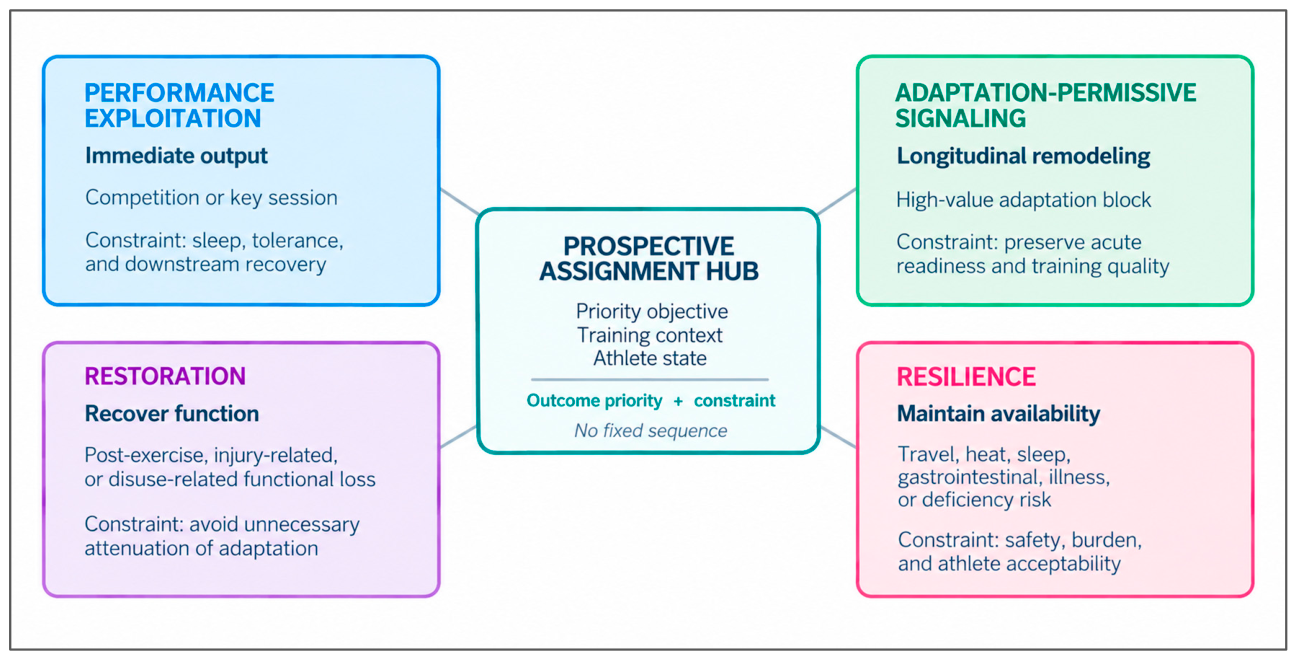
Figure 2.
NPX allocation and falsification architecture. (A) A strategy enters NPX only after satisfying safety, legality, product quality, and plausible efficacy requirements. The priority objective, training context, athlete state, product, dose, schedule, athlete-centered primary outcome, constraint thresholds, and action rule are specified before exposure. The observed pattern is classified as benefit without unacceptable constraint, benefit with a trade-off, precise neutrality/context invariance, or harm/intolerance; insufficiently precise results remain inconclusive. This classification guides retention, restriction, reassignment, pausing, withdrawal, or further testing. (B) P1–P3 test individual allocation rules using prespecified interaction or matched contrasts, whereas P4 compares a locked NPX-guided policy with standardized evidence-based use. Refutation requires an adequately precise estimate meeting the proposition-specific rule; imprecise results are inconclusive.
Figure 2.
NPX allocation and falsification architecture. (A) A strategy enters NPX only after satisfying safety, legality, product quality, and plausible efficacy requirements. The priority objective, training context, athlete state, product, dose, schedule, athlete-centered primary outcome, constraint thresholds, and action rule are specified before exposure. The observed pattern is classified as benefit without unacceptable constraint, benefit with a trade-off, precise neutrality/context invariance, or harm/intolerance; insufficiently precise results remain inconclusive. This classification guides retention, restriction, reassignment, pausing, withdrawal, or further testing. (B) P1–P3 test individual allocation rules using prespecified interaction or matched contrasts, whereas P4 compares a locked NPX-guided policy with standardized evidence-based use. Refutation requires an adequately precise estimate meeting the proposition-specific rule; imprecise results are inconclusive.
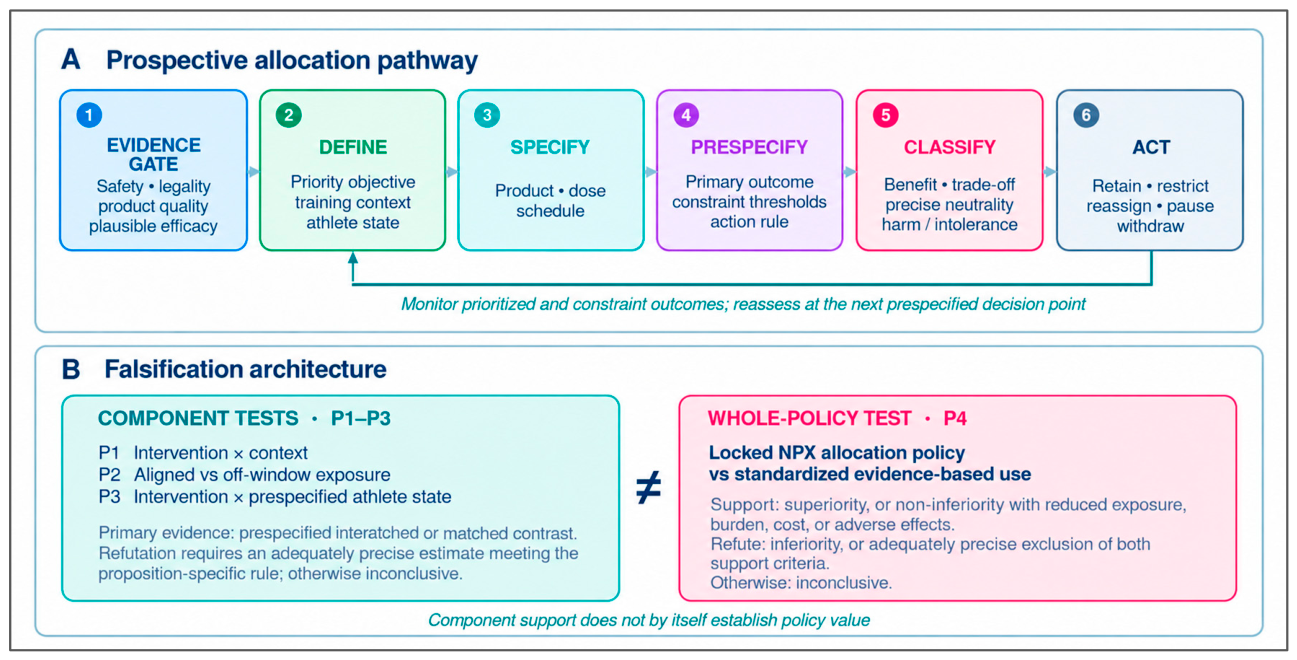

Table 1.
Construct-by-construct comparison of NPX with established evidence-based and periodized sports-nutrition practice.
Table 1.
Construct-by-construct comparison of NPX with established evidence-based and periodized sports-nutrition practice.
| Decision construct | Existing evidence-based practice | NPX formalization and prospective requirement |
Result indicating no added NPX value |
|---|---|---|---|
| Evidence eligibility | Safety, legality, product quality, formulation, and general efficacy are assessed from compound-specific evidence. | Inherited entry gate; only eligible strategies proceed to allocation. | Failure at the gate; NPX is not applied. |
| Dominant objective | Training phase and nutrition goals are commonly aligned. | One functional window and its primary endpoint are assigned before exposure; other objectives become constraints. | The intervention effect is equally useful across contexts, or assignment does not improve prediction. |
| Bottleneck | Athlete needs and deficiencies may guide practice. | A limitation or risk state is defined independently before treatment and linked to the proposed mechanism. | Benefit is equivalent, larger when the bottleneck is absent, or the proposed state cannot be measured reliably. |
| Intervention and temporal fit |
Dose and conventional timing follow product-specific guidance. | Product, formulation, dose, onset, persistence, duration, adherence, washout, and carryover are specified as one strategy. | Exposure-matched schedules are equivalent within a prespecified margin, or biological exposure is not separable. |
| Outcome hierarchy and trade-off | Performance, recovery, health, and adverse effects are evaluated, often separately. | One athlete-centered primary outcome, explicit constraint outcomes, and optional mechanistic outcomes are prespecified with decision thresholds. | The additional hierarchy does not change interpretation or action; mechanistic data add no decision value. |
| Exit and reallocation | Strategies are reviewed periodically. | Retain, restrict, shift, pause, or withdraw according to a locked rule and a change in objective or state. | A simpler fixed strategy achieves the same outcome and burden. |
| Whole-policy evaluation | Individual products are usually compared with placebo or usual practice. | A locked NPX policy is compared with standardized evidence-based use. | No superiority, and no non-inferior effectiveness with a prespecified reduction in exposure, burden, or harm. |
Note: The evidence-eligibility gate is inherited from established practice and is not an NPX innovation. NPX, Nutraceutical Periodization for eXercise.
Table 2.
Prospective assignment rubric for the four NPX functional windows.
| Window | Operational definition and required pre-exposure inputs |
Primary endpoint and principal constraints |
Deployment scale and reassignment trigger |
|---|---|---|---|
| Performance exploitation | Immediate output is the dominant objective; define task, session priority, prior exposure, tolerance, and time of day. | Task performance, decision quality, or session completion; constrain sleep, anxiety, gastrointestinal symptoms, body-mass consequences, and adverse events. | Session for acute agents; block for loading agents. Reassign when immediate output no longer dominates or costs exceed the target-task benefit. |
| Adaptation-permissive signaling | The block targets oxidative, mitochondrial, or tissue remodeling and functional loss does not threaten the next priority exposure. | Longitudinal performance or functional adaptation; mechanistic markers are supportive. Constrain excessive fatigue, injury risk, and inability to complete planned training. | Session to block. Reassign to restoration when loss of function jeopardizes the next high-value stimulus. |
| Restoration | A realized post-exercise, injury-related, or disuse-related loss of force, function, readiness, appetite, or sleep threatens the next meaningful exposure. | Recovery or preservation of function and readiness; constrain suppression of a prioritized adaptation, adverse effects, and unnecessary exposure. | Hours to days or a rehabilitation/disuse block. Exit when function is restored, loading resumes, or the next objective changes. |
| Resilience | A prespecified travel, heat, sleep, gastrointestinal, illness, or deficiency-related risk threatens training availability. | Illness or gastrointestinal burden, missed sessions, or preserved availability; constrain treatment burden, adverse effects, and unsupported class-wide inference. | Defined risk period with intervention-specific lead-in. Exit when the risk resolves; deficiency correction follows clinical and biochemical criteria. |
Note: When more than one window is plausible, the dominant window is linked to the prespecified outcome whose failure would most compromise the next high-priority objective. Other windows become constraints. Assignment must not be revised after the intervention response is observed.
Table 3.
Falsifiable propositions of the NPX framework.
| Proposition | Directional prediction | Primary estimand | Refutation rule |
|---|---|---|---|
| P1—Window/context effect modification | A fixed strategy has a meaningfully larger effect in the prospectively targeted than non-target context. | Intervention × window/context interaction contrast. | Upper confidence bound below the prespecified meaningful target-context interaction margin, including a smaller-than-meaningful, negligible, or non-target-favoring effect; an interval spanning the margin is inconclusive. |
| P2—Temporal allocation | Target-aligned exposure exceeds exposure-matched distal/off-window use by the prespecified meaningful amount without unacceptable constraints. | Aligned-versus-distal treatment contrast, with exposure separation verified. | A precise difference below the smallest effect of interest, or equal/better performance with distal timing. |
| P3—Bottleneck/state dependence | Benefit increases with an independently measured pretreatment limitation or risk state. | Intervention × baseline-state interaction. | A precise negligible/opposite interaction, or equal/larger benefit when the bottleneck is absent. |
| P4—Policy utility | A locked NPX policy is superior on the primary outcome, or non-inferior with lower exposure, burden, cost, or harm. | Treatment-policy between-policy contrast analyzed by the intention-to-treat principle; two-part non-inferiority-plus-efficiency gate when applicable. | Inferiority, or an adequately precise result excluding both the superiority threshold and non-inferiority-plus-efficiency criterion. |
Note: An imprecise nonsignificant result is inconclusive, not evidence of invariance. The smallest effect of interest, equivalence region, non-inferiority margin, and acceptable constraint thresholds must be justified before recruitment.
Disclaimer/Publisher’s Note: The statements, opinions and data contained in all publications are solely those of the individual author(s) and contributor(s) and not of MDPI and/or the editor(s). MDPI and/or the editor(s) disclaim responsibility for any injury to people or property resulting from any ideas, methods, instructions or products referred to in the content. |
© 2026 by the authors. Licensee MDPI, Basel, Switzerland. This article is an open access article distributed under the terms and conditions of the Creative Commons Attribution (CC BY) license (http://creativecommons.org/licenses/by/4.0/).
Copyright: This open access article is published under a Creative Commons CC BY 4.0 license, which permit the free download, distribution, and reuse, provided that the author and preprint are cited in any reuse.